

IEC 60934:2000
(Main)Circuit-breakers for equipment (CBE)
General Information
- Abstract
Applicable to mechanical switching devices designed as 'circuit-breakers for equipment' (CBE) intended to provide protection to circuits within electrical equipment for a.c. not exceeding 440 V and/or d.c. not exceeding 250 V, and a rated current not exceeding 125 A.
- Status
- Published
- Publication Date
- 17-Jan-2013
- Technical Committee
- SC 23E - Circuit-breakers and similar equipment for household use
- Drafting Committee
- WG 5 - TC 23/SC 23E/WG 5
- Current Stage
- DELPUB - Deleted Publication
- Start Date
- 30-Jan-2019
- Completion Date
- 28-Aug-2026
Buy Documents
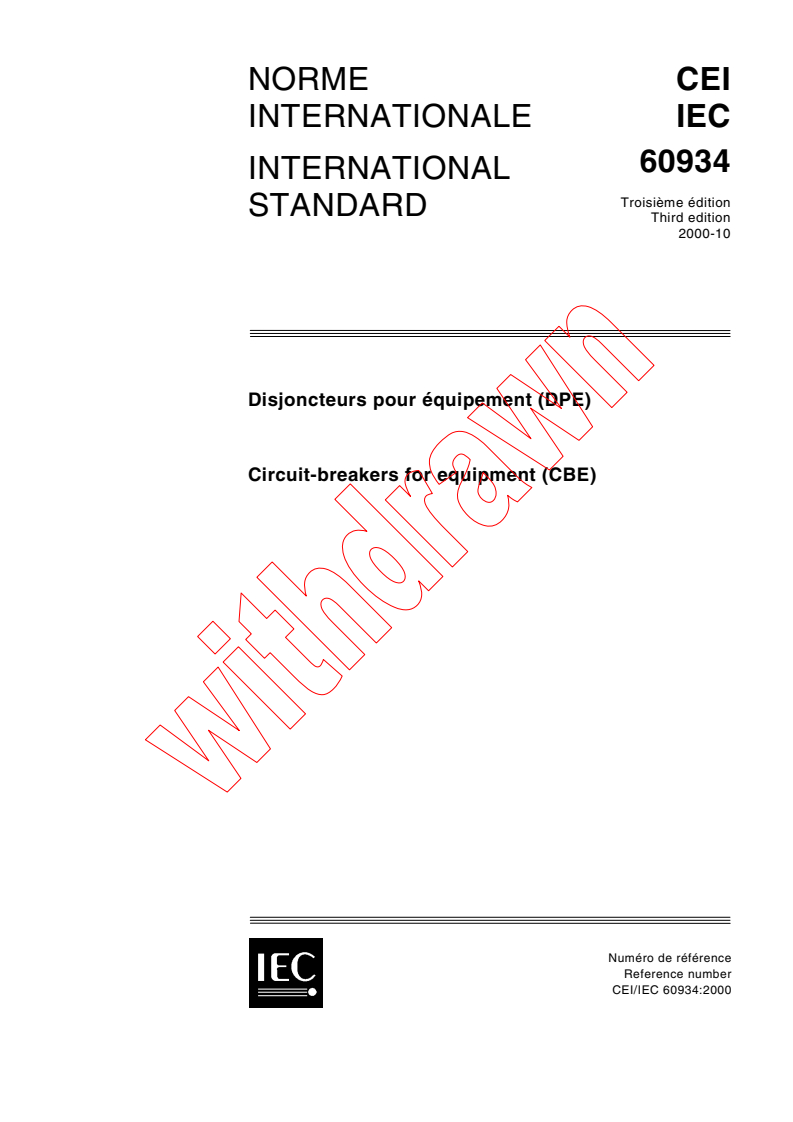
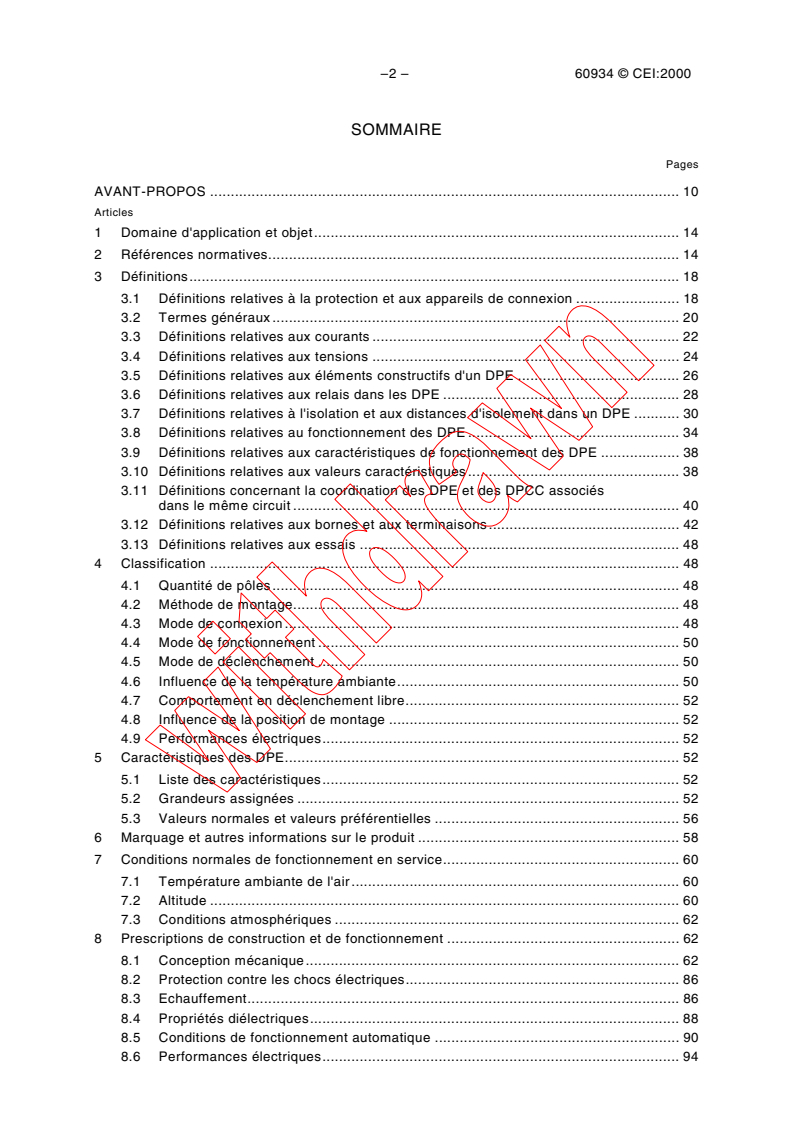
IEC 60934:2000 - Circuit-breakers for equipment (CBE) Released:10/27/2000
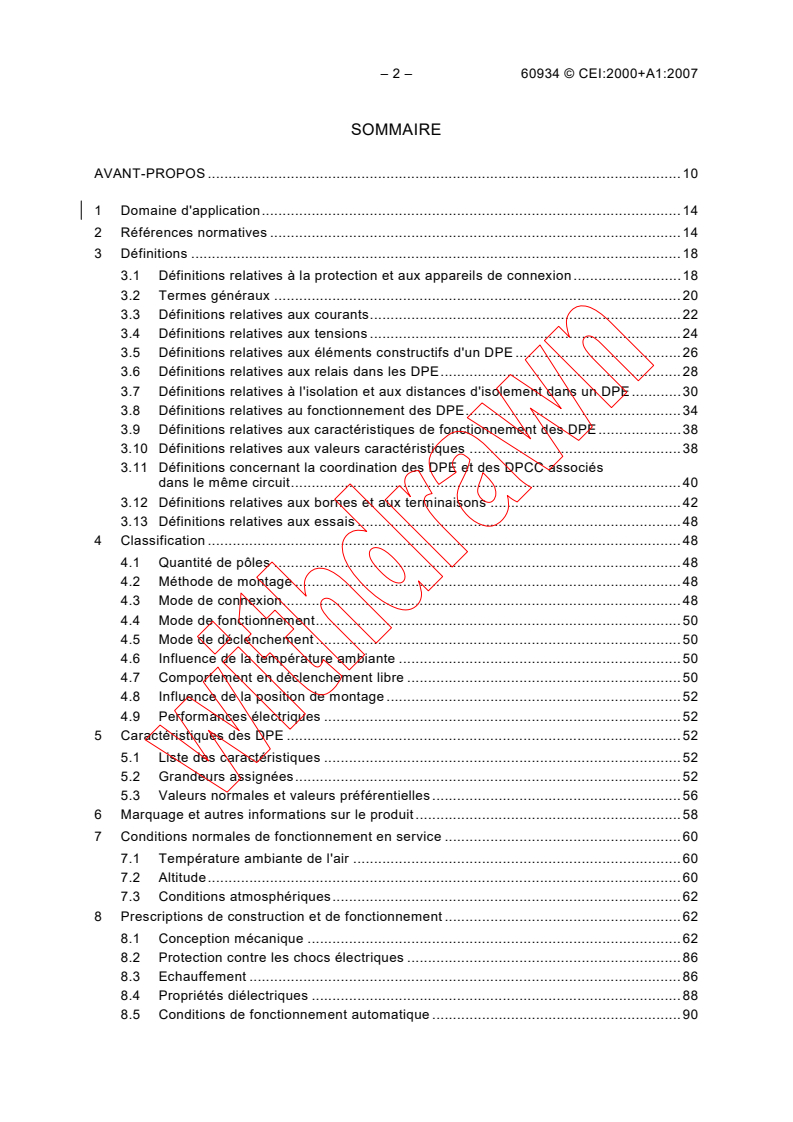
IEC 60934:2000+AMD1:2007 CSV - Circuit-breakers for equipment (CBE) Released:3/30/2007
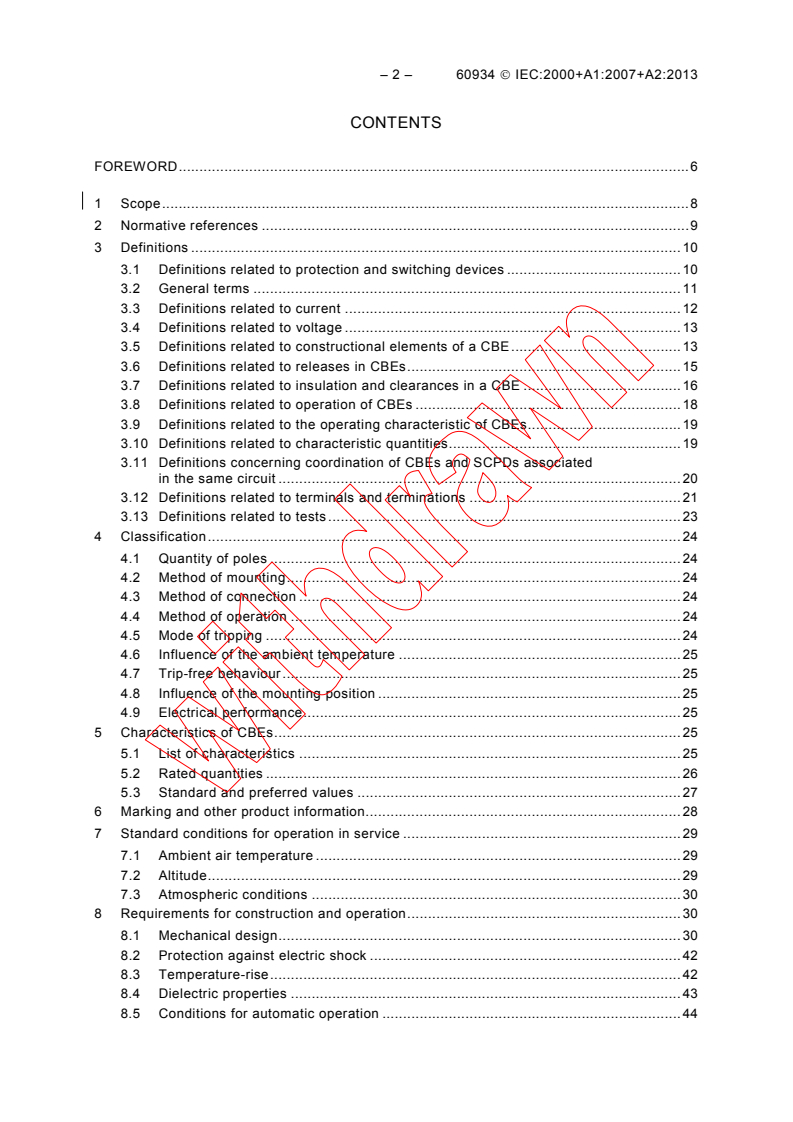
IEC 60934:2000+AMD1:2007+AMD2:2013 CSV - Circuit-breakers for equipment (CBE) Released:1/18/2013
Overview
IEC 60934:2000 specifies requirements for circuit-breakers for equipment (CBE). These are mechanical switching devices designed to protect circuits within electrical equipment operating at alternating current (a.c.) not exceeding 440 V and/or direct current (d.c.) not exceeding 250 V, with rated currents up to 125 A. The standard, published by the International Electrotechnical Commission (IEC), ensures that CBEs maintain operational reliability and safety within equipment such as appliances, motors, transformers, and internal wiring.
IEC 60934 applies to household and similar applications, establishing critical safety criteria, operational behaviors, and testing procedures. This standard does not apply to protection of building installation wiring, focusing instead on the protection and management of circuits integral to the equipment itself.
Key Topics
- Definition and Classification: IEC 60934 provides comprehensive definitions for CBEs and their associated components, including details on protected and unprotected poles, circuit characteristics, operational categories, and types of overcurrent releases.
- Operational Requirements: The standard outlines functional demands such as behavior under normal and overload conditions, short-circuit response capabilities, dielectric properties, and requirements for reliable isolation.
- Marking and Product Identification: CBEs must feature clear and durable markings for rated voltage, current, and principal characteristics to ensure proper installation and maintenance.
- Testing Documentation: Detailed procedures are defined for type tests, routine tests, and certification sequences, ensuring consistency and reproducibility of performance evaluations.
- Constructional and Safety Requirements: Criteria for mechanical design, resistance to electrical and environmental stresses (such as heat, humidity, and corrosion), and protection against electric shock are thoroughly specified.
- Environmental Considerations: Additional construction measures are encouraged for CBEs exposed to hazardous conditions, including locations with high humidity, dust, or extremes of temperature.
Applications
IEC 60934 CBEs are essential in:
- Electrical and Electronic Equipment: Providing internal circuit protection for commercial and residential appliances, industrial control panels, and other powered devices.
- Safety and Isolation: Enabling manual or automatic disconnection for maintenance and safety purposes, particularly in coordinated setups alongside Short-Circuit Protective Devices (SCPDs).
- Equipment with Variable Environmental Conditions: Utilized in products installed in locations ranging from typical domestic spaces to challenging industrial environments, with additional requirements as needed for ingress protection.
- Motor and Transformer Protection: Safeguarding key machine elements from overcurrent, overload, and fault conditions, helping extend equipment lifespan and enhance operational safety.
Related Standards
For effective implementation and conformity, IEC 60934 should be considered alongside several related standards, including:
- IEC 60529 - Degrees of protection provided by enclosures (IP Code)
- IEC 60664 - Insulation coordination for equipment within low-voltage systems
- IEC 60898 - Circuit-breakers for overcurrent protection for household and similar installations
- IEC 60269 - Low-voltage fuses
- IEC 60947-1 - Low-voltage switchgear and controlgear
- IEC 61000 series - Electromagnetic compatibility (EMC) requirements
- CISPR 22 - Radio disturbance characteristics for IT equipment
Compliance with IEC 60934 assures that CBEs are suitable for their intended protective functions, supporting safety, product reliability, and international market acceptance. Integration with the above standards supports comprehensive electrical safety and compatibility across various types of electrical equipment and environments.
Relations
- Effective Date
- 25-Aug-2026
- Effective Date
- 05-Sep-2023
- Effective Date
- 05-Sep-2023
- Effective Date
- 05-Sep-2023
- Effective Date
- 05-Sep-2023
- Effective Date
- 05-Sep-2023
Buy Documents
IEC 60934:2000 - Circuit-breakers for equipment (CBE) Released:10/27/2000
IEC 60934:2000+AMD1:2007 CSV - Circuit-breakers for equipment (CBE) Released:3/30/2007
IEC 60934:2000+AMD1:2007+AMD2:2013 CSV - Circuit-breakers for equipment (CBE) Released:1/18/2013
Get Certified
Connect with accredited certification bodies for this standard

IMQ S.p.A. (Certification)
Italian electrical product certification.

SLG Prüf- und Zertifizierungs GmbH
German testing and certification body.

UL Solutions
Global safety science company with testing, inspection and certification.
Sponsored listings
Frequently Asked Questions
IEC 60934:2000 is a standard published by the International Electrotechnical Commission (IEC). Its full title is "Circuit-breakers for equipment (CBE)". This standard covers: Applicable to mechanical switching devices designed as 'circuit-breakers for equipment' (CBE) intended to provide protection to circuits within electrical equipment for a.c. not exceeding 440 V and/or d.c. not exceeding 250 V, and a rated current not exceeding 125 A.
Applicable to mechanical switching devices designed as 'circuit-breakers for equipment' (CBE) intended to provide protection to circuits within electrical equipment for a.c. not exceeding 440 V and/or d.c. not exceeding 250 V, and a rated current not exceeding 125 A.
IEC 60934:2000 is classified under the following ICS (International Classification for Standards) categories: 29.120.40 - Switches; 29.120.50 - Fuses and other overcurrent protection devices. The ICS classification helps identify the subject area and facilitates finding related standards.
IEC 60934:2000 has the following relationships with other standards: It is inter standard links to EN 3773-006:2017, IEC 60934:2000/AMD2:2013, IEC 60934:2000/AMD1:2007, IEC 60934:1993, IEC 60934:2019, IEC 60934:1993/AMD2:1997. Understanding these relationships helps ensure you are using the most current and applicable version of the standard.
IEC 60934:2000 is available in PDF format for immediate download after purchase. The document can be added to your cart and obtained through the secure checkout process. Digital delivery ensures instant access to the complete standard document.
Standards Content (Sample)
NORME CEI
INTERNATIONALE IEC
INTERNATIONAL
Troisième édition
STANDARD
Third edition
2000-10
Disjoncteurs pour équipement (DPE)
Circuit-breakers for equipment (CBE)
Numéro de référence
Reference number
CEI/IEC 60934:2000
Numérotation des publications Publication numbering
Depuis le 1er janvier 1997, les publications de la CEI As from 1 January 1997 all IEC publications are
sont numérotées à partir de 60000. Ainsi, la CEI 34-1 issued with a designation in the 60000 series. For
devient la CEI 60034-1. example, IEC 34-1 is now referred to as IEC 60034-1.
Editions consolidées Consolidated editions
Les versions consolidées de certaines publications de la The IEC is now publishing consolidated versions of its
CEI incorporant les amendements sont disponibles. Par publications. For example, edition numbers 1.0, 1.1
exemple, les numéros d’édition 1.0, 1.1 et 1.2 indiquent and 1.2 refer, respectively, to the base publication,
respectivement la publication de base, la publication de the base publication incorporating amendment 1 and
base incorporant l’amendement 1, et la publication de the base publication incorporating amendments 1
base incorporant les amendements 1 et 2. and 2.
Informations supplémentaires Further information on IEC publications
sur les publications de la CEI
Le contenu technique des publications de la CEI est The technical content of IEC publications is kept
constamment revu par la CEI afin qu'il reflète l'état under constant review by the IEC, thus ensuring that
actuel de la technique. Des renseignements relatifs à the content reflects current technology. Information
cette publication, y compris sa validité, sont dispo- relating to this publication, including its validity, is
nibles dans le Catalogue des publications de la CEI available in the IEC Catalogue of publications
(voir ci-dessous) en plus des nouvelles éditions, (see below) in addition to new editions, amendments
amendements et corrigenda. Des informations sur les and corrigenda. Information on the subjects under
sujets à l’étude et l’avancement des travaux entrepris consideration and work in progress undertaken by the
par le comité d’études qui a élaboré cette publication, technical committee which has prepared this
ainsi que la liste des publications parues, sont publication, as well as the list of publications issued,
également disponibles par l’intermédiaire de: is also available from the following:
• Site web de la CEI (www.iec.ch) • IEC Web Site (www.iec.ch)
• Catalogue des publications de la CEI • Catalogue of IEC publications
Le catalogue en ligne sur le site web de la CEI The on-line catalogue on the IEC web site
(www.iec.ch/catlg-f.htm) vous permet de faire des (www.iec.ch/catlg-e.htm) enables you to search
recherches en utilisant de nombreux critères, by a variety of criteria including text searches,
comprenant des recherches textuelles, par comité technical committees and date of publication. On-
d’études ou date de publication. Des informations line information is also available on recently
en ligne sont également disponibles sur les issued publications, withdrawn and replaced
nouvelles publications, les publications rempla- publications, as well as corrigenda.
cées ou retirées, ainsi que sur les corrigenda.
• IEC Just Published
• IEC Just Published
Ce résumé des dernières publications parues
This summary of recently issued publications
(www.iec.ch/JP.htm) est aussi disponible par
(www.iec.ch/JP.htm) is also available by email.
courrier électronique. Veuillez prendre contact
Please contact the Customer Service Centre (see
avec le Service client (voir ci-dessous) pour plus
below) for further information.
d’informations.
• Service clients
• Customer Service Centre
Si vous avez des questions au sujet de cette
If you have any questions regarding this
publication ou avez besoin de renseignements
publication or need further assistance, please
supplémentaires, prenez contact avec le Service
contact the Customer Service Centre:
clients:
Email: custserv@iec.ch
Email: custserv@iec.ch
Tél: +41 22 919 02 11
Tel: +41 22 919 02 11
Fax: +41 22 919 03 00
Fax: +41 22 919 03 00
.
NORME CEI
INTERNATIONALE IEC
INTERNATIONAL
Troisième édition
STANDARD
Third edition
2000-10
Disjoncteurs pour équipement (DPE)
Circuit-breakers for equipment (CBE)
IEC 2000 Droits de reproduction réservés Copyright - all rights reserved
Aucune partie de cette publication ne peut être reproduite ni No part of this publication may be reproduced or utilized in
utilisée sous quelque forme que ce soit et par aucun procédé, any form or by any means, electronic or mechanical,
électronique ou mécanique, y compris la photocopie et les including photocopying and microfilm, without permission in
microfilms, sans l'accord écrit de l'éditeur. writing from the publisher.
International Electrotechnical Commission 3, rue de Varembé Geneva, Switzerland
Telefax: +41 22 919 0300 e-mail: inmail@iec.ch IEC web site http://www.iec.ch
CODE PRIX
Commission Electrotechnique Internationale
XE
PRICE CODE
International Electrotechnical Commission
Pour prix, voir catalogue en vigueur
For price, see current catalogue
– 2 – 60934 © CEI:2000
SOMMAIRE
Pages
AVANT-PROPOS . 10
Articles
1 Domaine d'application et objet. 14
2 Références normatives. 14
3 Définitions. 18
3.1 Définitions relatives à la protection et aux appareils de connexion . 18
3.2 Termes généraux . 20
3.3 Définitions relatives aux courants . 22
3.4 Définitions relatives aux tensions . 24
3.5 Définitions relatives aux éléments constructifs d'un DPE . 26
3.6 Définitions relatives aux relais dans les DPE . 28
3.7 Définitions relatives à l'isolation et aux distances d'isolement dans un DPE . 30
3.8 Définitions relatives au fonctionnement des DPE . 34
3.9 Définitions relatives aux caractéristiques de fonctionnement des DPE . 38
3.10 Définitions relatives aux valeurs caractéristiques . 38
3.11 Définitions concernant la coordination des DPE et des DPCC associés
dans le même circuit . 40
3.12 Définitions relatives aux bornes et aux terminaisons. 42
3.13 Définitions relatives aux essais . 48
4 Classification .48
4.1 Quantité de pôles. 48
4.2 Méthode de montage. 48
4.3 Mode de connexion . 48
4.4 Mode de fonctionnement . 50
4.5 Mode de déclenchement . 50
4.6 Influence de la température ambiante. 50
4.7 Comportement en déclenchement libre. 52
4.8 Influence de la position de montage . 52
4.9 Performances électriques. 52
5 Caractéristiques des DPE. 52
5.1 Liste des caractéristiques. 52
5.2 Grandeurs assignées . 52
5.3 Valeurs normales et valeurs préférentielles . 56
6 Marquage et autres informations sur le produit . 58
7 Conditions normales de fonctionnement en service. 60
7.1 Température ambiante de l'air. 60
7.2 Altitude . 60
7.3 Conditions atmosphériques . 62
8 Prescriptions de construction et de fonctionnement . 62
8.1 Conception mécanique. 62
8.2 Protection contre les chocs électriques. 86
8.3 Echauffement. 86
8.4 Propriétés diélectriques. 88
8.5 Conditions de fonctionnement automatique . 90
8.6 Performances électriques. 94
60934 IEC:2000 – 3 –
CONTENTS
Page
FOREWORD .11
Clause
1 Scope and object . 15
2 Normative references. 15
3 Definitions. 19
3.1 Definitions related to protection and switching devices. 19
3.2 General terms. 21
3.3 Definitions related to current . 23
3.4 Definitions related to voltage. 25
3.5 Definitions related to constructional elements of a CBE . 27
3.6 Definitions related to releases in CBEs . 29
3.7 Definitions related to insulation and clearances in a CBE. 31
3.8 Definitions related to operation of CBEs. 35
3.9 Definitions related to the operating characteristic of CBEs . 39
3.10 Definitions related to characteristic quantities . 39
3.11 Definitions concerning coordination of CBEs and SCPDs associated
in the same circuit. 41
3.12 Definitions related to terminals and terminations. 43
3.13 Definitions related to tests . 49
4 Classification .49
4.1 Quantity of poles. 49
4.2 Method of mounting . 49
4.3 Method of connection. 49
4.4 Method of operation. 51
4.5 Mode of tripping. 51
4.6 Influence of the ambient temperature. 51
4.7 Trip-free behaviour . 53
4.8 Influence of the mounting position. 53
4.9 Electrical performance . 53
5 Characteristics of CBEs . 53
5.1 List of characteristics . 53
5.2 Rated quantities. 53
5.3 Standard and preferred values. 57
6 Marking and other product information . 59
7 Standard conditions for operation in service. 61
7.1 Ambient air temperature . 61
7.2 Altitude . 61
7.3 Atmospheric conditions. 63
8 Requirements for construction and operation . 63
8.1 Mechanical design . 63
8.2 Protection against electric shock. 87
8.3 Temperature-rise . 87
8.4 Dielectric properties. 89
8.5 Conditions for automatic operation. 91
8.6 Electrical performance . 95
– 4 – 60934 © CEI:2000
Articles Pages
8.7 Performances dans les conditions de courant conditionnel de court-circuit. 94
8.8 Résistance aux secousses et aux chocs mécaniques . 94
8.9 Résistance à la chaleur . 94
8.10 Résistance à la chaleur anormale et au feu . 94
8.11 Résistance aux courants de cheminement. 94
8.12 Résistance à la rouille . 96
9 Essais. 98
9.1 Essais de type et séquences d'essai . 98
9.2 Conditions d'essai . 100
9.3 Essai de l'indélébilité du marquage. 102
9.4 Essai de sûreté des bornes, parties conduisant le courant et connexions. 102
9.5 Essai de la sûreté des bornes pour conducteurs externes (voir 3.12.15) . 108
9.6 Essai pour la protection contre les chocs électriques . 112
9.7 Essai des propriétés diélectriques . 112
9.8 Essai d'échauffement . 120
9.9 Essai de 28 jours . 122
9.10 Essai de la caractéristique de déclenchement . 122
9.11 Vérification des performances électriques . 124
9.12 Essais au courant conditionnel de court-circuit . 132
9.13 Essai de résistance aux secousses et aux chocs mécaniques . 138
9.14 Essai de résistance à la chaleur . 138
9.15 Résistance à la chaleur anormale et au feu . 140
9.16 Essai de résistance aux courants de cheminement. 140
9.17 Essai de résistance à la rouille . 142
Annexe A (normative) Zone temps-courant . 154
Annexe B (normative) Détermination des distances d'isolement dans l'air et
des lignes de fuite . 156
Annexe C (normative) Séquences d'essais et nombre d'échantillons à essayer en vue
de la certification . 160
Annexe D (normative) Correspondance entre les conducteurs cuivre ISO et AWG. 166
Annexe E (normative) Exemples de bornes. 168
Annexe F (informative) Coordination entre DPE et DPCC associés dans le même circuit. 186
Annexe G (normative) Comportement électromagnétique des DPE . 212
Annexe H (normative) Corrélation entre la tension nominale du système d'alimentation et
la tension phase-neutre correspondante pour déterminer la tension de choc assignée. 216
Annexe J (normative) Essais individuels ou statistiques . 218
Annexe K (normative) Spécifications additionnelles pour les performances électriques
des interrupteurs-DPE . 222
Bibliographie . 224
60934 IEC:2000 – 5 –
Clause Page
8.7 Performance under conditional short-circuit current conditions. 95
8.8 Resistance to mechanical shock and impact . 95
8.9 Resistance to heat . 95
8.10 Resistance to abnormal heat and to fire. 95
8.11 Resistance to tracking . 95
8.12 Resistance to rusting . 97
9 Tests . 99
9.1 Type tests and sequences . 99
9.2 Test conditions . 101
9.3 Test of indelibility of marking . 103
9.4 Test of reliability of terminals, current-carrying parts and connections. 103
9.5 Test of reliability of terminals for external conductors (see 3.12.15) . 109
9.6 Test of protection against electric shock . 113
9.7 Test of dielectric properties. 113
9.8 Test of temperature-rise. 121
9.9 28-day test. 123
9.10 Test of tripping characteristics . 123
9.11 Verification of electrical operational capability. 125
9.12 Conditional short-circuit tests. 133
9.13 Test of resistance to mechanical shock and impact. 139
9.14 Tests of resistance to heat. 139
9.15 Test of resistance to abnormal heat and to fire . 141
9.16 Test of resistance to tracking . 141
9.17 Test of resistance to rusting. 143
Annex A (normative) Time-current zone . 155
Annex B (normative) Determination of clearances and creepage distances . 157
Annex C (normative) Test sequences and number of samples to be submitted
for certification purposes . 161
Annex D (normative) Correspondence between ISO and AWG copper conductors. 167
Annex E (normative) Examples of terminals . 169
Annex F (informative) Coordination between a CBE and a short-circuit protective
device (SCPD) associated in the same circuit. 187
Annex G (normative) Electromagnetic behaviour of CBEs . 213
Annex H (normative) Correlation between nominal voltage of the supply systems and
the line-to-neutral voltage relevant for determining the rated impulse voltage. 217
Annex J (normative) Routine or statistical tests . 219
Annex K (normative) Additional requirements for electrical performance
of CBE-switches.223
Bibliography . 225
– 6 – 60934 © CEI:2000
Pages
Figure 1 – Vis autotaraudeuse par déformation . 144
Figure 2 – Vis autotaraudeuse avec découpe . 144
Figures 3 à 6 – Circuits d'essai pour essais de surintensité. 146
Figure 7 – Doigt d'épreuve. 148
Figure 8 – Appareil pour l'essai à la bille . 150
Figure 9 – Dispositions et dimensions des électrodes pour l'essai de résistance
aux courants de cheminement . 150
Figures 10 à 13 – Circuits d'essai pour la vérification du courant conditionnel
en court-circuit . 152
Figures A.1 à A.4. 154
Figures B.1 à B.10. 158
Figure E.1 – Exemples de bornes à trou . 168
Figure E.2 – Exemples de bornes à serrage sous tête de vis et bornes à goujon fileté. 170
Figure E.3 – Exemples de bornes à plaquette . 172
Figure E.4 – Exemples de bornes pour cosses et barrettes . 172
Figure E.5 – Exemples de dispositifs de connexion sans vis. 174
Figure E.6 – Dimensions des languettes . 176
Figure E.7 – Dimensions de l'empreinte sphérique du dispositif de verrouillage
des languettes . 178
Figure E.8 – Dimensions de l'empreinte rectangulaire du dispositif de verrouillage
des languettes . 178
Figure E.9 – Dimensions du trou du dispositif de verrouillage des languettes. 178
Figure E.10 – Dimensions des languettes . 180
Figure E.11 – Dimensions des languettes . 180
Figure E.12 – Dimensions des languettes . 180
Figure E.13 – Dimension des languettes acceptant deux tailles différentes de clips . 182
Figure E.14 – Dimensions des clips pour languettes. 184
Figure F.1 – DPE thermique uniquement, accompagné d'un disjoncteur
magnéto-thermique. 198
Figure F.2 – DPE thermique uniquement accompagné d'un fusible. 200
Figure F.3 – DPE magnéto-thermique accompagné d'un disjoncteur magnéto-thermique. 202
Figure F.4 – DPE magnéto-hydraulique accompagné d'un disjoncteur magnéto-thermique . 204
Figure F.5 – DPE thermique accompagné d'un disjoncteur magnéto-hydraulique. 204
Figure F.6 – DPE limiteur, accompagné d'un disjoncteur magnéto-thermique . 206
Figure F.7 – DPE limiteur accompagné d'un fusible. 208
Figure F.8 – Exemples illustrant des coordinations correctes et incorrectes. 210
Tableau 1 – Distances d'isolement minimales pour l'isolation principale et
l'isolation renforcée . 66
Tableau 2 – Lignes de fuite minimales . 70
Tableau 3 – Sections raccordables de conducteurs externes en cuivre pour les bornes
à vis et sans vis. 74
60934 IEC:2000 – 7 –
Page
Figure 1 – Thread-forming screw. 145
Figure 2 – Thread-cutting screw . 145
Figures 3 to 6 – Test circuits for overcurrent tests . 147
Figure 7 – Standard test finger . 149
Figure 8 – Ball pressure apparatus. 151
Figure 9 – Arrangements and dimensions of the electrodes for the tracking test . 151
Figures 10 to 13 – Test circuits for verification of the conditional short-circuit current. 153
Figures A.1 to A.4 .155
Figures B.1 to B.10 . 159
Figure E.1 – Examples of pillar terminals . 169
Figure E.2 – Examples of screw terminals and stud terminals. 171
Figure E.3 – Examples of saddle terminals. 173
Figure E.4 – Examples of lug terminals . 173
Figure E.5 – Examples of screwless terminals with clamping means . 175
Figure E.6 – Dimensions of male tabs . 177
Figure E.7 – Dimensions of round dimple detents of male tabs (see figure E.6). 179
Figure E.8 – Dimensions of rectangular dimple detents of male tabs . 179
Figure E.9 – Dimensions of hole detents of male tabs . 179
Figure E.10 – Dimensions of male tabs . 181
Figure E.11 – Dimensions of male tabs . 181
Figure E.12 – Dimensions of male tabs . 181
Figure E.13 – Dimensions of male tabs for two different sizes of female connectors . 183
Figure E.14 – Dimensions of female connectors for male tabs. 185
Figure F.1 – Thermal only CBE, backed up by thermal magnetic circuit-breaker. 199
Figure F.2 – Thermal only CBE, backed up by a fuse . 201
Figure F.3 – Thermal-magnetic CBE backed up by thermal-magnetic circuit-breaker. 203
Figure F.4 – Hydraulic-magnetic CBE backed up by thermal-magnetic circuit-breaker . 205
Figure F.5 – Thermal CBE backed up by a hydraulic-magnetic circuit-breaker. 205
Figure F.6 – Energy-limiting CBE, backed up by thermal-magnetic circuit-breaker. 207
Figure F.7 – Energy-limiting CBE, backed up by a fuse . 209
Figure F.8 – Examples illustrating proper and improper coordination. 211
Table 1 – Minimum clearances for basic and reinforced insulation. 67
Table 2 – Minimum creepage distances. 71
Table 3 – Connectable cross-sectional areas of external copper conductors
for screw type and screwless terminals . 75
– 8 – 60934 © CEI:2000
Pages
Tableau 4 – Distance minimale entre la vis de serrage et l'extrémité du conducteur
introduit à fond . 78
Tableau 5 – Dimensions des languettes en millimètres –
Dimensions A, B, C, D, E, F, J, M, N, P et Q . 82
Tableau 6 – Dimensions des languettes en millimètres –
Dimensions H, I, T, K, R, G, L, S et U . 84
Tableau 7 – Dimensions des languettes combinées acceptant deux tailles différentes
de clips. 84
Tableau 8 – Valeurs d'échauffement des DPE pour des températures ambiantes de l'air
de référence différentes (T) . 88
Tableau 9 – Caractéristiques de fonctionnement temps-courant . 90
Tableau 10 – Limites de fonctionnement des déclencheurs à manque de tension et
à tension zéro (pour courants alternatif et continu) . 92
Tableau 11 – Conditions d'essai pour les performances électriques des DPE destinés à
un usage général, circuits inductifs inclus . 96
Tableau 12 – Conditions d'essai pour les performances électriques des DPE utilisés
seulement dans des circuits essentiellement résistifs. 98
Tableau 13 – Liste des essais de type. 98
Tableau 14 – Sections normales de conducteurs en cuivre correspondant
aux courants assignés . 100
Tableau 15 – Diamètre des filetages et couples à appliquer . 104
Tableau 16 – Forces d'insertion et de retrait . 106
Tableau 17 – Forces de traction et de poussée . 108
Tableau 18 – Forces de traction. 110
Tableau 19 – Composition des conducteurs pour l'essai de 9.5.3 . 110
Tableau 20 – Tensions d'essai. 116
Tableau 21 – Ondes de tension pour la vérification de la coordination de l'isolement . 120
Tableau 22 – Facteur de puissance et constante de temps du circuit d'essai . 132
Tableau C.1 – Séquences d'essais . 160
Tableau C.2 – Nombre d'échantillons pour la procédure d'essai complète . 162
Tableau C.3 – Nombre réduit d'échantillons pour la procédure d'essai simplifiée . 164
Tableau D.1 – Correspondance entre sections des conducteurs ISO et AWG . 166
Tableau G.2.2 – Performances d'immunité minimales en CEM des DPE. 214
Tableau H.1 – Tensions nominales et tensions de choc assignées . 216
60934 IEC:2000 – 9 –
Page
Table 4 – Minimum distance between clamping screw and the end of conductor
when fully inserted . 79
Table 5 – Dimensions of tabs in millimetres –
Dimensions A, B, C, D, E, F, J, M, N, P and Q. 83
Table 6 – Dimensions of tabs in millimetres –
Dimensions H, I, T, K, R, G, L, S and U. 85
Table 7 – Dimensions in millimetres of combined male tabs for two different sizes
of female connectors .85
Table 8 – Temperature-rise values for CBEs for different reference
ambient air temperatures (T) . 89
Table 9 – Time-current operating characteristics . 91
Table 10 – Operating limits of undervoltage and zero-voltage releases (for a.c. and d.c.). 93
Table 11 – Test conditions for electrical performance for CBEs intended for general use,
including inductive circuits.97
Table 12 – Test conditions for electrical performance of CBEs used in essentially
resistive circuits only. 99
Table 13 – List of type tests . 99
Table 14 – Standard cross-sections of copper conductors corresponding to
the rated currents. 101
Table 15 – Screw-thread diameter and applied torques . 105
Table 16 – Insertion and withdrawal forces. 107
Table 17 – Push/pull force. 109
Table 18 – Pulling forces. 111
Table 19 – Make-up of conductors for the test of 9.5.3 . 111
Table 20 – Test voltages . 117
Table 21 – Impulse withstand test voltages for verification of insulation coordination . 121
Table 22 – Power factor and time constant of test circuit. 133
Table C.1 – Test sequences. 161
Table C.2 – Number of samples for full test procedure . 163
Table C.3 – Reduction of samples for simplified test procedure. 165
Table D.1 – Correspondence between ISO and AWG conductor cross-sections . 167
Table G.2.2 – Minimum EMC immunity performances of CBEs . 215
Table H.1 – Nominal voltages and corresponding rated impulse voltages . 217
– 10 – 60934 © CEI:2000
COMMISSION ÉLECTROTECHNIQUE INTERNATIONALE
____________
DISJONCTEURS POUR ÉQUIPEMENT (DPE)
AVANT-PROPOS
1) La CEI (Commission Électrotechnique Internationale) est une organisation mondiale de normalisation composée
de l'ensemble des comités électrotechniques nationaux (Comités nationaux de la CEI). La CEI a pour objet de
favoriser la coopération internationale pour toutes les questions de normalisation dans les domaines de
l'électricité et de l'électronique. A cet effet, la CEI, entre autres activités, publie des Normes internationales.
Leur élaboration est confiée à des comités d'études, aux travaux desquels tout Comité national intéressé par le
sujet traité peut participer. Les organisations internationales, gouvernementales et non gouvernementales, en
liaison avec la CEI, participent également aux travaux. La CEI collabore étroitement avec l'Organisation
Internationale de Normalisation (ISO), selon des conditions fixées par accord entre les deux organisations.
2) Les décisions ou accords officiels de la CEI concernant les questions techniques représentent, dans la mesure
du possible, un accord international sur les sujets étudiés, étant donné que les Comités nationaux intéressés
sont représentés dans chaque comité d’études.
3) Les documents produits se présentent sous la forme de recommandations internationales. Ils sont publiés
comme normes, spécifications techniques, rapports techniques ou guides et agréés comme tels par les Comités
nationaux.
4) Dans le but d'encourager l'unification internationale, les Comités nationaux de la CEI s'engagent à appliquer de
façon transparente, dans toute la mesure possible, les Normes internationales de la CEI dans leurs normes
nationales et régionales. Toute divergence entre la norme de la CEI et la norme nationale ou régionale
correspondante doit être indiquée en termes clairs dans cette dernière.
5) La CEI n’a fixé aucune procédure concernant le marquage comme indication d’approbation et sa responsabilité
n’est pas engagée quand un matériel est déclaré conforme à l’une de ses normes.
6) L’attention est attirée sur le fait que certains des éléments de la présente Norme internationale peuvent faire
l’objet de droits de propriété intellectuelle ou de droits analogues. La CEI ne saurait être tenue pour
responsable de ne pas avoir identifié de tels droits de propriété et de ne pas avoir signalé leur existence.
La Norme internationale CEI 60934 a été établie par le sous-comité 23E: Disjoncteurs et
appareillage similaire pour usage domestique, du comité d'études 23 de la CEI: Petit
appareillage.
Cette troisième édition annule et remplace la deuxième édition, parue en 1993, l'amendement 1
(1994) et l'amendement 2 (1997) et constitue une révision technique.
Le texte de cette norme est issu des documents suivants:
FDIS Rapport de vote
23E/430/FDIS 23E/441/RVD
Le rapport de vote indiqué dans le tableau ci-dessus donne toute information sur le vote ayant
abouti à l'approbation de cette norme.
Cette publication a été rédigée selon les Directives ISO/CEI, Partie 3.
Les annexes A, B, C, D, E, G, H, J et K font partie intégrante de cette norme.
L'annexe F est donnée uniquement à titre d'information.
60934 IEC:2000 – 11 –
INTERNATIONAL ELECTROTECHNICAL COMMISSION
___________
CIRCUIT-BREAKERS FOR EQUIPMENT (CBE)
FOREWORD
1) The IEC (International Electrotechnical Commission) is a worldwide organization for standardization comprising
all national electrotechnical committees (IEC National Committees). The object of the IEC is to promote
international co-operation on all questions concerning standardization in the electrical and electronic fields. To
this end and in addition to other activities, the IEC publishes International Standards. Their preparation is
entrusted to technical committees; any IEC National Committee interested in the subject dealt with may
participate in this preparatory work. International, governmental and non-government
...
NORME CEI
INTERNATIONALE
IEC
INTERNATIONAL
Edition 3.1
STANDARD
2007-03
Edition 3:2000 consolidée par l'amendement 1:2007
Edition 3:2000 consolidated with amendment 1:2007
Disjoncteurs pour équipement (DPE)
Circuit-breakers for equipment (CBE)
Numéro de référence
Reference number
CEI/IEC 60934:2000+A1:2007
Numérotation des publications Publication numbering
Depuis le 1er janvier 1997, les publications de la CEI As from 1 January 1997 all IEC publications are
sont numérotées à partir de 60000. Ainsi, la CEI 34-1 issued with a designation in the 60000 series. For
devient la CEI 60034-1. example, IEC 34-1 is now referred to as IEC 60034-1.
Editions consolidées Consolidated editions
Les versions consolidées de certaines publications de la The IEC is now publishing consolidated versions of its
CEI incorporant les amendements sont disponibles. Par publications. For example, edition numbers 1.0, 1.1
exemple, les numéros d’édition 1.0, 1.1 et 1.2 indiquent and 1.2 refer, respectively, to the base publication,
respectivement la publication de base, la publication de the base publication incorporating amendment 1 and
base incorporant l’amendement 1, et la publication de the base publication incorporating amendments 1
base incorporant les amendements 1 et 2. and 2.
Informations supplémentaires Further information on IEC publications
sur les publications de la CEI
Le contenu technique des publications de la CEI est The technical content of IEC publications is kept
constamment revu par la CEI afin qu'il reflète l'état under constant review by the IEC, thus ensuring that
actuel de la technique. Des renseignements relatifs à the content reflects current technology. Information
cette publication, y compris sa validité, sont dispo- relating to this publication, including its validity, is
nibles dans le Catalogue des publications de la CEI available in the IEC Catalogue of publications
(voir ci-dessous) en plus des nouvelles éditions, (see below) in addition to new editions, amendments
amendements et corrigenda. Des informations sur les and corrigenda. Information on the subjects under
sujets à l’étude et l’avancement des travaux entrepris consideration and work in progress undertaken by the
par le comité d’études qui a élaboré cette publication, technical committee which has prepared this
ainsi que la liste des publications parues, sont publication, as well as the list of publications issued,
également disponibles par l’intermédiaire de: is also available from the following:
• Site web de la CEI (www.iec.ch) • IEC Web Site (www.iec.ch)
• Catalogue des publications de la CEI • Catalogue of IEC publications
Le catalogue en ligne sur le site web de la CEI The on-line catalogue on the IEC web site
(www.iec.ch/searchpub) vous permet de faire des (www.iec.ch/searchpub) enables you to search by a
recherches en utilisant de nombreux critères, variety of criteria including text searches,
comprenant des recherches textuelles, par comité technical committees and date of publication. On-
d’études ou date de publication. Des informations en line information is also available on recently
ligne sont également disponibles sur les nouvelles issued publications, withdrawn and replaced
publications, les publications remplacées ou retirées, publications, as well as corrigenda.
ainsi que sur les corrigenda.
• IEC Just Published • IEC Just Published
Ce résumé des dernières publications parues This summary of recently issued publications
(www.iec.ch/online_news/justpub) est aussi dispo- (www.iec.ch/online_news/justpub) is also available
nible par courrier électronique. Veuillez prendre by email. Please contact the Customer Service
contact avec le Service client (voir ci-dessous) Centre (see below) for further information.
pour plus d’informations.
• Service clients • Customer Service Centre
Si vous avez des questions au sujet de cette If you have any questions regarding this
publication ou avez besoin de renseignements publication or need further assistance, please
supplémentaires, prenez contact avec le Service contact the Customer Service Centre:
clients:
Email: custserv@iec.ch Email: custserv@iec.ch
Tél: +41 22 919 02 11 Tel: +41 22 919 02 11
Fax: +41 22 919 03 00 Fax: +41 22 919 03 00
.
NORME CEI
INTERNATIONALE
IEC
INTERNATIONAL
Edition 3.1
STANDARD
2007-03
Edition 3:2000 consolidée par l'amendement 1:2007
Edition 3:2000 consolidated with amendment 1:2007
Disjoncteurs pour équipement (DPE)
Circuit-breakers for equipment (CBE)
© IEC 2007 Droits de reproduction réservés ⎯ Copyright - all rights reserved
Aucune partie de cette publication ne peut être reproduite ni No part of this publication may be reproduced or utilized in any
utilisée sous quelque forme que ce soit et par aucun procédé, form or by any means, electronic or mechanical, including
électronique ou mécanique, y compris la photocopie et les photocopying and microfilm, without permission in writing from
microfilms, sans l'accord écrit de l'éditeur. the publisher.
International Electrotechnical Commission, 3, rue de Varembé, PO Box 131, CH-1211 Geneva 20, Switzerland
Telephone: +41 22 919 02 11 Telefax: +41 22 919 03 00 E-mail: inmail@iec.ch Web: www.iec.ch
CODE PRIX
CS
Commission Electrotechnique Internationale
PRICE CODE
International Electrotechnical Commission
МеждународнаяЭлектротехническаяКомиссия
Pour prix, voir catalogue en vigueur
For price, see current catalogue
– 2 – 60934 © CEI:2000+A1:2007
SOMMAIRE
AVANT-PROPOS . 10
1 Domaine d'application . 14
2 Références normatives . 14
3 Définitions . 18
3.1 Définitions relatives à la protection et aux appareils de connexion . 18
3.2 Termes généraux . 20
3.3 Définitions relatives aux courants . 22
3.4 Définitions relatives aux tensions . 24
3.5 Définitions relatives aux éléments constructifs d'un DPE . 26
3.6 Définitions relatives aux relais dans les DPE . 28
3.7 Définitions relatives à l'isolation et aux distances d'isolement dans un DPE . 30
3.8 Définitions relatives au fonctionnement des DPE . 34
3.9 Définitions relatives aux caractéristiques de fonctionnement des DPE . 38
3.10 Définitions relatives aux valeurs caractéristiques . 38
3.11 Définitions concernant la coordination des DPE et des DPCC associés
dans le même circuit . 40
3.12 Définitions relatives aux bornes et aux terminaisons . 42
3.13 Définitions relatives aux essais . 48
4 Classification . 48
4.1 Quantité de pôles . 48
4.2 Méthode de montage . 48
4.3 Mode de connexion . 48
4.4 Mode de fonctionnement . 50
4.5 Mode de déclenchement . 50
4.6 Influence de la température ambiante . 50
4.7 Comportement en déclenchement libre . 50
4.8 Influence de la position de montage . 52
4.9 Performances électriques . 52
5 Caractéristiques des DPE . 52
5.1 Liste des caractéristiques . 52
5.2 Grandeurs assignées . 52
5.3 Valeurs normales et valeurs préférentielles . 56
6 Marquage et autres informations sur le produit . 58
7 Conditions normales de fonctionnement en service . 60
7.1 Température ambiante de l'air . 60
7.2 Altitude . 60
7.3 Conditions atmosphériques . 62
8 Prescriptions de construction et de fonctionnement . 62
8.1 Conception mécanique . 62
8.2 Protection contre les chocs électriques . 86
8.3 Echauffement . 86
8.4 Propriétés diélectriques . 88
8.5 Conditions de fonctionnement automatique . 90
60934 IEC:2000+A1:2007 – 3 –
CONTENTS
FOREWORD . 11
1 Scope . 15
2 Normative references . 15
3 Definitions . 19
3.1 Definitions related to protection and switching devices . 19
3.2 General terms . 21
3.3 Definitions related to current . 23
3.4 Definitions related to voltage . 25
3.5 Definitions related to constructional elements of a CBE . 27
3.6 Definitions related to releases in CBEs . 29
3.7 Definitions related to insulation and clearances in a CBE . 31
3.8 Definitions related to operation of CBEs . 35
3.9 Definitions related to the operating characteristic of CBEs. 39
3.10 Definitions related to characteristic quantities . 39
3.11 Definitions concerning coordination of CBEs and SCPDs associated
in the same circuit . 41
3.12 Definitions related to terminals and terminations . 43
3.13 Definitions related to tests . 49
4 Classification . 49
4.1 Quantity of poles . 49
4.2 Method of mounting . 49
4.3 Method of connection . 49
4.4 Method of operation . 51
4.5 Mode of tripping . 51
4.6 Influence of the ambient temperature . 51
4.7 Trip-free behaviour . 51
4.8 Influence of the mounting position . 53
4.9 Electrical performance . 53
5 Characteristics of CBEs . 53
5.1 List of characteristics . 53
5.2 Rated quantities . 53
5.3 Standard and preferred values . 57
6 Marking and other product information. 59
7 Standard conditions for operation in service . 61
7.1 Ambient air temperature . 61
7.2 Altitude . 61
7.3 Atmospheric conditions . 63
8 Requirements for construction and operation . 63
8.1 Mechanical design . 63
8.2 Protection against electric shock . 87
8.3 Temperature-rise . 87
8.4 Dielectric properties . 89
8.5 Conditions for automatic operation . 91
– 4 – 60934 © CEI:2000+A1:2007
8.6 Performances électriques . 94
8.7 Performances dans les conditions de courant conditionnel de court-circuit . 94
8.8 Résistance aux secousses et aux chocs mécaniques . 94
8.9 Résistance à la chaleur. 94
8.10 Résistance à la chaleur anormale et au feu . 94
8.11 Résistance aux courants de cheminement . 94
8.12 Résistance à la rouille. 96
9 Essais . 98
9.1 Essais de type et séquences d'essai . 98
9.2 Conditions d'essai . 100
9.3 Essai de l'indélébilité du marquage . 102
9.4 Essai de sûreté des bornes, parties conduisant le courant et connexions . 102
9.5 Essai de la sûreté des bornes pour conducteurs externes (voir 3.12.15) . 108
9.6 Essai pour la protection contre les chocs électriques . 112
9.7 Essai des propriétés diélectriques . 112
9.8 Essai d'échauffement . 120
9.9 Essai de 28 jours . 122
9.10 Essai de la caractéristique de déclenchement . 122
9.11 Vérification des performances électriques . 124
9.12 Essais au courant conditionnel de court-circuit . 132
9.13 Essai de résistance aux secousses et aux chocs mécaniques . 138
9.14 Essai de résistance à la chaleur . 138
9.15 Résistance à la chaleur anormale et au feu . 140
9.16 Essai de résistance aux courants de cheminement . 140
9.17 Essai de résistance à la rouille . 142
Annexe A (normative) Zone temps-courant . 154
Annexe B (normative) Détermination des distances d'isolement dans l'air et
des lignes de fuite . 156
Annexe C (normative) Séquences d'essais et nombre d'échantillons à essayer en vue
de la certification . 160
Annexe D (normative) Correspondance entre les conducteurs cuivre ISO et AWG . 166
Annexe E (normative) Exemples de bornes . 168
Annexe F (informative) Coordination entre DPE et DPCC associés dans le même circuit . 186
Annexe G (normative) Comportement électromagnétique des DPE . 212
Annexe H (normative) Corrélation entre la tension nominale du système d'alimentation et
la tension phase-neutre correspondante pour déterminer la tension de choc assignée . 216
Annexe J (normative) Essais individuels ou statistiques . 218
Annexe K (normative) Prescriptions supplémentaires pour les performances électriques
des DPE de type E . 222
Annexe L (normative) Prescriptions supplémentaires pour les DPE
aptes au sectionnement . 224
Bibliographie . 232
60934 IEC:2000+A1:2007 – 5 –
8.6 Electrical performance . 95
8.7 Performance under conditional short-circuit current conditions . 95
8.8 Resistance to mechanical shock and impact . 95
8.9 Resistance to heat . 95
8.10 Resistance to abnormal heat and to fire . 95
8.11 Resistance to tracking . 95
8.12 Resistance to rusting . 97
9 Tests . 99
9.1 Type tests and sequences . 99
9.2 Test conditions . 101
9.3 Test of indelibility of marking . 103
9.4 Test of reliability of terminals, current-carrying parts and connections . 103
9.5 Test of reliability of terminals for external conductors (see 3.12.15) . 109
9.6 Test of protection against electric shock . 113
9.7 Test of dielectric properties . 113
9.8 Test of temperature-rise . 121
9.9 28-day test . 123
9.10 Test of tripping characteristics . 123
9.11 Verification of electrical operational capability . 125
9.12 Conditional short-circuit tests . 133
9.13 Test of resistance to mechanical shock and impact . 139
9.14 Tests of resistance to heat . 139
9.15 Test of resistance to abnormal heat and to fire . 141
9.16 Test of resistance to tracking. 141
9.17 Test of resistance to rusting . 143
Annex A (normative) Time-current zone . 155
Annex B (normative) Determination of clearances and creepage distances . 157
Annex C (normative) Test sequences and number of samples to be submitted
for certification purposes. 161
Annex D (normative) Correspondence between ISO and AWG copper conductors . 167
Annex E (normative) Examples of terminals . 169
Annex F (informative) Coordination between a CBE and a short-circuit protective
device (SCPD) associated in the same circuit . 187
Annex G (normative) Electromagnetic behaviour of CBEs . 213
Annex H (normative) Correlation between nominal voltage of the supply systems and
the line-to-neutral voltage relevant for determining the rated impulse voltage . 217
Annex J (normative) Routine or statistical tests . 219
Annex K (normative) Additional requirements for electrical performance
of E-type CBEs . 223
Annex L (normative) Additional requirements for CBEs suitable for isolation . 225
Bibliography . 233
– 6 – 60934 © CEI:2000+A1:2007
Figure 1 – Vis autotaraudeuse par déformation . 144
Figure 2 – Vis autotaraudeuse avec découpe. 144
Figures 3 à 6 – Circuits d'essai pour essais de surintensité . 146
Figure 7 – Doigt d'épreuve . 148
Figure 8 – Appareil pour l'essai à la bille . 150
Figure 9 – Dispositions et dimensions des électrodes pour l'essai de résistance
aux courants de cheminement . 150
Figures 10 à 13 – Circuits d'essai pour la vérification du courant conditionnel
en court-circuit . 152
Figures A.1 à A.4 . 154
Figures B.1 à B.10 . 158
Figure E.1 – Exemples de bornes à trou . 168
Figure E.2 – Exemples de bornes à serrage sous tête de vis et bornes à goujon fileté . 170
Figure E.3 – Exemples de bornes à plaquette . 172
Figure E.4 – Exemples de bornes pour cosses et barrettes . 172
Figure E.5 – Exemples de dispositifs de connexion sans vis . 174
Figure E.6 – Dimensions des languettes . 176
Figure E.7 – Dimensions de l'empreinte sphérique du dispositif de verrouillage
des languettes . 178
Figure E.8 – Dimensions de l'empreinte rectangulaire du dispositif de verrouillage
des languettes . 178
Figure E.9 – Dimensions du trou du dispositif de verrouillage des languettes . 178
Figure E.10 – Dimensions des languettes . 180
Figure E.11 – Dimensions des languettes . 180
Figure E.12 – Dimensions des languettes . 180
Figure E.13 – Dimension des languettes acceptant deux tailles différentes de clips. 182
Figure E.14 – Dimensions des clips pour languettes . 184
Figure F.1 – DPE thermique uniquement, accompagné d'un disjoncteur magnétothermique . 198
Figure F.2 – DPE thermique uniquement, accompagné d'un fusible . 200
Figure F.3 – DPE magnétothermique accompagné d'un disjoncteur magnétothermique . 202
Figure F.4 – DPE magnéto-hydraulique accompagné d'un disjoncteur magnéto-thermique . 204
Figure F.5 – DPE thermique accompagné d'un disjoncteur magnéto-hydraulique . 204
Figure F.6 – DPE limiteur, accompagné d'un disjoncteur magnétothermique . 206
Figure F.7 – DPE limiteur, accompagné d'un fusible . 208
Figure F.8 – Exemples illustrant des coordinations correctes et incorrectes . 210
Tableau 1 – Distances d'isolement minimales pour l'isolation principale et
l'isolation renforcée . 66
Tableau 2 – Lignes de fuite minimales . 70
Tableau 3 – Sections raccordables de conducteurs externes en cuivre pour les bornes
à vis et sans vis . 74
Tableau 4 – Distance minimale entre la vis de serrage et l'extrémité du conducteur
introduit à fond . 78
Tableau 5 – Dimensions des languettes en millimètres –
Dimensions A, B, C, D, E, F, J, M, N, P et Q . 82
60934 IEC:2000+A1:2007 – 7 –
Figure 1 – Thread-forming screw . 145
Figure 2 – Thread-cutting screw . 145
Figures 3 to 6 – Test circuits for overcurrent tests . 147
Figure 7 – Standard test finger. 149
Figure 8 – Ball pressure apparatus . 151
Figure 9 – Arrangements and dimensions of the electrodes for the tracking test . 151
Figures 10 to 13 – Test circuits for verification of the conditional short-circuit current . 153
Figures A.1 to A.4 . 155
Figures B.1 to B.10 . 159
Figure E.1 – Examples of pillar terminals . 169
Figure E.2 – Examples of screw terminals and stud terminals . 171
Figure E.3 – Examples of saddle terminals . 173
Figure E.4 – Examples of lug terminals . 173
Figure E.5 – Examples of screwless terminals with clamping means . 175
Figure E.6 – Dimensions of male tabs . 177
Figure E.7 – Dimensions of round dimple detents of male tabs (see figure E.6) . 179
Figure E.8 – Dimensions of rectangular dimple detents of male tabs . 179
Figure E.9 – Dimensions of hole detents of male tabs . 179
Figure E.10 – Dimensions of male tabs . 181
Figure E.11 – Dimensions of male tabs . 181
Figure E.12 – Dimensions of male tabs . 181
Figure E.13 – Dimensions of male tabs for two different sizes of female connectors . 183
Figure E.14 – Dimensions of female connectors for male tabs . 185
Figure F.1 – Thermal only CBE, backed up by thermal magnetic circuit-breaker . 199
Figure F.2 – Thermal only CBE, backed up by a fuse . 201
Figure F.3 – Thermal-magnetic CBE backed up by thermal-magnetic circuit-breaker . 203
Figure F.4 – Hydraulic-magnetic CBE backed up by thermal-magnetic circuit-breaker. 205
Figure F.5 – Thermal CBE backed up by a hydraulic-magnetic circuit-breaker . 205
Figure F.6 – Energy-limiting CBE, backed up by thermal-magnetic circuit-breaker . 207
Figure F.7 – Energy-limiting CBE, backed up by a fuse . 209
Figure F.8 – Examples illustrating proper and improper coordination . 211
Table 1 – Minimum clearances for basic and reinforced insulation . 67
Table 2 – Minimum creepage distances . 71
Table 3 – Connectable cross-sectional areas of external copper conductors
for screw type and screwless terminals . 75
Table 4 – Minimum distance between clamping screw and the end of conductor
when fully inserted . 79
Table 5 – Dimensions of tabs in millimetres –
Dimensions A, B, C, D, E, F, J, M, N, P and Q . 83
– 8 – 60934 © CEI:2000+A1:2007
Tableau 6 – Dimensions des languettes en millimètres –
Dimensions H, I, T, K, R, G, L, S et U . 84
Tableau 7 – Dimensions des languettes combinées acceptant deux tailles différentes
de clips . 84
Tableau 8 – Valeurs d'échauffement des DPE pour des températures ambiantes de l'air
de référence différentes (T) . 88
Tableau 9 – Caractéristiques de fonctionnement temps-courant . 90
Tableau 10 – Limites de fonctionnement des déclencheurs à manque de tension et
à tension zéro (pour courants alternatif et continu) . 92
Tableau 11 – Conditions d'essai pour les performances électriques des DPE destinés à
un usage général, circuits inductifs inclus . 96
Tableau 12 – Conditions d'essai pour les performances électriques des DPE utilisés
seulement dans des circuits essentiellement résistifs . 98
Tableau 13 – Liste des essais de type . 98
Tableau 14 – Sections normales de conducteurs en cuivre correspondant
aux courants assignés . 100
Tableau 15 – Diamètre des filetages et couples à appliquer . 104
Tableau 16 – Forces d'insertion et de retrait . 106
Tableau 17 – Forces de traction et de poussée . 108
Tableau 18 – Forces de traction . 110
Tableau 19 – Composition des conducteurs pour l'essai de 9.5.3 . 110
Tableau 20 – Tensions d'essai . 116
Tableau 21 – Ondes de tension pour la vérification de la coordination de l'isolement . 120
Tableau 22 – Facteur de puissance et constante de temps du circuit d'essai . 132
Tableau C.1 – Séquences d'essais . 160
Tableau C.2 – Nombre d'échantillons pour la procédure d'essai complète . 162
Tableau C.3 – Nombre réduit d'échantillons pour la procédure d'essai simplifiée . 164
Tableau D.1 – Correspondance entre sections des conducteurs ISO et AWG . 166
Tableau G.2.2 – Performances d'immunité minimales en CEM des DPE . 214
Tableau H.1 – Tensions nominales et tensions de choc assignées correspondantes . 216
Tableau L.1 – Distances d'isolement minimales pour les DPE aptes au sectionnement,
entre des parties actives séparées lorsque les contacts sont en position d'ouverture,
en fonction de la tension assignée de tenue aux chocs . 226
Tableau L.2 – Lignes de fuite minimales pour les DPE aptes au sectionnement, entre
des parties actives séparées lorsque les contacts sont en position d'ouverture . 226
Tableau L.3 – Tensions d'essai pour la vérification du sectionnement à travers
les contacts ouverts, en fonction de la tension de choc assignée et de l'altitude
à laquelle est effectué l'essai. 230
60934 IEC:2000+A1:2007 – 9 –
Table 6 – Dimensions of tabs in millimetres –
Dimensions H, I, T, K, R, G, L, S and U . 85
Table 7 – Dimensions in millimetres of combined male tabs for two different sizes
of female connectors . 85
Table 8 – Temperature-rise values for CBEs for different reference
ambient air temperatures (T) . 89
Table 9 – Time-current operating characteristics . 91
Table 10 – Operating limits of undervoltage and zero-voltage releases (for a.c. and d.c.) . 93
Table 11 – Test conditions for electrical performance for CBEs intended for general use,
including inductive circuits . 97
Table 12 – Test conditions for electrical performance of CBEs used in essentially
resistive circuits only . 99
Table 13 – List of type tests . 99
Table 14 – Standard cross-sections of copper conductors corresponding to
the rated currents . 101
Table 15 – Screw-thread diameter and applied torques . 105
Table 16 – Insertion and withdrawal forces . 107
Table 17 – Push/pull force . 109
Table 18 – Pulling forces . 111
Table 19 – Make-up of conductors for the test of 9.5.3 . 111
Table 20 – Test voltages . 117
Table 21 – Impulse withstand test voltages for verification of insulation coordination . 121
Table 22 – Power factor and time constant of test circuit . 133
Table C.1 – Test sequences . 161
Table C.2 – Number of samples for full test procedure . 163
Table C.3 – Reduction of samples for simplified test procedure . 165
Table D.1 – Correspondence between ISO and AWG conductor cross-sections . 167
Table G.2.2 – Minimum EMC immunity performances of CBEs . 215
Table H.1 – Nominal voltages and corresponding rated impulse voltages. 217
Table L.1 – Minimum clearances for CBEs suitable for isolation, between live parts
separated when the contacts are in the open position, as a function of the rated impulse
withstand voltage . 227
Table L.2 – Minimum creepage distances for CBEs suitable for isolation,
between live parts separated when the contacts are in the open position . 227
Table L.3 – Test voltages for verifying isolation across the open contacts,
as a function of the rated impulse withstand voltage and the altitude where
the test is carried out . 231
– 10 – 60934 © CEI:2000+A1:2007
COMMISSION ÉLECTROTECHNIQUE INTERNATIONALE
____________
DISJONCTEURS POUR ÉQUIPEMENT (DPE)
AVANT-PROPOS
1) La Commission Electrotechnique Internationale (CEI) est une organisation mondiale de normalisation composée
de l'ensemble des comités électrotechniques nationaux (Comités nationaux de la CEI). La CEI a pour objet de
favoriser la coopération internationale pour toutes les questions de normalisation dans les domaines de
l'électricité et de l'électronique. A cet effet, la CEI – entre autres activités – publie des Normes internationales,
des Spécifications techniques, des Rapports techniques, des Spécifications accessibles au public (PAS) et des
Guides (ci-après dénommés "Publication(s) de la CEI"). Leur élaboration est confiée à des comités d'études,
aux travaux desquels tout Comité national intéressé par le sujet traité peut participer. Les organisations
internationales, gouvernementales et non gouvernementales, en liaison avec la CEI, participent également aux
travaux. La CEI collabore étroitement avec l'Organisation Internationale de Normalisation (ISO), selon des
conditions fixées par accord entre les deux organisations.
2) Les décisions ou accords officiels de la CEI concernant les questions techniques représentent, dans la mesure
du possible, un accord international sur le
...
IEC 60934 ®
Edition 3.2 2013-01
INTERNATIONAL
STANDARD
NORME
INTERNATIONALE
Circuit-breakers for equipment (CBE)
Disjoncteurs pour équipement (DPE)
All rights reserved. Unless otherwise specified, no part of this publication may be reproduced or utilized in any form
or by any means, electronic or mechanical, including photocopying and microfilm, without permission in writing from
either IEC or IEC's member National Committee in the country of the requester.
If you have any questions about IEC copyright or have an enquiry about obtaining additional rights to this publication,
please contact the address below or your local IEC member National Committee for further information.
Droits de reproduction réservés. Sauf indication contraire, aucune partie de cette publication ne peut être reproduite ni
utilisée sous quelque forme que ce soit et par aucun procédé, électronique ou mécanique, y compris la photocopie et les
microfilms, sans l'accord écrit de la CEI ou du Comité national de la CEI du pays du demandeur.
Si vous avez des questions sur le copyright de la CEI ou si vous désirez obtenir des droits supplémentaires sur cette
publication, utilisez les coordonnées ci-après ou contactez le Comité national de la CEI de votre pays de résidence.
IEC Central Office Tel.: +41 22 919 02 11
3, rue de Varembé Fax: +41 22 919 03 00
CH-1211 Geneva 20 info@iec.ch
Switzerland www.iec.ch
About the IEC
The International Electrotechnical Commission (IEC) is the leading global organization that prepares and publishes
International Standards for all electrical, electronic and related technologies.
About IEC publications
The technical content of IEC publications is kept under constant review by the IEC. Please make sure that you have the
latest edition, a corrigenda or an amendment might have been published.
Useful links:
IEC publications search - www.iec.ch/searchpub Electropedia - www.electropedia.org
The advanced search enables you to find IEC publications The world's leading online dictionary of electronic and
by a variety of criteria (reference number, text, technical electrical terms containing more than 30 000 terms and
committee,…). definitions in English and French, with equivalent terms in
It also gives information on projects, replaced and additional languages. Also known as the International
withdrawn publications. Electrotechnical Vocabulary (IEV) on-line.
IEC Just Published - webstore.iec.ch/justpublished Customer Service Centre - webstore.iec.ch/csc
Stay up to date on all new IEC publications. Just Published If you wish to give us your feedback on this publication
details all new publications released. Available on-line and or need further assistance, please contact the
also once a month by email. Customer Service Centre: csc@iec.ch.
A propos de la CEI
La Commission Electrotechnique Internationale (CEI) est la première organisation mondiale qui élabore et publie des
Normes internationales pour tout ce qui a trait à l'électricité, à l'électronique et aux technologies apparentées.
A propos des publications CEI
Le contenu technique des publications de la CEI est constamment revu. Veuillez vous assurer que vous possédez
l’édition la plus récente, un corrigendum ou amendement peut avoir été publié.
Liens utiles:
Recherche de publications CEI - www.iec.ch/searchpub Electropedia - www.electropedia.org
La recherche avancée vous permet de trouver des Le premier dictionnaire en ligne au monde de termes
publications CEI en utilisant différents critères (numéro de électroniques et électriques. Il contient plus de 30 000
référence, texte, comité d’études,…). termes et définitions en anglais et en français, ainsi que
Elle donne aussi des informations sur les projets et les les termes équivalents dans les langues additionnelles.
publications remplacées ou retirées. Egalement appelé Vocabulaire Electrotechnique
International (VEI) en ligne.
Just Published CEI - webstore.iec.ch/justpublished
Service Clients - webstore.iec.ch/csc
Restez informé sur les nouvelles publications de la CEI.
Just Published détaille les nouvelles publications parues. Si vous désirez nous donner des commentaires sur
Disponible en ligne et aussi une fois par mois par email. cette publication ou si vous avez des questions
contactez-nous: csc@iec.ch.
IEC 60934 ®
Edition 3.2 2013-01
INTERNATIONAL
STANDARD
NORME
INTERNATIONALE
Circuit-breakers for equipment (CBE)
Disjoncteurs pour équipement (DPE)
INTERNATIONAL
ELECTROTECHNICAL
COMMISSION
COMMISSION
ELECTROTECHNIQUE
INTERNATIONALE
ICS 29.120.40; 29.120.50 ISBN 978-2-8322-0571-6
– 2 – 60934 IEC:2000+A1:2007+A2:2013
CONTENTS
FOREWORD . 6
1 Scope . 8
2 Normative references . 9
3 Definitions . 10
3.1 Definitions related to protection and switching devices . 10
3.2 General terms . 11
3.3 Definitions related to current . 12
3.4 Definitions related to voltage . 13
3.5 Definitions related to constructional elements of a CBE . 13
3.6 Definitions related to releases in CBEs . 15
3.7 Definitions related to insulation and clearances in a CBE . 16
3.8 Definitions related to operation of CBEs . 18
3.9 Definitions related to the operating characteristic of CBEs. 19
3.10 Definitions related to characteristic quantities . 19
3.11 Definitions concerning coordination of CBEs and SCPDs associated
in the same circuit . 20
3.12 Definitions related to terminals and terminations . 21
3.13 Definitions related to tests . 23
4 Classification . 24
4.1 Quantity of poles . 24
4.2 Method of mounting . 24
4.3 Method of connection . 24
4.4 Method of operation . 24
4.5 Mode of tripping . 24
4.6 Influence of the ambient temperature . 25
4.7 Trip-free behaviour . 25
4.8 Influence of the mounting position . 25
4.9 Electrical performance . 25
5 Characteristics of CBEs . 25
5.1 List of characteristics . 25
5.2 Rated quantities . 26
5.3 Standard and preferred values . 27
6 Marking and other product information. 28
7 Standard conditions for operation in service . 29
7.1 Ambient air temperature . 29
7.2 Altitude . 29
7.3 Atmospheric conditions . 30
8 Requirements for construction and operation . 30
8.1 Mechanical design . 30
8.2 Protection against electric shock . 42
8.3 Temperature-rise . 42
8.4 Dielectric properties . 43
8.5 Conditions for automatic operation . 44
60934 IEC:2000+A1:2007+A2:2013 – 3 –
8.6 Electrical performance and behaviour at rated short-circuit capacity . 46
8.7 Performance under conditional short-circuit current conditions . 46
8.8 Resistance to mechanical shock and impact . 46
8.9 Resistance to heat . 46
8.10 Resistance to abnormal heat and to fire . 46
8.11 Resistance to tracking . 46
8.12 Resistance to rusting . 47
9 Tests . 48
9.1 Type tests and sequences . 48
9.2 Test conditions . 49
9.3 Test of indelibility of marking . 50
9.4 Test of reliability of terminals, current-carrying parts and connections . 50
9.5 Test of reliability of terminals for external conductors (see 3.12.15) . 53
9.6 Test of protection against electric shock . 54
9.7 Test of dielectric properties . 55
9.8 Test of temperature-rise . 58
9.9 28-day test . 59
9.10 Test of tripping characteristics . 59
9.11 Verification of electrical operational capability . 60
9.12 Conditional short-circuit tests . 64
9.13 Test of resistance to mechanical shock and impact . 67
9.14 Tests of resistance to heat . 67
9.15 Test of resistance to abnormal heat and to fire . 68
9.16 Test of resistance to tracking. 68
9.17 Test of resistance to rusting . 69
Annex A (normative) Time-current zone . 75
Annex B (normative) Determination of clearances and creepage distances . 76
Annex C (normative) Test sequences and number of samples to be submitted
for certification purposes. 78
Annex D (normative) Correspondence between ISO and AWG copper conductors . 81
Annex E (normative) Examples of terminals . 82
Annex F (informative) Coordination between a CBE and a short-circuit protective
device (SCPD) associated in the same circuit . 91
Annex G (normative) Electromagnetic behaviour of CBEs . 104
Annex H (normative) Correlation between nominal voltage of the supply systems and
the line-to-neutral voltage relevant for determining the rated impulse voltage . 106
Annex J (normative) Routine or statistical tests . 107
Annex K (normative) Additional requirements for electrical performance
of E-type CBEs . 109
Annex L (normative) Additional requirements for CBEs suitable for isolation . 110
Bibliography . 114
– 4 – 60934 IEC:2000+A1:2007+A2:2013
Figure 1 – Thread-forming screw . 70
Figure 2 – Thread-cutting screw . 70
Figures 3 to 6 – Test circuits for overcurrent tests . 71
Figure 7 – Standard test finger. 72
Figure 8 – Ball pressure apparatus . 73
Figure 9 – Arrangements and dimensions of the electrodes for the tracking test . 73
Figures 10 to 13 – Test circuits for verification of the conditional short-circuit current . 74
Figures A.1 to A.4 . 75
Figures B.1 to B.10 . 77
Figure E.1 – Examples of pillar terminals . 82
Figure E.2 – Examples of screw terminals and stud terminals . 83
Figure E.3 – Examples of saddle terminals . 84
Figure E.4 – Examples of lug terminals . 84
Figure E.5 – Examples of screwless terminals with clamping means . 85
Figure E.6 – Dimensions of male tabs . 86
Figure E.7 – Dimensions of round dimple detents of male tabs (see figure E.6) . 87
Figure E.8 – Dimensions of rectangular dimple detents of male tabs . 87
Figure E.9 – Dimensions of hole detents of male tabs . 87
Figure E.10 – Dimensions of male tabs . 88
Figure E.11 – Dimensions of male tabs . 88
Figure E.12 – Dimensions of male tabs . 88
Figure E.13 – Dimensions of male tabs for two different sizes of female connectors . 89
Figure E.14 – Dimensions of female connectors for male tabs . 90
Figure F.1 – Thermal only CBE, backed up by thermal magnetic circuit-breaker . 97
Figure F.2 – Thermal only CBE, backed up by a fuse . 98
Figure F.3 – Thermal-magnetic CBE backed up by thermal-magnetic circuit-breaker . 99
Figure F.4 – Hydraulic-magnetic CBE backed up by thermal-magnetic circuit-breaker. 100
Figure F.5 – Thermal CBE backed up by a hydraulic-magnetic circuit-breaker . 100
Figure F.6 – Energy-limiting CBE, backed up by thermal-magnetic circuit-breaker . 101
Figure F.7 – Energy-limiting CBE, backed up by a fuse . 102
Figure F.8 – Examples illustrating proper and improper coordination . 103
Table 1 – Minimum clearances for basic and reinforced insulation . 32
Table 2 – Minimum creepage distances . 34
Table 3 – Connectable cross-sectional areas of external copper conductors
for screw type and screwless terminals . 36
Table 4 – Minimum distance between clamping screw and the end of conductor
when fully inserted . 37
Table 5 – Dimensions of tabs in millimetres –
Dimensions A, B, C, D, E, F, J, M, N, P and Q . 40
60934 IEC:2000+A1:2007+A2:2013 – 5 –
Table 6 – Dimensions of tabs in millimetres –
Dimensions H, I, T, K, R, G, L, S and U . 41
Table 7 – Dimensions in millimetres of combined male tabs for two different sizes
of female connectors . 41
Table 8 – Temperature-rise values for CBEs for different reference
ambient air temperatures (T) . 43
Table 9 – Time-current operating characteristics . 44
Table 10 – Operating limits of undervoltage and zero-voltage releases (for a.c. and d.c.) . 45
Table 11 – Test conditions for electrical performance for CBEs intended for general use,
including inductive circuits . 47
Table 12 – Test conditions for electrical performance of CBEs used in essentially
resistive circuits only . 48
Table 13 – List of type tests . 49
Table 14 – Standard cross-sections of copper conductors corresponding to
the rated currents . 50
Table 15 – Screw-thread diameter and applied torques . 51
Table 16 – Insertion and withdrawal forces . 52
Table 17 – Push/pull force . 53
Table 18 – Pulling forces . 53
Table 19 – Make-up of conductors for the test of 9.5.3 . 54
Table 20 – Test voltages . 57
Table 21 – Impulse withstand test voltages for verification of insulation coordination . 58
Table 22 – Power factor and time constant of test circuit . 65
Table C.1 – Test sequences . 78
Table C.2 – Number of samples for full test procedure . 79
Table C.3 – Reduction of samples for simplified test procedure . 80
Table D.1 – Correspondence between ISO and AWG conductor cross-sections . 81
Table G.2.2 – Minimum EMC immunity performances of CBEs . 105
Table H.1 – Nominal voltages and corresponding rated impulse voltages. 106
Table L.1 – Minimum clearances for CBEs suitable for isolation, between live parts
separated when the contacts are in the open position, as a function of the rated impulse
withstand voltage . 111
Table L.2 – Minimum creepage distances for CBEs suitable for isolation,
between live parts separated when the contacts are in the open position . 111
Table L.3 – Test voltages for verifying isolation across the open contacts,
as a function of the rated impulse withstand voltage and the altitude where
the test is carried out . 113
– 6 – 60934 IEC:2000+A1:2007+A2:2013
INTERNATIONAL ELECTROTECHNICAL COMMISSION
___________
CIRCUIT-BREAKERS FOR EQUIPMENT (CBE)
FOREWORD
1) The International Electrotechnical Commission (IEC) is a worldwide organization for standardization comprising
all national electrotechnical committees (IEC National Committees). The object of IEC is to promote
international co-operation on all questions concerning standardization in the electrical and electronic fields. To
this end and in addition to other activities, IEC publishes International Standards, Technical Specifications,
Technical Reports, Publicly Available Specifications (PAS) and Guides (hereafter referred to as “IEC
Publication(s)”). Their preparation is entrusted to technical committees; any IEC National Committee interested
in the subject dealt with may participate in this preparatory work. International, governmental and non-
governmental organizations liaising with the IEC also participate in this preparation. IEC collaborates closely
with the International Organization for Standardization (ISO) in accordance with conditions determined by
agreement between the two organizations.
2) The formal decisions or agreements of IEC on technical matters express, as nearly as possible, an international
consensus of opinion on the relevant subjects since each technical committee has representation from all
interested IEC National Committees.
3) IEC Publications have the form of recommendations for international use and are accepted by IEC National
Committees in that sense. While all reasonable efforts are made to ensure that the technical content of IEC
Publications is accurate, IEC cannot be held responsible for the way in which they are used or for any
misinterpretation by any end user.
4) In order to promote international uniformity, IEC National Committees undertake to apply IEC Publications
transparently to the maximum extent possible in their national and regional publications. Any divergence
between any IEC Publication and the corresponding national or regional publication shall be clearly indicated in
the latter.
5) IEC itself does not provide any attestation of conformity. Independent certification bodies provide conformity
assessment services and, in some areas, access to IEC marks of conformity. IEC is not responsible for any
services carried out by independent certification bodies.
6) All users should ensure that they have the latest edition of this publication.
7) No liability shall attach to IEC or its directors, employees, servants or agents including individual experts and
members of its technical committees and IEC National Committees for any personal injury, property damage or
other damage of any nature whatsoever, whether direct or indirect, or for costs (including legal fees) and
expenses arising out of the publication, use of, or reliance upon, this IEC Publication or any other IEC
Publications.
8) Attention is drawn to the Normative references cited in this publication. Use of the referenced publications is
indispensable for the correct application of this publication.
9) Attention is drawn to the possibility that some of the elements of this IEC Publication may be the subject of
patent rights. IEC shall not be held responsible for identifying any or all such patent rights.
International Standard IEC 60934 has been prepared by subcommittee 23E: Circuit-breakers
and similar equipment for household use, of IEC technical committee 23: Electrical
accessories.
This consolidated version of IEC 60934 consists of the third edition (2000) [documents
23E/430/FDIS and 23E/441/RVD], its amendment 1 (2007) [documents 23E/624/FDIS and
23E/627/RVD] and its amendment 2 (2013) [documents 23E/767/FDIS and 23E/774/RVD].
The technical content is therefore identical to the base edition and its amendments and has
been prepared for user convenience.
It bears the edition number 3.2.
A vertical line in the margin shows where the base publication has been modified by
amendments 1 and 2.
Annexes A, B, C, D, E, G, H, J, K and L form an integral part of this standard.
Annex F is for information only.
60934 IEC:2000+A1:2007+A2:2013 – 7 –
In this standard, the following print types are used:
– Requirements proper: in roman type
– Test specifications: in italic type
– Explanatory matter: in smaller roman type.
The committee has decided that the contents of the base publication and its amendments will
remain unchanged until the stability date indicated on the IEC web site under
"http://webstore.iec.ch" in the data related to the specific publication. At this date, the
publication will be
• reconfirmed,
• withdrawn,
• replaced by a revised edition, or
• amended.
– 8 – 60934 IEC:2000+A1:2007+A2:2013
CIRCUIT-BREAKERS FOR EQUIPMENT (CBE)
1 Scope
This International Standard is applicable to mechanical switching devices designed as "circuit-
breakers for equipment" (CBE) for household and similar applications. CBEs according to this
standard are intended to provide protection to circuits within electrical equipment including its
components (e.g. motors, transformers, internal wiring). This standard covers also CBEs
applicable for protection of electrical equipment in case of undervoltage and/or overvoltage.
This standard also covers CBEs which are suitable for isolation.
NOTE The term "equipment" includes appliances.
CBEs are not applicable for overcurrent protection of wiring installations of buildings.
CBEs according to this standard have:
– a rated voltage not exceeding 440 V a.c. (between phases) and/or d.c. not exceeding
250 V;
– a rated current not exceeding 125 A;
– a short-circuit capacity (I ) of at least 6xI (a.c types) and 4xI (d.c.-types) but not
cn n n
exceeding 3 000 A.
CBEs may have a conditional short-circuit current rating in association with a specified short-
circuit protective device (SCPD). A guide for coordination of a CBE associated in the same
circuit with a SCPD is given in Annex F.
For CBEs having a degree of protection higher than IP20 according to IEC 60529, for use in
locations where hazardous environmental conditions prevail (e.g. excessive humidity, heat or
cold or deposition of dust) and in hazardous locations (e.g. where explosions are liable to
occur), special constructions may be required.
This standard contains all the requirements necessary to ensure compliance with the
operational characteristics required for these devices by type tests. It also contains the details
relative to test requirements and methods of testing necessary to ensure reproducibility of test
results.
This standard states:
a) the characteristics of CBEs;
b) the conditions with which CBEs shall comply, with reference to:
1) their operation and behaviour in normal service;
2) their operation and behaviour in case of overload;
3) their operation and behaviour in case of short-circuits up to their rated short-circuit
capacity;
4) their dielectric properties;
c) the tests intended for confirming that these conditions have been met and the methods to
be adopted for the tests;
d) the data to be marked on the devices;
e) the test sequences to be carried out and the number of samples to be submitted for
certification purposes (see Annex C);
f) the routine tests to be carried out to reveal unacceptable variations in material or
manufacture, likely to affect safety (see Annex J).
60934 IEC:2000+A1:2007+A2:2013 – 9 –
2 Normative references
The following referenced documents are indispensable for the application of this document.
For dated references, only the edition cited applies. For undated references, the latest edition
of the referenced document (including any amendments) applies.
IEC 60050(151):1978, International Electrotechnical Vocabulary (IEV) – Chapter 151:
Electrical and magnetic devices
IEC 60050(441):1984, International Electrotechnical Vocabulary (IEV) – Chapter 441:
Switchgear, controlgear and fuses
IEC 60050(604):1987, International Electrotechnical Vocabulary (IEV) – Chapter 604:
Generation, transmission and distribution of electricity – Operation
IEC 60050(826):1982, International Electrotechnical Vocabulary (IEV) – Chapter 826:
Electrical installations of buildings
Amendment 1 (1990)
Amendment 2 (1995)
Amendment 3 (1999)
IEC 60060-1:1989, High-voltage test techniques – Part 1: General definitions and test
requirements
IEC 60068-2-20:1979, Environmental testing – Part 2: Tests – Test T: Soldering
IEC 60099-1:1991, Surge arresters – Part 1: Non-linear resistor type gapped arresters for a.c.
1)
systems
IEC 60227 (all parts), Polyvinyl chloride insulated cables of rated voltages up to and including
450/750 V
IEC 60269 (all parts), Low-voltage fuses
IEC 60417-1:1998, Graphical symbols for use on equipment – Part 1: Overview and
application
IEC 60529:1989, Degrees of protection provided by enclosures (IP Code)
IEC 60664 (all parts), Insulation coordination for equipment within low-voltage systems
IEC 60664-1:1992, Insulation coordination for equipment within low-voltage systems – Part 1:
Principles, requirements and tests
IEC 60664-3:1992, Insulation coordination for equipment within low-voltage systems – Part 3:
Use of coatings to achieve insulation coordination of printed board assemblies
IEC 60695-2-1 (all sheets), Fire hazard testing – Part 2: Test methods – Section 1: Glow-wire
test methods
IEC 60898:1995, Electrical accessories – Circuit-breakers for overcurrent protection for
household and similar installations
IEC 60947-1:1999, Low-voltage switchgear and controlgear – Part 1: General rules
IEC 60950:1999, Safety of information technology equipment
IEC 61000-4-2:1995, Electromagnetic compatibility (EMC) – Part 4: Testing and measurement
2)
techniques – Section 2: Electrostatic discharge immunity test – Basic EMC Publication
———————
1)
There is a consolidated edition 3.1 (1999) that includes IEC 60099-1 (1991) and its amendment 1 (1999).
2)
There is a consolidated edition 1.1 (1999) that includes IEC 61000-4-2 (1995) and its amendment 1 (1998).
– 10 – 60934 IEC:2000+A1:2007+A2:2013
IEC 61000-4-3:1995, Electromagnetic compatibility (EMC) – Part 4: Testing and measurement
techniques – Section 3: Radiated, radio-frequency, electromagnetic field immunity test
IEC 61000-4-4:1995, Electromagnetic compatibility (EMC) – Part 4: Testing and measurement
techniques – Section 4: Electrical fast transient/burst immunity test – Basic EMC Publication
IEC 61000-4-5:1995, Electromagnetic compatibility (EMC) – Part 4: Testing and measurement
techniques – Section 5: Surge immunity test
CISPR 22:1997, Information technology equipment – Radio disturbance characteristics –
Limits and methods of measurement
3 Definitions
For the purposes if this International standard, the following definitions apply.
3.1 Definitions related to protection and switching devices
3.1.1
circuit-breaker
mechanical switching device, capable of making, carrying and breaking currents under normal
circuit conditions and also making, carrying for a specified time and breaking currents under
specified abnormal conditions such as those of short circuit [IEV 441-14-20]
3.1.2
circuit-breaker for equipment (CBE)
circuit-breaker specifically designed for the protection of equipment
NOTE These CBEs are intended for:
– automatic interruption and non-automatic or automatic resetting;
– automatic interruption and non-automatic or automatic resetting and manual switching operation.
3.1.3
E-type CBE
void
3.1.4
fuse
device that, by the fusing of one or more of its specially designed and proportioned
components, opens the circuit in which it is inserted by breaking the current when this
exceeds a given value for a sufficient time. The fuse comprises all of the parts that form the
complete device [IEV 441-18-01]
3.1.5
switching device
device designed to make or break the current in one or more electric circuits [IEV 441-14-01]
3.1.6
mechanical switching device
switching device designed to close and open one or more electric circuits by means of
separable contacts [IEV 441-14-02]
3.1.7
switch (mechanical)
mechanical switching device capable of making, carrying and breaking currents under normal
circuit conditions which may include specified operating overload conditions and also carrying
for a specified time currents under specified abnormal circuit conditions such as those of
short circuit [IEV 441-14-10]
60934 IEC:2000+A1:2007+A2:2013 – 11 –
3.1.8
disconnector
mechanical switching device which in the open position complies with the requirements
specified for the isolating function [IEV 441-14-05, modified]
3.1.9
disconnection
interruption of an electrical circuit in a pole so as to provide insulation between the supply and
those parts intended to be disconnected from the supply
3.1.10
full-disconnection
disconnection that provides the equivalent of basic insulation by contact separation
3.1.11
micro-disconnection
disconnection that provides compliance of performance by contact separation
3.1.12
isolation (isolating function)
function intended to cut off the supply from all or a discrete section of the installation by
separating the installation from every source of electrical energy for reasons of safety
3.2 General terms
3.2.1
ambient air temperature
temperature, determined under prescribed conditions, of the air surrounding the complete
CBE (for example, for an enclosed CBE, it is the air outside the enclosure) [IEV 441-11-13,
modified]
3.2.2
applied voltage
voltage which exists across the terminals of a pole of a CBE just before the making of the
current. In the case of a.c., it is the r.m.s. value [IEV 441-17-24, modified]
3.2.3
main circuit (of a CBE)
all the conductive parts of a CBE included in the circuit which it is designed to close and to
open [IEV 441-15-02, modified]
3.2.4
control circuit (of a CBE)
circuit (other than a path of the main circuit) intended for the closing operation or opening
operation, or both, of a CBE [IEV 441-15-03, modified]
3.2.5
auxiliary circuit (of a CBE)
all the conductive parts of a CBE intended to be included in a circuit other than the main
circuit and the control circuit of the CBE [IEV 441-15-04, modified]
3.2.6
pole (of a CBE)
that part of a CBE associated exclusively with one, electrically separated, conducting path of
its main circuit provided with contacts intended to connect and disconnect the main circuit
itself and excluding those portions which provide a means for mounting and operating the
poles together [IEV 441-15-01, modified]
– 12 – 60934 IEC:2000+A1:2007+A2:2013
3.2.7
protected pole
pole provided with an overcurrent release (see 3.6.2)
3.2.8
unprotected pole
pole without overcurrent release (see 3.6.2) but otherwise generally capable of the same
performance as a protected pole of the same CBE
3.2.9
neutral conductor (symbol N)
conductor connected to the neutral point of a system and capable of contributing to the
transmission of electrical energy [IEV 826-01-03]
3.2.10
closed position
position in which the predetermined continuity of the main circuit of a CBE is secured
[IEV 441-16-22, modified]
3.2.11
open position
position in which the predetermined clearance between open contacts in the main circuit of a
CBE is provided [IEV 441-16-23, modified]
3.2.12
incorporated mounting
method of mounting where the user provides in his equipment a cavity to fix the CBE in its
position
3.3 Definitions related to current
3.3.1
current
flow of electric charge through a conductor
3.3.2
rated current
current assigned by the manufacturer for a specified operating condition of the CBE
3.3.3
overcurrent
current exceeding the rated current [IEV 441-11-06]
3.3.4
overload current
overcurrent that occurs in an electrically undamaged circuit
3.3.5
short-circuit current
overcurrent resulting from a fault of negligible impedance between points intended to be at
different potentials in normal service [IEV 441-11-07, modified]
NOTE A short-circuit current may result from a fault or from an incorrect connection.
3.3.6
conventional tripping current I
t
specified value of current which causes a CBE to operate within a specified time
(conventional time)
60934 IEC:2000+A1:2007+A2:2013 – 13 –
3.3.7
conventional non-tripping current I
nt
specified value of current which a CBE is capable of carrying for a specified time (conventional
time) without tripping
3.3.8
instantaneous tripping current I
i
value of current for which a CBE will operate automatically (without intentional time delay)
within a time less than 0,1 s
3.3.9
instantaneous non-tripping current I
ni
value of current for which a CBE will not operate automatically without intentional time delay
within a time equal to or less than 0,1 s
3.4 Definitions related to voltage
3.4.1
rated voltage
value of voltage assigned by the manufacturer to a CBE or to its components and to which
operation and performance characteristics are referred
NOTE A CBE may have more than one rated voltage value or may have a rated voltage range.
3.4.2
working voltage
highest value of the a.c. or d.c. voltage across any particular insulation which can occur when
a CBE is supplied at rated voltage
NOTE 1 Transients are disregarded.
NOTE 2 Both open-circuit and normal operating conditions are taken into account.
3.4.3
overvoltage
any voltage having a peak value exceeding the corresponding peak value of maximum
steady-state voltage at normal operating conditions
3.4.4
temporary overvoltage
overvoltage at power frequency of relatively long duration
3.4.5
transient overvoltage
short-duration overvoltage of a few milliseconds or less, oscillatory or non-oscillatory, usually
highly damped [IEV 604-03-13]
3.4.6
temporary withstand voltage
highest value of a temporary overvoltage which does not cause breakdown of insulation under
specified conditions
3.5 Definitions related to constructional elements of a CBE
3.5.1
accessible part
part which can be touched in normal use
3.5.2
conductive part
part which is capable of conducting current although it may not necessarily be used for
carrying service current [IEV 441-11-09]
– 14 – 60934 IEC:2000+A1:2007+A2:2013
3.5.3
exposed conductive part
conductive part which can readily be touched and which is not normally alive, but which may
become alive under fault conditions [IEV 441-11-10]
NOTE Typical exposed conductive parts are walls of metal enclosures, metal operating handles, etc.
3.5.4
live part
conductor or conductive part intended to be energized in normal use, including a neutral
conductor, but, by convention, not a PEN conductor [IEV 826-03-01]
NOTE This term does not necessarily imply a risk of electric shock.
3.5.5
detachable part
part which can be removed without the aid of a general purpose tool
3.5.6
main contact
contact included in the main circuit of a CBE, intended to carry, in the closed position, the
current of the main circuit [IEV 441-15-07, modified]
3.5.7
auxiliary contact
contact included in an auxiliary circuit of a CBE and mechanically operated by the CBE
[IEV 441-15-10, modified]
3.5.8
control contact
contact included in a control circuit of a CBE and mechanically operated by the CBE
[IEV 441-15-09, modified]
3.5.9
form A contact (make contact)
control or auxiliary contact which is closed when the main contacts of a CBE are closed and
open when they are open [IEV 441-15-12, modified]
3.5.10
form B contact (break contact)
control or auxiliary contact which is open when the main contacts of a CBE are closed and
closed when they are open [IEV 441-15-13, modified]
3.5.11
form C contact (make-break contact)
control or auxil
...