


IEC 60747-7:2010
(Main)Semiconductor devices - Discrete devices - Part 7: Bipolar transistors
Semiconductor devices - Discrete devices - Part 7: Bipolar transistors
IEC 60747-7:2010 gives the requirements applicable to the following sub-categories of bipolar transistors excluding microwave transistors.
- Small signal transistors (excluding switching and microwave applications);
- Linear power transistors (excluding switching, high-frequency, and microwave applications);
- High-frequency power transistors for amplifier and oscillator applications;
- Switching transistors for high speed switching and power switching applications;
- Resistor biased transistors. The main changes with respect to previous edition are listed below.
a) Clause 1 was amended by adding an item that should be included.
b) Clauses 3, 4, 5, 6 and 7 were amended by adding terms, definitions, suitable additions and deletions those should be included.
c) The text of the second edition was combined with that of IEC 60747-7-5.
This publication is to be read in conjunction with IEC 60747-1:2006.
Dispositifs à semiconducteurs - Dispositifs discrets - Partie 7: Transistors bipolaires
La CEI 60747-7:2010 donne les exigences applicables aux sous-catégories suivantes de transistors bipolaires, à l'exclusion des transistors micro-ondes.
- Transistors petits signaux (à l'exclusion des applications en commutation et en micro-ondes);
- Transistors de puissance linéaire (à l'exclusion des applications en commutation, à haute fréquence et en micro-ondes);
- Transistors de puissance haute fréquence pour applications en amplificateurs et en oscillateurs;
- Transistors de commutation pour applications en commutation à grande vitesse et en commutation de puissance;
- Transistors à résistances de polarisation. Les principaux changements par rapport à l'édition précédente sont énumérés ci-dessous.
a) L'article 1 a été amendé par l'ajout d'un élément qu'il convient d'inclure.
b) Les articles 3, 4, 5, 6 et 7 ont été amendés en ajoutant des termes et des définitions, ainsi que des ajouts et suppressions adaptés qu'il convient d'inclure.
c) Le texte de la deuxième édition a été combiné à la CEI 60747-7-5.
Cette publication doit être lue conjointement avec la CEI 60747-1:2006.
General Information
- Status
- Published
- Publication Date
- 15-Dec-2010
- Technical Committee
- SC 47E - Discrete semiconductor devices
- Drafting Committee
- WG 3 - TC 47/SC 47E/WG 3
- Current Stage
- PPUB - Publication issued
- Start Date
- 16-Dec-2010
- Completion Date
- 15-Jan-2011
Relations
- Effective Date
- 05-Sep-2023
- Effective Date
- 05-Sep-2023
- Effective Date
- 05-Sep-2023
Overview
IEC 60747-7:2010 is an international standard issued by the International Electrotechnical Commission (IEC) that defines the requirements and testing methods for bipolar transistors used as discrete semiconductor devices. This part of the IEC 60747 series specifically addresses various sub-categories of bipolar transistors, excluding microwave transistors, and provides detailed specifications essential to manufacturers, designers, and quality control engineers in the semiconductor industry.
This standard covers key bipolar transistor types including:
- Small signal transistors (excluding switching and microwave applications)
- Linear power transistors (excluding switching, high-frequency, and microwave applications)
- High-frequency power transistors for amplifier and oscillator applications
- Switching transistors for high-speed switching and power switching applications
- Resistor biased transistors
IEC 60747-7:2010 integrates amendments and consolidates previous editions including IEC 60747-7-5, ensuring comprehensive and up-to-date guidance consistent with IEC 60747-1:2006 general requirements.
Key Topics
Bipolar Transistor Categories and Characteristics
- Detailed definitions and functional regions of bipolar transistors
- Essential electrical parameters and letter symbols associated with bipolar transistor ratings and characteristics
- Specifications for each transistor category covering ratings (limiting values) and electrical characteristics such as voltages, currents, power limits, switching parameters, and frequency parameters
Measurement and Testing Methods
- Standardized procedures for measuring key parameters including:
- Collector, base, and emitter currents
- Voltage ratings (collector-base, collector-emitter, emitter-base)
- Safe operating area (SOA) verification
- Switching time and energy measurements under inductive and resistive load conditions
- Thermal resistance and noise characteristics
- Verification and acceptance criteria to ensure compliance with the standard and guarantee device reliability
Reliability and Endurance Testing
- Requirements and methods for endurance testing such as high temperature blocking (HTRB) and intermittent operating life tests
- Acceptance criteria for reliability, including type and routine testing protocols
- Guidelines for ensuring the durability and long-term operational stability of bipolar transistors in real-world applications
Resistor Biased Transistors
- Specific definitions, graphical symbols, ratings, characteristics, and testing methods uniquely applicable to resistor biased bipolar transistors
Applications
IEC 60747-7:2010 serves as an indispensable reference for industries and fields reliant on bipolar transistors including:
- Consumer electronics where small signal transistors are used for amplification and switching in devices
- Power management systems employing linear and switching power transistors for voltage regulation and amplification
- High-frequency communication technologies utilizing high-frequency power transistors in amplifier and oscillator circuits
- Industrial automation and control leveraging switching transistors for high-speed signal processing
- Semiconductor quality assurance ensuring that manufactured bipolar transistors meet rigorous international standards through reliable testing and measurement methods
By adhering to this standard, manufacturers ensure product interoperability, reliable performance, and safety across global markets, while design engineers benefit from consistent terminology and parameter definitions.
Related Standards
- IEC 60747-1:2006 – Semiconductor devices – Part 1: General requirements; serves as the foundational standard referenced alongside IEC 60747-7 for overarching principles and terminology
- Additional parts of IEC 60747 series covering other discrete semiconductor devices like diodes and field-effect transistors
- Complementary IEC publications on electrotechnical terminology such as Electropedia and IEC glossary for standardized terms and definitions in semiconductor technology
Keywords: IEC 60747-7, bipolar transistors standard, semiconductor devices, discrete devices, small signal transistors, power transistors, switching transistors, high-frequency transistors, resistor biased transistors, transistor ratings, transistor characteristics, measurement methods, reliability testing, safe operating area, IEC standards bipolar transistors

IEC 60747-7:2010+AMD1:2019 CSV - Semiconductor devices - Discrete devices - Part 7: Bipolar transistors Released:9/23/2019 Isbn:9782832274309


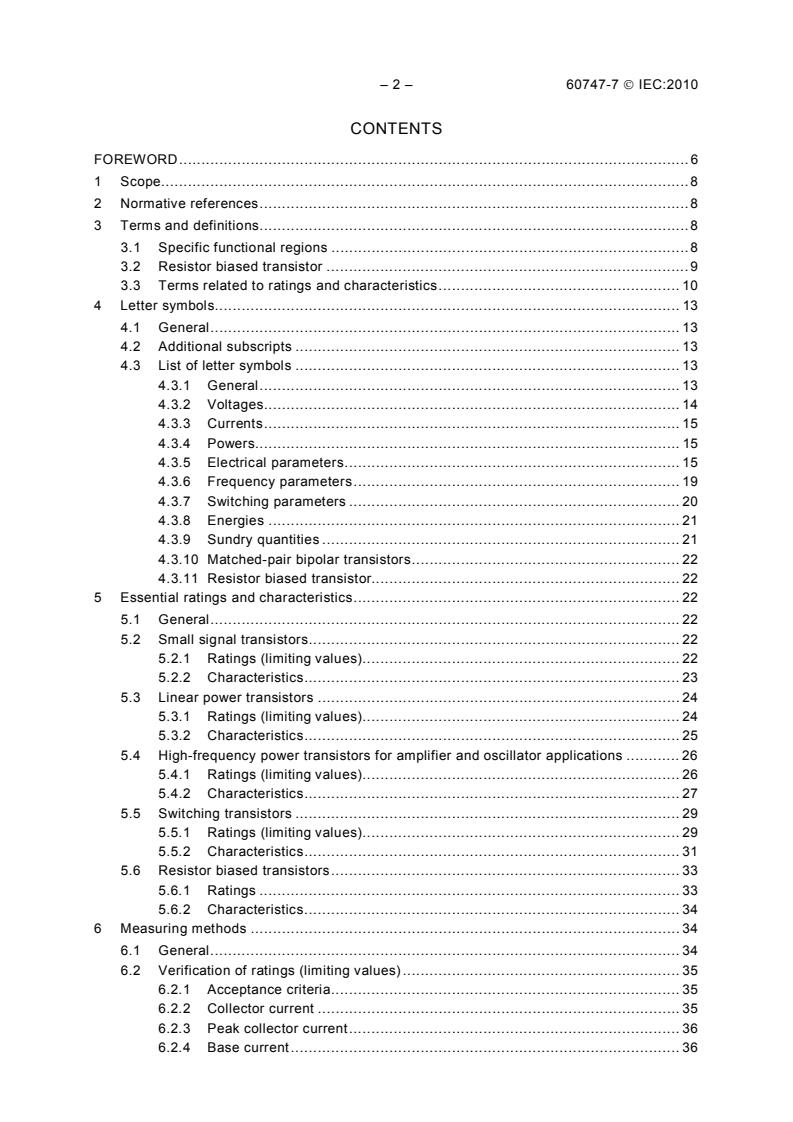
IEC 60747-7:2010 - Semiconductor devices - Discrete devices - Part 7: Bipolar transistors
Frequently Asked Questions
IEC 60747-7:2010 is a standard published by the International Electrotechnical Commission (IEC). Its full title is "Semiconductor devices - Discrete devices - Part 7: Bipolar transistors". This standard covers: IEC 60747-7:2010 gives the requirements applicable to the following sub-categories of bipolar transistors excluding microwave transistors. - Small signal transistors (excluding switching and microwave applications); - Linear power transistors (excluding switching, high-frequency, and microwave applications); - High-frequency power transistors for amplifier and oscillator applications; - Switching transistors for high speed switching and power switching applications; - Resistor biased transistors. The main changes with respect to previous edition are listed below. a) Clause 1 was amended by adding an item that should be included. b) Clauses 3, 4, 5, 6 and 7 were amended by adding terms, definitions, suitable additions and deletions those should be included. c) The text of the second edition was combined with that of IEC 60747-7-5. This publication is to be read in conjunction with IEC 60747-1:2006.
IEC 60747-7:2010 gives the requirements applicable to the following sub-categories of bipolar transistors excluding microwave transistors. - Small signal transistors (excluding switching and microwave applications); - Linear power transistors (excluding switching, high-frequency, and microwave applications); - High-frequency power transistors for amplifier and oscillator applications; - Switching transistors for high speed switching and power switching applications; - Resistor biased transistors. The main changes with respect to previous edition are listed below. a) Clause 1 was amended by adding an item that should be included. b) Clauses 3, 4, 5, 6 and 7 were amended by adding terms, definitions, suitable additions and deletions those should be included. c) The text of the second edition was combined with that of IEC 60747-7-5. This publication is to be read in conjunction with IEC 60747-1:2006.
IEC 60747-7:2010 is classified under the following ICS (International Classification for Standards) categories: 31.080.30 - Transistors. The ICS classification helps identify the subject area and facilitates finding related standards.
IEC 60747-7:2010 has the following relationships with other standards: It is inter standard links to IEC 60747-7-5:2005, IEC 60747-7:2010/AMD1:2019, IEC 60747-7:2000. Understanding these relationships helps ensure you are using the most current and applicable version of the standard.
IEC 60747-7:2010 is available in PDF format for immediate download after purchase. The document can be added to your cart and obtained through the secure checkout process. Digital delivery ensures instant access to the complete standard document.
Standards Content (Sample)
IEC 60747-7 ®
Edition 3.1 2019-09
CONSOLIDATED VERSION
INTERNATIONAL
STANDARD
NORME
INTERNATIONALE
colour
inside
Semiconductor devices – Discrete devices –
Part 7: Bipolar transistors
Dispositifs à semiconducteurs – Dispositifs discrets –
Partie 7: Transistors bipolaires
All rights reserved. Unless otherwise specified, no part of this publication may be reproduced or utilized in any form
or by any means, electronic or mechanical, including photocopying and microfilm, without permission in writing from
either IEC or IEC's member National Committee in the country of the requester. If you have any questions about IEC
copyright or have an enquiry about obtaining additional rights to this publication, please contact the address below or
your local IEC member National Committee for further information.
Droits de reproduction réservés. Sauf indication contraire, aucune partie de cette publication ne peut être reproduite
ni utilisée sous quelque forme que ce soit et par aucun procédé, électronique ou mécanique, y compris la photocopie
et les microfilms, sans l'accord écrit de l'IEC ou du Comité national de l'IEC du pays du demandeur. Si vous avez des
questions sur le copyright de l'IEC ou si vous désirez obtenir des droits supplémentaires sur cette publication, utilisez
les coordonnées ci-après ou contactez le Comité national de l'IEC de votre pays de résidence.
IEC Central Office Tel.: +41 22 919 02 11
3, rue de Varembé info@iec.ch
CH-1211 Geneva 20 www.iec.ch
Switzerland
About the IEC
The International Electrotechnical Commission (IEC) is the leading global organization that prepares and publishes
International Standards for all electrical, electronic and related technologies.
About IEC publications
The technical content of IEC publications is kept under constant review by the IEC. Please make sure that you have the
latest edition, a corrigendum or an amendment might have been published.
IEC publications search - webstore.iec.ch/advsearchform Electropedia - www.electropedia.org
The advanced search enables to find IEC publications by a The world's leading online dictionary on electrotechnology,
variety of criteria (reference number, text, technical containing more than 22 000 terminological entries in English
committee,…). It also gives information on projects, replaced and French, with equivalent terms in 16 additional languages.
and withdrawn publications. Also known as the International Electrotechnical Vocabulary
(IEV) online.
IEC Just Published - webstore.iec.ch/justpublished
Stay up to date on all new IEC publications. Just Published IEC Glossary - std.iec.ch/glossary
details all new publications released. Available online and 67 000 electrotechnical terminology entries in English and
once a month by email. French extracted from the Terms and Definitions clause of
IEC publications issued since 2002. Some entries have been
IEC Customer Service Centre - webstore.iec.ch/csc collected from earlier publications of IEC TC 37, 77, 86 and
If you wish to give us your feedback on this publication or CISPR.
need further assistance, please contact the Customer Service
Centre: sales@iec.ch.
A propos de l'IEC
La Commission Electrotechnique Internationale (IEC) est la première organisation mondiale qui élabore et publie des
Normes internationales pour tout ce qui a trait à l'électricité, à l'électronique et aux technologies apparentées.
A propos des publications IEC
Le contenu technique des publications IEC est constamment revu. Veuillez vous assurer que vous possédez l’édition la
plus récente, un corrigendum ou amendement peut avoir été publié.
Recherche de publications IEC - Electropedia - www.electropedia.org
webstore.iec.ch/advsearchform Le premier dictionnaire d'électrotechnologie en ligne au
La recherche avancée permet de trouver des publications IEC monde, avec plus de 22 000 articles terminologiques en
en utilisant différents critères (numéro de référence, texte, anglais et en français, ainsi que les termes équivalents dans
comité d’études,…). Elle donne aussi des informations sur les 16 langues additionnelles. Egalement appelé Vocabulaire
projets et les publications remplacées ou retirées. Electrotechnique International (IEV) en ligne.
IEC Just Published - webstore.iec.ch/justpublished Glossaire IEC - std.iec.ch/glossary
Restez informé sur les nouvelles publications IEC. Just 67 000 entrées terminologiques électrotechniques, en anglais
Published détaille les nouvelles publications parues. et en français, extraites des articles Termes et Définitions des
Disponible en ligne et une fois par mois par email. publications IEC parues depuis 2002. Plus certaines entrées
antérieures extraites des publications des CE 37, 77, 86 et
Service Clients - webstore.iec.ch/csc CISPR de l'IEC.
Si vous désirez nous donner des commentaires sur cette
publication ou si vous avez des questions contactez-nous:
sales@iec.ch.
IEC 60747-7 ®
Edition 3.1 2019-09
CONSOLIDATED VERSION
INTERNATIONAL
STANDARD
NORME
INTERNATIONALE
colour
inside
Semiconductor devices – Discrete devices –
Part 7: Bipolar transistors
Dispositifs à semiconducteurs – Dispositifs discrets –
Partie 7: Transistors bipolaires
INTERNATIONAL
ELECTROTECHNICAL
COMMISSION
COMMISSION
ELECTROTECHNIQUE
INTERNATIONALE
ICS 31.080.30 ISBN 978-2-8322-7430-9
IEC 60747-7 ®
Edition 3.1 2019-09
CONSOLIDATED VERSION
REDLINE VERSION
VERSION REDLINE
colour
inside
Semiconductor devices – Discrete devices –
Part 7: Bipolar transistors
Dispositifs à semiconducteurs – Dispositifs discrets –
Partie 7: Transistors bipolaires
– 2 – IEC 60747-7:2010+AMD1:2019 CSV
IEC 2019
CONTENTS
FOREWORD . 6
1 Scope . 8
2 Normative references . 8
3 Terms and definitions . 8
3.1 Specific functional regions . 8
3.2 Resistor biased transistor . 9
3.3 Terms related to ratings and characteristics . 10
4 Letter symbols . 13
4.1 General . 13
4.2 Additional subscripts . 13
4.3 List of letter symbols . 13
4.3.1 General . 13
4.3.2 Voltages . 14
4.3.3 Currents . 15
4.3.4 Powers . 15
4.3.5 Electrical parameters . 15
4.3.6 Frequency parameters . 19
4.3.7 Switching parameters . 20
4.3.8 Energies . 21
4.3.9 Sundry quantities . 21
4.3.10 Matched-pair bipolar transistors. 22
4.3.11 Resistor biased transistor . 22
5 Essential ratings and characteristics . 22
5.1 General . 22
5.2 Small signal transistors . 22
5.2.1 Ratings (limiting values) . 22
5.2.2 Characteristics . 23
5.3 Linear power transistors . 24
5.3.1 Ratings (limiting values) . 24
5.3.2 Characteristics . 25
5.4 High-frequency power transistors for amplifier and oscillator applications . 26
5.4.1 Ratings (limiting values) . 26
5.4.2 Characteristics . 27
5.5 Switching transistors . 29
5.5.1 Ratings (limiting values) . 29
5.5.2 Characteristics . 31
5.6 Resistor biased transistors . 33
5.6.1 Ratings . 33
5.6.2 Characteristics . 34
6 Measuring methods . 34
6.1 General . 34
6.2 Verification of ratings (limiting values) . 35
6.2.1 Acceptance criteria . 35
6.2.2 Collector current . 35
6.2.3 Peak collector current . 36
6.2.4 Base current . 36
IEC 2019
6.2.5 Peak base current . 37
6.2.6 Collector-base voltage . 38
6.2.7 Collector-emitter voltage, output voltage . 39
6.2.8 Emitter-base voltage, Input voltage . 39
6.2.9 Safe operating area (SOA) . 40
6.2.10 Output current (I ) . 44
O
6.2.11 Collector-emitter sustaining voltage . 44
6.3 Methods of measurement . 46
6.3.1 Turn-on time intervals and turn-on energy with inductive road . 46
6.3.2 Turn-off time intervals and turn-off energy with inductive road . 48
6.3.3 Collector-emitter cut-off currents (d.c. method) . 49
6.3.4 Collector-base cut-off current (d.c. method) . 50
6.3.5 Emitter-base cut-off current (d.c. method). 50
6.3.6 Collector-emitter saturation voltage . 50
6.3.7 Base-emitter saturation voltage . 52
6.3.8 Base-emitter voltage (d.c. method) . 54
6.3.9 Capacitances . 54
6.3.10 Hybrid parameters (small-signal and large-signal) . 57
6.3.11 Thermal resistance . 64
6.3.12 Switching times with resistive road . 69
6.3.13 High-frequency parameters (f , y.e, s.) . 71
T
6.3.14 Noise (F) . 81
6.3.15 Measuring methods for matched-pair bipolar transistors . 87
6.3.16 Measuring Methods for resistor biased transistors . 90
7 Acceptance and reliability . 94
7.1 General requirements . 94
7.2 Specific requirements . 94
7.2.1 List of endurance tests . 94
7.2.2 Conditions for endurance tests . 94
7.2.3 Acceptance-defining characteristics and acceptance criteria for
reliability tests . 94
7.3 Endurance and reliability test methods . 95
7.3.1 High temperature blocking (HTRB) . 95
7.3.2 Intermittent operating life . 96
7.4 Type tests and routine tests . 97
7.4.1 Type tests . 97
7.4.2 Routine tests . 97
Annex A (informative) Determination of the SOA . 99
Figure 1 – Resistor biased transistor graphical symbol . 9
Figure 2 – Modified hybrid π equivalent circuit . 19
Figure 3 – Test circuit for collector current . 35
Figure 4 – Test circuit for peak collector current . 36
Figure 5 – Test circuit for base current . 37
Figure 6 – Test circuit for peak base current . 37
Figure 7 – Circuit for testing the collector-base voltage V , V , V , V . 38
CBO CBS CBR CBX
Figure 8 – Circuit for testing the collector-emitter voltage V , V , V , V V . 39
CEO CES CER CEX, O
Figure 9 – Circuit for testing the emitter-base voltages V and input voltage V . 40
EBO I
– 4 – IEC 60747-7:2010+AMD1:2019 CSV
IEC 2019
Figure 10 – Test circuit of reverse bias safe operating area (RBSOA) . 41
Figure 11 – Waveforms and curves for RBSOA . 42
Figure 12 – Circuit for testing safe operating pulse duration at load short circuit
(SCSOA). 43
Figure 13 – Waveforms of base current I , collector current I and voltage V during
B C CE
load short circuit condition SCSOA . 43
Figure 14 – Circuit diagram for verifying the output current I . 44
O
Figure 15 – Basic circuit for the measurement of the collector-emitter sustaining
voltage . 45
Figure 16 – I versus V characteristic . 46
C CE
Figure 17 – Circuit diagram and waveforms . 47
Figure 18 – Waveforms during turn-off intervals . 48
Figure 19 – Basic circuit for the measurement of collector-emitter cut-off currents . 49
Figure 20 – Basic circuit for the measurement of the collector-emitter saturation
voltage (d.c. method) . 50
Figure 21 – Basic circuit for the measurement of the collector-emitter saturation
voltage (pulse method) . 51
Figure 22 – Basic circuit for the measurement of the base-emitter saturation voltage
(d.c. method) . 52
Figure 23 – Basic circuit for the measurement of the base-emitter saturation voltage
(pulse methods) . 53
Figure 24 – Base circuit for the measurement of base-emitter voltage (d.c. method) . 54
Figure 25 – Basic circuit for the measurement of the common-base output capacitance
using a two-terminal bridge . 55
Figure 26 – Basic circuit for the measurement of C using a three-terminal bridge . 56
CB
Figure 27 – Basic circuit for the measurement of C using a three-terminal bridge . 57
cb
Figure 28 – Basic circuit for the measurement of h and h . 58
11e 21e
Figure 29 – Basic circuit for the measurement of h . 59
12e
Figure 30 – Basic circuit for the measurement of h . 61
22e
Figure 31 – Basic circuit for the measurement of h . 62
22b
Figure 32 – Basic circuit for the measurement of h . 63
21E
Figure 33 – Basic test circuit for measuring the thermal resistance of NPN transistors . 66
Figure 34 – Emitter current (I ) versus emitter-base voltage (V ) for the junction
E EB
(1) (2)
temperatures T and T . 66
j j
Figure 35 – I and V change with time . 67
E EB
Figure 36 – Circuit diagram . 69
Figure 37 – Switching times . 70
Figure 38 – Circuit for the measurement of the transition frequency . 71
Figure 39 – Circuit for the measurement of complex common-emitter y parameters . 73
Figure 40 – Three-pole circuit for the measurement of y . 74
11e
Figure 41 – Three-pole circuit for the measurement of y . 74
22e
Figure 42 – Three-pole circuit for the measurement of y . 75
21e
Figure 43 – Three-pole circuit for the measurement of y . 76
12e
Figure 44 – Block diagram of the circuit for the measurement of s and s
11 22
parameters . 77
IEC 2019
Figure 45 – Block diagram of the circuit for the measurement of s and s
12 21
parameters . 79
Figure 46 – Basic block diagram for the measurement of the noise figure . 81
Figure 47 – Basic circuit for the measurement of the noise figure up to 3 MHz . 83
Figure 48 – Basic circuit for the measurement of the noise figure from 3 MHz to
300 MHz . 84
Figure 49 – Basic circuit for the measurement of the noise figure below 1 kHz (signal
generator method) . 86
Figure 50 – Basic circuit for the measurement of h /h . 88
21E1 21E2
Figure 51 – Matching of the collector current . 90
Figure 52 – Circuit diagram for measuring the on-state input voltage V , and off-
I(on)
state input voltage V . 90
I(off)
Figure 53 – Circuit diagram for measuring the bias resistor r . 91
Figure 54 – Circuit diagram and measuring the bias resistor r . 92
Figure 55 – Circuit diagram for measuring the on-state output voltage V . 93
O(on)
Figure 56 – Circuit diagram for measuring the off-sate output current I . 94
O(off)
Figure 57 – Test circuit for high temperature blocking . 96
Figure 58 – Circuit for Intermittent operating life . 97
Figure 59 – Expected number of cycles versus temperature rise ∆T . 97
vj
Figure A.1 – Typical ∆V versus collector-base (V ) characteristics . 99
EB CB
Figure A.2 – Typical safe operating area . 100
Table 1 – Acceptance defining characteristics and acceptance criteria . 35
Table 2 – Acceptance defining characteristics suitable for resistor biased transistor . 35
Table 3 – Acceptance defining characteristics after endurance tests for bipolar
transistors . 95
Table 4 – Minimum items of type and routine tests for transistors when applicable . 98
– 6 – IEC 60747-7:2010+AMD1:2019 CSV
IEC 2019
INTERNATIONAL ELECTROTECHNICAL COMMISSION
____________
SEMICONDUCTOR DEVICES –
DISCRETE DEVICES –
Part 7: Bipolar transistors
FOREWORD
1) The International Electrotechnical Commission (IEC) is a worldwide organization for standardization comprising
all national electrotechnical committees (IEC National Committees). The object of IEC is to promote
international co-operation on all questions concerning standardization in the electrical and electronic fields. To
this end and in addition to other activities, IEC publishes International Standards, Technical Specifications,
Technical Reports, Publicly Available Specifications (PAS) and Guides (hereafter referred to as “IEC
Publication(s)”). Their preparation is entrusted to technical committees; any IEC National Committee interested
in the subject dealt with may participate in this preparatory work. International, governmental and non-
governmental organizations liaising with the IEC also participate in this preparation. IEC collaborates closely
with the International Organization for Standardization (ISO) in accordance with conditions determined by
agreement between the two organizations.
2) The formal decisions or agreements of IEC on technical matters express, as nearly as possible, an international
consensus of opinion on the relevant subjects since each technical committee has representation from all
interested IEC National Committees.
3) IEC Publications have the form of recommendations for international use and are accepted by IEC National
Committees in that sense. While all reasonable efforts are made to ensure that the technical content of IEC
Publications is accurate, IEC cannot be held responsible for the way in which they are used or for any
misinterpretation by any end user.
4) In order to promote international uniformity, IEC National Committees undertake to apply IEC Publications
transparently to the maximum extent possible in their national and regional publications. Any divergence
between any IEC Publication and the corresponding national or regional publication shall be clearly indicated in
the latter.
5) IEC itself does not provide any attestation of conformity. Independent certification bodies provide conformity
assessment services and, in some areas, access to IEC marks of conformity. IEC is not responsible for any
services carried out by independent certification bodies.
6) All users should ensure that they have the latest edition of this publication.
7) No liability shall attach to IEC or its directors, employees, servants or agents including individual experts and
members of its technical committees and IEC National Committees for any personal injury, property damage or
other damage of any nature whatsoever, whether direct or indirect, or for costs (including legal fees) and
expenses arising out of the publication, use of, or reliance upon, this IEC Publication or any other IEC
Publications.
8) Attention is drawn to the Normative references cited in this publication. Use of the referenced publications is
indispensable for the correct application of this publication.
9) Attention is drawn to the possibility that some of the elements of this IEC Publication may be the subject of
patent rights. IEC shall not be held responsible for identifying any or all such patent rights.
This consolidated version of the official IEC Standard and its amendment has been
prepared for user convenience.
IEC 60747-7 edition 3.1 contains the third edition (2010-12) [documents 47E/404/FDIS
and 47E/408/RVD] and its amendment 1 (2019-09) [documents 47E/635/CDV and 47E/672/
RVC].
In this Redline version, a vertical line in the margin shows where the technical content
is modified by amendment 1. Additions are in green text, deletions are in strikethrough
red text. A separate Final version with all changes accepted is available in this
publication.
IEC 2019
International Standard IEC 60747-7 has been prepared by subcommittee 47E: Discrete
semiconductor devices, of IEC technical committee 47: Semiconductor devices.
The main changes with respect to previous edition are listed below.
a) Clause 1 was amended by adding an item that should be included.
b) Clauses 3, 4, 5, 6 and 7 were amended by adding terms, definitions, suitable additions
and deletions those should be included.
c) The text of the second edition was combined with that of IEC 60747-7-5.
This standard is to be read in conjunction with IEC 60747-1:2006.
This publication has been drafted in accordance with the ISO/IEC Directives, Part 2.
A list of all the parts in the IEC 60747 series, under the general title Semiconductor devices –
Discrete devices, can be found on the IEC website.
Future standards in this series will carry the new general title as cited above. Titles of existing
standards in this series will be updated at the time of the next edition.
The committee has decided that the contents of the base publication and its amendment will
remain unchanged until the stability date indicated on the IEC web site under
"http://webstore.iec.ch" in the data related to the specific publication. At this date, the
publication will be
• reconfirmed,
• withdrawn,
• replaced by a revised edition, or
• amended.
IMPORTANT – The 'colour inside' logo on the cover page of this publication indicates
that it contains colours which are considered to be useful for the correct
understanding of its contents. Users should therefore print this document using a
colour printer.
– 8 – IEC 60747-7:2010+AMD1:2019 CSV
IEC 2019
SEMICONDUCTOR DEVICES –
DISCRETE DEVICES –
Part 7: Bipolar transistors
1 Scope
This part of IEC 60747-7 gives the requirements applicable to the following sub-categories of
bipolar transistors excluding microwave transistors.
– Small signal transistors (excluding switching and microwave applications);
– Linear power transistors (excluding switching, high-frequency, and microwave
applications);
– High-frequency power transistors for amplifier and oscillator applications;
– Switching transistors for high speed switching and power switching applications;
– Resistor biased transistors.
2 Normative references
The following referenced documents are indispensable for the application of this document.
For dated references, only the edition cited applies. For undated references, the latest edition
of the referenced document (including any amendments) applies.
IEC 60050-521:2002, International Electrotechnical Vocabulary – Part 521: Semiconductor
devices and integrated circuits
IEC 60747-1:2006, Semiconductor devices – Part 1: General
IEC 60747-4:2007, Semiconductor devices – Discrete devices – Part 4: Microwave diodes and
transistors
3 Terms and definitions
For the purposes of this document the following terms and definitions apply.
3.1 Specific functional regions
3.1.1
functional collector region
collection region that acquires principal-current charge carriers from the functional base
region through the (collecting) junction between it and the functional base region
NOTE Note 1 to entry In the normal operating mode, this functional region is located in the collector region and,
in the inverse operating mode, in the emitter region.
3.1.2
functional emitter region
supply region that delivers principal-current charge carriers into the functional base region
through the (emitting) junction between it and the functional base region.
NOTE Note 1 to entry In the normal operating mode, this functional region is located in the emitter region and, in
the inverse operating mode, in the collector region.
IEC 2019
3.1.3
functional base region
control region through which the principal current passes and in which the concentration of
principal-current charge carriers is the result of an applied base current
3.1.4
collector(-base) space-charge region;
collector(-base) depletion layer
space-charge region between the functional collector region and the functional base region
3.1.5
emitter(-base) space-charge region;
emitter(-base) depletion layer
space-charge region between the functional emitter region and the functional base region
3.2 Resistor biased transistor
3.2.1
general description
bipolar junction transistors that incorporate with two bias resistors. One bias resistor is
connected between the In terminal and the base region and the another between the base
region and the common terminal. The resistor biased transistor is specified as a logic circuit
element.
The graphical symbol as shown in Figure 1 is used in this standard for resistor biased
transistors npn or pnp.
Out (Collector)
r
In
r
Common (Emitter)
IEC 2910/10
Figure 1 – Resistor biased transistor graphical symbol
3.2.2
input terminal
terminal connected to the bias resistor 1
3.2.3
output terminal
terminal connected to a collector
3.2.4
common terminal
terminal connected to an emitter
3.2.5
bias resistor 1
resistor connected between the input terminal and the internal base of the transistor
– 10 – IEC 60747-7:2010+AMD1:2019 CSV
IEC 2019
3.2.6
bias resistor 2
resistor connected between the internal base of the transistor and the common terminal
3.3 Terms related to ratings and characteristics
3.3.1
punch-through voltage
value of the collector-base voltage above which the open-circuit emitter-base voltage
increases almost linearly with increasing collector-base voltage
NOTE Note 1 to entry At this voltage, the collector depletion layer extends through the base to the emitter
depletion layer.
NOTE Note 2 to entry "Reach-through voltage" is a term also in the USA.
3.3.2
saturation voltages
3.3.2.1
collector-emitter saturation voltage
voltage between the collector and emitter electrodes under conditions of base current beyond
which the collector current remains essentially constant as the base current increased.
NOTE Note 1 to entry This is the voltage between the collector and emitter electrodes when both the base-emitter
and base-collector junctions are forward biased.
3.3.2.2
base-emitter saturation voltage
voltage between the base and emitter electrodes under conditions of emitter current or
collector current and base current beyond which the collector current remains essentially
constant as the base current increased.
NOTE Note 1 to entry This is the voltage between the base and emitter electrodes when both the base-emitter
and base-collector junctions are forward biased.
3.3.3
cut-off current
reverse current
reverse current of the base-collector junction or base-emitter junction.
3.3.4
saturation resistance
resistance between collector and emitter terminals under specified conditions of base current
and collector current when the collector current is limited by the external circuit
NOTE Note 1 to entry The saturation resistance may be determined either as the ratio of total voltage to total
current or as the ratio of differential voltage to differential current; the method of determination should be specified.
3.3.5
emitter depletion layer capacitance
part of the capacitance across an emitter-base junction that is associated with its depletion
layer
NOTE Note 1 to entry The emitter depletion layer capacitance is a function of the total potential difference across
the depletion layer.
3.3.6
collector depletion layer capacitance
part of the capacitance across a collector-base junction that is associated with its depletion
layer
IEC 2019
NOTE Note 1 to entry The depletion layer capacitance is a function of the total potential difference across the
depletion layer.
3.3.7
switching times
for bipolar transistors, the input waveform is the base current and the output waveform is the
collector current. The lower and upper limits are usually 10% and 90% of the amplitude.
3.3.7.1
turn on delay time
rise time
carrier storage time
fall time
t , t , t and t
d(on) r s f
see IEC 60050-521:2002,521-05-21, IEC 60050-521:2002,521-05-22, IEC 60050-521:2002,
521-05-23, IEC 60050-521:2002,521-05-24.
3.3.7.2
turn-on time
time interval between a step function change of the input signal level and the instant at which
the magnitude of the signal at the output terminals reaches a specified upper limit when the
semiconductor device is being switched from its non-conducting to its conducting state. The
lower and upper limits are usually 10 % and 90 % of the amplitude.
3.3.7.3
turn-off time
time interval between a step function change of the input signal level and the instant at which
the magnitude of the signal at the output terminals reaches a specified lower limit when the
semiconductor device is being switched from its conducting to its non-conducting state. The
lower and upper limits are usually 10 % and 90 % of the amplitude.
3.3.8
collector-emitter sustaining voltage
V
CE (SUS)
collector-emitter breakdown voltage at higher values of collector current where the breakdown
voltage is relatively constant over decreasing collector current for a specified termination
between base and emitter terminals
3.3.9
turn-on energy (per pulse)
E
on
energy dissipated in transistor during turn-on
3.3.10
turn-off energy (per pulse)
E
off
energy dissipated in transistor during turn-off
3.3.11
maximum frequency of oscillation
f
max
maximum frequency at which a transistor can be made to oscillate under specified conditions
NOTE Note 1 to entry This frequency approximates to the transition frequency at which the maximum available
power gain has decreased to unity.
– 12 – IEC 60747-7:2010+AMD1:2019 CSV
IEC 2019
3.3.12
transition frequency
f
T
frequency at which the modulus of the common-emitter small-signal short-circuit forward
current transfer ratio |h | has decreased to unity
21e
product of the modulus of the common-emitter small-signal short-circuit forward current
transfer ratio |h | and the frequency of measurement, this frequency being so chosen that
21e
|h | is decreasing at a slope of approximately 6 dB/octave
21e
3.3.13
frequency of unity current transfer ratio
f
frequency at which the modulus of the common-emitter small-signal short-circuit forward
current transfer ratio |h | has decreased to unity
21e
3.3.133.3.14
transfer ratio
3.3.134.1
small-signal short-circuit forward current transfer ratio
ratio between the alternating output current and the small sinusoidal input current producing it
under small-signal conditions, the output being short-circuited to a.c.
3.3.134.2
static value of the forward current transfer ratio
ratio between the continuous (direct) output and the continuous (direct) input current, the
output voltage being held constant
3.3.134.3
inherent (large-signal) forward current transfer ratio
difference between the continuous (direct) collector current and the collector-base cut-off
current divided by the sum of the continuous (direct) base current and the collector-base cut-
off current at a specified constant value of the collector-emitter voltage
3.3.134.4
small-signal open-circuit reverse voltage transfer ratio
ratio of the alternating voltage appearing at the input terminals, when they are a.c. open-
circuited, to the alternating voltage applied to the output terminals, under small-signal
conditions
3.3.134.5
transient current ratio in saturation (of a switching transistor)
quotient of the collector current suddenly demanded from a transistor and the minimum base
current necessary to hold it in saturation
3.3.143.3.15
resistor ratio (of resistor biased transistor)
ratio of the values of bias resistor 2 and bias resistor 1
3.3.153.3.16
input voltage (of resistor biased transistor)
voltage between the input terminal and the common terminal of the device
3.3.163.3.17
off-state input voltage (of resistor biased transistor)
input voltage at which the output current has reached its defined off-state value
IEC 2019
3.3.173.3.18
on-state input voltage (of resistor biased transistor)
input voltage at which the output current has reached its defined on-state value
3.3.183.3.19
output voltage (of resistor biased transistor)
voltage between the output terminal and the common terminal of the device
3.3.193.3.20
off-state output current (of resistor biased transistor)
current flowing into the output terminal in the off-state
3.3.203.3.21
on-state output voltage (of resistor biased transistor)
and I in
current flowing into the output terminal in the off-state output voltage with specified I
i o
such a way that the transistor is in its specified on state
4 Letter symbols
4.1 General
Mostly, existing letter symbols are added to the terms in titles. When several distinct forms
exist, the most commonly used form is given.
Subclause 4.2 of IEC 60747-1:2006 applies.
4.2 Additional subscripts
In addition to the list of recommended general subscripts given in Clause 4 of IEC 60747-
1:2006, the following subscripts are recommended for bipolar transistors:
B,b = base
C,c = collector
E,e = emitter
fl = floating
pt = punch-through (penetration, reach-through)
R,r (not as a first subscript) = specified resistance
sat = saturation
X = specified circuit
s = storage
T = transition
4.3 Lists of letter symbols
4.3.1 General
The symbols contained in the following lists are recommended for use in the field of bipolar
transistors. They have been compiled in accordance with the general rules in Clause 4 of
IEC 60747-1:2006.
– 14 – IEC 60747-7:2010+AMD1:2019 CSV
IEC 2019
4.3.2 Voltages
Name and designation Letter symbol Remarks
Collector-base (d.c.) voltage V
CB
Collector-emitter (d.c.) voltage V
CE
Emitter-base (d.c.) voltage V
EB
Base-emitter (d.c.) voltage V
BE
Collector-base (d.c.) voltage
V
CBO
with I = 0 I specified
E C
Emitter-base (d.c.) voltage
V
EBO
with I = 0 I specified
C E
Collector-emitter (d.c.) voltage
V
CEO
with I = 0 I specified
B C
Collector-emitter (d.c.) voltage
V
CER
with R = R I specified
BE C
Collector-emitter (d.c.) voltage
V
CES
with V = 0 I specified
BE C
Collector-emitter (d.c.) voltage
with V = X specified
BE
V
CEX
(reverse biased emitter-base
junction) I specified
C
Floating voltage, emitter-base
V
EBfl
with I = 0 V specified
E CB
Punch-through (penetration) voltage V
pt
Saturation voltage, collector-emitter
V
CEsat
with I specified I specified
B C
Saturation voltage, base-emitter
V
BEsat
with I specified I specified
B C
----------
...
IEC 60747-7 ®
Edition 3.0 2010-12
INTERNATIONAL
STANDARD
NORME
INTERNATIONALE
Semiconductor devices – Discrete devices –
Part 7: Bipolar transistors
Dispositifs à semiconducteurs – Dispositifs discrets –
Partie 7: Transistors bipolaires
All rights reserved. Unless otherwise specified, no part of this publication may be reproduced or utilized in any form or by
any means, electronic or mechanical, including photocopying and microfilm, without permission in writing from either IEC or
IEC's member National Committee in the country of the requester.
If you have any questions about IEC copyright or have an enquiry about obtaining additional rights to this publication,
please contact the address below or your local IEC member National Committee for further information.
Droits de reproduction réservés. Sauf indication contraire, aucune partie de cette publication ne peut être reproduite
ni utilisée sous quelque forme que ce soit et par aucun procédé, électronique ou mécanique, y compris la photocopie
et les microfilms, sans l'accord écrit de la CEI ou du Comité national de la CEI du pays du demandeur.
Si vous avez des questions sur le copyright de la CEI ou si vous désirez obtenir des droits supplémentaires sur cette
publication, utilisez les coordonnées ci-après ou contactez le Comité national de la CEI de votre pays de résidence.
IEC Central Office
3, rue de Varembé
CH-1211 Geneva 20
Switzerland
Email: inmail@iec.ch
Web: www.iec.ch
About the IEC
The International Electrotechnical Commission (IEC) is the leading global organization that prepares and publishes
International Standards for all electrical, electronic and related technologies.
About IEC publications
The technical content of IEC publications is kept under constant review by the IEC. Please make sure that you have the
latest edition, a corrigenda or an amendment might have been published.
§ Catalogue of IEC publications: www.iec.ch/searchpub
The IEC on-line Catalogue enables you to search by a variety of criteria (reference number, text, technical committee,…).
It also gives information on projects, withdrawn and replaced publications.
§ IEC Just Published: www.iec.ch/online_news/justpub
Stay up to date on all new IEC publications. Just Published details twice a month all new publications released. Available
on-line and also by email.
§ Electropedia: www.electropedia.org
The world's leading online dictionary of electronic and electrical terms containing more than 20 000 terms and definitions
in English and French, with equivalent terms in additional languages. Also known as the International Electrotechnical
Vocabulary online.
§ Customer Service Centre: www.iec.ch/webstore/custserv
If you wish to give us your feedback on this publication or need further assistance, please visit the Customer Service
Centre FAQ or contact us:
Email: csc@iec.ch
Tel.: +41 22 919 02 11
Fax: +41 22 919 03 00
A propos de la CEI
La Commission Electrotechnique Internationale (CEI) est la première organisation mondiale qui élabore et publie des
normes internationales pour tout ce qui a trait à l'électricité, à l'électronique et aux technologies apparentées.
A propos des publications CEI
Le contenu technique des publications de la CEI est constamment revu. Veuillez vous assurer que vous possédez
l’édition la plus récente, un corrigendum ou amendement peut avoir été publié.
§ Catalogue des publications de la CEI: www.iec.ch/searchpub/cur_fut-f.htm
Le Catalogue en-ligne de la CEI vous permet d’effectuer des recherches en utilisant différents critères (numéro de référence,
texte, comité d’études,…). Il donne aussi des informations sur les projets et les publications retirées ou remplacées.
§ Just Published CEI: www.iec.ch/online_news/justpub
Restez informé sur les nouvelles publications de la CEI. Just Published détaille deux fois par mois les nouvelles
publications parues. Disponible en-ligne et aussi par email.
§ Electropedia: www.electropedia.org
Le premier dictionnaire en ligne au monde de termes électroniques et électriques. Il contient plus de 20 000 termes et
définitions en anglais et en français, ainsi que les termes équivalents dans les langues additionnelles. Egalement appelé
Vocabulaire Electrotechnique International en ligne.
§ Service Clients: www.iec.ch/webstore/custserv/custserv_entry-f.htm
Si vous désirez nous donner des commentaires sur cette publication ou si vous avez des questions, visitez le FAQ du
Service clients ou contactez-nous:
Email: csc@iec.ch
Tél.: +41 22 919 02 11
Fax: +41 22 919 03 00
IEC 60747-7 ®
Edition 3.0 2010-12
INTERNATIONAL
STANDARD
NORME
INTERNATIONALE
Semiconductor devices – Discrete devices –
Part 7: Bipolar transistors
Dispositifs à semiconducteurs – Dispositifs discrets –
Partie 7: Transistors bipolaires
INTERNATIONAL
ELECTROTECHNICAL
COMMISSION
COMMISSION
ELECTROTECHNIQUE
PRICE CODE
INTERNATIONALE
XD
CODE PRIX
ICS 31.080.30 ISBN 978-2-88912-311-7
– 2 – 60747-7 Ó IEC:2010
CONTENTS
FOREW ORD . 6
1 Sc o pe . 8
2 Normative references . 8
3 Terms and definitions . 8
3.1 Specific functional regions . 8
3.2 Resistor biased transistor . 9
3.3 Terms related to ratings and characteristics . 10
4 Letter symbols . 13
4.1 General . 13
4.2 Additional subscripts . 13
4.3 List of letter symbols . 13
4.3.1 General . 13
4.3.2 Voltages . 14
4.3.3 Currents . 15
4.3.4 Powers. 15
4.3.5 Electrical parameters . 15
4.3.6 Frequency parameters . 19
4.3.7 Switching parameters . 20
4.3.8 Energies . 21
4.3.9 Sundry quantities . 21
4.3.10 Matched-pair bipolar transistors . 22
4.3.11 Resistor biased transistor. 22
5 Essential ratings and characteristics . 22
5.1 General . 22
5.2 Small signal transistors . 22
5.2.1 Ratings (limiting values) . 22
5.2.2 Characteristics . 23
5.3 Linear power transistors . 24
5.3.1 Ratings (limiting values) . 24
5.3.2 Characteristics . 25
5.4 High-frequency power transistors for amplifier and oscillator applications . 26
5.4.1 Ratings (limiting values) . 26
5.4.2 Characteristics . 27
5.5 Switching transistors . 29
5.5.1 Ratings (limiting values) . 29
5.5.2 Characteristics . 31
5.6 Resistor biased transistors . 33
5.6.1 Ratings . 33
5.6.2 Characteristics . 34
6 Measuring methods . 34
6.1 General . 34
6.2 Verification of ratings (limiting values) . 35
6.2.1 Acceptance criteria . 35
6.2.2 Collector current . 35
6.2.3 Peak collector current . 36
6.2.4 Base current . 36
60747-7 Ó IEC:2010 – 3 –
6.2.5 Peak base current . 37
6.2.6 Collector-base voltage . 38
6.2.7 Collector-emitter voltage, output voltage . 39
6.2.8 Emitter-base voltage, Input voltage . 39
6.2.9 Safe operating area (SOA) . 40
6.2.10 Output current (I ) . 43
O
6.2.11 Collector-emitter sustaining voltage . 44
6.3 Methods of measurement . 46
6.3.1 Turn-on time intervals and turn-on energy with inductive road . 46
6.3.2 Turn-off time intervals and turn-off energy with inductive road . 47
6.3.3 Collector-emitter cut-off currents (d.c. method) . 49
6.3.4 Collector-base cut-off current (d.c. method) . 49
6.3.5 Emitter-base cut-off current (d.c. method) . 50
6.3.6 Collector-emitter saturation voltage . 50
6.3.7 Base-emitter saturation voltage . 52
6.3.8 Base-emitter voltage (d.c. method) . 53
6.3.9 Capacitances . 54
6.3.10 Hybrid parameters (small-signal and large-signal) . 57
6.3.11 Thermal resistance . 64
6.3.12 Switching times with resistive road . 69
6.3.13 High-frequency parameters (f , y.e, s.). 71
T
6.3.14 Noise (F) . 81
6.3.15 Measuring methods for matched-pair bipolar transistors . 87
6.3.16 Measuring Methods for resistor biased transistors . 90
7 Acceptance and reliability . 94
7.1 General requirements . 94
7.2 Specific requirements . 94
7.2.1 List of endurance tests. 94
7.2.2 Conditions for endurance tests . 94
7.2.3 Acceptance-defining characteristics and acceptance criteria for
reliability tests . 94
7.3 Endurance and reliability test methods . 95
7.3.1 High temperature blocking (HTRB) . 95
7.3.2 Intermittent operating life . 96
7.4 Type tests and routine tests . 97
7.4.1 Type tests . 97
7.4.2 Routine tests . 97
Annex A (informative) Determination of the SOA . 99
Figure 1 – Resistor biased transistor graphical symbol . 9
Figure 2 – Modified hybrid p equivalent circuit . 19
Figure 3 – Test circuit for collector current . 35
Figure 4 – Test circuit for peak collector current . 36
Figure 5 – Test circuit for base current . 37
Figure 6 – Test circuit for peak base current. 37
Figure 7 – Circuit for testing the collector-base voltage V , V , V , V . 38
CBO CBS CBR CBX
Figure 8 – Circuit for testing the collector-emitter voltage V , V , V , V V . 39
CEO CES CER CEX, O
Figure 9 – Circuit for testing the emitter-base voltages V and input voltage V . 40
EBO I
– 4 – 60747-7 Ó IEC:2010
Figure 10 – Test circuit of reverse bias safe operating area (RBSOA) . 40
Figure 11 – Waveforms and curves for RBSOA . 41
Figure 12 – Circuit for testing safe operating pulse duration at load short circuit
(SCSOA) . 42
Figure 13 – Waveforms of base current I , collector current I and voltage V during
B C CE
load short circuit condition SCSOA . 43
Figure 14 – Circuit diagram for verifying the output current I . 44
O
Figure 15 – Basic circuit for the measurement of the collector-emitter sustaining
voltage . 44
Figure 16 – I versus V characteristic . 45
C CE
Figure 17 – Circuit diagram and waveforms . 47
Figure 18 – Waveforms during turn-off intervals . 48
Figure 19 – Basic circuit for the measurement of collector-emitter cut-off currents. 49
Figure 20 – Basic circuit for the measurement of the collector-emitter saturation
voltage (d.c. method) . 50
Figure 21 – Basic circuit for the measurement of the collector-emitter saturation
voltage (pulse method) . 51
Figure 22 – Basic circuit for the measurement of the base-emitter saturation voltage
(d.c. method) . 52
Figure 23 – Basic circuit for the measurement of the base-emitter saturation voltage
(pulse methods) . 53
Figure 24 – Base circuit for the measurement of base-emitter voltage (d.c. method) . 54
Figure 25 – Basic circuit for the measurement of the common-base output capacitance
using a two-terminal bridge. 55
Figure 26 – Basic circuit for the measurement of C using a three-terminal bridge . 56
CB
Figure 27 – Basic circuit for the measurement of C using a three-terminal bridge . 57
cb
Figure 28 – Basic circuit for the measurement of h and h . 58
11e 21e
Figure 29 – Basic circuit for the measurement of h . 59
12e
Figure 30 – Basic circuit for the measurement of h . 61
22e
Figure 31 – Basic circuit for the measurement of h . 62
22b
Figure 32 – Basic circuit for the measurement of h . 63
21E
Figure 33 – Basic test circuit for measuring the thermal resistance of NPN transistors . 66
Figure 34 – Emitter current (I ) versus emitter-base voltage (V ) for the junction
E EB
(1) (2)
temperatures T and T . 66
j j
Figure 35 – I and V change with time . 67
E EB
Figure 36 – Circuit diagram . 69
Figure 37 – Switching times . 70
Figure 38 – Circuit for the measurement of the transition frequency . 71
Figure 39 – Circuit for the measurement of complex common-emitter y parameters . 73
Figure 40 – Three-pole circuit for the measurement of y . 74
11e
Figure 41 – Three-pole circuit for the measurement of y . 74
22e
Figure 42 – Three-pole circuit for the measurement of y . 75
21e
Figure 43 – Three-pole circuit for the measurement of y . 76
12e
Figure 44 – Block diagram of the circuit for the measurement of s and s
11 22
parameters . 77
60747-7 Ó IEC:2010 – 5 –
Figure 45 – Block diagram of the circuit for the measurement of s and s
12 21
parameters . 79
Figure 46 – Basic block diagram for the measurement of the noise figure . 81
Figure 47 – Basic circuit for the measurement of the noise figure up to 3 MHz . 83
Figure 48 – Basic circuit for the measurement of the noise figure from 3 MHz to
300 MHz . 84
Figure 49 – Basic circuit for the measurement of the noise figure below 1 kHz (signal
generator method) . 86
Figure 50 – Basic circuit for the measurement of h /h . 88
21E1 21E2
Figure 51 – Matching of the collector current . 90
Figure 52 – Circuit diagram for measuring the on-state input voltage V , and off-
I(on)
state input voltage V . 90
I(off)
Figure 53 – Circuit diagram for measuring the bias resistor r . 91
Figure 54 – Circuit diagram and measuring the bias resistor r . 92
Figure 55 – Circuit diagram for measuring the on-state output voltage V . 93
O(on)
Figure 56 – Circuit diagram for measuring the off-sate output current I . 94
O(off)
Figure 57 – Test circuit for high temperature blocking . 96
Figure 58 – Circuit for Intermittent operating life . 97
Figure 59 – Expected number of cycles versus temperature rise DT . 97
vj
Figure A.1 – Typical DV versus collector-base (V ) characteristics . 99
EB CB
Figure A.2 – Typical safe operating area . 100
Table 1 – Acceptance defining characteristics and acceptance criteria . 35
Table 2 – Acceptance defining characteristics suitable for resistor biased transistor . 35
Table 3 – Acceptance defining characteristics after endurance tests for bipolar
transistors . 95
Table 4 – Minimum items of type and routine tests for transistors when applicable . 98
– 6 – 60747-7 Ó IEC:2010
INTERNATIONAL ELECTROTECHNICAL COMMISSION
____________
SEMICONDUCTOR DEVICES –
DISCRETE DEVICES –
Part 7: Bipolar transistors
FOREWORD
1) The International Electrotechnical Commission (IEC) is a worldwide organization for standardization comprising
all national electrotechnical committees (IEC National Committees). The object of IEC is to promote
international co-operation on all questions concerning standardization in the electrical and electronic fields. To
this end and in addition to other activities, IEC publishes International Standards, Technical Specifications,
Technical Reports, Publicly Available Specifications (PAS) and Guides (hereafter referred to as “IEC
Publication(s)”). Their preparation is entrusted to technical committees; any IEC National Committee interested
in the subject dealt with may participate in this preparatory work. International, governmental and non-
governmental organizations liaising with the IEC also participate in this preparation. IEC collaborates closely
with the International Organization for Standardization (ISO) in accordance with conditions determined by
agreement between the two organizations.
2) The formal decisions or agreements of IEC on technical matters express, as nearly as possible, an international
consensus of opinion on the relevant subjects since each technical committee has representation from all
interested IEC National Committees.
3) IEC Publications have the form of recommendations for international use and are accepted by IEC National
Committees in that sense. While all reasonable efforts are made to ensure that the technical content of IEC
Publications is accurate, IEC cannot be held responsible for the way in which they are used or for any
misinterpretation by any end user.
4) In order to promote international uniformity, IEC National Committees undertake to apply IEC Publications
transparently to the maximum extent possible in their national and regional publications. Any divergence
between any IEC Publication and the corresponding national or regional publication shall be clearly indicated in
the latter.
5) IEC itself does not provide any attestation of conformity. Independent certification bodies provide conformity
assessment services and, in some areas, access to IEC marks of conformity. IEC is not responsible for any
services carried out by independent certification bodies.
6) All users should ensure that they have the latest edition of this publication.
7) No liability shall attach to IEC or its directors, employees, servants or agents including individual experts and
members of its technical committees and IEC National Committees for any personal injury, property damage or
other damage of any nature whatsoever, whether direct or indirect, or for costs (including legal fees) and
expenses arising out of the publication, use of, or reliance upon, this IEC Publication or any other IEC
Publications.
8) Attention is drawn to the Normative references cited in this publication. Use of the referenced publications is
indispensable for the correct application of this publication.
9) Attention is drawn to the possibility that some of the elements of this IEC Publication may be the subject of
patent rights. IEC shall not be held responsible for identifying any or all such patent rights.
International Standard IEC 60747-7 has been prepared by subcommittee 47E: Discrete
semiconductor devices, of IEC technical committee 47: Semiconductor devices.
This third edition cancels and replaces the second edition published in 2000 and
IEC 60747-7-5 published in 2005.
The main changes with respect to previous edition are listed below.
a) Clause 1 was amended by adding an item that should be included.
b) Clauses 3, 4, 5, 6 and 7 were amended by adding terms, definitions, suitable additions
and deletions those should be included.
c) The text of the second edition was combined with that of IEC 60747-7-5.
This standard is to be read in conjunction with IEC 60747-1:2006.
60747-7 Ó IEC:2010 – 7 –
The text of this standard is based on the following documents:
FDIS Report on voting
47E/404/FDIS 47E/408/RVD
Full information on the voting for the approval of this standard can be found in the report on
voting indicated in the above table.
This publication has been drafted in accordance with the ISO/IEC Directives, Part 2.
A list of all the parts in the IEC 60747 series, under the general title Semiconductor devices –
Discrete devices, can be found on the IEC website.
Future standards in this series will carry the new general title as cited above. Titles of existing
standards in this series will be updated at the time of the next edition.
The committee has decided that the contents of this publication will remain unchanged until
the stability date indicated on the IEC web site under "http://webstore.iec.ch" in the data
related to the specific publication. At this date, the publication will be
reconfirmed,
withdrawn,
replaced by a revised edition, or
amended.
– 8 – 60747-7 Ó IEC:2010
SEMICONDUCTOR DEVICES –
DISCRETE DEVICES –
Part 7: Bipolar transistors
1 Scope
This part of IEC 60747-7 gives the requirements applicable to the following sub-categories of
bipolar transistors excluding microwave transistors.
– Small signal transistors (excluding switching and microwave applications);
– Linear power transistors (excluding switching, high-frequency, and microwave
applications);
– High-frequency power transistors for amplifier and oscillator applications;
– Switching transistors for high speed switching and power switching applications;
– Resistor biased transistors.
2 Normative references
The following referenced documents are indispensable for the application of this document.
For dated references, only the edition cited applies. For undated references, the latest edition
of the referenced document (including any amendments) applies.
IEC 60050-521:2002, International Electrotechnical Vocabulary – Part 521: Semiconductor
devices and integrated circuits
IEC 60747-1:2006, Semiconductor devices – Part 1: General
IEC 60747-4:2007, Semiconductor devices – Discrete devices – Part 4: Microwave diodes and
transistors
3 Terms and definitions
For the purposes of this document the following terms and definitions apply.
3.1 Specific functional regions
3.1.1
functional collector region
collection region that acquires principal-current charge carriers from the functional base
region through the (collecting) junction between it and the functional base region
NOTE In the normal operating mode, this functional region is located in the collector region and, in the inverse
operating mode, in the emitter region.
3.1.2
functional emitter region
supply region that delivers principal-current charge carriers into the functional base region
through the (emitting) junction between it and the functional base region.
NOTE In the normal operating mode, this functional region is located in the emitter region and, in the inverse
operating mode, in the collector region.
60747-7 Ó IEC:2010 – 9 –
3.1.3
functional base region
control region through which the principal current passes and in which the concentration of
principal-current charge carriers is the result of an applied base current
3.1.4
collector(-base) space-charge region;
collector(-base) depletion layer
space-charge region between the functional collector region and the functional base region
3.1.5
emitter(-base) space-charge region;
emitter(-base) depletion layer
space-charge region between the functional emitter region and the functional base region
3.2 Resistor biased transistor
3.2.1
general description
bipolar junction transistors that incorporate with two bias resistors. One bias resistor is
connected between the In terminal and the base region and the another between the base
region and the common terminal. The resistor biased transistor is specified as a logic circuit
element.
The graphical symbol as shown in Figure 1 is used in this standard for resistor biased
transistors npn or pnp.
Out (Collector)
r
In
r
Common (Emitter)
IEC 2910/10
Figure 1 – Resistor biased transistor graphical symbol
3.2.2
input terminal
terminal connected to the bias resistor 1
3.2.3
output terminal
terminal connected to a collector
3.2.4
common terminal
terminal connected to an emitter
3.2.5
bias resistor 1
resistor connected between the input terminal and the internal base of the transistor
– 10 – 60747-7 Ó IEC:2010
3.2.6
bias resistor 2
resistor connected between the internal base of the transistor and the common terminal
3.3 Terms related to ratings and characteristics
3.3.1
punch-through voltage
value of the collector-base voltage above which the open-circuit emitter-base voltage
increases almost linearly with increasing collector-base voltage
NOTE 1 At this voltage, the collector depletion layer extends through the base to the emitter depletion layer.
NOTE 2 "Reach-through voltage" is a term also in the USA.
3.3.2
saturation voltages
3.3.2.1
collector-emitter saturation voltage
voltage between the collector and emitter electrodes under conditions of base current beyond
which the collector current remains essentially constant as the base current increased.
NOTE This is the voltage between the collector and emitter electrodes when both the base-emitter and base-
collector junctions are forward biased.
3.3.2.2
base-emitter saturation voltage
voltage between the base and emitter electrodes under conditions of emitter current or
collector current and base current beyond which the collector current remains essentially
constant as the base current increased.
NOTE This is the voltage between the base and emitter electrodes when both the base-emitter and base-collector
junctions are forward biased.
3.3.3
cut-off current
reverse current
reverse current of the base-collector junction or base-emitter junction.
3.3.4
saturation resistance
resistance between collector and emitter terminals under specified conditions of base current
and collector current when the collector current is limited by the external circuit
NOTE The saturation resistance may be determined either as the ratio of total voltage to total current or as the
ratio of differential voltage to differential current; the method of determination should be specified.
3.3.5
emitter depletion layer capacitance
part of the capacitance across an emitter-base junction that is associated with its depletion
layer
NOTE The emitter depletion layer capacitance is a function of the total potential difference across the depletion
layer.
3.3.6
collector depletion layer capacitance
part of the capacitance across a collector-base junction that is associated with its depletion
layer
NOTE The depletion layer capacitance is a function of the total potential difference across the depletion layer.
60747-7 Ó IEC:2010 – 11 –
3.3.7
switching times
for bipolar transistors, the input waveform is the base current and the output waveform is the
collector current. The lower and upper limits are usually 10% and 90% of the amplitude.
3.3.7.1
turn on delay time
rise time
carrier storage time
fall time
t , t , t and t
d(on) r s f
see IEC 60050-521:2002,521-05-21, IEC 60050-521:2002,521-05-22, IEC 60050-521:2002,
521-05-23, IEC 60050-521:2002,521-05-24.
3.3.7.2
turn-on time
time interval between a step function change of the input signal level and the instant at which
the magnitude of the signal at the output terminals reaches a specified upper limit when the
semiconductor device is being switched from its non-conducting to its conducting state. The
lower and upper limits are usually 10 % and 90 % of the amplitude.
3.3.7.3
turn-off time
time interval between a step function change of the input signal level and the instant at which
the magnitude of the signal at the output terminals reaches a specified lower limit when the
semiconductor device is being switched from its conducting to its non-conducting state. The
lower and upper limits are usually 10 % and 90 % of the amplitude.
3.3.8
collector-emitter sustaining voltage
V
CE (SUS)
collector-emitter breakdown voltage at higher values of collector current where the breakdown
voltage is relatively constant over decreasing collector current for a specified termination
between base and emitter terminals
3.3.9
turn-on energy (per pulse)
E
on
energy dissipated in transistor during turn-on
3.3.10
turn-off energy (per pulse)
E
off
energy dissipated in transistor during turn-off
3.3.11
maximum frequency of oscillation
maximum frequency at which a transistor can be made to oscillate under specified conditions
NOTE This frequency approximates to the transition frequency.
3.3.12
transition frequency
f
T
frequency at which the modulus of the common-emitter small-signal short-circuit forward
current transfer ratio |h | has decreased to unity
21e
– 12 – 60747-7 Ó IEC:2010
3.3.13
transfer ratio
3.3.13.1
small-signal short-circuit forward current transfer ratio
ratio between the alternating output current and the small sinusoidal input current producing it
under small-signal conditions, the output being short-circuited to a.c.
3.3.13.2
static value of the forward current transfer ratio
ratio between the continuous (direct) output and the continuous (direct) input current, the
output voltage being held constant
3.3.13.3
inherent (large-signal) forward current transfer ratio
difference between the continuous (direct) collector current and the collector-base cut-off
current divided by the sum of the continuous (direct) base current and the collector-base cut-
off current at a specified constant value of the collector-emitter voltage
3.3.13.4
small-signal open-circuit reverse voltage transfer ratio
ratio of the alternating voltage appearing at the input terminals, when they are a.c. open-
circuited, to the alternating voltage applied to the output terminals, under small-signal
conditions
3.3.13.5
transient current ratio in saturation (of a switching transistor)
quotient of the collector current suddenly demanded from a transistor and the minimum base
current necessary to hold it in saturation
3.3.14
resistor ratio (of resistor biased transistor)
ratio of the values of bias resistor 2 and bias resistor 1
3.3.15
input voltage (of resistor biased transistor)
voltage between the input terminal and the common terminal of the device
3.3.16
off-state input voltage (of resistor biased transistor)
input voltage at which the output current has reached its defined off-state value
3.3.17
on-state input voltage (of resistor biased transistor)
input voltage at which the output current has reached its defined on-state value
3.3.18
output voltage (of resistor biased transistor)
voltage between the output terminal and the common terminal of the device
3.3.19
off-state output current (of resistor biased transistor)
current flowing into the output terminal in the off-state
3.3.20
on-state output voltage (of resistor biased transistor)
current flowing into the output terminal in the off-state output voltage with specified I and I in
i o
such a way that the transistor is in its specified on state
60747-7 Ó IEC:2010 – 13 –
4 Letter symbols
4.1 General
Mostly, existing letter symbols are added to the terms in titles. When several distinct forms
exist, the most commonly used form is given.
Subclause 4.2 of IEC 60747-1:2006 applies.
4.2 Additional subscripts
In addition to the list of recommended general subscripts given in Clause 4 of IEC 60747-
1:2006, the following subscripts are recommended for bipolar transistors:
B,b = base
C,c = collector
E,e = emitter
fl = floating
pt = punch-through (penetration, reach-through)
R,r (not as a first subscript) = specified resistance
sat = saturation
X = specified circuit
s = storage
T = transition
4.3 Lists of letter symbols
4.3.1 General
The symbols contained in the following lists are recommended for use in the field of bipolar
transistors. They have been compiled in accordance with the general rules in Clause 4 of
IEC 60747-1:2006.
– 14 – 60747-7 Ó IEC:2010
4.3.2 Voltages
Name and designation Letter symbol Remarks
Collector-base (d.c.) voltage V
CB
Collector-emitter (d.c.) voltage V
CE
Emitter-base (d.c.) voltage V
EB
Base-emitter (d.c.) voltage V
BE
Collector-base (d.c.) voltage
V
CBO
with I = 0 I specified
E C
Emitter-base (d.c.) voltage
V
EBO
with I = 0 I specified
C E
Collector-emitter (d.c.) voltage
V
CEO
with I = 0 I specified
B C
Collector-emitter (d.c.) voltage
V
CER
with R = R I specified
BE C
Collector-emitter (d.c.) voltage
V
CES
with V = 0 I specified
BE C
Collector-emitter (d.c.) voltage
with V = X specified
BE
V
CEX
(reverse biased emitter-base
junction) I specified
C
Floating voltage, emitter-base
V
EBfl
with I = 0 V specified
E CB
Punch-through (penetration) voltage V
pt
Saturation voltage, collector-emitter
V
CEsat
with I specified I specified
B C
Saturation voltage, base-emitter
V
BEsat
with I specified I specified
B C
60747-7 Ó IEC:2010 – 15 –
4.3.3 Currents
Name and designation Letter symbol Remarks
I
Base (d.c.) current
B
Collector (d.c.) current I
C
Emitter (d.c.) current I
E
Collector cut-off current
I
CBO
with I = 0 V specified
E CB
Collector cut-off current
I
CEO
with I = 0 V specified
B CE
Emitter cut-off current
I
EBO
with I = 0 V specified
C EB
Collector cut-off current
I
CER
with R = R V specified
BE CE
Collector cut-off current
I
CES
with V = 0 V specified
BE CE
Collector cut-off current
I
CEX
with V = X V specified
BE CE
Base cut-off current
I
BEX
with V = X V specified
BE BE
4.3.4 Powers
Name and designation Letter symbol Remarks
Collector power dissipation
P
C
with T or T specified
a c
Total input power (d.c. or average)
to all electrodes P
tot
with T or T specified
a c
4.3.5 Electrical parameters
4.3.5.1 Static parameters (specified for bias conditions)
Name and designation Letter symbol Remarks
I I
Static value of the forward current transfer ratio C E
h = = -1 with V = constant
h or h 21E CE
21E FE
(in common-emitter configuration)
I I
B B
V
BE
Static value of the input resistance
h = with V = constant
h or h
11E CE
11E IE
(in common-emitter configuration)
I
B
– 16 – 60747-7 Ó IEC:2010
4.3.5.2 Small-signal parameters (specified for bias and frequency conditions)
Name and designation Letter symbol Remarks
Small signal value of the short-circuit
input impedance:
V
be
h = with V = constant
– in common-emitter configuration h or h
11e ce
11e ie
I
b
V
eb
h = with V = constant
– in common-base configuration h or h cb
11b
11b ib
I
e
Small-signal value of the open-circuit
reverse voltage transfer ratio:
V
be
h = with I = constant
h or h
– in common-emitter configuration 12 e b
12e re
V
ce
V
eb
h = with I = constant
– in common-base configuration h or h 12b e
12b rb
V
cb
Small-signal value of the short-circuit
forward current transfer ratio:
I
c
h = with V = constant
h or h
– in common-emitter configuration 21e ce
21e fe
I
b
I
c
h = with V = constant
h or h
– in common-base configuration 21b cb
21b fb
I
e
Small-signal value of the open-circuit
output admittance:
I
c
h = with I = constant
– in common-emitter configuration h or h
22 e b
22e oe
V
ce
I
c
h = with I = constant
– in common-base configuration h or h
22b e
22b ob
V
cb
Real part of the small-signal value
h = Re(h )+ Im(h )
11e 11e 11e
of the short-circuit input impedance:
h = Re(h )+ Im( h )
11b 11b 11b
– in common-emitter configuration Re(h )
11e
Re(h )
– in common-base configuration
11b
Imaginary part of the small-signal value
of the short-circuit input impedance:
– in common-emitter configuration Im(h )
11e
– in common-base configuration Im(h )
11b
Input capacitance, output short-circuited
to a.c.:
h @ Re(h )+
– in common-emitter configuration C or C
11e 11e
11es ies
jwC
11es
h @ Re(h )+
– in common-base configuration C or C
11b 11b
11bs ibs
jwC
11bs
Input capacitance, output open-circuited to a.c.:
– in common-emitter configuration C or C
11eo ieo
– in common-base configuration C or C
11bo ibo
60747-7 Ó IEC:2010 – 17 –
4.3.5.2 (continued)
Name and designation Letter symbol Remarks
Output capacit
...
Questions, Comments and Discussion
Ask us and Technical Secretary will try to provide an answer. You can facilitate discussion about the standard in here.
Loading comments...