

IEC 60068-2-82:2007
(Main)Environmental testing - Part 2-82: Tests - Test XW1: Whisker test methods for electronic and electric components
General Information
- Abstract
IEC 60068-2-82:2007 specifies whisker tests for electric or electronic components representing the finished stage, with tin or tin-alloy finish. However, the standard does not specify tests for whiskers that may grow as a result of external mechanical stress. This test method is employed by a relevant specification (international component or application specification) with transfer of the test severities to be applied and with defined acceptance criteria. Where tests described in this standard are considered for other components, e.g. mechanical parts as used in electrical or electronic equipment, it should be ensured that the material system and whisker growth mechanisms are comparable. The contents of the corrigendum of December 2009 have been included in this copy.
- Status
- Published
- Publication Date
- 22-May-2007
- Technical Committee
- TC 91 - Electronics assembly technology
- Drafting Committee
- WG 3 - TC 91/WG 3
- Current Stage
- DELPUB - Deleted Publication
- Start Date
- 14-May-2019
- Completion Date
- 28-Aug-2026
Buy Documents
IEC 60068-2-82:2007 - Environmental testing - Part 2-82: Tests - Test XW1: Whisker test methods for electronic and electric components Released:5/23/2007
IEC 60068-2-82:2007 - Environmental testing - Part 2-82: Tests - Test XW1: Whisker test methods for electronic and electric components Released:5/23/2007
Overview
IEC 60068-2-82:2007 is an international environmental testing standard that specifies whisker test methods (Test XW1) for finished electric and electronic components with tin or tin-alloy finishes. It defines test equipment, specimen preparation, test schedules and observation/measurement procedures to assess spontaneous metallic protrusions ("whiskers") that can grow during storage or use. The standard does not cover whisker formation caused by external mechanical stress. Test severities and acceptance criteria are intended to be transferred by a relevant component or application specification.
Key topics and technical requirements
- Scope and applicability: Focus on components at the finished stage with tin or tin-alloy platings; other parts may be tested only if material systems and growth mechanisms are comparable.
- Test methods: Includes ambient, damp heat and temperature cycling test methods for inducing and evaluating whisker growth.
- Test equipment: Specifies required equipment such as desiccators, humidity chambers (per IEC 60068-2-78), thermal cycling chambers (per IEC 60068-2-14), optical microscopes, scanning electron microscopes (SEM) and fixing jigs.
- Specimen handling and preconditioning: Guidance on storage prior to testing, soldering simulation, heat preconditioning and lead forming.
- Test schedule and reporting: Procedures include initial measurement, test exposure, recovery, intermediate/final assessment and minimum test report requirements.
- Measurement and evaluation: Annexes provide a normative method to measure whisker length and informative guidance with examples (filament, column, kinked, spiral whiskers) and acceptance guidance.
- Normative references: Integrates related IEC documents (e.g., IEC 60068-1, IEC 60068-2-14, IEC 60068-2-78, IEC 60068-2-58, IEC 61192-3, IEC 61760-1).
Practical applications and users
IEC 60068-2-82 is used by:
- Component manufacturers validating tin/tin-alloy finishes for reliability and release criteria.
- Reliability engineers and qualification labs performing environmental testing to characterize whisker risk.
- OEMs (aerospace, automotive, defence, telecom, consumer electronics) specifying acceptance criteria in component or application specifications.
- Procurement and compliance teams verifying supplier test evidence for tin-plated components.
Practical benefits include improved failure-risk assessment for electrical shorts, clearer test transfer between specs, and standardized measurement of whisker growth for comparability across suppliers and industries.
Related standards
- IEC 60068-1 (General guidance)
- IEC 60068-2-14 (Temperature change/cycling)
- IEC 60068-2-78 (Damp heat)
- IEC 60068-2-58 (Solderability and soldering heat)
- IEC 61192-3, IEC 61760-1 (Workmanship and SMD specification)
Keywords: IEC 60068-2-82:2007, whisker test methods, tin whiskers, environmental testing, electronic components, humidity chamber, thermal cycling, SEM.
Relations
- Effective Date
- 25-Aug-2026
- Effective Date
- 25-Aug-2026
- Effective Date
- 05-Sep-2023
- Effective Date
- 05-Sep-2023
Buy Documents
IEC 60068-2-82:2007 - Environmental testing - Part 2-82: Tests - Test XW1: Whisker test methods for electronic and electric components Released:5/23/2007
IEC 60068-2-82:2007 - Environmental testing - Part 2-82: Tests - Test XW1: Whisker test methods for electronic and electric components Released:5/23/2007
Get Certified
Connect with accredited certification bodies for this standard

IMP NDT d.o.o.
Non-destructive testing services. Radiography, ultrasonic, magnetic particle, penetrant, visual inspection.
Inštitut za kovinske materiale in tehnologije
Institute of Metals and Technology. Materials testing, metallurgical analysis, NDT.
Q Techna d.o.o.
NDT and quality assurance specialist. 30+ years experience. NDT personnel certification per ISO 9712, nuclear and thermal power plant inspections, QA/
Sponsored listings
Frequently Asked Questions
IEC 60068-2-82:2007 is a standard published by the International Electrotechnical Commission (IEC). Its full title is "Environmental testing - Part 2-82: Tests - Test XW1: Whisker test methods for electronic and electric components". This standard covers: IEC 60068-2-82:2007 specifies whisker tests for electric or electronic components representing the finished stage, with tin or tin-alloy finish. However, the standard does not specify tests for whiskers that may grow as a result of external mechanical stress. This test method is employed by a relevant specification (international component or application specification) with transfer of the test severities to be applied and with defined acceptance criteria. Where tests described in this standard are considered for other components, e.g. mechanical parts as used in electrical or electronic equipment, it should be ensured that the material system and whisker growth mechanisms are comparable. The contents of the corrigendum of December 2009 have been included in this copy.
IEC 60068-2-82:2007 specifies whisker tests for electric or electronic components representing the finished stage, with tin or tin-alloy finish. However, the standard does not specify tests for whiskers that may grow as a result of external mechanical stress. This test method is employed by a relevant specification (international component or application specification) with transfer of the test severities to be applied and with defined acceptance criteria. Where tests described in this standard are considered for other components, e.g. mechanical parts as used in electrical or electronic equipment, it should be ensured that the material system and whisker growth mechanisms are comparable. The contents of the corrigendum of December 2009 have been included in this copy.
IEC 60068-2-82:2007 is classified under the following ICS (International Classification for Standards) categories: 19.040 - Environmental testing. The ICS classification helps identify the subject area and facilitates finding related standards.
IEC 60068-2-82:2007 has the following relationships with other standards: It is inter standard links to EN ISO 10374:1997, EN 15859:2010, IEC 60068-2-82:2007/COR1:2009, IEC 60068-2-82:2019. Understanding these relationships helps ensure you are using the most current and applicable version of the standard.
IEC 60068-2-82:2007 is available in PDF format for immediate download after purchase. The document can be added to your cart and obtained through the secure checkout process. Digital delivery ensures instant access to the complete standard document.
Standards Content (Sample)
IEC 60068-2-82 ®
Edition 1.0 2007-05
INTERNATIONAL
STANDARD
Environmental testing –
Part 2-82: Tests – Test XW : Whisker test methods for electronic and electric
components
All rights reserved. Unless otherwise specified, no part of this publication may be reproduced or utilized in any form
or by any means, electronic or mechanical, including photocopying and microfilm, without permission in writing from
either IEC or IEC's member National Committee in the country of the requester.
If you have any questions about IEC copyright or have an enquiry about obtaining additional rights to this publication,
please contact the address below or your local IEC member National Committee for further information.
IEC Central Office
3, rue de Varembé
CH-1211 Geneva 20
Switzerland
Email: inmail@iec.ch
Web: www.iec.ch
About the IEC
The International Electrotechnical Commission (IEC) is the leading global organization that prepares and publishes
International Standards for all electrical, electronic and related technologies.
About IEC publications
The technical content of IEC publications is kept under constant review by the IEC. Please make sure that you have the
latest edition, a corrigenda or an amendment might have been published.
ƒ Catalogue of IEC publications: www.iec.ch/searchpub
The IEC on-line Catalogue enables you to search by a variety of criteria (reference number, text, technical committee,…).
It also gives information on projects, withdrawn and replaced publications.
ƒ IEC Just Published: www.iec.ch/online_news/justpub
Stay up to date on all new IEC publications. Just Published details twice a month all new publications released. Available
on-line and also by email.
ƒ Electropedia: www.electropedia.org
The world's leading online dictionary of electronic and electrical terms containing more than 20 000 terms and definitions
in English and French, with equivalent terms in additional languages. Also known as the International Electrotechnical
Vocabulary online.
ƒ Customer Service Centre: www.iec.ch/webstore/custserv
If you wish to give us your feedback on this publication or need further assistance, please visit the Customer Service
Centre FAQ or contact us:
Email: csc@iec.ch
Tel.: +41 22 919 02 11
Fax: +41 22 919 03 00
IEC 60068-2-82 ®
Edition 1.0 2007-05
INTERNATIONAL
STANDARD
Environmental testing –
Part 2-82: Tests – Test XW : Whisker test methods for electronic and electric
components
INTERNATIONAL
ELECTROTECHNICAL
COMMISSION
PRICE CODE
V
ICS 19.040; 31.190 ISBN 2-8318-9162-0
– 2 – 60068-2-82 © IEC:2007(E)
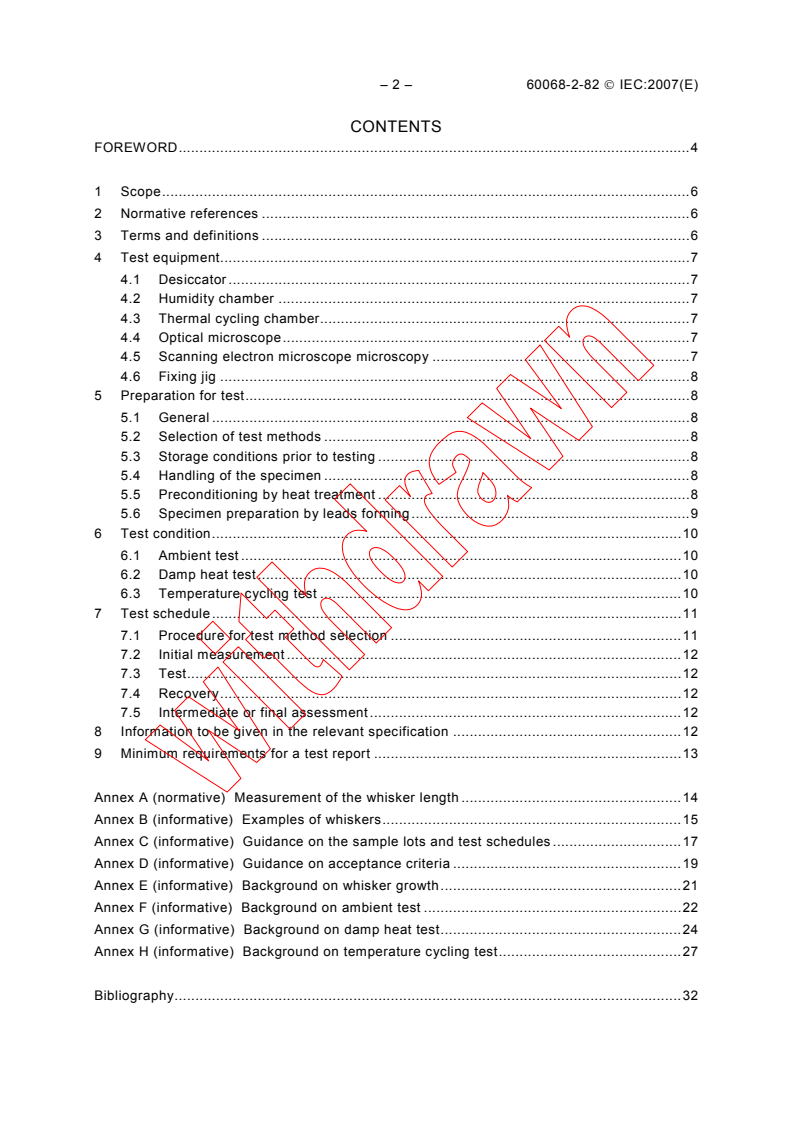
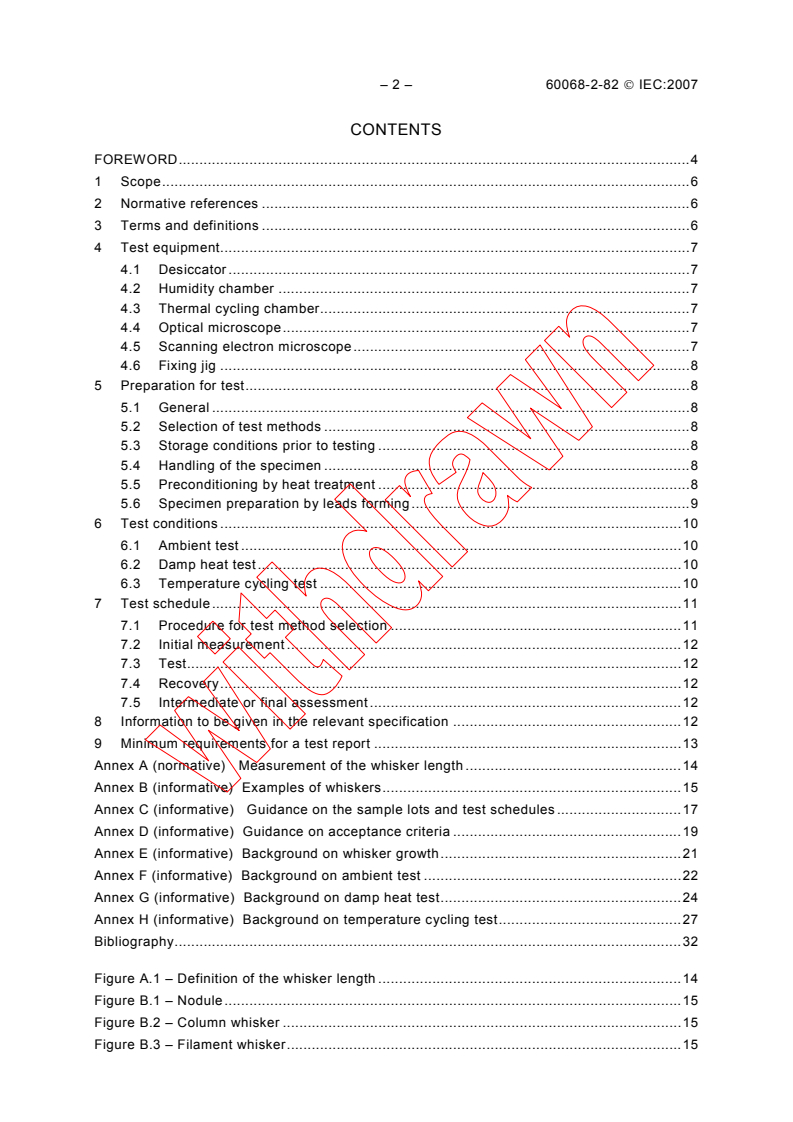
CONTENTS
FOREWORD.4
1 Scope.6
2 Normative references .6
3 Terms and definitions .6
4 Test equipment.7
4.1 Desiccator .7
4.2 Humidity chamber .7
4.3 Thermal cycling chamber.7
4.4 Optical microscope.7
4.5 Scanning electron microscope microscopy .7
4.6 Fixing jig .8
5 Preparation for test.8
5.1 General .8
5.2 Selection of test methods .8
5.3 Storage conditions prior to testing .8
5.4 Handling of the specimen .8
5.5 Preconditioning by heat treatment .8
5.6 Specimen preparation by leads forming.9
6 Test condition.10
6.1 Ambient test .10
6.2 Damp heat test.10
6.3 Temperature cycling test .10
7 Test schedule.11
7.1 Procedure for test method selection .11
7.2 Initial measurement .12
7.3 Test.12
7.4 Recovery.12
7.5 Intermediate or final assessment .12
8 Information to be given in the relevant specification .12
9 Minimum requirements for a test report .13
Annex A (normative) Measurement of the whisker length .14
Annex B (informative) Examples of whiskers.15
Annex C (informative) Guidance on the sample lots and test schedules .17
Annex D (informative) Guidance on acceptance criteria .19
Annex E (informative) Background on whisker growth.21
Annex F (informative) Background on ambient test .22
Annex G (informative) Background on damp heat test.24
Annex H (informative) Background on temperature cycling test.27
Bibliography.32
60068-2-82 © IEC:2007(E) – 3 –
Figure A.1 – Definition of the whisker length .14
Figure B.1 – Nodule.15
Figure B.2 – Column whisker .15
Figure B.3 – Filament whisker.15
Figure B.4 – Kinked whisker .16
Figure B.5 – Spiral whisker .16
Figure D.1 – Smallest distance of components and circuit boards .19
Figure F.1 – Whisker growth of tin plating in ambient test condition .23
Figure G.1 – Growth of the oxide layer in damp heat conditions.25
Figure G.2a – Growth of whiskers in damp heat conditions .25
Figure G.2b – Growth of whiskers in damp heat conditions .26
Figure G.2 – Growth of whiskers.26
Figure H.1 – Distribution of whisker length grown on FeNi (Alloy42) base material.28
Figure H.2 – Whisker grown on FeNi (Alloy42) base material.29
Figure H.3 – Relationship of Δϑ and number of cycles for whisker growth on FeNi
(Alloy 42) base material .29
Figure H.4 – Whisker growth on Cu based leadframes (QFP) in temperature cycling
tests .31
Table 1 – Methods of preconditioning: Soldering simulation .
Table 2 – Methods of preconditioning: Soldering.9
Table 3 – Severities of the ambient test .10
Table 4 – Severities of the temperature cycling test: temperature .10
Table 5 – Severities of the temperature cycling test: cycles .11
Table 6 – Suitability of test methods for different plating situations .11
Table H.1 – Example for a relationship between realistic application conditions and
test conditions .30
– 4 – 60068-2-82 © IEC:2007(E)
INTERNATIONAL ELECTROTECHNICAL COMMISSION
____________
ENVIRONMENTAL TESTING –
Part 2-82: Tests – Test XW : Whisker test methods
for electronic and electric components
FOREWORD
1) The International Electrotechnical Commission (IEC) is a worldwide organization for standardization comprising
all national electrotechnical committees (IEC National Committees). The object of IEC is to promote
international co-operation on all questions concerning standardization in the electrical and electronic fields. To
this end and in addition to other activities, IEC publishes International Standards, Technical Specifications,
Technical Reports, Publicly Available Specifications (PAS) and Guides (hereafter referred to as “IEC
Publication(s)”). Their preparation is entrusted to technical committees; any IEC National Committee interested
in the subject dealt with may participate in this preparatory work. International, governmental and non-
governmental organizations liaising with the IEC also participate in this preparation. IEC collaborates closely
with the International Organization for Standardization (ISO) in accordance with conditions determined by
agreement between the two organizations.
2) The formal decisions or agreements of IEC on technical matters express, as nearly as possible, an international
consensus of opinion on the relevant subjects since each technical committee has representation from all
interested IEC National Committees.
3) IEC Publications have the form of recommendations for international use and are accepted by IEC National
Committees in that sense. While all reasonable efforts are made to ensure that the technical content of IEC
Publications is accurate, IEC cannot be held responsible for the way in which they are used or for any
misinterpretation by any end user.
4) In order to promote international uniformity, IEC National Committees undertake to apply IEC Publications
transparently to the maximum extent possible in their national and regional publications. Any divergence
between any IEC Publication and the corresponding national or regional publication shall be clearly indicated in
the latter.
5) IEC itself does not provide any attestation of conformity. Independent certification bodies provide conformity
assessment services and, in some areas, access to IEC marks of conformity. IEC is not responsible for any
services carried out by independent certification bodies.
6) All users should ensure that they have the latest edition of this publication.
7) No liability shall attach to IEC or its directors, employees, servants or agents including individual experts and
members of its technical committees and IEC National Committees for any personal injury, property damage or
other damage of any nature whatsoever, whether direct or indirect, or for costs (including legal fees) and
expenses arising out of the publication, use of, or reliance upon, this IEC Publication or any other IEC
Publications.
8) Attention is drawn to the Normative references cited in this publication. Use of the referenced publications is
indispensable for the correct application of this publication.
9) Attention is drawn to the possibility that some of the elements of this IEC Publication may be the subject of
patent rights. IEC shall not be held responsible for identifying any or all such patent rights.
International Standard IEC 60068-2-82 has been prepared by IEC technical committee 91:
Electronics assembly technology.
The text of this standard is based on the following documents:
FDIS Report on voting
91/651/FDIS 91/685/RVD
Full information on the voting for the approval of this standard can be found in the report on
voting indicated in the above table.
This publication has been drafted in accordance with the ISO/IEC Directives, Part 2.
60068-2-82 © IEC:2007(E) – 5 –
A list of all parts in the IEC 60068 series, under the general title Environmental testing, can be
found on the IEC website.
The committee has decided that the contents of this publication will remain unchanged until
the maintenance result date indicated on the IEC web site under "http://webstore.iec.ch" in
the data related to the specific publication. At this date, the publication will be
• reconfirmed,
• withdrawn,
• replaced by a revised edition, or
• amended.
A bilingual version of this publication may be issued at a later date.
The contents of the corrigendum of December 2009 have been included in this copy.
– 6 – 60068-2-82 © IEC:2007(E)
ENVIRONMENTAL TESTING –
Part 2-82: Tests – Test XW : Whisker test methods
for electronic and electric components
1 Scope
This part of IEC 60068 specifies whisker tests for electric or electronic components
representing the finished stage, with tin or tin-alloy finish. However, the standard does not
specify tests for whiskers that may grow as a result of external mechanical stress.
This test method is employed by a relevant specification (international component or
application specification) with transfer of the test severities to be applied and with defined
acceptance criteria.
Where tests described in this standard are considered for other components, e.g. mechanical
parts as used in electrical or electronic equipment, it should be ensured that the material
system and whisker growth mechanisms are comparable.
2 Normative references
The following referenced documents are indispensable for the application of this document.
For dated references, only the edition cited applies. For undated references, the latest edition
of the referenced document (including any amendments) applies.
IEC 60068-1:1988, Environmental testing – Part 1: General and guidance
IEC 60068-2-14, Environmental testing – Part 2-14: Tests – Test N: Change of temperature
IEC 60068-2-20:1979, Environmental testing – Part 2-20: Tests – Test T: Soldering
IEC 60068-2-58:2004, Environmental testing – Part 2-58: Tests – Test Td: Test methods for
solderability, resistance to dissolution of metallization and to soldering heat of surface
mounting devices (SMD)
IEC 60068-2-78, Environmental testing – Part 2-78: Test Cab: Damp heat, steady state
IEC 61192-3:2002, Workmanship requirements for soldered electronic assemblies – Part 3:
Through-hole mount assemblies
IEC 61760-1:2006, Surface mounting technology – Part 1: Standard method for the
specification of surface mounting components (SMDs)
3 Terms and definitions
For the purposes of this document, the terms and definitions given in IEC 60068-1, as well as
the following, apply.
3.1
whisker
metallic protrusion which spontaneously grows during storage or use
60068-2-82 © IEC:2007(E) – 7 –
NOTE 1 Whiskers typically do not require any electrical field for their growth and may not be mixed with products
of electrochemical migration. Typical signs of whiskers include:
– striations in growth direction;
– typically no branching;
– typically constant diameters.
Exceptions are known, but rare and may require detailed investigation.
For the purposes of this standard, whiskers are considered if
– they have an aspect ratio (length/width) greater than 2,
– they have a length of 10 µm or more.
NOTE 2 For the purposes of this standard, whiskers have the following characteristics:
– they can be kinked, bent, or twisted; they usually have a uniform cross-sectional shape;
– they may have rings around the circumference of the column.
NOTE 3 Whiskers are not to be confused with dendrites which are fern-like growths on the surface of a material
which can be formed as a result of electro-migration of an ionic species or produced during solidification.
3.2
material system
termination consists of the following elements:
a) base material;
b) underlayer, if any, located under the final plating;
c) final tin or tin alloy plating.
NOTE There may be additional layers between the base material and the underlayer. The penultimate layer is the
used bulk material or the deposited layer underneath the final tin or tin alloy plating of the component.
4 Test equipment
The test equipment shall comprise the following elements:
4.1 Desiccator
The desiccator shall be capable of providing the conditions of temperature and humidity
specified in 6.1.
4.2 Humidity chamber
The humidity chamber shall meet all the requirements of IEC 60068-2-78 and be capable of
providing the conditions specified in 6.2.
4.3 Thermal cycling chamber
The thermal cycling chamber shall meet all the requirements of IEC 60068-2-14, test Na and
be capable of providing the conditions specified in 6.3.
4.4 Optical microscope
An optical stereo-microscope with a magnification of at least 50 times and an appropriate
illumination, capable of detecting whiskers with a length of 10 μm.
If used for measurement, the microscope shall be equipped with a scale or electronic
detection system capable for length measurement with an accuracy of at least ±5 µm.
4.5 Scanning electron microscope
A scanning electron microscope (SEM) capable of investigating the surface of the specimen,
preferably equipped with a handling system capable to tilt and rotate the specimen.
– 8 – 60068-2-82 © IEC:2007(E)
4.6 Fixing jig
The fixture jig shall be capable of setting samples in any of the test chambers specified in 4.1,
4.2 and 4.3 without affecting compliance with the specified requirements.
The jig should also be attachable to the optical microscope or be appropriately small in size
so that it can be inserted in the SEM sample chamber.
5 Preparation for test
5.1 General
The samples shall represent finished products as supplied to the market.
NOTE Guidance on suitable sample sizes is provided in Annex C.
5.2 Selection of test methods
Choose the appropriate test method according to the type of final plating, underlayer and
base material of the specimen according to Table 6.
5.3 Storage conditions prior to testing
The specimen shall be kept for at least 2 h in the standard atmospheric conditions defined in
IEC 60068-1, 5.3.1 prior to any preconditioning or test.
5.4 Handling of the specimen
It is recommended to hold the specimen with a fixture jig as specified in 4.6 to prevent them
from being contaminated unexpectedly. The fixture jig shall not contact the metallic surfaces
of the specimen to be tested. The sample shall be handled carefully to prevent the grown
whiskers from falling away unexpectedly. Broken whiskers shall be recorded, see 7.4.
Where there is a possibility of grown whiskers to drop down, an appropriate fixture jig design
shall be considered in advance of the test. Conductive sputter coating typically used to aid
SEM inspection, such as C, Pt, or Au, shall not be deposited on the specimen.
5.5 Preconditioning by heat treatment
5.5.1 Soldering simulation prior to ambient and damp heat test (see 6.1 and 6.2)
a) Components intended for soldering
Before soldering simulation, the specimen of material descriptions case 1.1, case 3 or case 4
shall have been stored under room temperature for more than 30 days after the last
manufacturing process, e.g. as indicated by the date code of the product.
Unless otherwise specified by the relevant specification, the components shall be submitted to
a soldering simulation according to Table 1 without the use of solder and without contact to
any metal surface.
60068-2-82 © IEC:2007(E) – 9 –
Table 1 – Methods of preconditioning – Soldering simulation
Soldering simulation
Component type
First half of the sample Second half of the sample
SMD Reflow heat treatment None
according to Table 3 (Group 3) of
8.1.2.1, IEC 60068-2-58
Other Bath with inert liquid None
according to test Ta, method 1 of
IEC 60068-2-20
Dipping depth: max. 4 mm.
e.g. Perfluoropolyether PFPE.
After preconditioning the test shall be started within 168 h.
Conditions of thermal preconditioning shall be recorded.
b) Components not intended for soldering
No thermal preconditioning shall be applied.
5.5.2 Soldering simulation prior to temperature cycling test (see 6.3)
a) Components intended for soldering
Before soldering, the specimen of material descriptions case 1.1, case 3 or case 4 shall have
been stored under room temperature for more than 30 days after the last manufacturing
process, e.g. as indicated by the date code of the product.
Unless otherwise specified by the relevant specification, the components may be assembled
onto printed circuit boards. The circuit board material shall be epoxide woven glass with a
thickness of (1,6 ± 0,2) mm. The assembly process shall be according to Table 2.
Table 2 – Methods of preconditioning – Soldering
Component type Soldering
SMD Hot air convection reflow soldering with SnAgCu solder , low activity flux,
according to Table 3 (Group 3) of 8.1.2.1, IEC 60068-2-58
Other Wave soldering by use of a soldering profile according to 6.1 of IEC 61760-
1, using SnAgCu solder
Apply 50 % of the solder paste volume recommended for typical production. This requirement shall ensure that
after soldering a part of the terminal surface is not covered by solder and remains for inspection.
After this preconditioning the test shall be started within 168 h.
The soldering conditions shall be recorded.
b) Components not intended for soldering
Unless otherwise described by the relevant specification, the components are tested in
unassembled stage.
5.6 Specimen preparation by leads forming
In cases where components are subjected to mechanical stress after delivery, e.g. the
forming of leads, a representative pre-conditioning is required. Unless otherwise specified by
the relevant specification, each specimen shall be bent 90° to the consistent inner bending
radius specified as the minimum radius in Table 1, of IEC 61192-3.
– 10 – 60068-2-82 © IEC:2007(E)
6 Test conditions
6.1 Ambient test
Unless otherwise specified by the relevant specification, apply the conditions according to
Table 3 and in accordance with the severity selected from Table 6:
Table 3 – Severities of the ambient test
Temperature Relative humidity
Severity
°C %
A 30 ± 2 60 ± 3
B 25 ± 10 50 ± 25
Test duration: 4 000 h.
6.2 Damp heat test
Unless otherwise specified by the relevant specification, use the humidity chamber specified
in IEC 60068-2-78 and apply the conditions stated below:
− temperature: (55 ± 3) °C
− relative humidity: (85 ± 5) %
− test duration: 2 000 h.
Apply heating, cooling, moistening, and dehumidifying in the test in a way that dew does not
condensate on the specimens.
6.3 Temperature cycling test
Unless otherwise specified by the relevant specification, apply the procedures specified in
IEC 60068-2-14, test Na with the conditions stated below:
For the lower temperature and upper temperature, one severity according to Table 4 shall be
used.
Table 4 – Severities of the temperature cycling test – Temperature
Severity Lower temperature Upper temperature
(First character) °C °C
K -40 ± 5 85 ± 2
L -55 ± 5 85 ± 2
M -40 ± 5 125 ± 2
N -55 ± 5 125 ± 2
NOTE Neither the sequence of listed severities nor the range between lower and
upper temperature impose a specific degree of severity, see Annex H.
NOTE Severities for this test are given by two characters, e.g. KQ for -40 °C / 85 °C / 1 000 cycles. Reference to
only one severity parameter can be made by using an “x” for the unspecified parameter, e.g Kx for -40 °C / 85 °C.
Apply a minimum dwell time of 20 min for both the low and high test temperature. The transfer
time between the extremes shall be less than 30 s.
For the number of test cycles, apply the conditions according to Table 5 and in accordance
with the severity selected from Table 6.
60068-2-82 © IEC:2007(E) – 11 –
Table 5 – Severities of the temperature cycling test – Cycles
Severity
Number of cycles
(Second character)
P 2 000
Q 1 000
NOTE Severities for this test are given by two characters, e.g. KQ for -40 °C / 85 °C / 1000 cycles. Reference to
only one severity parameter can be made by using an “x” for the unspecified parameter, e.g xQ for 1000 cycles.
7 Test schedule
7.1 Procedure for test method selection
Unless otherwise specified by the relevant specification, test methods shall be selected
according to the type of plating, underlayer and base material of the component. Apply the
decision matrix of Table 6 for the selection of the appropriate test methods.
Table 6 – Suitability of test methods for different plating situations
Test method and severity
Material description
Case
Damp heat test Temperature
Ambient test
Base material, underlayer and plating
cycling test
6.1 6.2 6.3
1 Base material is an alloy of only iron (Fe) and
nickel (Ni) without underlayer, or underlayer is an
YES
alloy of only iron and nickel. NO YES
Severity xP
Plating is tin (Sn) or any tin alloy, except those
alloys defined in case 1.1.
1.1 Base material is an alloy of only iron (Fe) and
nickel (Ni) without underlayer, or underlayer is alloy
YES YES
of only iron and nickel. YES
Severity A Severity xP
Plating is a tin (Sn) alloy containing copper (Cu) or
zinc (Zn) or both.
2 Any base material except those covered in case 1.0 YES YES
YES
or 1.1. Underlayer is nickel (Ni) or silver (Ag)
...
IEC 60068-2-82
Edition 1.0 2007-05
INTERNATIONAL
STANDARD
NORME
INTERNATIONALE
Environmental testing –
Part 2-82: Tests – Test XW : Whisker test methods for electronic and electric
components
Essais d’environnement –
Partie 2-82: Essais – Essai XW : Méthodes de vérification des trichites pour les
composants électroniques et électriques
All rights reserved. Unless otherwise specified, no part of this publication may be reproduced or utilized in any form or by
any means, electronic or mechanical, including photocopying and microfilm, without permission in writing from either IEC or
IEC's member National Committee in the country of the requester.
If you have any questions about IEC copyright or have an enquiry about obtaining additional rights to this publication,
please contact the address below or your local IEC member National Committee for further information.
Droits de reproduction réservés. Sauf indication contraire, aucune partie de cette publication ne peut être reproduite
ni utilisée sous quelque forme que ce soit et par aucun procédé, électronique ou mécanique, y compris la photocopie
et les microfilms, sans l'accord écrit de la CEI ou du Comité national de la CEI du pays du demandeur.
Si vous avez des questions sur le copyright de la CEI ou si vous désirez obtenir des droits supplémentaires sur cette
publication, utilisez les coordonnées ci-après ou contactez le Comité national de la CEI de votre pays de résidence.
IEC Central Office
3, rue de Varembé
CH-1211 Geneva 20
Switzerland
Email: inmail@iec.ch
Web: www.iec.ch
About the IEC
The International Electrotechnical Commission (IEC) is the leading global organization that prepares and publishes
International Standards for all electrical, electronic and related technologies.
About IEC publications
The technical content of IEC publications is kept under constant review by the IEC. Please make sure that you have the
latest edition, a corrigenda or an amendment might have been published.
ƒ Catalogue of IEC publications: www.iec.ch/searchpub
The IEC on-line Catalogue enables you to search by a variety of criteria (reference number, text, technical committee,…).
It also gives information on projects, withdrawn and replaced publications.
ƒ IEC Just Published: www.iec.ch/online_news/justpub
Stay up to date on all new IEC publications. Just Published details twice a month all new publications released. Available
on-line and also by email.
ƒ Electropedia: www.electropedia.org
The world's leading online dictionary of electronic and electrical terms containing more than 20 000 terms and definitions
in English and French, with equivalent terms in additional languages. Also known as the International Electrotechnical
Vocabulary online.
ƒ Customer Service Centre: www.iec.ch/webstore/custserv
If you wish to give us your feedback on this publication or need further assistance, please visit the Customer Service
Centre FAQ or contact us:
Email: csc@iec.ch
Tel.: +41 22 919 02 11
Fax: +41 22 919 03 00
A propos de la CEI
La Commission Electrotechnique Internationale (CEI) est la première organisation mondiale qui élabore et publie des
normes internationales pour tout ce qui a trait à l'électricité, à l'électronique et aux technologies apparentées.
A propos des publications CEI
Le contenu technique des publications de la CEI est constamment revu. Veuillez vous assurer que vous possédez
l’édition la plus récente, un corrigendum ou amendement peut avoir été publié.
ƒ Catalogue des publications de la CEI: www.iec.ch/searchpub/cur_fut-f.htm
Le Catalogue en-ligne de la CEI vous permet d’effectuer des recherches en utilisant différents critères (numéro de référence,
texte, comité d’études,…). Il donne aussi des informations sur les projets et les publications retirées ou remplacées.
ƒ Just Published CEI: www.iec.ch/online_news/justpub
Restez informé sur les nouvelles publications de la CEI. Just Published détaille deux fois par mois les nouvelles
publications parues. Disponible en-ligne et aussi par email.
ƒ Electropedia: www.electropedia.org
Le premier dictionnaire en ligne au monde de termes électroniques et électriques. Il contient plus de 20 000 termes et
définitions en anglais et en français, ainsi que les termes équivalents dans les langues additionnelles. Egalement appelé
Vocabulaire Electrotechnique International en ligne.
ƒ Service Clients: www.iec.ch/webstore/custserv/custserv_entry-f.htm
Si vous désirez nous donner des commentaires sur cette publication ou si vous avez des questions, visitez le FAQ du
Service clients ou contactez-nous:
Email: csc@iec.ch
Tél.: +41 22 919 02 11
Fax: +41 22 919 03 00
IEC 60068-2-82
Edition 1.0 2007-05
INTERNATIONAL
STANDARD
NORME
INTERNATIONALE
Environmental testing –
Part 2-82: Tests – Test XW : Whisker test methods for electronic and electric
components
Essais d’environnement –
Partie 2-82: Essais – Essai XW : Méthodes de vérification des trichites pour les
composants électroniques et électriques
INTERNATIONAL
ELECTROTECHNICAL
COMMISSION
COMMISSION
ELECTROTECHNIQUE
PRICE CODE
INTERNATIONALE
V
CODE PRIX
ICS 19.040 ISBN 2-8318-9718-1
– 2 – 60068-2-82 © IEC:2007
CONTENTS
FOREWORD.4
1 Scope.6
2 Normative references .6
3 Terms and definitions .6
4 Test equipment.7
4.1 Desiccator .7
4.2 Humidity chamber .7
4.3 Thermal cycling chamber.7
4.4 Optical microscope.7
4.5 Scanning electron microscope.7
4.6 Fixing jig .8
5 Preparation for test.8
5.1 General .8
5.2 Selection of test methods .8
5.3 Storage conditions prior to testing .8
5.4 Handling of the specimen .8
5.5 Preconditioning by heat treatment .8
5.6 Specimen preparation by leads forming.9
6 Test conditions .10
6.1 Ambient test .10
6.2 Damp heat test.10
6.3 Temperature cycling test .10
7 Test schedule.11
7.1 Procedure for test method selection .11
7.2 Initial measurement .12
7.3 Test.12
7.4 Recovery.12
7.5 Intermediate or final assessment .12
8 Information to be given in the relevant specification .12
9 Minimum requirements for a test report .13
Annex A (normative) Measurement of the whisker length .14
Annex B (informative) Examples of whiskers.15
Annex C (informative) Guidance on the sample lots and test schedules .17
Annex D (informative) Guidance on acceptance criteria .19
Annex E (informative) Background on whisker growth.21
Annex F (informative) Background on ambient test .22
Annex G (informative) Background on damp heat test.24
Annex H (informative) Background on temperature cycling test.27
Bibliography.32
Figure A.1 – Definition of the whisker length .
Figure B.1 – Nodule.15
Figure B.2 – Column whisker .15
Figure B.3 – Filament whisker.15
60068-2-82 © IEC:2007 – 3 –
Figure B.4 – Kinked whisker .16
Figure B.5 – Spiral whisker .16
Figure D.1 – Smallest distance of components and circuit boards .19
Figure F.1 – Whisker growth of tin plating in ambient test condition .23
Figure G.1 – Growth of the oxide layer in damp heat conditions.25
Figure G.2a – Growth of whiskers in damp heat conditions .25
Figure G.2b – Growth of whiskers in damp heat conditions .26
Figure G.2 – Growth of whiskers.26
Figure H.1 – Distribution of whisker length grown on FeNi (Alloy42) base material.28
Figure H.2 – Whisker grown on FeNi (Alloy42) base material.29
Figure H.3 – Relationship of Δϑ and number of cycles for whisker growth on FeNi
(Alloy42) base material .29
Figure H.4 – Whisker growth on Cu based leadframes (QFP) in temperature cycling
tests .31
Table 1 – Methods of preconditioning – Soldering simulation .9
Table 2 – Methods of preconditioning – Soldering.9
Table 3 – Severities of the ambient test .10
Table 4 – Severities of the temperature cycling test – Temperature .10
Table 5 – Severities of the temperature cycling test – Cycles.11
Table 6 – Suitability of test methods for different plating situations .11
Table H.1 – Example for a relationship between realistic application conditions and test
conditions .
– 4 – 60068-2-82 © IEC:2007
INTERNATIONAL ELECTROTECHNICAL COMMISSION
____________
ENVIRONMENTAL TESTING –
Part 2-82: Tests – Test XW : Whisker test methods
for electronic and electric components
FOREWORD
1) The International Electrotechnical Commission (IEC) is a worldwide organization for standardization comprising
all national electrotechnical committees (IEC National Committees). The object of IEC is to promote
international co-operation on all questions concerning standardization in the electrical and electronic fields. To
this end and in addition to other activities, IEC publishes International Standards, Technical Specifications,
Technical Reports, Publicly Available Specifications (PAS) and Guides (hereafter referred to as “IEC
Publication(s)”). Their preparation is entrusted to technical committees; any IEC National Committee interested
in the subject dealt with may participate in this preparatory work. International, governmental and non-
governmental organizations liaising with the IEC also participate in this preparation. IEC collaborates closely
with the International Organization for Standardization (ISO) in accordance with conditions determined by
agreement between the two organizations.
2) The formal decisions or agreements of IEC on technical matters express, as nearly as possible, an international
consensus of opinion on the relevant subjects since each technical committee has representation from all
interested IEC National Committees.
3) IEC Publications have the form of recommendations for international use and are accepted by IEC National
Committees in that sense. While all reasonable efforts are made to ensure that the technical content of IEC
Publications is accurate, IEC cannot be held responsible for the way in which they are used or for any
misinterpretation by any end user.
4) In order to promote international uniformity, IEC National Committees undertake to apply IEC Publications
transparently to the maximum extent possible in their national and regional publications. Any divergence
between any IEC Publication and the corresponding national or regional publication shall be clearly indicated in
the latter.
5) IEC itself does not provide any attestation of conformity. Independent certification bodies provide conformity
assessment services and, in some areas, access to IEC marks of conformity. IEC is not responsible for any
services carried out by independent certification bodies.
6) All users should ensure that they have the latest edition of this publication.
7) No liability shall attach to IEC or its directors, employees, servants or agents including individual experts and
members of its technical committees and IEC National Committees for any personal injury, property damage or
other damage of any nature whatsoever, whether direct or indirect, or for costs (including legal fees) and
expenses arising out of the publication, use of, or reliance upon, this IEC Publication or any other IEC
Publications.
8) Attention is drawn to the Normative references cited in this publication. Use of the referenced publications is
indispensable for the correct application of this publication.
9) Attention is drawn to the possibility that some of the elements of this IEC Publication may be the subject of
patent rights. IEC shall not be held responsible for identifying any or all such patent rights.
International Standard IEC 60068-2-82 has been prepared by IEC technical committee 91:
Electronics assembly technology.
This bilingual version, published in 2008-04, corresponds to the English version.
The text of this standard is based on the following documents:
FDIS Report on voting
91/651/FDIS 91/685/RVD
Full information on the voting for the approval of this standard can be found in the report on
voting indicated in the above table.
The French version of this standard has not been voted upon.
60068-2-82 © IEC:2007 – 5 –
This publication has been drafted in accordance with the ISO/IEC Directives, Part 2.
A list of all parts in the IEC 60068 series, under the general title Environmental testing, can be
found on the IEC website.
The committee has decided that the contents of this publication will remain unchanged until
the maintenance result date indicated on the IEC web site under "http://webstore.iec.ch" in
the data related to the specific publication. At this date, the publication will be
• reconfirmed,
• withdrawn,
• replaced by a revised edition, or
• amended.
The contents of the corrigendum of December 2009 have been included in this copy.
– 6 – 60068-2-82 © IEC:2007
ENVIRONMENTAL TESTING –
Part 2-82: Tests – Test XW : Whisker test methods
for electronic and electric components
1 Scope
This part of IEC 60068 specifies whisker tests for electric or electronic components
representing the finished stage, with tin or tin-alloy finish. However, the standard does not
specify tests for whiskers that may grow as a result of external mechanical stress.
This test method is employed by a relevant specification (international component or
application specification) with transfer of the test severities to be applied and with defined
acceptance criteria.
Where tests described in this standard are considered for other components, e.g. mechanical
parts as used in electrical or electronic equipment, it should be ensured that the material
system and whisker growth mechanisms are comparable.
2 Normative references
The following referenced documents are indispensable for the application of this document.
For dated references, only the edition cited applies. For undated references, the latest edition
of the referenced document (including any amendments) applies.
IEC 60068-1:1988, Environmental testing – Part 1: General and guidance
IEC 60068-2-14, Environmental testing – Part 2-14: Tests – Test N: Change of temperature
IEC 60068-2-20:1979, Environmental testing – Part 2-20: Tests – Test T: Soldering
IEC 60068-2-58:2004, Environmental testing – Part 2-58: Tests – Test Td: Test methods for
solderability, resistance to dissolution of metallization and to soldering heat of surface
mounting devices (SMD)
IEC 60068-2-78, Environmental testing – Part 2-78: Tests – Test Cab: Damp heat, steady
state
IEC 61192-3:2002, Workmanship requirements for soldered electronic assemblies – Part 3:
Through-hole mount assemblies
IEC 61760-1:2006, Surface mounting technology – Part 1: Standard method for the
specification of surface mounting components (SMDs)
3 Terms and definitions
For the purposes of this document, the terms and definitions given in IEC 60068-1, as well as
the following, apply.
3.1
whisker
metallic protrusion which spontaneously grows during storage or use
60068-2-82 © IEC:2007 – 7 –
NOTE 1 Whiskers typically do not require any electrical field for their growth and may not be mixed with products
of electrochemical migration. Typical signs of whiskers include:
– striations in growth direction;
– typically no branching;
– typically constant diameters.
Exceptions are known, but rare and may require detailed investigation.
For the purposes of this standard, whiskers are considered if
– they have an aspect ratio (length/width) greater than 2,
– they have a length of 10 µm or more.
NOTE 2 For the purposes of this standard, whiskers have the following characteristics:
– they can be kinked, bent, or twisted; they usually have a uniform cross-sectional shape;
– they may have rings around the circumference of the column.
NOTE 3 Whiskers are not to be confused with dendrites which are fern-like growths on the surface of a material
which can be formed as a result of electro-migration of an ionic species or produced during solidification.
3.2
material system
termination consists of the following elements:
a) base material;
b) underlayer, if any, located under the final plating;
c) final tin or tin alloy plating.
NOTE There may be additional layers between the base material and the underlayer. The penultimate layer is the
used bulk material or the deposited layer underneath the final tin or tin alloy plating of the component.
4 Test equipment
The test equipment shall comprise the following elements:
4.1 Desiccator
The desiccator shall be capable of providing the conditions of temperature and humidity
specified in 6.1.
4.2 Humidity chamber
The humidity chamber shall meet all the requirements of IEC 60068-2-78 and be capable of
providing the conditions specified in 6.2.
4.3 Thermal cycling chamber
The thermal cycling chamber shall meet all the requirements of IEC 60068-2-14, test Na and
be capable of providing the conditions specified in 6.3.
4.4 Optical microscope
An optical stereo-microscope with a magnification of at least 50 times and an appropriate
illumination, capable of detecting whiskers with a length of 10 μm.
If used for measurement, the microscope shall be equipped with a scale or electronic
detection system capable for length measurement with an accuracy of at least ±5 µm.
4.5 Scanning electron microscope
A scanning electron microscope (SEM) capable of investigating the surface of the specimen,
preferably equipped with a handling system capable to tilt and rotate the specimen.
– 8 – 60068-2-82 © IEC:2007
4.6 Fixing jig
The fixture jig shall be capable of setting samples in any of the test chambers specified in 4.1,
4.2 and 4.3 without affecting compliance with the specified requirements.
The jig should also be attachable to the optical microscope or be appropriately small in size
so that it can be inserted in the SEM sample chamber.
5 Preparation for test
5.1 General
The samples shall represent finished products as supplied to the market.
NOTE Guidance on suitable sample sizes is provided in Annex C.
5.2 Selection of test methods
Choose the appropriate test method according to the type of final plating, underlayer and
base material of the specimen according to Table 6.
5.3 Storage conditions prior to testing
The specimen shall be kept for at least 2 h in the standard atmospheric conditions defined in
IEC 60068-1, 5.3.1 prior to any preconditioning or test.
5.4 Handling of the specimen
It is recommended to hold the specimen with a fixture jig as specified in 4.6 to prevent them
from being contaminated unexpectedly. The fixture jig shall not contact the metallic surfaces
of the specimen to be tested. The sample shall be handled carefully to prevent the grown
whiskers from falling away unexpectedly. Broken whiskers shall be recorded, see 7.4.
Where there is a possibility of grown whiskers to drop down, an appropriate fixture jig design
shall be considered in advance of the test. Conductive sputter coating typically used to aid
SEM inspection, such as C, Pt, or Au, shall not be deposited on the specimen.
5.5 Preconditioning by heat treatment
5.5.1 Soldering simulation prior to ambient and damp heat test (see 6.1 and 6.2)
a) Components intended for soldering
Before soldering simulation, the specimen of material descriptions case 1.1, case 3 or case 4
shall have been stored under room temperature for more than 30 days after the last
manufacturing process, e.g. as indicated by the date code of the product.
Unless otherwise specified by the relevant specification, the components shall be submitted to
a soldering simulation according to Table 1 without the use of solder and without contact to
any metal surface.
60068-2-82 © IEC:2007 – 9 –
Table 1 – Methods of preconditioning – Soldering simulation
Soldering simulation
Component type
First half of the sample Second half of the sample
SMD Reflow heat treatment None
according to Table 3 (Group 3) of
8.1.2.1, IEC 60068-2-58
Other Bath with inert liquid None
according to test Ta, method 1 of
IEC 60068-2-20
Dipping depth: max. 4 mm.
e.g. Perfluoropolyether PFPE.
After preconditioning the test shall be started within 168 h.
Conditions of thermal preconditioning shall be recorded.
b) Components not intended for soldering
No thermal preconditioning shall be applied.
5.5.2 Soldering simulation prior to temperature cycling test (see 6.3)
a) Components intended for soldering
Before soldering, the specimen of material descriptions case 1.1, case 3 or case 4 shall have
been stored under room temperature for more than 30 days after the last manufacturing
process, e.g. as indicated by the date code of the product.
Unless otherwise specified by the relevant specification, the components may be assembled
onto printed circuit boards. The circuit board material shall be epoxide woven glass with a
thickness of (1,6 ± 0,2) mm. The assembly process shall be according to Table 2.
Table 2 – Methods of preconditioning – Soldering
Component type Soldering
SMD Hot air convection reflow soldering with SnAgCu solder , low activity flux,
according to Table 3 (Group 3) of 8.1.2.1, IEC 60068-2-58
Other Wave soldering by use of a soldering profile according to 6.1 of
IEC 61760-1, using SnAgCu solder
Apply 50 % of the solder paste volume recommended for typical production. This requirement shall ensure that
after soldering a part of the terminal surface is not covered by solder and remains for inspection.
After this preconditioning the test shall be started within 168 h.
The soldering conditions shall be recorded.
b) Components not intended for soldering
Unless otherwise described by the relevant specification, the components are tested in
unassembled stage.
5.6 Specimen preparation by leads forming
In cases where components are subjected to mechanical stress after delivery, e.g. the
forming of leads, a representative pre-conditioning is required. Unless otherwise specified by
the relevant specification, each specimen shall be bent 90° to the consistent inner bending
radius specified as the minimum radius in Table 1, of IEC 61192-3.
– 10 – 60068-2-82 © IEC:2007
6 Test conditions
6.1 Ambient test
Unless otherwise specified by the relevant specification, apply the conditions according to
Table 3 and in accordance with the severity selected from Table 6:
Table 3 – Severities of the ambient test
Temperature Relative humidity
Severity
°C %
A
30 ± 2 60 ± 3
B
25 ± 10 50 ± 25
Test duration: 4 000 h.
6.2 Damp heat test
Unless otherwise specified by the relevant specification, use the humidity chamber specified
in IEC 60068-2-78 and apply the conditions stated below:
– temperature: (55 ± 3) °C
– relative humidity: (85 ± 5) %
– test duration: 2 000 h.
Apply heating, cooling, moistening, and dehumidifying in the test in a way that dew does not
condensate on the specimens.
6.3 Temperature cycling test
Unless otherwise specified by the relevant specification, apply the procedures specified in
IEC 60068-2-14, test Na with the conditions stated below:
For the lower temperature and upper temperature, one severity according to Table 4 shall be
used.
Table 4 – Severities of the temperature cycling test – Temperature
Severity Lower temperature Upper temperature
(First character) °C °C
K
−40 ± 5 85 ± 2
L
−55 ± 5 85 ± 2
M
−40 ± 5 125 ± 2
N
−55 ± 5 125 ± 2
NOTE Neither the sequence of listed severities nor the range between lower and
upper temperature impose a specific degree of severity, see Annex H.
NOTE Severities for this test are given by two characters, e.g. KQ for −40 °C / 85 °C / 1 000 cycles. Reference to
only one severity parameter can be made by using an “x” for the unspecified parameter, e.g Kx for −40 °C / 85 °C.
Apply a minimum dwell time of 20 min for both the low and high test temperature. The transfer
time between the extremes shall be less than 30 s.
For the number of test cycles, apply the conditions according to Table 5 and in accordance
with the severity selected from Table 6.
60068-2-82 © IEC:2007 – 11 –
Table 5 – Severities of the temperature cycling test – Cycles
Severity
Number of cycles
(Second character)
P 2 000
Q 1 000
NOTE Severities for this test are given by two characters, e.g. KQ for −40 °C / 85 °C / 1 000 cycles. Reference to
only one severity parameter can be made by using an “x” for the unspecified parameter, e.g xQ for 1 000 cycles.
7 Test schedule
7.1 Procedure for test method selection
Unless otherwise specified by the relevant specification, test methods shall be selected
according to the type of plating, underlayer and base material of the component. Apply the
decision matrix of Table 6 for the selection of the appropriate test methods.
Table 6 – Suitability of test methods for different plating situations
Test method and severity
Material description
Case
Damp heat test Temperature
Ambient test
Base material, underlayer and plating
cycling test
6.1 6.2 6.3
1 Base material is an alloy of only iron (Fe) and
nickel (Ni) without underlayer, or underlayer is an
YES
alloy of only iron and nickel. NO YES
Severity xP
Plating is tin (Sn) or any tin alloy, except those
alloys defined in case 1.1.
1.1 Base material is an alloy of only iron (Fe) and
nickel (Ni) without underlayer, or underlayer is alloy
YES YES
of only iron and nickel. YES
Severity A Severity xP
Plating is a tin (Sn) alloy containing copper (Cu) or
zinc (Zn) or both.
2 Any base material except those covered in case 1.0 YES YES
YES
or 1.1. Underlayer is nickel (Ni) or silver (Ag).
Severity B Severity xQ
3 Base material is copper (Cu) or copper alloy, no
YES YES
YES
underlayer.
Severity A Severity xQ
Plating is tin (Sn) or any tin alloy.
3.1 Base material is copper (Cu) or copper alloy without
underlayer,
YES YES
or underlayer is copper or copper alloy. YES
Severity B Severity xQ
Plating is tin (Sn), with established inter-metallic Sn
Cu compound layer (see condition A below).
4 Base material or underlayer is none of the materials YES YES
YES
specified in cases 1 through 3 above.
Severity A Severity xP
Special conditions:
A) The presence of a grown inter-metallic Sn Cu compound layer with a minimum thickness
of 0,5 µm is presumed
– if the tin plating is deposited in a molten tin bath with a temperature of at least 250 °C
and a corresponding retention period of at least 0,5 s, or
– if the tin plating has been fused within 24 h after electroplating with a temperature of
at least 250 °C and a corresponding retention period of at least 0,5 s, or
– 12 – 60068-2-82 © IEC:2007
– if the tin plating has been annealed within 24 h after electroplating with a temperature
of at least 150 °C for a retention period of at least 1 h.
7.2 Initial measurement
Inspect the appearance of specimen prepared according to Clause 5 before performing the
test selected according to Table 6. Measure and record the maximum length of whiskers
found on the specimen.
If a more detailed assessment is desired, unless otherwise specified by the relevant specifi-
cation, whiskers shall be counted using a SEM in a square field of 250 μm × 250 μm at the
densest part on the sample.
7.3 Test
After the initial measurement, apply the test methods recommended by the decision matrix of
Table 6.
7.4 Recovery
At any intermediate test point, or after completion of the test, the specimen shall be stored in
the standard atmospheric conditions defined in IEC 60068-1, 5.3.1 for at least 2 h. The
specimen shall be handled carefully in order to prevent any whisker from falling off the
surface.
In the event of whiskers falling off, record such event and continue succeeding steps.
7.5 Intermediate or final assessment
Perform any intermediate or the final assessment as described in 7.2.
8 Information to be given in the relevant specification
When this test is included in the relevant specification, the following details shall be given as
far as they are applicable:
Information to be given: Subclause
a) Description of the fixing jig 4.6
b) Requirements for preparation of specimen
– thermal preconditioning 5.4, 5.5
– lead forming 5.6
c) Severities and tolerances for ambient test 6.1
– temperature
– humidity
– duration
d) Severities and tolerances for damp test 6.2
– temperature
– humidity
– duration
e) Severities and tolerances for temperature cycling test 6.3
– lower and upper temperature
– dwell time
– transition time
60068-2-82 © IEC:2007 – 13 –
– duration
f) Selection of test methods 7.1
g) Inspection area for assessments 7.2, 7.5
The relevant specification may specify intermediate inspections for all applied test methods.
The relevant specification shall specify for its purpose:
– performance and acceptance criteria for a visual inspection, if required
– acceptance criteria for all applied test methods.
9 Minimum requirements for a test report
When this test is used independently from a relevant specification, the following minimum
requirements for test reports shall apply:
– identification of the specimen;
– conditions of specimen preparation;
– test severities and duration;
– used test and measuring equipment:
– observed maximum whisker length.
– 14 – 60068-2-82 © IEC:2007
Annex A
(normative)
Measurement of the whisker length
The length of a whisker is defined as the straight-line distance from its source on the final
surface to its most distant point.
IEC 839/07
Figure A.1 – Definition of the whisker length
The specimen shall be rotated in order to make the source and the most distant point of the
whisker appear in the plane of observation.
NOTE Whiskers do not always grow in a single straight direction but may change direction during growth.
However, for the purpose of determining the length of the complete whisker, it is not appropriate to measure
fractions of a whisker regardless of their direction, and add them for a virtual total length.
60068-2-82 © IEC:2007 – 15 –
Annex B
(informative)
Examples of whiskers
The observed features may be addressed using the following terminology. However, this
description is not suitable for linking with acceptance criteria.
a) Nodule (also known as mound or hillock)
The length of the observed protrusion does not exceed two times its diameter.
IEC 840/07
Figure B.1 – Nodule
b) Column whisker
A whisker protruding from the final surface and having a columnar shape with a length up
to ten times its diameter.
IEC 841/07
Figure B.2 – Column whisker
c) Filament whisker (also know as needle whisker)
A whisker having a columnar shape with a length exceeding ten times its diameter.
IEC 842/07
Figure B.3 – Filament whisker
– 16 – 60068-2-82 © IEC:2007
d) Kinked whisker
A whisker having sections of columnar shape, showing spontaneous changes in growth
direction.
IEC 843/07
Figure B.4 – Kinked whisker
e) Spiral whisker
A whisker having a bent shape.
IEC 844/07
Figure B.5 – Spiral whisker
60068-2-82 © IEC:2007 – 17 –
Annex C
(informative)
Guidance on the sample lots and test schedules
C.1 General
This part of IEC 60068 should be used in conjunction with the relevant specification which will
define a sampling schedule, the tests to be used, the required degree of severity for each of
them and the respective requirements.
This annex provides the writers of the component specifications or application specifications
with a suitable basis for the definition of test schedules and requirements for the formation of
sample lots.
The aim is to harmonize requirements across independent component types or fields of
application, wherever deemed applicable.
C.2 Technological similarity
Products may be considered technologically similar, regardless of their actual size and
termination count, if their plated surfaces follow the same design, are built from the same
materials and use the same manufacturing process.
Variation in one or more of the following features does not affect the technological similarity of
products:
– thickness of base material, different wire diameter or lead or termination dimension;
– plating lines using identical plating process and equipment, including lines set up at
different locations;
– lead bending or forming specifications;
– lead or termination count;
– components using identical design, materials and process.
The following properties exclude products from being technologically similar:
– different composition of base material;
– different thickness or composition of underlayer;
– different composition of final material;
– different plating process, by physical type, by chemistry or by electric parameters;
– different post processing aiming at the suppression of whisker growth, e.g. fusing,
annealing.
A difference in any of the above items shall be assumed if the parameter exceeds the process
control limits.
Furthermore, technological similarity should be applicable to subcontractors only after passing
a qualification approval.
– 18 – 60068-2-82 © IEC:2007
C.3 Formation of inspection lots for qualification approval
Any inspection lot should consist of technologically similar products.
The inspection lots should be taken from different batches of products within a range of
technological similarity. If the concept of technological similarity is applied, the inspection lots
should be taken from batches representing the permissible variety of features as proposed in
Clause C.2.
The sample size for each inspection lot should be selected in the following way:
– the minimum number of leads or terminations inspected in each test should be 30;
– the minimum number of products used in each test should be 6;
– the number of requested leads or terminations should be equally distributed over the
number of components.
NOTE It is not recommended to meet the requirement for a lead or termination count on multi-pin components
with e.g. just one component.
C.4 Test schedule for qualification approval
Qualification approval should be performed on three independent inspection lots.
An additional qualification approval should be required for any change of one or more of the
following key parameters:
– composition of base material;
– thickness or composition of underlayer;
– composition of final material;
– plating process, by physical type, by chemistry or by process parameters;
– post processing aiming at the suppression of whisker growth, e.g. fusing, annealing.
An additional qualification approval should be required for any involvement of a new sub-
contractor for the electroplating process.
C.5 Test schedule for quality conformance inspections
Quality conformance inspection should be performed on single inspection lots with a
periodicity of three months.
60068-2-82 © IEC:2007 – 19 –
Annex D
(informative)
Guidance on acceptance criteria
D.1 General
This part of IEC 60068 should be used in conjunction with the relevant specification which will
define a sampling schedule, the tests to be used, the required degree of severity for each of
them and the respective requirements.
This annex provides the writers of the component specifications or application specifications
with a suitable basis for the definition of those permissible limits and acceptance criteria.
The aim is to harmonize requirements across independent component types or fields of
application, wherever deemed applicable.
D.2 Risks attributed to whiskers
The major risk associated with whiskers is the formation of an electric connection between
two independent conducting surfaces, generally referred to as a short-circuit. A short-circuit
originating from a whisker may generate substantial damage, e.g. in low impedance circuitry
by fusing or by arcing in vacuum, or in general malfunction of a device.
Whiskers are assumed to penetrate coatings on the protruding side.
At the time of publication of this standard, there is no evidence available that whisker growth
would be influenced by the presence of electrical or magnetic fields.
Hence the risk of a whisker forming a short-circuit is related only to the proximity of
conductive surfaces in electronic or electric circuits, e.g. on printed circuit boards. This means
that for modern QFP packages of integrated circuits, the smallest distance, d, has decreased
down to 0,17 mm. For very small “010 05 size” passive components, the smallest distance of
only 0,13 mm can be found in the literature.
IEC 845/07
Figure D.1 – Smallest distance of components and circuit boards
In addition, workmanship standards for printed board assemblies permit misalignment of the
component terminations against the solder lands resulting in a reduction of the above
mentioned smallest distance.
– 20 – 60068-2-82 © IEC:2007
Furthermore, due to the limited test duration, the growth of any whisker may not yet have
reached its final length. A safety margin may be appropriate to account for the further
asymptotic approximation to the final whisker length.
D.3 Acceptance criteria for whisker length
Based on the considerations above, 50 µm is recommended as a maximum permissible
whisker length for any of the prescribed tests.
There are, however, applications with less packing density that may permit a less tight
acceptance criterion, such as for example 100 µm.
D.4 Acceptance criteria for whisker density
Whisker density, i.e. whisker count per area, is not related in any way with the risks attributed
to whiskers.
There is no evidence available on any type of correlation between whisker density, uniformity
of whisker density over a final surface and whisker length.
Hence there is no justification to establish acceptance criteria based on whisker density.
60068-2-82 © IEC:2007 – 21 –
Annex E
(informative)
Background on whisker growth
Current knowledge concerning the basic mechanics of whisker growth are as follows:
...