

IEC 60068-2-20:2021
(Main)Environmental testing - Part 2-20: Tests - Test Ta and Tb: Test methods for solderability and resistance to soldering heat of devices with leads
General Information
- Abstract
IEC 60068-2-20:2021 outlines Tests Ta and Tb, applicable to devices with leads and leads themselves. Soldering tests for surface mounting devices (SMD) are described in IEC 60068-2-58. This document provides procedures for determining the solderability and resistance to soldering heat of devices in applications using solder alloys, which are eutectic or near eutectic tin lead (Pb), or lead-free alloys. The procedures in this document include the solder bath method and soldering iron method. The objective of this document is to ensure that component lead or termination solderability meets the applicable solder joint requirements of IEC 61191-3 and IEC 61191-4. In addition, test methods are provided to ensure that the component body can be resistant to the heat load to which it is exposed during soldering. This edition includes the following significant technical changes with respect to the previous edition:
- update of and clarification of pre-conditioning (former "aging") and its relation to natural aging.
- Status
- Published
- Publication Date
- 29-Mar-2021
- Technical Committee
- TC 91 - Electronics assembly technology
- Drafting Committee
- WG 3 - TC 91/WG 3
- Current Stage
- PPUB - Publication issued
- Start Date
- 30-Mar-2021
- Completion Date
- 16-Apr-2021
Buy Documents
IEC 60068-2-20:2021 RLV - Environmental testing - Part 2-20: Tests - Test Ta and Tb: Test methods for solderability and resistance to soldering heat of devices with leads Released:3/30/2021
IEC 60068-2-20:2021 - Environmental testing - Part 2-20: Tests - Test Ta and Tb: Test methods for solderability and resistance to soldering heat of devices with leads Released:3/30/2021
Overview
IEC 60068-2-20:2021 is an international environmental test standard that defines Test Ta and Test Tb procedures for assessing the solderability and resistance to soldering heat of components with leads. It covers devices with through‑leads and lead terminations used with eutectic or near‑eutectic tin‑lead (Pb) or lead‑free solder alloys and specifies two principal test methods: the solder bath method and the soldering‑iron method. This edition clarifies pre‑conditioning (accelerated ageing) and how it relates to natural aging.
Key topics and requirements
- Test scope
- Test Ta - verification of solderability of wire, tag terminations and leads.
- Test Tb - determination of component resistance to the thermal load of soldering processes.
- Test methods
- Solder bath method: immersion-based wetting and heat exposure procedure.
- Soldering‑iron method: localized heating using a controlled iron tip.
- Performance criteria
- Acceptance is based on achieving adequate wetting and avoiding unacceptable damage to the component body or lead terminations.
- Includes consideration of de‑wetting, contact angle/wetting behavior, and recovery after thermal exposure.
- Pre‑conditioning (accelerated ageing)
- Procedures and clarification on how accelerated pre‑conditioning is used prior to solderability testing to simulate natural aging.
- Supporting materials
- Guidance on flux types (colophony‑based compositions are referenced) and specimen preparation.
- Cross‑references to wetting balance methods (see IEC 60068‑2‑54 and IEC 60068‑2‑69) for quantitative wetting time/force data.
Applications and users
- Who uses IEC 60068-2-20:
- Component manufacturers (through‑hole components, leaded devices)
- PCB assemblers and process engineers verifying solder processes
- Quality assurance and reliability teams validating component compatibility with tin‑lead and lead‑free soldering
- Test labs performing environmental and solderability qualification
- Practical uses:
- Qualifying components to meet solder joint requirements in IEC 61191‑3 and IEC 61191‑4.
- Establishing process windows and acceptance criteria for wave soldering, hand soldering and other leaded‑component assembly operations.
- Assessing the impact of soldering heat on component integrity and termination wetting behavior.
Related standards
- IEC 60068‑1 (general environmental testing guidance)
- IEC 60068‑2‑58 (soldering tests for SMDs)
- IEC 60068‑2‑54, IEC 60068‑2‑69 (wetting balance / quantitative wetting methods)
- IEC 61191‑3, IEC 61191‑4 (requirements for soldered assemblies)
- IEC 60194 (PCB terms and definitions)
Keywords: IEC 60068-2-20, solderability test, resistance to soldering heat, solder bath method, soldering iron method, leaded components, lead‑free solder, pre‑conditioning, PCB assembly, wetting.
Relations
- Effective Date
- 05-Sep-2023
Buy Documents
IEC 60068-2-20:2021 RLV - Environmental testing - Part 2-20: Tests - Test Ta and Tb: Test methods for solderability and resistance to soldering heat of devices with leads Released:3/30/2021
IEC 60068-2-20:2021 - Environmental testing - Part 2-20: Tests - Test Ta and Tb: Test methods for solderability and resistance to soldering heat of devices with leads Released:3/30/2021
Get Certified
Connect with accredited certification bodies for this standard

IMP NDT d.o.o.
Non-destructive testing services. Radiography, ultrasonic, magnetic particle, penetrant, visual inspection.
Inštitut za kovinske materiale in tehnologije
Institute of Metals and Technology. Materials testing, metallurgical analysis, NDT.
Q Techna d.o.o.
NDT and quality assurance specialist. 30+ years experience. NDT personnel certification per ISO 9712, nuclear and thermal power plant inspections, QA/
Sponsored listings
Frequently Asked Questions
IEC 60068-2-20:2021 is a standard published by the International Electrotechnical Commission (IEC). Its full title is "Environmental testing - Part 2-20: Tests - Test Ta and Tb: Test methods for solderability and resistance to soldering heat of devices with leads". This standard covers: IEC 60068-2-20:2021 outlines Tests Ta and Tb, applicable to devices with leads and leads themselves. Soldering tests for surface mounting devices (SMD) are described in IEC 60068-2-58. This document provides procedures for determining the solderability and resistance to soldering heat of devices in applications using solder alloys, which are eutectic or near eutectic tin lead (Pb), or lead-free alloys. The procedures in this document include the solder bath method and soldering iron method. The objective of this document is to ensure that component lead or termination solderability meets the applicable solder joint requirements of IEC 61191-3 and IEC 61191-4. In addition, test methods are provided to ensure that the component body can be resistant to the heat load to which it is exposed during soldering. This edition includes the following significant technical changes with respect to the previous edition: - update of and clarification of pre-conditioning (former "aging") and its relation to natural aging.
IEC 60068-2-20:2021 outlines Tests Ta and Tb, applicable to devices with leads and leads themselves. Soldering tests for surface mounting devices (SMD) are described in IEC 60068-2-58. This document provides procedures for determining the solderability and resistance to soldering heat of devices in applications using solder alloys, which are eutectic or near eutectic tin lead (Pb), or lead-free alloys. The procedures in this document include the solder bath method and soldering iron method. The objective of this document is to ensure that component lead or termination solderability meets the applicable solder joint requirements of IEC 61191-3 and IEC 61191-4. In addition, test methods are provided to ensure that the component body can be resistant to the heat load to which it is exposed during soldering. This edition includes the following significant technical changes with respect to the previous edition: - update of and clarification of pre-conditioning (former "aging") and its relation to natural aging.
IEC 60068-2-20:2021 is classified under the following ICS (International Classification for Standards) categories: 19.040 - Environmental testing. The ICS classification helps identify the subject area and facilitates finding related standards.
IEC 60068-2-20:2021 has the following relationships with other standards: It is inter standard links to IEC 60068-2-20:2008. Understanding these relationships helps ensure you are using the most current and applicable version of the standard.
IEC 60068-2-20:2021 is available in PDF format for immediate download after purchase. The document can be added to your cart and obtained through the secure checkout process. Digital delivery ensures instant access to the complete standard document.
Standards Content (Sample)
IEC 60068-2-20 ®
Edition 6.0 2021-03
REDLINE VERSION
INTERNATIONAL
STANDARD
colour
inside
Environmental testing –
Part 2-20: Tests – Test T Tests Ta and Tb: Test methods for solderability and
resistance to soldering heat of devices with leads
All rights reserved. Unless otherwise specified, no part of this publication may be reproduced or utilized in any form
or by any means, electronic or mechanical, including photocopying and microfilm, without permission in writing from
either IEC or IEC's member National Committee in the country of the requester. If you have any questions about IEC
copyright or have an enquiry about obtaining additional rights to this publication, please contact the address below or
your local IEC member National Committee for further information.
IEC Central Office Tel.: +41 22 919 02 11
3, rue de Varembé info@iec.ch
CH-1211 Geneva 20 www.iec.ch
Switzerland
About the IEC
The International Electrotechnical Commission (IEC) is the leading global organization that prepares and publishes
International Standards for all electrical, electronic and related technologies.
About IEC publications
The technical content of IEC publications is kept under constant review by the IEC. Please make sure that you have the
latest edition, a corrigendum or an amendment might have been published.
IEC publications search - webstore.iec.ch/advsearchform IEC online collection - oc.iec.ch
The advanced search enables to find IEC publications by a Discover our powerful search engine and read freely all the
variety of criteria (reference number, text, technical publications previews. With a subscription you will always
committee, …). It also gives information on projects, replaced have access to up to date content tailored to your needs.
and withdrawn publications.
Electropedia - www.electropedia.org
IEC Just Published - webstore.iec.ch/justpublished
The world's leading online dictionary on electrotechnology,
Stay up to date on all new IEC publications. Just Published
containing more than 22 000 terminological entries in English
details all new publications released. Available online and
and French, with equivalent terms in 18 additional languages.
once a month by email.
Also known as the International Electrotechnical Vocabulary
(IEV) online.
IEC Customer Service Centre - webstore.iec.ch/csc
If you wish to give us your feedback on this publication or
need further assistance, please contact the Customer Service
Centre: sales@iec.ch.
IEC 60068-2-20 ®
Edition 6.0 2021-03
REDLINE VERSION
INTERNATIONAL
STANDARD
colour
inside
Environmental testing –
Part 2-20: Tests – Test T Tests Ta and Tb: Test methods for solderability and
resistance to soldering heat of devices with leads
INTERNATIONAL
ELECTROTECHNICAL
COMMISSION
ICS 19.040 ISBN 978-2-8322-9661-5
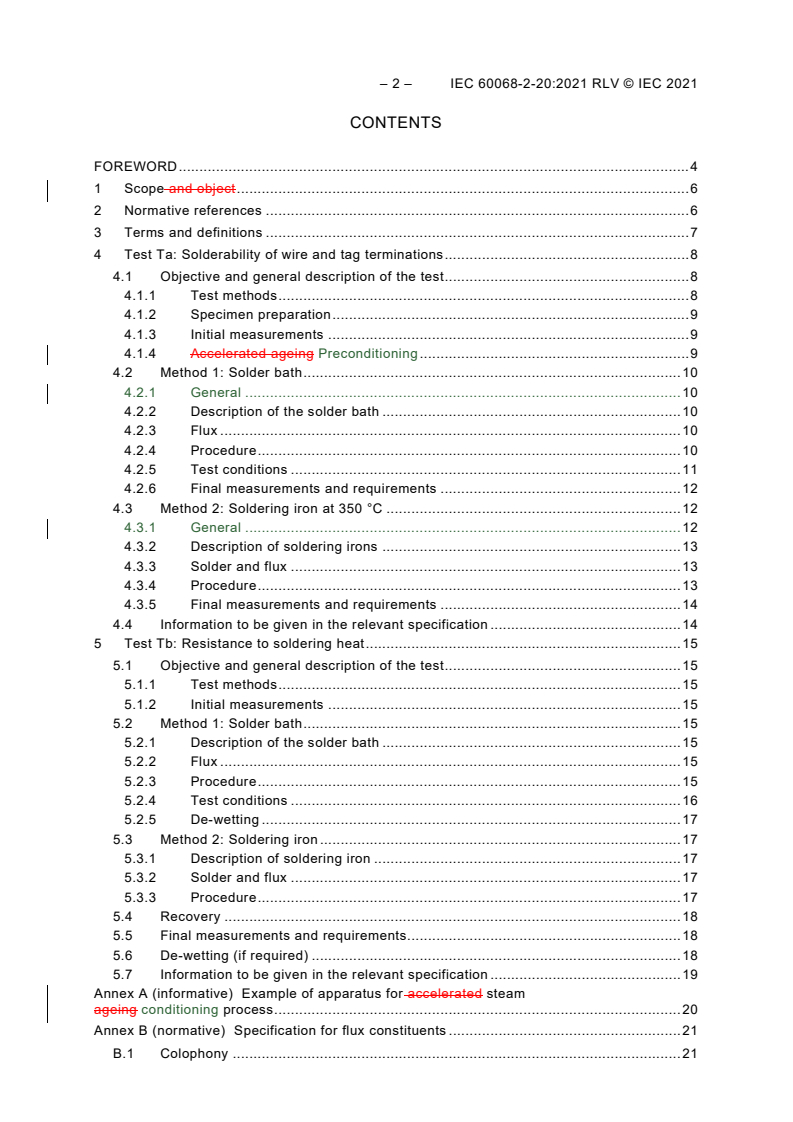
– 2 – IEC 60068-2-20:2021 RLV © IEC 2021
CONTENTS
FOREWORD . 4
1 Scope and object . 6
2 Normative references . 6
3 Terms and definitions . 7
4 Test Ta: Solderability of wire and tag terminations . 8
4.1 Objective and general description of the test . 8
4.1.1 Test methods . 8
4.1.2 Specimen preparation . 9
4.1.3 Initial measurements . 9
4.1.4 Accelerated ageing Preconditioning . 9
4.2 Method 1: Solder bath . 10
4.2.1 General . 10
4.2.2 Description of the solder bath . 10
4.2.3 Flux . 10
4.2.4 Procedure . 10
4.2.5 Test conditions . 11
4.2.6 Final measurements and requirements . 12
4.3 Method 2: Soldering iron at 350 °C . 12
4.3.1 General . 12
4.3.2 Description of soldering irons . 13
4.3.3 Solder and flux . 13
4.3.4 Procedure . 13
4.3.5 Final measurements and requirements . 14
4.4 Information to be given in the relevant specification . 14
5 Test Tb: Resistance to soldering heat . 15
5.1 Objective and general description of the test . 15
5.1.1 Test methods . 15
5.1.2 Initial measurements . 15
5.2 Method 1: Solder bath . 15
5.2.1 Description of the solder bath . 15
5.2.2 Flux . 15
5.2.3 Procedure . 15
5.2.4 Test conditions . 16
5.2.5 De-wetting . 17
5.3 Method 2: Soldering iron . 17
5.3.1 Description of soldering iron . 17
5.3.2 Solder and flux . 17
5.3.3 Procedure . 17
5.4 Recovery . 18
5.5 Final measurements and requirements . 18
5.6 De-wetting (if required) . 18
5.7 Information to be given in the relevant specification . 19
Annex A (informative) Example of apparatus for accelerated steam
ageing conditioning process . 20
Annex B (normative) Specification for flux constituents . 21
B.1 Colophony . 21
B.2 2-propanol (isopropanol isopropyl alcohol) . 21
B.3 Ethyl alcohol . 21
B.4 Flux composition . 21
Bibliography . 23
Figure 1 – Diagram of contact angle . 7
Figure 2 – Position of soldering iron . 14
Figure A.1 – Example of apparatus . 20
Table 1 – Solderability, solder bath method: Test severities (duration and temperature) . 12
Table 2 – Resistance to soldering heat, solder bath method: Test severities (duration
and temperature) . 17
Table B.1 – Colophony based flux compositions . 22
– 4 – IEC 60068-2-20:2021 RLV © IEC 2021
INTERNATIONAL ELECTROTECHNICAL COMMISSION
____________
ENVIRONMENTAL TESTING –
Part 2-20: Tests –
Test T Tests Ta and Tb: Test methods for solderability
and resistance to soldering heat of devices with leads
FOREWORD
1) The International Electrotechnical Commission (IEC) is a worldwide organization for standardization comprising
all national electrotechnical committees (IEC National Committees). The object of IEC is to promote international
co-operation on all questions concerning standardization in the electrical and electronic fields. To this end and
in addition to other activities, IEC publishes International Standards, Technical Specifications, Technical Reports,
Publicly Available Specifications (PAS) and Guides (hereafter referred to as “IEC Publication(s)”). Their
preparation is entrusted to technical committees; any IEC National Committee interested in the subject dealt with
may participate in this preparatory work. International, governmental and non-governmental organizations liaising
with the IEC also participate in this preparation. IEC collaborates closely with the International Organization for
Standardization (ISO) in accordance with conditions determined by agreement between the two organizations.
2) The formal decisions or agreements of IEC on technical matters express, as nearly as possible, an international
consensus of opinion on the relevant subjects since each technical committee has representation from all
interested IEC National Committees.
3) IEC Publications have the form of recommendations for international use and are accepted by IEC National
Committees in that sense. While all reasonable efforts are made to ensure that the technical content of IEC
Publications is accurate, IEC cannot be held responsible for the way in which they are used or for any
misinterpretation by any end user.
4) In order to promote international uniformity, IEC National Committees undertake to apply IEC Publications
transparently to the maximum extent possible in their national and regional publications. Any divergence between
any IEC Publication and the corresponding national or regional publication shall be clearly indicated in the latter.
5) IEC itself does not provide any attestation of conformity. Independent certification bodies provide conformity
assessment services and, in some areas, access to IEC marks of conformity. IEC is not responsible for any
services carried out by independent certification bodies.
6) All users should ensure that they have the latest edition of this publication.
7) No liability shall attach to IEC or its directors, employees, servants or agents including individual experts and
members of its technical committees and IEC National Committees for any personal injury, property damage or
other damage of any nature whatsoever, whether direct or indirect, or for costs (including legal fees) and
expenses arising out of the publication, use of, or reliance upon, this IEC Publication or any other IEC
Publications.
8) Attention is drawn to the Normative references cited in this publication. Use of the referenced publications is
indispensable for the correct application of this publication.
9) Attention is drawn to the possibility that some of the elements of this IEC Publication may be the subject of patent
rights. IEC shall not be held responsible for identifying any or all such patent rights.
This redline version of the official IEC Standard allows the user to identify the changes made to
the previous edition IEC 60068-2-20:2008. A vertical bar appears in the margin wherever a change
has been made. Additions are in green text, deletions are in strikethrough red text.
IEC 60068-2-20 has been prepared by IEC technical committee 91: Electronics assembly
technology. It is an International Standard.
This sixth edition cancels and replaces the fifth edition published in 2008. This sixth edition
constitutes a technical revision.
This edition includes the following significant technical changes with respect to the previous
edition:
a) update of and clarification of pre-conditioning (former "aging") and its relation to natural
aging.
The text of this International Standard is based on the following documents:
Draft Report on voting
91/1701/FDIS 91/1711/RVD
Full information on the voting for its approval can be found in the report on voting indicated in
the above table.
The language used for the development of this International Standard is English.
This document was drafted in accordance with ISO/IEC Directives, Part 2, and developed in
accordance with ISO/IEC Directives, Part 1 and ISO/IEC Directives, IEC Supplement, available
at www.iec.ch/members_experts/refdocs. The main document types developed by IEC are
described in greater detail at www.iec.ch/standardsdev/publications.
A list of all the parts in the IEC 60068 series, under the general title Environmental testing, can
be found on the IEC website.
The committee has decided that the contents of this document will remain unchanged until the
stability date indicated on the IEC website under "http://webstore.iec.ch" in the data related to
the specific document. At this date, the document will be
• reconfirmed,
• withdrawn,
• replaced by a revised edition, or
• amended.
IMPORTANT – The 'colour inside' logo on the cover page of this publication indicates that it
contains colours which are considered to be useful for the correct understanding of its
contents. Users should therefore print this document using a colour printer.
– 6 – IEC 60068-2-20:2021 RLV © IEC 2021
ENVIRONMENTAL TESTING –
Part 2-20: Tests –
Test T Tests Ta and Tb: Test methods for solderability
and resistance to soldering heat of devices with leads
1 Scope and object
This part of IEC 60068 outlines Test T Tests Ta and Tb, applicable to devices with leads and
leads themselves. Soldering tests for surface mounting devices (SMD) are described in
IEC 60068‑2‑58.
This document provides procedures for determining the solderability and resistance to soldering
heat of devices in applications using solder alloys, which are eutectic or near eutectic tin lead
(Pb), or lead-free alloys.
The procedures in this document include the solder bath method and soldering iron method.
The objective of this document is to ensure that component lead or termination solderability
meets the applicable solder joint requirements of IEC 61191-3 and IEC 61191-4. In addition,
test methods are provided to ensure that the component body can resist against be resistant to
the heat load to which it is exposed during soldering.
NOTE Information about wetting time and wetting force can be obtained by test methods using a wetting balance.
See IEC 60068-2-54 (solder bath method) and IEC 60068-2-69 (solder bath and solder globule method for SMDs)
can be consulted.
2 Normative references
The following documents are referred to in the text in such a way that some or all of their content
constitutes requirements of this document. For dated references, only the edition cited applies.
For undated references, the latest edition of the referenced document (including any
amendments) applies.
IEC 60068-1, Environmental testing – Part 1: General and guidance
IEC 60068-2-2, Environmental testing – Part 2-2: Tests – Test B: Dry heat
IEC 60068-2-66, Environmental testing – Part 2: Test methods – Test Cx: Damp heat, steady
state (unsaturated pressurized vapour)
IEC 60068-2-78, Environmental testing – Part 2-78: Tests – Test Cab: Damp heat, steady state
IEC 60194, Printed board design, manufacture and assembly – Terms and definitions
IEC 61191-3, Printed board assemblies – Part 3: Sectional specification – Requirements for
through-hole mount soldered assemblies
IEC 61191-4, Printed board assemblies – Part 4: Sectional specification – Requirements for
terminal soldered assemblies
3 Terms and definitions
For the purposes of this document, the following terms and definitions apply.
ISO and IEC maintain terminological databases for use in standardization at the following
addresses:
• IEC Electropedia: available at http://www.electropedia.org/
• ISO Online browsing platform: available at http://www.iso.org/obp
3.1
colophony
natural resin obtained as the residue after removal of turpentine from the oleo-resin of the pine
tree, consisting mainly of abietic acid and related resin acids, the remainder being resin acid
esters
Note 1 to entry: ”Rosin" is a synonym for colophony, and is deprecated because of the common confusion with the
generic term "resin".
3.2
contact angle
in general, the angle enclosed between two planes, tangent to a liquid surface and a solid/liquid
interface at their intersection (see Figure 1); in particular, the contact angle of liquid solder in
contact with a solid metal surface
Figure 1 – Diagram of contact angle
3.3
wetting
formation of an adherent coating of solder on a surface
Note 1 to entry: A small contact angle is indicative of wetting.
3.4
non-wetting
inability to form an adherent coating of solder on a surface
Note 1 to entry: In this case the contact angle is greater than 90°.
3.5
de-wetting
retraction of molten solder on a solid area that it has initially wetted
Note 1 to entry: In some cases, an extremely thin film of solder may remain. As the solder retracts the contact angle
increases.
– 8 – IEC 60068-2-20:2021 RLV © IEC 2021
3.6
solderability
ability of the lead, termination or lead of device electrode of a component to be wetted by solder
at the temperature of the termination or lead electrode, which is assumed to be the lowest
temperature in the soldering process within solderable the applicable temperature range of the
solder alloy
3.7
soldering time
time required for a defined surface area to be wetted under specific conditions
3.8
resistance to soldering heat
ability of device the component to withstand the highest temperature of the termination or lead
stress in terms of temperature gradient, peak temperature and duration of the soldering
process, where the temperature of the component body is within the applicable temperature
range of the solder alloy
3.9
lead-free solder
alloy that does not contain more than 0,1 % lead (Pb) by weight as its constituent and is used
for joining components to substrates or for coating surfaces
[75.1904 of IEC 60194]
[SOURCE: IEC 60194-2:2017, 3.12.5, modified – The words "as its constituent" have been
added.]
4 Test Ta: Solderability of wire and tag terminations
4.1 Objective and general description of the test
4.1.1 Test methods
Test Ta provides two different test methods to determine the solderability of areas on wire and
tag terminations that are required to be wetted by solder during the assembly operation.
– Method 1: solder bath;
– Method 2: soldering iron.
The test method to be used shall be indicated in the relevant specification. The solder bath
method is the one which most closely simulates the soldering procedures of flow soldering and
similar soldering processes.
The soldering iron method may be used in cases where Method 1 is impracticable.
If required by the relevant specification, the test conditioning may be preceded by accelerated
ageing. The following are recommended conditions:
If required by the relevant specification, the test specimen shall be preconditioned according to
4.1.4. The following are typical methods for preconditioning:
Ageing Type 1a: 1 h steam ageing
Ageing Type 1b: 4 h steam ageing
Ageing Type 2: 10 days damp heat, steady state condition (40 ± 2) °C; (93 ± 3) % RH
(Test Cab)
Ageing Type 3a: 4 h at 155 °C dry heat (Test Bb)
Ageing Type 3b: 16 h at 155 °C dry heat (Test Bb).
Ageing Type 4: 4 h unsaturated pressurized vapour (Test Cx)
NOTE The test specimens may be introduced into the chamber at any temperature from laboratory temperature to
the specified temperature.
NOTE 1 In general, the acceleration for ageing prior to solderability testing is estimated by simulating the
degradation in storage environment. However, the steam ageing condition does not correspond with storage
conditions because the failure mode derived from steam ageing is clearly different from that derived from storage
conditions. Therefore, an accelerated correlation between steam ageing and natural ageing in storage condition is
impossible and steam ageing conditions such as type 1a and type 1b are inappropriate as accelerated ageing.
NOTE 2 For Ni/Au surface, Type 2 or Type 4 is appropriate as preconditioning.
4.1.2 Specimen preparation
The surface to be tested shall be in the "as received" condition and shall not be subsequently
touched by the fingers or otherwise contaminated.
The specimen shall not be cleaned prior to the application of a solderability test. If required by
the relevant specification, the specimen may be degreased by immersion in a neutral organic
solvent at room temperature.
4.1.3 Initial measurements
The specimens shall be visually examined and, if required by the relevant specification,
electrically and mechanically checked.
4.1.4 Accelerated ageing Preconditioning
4.1.4.1 General
If accelerated ageing preconditioning is required by the relevant specification, one of the
following procedures shall may be adopted. At the end of the conditioning, the specimen shall
be subjected to standard atmospheric conditions for testing for not less than 2 h and not more
than 24 h.
NOTE Terminations may be detached if the ageing conditioning temperature is higher than the
component's maximum operating or storage temperature, or if the component is likely to
degrade considerably at 100 °C in steam and thus affect the solderability in a manner which
would not normally occur in natural ageing.
4.1.4.2 Ageing Type 1
The relevant specification shall indicate whether ageing type 1a (1 h in steam) or ageing type
1b (4 h in steam) is to be used. For these procedures the specimen is suspended, preferably
with the termination vertical, with the area to be tested positioned 25 mm to 30 mm above the
surface of boiling distilled water which is contained in a borosilicate glass or stainless steel
vessel of suitable size (e.g., a 2 liter beaker). The termination shall be not less than at least
10 mm from the walls of the vessel.
The vessel shall be provided with a cover of similar material, consisting of one or more plates
which are capable of covering approximately seven-eighths of the opening. A suitable method
of suspending the specimens shall be devised; perforations or slots in the cover are permitted
for this purpose. The specimen holder shall be non-metallic.
The level of water shall be maintained by the addition of hot distilled water, added gradually in
small quantities, so that the water will continue to boil vigorously; alternatively a reflux con-
denser may be provided used if desired. (See Figure A.1).
NOTE There are many problems for steam conditioning. For example, dew always condenses on the terminations
and liquid water directly drops onto specimens in some cases.
– 10 – IEC 60068-2-20:2021 RLV © IEC 2021
4.1.4.3 Ageing Type 2
Specimens are subjected to 10 days damp heat, steady state, according to IEC 60068-2-78,
Test Cab: Damp heat, steady state.
4.1.4.4 Ageing Type 3
Specimens are subjected to 4 h (Ageing Type 3a) or 16 h (Ageing Type 3b) dry heat at 155 °C
according to IEC 60068-2-2, Test B: Dry heat.
The test specimens may be introduced into the chamber at any temperature from laboratory
ambient to the specified temperature.
4.1.4.5 Ageing Type 4
Specimens are subjected to 4 h at 120 °C and 85 % RH according to IEC 60068-2-66, Test Cx:
Damp heat, steady state (unsaturated pressurized vapour).
4.2 Method 1: Solder bath
4.2.1 General
This method provides a procedure for assessing the solderability of wires, tags, and termina-
tions of irregular form.
4.2.2 Description of the solder bath
The solder bath shall be of adequate dimensions to accommodate the specimens and contain
sufficient solder to maintain the solder temperature during testing, and to prevent exceeding
the contamination levels applicable to the type of solder used for testing. If not otherwise
defined by the relevant specification, the solder bath shall be not less than 40 mm in depth and
not less than 300 ml in volume. The bath shall contain solder as specified in Table 1.
NOTE 1 When the specimens are of a small size and heat capacity, a solder bath with dimensions less than
described above can be appropriate.
NOTE 2 Clause A.2 of IEC 60068-2-69:2017 can be consulted as an example of the solder bath corresponding to
NOTE 1.
4.2.3 Flux
The flux to be used shall consist of 25 % by weight of colophony in 75 % by weight of 2-propanol
(isopropanol) or of ethyl alcohol, as specified in Annex B.
When non-activated flux is inappropriate, the above flux with the addition of diethylammonium
chloride (analytical reagent grade), up to an amount of 0,2 % chloride (expressed as free
chlorine based on the colophony content), may be used as required by the relevant
specification.
A colophony based flux as described in Annex B shall be used. The flux shall be non-activated
(see Table B.1).
If non-activated flux is inappropriate, the relevant specification may require the use of a low
activated flux (see Table B.1).
4.2.4 Procedure
The dross on the surface of the molten solder shall be wiped clean and bright removed with a
piece of suitable thermally resistant material, immediately before each test, to ensure a clean
and bright surface.
The termination to be tested shall be immersed first in the flux (described in 4.2.3) at laboratory
ambient temperature, and excess flux shall be eliminated either by draining off for a suitable
time, or by using any other procedure likely to produce a similar result. In case of dispute,
drainage shall be carried out for (60 ± 5) s.
NOTE It sometimes happen that excessive remaining flux may boil when coming into contact with the liquid solder
and gas bubbles may stick to the surface of terminations and prevent wetting of the termination in the respective
area such areas.
The termination is then immersed immediately in the solder bath in the direction of its
longitudinal axis. The point of immersion of the termination shall be at a distance not less than
10 mm from the walls of the bath.
The speed of immersion shall be (25 ± 2,5) mm/s determined at 25 mm/s or less. and the
termination shall remain immersed for the time selected from Table 1 with the body of the
component at the distance above the solder prescribed in the relevant specification. The
specimen shall then be withdrawn at (25 ± 2,5) mm/s.
For components having a high thermal capacity, an immersion time of (5,0 ± 0,5) s or (10 ± 1) s
may be selected from Table 1.
If required by the relevant specification, a screen of thermally insulating material of
(1,5 ± 0,5) mm thickness with clearance holes appropriate to the size of the termination, may
be placed between the body of the component and solder.
Any flux residues shall be removed with 2-propanol (isopropanol isopropyl alcohol) or ethanol
(ethyl alcohol) after testing.
4.2.5 Test conditions
The duration and temperature of immersion shall be selected from Table 1, unless otherwise
prescribed by the relevant specification.
– 12 – IEC 60068-2-20:2021 RLV © IEC 2021
Table 1 – Solderability, solder bath method: Test severities
(duration and temperature)
Severity
Alloy
(215 ± 3) °C (235 ± 3) °C (245 ± 3) °C (250± 3) °C
composition
(3 ± 0,3) s (10 ± 1) s (2 ± 0,2) s (5 ± 0,5) s (3 ± 0,3) s (3 ± 0,3) s
SnPb X X X X
Sn96,5Ag3Cu,5 X
Sn99,3Cu,7 X
Alloy composition for test purposes only. The solder alloys consist of 3,0 wt % to 4,0 wt % Ag, 0,5 wt % to 1,0 wt %
Cu, and the remainder of Sn may be used instead of Sn96,5Ag3Cu,5. The solder alloys consist of 0,45 wt % to
0,9 wt % Cu and the remainder of Sn may be used instead of Sn99,3Cu,7.
The alloy compositions are given for test reference purposes only.
SnPb: The solder alloys consisting of a mass fraction of 37 % or 40 % Pb, and the remainder of Sn may be used;
Sn96,5Ag3Cu,5: The solder alloys consisting of a mass fraction of 3,0 % to 4,0 % Ag, 0,5 % to 1,0 % Cu, and the
remainder of Sn may be used;
Sn99,3Cu,7: The solder alloys consisting of a mass fraction of 0,45 % to 0,9 % Cu and the remainder of Sn may be
used.
The basic lead-free solder alloys listed in this table represent compositions that are currently preferred for lead-free
soldering processes. If solder alloys other than those listed here are used, it needs to be verified that the given
severities are applicable.
NOTE 1 “X” denotes ‘applicable’.
NOTE 2 Refer to 4.1 of IEC 61190-1-3 to identify alloy composition.
NOTE 3 The basic lead-free solder alloys listed in this table represent compositions that are currently preferred for
lead-free soldering processes. If solder alloys other than those listed here are used, it has to be verified that the
given severities are applicable.
NOTE 1 "X" denotes ‘applicable’.
NOTE 2 Annex B of IEC 61190-1-3:2017 can be consulted to identify alloy compositions.
4.2.6 Final measurements and requirements
Inspection shall be carried out under adequate light with normal eyesight or with the assistance
of a magnifier capable of giving a magnification of 4 x to 25 x, depending on the size of objects.
The visual inspection shall be carried out under adequate light with a binocular microscope of
magnification in a range of 4x to 100x.
The specimens shall be visually examined and, if required by the relevant specification,
electrically and mechanically checked.
The dipped surface relevant for soldering shall be covered with solder coating with no more
than small amounts of scattered imperfections such as pin-holes or un-wetted or de-wetted
areas. All leads shall exhibit a continuous solder coating free from defects for a minimum of
95 % of the critical area of any individual lead. For solder alloys containing lead (Pb), solder
shall be smooth and bright.
4.3 Method 2: Soldering iron at 350 °C
4.3.1 General
This method provides a procedure for assessing the solderability of terminations in cases where
the solder bath method is impracticable. It applies to lead containing and lead-free solder alloys.
4.3.2 Description of soldering iron
To keep the bit tip temperature during test within the specified limits, usage of a temperature
controlled soldering iron is recommended.
Size A
Bit Tip temperature: (350 ± 10) °C
Bit Tip diameter: 8 mm
Exposed length: 32 mm reduced to a wedge shape over a length of approximately 10 mm.
Size B
Bit Tip temperature: (350 ± 10) °C
Bit Tip diameter: 3 mm
Exposed length: 12 mm reduced to a wedge shape over a length of approximately 5 mm.
The bit tip shall be made of copper, preferably plated with iron, or of an erosion-resistant copper
alloy, in accordance with usual practice, and tinned at on the test surface in contact with the
test termination.
4.3.3 Solder and flux
A cored solder wire shall be used comprising of solder as specified in Table 1, with a core or
cores containing 2,5 % to 3,5 % colophony as specified in Clause B.1. A visual check shall be
made during the test for the presence of flux.
4.3.4 Procedure
According to the type of component, a soldering iron with a tip of either Size A or Size B shall
be used as prescribed required in the relevant specification.
The nominal diameter of the cored solder wire to be used with Size A soldering iron tip is 1,2 mm
and 0,8 mm with Size B soldering iron tip.
The termination shall be positioned horizontally so that the soldering iron can be applied to the
test surface as shown in Figure 2.
If mechanical support for the terminations is required while performing this test, such support
shall be of thermally insulating material.
– 14 – IEC 60068-2-20:2021 RLV © IEC 2021
Figure 2 – Position of soldering iron
When testing heat-sensitive components, the relevant specification shall specify the distance
of the test area from the component body, or it shall specify the use of a specific heat sink.
The relevant specification may specify different conditions where the geometry of the termina-
tions renders the above procedure impracticable.
Surplus solder that has remained on the test surface of the iron from a previous test shall be
wiped off removed prior to the test.
The iron and the solder shall, unless otherwise specified, be applied to the termination for 2 s
to 3 s at the position stated in the relevant specification. During this period of time, the iron
shall be kept stationary.
If the relevant specification requires that several terminations of the component shall be tested,
an interval in the order of 5 s to 10 s shall be observed between the applications to the different
terminations of the component, to avoid it being overheated overheating.
Any flux residue shall be removed from the terminations with 2-propanol (isopropanol isopropyl
alcohol) or with ethanol (ethyl alcohol) after each test.
4.3.5 Final measurements and requirements
Inspection shall be carried out under adequate light with normal eyesight or with the assistance
of a magnifier capable of giving a magnification of 4 x to 25 x, depending on the size of objects.
The visual inspection shall be carried out under adequate light with a binocular microscope of
magnification in a range of 4x to 100x.
The specimens shall be visually examined and, if required by the relevant specification, elec-
trically and mechanically checked.
The solder shall have wetted the test area and there shall be no droplets.
4.4 Information to be given in the relevant specification
When this test is included in the relevant specification, the following details shall be given as
far as they are applicable.
Subclause
a) Whether degreasing is required 4.1.2
b) Initial measurements 4.1.3
c) Ageing Preconditioning method (if required) 4.1.4
d) Test method 4.2 or 4.3
e) Whether activated flux shall be used 4.2.3
f) Immersion depth, temperature and duration 4.2.4, 4.2.5
g) Whether a thermal screen is to be used 4.2.4
h) Size of soldering iron tip (A or B) 4.3.2
i) Distance of test area from component body or use of a heat sink 4.3.4
j) Different test conditions, if required by geometry of termination 4.3.4
k) Position of the soldering iron 4.3.4
l) Application time of soldering iron, if not 2 s to 3 s 4.3.4
m) Number of terminations to be tested 4.3.4
n) Final measurements and requirements 4.2.6, 4.3.5
o) Type of solder alloy Table 1, 4.3.3
5 Test Tb: Resistance to soldering heat
5.1 Objective and general description of the test
5.1.1 Test methods
Test Tb provides two different methods to determine the ability of a specimen to withstand the
heating stresses produced by soldering.
– Method 1: solder bath;
– Method 2: soldering iron.
Method 1 is identical to Test Ta, Method 1, but with different immersion times and temperatures.
Method 2 is identical to Test Ta, Method 2, but with the iron applied to the test surface for 10 s.
5.1.2 Initial measurements
The specimens shall be visually examined and electrically and mechanically checked as, if
required by the relevant specification, electrically and mechanically checked.
5.2 Method 1: Solder bath
5.2.1 Description of the solder bath
The solder bath shall be not less than 40 mm in depth and not less than 300 ml in volume. The
bath shall contain solder as specified in Table 2.
As required in 4.2.2.
The bath shall contain solder as specified in Table 2.
5.2.2 Flux
The flux to be used shall consist of 25 % by weight of colophony in 75 % by weight of 2-propanol
(isopropanol) or of ethyl alcohol, as specified in Annex B.
When non-activated flux is inappropriate, the above flux with the addition of diethylammonium
chloride (analytical reagent grade), up to an amount of 0,5 % chloride (expressed as free
– 16 – IEC 60068-2-20:2021 RLV © IEC 2021
chlorine based on the colophony content), may be used as required by the relevant
specification.
When the test forms part of a test sequence and is applied prior to a humidity test, a non-
activated flux comprising 25 % by weight of colophony in 75 % by weight 2-propanol
(isopropanol) or ethyl alcohol shall be used. In this case, the test shall be made on specimens
which have a surface which has satisfactorily passed the solderability Test Ta, Method 1, within
the previous 72 h period.
A colophony based flux as described in Annex B shall be used. The flux shall be high activated
(see Table B.1).
When the test forms part of a test sequence and is applied prior to a humidity test, a non-
activated flux (see Table B.1) shall be used. In this case, the test shall be made on specimens
taken from a lot that has satisfactorily passed the solderability Test Ta, Method 1, within the
previous 72 h period.
For the test resistance to soldering heat, highly activated flux is required to simulate the worst
case of heat transfer into the component body (highest wetting speed). But, if the intent is to
subject the test specimen, after the ‘resistance to soldering heat’ test, to a humidity environment
the highly activated flux may lead to corrosion effects. To avoid such unintended effects or
failures in this scenario, it is permitted to use non-activated flux for the "resistance to soldering
heat" test, provided sufficient wettability of the specimen is proven. This could be achieved, for
example, by taking test specimens from the same lot that have already satisfactorily passed the
solderability test. Under that condition, a comparable wetting speed can be assumed.
5.2.3 Procedure
The dross on the surface of the molten solder shall be wiped clean and bright by wiping removed
with a piece of suitable thermally resistant material, immediately before each test, to ensure a
clean and bright surface.
The termination to be tested shall be immersed first in the flux described in 5.2.2 at laboratory
ambient temperature, and then in the solder bath, in the direction of its longitudinal axis. The
point of immersion of the termination shall be at a distance not less than 10 mm from the walls
of the bath.
Immersion of the termination to within 2,0 mm to 2,5 mm from the component body or seating
plane, unless otherwise specified in the relevant specification, shall be completed in a time not
exceeding 1 s.
The termination shall remain immersed to the specified depth for one of the durations given in
Table 2, or as prescribed required in the relevant specification.
Any flux residues shall be removed from the terminations with 2-propanol (isopropyl alcohol) or
with ethanol (ethyl alcohol) after each test.
5.2.4 Test conditions
The duration and temperature of immersion shall be selected from Table 2, unless otherwise
prescribed required by the relevant specification.
Table 2 – Resistance to soldering heat, solder bath method:
Test severities (duration and temperature)
Severity
Alloy
(235 ± 3) °C (260 ± 3) °C
composition
(10 ± 1) s (5 ± 0,5) s (10 ± 1) s
b c
X
SnPb X X
b c
a
X X
Lead-free alloy
NOTE 1 "X" denotes "applicable".
NOTE 2 Certain soldering methods may require higher severity of (270 ± 3) °C for (5 ± 0,5) s or the more severe
condition of (10 ± 1) s. Such conditions should be provided by the detail relevant specification as agreed between
the trading partners.
NOTE 3 Care should be taken, that heat / moisture sensitive devices are handled according to the instructions of
the supplier.
a
Any alloys may be used, provided they are completely liquid at the required temperature.
b
The shorter immersion time of 5 s is mainly intended for heat-sensitive components to be mounted on printed
circuits. A warning should be given to the user that such components should be soldered to the printed circuit
board in less than 4 s.
c
This test severity is also used for the de-wetting test. As an optional test condition (260 ± 5) °C for (30 ± 3) s
is may also be used.
Unless otherwise prescribed required in the relevant specification, a screen of thermally
insulating material of (1,5 ± 0,5) mm thickness, with clearance holes appropriate to the size of
the termination, shall be placed between the body of the component and the molten solder.
When the relevant specification prescribes requires the use of a heat sink during this test, it
shall give full details of the size and type of heat sink to be used, which should be related to
the method used for production soldering.
5.2.5 De-wetting
The relevant specification shall prescribe whether this test is required.
A total immersion of 10 s is required because de-wetting can occur slowly; this immersion shall
be divided into two periods of 5 s each in order that any rapid de-wetting is not masked by any
subsequent re-wetting.
5.3 Method 2: Soldering iron
5.3.1 Description of soldering iron
As prescribed required in 4.3.2.
The relevant specification shall state whether iron tip A or iron tip B is to be used.
5.3.2 Solder and flux
As prescribed required in 4.3.3.
5.3.3 Procedure
As prescribed required in 4.3.4 (Method 2, with the soldering iro
...
IEC 60068-2-20 ®
Edition 6.0 2021-03
INTERNATIONAL
STANDARD
NORME
INTERNATIONALE
Environmental testing –
Part 2-20: Tests – Tests Ta and Tb: Test methods for solderability and
resistance to soldering heat of devices with leads
Essais d’environnement –
Partie 2-20: Essais – Essais Ta et Tb: Méthodes d'essai de la brasabilité
et de la résistance à la chaleur de brasage des dispositifs à broches
All rights reserved. Unless otherwise specified, no part of this publication may be reproduced or utilized in any form
or by any means, electronic or mechanical, including photocopying and microfilm, without permission in writing from
either IEC or IEC's member National Committee in the country of the requester. If you have any questions about IEC
copyright or have an enquiry about obtaining additional rights to this publication, please contact the address below or
your local IEC member National Committee for further information.
Droits de reproduction réservés. Sauf indication contraire, aucune partie de cette publication ne peut être reproduite
ni utilisée sous quelque forme que ce soit et par aucun procédé, électronique ou mécanique, y compris la photocopie
et les microfilms, sans l'accord écrit de l'IEC ou du Comité national de l'IEC du pays du demandeur. Si vous avez des
questions sur le copyright de l'IEC ou si vous désirez obtenir des droits supplémentaires sur cette publication, utilisez
les coordonnées ci-après ou contactez le Comité national de l'IEC de votre pays de résidence.
IEC Central Office Tel.: +41 22 919 02 11
3, rue de Varembé info@iec.ch
CH-1211 Geneva 20 www.iec.ch
Switzerland
About the IEC
The International Electrotechnical Commission (IEC) is the leading global organization that prepares and publishes
International Standards for all electrical, electronic and related technologies.
About IEC publications
The technical content of IEC publications is kept under constant review by the IEC. Please make sure that you have the
latest edition, a corrigendum or an amendment might have been published.
IEC publications search - webstore.iec.ch/advsearchform IEC online collection - oc.iec.ch
The advanced search enables to find IEC publications by a Discover our powerful search engine and read freely all the
variety of criteria (reference number, text, technical publications previews. With a subscription you will always
committee, …). It also gives information on projects, replaced have access to up to date content tailored to your needs.
and withdrawn publications.
Electropedia - www.electropedia.org
IEC Just Published - webstore.iec.ch/justpublished
The world's leading online dictionary on electrotechnology,
Stay up to date on all new IEC publications. Just Published
containing more than 22 000 terminological entries in English
details all new publications released. Available online and
and French, with equivalent terms in 18 additional languages.
once a month by email.
Also known as the International Electrotechnical Vocabulary
(IEV) online.
IEC Customer Service Centre - webstore.iec.ch/csc
If you wish to give us your feedback on this publication or
need further assistance, please contact the Customer Service
Centre: sales@iec.ch.
A propos de l'IEC
La Commission Electrotechnique Internationale (IEC) est la première organisation mondiale qui élabore et publie des
Normes internationales pour tout ce qui a trait à l'électricité, à l'électronique et aux technologies apparentées.
A propos des publications IEC
Le contenu technique des publications IEC est constamment revu. Veuillez vous assurer que vous possédez l’édition la
plus récente, un corrigendum ou amendement peut avoir été publié.
Recherche de publications IEC - IEC online collection - oc.iec.ch
webstore.iec.ch/advsearchform Découvrez notre puissant moteur de recherche et consultez
La recherche avancée permet de trouver des publications IEC gratuitement tous les aperçus des publications. Avec un
en utilisant différents critères (numéro de référence, texte, abonnement, vous aurez toujours accès à un contenu à jour
comité d’études, …). Elle donne aussi des informations sur adapté à vos besoins.
les projets et les publications remplacées ou retirées.
Electropedia - www.electropedia.org
IEC Just Published - webstore.iec.ch/justpublished
Le premier dictionnaire d'électrotechnologie en ligne au
Restez informé sur les nouvelles publications IEC. Just
monde, avec plus de 22 000 articles terminologiques en
Published détaille les nouvelles publications parues.
anglais et en français, ainsi que les termes équivalents dans
Disponible en ligne et une fois par mois par email.
16 langues additionnelles. Egalement appelé Vocabulaire
Electrotechnique International (IEV) en ligne.
Service Clients - webstore.iec.ch/csc
Si vous désirez nous donner des commentaires sur cette
publication ou si vous avez des questions contactez-nous:
sales@iec.ch.
IEC 60068-2-20 ®
Edition 6.0 2021-03
INTERNATIONAL
STANDARD
NORME
INTERNATIONALE
Environmental testing –
Part 2-20: Tests – Tests Ta and Tb: Test methods for solderability and
resistance to soldering heat of devices with leads
Essais d’environnement –
Partie 2-20: Essais – Essais Ta et Tb: Méthodes d'essai de la brasabilité
et de la résistance à la chaleur de brasage des dispositifs à broches
INTERNATIONAL
ELECTROTECHNICAL
COMMISSION
COMMISSION
ELECTROTECHNIQUE
INTERNATIONALE
ICS 19.040 ISBN 978-2-8322-9585-4
– 2 – IEC 60068-2-20:2021 © IEC 2021
CONTENTS
FOREWORD . 4
1 Scope . 6
2 Normative references . 6
3 Terms and definitions . 6
4 Test Ta: Solderability of wire and tag terminations . 8
4.1 Objective and general description of the test . 8
4.1.1 Test methods . 8
4.1.2 Specimen preparation . 8
4.1.3 Initial measurements . 9
4.1.4 Preconditioning . 9
4.2 Method 1: Solder bath . 10
4.2.1 General . 10
4.2.2 Description of the solder bath . 10
4.2.3 Flux . 10
4.2.4 Procedure . 10
4.2.5 Test conditions . 11
4.2.6 Final measurements and requirements . 11
4.3 Method 2: Soldering iron at 350 °C . 11
4.3.1 General . 11
4.3.2 Description of soldering irons . 11
4.3.3 Solder and flux . 12
4.3.4 Procedure . 12
4.3.5 Final measurements and requirements . 13
4.4 Information to be given in the relevant specification . 13
5 Test Tb: Resistance to soldering heat . 14
5.1 Objective and general description of the test . 14
5.1.1 Test methods . 14
5.1.2 Initial measurements . 14
5.2 Method 1: Solder bath . 14
5.2.1 Description of the solder bath . 14
5.2.2 Flux . 14
5.2.3 Procedure . 14
5.2.4 Test conditions . 15
5.2.5 De-wetting . 15
5.3 Method 2: Soldering iron . 16
5.3.1 Description of soldering iron . 16
5.3.2 Solder and flux . 16
5.3.3 Procedure . 16
5.4 Recovery . 16
5.5 Final measurements and requirements . 16
5.6 De-wetting (if required) . 16
5.7 Information to be given in the relevant specification . 17
Annex A (informative) Example of apparatus for steam conditioning process . 18
Annex B (normative) Specification for flux constituents . 19
B.1 Colophony . 19
B.2 2-propanol (isopropyl alcohol) . 19
B.3 Ethyl alcohol . 19
B.4 Flux composition . 19
Bibliography . 21
Figure 1 – Diagram of contact angle . 7
Figure 2 – Position of soldering iron . 12
Figure A.1 – Example of apparatus . 18
Table 1 – Solderability, solder bath method: Test severities (duration and temperature) . 11
Table 2 – Resistance to soldering heat, solder bath method: Test severities (duration
and temperature) . 15
Table B.1 – Colophony based flux compositions . 20
– 4 – IEC 60068-2-20:2021 © IEC 2021
INTERNATIONAL ELECTROTECHNICAL COMMISSION
____________
ENVIRONMENTAL TESTING –
Part 2-20: Tests –
Tests Ta and Tb: Test methods for solderability
and resistance to soldering heat of devices with leads
FOREWORD
1) The International Electrotechnical Commission (IEC) is a worldwide organization for standardization comprising
all national electrotechnical committees (IEC National Committees). The object of IEC is to promote international
co-operation on all questions concerning standardization in the electrical and electronic fields. To this end and
in addition to other activities, IEC publishes International Standards, Technical Specifications, Technical Reports,
Publicly Available Specifications (PAS) and Guides (hereafter referred to as “IEC Publication(s)”). Their
preparation is entrusted to technical committees; any IEC National Committee interested in the subject dealt with
may participate in this preparatory work. International, governmental and non-governmental organizations liaising
with the IEC also participate in this preparation. IEC collaborates closely with the International Organization for
Standardization (ISO) in accordance with conditions determined by agreement between the two organizations.
2) The formal decisions or agreements of IEC on technical matters express, as nearly as possible, an international
consensus of opinion on the relevant subjects since each technical committee has representation from all
interested IEC National Committees.
3) IEC Publications have the form of recommendations for international use and are accepted by IEC National
Committees in that sense. While all reasonable efforts are made to ensure that the technical content of IEC
Publications is accurate, IEC cannot be held responsible for the way in which they are used or for any
misinterpretation by any end user.
4) In order to promote international uniformity, IEC National Committees undertake to apply IEC Publications
transparently to the maximum extent possible in their national and regional publications. Any divergence between
any IEC Publication and the corresponding national or regional publication shall be clearly indicated in the latter.
5) IEC itself does not provide any attestation of conformity. Independent certification bodies provide conformity
assessment services and, in some areas, access to IEC marks of conformity. IEC is not responsible for any
services carried out by independent certification bodies.
6) All users should ensure that they have the latest edition of this publication.
7) No liability shall attach to IEC or its directors, employees, servants or agents including individual experts and
members of its technical committees and IEC National Committees for any personal injury, property damage or
other damage of any nature whatsoever, whether direct or indirect, or for costs (including legal fees) and
expenses arising out of the publication, use of, or reliance upon, this IEC Publication or any other IEC
Publications.
8) Attention is drawn to the Normative references cited in this publication. Use of the referenced publications is
indispensable for the correct application of this publication.
9) Attention is drawn to the possibility that some of the elements of this IEC Publication may be the subject of patent
rights. IEC shall not be held responsible for identifying any or all such patent rights.
IEC 60068-2-20 has been prepared by IEC technical committee 91: Electronics assembly
technology. It is an International Standard.
This sixth edition cancels and replaces the fifth edition published in 2008. This sixth edition
constitutes a technical revision.
This edition includes the following significant technical changes with respect to the previous
edition:
a) update of and clarification of pre-conditioning (former "aging") and its relation to natural
aging.
The text of this International Standard is based on the following documents:
Draft Report on voting
91/1701/FDIS 91/1711/RVD
Full information on the voting for its approval can be found in the report on voting indicated in
the above table.
The language used for the development of this International Standard is English.
This document was drafted in accordance with ISO/IEC Directives, Part 2, and developed in
accordance with ISO/IEC Directives, Part 1 and ISO/IEC Directives, IEC Supplement, available
at www.iec.ch/members_experts/refdocs. The main document types developed by IEC are
described in greater detail at www.iec.ch/standardsdev/publications.
A list of all the parts in the IEC 60068 series, under the general title Environmental testing, can
be found on the IEC website.
The committee has decided that the contents of this document will remain unchanged until the
stability date indicated on the IEC website under "http://webstore.iec.ch" in the data related to
the specific document. At this date, the document will be
• reconfirmed,
• withdrawn,
• replaced by a revised edition, or
• amended.
– 6 – IEC 60068-2-20:2021 © IEC 2021
ENVIRONMENTAL TESTING –
Part 2-20: Tests –
Tests Ta and Tb: Test methods for solderability
and resistance to soldering heat of devices with leads
1 Scope
This part of IEC 60068 outlines Tests Ta and Tb, applicable to devices with leads and leads
themselves. Soldering tests for surface mounting devices (SMD) are described in
IEC 60068‑2‑58.
This document provides procedures for determining the solderability and resistance to soldering
heat of devices in applications using solder alloys, which are eutectic or near eutectic tin lead
(Pb), or lead-free alloys.
The procedures in this document include the solder bath method and soldering iron method.
The objective of this document is to ensure that component lead or termination solderability
meets the applicable solder joint requirements of IEC 61191-3 and IEC 61191-4. In addition,
test methods are provided to ensure that the component body can be resistant to the heat load
to which it is exposed during soldering.
NOTE Information about wetting time and wetting force can be obtained by test methods using a wetting balance.
IEC 60068-2-69 (solder bath and solder globule method) can be consulted.
2 Normative references
The following documents are referred to in the text in such a way that some or all of their content
constitutes requirements of this document. For dated references, only the edition cited applies.
For undated references, the latest edition of the referenced document (including any
amendments) applies.
IEC 60068-1, Environmental testing – Part 1: General and guidance
IEC 60068-2-2, Environmental testing – Part 2-2: Tests – Test B: Dry heat
IEC 60068-2-66, Environmental testing – Part 2: Test methods – Test Cx: Damp heat, steady
state (unsaturated pressurized vapour)
IEC 60068-2-78, Environmental testing – Part 2-78: Tests – Test Cab: Damp heat, steady state
IEC 61191-3, Printed board assemblies – Part 3: Sectional specification – Requirements for
through-hole mount soldered assemblies
IEC 61191-4, Printed board assemblies – Part 4: Sectional specification – Requirements for
terminal soldered assemblies
3 Terms and definitions
For the purposes of this document, the following terms and definitions apply.
ISO and IEC maintain terminological databases for use in standardization at the following
addresses:
• IEC Electropedia: available at http://www.electropedia.org/
• ISO Online browsing platform: available at http://www.iso.org/obp
3.1
colophony
natural resin obtained as the residue after removal of turpentine from the oleo-resin of the pine
tree, consisting mainly of abietic acid and related resin acids, the remainder being resin acid
esters
Note 1 to entry: ”Rosin" is a synonym for colophony, and is deprecated because of the common confusion with the
generic term "resin".
3.2
contact angle
in general, the angle enclosed between two planes, tangent to a liquid surface and a solid/liquid
interface at their intersection (see Figure 1); in particular, the contact angle of liquid solder in
contact with a solid metal surface
Figure 1 – Diagram of contact angle
3.3
wetting
formation of an adherent coating of solder on a surface
Note 1 to entry: A small contact angle is indicative of wetting.
3.4
non-wetting
inability to form an adherent coating of solder on a surface
Note 1 to entry: In this case the contact angle is greater than 90°.
3.5
de-wetting
retraction of molten solder on a solid area that it has initially wetted
Note 1 to entry: In some cases, an extremely thin film of solder may remain. As the solder retracts the contact angle
increases.
3.6
solderability
ability of the lead, termination or electrode of a component to be wetted by solder at the
temperature of the termination or electrode, which is assumed to be the lowest temperature in
the soldering process within the applicable temperature range of the solder alloy
– 8 – IEC 60068-2-20:2021 © IEC 2021
3.7
soldering time
time required for a defined surface area to be wetted under specific conditions
3.8
resistance to soldering heat
ability of the component to withstand the highest temperature stress in terms of temperature
gradient, peak temperature and duration of the soldering process, where the temperature of the
component body is within the applicable temperature range of the solder alloy
3.9
lead-free solder
alloy that does not contain more than 0,1 % lead (Pb) by weight as its constituent and is used
for joining components to substrates or for coating surfaces
[SOURCE: IEC 60194-2:2017, 3.12.5, modified – The words "as its constituent" have been
added.]
4 Test Ta: Solderability of wire and tag terminations
4.1 Objective and general description of the test
4.1.1 Test methods
Test Ta provides two different test methods to determine the solderability of areas on wire and
tag terminations that are required to be wetted by solder during the assembly operation.
– Method 1: solder bath;
– Method 2: soldering iron.
The test method to be used shall be indicated in the relevant specification. The solder bath
method is the one which most closely simulates the soldering procedures of flow soldering and
similar soldering processes.
The soldering iron method may be used in cases where Method 1 is impracticable.
If required by the relevant specification, the test specimen shall be preconditioned according to
4.1.4. The following are typical methods for preconditioning:
Type 1a: 1 h steam
Type 1b: 4 h steam
Type 2: 10 days damp heat, steady state condition (40 ± 2) °C; (93 ± 3) % RH (Test Cab)
Type 3a: 4 h at 155 °C dry heat (Test Bb)
Type 3b: 16 h at 155 °C dry heat (Test Bb).
Type 4: 4 h unsaturated pressurized vapour (Test Cx)
NOTE 1 In general, the acceleration for ageing prior to solderability testing is estimated by simulating the
degradation in storage environment. However, the steam ageing condition does not correspond with storage
conditions because the failure mode derived from steam ageing is clearly different from that derived from storage
conditions. Therefore, an accelerated correlation between steam ageing and natural ageing in storage condition is
impossible and steam ageing conditions such as type 1a and type 1b are inappropriate as accelerated ageing.
NOTE 2 For Ni/Au surface, Type 2 or Type 4 is appropriate as preconditioning.
4.1.2 Specimen preparation
The surface to be tested shall be in the "as received" condition and shall not be subsequently
touched by the fingers or otherwise contaminated.
The specimen shall not be cleaned prior to the application of a solderability test. If required by
the relevant specification, the specimen may be degreased by immersion in a neutral organic
solvent at room temperature.
4.1.3 Initial measurements
The specimens shall be visually examined and, if required by the relevant specification,
electrically and mechanically checked.
4.1.4 Preconditioning
4.1.4.1 General
If preconditioning is required by the relevant specification, one of the following procedures may
be adopted. At the end of the conditioning, the specimen shall be subjected to standard
atmospheric conditions for testing for not less than 2 h and not more than 24 h.
Terminations may be detached if the conditioning temperature is higher than the component's
maximum operating or storage temperature, or if the component is likely to degrade
considerably at 100 °C in steam and thus affect the solderability in a manner which would not
normally occur in natural ageing.
4.1.4.2 Type 1
The relevant specification shall indicate whether type 1a (1 h in steam) or type 1b (4 h in steam)
is to be used. For these procedures the specimen is suspended, preferably with the termination
vertical, with the area to be tested positioned 25 mm to 30 mm above the surface of boiling
distilled water which is contained in a borosilicate glass or stainless steel vessel of suitable size
(e.g., a 2 liter beaker). The termination shall be at least 10 mm from the walls of the vessel.
The vessel shall be provided with a cover of similar material, consisting of one or more plates
which are capable of covering approximately seven-eighths of the opening. A suitable method
of suspending the specimens shall be devised; perforations or slots in the cover are permitted
for this purpose. The specimen holder shall be non-metallic.
The level of water shall be maintained by the addition of hot distilled water, added gradually in
small quantities, so that the water will continue to boil vigorously; alternatively a reflux con-
denser may be used if desired. (See Figure A.1).
NOTE There are many problems for steam conditioning. For example, dew always condenses on the terminations
and liquid water directly drops onto specimens in some cases.
4.1.4.3 Type 2
Specimens are subjected to 10 days damp heat, steady state, according to IEC 60068-2-78,
Test Cab: Damp heat, steady state.
4.1.4.4 Type 3
Specimens are subjected to 4 h (Type 3a) or 16 h (Type 3b) dry heat at 155 °C according to
IEC 60068-2-2, Test B: Dry heat.
The test specimens may be introduced into the chamber at any temperature from laboratory
ambient to the specified temperature.
4.1.4.5 Type 4
Specimens are subjected to 4 h at 120 °C and 85 % RH according to IEC 60068-2-66, Test Cx:
Damp heat, steady state (unsaturated pressurized vapour).
– 10 – IEC 60068-2-20:2021 © IEC 2021
4.2 Method 1: Solder bath
4.2.1 General
This method provides a procedure for assessing the solderability of wires, tags, and termina-
tions of irregular form.
4.2.2 Description of the solder bath
The solder bath shall be of adequate dimensions to accommodate the specimens and contain
sufficient solder to maintain the solder temperature during testing, and to prevent exceeding
the contamination levels applicable to the type of solder used for testing. If not otherwise
defined by the relevant specification, the solder bath shall be not less than 40 mm in depth and
not less than 300 ml in volume. The bath shall contain solder as specified in Table 1.
NOTE 1 When the specimens are of a small size and heat capacity, a solder bath with dimensions less than
described above can be appropriate.
NOTE 2 Clause A.2 of IEC 60068-2-69:2017 can be consulted as an example of the solder bath corresponding to
NOTE 1.
4.2.3 Flux
A colophony based flux as described in Annex B shall be used. The flux shall be non-activated
(see Table B.1).
If non-activated flux is inappropriate, the relevant specification may require the use of a low
activated flux (see Table B.1).
4.2.4 Procedure
The dross on the surface of the molten solder shall be removed with a piece of suitable thermally
resistant material, immediately before each test, to ensure a clean and bright surface.
The termination to be tested shall be immersed first in the flux (described in 4.2.3) at ambient
temperature, and excess flux shall be eliminated either by draining off for a suitable time, or by
using any other procedure likely to produce a similar result. In case of dispute, drainage shall
be carried out for (60 ± 5) s.
NOTE It sometimes happen that excessive remaining flux boil when coming into contact with the liquid solder and
gas bubbles stick to the surface of terminations and prevent wetting of the termination in such areas.
The termination is then immersed immediately in the solder bath in the direction of its
longitudinal axis. The point of immersion of the termination shall be at a distance not less than
10 mm from the walls of the bath.
The speed of immersion shall be determined at 25 mm/s or less. and the termination shall
remain immersed for the time selected from Table 1 with the body of the component at the
distance above the solder prescribed in the relevant specification. The specimen shall then be
withdrawn at (25 ± 2,5) mm/s.
For components having a high thermal capacity, an immersion time of (5,0 ± 0,5) s or (10 ± 1) s
may be selected from Table 1.
If required by the relevant specification, a screen of thermally insulating material of
(1,5 ± 0,5) mm thickness with clearance holes appropriate to the size of the termination, may
be placed between the body of the component and solder.
Any flux residues shall be removed with 2-propanol (isopropyl alcohol) or ethanol (ethyl alcohol)
after testing.
4.2.5 Test conditions
The duration and temperature of immersion shall be selected from Table 1, unless otherwise
prescribed by the relevant specification.
Table 1 – Solderability, solder bath method: Test severities
(duration and temperature)
Severity
Alloy
(215 ± 3) °C (235 ± 3) °C (245 ± 3) °C (250± 3) °C
composition
(3 ± 0,3) s (10 ± 1) s (2 ± 0,2) s (5 ± 0,5) s (3 ± 0,3) s (3 ± 0,3) s
SnPb X X X X
Sn96,5Ag3Cu,5 X
Sn99,3Cu,7 X
The alloy compositions are given for test reference purposes only.
SnPb: The solder alloys consisting of a mass fraction of 37 % or 40 % Pb, and the remainder of Sn may be used;
Sn96,5Ag3Cu,5: The solder alloys consisting of a mass fraction of 3,0 % to 4,0 % Ag, 0,5 % to 1,0 % Cu, and the
remainder of Sn may be used;
Sn99,3Cu,7: The solder alloys consisting of a mass fraction of 0,45 % to 0,9 % Cu and the remainder of Sn may be
used.
The basic lead-free solder alloys listed in this table represent compositions that are currently preferred for lead-free
soldering processes. If solder alloys other than those listed here are used, it needs to be verified that the given
severities are applicable.
NOTE 1 "X" denotes ‘applicable’.
NOTE 2 Annex B of IEC 61190-1-3:2017 can be consulted to identify alloy compositions.
4.2.6 Final measurements and requirements
The visual inspection shall be carried out under adequate light with a binocular microscope of
magnification in a range of 4x to 100x.
The specimens shall be visually examined and, if required by the relevant specification,
electrically and mechanically checked.
The dipped surface relevant for soldering shall be covered with solder coating with no more
than small amounts of scattered imperfections such as pin-holes or un-wetted or de-wetted
areas. All leads shall exhibit a continuous solder coating free from defects for a minimum of
95 % of the critical area of any individual lead. For solder alloys containing lead (Pb), solder
shall be smooth and bright.
4.3 Method 2: Soldering iron at 350 °C
4.3.1 General
This method provides a procedure for assessing the solderability of terminations in cases where
the solder bath method is impracticable. It applies to lead containing and lead-free solder alloys.
4.3.2 Description of soldering iron
To keep the tip temperature during test within the specified limits, usage of a temperature
controlled soldering iron is recommended.
– 12 – IEC 60068-2-20:2021 © IEC 2021
Size A
Tip temperature: (350 ± 10) °C
Tip diameter: 8 mm
Exposed length: 32 mm reduced to a wedge shape over a length of approximately 10 mm.
Size B
Tip temperature: (350 ± 10) °C
Tip diameter: 3 mm
Exposed length: 12 mm reduced to a wedge shape over a length of approximately 5 mm.
The tip shall be made of copper, preferably plated with iron, or of an erosion-resistant copper
alloy, in accordance with usual practice, and tinned on the surface in contact with the test
termination.
4.3.3 Solder and flux
A cored solder wire shall be used comprising of solder as specified in Table 1, with a core or
cores containing 2,5 % to 3,5 % colophony as specified in Clause B.1. A visual check shall be
made during the test for the presence of flux.
4.3.4 Procedure
According to the type of component, a soldering iron with a tip of either Size A or Size B shall
be used as required in the relevant specification.
The nominal diameter of the cored solder wire to be used with Size A soldering iron tip is 1,2 mm
and 0,8 mm with Size B soldering iron tip.
The termination shall be positioned horizontally so that the soldering iron can be applied to the
test surface as shown in Figure 2.
If mechanical support for the terminations is required while performing this test, such support
shall be of thermally insulating material.
Figure 2 – Position of soldering iron
When testing heat-sensitive components, the relevant specification shall specify the distance
of the test area from the component body, or it shall specify the use of a specific heat sink.
The relevant specification may specify different conditions where the geometry of the termina-
tions renders the above procedure impracticable.
Surplus solder that has remained on the test surface of the iron from a previous test shall be
removed prior to the test.
The iron and the solder shall, unless otherwise specified, be applied to the termination for 2 s
to 3 s at the position stated in the relevant specification. During this period of time, the iron
shall be kept stationary.
If the relevant specification requires that several terminations of the component shall be tested,
an interval in the order of 5 s to 10 s shall be observed between the applications to the different
terminations of the component, to avoid overheating.
Any flux residue shall be removed from the terminations with 2-propanol (isopropyl alcohol) or
with ethanol (ethyl alcohol) after each test.
4.3.5 Final measurements and requirements
The visual inspection shall be carried out under adequate light with a binocular microscope of
magnification in a range of 4x to 100x.
The specimens shall be visually examined and, if required by the relevant specification, elec-
trically and mechanically checked.
The solder shall have wetted the test area and there shall be no droplets.
4.4 Information to be given in the relevant specification
When this test is included in the relevant specification, the following details shall be given as
far as they are applicable.
Subclause
a) Whether degreasing is required 4.1.2
b) Initial measurements 4.1.3
c) Preconditioning method (if required) 4.1.4
d) Test method 4.2 or 4.3
e) Whether activated flux shall be used 4.2.3
f) Immersion depth, temperature and duration 4.2.4, 4.2.5
g) Whether a thermal screen is to be used 4.2.4
h) Size of soldering iron tip (A or B) 4.3.2
i) Distance of test area from component body or use of a heat sink 4.3.4
j) Different test conditions, if required by geometry of termination 4.3.4
k) Position of the soldering iron 4.3.4
l) Application time of soldering iron, if not 2 s to 3 s 4.3.4
m) Number of terminations to be tested 4.3.4
n) Final measurements and requirements 4.2.6, 4.3.5
o) Type of solder alloy Table 1, 4.3.3
– 14 – IEC 60068-2-20:2021 © IEC 2021
5 Test Tb: Resistance to soldering heat
5.1 Objective and general description of the test
5.1.1 Test methods
Test Tb provides two different methods to determine the ability of a specimen to withstand the
heating stresses produced by soldering.
– Method 1: solder bath;
– Method 2: soldering iron.
Method 1 is identical to Test Ta, Method 1, but with different immersion times and temperatures.
Method 2 is identical to Test Ta, Method 2, but with the iron applied to the test surface for 10 s.
5.1.2 Initial measurements
The specimens shall be visually examined and, if required by the relevant specification,
electrically and mechanically checked.
5.2 Method 1: Solder bath
5.2.1 Description of the solder bath
As required in 4.2.2.
The bath shall contain solder as specified in Table 2.
5.2.2 Flux
A colophony based flux as described in Annex B shall be used. The flux shall be high activated
(see Table B.1).
When the test forms part of a test sequence and is applied prior to a humidity test, a non-
activated flux (see Table B.1) shall be used. In this case, the test shall be made on specimens
taken from a lot that has satisfactorily passed the solderability Test Ta, Method 1, within the
previous 72 h period.
For the test resistance to soldering heat, highly activated flux is required to simulate the worst
case of heat transfer into the component body (highest wetting speed). But, if the intent is to
subject the test specimen, after the ‘resistance to soldering heat’ test, to a humidity environment
the highly activated flux may lead to corrosion effects. To avoid such unintended effects or
failures in this scenario, it is permitted to use non-activated flux for the "resistance to soldering
heat" test, provided sufficient wettability of the specimen is proven. This could be achieved, for
example, by taking test specimens from the same lot that have already satisfactorily passed the
solderability test. Under that condition, a comparable wetting speed can be assumed.
5.2.3 Procedure
The dross on the surface of the molten solder shall be removed with a piece of suitable thermally
resistant material, immediately before each test, to ensure a clean and bright surface.
The termination to be tested shall be immersed first in the flux described in 5.2.2 at ambient
temperature, and then in the solder bath, in the direction of its longitudinal axis. The point of
immersion of the termination shall be at a distance not less than 10 mm from the walls of the
bath.
Immersion of the termination to within 2,0 mm to 2,5 mm from the component body or seating
plane, unless otherwise specified in the relevant specification, shall be completed in a time not
exceeding 1 s.
The termination shall remain immersed to the specified depth for one of the durations given in
Table 2, or as required in the relevant specification.
Any flux residues shall be removed from the terminations with 2-propanol (isopropyl alcohol) or
with ethanol (ethyl alcohol) after each test.
5.2.4 Test conditions
The duration and temperature of immersion shall be selected from Table 2, unless otherwise
required by the relevant specification.
Table 2 – Resistance to soldering heat, solder bath method:
Test severities (duration and temperature)
Severity
Alloy
(235 ± 3) °C (260 ± 3) °C
composition
(10 ± 1) s (5 ± 0,5) s (10 ± 1) s
b c
X
SnPb X X
b c
a
X X
Lead-free alloy
"X" denotes "applicable".
Certain soldering methods may require higher severity of (270 ± 3) °C for (5 ± 0,5) s or the more severe condition
of (10 ± 1) s. Such conditions should be provided by the relevant specification as agreed between the trading
partners.
Care should be taken, that heat / moisture sensitive devices are handled according to the instructions of the
supplier.
a
Any alloys may be used, provided they are completely liquid at the required temperature.
b
The shorter immersion time of 5 s is mainly intended for heat-sensitive components to be mounted on printed
circuits. A warning should be given to the user that such components should be soldered to the printed circuit
board in less than 4 s.
c
This test severity is also used for the de-wetting test. As an optional test condition (260 ± 5) °C for (30 ± 3) s
may also be used.
Unless otherwise required in the relevant specification, a screen of thermally insulating material
of (1,5 ± 0,5) mm thickness, with clearance holes appropriate to the size of the termination,
shall be placed between the body of the component and the molten solder.
When the relevant specification requires the use of a heat sink during this test, it shall give full
details of the size and type of heat sink to be used, which should be related to the method used
for production soldering.
5.2.5 De-wetting
The relevant specification shall prescribe whether this test is required.
A total immersion of 10 s is required because de-wetting can occur slowly; this immersion shall
be divided into two periods of 5 s each in order that any rapid de-wetting is not masked by any
subsequent re-wetting.
– 16 – IEC 60068-2-20:2021 © IEC 2021
5.3 Method 2: Soldering iron
5.3.1 Description of soldering iron
As required in 4.3.2.
The relevant specification shall state whether iron tip A or iron tip B is to be used.
5.3.2 Solder and flux
As required in 4.3.3.
5.3.3 Procedure
As required in 4.3.4 (Method 2, with the soldering iron of Test Ta), but with the iron applied to
the test surface of the termination for one of the following temperatures and durations, as
prescribed in the relevant specification.
Temperature: 350 °C or 370 °C
Duration: (5 ± 1) s or (10 ± 1) s
If the relevant specification does not indicate the duration, 10 s shall apply.
In testing certain types of electromechanical and other heat-sensitive components, prolonged
heat stress can provoke non-repairable defects. The usual soldering times used in practice are
in the range of 1 s to 2 s; this and the heat sensitivity of the component should be considered
when selecting the test duration. Additional precautions (e.g. automatic switching off of the heat
source) may be necessary.
For heat-sensitive components, the relevant specification shall specify the distance of the test
area from the component body, or shall specify the use of a specific heat sink.
If the relevant specification requires that several terminations of the component shall be tested,
an interval in the order of 5 s to 10 s shall be observed between the applications to the different
terminations of the component to avoid overheating.
Any flux residues shall be removed from the terminations with 2-propanol (isopropyl alcohol) or
with ethanol (ethyl alcohol) after each test.
5.4 Recovery
The specimen shall remain under standard atmospheric conditions for testing as prescribed in
IEC 60068-1 for a period of 30 min, or until thermally stabilized.
NOTE For certain components, such as some semiconductors and capacitors, it can happ
...