

IEC 62828-1:2026
(Main)Reference conditions and procedures for testing industrial and process measurement transmitters - Part 1: General procedures for all types of transmitters
- Abstract
IEC 62828-1:2026 establishes a general framework for defining reference conditions and test procedures applicable for assessing the measurement performances of all types of industrial and process measurement transmitters (PMTs) used in measuring and control systems for industrial process and machinery. For the purpose of this document, an analogue PMT is a process measurement transmitter with only analogue current and/or voltage output(s), irrespective the technology adopted and the complexity of the circuitry. All the other process measurement transmitters, with digital output(s) only or with hybrid analogue and digital output(s), are considered to be digital PMTs. This document constitutes a common reference for the other parts of the IEC 62828 series. Specific test procedures and additional requirements for given types of PMTs (pressure, temperature, level, flow, etc.) are covered by other parts of this series. Sensing devices according to the IEC 60947 series are excluded from the scope of this document.
NOTE 1 In industrial and process applications, to indicate the process measurement transmitters, it is common also to use the terms "industrial transmitters", or "process transmitters".
NOTE 2 For better clarity, when the complete definition "industrial and process measurement transmitter" makes the sentence too long in this document, the short term "transmitter", or PMT, is used instead.
This second edition cancels and replaces the first edition published in 2017. This edition constitutes a technical revision.
This edition includes the following significant technical changes with respect to the previous edition:
a) informative Annexes E, F, G and H have been removed;
b) a new informative Annex G “Example of signal current for a 4 mA to 20 mA PMT” has been introduced (it has been moved from IEC 62828-2:2017 to this document);
c) the definitions of warm-up time, settling time and output signal have been moved from IEC 62828-4:2020 to this document;
d) The definitions of “inaccuracy” and “accuracy” have been reworked;
e) The clause regarding test report has been reworked.
- Status
- Published
- Publication Date
- 10-Jun-2026
- Technical Committee
- SC 65B - Measurement and control devices
- Drafting Committee
- WG 6 - TC 65/SC 65B/WG 6
- Current Stage
- PPUB - Publication issued
- Start Date
- 11-Jun-2026
- Completion Date
- 26-Jun-2026
Buy Documents
REDLINE IEC 62828-1:2026 RLV - Reference conditions and procedures for testing industrial and process measurement transmitters - Part 1: General procedures for all types of transmitters
iec62828-1{ed2.0}en - Reference conditions and procedures for testing industrial and process measurement transmitters - Part 1: General procedures for all types of transmitters
iec62828-1{ed2.0}fr - Conditions de référence et procédures pour l'essai des transmetteurs de mesure industrielle et de processus - Partie 1: Procédures générales pour tous les types de transmetteurs
IEC 62828-1:2026 is an IEC International Standard that sets the general reference conditions and test procedures for assessing the measurement performance of industrial and process measurement transmitters (PMTs). It is the common starting point for the IEC 62828 series and is written for transmitters used in industrial process and machinery measurement and control systems.
What does IEC 62828-1:2026 specify?
IEC 62828-1:2026 specifies the general framework for defining reference conditions and test procedures for all types of PMTs. It separates analogue PMTs, which have only analogue current and/or voltage outputs, from digital PMTs, which have only digital outputs or hybrid analogue and digital outputs.
The document also states what is outside its scope: sensing devices according to the IEC 60947 series are excluded. In practice, that means this part is for transmitter performance testing, not for those IEC 60947 sensing devices.
IEC 62828-1:2026 is organized into seven clauses, followed by informative annexes and a bibliography. The annexes give supporting descriptions, test summaries, worked examples, and documentation guidance.
| Annex | What it covers |
|---|---|
| Annex A | General description of a PMT and its functional blocks |
| Annex B | Summary of tests under standardized reference conditions |
| Annex C | Summary of tests under ambient and process influence conditions |
| Annex D | Tests for functional blocks |
| Annex E | Example calculation of Total Probable Error (TPE) |
| Annex F | Product documentation guidance |
| Annex G | Example of a 4 mA to 20 mA PMT signal current range |
What are the key requirements of IEC 62828-1:2026?
IEC 62828-1:2026 is mainly about how to test PMTs in a way that gives comparable performance data. Clauses 5 to 7 define the test conditions, the test methods, and the reporting rules that turn a transmitter's declared performance into results that can be checked and compared.
How does IEC 62828-1:2026 define the test conditions?
Clause 5 sets two families of reference conditions: standardized reference conditions, and reference conditions for ambient and process influences. The first family gives a controlled baseline for performance measurement, while the second reflects real installation conditions such as temperature, humidity, vibration, shock, power supply, and electromagnetic compatibility.
This matters because a transmitter can look good in a lab but behave differently on site. Clause 5 is the bridge between the controlled test bench and the actual installation environment.
How are PMTs tested?
Clause 6 classifies the tests into type tests, individual serial tests, acceptance tests, integration tests, periodic tests, and maintenance tests. It also says the choice of test depends on the transmitter type and its technical specification.
Clause 6.1.4 adds a preliminary evaluation step with checklists for functionality, configurability, hardware configuration, adjustment and adaptation procedures, operability, dependability, and technical support. In practice, that gives test teams a way to confirm the device is ready for the formal measurements and to document the functions that will be assessed.
How is measurement performance assessed?
Clause 6.2.2 is the core measurement-performance part of the document. It covers inaccuracy, measured error, non-linearity, non-conformity, hysteresis, non-repeatability, and uncertainty of measurement.
The standard defines how to obtain these values from rising and falling traverses across the range, and it requires the results to be reported in a way that matches the product documentation. This is important when a buyer or laboratory needs to confirm whether the measured performance is equal to, or better than, the declared performance.
For linear outputs, IEC 62828-1:2026 says that non-linearity relative to the bounds is the form to use in claims about linearity and accuracy. For non-linear outputs, the document uses non-conformity in the same structured way. That keeps the comparison method consistent across different transmitter designs.
What static and dynamic behavior does the standard check?
Clause 6.2.3 covers static behavior such as insulation resistance, dielectric strength, power consumption, operating area, influence of supply variation, load effects, ripple, overrange, and mounting position. These tests show whether the transmitter tolerates wiring, loop loading, supply changes, and installation position without drifting outside its declared behavior.
Clause 6.2.4 covers dynamic behavior, including step response, frequency response, startup drift, long-term drift, and long-term stability. In practice, these tests tell the user how quickly the PMT reacts, how stable it remains, and whether it is suitable for control loops or monitoring tasks where timing matters.
What operating influences and special cases are covered?
Clause 6.3 covers type tests under operating conditions. It includes the effects of ambient temperature, relative humidity, vibration, shock, accelerated functional life, and EMC.
For digital PMTs, Clause 6.3.9 adds protocol conformance, interoperability, and interchangeability checks. That is important when the transmitter must work with a bus system, not just produce a correct electrical output.
Annex C summarizes these influence tests, and the clause cross-references the relevant IEC environmental and EMC standards. For users, this is the part that shows whether a PMT can stay within specification in the field, not only in a controlled laboratory.
What has to be reported?
Clause 7 requires the test report to identify whether the PMT was tested as a stand-alone device or as part of a fieldbus system. If a fieldbus was involved, the report must state the bus type and configuration.
The report also has to justify which tests were included or omitted, record any conditions that may have affected the outcome, and include the input and output test data. Clause 7.1 also requires the original measurement documentation to be kept for at least five years after the report is published.
Clause 7.3 uses Total Probable Error (TPE) as a way to compare transmitter performance by combining several error contributions. The document treats TPE as a comparison tool, not the only decision criterion, so users still need to consider suitability, reliability, and application needs.
What terms does IEC 62828-1:2026 define?
- Process Measurement Transmitter (PMT) - The document's main subject, meaning a transmitter used to measure a process variable in industrial and process systems.
- Device Under Test (DUT) - The PMT being examined in a test setup.
- Common Data Dictionary (CDD) - The IEC data structure used to classify devices and exchange properties and test results electronically.
- List of Properties (LOP) - A structured set of device properties that can be used for electronic exchange of specifications and test results.
- Factory Acceptance Test (FAT) - An acceptance test performed at the factory, before delivery or installation.
- Site Acceptance Test (SAT) - An acceptance test performed at the installation site.
- Site Integration Test (SIT) - A test used to check how the PMT works as part of a larger installed system.
- Total Probable Error (TPE) - A combined error indicator used to compare PMT performance across several contributing factors.
Who uses IEC 62828-1:2026?
IEC 62828-1:2026 is used by transmitter manufacturers, test laboratories, calibration teams, quality managers, buyers, and system integrators. It is especially relevant for people who specify, test, accept, or compare PMTs for pressure, temperature, level, flow, and related industrial process applications.
It also helps users who need one common test language across analogue PMTs, digital PMTs, and hybrid devices. For procurement and quality work, that makes it easier to compare declared performance with test results in a consistent way.
What changed in IEC 62828-1:2026 from the previous edition?
IEC 62828-1:2026 cancels and replaces the first edition published in 2017. The edition states that it is a technical revision and lists these changes:
- informative Annexes E, F, G and H were removed;
- a new informative Annex G, "Example of signal current for a 4 mA to 20 mA PMT", was introduced and moved from IEC 62828-2:2017;
- the definitions of warm-up time, settling time, and output signal were moved from IEC 62828-4:2020;
- the definitions of "inaccuracy" and "accuracy" were reworked;
- the clause on the test report was reworked.
Which standards are used with IEC 62828-1:2026?
| Standard | What it contributes |
|---|---|
| IEC 60068-2-1, -2, -6, -27, -78 | Environmental tests for cold, dry heat, vibration, shock, and damp heat |
| IEC 60654-1, -3 | Operating conditions for industrial process measurement and control equipment |
| IEC 61010-1 | General safety requirements for measuring, control, and laboratory equipment |
| IEC 61326 (all parts) | EMC requirements and EMC test basis |
| IEC 61499 (all parts) | Function blocks |
| IEC 61804 (all parts) and IEC 61804-2 | Function blocks and EDDL integration |
| IEC 61158 (all parts) | Fieldbus specifications |
| IEC 61784-1, -2, -5 | Fieldbus profiles, including installation aspects |
| IEC 61987 and IEC 61987-1, -10, -11, -12, -13, -14, -15 | Common Data Dictionary structures and device property lists |
| IEC 61508, IEC 61511, IEC 62061 | Functional safety context used where PMTs are applied in safety-related systems |
| ISO/IEC Guide 98-3 | Guide to the expression of uncertainty in measurement |
| ISO 10012 | Measurement management system requirements |
| IEC 62381 | FAT, SAT, and SIT context |
| IEC 62382:2024 | Loop control testing context |
| IEC 60068-2-31, IEC 60529, IEC 62262, IEC 60654-2, IEC 60654-4, IEC 60721-3-1, IEC 60721-3-2 | Additional environmental, protection, storage, transport, corrosion, and impact references used in the related guidance |
What does the IEC 62828-1:2026 document contain?
IEC 62828-1:2026 contains the reference conditions, test procedures, and reporting rules needed to evaluate PMT performance. It includes the functional description of a generic transmitter, the test classification logic, and the methods used for accuracy-related, static, dynamic, environmental, EMC, and digital-interface checks.
It also contains summary tables for the main test groups, checklists for preliminary evaluation, and worked examples for error handling and TPE. The figures show topics such as warm-up and settling time, error curves, load limits, step response, frequency response, compensation options, and the 4 mA to 20 mA signal range, so the reader can see how the test concepts are applied in practice.
Relations
- Effective Date
- 05-Sep-2023
Buy Documents
REDLINE IEC 62828-1:2026 RLV - Reference conditions and procedures for testing industrial and process measurement transmitters - Part 1: General procedures for all types of transmitters
iec62828-1{ed2.0}en - Reference conditions and procedures for testing industrial and process measurement transmitters - Part 1: General procedures for all types of transmitters
iec62828-1{ed2.0}fr - Conditions de référence et procédures pour l'essai des transmetteurs de mesure industrielle et de processus - Partie 1: Procédures générales pour tous les types de transmetteurs
Get Certified
Connect with accredited certification bodies for this standard

DVS-ZERT GmbH
German welding certification society.
BSMI (Bureau of Standards, Metrology and Inspection)
Taiwan's standards and inspection authority.
CARES (UK Certification Authority for Reinforcing Steels)
UK certification for reinforcing steels and construction.
Sponsored listings
Frequently Asked Questions
IEC 62828-1:2026 is a standard published by the International Electrotechnical Commission (IEC). Its full title is "Reference conditions and procedures for testing industrial and process measurement transmitters - Part 1: General procedures for all types of transmitters". This standard covers: IEC 62828-1:2026 establishes a general framework for defining reference conditions and test procedures applicable for assessing the measurement performances of all types of industrial and process measurement transmitters (PMTs) used in measuring and control systems for industrial process and machinery. For the purpose of this document, an analogue PMT is a process measurement transmitter with only analogue current and/or voltage output(s), irrespective the technology adopted and the complexity of the circuitry. All the other process measurement transmitters, with digital output(s) only or with hybrid analogue and digital output(s), are considered to be digital PMTs. This document constitutes a common reference for the other parts of the IEC 62828 series. Specific test procedures and additional requirements for given types of PMTs (pressure, temperature, level, flow, etc.) are covered by other parts of this series. Sensing devices according to the IEC 60947 series are excluded from the scope of this document. NOTE 1 In industrial and process applications, to indicate the process measurement transmitters, it is common also to use the terms "industrial transmitters", or "process transmitters". NOTE 2 For better clarity, when the complete definition "industrial and process measurement transmitter" makes the sentence too long in this document, the short term "transmitter", or PMT, is used instead. This second edition cancels and replaces the first edition published in 2017. This edition constitutes a technical revision. This edition includes the following significant technical changes with respect to the previous edition: a) informative Annexes E, F, G and H have been removed; b) a new informative Annex G “Example of signal current for a 4 mA to 20 mA PMT” has been introduced (it has been moved from IEC 62828-2:2017 to this document); c) the definitions of warm-up time, settling time and output signal have been moved from IEC 62828-4:2020 to this document; d) The definitions of “inaccuracy” and “accuracy” have been reworked; e) The clause regarding test report has been reworked.
IEC 62828-1:2026 establishes a general framework for defining reference conditions and test procedures applicable for assessing the measurement performances of all types of industrial and process measurement transmitters (PMTs) used in measuring and control systems for industrial process and machinery. For the purpose of this document, an analogue PMT is a process measurement transmitter with only analogue current and/or voltage output(s), irrespective the technology adopted and the complexity of the circuitry. All the other process measurement transmitters, with digital output(s) only or with hybrid analogue and digital output(s), are considered to be digital PMTs. This document constitutes a common reference for the other parts of the IEC 62828 series. Specific test procedures and additional requirements for given types of PMTs (pressure, temperature, level, flow, etc.) are covered by other parts of this series. Sensing devices according to the IEC 60947 series are excluded from the scope of this document. NOTE 1 In industrial and process applications, to indicate the process measurement transmitters, it is common also to use the terms "industrial transmitters", or "process transmitters". NOTE 2 For better clarity, when the complete definition "industrial and process measurement transmitter" makes the sentence too long in this document, the short term "transmitter", or PMT, is used instead. This second edition cancels and replaces the first edition published in 2017. This edition constitutes a technical revision. This edition includes the following significant technical changes with respect to the previous edition: a) informative Annexes E, F, G and H have been removed; b) a new informative Annex G “Example of signal current for a 4 mA to 20 mA PMT” has been introduced (it has been moved from IEC 62828-2:2017 to this document); c) the definitions of warm-up time, settling time and output signal have been moved from IEC 62828-4:2020 to this document; d) The definitions of “inaccuracy” and “accuracy” have been reworked; e) The clause regarding test report has been reworked.
IEC 62828-1:2026 is classified under the following ICS (International Classification for Standards) categories: 17.020 - Metrology and measurement in general; 25.040.40 - Industrial process measurement and control. The ICS classification helps identify the subject area and facilitates finding related standards.
IEC 62828-1:2026 has the following relationships with other standards: It is inter standard links to IEC 62828-1:2017. Understanding these relationships helps ensure you are using the most current and applicable version of the standard.
IEC 62828-1:2026 is available in PDF format for immediate download after purchase. The document can be added to your cart and obtained through the secure checkout process. Digital delivery ensures instant access to the complete standard document.
Standards Content (Sample)
IEC 62828-1 ®
Edition 2.0 2026-06
INTERNATIONAL
STANDARD
REDLINE VERSION
Reference conditions and procedures for testing industrial and process
measurement transmitters -
Part 1: General procedures for all types of transmitters
ICS 17.020; 25.040.40 ISBN 978-2-8327-1334-1
All rights reserved. Unless otherwise specified, no part of this publication may be reproduced or utilized in any form or
by any means, electronic or mechanical, including photocopying and microfilm, without permission in writing from either
IEC or IEC's member National Committee in the country of the requester. If you have any questions about IEC copyright
or have an enquiry about obtaining additional rights to this publication, please contact the address below or your local
IEC member National Committee for further information.
IEC Secretariat Tel.: +41 22 919 02 11
3, rue de Varembé info@iec.ch
CH-1211 Geneva 20 www.iec.ch
Switzerland
About the IEC
The International Electrotechnical Commission (IEC) is the leading global organization that prepares and publishes
International Standards for all electrical, electronic and related technologies.
About IEC publications
The technical content of IEC publications is kept under constant review by the IEC. Please make sure that you have the
latest edition, a corrigendum or an amendment might have been published.
IEC publications search - IEC Products & Services Portal - products.iec.ch
webstore.iec.ch/advsearchform Discover our powerful search engine and read freely all the
The advanced search enables to find IEC publications by a publications previews, graphical symbols and the glossary.
variety of criteria (reference number, text, technical With a subscription you will always have access to up to date
committee, …). It also gives information on projects, content tailored to your needs.
replaced and withdrawn publications.
Electropedia - www.electropedia.org
The world's leading online dictionary on electrotechnology,
IEC Just Published - webstore.iec.ch/justpublished
Stay up to date on all new IEC publications. Just Published containing more than 22 500 terminological entries in English
details all new publications released. Available online and and French, with equivalent terms in 25 additional languages.
once a month by email. Also known as the International Electrotechnical Vocabulary
(IEV) online.
IEC Customer Service Centre - webstore.iec.ch/csc
If you wish to give us your feedback on this publication or
need further assistance, please contact the Customer
Service Centre: sales@iec.ch.
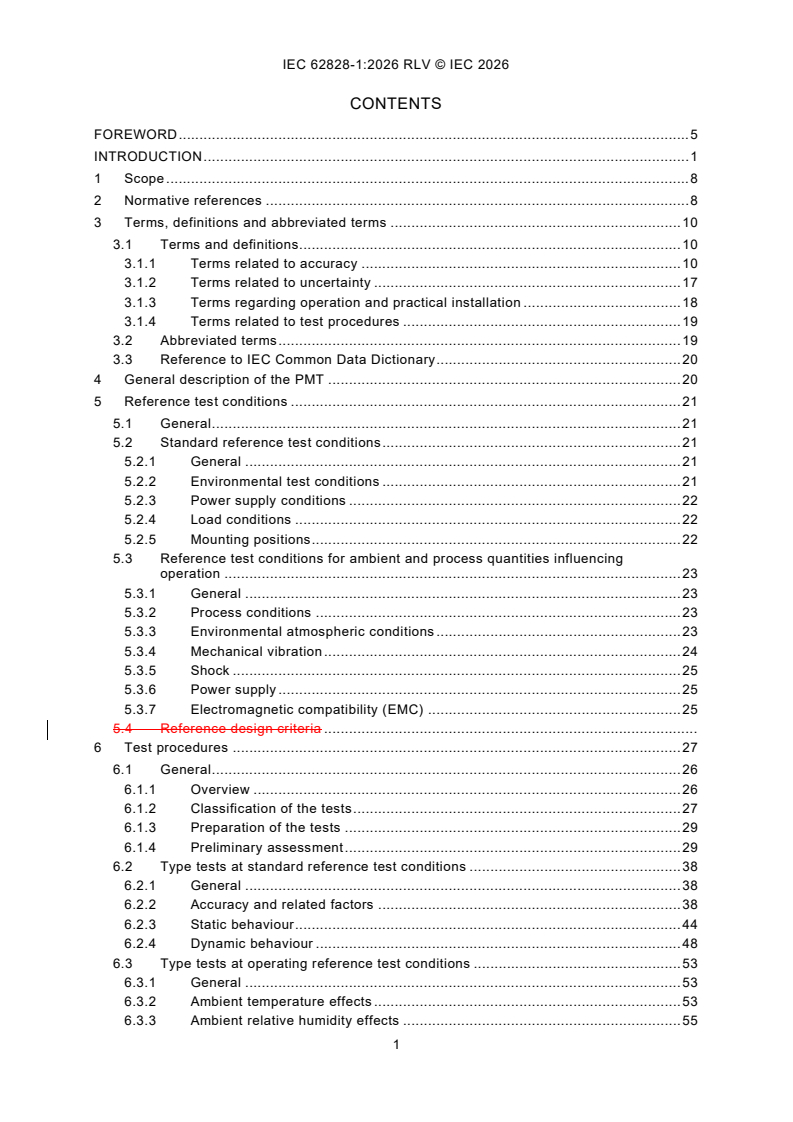
CONTENTS
FOREWORD . 5
INTRODUCTION . 1
1 Scope . 8
2 Normative references . 8
3 Terms, definitions and abbreviated terms . 10
3.1 Terms and definitions . 10
3.1.1 Terms related to accuracy . 10
3.1.2 Terms related to uncertainty . 17
3.1.3 Terms regarding operation and practical installation . 18
3.1.4 Terms related to test procedures . 19
3.2 Abbreviated terms . 19
3.3 Reference to IEC Common Data Dictionary . 20
4 General description of the PMT . 20
5 Reference test conditions . 21
5.1 General . 21
5.2 Standard reference test conditions . 21
5.2.1 General . 21
5.2.2 Environmental test conditions . 21
5.2.3 Power supply conditions . 22
5.2.4 Load conditions . 22
5.2.5 Mounting positions . 22
5.3 Reference test conditions for ambient and process quantities influencing
operation . 23
5.3.1 General . 23
5.3.2 Process conditions . 23
5.3.3 Environmental atmospheric conditions . 23
5.3.4 Mechanical vibration . 24
5.3.5 Shock . 25
5.3.6 Power supply . 25
5.3.7 Electromagnetic compatibility (EMC) . 25
5.4 Reference design criteria .
6 Test procedures . 27
6.1 General . 26
6.1.1 Overview . 26
6.1.2 Classification of the tests . 27
6.1.3 Preparation of the tests . 29
6.1.4 Preliminary assessment . 29
6.2 Type tests at standard reference test conditions . 38
6.2.1 General . 38
6.2.2 Accuracy and related factors . 38
6.2.3 Static behaviour . 44
6.2.4 Dynamic behaviour . 48
6.3 Type tests at operating reference test conditions . 53
6.3.1 General . 53
6.3.2 Ambient temperature effects . 53
6.3.3 Ambient relative humidity effects . 55
6.3.4 Vibration effects . 55
6.3.5 Shock, drop and topple effects . 57
6.3.6 Accelerated operational life test . 57
6.3.7 EMC tests . 58
6.3.8 Further test procedures . 58
6.3.9 Additional tests for digital transmitters . 58
6.4 Routine tests. 60
6.5 Acceptance, integration, periodic and maintenance tests . 60
6.5.1 General . 60
6.5.2 Periodical verification . 61
6.5.3 Periodical calibration . 61
7 Test report and technical documentation . 61
7.1 Test reportGeneral . 61
7.2 TechnicalTest documentation . 61
7.3 Total probable error . 62
Annex A (informative) General description of a PMT . 63
A.1 General description of a PMT . 63
A.2 Sensor subsystem . 65
A.3 Data processing . 65
A.4 Output subsystem . 65
A.5 Human interface . 66
A.6 External system interface . 66
A.7 Power supply assembly . 66
Annex B (informative) Tests at the standard reference conditions . 67
Annex C (Informative) Tests at ambient and process reference conditions for influence
quantities . 69
Annex D (informative) Function block testing . 71
D.1 General . 71
D.2 General qualitative checks . 71
D.3 Time-dependent function blocks . 71
D.4 Time-independent function blocks . 71
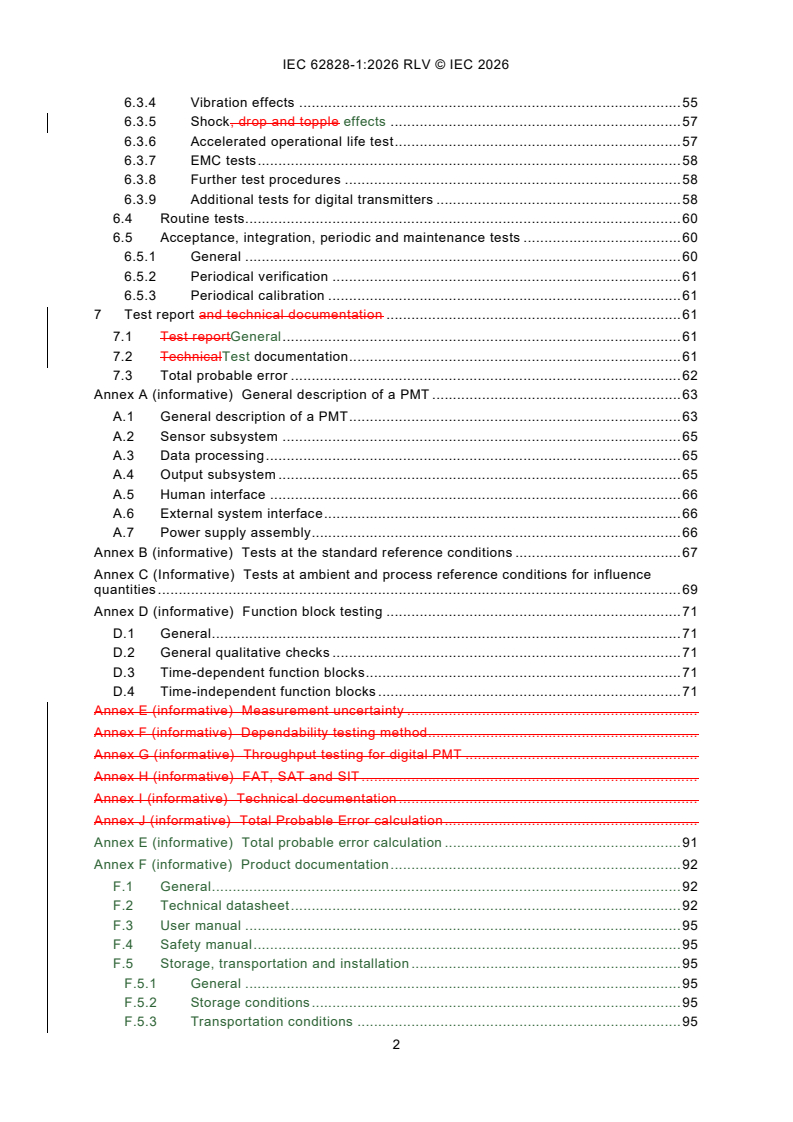
Annex E (informative) Measurement uncertainty .
Annex F (informative) Dependability testing method .
Annex G (informative) Throughput testing for digital PMT .
Annex H (informative) FAT, SAT and SIT .
Annex I (informative) Technical documentation .
Annex J (informative) Total Probable Error calculation .
Annex E (informative) Total probable error calculation . 91
Annex F (informative) Product documentation . 92
F.1 General . 92
F.2 Technical datasheet . 92
F.3 User manual . 95
F.4 Safety manual . 95
F.5 Storage, transportation and installation . 95
F.5.1 General . 95
F.5.2 Storage conditions . 95
F.5.3 Transportation conditions . 95
F.5.4 Mounting position . 96
F.5.5 Process connections . 96
F.5.6 Mechanical connections . 96
F.5.7 Output connections . 96
F.6 Calibration certificates . 96
Annex G (informative) Example of signal current range for a 4 to 20 mA PMT . 97
G.1 Measuring span . 97
G.2 Underrange . 97
G.3 Overrange . 97
G.4 Low alarm . 98
G.5 High alarm . 98
Bibliography . 99
Figure 1 – Principle diagram illustrating the definitions of warm-up time, settling time
and output signal . 15
Figure 2 – Block diagram of a generic PMT . 21
Figure 3 – Error curves corresponding to the example of Table 17 . 42
Figure 4 – Example of limit operation region in terms of output load resistance versus
supply voltage . 46
Figure 5 – Example of response with overshoot to a step input . 49
Figure 6 – Example of response without overshoot to a step input . 50
Figure 7 – Example 1 of frequency response . 51
Figure 8 – Example 2 of frequency response . 52
Figure 9 – Example of diagram of the compensation options . 54
Figure 9 – Levels of device compatibility from IEC 61804-2 .
Figure 10 – Example of an input signal and the corresponding output signal . 58
Figure A.1 – Schematic block diagram of an analogue industrial and process
measurement transmitter (example) . 63
Figure A.2 – Schematic block diagram of an intelligent industrial
and process measurement transmitter (example) .
Figure G.1 – Signal current range of a 4 mA to 20 mA transmitter . 97
Table 1 – Environmental test conditions . 22
Table 2 – Common ambient temperatures ranges . 24
Table 3 – Common ambient relative humidity ranges . 24
Table 4 – Vibration test levels . 25
Table 5 – Power supply ranges for voltage and frequency. 25
Table 6 – Example of number of measurement cycles and number and position of test
points. 28
Table 7 – Example of settings of span and lower range value adjustments for analogue
devices . 28
Table 8 – Checklist for assessing functionality . 30
Table 9 – Checklist for assessing configurability . 31
Table 10 – Checklist for assessing hardware configuration . 32
Table 11 – Checklist for assessing adjustment and tuning procedures . 32
Table 12 – Checklist for assessing operability . 33
Table 13 – Checklist for assessing dependability . 34
Table 14 – Checklist for assessing technical support . 35
Table 15 – Example of functions listing for a temperature compensated single variable
PMT (differential pressure) . 36
Table 16 – Example of functions listing for a temperature compensated multi-variable
PMT (differential pressure plus pressure and temperature) . 37
Table 17 – Example table of PMT errors . 40
Table B.1 – Summary of the tests at the reference conditions . 67
Table C.1 – Summary of the tests for influence quantities at the operating conditions . 69
Table F.1 – Example of compilation of technical data for a generic PMT . 93
INTERNATIONAL ELECTROTECHNICAL COMMISSION
____________
Reference conditions and procedures for testing industrial
and process measurement transmitters -
Part 1: General procedures for all types of transmitters
FOREWORD
1) The International Electrotechnical Commission (IEC) is a worldwide organization for standardization comprising
all national electrotechnical committees (IEC National Committees). The object of IEC is to promote international
co-operation on all questions concerning standardization in the electrical and electronic fields. To this end and
in addition to other activities, IEC publishes International Standards, Technical Specifications, Technical Reports,
Publicly Available Specifications (PAS) and Guides (hereafter referred to as "IEC Publication(s)"). Their prepa-
ration is entrusted to technical committees; any IEC National Committee interested in the subject dealt with may
participate in this preparatory work. International, governmental and non-governmental organizations liaising with
the IEC also participate in this preparation. IEC collaborates closely with the International Organization for Stand-
ardization (ISO) in accordance with conditions determined by agreement between the two organizations.
2) The formal decisions or agreements of IEC on technical matters express, as nearly as possible, an international
consensus of opinion on the relevant subjects since each technical committee has representation from all inter-
ested IEC National Committees.
3) IEC Publications have the form of recommendations for international use and are accepted by IEC National
Committees in that sense. While all reasonable efforts are made to ensure that the technical content of IEC
Publications is accurate, IEC cannot be held responsible for the way in which they are used or for any misinter-
pretation by any end user.
4) In order to promote international uniformity, IEC National Committees undertake to apply IEC Publications trans-
parently to the maximum extent possible in their national and regional publications. Any divergence between any
IEC Publication and the corresponding national or regional publication shall be clearly indicated in the latter.
5) IEC itself does not provide any attestation of conformity. Independent certification bodies provide conformity
assessment services and, in some areas, access to IEC marks of conformity. IEC is not responsible for any
services carried out by independent certification bodies.
6) All users should ensure that they have the latest edition of this publication.
7) No liability shall attach to IEC or its directors, employees, servants or agents including individual experts and
members of its technical committees and IEC National Committees for any personal injury, property damage or
other damage of any nature whatsoever, whether direct or indirect, or for costs (including legal fees) and ex-
penses arising out of the publication, use of, or reliance upon, this IEC Publication or any other IEC Publications.
8) Attention is drawn to the Normative references cited in this publication. Use of the referenced publications is
indispensable for the correct application of this publication.
9) IEC draws attention to the possibility that the implementation of this document may involve the use of (a) pa-
tent(s). IEC takes no position concerning the evidence, validity or applicability of any claimed patent rights in
respect thereof. As of the date of publication of this document, IEC had not received notice of (a) patent(s), which
may be required to implement this document. However, implementers are cautioned that this may not represent
the latest information, which may be obtained from the patent database available at https://patents.iec.ch. IEC
shall not be held responsible for identifying any or all such patent rights.
This redline version of the official IEC Standard allows the user to identify the changes made
to the previous edition IEC 62828-1:2017. A vertical bar appears in the margin wherever a
change has been made. Additions are in green text, deletions are in strikethrough red text.
IEC 62828-1 has been prepared by subcommittee 65B: Measurement and control devices, of
IEC Technical Committee 65: Industrial-process measurement, control and automation. It is an
International Standard.
This second edition cancels and replaces the first edition published in 2017. This edition con-
stitutes a technical revision.
This edition includes the following significant technical changes with respect to the previous
edition:
a) informative Annexes E, F, G and H have been removed;
b) a new informative Annex G “Example of signal current for a 4 mA to 20 mA PMT” has been
introduced (it has been moved from IEC 62828-2:2017 to this document);
c) the definitions of warm-up time, settling time and output signal have been moved from
IEC 62828-4:2020 to this document;
d) The definitions of “inaccuracy” and “accuracy” have been reworked;
e) The clause regarding test report has been reworked.
The text of this International Standard is based on the following documents:
Draft Report on voting
65B/1306/FDIS 65B/1320/RVD
Full information on the voting for its approval can be found in the report on voting indicated in
the above table.
The language used for the development of this International Standard is English.
This document was drafted in accordance with ISO/IEC Directives, Part 2, and developed in
accordance with ISO/IEC Directives, Part 1 and ISO/IEC Directives, IEC Supplement, available
at www.iec.ch/members_experts/refdocs. The main document types developed by IEC are de-
scribed in greater detail at www.iec.ch/publications.
A list of all parts in the IEC 62828 series, published under the general title Reference conditions
and procedures for testing industrial and process measurement transmitters, can be found on
the IEC website.
The committee has decided that the contents of this document will remain unchanged until the
stability date indicated on the IEC website under webstore.iec.ch in the data related to the
specific document. At this date, the document will be
– reconfirmed,
– withdrawn, or
– revised.
INTRODUCTION
Most of the current IEC standards on industrial and process measurement transmitters are ra-
ther old and were developed having in mind devices based on analogue technologies. Today's
digital industrial and process measurement transmitters are quite different from those analogue
transmitters: they include more functions and newer interfaces, both towards the computing
section (mostly digital electronic) and towards the measuring section (mostly mechanical). Even
if some standards dealing with digital process measurement transmitters already exist, they are
not sufficient, since some aspects of the performance are not covered by appropriate test meth-
ods.
In addition, existing IEC test standards for industrial and process measurement transmitters are
spread over many documents, so that for manufacturers and users it is difficult, impractical and
time-consuming to identify and select all the standards to be applied to a device measuring a
specific process quantity (pressure, temperature, flow, level, etc.).
To help manufacturers and users, it was decided to review, complete and reorganize the rele-
vant IEC standards and to create a more suitable, effective and comprehensive standard series
that provides in a systematic way all the necessary specifications and tests required for different
industrial and process measurement transmitters.
To solve the issues mentioned above and to provide an added value for the stakeholders, the
new standard series on industrial and process measurement transmitters covers the following
main aspects:
– applicable normative references;
– specific terms and definitions;
– typical configurations and architectures for the various types of industrial and process meas-
urement transmitters;
– hardware and software aspects;
– interfaces (to the process, to the operator, to the other measurement and control devices);
– physical, mechanical and electrical requirements and relevant tests; clear definition of the
test categories: type tests, acceptance tests and routine tests;
– performance (its specification, tests and verification);
– environmental protection, hazardous areas application, functional safety, etc.;
– structure of the technical product documentation.
To cover in a systematic way all the topics to be addressed, the standard series is organized in
several parts. At the moment of the publication of this document, the IEC 62828 consists of the
following parts:
– Part 1: General procedures for all types of transmitters;
– Part 2: Specific procedures for pressure transmitters;
– Part 3: Specific procedures for temperature transmitters;
– Part 4: Specific procedures for level transmitters;
– Part 5: Specific procedures for flow transmitters.
In preparing the IEC 62828 series many test procedures were taken, with the necessary im-
provements, from the IEC 61298 series. As the actual IEC 61298 series is applicable to all
process measurement and control devices, when the IEC 62828 series is completed the
IEC 61298 series will be revised to harmonise it with the IEC 62828 series, taking out from its
scope the industrial and process measurement transmitters. During the time when 61298 scope
is being updated, the new series IEC 62828 takes precedence for industrial and process meas-
urement transmitters.
When the IEC 62828 series is published, the IEC 60770 series will be withdrawn.
1 Scope
This Part of IEC 62828 establishes a general framework for defining reference conditions and
test procedures applicable to for assessing the measurement performances of all types of in-
dustrial and process measurement transmitters (PMTs) used in measuring and control systems
for industrial process and machinery. These reference test conditions are divided into “standard
reference conditions”, which apply when determining the accuracy of measurement, and “am-
bient and process reference conditions”, which are used to assess the influence of external
quantities on the measurement.
For the purpose of this document, an analogue PMT is a process measurement transmitter with
an only analogue current and/or voltage output(s), irrespective of the technology adopted and
the complexity of the circuitry. All the other process measurement transmitters, with digital out- ®
put(s) only or with hybrid analogue and digital output(s) (e.g. HART ), are considered to be
digital PMTs.
For general test procedures, reference is made to IEC 62828-1, which is applicable to all types
of industrial and process measurement transmitters.
Additional specific test procedures for given types of PMTs (pressure, temperature, level, flow)
are covered by other parts of this series.
This document constitutes a common reference for the other parts of the IEC 62828 series.
Specific test procedures and additional requirements for given types of PMTs (pressure, tem-
perature, level, flow, etc.) are covered by other parts of this series.
Sensing devices according to the IEC 60947 series are excluded from the scope of this docu-
ment.
NOTE 1 In industrial and process applications, to indicate the process measurement transmitters, it is common also
to use the terms "industrial transmitters", or "process transmitters".
NOTE 2 For better clarity, when the complete definition "industrial and process measurement transmitter" makes
the sentence too long in this document, the short term "transmitter", or PMT, is used instead.
Proximity devices with analogue output are excluded from the scope of this document.
2 Normative references
The following documents are referred to in the text in such a way that some or all of their content
constitutes requirements of this document. For dated references, only the edition cited applies.
For undated references, the latest edition of the referenced document (including any amend-
ments) applies.
IEC 60068-2-1, Environmental testing - Part 2-1: Tests - Test A: Cold
IEC 60068-2-2, Environmental testing - Part 2-2: Tests - Test B: Dry heat
IEC 60068-2-6, Environmental testing - Part 2-6: Tests - Test Fc: Vibration (sinusoidal)
IEC 60068-2-27, Environmental testing - Part 2-27: Tests - Test Ea and guidance: Shock
IEC 60068-2-31, Environmental testing – Part 2-31: Tests – Test Ec: Rough handling shocks,
primarily for equipment-type specimens
IEC 60068-2-78, Environmental testing - Part 2-78: Tests - Test Cab: Damp heat, steady state
IEC 60079-10 (all parts): Explosive atmospheres – Part 10: Classification of areas
IEC 60529:1989, Degrees of protection provided by enclosures (IP Code)
IEC 60529:1989/AMD1:1999
IEC 60529:1989/AMD2:2013
IEC 60654-1:1993, Industrial-process measurement and control equipment - Operating condi-
tions - Part 1: Climatic conditions
IEC 60654-3:1983, Operating conditions for industrial-process measurement and control equip-
ment - Part 3: Mechanical influences
IEC 60654-4:1987, Operating conditions for industrial-process measurement and control equip-
ment – Part 4: Corrosive and erosive influences
IEC 60721-3-1, Classification of environmental conditions – Part 3: Classification of groups of
environmental parameters and their severities – Section 1: Storage
IEC 60721-3-2, Classification of environmental conditions – Part 3: Classification of groups of
environmental parameters and their severities – Section 2: Transportation
IEC 61010-1:2010, Safety requirements for electrical equipment for measurement, control, and
laboratory use - Part 1: General requirements
IEC 61158 (all parts), Industrial communication networks – Fieldbus specifications
IEC 61298-1:2008, Process measurement and control devices – General methods and proce-
dures for evaluating performance – Part 1: General considerations
IEC 61298-4:2008, Process measurement and control devices – General methods and proce-
dures for evaluating performance – Part 4: Evaluation report content
IEC 61326 (all parts), Electrical equipment for measurement, control and laboratory use - EMC
requirements
IEC 61499 (all parts), Function blocks
IEC 61508 (all parts), Functional safety of electrical/electronic/programmable electronic safety-
related systems
IEC 61511 (all parts), Functional safety – Safety instrumented systems for the process industry
sector
IEC 61784-1, Industrial communication networks – Profiles – Part 1: Fieldbus profiles
IEC 61784-2, Industrial communication networks – Profiles – Part 2: Additional fieldbus profiles
for real-time networks based on ISO/IEC 8802-3
IEC 61784-5 (all parts), Industrial communication networks – Profiles – Part 5: Installation of
fieldbuses
IEC 61804 (all parts), Devices and integration in enterprise systems - Function blocks (FB) for
process control and electronic device description language (EDDL)
IEC 61804-2, Function blocks (FB) for process control – Part 2: Specification of FB concept
IEC 61918, Industrial communication networks – Installation of communication networks in in-
dustrial premises
IEC 61987-11:2016, Industrial-process measurement and control – Data structures and ele-
ments in process equipment catalogues – Part 11: List of properties (LOPs) of measuring equip-
ment for electronic data exchange – Generic structures
IEC 62061:2005, Safety of machinery – Functional safety of safety-related electrical, electronic
and programmable electronic control systems
IEC 62262:2002, Degrees of protection provided by enclosures for electrical equipment against
external mechanical impacts (IK Code)
IEC 62381:2012, Automation systems in the process industry – Factory acceptance test (FAT),
site acceptance test (SAT) and site integration test (SIT)
ISO/IEC Guide 98-3:2008, Uncertainty of measurement – Part 3: Guide to the expression of
uncertainty in measurement (GUM:1995)
ISO/IEC Guide 99:2007, International vocabulary of metrology – Basic and general concepts
and associated terms (VIM:2007)
3 Terms, definitions and abbreviated terms
3.1 Terms and definitions
For the purposes of this document, the following terms and definitions apply.
ISO and IEC maintain terminology databases for use in standardization at the following ad-
dresses:
– IEC Electropedia: available at https://www.electropedia.org/
– ISO Online browsing platform: available at https://www.iso.org/obp
3.1.1 Terms related to accuracy
3.1.1.1
accuracy
quality which characterizes the ability of a measuring instrument
to provide an indicated value close to a true value of the measurand
Note 1 to entry: This term is used in the "true value" approach.
Note 2 to entry: Accuracy is all the better when the indicated value is closer to the corresponding true value.
[SOURCE: IEC 60050-311:2001, 311-06-08]
3.1.1.2
conformity
ability of a measuring instrument to provide an indication having a specified characteristic curve
which can be linear, logarithmic, parabolic, etc.
3.1.1.3
dead band
dead zone
finite range of values within which a variation of the input variable does not produce any meas-
urable change in the output variable
Note 1 to entry: When this type of characteristic is intentional, it is sometimes called neutral zone.
Note 2 to entry: This entry was numbered 351-24-14 in IEC 60050-351:2006.
Note 3 to entry: This value is usually insignificant for the actual instruments.
[SOURCE: IEC 60050-351:2013, 351-45-15, modified – Note 3 has been added.]
3.1.1.4
error
discrepancy between a computed, observed or measured value or condition, and the true, spec-
ified or theoretically correct value or condition
Note 1 to entry: An error within a system may can be caused by failure of one or more of its components, or by
activation of a systematic fault.
[SOURCE: IEC 60050-192:20152024, 192-03-02]
3.1.1.5
hysteresis
phenomenon represented by a characteristic curve which has a branch, called ascending
branch, for increasing values of the input variable, and a different branch, called descending
branch, for decreasing values of the input variable
Note 1 to entry: The CDD code of this entry for Electronic Data Exchange is ABB661 and the hysteresis is defined
as the difference between consecutive upscale and downscale outputs for any single test cycle at the same input
test point.
[SOURCE: IEC 60050-351:2013, 351-45-16, modified – The note to entry has been added.]
3.1.1.6
inaccuracy
maximum positive and negative deviation from the specified characteristic curve observed in
testing a device under specified conditions and by a specified procedure
Note 1 to entry: The term “accuracy” is defined in IEC 60050-300:2001, 311-06-08.
[SOURCE: IEC 61298-1:2008]
3.1.1.7
linearity
ability of a measuring instrument to provide an indication having a linear relationship with a
defined quantity other than an influence quantity
Note 1 to entry: The method of expression of lack of linearity is different for different kinds of instrument and is
established in each particular instance.
[SOURCE: IEC 60050-311:2001, 311-06-05]
3.1.1.8
long-term drift
drift in output monitored for 30 days at 90 % of span
[SOURCE: IEC 61987-1:20082024, 3.2223]
3.1.1.9
long-term stability
drift of zero output signal in percent of full scale limit after a given period of normal operating
conditions
Note 1 to entry: The long-term stability can be evaluated over a different period of time, e.g. 6 months, 1, 2 or
5 years. Sometime manufacturers declare a life-time stability.
Note 2 to entry: Depending on the type of PMT, the drift can be referred to an upper range limit (e.g. digital pressure
PMTs), a fixed value (e.g. certain level PMTs), a full scale (e.g. some analogue PMTs), etc.
Note 3 to entry: The CDD code of this entry for Electronic Data Exchange is ABB551, modified (time period).
[SOURCE: IEC 61987 #ABB551 in the IEC common data dictionary, modified – Notes 1 and 2
to entry have been added.]
3.1.1.10
measured error
largest positive or negative value of errors of the average upscale or downscale values at each
point of measurement
[SOURCE: IEC 61298-1:2008]
3.1.1.11
measuring range
range defined by two values of the measurand, or quantity to be supplied, within which the limits
of uncertainty of the measuring instrument are specified
Note 1 to entry: An instrument can have several measuring ranges.
[SOURCE: IEC 60050-311:2001, 311-03-12]
3.1.1.12
non-conformity
deviation from ideal behavior for devices that have a non-linear input/output relationship (which
can be linear, logarithmic, parabolic, etc.), determined from the curve plotted using the overall
average of corresponding upscale and downscale errors
Note 1 to entry: Non-conformity can be calculated and expressed in one of three ways:
– independent: linecurve positioned so as to minimize the maximum deviation;
– terminal-based: linecurve positioned so as to coincide with the actual characteristic curve at the upper and lower
range-values;
– zero-based: linecurve positioned so as to coincide with the actual characteristic curve at the lower range-value.
Note 2 to entry: The corresponding properties are to be found in the CDD.
Note 3 to entry: in IEC 61298-2:2011 the non conformity is defined as the closeness with which a calibration curve
approximates to a specified characteristic curve (which can be linear, logarithmic, parabolic, etc.).
Note 4 to entry: Non-conformity does not include hysteresis.
[SOURCE: IEC 61987-13:2016, 3.3.6, modified: Note 3 and Note 4 – Specifications have been
added in parentheses.]
3.1.1.13
non-linearity
deviation from ideal behavior for devices that have a linear input/out relationship, determined
from the curve plotted using the overall average of corresponding upscale and downscale errors
Note 1 to entry: Non-linearity can be calculated and expressed in one of three ways:
– independent: line positioned so as to minimize the maximum deviation;
– terminal-based: line positioned so as to coincide with the actual characteristic curve at the upper and lower
range-values;
– zero-based: line positioned so as to coincide with the actual characteristic curve at the lower range-value.
Note 2 to entry: The corresponding properties can are to be found in the CDD.
Note 3 to entry: Linearity is defined in IEC 60050(300). definition 311-06-06.
Note 4 to entry: Non-linearity does not include hysteresis.
[SOURCE: IEC 61987-13:2016, 3.3.7 modified: Notes added]
3.1.1.14
overrange
input signal larger than an instrument is designed to accept or measure
Note 1 to entry: That part of the proportional range where the analogue output signal represents a process value
above the configured measuring range.
Note 2 to entry: The output signal can be not calibrated in overrange state.
3.1.1.15
overshoot
for a step response, the maximum transient deviation from the final steady-state value of the
output variable, expressed as a percentage of the difference between the final and the initial
steady-state values
Note 1 to entry: The CDD code of this entry for Electronic Data Exchange is ABD684.
[SOURCE: IEC 61987 #ABD684 in the IEC common data dictionary]
3.1.1.16
repeatability
closeness of agreement between the results of successive measurements of the same meas-
urand, carried out under the same conditions of measurement, i.e.:
– by the same measurement procedure,
– by th
...
IEC 62828-1 ®
Edition 2.0 2026-06
INTERNATIONAL
STANDARD
Reference conditions and procedures for testing industrial and process
measurement transmitters -
Part 1: General procedures for all types of transmitters
ICS 17.020; 25.040.40 ISBN 978-2-8327-1273-3
All rights reserved. Unless otherwise specified, no part of this publication may be reproduced or utilized in any form or
by any means, electronic or mechanical, including photocopying and microfilm, without permission in writing from either
IEC or IEC's member National Committee in the country of the requester. If you have any questions about IEC copyright
or have an enquiry about obtaining additional rights to this publication, please contact the address below or your local
IEC member National Committee for further information.
IEC Secretariat Tel.: +41 22 919 02 11
3, rue de Varembé info@iec.ch
CH-1211 Geneva 20 www.iec.ch
Switzerland
About the IEC
The International Electrotechnical Commission (IEC) is the leading global organization that prepares and publishes
International Standards for all electrical, electronic and related technologies.
About IEC publications
The technical content of IEC publications is kept under constant review by the IEC. Please make sure that you have the
latest edition, a corrigendum or an amendment might have been published.
IEC publications search - IEC Products & Services Portal - products.iec.ch
webstore.iec.ch/advsearchform Discover our powerful search engine and read freely all the
The advanced search enables to find IEC publications by a publications previews, graphical symbols and the glossary.
variety of criteria (reference number, text, technical With a subscription you will always have access to up to date
committee, …). It also gives information on projects, content tailored to your needs.
replaced and withdrawn publications.
Electropedia - www.electropedia.org
The world's leading online dictionary on electrotechnology,
IEC Just Published - webstore.iec.ch/justpublished
Stay up to date on all new IEC publications. Just Published containing more than 22 500 terminological entries in English
details all new publications released. Available online and and French, with equivalent terms in 25 additional languages.
once a month by email. Also known as the International Electrotechnical Vocabulary
(IEV) online.
IEC Customer Service Centre - webstore.iec.ch/csc
If you wish to give us your feedback on this publication or
need further assistance, please contact the Customer
Service Centre: sales@iec.ch.
CONTENTS
FOREWORD . 4
INTRODUCTION . 6
1 Scope . 7
2 Normative references . 7
3 Terms, definitions and abbreviated terms . 8
3.1 Terms and definitions . 8
3.1.1 Terms related to accuracy . 8
3.1.2 Terms related to uncertainty . 14
3.1.3 Terms regarding operation and practical installation . 15
3.1.4 Terms related to test procedures . 16
3.2 Abbreviated terms . 16
3.3 Reference to IEC Common Data Dictionary . 17
4 General description of the PMT . 17
5 Reference test conditions . 17
5.1 General . 17
5.2 Standard reference test conditions . 18
5.2.1 General . 18
5.2.2 Environmental test conditions . 18
5.2.3 Power supply conditions . 18
5.2.4 Load conditions . 19
5.2.5 Mounting positions . 19
5.3 Reference test conditions for ambient and process quantities influencing
operation . 19
5.3.1 General . 19
5.3.2 Process conditions . 19
5.3.3 Environmental atmospheric conditions . 19
5.3.4 Mechanical vibration . 20
5.3.5 Shock . 21
5.3.6 Power supply . 21
5.3.7 Electromagnetic compatibility (EMC) . 21
6 Test procedures . 22
6.1 General . 22
6.1.1 Overview . 22
6.1.2 Classification of the tests . 22
6.1.3 Preparation of the tests . 23
6.1.4 Preliminary assessment . 24
6.2 Type tests at standard reference test conditions . 31
6.2.1 General . 31
6.2.2 Accuracy and related factors . 31
6.2.3 Static behaviour . 37
6.2.4 Dynamic behaviour . 41
6.3 Type tests at operating reference test conditions . 46
6.3.1 General . 46
6.3.2 Ambient temperature effects . 46
6.3.3 Ambient relative humidity effects . 48
6.3.4 Vibration effects . 48
6.3.5 Shock effects . 50
6.3.6 Accelerated operational life test . 50
6.3.7 EMC tests . 50
6.3.8 Further test procedures . 51
6.3.9 Additional tests for digital transmitters . 51
6.4 Routine tests. 52
6.5 Acceptance, integration, periodic and maintenance tests . 52
6.5.1 General . 52
6.5.2 Periodical verification . 52
6.5.3 Periodical calibration . 52
7 Test report . 53
7.1 General . 53
7.2 Test documentation . 53
7.3 Total probable error . 53
Annex A (informative) General description of a PMT . 55
A.1 General description of a PMT . 55
A.2 Sensor subsystem . 56
A.3 Data processing . 56
A.4 Output subsystem . 56
A.5 Human interface . 57
A.6 External system interface . 57
A.7 Power supply assembly . 57
Annex B (informative) Tests at the standard reference conditions . 58
Annex C (Informative) Tests at ambient and process reference conditions for influence
quantities . 60
Annex D (informative) Function block testing . 62
D.1 General . 62
D.2 General qualitative checks . 62
D.3 Time-dependent function blocks . 62
D.4 Time-independent function blocks . 62
Annex E (informative) Total probable error calculation . 63
Annex F (informative) Product documentation . 64
F.1 General . 64
F.2 Technical datasheet . 64
F.3 User manual . 67
F.4 Safety manual . 67
F.5 Storage, transportation and installation . 67
F.5.1 General . 67
F.5.2 Storage conditions . 67
F.5.3 Transportation conditions . 67
F.5.4 Mounting position . 68
F.5.5 Process connections . 68
F.5.6 Mechanical connections . 68
F.5.7 Output connections . 68
F.6 Calibration certificates . 68
Annex G (informative) Example of signal current range for a 4 to 20 mA PMT . 69
G.1 Measuring span . 69
G.2 Underrange . 69
G.3 Overrange . 69
G.4 Low alarm . 70
G.5 High alarm . 70
Bibliography . 71
Figure 1 – Principle diagram illustrating the definitions of warm-up time, settling time
and output signal . 12
Figure 2 – Block diagram of a generic PMT . 17
Figure 3 – Error curves corresponding to the example of Table 17 . 35
Figure 4 – Example of limit operation region in terms of output load resistance versus
supply voltage . 39
Figure 5 – Example of response with overshoot to a step input . 42
Figure 6 – Example of response without overshoot to a step input . 43
Figure 7 – Example 1 of frequency response . 44
Figure 8 – Example 2 of frequency response . 45
Figure 9 – Example of diagram of the compensation options . 47
Figure 10 – Example of an input signal and the corresponding output signal . 50
Figure A.1 – Schematic block diagram of an analogue industrial and process
measurement transmitter (example) . 55
Figure G.1 – Signal current range of a 4 mA to 20 mA transmitter . 69
Table 1 – Environmental test conditions . 18
Table 2 – Common ambient temperatures ranges . 20
Table 3 – Common ambient relative humidity ranges . 20
Table 4 – Vibration test levels . 21
Table 5 – Power supply ranges for voltage and frequency. 21
Table 6 – Example of number of measurement cycles and number and position of test
points. 23
Table 7 – Example of settings of span and lower range value adjustments for analogue
devices . 23
Table 8 – Checklist for assessing functionality . 25
Table 9 – Checklist for assessing configurability . 26
Table 10 – Checklist for assessing hardware configuration . 27
Table 11 – Checklist for assessing adjustment and tuning procedures . 27
Table 12 – Checklist for assessing operability . 28
Table 13 – Checklist for assessing dependability . 29
Table 14 – Checklist for assessing technical support . 30
Table 15 – Example of functions listing for a temperature compensated single variable
PMT (differential pressure) . 30
Table 16 – Example of functions listing for a temperature compensated multi-variable
PMT (differential pressure plus pressure and temperature) . 31
Table 17 – Example table of PMT errors . 34
Table B.1 – Summary of the tests at the reference conditions . 58
Table C.1 – Summary of the tests for influence quantities at the operating conditions . 60
Table F.1 – Example of compilation of technical data for a generic PMT . 65
INTERNATIONAL ELECTROTECHNICAL COMMISSION
____________
Reference conditions and procedures for testing industrial
and process measurement transmitters -
Part 1: General procedures for all types of transmitters
FOREWORD
1) The International Electrotechnical Commission (IEC) is a worldwide organization for standardization comprising
all national electrotechnical committees (IEC National Committees). The object of IEC is to promote international
co-operation on all questions concerning standardization in the electrical and electronic fields. To this end and
in addition to other activities, IEC publishes International Standards, Technical Specifications, Technical Reports,
Publicly Available Specifications (PAS) and Guides (hereafter referred to as "IEC Publication(s)"). Their prepa-
ration is entrusted to technical committees; any IEC National Committee interested in the subject dealt with may
participate in this preparatory work. International, governmental and non-governmental organizations liaising with
the IEC also participate in this preparation. IEC collaborates closely with the International Organization for Stand-
ardization (ISO) in accordance with conditions determined by agreement between the two organizations.
2) The formal decisions or agreements of IEC on technical matters express, as nearly as possible, an international
consensus of opinion on the relevant subjects since each technical committee has representation from all inter-
ested IEC National Committees.
3) IEC Publications have the form of recommendations for international use and are accepted by IEC National
Committees in that sense. While all reasonable efforts are made to ensure that the technical content of IEC
Publications is accurate, IEC cannot be held responsible for the way in which they are used or for any misinter-
pretation by any end user.
4) In order to promote international uniformity, IEC National Committees undertake to apply IEC Publications trans-
parently to the maximum extent possible in their national and regional publications. Any divergence between any
IEC Publication and the corresponding national or regional publication shall be clearly indicated in the latter.
5) IEC itself does not provide any attestation of conformity. Independent certification bodies provide conformity
assessment services and, in some areas, access to IEC marks of conformity. IEC is not responsible for any
services carried out by independent certification bodies.
6) All users should ensure that they have the latest edition of this publication.
7) No liability shall attach to IEC or its directors, employees, servants or agents including individual experts and
members of its technical committees and IEC National Committees for any personal injury, property damage or
other damage of any nature whatsoever, whether direct or indirect, or for costs (including legal fees) and ex-
penses arising out of the publication, use of, or reliance upon, this IEC Publication or any other IEC Publications.
8) Attention is drawn to the Normative references cited in this publication. Use of the referenced publications is
indispensable for the correct application of this publication.
9) IEC draws attention to the possibility that the implementation of this document may involve the use of (a) pa-
tent(s). IEC takes no position concerning the evidence, validity or applicability of any claimed patent rights in
respect thereof. As of the date of publication of this document, IEC had not received notice of (a) patent(s), which
may be required to implement this document. However, implementers are cautioned that this may not represent
the latest information, which may be obtained from the patent database available at https://patents.iec.ch. IEC
shall not be held responsible for identifying any or all such patent rights.
IEC 62828-1 has been prepared by subcommittee 65B: Measurement and control devices, of
IEC Technical Committee 65: Industrial-process measurement, control and automation. It is an
International Standard.
This second edition cancels and replaces the first edition published in 2017. This edition con-
stitutes a technical revision.
This edition includes the following significant technical changes with respect to the previous
edition:
a) informative Annexes E, F, G and H have been removed;
b) a new informative Annex G “Example of signal current for a 4 mA to 20 mA PMT” has been
introduced (it has been moved from IEC 62828-2:2017 to this document);
c) the definitions of warm-up time, settling time and output signal have been moved from
IEC 62828-4:2020 to this document;
d) The definitions of “inaccuracy” and “accuracy” have been reworked;
e) The clause regarding test report has been reworked.
The text of this International Standard is based on the following documents:
Draft Report on voting
65B/1306/FDIS 65B/1320/RVD
Full information on the voting for its approval can be found in the report on voting indicated in
the above table.
The language used for the development of this International Standard is English.
This document was drafted in accordance with ISO/IEC Directives, Part 2, and developed in
accordance with ISO/IEC Directives, Part 1 and ISO/IEC Directives, IEC Supplement, available
at www.iec.ch/members_experts/refdocs. The main document types developed by IEC are de-
scribed in greater detail at www.iec.ch/publications.
A list of all parts in the IEC 62828 series, published under the general title Reference conditions
and procedures for testing industrial and process measurement transmitters, can be found on
the IEC website.
The committee has decided that the contents of this document will remain unchanged until the
stability date indicated on the IEC website under webstore.iec.ch in the data related to the
specific document. At this date, the document will be
– reconfirmed,
– withdrawn, or
– revised.
INTRODUCTION
Most of the current IEC standards on industrial and process measurement transmitters are ra-
ther old and were developed having in mind devices based on analogue technologies. Today's
digital industrial and process measurement transmitters are quite different from those analogue
transmitters: they include more functions and newer interfaces, both towards the computing
section (mostly digital electronic) and towards the measuring section (mostly mechanical). Even
if some standards dealing with digital process measurement transmitters already exist, they are
not sufficient, since some aspects of the performance are not covered by appropriate test meth-
ods.
In addition, existing IEC test standards for industrial and process measurement transmitters are
spread over many documents, so that for manufacturers and users it is difficult, impractical and
time-consuming to identify and select all the standards to be applied to a device measuring a
specific process quantity (pressure, temperature, flow, level, etc.).
To help manufacturers and users, it was decided to review, complete and reorganize the rele-
vant IEC standards and to create a more suitable, effective and comprehensive standard series
that provides in a systematic way all the necessary specifications and tests required for different
industrial and process measurement transmitters.
To solve the issues mentioned above and to provide an added value for the stakeholders, the
new standard series on industrial and process measurement transmitters covers the following
main aspects:
– applicable normative references;
– specific terms and definitions;
– typical configurations and architectures for the various types of industrial and process meas-
urement transmitters;
– hardware and software aspects;
– interfaces (to the process, to the operator, to the other measurement and control devices);
– physical, mechanical and electrical requirements and relevant tests; clear definition of the
test categories: type tests, acceptance tests and routine tests;
– performance (its specification, tests and verification);
– environmental protection, hazardous areas application, functional safety, etc.;
– structure of the product documentation.
To cover in a systematic way all the topics to be addressed, the standard series is organized in
several parts. At the moment of the publication of this document, the IEC 62828 consists of the
following parts:
– Part 1: General procedures for all types of transmitters;
– Part 2: Specific procedures for pressure transmitters;
– Part 3: Specific procedures for temperature transmitters;
– Part 4: Specific procedures for level transmitters;
– Part 5: Specific procedures for flow transmitters.
1 Scope
This Part of IEC 62828 establishes a general framework for defining reference conditions and
test procedures applicable for assessing the measurement performances of all types of indus-
trial and process measurement transmitters (PMTs) used in measuring and control systems for
industrial process and machinery.
For the purpose of this document, an analogue PMT is a process measurement transmitter with
only analogue current and/or voltage output(s), irrespective the technology adopted and the
complexity of the circuitry. All the other process measurement transmitters, with digital output(s)
only or with hybrid analogue and digital output(s), are considered to be digital PMTs.
This document constitutes a common reference for the other parts of the IEC 62828 series.
Specific test procedures and additional requirements for given types of PMTs (pressure, tem-
perature, level, flow, etc.) are covered by other parts of this series.
Sensing devices according to the IEC 60947 series are excluded from the scope of this docu-
ment.
NOTE 1 In industrial and process applications, to indicate the process measurement transmitters, it is common also
to use the terms "industrial transmitters", or "process transmitters".
NOTE 2 For better clarity, when the complete definition "industrial and process measurement transmitter" makes
the sentence too long in this document, the short term "transmitter", or PMT, is used instead.
2 Normative references
The following documents are referred to in the text in such a way that some or all of their content
constitutes requirements of this document. For dated references, only the edition cited applies.
For undated references, the latest edition of the referenced document (including any amend-
ments) applies.
IEC 60068-2-1, Environmental testing - Part 2-1: Tests - Test A: Cold
IEC 60068-2-2, Environmental testing - Part 2-2: Tests - Test B: Dry heat
IEC 60068-2-6, Environmental testing - Part 2-6: Tests - Test Fc: Vibration (sinusoidal)
IEC 60068-2-27, Environmental testing - Part 2-27: Tests - Test Ea and guidance: Shock
IEC 60068-2-78, Environmental testing - Part 2-78: Tests - Test Cab: Damp heat, steady state
IEC 60654-1, Industrial-process measurement and control equipment - Operating conditions -
Part 1: Climatic conditions
IEC 60654-3, Operating conditions for industrial-process measurement and control equipment -
Part 3: Mechanical influences
IEC 61010-1, Safety requirements for electrical equipment for measurement, control, and la-
boratory use - Part 1: General requirements
IEC 61326 (all parts), Electrical equipment for measurement, control and laboratory use - EMC
requirements
IEC 61499 (all parts), Function blocks
IEC 61804 (all parts), Devices and integration in enterprise systems - Function blocks (FB) for
process control and electronic device description language (EDDL)
3 Terms, definitions and abbreviated terms
3.1 Terms and definitions
For the purposes of this document, the following terms and definitions apply.
ISO and IEC maintain terminology databases for use in standardization at the following ad-
dresses:
– IEC Electropedia: available at https://www.electropedia.org/
– ISO Online browsing platform: available at https://www.iso.org/obp
3.1.1 Terms related to accuracy
3.1.1.1
accuracy
quality which characterizes the ability of a measuring instrument
to provide an indicated value close to a true value of the measurand
Note 1 to entry: This term is used in the "true value" approach.
Note 2 to entry: Accuracy is all the better when the indicated value is closer to the corresponding true value.
[SOURCE: IEC 60050-311:2001, 311-06-08]
3.1.1.2
conformity
ability of a measuring instrument to provide an indication having a specified characteristic curve
which can be linear, logarithmic, parabolic, etc.
3.1.1.3
dead band
dead zone
finite range of values within which a variation of the input variable does not produce any meas-
urable change in the output variable
Note 1 to entry: When this type of characteristic is intentional, it is sometimes called neutral zone.
Note 2 to entry: This entry was numbered 351-24-14 in IEC 60050-351:2006.
Note 3 to entry: This value is usually insignificant for the actual instruments.
[SOURCE: IEC 60050-351:2013, 351-45-15, modified – Note 3 has been added.]
3.1.1.4
error
discrepancy between a computed, observed or measured value or condition, and the true, spec-
ified or theoretically correct value or condition
Note 1 to entry: An error within a system can be caused by failure of one or more of its components, or by activation
of a systematic fault.
[SOURCE: IEC 60050-192:2024, 192-03-02]
3.1.1.5
hysteresis
phenomenon represented by a characteristic curve which has a branch, called ascending
branch, for increasing values of the input variable, and a different branch, called descending
branch, for decreasing values of the input variable
Note 1 to entry: The CDD code of this entry for Electronic Data Exchange is ABB661 and the hysteresis is defined
as the difference between consecutive upscale and downscale outputs for any single test cycle at the same input
test point.
[SOURCE: IEC 60050-351:2013, 351-45-16, modified – The note to entry has been added.]
3.1.1.6
inaccuracy
maximum positive and negative deviation from the specified characteristic curve observed in
testing a device under specified conditions and by a specified procedure
Note 1 to entry: The term “accuracy” is defined in IEC 60050-300:2001, 311-06-08.
3.1.1.7
linearity
ability of a measuring instrument to provide an indication having a linear relationship with a
defined quantity other than an influence quantity
Note 1 to entry: The method of expression of lack of linearity is different for different kinds of instrument and is
established in each particular instance.
[SOURCE: IEC 60050-311:2001, 311-06-05]
3.1.1.8
long-term drift
drift in output monitored for 30 days at 90 % of span
[SOURCE: IEC 61987-1:2024, 3.23]
3.1.1.9
long-term stability
drift of zero output signal in percent of full scale after a given period of normal operating condi-
tions
Note 1 to entry: The long-term stability can be evaluated over a different period of time, e.g. 6 months, 1, 2 or
5 years.
Note 2 to entry: Depending on the type of PMT, the drift can be referred to an upper range limit (e.g. digital pressure
PMTs), a fixed value (e.g. certain level PMTs), a full scale (e.g. some analogue PMTs), etc.
[SOURCE: IEC 61987 #ABB551 in the IEC common data dictionary, modified – Notes 1 and 2
to entry have been added.]
3.1.1.10
measured error
largest positive or negative value of errors of the average upscale or downscale values at each
point of measurement
3.1.1.11
measuring range
range defined by two values of the measurand, or quantity to be supplied, within which the limits
of uncertainty of the measuring instrument are specified
Note 1 to entry: An instrument can have several measuring ranges.
[SOURCE: IEC 60050-311:2001, 311-03-12]
3.1.1.12
non-conformity
deviation from ideal behavior for devices that have a non-linear input/output relationship (which
can be linear, logarithmic, parabolic, etc.), determined from the curve plotted using the overall
average of corresponding upscale and downscale errors
Note 1 to entry: Non-conformity can be calculated and expressed in one of three ways:
– independent: curve positioned so as to minimize the maximum deviation;
– terminal-based: curve positioned so as to coincide with the actual characteristic curve at the upper and lower
range-values;
– zero-based: curve positioned so as to coincide with the actual characteristic curve at the lower range-value.
Note 2 to entry: The corresponding properties are to be found in the CDD.
[SOURCE: IEC 61987-13:2016, 3.3.6, modified – Specifications have been added in parenthe-
ses.]
3.1.1.13
non-linearity
deviation from ideal behavior for devices that have a linear input/out relationship, determined
from the curve plotted using the overall average of corresponding upscale and downscale errors
Note 1 to entry: Non-linearity can be calculated and expressed in one of three ways:
– independent: line positioned so as to minimize the maximum deviation;
– terminal-based: line positioned so as to coincide with the actual characteristic curve at the upper and lower
range-values;
– zero-based: line positioned so as to coincide with the actual characteristic curve at the lower range-value.
Note 2 to entry: The corresponding properties are to be found in the CDD.
[SOURCE: IEC 61987-13:2016, 3.3.7]
3.1.1.14
overrange
input signal larger than an instrument is designed to accept or measure
Note 1 to entry: That part of the proportional range where the analogue output signal represents a process value
above the configured measuring range.
Note 2 to entry: The output signal can be not calibrated in overrange state.
3.1.1.15
overshoot
for a step response, the maximum transient deviation from the final steady-state value of the
output variable, expressed as a percentage of the difference between the final and the initial
steady-state values
[SOURCE: IEC 61987 #ABD684 in the IEC common data dictionary]
3.1.1.16
repeatability
closeness of agreement between the results of successive measurements of the same meas-
urand, carried out under the same conditions of measurement, i.e.:
– by the same measurement procedure,
– by the same observer,
– with the same measuring instruments, used under the same conditions,
– in the same laboratory,
– at relatively short intervals of time.
Note 1 to entry: The concept of "measurement procedure" is defined in VIM 2.5.
[SOURCE: IEC 60050-311:2001, 311-06-06]
3.1.1.17
signal
physical variable quantity, one or more parameters of which carry information about one or
more variable quantities
Note 1 to entry: These parameters are designed "information parameters".
Note 2 to entry: This entry was numbered 351-21-51 in IEC 60050-351:2006.
[SOURCE: IEC 60050-351:2013, 351-41-17]
3.1.1.18
span
algebraic difference between the values of the upper and lower limits of the measuring range
Note 1 to entry: The limits shall not be considered as physical limits regarding the capabilities of the device, but
rather as the upper and lower values defined for the relevant application.
[SOURCE: IEC 61987 #ABB785 in the IEC common data dictionary ("other variables" re-
moved)].
3.1.1.19
span error
difference between the actual span and the ideal span, expressed as percentage of ideal span
[SOURCE: IEC 61987 # ABB655 in the IEC common data dictionary].
3.1.1.20
stability
ability of a measuring instrument to keep its performance characteristics unchanged during a
specified time interval, all other conditions being the same
[SOURCE: IEC 60050-311:2001, 311-06-12]
3.1.1.21
warm-up time
duration between the instant when the power supply is energized and the instant when the
instrument can be used, as specified by the manufacturer
[SOURCE: IEC 61987 #ABB026 in the IEC common data dictionary]
3.1.1.22
settling time
time interval between the step change of an input signal and the instant when the resulting
variation of the output signal does not deviate more than 1 % from its steady state value
[SOURCE: IEC 61987 #ABA999 in the IEC common data dictionary]
3.1.1.23
output signal
analogue or digital representation of the measurand produced by a transmitter
Note 1 to entry: A transmitter is a transducer with standardized output, see IEC 60050-351-2013, 351-56-29.
[SOURCE: IEC 60050-314:2001, 314-04-06, modified: “transducer” has been replaced by
“transmitter”.]
Figure 1 – Principle diagram illustrating the definitions
of warm-up time, settling time and output signal
3.1.1.24
start-up drift
drift in output monitored after a defined period of time following power on
3.1.1.25
step response time
duration between the instant when the measurand (or quantity supplied) is subjected to a spec-
ified abrupt change and the instant when the indication (or quantity supplied) reaches, and
remains within specified limits of, its final steady-state value
Note 1 to entry: This definition is the one conventionally used for measuring instruments. Other definitions exist.
Note 2 to entry: The dead time of the transmitter response is included in the step response time (see Figure 5 and
Figure 6).
[SOURCE: IEC 60050-311:2001, 311-06-04, modified – Note 2 has been added.]
3.1.1.26
true value
value consistent with the definition of a given particular quantity
Note 1 to entry: This term is used in the "true value" approach.
Note 2 to entry: This is a value that would be obtained by a perfect measurement.
Note 3 to entry: True values are by nature indeterminate.
Note 4 to entry: The indefinite article "a", rather than the definite article "the", is used in conjunction with "true
value" because there can be many values consistent with the definition of a given particular quantity.
[SOURCE: IEC 60050-311:2001, 311-01-04]
3.1.1.27
conventional true value (of a quantity)
value attributed to a particular quantity and accepted, sometimes by convention, as having an
uncertainty appropriate for a given purpose
Note 1 to entry: This term is used in the "uncertainty" approach.
Note 2 to entry: The "conventional true value" is sometimes called "assigned value", "best estimate of the value",
"conventional value" or "reference value". The term "reference value", in this sense, should not be confused with
"reference value" in the sense used in 311-07-01.
Note 3 to entry: Frequently, a large number of results of measurement of a quantity are used to establish a con-
ventional true value.
Note 4 to entry: Traditional definitions, based on the true value approach, treated the conventional true value as a
value approximating to a true value of the quantity such that the difference could be neglected for the purposes for
which that value was used.
[SOURCE: IEC 60050-311:2001, 311-01-06]
3.1.1.28
variable quantity
variable
physical quantity the value of which is subject to change and can usually be measured
Note 1 to entry: The term "variable" alone is frequently used to circumvent the lengthy but correct designation
"variable quantity".
[SOURCE: IEC 60050-351:2013, 351-41-01]
3.1.1.29
zero offset
deviation of the actual zero output from the specified zero output
Note 1 to entry: For example, the specified output of a 4-20 mA PMT is 4 mA.
3.1.1.30
zero output
output signal of a PMT at the lower range value
3.1.1.31
zero point error
absolute error of a device under reference conditions, when the input is at the lower range value
[SOURCE: IEC 61987 #ABB656 in the IEC common data dictionary. Terms related to the un-
certainty.]
3.1.2 Terms related to uncertainty
3.1.2.1
combined standard measurement uncertainty
standard measurement uncertainty that is obtained using the individual standard measurement
uncertainties associated with the input quantities in a measurement model
[SOURCE: ISO/IEC Guide 99:2007, 2.31, modified – The note has been removed.]
3.1.2.2
coverage factor
number larger than one by which a combined standard measurement uncertainty is multiplied
to obtain an expanded measurement uncertainty
Note 1 to entry: A coverage factor is usually symbolized by k (see also ISO/IEC GUM Guide 98-3:2008, 2.3.6).
[SOURCE: ISO/IEC Guide 99:2007, 2.38]
3.1.2.3
expanded measurement uncertainty
product of a combined standard measurement uncertainty and a factor larger than the number
one
Note 1 to entry: The factor depends upon the type of probability distribution of the output quantity in a measurement
model and on the selected coverage probability (unless otherwise specified, the factor is set to 2, to have a coverage
probability of 95 %).
...
IEC 62828-1 ®
Edition 2.0 2026-06
NORME
INTERNATIONALE
Conditions de référence et procédures pour l'essai des transmetteurs de mesure
industrielle et de processus -
Partie 1: Procédures générales pour tous les types de transmetteurs
ICS 17.020; 25.040.40 ISBN 978-2-8327-1273-3
Droits de reproduction réservés. Sauf indication contraire, aucune partie de cette publication ne peut être reproduite ni
utilisée sous quelque forme que ce soit et par aucun procédé, électronique ou mécanique, y compris la photocopie et
les microfilms, sans l'accord écrit de l'IEC ou du Comité national de l'IEC du pays du demandeur. Si vous avez des
questions sur le copyright de l'IEC ou si vous désirez obtenir des droits supplémentaires sur cette publication, utilisez
les coordonnées ci-après ou contactez le Comité national de l'IEC de votre pays de résidence.
IEC Secretariat Tel.: +41 22 919 02 11
3, rue de Varembé info@iec.ch
CH-1211 Geneva 20 www.iec.ch
Switzerland
A propos de l'IEC
La Commission Electrotechnique Internationale (IEC) est la première organisation mondiale qui élabore et publie des
Normes internationales pour tout ce qui a trait à l'électricité, à l'électronique et aux technologies apparentées.
A propos des publications IEC
Le contenu technique des publications IEC est constamment revu. Veuillez vous assurer que vous possédez l’édition la
plus récente, un corrigendum ou amendement peut avoir été publié.
Recherche de publications IEC - IEC Products & Services Portal - products.iec.ch
webstore.iec.ch/advsearchform Découvrez notre puissant moteur de recherche et consultez
La recherche avancée permet de trouver des publications gratuitement tous les aperçus des publications, symboles
IEC en utilisant différents critères (numéro de référence, graphiques et le glossaire. Avec un abonnement, vous aurez
texte, comité d’études, …). Elle donne aussi des toujours accès à un contenu à jour adapté à vos besoins.
informations sur les projets et les publications remplacées
ou retirées. Electropedia - www.electropedia.org
Le premier dictionnaire d'électrotechnologie en ligne au
IEC Just Published - webstore.iec.ch/justpublished monde, avec plus de 22 500 articles terminologiques en
Restez informé sur les nouvelles publications IEC. Just anglais et en français, ainsi que les termes équivalents
dans 25 langues additionnelles. Egalement appelé
Published détaille les nouvelles publications parues.
Disponible en ligne et une fois par mois par email. Vocabulaire Electrotechnique International (IEV) en ligne.
Service Clients - webstore.iec.ch/csc
Si vous désirez nous donner des commentaires sur cette
publication ou si vous avez des questions contactez-
nous: sales@iec.ch.
SOMMAIRE
AVANT-PROPOS . 5
INTRODUCTION . 7
1 Domaine d'application . 8
2 Références normatives . 8
3 Termes, définitions et abréviations . 9
3.1 Termes et définitions . 9
3.1.1 Termes relatifs à l'exactitude . 9
3.1.2 Termes relatifs à l'incertitude . 15
3.1.3 Termes relatifs au fonctionnement et à l'installation pratique . 17
3.1.4 Termes relatifs aux procédures d'essai . 18
3.2 Abréviations . 18
3.3 Référence au dictionnaire de données communes de l'IEC . 19
4 Description générale du PMT . 19
5 Conditions d'essai de référence . 19
5.1 Généralités . 19
5.2 Conditions d'essai de référence normalisées . 20
5.2.1 Généralités . 20
5.2.2 Conditions d'essai d'environnement . 20
5.2.3 Conditions d'alimentation électrique. 20
5.2.4 Conditions de charge . 21
5.2.5 Positions de montage . 21
5.3 Conditions d'essai de référence pour les grandeurs ambiantes et les
grandeurs de processus qui influencent le fonctionnement . 21
5.3.1 Généralités . 21
5.3.2 Conditions de processus . 21
5.3.3 Conditions atmosphériques d'environnement . 21
5.3.4 Vibrations mécaniques. 23
5.3.5 Chocs . 23
5.3.6 Alimentation électrique . 23
5.3.7 Compatibilité électromagnétique (CEM) . 24
6 Procédures d'essai . 24
6.1 Généralités . 24
6.1.1 Vue d'ensemble . 24
6.1.2 Classification des essais. 24
6.1.3 Préparation des essais . 26
6.1.4 Évaluation préliminaire . 27
6.2 Essais de type aux conditions d'essai de référence normalisées . 36
6.2.1 Généralités . 36
6.2.2 Exactitude et facteurs associés . 36
6.2.3 Comportement statique . 42
6.2.4 Comportement dynamique . 46
6.3 Essais de type aux conditions d'essai de référence de fonctionnement . 51
6.3.1 Généralités . 51
6.3.2 Effets de la température ambiante . 51
6.3.3 Effets de l'humidité relative ambiante . 53
6.3.4 Effets des vibrations . 54
6.3.5 Effets des chocs . 55
6.3.6 Essai de durée de vie fonctionnel accéléré . 56
6.3.7 Essais de CEM . 56
6.3.8 Autres procédures d'essai . 56
6.3.9 Essais supplémentaires pour les transmetteurs numériques . 57
6.4 Essais individuels de série . 58
6.5 Essais de réception, essais d'intégration, essais périodiques et essais de
maintenance . 58
6.5.1 Généralités . 58
6.5.2 Vérification périodique . 58
6.5.3 Étalonnage périodique . 58
7 Rapport d'essai . 59
7.1 Généralités . 59
7.2 Documentation relative aux essais . 59
7.3 Erreur probable totale . 59
Annex A (informative) Description générale d'un PMT . 61
A.1 Description générale d'un PMT . 61
A.2 Sous-système de capteur . 62
A.3 Traitement des données. 62
A.4 Sous-système de sortie . 63
A.5 Interface humaine . 63
A.6 Interface système externe . 63
A.7 Ensemble d'alimentation . 63
Annex B (informative) Essais aux conditions de référence normalisées. 64
Annex C (informative) Essais aux conditions de référence ambiantes et de processus
pour les grandeurs d'influence . 66
Annex D (informative) Essais de blocs fonctionnels . 68
D.1 Généralités . 68
D.2 Contrôles qualitatifs généraux . 68
D.3 Blocs fonctionnels dépendant du temps . 68
D.4 Blocs fonctionnels ne dépendant pas du temps . 69
Annex E (informative) Calcul de l'erreur probable totale . 70
Annex F (informative) Documentation du produit . 71
F.1 Généralités . 71
F.2 Fiche technique . 71
F.3 Manuel de l'utilisateur . 74
F.4 Manuel de sécurité. 74
F.5 Stockage, transport et installation . 74
F.5.1 Généralités . 74
F.5.2 Conditions de stockage . 74
F.5.3 Conditions de transport . 74
F.5.4 Position de montage . 75
F.5.5 Connexions de processus . 75
F.5.6 Connexions mécaniques . 75
F.5.7 Connexions de sortie . 75
F.6 Certificats d'étalonnage . 75
Annex G (informative) Exemple de plage de courant de signal d'un PMT 4 mA à
20 mA . 76
G.1 Intervalle de mesure . 76
G.2 Dépassement inférieur . 76
G.3 Dépassement . 76
G.4 Alarme faible. 77
G.5 Alarme élevée . 77
Bibliographie . 78
Figure 1 – Schéma de principe représentant les définitions de la durée de
préchauffage, de la durée d'établissement et du signal de sortie . 14
Figure 2 – Schéma fonctionnel d'un PMT générique . 19
Figure 3 – Courbes d'erreur correspondant à l'exemple du Tableau 17 . 40
Figure 4 – Exemple de zone d'exploitation limite en ce qui concerne la résistance de
charge de sortie par rapport à la tension d'alimentation . 44
Figure 5 – Exemple de réponse à une entrée d'échelon avec taux de dépassement . 47
Figure 6 – Exemple de réponse à une entrée d'échelon sans taux de dépassement . 48
Figure 7 – Exemple 1 de réponse en fréquence . 49
Figure 8 – Exemple 2 de réponse en fréquence . 50
Figure 9 – Exemple de schéma des options de compensation . 53
Figure 10 – Exemple de signal d'entrée et de signal de sortie correspondant . 56
Figure A.1 – Schéma fonctionnel d'un transmetteur de mesure industrielle et de
processus analogique (exemple) . 61
Figure G.1 – Plage de courant de signal d'un transmetteur 4 mA à 20 m. 76
Tableau 1 – Conditions d'essai d'environnement . 20
Tableau 2 – Plages de températures ambiantes communes . 22
Tableau 3 – Plages d'humidité relative ambiante communes . 23
Tableau 4 – Niveaux d'essai de vibration . 23
Tableau 5 – Plages d'alimentation électrique pour la tension et la fréquence . 24
Tableau 6 – Exemple avec le nombre de cycles de mesure et le nombre et la position
des points d'essai . 26
Tableau 7 – Exemple de réglages de l'intervalle et de la valeur inférieure de la plage
pour des appareils analogiques . 26
Tableau 8 – Liste de contrôle pour l'évaluation de la fonctionnalité . 28
Tableau 9 – Liste de contrôle pour l'évaluation de la configurabilité . 29
Tableau 10 – Liste de contrôle pour l'évaluation de la configuration matérielle . 30
Tableau 11 – Liste de contrôle pour l'évaluation des procédures de réglage et
d'adaptation . 30
Tableau 12 – Liste de contrôle pour l'évaluation de l'opérabilité . 31
Tableau 13 – Liste de contrôle pour l'évaluation de la sûreté de fonctionnement. 33
Tableau 14 – Liste de contrôle pour l'évaluation de l'assistance technique . 34
Tableau 15 – Exemple d'énumération de fonctions pour un PMT à variable simple à
compensation de température (pression différentielle) . 35
Tableau 16 – Exemple d'énumération de fonctions pour un PMT à variables multiples à
compensation de température (pression différentielle plus pression et température) . 35
Tableau 17 – Exemple de tableau d'erreurs de PMT . 39
Tableau B.1 – Récapitulatif des essais aux conditions de référence . 64
Tableau C.1 – Récapitulatif des essais aux conditions de fonctionnement pour les
grandeurs d'influence . 66
Tableau F.1 – Exemple de compilation de données techniques pour un PMT générique . 72
COMMISSION ÉLECTROTECHNIQUE INTERNATIONALE
____________
Conditions de référence et procédures pour l'essai
des transmetteurs de mesure industrielle et de processus -
Partie 1: Procédures générales pour tous les types de transmetteurs
AVANT-PROPOS
1) La Commission Électrotechnique Internationale (IEC) est une organisation mondiale de normalisation composée
de l'ensemble des comités électrotechniques nationaux (Comités nationaux de l'IEC). L'IEC a pour objet de
favoriser la coopération internationale pour toutes les questions de normalisation dans les domaines de
l'électricité et de l'électronique. À cet effet, l'IEC – entre autres activités – publie des Normes internationales,
des Spécifications techniques, des Rapports techniques, des Spécifications accessibles au public (PAS) et des
Guides (ci-après dénommés "Publication(s) de l'IEC"). Leur élaboration est confiée à des comités d'études, aux
travaux desquels tout Comité national intéressé par le sujet traité peut participer. Les organisations
internationales, gouvernementales et non gouvernementales, en liaison avec l'IEC, participent également aux
travaux. L'IEC collabore étroitement avec l'Organisation Internationale de Normalisation (ISO), selon des
conditions fixées par accord entre les deux organisations.
2) Les décisions ou accords officiels de l'IEC concernant les questions techniques représentent, dans la mesure du
possible, un accord international sur les sujets étudiés, étant donné que les Comités nationaux de l'IEC intéressés
sont représentés dans chaque comité d'études.
3) Les Publications de l'IEC se présentent sous la forme de recommandations internationales et sont agréées
comme telles par les Comités nationaux de l'IEC. Tous les efforts raisonnables sont entrepris afin que l'IEC
s'assure de l'exactitude du contenu technique de ses publications; l'IEC ne peut pas être tenue responsable de
l'éventuelle mauvaise utilisation ou interprétation qui en est faite par un quelconque utilisateur final.
4) Dans le but d'encourager l'uniformité internationale, les Comités nationaux de l'IEC s'engagent, dans toute la
mesure possible, à appliquer de façon transparente les Publications de l'IEC dans leurs publications nationales
et régionales. Toutes divergences entre toutes Publications de l'IEC et toutes publications nationales ou
régionales correspondantes doivent être indiquées en termes clairs dans ces dernières.
5) L'IEC elle-même ne fournit aucune attestation de conformité. Des organismes de certification indépendants
fournissent des services d'évaluation de conformité et, dans certains secteurs, accèdent aux marques de
conformité de l'IEC. L'IEC n'est responsable d'aucun des services effectués par les organismes de certification
indépendants.
6) Tous les utilisateurs doivent s'assurer qu'ils sont en possession de la dernière édition de cette publication.
7) Aucune responsabilité ne doit être imputée à l'IEC, à ses administrateurs, employés, auxiliaires ou mandataires,
y compris ses experts particuliers et les membres de ses comités d'études et des Comités nationaux de l'IEC,
pour tout préjudice causé en cas de dommages corporels et matériels, ou de tout autre dommage de quelque
nature que ce soit, directe ou indirecte, ou pour supporter les coûts (y compris les frais de justice) et les dépenses
découlant de la publication ou de l'utilisation de cette Publication de l'IEC ou de toute autre Publication de l'IEC,
ou au crédit qui lui est accordé.
8) L'attention est attirée sur les références normatives citées dans cette publication. L'utilisation de publications
référencées est obligatoire pour une application correcte de la présente publication.
9) L'IEC attire l'attention sur le fait que la mise en application du présent document peut entraîner l'utilisation d'un
ou de plusieurs brevets. L'IEC ne prend pas position quant à la preuve, à la validité et à l'applicabilité de tout
droit de brevet revendiqué à cet égard. À la date de publication du présent document, l'IEC n'avait pas reçu
notification qu'un ou plusieurs brevets pouvaient être nécessaires à sa mise en application. Toutefois, il y a lieu
d'avertir les responsables de la mise en application du présent document que des informations plus récentes
sont susceptibles de figurer dans la base de données de brevets, disponible à l'adresse https://patents.iec.ch.
L'IEC ne saurait être tenue pour responsable de ne pas avoir identifié tout ou partie de tels droits de brevet.
L'IEC 62828-1 a été établie par le sous-comité 65B: Équipements de mesure et de
contrôle-commande, du comité d'études 65 de l'IEC: Mesure, commande et automation dans
les processus industriels. Il s'agit d'une Norme internationale.
Cette deuxième édition annule et remplace la première édition parue en 2017. Cette édition
constitue une révision technique.
Cette édition inclut les modifications techniques majeures suivantes par rapport à l'édition
précédente:
a) les annexes informatives E, F, G et H ont été supprimées;
b) une nouvelle Annexe G informative "Exemple de courant de signal d'un PMT 4 mA à 20 mA"
a été ajoutée (elle a été déplacée de l'IEC 62828-2:2017 dans le présent document);
c) les définitions de la durée de préchauffage, de la durée d'établissement et du signal de
sortie ont été déplacées de l'IEC 62828-4:2020 dans le présent document;
d) les définitions de "inexactitude" et de "exactitude" ont été retravaillées;
e) l'article relatif au rapport d'essai a été retravaillé.
Le texte de cette Norme internationale est issu des documents suivants:
Projet Rapport de vote
65B/1306/FDIS 65B/1320/RVD
Le rapport de vote indiqué dans le tableau ci-dessus donne toute information sur le vote ayant
abouti à son approbation.
La langue employée pour l'élaboration de cette Norme internationale est l'anglais.
La version française de la norme n’a pas été soumise au vote.
Le présent document a été rédigé selon les Directives ISO/IEC, Partie 2, il a été développé
selon les Directives ISO/IEC, Partie 1 et les Directives ISO/IEC, Supplément IEC, disponibles
sous www.iec.ch/members_experts/refdocs. Les principaux types de documents développés
par l'IEC sont décrits plus en détail sous www.iec.ch/publications.
Une liste de toutes les parties de la série IEC 62828, publiées sous le titre général Conditions
de référence et procédures pour l'essai des transmetteurs de mesure industrielle et de
processus, se trouve sur le site web de l'IEC.
Le comité a décidé que le contenu de ce document ne sera pas modifié avant la date de stabilité
indiquée sur le site web de l'IEC sous webstore.iec.ch dans les données relatives au document
recherché. À cette date, le document sera
– reconduit,
– supprimé, ou
– révisé.
INTRODUCTION
La plupart des normes IEC actuelles relatives aux transmetteurs de mesure industrielle et de
processus sont assez anciennes. Elles ont été développées pour des appareils reposant sur
des technologies analogiques. Les transmetteurs numériques de mesure industrielle et de
processus actuels sont relativement différents de ces transmetteurs analogiques: ils
comprennent davantage de fonctions et des interfaces plus récentes, tant en ce qui concerne
la section de calcul (l'électronique numérique principalement) que la section de mesure
(mécanique principalement). Même s'il existe déjà des normes qui traitent des transmetteurs
numériques de mesure de processus, celles-ci ne sont pas suffisantes, car certains aspects de
leurs performances ne sont pas couverts par des méthodes d'essai appropriées.
De plus, les normes d'essai IEC existantes relatives aux transmetteurs de mesure industrielle
et de processus ont été réparties sur de nombreux documents, ce qui rend difficile, peu pratique
et long pour les fabricants et les utilisateurs d'identifier et de choisir toutes les normes à
appliquer à un appareil de mesure d'une grandeur de processus spécifique (pression,
température, débit, niveau, etc.).
Afin d'aider les fabricants et les utilisateurs, il a été décidé de revoir, compléter et réorganiser
les normes IEC correspondantes et de créer une série de normes plus adaptées, efficaces et
exhaustives, fournissant de manière systématique toutes les spécifications nécessaires et tous
les essais exigés pour les différents transmetteurs de mesure industrielle et de processus.
En vue de résoudre les problèmes mentionnés ci-dessus et d'offrir une valeur ajoutée aux
parties prenantes, la nouvelle série de normes sur les transmetteurs de mesure industrielle et
de processus couvre les principaux aspects suivants:
– références normatives applicables;
– termes et définitions spécifiques;
– configurations et architectures classiques des différents types de transmetteurs de mesure
industrielle et de processus;
– aspects relatifs au matériel et au logiciel;
– interfaces (avec le processus, l'opérateur, les autres appareils de mesure et de commande);
– exigences physiques, mécaniques et électriques et essais associés; définition claire des
catégories d'essais: essais de type, essais de réception et essais individuels de série;
– performances (spécifications, essais et vérifications);
– protection de l'environnement, application dans les zones dangereuses, sécurité
fonctionnelle, etc.;
– structure de la documentation du produit.
Afin de couvrir de manière systématique tous les sujets à traiter, la série de normes est
organisée en plusieurs parties. Au moment de la publication du présent document, l'IEC 62828
comprend les parties suivantes:
– Partie 1: Procédures générales pour tous les types de transmetteurs;
– Partie 2: Procédures spécifiques pour les transmetteurs de pression;
– Partie 3: Procédures spécifiques pour les transmetteurs de température;
– Partie 4: Procédures spécifiques pour les transmetteurs de niveau;
– Partie 5: Procédures spécifiques pour les transmetteurs de débit.
1 Domaine d'application
La présente Partie de l'IEC 62828 établit un cadre général pour définir les conditions de
référence et les procédures d'essai applicables à l'évaluation des performances de mesure de
tous les types de transmetteurs de mesure industrielle et de processus (PMT, Process
Measurement Transmitter) utilisés dans les systèmes de mesure et de commande des
processus et machines industriels.
Pour les besoins du présent document, un PMT analogique est un transmetteur de mesure de
processus à courant et/ou tension de sortie analogique uniquement, quelles que soient la
technologie adoptée et la complexité du circuit. Tous les autres transmetteurs de mesure de
processus, à sortie numérique uniquement ou à sortie hybride analogique et numérique sont
considérés comme des PMT numériques.
Le présent document constitue une référence commune pour les autres parties de la série
IEC 62828.
Les procédures d'essai spécifiques et les exigences supplémentaires applicables à d'autres
types de PMT (pression, température, niveau, débit, etc.) sont traitées dans les autres parties
de cette série de normes.
Les dispositifs de détection conformes à la série IEC 60947 sont exclus du domaine
d'application du présent document.
NOTE 1 Dans les applications industrielles et de processus, les termes "transmetteurs industriels" ou
"transmetteurs de processus" sont souvent utilisés pour désigner les transmetteurs de mesure de processus.
NOTE 2 Pour plus de clarté, lorsque la définition complète "transmetteur de mesure industrielle et de processus"
rallonge la phrase de manière trop importante dans le présent document, l'abréviation "transmetteur" ou PMT est
utilisée à la place.
2 Références normatives
Les documents suivants sont cités dans le texte de sorte qu'ils constituent, pour tout ou partie
de leur contenu, des exigences du présent document. Pour les références datées, seule
l'édition citée s'applique. Pour les références non datées, la dernière édition du document de
référence s'applique (y compris les éventuels amendements).
IEC 60068-2-1, Essais d'environnement - Partie 2-1: Essais - Essai A: Froid
IEC 60068-2-2, Essais d'environnement - Partie 2-2: Essais - Essai B: Chaleur sèche
IEC 60068-2-6, Essais d'environnement - Partie 2-6: Essais - Essai Fc: Vibrations
(sinusoïdales)
IEC 60068-2-27, Essais d'environnement - Partie 2-27: Essais - Essai Ea et guide: Chocs
IEC 60068-2-78, Essais d'environnement - Partie 2-78: Essais - Essai Cab: Chaleur humide,
essai continu
IEC 60654-1, Matériels de mesure et de commande dans les processus industriels - Conditions
de fonctionnement - Partie 1: Conditions climatiques
IEC 60654-3, Conditions de fonctionnement pour les matériels de mesure et commande dans
les processus industriels - Partie 3: Influences mécaniques
IEC 61010-1, Règles de sécurité pour appareils électriques de mesurage, de régulation et de
laboratoire - Partie 1: Exigences générales
IEC 61326 (toutes les parties), Matériel électrique de mesure, de commande et de laboratoire -
Exigences relatives à la CEM
IEC 61499 (toutes les parties), Blocs fonctionnels
IEC 61804 (toutes les parties), Les dispositifs et leur intégration dans les systèmes de
l'entreprise - Blocs fonctionnels (FB) pour les procédés industriels et le langage de description
électronique de produit (EDDL)
3 Termes, définitions et abréviations
3.1 Termes et définitions
Pour les besoins du présent document, les termes et définitions suivants s'appliquent.
L'ISO et l'IEC tiennent à jour des bases de données terminologiques destinées à être utilisées
en normalisation, consultables aux adresses suivantes:
– IEC Electropedia: disponible à l'adresse https://www.electropedia.org/
– ISO Online browsing platform: disponible à l'adresse https://www.iso.org/obp
3.1.1 Termes relatifs à l'exactitude
3.1.1.1
exactitude
qualité qui caractérise l'aptitude d'un appareil de mesure à donner
une valeur indiquée proche d'une valeur vraie du mesurande
Note 1 à l'article: Ce terme est utilisé dans l'approche "valeur vraie".
Note 2 à l'article: L'exactitude est d'autant meilleure que la valeur indiquée est plus proche de la valeur vraie
correspondante.
[SOURCE: IEC 60050-311:2001, 311-06-08]
3.1.1.2
conformité
aptitude d'un appareil de mesure à fournir une indication présentant une courbe caractéristique
spécifiée qui peut être linéaire, logarithmique, parabolique, etc.
3.1.1.3
zone d'insensibilité
zone morte
plage finie de valeurs de la variable d'entrée à l'intérieur de laquelle une variation de la variable
d'entrée n'entraîne pas de variation mesurable de la variable de sortie
Note 1 à l'article: Lorsqu'une caractéristique de ce genre a été introduite intentionnellement, on l'appelle parfois
zone neutre
Note 2 à l'article: Cet article était numéroté 351-24-14 dans l'IEC 60050-351:2006.
Note 3 à l'article: Cette valeur n'est généralement pas significative pour les appareils réels.
[SOURCE: IEC 60050-351:2013, 351-45-15, modifié - La Note 3 a été ajoutée.]
3.1.1.4
erreur
écart entre une valeur ou condition calculée, observée ou mesurée et la valeur ou condition
vraie, spécifiée ou théoriquement correcte
Note 1 à l'article: Une erreur dans un système peut être causée par une défaillance d'un ou de plusieurs de ses
composants ou par l'activation d'une panne systématique.
[SOURCE: IEC 60050-192:2024, 192-03-02]
3.1.1.5
hystérèse
phénomène représenté par une courbe caractéristique qui possède deux branches distinctes,
l'une dite "ascendante", pour des valeurs croissantes de la variable d'entrée, l'autre dite
"descendante" pour des valeurs décroissantes de cette même variable d'entrée
Note 1 à l'article: Le code CDD de cet article pour l'échange électronique de données est ABB661, l'hystérèse étant
définie comme la différence entre les sorties ascendantes et descendantes pour un seul cycle d'essai au même point
d'essai d'entrée
[SOURCE: IEC 60050-351:2013, 351-45-16, modifié – La Note à l'article a été ajoutée.]
3.1.1.6
inexactitude
écart positif ou négatif maximal par rapport à la courbe caractéristique spécifiée, observé
lorsqu'un appareil est soumis à l'essai dans les conditions spécifiées et selon une procédure
spécifiée
Note 1 à l'article: Le terme "exactitude" est défini dans l'IEC 60050-300:2001, 311-06-08.
3.1.1.7
linéarité
aptitude d'un appareil de mesure à fournir une indication ayant une relation linéaire avec une
grandeur définie autre qu'une grandeur d'influence
Note 1 à l'article: Le mode d'expression du défaut de linéarité, étant différent suivant les différents types d'appareils,
est fixé dans chaque cas particulier.
[SOURCE: IEC 60050-311:2001, 311-06-05]
3.1.1.8
dérive à long terme
dérive de la sortie surveillée pendant 30 jours, à 90 % de l'intervalle
[SOURCE: IEC 61987-1:2024, 3.23]
3.1.1.9
stabilité à long terme
dérive du signal de sortie zéro en pourcentage de la pleine échelle après une période donnée
dans des conditions de fonctionnement normales
Note 1 à l'article: La stabilité à long terme peut être évaluée sur une période différente, par exemple 6 mois, 1 an,
2 ans ou 5 ans.
Note 2 à l'article: Selon le type de PMT, la dérive peut être associée à une limite supérieure de l'étendue (les PMT
numériques de pression, par exemple), à une valeur fixe (certains PMT de niveau, par exemple), à une pleine échelle
(certains PMT analogiques, par exemple), etc.
[SOURCE: IEC 61987, ABB551 dans le dictionnaire de données communes de l'IEC, modifié -
Les Notes 1 et 2 à l'article ont été ajoutées.]
3.1.1.10
erreur mesurée
valeur positive ou négative la plus élevée de l'erreur de la valeur moyenne, mesurée en montant
ou en descendant, à chaque point de mesure
3.1.1.11
étendue de mesure
plage définie par deux valeurs du mesurande, ou grandeur à fournir, dans laquelle les limites
d'incertitude de l'appareil de mesure sont spécifiées
Note 1 à l'article: Un appareil peut avoir plusieurs étendues de mesure.
[SOURCE: IEC 60050-311:2001, 311-03-12]
3.1.1.12
non-conformité
écart par rapport au comportement idéal pour les appareils ayant une relation non linéaire entre
l'entrée et la sortie (qui peut être linéaire, logarithmique, parabolique, etc.) déterminé par la
courbe qui a été tracée à partir de la moyenne globale des erreurs des échelles supérieure et
inférieure correspondantes
Note 1 à l'article: La non-conformité peut se calculer et s'exprimer de l'une des trois façons suivantes:
– indépendante: courbe placée de façon à réduire le plus possible l'écart maximal;
– fondée sur la borne: courbe placée de façon à coïncider avec la courbe caractéristique réelle au niveau des
valeurs des plages supérieure et inférieure;
– par rapport au zéro: courbe placée de façon à coïncider avec la courbe caractéristique réelle au niveau de la
valeur de plage inférieure.
Note 2 à l'article: Les propriétés correspondantes se trouvent dans le CDD.
[SOURCE: IEC 61987-13:2016, 3.3.6, modifié – Les spécifications ont été ajoutées entre
parenthèses.]
3.1.1.13
non-linéarité
écart par rapport au comportement idéal pour les appareils ayant une relation linéaire entre
l'entrée et la sortie, déterminé par la courbe qui a été tracée à partir de la moyenne globale des
erreurs des échelles supérieure et inférieure correspondantes
Note 1 à l'article: La non-linéarité peut se calculer et s'exprimer de l'une des trois façons suivantes:
– indépendante: droite placée de façon à réduire le plus possible l'écart maximal;
– fondée sur la borne: droite placée de façon à coïncider avec la courbe caractéristique réelle au niveau des
valeurs des plages supérieure et inférieure;
– par rapport au zéro: droite placée de façon à coïncider avec la courbe caractéristique réelle au niveau de la
valeur de plage inférieure.
Note 2 à l'article: Les propriétés correspondantes se trouvent dans le CDD.
[SOURCE: IEC 61987-13:2016, 3.3.7]
3.1.1.14
dépassement
signal d'entrée plus important que ce qu'un appareil est conçu pour accepter ou mesurer
Note 1 à l'article: Partie de la plage proportionnelle où le signal de sortie analogique représente une valeur de
processus supérieure à l'étendue de mesure configurée.
Note 2 à l'article: Dans l'état de dépassement, le signal de sortie peut ne pas être étalonné.
3.1.1.15
taux de dépassement
pour une réponse à un échelon, la déviation transitoire maximale de la variable de sortie à partir
de sa valeur de régime établi final, exprimée en pourcentage de la différence entre les valeurs
en régime établi initiale et finale
[SOURCE: IEC 61987, ABD684 dans le dictionnaire de données communes de l'IEC]
3.1.1.16
répétabilité
étroitesse de l'accord entre les résultats des mesures successives du même mesurande,
effectuées dans les mêmes conditions de mesure, c'est-à-dire:
– suivant le même mode opératoire,
– par le même observateur,
– au moyen des mêmes appareils de mesure, utilisés dans les mêmes conditions,
– dans le même laboratoire,
– à des intervalles de temps assez courts.
Note 1 à l'article: La notion de "mode opératoire" est définie en 2.5 dans le VIM.
[SOURCE: IEC 60050-311:2001, 311-06-06]
3.1.1.17
signal
grandeur physique variable dont un ou plusieurs paramètres sont porteurs d'informations
concernant une ou plusieurs grandeurs variables
Note 1 à l'article: Ces paramètres sont appelés "paramètres informationnels".
Note 2 à l'article: Cet article était numéroté 351-21-51 dans l'IEC 60050-351:2006.
[SOURCE: IEC 60050-351:2013, 351-41-17]
3.1.1.18
intervalle (de mesure)
différence algébrique entre les valeurs de la limite supérieure et de la limite inférieure de
l'étendue de mesure
Note 1 à l'article: Les limites ne doivent pas être considérées comme des limites physiques par rapport aux
capacités de l'appareil, mais plutôt comme des valeurs supérieure et inférieure définies pour l'application
correspondante.
[SOURCE: IEC 61987, ABB785 dans le dictionnaire de données communes de l'IEC ("autres
variables" a été supprimé)]
3.1.1.19
erreur d'intervalle (de mesure)
différence entre l'intervalle réel et l'intervalle idéal, exprimée en tant que pourcentage de
l'intervalle idéal
[SOURCE: IEC 61987, ABB655 dans le dictionnaire de données communes de l'IEC]
3.1.1.20
stabilité
aptitude d'un appareil de mesure à conserver ses caractéristiques de fonctionnement sans
modification pendant une durée spécifiée, toutes les autres conditions demeurant les mêmes
[SOURCE: IEC 60050-311:2001, 311-06-12]
3.1.1.21
durée de préchauffage
durée comprise entre l'instant où l'alimentation est mise sous tension, et l'instant où l'appareil
de mesure est en état d'être utilisé, comme spécifié par le fabricant
[SOURCE: IEC 61987, ABB026 dans le dictionnaire de données communes de l'IEC]
3.1.1.22
durée d'établissement
intervalle de temps compris entre la variation en échelon d'un signal d'entrée et l'instant où la
variation obtenue de la sortie du signal ne s'écarte pas de plus de 1 % de sa valeur finale en
régime établi
[SOURCE: IEC 61987, ABA999 dans le dictionnaire de données communes de l'IEC]
3.1.1.23
signal de sortie
représentation analogique ou numérique du mesurande fournie par un transmetteur
Note 1 à l'article: Un transmetteur est un transducteur dont la variable de sortie est un signal normalisé, voir
l'IEC 60050-351-2013, 351-56-29.
[SOURCE: IEC 60050-314:2001, 314-04-06, modifié – "transducteur" a été remplacé par
"transmetteur".]
Figure 1 – Schéma de principe représentant les définitions
de la durée de préchauffage, de la durée d'établissement et du signal de sortie
3.1.1.24
dérive au démarrage
dérive de la sortie surveillée après une période définie après la mise sous tension
3.1.1.25
temps de réponse à un échelon
durée comprise entre l'instant où le mesurande (ou la grandeur fournie) subit un changement
brusque spécifié et l'instant où l'indication (ou la grandeur fournie) atteint, et se maintient dans
une plage de limites spécifiées autour de sa valeur finale, en régime établi
Note 1 à l'article: Cette définition est celle qui est conventionnellement utilisée pour les appareils de mesure.
D'autres définitions existent.
Note 2 à l'article: Le temps mort de la réponse du transmetteur est inclus dans le temps de réponse à un échelon
(voir la Figure 5 et la Figure 6).
[SOURCE: IEC 60050-311:2001, 311-06-04, modifié – La Note 2 a été ajoutée.]
3.1.1.26
valeur vraie
valeur compatible avec la définition d'une grandeur particulière donnée
Note 1 à l'article: Ce terme est utilisé dans l'approche "valeur vraie".
Note 2
...