

IEC 61760-1:2026
(Main)Surface mounting technology - Part 1: Standard method for the specification of surface mounting components (SMDs)
- Abstract
IEC 61760-1:2026 defines requirements for component specifications of electronic components that are intended for usage in surface mounting technology. To this end, it specifies a reference set of process conditions and related test conditions to be considered when compiling component specifications. The objective of this document is to ensure that a wide variety of SMDs can be subjected to the same placement, mounting and subsequent processes (e.g. cleaning, inspection) during assembly. This document defines tests and requirements that are included in any SMD component’s general, sectional or detail specification. In addition, this document provides component users and manufacturers with a reference set of typical process conditions used in surface mounting technology. Some of the requirements for component specifications in this document are also applicable to components with leads intended for mounting on a circuit board, including solderless interconnection technology. Cases for which this is appropriate are indicated in the relevant subclauses.
NOTE Solderless interconnection technology refers to a mounting method which is not part of the surface-mounting process and the components do not undergo a soldering operation. Such components are included in this document because the mounting of components for solderless interconnection commonly occurs after the mounting of SMDs.
This edition includes the following significant technical changes with respect to the previous edition:
a) added new subclause 4.2 - Classification of electronic assemblies;
b) added new subclause 4.4.8 - Creepage and clearance distances - Insulation coordination;
c) added new subclause 4.9 - Thermal and electrical performance;
d) updated Clause 6 - Soldering: now including requirements related to application of low temperature solders;
e) added new subclause 6.2.2 - Commonly used solder alloys;
f) updated subclause 6.3.6 - Resistance to vacuum during soldering;
g) updated subclause 6.3.7 - Resistance to cleaning media and processes - now includes the tests in IEC 60068-2-88, Tests - Test XD: Resistance of components and assemblies to liquid cleaning media;
h) added new subclause 6.3.9 - Rework of soldered components;
i) added new Annex B - Sustainability.
- Status
- Published
- Publication Date
- 22-Jun-2026
- Technical Committee
- TC 91 - Electronics assembly technology
- Drafting Committee
- WG 1 - TC 91/WG 1
- Current Stage
- PPUB - Publication issued
- Start Date
- 23-Jun-2026
- Completion Date
- 03-Jul-2026
Buy Documents
REDLINE IEC 61760-1:2026 CMV - Surface mounting technology - Part 1: Standard method for the specification of surface mounting components (SMDs)
iec61760-1{ed4.0}en - Surface mounting technology - Part 1: Standard method for the specification of surface mounting components (SMDs)
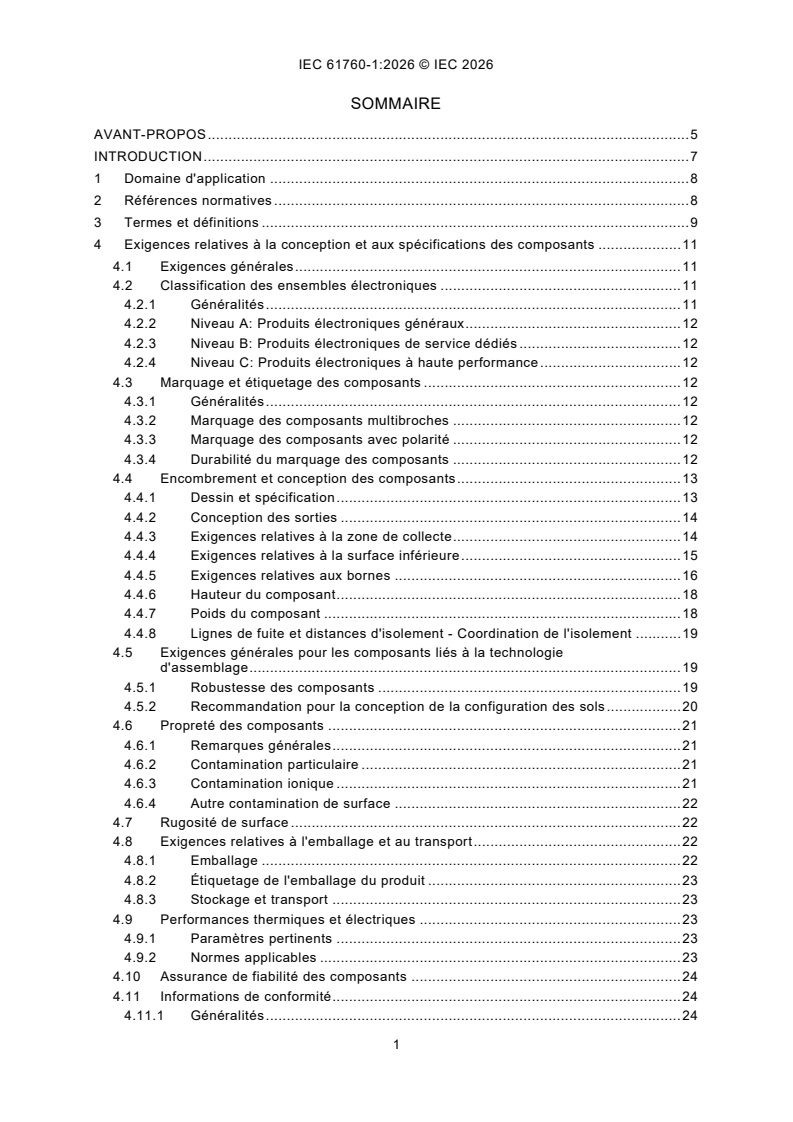
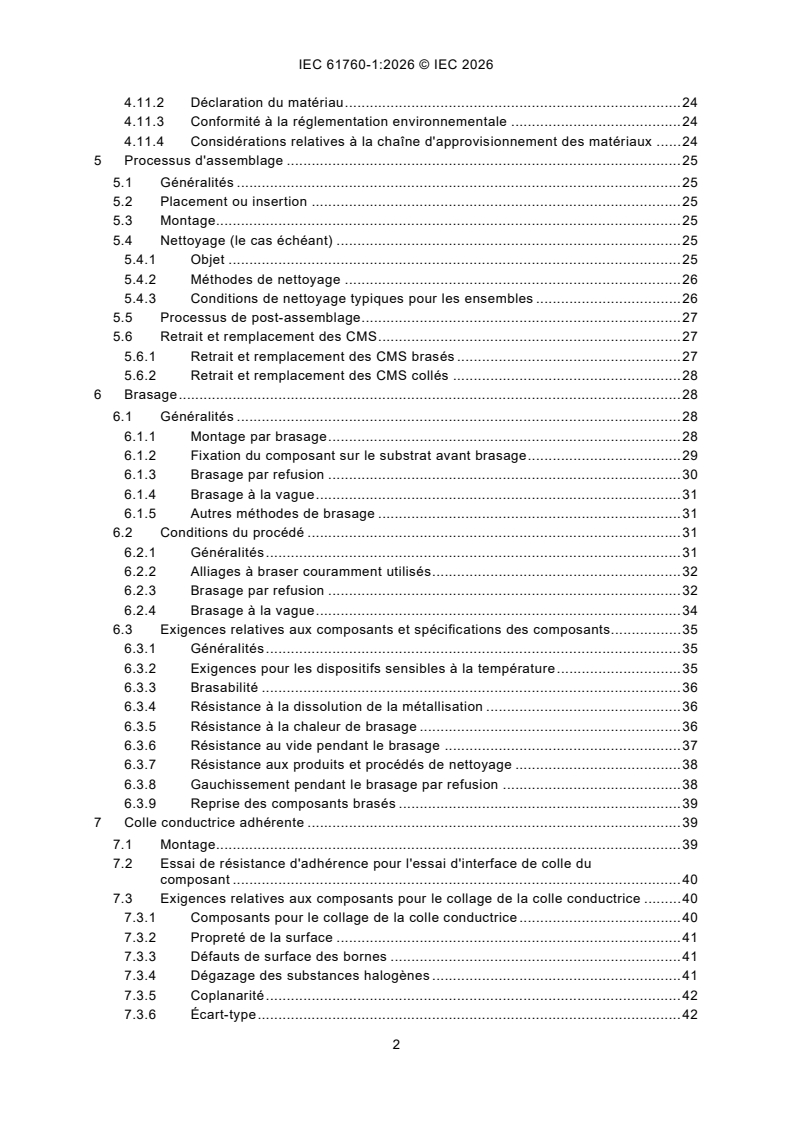
iec61760-1{ed4.0}fr - Technologie de montage en surface - Partie 1: Méthode normalisée pour la spécification des composants pour montage en surface (CMS)
IEC 61760-1:2026 is an International Standard from IEC for the specification of surface mounting components (SMDs). It sets a reference set of process conditions and test conditions so that component manufacturers and users can describe whether a part can withstand placement, mounting, cleaning, inspection, and related assembly steps. The standard is written for people drafting component specifications, selecting parts, and qualifying assemblies in surface mounting technology.
What does IEC 61760-1:2026 specify?
IEC 61760-1:2026 specifies what should appear in component specifications for electronic components intended for surface mounting technology. It gives a common framework for process conditions and tests so a wide range of SMDs can be assessed against the same assembly steps.
The standard is organized around:
- Clause 1 - scope
- Clause 2 - normative references
- Clause 3 - terms and definitions
- Clause 4 - design and specification requirements
- Clause 5 - assembly processes
- Clause 6 - soldering
- Clause 7 - conductive adhesive bonding
- Clause 8 - sintering
- Clause 9 - solderless interconnection
- Annex A - conformity information
- Annex B - sustainability
Some requirements also apply to leaded components intended for mounting on a circuit board, including solderless interconnection technology, where the relevant subclauses say so. The document also includes these cases because solderless mounting often follows SMT assembly in mixed-technology products.
| Annex | What it covers |
|---|---|
| Annex A | Material declaration, environmental compliance, and supply-chain material considerations |
| Annex B | Sustainability topics such as eco-design, life cycle assessment, product carbon footprint, energy use, recycling, repair, and working conditions |
What are the key requirements of IEC 61760-1:2026?
IEC 61760-1:2026 requires a component specification to cover the design, process, and test information needed to judge assembly robustness. In practice, it tells the spec writer what to define so the component can be placed, joined, cleaned, reworked, and verified with predictable results.
Component specifications must include the assembly-related tests and requirements
Clause 4.1 says an SMD component specification shall include the tests and requirements from Clauses 5 to 9, in addition to the design and specification items in Clause 4. That matters because the component is not defined only by its electrical data - it must also be suitable for the assembly process it will face.
Assemblies are classified by end-use criticality
Clause 4.2 defines three product levels:
- Level A for general electronic products
- Level B for dedicated service products
- Level C for high-performance products
The user of the assembly is responsible for choosing the level, and the contract should state the required level and any exceptions. This matters because the level drives how much verification and inspection is appropriate.
Marking and identification have to survive assembly
Clause 4.3 requires clear marking of pin 1 on multibin components and clear polarity marking on polarized components. It also expects the marking to remain legible after the cleaning-related resistance test in 6.3.7. In practice, this helps assembly orientation, traceability, and post-process inspection.
Geometry, terminals, and seating behavior must be defined in detail
Clause 4.4 requires drawings and dimensional data for the body and terminals, including 2D and, where needed, 3D geometry. It also covers terminal layout, optical recognition, shape, double-sided reflow capability, hardness, and material content, as well as component height and weight.
This matters because the land pattern, pick-and-place handling, solder joint formation, and mechanical fit all depend on the exact geometry. For larger components, thermal expansion data may also be needed, and for bottom-terminal components the wetted sidewall height needs to be stated.
Cleanliness, roughness, packaging, and transport are part of the specification
Clauses 4.5 to 4.8 address component robustness, cleanliness, surface roughness, packaging, labeling, storage, and transport. The roughness section points to agreed test methods and gives typical roughness guidance for printed, plated, and unplated terminations.
This matters because contamination, poor surface finish, or damaged packaging can affect solderability, conductive adhesive bonding, or sintering.
Reliability, operating range, and reflow history have to be considered
Clause 4.10 says long-term performance requirements and test methods must be part of the specification, preferably using mounted components and methods from the IEC 60068 series. It also expects the operating temperature range to be stated and the number of allowed reflow passes to be specified.
In practice, this is how the component is qualified for real assembly lines, including repeated reflow exposure.
The joining method drives additional component requirements
Clauses 5 to 9 cover placement or insertion, mounting, cleaning, post-assembly processes, removal and replacement, soldering, conductive adhesive bonding, sintering, and solderless interconnection. Each method brings its own process window and component conditions.
For soldering, Clause 6 covers reflow and wave processes, low temperature solders, solder alloys, vacuum resistance, cleaning resistance, warpage during reflow, and rework of soldered components. For conductive adhesive bonding, Clause 7 requires a defined bond-strength test and acceptance criteria. For sintering, Clause 8 gives typical temperature, time, and pressure ranges and asks for surface finish, cleanliness, and mechanical integrity data. For solderless interconnection, Clause 9 covers press-fit geometry, insertion force, insertion depth, materials, finishes, and rework guidance.
What terms does IEC 61760-1:2026 define?
IEC 61760-1:2026 uses the terms and definitions of IEC 60194-2 and adds key terms used in assembly and qualification.
- CMS - Dispositif de montage en surface, a component designed to be mounted on pads or tracks at the surface of a substrate.
- Coplanarité - The height difference between the lowest and highest terminals when the component rests in its seating plane.
- Démouillage - A solder condition where molten solder withdraws and leaves irregular mounds separated by thin films.
- Dissolution de la métallisation - Dissolution of a metallized metal or alloy, including dissolution by molten solder.
- Force de positionnement - The dynamic force applied to a component during placement before it comes to rest.
- Résistance à la chaleur de brasage - A component’s ability to withstand the heat generated by soldering.
- Substrat - The base material that supports an electronic circuit.
- Mouillage - The spreading of a liquid so it makes intimate contact with a solid surface.
Who uses IEC 61760-1:2026?
IEC 61760-1:2026 is used by component manufacturers, component specification writers, PCB and assembly engineers, quality managers, buyers, and test laboratories. They use it when defining component specifications, checking whether a part suits a reflow or wave process, selecting conductive adhesive or sintering options, and documenting packaging, storage, and handling needs.
It is also relevant to teams working on mixed-technology boards and on solderless press-fit interconnections, because the standard includes cases where leaded components are mounted on circuit boards after SMT parts have been placed.
What changed in IEC 61760-1:2026 from the previous edition?
IEC 61760-1:2026 is the fourth edition and replaces the third edition from 2020. The edition introduces these technical changes:
- a new 4.2 on classification of electronic assemblies
- a new 4.4.8 on creepage and clearance distances and insulation coordination
- a new 4.9 on thermal and electrical performance
- an updated Clause 6 on soldering, including low temperature solders
- a new 6.2.2 on commonly used solder alloys
- an updated 6.3.6 on resistance to vacuum during soldering
- an updated 6.3.7 on resistance to cleaning media and processes, including IEC 60068-2-88
- a new 6.3.9 on rework of soldered components
- a new Annex B on sustainability
Which standards are used with IEC 61760-1:2026?
IEC 61760-1:2026 relies on several referenced standards for tests, terminology, packaging, and safety-related design details.
- IEC 60068-2-2 - dry heat testing
- IEC 60068-2-21 - robustness of leads and integrated mounting devices
- IEC 60068-2-58 - solderability, metallization dissolution, and solder heat resistance
- IEC 60068-2-88 - resistance to liquid cleaning media
- IEC 60191-6 - outline drawing rules for surface-mounted semiconductor packages
- IEC 60194-2 - vocabulary for electronics and printed board technology
- IEC 60286-3 / -4 / -5 / -6 - packaging for tapes, magazines, trays, and bulk
- IEC 60664-1 - insulation coordination
- IEC 60749-20 - humidity and soldering heat testing for plastic-encapsulated semiconductors
- IEC 61188-6-4 - land pattern design guidance
- IEC 61340-5-1 / -5-3 - ESD protection and ESD-sensitive packaging
- IEC 61760-2 - transport and storage conditions for SMDs
- IEC 61760-4 - moisture-sensitive device classification, packaging, labeling, and handling
- IEC 62090 - barcode and 2D label symbologies for electronic component packages
- IPC/JEDEC J-STD-020 - moisture and reflow sensitivity classification
- IPC/JEDEC J-STD-033 - handling, packing, shipping, and use of moisture/reflow sensitive SMDs
What does the IEC 61760-1:2026 document contain?
IEC 61760-1:2026 contains figures, tables, process descriptions, and qualification guidance that support component specification writing and manufacturing qualification. The figures show examples of orientation marking, vacuum pickup geometry, coplanarity, seating stability, soldering profiles, adhesive bonding steps, and sintering arrangements.
The tables cover surface roughness guidance, basic cleaning processes, example substances for risk evaluation and customer reporting, and typical curing conditions. Annex A expands on material declarations, environmental regulation, and supply-chain due diligence, while Annex B groups sustainability topics such as eco-design, life cycle assessment, product carbon footprint, greenhouse gases, energy consumption, recycling, repair, and working conditions.
Relations
- Effective Date
- 05-Sep-2023
Buy Documents
REDLINE IEC 61760-1:2026 CMV - Surface mounting technology - Part 1: Standard method for the specification of surface mounting components (SMDs)
iec61760-1{ed4.0}en - Surface mounting technology - Part 1: Standard method for the specification of surface mounting components (SMDs)
iec61760-1{ed4.0}fr - Technologie de montage en surface - Partie 1: Méthode normalisée pour la spécification des composants pour montage en surface (CMS)
Frequently Asked Questions
IEC 61760-1:2026 is a standard published by the International Electrotechnical Commission (IEC). Its full title is "Surface mounting technology - Part 1: Standard method for the specification of surface mounting components (SMDs)". This standard covers: IEC 61760-1:2026 defines requirements for component specifications of electronic components that are intended for usage in surface mounting technology. To this end, it specifies a reference set of process conditions and related test conditions to be considered when compiling component specifications. The objective of this document is to ensure that a wide variety of SMDs can be subjected to the same placement, mounting and subsequent processes (e.g. cleaning, inspection) during assembly. This document defines tests and requirements that are included in any SMD component’s general, sectional or detail specification. In addition, this document provides component users and manufacturers with a reference set of typical process conditions used in surface mounting technology. Some of the requirements for component specifications in this document are also applicable to components with leads intended for mounting on a circuit board, including solderless interconnection technology. Cases for which this is appropriate are indicated in the relevant subclauses. NOTE Solderless interconnection technology refers to a mounting method which is not part of the surface-mounting process and the components do not undergo a soldering operation. Such components are included in this document because the mounting of components for solderless interconnection commonly occurs after the mounting of SMDs. This edition includes the following significant technical changes with respect to the previous edition: a) added new subclause 4.2 - Classification of electronic assemblies; b) added new subclause 4.4.8 - Creepage and clearance distances - Insulation coordination; c) added new subclause 4.9 - Thermal and electrical performance; d) updated Clause 6 - Soldering: now including requirements related to application of low temperature solders; e) added new subclause 6.2.2 - Commonly used solder alloys; f) updated subclause 6.3.6 - Resistance to vacuum during soldering; g) updated subclause 6.3.7 - Resistance to cleaning media and processes - now includes the tests in IEC 60068-2-88, Tests - Test XD: Resistance of components and assemblies to liquid cleaning media; h) added new subclause 6.3.9 - Rework of soldered components; i) added new Annex B - Sustainability.
IEC 61760-1:2026 defines requirements for component specifications of electronic components that are intended for usage in surface mounting technology. To this end, it specifies a reference set of process conditions and related test conditions to be considered when compiling component specifications. The objective of this document is to ensure that a wide variety of SMDs can be subjected to the same placement, mounting and subsequent processes (e.g. cleaning, inspection) during assembly. This document defines tests and requirements that are included in any SMD component’s general, sectional or detail specification. In addition, this document provides component users and manufacturers with a reference set of typical process conditions used in surface mounting technology. Some of the requirements for component specifications in this document are also applicable to components with leads intended for mounting on a circuit board, including solderless interconnection technology. Cases for which this is appropriate are indicated in the relevant subclauses. NOTE Solderless interconnection technology refers to a mounting method which is not part of the surface-mounting process and the components do not undergo a soldering operation. Such components are included in this document because the mounting of components for solderless interconnection commonly occurs after the mounting of SMDs. This edition includes the following significant technical changes with respect to the previous edition: a) added new subclause 4.2 - Classification of electronic assemblies; b) added new subclause 4.4.8 - Creepage and clearance distances - Insulation coordination; c) added new subclause 4.9 - Thermal and electrical performance; d) updated Clause 6 - Soldering: now including requirements related to application of low temperature solders; e) added new subclause 6.2.2 - Commonly used solder alloys; f) updated subclause 6.3.6 - Resistance to vacuum during soldering; g) updated subclause 6.3.7 - Resistance to cleaning media and processes - now includes the tests in IEC 60068-2-88, Tests - Test XD: Resistance of components and assemblies to liquid cleaning media; h) added new subclause 6.3.9 - Rework of soldered components; i) added new Annex B - Sustainability.
IEC 61760-1:2026 is classified under the following ICS (International Classification for Standards) categories: 31.240 - Mechanical structures for electronic equipment. The ICS classification helps identify the subject area and facilitates finding related standards.
IEC 61760-1:2026 has the following relationships with other standards: It is inter standard links to IEC 61760-1:2020. Understanding these relationships helps ensure you are using the most current and applicable version of the standard.
IEC 61760-1:2026 is available in PDF format for immediate download after purchase. The document can be added to your cart and obtained through the secure checkout process. Digital delivery ensures instant access to the complete standard document.
Standards Content (Sample)
IEC 61760-1 ®
Edition 4.0 2026-06
INTERNATIONAL
STANDARD
COMMENTED VERSION
Surface mounting technology -
Part 1: Standard method for the specification of surface mounting components
(SMDs)
ICS 31.240 ISBN 978-2-8327-1353-2
All rights reserved. Unless otherwise specified, no part of this publication may be reproduced or utilized in any form or
by any means, electronic or mechanical, including photocopying and microfilm, without permission in writing from either
IEC or IEC's member National Committee in the country of the requester. If you have any questions about IEC copyright
or have an enquiry about obtaining additional rights to this publication, please contact the address below or your local
IEC member National Committee for further information.
IEC Secretariat Tel.: +41 22 919 02 11
3, rue de Varembé info@iec.ch
CH-1211 Geneva 20 www.iec.ch
Switzerland
About the IEC
The International Electrotechnical Commission (IEC) is the leading global organization that prepares and publishes
International Standards for all electrical, electronic and related technologies.
About IEC publications
The technical content of IEC publications is kept under constant review by the IEC. Please make sure that you have the
latest edition, a corrigendum or an amendment might have been published.
IEC publications search - IEC Products & Services Portal - products.iec.ch
webstore.iec.ch/advsearchform Discover our powerful search engine and read freely all the
The advanced search enables to find IEC publications by a publications previews, graphical symbols and the glossary.
variety of criteria (reference number, text, technical With a subscription you will always have access to up to date
committee, …). It also gives information on projects, content tailored to your needs.
replaced and withdrawn publications.
Electropedia - www.electropedia.org
The world's leading online dictionary on electrotechnology,
IEC Just Published - webstore.iec.ch/justpublished
Stay up to date on all new IEC publications. Just Published containing more than 22 500 terminological entries in English
details all new publications released. Available online and and French, with equivalent terms in 25 additional languages.
once a month by email. Also known as the International Electrotechnical Vocabulary
(IEV) online.
IEC Customer Service Centre - webstore.iec.ch/csc
If you wish to give us your feedback on this publication or
need further assistance, please contact the Customer
Service Centre: sales@iec.ch.
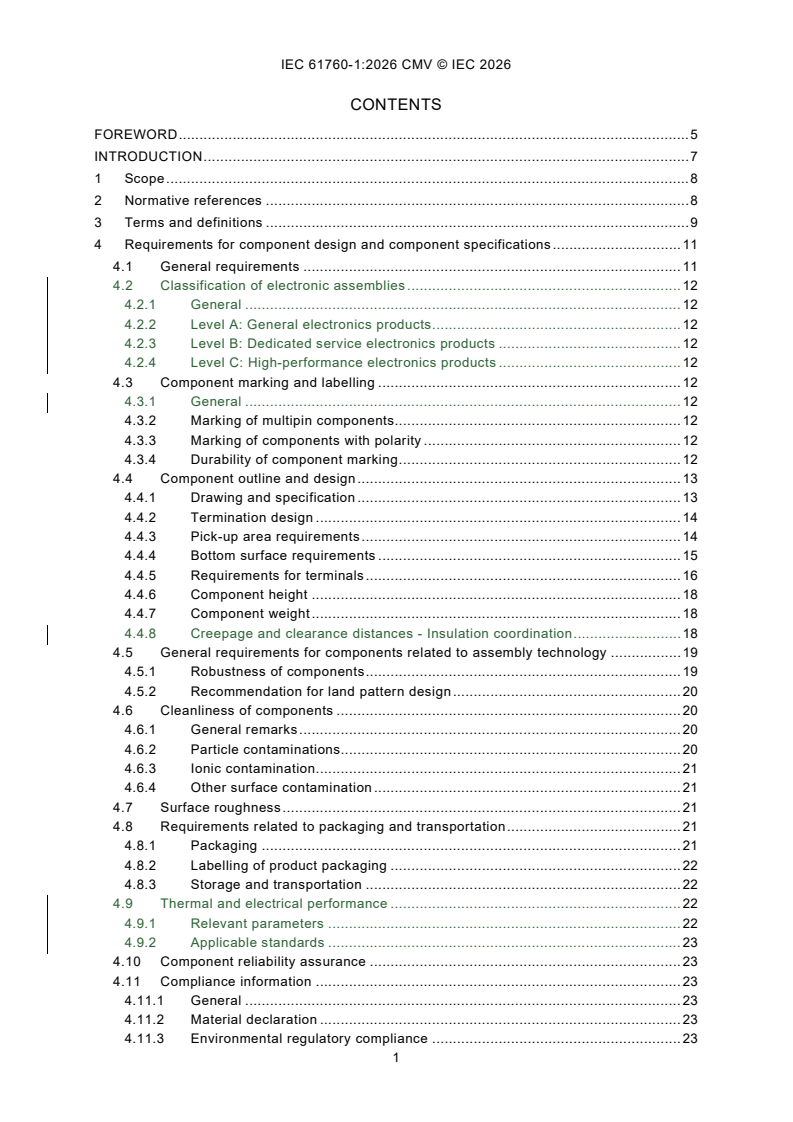
CONTENTS
FOREWORD . 5
INTRODUCTION . 7
1 Scope . 8
2 Normative references . 8
3 Terms and definitions . 9
4 Requirements for component design and component specifications . 11
4.1 General requirements . 11
4.2 Classification of electronic assemblies . 12
4.2.1 General . 12
4.2.2 Level A: General electronics products . 12
4.2.3 Level B: Dedicated service electronics products . 12
4.2.4 Level C: High-performance electronics products . 12
4.3 Component marking and labelling . 12
4.3.1 General . 12
4.3.2 Marking of multipin components. 12
4.3.3 Marking of components with polarity . 12
4.3.4 Durability of component marking . 12
4.4 Component outline and design . 13
4.4.1 Drawing and specification . 13
4.4.2 Termination design . 14
4.4.3 Pick-up area requirements . 14
4.4.4 Bottom surface requirements . 15
4.4.5 Requirements for terminals . 16
4.4.6 Component height . 18
4.4.7 Component weight . 18
4.4.8 Creepage and clearance distances - Insulation coordination . 18
4.5 General requirements for components related to assembly technology . 19
4.5.1 Robustness of components . 19
4.5.2 Recommendation for land pattern design . 20
4.6 Cleanliness of components . 20
4.6.1 General remarks . 20
4.6.2 Particle contaminations. 20
4.6.3 Ionic contamination . 21
4.6.4 Other surface contamination . 21
4.7 Surface roughness . 21
4.8 Requirements related to packaging and transportation . 21
4.8.1 Packaging . 21
4.8.2 Labelling of product packaging . 22
4.8.3 Storage and transportation . 22
4.9 Thermal and electrical performance . 22
4.9.1 Relevant parameters . 22
4.9.2 Applicable standards . 23
4.10 Component reliability assurance . 23
4.11 Compliance information . 23
4.11.1 General . 23
4.11.2 Material declaration . 23
4.11.3 Environmental regulatory compliance . 23
4.11.4 Considerations on the materials’ supply chain . 23
5 Assembly processes . 24
5.1 General . 24
5.2 Placement or insertion . 24
5.3 Mounting . 24
5.4 Cleaning (where applicable) . 24
5.4.1 Purpose . 24
5.4.2 Cleaning methods . 24
5.4.3 Typical cleaning conditions for assemblies . 25
5.5 Post assembly processes . 25
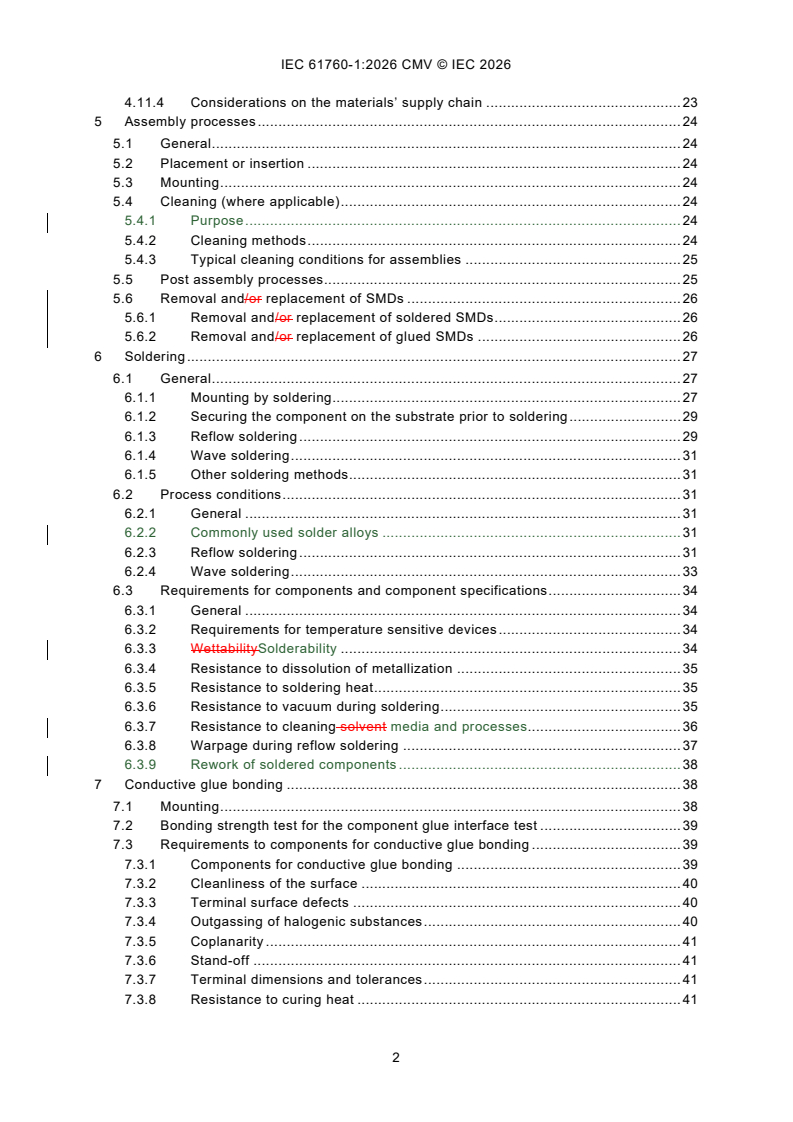
5.6 Removal and/or replacement of SMDs . 26
5.6.1 Removal and/or replacement of soldered SMDs . 26
5.6.2 Removal and/or replacement of glued SMDs . 26
6 Soldering . 27
6.1 General . 27
6.1.1 Mounting by soldering . 27
6.1.2 Securing the component on the substrate prior to soldering . 29
6.1.3 Reflow soldering . 29
6.1.4 Wave soldering . 31
6.1.5 Other soldering methods . 31
6.2 Process conditions . 31
6.2.1 General . 31
6.2.2 Commonly used solder alloys . 31
6.2.3 Reflow soldering . 31
6.2.4 Wave soldering . 33
6.3 Requirements for components and component specifications . 34
6.3.1 General . 34
6.3.2 Requirements for temperature sensitive devices . 34
6.3.3 WettabilitySolderability . 34
6.3.4 Resistance to dissolution of metallization . 35
6.3.5 Resistance to soldering heat . 35
6.3.6 Resistance to vacuum during soldering . 35
6.3.7 Resistance to cleaning solvent media and processes. 36
6.3.8 Warpage during reflow soldering . 37
6.3.9 Rework of soldered components . 38
7 Conductive glue bonding . 38
7.1 Mounting . 38
7.2 Bonding strength test for the component glue interface test . 39
7.3 Requirements to components for conductive glue bonding . 39
7.3.1 Components for conductive glue bonding . 39
7.3.2 Cleanliness of the surface . 40
7.3.3 Terminal surface defects . 40
7.3.4 Outgassing of halogenic substances . 40
7.3.5 Coplanarity . 41
7.3.6 Stand-off . 41
7.3.7 Terminal dimensions and tolerances . 41
7.3.8 Resistance to curing heat . 41
8 Sintering . 41
8.1 General . 41
8.2 Typical process conditions for wet silver-sintering processes . 42
8.3 Requirements for components and component specifications . 42
9 Solderless interconnection . 43
9.1 General . 43
9.2 Typical process conditions . 43
9.3 Requirements for components and component specifications . 44
9.4 Rework of components with solderless interconnections . 44
Annex A (informative) Details on compliance information . 45
A.1 Material declaration . 45
A.2 Environmental regulatory compliance . 46
A.3 Considerations on the materials' supply chain . 47
Annex B (informative) Sustainability . 48
B.1 General . 48
B.2 Programs to support sustainable products and production . 48
B.2.1 Eco-design of products (electronic equipment) . 48
B.2.2 Life Cycle Assessment (or analysis) (LCA) . 48
B.2.3 Product Carbon Footprint (PCF) . 49
B.2.4 GHG (greenhouse gases), including CO emissions in manufacturing . 49
2,
B.2.5 Energy usage in the production . 49
B.2.6 Recycling, recovering and repair. 49
B.2.7 Sustainability of work conditions . 49
Bibliography . 50
List of comments. 54
Figure 1 – Example of a component with marked specific orientation put in tape (top)
and tray (bottom) . 13
Figure 2 – Vacuum pipette, pick-up area and component compartment . 15
Figure 3 – Coplanarity of terminals . 16
Figure 4 – Stable seating of component . 16
Figure 5 – Unstable seating of component . 17
Figure 6 – Terminals arranged peripherally in two rows . 17
Figure 7 – Good contrast between component body and surroundings . 17
Figure 8 – Component weight and pipette suction strength . 18
Figure 9 – Process steps for soldering . 29
Figure 10 – Generic reflow temperature/time profile . 32
Figure 11 – Generic wave soldering temperature/time profile . 33
Figure 12 – Process steps for gluing . 39
Figure 13 – Stand-off definition . 41
Figure 14 – Sinter process on one side, both sides, and both sides including
presintering. 42
Table 1 – Typical roughness requirements . 21
Table 2 – Basic cleaning processes . 25
Table 3 – Examples of substances proposed to be included in risk evaluation and
customer reporting . 40
Table 4 – Examples of typical curing conditions . 41
INTERNATIONAL ELECTROTECHNICAL COMMISSION
____________
Surface mounting technology -
Part 1: Standard method for the specification of surface mounting
components (SMDs)
FOREWORD
1) The International Electrotechnical Commission (IEC) is a worldwide organization for standardization comprising
all national electrotechnical committees (IEC National Committees). The object of IEC is to promote international
co-operation on all questions concerning standardization in the electrical and electronic fields. To this end and
in addition to other activities, IEC publishes International Standards, Technical Specifications, Technical Reports,
Publicly Available Specifications (PAS) and Guides (hereafter referred to as “IEC Publication(s)”). Their
preparation is entrusted to technical committees; any IEC National Committee interested in the subject dealt with
may participate in this preparatory work. International, governmental and non-governmental organizations liaising
with the IEC also participate in this preparation. IEC collaborates closely with the International Organization for
Standardization (ISO) in accordance with conditions determined by agreement between the two organizations.
2) The formal decisions or agreements of IEC on technical matters express, as nearly as possible, an international
consensus of opinion on the relevant subjects since each technical committee has representation from all
interested IEC National Committees.
3) IEC Publications have the form of recommendations for international use and are accepted by IEC National
Committees in that sense. While all reasonable efforts are made to ensure that the technical content of IEC
Publications is accurate, IEC cannot be held responsible for the way in which they are used or for any
misinterpretation by any end user.
4) In order to promote international uniformity, IEC National Committees undertake to apply IEC Publications
transparently to the maximum extent possible in their national and regional publications. Any divergence between
any IEC Publication and the corresponding national or regional publication shall be clearly indicated in the latter.
5) IEC itself does not provide any attestation of conformity. Independent certification bodies provide conformity
assessment services and, in some areas, access to IEC marks of conformity. IEC is not responsible for any
services carried out by independent certification bodies.
6) All users should ensure that they have the latest edition of this publication.
7) No liability shall attach to IEC or its directors, employees, servants or agents including individual experts and
members of its technical committees and IEC National Committees for any personal injury, property damage or
other damage of any nature whatsoever, whether direct or indirect, or for costs (including legal fees) and
expenses arising out of the publication, use of, or reliance upon, this IEC Publication or any other IEC
Publications.
8) Attention is drawn to the Normative references cited in this publication. Use of the referenced publications is
indispensable for the correct application of this publication.
9) IEC draws attention to the possibility that the implementation of this document may involve the use of (a)
patent(s). IEC takes no position concerning the evidence, validity or applicability of any claimed patent rights in
respect thereof. As of the date of publication of this document, IEC had not received notice of (a) patent(s), which
may be required to implement this document. However, implementers are cautioned that this may not represent
the latest information, which may be obtained from the patent database available at https://patents.iec.ch. IEC
shall not be held responsible for identifying any or all such patent rights.
This commented version (CMV) of the official standard IEC 61760-1:2026 edition 4.0 allows the
user to identify the changes made to the previous IEC 61760-1:2020 edition 3.0. Furthermore,
comments from IEC TC 91 experts are provided to explain the reasons of the most relevant
changes, or to clarify any part of the content.
A vertical bar appears in the margin wherever a change has been made. Additions are in green
text, deletions are in strikethrough red text. Experts' comments are identified by a blue-
background number. Mouse over a number to display a pop-up note with the comment.
This publication contains the CMV and the official standard. The full list of comments is available
at the end of the CMV.
IEC 61760-1 has been prepared by IEC technical committee 91: Electronics assembly
technology. It is an International Standard.
This fourth edition cancels and replaces the third published in 2020. This edition constitutes a
technical revision.
This edition includes the following significant technical changes with respect to the previous
edition:
a) added new subclause 4.2 – Classification of electronic assemblies;
b) added new subclause 4.4.8 – Creepage and clearance distances - Insulation coordination;
c) added new subclause 4.9 – Thermal and electrical performance;
d) updated Clause 6 – Soldering: now including requirements related to application of low
temperature solders;
e) added new subclause 6.2.2 – Commonly used solder alloys;
f) updated subclause 6.3.6 – Resistance to vacuum during soldering;
g) updated subclause 6.3.7 – Resistance to cleaning media and processes - now includes the
tests in IEC 60068-2-88, Tests – Test XD: Resistance of components and assemblies to
liquid cleaning media;
h) added new subclause 6.3.9 – Rework of soldered components;
i) added new Annex B – Sustainability.
The text of this International Standard is based on the following documents:
FDIS Report on voting
91/2103/FDIS 91/2113/RVD
Full information on the voting for its approval can be found in the report on voting indicated in
the above table.
The language used for the development of this International Standard is English.
This document was drafted in accordance with ISO/IEC Directives, Part 2, and developed in
accordance with ISO/IEC Directives, Part 1 and ISO/IEC Directives, IEC Supplement, available
at www.iec.ch/members_experts/refdocs. The main document types developed by IEC are
described in greater detail at www.iec.ch/publications.
A list of all parts in the IEC 61760 series, published under the general title Surface mounting
technology, can be found on the IEC website.
The committee has decided that the contents of this document will remain unchanged until the
stability date indicated on the IEC website under "http://webstore.iec.ch" in the data related to
the specific document. At this date, the document will be
– reconfirmed,
– withdrawn, or
– replaced.
INTRODUCTION
Specifications for electronic components have in the past been formulated for each component
family. The regulations for environmental tests have been selected from IEC 60068 and other
IEC and ISO publications. The intention for this procedure was that all components, once
installed in a piece of equipment, had to satisfy certain criteria.
The introduction and increasing use of different mounting processes on one assembly make it
necessary essential to extend the existing requirements to include those arising from
processing during assembly.
Nevertheless, there existed no harmonized standard that prescribes the content of a component
specification before the publication of this document. It is the purpose of this document to define
the general requirements for component specifications derived from the assembly processes.
This is done in three steps.
In the first step, general requirements for component specifications and component design
related to the handling and placement of the component on the substrate are given (Clause 4).
In the second step, the requirements related to assembly processes are given (Clause 5). In
the third step, additional requirements resulting from specific mounting methods are given (from
Clause 6 to Clause 9).
Additional consideration with respect to the through-hole components are crucial to mixed
technology boards, i.e. boards containing through-hole components and SMDs, require
additional consideration with respect to the through-hole components. These may can be
subject to the same requirements as the SMDs. Persons responsible for drafting specifications
for "non-surface mounting components" wishing to include a statement on their ability to
withstand surface mounting conditions should use the classifications and tests set out in the
present document.
1 Scope
This part of IEC 61760 defines requirements for component specifications of electronic
components that are intended for usage in surface mounting technology. To this end, it specifies
a reference set of process conditions and related test conditions to be considered when
compiling component specifications.
The objective of this document is to ensure that a wide variety of SMDs can be subjected to the
same placement, mounting and subsequent processes (e.g. cleaning, inspection) during
assembly. This document defines tests and requirements that need to be part of are included
in any SMD component’s general, sectional or detail specification. In addition, this document
provides component users and manufacturers with a reference set of typical process conditions
used in surface mounting technology.
Some of the requirements for component specifications in this document are also applicable to
components with leads intended for mounting on a circuit board, including solderless
interconnection technology. Cases for which this is appropriate are indicated in the relevant
subclauses.
NOTE Solderless interconnection technology refers to a mounting method which is not part of the surface-mounting
process and the components do not undergo a soldering operation. Such components are included in this document
because the mounting of components for solderless interconnection commonly occurs after the mounting of SMDs.
2 Normative references
The following documents are referred to in the text in such a way that some or all of their content
constitutes requirements of this document. For dated references, only the edition cited applies.
For undated references, the latest edition of the referenced document (including any
amendments) applies.
IEC 60068 (all parts), Environmental testing
IEC 60068–2–2, Environmental testing – Part 2-2: Tests – Test B: Dry heat
IEC 60068–2–21, Environmental testing – Part 2-21: Tests – Test U: Robustness of
terminations and integral mounting devices
IEC 60068-2-45:1980, Basic environmental testing procedures – Part 2-45: Tests – Test XA
and guidance: Immersion in cleaning solvents
IEC 60068-2-45:1980/AMD1:1993
IEC 60068–2–58, Environmental testing – Part 2-58: Tests – Test Td: Test methods for
solderability, resistance to dissolution of metallization and to soldering heat of surface mounting
devices (SMDs)
IEC 60068-2-88, Environmental testing - Part 2-88: Tests – Test XD: Resistance of components
and assemblies to liquid cleaning media
IEC 60191–6, Mechanical standardization of semiconductor devices – Part 6: General rules for
the preparation of outline drawings of surface mounted semiconductor device packages
IEC 60194–2, Printed boards design, manufacture and assembly – Vocabulary – Part 2:
Common usage in electronic technologies as well as printed board and electronic assembly
technologies
IEC 60286-3, Packaging of components for automatic handling - Part 3: Packaging of surface
mount components on continuous tapes
IEC 60286-4, Packaging of components for automatic handling - Part 4: Stick magazines for
electronic components encapsulated in packages of different forms
IEC 60286–5, Packaging of components for automatic handling – Part 5: Matrix trays
IEC 60286–6, Packaging of components for automatic handling – Part 6: Bulk case packaging
for surface mounting components
IEC 60664-1, Insulation coordination for equipment within low-voltage supply systems - Part 1:
Principles, requirements and tests
IEC 60749-20:2008, Semiconductor devices - Mechanical and climatic test methods - Part 20:
Resistance of plastic encapsulated SMDs to the combined effect of moisture and soldering heat
IEC 61188–6–4, Printed boards and printed board assemblies – Design and use – Part 6-4:
Land pattern design – Generic requirements for dimensional drawings of surface mounted
components (SMD) from the viewpoint of land pattern design
IEC 61340–5–1, Electrostatics – Part 5-1: Protection of electronic devices from electrostatic
phenomena – General requirements
IEC 61340–5–3, Electrostatics – Part 5-3: Protection of electronic devices from electrostatic
phenomena – Properties and requirements classification for packaging intended for
electrostatic discharge sensitive devices
IEC 61760–2, Surface mounting technology – Part 2: Transportation and storage conditions of
surface mounting devices (SMD) – Application guide
IEC 61760–4, Surface mounting technology – Part 4: Classification, packaging, labelling and
handling of moisture sensitive devices
IEC 62090, Product package labels for electronic components using bar code and two-
dimensional symbologies
IPC/JEDEC J-STD-020, Moisture/Reflow Sensitivity Classification for Nonhermetic Solid State
Non-hermetic Surface Mount Devices (SMDs)
IPC/JEDEC J-STD-033, Handling, PackagingPacking, Shipping and Use of Moisture/Reflow
Sensitive Surface Mount Devices
3 Terms and definitions
For the purposes of this document, the terms and definitions of IEC 60194–2 and the following
apply.
ISO and IEC maintain terminological databases for use in standardization at the following
addresses
– IEC Electropedia: available at http://www.electropedia.org/
– ISO Online browsing platform: available at http://www.iso.org/obp
3.1
adhesive
substance such as glue or cement used to bond objects together
Note 1 to entry: In surface mounting technology different gluing systems are used:
– nonconductive adhesive (only for mechanical connection);
– electrically conductive adhesive (for electrical and mechanical connection);
– thermally conductive adhesive (for thermal and mechanical connection);
– combination of electrically and thermally conductive adhesive.
Most used adhesives are thermal curing systems, but there are also UV-curing systems in use.
3.2
centring force
force required by the pick-up tooling to centre a surface mounting device in its proper location
on a substrate
3.2
compliant press-fit pin
press-fit pin with at least one compliant press-fit zone designed to be inserted into a plated-
through hole of a circuit board
3.3
compliant press-fit zone
specifically shaped section of a press-fit pin which is elastically and plastically deformed during
pin insertion
Note 1 to entry: A compliant press-fit zone is characterized by its base material, surface finish and geometry.
3.4
coplanarity
distance in height between the lowest and highest leads when the component is in its seating
plane
3.5
dewetting
condition that results when molten solder coats a surface and then recedes to leave irregularly
shaped mounds of solder that are separated by areas that are covered with a thin film of solder
and with the basis metal not exposed
3.6
dissolution of metallization
process of dissolving metal or a plated metal alloy, usually by introduction of chemicals
Note 1 to entry: For the purposes of this document, the dissolution of metallization also includes dissolution by
exposure to molten solder.
3.7
immersion attitude
positioning of an object when immersed in a solder bath
3.7
lead-free component
component where lead content in the materials is equal to or less than 0,1 % by weight per
material used
3.8
Montreal Protocol
agreement by industrialized nations, at a meeting held in Montreal, Canada, to eliminate
chlorofluorocarbons from all processes by 1995
3.9
pick-up force
dynamic force exerted on the body of a component – generally from above – and its seating
plane during the pick-up of the component (e.g. from a tape or tray)
Note 1 to entry: The maximum level is normally taken into account.
3.9
placement force
dynamic force exerted on the component body (generally from above) and its seating plane
Note 1 to entry: This occurs during the period between the component’s first contact with the substrate (or the
soldering paste or adhesive, etc.) and its coming to rest. The maximum level is normally taken into account.
3.10
resistance to soldering heat
ability of a component to withstand the effects of the heat generated by the soldering process
3.11
seating plane
surface on which a component rests
3.13
solderability
ability of a metal to be wetted by molten solder
3.14
solder meniscus
contour of a solder shape that is the result of the surface tension forces that take place during
wetting
3.12
stand-off
distance between seating plane of the component and the seating plane of the terminations
3.13
substrate
basic material that forms the support structure of an electronic circuit
3.14
surface mounting component
surface mounting device
SMD
electronic component designed for mounting on to terminal pads or conducting tracks on the
surface of substrate
3.15
wetting
physical phenomenon in which surface tension of a liquid, usually when in contact with solids,
is reduced to the point where the liquid diffuses and makes intimate contact with the entire
substrate surface in the form of a thin layer
4 Requirements for component design and component specifications
4.1 General requirements
A component specification for surface mounting devices (SMDs) shall, in addition to the
requirements listed in 4.3 to 4.11, contain specifications of the relevant tests and requirements
from Clause 5 to Clause 9.
4.2 Classification of electronic assemblies 1
4.2.1 General
This document recognizes that electrical and electronic assemblies are subject to
classifications by intended end-item use. Three general end-product levels have been
established to reflect differences in producibility, functional performance requirements, and
verification (inspection/test) frequency.
It should be recognized that there can be overlaps of equipment between levels. The user of
the assemblies is responsible for determining the level to which the product belongs. The
contract shall specify the level required and indicate any exceptions or additional requirements
to the parameters, where appropriate.
4.2.2 Level A: General electronics products
This level includes consumer products, some computers and computer peripherals, and
hardware suitable for applications where the major requirement is function of the completed
assembly.
4.2.3 Level B: Dedicated service electronics products
This level includes communications equipment, sophisticated business machines, and
instruments where high performance and extended life is required, and for which uninterrupted
service is desired but not mandatory. Typically, the end-use environment would not cause
failures.
4.2.4 Level C: High-performance electronics products
This level includes all equipment where continued performance or performance-on-demand is
mandatory. Equipment downtime cannot be tolerated, end-use environment can be
uncommonly harsh, and the equipment shall function when required, such as life support
systems and other critical systems.
4.3 Component marking and labelling
4.3.1 General
In general, marking should identify 2nd level terminal finish or material and should follow J-
STD-609 [1]. This is critical because assembly reflow operations can be dependent on the
specific solder alloys per 6.1.3.
4.3.2 Marking of multipin components
Pin 1 (see Figure 1) shall be clearly marked on a multipin component (e.g. SO-IC, QFP).
4.3.3 Marking of components with polarity
For components with polarity, the polarity of the component shall be clearly marked on the
component (e.g. for electrolytic capacitors).
4.3.4 Durability of component marking
Specifications shall require that the specified component marking shall remain legible after the
tests specified in 6.3.7 have been performed. This test shall be performed after completion of
the relevant test for resistance to soldering heat or for solderability, as specified in the
component specification.
Key
D direction of unreeling
T tray
1 pin 1 of the component
Figure 1 – Example of a component with marked specific orientation put in tape (top)
and tray (bottom)
4.4 Component outline and design
4.4.1 Drawing and specification
Drawings, including bottom-view, top-view and side-view drawings, of the component showing
all dimensions and tolerances of its body and terminals shall be part of the component
specification. The drawings shall include reference to the positioning of the component body
and terminals on the mounting land pattern. If conductive surfaces are not planar, their three-
dimensional geometry shall be clearly specified with the relevant tolerances. An example is the
presence of grooves on thermal pads of QFP.
In any 2D drawing or 3D data, conductive parts and/or surfaces and insulating parts/ or surfaces
shall be clearly distinguished, at least for the bottom and the sides of components, as well as
for movable parts. This requirement applies both to the disassembled and the assembled
condition for parts requiring a final assembly step after mounting on a substrate (e.g. if a
connector contains spring-loaded retainers whose position and/or angle changes upon mating).
The locations and dimensions of conductive parts/ or surfaces shall be specified, even if they
are not intended for establishing a contact with the mounting surface, for example punched or
sawn surfaces consisting of unplated leadframe resulting from component singulation for
moulded semiconductor packages.
The generic requirements for dimensional drawings of SMDs from the viewpoint of land-pattern
design as specified in IEC 61188–6–4 shall be adopted for surface mounting devices.
Where necessary (e.g. in the case of large components with an overall length of more than
25 mm), the detail specification shall contain data on thermal expansion, at least along the X
and Y axes. In the case of mechanical fixation of large components (e.g. by screwing), mismatch
of the coefficients of thermal expansion between component and mounting substrate can result
in warping of the component and the mounting substrate.
For components singulated by punching or sawing, for which it can happen that parts of the
terminals may do not wet during a soldering operation owing to the absence of a surface finish
preserving a solderable surface on the leadframe, such surfaces shall be indicated in the
drawing.
The minimum height of the plated flank of the leadframe shall be indicated in the drawing for
bottom-termination components (BTCs) (such as quad-flat no lead packages (QFNs), DFNs
(dual-flat no lead packages), etc.) for which a wettable-flank pin modification has been applied
to assure the formation of an outer fillet in reflow soldering.
NOTE 1 For components intended for high-reliabilityperformance applications, such as automotive and aerospace
industries, the height of the wettable portion typically is larger than 100 µm to enable a robust automated solder-joint
inspection.
NOTE 2 The presence of an outer fillet, as enabled by a wettable-flank pin modifciation, generally increases the
reliability of the solder joints under environmental loads such as thermal cycling.
4.4.2 Termination design
The relevant specification shall provide information on termination design (i.e. the termination
base material, layer structure and finish).
4.4.3 Pick-up area requirements
The design of the component shall consider that it shall be possible to grip the component by
suction and transport it to its exact placement position on the substrate. It shall be possible to
create a vacuum strong enough to fix the component in its position under the pipette. During
the total transport process, which may can include optical inspection, the component shall
remain exactly in its position under the pipette, until the component is placed.
The centre of the suction area should match the centre of gravity and the geometrical centre.
The opening of the pipette (Y), the dimension (L) of the component or its pick up area (X) and
the tolerances on the position of
...
IEC 61760-1 ®
Edition 4.0 2026-06
INTERNATIONAL
STANDARD
Surface mounting technology -
Part 1: Standard method for the specification of surface mounting components
(SMDs)
ICS 31.240 ISBN 978-2-8327-1309-9
All rights reserved. Unless otherwise specified, no part of this publication may be reproduced or utilized in any form or
by any means, electronic or mechanical, including photocopying and microfilm, without permission in writing from either
IEC or IEC's member National Committee in the country of the requester. If you have any questions about IEC copyright
or have an enquiry about obtaining additional rights to this publication, please contact the address below or your local
IEC member National Committee for further information.
IEC Secretariat Tel.: +41 22 919 02 11
3, rue de Varembé info@iec.ch
CH-1211 Geneva 20 www.iec.ch
Switzerland
About the IEC
The International Electrotechnical Commission (IEC) is the leading global organization that prepares and publishes
International Standards for all electrical, electronic and related technologies.
About IEC publications
The technical content of IEC publications is kept under constant review by the IEC. Please make sure that you have the
latest edition, a corrigendum or an amendment might have been published.
IEC publications search - IEC Products & Services Portal - products.iec.ch
webstore.iec.ch/advsearchform Discover our powerful search engine and read freely all the
The advanced search enables to find IEC publications by a publications previews, graphical symbols and the glossary.
variety of criteria (reference number, text, technical With a subscription you will always have access to up to date
committee, …). It also gives information on projects, content tailored to your needs.
replaced and withdrawn publications.
Electropedia - www.electropedia.org
The world's leading online dictionary on electrotechnology,
IEC Just Published - webstore.iec.ch/justpublished
Stay up to date on all new IEC publications. Just Published containing more than 22 500 terminological entries in English
details all new publications released. Available online and and French, with equivalent terms in 25 additional languages.
once a month by email. Also known as the International Electrotechnical Vocabulary
(IEV) online.
IEC Customer Service Centre - webstore.iec.ch/csc
If you wish to give us your feedback on this publication or
need further assistance, please contact the Customer
Service Centre: sales@iec.ch.
CONTENTS
FOREWORD . 4
INTRODUCTION . 6
1 Scope . 7
2 Normative references . 7
3 Terms and definitions . 8
4 Requirements for component design and component specifications . 10
4.1 General requirements . 10
4.2 Classification of electronic assemblies . 10
4.2.1 General . 10
4.2.2 Level A: General electronics products . 10
4.2.3 Level B: Dedicated service electronics products . 11
4.2.4 Level C: High-performance electronics products . 11
4.3 Component marking and labelling . 11
4.3.1 General . 11
4.3.2 Marking of multipin components. 11
4.3.3 Marking of components with polarity . 11
4.3.4 Durability of component marking . 11
4.4 Component outline and design . 12
4.4.1 Drawing and specification . 12
4.4.2 Termination design . 13
4.4.3 Pick-up area requirements . 13
4.4.4 Bottom surface requirements . 14
4.4.5 Requirements for terminals . 15
4.4.6 Component height . 17
4.4.7 Component weight . 17
4.4.8 Creepage and clearance distances - Insulation coordination . 17
4.5 General requirements for components related to assembly technology . 18
4.5.1 Robustness of components . 18
4.5.2 Recommendation for land pattern design . 19
4.6 Cleanliness of components . 19
4.6.1 General remarks . 19
4.6.2 Particle contaminations. 19
4.6.3 Ionic contamination . 20
4.6.4 Other surface contamination . 20
4.7 Surface roughness . 20
4.8 Requirements related to packaging and transportation . 20
4.8.1 Packaging . 20
4.8.2 Labelling of product packaging . 21
4.8.3 Storage and transportation . 21
4.9 Thermal and electrical performance . 21
4.9.1 Relevant parameters . 21
4.9.2 Applicable standards . 22
4.10 Component reliability assurance . 22
4.11 Compliance information . 22
4.11.1 General . 22
4.11.2 Material declaration . 22
4.11.3 Environmental regulatory compliance . 22
4.11.4 Considerations on the materials’ supply chain . 22
5 Assembly processes . 23
5.1 General . 23
5.2 Placement or insertion . 23
5.3 Mounting . 23
5.4 Cleaning (where applicable) . 23
5.4.1 Purpose . 23
5.4.2 Cleaning methods . 23
5.4.3 Typical cleaning conditions for assemblies . 24
5.5 Post assembly processes . 24
5.6 Removal and replacement of SMDs . 25
5.6.1 Removal and replacement of soldered SMDs . 25
5.6.2 Removal and replacement of glued SMDs. 25
6 Soldering . 26
6.1 General . 26
6.1.1 Mounting by soldering . 26
6.1.2 Securing the component on the substrate prior to soldering . 27
6.1.3 Reflow soldering . 27
6.1.4 Wave soldering . 28
6.1.5 Other soldering methods . 28
6.2 Process conditions . 28
6.2.1 General . 28
6.2.2 Commonly used solder alloys . 29
6.2.3 Reflow soldering . 29
6.2.4 Wave soldering . 31
6.3 Requirements for components and component specifications . 31
6.3.1 General . 31
6.3.2 Requirements for temperature sensitive devices . 32
6.3.3 Solderability . 32
6.3.4 Resistance to dissolution of metallization . 33
6.3.5 Resistance to soldering heat . 33
6.3.6 Resistance to vacuum during soldering . 33
6.3.7 Resistance to cleaning media and processes . 34
6.3.8 Warpage during reflow soldering . 35
6.3.9 Rework of soldered components . 35
7 Conductive glue bonding . 36
7.1 Mounting . 36
7.2 Bonding strength test for the component glue interface test . 36
7.3 Requirements to components for conductive glue bonding . 37
7.3.1 Components for conductive glue bonding . 37
7.3.2 Cleanliness of the surface . 37
7.3.3 Terminal surface defects . 37
7.3.4 Outgassing of halogenic substances . 37
7.3.5 Coplanarity . 38
7.3.6 Stand-off . 38
7.3.7 Terminal dimensions and tolerances . 38
7.3.8 Resistance to curing heat . 39
8 Sintering . 39
8.1 General . 39
8.2 Typical process conditions for wet silver-sintering processes . 40
8.3 Requirements for components and component specifications . 40
9 Solderless interconnection . 41
9.1 General . 41
9.2 Typical process conditions . 41
9.3 Requirements for components and component specifications . 41
9.4 Rework of components with solderless interconnections . 42
Annex A (informative) Details on compliance information . 43
A.1 Material declaration . 43
A.2 Environmental regulatory compliance . 44
A.3 Considerations on the materials' supply chain . 45
Annex B (informative) Sustainability . 46
B.1 General . 46
B.2 Programs to support sustainable products and production . 46
B.2.1 Eco-design of products (electronic equipment) . 46
B.2.2 Life Cycle Assessment (or analysis) (LCA) . 46
B.2.3 Product Carbon Footprint (PCF) . 47
B.2.4 GHG (greenhouse gases), including CO emissions in manufacturing . 47
2,
B.2.5 Energy usage in the production . 47
B.2.6 Recycling, recovering and repair. 47
B.2.7 Sustainability of work conditions . 47
Bibliography . 48
Figure 1 – Example of a component with marked specific orientation put in tape (top)
and tray (bottom) . 12
Figure 2 – Vacuum pipette, pick-up area and component compartment . 14
Figure 3 – Coplanarity of terminals . 15
Figure 4 – Stable seating of component . 15
Figure 5 – Unstable seating of component . 16
Figure 6 – Terminals arranged peripherally in two rows . 16
Figure 7 – Good contrast between component body and surroundings . 16
Figure 8 – Component weight and pipette suction strength . 17
Figure 9 – Process steps for soldering . 26
Figure 10 – Generic reflow temperature profile . 30
Figure 11 – Generic wave soldering profile . 31
Figure 12 – Process steps for gluing . 36
Figure 13 – Stand-off definition . 38
Figure 14 – Sinter process on one side, both sides, and both sides including
presintering. 40
Table 1 – Typical roughness requirements . 20
Table 2 – Basic cleaning processes . 24
Table 3 – Examples of substances proposed to be included in risk evaluation and
customer reporting . 38
Table 4 – Examples of typical curing conditions . 39
INTERNATIONAL ELECTROTECHNICAL COMMISSION
____________
Surface mounting technology -
Part 1: Standard method for the specification of surface mounting
components (SMDs)
FOREWORD
1) The International Electrotechnical Commission (IEC) is a worldwide organization for standardization comprising
all national electrotechnical committees (IEC National Committees). The object of IEC is to promote international
co-operation on all questions concerning standardization in the electrical and electronic fields. To this end and
in addition to other activities, IEC publishes International Standards, Technical Specifications, Technical Reports,
Publicly Available Specifications (PAS) and Guides (hereafter referred to as “IEC Publication(s)”). Their
preparation is entrusted to technical committees; any IEC National Committee interested in the subject dealt with
may participate in this preparatory work. International, governmental and non-governmental organizations liaising
with the IEC also participate in this preparation. IEC collaborates closely with the International Organization for
Standardization (ISO) in accordance with conditions determined by agreement between the two organizations.
2) The formal decisions or agreements of IEC on technical matters express, as nearly as possible, an international
consensus of opinion on the relevant subjects since each technical committee has representation from all
interested IEC National Committees.
3) IEC Publications have the form of recommendations for international use and are accepted by IEC National
Committees in that sense. While all reasonable efforts are made to ensure that the technical content of IEC
Publications is accurate, IEC cannot be held responsible for the way in which they are used or for any
misinterpretation by any end user.
4) In order to promote international uniformity, IEC National Committees undertake to apply IEC Publications
transparently to the maximum extent possible in their national and regional publications. Any divergence between
any IEC Publication and the corresponding national or regional publication shall be clearly indicated in the latter.
5) IEC itself does not provide any attestation of conformity. Independent certification bodies provide conformity
assessment services and, in some areas, access to IEC marks of conformity. IEC is not responsible for any
services carried out by independent certification bodies.
6) All users should ensure that they have the latest edition of this publication.
7) No liability shall attach to IEC or its directors, employees, servants or agents including individual experts and
members of its technical committees and IEC National Committees for any personal injury, property damage or
other damage of any nature whatsoever, whether direct or indirect, or for costs (including legal fees) and
expenses arising out of the publication, use of, or reliance upon, this IEC Publication or any other IEC
Publications.
8) Attention is drawn to the Normative references cited in this publication. Use of the referenced publications is
indispensable for the correct application of this publication.
9) IEC draws attention to the possibility that the implementation of this document may involve the use of (a) patent(s).
IEC takes no position concerning the evidence, validity or applicability of any claimed patent rights in respect
thereof. As of the date of publication of this document, IEC had not received notice of (a) patent(s), which may
be required to implement this document. However, implementers are cautioned that this may not represent the
latest information, which may be obtained from the patent database available at https://patents.iec.ch. IEC shall
not be held responsible for identifying any or all such patent rights.
IEC 61760-1 has been prepared by IEC technical committee 91: Electronics assembly
technology. It is an International Standard.
This fourth edition cancels and replaces the third published in 2020. This edition constitutes a
technical revision.
This edition includes the following significant technical changes with respect to the previous
edition:
a) added new subclause 4.2 – Classification of electronic assemblies;
b) added new subclause 4.4.8 – Creepage and clearance distances - Insulation coordination;
c) added new subclause 4.9 – Thermal and electrical performance;
d) updated Clause 6 – Soldering: now including requirements related to application of low
temperature solders;
e) added new subclause 6.2.2 – Commonly used solder alloys;
f) updated subclause 6.3.6 – Resistance to vacuum during soldering;
g) updated subclause 6.3.7 – Resistance to cleaning media and processes - now includes the
tests in IEC 60068-2-88, Tests – Test XD: Resistance of components and assemblies to
liquid cleaning media;
h) added new subclause 6.3.9 – Rework of soldered components;
i) added new Annex B – Sustainability.
The text of this International Standard is based on the following documents:
FDIS Report on voting
91/2103/FDIS 91/2113/RVD
Full information on the voting for its approval can be found in the report on voting indicated in
the above table.
The language used for the development of this International Standard is English.
This document was drafted in accordance with ISO/IEC Directives, Part 2, and developed in
accordance with ISO/IEC Directives, Part 1 and ISO/IEC Directives, IEC Supplement, available
at www.iec.ch/members_experts/refdocs. The main document types developed by IEC are
described in greater detail at www.iec.ch/publications.
A list of all parts in the IEC 61760 series, published under the general title Surface mounting
technology, can be found on the IEC website.
The committee has decided that the contents of this document will remain unchanged until the
stability date indicated on the IEC website under "http://webstore.iec.ch" in the data related to
the specific document. At this date, the document will be
– reconfirmed,
– withdrawn, or
– replaced.
INTRODUCTION
Specifications for electronic components have in the past been formulated for each component
family. The regulations for environmental tests have been selected from IEC 60068 and other
IEC and ISO publications. The intention for this procedure was that all components, once
installed in a piece of equipment, had to satisfy certain criteria.
The introduction and increasing use of different mounting processes on one assembly make it
essential to extend the existing requirements to include those arising from processing during
assembly.
Nevertheless, there existed no harmonized standard that prescribes the content of a component
specification before the publication of this document. It is the purpose of this document to define
the general requirements for component specifications derived from the assembly processes.
This is done in three steps.
In the first step, general requirements for component specifications and component design
related to the handling and placement of the component on the substrate are given (Clause 4).
In the second step, the requirements related to assembly processes are given (Clause 5). In
the third step, additional requirements resulting from specific mounting methods are given (from
Clause 6 to Clause 9).
Additional consideration with respect to the through-hole components are crucial to mixed
technology boards, i.e. boards containing through-hole components and SMDs. These can be
subject to the same requirements as the SMDs. Persons responsible for drafting specifications
for "non-surface mounting components" wishing to include a statement on their ability to
withstand surface mounting conditions should use the classifications and tests set out in the
present document.
1 Scope
This part of IEC 61760 defines requirements for component specifications of electronic
components that are intended for usage in surface mounting technology. To this end, it specifies
a reference set of process conditions and related test conditions to be considered when
compiling component specifications.
The objective of this document is to ensure that a wide variety of SMDs can be subjected to the
same placement, mounting and subsequent processes (e.g. cleaning, inspection) during
assembly. This document defines tests and requirements that are included in any SMD
component’s general, sectional or detail specification. In addition, this document provides
component users and manufacturers with a reference set of typical process conditions used in
surface mounting technology.
Some of the requirements for component specifications in this document are also applicable to
components with leads intended for mounting on a circuit board, including solderless
interconnection technology. Cases for which this is appropriate are indicated in the relevant
subclauses.
NOTE Solderless interconnection technology refers to a mounting method which is not part of the surface-mounting
process and the components do not undergo a soldering operation. Such components are included in this document
because the mounting of components for solderless interconnection commonly occurs after the mounting of SMDs.
2 Normative references
The following documents are referred to in the text in such a way that some or all of their content
constitutes requirements of this document. For dated references, only the edition cited applies.
For undated references, the latest edition of the referenced document (including any
amendments) applies.
IEC 60068–2–2, Environmental testing – Part 2-2: Tests – Test B: Dry heat
IEC 60068–2–21, Environmental testing – Part 2-21: Tests – Test U: Robustness of
terminations and integral mounting devices
IEC 60068–2–58, Environmental testing – Part 2-58: Tests – Test Td: Test methods for
solderability, resistance to dissolution of metallization and to soldering heat of surface mounting
devices (SMDs)
IEC 60068-2-88, Environmental testing - Part 2-88: Tests – Test XD: Resistance of components
and assemblies to liquid cleaning media
IEC 60191–6, Mechanical standardization of semiconductor devices – Part 6: General rules for
the preparation of outline drawings of surface mounted semiconductor device packages
IEC 60194–2, Printed boards design, manufacture and assembly – Vocabulary – Part 2:
Common usage in electronic technologies as well as printed board and electronic assembly
technologies
IEC 60286-3, Packaging of components for automatic handling - Part 3: Packaging of surface
mount components on continuous tapes
IEC 60286-4, Packaging of components for automatic handling - Part 4: Stick magazines for
electronic components encapsulated in packages of different forms
IEC 60286–5, Packaging of components for automatic handling – Part 5: Matrix trays
IEC 60286–6, Packaging of components for automatic handling – Part 6: Bulk case packaging
for surface mounting components
IEC 60664-1, Insulation coordination for equipment within low-voltage supply systems - Part 1:
Principles, requirements and tests
IEC 60749-20, Semiconductor devices - Mechanical and climatic test methods - Part 20:
Resistance of plastic encapsulated SMDs to the combined effect of moisture and soldering heat
IEC 61188–6–4, Printed boards and printed board assemblies – Design and use – Part 6-4:
Land pattern design – Generic requirements for dimensional drawings of surface mounted
components (SMD) from the viewpoint of land pattern design
IEC 61340–5–1, Electrostatics – Part 5-1: Protection of electronic devices from electrostatic
phenomena – General requirements
IEC 61340–5–3, Electrostatics – Part 5-3: Protection of electronic devices from electrostatic
phenomena – Properties and requirements classification for packaging intended for
electrostatic discharge sensitive devices
IEC 61760–2, Surface mounting technology – Part 2: Transportation and storage conditions of
surface mounting devices (SMD) – Application guide
IEC 61760–4, Surface mounting technology – Part 4: Classification, packaging, labelling and
handling of moisture sensitive devices
IEC 62090, Product package labels for electronic components using bar code and two-
dimensional symbologies
IPC/JEDEC J-STD-020, Moisture/Reflow Sensitivity Classification for Non-hermetic Surface
Mount Devices (SMDs)
IPC/JEDEC J-STD-033, Handling, Packing, Shipping and Use of Moisture/Reflow Sensitive
Surface Mount Devices
3 Terms and definitions
For the purposes of this document, the terms and definitions of IEC 60194–2 and the following
apply.
ISO and IEC maintain terminological databases for use in standardization at the following
addresses
– IEC Electropedia: available at http://www.electropedia.org/
– ISO Online browsing platform: available at http://www.iso.org/obp
3.1
adhesive
substance such as glue or cement used to bond objects together
Note 1 to entry: In surface mounting technology different gluing systems are used:
– nonconductive adhesive (only for mechanical connection);
– electrically conductive adhesive (for electrical and mechanical connection);
– thermally conductive adhesive (for thermal and mechanical connection);
– combination of electrically and thermally conductive adhesive.
Most used adhesives are thermal curing systems, but there are also UV-curing systems in use.
3.2
compliant press-fit pin
press-fit pin with at least one compliant press-fit zone designed to be inserted into a plated-
through hole of a circuit board
3.3
compliant press-fit zone
specifically shaped section of a press-fit pin which is elastically and plastically deformed during
pin insertion
Note 1 to entry: A compliant press-fit zone is characterized by its base material, surface finish and geometry.
3.4
coplanarity
distance in height between the lowest and highest leads when the component is in its seating
plane
3.5
dewetting
condition that results when molten solder coats a surface and then recedes to leave irregularly
shaped mounds of solder that are separated by areas that are covered with a thin film of solder
and with the basis metal not exposed
3.6
dissolution of metallization
process of dissolving metal or a plated metal alloy, usually by introduction of chemicals
Note 1 to entry: For the purposes of this document, the dissolution of metallization also includes dissolution by
exposure to molten solder.
3.7
immersion attitude
positioning of an object when immersed in a solder bath
3.8
Montreal Protocol
agreement by industrialized nations, at a meeting held in Montreal, Canada, to eliminate
chlorofluorocarbons from all processes by 1995
3.9
placement force
dynamic force exerted on the component body (generally from above) and its seating plane
Note 1 to entry: This occurs during the period between the component’s first contact with the substrate (or the
soldering paste or adhesive, etc.) and its coming to rest. The maximum level is normally taken into account.
3.10
resistance to soldering heat
ability of a component to withstand the effects of the heat generated by the soldering process
3.11
seating plane
surface on which a component rests
3.12
stand-off
distance between seating plane of the component and the seating plane of the terminations
3.13
substrate
basic material that forms the support structure of an electronic circuit
3.14
surface mounting device
SMD
electronic component designed for mounting on to terminal pads or conducting tracks on the
surface of substrate
3.15
wetting
physical phenomenon in which surface tension of a liquid, usually when in contact with solids,
is reduced to the point where the liquid diffuses and makes intimate contact with the entire
substrate surface in the form of a thin layer
4 Requirements for component design and component specifications
4.1 General requirements
A component specification for surface mounting devices (SMDs) shall, in addition to the
requirements listed in 4.3 to 4.11, contain specifications of the relevant tests and requirements
from Clause 5 to Clause 9.
4.2 Classification of electronic assemblies
4.2.1 General
This document recognizes that electrical and electronic assemblies are subject to
classifications by intended end-item use. Three general end-product levels have been
established to reflect differences in producibility, functional performance requirements, and
verification (inspection/test) frequency.
It should be recognized that there can be overlaps of equipment between levels. The user of
the assemblies is responsible for determining the level to which the product belongs. The
contract shall specify the level required and indicate any exceptions or additional requirements
to the parameters, where appropriate.
4.2.2 Level A: General electronics products
This level includes consumer products, some computers and computer peripherals, and
hardware suitable for applications where the major requirement is function of the completed
assembly.
4.2.3 Level B: Dedicated service electronics products
This level includes communications equipment, sophisticated business machines, and
instruments where high performance and extended life is required, and for which uninterrupted
service is desired but not mandatory. Typically, the end-use environment would not cause
failures.
4.2.4 Level C: High-performance electronics products
This level includes all equipment where continued performance or performance-on-demand is
mandatory. Equipment downtime cannot be tolerated, end-use environment can be
uncommonly harsh, and the equipment shall function when required, such as life support
systems and other critical systems.
4.3 Component marking and labelling
4.3.1 General
In general, marking should identify 2nd level terminal finish or material and should follow J-
STD-609 [1]. This is critical because assembly reflow operations can be dependent on the
specific solder alloys per 6.1.3.
4.3.2 Marking of multipin components
Pin 1 (see Figure 1) shall be clearly marked on a multipin component (e.g. SO-IC, QFP).
4.3.3 Marking of components with polarity
For components with polarity, the polarity of the component shall be clearly marked on the
component (e.g. for electrolytic capacitors).
4.3.4 Durability of component marking
Specifications shall require that the specified component marking shall remain legible after the
tests specified in 6.3.7 have been performed. This test shall be performed after completion of
the relevant test for resistance to soldering heat or for solderability, as specified in the
component specification.
Key
D direction of unreeling
T tray
1 pin 1 of the component
Figure 1 – Example of a component with marked specific orientation put in tape (top)
and tray (bottom)
4.4 Component outline and design
4.4.1 Drawing and specification
Drawings, including bottom-view, top-view and side-view drawings, of the component showing
all dimensions and tolerances of its body and terminals shall be part of the component
specification. The drawings shall include reference to the positioning of the component body
and terminals on the mounting land pattern. If conductive surfaces are not planar, their three-
dimensional geometry shall be clearly specified with the relevant tolerances. An example is the
presence of grooves on thermal pads of QFP.
In any 2D drawing or 3D data, conductive parts or surfaces and insulating parts or surfaces
shall be clearly distinguished, at least for the bottom and the sides of components, as well as
for movable parts. This requirement applies both to the disassembled and the assembled
condition for parts requiring a final assembly step after mounting on a substrate (e.g. if a
connector contains spring-loaded retainers whose position and/or angle changes upon mating).
The locations and dimensions of conductive parts or surfaces shall be specified, even if they
are not intended for establishing a contact with the mounting surface, for example punched or
sawn surfaces consisting of unplated leadframe resulting from component singulation for
moulded semiconductor packages.
The generic requirements for dimensional drawings of SMDs from the viewpoint of land-pattern
design as specified in IEC 61188–6–4 shall be adopted for surface mounting devices.
Where necessary (e.g. in the case of large components with an overall length of more than
25 mm), the detail specification shall contain data on thermal expansion, at least along the X
and Y axes. In the case of mechanical fixation of large components (e.g. by screwing), mismatch
of the coefficients of thermal expansion between component and mounting substrate can result
in warping of the component and the mounting substrate.
For components singulated by punching or sawing, for which it can happen that parts of the
terminals do not wet during a soldering operation owing to the absence of a surface finish
preserving a solderable surface on the leadframe, such surfaces shall be indicated in the
drawing.
The minimum height of the plated flank of the leadframe shall be indicated in the drawing for
bottom-termination components (BTCs) (such as quad-flat no lead packages (QFNs), DFNs
(dual-flat no lead packages), etc.) for which a wettable-flank pin modification has been applied
to assure the formation of an outer fillet in reflow soldering.
NOTE 1 For components intended for high-performance applications, such as automotive and aerospace industries,
the height of the wettable portion typically is larger than 100 µm to enable a robust automated solder-joint inspection.
NOTE 2 The presence of an outer fillet, as enabled by a wettable-flank pin modifciation, generally increases the
reliability of the solder joints under environmental loads such as thermal cycling.
4.4.2 Termination design
The relevant specification shall provide information on termination design (i.e. the termination
base material, layer structure and finish).
4.4.3 Pick-up area requirements
The design of the component shall consider that it shall be possible to grip the component by
suction and transport it to its exact placement position on the substrate. It shall be possible to
create a vacuum strong enough to fix the component in its position under the pipette. During
the total transport process, which can include optical inspection, the component shall remain
exactly in its position under the pipette, until the component is placed.
The centre of the suction area should match the centre of gravity and the geometrical centre.
The opening of the pipette (Y), the dimension (L) of the component or its pick up area (X) and
the tolerances on the position of the component inside the compartment of packaging with
length dimension (A ) and width dimension (B ) shall match in such a way that the vacuum
0 0
necessary for pick up can be created (see Figure 2 for an illustration of the geometrical
dimensions). It shall be possible to apply the vacuum irrespective of the component’s position
in its compartment.
For further requirements concerning the position of the component inside the packaging, IEC
60286-3 for taping, IEC 60286-4 for stick magazines and IEC 60286–5 for matrix trays apply.
Dimension L is the length or the width of the component, as applicable.
Requirement: X − Y > Z
Z = (Z + Z ) = (A − L)
1 2 0
Z = (Z + Z ) = (B − L)
1 2 0
Key
C component
P component pocket
N pick-up nozzle (pipette)
opening of the pipette
Y
dimension of the component (length or width)
L
X dimension of the pick-up area of the component
length dimension of compartment of packaging
A
width dimension of compartment of packaging
B
gap between component and packaging – left-sided
Z
gap between component and packaging – right-sided
Z
Example for a component with a flat surface.
Figure 2 – Vacuum pipette, pick-up area and component compartment
If it is not possible to provide a pick-up area of sufficient size to enable gripping the component
by suction, the component design shall enable gripping the component by mechanical chucks
or grippers. The component specification shall provide guidance on appropriate chuck or gripper
designs.
4.4.4 Bottom surface requirements
In cases where the component is to be bonded to the substrate with adhesive, its lower surface
(except for the terminals) shall be capable of retaining the applied adhesive.
The stand-off between the lower surface of bonded components and the seating plane shall be
specified. The detail specification shall state the maximum stand-off. For components that are
fixed by an additional fixing adhesive or if a cleaning process is used, the minimum stand-off
should be included in the component
...
IEC 61760-1 ®
Edition 4.0 2026-06
NORME
INTERNATIONALE
Technologie de montage en surface -
Partie 1: Méthode normalisée pour la spécification des composants pour
montage en surface (CMS)
ICS 31.240 ISBN 978-2-8327-1309-9
Droits de reproduction réservés. Sauf indication contraire, aucune partie de cette publication ne peut être reproduite ni
utilisée sous quelque forme que ce soit et par aucun procédé, électronique ou mécanique, y compris la photocopie et
les microfilms, sans l'accord écrit de l'IEC ou du Comité national de l'IEC du pays du demandeur. Si vous avez des
questions sur le copyright de l'IEC ou si vous désirez obtenir des droits supplémentaires sur cette publication, utilisez
les coordonnées ci-après ou contactez le Comité national de l'IEC de votre pays de résidence.
IEC Secretariat Tel.: +41 22 919 02 11
3, rue de Varembé info@iec.ch
CH-1211 Geneva 20 www.iec.ch
Switzerland
A propos de l'IEC
La Commission Electrotechnique Internationale (IEC) est la première organisation mondiale qui élabore et publie des
Normes internationales pour tout ce qui a trait à l'électricité, à l'électronique et aux technologies apparentées.
A propos des publications IEC
Le contenu technique des publications IEC est constamment revu. Veuillez vous assurer que vous possédez l’édition la
plus récente, un corrigendum ou amendement peut avoir été publié.
Recherche de publications IEC - IEC Products & Services Portal - products.iec.ch
webstore.iec.ch/advsearchform Découvrez notre puissant moteur de recherche et consultez
La recherche avancée permet de trouver des publications gratuitement tous les aperçus des publications, symboles
IEC en utilisant différents critères (numéro de référence, graphiques et le glossaire. Avec un abonnement, vous aurez
texte, comité d’études, …). Elle donne aussi des toujours accès à un contenu à jour adapté à vos besoins.
informations sur les projets et les publications remplacées
ou retirées. Electropedia - www.electropedia.org
Le premier dictionnaire d'électrotechnologie en ligne au
IEC Just Published - webstore.iec.ch/justpublished monde, avec plus de 22 500 articles terminologiques en
Restez informé sur les nouvelles publications IEC. Just anglais et en français, ainsi que les termes équivalents
dans 25 langues additionnelles. Egalement appelé
Published détaille les nouvelles publications parues.
Disponible en ligne et une fois par mois par email. Vocabulaire Electrotechnique International (IEV) en ligne.
Service Clients - webstore.iec.ch/csc
Si vous désirez nous donner des commentaires sur cette
publication ou si vous avez des questions contactez-
nous: sales@iec.ch.
SOMMAIRE
AVANT-PROPOS . 5
INTRODUCTION . 7
1 Domaine d'application . 8
2 Références normatives . 8
3 Termes et définitions . 9
4 Exigences relatives à la conception et aux spécifications des composants . 11
4.1 Exigences générales . 11
4.2 Classification des ensembles électroniques . 11
4.2.1 Généralités . 11
4.2.2 Niveau A: Produits électroniques généraux . 12
4.2.3 Niveau B: Produits électroniques de service dédiés . 12
4.2.4 Niveau C: Produits électroniques à haute performance . 12
4.3 Marquage et étiquetage des composants . 12
4.3.1 Généralités . 12
4.3.2 Marquage des composants multibroches . 12
4.3.3 Marquage des composants avec polarité . 12
4.3.4 Durabilité du marquage des composants . 12
4.4 Encombrement et conception des composants . 13
4.4.1 Dessin et spécification . 13
4.4.2 Conception des sorties . 14
4.4.3 Exigences relatives à la zone de collecte . 14
4.4.4 Exigences relatives à la surface inférieure . 15
4.4.5 Exigences relatives aux bornes . 16
4.4.6 Hauteur du composant . 18
4.4.7 Poids du composant . 18
4.4.8 Lignes de fuite et distances d'isolement - Coordination de l'isolement . 19
4.5 Exigences générales pour les composants liés à la technologie
d'assemblage . 19
4.5.1 Robustesse des composants . 19
4.5.2 Recommandation pour la conception de la configuration des sols . 20
4.6 Propreté des composants . 21
4.6.1 Remarques générales . 21
4.6.2 Contamination particulaire . 21
4.6.3 Contamination ionique . 21
4.6.4 Autre contamination de surface . 22
4.7 Rugosité de surface . 22
4.8 Exigences relatives à l'emballage et au transport . 22
4.8.1 Emballage . 22
4.8.2 Étiquetage de l'emballage du produit . 23
4.8.3 Stockage et transport . 23
4.9 Performances thermiques et électriques . 23
4.9.1 Paramètres pertinents . 23
4.9.2 Normes applicables . 23
4.10 Assurance de fiabilité des composants . 24
4.11 Informations de conformité . 24
4.11.1 Généralités . 24
4.11.2 Déclaration du matériau . 24
4.11.3 Conformité à la réglementation environnementale . 24
4.11.4 Considérations relatives à la chaîne d'approvisionnement des matériaux . 24
5 Processus d'assemblage . 25
5.1 Généralités . 25
5.2 Placement ou insertion . 25
5.3 Montage. 25
5.4 Nettoyage (le cas échéant) . 25
5.4.1 Objet . 25
5.4.2 Méthodes de nettoyage . 26
5.4.3 Conditions de nettoyage typiques pour les ensembles . 26
5.5 Processus de post-assemblage . 27
5.6 Retrait et remplacement des CMS . 27
5.6.1 Retrait et remplacement des CMS brasés . 27
5.6.2 Retrait et remplacement des CMS collés . 28
6 Brasage . 28
6.1 Généralités . 28
6.1.1 Montage par brasage . 28
6.1.2 Fixation du composant sur le substrat avant brasage . 29
6.1.3 Brasage par refusion . 30
6.1.4 Brasage à la vague . 31
6.1.5 Autres méthodes de brasage . 31
6.2 Conditions du procédé . 31
6.2.1 Généralités . 31
6.2.2 Alliages à braser couramment utilisés . 32
6.2.3 Brasage par refusion . 32
6.2.4 Brasage à la vague . 34
6.3 Exigences relatives aux composants et spécifications des composants . 35
6.3.1 Généralités . 35
6.3.2 Exigences pour les dispositifs sensibles à la température . 35
6.3.3 Brasabilité . 36
6.3.4 Résistance à la dissolution de la métallisation . 36
6.3.5 Résistance à la chaleur de brasage . 36
6.3.6 Résistance au vide pendant le brasage . 37
6.3.7 Résistance aux produits et procédés de nettoyage . 38
6.3.8 Gauchissement pendant le brasage par refusion . 38
6.3.9 Reprise des composants brasés . 39
7 Colle conductrice adhérente . 39
7.1 Montage. 39
7.2 Essai de résistance d'adhérence pour l'essai d'interface de colle du
composant . 40
7.3 Exigences relatives aux composants pour le collage de la colle conductrice . 40
7.3.1 Composants pour le collage de la colle conductrice . 40
7.3.2 Propreté de la surface . 41
7.3.3 Défauts de surface des bornes . 41
7.3.4 Dégazage des substances halogènes . 41
7.3.5 Coplanarité . 42
7.3.6 Écart-type . 42
7.3.7 Dimensions et tolérances des bornes . 42
7.3.8 Résistance à la chaleur de polymérisation . 43
8 Frittage . 43
8.1 Généralités . 43
8.2 Conditions de procédé typiques pour les procédés de frittage à l'argent
humide . 44
8.3 Exigences relatives aux composants et spécifications des composants . 44
9 Interconnexion sans soudure . 45
9.1 Généralités . 45
9.2 Conditions de procédé typiques . 45
9.3 Exigences relatives aux composants et spécifications des composants . 46
9.4 Retouche de composants avec interconnexions sans soudure . 46
Annexe A (informative) Détails sur les informations de conformité . 47
A.1 Déclaration du matériau . 47
A.2 Conformité à la réglementation environnementale . 48
A.3 Considérations relatives à la chaîne d'approvisionnement des matériaux . 49
Annexe B (informative) Durabilité . 51
B.1 Généralités . 51
B.2 Programmes de soutien aux produits et à la production durables . 51
B.2.1 Éco-conception des produits (équipements électroniques) . 51
B.2.2 Analyse du cycle de vie (ACV) . 51
B.2.3 Empreinte carbone du produit (PCF) . 52
B.2.4 GES (gaz à effet de serre), y compris CO émissions dans le secteur
2,
manufacturier . 52
B.2.5 Consommation d'énergie dans la production . 52
B.2.6 Recyclage, valorisation et réparation . 52
B.2.7 Durabilité des conditions de travail . 52
Bibliographie . 53
Figure 1 - Exemple d'un composant avec une orientation spécifique marquée placé
dans le ruban (en haut) et le plateau (en bas) . 13
Figure 2 - Pipette à vide, zone de ramassage et compartiment des composants . 15
Figure 3 - Coplanarité des bornes . 16
Figure 4 - Assise stable du composant . 16
Figure 5 - Assise instable du composant . 17
Figure 6 - Bornes disposées en périphérie sur deux rangées . 17
Figure 7 - Bon contraste entre le corps du composant et l'environnement . 17
Figure 8 - Poids du composant et résistance à l'aspiration de la pipette . 18
Figure 9 - Étapes du processus de brasage . 29
Figure 10 - Profil générique de température de refusion . 33
Figure 11 - Profil générique de brasage à la vague . 34
Figure 12 - Étapes du processus de collage . 40
Figure 13 - Définition de l'isolement . 42
Figure 14 - Processus de frittage sur un côté, les deux côtés et les deux côtés,
y compris le préfrittage . 44
Tableau 1- Exigences types de rugosité . 22
Tableau 2 - Processus de nettoyage de base . 26
Tableau 3 - Exemples de substances qu'il est proposé d'inclure dans l'évaluation
des risques et les rapports clients . 42
Tableau 4 - Exemples de conditions de durcissement types . 43
COMMISSION ÉLECTROTECHNIQUE INTERNATIONALE
____________
Technologie de montage en surface -
Partie 1: Méthode normalisée pour la spécification des composants pour
montage en surface (CMS)
AVANT-PROPOS
1) La Commission électrotechnique internationale (IEC) est une organisation mondiale de normalisation composée
de tous les comités électrotechniques nationaux (Comités nationaux IEC). L'IEC a pour objet de promouvoir la
coopération internationale sur toutes les questions de normalisation dans les domaines électrique et électronique.
À cet effet, l'IEC, entre autres activités, publie des Normes internationales, des Spécifications techniques, des
Rapports techniques, des Spécifications accessibles au public (PAS) et des Guides (ci-après dénommés «
Publication(s) IEC »)"). Leur préparation est confiée à des comités techniques; tout comité national de l'IEC
intéressé par le sujet traité peut participer à ces travaux préparatoires. Les organisations internationales,
gouvernementales et non gouvernementales en liaison avec l'IEC participent également à cette préparation.
L'IEC collabore étroitement avec l'Organisation internationale de normalisation (ISO) dans le respect des
conditions déterminées par accord entre les deux organisations.
2) Les décisions ou accords officiels de l'IEC sur les questions techniques expriment, dans la mesure du possible,
un consensus international sur les sujets pertinents, étant donné que chaque comité technique est représenté
par tous les Comités nationaux de l'IEC intéressés.
3) Les Publications IEC se présentent sous la forme de recommandations internationales et sont acceptées par les
Comités nationaux de l'IEC en ce sens. Bien que tous les efforts raisonnables soient faits pour s'assurer que le
contenu technique des Publications de l'IEC est exact, l'IEC ne peut être tenue pour responsable de la manière
dont elles sont utilisées ou de toute mauvaise interprétation par un utilisateur final.
4) Afin de promouvoir l'uniformité internationale, les Comités nationaux de l'IEC s'engagent à appliquer les
Publications de l'IEC de manière transparente, dans toute la mesure possible, dans leurs publications nationales
et régionales. Toute divergence entre une publication IEC et la publication nationale ou régionale correspondante
doit être clairement indiquée dans cette dernière.
5) l'IEC elle-même ne fournit aucune attestation de conformité. Des organismes de certification indépendants
fournissent des services d'évaluation de la conformité et, dans certains domaines, donnent accès aux marques
de conformité IEC. L'IEC n'est pas responsable des services fournis par des organismes de certification
indépendants.
6) Il convient que tous les utilisateurs s'assurent d'avoir la dernière édition de la présente publication.
7) Aucune responsabilité ne doit être imputée à l’IEC ou à ses administrateurs, employés, préposés ou mandataires,
y compris les experts individuels et les membres de ses comités techniques et des Comités nationaux de l’IEC,
pour tout préjudice corporel, dommage matériel ou autre dommage de quelque nature que ce soit, direct ou
indirect, ou pour les coûts (y compris les frais de justice) et les dépenses découlant de la publication, de
l’utilisation ou de la confiance accordée à la présente Publication de l’IEC ou à toute autre Publication de l’IEC.
8) L'attention est attirée sur les références normatives citées dans la présente publication. L'utilisation des
publications référencées est indispensable à l'application correcte de la présente publication.
9) L'IEC attire l'attention sur le fait que la mise en œuvre du présent document peut impliquer l'utilisation d'un ou de
plusieurs brevets. L'IEC ne prend pas position quant à la preuve, à la validité ou à l'applicabilité des droits de
propriété revendiqués à cet égard. À la date de publication du présent document, l'IEC n'avait pas reçu
notification d'un ou de plusieurs brevets qui pourraient être nécessaires à sa mise en application. Toutefois, les
responsables de la mise en œuvre sont avertis que cela peut ne pas représenter les informations les plus
récentes, qui peuvent être obtenues à partir de la base de données sur les brevets disponible à l'adresse
https://patents.iec.ch. L'IEC ne saurait être tenue pour responsable d'avoir identifié tout ou partie de tels droits
de propriété.
L'IEC 61760-1 a été établie par le comité d'études 91 de l'IEC: Technique d'assemblage
électronique. Il s'agit d'une Norme internationale.
Cette quatrième édition annule et remplace la troisième parue en 2020. Cette édition constitue
une révision technique.
Cette édition inclut les modifications techniques majeures suivantes par rapport à l'édition
précédente:
a) ajout d’un nouveau paragraphe 4.2 – Classification des ensembles électroniques;
b) ajout d’un nouveau paragraphe 4.4.8 – Lignes de fuite et distances d’isolement –
Coordination de l’isolement;
c) ajout d’un nouveau paragraphe 4.9 – Performances thermiques et électriques;
d) mise à jour de l’article 6 – Brasage (contient désormais des exigences concernant
l’application de brasage à basse température);
e) ajout d’un nouveau paragraphe 6.2.2 – Alliages à braser couramment utilisés;
f) mise à jour du paragraphe 6.3.6 – Résistance au vide pendant le brasage;
g) mise à jour du paragraphe 6.3.7 – Résistance aux produits et procédés de nettoyage
(contient désormais les tests décrits dans l’IEC 60068-2-88, Essais - Essai XD: résistance
des composants et des assemblages aux produits de nettoyage liquides);
h) ajout d’un nouveau paragraphe 6.3.9 – Reprise des composants brasés;
i) ajout d’une nouvelle Annexe B – Durabilité.
Le texte de la présente Norme internationale est issu des documents suivants:
FDIS Rapport de vote
91/2103/FDIS 91/2113/RVD
Le rapport de vote indiqué dans le tableau ci-dessus donne toute information sur le vote ayant
abouti à son approbation.
La langue utilisée pour l'élaboration de la présente Norme internationale est l'anglais.
Le présent document a été rédigé conformément aux directives ISO/IEC, Partie 2, et élaboré
conformément aux directives ISO/IEC, Partie 1 et aux directives ISO/IEC, Supplément IEC,
disponibles à l’adresse www.iec.ch/members_experts/refdocs. Les principaux types de
documents développés par l'IEC sont décrits plus en détail à l'adresse www.iec.ch/publications.
Une liste de toutes les parties de la série IEC 61760, publiées sous le titre général Technologie
de montage en surface, peut être consultée sur le site web de l'IEC.
Le comité a décidé que le contenu de ce document ne sera pas modifié avant la date de stabilité
indiquée sur le site web de l'IEC sous « http://webstore.iec.ch » dans les données relatives au
document recherché. À cette date, le document sera
– reconduit,
– retiré, ou
– remplacé.
INTRODUCTION
Les spécifications relatives aux composants électroniques ont été formulées dans le passé pour
chaque famille de composants. Les réglementations relatives aux essais d'environnement ont
été choisies dans l'IEC 60068 et dans d'autres publications IEC et ISO. L'objectif de cette
procédure était que tous les composants, une fois installés dans un équipement, devaient
satisfaire à certains critères.
L'introduction et l'utilisation croissante de différents processus de montage sur un assemblage
rendent indispensable l'extension des exigences existantes pour inclure celles résultant du
traitement pendant l'assemblage.
Néanmoins, il n'existait pas de norme harmonisée prescrivant le contenu d'une spécification de
composant avant la publication du présent document. Le présent document a pour objet de
définir les exigences générales relatives aux spécifications des composants issues des
processus d'assemblage. Cela se fait en trois étapes.
Dans un premier temps, les exigences générales relatives aux spécifications des composants
et à la conception des composants, relatives à la manipulation et au placement du composant
sur le substrat, sont données (Article 4). Dans la deuxième étape, les exigences relatives aux
processus d'assemblage sont données (Article 5). Dans la troisième étape, des exigences
supplémentaires résultant de méthodes de montage spécifiques sont données (de l'Article 6 à
l'Article 9).
Des considérations supplémentaires concernant les composants à trous traversants sont
cruciales pour les cartes de technologie mixte, c'est-à-dire les cartes contenant des
composants à trous traversants et des CMS. Ils peuvent être soumis aux mêmes exigences que
les CMS. Il convient que les personnes responsables de la rédaction des spécifications pour
les « composants pour montage en surface autres que les composants pour montage en surface
» souhaitant inclure une déclaration sur leur capacité à résister aux conditions de montage en
surface utilisent les classifications et les essais décrits dans le présent document.
1 Domaine d'application
La présente partie de l'IEC 61760 définit les exigences relatives aux spécifications des
composants électroniques destinés à être utilisés dans la technologie de montage en surface.
À cette fin, elle spécifie un ensemble de référence de conditions de procédé et de conditions
d'essai associées à prendre en compte lors de l'élaboration des spécifications des composants.
L'objectif du présent document est de s'assurer qu'une grande variété de CMS peut être
soumise au même placement, au même montage et aux mêmes processus ultérieurs (par
exemple, nettoyage, inspection) pendant l'assemblage. Le présent document définit les essais
et les exigences qui sont inclus dans la spécification générale, intermédiaire ou particulière
d'un composant de CMS. En outre, le présent document fournit aux utilisateurs et aux fabricants
de composants un ensemble de référence de conditions de processus types utilisées dans la
technologie de montage en surface.
Certaines des exigences relatives aux spécifications des composants du présent document
sont également applicables aux composants avec des sorties destinées à être montées sur une
carte de circuit imprimé, y compris la technologie d'interconnexion sans soudure. Les cas pour
lesquels cela est approprié sont indiqués dans les paragraphes correspondants.
NOTE La technologie d'interconnexion sans soudure fait référence à une méthode de montage qui ne fait pas partie
du processus de montage en surface et les composants ne subissent pas d'opération de brasage. Ces composants
sont inclus dans le présent document car le montage des composants pour l'interconnexion sans soudure se produit
généralement après le montage des CMS.
2 Références normatives
Les documents suivants sont cités dans le texte de telle sorte qu'ils constituent, pour tout ou
partie de leur contenu, des exigences du présent document. Pour les références datées, seule
l'édition citée s'applique. Pour les références non datées, la dernière édition du document de
référence s'applique (y compris les éventuels amendements).
IEC 60068-2-2, Essais d'environnement - Partie 2-2: Essais - Essai B: Chaleur sèche
IEC 60068-2-21, Essais d'environnement - Partie 2-21: Essais - Essai U: Robustesse des
sorties et des dispositifs de montage intégrés
IEC 60068-2-58, Essais d'environnement - Partie 2-58: Essais - Essai Td: Méthodes d'essai
pour la brasabilité, la résistance à la dissolution de la métallisation et à la chaleur de brasage
des dispositifs de montage en surface (CMS)
IEC 60068-2-88, Essais d'environnement - Partie 2-88: Essais - Essai XD: Résistance des
composants et ensembles aux produits de nettoyage liquides
IEC 60191-6, Normalisation mécanique des dispositifs à semiconducteurs - Partie 6: Règles
générales pour la préparation des dessins d'encombrement des boîtiers de dispositifs à
semiconducteurs montés en surface
IEC 60194-2, Conception, fabrication et assemblage des cartes imprimées - Vocabulaire –
Partie 2: Usage courant dans les technologies électroniques ainsi que dans les technologies
des cartes imprimées et des assemblages électroniques
IEC 60286-3, Emballage des composants pour manutention automatique - Partie 3: Emballage
des composants pour montage en surface sur bandes continues
IEC 60286-4, Emballage des composants pour manutention automatique - Partie 4: Magasins
chargeurs pour composants électroniques encapsulés dans des emballages de formes
différentes
IEC 60286-5, Emballage des composants pour manutention automatique - Partie 5: Plateaux
matriciels
IEC 60286-6, Emballage des composants pour manutention automatique - Partie 6: Emballage
en vrac pour composants pour montage en surface
IEC 60664-1, Coordination de l'isolement des matériels dans les réseaux d'alimentation basse
tension - Partie 1: Principes, exigences et essais
IEC 60749-20, Dispositifs à semiconducteurs - Méthodes d'essais mécaniques et climatiques -
Partie 20: Résistance des CMS encapsulés en plastique à l'action combinée de l'humidité et de
la chaleur de brasage
IEC 61188-6-4, Cartes imprimées et assemblages de cartes imprimées - Conception et
utilisation - Partie 6-4: Conception des plans de montage - Exigences génériques pour les
dessins dimensionnels des composants pour montage en surface (CMS) du point de vue de la
conception des plans de montage
IEC 61340-5-1, Électrostatique - Partie 5-1: Protection des dispositifs électroniques contre les
phénomènes électrostatiques - Exigences générales
IEC 61340-5-3, Électrostatique - Partie 5-3: Protection des dispositifs électroniques contre les
phénomènes électrostatiques - Classification des propriétés et des exigences pour les
emballages destinés aux dispositifs sensibles aux décharges électrostatiques
IEC 61760-2, Technique de montage en surface - Partie 2: Conditions de transport et de
stockage des dispositifs de montage en surface (CMS) - Guide d'application
IEC 61760-4, Technique de montage en surface - Partie 4: Classification, emballage,
étiquetage et manipulation des dispositifs sensibles à l'humidité
IEC 62090, Étiquettes des emballages de produits pour composants électroniques utilisant un
code-barres et des symbologies bidimensionnelles
IPC/JEDEC J-STD-020, Classification de la sensibilité à l'humidité et au reflux pour les
dispositifs à montage en surface (CMS) non hermétiques
IPC/JEDEC J-STD-033, Handling, Packing, Shipping and Use of Moisture/Reflow Sensitive
Surface Mount Devices (disponible en anglais uniquement)
3 Termes et définitions
Pour les besoins du présent document, les termes et définitions de l'IEC 60194-2 ainsi que les
suivants s'appliquent.
L'ISO et l'IEC tiennent à jour des bases de données terminologiques destinées à la
normalisation aux adresses suivantes
– IEC Electropedia: disponible à l'adresse http://www.electropedia.org/
– ISO Online browsing platform: disponible à l'adresse http://www.iso.org/obp
3.1
adhésif
substance telle que colle ou ciment utilisée pour coller des objets entre eux
Note 1 à l'article: Dans la technologie de montage en surface, différents systèmes de collage sont utilisés:
– adhésif non conducteur (uniquement pour la connexion mécanique);
– adhésif électriquement conducteur (pour connexion électrique et mécanique);
– adhésif thermoconducteur (pour connexion thermique et mécanique);
– combinaison d'adhésif électriquement et thermiquement conducteur
La plupart des adhésifs utilisés sont des systèmes de durcissement thermique, mais il existe également des systèmes
de durcissement UV utilisés.
3.2
broche d'ajustement à force souple
broche d'insertion à force comportant au moins une zone d'insertion à force souple conçue pour
être insérée dans un trou métallisé d'une carte de circuit imprimé
3.3
zone d'insertion à force souple
section de forme spécifique d'une broche d'insertion à force qui est déformée élastiquement et
plastiquement pendant l'insertion de la broche
Note 1 à l'article: Une zone d'ajustement à force souple est caractérisée par son matériau de base, son état de
surface et sa géométrie.
3.4
coplanarité
distance en hauteur entre les sorties la plus basse et la plus haute lorsque le composant est
dans son plan d'appui
3.5
démouillage
condition qui se produit lorsque la brasure fondue recouvre une surface puis recule pour laisser
des monticules de brasure de forme irrégulière qui sont séparés par des zones recouvertes
d'un mince film de brasure et dont le métal de base n'est pas exposé
3.6
dissolution de la métallisation
procédé de dissolution d'un métal ou d'un alliage métallique métallisé, généralement par
introduction de produits chimiques
Note 1 à l'article: Pour les besoins du présent document, la dissolution de la métallisation comprend également la
dissolution par exposition à la brasure fondue.
3.7
attitude d'immersion
positionnement d'un objet immergé dans un bain de brasure
3.8
Protocole de Montréal
accord conclu par les pays industrialisés, lors d'une réunion tenue à Montréal, Canada, en vue
d'éliminer les chlorofluorocarbones de tous les processus d'ici 1995
3.9
force de positionnement
force dynamique exercée sur le corps du composant (généralement par le dessus) et son plan
d'appui
Note 1 à l'article: Ceci se produit pendant la période comprise entre le premier contact du composant avec le
substrat (ou la pâte à braser ou l'adhésif, etc.) et son arrêt. Le niveau maximal est normalement pris en compte.
3.10
résistance à la chaleur de brasage
capacité d'un composant à résister aux effets de la chaleur générée par le processus de
brasage
3.11
plan de siège
surface sur laquelle repose un composant
3.12
écartement
distance entre le plan d'appui du composant et le plan d'appui des sorties
3.13
substrat
matériau de base qui forme la structure de support d'un circuit électronique
3.14
dispositif de montage en surface
CMS
composant électronique conçu pour être monté sur des plages de connexion ou des pistes
conductrices à la surface du substrat
3.15
mouillage
phénomène physique dans lequel la tension superficielle d'un liquide, généralement lorsqu'il
est en contact avec des solides, est réduite au point où le liquide diffuse et entre en contact
intime avec toute la surface du substrat sous la forme d'une couche mince
4 Exigences relatives à la conception et aux spécifications des composants
4.1 Exigences générales
Une spécification de composant pour les dispositifs de montage en surface (CMS) doit, en plus
des exigences énumérées de 4.3 à 4.11, contenir les spécifications des essais et exigences
applicables des Articles 5 à 9.
4.2 Classification des ensembles électroniques
4.2.1 Généralités
Le présent document reconnaît que les ensembles électriques et électroniques sont soumis à
des classifications par utilisation finale prévue. Trois niveaux généraux de produits finis ont été
établis pour refléter les différences de productibilité, les exigences de performance
fonctionnelle et la fréquence de vérification (inspection/essai).
Il convient de reconnaître qu'il peut y avoir des chevauchements d'équipements entre les
niveaux. L'utilisateur des ensembles est responsable de la détermination du niveau auquel le
produit appartient. Le contrat doit spécifier le niveau requis et indiquer toute exception ou
exigence supplémentaire aux paramètres, le cas échéant.
4.2.2 Niveau A: Produits électroniques généraux
Ce niveau comprend les produits de consommation courante, certains ordinateurs et
périphériques informatiques, ainsi que le matériel adapté aux applications pour lesquelles
l'exigence principale est la fonction de l'assemblage complet.
4.2.3 Niveau B: Produits électroniques de service dédiés
Ce niveau comprend les équipements de communication, les machines professionnelles
sophistiquées et les instruments nécessitant des performances élevées et une durée de vie
prolongée, et pour lesquels un service ininterrompu est souhaité mais pas obligatoire.
Généralement, l'environnement d'utilisation finale ne provoquerait pas de défaillances.
4.2.4 Niveau C: Produits électroniques à haute performance
Ce niveau inclut tous les équipements pour lesquels une performance continue ou une
performance sur demande est obligatoire. Le temps d'arrêt de l'équipement ne peut pas être
toléré, l'environnement d'utilisation finale peut être exceptionnellement difficile et l'équipement
doit fonctionner si nécessaire, comme les systèmes de maintien de la vie et d'autres systèmes
critiques.
4.3 Marquage et étiquetage des composants
4.3.1 Généralités
En général, il convient que le marquage identifie la finition ou le matériau de la borne de
deuxième niveau et qu'il soit conforme à la J-STD-609 [1]. Ceci est essentiel car les opérations
de refusion de l'assemblage peuvent dépendre des alliages de brasure spécifiques selon 6.1.3.
4.3.2 Marquage des composants multibroches
La broche 1 (voir Figure 1) doit être clairement marquée sur un composant multibroches
(par exemple SO-IC, QFP).
4.3.3 Marquage des composants avec polarité
Pour les composants de polarité, la polarité du composant doit être clairement marquée sur le
composant (par exemple pour les condensateurs électrolytiques).
4.3.4 Durabilité du marquage des composants
Les spécifications doivent exiger que le marquage spécifié du composant reste lisible après
avoir effectué les essais spécifiés en 6.3.7. Cet essai doit être réalisé après l'achèvement de
l'essai correspondant de résistance à la chaleur de brasage ou de brasabilité, tel que spécifié
dans la spécification du composant.
Légende
D sens de déroulement
T plateau
1 broche 1 du composant
Figure 1 - Exemple d'un composant avec une orientation spécifique marquée placé dans
le ruban (en haut) et le plateau (en bas)
4.4 Encombrement et conception des composants
4.4.1 Dessin et spécification
Les dessins, y compris les dessins de dessous, de dessus et de côté, du composant montrant
toutes les dimensions et tolérances de son corps et de ses bornes doivent faire partie de la
spécification du composant. Les dessins doivent inclure une référence au positionnement du
corps du composant et des bornes sur le plan de montage. Si les surfaces conductrices ne sont
pas planes, leur géométrie tridimensionnelle doit être clairement spécifiée avec les tolérances
correspondantes. Un exemple est la présence de rainures sur les coussins thermiques du QFP.
Dans tout dessin 2D ou toute donnée 3D, les parties ou surfaces conductrices et les parties ou
surfaces isolantes doivent être clairement distinguées, au moins pour le fond et les côtés des
composants, ainsi que pour les parties mobiles. Cette exigence s'applique à la fois à l'état
démonté et à l'état assemblé pour les parties nécessitant une étape d'assemblage final après
le montage sur un substrat (par exemple, si un connecteur contient des éléments de retenue à
ressort dont la position et/ou l'angle change lors de l'accouplement). Les emplacements et les
dimensions des parties ou surfaces conductrices doivent être spécifiés, même s'ils ne sont pas
destinés à établir un contact avec la surface de montage, par exemple des surfaces
poinçonnées ou sciées constituées d'une grille non métallisée résultant de la singulation des
composants pour les boîtiers semi-conducteurs moulés.
Les exigences génériques relatives aux dessins dimensionnels des CMS du point de vue de la
conception du plan de pose, telles que spécifiées dans l'IEC 61188-6-4, doivent être adoptées
pour les dispositifs de montage en surface.
Si nécessaire (par exemple, dans le cas de composants de grande taille dont la longueur hors
tout est supérieure à 25 mm), la spécification particulière doit contenir des données sur la
dilatation thermique, au moins le long des axes X et Y. Dans le cas d'une fixation mécanique
de composants de grande taille (par exemple par vissage), une désadaptation des coefficients
de dilatation thermique entre le composant et le substrat de montage peut entraîner un
gauchissement du composant et du substrat de montage.
Pour les composants isolés par poinçonnage ou sciage, pour lesquels il peut arriver que des
parties des bornes ne mouillent pas pendant une opération de brasage en raison de l'absence
d'un fini de surface préservant une surface brasable sur le cadre de sortie, ces surfaces doivent
être indiquées sur le dessin.
La hauteur minimale du flanc métallisé de la grille de connexion doit être indiquée sur le dessin
pour les composants de terminaison par le bas (BTC) (tels que les boîtiers à quatre sorties
plates sans sorties (QFN), les DFN (boîtie
...