


IEC 62056-53:2006
(Main)Electricity metering - Data exchange for meter reading, tariff and load control - Part 53: COSEM application layer
General Information
- Abstract
Specifies the COSEM application layer in terms of structure, services and protocols for COSEM clients and servers, and defines how to use the COSEM application layer in various communication profiles. It defines services for establishing and releasing application associations, and data communication services for accessing the methods and attributes of COSEM interface objects, defined in IEC 62056-62, using either logical name (LN) or short name (SN) referencing.
This publication is of high relevance for Smart Grid.
- Status
- Replaced
- Publication Date
- 10-Dec-2006
- Technical Committee
- TC 13 - Electrical energy measurement and control
- Drafting Committee
- WG 14 - TC 13/WG 14
- Current Stage
- DELPUB - Deleted Publication
- Start Date
- 05-Jun-2013
- Completion Date
- 28-Aug-2026
Relations
- Effective Date
- 05-Sep-2023
- Effective Date
- 05-Sep-2023
Get Certified
Connect with accredited certification bodies for this standard

BSI Group
BSI (British Standards Institution) is the business standards company that helps organizations make excellence a habit.

DIBt (Deutsches Institut für Bautechnik)
German Institute for Building Technology.
DIN CERTCO
DIN Group product certification.
Sponsored listings
Frequently Asked Questions
IEC 62056-53:2006 is a standard published by the International Electrotechnical Commission (IEC). Its full title is "Electricity metering - Data exchange for meter reading, tariff and load control - Part 53: COSEM application layer". This standard covers: Specifies the COSEM application layer in terms of structure, services and protocols for COSEM clients and servers, and defines how to use the COSEM application layer in various communication profiles. It defines services for establishing and releasing application associations, and data communication services for accessing the methods and attributes of COSEM interface objects, defined in IEC 62056-62, using either logical name (LN) or short name (SN) referencing. This publication is of high relevance for Smart Grid.
Specifies the COSEM application layer in terms of structure, services and protocols for COSEM clients and servers, and defines how to use the COSEM application layer in various communication profiles. It defines services for establishing and releasing application associations, and data communication services for accessing the methods and attributes of COSEM interface objects, defined in IEC 62056-62, using either logical name (LN) or short name (SN) referencing. This publication is of high relevance for Smart Grid.
IEC 62056-53:2006 is classified under the following ICS (International Classification for Standards) categories: 35.100.70 - Application layer; 91.140.50 - Electricity supply systems. The ICS classification helps identify the subject area and facilitates finding related standards.
IEC 62056-53:2006 has the following relationships with other standards: It is inter standard links to IEC 62056-5-3:2013, IEC 62056-53:2002. Understanding these relationships helps ensure you are using the most current and applicable version of the standard.
IEC 62056-53:2006 is available in PDF format for immediate download after purchase. The document can be added to your cart and obtained through the secure checkout process. Digital delivery ensures instant access to the complete standard document.
Standards Content (Sample)
INTERNATIONAL IEC
STANDARD 62056-53
Second edition
2006-12
Electricity metering –
Data exchange for meter reading,
tariff and load control –
Part 53:
COSEM application layer
Reference number
Publication numbering
As from 1 January 1997 all IEC publications are issued with a designation in the
60000 series. For example, IEC 34-1 is now referred to as IEC 60034-1.
Consolidated editions
The IEC is now publishing consolidated versions of its publications. For example,
edition numbers 1.0, 1.1 and 1.2 refer, respectively, to the base publication, the
base publication incorporating amendment 1 and the base publication incorporating
amendments 1 and 2.
Further information on IEC publications
The technical content of IEC publications is kept under constant review by the IEC,
thus ensuring that the content reflects current technology. Information relating to
this publication, including its validity, is available in the IEC Catalogue of
publications (see below) in addition to new editions, amendments and corrigenda.
Information on the subjects under consideration and work in progress undertaken
by the technical committee which has prepared this publication, as well as the list
of publications issued, is also available from the following:
• IEC Web Site (www.iec.ch)
• Catalogue of IEC publications
The on-line catalogue on the IEC web site (www.iec.ch/searchpub) enables you to
search by a variety of criteria including text searches, technical committees
and date of publication. On-line information is also available on recently issued
publications, withdrawn and replaced publications, as well as corrigenda.
• IEC Just Published
This summary of recently issued publications (www.iec.ch/online_news/ justpub)
is also available by email. Please contact the Customer Service Centre (see
below) for further information.
• Customer Service Centre
If you have any questions regarding this publication or need further assistance,
please contact the Customer Service Centre:
Email: custserv@iec.ch
Tel: +41 22 919 02 11
Fax: +41 22 919 03 00
INTERNATIONAL IEC
STANDARD 62056-53
Second edition
2006-12
Electricity metering –
Data exchange for meter reading,
tariff and load control –
Part 53:
COSEM application layer
© IEC 2006 ⎯ Copyright - all rights reserved
No part of this publication may be reproduced or utilized in any form or by any means, electronic or
mechanical, including photocopying and microfilm, without permission in writing from the publisher.
International Electrotechnical Commission, 3, rue de Varembé, PO Box 131, CH-1211 Geneva 20, Switzerland
Telephone: +41 22 919 02 11 Telefax: +41 22 919 03 00 E-mail: inmail@iec.ch Web: www.iec.ch
PRICE CODE
Commission Electrotechnique Internationale XG
International Electrotechnical Commission
МеждународнаяЭлектротехническаяКомиссия
For price, see current catalogue
– 2 – 62056-53 © IEC:2006(E)
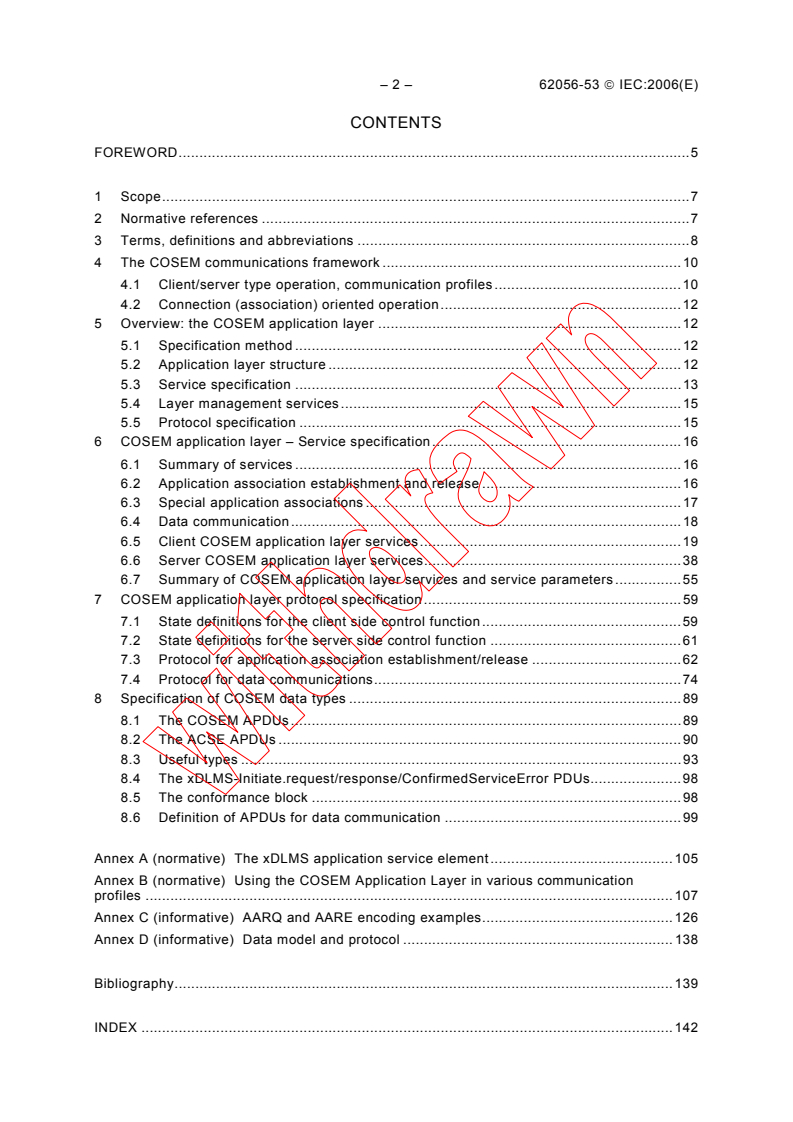
CONTENTS
FOREWORD.5
1 Scope.7
2 Normative references .7
3 Terms, definitions and abbreviations .8
4 The COSEM communications framework .10
4.1 Client/server type operation, communication profiles .10
4.2 Connection (association) oriented operation.12
5 Overview: the COSEM application layer .12
5.1 Specification method .12
5.2 Application layer structure .12
5.3 Service specification .13
5.4 Layer management services.15
5.5 Protocol specification .15
6 COSEM application layer – Service specification.16
6.1 Summary of services .16
6.2 Application association establishment and release .16
6.3 Special application associations .17
6.4 Data communication.18
6.5 Client COSEM application layer services.19
6.6 Server COSEM application layer services.38
6.7 Summary of COSEM application layer services and service parameters .55
7 COSEM application layer protocol specification .59
7.1 State definitions for the client side control function.59
7.2 State definitions for the server side control function .61
7.3 Protocol for application association establishment/release .62
7.4 Protocol for data communications.74
8 Specification of COSEM data types .89
8.1 The COSEM APDUs.89
8.2 The ACSE APDUs .90
8.3 Useful types .93
8.4 The xDLMS-Initiate.request/response/ConfirmedServiceError PDUs.98
8.5 The conformance block .98
8.6 Definition of APDUs for data communication .99
Annex A (normative) The xDLMS application service element.105
Annex B (normative) Using the COSEM Application Layer in various communication
profiles .107
Annex C (informative) AARQ and AARE encoding examples.126
Annex D (informative) Data model and protocol .138
Bibliography.139
INDEX .142
62056-53 © IEC:2006(E) – 3 –
Figure 1 – Client/server relationship in COSEM .10
Figure 2 – Exchanging messages via the communication protocol .11
Figure 3 – The COSEM application layer on the top of various lower layer stacks.11
Figure 4 – A complete communication session in the CO environment .12
Figure 5 – The structure of the COSEM application layers .13
Figure 6 – Structure of the COSEM AL when the server is using SN references.15
Figure 7 – Summary of COSEM application layer services .16
Figure 8 – Normal service sequence for the COSEM-OPEN service.17
Figure 9 – Client side services for application association establishment .19
Figure 10 – Client side services for releasing an application association.23
Figure 11 – Client side data communication services .26
Figure 12 – Client side services for event notification .35
Figure 13 – Server side services for application association establishment .38
Figure 14 – Server side services for releasing an application association .40
Figure 15 – Server side data communications services using LN referencing.44
Figure 16 – Partial state machine for the client side control function .60
Figure 17 – Partial state machine for the server side control function.61
Figure 18 – MSC for successful application association establishment preceded by a
successful lower layer connection establishment .63
Figure 19 – Graceful association release using the A-RELEASE service.69
Figure 20 – Graceful release of an application association by disconnection the
supporting layer .70
Figure 21 – Aborting an application association following a PH-ABORT.indication .71
Figure 22 – MSC for a confirmed GET service in case of success.75
Figure 23 – MSC for a confirmed SET service in case of success .75
Figure 24 – MSC for the SET service in case of failure .76
Figure 25 – MSC for the ACTION service (simplest case) .76
Figure 26 – Long data with the GET service in three data blocks .81
Figure 27 – Long data transfer in three data blocks with the SET service.83
Figure 28 – Long data transfer with the ACTION service.85
Figure 29 – MSC for the ReadRequest/Response services .87
Figure B.1 – Identification/addressing scheme in the 3-layer, connection-oriented,
HDLC based communication profile .110
Figure B.2 – Data link layer services provided to and used by the client COSEM
application layer .111
Figure B.3 – Data link layer services provided to and used by the server COSEM
application layer .112
Figure B.4 – Example: EventNotificaton triggered by the client .115
Figure B.5 – Multi-drop configuration and its model .116
Figure B.6 – Master/ Slave operation on the multi-drop bus .116
Figure B.7 – COSEM as a standard Internet application protocol .118
Figure B.8 – Examples for lower-layer protocols in the TCP-UDP/IP based profiles .119
Figure B.9 – Identification/addressing scheme in the TCP-UDP/IP based profile(s).120
Figure B.10 – Summary of TCP/UDP layer services on the client and server side .121
Figure D.1 – The three-step approach of COSEM .138
– 4 – 62056-53 © IEC:2006(E)
Table 1 – Mapping between client side LN and server side SN referencing services .37
Table 2 – Application layer services – summary.55
Table 3 – Summary of the service parameters in the COSEM-OPEN service primitives.56
Table 4 – Summary of the service parameters in the COSEM-RELEASE service primitives .57
Table 5 – Summary of the service parameters in the COSEM-ABORT service primitives .57
Table 6 – Summary of the service parameters in the COSEM GET service primitives .57
Table 7 – Summary of the service parameters in the COSEM SET service primitives.58
Table 8 – Summary of the service parameters in the COSEM ACTION service primitives .58
Table 9 – Summary of the service parameters in the COSEM EventNotification service
primitives .59
Table 10 – Mapping between the EventNotification and InformationReport services.88
Table B.1 – Application associations and data exchange in the 3-layer, connection-
oriented, HDLC based profile.113
Table B.2 –Application associations and data exchange in the TCP-UDP/IP based profile .123
62056-53 © IEC:2006(E) – 5 –
INTERNATIONAL ELECTROTECHNICAL COMMISSION
____________
ELECTRICITY METERING –
DATA EXCHANGE FOR METER READING,
TARIFF AND LOAD CONTROL –
Part 53: COSEM application layer
FOREWORD
1) The International Electrotechnical Commission (IEC) is a worldwide organization for standardization comprising
all national electrotechnical committees (IEC National Committees). The object of IEC is to promote
international co-operation on all questions concerning standardization in the electrical and electronic fields. To
this end and in addition to other activities, IEC publishes International Standards, Technical Specifications,
Technical Reports, Publicly Available Specifications (PAS) and Guides (hereafter referred to as “IEC
Publication(s)”). Their preparation is entrusted to technical committees; any IEC National Committee interested
in the subject dealt with may participate in this preparatory work. International, governmental and non-
governmental organizations liaising with the IEC also participate in this preparation. IEC collaborates closely
with the International Organization for Standardization (ISO) in accordance with conditions determined by
agreement between the two organizations.
2) The formal decisions or agreements of IEC on technical matters express, as nearly as possible, an international
consensus of opinion on the relevant subjects since each technical committee has representation from all
interested IEC National Committees.
3) IEC Publications have the form of recommendations for international use and are accepted by IEC National
Committees in that sense. While all reasonable efforts are made to ensure that the technical content of IEC
Publications is accurate, IEC cannot be held responsible for the way in which they are used or for any
misinterpretation by any end user.
4) In order to promote international uniformity, IEC National Committees undertake to apply IEC Publications
transparently to the maximum extent possible in their national and regional publications. Any divergence
between any IEC Publication and the corresponding national or regional publication shall be clearly indicated in
the latter.
5) IEC provides no marking procedure to indicate its approval and cannot be rendered responsible for any
equipment declared to be in conformity with an IEC Publication.
6) All users should ensure that they have the latest edition of this publication.
7) No liability shall attach to IEC or its directors, employees, servants or agents including individual experts and
members of its technical committees and IEC National Committees for any personal injury, property damage or
other damage of any nature whatsoever, whether direct or indirect, or for costs (including legal fees) and
expenses arising out of the publication, use of, or reliance upon, this IEC Publication or any other IEC
Publications.
8) Attention is drawn to the Normative references cited in this publication. Use of the referenced publications is
indispensable for the correct application of this publication.
9) Attention is drawn to the possibility that some of the elements of this IEC Publication may be the subject of
patent rights. IEC shall not be held responsible for identifying any or all such patent rights.
The International Electrotechnical Commission (IEC) draws attention to the fact that it is claimed that compliance
with this International Standard may involve the use of a maintenance service concerning the stack of protocols on
which the present standard IEC 62056-53 is based.
The IEC takes no position concerning the evidence, validity and scope of this maintenance service.
The provider of the maintenance service has assured the IEC that he is willing to provide services under
reasonable and non-discriminatory terms and conditions with applicants throughout the world. In this respect, the
statement of the provider of the maintenance service is registered with the IEC. Information may be obtained from:
DLMS User Association
Geneva / Switzerland
www.dlms.ch
International Standard IEC 62056-53 has been prepared by IEC technical committee 13:
Equipment for electrical energy measurement and load control.
———————
Device Language Message Specification
– 6 – 62056-53 © IEC:2006(E)
This standard cancels and replaces the first edition which was published in 2002.
It constitutes a technical revision. The main changes with respect to the previous edition are
as follows:
• the protocol of the COSEM-RELEASE service has been changed: depending on the
communication profile used, these services may rely on the ACSE A_RELEASE services;
• the parsing order of the AARQ APDU has been changed;
• handling of repeated application association requests has been simplified;
• the Service_Class parameter of the COSEM-OPEN service is now linked to the response-
allowed field of the xDLMS-Initiate.request APDU;
• the Service_Class parameter of COSEM services for data exchange using LN referencing
is now linked to bit 6 of the Invoke-Id-And-Priority parameter;
• a new, optional EXCEPTION APDU has been introduced. The server may send back this
APDU after an erroneous service request;
• a general part about using the COSEM application layer in various communication profiles
has been added;
• the description of using the COSEM Application layer in the 3-layer, connection-oriented,
HDLC based communication profile has been amended;
• a new, TCP-UDP/IP based communication profile has been defined.
The text of this standard is based on the following documents:
FDIS Report on voting
13/1387/FDIS 13/1398/RVD
Full information on the voting for the approval of this standard can be found in the report on
voting indicated in the above table.
This publication has been drafted in accordance with the ISO/IEC Directives, Part 2.
A list of all parts of IEC 62056 series, published under the general title Electricity metering –
Data exchange for meter reading, tariff and load control, can be found on the IEC website.
The committee has decided that the contents of this publication will remain unchanged until
the maintenance result date indicated on the IEC web site under "http://webstore.iec.ch" in
the data related to the specific publication. At this date, the publication will be
• reconfirmed,
• withdrawn,
• replaced by a revised edition, or
• amended.
A bilingual version of the publication may be issued at a later date.
62056-53 © IEC:2006(E) – 7 –
ELECTRICITY METERING –
DATA EXCHANGE FOR METER READING,
TARIFF AND LOAD CONTROL –
Part 53: COSEM application layer
1 Scope
This part of IEC 62056 specifies the COSEM application layer in terms of structure, services
and protocols for COSEM clients and servers, and defines how to use the COSEM application
layer in various communication profiles.
It defines services for establishing and releasing application associations, and data
communication services for accessing the methods and attributes of COSEM interface
objects, defined in IEC 62056-62, using either logical name (LN) or short name (SN)
referencing.
Annex A describes the xDLMS application service element.
Annex B defines how to use the COSEM application layer in various communication profiles.
Annex C includes encoding examples for APDUs.
Annex D gives an explanation of the role of data models and protocols in electricity meter
data exchange.
2 Normative references
The following referenced documents are indispensable for the application of this document.
For dated references, only the edition cited applies. For undated references, the latest edition
of the referenced document (including any amendments) applies.
IEC 60050-300:2001, International Electrotechnical Vocabulary (IEV) – Electrical and
electronic measurements and measuring instruments – Part 311: General terms relating to
measurements – Part 312: General terms relating to electrical measurements – Part 313:
Types of electrical measuring instruments – Part 314: Specific terms according to the type of
instrument
IEC 61334-4-41:1996, Distribution automation using distribution line carrier systems – Part 4:
Data communication protocols – Section 41: Application protocols – Distribution line message
specification
IEC 61334-6:2000, Distribution automation using distribution line carrier systems – Part 6:
A-XDR encoding rule
IEC 62051:1999, Electricity metering – Glossary of terms
IEC 62051-1:2004, Electricity metering – Data exchange for meter reading, tariff and load
control – Glossary of Terms – Part 1: Terms related to data exchange with metering
equipment using DLMS/COSEM
IEC 62056-21:2002, Electricity metering – Data exchange for meter reading, tariff and load
control – Part 21: Direct local data exchange
– 8 – 62056-53 © IEC:2006(E)
IEC 62056-42:2002, Electricity metering – Data exchange for meter reading, tariff and load
control – Part 42: Physical layer services and procedures for connection-oriented
asynchronous data exchange
IEC 62056-46:2002, Electricity metering – Data exchange for meter reading, tariff and load
control – Part 46: Data link layer using HDLC protocol
Amendment 1
IEC 62056-47, Electricity metering – Data exchange for meter reading, tariff and load control
– Part 47: COSEM transport layer for IP networks
IEC 62056-61, Ed.2, Electricity metering – Data exchange for meter reading, tariff and load
control – Part 61: Object identification system (OBIS)
IEC 62056-62, Ed.2, Electricity metering – Data exchange for meter reading, tariff and load
control – Part 62: Interface classes
ISO/IEC 8649:1996, Information technology – Open Systems Interconnection – Service definition
for the Association Control Service Element
ISO/IEC 8650-1:1996, Information technology – Open systems interconnection – Connection-
oriented protocol for the Association Control Service Element: Protocol specification
ISO/IEC 8824, Information technology – Abstract Syntax Notation One (ASN.1)
ISO/IEC 8825, Information technology – ASN.1 encoding rules
ISO/IEC 13239:2002, Information technology – Telecommunications and information exchange
between systems – High-level data link control (HDLC) procedures
STD0005 – Internet Protocol
Author: J. Postel
Date: September 1981
Also: RFC0791, RFC0792, RFC0919, RFC0922, RFC0950, RFC1112
STD0006 – User Datagram Protocol
Author: J. Postel
Date: 28 August 1980
Also: RFC0768
STD0007 – Transmission Control Protocol
Author: J. Postel
Date: September 1981
Also: RFC0793
See also Bibliography for other related Internet RFCs.
3 Terms, definitions and abbreviations
3.1 Terms and definitions
For the purposes of this part of IEC 62056, the definitions in IEC 60050-300, IEC 62051 and
IEC 62051-1 apply.
3.2 Abbreviations
.cnf .confirm service primitive
.ind .indication service primitive
———————
To be published.
62056-53 © IEC:2006(E) – 9 –
.req .request service primitive
.res .response service primitive
AA Application Association
AARE Application Association REsponse
AARQ Application Association ReQuest
ACSE Application Control Service Element
AE Application Entity
AP Application Process
APDU Application layer Protocol Data Unit
API Application Programming Interface
ARP Address Resolution Protocol
ASE Application Service Element
ASO Application Service Object
ATM Asynchronous Transfer Mode
A-XDR Adapted eXtended Data Representation
BER Basic Encoding Rules
CF Control function
CO Connection Oriented
COSEM COmpanion Specification for Energy Metering
DLMS Device Language Message Specification
DSAP Data link Service Access Point
FDDI Fibre Distributed Data Interface
FTP File Transfer Protocol
GMT Greenwich Mean Time
GSM Global System for Mobile communications
HDLC High-level Data Link Control
HLS High Level Security
HTTP Hypertext Transfer Protocol
IC Interface Class
IETF Internet Engineering Task Force
IP Internet Protocol
LAN Local Area Network
LLC Logical Link Control (sub-layer)
LLS Low Level Security
LPDU LLC Protocol Data Unit
LSAP LLC sub-layer Service Access Point
LSB Least Significant Bit
MAC Medium Access Control
MD5 Message Digest Algorithm 5
MIB Management Information Base
MSB Most Significant Bit
MSC Message Sequence Chart
OBIS OBject Identification System
– 10 – 62056-53 © IEC:2006(E)
OSI Open System Interconnection
PDU Protocol Data Unit
PPP Point-to-Point Protocol
PSTN Public Switched Telephone Network
RARP Reverse Address Resolution Protocol
RFC Request For Comment
RLRQ Release Request
RLRE Release Response
SAP Service Access Point
SHA-1 Secure Hash Algorithm 1
SNMP Simple Network Management Protocol
VAA Virtual Application Association
xDLMS-ASE extended DLMS Application Service Element
4 The COSEM communications framework
4.1 Client/server type operation, communication profiles
Communication with electricity metering equipment using the COSEM interface object model
is based on the client/server paradigm where metering equipment plays the server role. In
this environment, communication takes place always between a client and a server AP: in
other words, the server AP provides remote services to the client AP. These services are
provided via exchanging messages (SERVICE.requests/.responses) between the client and
the server APs, as shown in Figure 1.
Server application
Client application (COSEM device)
SERVICE.request
SERVICE.response
IEC 2070/06
Figure 1 – Client/server relationship in COSEM
In general, the client and the server APs are located in separate devices; exchanging
messages is done with the help of the communication protocol as shown in Figure 2.
———————
The term metering equipment is an abstraction; consequently the equipment playing the role of a server may be
any type of equipment for which this abstraction is suitable.
62056-53 © IEC:2006(E) – 11 –
.request
Client Server
.response
.response
.request
Application
layer
Protocol
Intermediate
protocol layers
Physical layer
Physical channel
IEC 2071/06
Figure 2 – Exchanging messages via the communication protocol
In general, communication protocols are structured in layers. The client and server COSEM
applications use services of the highest protocol layer, that of the application layer:
consequently, this is the only protocol layer containing COSEM specific element(s). This is
called the xDLMS_ASE. All COSEM interface object related services – the xDLMS application
protocol – are provided by this xDLMS_ASE.
Other protocol layers are independent of the COSEM model. Consequently, the COSEM
application layer can be placed on the top of a wide variety of lower protocol layer stacks, as
shown in Figure 3.
Profile 2
Profile 1
Profile M
Application layer
ACSE
xDLMS_ASE
N layer
N layer
N layer
N-1 layer
………
Physical layer
Physical layer
Physical layer
IEC 2072/06
Figure 3 – The COSEM application layer on the top of various lower layer stacks
– 12 – 62056-53 © IEC:2006(E)
A complete protocol stack – including the application layer, a physical layer and all protocol
layers between these extreme layers – is called a communication profile.
A communication profile is characterized by the protocol layers included, their parameters,
and by the type – connection-oriented or connectionless – of the ACSE included in the
application layer.
4.2 Connection (association) oriented operation
The xDLMS application protocol is a connection-oriented protocol. It means that the client and
server APs can use the services of the xDLMS_ASE only when these APs are associated .
Therefore, in this environment a communication session consists of three phases, as shown
in Figure 4.
Client application Server application
Phase 1.
Connection establishment
Phase 2.
Data communication
Phase 3.
t
Connection release
IEC 2073/06
Figure 4 – A complete communication session in the CO environment
In the DLMS/COSEM environment, application association establishment is normally done by
using the association request/response services of the standard association control service
element. On the other hand, for the purposes of very simple devices, one-way communicating
devices and for multicasting and broadcasting, pre-established application associations are
also allowed; see 6.3.3. For such associations, there is no need to use the services of the
ACSE: a full communication session may include only the data communication phase. (It can
be considered that the connection establishment phase has been already done somewhere in
the past.)
5 Overview: the COSEM application layer
5.1 Specification method
The COSEM application layer is specified in terms of structure, services, and protocols.
5.2 Application layer structure
The main component of the client and server COSEM application layers is the COSEM ASO,
which provides services to the COSEM AP, and uses services provided by the supporting
lower layer.
Both the client and server side COSEM ASO contain three mandatory components:
• the ACSE. The task of this element is to establish, maintain, and release application
associations. For the purposes of connection-oriented profiles, the connection-oriented
ACSE, specified in ISO/IEC 8649 and ISO/IEC 8650-1 is used;
———————
ACSE = Association Control Service Element
Application associations can be considered as application level connections.
62056-53 © IEC:2006(E) – 13 –
• the Extended DLMS application service element (xDLMS_ASE). The task of this element is
to provide data communication services between COSEM APs. See also Annex A;
• the Control function (CF). This element specifies how the ASO services invoke the
appropriate service primitives of the ACSE and the xDLMS ASE and the services of the
supporting layer.
NOTE Both the client and the server COSEM ASO may contain other, optional application protocol components.
Figure 5 shows ‘minimal’ COSEM ASOs, containing only the three mandatory components.
COSEM client
COSEM server
application process
application process
Referencing by
COSEM client ASO services
COSEM server ASO services
Logical Name
Referencing by Logical Name
COSEM client application layer COSEM server application layer
COSEM client ASO COSEM server ASO
Server control function
Client control function
Server Server
Client Client
xDLMS _ASE ACSE
xDLMS_ASE
ACSE
Supporting layer services Supporting layer services
Supporting layer
Supporting layer
and
and
other protocol layers other protocol layers
WAN, LAN
IEC 2074/06
Figure 5 – The structure of the COSEM application layers
The COSEM application layer performs also some functions of the OSI presentation layer:
• for encoding the ACSE APDUS- AARQ, AARE, RLRQ, RLRE – BER encoding is used
(ISO/IEC 8825);
• for encoding the APDUs carrying the data communication services, A-XDR encoding is
used (IEC 61334-6).
5.3 Service specification
Service specifications cover the services required of, or by the COSEM client and server APs
at the logical interfaces with the respective COSEM application layer, using connection-
oriented procedures.
Services provided by the COSEM ASO fall into three categories:
• application association establishment and release;
• data communication;
• layer management.
The client and server application layer services are specified in Clause 6.
Applications
Protocol
(interface objects)
(communications)
– 14 – 62056-53 © IEC:2006(E)
5.3.1 Services provided for application association establishment and release
These services are the following:
• COSEM-OPEN;
• COSEM-RELEASE;
• COSEM-ABORT.
The COSEM-OPEN service is used during AA establishment phase and relies on the
association request/response services of the ACSE. In the case of pre-established application
associations (6.3.3) these services are not used.
In certain COSEM communication profiles – for example in the 3-layer, connection-oriented,
HDLC based profile – there is a one-to-one relationship between a confirmed AA and the
supporting protocol layer connection. In this case, the COSEM-RELEASE service used during
the association release phase does not rely on the ACSE A_RELEASE services. Confirmed
AAs in these profiles are released simply by disconnecting the corresponding lower layer
connection.
Optionally, the COSEM-RELEASE service may rely on the ACSE A_RELEASE service. In
some communication profiles, like in the TCP-UDP/IP based profile, using the ACSE
A_RELEASE services for releasing COSEM AAs is mandatory.
5.3.2 Data communication services
IEC 62056-62 specifies two referencing methods for COSEM servers: referencing by Logical
Names (LN) and referencing by Short Names (SN). Therefore, two distinct service sets are
specified for the server side xDLMS_ASE. One set uses exclusively LN references the other
set uses exclusively SN references. Thus, these services are the following:
• COSEM interface object attribute-related services: GET, SET for LN referencing and
Read, Write, Unconfirmed Write for SN referencing;
• COSEM interface object method-related services: ACTION (LN), Read, Write or
UnconfirmedWrite (SN);
• the EventNotification (LN), InformationReport (SN) services.
The services rely on the services of the xDLMS_ASE. Most of these services contain
references to attributes or methods of COSEM interface objects.
The service set to be used on the server side during the data communications phase is
negotiated during the association establishment phase using the conformance block, see 8.5.
It shall not change during the lifetime of the established association. Using LN or SN services
within a given AA is exclusive. Therefore, it can be considered that there are two, different
server xDLMS_ASE-s: one providing services with Logical name references and another
providing services with Short name references. The server application layer shall include one
or both of these xDLMS_ASEs.
NOTE A server could use both LN and SN referencing in different AAs.
On the client side, in order to handle the different referencing schemes transparently for the
COSEM client AP, the COSEM client application layer provides only one service set, using
Logical Name referencing. This has two major consequences:
• using a unique, standardized service set between COSEM client applications and the
communications protocol – hiding the particularities of different COSEM servers – allows
to specify an Application Programming Interface (API). This is an explicitly specified
interface corresponding to this service set for applications running in a given computing
environment (e.g. Windows XP, UNIX, etc.) Using this – public – API specification, client
applications can be developed without knowledge about particularities of a given server;
62056-53 © IEC:2006(E) – 15 –
• when the COSEM server device does not use LN referencing, the client application layer
shall include an additional component. The purpose of this component is to map the LN
service set, used by the client AP into/from the service set, used by the server AP.
Figure 6 shows the COSEM client application layer when the server is using SN
referencing. The additional component is called SN_MAPPER_ASE. See also 6.5.5.2.
COSEM client
COSEM server
application process
application process
Referencing by
COSEM client ASO services
COSEM server ASO services
Short Name
Referencing by Logical Name
COSEM client application layer
COSEM server application layer
COSEM client ASO
COSEM server ASO
Client control function
Server control function
Client
xDLMS _ASE
Client
Server Server
ACSE
Client xDLMS _ASE ACSE
SN_MAPPER
Supporting layer services Supporting layer services
Supporting layer
Supporting layer
and
and
other protocol layers other protocol layers
WAN, LAN
IEC 2075/06
Figure 6 – Structure of the COSEM AL when the server is using SN references
5.4 Layer management services
Layer management services have local importance only. Therefore, specification of these
services is not within the scope of this standard. The specific SetMapperTables service is
defined in 6.5.5.1.
5.5 Protocol specification
The COSEM application layer protocols specify the procedures for the transfer of information
for application association control, authentication (ACSE procedures) and for data exchange
between COSEM clients and servers (xDLMS procedures). These procedures are defined in
terms of:
• the interactions between peer ACSE and xDLMS protocol machines through the use of
services of the supporting protocol layer;
• the interactions between the ACSE and xDLMS protocol machines and their service user;
• the abstract syntax (ASN.1, ISO/IEC 8824) representation of Application Protocol Data
Units (APDUs) is also specified with the application protocols; see Clause 8.
NOTE All COSEM services are operating on an already established physical connection. Establishment of this
physical connection is done outside of the COSEM protocol, therefore, it is not within the scope of this standard.
Applications
Protocol
(interface objects)
(communications)
– 16 – 62056-53 © IEC:2006(E)
6 COSEM application layer – Service specification
6.1 Summary of services
A summary of the services available at the top of the COSEM application layer is shown in
Figure 7.
COSEM client
COSEM server
application process
application process
Application layer
ZZ.request
ZZ.response
EventNotification
IEC 2076/06
NOTE XX and ZZ refer to client/server type data communication services. These services may be different on the
client side and the server side, if the server does not use LN referencing. See 6.4.
Figure 7 – Summary of COSEM application layer services
6.2 Application association establishment and release
The COSEM-OPEN, COSEM-RELEASE and COSEM-ABORT services are used for the
establishment and release of AAs.
The COSEM-OPEN.request service is invoked by the COSEM client AP to establish a
confirmed or non-confirmed AA with a COSEM server AP. Invoking this service implies
generating a COSEM-OPEN.indication service primitive at the server side . If the association
to be established is a confirmed one, the server shall respond to this request by invoking the
COSEM-OPEN.response service, which is transferred to the client AP as a remote
confirmation (COSEM-OPEN.confirm). This normal opening sequence is shown in Figure 8.
———————
Before the invocation of the COSEM-OPEN.request service, the physical layers must be connected. Depending
on the communication profile, the invocation of the COSEM-OPEN.request service may also imply the
connection of the lower layers.
COSEM-OPEN.req
COSEM-OPEN.cnf
COSEM-RELEASE.req
COSEM-RELEASE.cnf
COSEM-ABORT.ind
XX.req
XX.cnf
Trigg_EventNotif.req
EventNotification.ind
COSEM-OPEN.ind
COSEM-OPEN.res
COSEM-RELEASE.ind
COSEM-RELEASE.res
COSEM-ABORT.ind
ZZ.ind
ZZ.res
EventNotification.req or
InformationReport.req
62056-53 © IEC:2006(E) – 17 –
Server
Client
application layer
application layer
COSEM-
COSEM-
OPEN.indication
OPEN.request
COSEM-
OPEN.confirm COSEM-
OPEN.response
Time
IEC 2077/06
Figure 8 – Normal service sequence for the COSEM-OPEN service
NOTE The COSEM-OPEN.request service may also be locally (negatively) confirmed, for example when the
connection of a lower layer is not successful.
The COSEM-RELEASE service is provided for graceful disconnection of an existing
application association. As COSEM server application processes are not allowed to request a
graceful disconnection, the COSEM-RELEASE.request service is available only for the
COSEM client. The nominal service sequence for the COSEM-RELEASE service is the same
as shown in Figure 8 for the COSEM-OPEN service, replacing the word ‘OPEN’ with the word
‘RELEASE’.
The ABORT service is used to indicate the disconnection of the physical connection. This
service is the same at both sides.
6.3 Special application associations
6.3.1 Confirmed application associations
For the purposes of this standard, the term confirmed application association is used to
designate an AA, which is established between a client and a server AP with the help of an
AARQ/AARE message exchange (see 7.3.1). Establishment of a confirmed AA is always
initiated by the client application in invoking the COSEM-OPEN.request service with
Service_Class == Confirmed.
After the establishment of a confirmed AA, any xDLMS data communication services using LN
referencing can be invoked in a confirmed or an unconfirmed manner, until the association is
released.
NOTE xDLMS services using SN referencing are either confirmed (Read, Write) or Unconfirmed (Unconfirmed
Write).
6.3.2 Non-confirmed application associations
For the purposes of this standard, the term non-confirmed application association is used to
designate an AA, which is established without an AARQ/AARE message exchange: only an
AARQ shall be sent from the client to the server. Similarly to the confirmed AA, establishment
of a non-confirmed AA is also always initiated by the Client application, but in invoking the
COSEM-OPEN.request service with Service_Class == Unconfirmed.
After the establishment of a non-confirmed AA, xDLMS data communication services using LN
referencing can only be invoked in unconfirmed manner, until the association is released.
NOTE With SN referencing, in non-confirmed AAs only the UnconfirmedWrite service can be used.
As the establishment of such non-confirmed AAs does not require the Server AP to respond to
the association request coming from the client, in some cases – for example one-way
communications or broadcasting – the establishment of a non-confirmed AA is the only
possibility.
– 18 – 62056-53 © IEC:2006(E)
6.3.3 Pr
...