

IEC 62055-41:2007
(Main)Electricity metering - Payment systems - Part 41: Standard transfer specification (STS) - Application layer protocol for one-way token carrier systems
General Information
- Abstract
specifies the application layer protocol of the STS for transferring units of credit and other management information from a point-of-sale (POS) system to an STS-compliant payment meter in a one-way token carrier system. It is primarily intended for application with electricity payment meters without a tariff employing energy-based tokens, but may also have application with currency-based token systems and for services other than electricity.
- Status
- Published
- Publication Date
- 22-May-2007
- Technical Committee
- TC 13 - Electrical energy measurement and control
- Drafting Committee
- WG 15 - TC 13/WG 15
- Current Stage
- DELPUB - Deleted Publication
- Start Date
- 14-May-2014
- Completion Date
- 28-Aug-2026
Overview
IEC 62055-41:2007 defines the application layer protocol of the Standard Transfer Specification (STS) for one-way token carrier systems used in electricity metering payment systems. The standard specifies how a point-of-sale (POS) system transfers units of credit and other management information to an STS‑compliant payment meter via one‑way tokens. While primarily intended for energy‑based prepayment electricity meters (no tariff), the protocol can also apply to currency‑based tokens and non‑electric services.
Key Topics
- APDU (Application Protocol Data Unit): formalizes data elements and message structures exchanged between POS and the token carrier and from the token carrier to the meter.
- Token formats and classes: defines token data elements, token classes/sub‑classes, TransferCredit tokens and special management tokens (e.g., SetTariffRate, ClearCredit, SetMaximumPowerLimit).
- TCDU generation & extraction: procedures for creating Token Carrier Data Units and extracting token contents at the meter.
- Security functions & key management: decoder/vending key classification, encryption/decryption algorithms, authentication and validation results, and guidance for a Key Management System (KMS).
- Meter application requirements: acceptance/rejection behaviour, displays/indicators, and functional behaviour for applied tokens.
- Operational model & identifiers: POS→TokenCarrier→Meter dataflows, ISO transaction reference number composition, and entity identifiers used in STS deployments.
- Maintenance and lifecycle: requirements for maintaining STS entities, operational processes and guidance for procurement and implementation.
Applications
- Prepayment electricity metering: secure one‑way token delivery of energy credit to meters in residential, commercial or industrial settings.
- Vending and POS integration: POS vendors implement the APDU and token generation to vend prepaid credit securely.
- Utility operations: utilities and metering service providers use the standard to ensure interoperability between meters, vending systems and token carriers.
- Other tokenized services: applicable to currency‑based token systems or non‑electric services where one‑way token transfer is suitable.
Who uses IEC 62055-41
- Meter manufacturers and firmware engineers
- POS and vending solution developers
- Utilities, retail vending operators and system integrators
- Test laboratories, certification bodies and procurement teams
- Security and KMS architects involved in token lifecycle management
Related standards
- Other parts of the IEC 62055 series (Standard Transfer Specification) cover complementary layers and system requirements; implementers should consult the full series and normative references listed in IEC 62055-41 for complete interoperability and compliance guidance.
Keywords: IEC 62055-41, STS, standard transfer specification, one-way token carrier, application layer protocol, electricity metering, prepayment meter, token security, Key Management System (KMS).
Relations
- Effective Date
- 05-Sep-2023
- Effective Date
- 05-Sep-2023
Get Certified
Connect with accredited certification bodies for this standard

BSI Group
BSI (British Standards Institution) is the business standards company that helps organizations make excellence a habit.

DIBt (Deutsches Institut für Bautechnik)
German Institute for Building Technology.
DIN CERTCO
DIN Group product certification.
Sponsored listings
Frequently Asked Questions
IEC 62055-41:2007 is a standard published by the International Electrotechnical Commission (IEC). Its full title is "Electricity metering - Payment systems - Part 41: Standard transfer specification (STS) - Application layer protocol for one-way token carrier systems". This standard covers: specifies the application layer protocol of the STS for transferring units of credit and other management information from a point-of-sale (POS) system to an STS-compliant payment meter in a one-way token carrier system. It is primarily intended for application with electricity payment meters without a tariff employing energy-based tokens, but may also have application with currency-based token systems and for services other than electricity.
specifies the application layer protocol of the STS for transferring units of credit and other management information from a point-of-sale (POS) system to an STS-compliant payment meter in a one-way token carrier system. It is primarily intended for application with electricity payment meters without a tariff employing energy-based tokens, but may also have application with currency-based token systems and for services other than electricity.
IEC 62055-41:2007 is classified under the following ICS (International Classification for Standards) categories: 35.100.70 - Application layer; 91.140.50 - Electricity supply systems. The ICS classification helps identify the subject area and facilitates finding related standards.
IEC 62055-41:2007 has the following relationships with other standards: It is inter standard links to IEC PAS 62055-41:2003, IEC 62055-41:2014. Understanding these relationships helps ensure you are using the most current and applicable version of the standard.
IEC 62055-41:2007 is available in PDF format for immediate download after purchase. The document can be added to your cart and obtained through the secure checkout process. Digital delivery ensures instant access to the complete standard document.
Standards Content (Sample)
INTERNATIONAL IEC
STANDARD 62055-41
First edition
2007-05
Electricity metering – Payment systems –
Part 41:
Standard transfer specification (STS) –
Application layer protocol for one-way
token carrier systems
Reference number
All rights reserved. Unless otherwise specified, no part of this publication may be reproduced or utilized in any form
or by any means, electronic or mechanical, including photocopying and microfilm, without permission in writing from
either IEC or IEC's member National Committee in the country of the requester.
If you have any questions about IEC copyright or have an enquiry about obtaining additional rights to this publication,
please contact the address below or your local IEC member National Committee for further information.
IEC Central Office
3, rue de Varembé
CH-1211 Geneva 20
Switzerland
Email: inmail@iec.ch
Web: www.iec.ch
About the IEC
The International Electrotechnical Commission (IEC) is the leading global organization that prepares and publishes
International Standards for all electrical, electronic and related technologies.
About IEC publications
The technical content of IEC publications is kept under constant review by the IEC. Please make sure that you have the
latest edition, a corrigenda or an amendment might have been published.
ƒ Catalogue of IEC publications: www.iec.ch/searchpub
The IEC on-line Catalogue enables you to search by a variety of criteria (reference number, text, technical committee,…).
It also gives information on projects, withdrawn and replaced publications.
ƒ IEC Just Published: www.iec.ch/online_news/justpub
Stay up to date on all new IEC publications. Just Published details twice a month all new publications released. Available
on-line and also by email.
ƒ Customer Service Centre: www.iec.ch/webstore/custserv
If you wish to give us your feedback on this publication or need further assistance, please visit the Customer Service
Centre FAQ or contact us:
Email:
csc@iec.ch
Tel.: +41 22 919 02 11
Fax: +41 22 919 03 00
INTERNATIONAL IEC
STANDARD 62055-41
First edition
2007-05
Electricity metering – Payment systems –
Part 41:
Standard transfer specification (STS) –
Application layer protocol for one-way
token carrier systems
PRICE CODE
Commission Electrotechnique Internationale XD
International Electrotechnical Commission
МеждународнаяЭлектротехническаяКомиссия
For price, see current catalogue
– 2 – 62055-41 © IEC:2007(E)
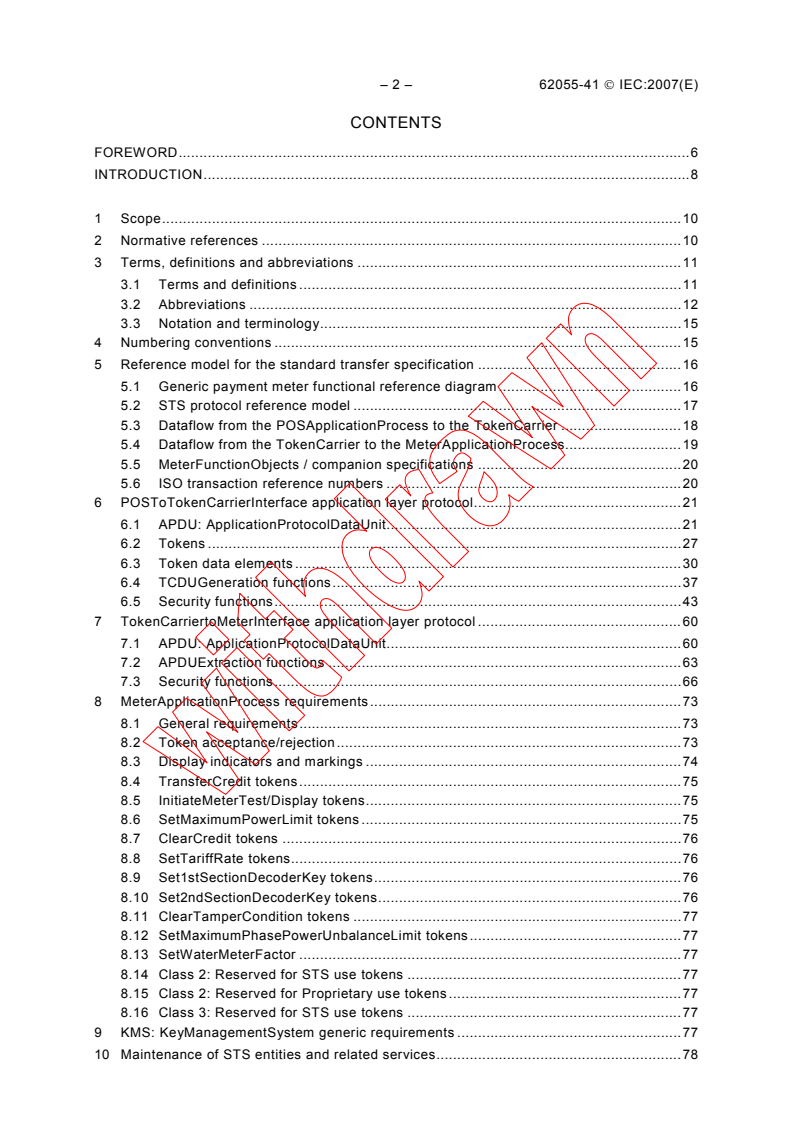
CONTENTS
FOREWORD.6
INTRODUCTION.8
1 Scope.10
2 Normative references .10
3 Terms, definitions and abbreviations .11
3.1 Terms and definitions .11
3.2 Abbreviations .12
3.3 Notation and terminology.15
4 Numbering conventions .15
5 Reference model for the standard transfer specification .16
5.1 Generic payment meter functional reference diagram .16
5.2 STS protocol reference model .17
5.3 Dataflow from the POSApplicationProcess to the TokenCarrier .18
5.4 Dataflow from the TokenCarrier to the MeterApplicationProcess.19
5.5 MeterFunctionObjects / companion specifications .20
5.6 ISO transaction reference numbers .20
6 POSToTokenCarrierInterface application layer protocol.21
6.1 APDU: ApplicationProtocolDataUnit.21
6.2 Tokens .27
6.3 Token data elements .30
6.4 TCDUGeneration functions.37
6.5 Security functions.43
7 TokenCarriertoMeterInterface application layer protocol .60
7.1 APDU: ApplicationProtocolDataUnit.60
7.2 APDUExtraction functions .63
7.3 Security functions.66
8 MeterApplicationProcess requirements.73
8.1 General requirements.73
8.2 Token acceptance/rejection.73
8.3 Display indicators and markings .74
8.4 TransferCredit tokens.75
8.5 InitiateMeterTest/Display tokens.75
8.6 SetMaximumPowerLimit tokens .75
8.7 ClearCredit tokens .76
8.8 SetTariffRate tokens.76
8.9 Set1stSectionDecoderKey tokens.76
8.10 Set2ndSectionDecoderKey tokens.76
8.11 ClearTamperCondition tokens .77
8.12 SetMaximumPhasePowerUnbalanceLimit tokens.77
8.13 SetWaterMeterFactor .77
8.14 Class 2: Reserved for STS use tokens .77
8.15 Class 2: Reserved for Proprietary use tokens .77
8.16 Class 3: Reserved for STS use tokens .77
9 KMS: KeyManagementSystem generic requirements .77
10 Maintenance of STS entities and related services.78
62055-41 © IEC:2007(E) – 3 –
10.1 General .78
10.2 Operations .80
10.3 Standardisation .82
Annex A (informative) Guidelines for a KeyManagementSystem (KMS).86
Annex B (informative) Entities and identifiers in an STS-compliant system.89
Annex C (informative) Code of practice for the implementation of STS-compliant
systems .92
Bibliography.102
Table 1 – Data elements in the APDU.21
Table 2 – Data elements in the IDRecord.22
Table 3 – Data elements in the MeterPAN .22
Table 4 – Data elements in the IAIN / DRN .23
Table 5 – Token carrier types .24
Table 6 – DKGA codes .24
Table 7 – EA codes.25
Table 8 – SGC types and key types .25
Table 9 – DOE codes for the year .26
Table 10 – DOE codes for the month .27
Table 11 –Token definition format.27
Table 12 – Data elements used in tokens.30
Table 13 – Token classes .31
Table 14 – Token sub-classes .31
Table 15 – TID calculation examples .33
Table 16 – Units of measure for electricity .34
Table 17 – Units of measure for other applications .34
Table 18 – Bit allocations for the TransferAmount.34
Table 19 – Maximum error due to rounding .35
Table 20 – Examples of TransferAmount values .35
Table 21 – Example of a CRC calculation .35
Table 22 – Permissible control field values .36
Table 23 – Selection of register to clear.37
Table 24 – Classification of vending keys .44
Table 25 – Classification of decoder keys .45
Table 26 – Permitted relationships between decoder key types.49
Table 27 – Definition of the PANBlock .51
Table 28 – Data elements in the PANBlock .51
Table 29 – Definition of the CONTROLBlock.52
Table 30 – Data elements in the CONTROLBlock .52
Table 31 – Range of applicable decoder reference numbers .52
Table 32 – List of applicable supply group codes .53
– 4 – 62055-41 © IEC:2007(E)
Table 33 – Sample substitution tables.57
Table 34 – Sample permutation table.58
Table 35 – Data elements in the APDU .61
Table 36 – Possible values for the AuthenticationResult .61
Table 37 – Possible values for the ValidationResult .62
Table 38 – Possible values for the TokenResult.62
Table 39 – Values stored in the DKR .67
Table 40 – Sample permutation table.68
Table 41 – Sample substitution tables.69
Table 42 – Entities/services requiring maintenance service .78
Table A.1 – Entities that participate in KMS processes .86
Table A.2 – Processes surrounding the payment meter and DecoderKey.87
Table A.3 – Processes surrounding the CryptographicModule.87
Table A.4 – Processes surrounding the SGC and VendingKey.88
Table B.1 – Typical entities deployed in an STS-compliant system .90
Table B.2 – Identifiers associated with the entities in an STS-compliant system .91
Table C.1 – Data elements associated with a SGC .93
Table C.2 – Data elements associated with the CryptographicModule.94
Table C.3 – Items that should be noted in purchase orders and tenders .97
Figure 1 – Functional block diagram of a generic single-part payment meter.16
Figure 2 – STS modelled as a 2-layer collapsed OSI protocol stack .17
Figure 3 – Dataflow from the POSApplicationProcess to the TokenCarrier .18
Figure 4 – Dataflow from the TokenCarrier to the MeterApplicationProcess .19
Figure 5 – Composition of ISO transaction reference number .20
Figure 6 – Transposition of the 2 Class bits .38
Figure 7 – TCDUGeneration function for Class 0, 1 and 2 tokens.39
Figure 8 – TCDUGeneration function for Set1stSectionDecoderKey token .40
Figure 9 – TCDUGeneration function for Set2ndSectionDecoderKey token .42
Figure 10 – DecoderKey changes – State diagram.48
Figure 11 – DecoderKeyGenerationAlgorithm01.53
Figure 12 – DecoderKeyGenerationAlgorithm02.54
Figure 13 – DecoderKeyGenerationAlgorithm03.55
Figure 14 – STA: EncryptionAlgorithm07.56
Figure 15 – STA encryption substitution process.57
Figure 16 – STA encryption permutation process .58
Figure 17 – STA encryption DecoderKey rotation process.58
Figure 18 – STA encryption worked example for TransferCredit token .59
Figure 19 – DEA: EncryptionAlgorithm09 .60
Figure 20 – APDUExtraction function .63
Figure 21 – Extraction of the 2 Class bits.64
Figure 22 – STA DecryptionAlgorithm07 .67
62055-41 © IEC:2007(E) – 5 –
Figure 23 – STA decryption permutation process .68
Figure 24 – STA decryption substitution process.69
Figure 25 – STA decryption DecoderKey rotation process.70
Figure 26 – STA decryption worked example for TransferCredit token .70
Figure 27 – DEA DecryptionAlgorithm09 .71
Figure A.1 – KeyManagementSystem and interactive relationships between entities.86
Figure B.1 – Entities and identifiers deployed in an STS-compliant system .89
– 6 – 62055-41 © IEC:2007(E)
INTERNATIONAL ELECTROTECHNICAL COMMISSION
_____________
ELECTRICITY METERING – PAYMENT SYSTEMS –
Part 41: Standard transfer specification (STS) –
Application layer protocol for one-way
token carrier systems
FOREWORD
1) The International Electrotechnical Commission (IEC) is a worldwide organization for standardization
comprising all national electrotechnical committees (IEC National Committees). The object of IEC is to
promote international co-operation on all questions concerning standardization in the electrical and electronic
fields. To this end and in addition to other activities, IEC publishes International Standards, Technical
Specifications, Technical Reports, Publicly Available Specifications (PAS) and Guides (hereafter referred to
as “IEC Publication(s)”). Their preparation is entrusted to technical committees; any IEC National Committee
interested in the subject dealt with may participate in this preparatory work. International, governmental and
non-governmental organizations liaising with the IEC also participate in this preparation. IEC collaborates
closely with the International Organization for Standardization (ISO) in accordance with conditions determined
by agreement between the two organizations.
2) The formal decisions or agreements of IEC on technical matters express, as nearly as possible, an
international consensus of opinion on the relevant subjects since each technical committee has
representation from all interested IEC National Committees.
3) IEC Publications have the form of recommendations for international use and are accepted by IEC National
Committees in that sense. While all reasonable efforts are made to ensure that the technical content of IEC
Publications is accurate, IEC cannot be held responsible for the way in which they are used or for any
misinterpretation by any end user.
4) In order to promote international uniformity, IEC National Committees undertake to apply IEC Publications
transparently to the maximum extent possible in their national and regional publications. Any divergence
between any IEC Publication and the corresponding national or regional publication shall be clearly indicated
in the latter.
5) IEC provides no marking procedure to indicate its approval and cannot be rendered responsible for any
equipment declared to be in conformity with an IEC Publication.
6) All users should ensure that they have the latest edition of this publication.
7) No liability shall attach to IEC or its directors, employees, servants or agents including individual experts and
members of its technical committees and IEC National Committees for any personal injury, property damage
or other damage of any nature whatsoever, whether direct or indirect, or for costs (including legal fees) and
expenses arising out of the publication, use of, or reliance upon, this IEC Publication or any other IEC
Publications.
8) Attention is drawn to the Normative references cited in this publication. Use of the referenced publications is
indispensable for the correct application of this publication.
The IEC draws attention to the fact that it is claimed that compliance with this document may involve the use of
patents concerning the SpecialReservedTokenIdentifier given in 6.3.5.2.
The IEC takes no position concerning the evidence, validity and scope of these patent rights. The holder of these
patent rights have assured the IEC that they are willing to negotiate licences under reasonable and non-
discriminatory terms and conditions with applicants throughout the world. In this respect, the statements of the
holders of these patents are registered with the IEC. Information may be obtained from:
Address: Actaris Measurement and Systems, P.O. Box 4059,TygerValley 7536, Republic of South Africa
Tel: +27 21 914 3640
Fax: +27 21 914 3630
Website: http://www.actaris.com
Address: Merlin Gerin SA (Pty) Ltd t/a Conlog, P.O. Box 2332, Durban 4000, Republic of South Africa
Tel: +27 31 2681141
Fax: +27 31 2087790
Website: http://www.conlog.co.za
62055-41 © IEC:2007(E) – 7 –
Attention is drawn to the possibility that some of the elements of this IEC Publication may be the subject of patent
rights other than those identified above. IEC shall not be held responsible for identifying any or all such patent
rights.
International Standard IEC 62055-41 has been prepared by IEC technical committee 13:
Electrical energy measurement, tariff and load control.
This standard cancels and replaces IEC/PAS 62055-41 published in 2003. This first edition
constitutes a technical revision.
The text of this standard is based on the following documents:
CDV Report on voting
13/1405/CDV 13/1409/RVC
Full information on the voting for the approval of this standard can be found in the report on
voting indicated in the above table.
This publication has been drafted in accordance with the ISO/IEC Directives, Part 2.
The committee has decided that the contents of this publication will remain unchanged until
the maintenance result date indicated on the IEC web site under "http://webstore.iec.ch" in
the data related to the specific publication. At this date, the publication will be
• reconfirmed,
• withdrawn,
• replaced by a revised edition, or
• amended.
A bilingual version of this publication may be issued at a later date.
– 8 – 62055-41 © IEC:2007(E)
INTRODUCTION
The IEC 62055 series covers payment systems, encompassing the customer information
systems, point of sale systems, token carriers, payment meters and the respective interfaces
that exist between these entities. At the time of preparation of this standard, IEC 62055
comprised the following parts, under the general title, Electricity metering – Payment systems:
Part 21: Framework for standardization
Part 31: Particular requirements – Static payment meters for active energy (classes 1 and 2)
Part 41: Standard transfer specification – Application layer protocol for one-way token
carrier systems
Part 51: Standard transfer specification – Physical layer protocol for one-way numeric and
magnetic card token carriers
Part 52: Standard transfer specification – Physical layer protocol for a two-way virtual token
carrier for direct local connection
The Part 4x series specifies application layer protocols and the Part 5x series specifies
physical layer protocols.
The standard transfer specification (STS) is a secure message protocol that allows
information to be carried between point-of-sale (POS) equipment and payment meters and it
caters for several message types such as credit, configuration control, display and test
instructions. It further specifies devices and codes of practice that allows for the secure
management (generation, storage, retrieval and transportation) of cryptographic keys used
within the system.
The national electricity utility in South Africa (Eskom) first developed and published the STS
in 1993 and transferred ownership to the STS Association in 1998 for management and
further development. It is currently the only open system for one-way payment meters and to
date there are more than 4 million STS payment meters in the field, being used by
approximately 400 utilities in 28 countries. The STS has been stable for 10 years, is the de
facto industry standard at national and international level and hence has been developed as
an IEC standard with the appropriate reformatting to comply with WG15 work. The primary
application of the STS has been for use with payment meters without a tariff employing
energy-based tokens, but it could be applied to currency-based token systems.
Prior to the development of the STS a variety of proprietary payment meters and POS
equipment had been developed, which were, however, not compatible with each other. This
gave rise to a definite need among the major users to move towards standardized solutions in
addressing operational problems experienced where various types of payment meter and POS
equipment had to be operated simultaneously. A standard transfer specification was
developed that would allow for the application and inter-operability of payment meters and
POS equipment from multiple manufacturers in a payment metering installation.
Two encryption algorithms are supported in this standard. The STA is used in existing
systems, while the DEA may be considered for future systems.
The token carrier, which is not specified in this part of IEC 62055, is the physical device or
medium used to transport the information from the POS equipment to the payment meter.
Three types of token carriers are currently specified in IEC 62055-51 and IEC 62055-52: the
magnetic card, the numeric token carrier and a virtual token carrier, which have been
approved by the STS Association. New token carriers can be proposed as new work items
through the National Committees or through the STS Association.
62055-41 © IEC:2007(E) – 9 –
Although the main implementation of the STS is in the electricity supply industry, it inherently
provides for the management of other utility services like water and gas. Future revisions of
the STS may allow for other token carrier technologies like smart cards and memory keys with
two-way functionality and to cater for a real-time clock and complex tariffs in the payment
meter.
Not all the requirements specified in this standard are compulsory for implementation in a
particular system configuration, and, as a guideline, a selection of optional configuration
parameters are listed in Clause C.11.
The STS Association has established D-type liaison with working group 15 of IEC TC 13 for
the development of standards within the scope of the STS and is thus responsible for the
maintenance of any such IEC standards that might be developed as a result of this liaison.
• The STS Association is also registered with the IEC as a Registration Authority for
providing maintenance services in support of the STS (see Clause C.1 for more
information).
– 10 – 62055-41 © IEC:2007(E)
ELECTRICITY METERING – PAYMENT SYSTEMS –
Part 41: Standard transfer specification (STS) –
Application layer protocol for one-way
token carrier systems
1 Scope
This part of IEC 62055 specifies the application layer protocol of the STS for transferring units
of credit and other management information from a point-of-sale (POS) system to an STS-
compliant payment meter in a one-way token carrier system. It is primarily intended for
application with electricity payment meters without a tariff employing energy-based tokens,
but may also have application with currency-based token systems and for services other than
electricity.
It specifies
• a POSToTokenCarrierInterface structured with an application layer protocol and a physical
layer protocol using the OSI model as reference;
• tokens for the application layer protocol to transfer the various messages from the POS to
the payment meter;
• security functions and processes in the application layer protocol such as the Standard
Transfer Algorithm and the Data Encryption Algorithm, including the generation and
distribution of the associated cryptographic keys;
• security functions and processes in the application layer protocol at the payment meter
such as decryption algorithms, token authentication, validation and cancellation;
• specific requirements for the MeterApplicationProcess in response to tokens received;
• a scheme for dealing with payment meter functionality in the MeterApplicationProcess and
associated companion specifications;
• generic requirements for an STS-compliant KeyManagementSystem;
• guidelines for a KeyManagementSystem;
• entities and identifiers used in an STS system;
• a code of practice and maintenance support services from the STS Association.
It is intended for use by manufacturers of payment meters that have to accept tokens that
comply with the STS and also by manufacturers of POS systems that have to produce STS-
compliant tokens and is to be read in conjunction with IEC 62055-5x series.
NOTE 1 Although developed for payment systems for electricity, the standard also makes provision for tokens
used in other utility services, such as water and gas.
NOTE 2 STS-compliant products are required to comply with selective parts of this International Standard only,
which should be the subject of the purchase contract (see also C.11).
2 Normative references
The following referenced documents are indispensable for the application of this document.
For dated references, only the edition cited applies. For undated references, the latest edition
of the referenced document (including any amendments) applies.
62055-41 © IEC:2007(E) – 11 –
IEC 60050-300, International Electrotechnical Vocabulary (IEV) – Electrical and electronic
measurements and measuring instruments – Part 311: General terms relating to
measurements – Part 312: General terms relating to electrical measurements – Part 313:
Types of electrical measuring instruments – Part 314: Specific terms according to the type of
instrument
IEC 62051:1999, Electricity metering – Glossary of terms
IEC 62055-21:2005, Electricity metering – Payment systems – Part 21: Framework for
standardization
IEC 62055-31:2005, Electricity metering – Payment systems – Part 31: Particular require-
ments – Static payment meters for active energy (classes 1 and 2)
IEC 62055-51, Electricity metering – Payment systems – Part 51: Standard transfer specifi-
cation – Physical layer protocol for one-way numeric and magnetic card token carriers
IEC 62055-52, Electricity metering – Payment systems – Part 52: Standard transfer
specification – Physical layer protocol for a two-way virtual token carrier for direct local
connection
ISO/IEC 7812-1:2006, Identification cards – Identification of issuers – Part 1: Numbering
system
ISO/IEC 7812-2:2000, Identification cards – Identification of issuers – Part 2: Application and
registration procedures
ANSI X3.92-1981, American National Standard Data Encryption Algorithm, American National
Standards Institute
FIPS PUB 46-3:1999, Federal Information Processing Standards Publication – Data
Encryption Standard
3 Terms, definitions and abbreviations
3.1 Terms and definitions
3.1.1 General
For the purposes of this document, the terms and definitions given in IEC 60050-300,
IEC 62051, IEC 62055-31 and the following terms apply.
Where there is a difference between the definitions in this standard and those contained in
other referenced IEC standards, then those defined in this standard shall take precedence.
The term “meter” is used interchangeably with “payment meter”, “prepayment meter” and
“decoder”, where the decoder is a sub-part of an electricity payment meter or a multi-part
payment meter.
The term “POS” is used synonymously with “CIS”, “MIS” and “HHU” in the sense that tokens
may also be generated by, and transferred between these entities and the payment meter.
———————
To be published.
– 12 – 62055-41 © IEC:2007(E)
The term “utility” is used to signify the supplier of the service in a general sense. It should be
noted that, in the liberalized markets, the actual contracting party acting as the “supplier” of
the service to the consumer may not be the traditional utility as such, but may be a third
service provider party.
3.1.2
companion specification
specification managed by the STS Association, which defines a specific instance of a
MeterFunctionObject (see 5.5 and Clause C.8)
3.1.3
decoder
part of the TokenCarrierToMeterInterface of a payment meter that performs the functions of
the application layer protocol and which allows token-based transactions to take place
between a POS and the payment meter
3.1.4
meter serial number
number that is associated with the metrological part of the payment meter
NOTE In a single-part payment meter the DRN and meter serial number may be synonymous, while in a multi-part
payment meter they may be different.
3.1.5
token
subset of data elements, containing an instruction and information that is present in the APDU
of the Application Layer of the POSToTokenCarrierInterface, and which is also transferred to
the payment meter by means of a token carrier (the converse is also true in the case of a
token being sent from the payment meter to the POS)
3.1.6
token carrier
medium that is used in the Physical Layer of the POSToTokenCarrierInterface, onto which a
token is modulated or encoded, and which serves to carry a token from the point where it is
generated to the remote payment meter, where it is received
3.1.7
one-way token carrier system
payment metering system, which employs token carriers that transfer information in one
direction only – from the POS to the payment meter
3.1.8
token-based transaction
processing of any token by the payment meter that has material effect on the amount, value
or quality of service to be delivered to the consumer under control of the payment meter (in
terms of current practice this means tokens of Class 0 and Class 2)
3.2 Abbreviations
ANSI American National Standards Institute
APDU ApplicationProtocolDataUnit
CA CertificationAuthority
CC CountryCode
CIS Customer Information System
CM CryptographicModule
62055-41 © IEC:2007(E) – 13 –
CMAC CryptographicModuleAuthenticationCode
CMID CryptographicModuleIdentifier
COP Code of practice
CRC CyclicRedundancyCode
DAC DeviceAuthenticationCode
DCTK DecoderCommonTransferKey
DD Discretionary Data
DDTK DecoderDefaultTransferKey
DEA Data Encryption Algorithm
DES Data Encryption Standard
DITK DecoderInitializationTransferKey
DK DecoderKey
DKGA DecoderKeyGenerationAlgorithm
DKR DecoderKeyRegister
DOE DateOfExpiry
DRN DecoderReferenceNumber [known as a “meter number” in systems in
use prior to the development of this standard]
DSN DecoderSerialNumber
DUTK DecoderUniqueTransferKey
EA EncryptionAlgorithm
ECB Electronic Code Book
ETX ASCII End of Text character
FAC FirmwareAuthenticationCode
FIPS Federal Information Processing Standards
FOIN FunctionObjectIdentificationNumber
FS FieldSeparator
GPRS General Packet Radio Service
GSM Global System For Mobile Communications
HHU HandHeldUnit
IAIN IndividualAccountIdentificationNumber
ID Identification; Identifier
IIN IssuerIdentificationNumber
ISDN Integrated Services Digital Network
ISO International Standards Organization
ISO BIN Replaced by IIN
KCT KeyChangeToken
KEK KeyExchangeKey
KEN KeyExpiryNumber
KLF KeyLoadFile
KMC KeyManagementCentre
KMI KeyManagementInfrastructure
– 14 – 62055-41 © IEC:2007(E)
KMS KeyManagementSystem
KRN KeyRevisionNumber
KT KeyType
LAN Local Area Network
LRC LongitudinalRedundancyCheck
MFO MeterFunctionObject
Mfr Manufacturer
MII MajorIndustryIdentifier
MIS Management Information System
MPL MaximumPowerLimit
MPPUL MaximumPhasePowerUnbalanceLimit
NIST National Institute of Standards and Technology
NKHO NewKeyHighOrder bits
NKLO NewKeyLowOrder bits
NWIP New Work Item Proposal
OSI Open Systems Interconnection
PAN PrimaryAccountNumber
PLC Power Line Carrier
POS PointOfSale
PRN Printer
PSTN Public Switched Telephone Network
RND RandomNumber
RO Rollover
SG SupplyGroup
SGC SupplyGroupCode
STA Standard Transfer Algorithm
STS Standard Transfer Specification
STSA Standard Transfer Specification Association
STX ASCII Start of Text character
TCDU TokenCarrierDataUnit
TCT TokenCarrierType
TDEA Triple Data Encryption Algorithm
TI TariffIndex
TID TokenIdentifier
UC UtilityCode
VCDK VendingCommonDESKey
VDDK VendingDefaultDESKey
VK VendingKey
VUDK VendingUniqueDESKey
WAN Wide Area Network
62055-41 © IEC:2007(E) – 15 –
XOR Exclusive Or (logical)
3.3 Notation and terminology
Throughout this standard the following rules are observed regarding the naming of terms.
• Entity names, data element names, function names and process names are treated as
generic object classes and are given names in terms of phrases in which the words are
capitalized and joined without spaces. Examples are: SupplyGroupCode as a data element
name, EncryptionAlgorithm07 as a function name and TransferCredit as a process name
(see note).
• Direct (specific) reference to a named class of object uses the capitalized form, while
general (non-specific) reference uses the conventional text i.e. lower case form with
spaces. An example of a direct reference is: “The SupplyGroupCode is linked to a group of
meters”, while an example of a general reference is: “A supply group code links to a
vending key”.
• Other terms use the generally accepted abbreviated forms like PSTN for Public Switched
Telephone Network.
NOTE The notation used for naming of objects has been aligned with the so-called “camel-notation” used in the
common information model (CIM) standards prepared by IEC TC57, in order to facilitate future harmonization and
integration of payment system standards with the CIM standards.
4 Numbering conventions
In this standard, the representation of numbers in binary strings uses the convention that the
least significant bit is to the right and the most significant bit is to the left.
Numbering of bit positions start with bit position 0, which corresponds to the least significant
bit of a binary number.
Numbers are generally in decimal format, unless otherwise indicated. Any digit without an
indicator signifies decimal format.
Binary digit values range from 0-1.
Decimal digit values range from 0-9.
Hexadecimal digit values range from 0-9, A-F and are indicated by “hex”.
– 16 – 62055-41 © IEC:2007(E)
5 Reference model for the standard transfer specification
5.1 Generic payment meter functional reference diagram
Supply
network
IEC 62055-4x series and IEC 62055-5x series
connected supply
Supply Interface
Token Carrier to
Accounting
Token
Token
Meter Interface
function
Carrier
function
Metering
function
Test functions
Meter
metered supply
Application
Display functions
Process
User
Interface
Delivery
Recording functions
function
Time
Security functions
function
Load Interface
delivered supply
Load
circuit IEC 545/07
Figure 1 – Functional block diagram of a generic single-part payment meter
The IEC 62055-4x series primarily deals with the application layer protocol and IEC 62055-5x
series with the physical layer protocol of the TokenCarrierToMeterInterface. The TokenCarrier
is included in the Physical Layer. In this standard the Decoder (see Clause 3) is defined as
that part of the payment meter where the Application Layer functions of the
TokenCarrierToMeterInterface are located and it is thus allocated a DRN (see 6.1.2.3).
NOTE MeterFunctionObjects are further discussed in 5.5.
In a single-part payment meter all the essential functions are located in a single enclosure as
depicted in Figure 1 above, in which case the decoder is integral with the metering function
and the DRN could thus optionally be synonymous with the meter serial number.
In a multi-part payment meter it is possible for the TokenCarrierToMeterInterface to be
located in a separate enclosure from that of the metering function, for example, which may
well be a stand-alone meter in its own right and having its own meter serial number. In this
case, the DRN would not be the same as the meter serial number but would be distinctly
different and would thus be marked on the enclosure containing the decoder.
In all cases, there shall only be one Application Layer implementation and thus there shall be
only one DRN associated with a payment meter, whether it is single- or multi-part, even
62055-41 © IEC:2007(E) – 17 –
though there may also be more than one Physical Layer implementation in the same payment
meter
It is also possible that the Application Layer functions and the Physical Layer functions are
located in separate enclosures, in which case, the marking (see 8.3) of the DRN and the EA
code is applied to that part that contains the physical TokenCarrier connection point. This may
be a cable or modem connector for a virtual token carrier, a keypad for a numeric token
carrier or a magnetic card reader for magnetic card token carrier for example (see also 5.2 for
more examples of token carriers).
For a more complete description of payment meter function classes see IEC 62055-21.
5.2 STS protocol reference model
POS METER
Application Application MeterFunctionObjects
Process Process
Companion Specifications
Key Management
6.1 6.2 6.3 7.1
APDU APDU
Application Layer Application Layer
6.4 7.2
Protocol Protocol
6.5 7.3
TCDU TCDU
Physical Layer Physical Layer
Physical Layer Physical Layer
Protocol Protocol
Protocol Protocol
Token Carrier
Token Carrier
POSToTokenCarrierInterface TokenCarrierToMeterInterface
IEC 546/07
Key
APDU ApplicationProtocolDataUnit; data interface to the application layer protocol
TCDU TokenCarrierDataUnit; data interface to the physical layer protocol
Relevant clause number references in this standard are indicated adjacent to each box
Figure 2 – STS modelled as a 2-layer collapsed OSI protocol stack
The STS is a secure data transfer protocol between a POS and a payment meter using a
token carrier as the transfer medium. The application layer protocol deals with tokens and
encryption processes and functions, while the physical layer protocol deals with the actual
encoding of token data onto a token carrier (see Figure 2).
Examples of physically transportable token carrier devices are: numeric, magnetic cards,
memory cards and memory keys. Examples of virtual token carriers are: PSTN mo
...