

IEC 60068-2-21:1999
(Main)Environmental testing - Part 2-21: Tests - Test U: Robustness of terminations and integral mounting devices
General Information
- Abstract
Applicable to all electrical and electronic components whose terminations or integral mounting devices are liable to be submitted to stresses during normal assembly or handling operations.
- Status
- Published
- Publication Date
- 06-Jan-1999
- Technical Committee
- TC 91 - Electronics assembly technology
- Current Stage
- DELPUB - Deleted Publication
- Start Date
- 22-Jun-2006
- Completion Date
- 28-Aug-2026
Buy Documents
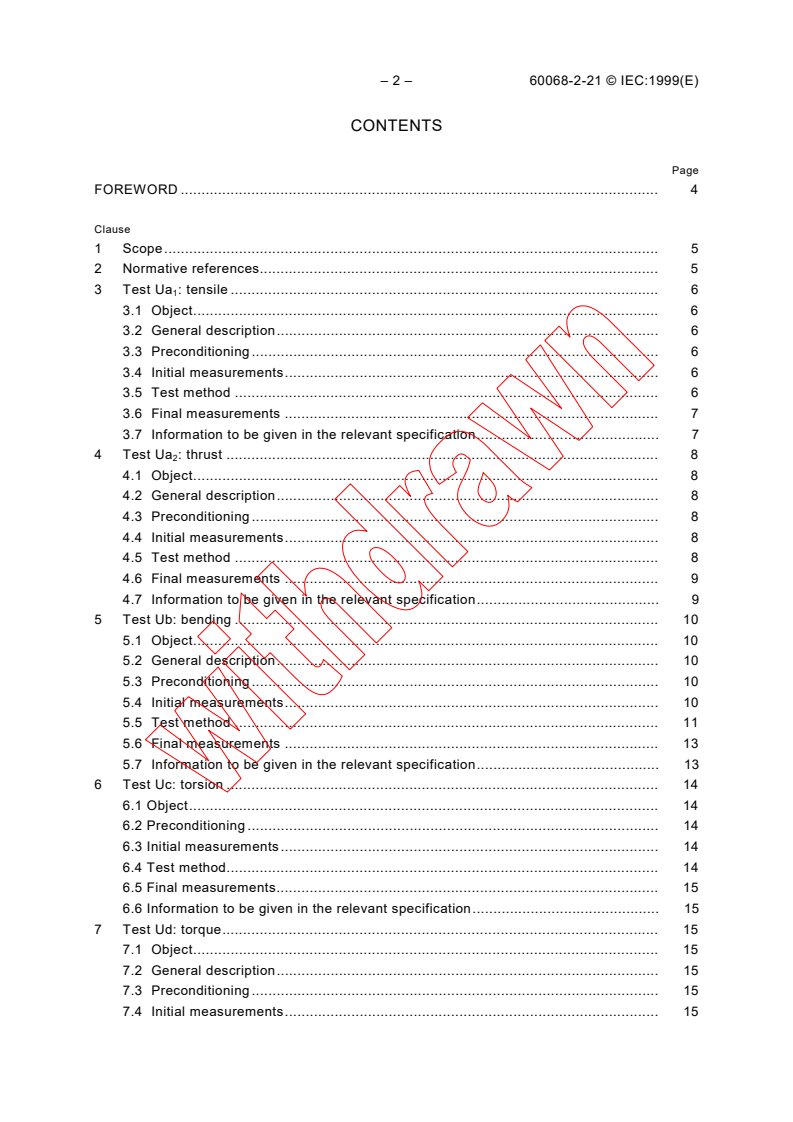
IEC 60068-2-21:1999 - Environmental testing - Part 2-21: Tests - Test U: Robustness of terminations and integral mounting devices Released:1/7/1999
IEC 60068-2-21:1999 - Environmental testing - Part 2-21: Tests - Test U: Robustness of terminations and integral mounting devices Released:1/7/1999
Overview
IEC 60068-2-21:1999 - Environmental testing - Part 2-21: Tests - Test U: Robustness of terminations and integral mounting devices - defines mechanical test methods to verify that electrical and electronic components’ terminations and mounting features withstand stresses encountered during normal assembly and handling. The standard applies to both leaded and surface-mounted devices (SMD) and covers tests performed on mounted and unmounted components.
Key topics and requirements
- Scope: Applicable to all components whose terminations or integral mounting devices may be stressed during assembly or handling.
- Test family (Test U) includes:
- Ua - Tensile: axial pull on terminations; forces specified by conductor cross‑section (examples in the standard include 2.5 N, 5 N, 10 N, 20 N, 40 N for increasing wire sizes).
- Ua - Thrust: axial push applied near the body (for small, low‑mass specimens).
- Ub - Bending: flexural stresses on leaded terminations.
- Uc - Torsion: twisting stresses on leads.
- Ud - Torque: torque applied to threaded studs or screw terminations.
- Ue - SMD robustness (mounted state): bending, pull/push and shear tests for surface-mounted components on printed circuit boards.
- Test procedure structure:
- Preconditioning: as defined in the relevant specification (may include soldering, climatic sequences, etc.).
- Initial measurements: visual, electrical and mechanical checks before testing.
- Test method: defined loading direction, magnitude and duration (e.g., progressive application and maintained load for 10 s ±1 s in many tests).
- Final measurements: repeat of visual, electrical and mechanical checks after testing.
- Specification inputs: the standard requires the relevant product specification to state test parameters such as number of terminations to be tested, force/torque values for non‑standard terminations, and details of any stripping/joining operations.
Applications
- Qualification and acceptance testing of discrete components, connectors and SMD parts subject to assembly stresses.
- Reliability assurance for automated pick-and-place and soldering processes.
- Supplier and incoming inspection criteria for components used on PCBs and in electromechanical assemblies.
- Design validation for termination and mounting robustness during product development.
Who should use this standard
- Component manufacturers and PCB assemblers
- Design and test engineers (electronics/mechanical)
- Quality and reliability engineers
- Test laboratories and compliance officers
- Purchasing/specification authors who must define robust acceptance criteria
Related standards
- IEC 60068-1 (general guidance)
- IEC 60068-2-20 (soldering)
- IEC 60068-2-61 (climatic sequence)
- IEC 61191-2 (SMD soldered assemblies)
- Base material standards cited for PCB laminates
Keywords: IEC 60068-2-21, robustness of terminations, environmental testing, SMD robustness, tensile test Ua, bending Ub, torsion Uc, torque Ud, component qualification.
Relations
- Effective Date
- 05-Sep-2023
Buy Documents
IEC 60068-2-21:1999 - Environmental testing - Part 2-21: Tests - Test U: Robustness of terminations and integral mounting devices Released:1/7/1999
IEC 60068-2-21:1999 - Environmental testing - Part 2-21: Tests - Test U: Robustness of terminations and integral mounting devices Released:1/7/1999
Get Certified
Connect with accredited certification bodies for this standard

IMP NDT d.o.o.
Non-destructive testing services. Radiography, ultrasonic, magnetic particle, penetrant, visual inspection.
Inštitut za kovinske materiale in tehnologije
Institute of Metals and Technology. Materials testing, metallurgical analysis, NDT.
Q Techna d.o.o.
NDT and quality assurance specialist. 30+ years experience. NDT personnel certification per ISO 9712, nuclear and thermal power plant inspections, QA/
Sponsored listings
Frequently Asked Questions
IEC 60068-2-21:1999 is a standard published by the International Electrotechnical Commission (IEC). Its full title is "Environmental testing - Part 2-21: Tests - Test U: Robustness of terminations and integral mounting devices". This standard covers: Applicable to all electrical and electronic components whose terminations or integral mounting devices are liable to be submitted to stresses during normal assembly or handling operations.
Applicable to all electrical and electronic components whose terminations or integral mounting devices are liable to be submitted to stresses during normal assembly or handling operations.
IEC 60068-2-21:1999 is classified under the following ICS (International Classification for Standards) categories: 19.040 - Environmental testing; 31.190 - Electronic component assemblies. The ICS classification helps identify the subject area and facilitates finding related standards.
IEC 60068-2-21:1999 has the following relationships with other standards: It is inter standard links to IEC 60068-2-21:2006. Understanding these relationships helps ensure you are using the most current and applicable version of the standard.
IEC 60068-2-21:1999 is available in PDF format for immediate download after purchase. The document can be added to your cart and obtained through the secure checkout process. Digital delivery ensures instant access to the complete standard document.
Standards Content (Sample)
INTERNATIONAL
IEC
STANDARD
60068-2-21
Fifth edition
1999-01
Environmental testing –
Part 2-21:
Tests – Test U: Robustness of terminations
and integral mounting devices
Essais d'environnement –
Partie 2-21:
Essais – Essai U: Robustesse des sorties
et des dispositifs de fixation
Reference number
Numbering
As from 1 January 1997 all IEC publications are issued with a designation in the
60000 series.
Consolidated publications
Consolidated versions of some IEC publications including amendments are
available. For example, edition numbers 1.0, 1.1 and 1.2 refer, respectively, to the
base publication, the base publication incorporating amendment 1 and the base
publication incorporating amendments 1 and 2.
Validity of this publication
The technical content of IEC publications is kept under constant review by the IEC,
thus ensuring that the content reflects current technology.
Information relating to the date of the reconfirmation of the publication is available
in the IEC catalogue.
Information on the subjects under consideration and work in progress undertaken by
the technical committee which has prepared this publication, as well as the list of
publications issued, is to be found at the following IEC sources:
• IEC web site*
• Catalogue of IEC publications
Published yearly with regular updates
(On-line catalogue)*
• IEC Bulletin
Available both at the IEC web site* and as a printed periodical
Terminology, graphical and letter symbols
For general terminology, readers are referred to IEC 60050: International
Electrotechnical Vocabulary (IEV).
For graphical symbols, and letter symbols and signs approved by the IEC for
general use, readers are referred to publications IEC 60027: Letter symbols to be
used in electrical technology, IEC 60417: Graphical symbols for use on equipment.
Index, survey and compilation of the single sheets and IEC 60617: Graphical symbols
for diagrams.
* See web site address on title page.
INTERNATIONAL
IEC
STANDARD
60068-2-21
Fifth edition
1999-01
Environmental testing –
Part 2-21:
Tests – Test U: Robustness of terminations
and integral mounting devices
Essais d'environnement –
Partie 2-21:
Essais – Essai U: Robustesse des sorties
et des dispositifs de fixation
IEC 1999 Copyright - all rights reserved
No part of this publication may be reproduced or utilized in any form or by any means, electronic or
mechanical, including photocopying and microfilm, without permission in writing from the publisher.
International Electrotechnical Commission 3, rue de Varembé Geneva, Switzerland
Telefax: +41 22 919 0300 e-mail: inmail@iec.ch IEC web site http://www.iec.ch
Commission Electrotechnique Internationale
PRICE CODE
U
International Electrotechnical Commission
For price, see current catalogue
– 2 – 60068-2-21 © IEC:1999(E)
CONTENTS
Page
FOREWORD . 4
Clause
1 Scope. 5
2 Normative references. 5
3 Test Ua : tensile . 6
3.1 Object. 6
3.2 General description. 6
3.3 Preconditioning. 6
3.4 Initial measurements. 6
3.5 Test method . 6
3.6 Final measurements . 7
3.7 Information to be given in the relevant specification. 7
4 Test Ua : thrust . 8
4.1 Object. 8
4.2 General description. 8
4.3 Preconditioning. 8
4.4 Initial measurements. 8
4.5 Test method . 8
4.6 Final measurements . 9
4.7 Information to be given in the relevant specification. 9
5 Test Ub: bending . 10
5.1 Object. 10
5.2 General description. 10
5.3 Preconditioning. 10
5.4 Initial measurements. 10
5.5 Test method . 11
5.6 Final measurements . 13
5.7 Information to be given in the relevant specification. 13
6 Test Uc: torsion . 14
6.1 Object. 14
6.2 Preconditioning . 14
6.3 Initial measurements. 14
6.4 Test method. 14
6.5 Final measurements. 15
6.6 Information to be given in the relevant specification. 15
7 Test Ud: torque. 15
7.1 Object. 15
7.2 General description. 15
7.3 Preconditioning. 15
7.4 Initial measurements. 15
60068-2-21 © IEC:1999(E) – 3 –
Clause Page
7.5 Test method . 15
7.6 Final measurements . 16
7.7 Information to be given in the relevant specification. 16
8 Test Ue: robustness of terminations for SMD in the mounted state . 17
8.1 Object. 17
8.2 General description. 17
8.3 Mounting. 18
8.4 Initial measurements. 19
8.5 Test methods. 19
8.6 Final measurements . 21
8.7 Information to be given in the relevant specification. 22
– 4 – 60068-2-21 © IEC:1999(E)
INTERNATIONAL ELECTROTECHNICAL COMMISSION
___________
ENVIRONMENTAL TESTING –
Part 2-21: Tests –
Test U: Robustness of terminations and integral mounting devices
FOREWORD
1) The IEC (International Electrotechnical Commission) is a worldwide organization for standardization comprising
all national electrotechnical committees (IEC National Committees). The object of the IEC is to promote
international co-operation on all questions concerning standardization in the electrical and electronic fields. To
this end and in addition to other activities, the IEC publishes International Standards. Their preparation is
entrusted to technical committees; any IEC National Committee interested in the subject dealt with may
participate in this preparatory work. International, governmental and non-governmental organizations liaising
with the IEC also participate in this preparation. The IEC collaborates closely with the International Organization
for Standardization (ISO) in accordance with conditions determined by agreement between the two
organizations.
2) The formal decisions or agreements of the IEC on technical matters express, as nearly as possible, an
international consensus of opinion on the relevant subjects since each technical committee has representation
from all interested National Committees.
3) The documents produced have the form of recommendations for international use and are published in the form
of standards, technical reports or guides and they are accepted by the National Committees in that sense.
4) In order to promote international unification, IEC National Committees undertake to apply IEC International
Standards transparently to the maximum extent possible in their national and regional standards. Any
divergence between the IEC Standard and the corresponding national or regional standard shall be clearly
indicated in the latter.
5) The IEC provides no marking procedure to indicate its approval and cannot be rendered responsible for any
equipment declared to be in conformity with one of its standards.
6) Attention is drawn to the possibility that some of the elements of this International Standard may be the subject
of patent rights. The IEC shall not be held responsible for identifying any or all such patent rights.
International Standard IEC 60068-2-21 has been prepared by IEC technical committee 50:
Environmental testing, and is published by IEC technical committee 91: Surface mounting
technology.
This fifth edition cancels and replaces the fourth edition, published in 1983, and its
Amendments 1, 2 and 3 published in 1985, 1991 and 1992, respectively, and constitutes a
technical revision.
The text of this edition is based on the following documents.
FDIS Report on voting
91/156/FDIS 91/163/RVD
Full information on the voting for the approval of this standard can be found in the report on
voting indicated in the above table.
60068-2-21 © IEC:1999(E) – 5 –
ENVIRONMENTAL TESTING –
Part 2-21: Tests –
Test U: Robustness of terminations and integral mounting devices
1 Scope
This part of IEC 60068 is applicable to all electrical and electronic components whose
terminations or integral mounting devices are liable to be submitted to stresses during normal
assembly or handling operations.
Table 1 provides details of the applicable tests.
Table 1 – Application
Test Type Component Mounted/
not mounted
Ua Tensile Leaded devices Not mounted
Ua Thrust Leaded devices Not mounted
Ub Bending Leaded devices Not mounted
Uc Torsion Leaded devices Not mounted
Ud Torque Threaded stud or screw termination Not mounted
Ue Bending Surface mounted devices Mounted
Ue Pull/push Surface mounted devices Mounted
Ue Shear Surface mounted devices Mounted
2 Normative references
The following normative documents contain provisions which, through reference in this text,
constitute provisions of this part of IEC 60068. At the time of publication, the editions indicated
were valid. All normative documents are subject to revision, and parties to agreements based
on this part of IEC 60068 are encouraged to investigate the possibility of applying the most
recent editions of the normative documents indicated below. Members of IEC and ISO maintain
registers of currently valid International Standards.
IEC 60068-1:1988, Environmental testing – Part 1: General and guidance
IEC 60068-2-20:1979, Environmental testing – Part 2: Tests – Test T: Soldering
IEC 60068-2-61:1991, Environmental testing – Part 2: Tests – Test Z/ABDM: Climatic sequence
IEC 60249-2-4:1987, Base materials for printed circuits – Part 2 : Specifications – Specification
No. 4: Epoxy woven glass fibre copper-clad laminated sheet, general purpose grade
IEC 61191-2: — Printed board assemblies – Part 2: Sectional specification – Surface mount
1)
soldered assemblies
___________
1)
To be published.
– 6 – 60068-2-21 © IEC:1999(E)
ISO 31-3:1992, Quantities and units – Part 3: Mechanics
ISO 272:1982, Fasteners – Hexagon products – Widths across flats
ISO 9453:1990, Soft solder alloys – Chemical compositions and forms
3 Test Ua : tensile
This test is applicable to all types of terminations.
3.1 Object
The purpose of this test is to verify that the terminations and attachment of the terminations to
the body of the component will withstand such axial stresses as are likely to be applied during
normal assembly or handling operations.
3.2 General description
With the termination in its normal position and the component held by its body, a force is
applied to the termination in the direction of its axis and acting in a direction away from the
body of the component. The force shall be applied progressively (without any shock) and then
maintained for a period of 10 s ± 1 s.
3.3 Preconditioning
The method of preconditioning shall be as prescribed in the relevant specification.
3.4 Initial measurements
The specimen shall be visually inspected and electrically and mechanically checked, as
required by the relevant specification.
3.5 Test method
Refer to figure 2a.
3.5.1 Application
This test applies to all types of terminations. It shall be carried out on all the terminations,
except where a component has more than three terminations, in which case the specification
shall state the number of terminations per component to be tested. The test shall be carried out
in such a manner that all the terminations of the component have an equal probability of being
subjected to test.
3.5.2 Procedure
With the termination in its normal position and the component held by its body, a force with a
value as stated in table 2 shall be applied to the termination in the direction of its axis and
acting in a direction away from the body of the component. The force shall be applied
progressively (without any shock) and then maintained for a period of 10 s ± 1 s.
The value of the applied force is as follows:
a) Wire terminations (circular section or strip) or pins
The value of the force applied shall be that indicated in table 2.
NOTE – For components with oversized wire terminations, the appropriate force should be given in the relevant
specification.
60068-2-21 © IEC:1999(E) – 7 –
Insulated wires shall be stripped of the insulation at the point at which the load is applied
Stranded wires shall be united mechanically at the point of application of the load (such as
by soldering or knotting), prior to the application of the load. Where the technical features
of insulated or stranded wires may give rise to difficulties during the stripping, joining or
knotting operations and be liable to cause dispute for the test results, such operations shall
be in accordance with the relevant specification or, where necessary, with the instructions
of the component manufacturer.
Table 2 – Value of applied force for test Ua
Nominal cross-sectional area (S)* Corresponding diameter (d) for Force with tolerance of ±10 %
circular-section wires
N
mm mm
S ≤ 0,05 d ≤ 0,25
2,5
0,05 < S ≤ 0,10 0,25 < d ≤ 0,35
0,10 < S ≤ 0,20 0,35 < d ≤ 0,50
0,20 < S ≤ 0,50 0,50 < d ≤ 0,80
0,50 < S ≤ 1,20 0,80 < d ≤ 1,25
S > 1,20 d > 1,25 40
* For circular-section wires, strips or pins, the nominal cross-sectional area is equal to the value calculated from
the nominal dimension(s) given in the relevant specification. For stranded wires, the nominal cross-sectional
area is obtained by taking the sum of the cross-sectional areas of the individual strands of the conductor
specified in the relevant specification.
b) Other terminations (tag terminations, threaded studs, screws, terminals, etc.)
The value of the force to be applied shall be given in the relevant specification.
3.6 Final measurements
The specimen shall be visually inspected and electrically and mechanically checked, as
required by the relevant specification.
3.7 Information to be given in the relevant specification
Subclause
a) Method of preconditioning 3.3
b) Initial measurements 3.4
c) Number of terminations to be tested, if more than three 3.5.1
d) Force (for oversized and other terminations) 3.5.2
e) Details of stripping, joining or knotting operations, if necessary 3.5.2
f) Final measurements 3.6
– 8 – 60068-2-21 © IEC:1999(E)
4 Test Ua : thrust
4.1 Object
The purpose of this test is to verify that the terminations and attachment of the terminations to
the body of the component will withstand such thrusts as are likely to be applied during normal
assembly or handling operations. This test applies only to specimens of small dimensions and
of low mass, to the exclusion of equipment and assemblies.
NOTE – This test does not apply to flexible terminations.
4.2 General description
With the termination in its normal position and the component held by its body, thrust is applied
to the termination as close as possible to the body of the component, but leaving a clear 2 mm
of wire between the body of the component and the nearest point of the device applying the
force. The force shall be applied progressively (without any shock) and then maintained for a
period of 10 s ± 1 s.
4.3 Preconditioning
The method of preconditioning shall be as prescribed in the relevant specification.
4.4 Initial measurements
The specimen shall be visually inspected and electrically and mechanically checked, as
required by the relevant specification.
4.5 Test method
Refer to figure 2b.
4.5.1 Application
The relevant specification shall state whether this test is applicable. When applicable, it shall
be carried out on all the terminations, except where a component has more than three
terminations, in which case the specification shall state the number of terminations per
component to be tested. The test shall be carried out in such a manner that all the terminations
of the component have an equal probability of being subjected to test. The relevant
specification shall define the direction of applied force.
4.5.2 Procedure
With the termination in its normal position and the component held by its body, thrust shall be
applied to the termination as close as possible to the body of the component, but leaving a
clear 2 mm of wire between the body of the component and the nearest point of the device
applying the force. The force shall be applied progressively (without any shock) and then
maintained for a period of 10 s ± 1 s.
The value of the applied force is as follows:
a) Wire terminations (circular-section or strip) or pins
The value of the force applied shall be as given in table 3.
60068-2-21 © IEC:1999(E) – 9 –
Table 3 – Value of applied force for test Ua
Nominal cross-sectional area (S)* Corresponding diameter (d) for Force with tolerance of ±10 %
circular-section wire
N
mm mm
0,25
S ≤ 0,05 d ≤ 0,25
0,5
0,05 < S ≤ 0,10 0,25 < d ≤ 0,35
0,10 < S ≤ 0,20 0,35 < d ≤ 0,50
0,20 < S ≤ 0,50 0,50 < d ≤ 0,80
0,50 < S ≤ 1,20 0,80 < d ≤ 1,25
S > 1,20 d > 1,25 8
* For circular-section wires, strips or pins, the nominal cross-sectional area is equal to the value calculated from
the nominal dimension(s) given in the relevant specification.
Insulated wires shall be stripped of the insulation at the point at which the load is applied.
Where the technical features of insulated wires may give rise to difficulties during the
stripping, and be liable to cause dispute for the test results, such operations shall be in
accordance with the relevant specification or, where necessary, with the instructions of the
component manufacturer.
b) Other terminations (tag terminations, threaded studs, screws, terminals, etc.)
The value of the force to be applied shall be given in the relevant specification.
4.6 Final measurements
The specimen shall be visually inspected and electrically and mechanically checked, as
required by the relevant specification.
4.7 Information to be given in the relevant specification
Subclause
a) Method of preconditioning 4.3
b) Initial measurements 4.4
c) Indication as to whether the test is applicable 4.5.1
d) Number of terminations to be tested, if more than three 4.5.1
e) Direction of applied force 4.5.1
f) Details of stripping, if necessary 4.5.2
g) Force, for other than wire terminations or pins 4.5.2
h) Final measurements 4.6
– 10 – 60068-2-21 © IEC:1999(E)
5 Test Ub: bending
This test is applicable to pliable terminations only.
5.1 Object
The purpose of this test is to verify that pliable terminations and attachment of such
terminations to the body of the component shall withstand such bending loads as are likely to
be applied during normal assembly or handling operations. In order for the terminations to be
considered pliable, the following conditions shall apply :
a) Test prescribed in 5.5.2.1 and 5.5.2.3
The termination shall assume, during the course of the test, a displacement of at least 30°
with respect to its initial position (see figure 3c).
b) Test prescribed in 5.5.2.2:
The termination shall be capable of being bent with the fingers.
5.2 General description
a) Bending (wire or strip terminations)
With the termination in its normal position and the component held by its body in such a
manner that the axis of the termination is vertical, a mass is suspended from the end of
termination. The body of the component is then inclined through an angle of approximately
90° in the vertical plane and then returned to its original position; this operation constitutes
one bend.
Method 1: two or more bends in opposite directions.
Method 2: two or more bends in the same direction.
b) Bending (tag terminations)
Tag terminations, capable of being bent with the fingers, shall be bent through 45° and then
returned to their initial position; this operation constitutes one bend.
Method 1: two bends in opposite directions.
Method 2: two bends in the same direction.
c) Simultaneous bending
All the terminations on one side of the component shall be held in a clamp at a point 3 mm
from the seal between the termination and the body of the component. A mass shall be
attached to the clamp with the terminations pointing downwards. The body of the
component is then inclined through an angle of 45° and returned to its original position.
This test shall be performed in two opposite directions.
5.3 Preconditioning
The method of preconditioning shall be as prescribed in the relevant specification.
5.4 Initial measurements
The specimen shall be visually inspected and electrically and mechanically checked, as
required by the relevant specification.
60068-2-21 © IEC:1999(E) – 11 –
5.5 Test method
5.5.1 Application
The relevant specification shall state whether this test is applicable. When applicable, the test
shall be carried out on all the terminations, except where a component has more than three
terminations, in which case the specification shall state the number of terminations per
component to be tested. The test shall be carried out in such a manner that all the terminations
of the component have an equal probability of being subjected to test. This limitation in the
number of terminations tested does not apply to simultaneous bending (5.5.2.3), which is
generally applicable to certain types of microelectronic packages with several terminations in
line on one or more sides.
5.5.2 Procedure
Refer to figure 3.
5.5.2.1 Bending (wire or strip terminations)
With the termination in its normal position and the component held by its body in such a
manner that the axis of the termination is vertical, a mass applying a force of a value given in
table 3 is then suspended from the end of the termination. The body of the component is then
inclined, over a period of 2 s to 3 s, through an angle of approximately 90° in the vertical plane
and then returned to its original position over the same period of time; this operation
constitutes one bend. The test shall be performed according to the relevant specification,
stipulating one or other of the following procedures.
a) Method 1 (see figure 3a)
One bend immediately followed by a second bend in the opposite direction, or a larger
number of alternate bends where prescribed in the relevant specification.
b) Method 2 (see figure 3b)
Two bends in the same direction without interruption, or a larger number of alternate bends
where prescribed in the relevant specification. No device capable of imposing a radius of
curvature shall be placed between the body of the component and the point of application of
the force. Strip terminations shall be bent perpendicularly to the widest surface of the strip.
The value of the force to be applied is given in table 4.
Table 4 – Value of applied force for test Ub
Section modulus (Z ) Diameter(d) of corresponding Force with tolerance
x
round leads of ±10 %
mm mm N
–3
0,5
Zx ≤ 1,5 x 10 d ≤ 0,25
–3 –3
1,25
1,5 x 10 < Z ≤ 4,2 x 10 0,25 < d ≤ 0,35
x
–3 –2
2,5
4,2 x 10 < Z ≤ 1,2 x 10 0,35 < d ≤ 0,50
x
–2 –1
1,2 x 10 < Z ≤ 0,5 x 10 0,50 < d ≤ 0,80
x
–1 –1
0,5 x 10 < Z ≤1,9 x 10 0,80 < d ≤ 1,25
x
–1
1,9x10 < Z 1,25 < d 20
x
– 12 – 60068-2-21 © IEC:1999(E)
NOTE 1 – For round terminations, the section modulus is given by the following formula:
πd
Z =
x
where d is the lead diameter.
For strip terminations, the section modulus is given by the following formula:
ba
Z =
x
where
a is the thickness of the rectangular strip perpendicular to the bending axis
b is the other dimension of the rectangular strip
Z is the section modulus
x
NOTE 2 – The section modulus is defined in ISO 31-3, item 3-21, and the derivation of the above formula can be
found in standard textbooks on mechanical engineering.
5.5.2.2 Bending (tag terminations)
Tag terminations, capable of being bent with the fingers, shall be bent through 45° and then
returned to their initial position; this operation shall constitute one bend (see figure 3). The test
shall be performed according to the relevant specification, stipulating one or other of the
following procedures:
a) Method 1
One bend immediately followed by a second bend in the opposite direction.
b) Method 2
Two bends in the same direction, without interruption. The relevant specification may
stipulate other details (such as use of pliers, place of bending, etc.)
5.5.2.3 Simultaneous bending
All terminations on one side of the component shall be clamped at the seating plane or, where
it is not given, at a point approximately 3 mm from the seal between the termination and the
body of the component, in a clamp with a radius of 0,1 mm at the edge where bending will
occur. A mass shall be attached to the clamp with the terminations pointing downwards. This
mass, which shall include the mass of the clamp, shall apply a force equal to that given in
table 4, multiplied by the number of leads clamped.
The body of the component is then inclined through an angle of 45°, taking 2 s to 3 s for the
operation, and returned to its initial position over the same period of time. The test shall be
performed once in one direction, and returned to the normal position, and once in the opposite
...
NORME CEI
INTERNATIONALE IEC
60068-2-21
INTERNATIONAL
Cinquième édition
STANDARD
Fifth edition
1999-01
Essais d’environnement –
Partie 2-21:
Essais – Essai U: Robustesse des sorties
et des dispositifs de montage incorporés
Environmental testing –
Part 2-21:
Tests – Test U: Robustness of terminations
and integral mounting devices
Numéro de référence
Reference number
CEI/IEC 60068-2-21:2001
Numérotation des publications Publication numbering
Depuis le 1er janvier 1997, les publications de la CEI As from 1 January 1997 all IEC publications are
sont numérotées à partir de 60000. Ainsi, la CEI 34-1 issued with a designation in the 60000 series. For
devient la CEI 60034-1. example, IEC 34-1 is now referred to as IEC 60034-1.
Editions consolidées Consolidated editions
Les versions consolidées de certaines publications de la The IEC is now publishing consolidated versions of its
CEI incorporant les amendements sont disponibles. Par publications. For example, edition numbers 1.0, 1.1
exemple, les numéros d’édition 1.0, 1.1 et 1.2 indiquent and 1.2 refer, respectively, to the base publication,
respectivement la publication de base, la publication de the base publication incorporating amendment 1 and
base incorporant l’amendement 1, et la publication de the base publication incorporating amendments 1
base incorporant les amendements 1 et 2. and 2.
Informations supplémentaires Further information on IEC publications
sur les publications de la CEI
Le contenu technique des publications de la CEI est The technical content of IEC publications is kept
constamment revu par la CEI afin qu'il reflète l'état under constant review by the IEC, thus ensuring that
actuel de la technique. Des renseignements relatifs à the content reflects current technology. Information
cette publication, y compris sa validité, sont dispo- relating to this publication, including its validity, is
nibles dans le Catalogue des publications de la CEI available in the IEC Catalogue of publications
(voir ci-dessous) en plus des nouvelles éditions, (see below) in addition to new editions, amendments
amendements et corrigenda. Des informations sur les and corrigenda. Information on the subjects under
sujets à l’étude et l’avancement des travaux entrepris consideration and work in progress undertaken by the
par le comité d’études qui a élaboré cette publication, technical committee which has prepared this
ainsi que la liste des publications parues, sont publication, as well as the list of publications issued,
également disponibles par l’intermédiaire de: is also available from the following:
• Site web de la CEI (www.iec.ch) • IEC Web Site (www.iec.ch)
• Catalogue des publications de la CEI • Catalogue of IEC publications
Le catalogue en ligne sur le site web de la CEI The on-line catalogue on the IEC web site
(www.iec.ch/catlg-f.htm) vous permet de faire des (www.iec.ch/catlg-e.htm) enables you to search
recherches en utilisant de nombreux critères, by a variety of criteria including text searches,
comprenant des recherches textuelles, par comité technical committees and date of publication. On-
d’études ou date de publication. Des informations line information is also available on recently
en ligne sont également disponibles sur les issued publications, withdrawn and replaced
nouvelles publications, les publications rempla- publications, as well as corrigenda.
cées ou retirées, ainsi que sur les corrigenda.
• IEC Just Published
• IEC Just Published
Ce résumé des dernières publications parues
This summary of recently issued publications
(www.iec.ch/JP.htm) est aussi disponible par
(www.iec.ch/JP.htm) is also available by email.
courrier électronique. Veuillez prendre contact
Please contact the Customer Service Centre (see
avec le Service client (voir ci-dessous) pour plus
below) for further information.
d’informations.
• Service clients
• Customer Service Centre
Si vous avez des questions au sujet de cette
If you have any questions regarding this
publication ou avez besoin de renseignements
publication or need further assistance, please
supplémentaires, prenez contact avec le Service
contact the Customer Service Centre:
clients:
Email: custserv@iec.ch
Email: custserv@iec.ch
Tél: +41 22 919 02 11
Tel: +41 22 919 02 11
Fax: +41 22 919 03 00
Fax: +41 22 919 03 00
.
NORME CEI
INTERNATIONALE IEC
60068-2-21
INTERNATIONAL
Cinquième édition
STANDARD
Fifth edition
1999-01
Essais d’environnement –
Partie 2-21:
Essais – Essai U: Robustesse des sorties
et des dispositifs de montage incorporés
Environmental testing –
Part 2-21:
Tests – Test U: Robustness of terminations
and integral mounting devices
IEC 2001 Droits de reproduction réservés Copyright - all rights reserved
Aucune partie de cette publication ne peut être reproduite ni No part of this publication may be reproduced or utilized in
utilisée sous quelque forme que ce soit et par aucun procédé, any form or by any means, electronic or mechanical,
électronique ou mécanique, y compris la photocopie et les including photocopying and microfilm, without permission in
microfilms, sans l'accord écrit de l'éditeur. writing from the publisher.
International Electrotechnical Commission 3, rue de Varembé Geneva, Switzerland
Telefax: +41 22 919 0300 e-mail: inmail@iec.ch IEC web site http://www.iec.ch
CODE PRIX
Commission Electrotechnique Internationale
U
PRICE CODE
International Electrotechnical Commission
Pour prix, voir catalogue en vigueur
For price, see current catalogue
– 2 – 60068-2-21 © CEI:1999
SOMMAIRE
AVANT-PROPOS . 6
1 Domaine d’application. 8
2 Références normatives . 8
3Essai Ua : traction . 10
3.1 Objet. 10
3.2 Description générale. 10
3.3 Préconditionnement . 10
3.4 Mesures initiales. 10
3.5 Méthode d’essai. 10
3.6 Mesures finales . 12
3.7 Renseignements à donner dans la spécification particulière . 12
4Essai Ua poussée . 12
2:
4.1 Objet. 12
4.2 Description générale. 12
4.3 Préconditionnement . 14
4.4 Mesures initiales. 14
4.5 Méthode d’essai. 14
4.6 Mesures finales . 16
4.7 Renseignements à donner dans la spécification particulière . 16
5 Essai Ub: pliage. 16
5.1 Objet. 16
5.2 Description générale. 16
5.3 Préconditionnement . 18
5.4 Mesures initiales. 18
5.5 Méthode d’essai. 18
5.6 Mesures finales . 22
5.7 Renseignements à donner dans la spécification particulière . 22
6 Essai Uc: torsion. 22
6.1 Objet. 22
6.2 Préconditionnement . 22
6.3 Mesures initiales. 24
6.4 Méthode d’essai. 24
6.5 Mesures finales . 24
6.6 Renseignements à donner dans la spécification particulière . 24
7 Essai Ud: couple. 26
7.1 Objet. 26
7.2 Description générale. 26
7.3 Préconditionnement . 26
7.4 Mesures initiales. 26
7.5 Méthode d’essai. 26
7.6 Mesures finales . 28
7.7 Renseignements à donner dans la spécification particulière . 28
60068-2-21 © IEC:1999 – 3 –
CONTENTS
FOREWORD . 7
1 Scope . 9
2 Normative references. 9
3Test Ua : tensile . 11
3.1 Object. 11
3.2 General description. 11
3.3 Preconditioning. 11
3.4 Initial measurements. 11
3.5 Test method. 11
3.6 Final measurements . 13
3.7 Information to be given in the relevant specification . 13
4Test Ua : thrust. 13
4.1 Object. 13
4.2 General description. 13
4.3 Preconditioning. 15
4.4 Initial measurements. 15
4.5 Test method. 15
4.6 Final measurements . 17
4.7 Information to be given in the relevant specification . 17
5 Test Ub: bending . 17
5.1 Object. 17
5.2 General description. 17
5.3 Preconditioning. 19
5.4 Initial measurements. 19
5.5 Test method. 19
5.6 Final measurements . 23
5.7 Information to be given in the relevant specification . 23
6 Test Uc: torsion . 23
6.1 Object. 23
6.2 Preconditioning. 23
6.3 Initial measurements. 25
6.4 Test method. 25
6.5 Final measurements . 25
6.6 Information to be given in the relevant specification . 25
7 Test Ud: torque . 27
7.1 Object. 27
7.2 General description. 27
7.3 Preconditioning. 27
7.4 Initial measurements. 27
7.5 Test method. 27
7.6 Final measurements . 29
7.7 Information to be given in the relevant specification . 29
– 4 – 60068-2-21 © CEI:1999
8 Essai Ue: robustesse des sorties pour CMS déjà montés. 28
8.1 Objet. 28
8.2 Description générale. 28
8.3 Montage . 30
8.4 Mesures initiales. 32
8.5 Méthodes d’essai. 34
8.6 Mesures finales . 38
8.7 Renseignements à donner dans la spécification particulière . 38
Figure 1 – Pince pour les essais sur sorties courtes . 22
Figure 2 – Schémas montrant la direction des forces à appliquer à l’aide de flèches
Essai Ua traction et essai Ua poussée. 40
1: 2:
Figure 3 – Schémas montrant l’exécution de l’essai Ub: pliage (voir 5.5.2.1 et 5.5.2.3) . 42
Figure 4 – Schémas d’exécution de l’essai Uc: essai de torsion pour sorties par fil . 44
Figure 5 – Exemple de substrat pour la méthode d’essai Ue (adapté aussi à l’essai électrique). 46
Figure 6 – Exemple de substrat pour les méthodes d’essai Ue et Ue
2 3
(adapté aussi à l’essai électrique) . 46
Figure 7 – Dispositif de pliage pour l’essai Ue . 48
Figure 8 – Exemple de substrat d’essai pour arrachement par poussée. 48
Figure 9 – Force essai Ue – Arrachement par traction. 50
Figure 10 – Exemple d’outil de poussée pour l’essai Ue – Arrachement par poussée. 50
Figure 11 – Exemple d’essai de cisaillement (adhérence) – Ue . 50
Tableau 1 – Application. 8
Tableau 2 – Valeur de la force appliquée pour l’essai Ua . 12
Tableau 3 – Valeur de la force appliquée pour l’essai Ua . 14
Tableau 4 – Valeur de la force appliquée pour l’essai Ub . 20
Tableau 5 – Sévérité du couple . 26
60068-2-21 © IEC:1999 – 5 –
8 Test Ue: robustness of terminations for SMD in the mounted state. 29
8.1 Object. 29
8.2 General description. 29
8.3 Mounting. 31
8.4 Initial measurements. 33
8.5 Test methods. 35
8.6 Final measurements . 39
8.7 Information to be given in the relevant specification . 39
Figure 1 – Clamp for the testing of short terminations. 23
Figure 2 – Sketches showing direction by arrow heads of application of forces
Test Ua : tensile and test Ua : thrust. 41
1 2
Figure 3 – Sketches showing test procedure for test Ub: bending (see 5.5.2.1 and 5.5.2.3). 43
Figure 4 – Diagrams showing test procedure for test Uc: torsion test for wire terminations . 45
Figure 5 – Example of substrate for test method Ue (also suitable for electrical test). 47
Figure 6 – Example of substrate for test methods Ue and Ue
2 3
(also suitable for electrical test). 47
Figure 7 – Bending jig for test Ue . 49
Figure 8 – Example of a push-off test substrate. 49
Figure 9 – Force test Ue – pull-off. 51
Figure 10 – Example of a force application pushing tool for test Ue – push-off . 51
Figure 11 – Example of the shear (adhesion) test – Ue . 51
Table 1 – Application. 9
Table 2 – Value of applied force for test Ua . 13
Table 3 – Value of applied force for test Ua . 15
Table 4 – Value of applied force for test Ub. 21
Table 5 – Torque severity. 27
– 6 – 60068-2-21 © CEI:1999
COMMISSION ÉLECTROTECHNIQUE INTERNATIONALE
____________
ESSAIS D’ENVIRONNEMENT –
Partie 2-21: Essais – Essai U: Robustesse des sorties
et des dispositifs de montage incorporés
AVANT-PROPOS
1) La CEI (Commission Électrotechnique Internationale) est une organisation mondiale de normalisation
composée de l'ensemble des comités électrotechniques nationaux (Comités nationaux de la CEI). La CEI a
pour objet de favoriser la coopération internationale pour toutes les questions de normalisation dans les
domaines de l'électricité et de l'électronique. A cet effet, la CEI, entre autres activités, publie des Normes
internationales. Leur élaboration est confiée à des comités d'études, aux travaux desquels tout Comité national
intéressé par le sujet traité peut participer. Les organisations internationales, gouvernementales et non
gouvernementales, en liaison avec la CEI, participent également aux travaux. La CEI collabore étroitement
avec l'Organisation Internationale de Normalisation (ISO), selon des conditions fixées par accord entre les
deux organisations.
2) Les décisions ou accords officiels de la CEI concernant les questions techniques représentent, dans la mesure
du possible, un accord international sur les sujets étudiés, étant donné que les Comités nationaux intéressés
sont représentés dans chaque comité d’études.
3) Les documents produits se présentent sous la forme de recommandations internationales. Ils sont publiés
comme normes, spécifications techniques, rapports techniques ou guides et agréés comme tels par les
Comités nationaux.
4) Dans le but d'encourager l'unification internationale, les Comités nationaux de la CEI s'engagent à appliquer de
façon transparente, dans toute la mesure possible, les Normes internationales de la CEI dans leurs normes
nationales et régionales. Toute divergence entre la norme de la CEI et la norme nationale ou régionale
correspondante doit être indiquée en termes clairs dans cette dernière.
5) La CEI n’a fixé aucune procédure concernant le marquage comme indication d’approbation et sa responsabilité
n’est pas engagée quand un matériel est déclaré conforme à l’une de ses normes.
6) L’attention est attirée sur le fait que certains des éléments de la présente Norme internationale peuvent faire
l’objet de droits de propriété intellectuelle ou de droits analogues. La CEI ne saurait être tenue pour
responsable de ne pas avoir identifié de tels droits de propriété et de ne pas avoir signalé leur existence
La Norme internationale CEI 60068-2-21 a été établie par le comité d’études 104 de la CEI:
Conditions, classification et essais d'environnement et est publiée par le comité d'études 91
de la CEI: Techniques d'assemblage des composants électroniques.
La cinquième édition annule et remplace la quatrième édition, publiée en 1983, et ses amen-
dements 1, 2 et 3 publiés respectivement en 1985, 1991 et 1992 et constitue une révision
technique.
Cette version bilingue (2001-06) remplace la version monolingue anglaise.
Le texte anglais de cette norme est basé sur les documents 91/156/FDIS et 91/163/RVD.
Le rapport de vote 91/163/RVD donne toute information sur le vote ayant abouti à
l'approbation de cette norme.
La version française de cette norme n'a pas été soumise au vote.
Cette publication a été rédigée selon les Directives ISO/CEI, Partie 3.
Le comité a décidé que le contenu de cette publication ne sera pas modifié avant 2004.
A cette date, la publication sera
reconduite;
supprimée;
remplacée par une édition révisée, ou
amendée.
60068-2-21 © IEC:1999 – 7 –
INTERNATIONAL ELECTROTECHNICAL COMMISSION
____________
ENVIRONMENTAL TESTING –
Part 2-21: Tests – Test U: Robustness of terminations
and integral mounting devices
FOREWORD
1) The IEC (International Electrotechnical Commission) is a worldwide organization for standardization comprising
all national electrotechnical committees (IEC National Committees). The object of the IEC is to promote
international co-operation on all questions concerning standardization in the electrical and electronic fields. To
this end and in addition to other activities, the IEC publishes International Standards. Their preparation is
entrusted to technical committees; any IEC National Committee interested in the subject dealt with may
participate in this preparatory work. International, governmental and non-governmental organizations liaising
with the IEC also participate in this preparation. The IEC collaborates closely with the International
Organization for Standardization (ISO) in accordance with conditions determined by agreement between the
two organizations.
2) The formal decisions or agreements of the IEC on technical matters express, as nearly as possible, an
international consensus of opinion on the relevant subjects since each technical committee has representation
from all interested National Committees.
3) The documents produced have the form of recommendations for international use and are published in the form
of standards, technical specifications, technical reports or guides and they are accepted by the National
Committees in that sense.
4) In order to promote international unification, IEC National Committees undertake to apply IEC International
Standards transparently to the maximum extent possible in their national and regional standards. Any
divergence between the IEC Standard and the corresponding national or regional standard shall be clearly
indicated in the latter.
5) The IEC provides no marking procedure to indicate its approval and cannot be rendered responsible for any
equipment declared to be in conformity with one of its standards.
6) Attention is drawn to the possibility that some of the elements of this International Standard may be the subject
of patent rights. The IEC shall not be held responsible for identifying any or all such patent rights.
International Standard IEC 60068-2-21 has been prepared by IEC technical committee 104:
Environmental conditions, classification and methods of test, and is published by IEC
technical committee 91: Electronics assembly technology.
This fifth edition cancels and replaces the fourth edition, published in 1983, and its amend-
ments 1, 2 and 3 published in 1985, 1991 and 1992, respectively, and constitutes a technical
revision.
This bilingual version (2001-06) replaces the English version.
The text of this standard is based on the following documents:
FDIS Report on voting
91/156/FDIS 91/163/RVD
Full information on the voting for the approval of this standard can be found in the report on
voting indicated in the above table.
This publication has been drafted in accordance with the ISO/IEC Directives, Part 3.
The committee has decided that the contents of this publication will remain unchanged
until 2004. At this date, the publication will be
reconfirmed;
withdrawn;
replaced by a revised edition, or
amended.
– 8 – 60068-2-21 © CEI:1999
ESSAIS D’ENVIRONNEMENT –
Partie 2-21: Essais – Essai U: Robustesse des sorties
et des dispositifs de montage incorporés
1 Domaine d’application
Cette partie de la CEI 60068 est applicable à tous les composants électriques et électro-
niques dont les sorties ou les dispositifs de montage incorporés sont susceptibles d’être
soumis à des contraintes au cours des opérations normales de montage ou de manipulation.
Le tableau 1 fournit les détails concernant les essais applicables.
Tableau 1 – Application
Essai Type Composant Monté/non monté
Ua Traction Composants avec sorties par fils Non monté
Ua Poussée Composants avec sorties par fils Non monté
Ub Pliage Composants avec sorties par fils Non monté
Uc Torsion Composants avec sorties par fils Non monté
Ud Couple Sortie par goujons filetés ou vis Non monté
Ue Pliage Composants montés en surface Monté
Ue Arrachement par Composants montés en surface Monté
traction/ poussée
Ue Cisaillement Composants montés en surface Monté
2 Références normatives
Les documents normatifs suivants contiennent des dispositions qui, par suite de la référence
qui y est faite, constituent des dispositions valables pour la présente partie de la CEI 60068.
Pour les références datées, les amendements ultérieurs ou les révisions de ces publications
ne s’appliquent pas. Toutefois, les parties prenantes aux accords fondés sur la présente
partie de la CEI 60068 sont invitées à rechercher la possibilité d'appliquer les éditions les
plus récentes des documents normatifs indiqués ci-après. Pour les références non datées, la
dernière édition du document normatif en référence s’applique. Les membres de la CEI et de
l'ISO possèdent le registre des Normes internationales en vigueur.
CEI 60068-1:1988, Essais d’environnement – Partie 1: Généralités et guide
CEI 60068-2-20:1979, Essais d’environnement – Partie 2: Essais – Essai T: Soudure
CEI 60068-2-61:1991, Essais d’environnement – Partie 2: Essais – Essai Z/ABDM: Séquence
climatique
Matériaux de base pour circuits imprimés – Partie 2: Spécifications –
CEI 60249-2-4:1987,
Spécification No. 4: Feuille de tissu de verre époxyde recouverte de cuivre, de qualité courante
CEI 61191-2:— Ensembles de cartes imprimées – Partie 2: Spécification intermédiaire –
Exigences relatives à l'assemblage par brasage pour montage en surface
ISO 31-3:1992, Grandeurs et unités – Partie 3: Mécanique
ISO 272:1982, Eléments de fixation – Produits hexagonaux – Dimensions des surplats
ISO 9453:1990, Alliages de brasage tendre – Compositions chimiques et formes
60068-2-21 © IEC:1999 – 9 –
ENVIRONMENTAL TESTING –
Part 2-21: Tests – Test U: Robustness of terminations
and integral mounting devices
1 Scope
This part of IEC 60068 is applicable to all electrical and electronic components whose
terminations or integral mounting devices are liable to be submitted to stresses during normal
assembly or handling operations.
Table 1 provides details of the applicable tests.
Table 1 – Application
Test Type Component Mounted/not mounted
Ua Tensile Leaded devices Not mounted
Ua Thrust Leaded devices Not mounted
Ub Bending Leaded devices Not mounted
Uc Torsion Leaded devices Not mounted
Ud Torque Threaded stud or screw termination Not mounted
Ue Bending Surface mounted devices Mounted
Ue Pull/push Surface mounted devices Mounted
Ue Shear Surface mounted devices Mounted
2 Normative references
The following normative documents contain provisions which, through reference in this text,
constitute provisions of this part of IEC 60068. For dated references, subsequent amend-
ments to, or revisions of, any of these publications do not apply. However, parties to
agreements based on this part of IEC 60068 are encouraged to investigate the possibility of
applying the most recent editions of the normative documents indicated below. For undated
references, the latest edition of the normative document referred to applies. Members of IEC
and ISO maintain registers of currently valid International Standards.
IEC 60068-1:1988, Environmental testing – Part 1: General and guidance
IEC 60068-2-20:1979, Environmental testing – Part 2: Tests – Test T: Soldering
IEC 60068-2-61:1991, Environmental testing – Part 2: Tests – Test Z/ABDM: Climatic sequence
IEC 60249-2-4:1987, Base materials for printed circuits – Part 2 : Specifications –
Specification No. 4: Epoxy woven glass fibre copper-clad laminated sheet, general purpose
grade
IEC 61191-2:— Printed board assemblies – Part 2: Sectional specification – Requirements for
surface mount soldered assemblies
ISO 31-3:1992, Quantities and units – Part 3: Mechanics
ISO 272:1982, Fasteners – Hexagon products – Widths across flats
ISO 9453:1990, Soft solder alloys – Chemical compositions and forms
– 10 – 60068-2-21 © CEI:1999
3 Essai Ua : traction
Cet essai est applicable à tous les types de sorties.
3.1 Objet
Cet essai a pour but de vérifier que les sorties et leur fixation au corps du composant
résistent aux contraintes axiales analogues à celles qu’elles sont susceptibles de subir au
cours des opérations normales de montage ou de manipulation.
3.2 Description générale
La sortie étant en position normale et le composant maintenu par son corps, on applique à la
sortie une force suivant son axe et agissant dans la direction opposée à celle du corps du
composant. On doit appliquer la force progressivement (sans aucun choc) puis la maintenir
pendant 10 s ± 1 s.
3.3 Préconditionnement
La méthode de préconditionnement doit être celle que prescrit la spécification applicable.
3.4 Mesures initiales
Le spécimen doit être examiné visuellement et soumis aux vérifications électriques et
mécaniques prescrites par la spécification applicable.
3.5 Méthode d’essai
Se reporter à la figure 2a.
3.5.1 Application
Cet essai s’applique à tous les types de sorties. Il doit être réalisé sur toutes les sorties, sauf
lorsqu’un composant en comporte plus de trois, auquel cas la spécification doit indiquer le
nombre de sorties à soumettre aux essais par composant. L’essai doit être réalisé de telle manière
que toutes les sorties du composant aient la même probabilité d’être soumises à l’essai.
3.5.2 Procédure
La sortie étant en position normale et le composant maintenu par son corps, on doit appliquer
à la sortie une force dont la valeur est indiquée au tableau 2 et qui est dirigée suivant l’axe de
la sortie et dans la direction opposée à celle du corps du composant. On doit appliquer la
force progressivement (sans aucun choc) puis la maintenir pendant 10 s ± 1 s.
La valeur de la force appliquée est la suivante:
a) Sorties par fils (section circulaire ou méplats) ou broches
La valeur de la force appliquée doit être celle indiquée au tableau 2.
NOTE Pour les composants à sorties par fils de taille supérieure, il convient que la force appropriée soit
indiquée dans la spécification applicable.
Les fils isolés doivent être dénudés au point d’application de la force. Les fils multibrins
doivent être réunis mécaniquement au point d’application de la force (par exemple par
soudage ou nouage), avant son application. Lorsque les caractéristiques techniques des
fils isolés ou multibrins peuvent conduire, au cours des opérations de dénudage, d’assem-
blage ou de nouage, à des difficultés susceptibles de donner lieu à des contestations des
résultats d’essai, ces opérations doivent être effectuées conformément à la spécification
applicable ou, le cas échéant, aux instructions du fabricant du composant.
60068-2-21 © IEC:1999 – 11 –
3 Test Ua : tensile
This test is applicable to all types of terminations.
3.1 Object
The purpose of this test is to verify that the terminations and attachment of the terminations to
the body of the component will withstand such axial stresses as are likely to be applied during
normal assembly or handling operations.
3.2 General description
With the termination in its normal position and the component held by its body, a force is
applied to the termination in the direction of its axis and acting in a direction away from the
body of the component. The force shall be applied progressively (without any shock) and then
maintained for a period of 10 s ± 1 s.
3.3 Preconditioning
The method of preconditioning shall be as prescribed in the relevant specification.
3.4 Initial measurements
The specimen shall be visually inspected and electrically and mechanically checked, as
required by the relevant specification.
3.5 Test method
Refer to figure 2a.
3.5.1 Application
This test applies to all types of terminations. It shall be carried out on all the terminations,
except where a component has more than three terminations, in which case the specification
shall state the number of terminations per component to be tested. The test shall be carried
out in such a manner that all the terminations of the component have an equal probability of
being subjected to test.
3.5.2 Procedure
With the termination in its normal position and the component held by its body, a force with a
value as stated in table 2 shall be applied to the termination in the direction of its axis and
acting in a direction away from the body of the component. The force shall be applied
progressively (without any shock) and then maintained for a period of 10 s ± 1 s.
The value of the applied force is as follows:
a) Wire terminations (circular section or strip) or pins
The value of the force applied shall be that indicated in table 2.
NOTE For components with oversized wire terminations, the appropriate force should be given in the relevant
specification.
Insulated wires shall be stripped of the insulation at the point at which the load is applied
Stranded wires shall be united mechanically at the point of application of the load (such as
by soldering or knotting), prior to the application of the load. Where the technical features
of insulated or stranded wires may give rise to difficulties during the stripping, joining or
knotting operations and be liable to cause dispute for the test results, such operations
shall be in accordance with the relevant specification or, where necessary, with the
instructions of the component manufacturer.
– 12 – 60068-2-21 © CEI:1999
Tableau 2 – Valeur de la force appliquée pour l’essai Ua
a
Section nominale (S) Diamètre correspondant (d) pour Force avec tolérance de ±10 %
les fils de section circulaire
mm mm N
S ≤ 0,05 d ≤ 0,25 1
0,05 < S ≤ 0,10 0,25 < d ≤ 0,35 2,5
0,10 < S ≤ 0,20 0,35 < d ≤ 0,50 5
0,20 < S ≤ 0,50 0,50 < d ≤ 0,80 10
0,50 < S ≤ 1,20 0,80 < d ≤ 1,25 20
S > 1,20 d > 1,25 40
a
Pour les fils de section circulaire, méplats ou broches, la section nominale est égale à la valeur calculée
d’après la ou les dimension(s) nominale(s) donnée(s) dans la spécification applicable. Pour les fils
multibrins, la section nominale est obtenue en faisant la somme des sections des brins individuels du fil
prescrit dans la spécification applicable.
b) Autres sorties (cosses, goujons filetés, vis, bornes, etc.)
La valeur de la force à appliquer doit être donnée dans la spécification particulière.
3.6 Mesures finales
Le spécimen doit être examiné visuellement et soumis aux vérifications électriques et
mécaniques prescrites par la spécification applicable.
3.7 Renseignements à donner dans la spécification particulière
Paragraphes
a) Méthode de préconditionnement 3.3
b) Mesures initiales 3.4
c) Nombre de sorties à soumettre aux essais, s’il y en a plus de trois 3.5.1
d) Force (pour les sorties de taille supérieure à celles du tableau et les autres) 3.5.2
e) Détails concernant le dénudage, l’assemblage ou le nouage, le cas échéant 3.5.2
f) Mesures finales 3.6
4 Essai Ua poussée
2:
4.1 Objet
Cet essai a pour but de vérifier que les sorties et leur fixation au corps du composant
résistent aux poussées analogues à celles qu’elles sont susceptibles de subir au cours des
opérations normales de montage ou de manipulation. Cet essai s’applique uniquement aux spéci-
mens de petites dimensions et de faible masse, à l’exception des matériels et ensembles.
NOTE Cet essai ne s’applique pas aux sorties flexibles.
4.2 Description générale
La sortie étant en position normale et le composant maintenu par son corps, on applique, à la
sortie et aussi près que possible du corps du composant, une poussée en laissant toutefois
2 mm de fil entre le corps du composant et le point le plus proche du dispositif d’application
de la force. On doit appliquer la force progressivement (sans aucun choc) puis la maintenir
pendant 10 s ± 1 s.
60068-2-21 © IEC:1999 – 13 –
Table 2 – Value of applied force for test Ua
a
Nominal cross-sectional area (S) Corresponding diameter (d) for Force with tolerance of ±10 %
circular-section wires
mm mm N
S ≤ 0,05 d ≤ 0,25 1
0,05 < S ≤ 0,10 0,25 < d ≤ 0,35 2,5
0,10 < S ≤ 0,20 0,35 < d ≤ 0,50 5
0,20 < S ≤ 0,50 0,50 < d ≤ 0,80 10
0,50 < S ≤ 1,20 0,80 < d ≤ 1,25 20
S > 1,20 d > 1,25 40
a
For circular-section wires, strips or pins, the nominal cross-sectional area is equal to the value calculated
from the nominal dimension(s) given in the relevant specification. For stranded wires, the nominal cross-
sectional area is obtained by taking the sum of the cross-sectional areas of the individual strands of the
conductor specified in the relevant specification.
b) Other terminations (tag terminations, threaded studs, screws, terminals, etc.)
The value of the force to be applied shall be given in the relevant specification.
3.6 Final measurements
The specimen shall be visually inspected and electrically and mechanically checked, as
required by the relevant specification.
3.7 Information to be given in the relevant specification
Subclause
a) Method of preconditioning 3.3
b) Initial measurements 3.4
c) Number of terminations to be tested, if more than three 3.5.1
d) Force (for oversized and other terminations) 3.5.2
e) Details of stripping, joining or knotting operations, if necessary 3.5.2
f) Final measurements 3.6
4 Test Ua : thrust
4.1 Object
The purpose of this test is to verify that the terminations and attachment of the terminations to
the body of the component will withstand such thrusts as are likely to be applied during
normal assembly or handling operations. This test applies only to specimens of small
dimensions and of low mass, to the exclusion of equipment and assemblies.
NOTE This test does not apply to flexible terminations.
4.2 General description
With the termination in its normal position and the component held by its body, thrust is
applied to the termination as close as possible to the body of the component, but leaving a
clear 2 mm of wire between the body of the component and the nearest point of the device
applying the force. The force shall be applied progressively (without any shock)
...