

IEC 60300-1:2014
(Main)Dependability management - Part 1: Guidance for management and application
General Information
- Abstract
IEC 60300-1:2014 establishes a framework for dependability management. It provides guidance on dependability management of products, systems, processes or services involving hardware, software and human aspects or any integrated combinations of these elements. It presents guidance on planning and implementation of dependability activities and technical processes throughout the life cycle taking into account other requirements such as those relating to safety and the environment. This standard gives guidelines for management and their technical personnel to assist them to optimize dependability. This third edition cancels and replaces the second edition published in 2003 and constitutes a technical revision. This edition includes the following significant technical changes with respect to the previous edition:
- an updating of definitions to reflect IEC 60050-191:2014;
- an enhanced description of dependability and its attributes;
- a more generic approach to dependability management;
- revised guidelines for application of dependability management;
- a more generic approach to the life cycle;
- a framework for dependability standards. Keywords: dependability management
- Status
- Published
- Publication Date
- 22-May-2014
- Technical Committee
- TC 56 - Dependability
- Drafting Committee
- MT 8 - TC 56/MT 8
- Current Stage
- DELPUB - Deleted Publication
- Start Date
- 11-Jun-2024
- Completion Date
- 07-Feb-2020
Buy Documents
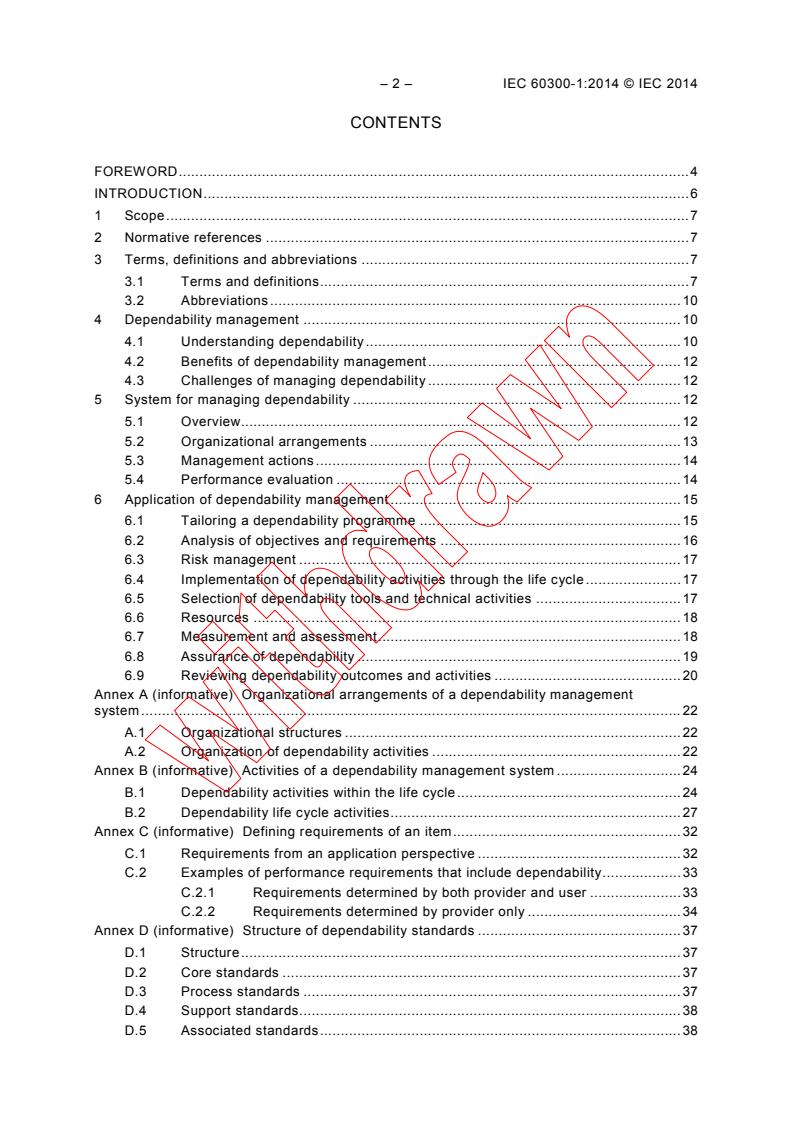
IEC 60300-1:2014 - Dependability management - Part 1: Guidance for management and application Released:5/23/2014
IEC 60300-1:2014 - Dependability management - Part 1: Guidance for management and application Released:5/23/2014
Overview
IEC 60300-1:2014 - "Dependability management – Part 1: Guidance for management and application" - establishes a management framework for achieving and optimizing dependability of items (products, systems, processes or services) that include hardware, software and human elements. The standard provides guidance for planning and implementing dependability activities across the entire life cycle, taking into account related requirements such as safety and environmental constraints. This third edition (2014) updates definitions, enhances the description of dependability attributes, adopts a more generic life‑cycle approach and introduces a framework for dependability standards. It cancels and replaces the 2003 edition and related IEC 60300-2 (2004).
Key topics and technical requirements
The standard focuses on practical management and application of dependability. Core technical topics include:
- Dependability concepts and attributes - availability, reliability, maintainability, supportability and related time‑dependent characteristics.
- Life‑cycle approach - planning and implementing dependability activities during concept, development, realization, utilization, enhancement and retirement.
- Dependability management system - organizational arrangements, management actions, performance evaluation and resource allocation.
- Requirements and tailoring - analysis and definition of dependability requirements, tailoring a dependability programme to context and risk.
- Risk management and assurance - integrating dependability risk assessment with technical activities and assurance practices.
- Measurement and assessment - metrics, monitoring, review and continuous improvement of dependability performance.
- Tool and technique selection - guidance on choosing appropriate dependability tools and technical activities for different stages of the life cycle.
- Supporting materials - informative annexes (organizational arrangements, activity checklists, requirements examples and dependability standards framework).
Practical applications and users
IEC 60300-1:2014 is intended for organizations and personnel responsible for designing, producing, operating or maintaining items where dependable performance matters. Typical users include:
- Managers responsible for product or system dependability strategy and resource planning
- Systems engineers and dependability engineers defining and verifying dependability requirements
- Quality, maintenance and reliability teams implementing life‑cycle activities and metrics
- Procurement and suppliers aligning contracts with dependability objectives
- Safety, environmental and risk management professionals integrating dependability with other requirements
Practical applications: product design and validation, system integration, maintenance planning, service delivery, life‑cycle cost optimization, and dependability assurance programs.
Related standards
- Definitions aligned with IEC 60050-191:2014 (electrotechnical vocabulary).
- Part of the IEC 60300 series (Dependability management); the standard provides a framework for associated dependability process, core and support standards.
Keywords: dependability management, IEC 60300-1:2014, life cycle, reliability, availability, maintainability, supportability, dependability standards, risk management.
Relations
- Replaces
IEC 60300-2:2004 - Dependability management - Part 2: Guidelines for dependability management - Effective Date
- 05-Sep-2023
- Effective Date
- 05-Sep-2023
- Effective Date
- 05-Sep-2023
Buy Documents
IEC 60300-1:2014 - Dependability management - Part 1: Guidance for management and application Released:5/23/2014
IEC 60300-1:2014 - Dependability management - Part 1: Guidance for management and application Released:5/23/2014
Get Certified
Connect with accredited certification bodies for this standard

BSI Group
BSI (British Standards Institution) is the business standards company that helps organizations make excellence a habit.

Bureau Veritas
Bureau Veritas is a world leader in laboratory testing, inspection and certification services.

DNV
DNV is an independent assurance and risk management provider.
Sponsored listings
Frequently Asked Questions
IEC 60300-1:2014 is a standard published by the International Electrotechnical Commission (IEC). Its full title is "Dependability management - Part 1: Guidance for management and application". This standard covers: IEC 60300-1:2014 establishes a framework for dependability management. It provides guidance on dependability management of products, systems, processes or services involving hardware, software and human aspects or any integrated combinations of these elements. It presents guidance on planning and implementation of dependability activities and technical processes throughout the life cycle taking into account other requirements such as those relating to safety and the environment. This standard gives guidelines for management and their technical personnel to assist them to optimize dependability. This third edition cancels and replaces the second edition published in 2003 and constitutes a technical revision. This edition includes the following significant technical changes with respect to the previous edition: - an updating of definitions to reflect IEC 60050-191:2014; - an enhanced description of dependability and its attributes; - a more generic approach to dependability management; - revised guidelines for application of dependability management; - a more generic approach to the life cycle; - a framework for dependability standards. Keywords: dependability management
IEC 60300-1:2014 establishes a framework for dependability management. It provides guidance on dependability management of products, systems, processes or services involving hardware, software and human aspects or any integrated combinations of these elements. It presents guidance on planning and implementation of dependability activities and technical processes throughout the life cycle taking into account other requirements such as those relating to safety and the environment. This standard gives guidelines for management and their technical personnel to assist them to optimize dependability. This third edition cancels and replaces the second edition published in 2003 and constitutes a technical revision. This edition includes the following significant technical changes with respect to the previous edition: - an updating of definitions to reflect IEC 60050-191:2014; - an enhanced description of dependability and its attributes; - a more generic approach to dependability management; - revised guidelines for application of dependability management; - a more generic approach to the life cycle; - a framework for dependability standards. Keywords: dependability management
IEC 60300-1:2014 is classified under the following ICS (International Classification for Standards) categories: 03.100.40 - Research and development; 03.120.01 - Quality in general; 21.020 - Characteristics and design of machines, apparatus, equipment. The ICS classification helps identify the subject area and facilitates finding related standards.
IEC 60300-1:2014 has the following relationships with other standards: It is inter standard links to IEC 60300-2:2004, IEC 60300-1:2003, IEC 60300-1:2024. Understanding these relationships helps ensure you are using the most current and applicable version of the standard.
IEC 60300-1:2014 is available in PDF format for immediate download after purchase. The document can be added to your cart and obtained through the secure checkout process. Digital delivery ensures instant access to the complete standard document.
Standards Content (Sample)
IEC 60300-1 ®
Edition 3.0 2014-05
INTERNATIONAL
STANDARD
Dependability management –
Part 1: Guidance for management and application
All rights reserved. Unless otherwise specified, no part of this publication may be reproduced or utilized in any form
or by any means, electronic or mechanical, including photocopying and microfilm, without permission in writing from
either IEC or IEC's member National Committee in the country of the requester. If you have any questions about IEC
copyright or have an enquiry about obtaining additional rights to this publication, please contact the address below or
your local IEC member National Committee for further information.
IEC Central Office Tel.: +41 22 919 02 11
3, rue de Varembé Fax: +41 22 919 03 00
CH-1211 Geneva 20 info@iec.ch
Switzerland www.iec.ch
About the IEC
The International Electrotechnical Commission (IEC) is the leading global organization that prepares and publishes
International Standards for all electrical, electronic and related technologies.
About IEC publications
The technical content of IEC publications is kept under constant review by the IEC. Please make sure that you have the
latest edition, a corrigenda or an amendment might have been published.
IEC Catalogue - webstore.iec.ch/catalogue Electropedia - www.electropedia.org
The stand-alone application for consulting the entire The world's leading online dictionary of electronic and
bibliographical information on IEC International Standards, electrical terms containing more than 30 000 terms and
Technical Specifications, Technical Reports and other definitions in English and French, with equivalent terms in 14
documents. Available for PC, Mac OS, Android Tablets and additional languages. Also known as the International
iPad. Electrotechnical Vocabulary (IEV) online.
IEC publications search - www.iec.ch/searchpub IEC Glossary - std.iec.ch/glossary
The advanced search enables to find IEC publications by a More than 55 000 electrotechnical terminology entries in
variety of criteria (reference number, text, technical English and French extracted from the Terms and Definitions
committee,…). It also gives information on projects, replaced clause of IEC publications issued since 2002. Some entries
and withdrawn publications. have been collected from earlier publications of IEC TC 37,
77, 86 and CISPR.
IEC Just Published - webstore.iec.ch/justpublished
Stay up to date on all new IEC publications. Just Published IEC Customer Service Centre - webstore.iec.ch/csc
details all new publications released. Available online and If you wish to give us your feedback on this publication or
also once a month by email. need further assistance, please contact the Customer Service
Centre: csc@iec.ch.
IEC 60300-1 ®
Edition 3.0 2014-05
INTERNATIONAL
STANDARD
Dependability management –
Part 1: Guidance for management and application
INTERNATIONAL
ELECTROTECHNICAL
COMMISSION
PRICE CODE
X
ICS 03.100.40, 03.120.01, 21.020 ISBN 978-2-8322-1558-6
– 2 – IEC 60300-1:2014 © IEC 2014
CONTENTS
FOREWORD . 4
INTRODUCTION . 6
1 Scope . 7
2 Normative references . 7
3 Terms, definitions and abbreviations . 7
3.1 Terms and definitions . 7
3.2 Abbreviations . 10
4 Dependability management . 10
4.1 Understanding dependability . 10
4.2 Benefits of dependability management . 12
4.3 Challenges of managing dependability . 12
5 System for managing dependability . 12
5.1 Overview. 12
5.2 Organizational arrangements . 13
5.3 Management actions . 14
5.4 Performance evaluation . 14
6 Application of dependability management . 15
6.1 Tailoring a dependability programme . 15
6.2 Analysis of objectives and requirements . 16
6.3 Risk management . 17
6.4 Implementation of dependability activities through the life cycle . 17
6.5 Selection of dependability tools and technical activities . 17
6.6 Resources . 18
6.7 Measurement and assessment . 18
6.8 Assurance of dependability . 19
6.9 Reviewing dependability outcomes and activities . 20
Annex A (informative) Organizational arrangements of a dependability management
system . 22
A.1 Organizational structures . 22
A.2 Organization of dependability activities . 22
Annex B (informative) Activities of a dependability management system . 24
B.1 Dependability activities within the life cycle . 24
B.2 Dependability life cycle activities . 27
Annex C (informative) Defining requirements of an item . 32
C.1 Requirements from an application perspective . 32
C.2 Examples of performance requirements that include dependability . 33
C.2.1 Requirements determined by both provider and user . 33
C.2.2 Requirements determined by provider only . 34
Annex D (informative) Structure of dependability standards . 37
D.1 Structure . 37
D.2 Core standards . 37
D.3 Process standards . 37
D.4 Support standards. 38
D.5 Associated standards . 38
Annex E (informative) Checklist for review of dependability . 39
E.1 Introductory remark . 39
E.2 Concept . 39
E.2.1 Requirements definition . 39
E.2.2 Requirements analysis. 39
E.2.3 High-level architectural design . 39
E.3 Development . 40
E.3.1 Item design . 40
E.3.2 Full-scale system development . 40
E.4 Realization . 41
E.4.1 Item realization . 41
E.4.2 Item implementation . 41
E.5 Utilization . 41
E.6 Enhancement . 41
E.7 Retirement . 42
Bibliography . 43
Figure 1 – Relationship of dependability to the needs and requirements of an item
(product, system, process or service). 11
Figure 2 – Dependability management systems . 13
Figure B.1 – Dependability activities and the life cycle . 26
Figure C.1 – Example showing the relationship between the functional, non-functional
and dependability requirements for a motor-driven pipeline pump . 34
Figure C.2 – Example showing the relationship between the functional, non-functional
and dependability requirements for a family car . 36
Figure D.1 – Framework for dependability standards . 37
Table B.1 – Activities during the concept stage . 27
Table B.2 – Activities during development stage . 29
Table B.3 – Activities during the realization stage . 30
Table B.4 – Activities during the utilization stage . 31
Table B.5 – Activities during the enhancement stage . 31
Table B.6 – Activities during the retirement stage . 31
– 4 – IEC 60300-1:2014 © IEC 2014
INTERNATIONAL ELECTROTECHNICAL COMMISSION
____________
DEPENDABILITY MANAGEMENT –
Part 1: Guidance for management and application
FOREWORD
1) The International Electrotechnical Commission (IEC) is a worldwide organization for standardization comprising
all national electrotechnical committees (IEC National Committees). The object of IEC is to promote
international co-operation on all questions concerning standardization in the electrical and electronic fields. To
this end and in addition to other activities, IEC publishes International Standards, Technical Specifications,
Technical Reports, Publicly Available Specifications (PAS) and Guides (hereafter referred to as “IEC
Publication(s)”). Their preparation is entrusted to technical committees; any IEC National Committee interested
in the subject dealt with may participate in this preparatory work. International, governmental and non-
governmental organizations liaising with the IEC also participate in this preparation. IEC collaborates closely
with the International Organization for Standardization (ISO) in accordance with conditions determined by
agreement between the two organizations.
2) The formal decisions or agreements of IEC on technical matters express, as nearly as possible, an international
consensus of opinion on the relevant subjects since each technical committee has representation from all
interested IEC National Committees.
3) IEC Publications have the form of recommendations for international use and are accepted by IEC National
Committees in that sense. While all reasonable efforts are made to ensure that the technical content of IEC
Publications is accurate, IEC cannot be held responsible for the way in which they are used or for any
misinterpretation by any end user.
4) In order to promote international uniformity, IEC National Committees undertake to apply IEC Publications
transparently to the maximum extent possible in their national and regional publications. Any divergence
between any IEC Publication and the corresponding national or regional publication shall be clearly indicated in
the latter.
5) IEC itself does not provide any attestation of conformity. Independent certification bodies provide conformity
assessment services and, in some areas, access to IEC marks of conformity. IEC is not responsible for any
services carried out by independent certification bodies.
6) All users should ensure that they have the latest edition of this publication.
7) No liability shall attach to IEC or its directors, employees, servants or agents including individual experts and
members of its technical committees and IEC National Committees for any personal injury, property damage or
other damage of any nature whatsoever, whether direct or indirect, or for costs (including legal fees) and
expenses arising out of the publication, use of, or reliance upon, this IEC Publication or any other IEC
Publications.
8) Attention is drawn to the Normative references cited in this publication. Use of the referenced publications is
indispensable for the correct application of this publication.
9) Attention is drawn to the possibility that some of the elements of this IEC Publication may be the subject of
patent rights. IEC shall not be held responsible for identifying any or all such patent rights.
International Standard IEC 60300-1 has been prepared by IEC technical committee 56:
Dependability.
This third edition cancels and replaces the second edition published in 2003 and constitutes a
technical revision.
This edition includes the following significant technical changes with respect to the previous
edition:
a) an updating of definitions to reflect IEC 60050-191:2014;
b) an enhanced description of dependability and its attributes;
c) a more generic approach to dependability management;
d) revised guidelines for application of dependability management;
e) a more generic approach to the life cycle;
f) a framework for dependability standards.
In addition, this third edition cancels and replaces the second edition of document
IEC 60300-2 published in 2004.
The text of this standard is based on the following documents:
FDIS Report on voting
56/1550/FDIS 56/1556/RVD
Full information on the voting for the approval of this standard can be found in the report on
voting indicated in the above table.
This publication has been drafted in accordance with the ISO/IEC Directives, Part 2.
A list of all parts in the IEC 60300 series, published under the general title Dependability
management, can be found on the IEC website.
The committee has decided that the contents of this publication will remain unchanged until
the stability date indicated on the IEC web site under "http://webstore.iec.ch" in the data
related to the specific publication. At this date, the publication will be
• reconfirmed,
• withdrawn,
• replaced by a revised edition, or
• amended.
A bilingual version of this publication may be issued at a later date.
– 6 – IEC 60300-1:2014 © IEC 2014
INTRODUCTION
This part of IEC 60300 describes the processes involved in managing dependability within an
organization and establishes a framework for managing dependability activities for the
purpose of achieving dependability performance.
Dependability is the ability of an item to perform as and when required. Dependability is a
term used to describe the time-dependent characteristics associated with the performance of
an item. Dependability includes characteristics such as availability, reliability, maintainability
and supportability under given conditions of use and maintenance support requirements.
Dependability describes the extent to which something can be trusted to behave as expected.
Dependability creates trust and confidence and affects the ability of an organization to meet
its objectives. It is achieved by effective planning and implementation of dependability
activities throughout the life cycle of items.
Dependability has a strong impact on the user’s perception of the value of an item developed
or provided by an organization. Poor dependability will affect an organization’s capability to
deliver its objectives and reduce its reputation.
Dependability management provides a systematic approach for addressing dependability and
related issues from an organizational and business perspective. Dependability is often driven
by technology and requires the integration of innovation with legacy products. Achieving
dependability throughout the life cycle process can be influenced by market dynamics, global
economics and resource distributions, changing customer needs, and a competitive
environment. Strategies need to adapt to anticipated changes to sustain viability in business
operations. Dependability management focuses on the needs of stakeholders in optimizing
dependability to enhance organizational objectives and return-on-investments.
This standard is written specifically for application to technological products, systems,
processes and services, which are referred to in this standard by the general term “item”.
However, much of the guidance provided is generic and can be adapted for application in
various non-technological applications. In addition, the potential side effects on safety,
environment and other factors should be identified, analysed and managed when optimizing
dependability.
The intended audience for this standard ranges from users, owners and customers to
organizations involved in and responsible for ensuring dependability requirements are being
met. Organizations include all types and sizes of corporations, public and private institutions
such as in government agencies, business enterprises, and non-profit associations.
DEPENDABILITY MANAGEMENT –
Part 1: Guidance for management and application
1 Scope
This part of IEC 60300 establishes a framework for dependability management. It provides
guidance on dependability management of products, systems, processes or services involving
hardware, software and human aspects or any integrated combinations of these elements. It
presents guidance on planning and implementation of dependability activities and technical
processes throughout the life cycle taking into account other requirements such as those
relating to safety and the environment.
This standard gives guidelines for management and their technical personnel to assist them
to optimize dependability.
This standard is not intended for the purpose of certification.
2 Normative references
The following documents, in whole or in part, are normatively referenced in this document and
are indispensable for its application. For dated references, only the edition cited applies. For
undated references, the latest edition of the referenced document (including any
amendments) applies.
None.
3 Terms, definitions and abbreviations
For the purposes of this document, the following terms and definitions apply.
3.1 Terms and definitions
3.1.1
availability < of an item>
ability to be in a state to perform as required
Note 1 to entry: Availability depends upon the combined characteristics of the reliability, recoverability and
maintainability of the item, and in some cases, on the maintenance support performance.
Note 2 to entry: Availability may be quantified using appropriate performance measures.
[SOURCE: IEC 60050-191:2014 [1] , 191-41-23]
3.1.2
dependability
ability to perform as and when required
Note 1 to entry: Dependability includes availability, reliability, recoverability, maintainability, and maintenance
support performance, and, in some cases, other characteristics such as durability, safety and security.
_____________
Numbers in brackets refer to the bibliography.
– 8 – IEC 60300-1:2014 © IEC 2014
Note 2 to entry: Dependability is used as a collective term for the time-related quality characteristics of an item.
[SOURCE: IEC 60050-191:2014, 191-41-22]
3.1.3
dependability case
evidence-based, reasoned, traceable argument created to support the contention that a
defined system will satisfy the dependability requirements
3.1.4
dependability management
coordinated activities to direct and control an organization with regard to dependability
Note 1 to entry: Dependability management is part of an organization’s overall management.
3.1.5
dependability management system
set of interrelated or interacting elements of an organization to establish dependability-related
policies and objectives and the processes to achieve those dependability objectives
Note 1 to entry: Systems for managing dependability are part of the overall management system and not usually a
separate management system.
Note 2 to entry: The system elements include the organization’s structure, roles and responsibilities, planning,
procedures and processes.
3.1.6
dependability plan
set of scheduled activities to achieve dependability objectives and targets for an item
3.1.7
dependability programme
coordinated set of plans that describe the activities that lead to cost-effective achievement of
dependability objectives and targets and the way they are resourced
3.1.8
item
subject being considered
Note 1 to entry: The item may be an individual part, component, device, functional unit, equipment, subsystem, or
system.
Note 2 to entry: The item may consist of hardware, software, people or any combination thereof.
Note 3 to entry: The item is often comprised of elements that may each be individually considered.
[SOURCE: IEC 60050-191:2014, 191-41-01]
3.1.9
life cycle
series of identifiable stages through which an item goes, from its conception to disposal
EXAMPLE A typical system lifecycle consists of: concept and definition; design and development; construction,
installation and commissioning; operation and maintenance; mid-life upgrading, or life extension; and
decommissioning and disposal.
Note1 to entry: The stages identified will vary with application.
[SOURCE: IEC 60050-191:2014, 191-41-09]
3.1.10
maintainability
ability to be retained in, or restored to a state to perform as required, under given conditions
of use and maintenance
Note 1 to entry: Given conditions would include aspects that affect maintainability, such as: location for
maintenance, accessibility, maintenance procedures and maintenance resources.
Note 2 to entry: Maintainability may be quantified using appropriate measures.
[SOURCE: IEC 60050-191:2014, 191-41-27]
3.1.11
maintenance support
provision of resources to maintain an item
Note 1 to entry: Resources include human resources, support equipment, materials and spare parts, maintenance
facilities, documentation and information, and maintenance information systems.
[SOURCE: IEC 60050-191:2014, 191-41-28]
3.1.12
organization
person or group of people that has its own functions with responsibilities, authorities and
relationships to achieve its objectives
Note 1 to entry: The concept of organization includes, but is not limited, to sole-trader, company, corporation,
firm, enterprise, authority, partnership, charity or institution, or part or combination thereof, whether incorporated or
not, public or private.
Note 2 to entry: For organizations with more than one operating unit, a single unit may be defined as an
organization.
3.1.13
reliability
ability to perform as required, without failure, for a given time interval, under given conditions
Note 1 to entry: The time interval duration may be expressed in units appropriate to the item concerned, e.g.
calendar time, operating cycles, distance run, etc., and the units should always be clearly stated.
Note 2 to entry: Given conditions include aspects that affect reliability, such as: mode of operation, stress levels,
environmental conditions and maintenance.
Note 3 to entry: Reliability may be quantified using appropriate measures.
[SOURCE: IEC 60050-191:2014, 191-41-24]
3.1.14
requirement
need or expectation that is stated, generally implied or obligatory
[SOURCE: ISO 9000:2005, 3.1.2]
3.1.15
stakeholder
person or organization that can affect, be affected by, or perceive themselves to be affected
by a decision or activity
3.1.16
supportability
ability to be supported to sustain the required availability with a defined operational profile
and logistic and maintenance resources
– 10 – IEC 60300-1:2014 © IEC 2014
Note 1 to entry: Supportability complements the inherent reliability and maintainability of the item, combined with
factors external to the item that affect the relative ease of providing the required maintenance and logistic support.
[SOURCE: IEC 60050-191:2014, 191-41-31, note 1 has been modified]
3.1.17
system
set of interrelated items that collectively fulfil a requirement
Note 1 to entry: A system is considered to have a defined real or abstract boundary.
Note 2 to entry: External resources (from outside the system boundary) may be required for the system to
operate.
Note 3 to entry: A system structure may be hierarchical, e.g. system, subsystem, component, etc.
Note 4 to entry: Conditions of use and maintenance should be expressed or implied within the requirement.
[SOURCE: IEC 60050-191:2014, 191-41-03]
3.1.18
tailoring
process to adapt, adjust or alter an organization’s set of established processes and activities
to fulfil, satisfy or meet requirements as they apply to dependability
3.2 Abbreviations
COTS Commercial-off-the-shelf
FMEA Failure modes and effects analysis
FRACAS Failure recording, analysis and corrective action system
FTA Fault tree analysis
HSE Health, safety and environment
MTBF Mean time between failure
HAZOP Hazard and operability studies
RCM Reliability centred maintenance
4 Dependability management
4.1 Understanding dependability
Dependability is the ability of an item to perform as and when required. Dependability is thus
the ability to fulfil the requirements and expectations of an item consistently over time.
Dependability creates value in that the item retains its performance characteristics, operates
as desired, and satisfies customer needs and expectations.
Management of dependability is a key element of an organization’s wider management
systems in particular those for assets, finance and quality. Dependability management
encompasses the planning and application of organizational arrangements, processes and
associated methods and techniques to achieve the organization’s performance and product
objectives.
Dependability is improved by systematically reducing the frequency of outages, product
failures, service downtimes, and other undesired events and minimizing their effects. This is
achieved by actions such as improving design, eliminating root causes of failure, simplifying
complex processes, mitigating anomalies, promoting fault tolerance in design and fitness for
use, advocating fault avoidance and error prevention, managing maintenance activities and
making commitments to build trust and integrity to ensure user confidence throughout the life
cycle. Early consideration of dependability in the life cycle is crucial since rectifying a design
that causes poor dependability will often be more difficult, time consuming and costly at a
later time.
Figure 1 illustrates the relationship of dependability to the needs of stakeholders and the
requirements of an item. Depending on context, stakeholders can include users, owners,
customers, government agencies, businesses and organizations responsible for ensuring
dependability requirements are met.
IEC 1362/14
Figure 1 – Relationship of dependability to the needs and
requirements of an item (product, system, process or service)
Requirements are determined from the needs of stakeholders and from constraints such as
the conditions of use, resources and legislation. They include functional requirements, which
define what the item is required to do, and non-functional requirements, which specify
additional attributes. Examples of functional requirements are capacity and power output and
examples of non-functional requirements are safety, environmental sustainability and
efficiency. Dependability requirements, which define the time-dependent ability to achieve
dependability performance in these requirements consist of characteristics such as reliability,
availability, maintainability and supportability.
Functional and non-functional requirements and dependability requirements are inter-related.
A dependability requirement can only exist if there is a functional or non-functional
requirement that has to be satisfied. There can be competing objectives between desirable
requirements, such as safety or oil/gas production and dependability, and therefore trade-offs
may be necessary. There can also be constraints related to cost, availability of item
components or resources, or fixed timelines that could cause a compromise between
functionality and dependability.
The perception of the ability to perform as and when required can vary for different
stakeholders. Users, providers, operators, maintainers and others who interact with an item
can have overlapping dependability requirements but with different application objectives and
usage expectations. This can result in differing perceptions of dependability which might need
to be considered while defining requirements.
Dependability includes objectively measureable characteristics, such as reliability, availability
and maintainability, and more subjective judgements of trustworthiness relating to the
functions required by particular stakeholders. The ability to measure the attainment of
performance objectives is a fundamental consideration in setting the requirements.
– 12 – IEC 60300-1:2014 © IEC 2014
Dependability includes both the ability to meet functional and non-functional requirements
under normal and expected conditions, and the ability to adapt to unexpected changes in
requirements, assumptions and circumstances to recover from external system failures.
4.2 Benefits of dependability management
Managing dependability results in benefits such as
• meeting stakeholder requirements and objectives,
• achieving expected service levels,
• maintaining production or manufacturing capacity through increased availability,
• improving safety when potential detrimental consequences are identified and dealt with
appropriately,
• reducing environmental impact when detrimental consequences are identified and dealt
with appropriately,
• increasing life and durability and reducing life cycle costs, and
• improving quality.
4.3 Challenges of managing dependability
Dependability needs to be addressed during the entire life cycle of an item. Early
consideration and implementation of relevant dependability activities will better ensure that
dependability requirements are achieved.
There can be complications when multiple organizations are involved, mid-life upgrading
occurs, or the item’s dependability is influenced by interconnected and external systems.
Items are often integrated to operate with legacy items that are in different stages of the life
cycle, with older generation technologies and methods of design. Dependability management
needs to ensure interoperability and dependability of the integrated items through interface
specifications to ensure dependable performance.
Systems are becoming more complex and can exhibit the characteristics of "open systems”,
“systems of systems” or “unbounded or weakly bounded systems”. The systems can be
managed by different parties that have different objectives and can be at different stages of
the life cycle. This, together with the scale and complexity of the system makes it difficult for
any stakeholder to comprehend the system as a whole and changes are thus less predictable
and controllable. For that reason, it is crucial for stakeholders to understand and agree on the
boundaries of their responsibilities and to assign accountability for implementation. Planning
for dependability needs to take into account the potential for major failures and changes
outside respective boundaries as well as inside.
5 System for managing dependability
5.1 Overview
The purpose of a system for managing dependability is to direct and control an organization
with regard to dependability, coordinating with other disciplines to provide an efficient and
integrated effort to achieve objectives. Organizational policies and objectives may include
dependability policies and objectives, which then lead to a dependability management system
that can effectively implement them.
Figure 2 shows dependability management as a part of a generic management system. The
dependability management system results in a dependability programme which feeds into
organizational plans and activities.
IEC 1363/14
Figure 2 – Dependability management systems
A dependability management system consists of three elements:
• organizational arrangements to implement dependability policies and objectives;
• dependability activities that are implemented in the dependability programme;
• performance evaluation arrangements.
5.2 Organizational arrangements
Establishing organizational arrangements focuses on the management structure needed to
facilitate effective implementation of the dependability policies. Dependability management
should be integrated by the management systems of an organization in order to enable
effective decision-making and influence technical direction. In particular, dependability
engineering should be closely integrated into engineering projects for design and process
improvements. Annex A describes the incorporation of dependability activities in the
organizational operations, strategies and processes to achieve long-term goals and on-going
project objectives.
Dependability policies and objectives need to be aligned with organizational policies and
objectives and those of stakeholders comprising both technical and business perspectives.
Organizational arrangements for managing dependability should take into consideration the
organization’s context, its objectives and the strategies to achieve them, and its risks and
opportunities.
Dependability management systems do not always require a complex organizational
infrastructure and reporting hierarchy to be effective. Dependability activities either can be
managed by a separate organizational unit with close coordination, be fully integrated into
other relevant areas, or be a mixture of the two approaches. The alignment of organizational
structure, responsibilities, procedures, activities, resources and information is critical to
efficient and effective direction and control of dependability. There should be dependability
management involvement in planning, review, auditing, verification and validation of on-going
project activities.
Where functions such as design, maintenance and logistic support are outsourced, the
responsibility for dependability aspects of outsourcing should be specified, monitored and
controlled.
One of the challenges with managing dependability over the life cycle is that often more than
one organization is involved. Over the life cycle, certain responsibilities may need to be
– 14 – IEC 60300-1:2014 © IEC 2014
passed from one organization to another. Since organizational styles and procedures vary,
the management of dependability needs to adapt to different situations.
A means to manage and control dependability data and information should be established as
a part of the organization’s management information systems. This is to provide management
insights on historical data and dependability-related performance records, enabling
measurement of dependability status and improvements.
5.3 Management actions
Effective dependability management helps to ensure that dependability requirements are met
in conjunction with functional and non-functional requirements.
Management actions should address the following:
• provide leadership through management commitment, policy direction and establishment
of roles, responsibilities and authority;
• provide operational planning and control to achieve dependability objectives and manage
risks;
• involve stakeholders by identifying dependability requirements and issues, communication
of dependability programme status, conflict resolution and trade-offs, and securing and
maintaining agreements and accountability;
• coordinate different organizational functions that are involved in dependability activities
with assigned dependability responsibility for the coordination of management and
technical effort;
• manage risks to dependability objectives and targets;
• provide and manage resources including acquisition of capital equipment, staff training
and deployment, outsourcing and sub-contracting of dependability technical work;
• manage the technical activities needed during an item’s life cycle to achieve dependability;
• manage knowledge and information through the capture and dissemination of relevant
dependability data and knowledge, including maintenance of a dependability performance
data base;
• undertake performance evaluations through monitoring, measuring analysis and
evaluation, audit and assurance and management review;
• ensure sustained improvement via the planning and control of enhancement activities and
appropriate reviews of progress.
Dependability related issues and technical concerns should be brought to management
attention at review meetings for resolution, decisions and priority setting of task assignments.
5.4 Performance evaluation
Performance of organizational arrangements and processes is evaluated to assure relevant
stakeholders that dependability management activities are being carried out well and will
achieve the required dependability performance.
The organization should define performance indicators and targets for the dependability
management system and monitor measure, analyse and improve performance against these
indicators and targets.
This could involve
• evaluating the operation and effectiveness of dependability processes, activities and
procedures,
• evaluating whether the organization’s dependability policies and objectives are being met,
• reviewing the suitability of the dependability policies objectives and programme,
• assessing the dependability performance of items, and
• monitoring agreements and responsibilities.
6 Application of dependability management
6.1 Tailoring a dependability programme
The basic elements of a dependability programme are as follows:
• dependability plans, which define the activities, techniques and resources required to
achieve dependability of items;
• methods for measurement and assessment;
• assurance and review (see Figure 2).
Management accountable for the resulting dependability of an item should tailor these
elements to fulfil the dependability objectives for that specific situation or project. Tailoring
applies to any stage of the life cycle but important tailoring occurs during the initial design-
related parts of the life cycle. It might not be necessary to tailor activities in all cases, for
example, for manufacturers who develop and produce similar products.
The general tailoring of the dependability programme involves the following:
• identification of the organizational context, including policy and infrastructure;
• consideration of regulatory requirements or standards;
• identification of item related characteristics such as its features and functions, past history
of similar items, their intended end use and anticipated application environments;
• analysis of objectives and requirements;
• determination of the specific life cycle stages or phases that are applicable;
• assessing risks;
• selection of dependability activities relevant to the specific life cycle stages or phases
identified;
• selection of tools and technical activities needed to achieve dependability;
• selection of techniques for measurement and assessment;
• definition of the capability and resources needed and actually available for
implementation;
• prioritization and allocation of resources;
• planning reviews and assurance;
• documentation of the rationale in formalizing the tailoring decisions as part of the
organizational or project plan.
If the magnitude of the programme dictates the need for each functional area to have its own
plan, these dependability activities can be documented in their own separate plans.
Tailoring criteria and guidelines describe
• how the organization’s dependability activities are used within project processes,
• which mandatory and legal requirements need to be satisfied,
• which options may be exercised as well as the criteria for selecting from these options,
and
• how to make decisions about which dependability procedures should be performed.
– 16 – IEC 60300-1:2014 © IEC 2014
Tai
...
IEC 60300-1 ®
Edition 3.0 2014-05
INTERNATIONAL
STANDARD
NORME
INTERNATIONALE
Dependability management –
Part 1: Guidance for management and application
Gestion de la sûreté de fonctionnement –
Partie 1: Lignes directrices pour la gestion et l’application
All rights reserved. Unless otherwise specified, no part of this publication may be reproduced or utilized in any form
or by any means, electronic or mechanical, including photocopying and microfilm, without permission in writing from
either IEC or IEC's member National Committee in the country of the requester. If you have any questions about IEC
copyright or have an enquiry about obtaining additional rights to this publication, please contact the address below or
your local IEC member National Committee for further information.
Droits de reproduction réservés. Sauf indication contraire, aucune partie de cette publication ne peut être reproduite
ni utilisée sous quelque forme que ce soit et par aucun procédé, électronique ou mécanique, y compris la photocopie
et les microfilms, sans l'accord écrit de l'IEC ou du Comité national de l'IEC du pays du demandeur. Si vous avez des
questions sur le copyright de l'IEC ou si vous désirez obtenir des droits supplémentaires sur cette publication, utilisez
les coordonnées ci-après ou contactez le Comité national de l'IEC de votre pays de résidence.
IEC Central Office Tel.: +41 22 919 02 11
3, rue de Varembé Fax: +41 22 919 03 00
CH-1211 Geneva 20 info@iec.ch
Switzerland www.iec.ch
About the IEC
The International Electrotechnical Commission (IEC) is the leading global organization that prepares and publishes
International Standards for all electrical, electronic and related technologies.
About IEC publications
The technical content of IEC publications is kept under constant review by the IEC. Please make sure that you have the
latest edition, a corrigenda or an amendment might have been published.
IEC Catalogue - webstore.iec.ch/catalogue Electropedia - www.electropedia.org
The stand-alone application for consulting the entire The world's leading online dictionary of electronic and
bibliographical information on IEC International Standards, electrical terms containing more than 30 000 terms and
Technical Specifications, Technical Reports and other definitions in English and French, with equivalent terms in 14
documents. Available for PC, Mac OS, Android Tablets and additional languages. Also known as the International
iPad. Electrotechnical Vocabulary (IEV) online.
IEC publications search - www.iec.ch/searchpub IEC Glossary - std.iec.ch/glossary
The advanced search enables to find IEC publications by a More than 55 000 electrotechnical terminology entries in
variety of criteria (reference number, text, technical English and French extracted from the Terms and Definitions
committee,…). It also gives information on projects, replaced clause of IEC publications issued since 2002. Some entries
and withdrawn publications. have been collected from earlier publications of IEC TC 37,
77, 86 and CISPR.
IEC Just Published - webstore.iec.ch/justpublished
Stay up to date on all new IEC publications. Just Published IEC Customer Service Centre - webstore.iec.ch/csc
details all new publications released. Available online and If you wish to give us your feedback on this publication or
also once a month by email. need further assistance, please contact the Customer Service
Centre: csc@iec.ch.
A propos de l'IEC
La Commission Electrotechnique Internationale (IEC) est la première organisation mondiale qui élabore et publie des
Normes internationales pour tout ce qui a trait à l'électricité, à l'électronique et aux technologies apparentées.
A propos des publications IEC
Le contenu technique des publications IEC est constamment revu. Veuillez vous assurer que vous possédez l’édition la
plus récente, un corrigendum ou amendement peut avoir été publié.
Catalogue IEC - webstore.iec.ch/catalogue Electropedia - www.electropedia.org
Application autonome pour consulter tous les renseignements
Le premier dictionnaire en ligne de termes électroniques et
bibliographiques sur les Normes internationales,
électriques. Il contient plus de 30 000 termes et définitions en
Spécifications techniques, Rapports techniques et autres
anglais et en français, ainsi que les termes équivalents dans
documents de l'IEC. Disponible pour PC, Mac OS, tablettes
14 langues additionnelles. Egalement appelé Vocabulaire
Android et iPad.
Electrotechnique International (IEV) en ligne.
Recherche de publications IEC - www.iec.ch/searchpub
Glossaire IEC - std.iec.ch/glossary
La recherche avancée permet de trouver des publications IEC Plus de 55 000 entrées terminologiques électrotechniques, en
en utilisant différents critères (numéro de référence, texte, anglais et en français, extraites des articles Termes et
comité d’études,…). Elle donne aussi des informations sur les Définitions des publications IEC parues depuis 2002. Plus
projets et les publications remplacées ou retirées. certaines entrées antérieures extraites des publications des
CE 37, 77, 86 et CISPR de l'IEC.
IEC Just Published - webstore.iec.ch/justpublished
Service Clients - webstore.iec.ch/csc
Restez informé sur les nouvelles publications IEC. Just
Published détaille les nouvelles publications parues. Si vous désirez nous donner des commentaires sur cette
Disponible en ligne et aussi une fois par mois par email. publication ou si vous avez des questions contactez-nous:
csc@iec.ch.
IEC 60300-1 ®
Edition 3.0 2014-05
INTERNATIONAL
STANDARD
NORME
INTERNATIONALE
Dependability management –
Part 1: Guidance for management and application
Gestion de la sûreté de fonctionnement –
Partie 1: Lignes directrices pour la gestion et l’application
INTERNATIONAL
ELECTROTECHNICAL
COMMISSION
COMMISSION
ELECTROTECHNIQUE
PRICE CODE
INTERNATIONALE
X
CODE PRIX
ICS 03.100.40, 03.120.01, 21.020 ISBN 978-2-8322-1777-1
– 2 – IEC 60300-1:2014 © IEC 2014
CONTENTS
FOREWORD. 4
INTRODUCTION . 6
1 Scope . 7
2 Normative references . 7
3 Terms, definitions and abbreviations . 7
3.1 Terms and definitions . 7
3.2 Abbreviations . 10
4 Dependability management . 10
4.1 Understanding dependability . 10
4.2 Benefits of dependability management . 12
4.3 Challenges of managing dependability . 12
5 System for managing dependability . 12
5.1 Overview . 12
5.2 Organizational arrangements . 13
5.3 Management actions . 14
5.4 Performance evaluation . 14
6 Application of dependability management . 15
6.1 Tailoring a dependability programme . 15
6.2 Analysis of objectives and requirements . 16
6.3 Risk management . 17
6.4 Implementation of dependability activities through the life cycle . 17
6.5 Selection of dependability tools and technical activities . 17
6.6 Resources . 18
6.7 Measurement and assessment . 18
6.8 Assurance of dependability . 19
6.9 Reviewing dependability outcomes and activities . 20
Annex A (informative) Organizational arrangements of a dependability management
system . 22
A.1 Organizational structures . 22
A.2 Organization of dependability activities . 22
Annex B (informative) Activities of a dependability management system . 24
B.1 Dependability activities within the life cycle . 24
B.2 Dependability life cycle activities . 27
Annex C (informative) Defining requirements of an item . 32
C.1 Requirements from an application perspective . 32
C.2 Examples of performance requirements that include dependability . 33
C.2.1 Requirements determined by both provider and user . 33
C.2.2 Requirements determined by provider only . 34
Annex D (informative) Structure of dependability standards . 37
D.1 Structure . 37
D.2 Core standards . 37
D.3 Process standards. 37
D.4 Support standards . 38
D.5 Associated standards . 38
Annex E (informative) Checklist for review of dependability. 39
E.1 Introductory remark . 39
E.2 Concept . 39
E.2.1 Requirements definition . 39
E.2.2 Requirements analysis . 39
E.2.3 High-level architectural design . 39
E.3 Development . 40
E.3.1 Item design . 40
E.3.2 Full-scale system development . 40
E.4 Realization . 41
E.4.1 Item realization . 41
E.4.2 Item implementation . 41
E.5 Utilization . 41
E.6 Enhancement . 41
E.7 Retirement . 42
Bibliography . 43
Figure 1 – Relationship of dependability to the needs and requirements of an item
(product, system, process or service) . 11
Figure 2 – Dependability management systems . 13
Figure B.1 – Dependability activities and the life cycle . 26
Figure C.1 – Example showing the relationship between the functional, non-functional
and dependability requirements for a motor-driven pipeline pump . 34
Figure C.2 – Example showing the relationship between the functional, non-functional
and dependability requirements for a family car . 36
Figure D.1 – Framework for dependability standards . 37
Table B.1 – Activities during the concept stage . 27
Table B.2 – Activities during development stage . 29
Table B.3 – Activities during the realization stage . 30
Table B.4 – Activities during the utilization stage . 31
Table B.5 – Activities during the enhancement stage . 31
Table B.6 – Activities during the retirement stage . 31
– 4 – IEC 60300-1:2014 © IEC 2014
INTERNATIONAL ELECTROTECHNICAL COMMISSION
____________
DEPENDABILITY MANAGEMENT –
Part 1: Guidance for management and application
FOREWORD
1) The International Electrotechnical Commission (IEC) is a worldwide organization for standardization comprising
all national electrotechnical committees (IEC National Committees). The object of IEC is to promote
international co-operation on all questions concerning standardization in the electrical and electronic fields. To
this end and in addition to other activities, IEC publishes International Standards, Technical Specifications,
Technical Reports, Publicly Available Specifications (PAS) and Guides (hereafter referred to as “IEC
Publication(s)”). Their preparation is entrusted to technical committees; any IEC National Committee interested
in the subject dealt with may participate in this preparatory work. International, governmental and non-
governmental organizations liaising with the IEC also participate in this preparation. IEC collaborates closely
with the International Organization for Standardization (ISO) in accordance with conditions determined by
agreement between the two organizations.
2) The formal decisions or agreements of IEC on technical matters express, as nearly as possible, an international
consensus of opinion on the relevant subjects since each technical committee has representation from all
interested IEC National Committees.
3) IEC Publications have the form of recommendations for international use and are accepted by IEC National
Committees in that sense. While all reasonable efforts are made to ensure that the technical content of IEC
Publications is accurate, IEC cannot be held responsible for the way in which they are used or for any
misinterpretation by any end user.
4) In order to promote international uniformity, IEC National Committees undertake to apply IEC Publications
transparently to the maximum extent possible in their national and regional publications. Any divergence
between any IEC Publication and the corresponding national or regional publication shall be clearly indicated in
the latter.
5) IEC itself does not provide any attestation of conformity. Independent certification bodies provide conformity
assessment services and, in some areas, access to IEC marks of conformity. IEC is not responsible for any
services carried out by independent certification bodies.
6) All users should ensure that they have the latest edition of this publication.
7) No liability shall attach to IEC or its directors, employees, servants or agents including individual experts and
members of its technical committees and IEC National Committees for any personal injury, property damage or
other damage of any nature whatsoever, whether direct or indirect, or for costs (including legal fees) and
expenses arising out of the publication, use of, or reliance upon, this IEC Publication or any other IEC
Publications.
8) Attention is drawn to the Normative references cited in this publication. Use of the referenced publications is
indispensable for the correct application of this publication.
9) Attention is drawn to the possibility that some of the elements of this IEC Publication may be the subject of
patent rights. IEC shall not be held responsible for identifying any or all such patent rights.
International Standard IEC 60300-1 has been prepared by IEC technical committee 56:
Dependability.
This bilingual version (2014-08) corresponds to the English version, published in 2014-05.
This third edition cancels and replaces the second edition published in 2003 and constitutes a
technical revision.
This edition includes the following significant technical changes with respect to the previous
edition:
a) an updating of definitions to reflect IEC 60050-191:2014;
b) an enhanced description of dependability and its attributes;
c) a more generic approach to dependability management;
d) revised guidelines for application of dependability management;
e) a more generic approach to the life cycle;
f) a framework for dependability standards.
In addition, this third edition cancels and replaces the second edition of document IEC 60300-
2 published in 2004.
The text of this standard is based on the following documents:
FDIS Report on voting
56/1550/FDIS 56/1556/RVD
Full information on the voting for the approval of this standard can be found in the report on
voting indicated in the above table.
The French version of this standard has not been voted upon.
This publication has been drafted in accordance with the ISO/IEC Directives, Part 2.
A list of all parts in the IEC 60300 series, published under the general title Dependability
management, can be found on the IEC website.
The committee has decided that the contents of this publication will remain unchanged until
the stability date indicated on the IEC web site under "http://webstore.iec.ch" in the data
related to the specific publication. At this date, the publication will be
• reconfirmed,
• withdrawn,
• replaced by a revised edition, or
• amended.
– 6 – IEC 60300-1:2014 © IEC 2014
INTRODUCTION
This part of IEC 60300 describes the processes involved in managing dependability within an
organization and establishes a framework for managing dependability activities for the
purpose of achieving dependability performance.
Dependability is the ability of an item to perform as and when required. Dependability is a
term used to describe the time-dependent characteristics associated with the performance of
an item. Dependability includes characteristics such as availability, reliability, maintainability
and supportability under given conditions of use and maintenance support requirements.
Dependability describes the extent to which something can be trusted to behave as expected.
Dependability creates trust and confidence and affects the ability of an organization to meet
its objectives. It is achieved by effective planning and implementation of dependability
activities throughout the life cycle of items.
Dependability has a strong impact on the user’s perception of the value of an item developed
or provided by an organization. Poor dependability will affect an organization’s capability to
deliver its objectives and reduce its reputation.
Dependability management provides a systematic approach for addressing dependability and
related issues from an organizational and business perspective. Dependability is often driven
by technology and requires the integration of innovation with legacy products. Achieving
dependability throughout the life cycle process can be influenced by market dynamics, global
economics and resource distributions, changing customer needs, and a competitive
environment. Strategies need to adapt to anticipated changes to sustain viability in business
operations. Dependability management focuses on the needs of stakeholders in optimizing
dependability to enhance organizational objectives and return-on-investments.
This standard is written specifically for application to technological products, systems,
processes and services, which are referred to in this standard by the general term “item”.
However, much of the guidance provided is generic and can be adapted for application in
various non-technological applications. In addition, the potential side effects on safety,
environment and other factors should be identified, analysed and managed when optimizing
dependability.
The intended audience for this standard ranges from users, owners and customers to
organizations involved in and responsible for ensuring dependability requirements are being
met. Organizations include all types and sizes of corporations, public and private institutions
such as in government agencies, business enterprises, and non-profit associations.
DEPENDABILITY MANAGEMENT –
Part 1: Guidance for management and application
1 Scope
This part of IEC 60300 establishes a framework for dependability management. It provides
guidance on dependability management of products, systems, processes or services involving
hardware, software and human aspects or any integrated combinations of these elements. It
presents guidance on planning and implementation of dependability activities and technical
processes throughout the life cycle taking into account other requirements such as those
relating to safety and the environment.
This standard gives guidelines for management and their technical personnel to assist them
to optimize dependability.
This standard is not intended for the purpose of certification.
2 Normative references
The following documents, in whole or in part, are normatively referenced in this document and
are indispensable for its application. For dated references, only the edition cited applies. For
undated references, the latest edition of the referenced document (including any
amendments) applies.
None.
3 Terms, definitions and abbreviations
For the purposes of this document, the following terms and definitions apply.
3.1 Terms and definitions
3.1.1
availability < of an item>
ability to be in a state to perform as required
Note 1 to entry: Availability depends upon the combined characteristics of the reliability, recoverability and
maintainability of the item, and in some cases, on the maintenance support performance.
Note 2 to entry: Availability may be quantified using appropriate performance measures.
[SOURCE: IEC 60050-191:2014 [1] , 191-41-23]
3.1.2
dependability
ability to perform as and when required
Note 1 to entry: Dependability includes availability, reliability, recoverability, maintainability, and maintenance
support performance, and, in some cases, other characteristics such as durability, safety and security.
_____________
Numbers in brackets refer to the bibliography.
– 8 – IEC 60300-1:2014 © IEC 2014
Note 2 to entry: Dependability is used as a collective term for the time-related quality characteristics of an item.
[SOURCE: IEC 60050-191:2014, 191-41-22]
3.1.3
dependability case
evidence-based, reasoned, traceable argument created to support the contention that a
defined system will satisfy the dependability requirements
3.1.4
dependability management
coordinated activities to direct and control an organization with regard to dependability
Note 1 to entry: Dependability management is part of an organization’s overall management.
3.1.5
dependability management system
set of interrelated or interacting elements of an organization to establish dependability-related
policies and objectives and the processes to achieve those dependability objectives
Note 1 to entry: Systems for managing dependability are part of the overall management system and not usually a
separate management system.
Note 2 to entry: The system elements include the organization’s structure, roles and responsibilities, planning,
procedures and processes.
3.1.6
dependability plan
set of scheduled activities to achieve dependability objectives and targets for an item
3.1.7
dependability programme
coordinated set of plans that describe the activities that lead to cost-effective achievement of
dependability objectives and targets and the way they are resourced
3.1.8
item
subject being considered
Note 1 to entry: The item may be an individual part, component, device, functional unit, equipment, subsystem, or
system.
Note 2 to entry: The item may consist of hardware, software, people or any combination thereof.
Note 3 to entry: The item is often comprised of elements that may each be individually considered.
[SOURCE: IEC 60050-191:2014, 191-41-01]
3.1.9
life cycle
series of identifiable stages through which an item goes, from its conception to disposal
EXAMPLE A typical system lifecycle consists of: concept and definition; design and development; construction,
installation and commissioning; operation and maintenance; mid-life upgrading, or life extension; and
decommissioning and disposal.
Note1 to entry: The stages identified will vary with application.
[SOURCE: IEC 60050-191:2014, 191-41-09]
3.1.10
maintainability
ability to be retained in, or restored to a state to perform as required, under given conditions
of use and maintenance
Note 1 to entry: Given conditions would include aspects that affect maintainability, such as: location for
maintenance, accessibility, maintenance procedures and maintenance resources.
Note 2 to entry: Maintainability may be quantified using appropriate measures.
[SOURCE: IEC 60050-191:2014, 191-41-27]
3.1.11
maintenance support
provision of resources to maintain an item
Note 1 to entry: Resources include human resources, support equipment, materials and spare parts, maintenance
facilities, documentation and information, and maintenance information systems.
[SOURCE: IEC 60050-191:2014, 191-41-28]
3.1.12
organization
person or group of people that has its own functions with responsibilities, authorities and
relationships to achieve its objectives
Note 1 to entry: The concept of organization includes, but is not limited, to sole-trader, company, corporation,
firm, enterprise, authority, partnership, charity or institution, or part or combination thereof, whether incorporated or
not, public or private.
Note 2 to entry: For organizations with more than one operating unit, a single unit may be defined as an
organization.
3.1.13
reliability
ability to perform as required, without failure, for a given time interval, under given conditions
Note 1 to entry: The time interval duration may be expressed in units appropriate to the item concerned, e.g.
calendar time, operating cycles, distance run, etc., and the units should always be clearly stated.
Note 2 to entry: Given conditions include aspects that affect reliability, such as: mode of operation, stress levels,
environmental conditions and maintenance.
Note 3 to entry: Reliability may be quantified using appropriate measures.
[SOURCE: IEC 60050-191:2014, 191-41-24]
3.1.14
requirement
need or expectation that is stated, generally implied or obligatory
[SOURCE: ISO 9000:2005, 3.1.2]
3.1.15
stakeholder
person or organization that can affect, be affected by, or perceive themselves to be affected
by a decision or activity
3.1.16
supportability
ability to be supported to sustain the required availability with a defined operational profile
and logistic and maintenance resources
– 10 – IEC 60300-1:2014 © IEC 2014
Note 1 to entry: Supportability complements the inherent reliability and maintainability of the item, combined with
factors external to the item that affect the relative ease of providing the required maintenance and logistic support.
[SOURCE: IEC 60050-191:2014, 191-41-31, note 1 has been modified]
3.1.17
system
set of interrelated items that collectively fulfil a requirement
Note 1 to entry: A system is considered to have a defined real or abstract boundary.
Note 2 to entry: External resources (from outside the system boundary) may be required for the system to
operate.
Note 3 to entry: A system structure may be hierarchical, e.g. system, subsystem, component, etc.
Note 4 to entry: Conditions of use and maintenance should be expressed or implied within the requirement.
[SOURCE: IEC 60050-191:2014, 191-41-03]
3.1.18
tailoring
process to adapt, adjust or alter an organization’s set of established processes and activities
to fulfil, satisfy or meet requirements as they apply to dependability
3.2 Abbreviations
COTS Commercial-off-the-shelf
FMEA Failure modes and effects analysis
FRACAS Failure recording, analysis and corrective action system
FTA Fault tree analysis
HSE Health, safety and environment
MTBF Mean time between failure
HAZOP Hazard and operability studies
RCM Reliability centred maintenance
4 Dependability management
4.1 Understanding dependability
Dependability is the ability of an item to perform as and when required. Dependability is thus
the ability to fulfil the requirements and expectations of an item consistently over time.
Dependability creates value in that the item retains its performance characteristics, operates
as desired, and satisfies customer needs and expectations.
Management of dependability is a key element of an organization’s wider management
systems in particular those for assets, finance and quality. Dependability management
encompasses the planning and application of organizational arrangements, processes and
associated methods and techniques to achieve the organization’s performance and product
objectives.
Dependability is improved by systematically reducing the frequency of outages, product
failures, service downtimes, and other undesired events and minimizing their effects. This is
achieved by actions such as improving design, eliminating root causes of failure, simplifying
complex processes, mitigating anomalies, promoting fault tolerance in design and fitness for
use, advocating fault avoidance and error prevention, managing maintenance activities and
making commitments to build trust and integrity to ensure user confidence throughout the life
cycle. Early consideration of dependability in the life cycle is crucial since rectifying a design
that causes poor dependability will often be more difficult, time consuming and costly at a
later time.
Figure 1 illustrates the relationship of dependability to the needs of stakeholders and the
requirements of an item. Depending on context, stakeholders can include users, owners,
customers, government agencies, businesses and organizations responsible for ensuring
dependability requirements are met.
IEC 1362/14
Figure 1 – Relationship of dependability to the needs and
requirements of an item (product, system, process or service)
Requirements are determined from the needs of stakeholders and from constraints such as
the conditions of use, resources and legislation. They include functional requirements, which
define what the item is required to do, and non-functional requirements, which specify
additional attributes. Examples of functional requirements are capacity and power output and
examples of non-functional requirements are safety, environmental sustainability and
efficiency. Dependability requirements, which define the time-dependent ability to achieve
dependability performance in these requirements consist of characteristics such as reliability,
availability, maintainability and supportability.
Functional and non-functional requirements and dependability requirements are inter-related.
A dependability requirement can only exist if there is a functional or non-functional
requirement that has to be satisfied. There can be competing objectives between desirable
requirements, such as safety or oil/gas production and dependability, and therefore trade-offs
may be necessary. There can also be constraints related to cost, availability of item
components or resources, or fixed timelines that could cause a compromise between
functionality and dependability.
The perception of the ability to perform as and when required can vary for different
stakeholders. Users, providers, operators, maintainers and others who interact with an item
can have overlapping dependability requirements but with different application objectives and
usage expectations. This can result in differing perceptions of dependability which might need
to be considered while defining requirements.
Dependability includes objectively measureable characteristics, such as reliability, availability
and maintainability, and more subjective judgements of trustworthiness relating to the
functions required by particular stakeholders. The ability to measure the attainment of
performance objectives is a fundamental consideration in setting the requirements.
– 12 – IEC 60300-1:2014 © IEC 2014
Dependability includes both the ability to meet functional and non-functional requirements
under normal and expected conditions, and the ability to adapt to unexpected changes in
requirements, assumptions and circumstances to recover from external system failures.
4.2 Benefits of dependability management
Managing dependability results in benefits such as
• meeting stakeholder requirements and objectives,
• achieving expected service levels,
• maintaining production or manufacturing capacity through increased availability,
• improving safety when potential detrimental consequences are identified and dealt with
appropriately,
• reducing environmental impact when detrimental consequences are identified and dealt
with appropriately,
• increasing life and durability and reducing life cycle costs, and
• improving quality.
4.3 Challenges of managing dependability
Dependability needs to be addressed during the entire life cycle of an item. Early
consideration and implementation of relevant dependability activities will better ensure that
dependability requirements are achieved.
There can be complications when multiple organizations are involved, mid-life upgrading
occurs, or the item’s dependability is influenced by interconnected and external systems.
Items are often integrated to operate with legacy items that are in different stages of the life
cycle, with older generation technologies and methods of design. Dependability management
needs to ensure interoperability and dependability of the integrated items through interface
specifications to ensure dependable performance.
Systems are becoming more complex and can exhibit the characteristics of "open systems”,
“systems of systems” or “unbounded or weakly bounded systems”. The systems can be
managed by different parties that have different objectives and can be at different stages of
the life cycle. This, together with the scale and complexity of the system makes it difficult for
any stakeholder to comprehend the system as a whole and changes are thus less predictable
and controllable. For that reason, it is crucial for stakeholders to understand and agree on the
boundaries of their responsibilities and to assign accountability for implementation. Planning
for dependability needs to take into account the potential for major failures and changes
outside respective boundaries as well as inside.
5 System for managing dependability
5.1 Overview
The purpose of a system for managing dependability is to direct and control an organization
with regard to dependability, coordinating with other disciplines to provide an efficient and
integrated effort to achieve objectives. Organizational policies and objectives may include
dependability policies and objectives, which then lead to a dependability management system
that can effectively implement them.
Figure 2 shows dependability management as a part of a generic management system. The
dependability management system results in a dependability programme which feeds into
organizational plans and activities.
IEC 1363/14
Figure 2 – Dependability management systems
A dependability management system consists of three elements:
• organizational arrangements to implement dependability policies and objectives;
• dependability activities that are implemented in the dependability programme;
• performance evaluation arrangements.
5.2 Organizational arrangements
Establishing organizational arrangements focuses on the management structure needed to
facilitate effective implementation of the dependability policies. Dependability management
should be integrated by the management systems of an organization in order to enable
effective decision-making and influence technical direction. In particular, dependability
engineering should be closely integrated into engineering projects for design and process
improvements. Annex A describes the incorporation of dependability activities in the
organizational operations, strategies and processes to achieve long-term goals and on-going
project objectives.
Dependability policies and objectives need to be aligned with organizational policies and
objectives and those of stakeholders comprising both technical and business perspectives.
Organizational arrangements for managing dependability should take into consideration the
organization’s context, its objectives and the strategies to achieve them, and its risks and
opportunities.
Dependability management systems do not always require a complex organizational
infrastructure and reporting hierarchy to be effective. Dependability activities either can be
managed by a separate organizational unit with close coordination, be fully integrated into
other relevant areas, or be a mixture of the two approaches. The alignment of organizational
structure, responsibilities, procedures, activities, resources and information is critical to
efficient and effective direction and control of dependability. There should be dependability
management involvement in planning, review, auditing, verification and validation of on-going
project activities.
Where functions such as design, maintenance and logistic support are outsourced, the
responsibility for dependability aspects of outsourcing should be specified, monitored and
controlled.
One of the challenges with managing dependability over the life cycle is that often more than
one organization is involved. Over the life cycle, certain responsibilities may need to be
– 14 – IEC 60300-1:2014 © IEC 2014
passed from one organization to another. Since organizational styles and procedures vary,
the management of dependability needs to adapt to different situations.
A means to manage and control dependability data and information should be established as
a part of the organization’s management information systems. This is to provide management
insights on historical data and dependability-related performance records, enabling
measurement of dependability status and improvements.
5.3 Management actions
Effective dependability management helps to ensure that dependability requirements are met
in conjunction with functional and non-functional requirements.
Management actions should address the following:
• provide leadership through management commitment, policy direction and establishment
of roles, responsibilities and authority;
• provide operational planning and control to achieve dependability objectives and manage
risks;
• involve stakeholders by identifying dependability requirements and issues, communication
of dependability programme status, conflict resolution and trade-offs, and securing and
maintaining agreements and accountability;
• coordinate different organizational functions that are involved in dependability activities
with assigned dependability responsibility for the coordination of management and
technical effort;
• manage risks to dependability objectives and targets;
• provide and manage resources including acquisition of capital equipment, staff training
and deployment, outsourcing and sub-contracting of dependability technical work;
• manage the technical activities needed during an item’s life cycle to achieve dependability;
• manage knowledge and information through the capture and dissemination of relevant
dependability data and knowledge, including maintenance of a dependability performance
data base;
• undertake performance evaluations through monitoring, measuring analysis and
evaluation, audit and assurance and management review;
• ensure sustained improvement via the planning and control of enhancement activities and
appropriate reviews of progress.
Dependability related issues and technical concerns should be brought to management
attention at review meetings for resolution, decisions and priority setting of task assignments.
5.4 Performance evaluation
Performance of organizational arrangements and processes is evaluated to assure relevant
stakeholders that dependability management activities are being carried out well and will
achieve the required dependability performance.
The organization should define performance indicators and targets for the dependability
management system and monitor measure, analyse and improve performance against these
indicators and targets.
This could involve
• evaluating the operation and effectiveness of dependability processes, activities and
procedures,
• evaluating whether the organization’s dependability policies and objectives are being met,
• reviewing the suitability of the dependability policies objectives and programme,
...