

IEC 60300-1:2003
(Main)Dependability management - Part 1: Dependability management systems
General Information
- Abstract
IEC 60300-1:2003 describes the concepts and principles of dependability management systems. It identifies the generic processes in dependability for planning, resource allocation, control, and tailoring necessary to meet dependability objectives. This standard deals with the dependability performance issues in the product life-cycle phases concerning planning, design, measurements, analysis and improvement. Dependability includes availability performance and its influencing factors: reliability performance, maintainability performance, and maintenance support performance. This second edition cancels and replaces the first edition, published in 1993, and constitutes a technical revision. The main changes with respect to the previous edition are:
- dependability management system seen as part of the organization's overall management system;
- structural and terminological alignment with ISO 9000:2000 standards;
- focus on systems. This bilingual version (2013-02) corresponds to the monolingual English version, published in 2003-06. Key words: dependability management systems
- Status
- Published
- Publication Date
- 17-Jun-2003
- Technical Committee
- TC 56 - Dependability
- Current Stage
- DELPUB - Deleted Publication
- Start Date
- 23-May-2014
- Completion Date
- 28-Aug-2026
Buy Documents
IEC 60300-1:2003 - Dependability management - Part 1: Dependability management systems Released:6/18/2003
IEC 60300-1:2003 - Dependability management - Part 1: Dependability management systems Released:6/18/2003
Overview
IEC 60300-1:2003 - Dependability management - Part 1: Dependability management systems describes the concepts and principles for establishing a dependability management system. The standard identifies generic dependability processes for planning, resource allocation, control and tailoring required to meet dependability objectives across the product life cycle. Dependability is defined as the collective term for availability and its influencing factors: reliability, maintainability and maintenance support. IEC 60300-1:2003 is aligned with ISO 9000/9001/9004 (2000) and frames dependability activities as part of an organization’s overall management system.
Key topics and requirements
- Dependability management system: structure, responsibilities, procedures and resources to direct and control dependability activities; considered part of the organization’s overall management system.
- Management responsibility: management commitment, dependability policy, planning, communication and management review.
- Resource management: provision of resources, human resources, infrastructure and work environment necessary to achieve dependability objectives.
- Product realization: planning of product realization, customer-related processes, design and development, purchasing/subcontracting, production and service provision, and control of monitoring/measurement devices.
- Measurement, analysis and improvement: monitoring and measurement of dependability performance, control of nonconforming product, data analysis and continual improvement.
- Dependability planning and documentation: development of dependability plans that define practices, resources and activity sequences for projects, contracts or products.
- Tool-box approach: IEC 60300-1 provides non‑prescriptive guidance and references IEC 60300-2 for methods and application guidelines, enabling tailoring to project needs.
- System focus & standards alignment: structural and terminological alignment with ISO 9000:2000 and a focus on systems-level dependability.
Applications and users
Practical uses of IEC 60300-1:2003 include:
- Integrating dependability into product lifecycle activities (concept, design, production, operation and disposal).
- Defining dependability plans for contracts, projects or product lines.
- Establishing performance monitoring and improvement processes for availability, reliability and maintainability.
- Coordinating supplier/customer responsibilities for maintenance support performance.
Typical users:
- Dependability/reliability engineers and systems engineers
- Quality and program managers integrating dependability into QMS (ISO 9001)
- Maintenance managers and support organizations
- Product developers, procurement and supply-chain teams
Related standards
- IEC 60300-2 - Dependability management - Part 2: Guidelines for dependability programme management
- ISO 9000:2000 - Quality management systems - Fundamentals and vocabulary
- ISO 9001:2000 - Quality management systems - Requirements
- ISO 9004:2000 - Quality management systems - Guidelines for performance improvements
Keywords: IEC 60300-1:2003, dependability management systems, dependability, availability, reliability, maintainability, maintenance support, product life cycle, ISO 9001.
Relations
- Revised
IEC 60300-1:2014 - Dependability management - Part 1: Guidance for management and application - Effective Date
- 05-Sep-2023
Buy Documents
IEC 60300-1:2003 - Dependability management - Part 1: Dependability management systems Released:6/18/2003
IEC 60300-1:2003 - Dependability management - Part 1: Dependability management systems Released:6/18/2003
Get Certified
Connect with accredited certification bodies for this standard

BSI Group
BSI (British Standards Institution) is the business standards company that helps organizations make excellence a habit.

Bureau Veritas
Bureau Veritas is a world leader in laboratory testing, inspection and certification services.

DNV
DNV is an independent assurance and risk management provider.
Sponsored listings
Frequently Asked Questions
IEC 60300-1:2003 is a standard published by the International Electrotechnical Commission (IEC). Its full title is "Dependability management - Part 1: Dependability management systems". This standard covers: IEC 60300-1:2003 describes the concepts and principles of dependability management systems. It identifies the generic processes in dependability for planning, resource allocation, control, and tailoring necessary to meet dependability objectives. This standard deals with the dependability performance issues in the product life-cycle phases concerning planning, design, measurements, analysis and improvement. Dependability includes availability performance and its influencing factors: reliability performance, maintainability performance, and maintenance support performance. This second edition cancels and replaces the first edition, published in 1993, and constitutes a technical revision. The main changes with respect to the previous edition are: - dependability management system seen as part of the organization's overall management system; - structural and terminological alignment with ISO 9000:2000 standards; - focus on systems. This bilingual version (2013-02) corresponds to the monolingual English version, published in 2003-06. Key words: dependability management systems
IEC 60300-1:2003 describes the concepts and principles of dependability management systems. It identifies the generic processes in dependability for planning, resource allocation, control, and tailoring necessary to meet dependability objectives. This standard deals with the dependability performance issues in the product life-cycle phases concerning planning, design, measurements, analysis and improvement. Dependability includes availability performance and its influencing factors: reliability performance, maintainability performance, and maintenance support performance. This second edition cancels and replaces the first edition, published in 1993, and constitutes a technical revision. The main changes with respect to the previous edition are: - dependability management system seen as part of the organization's overall management system; - structural and terminological alignment with ISO 9000:2000 standards; - focus on systems. This bilingual version (2013-02) corresponds to the monolingual English version, published in 2003-06. Key words: dependability management systems
IEC 60300-1:2003 is classified under the following ICS (International Classification for Standards) categories: 03.100.40 - Research and development; 03.120.01 - Quality in general; 21.020 - Characteristics and design of machines, apparatus, equipment. The ICS classification helps identify the subject area and facilitates finding related standards.
IEC 60300-1:2003 has the following relationships with other standards: It is inter standard links to IEC 60300-1:2014. Understanding these relationships helps ensure you are using the most current and applicable version of the standard.
IEC 60300-1:2003 is available in PDF format for immediate download after purchase. The document can be added to your cart and obtained through the secure checkout process. Digital delivery ensures instant access to the complete standard document.
Standards Content (Sample)
INTERNATIONAL IEC
STANDARD
60300-1
Second edition
2003-06
Dependability management –
Part 1:
Dependability management systems
Gestion de la sûreté de fonctionnement –
Partie 1:
Gestion du programme de sûreté de fonctionnement
Reference number
Publication numbering
As from 1 January 1997 all IEC publications are issued with a designation in the
60000 series. For example, IEC 34-1 is now referred to as IEC 60034-1.
Consolidated editions
The IEC is now publishing consolidated versions of its publications. For example,
edition numbers 1.0, 1.1 and 1.2 refer, respectively, to the base publication, the
base publication incorporating amendment 1 and the base publication incorporating
amendments 1 and 2.
Further information on IEC publications
The technical content of IEC publications is kept under constant review by the IEC,
thus ensuring that the content reflects current technology. Information relating to
this publication, including its validity, is available in the IEC Catalogue of
publications (see below) in addition to new editions, amendments and corrigenda.
Information on the subjects under consideration and work in progress undertaken
by the technical committee which has prepared this publication, as well as the list
of publications issued, is also available from the following:
• IEC Web Site (www.iec.ch)
• Catalogue of IEC publications
The on-line catalogue on the IEC web site (http://www.iec.ch/searchpub/cur_fut.htm)
enables you to search by a variety of criteria including text searches, technical
committees and date of publication. On-line information is also available on
recently issued publications, withdrawn and replaced publications, as well as
corrigenda.
• IEC Just Published
This summary of recently issued publications (http://www.iec.ch/online_news/
justpub/jp_entry.htm) is also available by email. Please contact the Customer
Service Centre (see below) for further information.
• Customer Service Centre
If you have any questions regarding this publication or need further assistance,
please contact the Customer Service Centre:
Email: custserv@iec.ch
Tel: +41 22 919 02 11
Fax: +41 22 919 03 00
INTERNATIONAL IEC
STANDARD
60300-1
Second edition
2003-06
Dependability management –
Part 1:
Dependability management systems
Gestion de la sûreté de fonctionnement –
Partie 1:
Gestion du programme de sûreté de fonctionnement
IEC 2003 Copyright - all rights reserved
No part of this publication may be reproduced or utilized in any form or by any means, electronic or
mechanical, including photocopying and microfilm, without permission in writing from the publisher.
International Electrotechnical Commission, 3, rue de Varembé, PO Box 131, CH-1211 Geneva 20, Switzerland
Telephone: +41 22 919 02 11 Telefax: +41 22 919 03 00 E-mail: inmail@iec.ch Web: www.iec.ch
PRICE CODE
Commission Electrotechnique Internationale
Q
International Electrotechnical Commission
Международная Электротехническая Комиссия
For price, see current catalogue
– 2 – 60300-1 IEC:2003(E)
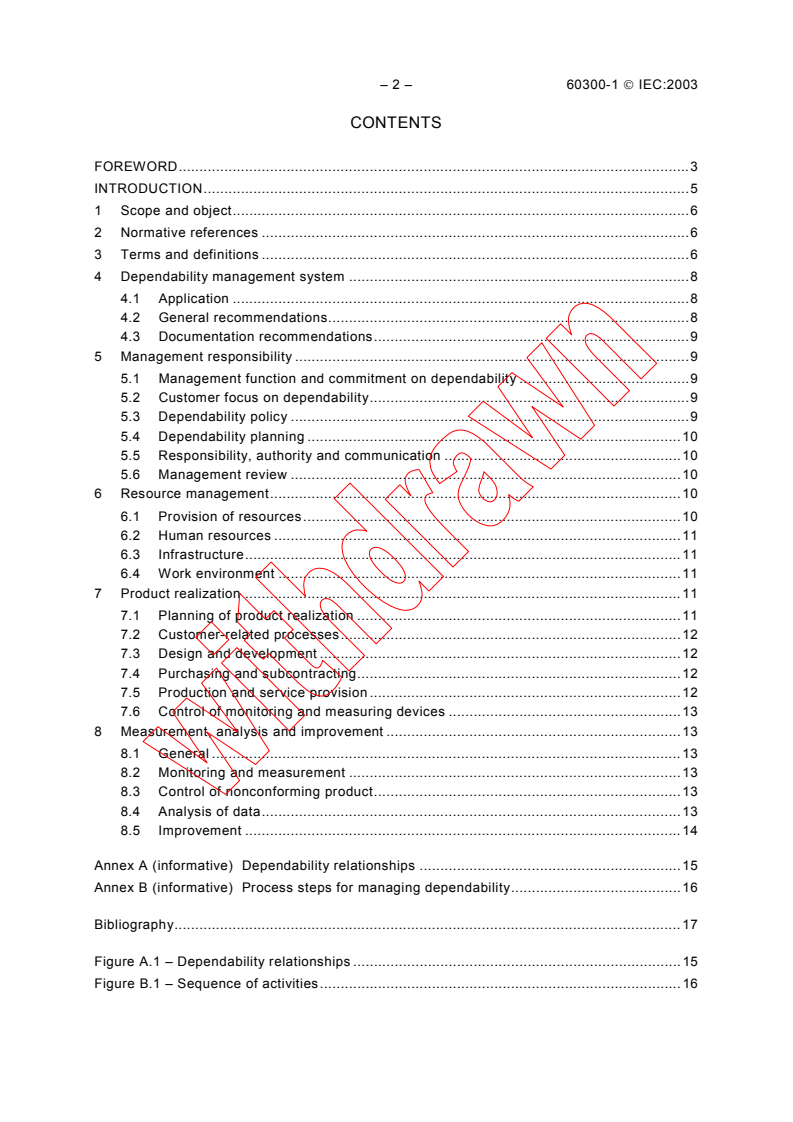
CONTENTS
FOREWORD . 3
INTRODUCTION .5
1 Scope and object . 6
2 Normative references. 6
3 Terms and definitions . 6
4 Dependability management system. 8
4.1 Application. 8
4.2 General recommendations . 8
4.3 Documentation recommendations . 9
5 Management responsibility. 9
5.1 Management function and commitment on dependability. 9
5.2 Customer focus on dependability . 9
5.3 Dependability policy. 9
5.4 Dependability planning .10
5.5 Responsibility, authority and communication.10
5.6 Management review.10
6 Resource management .10
6.1 Provision of resources .10
6.2 Human resources .11
6.3 Infrastructure .11
6.4 Work environment.11
7 Product realization.11
7.1 Planning of product realization.11
7.2 Customer-related processes .12
7.3 Design and development .12
7.4 Purchasing and subcontracting .12
7.5 Production and service provision .12
7.6 Control of monitoring and measuring devices.13
8 Measurement, analysis and improvement .13
8.1 General .13
8.2 Monitoring and measurement.13
8.3 Control of nonconforming product .13
8.4 Analysis of data .13
8.5 Improvement.14
Annex A (informative) Dependability relationships.15
Annex B (informative) Process steps for managing dependability .16
Bibliography.17
Figure A.1 – Dependability relationships .15
Figure B.1 – Sequence of activities .16
60300-1 IEC:2003(E) – 3 –
INTERNATIONAL ELECTROTECHNICAL COMMISSION
____________
DEPENDABILITY MANAGEMENT –
Part 1: Dependability management systems
FOREWORD
1) The IEC (International Electrotechnical Commission) is a worldwide organization for standardization comprising
all national electrotechnical committees (IEC National Committees). The object of the IEC is to promote
international co-operation on all questions concerning standardization in the electrical and electronic fields. To
this end and in addition to other activities, the IEC publishes International Standards. Their preparation is
entrusted to technical committees; any IEC National Committee interested in the subject dealt with may
participate in this preparatory work. International, governmental and non-governmental organizations liaising
with the IEC also participate in this preparation. The IEC collaborates closely with the International
Organization for Standardization (ISO) in accordance with conditions determined by agreement between the
two organizations.
2) The formal decisions or agreements of the IEC on technical matters express, as nearly as possible, an
international consensus of opinion on the relevant subjects since each technical committee has representation
from all interested National Committees.
3) The documents produced have the form of recommendations for international use and are published in the form
of standards, technical specifications, technical reports or guides and they are accepted by the National
Committees in that sense.
4) In order to promote international unification, IEC National Committees undertake to apply IEC International
Standards transparently to the maximum extent possible in their national and regional standards. Any
divergence between the IEC Standard and the corresponding national or regional standard shall be clearly
indicated in the latter.
5) The IEC provides no marking procedure to indicate its approval and cannot be rendered responsible for any
equipment declared to be in conformity with one of its standards.
6) Attention is drawn to the possibility that some of the elements of this International Standard may be the subject
of patent rights. The IEC shall not be held responsible for identifying any or all such patent rights.
International Standard IEC 60300-1 has been prepared by IEC technical committee 56:
Dependability.
This second edition cancels and replaces the first edition, published in 1993, and constitutes
a technical revision.
The main changes with respect to the previous edition are listed below.
– Dependability management system seen as part of the organization’s overall management
system.
– Structural and terminological alignment with ISO 9000:2000 standards.
– Focus on systems.
The text of this standard is based on the following documents:
FDIS Report on voting
56/856/FDIS 56/861/RVD
Full information on the voting for the approval of this standard can be found in the report on
voting indicated in the above table.
This publication has been drafted in accordance with the ISO/IEC Directives, Part 2.
– 4 – 60300-1 IEC:2003(E)
The committee has decided that the contents of this publication will remain unchanged until 2010.
At this date, the publication will be
• reconfirmed;
• withdrawn;
• replaced by a revised edition, or
• amended.
60300-1 IEC:2003(E) – 5 –
INTRODUCTION
Dependability is a key decision factor in today’s global business environment. Dependability
affects product costs and processes. It is an inherent product design property influencing
product performance. A dependable product is achieved through the implementation of
dependability disciplines in the early concept and design phases of the product life cycle to
provide cost-effective product operations. Like other technical and engineering disciplines,
dependability needs to be managed in order to deliver high-value products to customers. In the
broadest sense, dependability reflects user confidence in fitness for use by attaining satisfaction
in product performance capability, delivering service availability upon demand, and minimizing
the costs associated with the acquisition and ownership throughout the life cycle.
Dependability is the collective term describing the availability performance of any simple to
complex product. The factors influencing the availability performance of a product are the
reliability and maintainability design characteristics and the maintenance support perform-
ance. Annex A provides the dependability relationships. In many products, reliability,
maintainability, and availability rank amongst the dominant performance characteristics of
importance to the customers seeking cost-effective operation. Reliability and maintainability
are performance characteristics inherent in the product design. Maintenance support is
external to the product, and will affect its dependability. Maintenance support performance
reflects the ability of the maintenance organization to provide the necessary resources to
sustain a level of maintenance support effort to achieve system availability performance
objectives.
This part of IEC 60300 provides general guidelines in establishing a dependability manage-
ment system to meet most organization or project needs. The structure of the referenced
dependability standards follows a “tool-box” concept. The recommendations are non-
prescriptive to facilitate tailoring and effective implementation of dependability disciplines in
management. The top-level dependability management standard IEC 60300-1 is supported by
IEC 60300-2 providing references to application guidelines and methods. This “tool-box”
concept helps standards users locate specific dependability application guidelines and
relevant methods to accomplish their respective project objectives.
This standard encourages innovation and flexibility in management and design for product
optimization with known constraints and technology limitations. It is aligned with
ISO 9001:2000 and ISO 9004:2000 Quality Management Systems (QMS) structure to facilitate
incorporation of dependability activities in the overall management system. Dependability
activities complement QMS processes to achieve the desired levels of reliability,
maintainability, and maintenance support performance of products. The alignment of
IEC 60300-1 to ISO 9001:2000 and ISO 9004:2000 is necessary to link specific dependability
recommendations to relevant QMS processes. The major clauses in IEC 60300-1 are cross-
referencing ISO 9001:2000 and ISO 9004:2000 although some clause headings may not be
exactly the same. They address similar quality topics from a dependability perspective.
– 6 – 60300-1 IEC:2003(E)
DEPENDABILITY MANAGEMENT –
Part 1: Dependability management systems
1 Scope and object
This part of IEC 60300 describes the concepts and principles of dependability management
systems. It identifies the generic processes in dependability for planning, resource allocation,
control, and tailoring necessary to meet dependability objectives.
This standard deals with the dependability performance issues in the product life-cycle
phases concerning planning, design, measurements, analysis and improvement. Depend-
ability includes availability performance and its influencing factors: reliability performance,
maintainability performance, and maintenance support performance.
The object of this standard is to facilitate co-operation by all parties concerned (supplier,
organization and customer) and foster understanding of the dependability needs and value to
achieve the overall dependability objectives.
2 Normative references
The following referenced documents are indispensable for the application of this document.
For dated references, only the edition cited applies. For undated references, the latest edition
of the referenced document (including any amendments) applies.
IEC 60300-2, Dependability management – Part 2: Guidelines for dependability programme
management
ISO 9000:2000, Quality management systems – Fundamentals and vocabulary
ISO 9001:2000, Quality management systems – Requirements
ISO 9004:2000, Quality management systems – Guidelines for performance improvements
3 Terms and definitions
For the purposes of this document, the following terms and definitions apply.
NOTE Certain terms come from IEC 60050(191) and, where this is the case, the concept from that publication is
referenced in square brackets after the definition. ISO 9000:2000 is used as referenced to quality vocabulary.
3.1
dependability
collective term used to describe the availability performance and its influencing factors:
reliability performance, maintainability performance and maintenance support performance
NOTE Dependability is used only for general descriptions in non-quantitative terms.
[IEC 60050, 191-02-03]
___________
Second edition to be published.
60300-1 IEC:2003(E) – 7 –
3.2
dependability management
coordinated activities to direct and control an organization with regard to dependability
NOTE Dependability management is part of an organization’s overall management.
3.3
dependability management system
management system to direct and control an organization with regard to dependability
NOTE 1 The dependability management system of an organization is part of its overall management system.
NOTE 2 The organizational structure, responsibilities, procedures, processes and resources used for managing
dependability are often referred to as dependability programme.
3.4
dependability plan
document setting out the specific dependability practices, resources and sequences of
activities relevant to a particular product, contract or project
3.5
product
result of a process
NOTE 1 There are four generic product categories, as follows:
– services (for example, transport);
– software (for example, computer program, dictionary);
– hardware (for example, engine mechanical part);
– processed materials (for example, lubricant).
Many products comprise elements belonging to different generic product categories. Whether the product is then
called service, software, hardware or processed material depends on the dominant element. For example the
offered product “automobile” consists of hardware (for example, tyres), processed materials (for example, fuel,
cooling liquid), software (for example, engine control software, driver's manual), and service (for example,
operating explanations given by the salesman).
NOTE 2 Service is the result of at least one activity necessarily performed at the interface between the supplier
and customer and is generally intangible. Provision of a service can involve, for example, the following:
– an activity performed on a customer-supplied tangible product (for example, automobile to be repaired);
– an activity performed on a customer-supplied intangible product (for example, the income statement needed to
prepare a tax return);
– the delivery of an intangible product (for example, the delivery of information in the context of knowledge
transmission);
– the creation of ambience for the customer (for example, in hotels and restaurants).
Software consists of information and is generally intangible and can be in the form of approaches, transactions or
procedures.
Hardware is generally tangible and its amount is a countable characteristic. Processed materials are generally
tangible and their amount is a continuous characteristic. Hardware and processed materials often are referred to as
goods.
NOTE 3 Quality assurance is mainly focused on intended product.
[ISO 9000, 3.4.2]
NOTE 4 In the context of dependability, a product may be simple (for example, a device, a software algorithm) or
complex (for example, a transportation system or an integrated network comprising of hardware, software and
human elements and support facilities and activities).
3.6
system
set of interrelated or interacting elements
[ISO 9000, 3.2.1]
NOTE 1 In the context of dependability, a system will have
– a defined purpose expressed in terms of intended functions;
– stated conditions of operation/use (191-01-12);
– defined boundaries.
NOTE 2 The structure of a system may be hierarchical.
– 8 – 60300-1 IEC:2003(E)
4 Dependability management system
4.1 Application
This standard is applicable for organizations wishing to establish and maintain a dependability
management system. It provides generic guidance for effective dependability management of
products, which may consist of a combination of hardware, software, and human interactions
and support activities. The objective is to ensure achievement of the dep
...
IEC 60300-1 ®
Edition 2.0 2003-06
INTERNATIONAL
STANDARD
NORME
INTERNATIONALE
Dependability management –
Part 1: Dependability management systems
Gestion de la sûreté de fonctionnement –
Partie 1: Gestion du programme de sûreté de fonctionnement
All rights reserved. Unless otherwise specified, no part of this publication may be reproduced or utilized in any form
or by any means, electronic or mechanical, including photocopying and microfilm, without permission in writing from
either IEC or IEC's member National Committee in the country of the requester.
If you have any questions about IEC copyright or have an enquiry about obtaining additional rights to this publication,
please contact the address below or your local IEC member National Committee for further information.
Droits de reproduction réservés. Sauf indication contraire, aucune partie de cette publication ne peut être reproduite ni
utilisée sous quelque forme que ce soit et par aucun procédé, électronique ou mécanique, y compris la photocopie et les
microfilms, sans l'accord écrit de la CEI ou du Comité national de la CEI du pays du demandeur.
Si vous avez des questions sur le copyright de la CEI ou si vous désirez obtenir des droits supplémentaires sur cette
publication, utilisez les coordonnées ci-après ou contactez le Comité national de la CEI de votre pays de résidence.
IEC Central Office Tel.: +41 22 919 02 11
3, rue de Varembé Fax: +41 22 919 03 00
CH-1211 Geneva 20 info@iec.ch
Switzerland www.iec.ch
About the IEC
The International Electrotechnical Commission (IEC) is the leading global organization that prepares and publishes
International Standards for all electrical, electronic and related technologies.
About IEC publications
The technical content of IEC publications is kept under constant review by the IEC. Please make sure that you have the
latest edition, a corrigenda or an amendment might have been published.
Useful links:
IEC publications search - www.iec.ch/searchpub Electropedia - www.electropedia.org
The advanced search enables you to find IEC publications The world's leading online dictionary of electronic and
by a variety of criteria (reference number, text, technical electrical terms containing more than 30 000 terms and
committee,…). definitions in English and French, with equivalent terms in
It also gives information on projects, replaced and additional languages. Also known as the International
withdrawn publications. Electrotechnical Vocabulary (IEV) on-line.
IEC Just Published - webstore.iec.ch/justpublished Customer Service Centre - webstore.iec.ch/csc
Stay up to date on all new IEC publications. Just Published If you wish to give us your feedback on this publication
details all new publications released. Available on-line and or need further assistance, please contact the
also once a month by email. Customer Service Centre: csc@iec.ch.
A propos de la CEI
La Commission Electrotechnique Internationale (CEI) est la première organisation mondiale qui élabore et publie des
Normes internationales pour tout ce qui a trait à l'électricité, à l'électronique et aux technologies apparentées.
A propos des publications CEI
Le contenu technique des publications de la CEI est constamment revu. Veuillez vous assurer que vous possédez
l’édition la plus récente, un corrigendum ou amendement peut avoir été publié.
Liens utiles:
Recherche de publications CEI - www.iec.ch/searchpub Electropedia - www.electropedia.org
La recherche avancée vous permet de trouver des Le premier dictionnaire en ligne au monde de termes
publications CEI en utilisant différents critères (numéro de électroniques et électriques. Il contient plus de 30 000
référence, texte, comité d’études,…). termes et définitions en anglais et en français, ainsi que
Elle donne aussi des informations sur les projets et les les termes équivalents dans les langues additionnelles.
publications remplacées ou retirées. Egalement appelé Vocabulaire Electrotechnique
International (VEI) en ligne.
Just Published CEI - webstore.iec.ch/justpublished
Service Clients - webstore.iec.ch/csc
Restez informé sur les nouvelles publications de la CEI.
Just Published détaille les nouvelles publications parues. Si vous désirez nous donner des commentaires sur
Disponible en ligne et aussi une fois par mois par email. cette publication ou si vous avez des questions
contactez-nous: csc@iec.ch.
IEC 60300-1 ®
Edition 2.0 2003-06
INTERNATIONAL
STANDARD
NORME
INTERNATIONALE
Dependability management –
Part 1: Dependability management systems
Gestion de la sûreté de fonctionnement –
Partie 1: Gestion du programme de sûreté de fonctionnement
INTERNATIONAL
ELECTROTECHNICAL
COMMISSION
COMMISSION
ELECTROTECHNIQUE
PRICE CODE
INTERNATIONALE
CODE PRIX Q
ICS 03.100.40; 03.120.01; 21.020 ISBN 978-2-83220-665-2
– 2 – 60300-1 IEC:2003
CONTENTS
FOREWORD . 3
INTRODUCTION . 5
1 Scope and object . 6
2 Normative references . 6
3 Terms and definitions . 6
4 Dependability management system . 8
4.1 Application . 8
4.2 General recommendations . 8
4.3 Documentation recommendations . 9
5 Management responsibility . 9
5.1 Management function and commitment on dependability . 9
5.2 Customer focus on dependability . 9
5.3 Dependability policy . 9
5.4 Dependability planning . 10
5.5 Responsibility, authority and communication . 10
5.6 Management review . 10
6 Resource management . 10
6.1 Provision of resources . 10
6.2 Human resources . 11
6.3 Infrastructure . 11
6.4 Work environment . 11
7 Product realization . 11
7.1 Planning of product realization . 11
7.2 Customer-related processes . 12
7.3 Design and development . 12
7.4 Purchasing and subcontracting . 12
7.5 Production and service provision . 12
7.6 Control of monitoring and measuring devices . 13
8 Measurement, analysis and improvement . 13
8.1 General . 13
8.2 Monitoring and measurement . 13
8.3 Control of nonconforming product . 13
8.4 Analysis of data . 13
8.5 Improvement . 14
Annex A (informative) Dependability relationships . 15
Annex B (informative) Process steps for managing dependability . 16
Bibliography . 17
Figure A.1 – Dependability relationships . 15
Figure B.1 – Sequence of activities . 16
60300-1 IEC:2003 – 3 –
INTERNATIONAL ELECTROTECHNICAL COMMISSION
____________
DEPENDABILITY MANAGEMENT –
Part 1: Dependability management systems
FOREWORD
1) The IEC (International Electrotechnical Commission) is a worldwide organization for standardization comprising
all national electrotechnical committees (IEC National Committees). The object of the IEC is to promote
international co-operation on all questions concerning standardization in the electrical and electronic fields. To
this end and in addition to other activities, the IEC publishes International Standards. Their preparation is
entrusted to technical committees; any IEC National Committee interested in the subject dealt with may
participate in this preparatory work. International, governmental and non-governmental organizations liaising
with the IEC also participate in this preparation. The IEC collaborates closely with the International
Organization for Standardization (ISO) in accordance with conditions determined by agreement between the
two organizations.
2) The formal decisions or agreements of the IEC on technical matters express, as nearly as possible, an
international consensus of opinion on the relevant subjects since each technical committee has representation
from all interested National Committees.
3) The documents produced have the form of recommendations for international use and are published in the form
of standards, technical specifications, technical reports or guides and they are accepted by the National
Committees in that sense.
4) In order to promote international unification, IEC National Committees undertake to apply IEC International
Standards transparently to the maximum extent possible in their national and regional standards. Any
divergence between the IEC Standard and the corresponding national or regional standard shall be clearly
indicated in the latter.
5) The IEC provides no marking procedure to indicate its approval and cannot be rendered responsible for any
equipment declared to be in conformity with one of its standards.
6) Attention is drawn to the possibility that some of the elements of this International Standard may be the subject
of patent rights. The IEC shall not be held responsible for identifying any or all such patent rights.
International Standard IEC 60300-1 has been prepared by IEC technical committee 56:
Dependability.
This second edition cancels and replaces the first edition, published in 1993, and constitutes
a technical revision.
The main changes with respect to the previous edition are listed below.
– Dependability management system seen as part of the organization’s overall management
system.
– Structural and terminological alignment with ISO 9000:2000 standards.
– Focus on systems.
This bilingual version (2013-02) corresponds to the monolingual English version, published in
2003-06.
The text of this standard is based on the following documents:
FDIS Report on voting
56/856/FDIS 56/861/RVD
Full information on the voting for the approval of this standard can be found in the report on
voting indicated in the above table.
The French version of this standard has not been voted upon.
– 4 – 60300-1 IEC:2003
This publication has been drafted in accordance with the ISO/IEC Directives, Part 2.
The committee has decided that the contents of this publication will remain unchanged until
2010. At this date, the publication will be
• reconfirmed;
• withdrawn;
• replaced by a revised edition, or
• amended.
60300-1 IEC:2003 – 5 –
INTRODUCTION
Dependability is a key decision factor in today’s global business environment. Dependability
affects product costs and processes. It is an inherent product design property influencing
product performance. A dependable product is achieved through the implementation of
dependability disciplines in the early concept and design phases of the product life cycle to
provide cost-effective product operations. Like other technical and engineering disciplines,
dependability needs to be managed in order to deliver high-value products to customers. In
the broadest sense, dependability reflects user confidence in fitness for use by attaining
satisfaction in product performance capability, delivering service availability upon demand,
and minimizing the costs associated with the acquisition and ownership throughout the life
cycle.
Dependability is the collective term describing the availability performance of any simple to
complex product. The factors influencing the availability performance of a product are the
reliability and maintainability design characteristics and the maintenance support perform-
ance. Annex A provides the dependability relationships. In many products, reliability,
maintainability, and availability rank amongst the dominant performance characteristics of
importance to the customers seeking cost-effective operation. Reliability and maintainability
are performance characteristics inherent in the product design. Maintenance support is
external to the product, and will affect its dependability. Maintenance support performance
reflects the ability of the maintenance organization to provide the necessary resources to
sustain a level of maintenance support effort to achieve system availability performance
objectives.
This part of IEC 60300 provides general guidelines in establishing a dependability manage-
ment system to meet most organization or project needs. The structure of the referenced
dependability standards follows a “tool-box” concept. The recommendations are non-
prescriptive to facilitate tailoring and effective implementation of dependability disciplines in
management. The top-level dependability management standard IEC 60300-1 is supported by
IEC 60300-2 providing references to application guidelines and methods. This “tool-box”
concept helps standards users locate specific dependability application guidelines and
relevant methods to accomplish their respective project objectives.
This standard encourages innovation and flexibility in management and design for product
optimization with known constraints and technology limitations. It is aligned with
ISO 9001:2000 and ISO 9004:2000 Quality Management Systems (QMS) structure to facilitate
incorporation of dependability activities in the overall management system. Dependability
activities complement QMS processes to achieve the desired levels of reliability,
maintainability, and maintenance support performance of products. The alignment of
IEC 60300-1 to ISO 9001:2000 and ISO 9004:2000 is necessary to link specific dependability
recommendations to relevant QMS processes. The major clauses in IEC 60300-1 are cross-
referencing ISO 9001:2000 and ISO 9004:2000 although some clause headings may not be
exactly the same. They address similar quality topics from a dependability perspective.
– 6 – 60300-1 IEC:2003
DEPENDABILITY MANAGEMENT –
Part 1: Dependability management systems
1 Scope and object
This part of IEC 60300 describes the concepts and principles of dependability management
systems. It identifies the generic processes in dependability for planning, resource allocation,
control, and tailoring necessary to meet dependability objectives.
This standard deals with the dependability performance issues in the product life-cycle
phases concerning planning, design, measurements, analysis and improvement. Depend-
ability includes availability performance and its influencing factors: reliability performance,
maintainability performance, and maintenance support performance.
The object of this standard is to facilitate co-operation by all parties concerned (supplier,
organization and customer) and foster understanding of the dependability needs and value to
achieve the overall dependability objectives.
2 Normative references
The following referenced documents are indispensable for the application of this document.
For dated references, only the edition cited applies. For undated references, the latest edition
of the referenced document (including any amendments) applies.
IEC 60300-2, Dependability management – Part 2: Guidelines for dependability programme
management
ISO 9000:2000, Quality management systems – Fundamentals and vocabulary
ISO 9001:2000, Quality management systems – Requirements
ISO 9004:2000, Quality management systems – Guidelines for performance improvements
3 Terms and definitions
For the purposes of this document, the following terms and definitions apply.
NOTE Certain terms come from IEC 60050(191) and, where this is the case, the concept from that publication is
referenced in square brackets after the definition. ISO 9000:2000 is used as referenced to quality vocabulary.
3.1
dependability
collective term used to describe the availability performance and its influencing factors:
reliability performance, maintainability performance and maintenance support performance
NOTE Dependability is used only for general descriptions in non-quantitative terms.
[IEC 60050, 191-02-03]
___________
Second edition to be published.
60300-1 IEC:2003 – 7 –
3.2
dependability management
coordinated activities to direct and control an organization with regard to dependability
NOTE Dependability management is part of an organization’s overall management.
3.3
dependability management system
management system to direct and control an organization with regard to dependability
NOTE 1 The dependability management system of an organization is part of its overall management system.
NOTE 2 The organizational structure, responsibilities, procedures, processes and resources used for managing
dependability are often referred to as dependability programme.
3.4
dependability plan
document setting out the specific dependability practices, resources and sequences of
activities relevant to a particular product, contract or project
3.5
product
result of a process
NOTE 1 There are four generic product categories, as follows:
– services (for example, transport);
– software (for example, computer program, dictionary);
– hardware (for example, engine mechanical part);
– processed materials (for example, lubricant).
Many products comprise elements belonging to different generic product categories. Whether the product is then
called service, software, hardware or processed material depends on the dominant element. For example the
offered product “automobile” consists of hardware (for example, tyres), processed materials (for example, fuel,
cooling liquid), software (for example, engine control software, driver's manual), and service (for example,
operating explanations given by the salesman).
NOTE 2 Service is the result of at least one activity necessarily performed at the interface between the supplier
and customer and is generally intangible. Provision of a service can involve, for example, the following:
– an activity performed on a customer-supplied tangible product (for example, automobile to be repaired);
– an activity performed on a customer-supplied intangible product (for example, the income statement needed to
prepare a tax return);
– the delivery of an intangible product (for example, the delivery of information in the context of knowledge
transmission);
– the creation of ambience for the customer (for example, in hotels and restaurants).
Software consists of information and is generally intangible and can be in the form of approaches, transactions or
procedures.
Hardware is generally tangible and its amount is a countable characteristic. Processed materials are generally
tangible and their amount is a continuous characteristic. Hardware and processed materials often are referred to as
goods.
NOTE 3 Quality assurance is mainly focused on intended product.
[ISO 9000, 3.4.2]
NOTE 4 In the context of dependability, a product may be simple (for example, a device, a software algorithm) or
complex (for example, a transportation system or an integrated network comprising of hardware, software and
human elements and support facilities and activities).
3.6
system
set of interrelated or interacting elements
[ISO 9000, 3.2.1]
NOTE 1 In the context of dependability, a system will have
– a defined purpose expressed in terms of intended functions;
– stated conditions of operation/use (191-01-12);
– defined boundaries.
– 8 – 60300-1 IEC:2003
NOTE 2 The structure of a system may be hierarchical.
4 Dependability management system
4.1 Application
This standard is applicable for organizations wishing to establish and maintain a dependability
management system. It provides generic guidance for effective dependability management of
products, which may consist of a combination of hardware, software, and human interactions
and support activities. The objective is to ensure achievement of the dependability of the
product under consideration by addressing the essential dependability management processes.
These processes are generic and applicable to all organizations, life-cycle phases, and
contract situations, regardless of type, size and product provided.
It is recognized that, in certain circumstances, it may be inappropriate to include all the
clauses of this standard within a project or a contract. Accordingly, this standard should only
be considered as forming part of a contract – however that contract may be formed – if the
parties to that contract explicitly call upon and refer to this standard (or parts thereof) and
require it to be included within the contract.
This standard describes the fundamentals of dependability management systems and
provides general principles for organizations aiming to
a) establish a dependability management system to achieve product dependability
objectives;
b) determine the customer’s dependability needs and expectations and how to meet them;
c) assist in the development of dependability plans;
d) measure and improve the effectiveness of the dependability management system;
e) facilitate communications on dependability activities.
4.2 General recommendations
The organization should establish and maintain a dependability management system to direct
and control the dependability activities. The dependability management system of an
organization should be an integral part of its overall management system. Annex B provides
generic process steps for managing dependability.
The organization should
a) identify the dependability activities related to the needs of the organization’s business;
b) establish dependability objectives and plan product life-cycle phases as appropriate to
specific projects;
c) ensure timely implementation of relevant time-phased dependability activities during all
applicable project phases;
d) determine criteria and methods for dependability assessment, evaluation and acceptance
of the product;
e) provide available resources and information necessary to support product realization by
implementation of relevant dependability activities in projects;
f) monitor the dependability activities, and measure and analyse the results for continual
improvement;
g) encourage collaboration of process applications (design, product realization, service
provision, etc.) to maintain cost-effective operations;
h) promote supplier-organization-customer relationships to achieve overall project objectives
and customer satisfaction.
60300-1 IEC:2003 – 9 –
4.3 Documentation recommendations
The dependability management system documentation should include
a) documented statement of dependability policy and objectives;
b) dependability plans;
c) dependability methods relevant to the organization’s project or business;
d) dependability records.
5 Management responsibility
5.1 Management function and commitment on dependability
The management function on dependability should be identified. A dependability management
system should be an integral part of the overall management system. Specific management
roles and dependability objectives should be clarified in relation to quality and other technical
disciplines as necessary for the organization or project. This is to achieve business needs and
customer objectives, and continual improvement of the organization. The management
function on dependability should include
– strategic planning for dependability;
– definition of a suitable organizational structure, including definition of responsibilities and
authorities for dependability activities;
– allocation of dependability resources;
– communication of dependability objectives and the benefits arising out of the
dependability activities;
– identification of responsibilities and authorities for dependability management and
activities;
– establishment of dependability policy, programmes and associated processes;
– implementation and control of dependability activities;
– assessment of dependability performance results;
– continual improvements of product dependability;
– systematic review of above.
Top management should provide evidence of its commitment and involvement in the
dependability management system to ensure its effectiveness and continual improvement.
5.2 Customer focus on dependability
Top management should ensure that customer needs and expectations for dependability are
determined, understood, and met by focusing on the objective of enhancing customer
satisfaction. Supplier and customer dialogue should be sustained to ensure that dependability
problems are promptly resolved and the dependability of product is continually improved.
5.3 Dependability policy
Top management should establish a policy aimed at achievement of product dependability
objectives and customer value. The dependability policy may form part of the management
policy, or be incorporated in the quality policy.
– 10 – 60300-1 IEC:2003
5.4 Dependability planning
Top management should ensure that dependability planning is linked to the strategic business
plan and form part of the overall management plan. Dependability should be viewed as a key
business decision factor and technology enabler to deliver added value to customers. The
dependability plan should encompass customer feedback mechanisms to determine product
dependability performance. Dependability planning should examine some of the following
issues as appropriate:
– market needs and timing for dependability initiatives;
– dependability as a value-added attribute of products providing a market advantage or
leverage;
– interactions between dependability management and other management processes;
– dependability design trade-off to optimize cost-effective solutions;
– regulatory and contract stipulations affecting cost-effective dependability performance;
– dependability competence development and maintenance of the organization’s resources;
– retention of knowledge base and intellectual properties;
– dependability information dissemination and feedback mechanisms;
– implementation of dependability plan and strategy;
– social benefits and environmental impact.
5.5 Responsibility, authority and communication
Top management should ensure that the responsibilities and authorities for dependability are
defined, communicated, and provided with sufficient resources. Specific dependability
functions and assignments to projects should be identified, and their interrelation with quality
and other technical disciplines should be communicated within the organization.
Where necessary, the role of a management representative for dependability issues should be
designated to ensure customer needs and expectations on dependability are adequately
addressed. Internal and external communications on dependability issues should be identified
as part of the dependability planning process.
5.6 Management review
The dependability management system should be reviewed regularly to ensure its continuing
suitability, adequacy, and effectiveness. Management review may be combined with other
continual improvement activities. Top management should conduct the management review to
determine if the organization’s dependability policy and objectives are met. Relevant
dependability information should be made available at the management review meetings for
decision-making. Recommendations on dependability improvements and proposed changes in
the dependability management system should be presented for the review. Decision and
action items resulting from the management review meetings should be recorded for
reference and follow-up.
6 Resource management
6.1 Provision of resources
The organization should determine and provide the resources needed:
a) to implement and maintain the dependability management system and continually improve
its effectiveness;
b) to achieve and enhance customer satisfaction by meeting customer needs and
expectations on dependability.
60300-1 IEC:2003 – 11 –
6.2 Human resources
Personnel assigned to dependability projects or performing specific dependability activities
should be competent, based on appropriate education, training, skills and experience.
Personnel responsible for dependability should be encouraged and provided with the
opportunity to continuously improve their knowledge and competence through training and
education. Their dependability knowledge and competence should be kept current and up-to-
date to enable adaptation to business and market changes. A human resource review process
should be in place to determine the need for appropriate competence enhancement, personal
development, and to prepare the employees for assuming additional responsibilities.
6.3 Infrastructure
The organization should determine, provide and maintain the infrastructure needed to achieve
long-term dependability goals and short-term project objectives reflecting the organization’s
dependability policy.
Infrastructure includes, for example,
a) workplace, facilities and utilities to support dependability activities;
b) information systems to facilitate dependability data capture, dissemination and archiving,
and use of data;
c) security systems to protect information and intellectual properties;
d) processes for contracting out non-core support activities.
6.4 Work environment
The organization should establish and maintain a work environment to encourage continual
learning, leadership training and team building, and continual process improvement according
to the organization’s business needs. Dependability as a key business factor should be taken
into consideration in the work environment.
7 Product realization
7.1 Planning of product realization
The organization should plan and develop the processes affecting dependability consistent
with the product objectives or specification. Appropriate dependability activities should be
implemented in each product life-cycle phase. These should be integrated with other elements
of the product development and production processes and the operational activities of the
organization for cohesive project effort. The extent and contents of a dependability plan
should be governed by the particular needs of the project. This content includes the specific
constraints and the criticality of dependability application of the actual product.
NOTE Guidance for developing a dependability plan is provided in IEC 60300-2.
In planning for product realization, the organization should determine where appropriate:
a) the dependability objectives for the product;
b) the methods and processes to be applied to meet the dependability objectives;
c) the need to establish specific processes affecting dependability due to technology
limitations and application constraints;
d) the verification and validation methods and relevant criteria for product dependability
evaluation and acceptance;
e) the need for dependability documentation and records.
– 12 – 60300-1 IEC:2003
7.2 Customer-related processes
The organization should determine
a) the dependability needs and objectives in conjunction with the customer reflecting the
market or business strategy;
b) the statutory and regulatory requirements governing the use and applications of the
product;
c) the expected end-use conditions and application environments affecting the dependability
performance of the product.
The organization should ensure that dependability objectives are defined and the organi-
zation’s ability in meeting those objectives is assessed. A dependability review process
should be put in place and reviews conducted at specific product life-cycle phases to facilitate
evaluation and acceptance of the product.
Dependability records should be maintained for product validation and acceptance. Relevant
information associated with the product dependability should be communicated to the
customer on a timely basis. Customer feedback on dependability issues should be reviewed
for problem resolution and continual improvement. Customers should be advised of any
planned product discontinuance.
7.3 Design and development
The organization should plan and control the design and development activities affecting
dependability of the product. Design inputs and outputs should be reviewed, evaluated and
records maintained. Design changes or modifications should be controlled. Dependability
issues impacting production, service operations, maintenance support, and product disposal
or possible reuse should be identified, documented and resolved as early as possible. Project
risk assessment and life-cycle cost analysis should be initiated where applicable and
appropriate to ensure dependability performance is optimized with given life-cycle cost
constraints.
7.4 Purchasing and subcontracting
The organization should ensure that purchased and subcontracted product conforms to
specified dependability criteria. Supplier selection should be initiated. Supplier qualification
should form part of the purchasing and subcontracting process. Where necessary, relevant
dependability data and history of the product should be obtained and assessed to validate
that its dependability could meet end-use environment. Supplier communications should be
established to ensure a collaborative effort and sharing of dependability information relating to
the purchased and subcontracted product.
7.5 Production and service provision
The organization should plan its production and service provision processes for control of
dependability performance. Where applicable, dependability testing and validation of the
product at specific stages of assembly and product integration should be conducted to ensure
product conformance prior to release or delivery. Product identification should be initiated
where appropriate for control of product versions to ensure product traceability. The
organization should establish a supply-chain management process to facilitate procurement,
and contracting of the project work. Where applicable, customer property should be identified
and protected against damage, misuse or loss. All incidents related to the customer property
should be reported to the customer for action and resolution on a timely basis. Where the
product has degradation or shelf-life limitation, a preservation process should be initiated to
monitor and record its status and conditions.
60300-1 IEC:2003 – 13 –
7.6 Control of monitoring and measuring devices
Dependability testing and measurement relies on the accuracy of instrumentation and
measuring devices. The organization should establish processes as part of the QMS for
control and calibration of monitoring and measuring devices. Primary test equipment and
software test algorithms for product dependability evaluation and performance validation
should be calibrated and traceable to established standards. Calibration records for
monitoring and measuring equipment should be maintained.
8 Measurement, analysis and improvement
8.1 General
The organization should plan and implement processes to monitor, measure, analyse and
improve the effectiveness of the organization's dependability management system and the
dependability of its products. Early focus on design for dependability should be initiated as
appropriate to the product life-cycle phases.
NOTE Guidance for quality management system performance improvement is provided in ISO 9004. Guidance for
product dependability improvement is provided in IEC 60300-2.
8.2 Monitoring and measurement
The organization should initiate processes for
a) determining customer satisfaction by monitoring customer feedback and complaints;
b) validating the status and effectiveness of the dependability plan by suitable assessment or
survey methods;
c) measuring the product performance for acceptance at various phases of the product life
cycle to determine design adequacy, yield and throughput, effectiveness in operation and
maintenance, as well as efficiency in logistic support. Typical product performance data
needed for dependability assessment include the following:
– system configuration;
– reliability evaluation and verification;
– systems integration test results;
– product acceptance records;
– system operational records on failures, malfunction, or degradation;
– maintenance service records;
– logistics support.
8.3 Control of nonconforming product
The organization should establish a process for controlling nonconforming product.
Nonconforming products such as products with excessive early failures, design defects, or
abnormal wear-out should be identified and controlled for dependability management review
and resolution.
8.4 Analysis of data
The organization should establish a process for data collection, analysis and reporting. The
analysed data should be interpreted to provide information on items such as customer
satisfaction, supplier quality, product dependability, performance trends and corrective/
preventive action recommendations as appropriate.
Dependability analysis results should be documented and used to support management
decisions on projects.
– 14 – 60300-1 IEC:2003
8.5 Improvement
The organization should continually improve the effectiveness of the dependability manage-
ment system through implementation of dependability policy and strategic plans, use of
suitable assessment or survey methods and the analysis of relevant dependability data,
management of nonconformity through preventive and corrective actions and review
processes. Improvement records should be maintained to establish trends.
60300-1 IEC:2003 – 15 –
Annex A
(informative)
Dependability relationships
Dependability
Availability
performance
Maintenance
Maintainability
Reliability
support
performance
performance
performance
IEC 1748/03
Figure A.1 – Dependability relationships
Dependability is a collective term used to describe the availability performance and its
influencing factors: reliability performance, maintainability performance and maintenance
support performance.
Availability performance is the ability of an item to be in a state to perform a required
function under given conditions at a given instant of time or over a given time interval,
assuming that the required external resources are provided [see IEV 191-02-05].
Reliability performance is the ability of an item to perform a required function under given
conditions for a given time interval [see IEV 191-02-06].
Maintainability performance is the ability of an item under given conditions of use, to be
retained in, or restored to a state in which it can perform a required function, when
maintenance is performed under given conditions and using stated procedures and resources
[see IEV 191-02-07].
Maintenance support performance is the ability of a maintenance organization, under given
conditions, to provide upon demand, the resources required to maintain an item, under a
given maintenance policy [see IEV 191-02-08].
– 16 – 60300-1 IEC:2003
Annex B
(informative)
Process steps for managing dependability
1. Define dependability objectives
2. Analyse scope of dependability
work needed and implications
3. Plan strategy and activities to
achieve dependability objectives
4. Implement selected
dependability activities
Analyse results of dependability
5.
activities implemented
6. Evaluate achieved dependability
results for further improvement
IEC 1749/03
Figure B.1 – Sequence of activities
The process steps for managing dependability consist of a sequence of activities that could
be applied to any phase of a product life cycle. The feedback loop to the various process
steps permits continual improvement where appropriate.
A product life cycle consists of the following phases:
– concept and definition;
– design and development;
– manufacturing;
– installation;
– operation and maintenance;
– disposal.
NOTE Applicable dependability standards to each process step are provided in IEC 60300-2.
60300-1 IEC:2003 – 17 –
Bibliography
IEC 60050-191:1990, International Electrotechnical Vocabulary (IEV) – Chapter 191:
Dependability and quality of service
___________
– 18 – 60300-1 CEI:2003
SOMMAIRE
AVANT-PROPOS . 19
INTRODUCTION . 21
1 Dom
...