

IEC TR 62258-3:2010
(Main)Semiconductor die products - Part 3: Recommendations for good practice in handling, packing and storage
General Information
- Abstract
IEC/TR 62258-3:2010 has been developed to facilitate the production, supply and use of semiconductor die products, including:
- wafers,
- singulated bare die,
- die and wafers with attached connection structures,
- and minimally or partially encapsulated die and wafers. This report contains suggested good practice for the handling, packing and storage of die products. Success in manufacture of electronic assemblies containing die products is enhanced by attention to handling, storage and environmental conditions. This report provides guidelines taken from industry experience and is especially useful to those integrating die products into assemblies for the first time. It is also intended as an aid to setting up and auditing facilities that handle or use bare die products, from wafer fabrication to final assembly. This edition includes the following significant technical changes with respect to the previous edition.
1. Special requirements have been added throughout the document for optical die, where applicable. For example see 4.3 paragraph 4 and 10.1.3 paragraph 3.
2. The following new subclauses have been added:
- 4.4.6 ESD Guidelines
- 5.1 Wafer thinning
3. Subclause 5.2 (Singulation or die separation) has been renamed from the previous Subclause 5.1 (Wafer sawing) and has been expanded to included other methods of singulation or sawing, including:
- 5.2.2 Wafer scribing
- 5.2.3 Laser cutting
- 5.2.4 Dice before grind (DBG)
4. Subclause 5.3.7 (previous edition Subclause 5.2.7) has been changed to include optical and microwave die.
5. In Subclause 6.3, the Subclause 6.3.2 (Specialised wafer tubs) has been added to include wafer taubs specially handle and ship wafers that have not been singulated.
6. Two new Subclauses have been to Clause 6:
- 6.9 Handling and packing of thinned die or wafers
- 6.10 Packing materials and their reuse
7. A new subclause has been added to Subclause 9.6:
- 9.6.3 Use of packing material having sacrificial properties
8. Annex A (Planning checklist) has been updated throughout.
9. In Annex B (Material specifications) a new Subclause has been added:
- B.5 Adhesive gel tray material specifications.
- Status
- Published
- Publication Date
- 05-Aug-2010
- Technical Committee
- TC 47 - Semiconductor devices
- Drafting Committee
- WG 3 - TC 47/WG 3
- Current Stage
- PPUB - Publication issued
- Start Date
- 06-Aug-2010
- Completion Date
- 31-Oct-2010
Overview
IEC TR 62258-3:2010, published by the International Electrotechnical Commission (IEC), provides comprehensive recommendations for good practices in handling, packing, and storage of semiconductor die products. The scope covers various die forms including wafers, singulated bare die, die and wafers with attached connection structures, and partially encapsulated die and wafers. This technical report is essential for manufacturers, suppliers, and assemblers aiming to optimize the quality and reliability of electronic assemblies containing semiconductor dies.
The document emphasizes proper environmental controls, handling protocols, and packaging solutions to minimize damage and contamination risks. It also introduces updated guidelines reflecting industry advancements such as special requirements for optical die, ESD precautions, advanced singulation methods, and storage material specifications. IEC TR 62258-3 serves as a vital resource for first-time integrators and established operations to ensure consistent die product quality throughout production and storage phases.
Key Topics
- Handling Best Practices: Guidelines for safe and effective handling of semiconductor dies including cleanroom protocols, operator attire, tool usage, and electrostatic discharge (ESD) prevention measures.
- Advanced Singulation Methods: Expanded coverage of wafer singulation techniques such as wafer sawing, scribing, laser cutting, and Dice Before Grind (DBG) processes, with advice on mounting and drying procedures.
- Die Sorting and Removal: Techniques for sorting and removing die from wafers or carriers, addressing handling concerns for sensitive die types like MEMS and optical components.
- Packaging Solutions: Detailed recommendations for transport and storage media including wafer carriers, specialised wafer tubs, film frames, grip rings, waffle packs, vacuum-release trays, gel trays, and tape-and-reel systems.
- Storage Environment Controls: Guidance on short-term and long-term storage conditions, highlighting environmental parameters like temperature, humidity, inert atmosphere purity, and contamination control.
- Traceability Measures: Best practices for maintaining traceability of wafers and die products through marking, labeling, and documentation to ensure quality assurance and process integrity.
- Automated Handling Guidelines: Recommendations for automated die handling during assembly lines, focusing on safe removal techniques and contamination prevention.
Applications
IEC TR 62258-3:2010 is highly valuable for:
- Semiconductor Manufacturers: To implement consistent handling and storage protocols enhancing die yield and product reliability.
- Assembly Integrators: Particularly those new to working with bare die products, as it provides a roadmap for minimizing electrostatic damage, contamination, and mechanical stresses.
- Quality Assurance Teams: For auditing facilities and enforcing standards that reduce die defects associated with improper packing or environmental exposure.
- Packaging and Logistics Providers: Offering insight into specialized containers and materials that safeguard die during transport and storage.
- R&D and Process Engineers: To optimize wafer singulation and thinning processes while preventing mechanical or chemical damage.
- Inventory Management: Supporting best practices for die banking with an emphasis on long-term storage stability and periodic qualification.
Related Standards
- IEC 61340 Series: For electrostatic discharge (ESD) control practices critical to semiconductor handling environments.
- IEC 60068 Series: Environmental testing standards addressing storage and transport conditions affecting electronic components.
- JEDEC Standards: Widely recognized for packaging and handling semiconductor devices including trays, tapes, and reels.
- ISO 14644: Cleanroom classification standards supporting contamination control during die processing.
- ANSI/ESD S20.20: Provides requirements for ESD control programs in electronic manufacturing environments.
Adhering to IEC TR 62258-3:2010 ensures optimized handling, packing, and storage protocols for semiconductor die products, directly impacting product quality, reliability, and manufacturing efficiency. Organizations engaged in semiconductor production and assembly can leverage these expert recommendations to reduce damage risks and streamline supply chain integrity.
Relations
- Effective Date
- 10-Feb-2026
- Effective Date
- 05-Sep-2023
Frequently Asked Questions
IEC TR 62258-3:2010 is a technical report published by the International Electrotechnical Commission (IEC). Its full title is "Semiconductor die products - Part 3: Recommendations for good practice in handling, packing and storage". This standard covers: IEC/TR 62258-3:2010 has been developed to facilitate the production, supply and use of semiconductor die products, including: - wafers, - singulated bare die, - die and wafers with attached connection structures, - and minimally or partially encapsulated die and wafers. This report contains suggested good practice for the handling, packing and storage of die products. Success in manufacture of electronic assemblies containing die products is enhanced by attention to handling, storage and environmental conditions. This report provides guidelines taken from industry experience and is especially useful to those integrating die products into assemblies for the first time. It is also intended as an aid to setting up and auditing facilities that handle or use bare die products, from wafer fabrication to final assembly. This edition includes the following significant technical changes with respect to the previous edition. 1. Special requirements have been added throughout the document for optical die, where applicable. For example see 4.3 paragraph 4 and 10.1.3 paragraph 3. 2. The following new subclauses have been added: - 4.4.6 ESD Guidelines - 5.1 Wafer thinning 3. Subclause 5.2 (Singulation or die separation) has been renamed from the previous Subclause 5.1 (Wafer sawing) and has been expanded to included other methods of singulation or sawing, including: - 5.2.2 Wafer scribing - 5.2.3 Laser cutting - 5.2.4 Dice before grind (DBG) 4. Subclause 5.3.7 (previous edition Subclause 5.2.7) has been changed to include optical and microwave die. 5. In Subclause 6.3, the Subclause 6.3.2 (Specialised wafer tubs) has been added to include wafer taubs specially handle and ship wafers that have not been singulated. 6. Two new Subclauses have been to Clause 6: - 6.9 Handling and packing of thinned die or wafers - 6.10 Packing materials and their reuse 7. A new subclause has been added to Subclause 9.6: - 9.6.3 Use of packing material having sacrificial properties 8. Annex A (Planning checklist) has been updated throughout. 9. In Annex B (Material specifications) a new Subclause has been added: - B.5 Adhesive gel tray material specifications.
IEC/TR 62258-3:2010 has been developed to facilitate the production, supply and use of semiconductor die products, including: - wafers, - singulated bare die, - die and wafers with attached connection structures, - and minimally or partially encapsulated die and wafers. This report contains suggested good practice for the handling, packing and storage of die products. Success in manufacture of electronic assemblies containing die products is enhanced by attention to handling, storage and environmental conditions. This report provides guidelines taken from industry experience and is especially useful to those integrating die products into assemblies for the first time. It is also intended as an aid to setting up and auditing facilities that handle or use bare die products, from wafer fabrication to final assembly. This edition includes the following significant technical changes with respect to the previous edition. 1. Special requirements have been added throughout the document for optical die, where applicable. For example see 4.3 paragraph 4 and 10.1.3 paragraph 3. 2. The following new subclauses have been added: - 4.4.6 ESD Guidelines - 5.1 Wafer thinning 3. Subclause 5.2 (Singulation or die separation) has been renamed from the previous Subclause 5.1 (Wafer sawing) and has been expanded to included other methods of singulation or sawing, including: - 5.2.2 Wafer scribing - 5.2.3 Laser cutting - 5.2.4 Dice before grind (DBG) 4. Subclause 5.3.7 (previous edition Subclause 5.2.7) has been changed to include optical and microwave die. 5. In Subclause 6.3, the Subclause 6.3.2 (Specialised wafer tubs) has been added to include wafer taubs specially handle and ship wafers that have not been singulated. 6. Two new Subclauses have been to Clause 6: - 6.9 Handling and packing of thinned die or wafers - 6.10 Packing materials and their reuse 7. A new subclause has been added to Subclause 9.6: - 9.6.3 Use of packing material having sacrificial properties 8. Annex A (Planning checklist) has been updated throughout. 9. In Annex B (Material specifications) a new Subclause has been added: - B.5 Adhesive gel tray material specifications.
IEC TR 62258-3:2010 is classified under the following ICS (International Classification for Standards) categories: 31.080.99 - Other semiconductor devices. The ICS classification helps identify the subject area and facilitates finding related standards.
IEC TR 62258-3:2010 has the following relationships with other standards: It is inter standard links to EN IEC 62435-4:2018, IEC TR 62258-3:2005. Understanding these relationships helps ensure you are using the most current and applicable version of the standard.
IEC TR 62258-3:2010 is available in PDF format for immediate download after purchase. The document can be added to your cart and obtained through the secure checkout process. Digital delivery ensures instant access to the complete standard document.
Standards Content (Sample)
IEC/TR 62258-3 ®
Edition 2.0 2010-08
TECHNICAL
REPORT
RAPPORT
TECHNIQUE
Semiconductor die products –
Part 3: Recommendations for good practice in handling, packing and storage
Produits à puces de semi-conducteurs –
Partie 3: Bonnes pratiques recommandées pour la manipulation, le
conditionnement et le stockage
IEC/TR 62258-3:2010
All rights reserved. Unless otherwise specified, no part of this publication may be reproduced or utilized in any form or by
any means, electronic or mechanical, including photocopying and microfilm, without permission in writing from either IEC or
IEC's member National Committee in the country of the requester.
If you have any questions about IEC copyright or have an enquiry about obtaining additional rights to this publication,
please contact the address below or your local IEC member National Committee for further information.
Droits de reproduction réservés. Sauf indication contraire, aucune partie de cette publication ne peut être reproduite
ni utilisée sous quelque forme que ce soit et par aucun procédé, électronique ou mécanique, y compris la photocopie
et les microfilms, sans l'accord écrit de la CEI ou du Comité national de la CEI du pays du demandeur.
Si vous avez des questions sur le copyright de la CEI ou si vous désirez obtenir des droits supplémentaires sur cette
publication, utilisez les coordonnées ci-après ou contactez le Comité national de la CEI de votre pays de résidence.
IEC Central Office
3, rue de Varembé
CH-1211 Geneva 20
Switzerland
Email: inmail@iec.ch
Web: www.iec.ch
About the IEC
The International Electrotechnical Commission (IEC) is the leading global organization that prepares and publishes
International Standards for all electrical, electronic and related technologies.
About IEC publications
The technical content of IEC publications is kept under constant review by the IEC. Please make sure that you have the
latest edition, a corrigenda or an amendment might have been published.
ƒ Catalogue of IEC publications: www.iec.ch/searchpub
The IEC on-line Catalogue enables you to search by a variety of criteria (reference number, text, technical committee,…).
It also gives information on projects, withdrawn and replaced publications.
ƒ IEC Just Published: www.iec.ch/online_news/justpub
Stay up to date on all new IEC publications. Just Published details twice a month all new publications released. Available
on-line and also by email.
ƒ Electropedia: www.electropedia.org
The world's leading online dictionary of electronic and electrical terms containing more than 20 000 terms and definitions
in English and French, with equivalent terms in additional languages. Also known as the International Electrotechnical
Vocabulary online.
ƒ Customer Service Centre: www.iec.ch/webstore/custserv
If you wish to give us your feedback on this publication or need further assistance, please visit the Customer Service
Centre FAQ or contact us:
Email: csc@iec.ch
Tel.: +41 22 919 02 11
Fax: +41 22 919 03 00
A propos de la CEI
La Commission Electrotechnique Internationale (CEI) est la première organisation mondiale qui élabore et publie des
normes internationales pour tout ce qui a trait à l'électricité, à l'électronique et aux technologies apparentées.
A propos des publications CEI
Le contenu technique des publications de la CEI est constamment revu. Veuillez vous assurer que vous possédez
l’édition la plus récente, un corrigendum ou amendement peut avoir été publié.
ƒ Catalogue des publications de la CEI: www.iec.ch/searchpub/cur_fut-f.htm
Le Catalogue en-ligne de la CEI vous permet d’effectuer des recherches en utilisant différents critères (numéro de référence,
texte, comité d’études,…). Il donne aussi des informations sur les projets et les publications retirées ou remplacées.
ƒ Just Published CEI: www.iec.ch/online_news/justpub
Restez informé sur les nouvelles publications de la CEI. Just Published détaille deux fois par mois les nouvelles
publications parues. Disponible en-ligne et aussi par email.
ƒ Electropedia: www.electropedia.org
Le premier dictionnaire en ligne au monde de termes électroniques et électriques. Il contient plus de 20 000 termes et
définitions en anglais et en français, ainsi que les termes équivalents dans les langues additionnelles. Egalement appelé
Vocabulaire Electrotechnique International en ligne.
ƒ Service Clients: www.iec.ch/webstore/custserv/custserv_entry-f.htm
Si vous désirez nous donner des commentaires sur cette publication ou si vous avez des questions, visitez le FAQ du
Service clients ou contactez-nous:
Email: csc@iec.ch
Tél.: +41 22 919 02 11
Fax: +41 22 919 03 00
IEC/TR 62258-3 ®
Edition 2.0 2010-08
TECHNICAL
REPORT
RAPPORT
TECHNIQUE
Semiconductor die products –
Part 3: Recommendations for good practice in handling, packing and storage
Produits à puces de semi-conducteurs –
Partie 3: Bonnes pratiques recommandées pour la manipulation, le
conditionnement et le stockage
INTERNATIONAL
ELECTROTECHNICAL
COMMISSION
COMMISSION
ELECTROTECHNIQUE
PRICE CODE
INTERNATIONALE
XA
CODE PRIX
ICS 31.080.99 ISBN 978-2-88912-138-0
– 2 – TR 62258-3 © IEC:2010
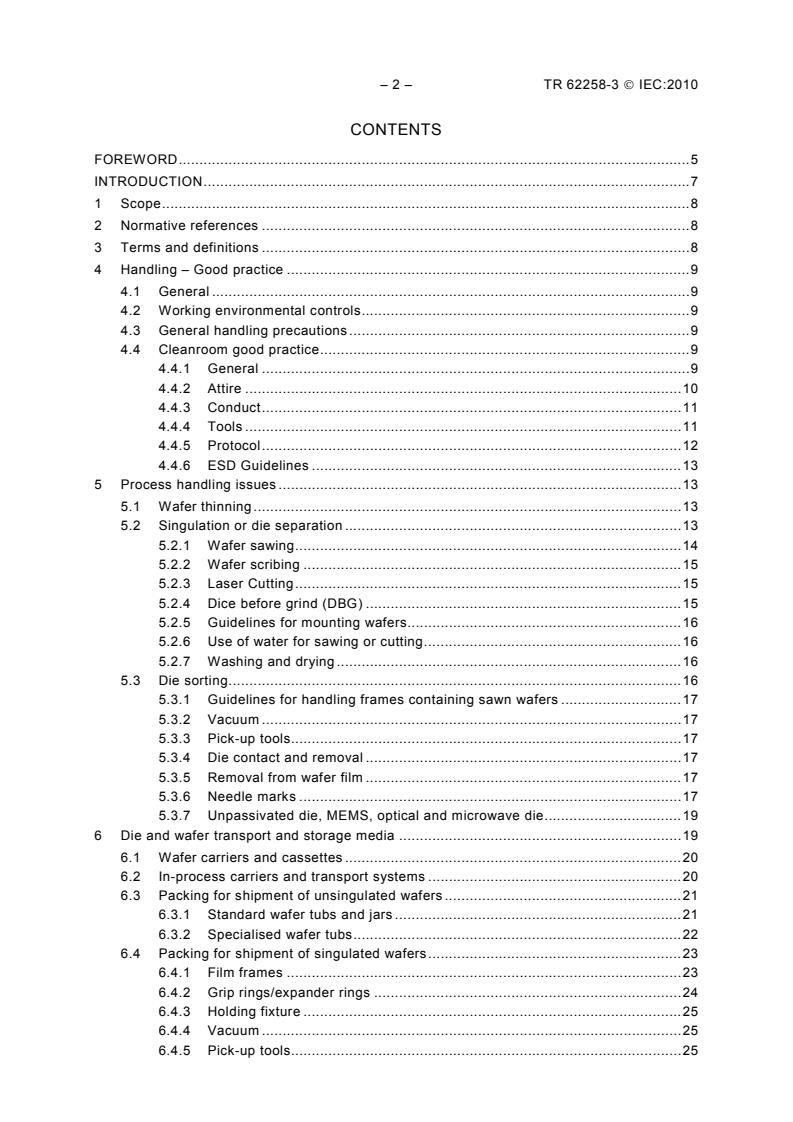
CONTENTS
FOREWORD.5
INTRODUCTION.7
1 Scope.8
2 Normative references .8
3 Terms and definitions .8
4 Handling – Good practice .9
4.1 General .9
4.2 Working environmental controls.9
4.3 General handling precautions.9
4.4 Cleanroom good practice.9
4.4.1 General .9
4.4.2 Attire .10
4.4.3 Conduct.11
4.4.4 Tools .11
4.4.5 Protocol.12
4.4.6 ESD Guidelines .13
5 Process handling issues .13
5.1 Wafer thinning.13
5.2 Singulation or die separation .13
5.2.1 Wafer sawing.14
5.2.2 Wafer scribing .15
5.2.3 Laser Cutting.15
5.2.4 Dice before grind (DBG) .15
5.2.5 Guidelines for mounting wafers.16
5.2.6 Use of water for sawing or cutting.16
5.2.7 Washing and drying .16
5.3 Die sorting.16
5.3.1 Guidelines for handling frames containing sawn wafers .17
5.3.2 Vacuum .17
5.3.3 Pick-up tools.17
5.3.4 Die contact and removal .17
5.3.5 Removal from wafer film .17
5.3.6 Needle marks .17
5.3.7 Unpassivated die, MEMS, optical and microwave die.19
6 Die and wafer transport and storage media .19
6.1 Wafer carriers and cassettes .20
6.2 In-process carriers and transport systems .20
6.3 Packing for shipment of unsingulated wafers .21
6.3.1 Standard wafer tubs and jars .21
6.3.2 Specialised wafer tubs.22
6.4 Packing for shipment of singulated wafers.23
6.4.1 Film frames .23
6.4.2 Grip rings/expander rings .24
6.4.3 Holding fixture .25
6.4.4 Vacuum .25
6.4.5 Pick-up tools.25
TR 62258-3 © IEC:2010 – 3 –
6.4.6 Die contact and removal .25
6.5 Packing for shipment of single wafers .26
6.5.1 Carriers .26
6.5.2 Vacuum bags.26
6.6 Packing for shipment of die using trays .26
6.6.1 Waffle packs.26
6.6.2 Vacuum release (VR) trays for die products.28
6.6.3 Gel trays for die products .30
6.6.4 Recommendations for die orientation in trays .30
6.6.5 Corner proctection of sensitive die.30
6.7 Packing for shipment of die using tape-and-reel .30
6.7.1 Embossed tape with cover tape .31
6.7.2 Punched tape with top and bottom cover tape .31
6.7.3 Adhesive-backed punched carrier tape (without cover tape) .31
6.7.4 Cover tape recommendations .32
6.7.5 Orientation of die in tape-and-reel .32
6.7.6 Tape-and-reel packing structure .32
6.8 Secondary packing for shipment.33
6.9 Handling and packing of thinned die or wafers.33
6.10 Packing materials and their reuse.33
7 Storage good practice .34
7.1 Die and wafer storage .34
7.2 Short-term storage environment and conditions.34
7.3 Storage time limitations .34
7.4 Singulated wafer on wafer frame or ring .35
7.5 Die products in the production area .35
7.6 Die in tape-and-reel.35
7.7 Dry-packed die products.35
8 Traceability good practice.35
8.1 General .35
8.2 Wafer traceability .35
8.3 Die products traceability.35
8.4 Wafer and die back side marking.36
9 Guidelines for long-term storage (die banking) of bare die and wafers.36
9.1 General .36
9.2 Prerequisite for storage .36
9.3 Damage to die products during long-term storage .37
9.3.1 Long-term storage failure mechanisms .37
9.3.2 Mechanical storage conditions.37
9.4 Long-term storage environment .37
9.5 Recommended inert atmosphere purity .38
9.6 Chemical contamination .38
9.6.1 Vacuum packing .38
9.6.2 Positive pressure systems for packing .39
9.6.3 Use of packing material having sacrificial properties.39
9.6.4 Use of bio-degradable material.39
9.7 Electrical effects.39
9.8 Protection from radiation .39
9.9 Periodic qualification of stored die products .39
– 4 – TR 62258-3 © IEC:2010
10 Good practice for automated handling during assembly .40
10.1 Removal of die from shipping media.40
10.1.1 Die supplied on adhesive-backed carrier tape.40
10.1.2 Die supplied in pocketed or punched tape .40
10.1.3 Die especially sensitive to damage and contamination.40
10.1.4 Die or wafer with back side marking .40
10.2 Equipment out of service .40
Annex A (informative) Planning checklist .41
Annex B (informative) Material specifications.49
Bibliography.53
Figure 1 – Bevel cut for bare die and flip-chip products.15
Figure 2 – Process flow for dice before grind (DBG) .16
Figure 3 – Die eject needle .18
Figure 4 – Wafer jar structure .22
Figure 5 – Specialised wafer tub .23
Figure 6 – Film frame.24
Figure 7 – Grip ring.25
Figure 8 – Single waffle pack .27
Figure 9 – Stacked waffle packs .28
Figure 10 – Vacuum-release trays .29
Figure 11 – Corner relief in the cavity of a chip tray .30
Figure 12 – Tape-and-reel packing structure.32
Figure 13 – Packaging material for shipment .33
Table 1 – Example die eject marks .19
Table A.1 – Planning checklist .41
TR 62258-3 © IEC:2010 – 5 –
INTERNATIONAL ELECTROTECHNICAL COMMISSION
____________
SEMICONDUCTOR DIE PRODUCTS –
Part 3: Recommendations for good practice
in handling, packing and storage
FOREWORD
1) The International Electrotechnical Commission (IEC) is a worldwide organization for standardization comprising
all national electrotechnical committees (IEC National Committees). The object of IEC is to promote
international co-operation on all questions concerning standardization in the electrical and electronic fields. To
this end and in addition to other activities, IEC publishes International Standards, Technical Specifications,
Technical Reports, Publicly Available Specifications (PAS) and Guides (hereafter referred to as “IEC
Publication(s)”). Their preparation is entrusted to technical committees; any IEC National Committee interested
in the subject dealt with may participate in this preparatory work. International, governmental and non-
governmental organizations liaising with the IEC also participate in this preparation. IEC collaborates closely
with the International Organization for Standardization (ISO) in accordance with conditions determined by
agreement between the two organizations.
2) The formal decisions or agreements of IEC on technical matters express, as nearly as possible, an international
consensus of opinion on the relevant subjects since each technical committee has representation from all
interested IEC National Committees.
3) IEC Publications have the form of recommendations for international use and are accepted by IEC National
Committees in that sense. While all reasonable efforts are made to ensure that the technical content of IEC
Publications is accurate, IEC cannot be held responsible for the way in which they are used or for any
misinterpretation by any end user.
4) In order to promote international uniformity, IEC National Committees undertake to apply IEC Publications
transparently to the maximum extent possible in their national and regional publications. Any divergence
between any IEC Publication and the corresponding national or regional publication shall be clearly indicated in
the latter.
5) IEC itself does not provide any attestation of conformity. Independent certification bodies provide conformity
assessment services and, in some areas, access to IEC marks of conformity. IEC is not responsible for any
services carried out by independent certification bodies.
6) All users should ensure that they have the latest edition of this publication.
7) No liability shall attach to IEC or its directors, employees, servants or agents including individual experts and
members of its technical committees and IEC National Committees for any personal injury, property damage or
other damage of any nature whatsoever, whether direct or indirect, or for costs (including legal fees) and
expenses arising out of the publication, use of, or reliance upon, this IEC Publication or any other IEC
Publications.
8) Attention is drawn to the Normative references cited in this publication. Use of the referenced publications is
indispensable for the correct application of this publication.
9) Attention is drawn to the possibility that some of the elements of this IEC Publication may be the subject of
patent rights. IEC shall not be held responsible for identifying any or all such patent rights.
The main task of IEC technical committees is to prepare International Standards. However, a
technical committee may propose the publication of a technical report when it has collected
data of a different kind from that which is normally published as an International Standard, for
example "state of the art".
IEC 62258-3, which is a technical report, has been prepared by IEC technical committee 47:
Semiconductor devices.
The text of this technical report is based on the following documents:
Enquiry draft Report on voting
47/2024A/DTR 47/2058/RVC
Full information on the voting for the approval of this technical report can be found in the
report on voting indicated in the above table.
– 6 – TR 62258-3 © IEC:2010
This second edition cancels and replaces the first edition published in 2005. This edition
constitutes a technical revision.
This edition includes the following significant technical changes with respect to the previous
edition.
1. Special requirements have been added throughout the document for optical die, where
applicable. For example see 4.3 paragraph 4 and 10.1.3 paragraph 3.
2. The following new subclauses have been added:
• 4.4.6 ESD Guidelines
• 5.1 Wafer thinning
3. Subclause 5.2 (Singulation or die separation) has been renamed from the previous
Subclause 5.1 (Wafer sawing) and has been expanded to included other methods of
singulation or sawing, including:
• 5.2.2 Wafer scribing
• 5.2.3 Laser cutting
• 5.2.4 Dice before grind (DBG)
4. Subclause 5.3.7 (previous edition Subclause 5.2.7) has been changed to include
optical and microwave die.
5. In Subclause 6.3, the Subclause 6.3.2 (Specialised wafer tubs) has been added to
include wafer tubs specially handle and ship wafers that have not been singulated.
6. Two new subclauses have been to Clause 6:
• 6.9 Handling and packing of thinned die or wafers
• 6.10 Packing materials and their reuse
7. A new subclause has been added to Subclause 9.6:
• 9.6.3 Use of packing material having sacrificial properties
8. Annex A (Planning checklist) has been updated throughout
9. In Annex B (Material specifications) a new subclause has been added:
• B.5 Adhesive gel tray material specifications
This publication has been drafted in accordance with the ISO/IEC Directives, Part 2.
The committee has decided that the contents of this publication will remain unchanged until
the stability date indicated on the IEC web site under "http://webstore.iec.ch" in the data
related to the specific publication. At this date, the publication will be
• reconfirmed;
• withdrawn;
• replaced by a revised edition, or
• amended.
TR 62258-3 © IEC:2010 – 7 –
INTRODUCTION
th
This technical report is based on the work carried out in the ESPRIT 4 Framework project
GOOD-DIE which resulted in publication of the ES59008 series of European specifications.
Organisations that helped prepare this document included the European IST ENCASIT project,
JEITA, JEDEC and ZVEI.
The structure of this International Standard as currently conceived is as follows
Part 1: Requirements for procurement and use
Part 2: Exchange data formats
Part 3: Recommendations for good practice in handling, packing and storage (Technical
Report)
Part 4: Questionnaire for die users and suppliers (Technical Report).
Part 5: Requirements for information concerning electrical simulation
Part 6: Requirements for information concerning thermal simulation
Part 7: XML schema for data exchange (Technical Report)
Part 8: EXPRESS model schema for data exchange (Technical Report).
Further parts may be added as required.
– 8 – TR 62258-3 © IEC:2010
SEMICONDUCTOR DIE PRODUCTS –
Part 3: Recommendations for good practice
in handling, packing and storage
1 Scope
This technical report has been developed to facilitate the production, supply and use of
semiconductor die products, including:
– wafers,
– singulated bare die,
– die and wafers with attached connection structures, and
– minimally or partially encapsulated die and wafers.
This report contains suggested good practice for the handling, packing and storage of die
products.
Success in manufacture of electronic assemblies containing die products is enhanced by
attention to handling, storage and environmental conditions. This report provides guidelines
taken from industry experience and is especially useful to those integrating die products into
assemblies for the first time. It is also intended as an aid to setting up and auditing facilities
that handle or use bare die products, from wafer fabrication to final assembly.
2 Normative references
The following referenced documents are indispensable for the application of this document.
For dated references, only the edition cited applies. For undated references the lasted edition
of the referenced document (including any amendments) applies.
IEC 60050, International Electrotechnical Vocabulary
IEC 60286-3, Packaging of components for automatic handling – Part 3: Packaging of surface
mount components on continuous tapes
IEC 61340-5-1, Electrostatics – Part 5-1: Protection of electronic devices from electrostatic
phenomena – General requirements
IEC 61340-5-2, Electrostatics – Part 5-2: Protection of electronic devices from electrostatic
phenomena – User guide
IEC 62258-1, Semiconductor die products – Part 1: Requirements for procurement and use
ISO 14644-1, Cleanrooms and associated controlled environments – Part 1: Classification of
air cleanliness
3 Terms and definitions
For the purpose of this document, the terms and definitions defined in IEC 60050, IEC 62258-
1 apply.
TR 62258-3 © IEC:2010 – 9 –
4 Handling – Good practice
4.1 General
Contact with the exposed active surface of die products should be avoided. When contact is
absolutely necessary, only properly designed tools and materials should be used.
The working environment, including tools, materials and containers for handling and transport
of die products should provide for ESD protection (refer to IEC 61340-5-1 and IEC 61340-5-2).
It should also be realised that die products are sensitive to certain chemicals.
4.2 Working environmental controls
The following are the typical recommended working environmental conditions for most
semiconductor technologies. Characterisation of the particular technology used should be
conducted to determine any specific environmental needs. This working environment should
not be used for storage of semiconductor die.
a) Temperature: 17 °C to 28 °C
+
20 %
b) Relative Humidity: 40 % nominal
10 %
−
c) Particle count: ISO 14644-1, Class 8 or better
4.3 General handling precautions
The selection of appropriate tools is critical to successful handling of bare die and wafers.
There is a range of specialized tools available for correct handling of die and wafers. If any
tooling or equipment is found to damage die products, its use should be suspended
immediately.
Die products should never be allowed to come into contact with each other, or to be stacked
on top of each other without the use of suitable separators.
Die products should not be placed with the active side touching a hard surface. The die
surface can also be damaged if it touches a soft surface that has embedded hard particles,
such as silicon debris.
Extra care is required when handling optical die, such as lasers, where edges of the die may
be critical optical facets which should not contact with tools or surfaces.
When handling wafers it is recommended that physical contact should be made only with the
outer periphery and/or the back side of the wafer.
4.4 Cleanroom good practice
Containers of bare die or wafers should only be opened in a work area with a controlled
environment, known as a cleanroom. This applies to any process that exposes the die or
wafer surface to the environment, for example quality checks, die sorting or assembly of
products containing bare die.
Personnel working in these areas need to be adequately trained to ensure that die products
are not physically damaged nor contaminated when handled in the cleanroom.
4.4.1 General
ESD damage can be reduced through the use of grounded workstations, conductive wrist
straps and/or shoe straps, conductive containers, ESD treatment chemicals, conductive floor
– 10 – TR 62258-3 © IEC:2010
waxes, tiles, mats, ionizers, conductive packing foams, and shielded bags. These items can
also improve the efficiency of the environmental controls employed.
Bare die or wafers in process should remain in a clean environment at all times. If wafers are
to be transported between cleanrooms, a suitable wafer carrier should be used and the
container should remain closed during transportation. The container should be externally
cleaned on re-entering the cleanroom.
It is recommended that die or wafers should not be handled manually. Handling die or wafers
with bare hands should be avoided since this will cause contamination from skin oil, skin
flakes, and a variety of other contaminants from human and other sources. Even when using
gloves, handling can cause contamination by transfer of plasticizer from the glove. However,
it is acceptable to handle wafers with a gloved hand as long as the wafer is held on the edge
and the active surface is not touched at all.
All surfaces coming in contact with die products throughout the process should be clean and,
when practicable, non-metallic. Any hard material in contact with the die products can cause
scratches or chipping.
Care should be taken to avoid contaminating surfaces used for product handling. Working
surfaces should not be used to hold non-clean items, such as equipment covers, internal
parts or personal belongings. Wiping a surface may not adequately remove oils and residues.
These principles should be observed at all times, since if one die or wafer becomes
contaminated, the contaminants can be transferred to other surfaces, process equipment and
wafers.
4.4.2 Attire
4.4.2.1 Hats, hoods, nets, masks and shoes
Head and facial hair should be completely enclosed at all times using appropriate hoods or
nets to avoid contamination from skin particles or hair.
It is recommended that masks are worn at all times while in the production area with exposed
wafers or die to prevent contamination by spittle. Masks should cover the mouth, and ideally,
the nose and should be replaced daily or more often if they become contaminated.
Special ESD-safe cleanroom shoes should be worn within the cleanroom. These shoes should
be kept inside the cleanroom or changing area and only be taken outside the area for
cleaning or repair. Alternatively, overshoes can be used which should be discarded
immediately after use in suitable waste containers. Some overshoes are suitable for re-use
after washing, however, they are not intended to be re-used without being cleaned.
4.4.2.2 Smocks and gowns
Special smocks and gowns should be worn within the cleanroom, to cover normal clothing.
They should be selected according to the cleanroom classification and should be made of
material that is both anti-static and lint-free.
4.4.2.3 Gloves
Gloves serve as the final barrier in preventing release of skin flakes, skin oils, and other
hand-carried contaminants. Disposable vinyl gloves that are approved for cleanrooms are
appropriate for general use.
Cotton gloves or other gloves that shed lint or powder should not be worn in handling die
products, even under vinyl gloves, since vinyl can tear and release particulates from the inner
glove. Polyester or nylon gloves may be worn under vinyl gloves. Rubber gloves packed with
powder should not to be used.
TR 62258-3 © IEC:2010 – 11 –
Gloves should be replaced each time the cleanroom is entered, or more often if they become
contaminated in any way, for example by ink or from touching the face. Gloves that have rips
or tears should be replaced immediately.
When gowning, gloves should always be put on last, after other items. Gloves should be worn
over cuffs on sleeves and should be held at the wrists only at all times.
No contact should be made with face, hair, or other potential sources of contamination by
gloved hands; such contamination can be transferred to other items, including die products,
process equipment and handling equipment.
4.4.2.4 Finger cots
Finger cots are often used instead of gloves in lower class clean rooms for some back-end
operations. These offer less protection from contamination, but are more convenient for some
operations, for example wafer quality control inspection. It is recommended that finger cots be
worn on all fingers to prevent inadvertent contamination from an uncovered finger. Finger cots
should be kept and used in the cleanroom area and not kept in the cleanroom gowning area.
Finger cots should not be re-used and should be replaced if torn or damaged. Fresh finger
cots should be used after re-entering the cleanroom.
4.4.3 Conduct
Food and drink should not be allowed in the cleanroom.
Hands should be washed before gowning and entering the work area, especially after
handling foods.
Cosmetics should not be worn in the cleanroom as the chemicals they contain could damage
or contaminate die products. Excessive use of creams and lotions should also be avoided
since chemical additives can also damage or contaminate die products.
The following are some of the practices and items that should be prohibited in the controlled
environment:
a) smoking or the use of any tobacco product;
b) acts of personal hygiene or grooming;
c) hair brushes or combs;
d) chewing-gum, sweets or candy;
e) plants or cut flowers;
f) pencils or erasers;
g) paper or card products not designed for cleanroom use.
4.4.4 Tools
The use of automated equipment and vacuum tools is preferred at all times for handling die
and wafers. Any tool used should not generate ESD hazards.
Tools should only be used for their designed purpose in handling die products and should not
be used as screwdrivers, pry bars, letter openers, etc.
4.4.4.1 Pick-up tools and collets
A wafer extraction tool should be used to assist in guiding the wafer out of a cassette in order
to avoid scratching or damaging the wafer.
– 12 – TR 62258-3 © IEC:2010
Vacuum wand-tips and die pick-up collets should be cleaned regularly using appropriate
materials such as isopropyl alcohol and polyester cleanroom wipes. Extreme care should be
taken in handling and cleaning die pick-up tools that touch the active surface of the die.
Wafer vacuum pick-up tools should be used to grasp the back (unpatterned) side of the
wafers only.
The largest pick-up tool compatible with the die size should be used in order to deliver the
maximum vacuum to the surface of the die. For very small die, increasing the bore size of the
pick-up tool may be necessary, most tool suppliers have this capability. Damaged tooling,
irregular edges on the tooling, and so forth can also adversely affect die pick-up, since this
would prevent the tool from making a good seal with the die. A soft tip on the tool is
recommended as this will assist in die pick-up and reduce any damage to the die surface.
At no time should a "hard-faced" tool be used for die removal, unless it is designed for "edge
contact" of the die only. Tools of this type are typically referred to as collets. Heated collets
should not be used to remove die from the membrane due to the temperature limits of PVC.
Note that some die have junctions extending to the edge of the die, especially discrete power
devices, so that any chipping of the edges of these die can cause leakage or shorts.
If any die are dropped in the assembly work area, they should be inspected by microscope for
mechanical damage and contamination prior to returning them to the die bank. It should be
ensured that individually-handled die are correctly oriented in a die carrier before they are
reintroduced to assembly equipment. Any individual die that fall to the floor of a production
line should be scrapped.
4.4.4.2 Tweezers
Manual handling of individual die with tweezers should be prohibited, but it is recognized that
for low-volume use, tweezers may have to be used for operations where conditions do not
permit the use of other types of pick-up tools. Where tweezers are used to handle bare die,
care should be taken not to chip the edge of the die. They should not come in contact with the
active surface since this can create scratches or damage bumps on flip-chip die.
Tweezers for handling wafers are of a special design and should be made of plastic or be
coated with PTFE and have an off-set to limit the distance they extend onto the wafer. These
tweezers should be used to grasp the wafer at the flat of the outside edge and should not be
allowed to extend into its centre. The larger tip should contact only the back side of the wafer.
Tweezers should be cleaned regularly using suitable cleaning materials such as methanol or
isopropyl alcohol and a polyester clean-room wipe. They should remain at the work area at
assigned locations and should not be stored with personal belongings or hung on garments.
Tweezers with a damaged coating should not be used.
4.4.5 Protocol
A protocol should be established in each cleanroom area which shows how personnel and
materials are to move from one class-level environment to another without compromising
each environment, product, carriers, or protective clothing. This protocol should include the
following:
a) physical path to follow for personnel travelling from one area to another;
b) required protective clothing, care, and dressing sequence during gowning or removing;
c) approved flow of materials through the area including identification and required protective
packaging;
d) restrictions of materials that are allowed in each area;
e) requirements for managing process equipment in the area, including bringing in new
equipment or repairing equipment;
TR 62258-3 © IEC:2010 – 13 –
f) maintenance and cleaning of the cleanroom environment.
4.4.6 ESD Guidelines
Die products, either prior to assembly or in a partially assembled state, are very sensitive to
ESD damage.
Complete wafers of die products are not immune from ESD damage and are particularly prone
to damage due to electrical discharge from equipment and tools used to handle the wafers.
Advanced and small geometry die tend to have reduced on-chip ESD protection circuitry and
are ultra-sensitive to ESD.
4.4.6.1 Ionizers
The use of Ionizers is generally the most effective way of reducing potential ESD from
handling equipment. Ionizers should be cleaned and balanced on a regular basis including a
performance test. Self-balancing ionizers should also be tested periodically to ensure they are
functioning correctly. A poorly balanced ionizer could be worse than not having one at all.
5 Process handling issues
5.1 Wafer thinning
Wafers, as cut from crystals of semiconductor materials, are normally thicker than required for
final products. Wafers are often thinned after patterning, normally by grinding the backside of
the wafer. The trend for advanced products using thin semiconductor die may require
additional processing such as plasma etch or chemical-mechanical polish (CMP).
After mechanical grinding, a stress or damage region can remain which is several microns
thick. This stress layer weakens the crystal structure and is normally removed to increase the
strength of very thin wafers. This region is normally removed by fine polishing or etching
using plasma etch or CMP.
In order to remove material from the backside of the wafer, it may be mounted face down onto
an adhesive film, known as back-grind tape, mounted on a film frame or ring. This tape
normally has higher adhesive strength than used for wafer sawing to ensure that the wafer is
held rigidly during processing. Ultra-violet (UV) sensitive or heat release tape can be used
which has a high adhesion strength during back-grind. This adhesive strength is reduced by
the action of UV radiation or heat to enable easy release of the wafer after back-grind.
An alternative method for mounting wafers is to mount them in wax. This can be used for
bumped wafers where insufficient adhesion would be obtained using back-grind tape. After
grinding, the wax is heated to remove the wafer which then has to be carefully cleaned to
avoid leaving any residue on the wafer.
Very thin wafers, i.e. <100um, are very flexible and can easily be damaged if not supported.
Additional special handling may be required.
Wafers may need to be supported by or mounted on a temporary rigid carrier during the
thinning process to produce very thin wafers. The carrier can also be used during subsequent
processing such as singulation, adding a redistribution layer or bonding to another wafer.
5.2 Singulation or die separation
The term singulation used throughout this document includes any method for separation of
wafers into individual die devices. Singulation includes wafer sawing, scribing, dicing and dice
– 14 – TR 62258-3 © IEC:2010
before grind DBG. The most common method for cutting silicon wafers i
...