


IEC 60034-22:2009
(Main)Rotating electrical machines - Part 22: AC generators for reciprocating internal combustion (RIC) engine driven generating sets
General Information
- Abstract
IEC 60034-22:2009 establishes the principal characteristics of a.c. generators under the control of their voltage regulators when used for reciprocating internal combustion engine driven generating set applications and supplements the requirements given in IEC 60034-1. It covers the use of such generators for land and marine use, but excludes generating sets used on aircraft or used to propel land vehicles and locomotives. The most important changes with respect to the previous edition are:
- technical changes to many definitions;
- revision of table 1 and of the annex.
- Status
- Withdrawn
- Publication Date
- 27-Oct-2009
- Withdrawal Date
- 03-Dec-2023
- Technical Committee
- TC 2 - Rotating machinery
- Drafting Committee
- MT 11 - TC 2/MT 11
Buy Documents
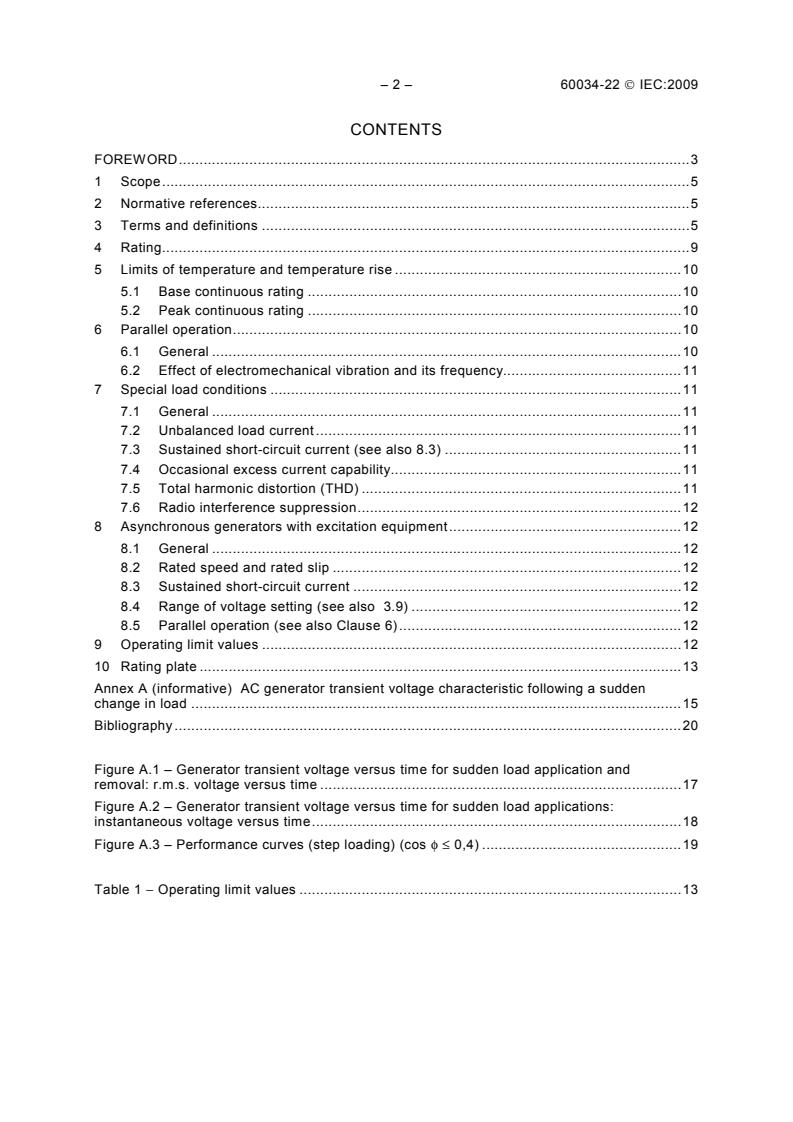
IEC 60034-22:2009 - Rotating electrical machines - Part 22: AC generators for reciprocating internal combustion (RIC) engine driven generating sets
IEC 60034-22:2009 - Rotating electrical machines - Part 22: AC generators for reciprocating internal combustion (RIC) engine driven generating sets
Relations
- Effective Date
- 25-Aug-2026
- Effective Date
- 05-Sep-2023
Buy Documents
IEC 60034-22:2009 - Rotating electrical machines - Part 22: AC generators for reciprocating internal combustion (RIC) engine driven generating sets
IEC 60034-22:2009 - Rotating electrical machines - Part 22: AC generators for reciprocating internal combustion (RIC) engine driven generating sets
Get Certified
Connect with accredited certification bodies for this standard

IMQ S.p.A. (Certification)
Italian electrical product certification.

SLG Prüf- und Zertifizierungs GmbH
German testing and certification body.

UL Solutions
Global safety science company with testing, inspection and certification.
Sponsored listings
Frequently Asked Questions
IEC 60034-22:2009 is a standard published by the International Electrotechnical Commission (IEC). Its full title is "Rotating electrical machines - Part 22: AC generators for reciprocating internal combustion (RIC) engine driven generating sets". This standard covers: IEC 60034-22:2009 establishes the principal characteristics of a.c. generators under the control of their voltage regulators when used for reciprocating internal combustion engine driven generating set applications and supplements the requirements given in IEC 60034-1. It covers the use of such generators for land and marine use, but excludes generating sets used on aircraft or used to propel land vehicles and locomotives. The most important changes with respect to the previous edition are: - technical changes to many definitions; - revision of table 1 and of the annex.
IEC 60034-22:2009 establishes the principal characteristics of a.c. generators under the control of their voltage regulators when used for reciprocating internal combustion engine driven generating set applications and supplements the requirements given in IEC 60034-1. It covers the use of such generators for land and marine use, but excludes generating sets used on aircraft or used to propel land vehicles and locomotives. The most important changes with respect to the previous edition are: - technical changes to many definitions; - revision of table 1 and of the annex.
IEC 60034-22:2009 is classified under the following ICS (International Classification for Standards) categories: 01 - GENERALITIES. TERMINOLOGY. STANDARDIZATION. DOCUMENTATION; 29.160.01 - Rotating machinery in general. The ICS classification helps identify the subject area and facilitates finding related standards.
IEC 60034-22:2009 has the following relationships with other standards: It is inter standard links to EN ISO 13631:2002, IEC 60034-22:1996. Understanding these relationships helps ensure you are using the most current and applicable version of the standard.
IEC 60034-22:2009 is available in PDF format for immediate download after purchase. The document can be added to your cart and obtained through the secure checkout process. Digital delivery ensures instant access to the complete standard document.
Standards Content (Sample)
IEC 60034-22 ®
Edition 2.0 2009-10
INTERNATIONAL
STANDARD
NORME
INTERNATIONALE
Rotating electrical machines –
Part 22: AC generators for reciprocating internal combustion (RIC) engine driven
generating sets
Machines électriques tournantes –
Partie 22: Génératrices à courant alternatif pour groupes électrogènes entraînés
par un moteur à combustion interne
All rights reserved. Unless otherwise specified, no part of this publication may be reproduced or utilized in any form or by
any means, electronic or mechanical, including photocopying and microfilm, without permission in writing from either IEC or
IEC's member National Committee in the country of the requester.
If you have any questions about IEC copyright or have an enquiry about obtaining additional rights to this publication,
please contact the address below or your local IEC member National Committee for further information.
Droits de reproduction réservés. Sauf indication contraire, aucune partie de cette publication ne peut être reproduite
ni utilisée sous quelque forme que ce soit et par aucun procédé, électronique ou mécanique, y compris la photocopie
et les microfilms, sans l'accord écrit de la CEI ou du Comité national de la CEI du pays du demandeur.
Si vous avez des questions sur le copyright de la CEI ou si vous désirez obtenir des droits supplémentaires sur cette
publication, utilisez les coordonnées ci-après ou contactez le Comité national de la CEI de votre pays de résidence.
IEC Central Office
3, rue de Varembé
CH-1211 Geneva 20
Switzerland
Email: inmail@iec.ch
Web: www.iec.ch
About the IEC
The International Electrotechnical Commission (IEC) is the leading global organization that prepares and publishes
International Standards for all electrical, electronic and related technologies.
About IEC publications
The technical content of IEC publications is kept under constant review by the IEC. Please make sure that you have the
latest edition, a corrigenda or an amendment might have been published.
ƒ Catalogue of IEC publications: www.iec.ch/searchpub
The IEC on-line Catalogue enables you to search by a variety of criteria (reference number, text, technical committee,…).
It also gives information on projects, withdrawn and replaced publications.
ƒ IEC Just Published: www.iec.ch/online_news/justpub
Stay up to date on all new IEC publications. Just Published details twice a month all new publications released. Available
on-line and also by email.
ƒ Electropedia: www.electropedia.org
The world's leading online dictionary of electronic and electrical terms containing more than 20 000 terms and definitions
in English and French, with equivalent terms in additional languages. Also known as the International Electrotechnical
Vocabulary online.
ƒ Customer Service Centre: www.iec.ch/webstore/custserv
If you wish to give us your feedback on this publication or need further assistance, please visit the Customer Service
Centre FAQ or contact us:
Email: csc@iec.ch
Tel.: +41 22 919 02 11
Fax: +41 22 919 03 00
A propos de la CEI
La Commission Electrotechnique Internationale (CEI) est la première organisation mondiale qui élabore et publie des
normes internationales pour tout ce qui a trait à l'électricité, à l'électronique et aux technologies apparentées.
A propos des publications CEI
Le contenu technique des publications de la CEI est constamment revu. Veuillez vous assurer que vous possédez
l’édition la plus récente, un corrigendum ou amendement peut avoir été publié.
ƒ Catalogue des publications de la CEI: www.iec.ch/searchpub/cur_fut-f.htm
Le Catalogue en-ligne de la CEI vous permet d’effectuer des recherches en utilisant différents critères (numéro de référence,
texte, comité d’études,…). Il donne aussi des informations sur les projets et les publications retirées ou remplacées.
ƒ Just Published CEI: www.iec.ch/online_news/justpub
Restez informé sur les nouvelles publications de la CEI. Just Published détaille deux fois par mois les nouvelles
publications parues. Disponible en-ligne et aussi par email.
ƒ Electropedia: www.electropedia.org
Le premier dictionnaire en ligne au monde de termes électroniques et électriques. Il contient plus de 20 000 termes et
définitions en anglais et en français, ainsi que les termes équivalents dans les langues additionnelles. Egalement appelé
Vocabulaire Electrotechnique International en ligne.
ƒ Service Clients: www.iec.ch/webstore/custserv/custserv_entry-f.htm
Si vous désirez nous donner des commentaires sur cette publication ou si vous avez des questions, visitez le FAQ du
Service clients ou contactez-nous:
Email: csc@iec.ch
Tél.: +41 22 919 02 11
Fax: +41 22 919 03 00
IEC 60034-22 ®
Edition 2.0 2009-10
INTERNATIONAL
STANDARD
NORME
INTERNATIONALE
Rotating electrical machines –
Part 22: AC generators for reciprocating internal combustion (RIC) engine driven
generating sets
Machines électriques tournantes –
Partie 22: Génératrices à courant alternatif pour groupes électrogènes entraînés
par un moteur à combustion interne
INTERNATIONAL
ELECTROTECHNICAL
COMMISSION
COMMISSION
ELECTROTECHNIQUE
PRICE CODE
INTERNATIONALE
R
CODE PRIX
ICS 29.160 ISBN 978-2-88910-020-0
– 2 – 60034-22 © IEC:2009
CONTENTS
FOREWORD.3
1 Scope.5
2 Normative references.5
3 Terms and definitions .5
4 Rating.9
5 Limits of temperature and temperature rise .10
5.1 Base continuous rating .10
5.2 Peak continuous rating .10
6 Parallel operation.10
6.1 General .10
6.2 Effect of electromechanical vibration and its frequency.11
7 Special load conditions .11
7.1 General .11
7.2 Unbalanced load current .11
7.3 Sustained short-circuit current (see also 8.3) .11
7.4 Occasional excess current capability.11
7.5 Total harmonic distortion (THD) .11
7.6 Radio interference suppression.12
8 Asynchronous generators with excitation equipment.12
8.1 General .12
8.2 Rated speed and rated slip .12
8.3 Sustained short-circuit current .12
8.4 Range of voltage setting (see also 3.9) .12
8.5 Parallel operation (see also Clause 6).12
9 Operating limit values .12
10 Rating plate .13
Annex A (informative) AC generator transient voltage characteristic following a sudden
change in load .15
Bibliography .20
Figure A.1 – Generator transient voltage versus time for sudden load application and
removal: r.m.s. voltage versus time .17
Figure A.2 – Generator transient voltage versus time for sudden load applications:
instantaneous voltage versus time.18
Figure A.3 – Performance curves (step loading) (cos φ ≤ 0,4) .19
Table 1 − Operating limit values .13
60034-22 © IEC:2009 – 3 –
INTERNATIONAL ELECTROTECHNICAL COMMISSION
____________
ROTATING ELECTRICAL MACHINES –
Part 22: AC generators for reciprocating internal combustion (RIC)
engine driven generating sets
FOREWORD
1) The International Electrotechnical Commission (IEC) is a worldwide organization for standardization comprising
all national electrotechnical committees (IEC National Committees). The object of IEC is to promote
international co-operation on all questions concerning standardization in the electrical and electronic fields. To
this end and in addition to other activities, IEC publishes International Standards, Technical Specifications,
Technical Reports, Publicly Available Specifications (PAS) and Guides (hereafter referred to as “IEC
Publication(s)”). Their preparation is entrusted to technical committees; any IEC National Committee interested
in the subject dealt with may participate in this preparatory work. International, governmental and non-
governmental organizations liaising with the IEC also participate in this preparation. IEC collaborates closely
with the International Organization for Standardization (ISO) in accordance with conditions determined by
agreement between the two organizations.
2) The formal decisions or agreements of IEC on technical matters express, as nearly as possible, an international
consensus of opinion on the relevant subjects since each technical committee has representation from all
interested IEC National Committees.
3) IEC Publications have the form of recommendations for international use and are accepted by IEC National
Committees in that sense. While all reasonable efforts are made to ensure that the technical content of IEC
Publications is accurate, IEC cannot be held responsible for the way in which they are used or for any
misinterpretation by any end user.
4) In order to promote international uniformity, IEC National Committees undertake to apply IEC Publications
transparently to the maximum extent possible in their national and regional publications. Any divergence
between any IEC Publication and the corresponding national or regional publication shall be clearly indicated in
the latter.
5) IEC itself does not provide any attestation of conformity. Independent certification bodies provide conformity
assessment services and, in some areas, access to IEC marks of conformity. IEC is not responsible for any
services carried out by independent certification bodies.
6) All users should ensure that they have the latest edition of this publication.
7) No liability shall attach to IEC or its directors, employees, servants or agents including individual experts and
members of its technical committees and IEC National Committees for any personal injury, property damage or
other damage of any nature whatsoever, whether direct or indirect, or for costs (including legal fees) and
expenses arising out of the publication, use of, or reliance upon, this IEC Publication or any other IEC
Publications.
8) Attention is drawn to the Normative references cited in this publication. Use of the referenced publications is
indispensable for the correct application of this publication.
9) Attention is drawn to the possibility that some of the elements of this IEC Publication may be the subject of
patent rights. IEC shall not be held responsible for identifying any or all such patent rights.
International Standard IEC 60034-22 has been prepared by IEC technical committee 2:
Rotating machinery.
This second edition cancels and replaces the first edition published in 1996 and constitutes a
technical revision.
The technical changes with regard to the previous edition include:
– Clause 2: The standards which were not referenced in the text have been deleted.
– Clause 3: Technical and editorial changes to many of the definitions have been made.
– Clause 4: In the NOTE, the quantity T has been replaced by TL.
L
– Clause 7: Technical and editorial changes to many clauses have been made.
– Clause 9: Table 1 has been revised.
– Annex A: This annex has been revised.
– 4 – 60034-22 © IEC:2009
The text of this standard is based on the following documents:
FDIS Report on voting
2/1568/FDIS 2/1573/RVD
Full information on the voting for the approval of this standard can be found in the report on
voting indicated in the above table.
This publication has been drafted in accordance with the ISO/IEC Directives, Part 2.
A list of all parts of IEC 60034 series, under the general title, Rotating electrical machines, can
be found on the IEC website.
NOTE A table of cross-references of all IEC TC 2 publications can be found in the IEC TC 2 dashboard on the IEC
website.
The committee has decided that the contents of this publication will remain unchanged until the
maintenance result date indicated on the IEC web site under "http://webstore.iec.ch" in the data
related to the specific publication. At this date, the publication will be
• reconfirmed,
• withdrawn,
• replaced by a revised edition, or
• amended.
60034-22 © IEC:2009 – 5 –
ROTATING ELECTRICAL MACHINES –
Part 22: AC generators for reciprocating internal combustion (RIC)
engine driven generating sets
1 Scope
This part of IEC 60034 establishes the principal characteristics of a.c. generators under the
control of their voltage regulators when used for reciprocating internal combustion (RIC) engine
driven generating set applications and supplements the requirements given in IEC 60034-1. It
covers the use of such generators for land and marine use, but excludes generating sets used
on aircraft or used to propel land vehicles and locomotives.
NOTE 1 For some specific applications (e.g. essential hospital supplies, high-rise buildings, etc.) supplementary
requirements may be necessary. The provisions of this standard should be regarded as a basis for such
requirements.
NOTE 2 Attention is drawn to the need to take note of additional regulations or requirements imposed by various
regulatory bodies. Such regulations or requirements may form the subject of agreement between the customer and
the manufacturer when conditions of use of the end product invoke such requirements.
NOTE 3 Examples of regulatory authorities:
− classification societies, for generating sets used on ships and offshore installations;
− government agencies;
− inspection agencies, local utilities, etc.
Annex A discusses the behaviour of generators covered by this standard when subjected to
sudden load changes.
2 Normative references
The following referenced documents are indispensable for the application of this document. For
dated references, only the edition cited applies. For undated references, the latest edition of
the referenced document (including any amendments) applies.
− Part 1: Rating and performance
IEC 60034-1:2004, Rotating electrical machines
IEC 60085, Electrical insulation – Thermal evaluation and designation
CISPR 11, Industrial, scientific and medical equipment – Radio-frequency disturbance
characteristics – Limits and methods of measurement
3 Terms and definitions
For the purposes of this document, the following terms and definitions apply:
NOTE 1 In this standard, suffix “N” is used for “rated” in accordance with IEC 60027-1 and IEC 60027-4 whereas
in ISO 8528, suffix “r” is so used.
NOTE 2 Voltage terms relate to a generator running at constant (rated) speed under the control of the normal
excitation and voltage control system.
– 6 – 60034-22 © IEC:2009
3.1
rated output
S
N
the product of the rated r.m.s. voltage, the rated r.m.s. current and a constant m, expressed in
volt-amperes (VA) or its decimal multiples
where
m = 1 for single-phase;
m = 2 for two-phase;
m = 3 for three-phase
3.2
rated active power
P
N
the product of the rated r.m.s. voltage, the in-phase component of the rated r.m.s. current and
a constant m, expressed in watts (W) or its decimal multiples
where
m = 1 for single-phase;
m = 2 for two-phase;
3 for three-phase
m =
3.3
rated power factor
cos φ
N
the ratio of the rated active power to the rated output
P
N
cosφ=
N
S
N
3.4
rated reactive power
Q
N
the geometrical difference of the rated apparent power and the rated active power expressed in
volt-amperes reactive (var) or its decimal multiples
2 2
Q =()S − P
N
N N
3.5
rated speed of rotation
n
N
the speed of rotation necessary for voltage generation at rated frequency
NOTE 1 For a synchronous generator, the rated speed of rotation is given by:
f
N
n =
N
p
where
p is the number of pole pairs;
f is the rated frequency (according to load requirements).
N
For an asynchronous generator the rated speed of rotation is given by:
60034-22 © IEC:2009 – 7 –
f
N
()
n = 1− s
N N
p
where
p is the number of pole pairs;
f is the rated frequency (according to load requirements);
N
s is the rated slip.
N
NOTE 2 Since the slip of an asynchronous generator is always negative, the rated speed is above the
synchronous speed.
3.6
rated slip
s
N
the difference between the synchronous speed and the rated speed of the rotor divided by the
synchronous speed, when the generating set is giving its rated active power
f
N
− n
N
p
s =
N
f
N
p
NOTE Rated slip s is only relevant to an asynchronous generator.
N
3.7
rated voltage
U
N
the line-to-line voltage at the terminals of the generator at rated frequency
NOTE Rated voltage is the voltage assigned by the manufacturer for operating and performance characteristics.
3.8
no-load voltage
U
the line-to-line voltage at the terminals of the generator at rated frequency and no-load
3.9
range of voltage setting
ΔU
s
the range of possible upward and downward adjustment of voltage at generator terminals
(ΔU and ΔU , where U is the upper limit of voltage setting and U is the lower limit of
sup sdo sup sdo
voltage setting) at rated frequency, for all loads between no-load and rated output.
ΔU = | ΔU | + | ΔU |
s sup sdo
The voltage setting range is expressed as a percentage of the rated voltage.
a) upward range, ΔU
sup
U − U
sup N
ΔU = ×100 %
sup
U
N
b) downward range, ΔU
sdo
U − U
sdo N
ΔU = ×100 %
sdo
U
N
– 8 – 60034-22 © IEC:2009
3.10
steady-state voltage tolerance band
1)
ΔU
the agreed voltage band about the steady-state voltage that the voltage may reach within a
given voltage recovery time after a specified sudden increase or decrease of load
3.11
steady-state voltage regulation
1)
ΔU
st
the change in steady-state voltage for all load changes between no-load and rated output,
taking into account the influence of temperature but not considering the effect of quadrature
current compensation voltage droop.
NOTE The initial set voltage is usually rated voltage, but may be anywhere within the range of voltage setting,
ΔU . See 3.9.
s
The steady-state voltage regulation is expressed as a percentage of the rated voltage.
UU−
st:max st:min
ΔU = ×100%
st
U
N
3.12
transient voltage regulation
δ
dynU
the maximum voltage change following a sudden change of load, expressed as a percentage of
the rated voltage.
a) With load increase
−
maximum transient voltage drop δ
dynU
the voltage drop when the generator, initially at rated voltage, is switched onto a
symmetrical load which absorbs a specified current at rated voltage at a given power
factor or range of power factors.
UU−
dyn:min N
−
δ = × 100%
dynU
U
N
b) With load decrease
+
maximum transient voltage rise δ
dynU
the voltage rise when a specified load at a given power factor is suddenly switched off.
UU−
dyn:max N
+
δ = × 100 %
dynU
U
N
3.13
voltage recovery time
1)
t
rec
the time interval from the time at which a load change is initiated (t ) until the time when the
voltage returns to and remains within the specified steady-state voltage tolerance band (t )
u, in
tt=−t
()
()
rec u, in 0
___________
1)
For an explanation of these terms and examples of their use, see Annex A.
60034-22 © IEC:2009 – 9 –
3.14
)
recovery voltage U
rec
the final steady-state voltage for a specified load condition
NOTE Recovery voltage is normally expressed as a percentage of the rated voltage. For loads in excess of rated,
recovery voltage is limited by saturation and exciter-regulator field forcing capability.
3.15
voltage modulation
Û
mod
the quasi-periodic voltage variation (peak-to-valley) about a steady-state voltage having typical
frequencies below the fundamental generation frequency expressed as a percentage of
average peak voltage at rated frequency and uniform drive
$$
UU−
mod:max mod:min
$
U =×2 × 100 %
mod
$$
UU+
mod:max mod:min
3.16
voltage unbalance
U
ubal
the rms value of the unbalanced phase voltages between consecutive phases in a three-phase
system that may occur.
Voltage unbalance is expressed as a percentage of the mean voltage
ˆ ˆ
U − U
max mean
ˆ
U = ×100 %
ubal
ˆ
U
mean
3.17
voltage regulation characteristics
curves of terminal voltage as a function of load current at a given power factor under steady-
state conditions at rated speed without any manual adjustment of the voltage regulation system
3.18
relative thermal life expectancy factor
TL
the relative thermal life expectancy related to the thermal life expectancy in case of duty type
S1 with rated output (see Annex A of IEC 60034-1)
4 Rating
The generator rating class shall be specified in accordance with IEC 60034-1. In the case of
generators for RIC engine driven generating sets, continuous ratings (duty type S1) or ratings
with discrete constant loads (duty type S10) are applicable.
For the purpose of this standard, the maximum continuous rating based on duty type S1 is
named the base continuous rating (BR).
Additionally, for duty type S10, there is a peak continuous rating (PR), where the permissible
generator temperature rises are increased by a specific amount according to the thermal
classification.
NOTE In the case of duty type S10, operation at the peak continuous rating (PR) thermally ages the generator
insulation systems at an increased rate. Quantity TL for the relative thermal life expectancy of the insulation system
is therefore an important integral part of the rating class (see 4.2.10 of IEC 60034-1).
___________
)
For an explanation of these terms and examples of their use, see Annex A.
– 10 – 60034-22 © IEC:2009
5 Limits of temperature and temperature rise
5.1 Base continuous rating
The generator shall be capable of delivering its base continuous rating (BR) over the whole
range of operating conditions (e.g. minimum to maximum coolant temperatures) with total
temperatures not exceeding the sum of 40 °C and the temperature rises specified in Table 6 of
IEC 60034-1. See Note 1 below.
5.2 Peak continuous rating
At the generator peak continuous rating (PR), the total temperatures may be increased by the
following allowances (see Notes 1 and 2).
Thermal classification in
Rating <5 MVA Rating ≥5 MVA
accordance with IEC 60085
A or E 15 ºC 10 ºC
B or F 20 ºC 15 ºC
H 25 ºC 20 ºC
For ambient temperatures below 10 °C, the limit of total temperature shall be reduced by 1 °C
for each °C by which the ambient temperature is below 10 °C.
NOTE 1 The RIC engine output may vary with changes of ambient air temperature. In operation, the generator
total temperature will depend upon its primary coolant temperature which is not necessarily related to the RIC
engine inlet air temperature.
NOTE 2 When the generator operates at these higher temperatures, the generator insulation system will age
thermally at between 2 to 6 times the rate which occurs at the generator base continuous rating temperature rise
values (depending on the temperature increase and specific insulation system). For example, the thermal ageing
relevant to operation for 1 h at peak continuous rating is approximately equal to that obtained with operation for 2 h
to 6 h at base continuous rating. It is essential that the value of TL be determined by the manufacturer and marked
on the rating plate in accordance with item b) of Clause 10.
6 Parallel operation
6.1 General
When running in parallel with other generator sets or with another source of supply, means
shall be provided to ensure stable operation and correct sharing of reactive power.
This is most often effected by influencing the automatic voltage regulator by a sensing circuit
with an additional reactive current component. This causes a voltage droop characteristic for
reactive loads.
The grade of quadrature current compensation (QCC) voltage droop δ is the difference
qcc
between the no-load voltage U and the voltage at the rated current at the power factor zero
(overexcited) U when running isolated, expressed as a percentage of rated voltage U .
N
Q
U − U
0 Q
δ = ×100 %
qcc
U
N
NOTE 1 Unity power factor loads produce virtually no droop.
NOTE 2 Identical a.c. generators with identical excitation systems may operate in parallel without requiring voltage
droop when their field windings are connected by equalizer links. Adequate reactive load sharing is achieved when
there is correct active load sharing.
60034-22 © IEC:2009 – 11 –
NOTE 3 When generating sets are operating in parallel with star points directly connected together, circulating
currents may occur, particularly third harmonic currents. Circulating currents can increase the r.m.s. current which
may reduce the thermal life expectancy of the insulation system.
6.2 Effect of electromechanical vibration and its frequency
It is the responsibility of the generating set manufacturer to ensure that the set shall operate
stably in parallel with others, and the generator manufacturer shall collaborate as necessary to
achieve this.
If there is a RIC engine torque irregularity at a frequency close to the electromechanical natural
frequency, resonance will occur. The electrical natural frequency usually lies in the range
–1
of 1 Hz to 5 Hz, and hence resonance is most likely to arise with low speed (100 min to
–1
180 min ) RIC engine generator sets.
In such cases, the generating set manufacturer shall be prepared to give advice to the
customer, assisted by a system analysis if necessary, and it is expected that the generator
manufacturer will assist in such investigation.
7 Special load conditions
7.1 General
In addition to the conditions given in IEC 60034-1, the requirements given in 7.2 to 7.6 shall
apply.
NOTE Consideration of the variation of these requirements from IEC 60034-1 will assist in the specification of
special load conditions.
7.2 Unbalanced load current
Limiting values shall be in accordance with 7.2.3 of IEC 60034-1, except that generators with
ratings up to 1 000 kVA, which are intended to be loaded between line and neutral, shall be
capable of operating continuously with a negative phase sequence current up to and including
10 % of the rated current.
7.3 Sustained short-circuit current (see also 8.3)
Sustained short-circuit current is attained by an excitation system of a synchronous generator
designed to provide a specified value of short-circuit current for a specified period of time. The
value of sustained short-circuit current shall be decided by agreement between purchaser and
manufacturer.
NOTE 1 Under short-circuit conditions on a synchronous generator, it may be necessary to sustain a minimum
value of current (after the transient disturbance has ceased) for a sufficient time to ensure operation of the system’s
protective devices.
NOTE 2 Sustained short-circuit current is not necessary in cases where special relaying or other designs or
means are employed to otherwise achieve selective protection, or where no selective protection is required.
7.4 Occasional excess current capability
Short-term excess current capability shall be in accordance with 9.3.2 of IEC 60034-1.
7.5 Total harmonic distortion (THD)
Limiting values of the total harmonic distortion of the line-to-line terminal voltages shall be in
accordance with 9.11 of IEC 60034-1. When tested on open-circuit and at rated speed and
voltage, the total harmonic distortion of the line-to-line terminal voltage shall not exceed 5 %.
– 12 – 60034-22 © IEC:2009
7.6 Radio interference suppression
Limiting values of radio interference for continuous and clicking disturbances shall be in
accordance with CISPR 11.
The grade of radio interference suppression involves the interface voltage, power and field
strength. This shall be decided by agreement between purchaser and manufacturer.
8 Asynchronous generators with excitation equipment
8.1 General
Asynchronous generators need reactive power for voltage generation. When running in
isolation, special equipment is necessary to provide their excitation, and this equipment also
has to supply the reactive power demand of the connected load. The following terms and notes
are valid for asynchronous generators which are not connected to the power grid for supplying
the required reactive power but are provided with specially incorporated excitation equipment.
8.2 Rated speed and rated slip
(For definitions, see Clause 3.)
8.3 Sustained short-circuit current
(For definition, see 7.3.)
NOTE Asynchronous generators deliver an occasional sustained short-circuit current only when provided with
especially equipped excitation sources.
8.4 Range of voltage setting (see also 3.9)
To provide a range of voltage adjustment for asynchronous generators special controllable
excitation equipment is required.
8.5 Parallel operation (see also Clause 6)
Asynchronous generators, with special excitation equipment, running in parallel (to another
such generator or to the mains), share the reactive power demand of the connected load
according to the capabilities of their excitation systems.
Asynchronous generators share the active power demand of the connected load according to
the speed of the RIC engine.
9 Operating limit values
Four performance classes of major significance are given in table 1 to describe the generator
characteristics. (For definitions of performance class, see ISO 8528-1, Clause 7.)
The values in Table 1 apply only to the generator, exciter and regulator operating at constant
(rated) speed and starting from ambient temperature. The effect of the prime mover speed
regulation may cause these values to differ from the values given in the table.
60034-22 © IEC:2009 – 13 –
Table 1 − Operating limit values
Parameter Symbol Unit Reference Load Power factor Performance class
to change (overexcited)
subclause
G1 G2 G3 G4
a)
Range of ΔU % 3.9 Rated ≥ [±5] d) AMP c)
s
voltage setting
a)
Steady-state % 3.10 Rated AMP
ΔU ±3 ±3 ±3
voltage
tolerance band
b)
Steady-state % 3.11 Rated 5 2,5 1 AMP
ΔU
st
voltage
regulation
−
Maximum δ % 3.12 0 to 100 % Rated −30 −24 −18 AMP
dynU
e)
transient
voltage drop
f), g), h)
+
Maximum % 3.12 100 % to 0 Rated 35 25 20 AMP
δ
dynU
e)
transient
voltage rise f),
g), h)
Maximum t s 3.13 0 to 100 % > 0 ≤ 0,4 2,5 1,5 1,5 AMP
rec
e)
voltage
Rated
recovery time
100 % to 0
f) ,g)
i)
Maximum % 3.16 Rated AMP
U ≤1,0 ≤1,0 ≤1,0
ubal
voltage
unbalance
j)
a) All loads between no-load and rated output (SN).
b) All load changes between no-load and rated output.
c) AMP = by agreement between manufacturer and purchaser.
d) Not necessary if parallel operation or fixed voltage setting is not required.
e) Load current at rated voltage, constant impedance load.
f) Other power factors and limit values may be by agreement.
g) It should be noted that the choice of a grade of transient voltage performance better than is actually
necessary can result in a much larger generator. Since there is a fairly consistent relationship between
transient voltage performance and the sub-transient reactances, the system fault level will also be increased.
h) Higher values may be applied to generators with rated outputs higher than 5 MVA and rotational speeds
−1
of 600 min or less.
i) At no-load.
j) In case of parallel operation, these values will be reduced to 0,5.
10 Rating plate
The generator rating plate shall comply with the requirements of IEC 60034-1 and, in addition,
the rated output and power factor and class of rating shall be combined as follows.
a) Where a continuous rating based on duty type S1 is stated, the rated output shall be
followed by the marking “BR” (base continuous rating), for example:
S = 22 kVA (cos φ 0,8 overexcited) BR
N
b) Where a rating with discrete constant loads based on duty type S10 is stated, the base
continuous rating based on duty S1 shall be marked as in a). In addition, the peak rated
output shall be shown followed by the marking “PR” (peak continuous rating), the maximum
– 14 – 60034-22 © IEC:2009
running time per year (see 13.3.2 of ISO 8528-1:2005) and the value of the quantity TL, for
example:
S = 24 kVA (cos φ 0,8 overexcited), PR, 300 h, TL = 0,90
N
Upon request, the generator manufacturer shall provide the set manufacturer with a capability
graph or set of values showing the permissible output of the generator set over the range of
coolant temperature involved.
60034-22 © IEC:2009 – 15 –
Annex A
(informative)
AC generator transient voltage characteristic
following a sudden change in load
A.1 General
When a generator is subjected to a sudden load change there will be a resultant time varying
change in terminal voltage. One function of the exciter-regulator system is to detect this
change in terminal voltage, and to vary the field excitation as required to restore the terminal
voltage. The maximum transient deviation in terminal voltage that occurs is a function of:
a) the magnitude, power factor and rate of change of the applied load;
b) the magnitude, power factor and current versus voltage characteristic of any initial load;
c) the response time and voltage forcing capability of the exciter-regulator system;
d) the RIC engine speed versus time following the sudden load change.
Transient voltage performance is therefore a system performance characteristic involving the
generator, exciter, regulator and RIC engine and cannot be established on the basis of
generator data alone. The scope of this annex covers only the generator and exciter-regulator
system.
In selecting or applying generators, the maximum transient voltage deviation (voltage dip)
following a sudden increase in load is often specified or requested. When requested by the
customer, the generator manufacturer should furnish the expected transient voltage deviation,
assuming either of the following criteria applies:
− the generator, exciter, and regulator are furnished as an integrated package by the a.c.
generator manufacturer, or
− complete data defining the transient performance of the regulator (and exciter if
applicable) is made available to the generator manufacturer.
When furnishing the expected transient voltage deviation, the following conditions shall be
assumed unless otherwise specified:
1) constant speed (rated);
2) generator, exciter, regulator initially operating at no-load, rated voltage, starting from
ambient temperature;
3) application of a constant impedance linear load as specified.
NOTE The expected transient voltage deviation refers to the average voltage change of all phases at the
generator terminals, i.e. it takes no account of asymmetry which is influenced by factors outside the control of the
generator manufacturer.
A.2 Voltage recorder performance
The following requirements are desirable:
a) response time ≤1 ms;
b) sensitivity ≥1 %/mm.
NOTE When peak-to-peak recording instruments are used, readings of the steady-state terminal voltage before
and after load application should be made with an r.m.s.-indicating instrument in order to determine minimum
transient voltage (see Figure A.2).
– 16 – 60034-22 © IEC:2009
A.3 Examples
Strip charts of the output voltage as a function of time demonstrate the transient performance
of the generator, exciter, regulation system to sudden changes in load. The entire voltage
envelope should be recorded to determine the performance characteristics.
Strip charts representing two types of voltage recorder are illustrated in Figures A.1 and A.2.
The labelled charts and sample calculations should be used as a guide to determine the
generator-exciter-regulator performance when subjected to a sudden load change.
A.4 Motor starting loads
A.4.1 Test conditions
The following test conditions are recommended for demonstrating the capability of a
synchronous generator, exciter and regulation system for starting a motor.
A.4.2 Load simulation
The load simulation consists of:
a) Constant impedance (non-saturable reactive load).
b) Power factor ≤0,4 overexcited.
NOTE The current drawn by the simulated motor starting load should be corrected by the ratio U /U whenever
N rec
the generator terminal voltage fails to return to rated voltage. This value of current and rated terminal voltage
should be used to determine the actual kVA load applied.
A.4.3 Temperature
The test should be conducted with the generator and excitation system initially at ambient
temperature.
60034-22 © IEC:2009 – 17 –
Load applied: Load removed:
generator initially at generator initially at
no-load voltage rated voltage, rated load
U
dyn:max
+
δ
Time at which dyn U
load applied
U
rec
ΔU
U
0 U
Δ
U
N
st
Δ
U
Voltage U
–
δ
dyn U
Time at which
U
load removed
dyn:min
t
rec
t t t
t
Time t
0 u.in 0 u.in
IEC 1911/09
Figure A.1 – Generator transient voltage versus time for sudden load application and removal: r.m.s. voltage versus time
– 18 – 60034-22 © IEC:2009
605 I
rms
IEC 1912/09
Oscillogram of load current Current drawn by the load
corrected to rated voltage:
U
N
II′=×
LL
U
rec
δ
dynU
t t
u,in
L = 47 mm
D = 34,5 mm
480 V
rms
U = 455 V
U = 334 V
rec rms
dyn, min rms
IEC 1913/09
Oscillogram of terminal voltage
Key
−
δ voltage dip
dynU
U rated terminal voltage
N
U no-load voltage (r.m.s. voltmeter reading)
L measured peak-to-peak amplitude of recovery voltage (mm)
I' current drawn by the load corrected to rated voltage
L
I real current drawn by the load
L
U steady-state voltmeter reading of recovery voltage (r.m.s.)
rec
D measured peak-to-peak amplitude of minimum transient voltage (mm)
U calculated minimum transient voltage
dyn,min
t instant at which load is applied
t instant of recovering to specified band
u,in
D 34,5
Example: U = 480 V: U = 480 V U =× U = × 455= 334 V
N 0 dyn,min rec
L 47
UU−
334 − 480
dyn,min N
−
δ = ×=100 ×=100−30,4 %
dynU
U 480
N
Figure A.2 – Generator transient voltage versus time for sudden load applications:
instantaneous voltage versus time
60034-22 © IEC:2009 – 19 –
A.5 Presentation of data
Transient voltage regulation performance curves should be plotted as ‘voltage dip’ (in per cent
of rated voltage) versus ‘kVA load’ (see Figure A.3).
The performance characteristics will vary considerably for broad voltage range generators
when operating over the full range of their adjustment. Therefore, the per cent voltage dip
versus kVA load curve provided for broad voltage range generators should show the
performance at the extreme ends of the operating range; i.e., 208-240/416-480 V. For discrete
voltage generators, the per cent voltage dip versus kVA load curve should show the
performance at the discrete rated voltage(s).
Unless otherwise noted, the per cent voltage dip versus kVA load curve should provide a
voltage recovery to at least 90 % of rated voltage. If the recovery voltage is less than 90 % of
rated voltage, a point on the voltage dip curve beyond which the voltage will not recover to
90 % of voltage should be identified or a separate voltage recovery versus kVA load curve
should be provided.
%
208/416 V
240/480 V
Voltage
dip
0 100 200 300 400 500 600 kVA
Load
IEC 1914/09
Indicates recovery voltage less than 90 %.
Figure A.3 – Performance curves (step loading) (cos φ ≤ 0,4)
– 20 – 60034-22 © IEC:2009
Bibliography
IEC 60027-1, Letter symbols to be used in electrical technology − Part 1: General
IEC 60027-4, Letter symbols to be used in electrical technology − Part 4: Rotating electric
machines
IEC 60034-26, Rotating electrical machines – Part 26: Effects of unbalanced voltages on the
performance of the three-phase cage induction motors
ISO 8528-1:2005, Reciprocating internal combustion engine driven alternating current
generating sets – Part 1: Application, ratings and performance
___________
– 22 – 60034-22 © CEI:2009
SOMMAIRE
AVANT-PROPOS .23
1 Domaine d'application.25
2 Références normatives .25
3 Termes et définitions .25
4 Caractéristiques assignées .29
5 Valeurs limites de température et d'échauffement .30
5.1 Caractéristiques assignées du type continu de base.30
5.2 Caractéristiques assignées du type continu de pointe.30
6 Fonctionnement en parallèle .
...
IEC 60034-22 ®
Edition 2.0 2009-10
INTERNATIONAL
STANDARD
NORME
INTERNATIONALE
Rotating electrical machines –
Part 22: AC generators for reciprocating internal combustion (RIC) engine driven
generating sets
Machines électriques tournantes –
Partie 22: Génératrices à courant alternatif pour groupes électrogènes entraînés
par un moteur à combustion interne
All rights reserved. Unless otherwise specified, no part of this publication may be reproduced or utilized in any form or by
any means, electronic or mechanical, including photocopying and microfilm, without permission in writing from either IEC or
IEC's member National Committee in the country of the requester.
If you have any questions about IEC copyright or have an enquiry about obtaining additional rights to this publication,
please contact the address below or your local IEC member National Committee for further information.
Droits de reproduction réservés. Sauf indication contraire, aucune partie de cette publication ne peut être reproduite
ni utilisée sous quelque forme que ce soit et par aucun procédé, électronique ou mécanique, y compris la photocopie
et les microfilms, sans l'accord écrit de la CEI ou du Comité national de la CEI du pays du demandeur.
Si vous avez des questions sur le copyright de la CEI ou si vous désirez obtenir des droits supplémentaires sur cette
publication, utilisez les coordonnées ci-après ou contactez le Comité national de la CEI de votre pays de résidence.
IEC Central Office
3, rue de Varembé
CH-1211 Geneva 20
Switzerland
Email: inmail@iec.ch
Web: www.iec.ch
About the IEC
The International Electrotechnical Commission (IEC) is the leading global organization that prepares and publishes
International Standards for all electrical, electronic and related technologies.
About IEC publications
The technical content of IEC publications is kept under constant review by the IEC. Please make sure that you have the
latest edition, a corrigenda or an amendment might have been published.
ƒ Catalogue of IEC publications: www.iec.ch/searchpub
The IEC on-line Catalogue enables you to search by a variety of criteria (reference number, text, technical committee,…).
It also gives information on projects, withdrawn and replaced publications.
ƒ IEC Just Published: www.iec.ch/online_news/justpub
Stay up to date on all new IEC publications. Just Published details twice a month all new publications released. Available
on-line and also by email.
ƒ Electropedia: www.electropedia.org
The world's leading online dictionary of electronic and electrical terms containing more than 20 000 terms and definitions
in English and French, with equivalent terms in additional languages. Also known as the International Electrotechnical
Vocabulary online.
ƒ Customer Service Centre: www.iec.ch/webstore/custserv
If you wish to give us your feedback on this publication or need further assistance, please visit the Customer Service
Centre FAQ or contact us:
Email: csc@iec.ch
Tel.: +41 22 919 02 11
Fax: +41 22 919 03 00
A propos de la CEI
La Commission Electrotechnique Internationale (CEI) est la première organisation mondiale qui élabore et publie des
normes internationales pour tout ce qui a trait à l'électricité, à l'électronique et aux technologies apparentées.
A propos des publications CEI
Le contenu technique des publications de la CEI est constamment revu. Veuillez vous assurer que vous possédez
l’édition la plus récente, un corrigendum ou amendement peut avoir été publié.
ƒ Catalogue des publications de la CEI: www.iec.ch/searchpub/cur_fut-f.htm
Le Catalogue en-ligne de la CEI vous permet d’effectuer des recherches en utilisant différents critères (numéro de référence,
texte, comité d’études,…). Il donne aussi des informations sur les projets et les publications retirées ou remplacées.
ƒ Just Published CEI: www.iec.ch/online_news/justpub
Restez informé sur les nouvelles publications de la CEI. Just Published détaille deux fois par mois les nouvelles
publications parues. Disponible en-ligne et aussi par email.
ƒ Electropedia: www.electropedia.org
Le premier dictionnaire en ligne au monde de termes électroniques et électriques. Il contient plus de 20 000 termes et
définitions en anglais et en français, ainsi que les termes équivalents dans les langues additionnelles. Egalement appelé
Vocabulaire Electrotechnique International en ligne.
ƒ Service Clients: www.iec.ch/webstore/custserv/custserv_entry-f.htm
Si vous désirez nous donner des commentaires sur cette publication ou si vous avez des questions, visitez le FAQ du
Service clients ou contactez-nous:
Email: csc@iec.ch
Tél.: +41 22 919 02 11
Fax: +41 22 919 03 00
IEC 60034-22 ®
Edition 2.0 2009-10
INTERNATIONAL
STANDARD
NORME
INTERNATIONALE
Rotating electrical machines –
Part 22: AC generators for reciprocating internal combustion (RIC) engine driven
generating sets
Machines électriques tournantes –
Partie 22: Génératrices à courant alternatif pour groupes électrogènes entraînés
par un moteur à combustion interne
INTERNATIONAL
ELECTROTECHNICAL
COMMISSION
COMMISSION
ELECTROTECHNIQUE
PRICE CODE
INTERNATIONALE
R
CODE PRIX
ICS 29.160 ISBN 978-2-88910-020-0
– 2 – 60034-22 © IEC:2009
CONTENTS
FOREWORD.3
1 Scope.5
2 Normative references.5
3 Terms and definitions .5
4 Rating.9
5 Limits of temperature and temperature rise .10
5.1 Base continuous rating .10
5.2 Peak continuous rating .10
6 Parallel operation.10
6.1 General .10
6.2 Effect of electromechanical vibration and its frequency.11
7 Special load conditions .11
7.1 General .11
7.2 Unbalanced load current .11
7.3 Sustained short-circuit current (see also 8.3) .11
7.4 Occasional excess current capability.11
7.5 Total harmonic distortion (THD) .11
7.6 Radio interference suppression.12
8 Asynchronous generators with excitation equipment.12
8.1 General .12
8.2 Rated speed and rated slip .12
8.3 Sustained short-circuit current .12
8.4 Range of voltage setting (see also 3.9) .12
8.5 Parallel operation (see also Clause 6).12
9 Operating limit values .12
10 Rating plate .13
Annex A (informative) AC generator transient voltage characteristic following a sudden
change in load .15
Bibliography .20
Figure A.1 – Generator transient voltage versus time for sudden load application and
removal: r.m.s. voltage versus time .17
Figure A.2 – Generator transient voltage versus time for sudden load applications:
instantaneous voltage versus time.18
Figure A.3 – Performance curves (step loading) (cos φ ≤ 0,4) .19
Table 1 − Operating limit values .13
60034-22 © IEC:2009 – 3 –
INTERNATIONAL ELECTROTECHNICAL COMMISSION
____________
ROTATING ELECTRICAL MACHINES –
Part 22: AC generators for reciprocating internal combustion (RIC)
engine driven generating sets
FOREWORD
1) The International Electrotechnical Commission (IEC) is a worldwide organization for standardization comprising
all national electrotechnical committees (IEC National Committees). The object of IEC is to promote
international co-operation on all questions concerning standardization in the electrical and electronic fields. To
this end and in addition to other activities, IEC publishes International Standards, Technical Specifications,
Technical Reports, Publicly Available Specifications (PAS) and Guides (hereafter referred to as “IEC
Publication(s)”). Their preparation is entrusted to technical committees; any IEC National Committee interested
in the subject dealt with may participate in this preparatory work. International, governmental and non-
governmental organizations liaising with the IEC also participate in this preparation. IEC collaborates closely
with the International Organization for Standardization (ISO) in accordance with conditions determined by
agreement between the two organizations.
2) The formal decisions or agreements of IEC on technical matters express, as nearly as possible, an international
consensus of opinion on the relevant subjects since each technical committee has representation from all
interested IEC National Committees.
3) IEC Publications have the form of recommendations for international use and are accepted by IEC National
Committees in that sense. While all reasonable efforts are made to ensure that the technical content of IEC
Publications is accurate, IEC cannot be held responsible for the way in which they are used or for any
misinterpretation by any end user.
4) In order to promote international uniformity, IEC National Committees undertake to apply IEC Publications
transparently to the maximum extent possible in their national and regional publications. Any divergence
between any IEC Publication and the corresponding national or regional publication shall be clearly indicated in
the latter.
5) IEC itself does not provide any attestation of conformity. Independent certification bodies provide conformity
assessment services and, in some areas, access to IEC marks of conformity. IEC is not responsible for any
services carried out by independent certification bodies.
6) All users should ensure that they have the latest edition of this publication.
7) No liability shall attach to IEC or its directors, employees, servants or agents including individual experts and
members of its technical committees and IEC National Committees for any personal injury, property damage or
other damage of any nature whatsoever, whether direct or indirect, or for costs (including legal fees) and
expenses arising out of the publication, use of, or reliance upon, this IEC Publication or any other IEC
Publications.
8) Attention is drawn to the Normative references cited in this publication. Use of the referenced publications is
indispensable for the correct application of this publication.
9) Attention is drawn to the possibility that some of the elements of this IEC Publication may be the subject of
patent rights. IEC shall not be held responsible for identifying any or all such patent rights.
International Standard IEC 60034-22 has been prepared by IEC technical committee 2:
Rotating machinery.
This second edition cancels and replaces the first edition published in 1996 and constitutes a
technical revision.
The technical changes with regard to the previous edition include:
– Clause 2: The standards which were not referenced in the text have been deleted.
– Clause 3: Technical and editorial changes to many of the definitions have been made.
– Clause 4: In the NOTE, the quantity T has been replaced by TL.
L
– Clause 7: Technical and editorial changes to many clauses have been made.
– Clause 9: Table 1 has been revised.
– Annex A: This annex has been revised.
– 4 – 60034-22 © IEC:2009
The text of this standard is based on the following documents:
FDIS Report on voting
2/1568/FDIS 2/1573/RVD
Full information on the voting for the approval of this standard can be found in the report on
voting indicated in the above table.
This publication has been drafted in accordance with the ISO/IEC Directives, Part 2.
A list of all parts of IEC 60034 series, under the general title, Rotating electrical machines, can
be found on the IEC website.
NOTE A table of cross-references of all IEC TC 2 publications can be found in the IEC TC 2 dashboard on the IEC
website.
The committee has decided that the contents of this publication will remain unchanged until the
maintenance result date indicated on the IEC web site under "http://webstore.iec.ch" in the data
related to the specific publication. At this date, the publication will be
• reconfirmed,
• withdrawn,
• replaced by a revised edition, or
• amended.
60034-22 © IEC:2009 – 5 –
ROTATING ELECTRICAL MACHINES –
Part 22: AC generators for reciprocating internal combustion (RIC)
engine driven generating sets
1 Scope
This part of IEC 60034 establishes the principal characteristics of a.c. generators under the
control of their voltage regulators when used for reciprocating internal combustion (RIC) engine
driven generating set applications and supplements the requirements given in IEC 60034-1. It
covers the use of such generators for land and marine use, but excludes generating sets used
on aircraft or used to propel land vehicles and locomotives.
NOTE 1 For some specific applications (e.g. essential hospital supplies, high-rise buildings, etc.) supplementary
requirements may be necessary. The provisions of this standard should be regarded as a basis for such
requirements.
NOTE 2 Attention is drawn to the need to take note of additional regulations or requirements imposed by various
regulatory bodies. Such regulations or requirements may form the subject of agreement between the customer and
the manufacturer when conditions of use of the end product invoke such requirements.
NOTE 3 Examples of regulatory authorities:
− classification societies, for generating sets used on ships and offshore installations;
− government agencies;
− inspection agencies, local utilities, etc.
Annex A discusses the behaviour of generators covered by this standard when subjected to
sudden load changes.
2 Normative references
The following referenced documents are indispensable for the application of this document. For
dated references, only the edition cited applies. For undated references, the latest edition of
the referenced document (including any amendments) applies.
− Part 1: Rating and performance
IEC 60034-1:2004, Rotating electrical machines
IEC 60085, Electrical insulation – Thermal evaluation and designation
CISPR 11, Industrial, scientific and medical equipment – Radio-frequency disturbance
characteristics – Limits and methods of measurement
3 Terms and definitions
For the purposes of this document, the following terms and definitions apply:
NOTE 1 In this standard, suffix “N” is used for “rated” in accordance with IEC 60027-1 and IEC 60027-4 whereas
in ISO 8528, suffix “r” is so used.
NOTE 2 Voltage terms relate to a generator running at constant (rated) speed under the control of the normal
excitation and voltage control system.
– 6 – 60034-22 © IEC:2009
3.1
rated output
S
N
the product of the rated r.m.s. voltage, the rated r.m.s. current and a constant m, expressed in
volt-amperes (VA) or its decimal multiples
where
m = 1 for single-phase;
m = 2 for two-phase;
m = 3 for three-phase
3.2
rated active power
P
N
the product of the rated r.m.s. voltage, the in-phase component of the rated r.m.s. current and
a constant m, expressed in watts (W) or its decimal multiples
where
m = 1 for single-phase;
m = 2 for two-phase;
3 for three-phase
m =
3.3
rated power factor
cos φ
N
the ratio of the rated active power to the rated output
P
N
cosφ=
N
S
N
3.4
rated reactive power
Q
N
the geometrical difference of the rated apparent power and the rated active power expressed in
volt-amperes reactive (var) or its decimal multiples
2 2
Q =()S − P
N
N N
3.5
rated speed of rotation
n
N
the speed of rotation necessary for voltage generation at rated frequency
NOTE 1 For a synchronous generator, the rated speed of rotation is given by:
f
N
n =
N
p
where
p is the number of pole pairs;
f is the rated frequency (according to load requirements).
N
For an asynchronous generator the rated speed of rotation is given by:
60034-22 © IEC:2009 – 7 –
f
N
()
n = 1− s
N N
p
where
p is the number of pole pairs;
f is the rated frequency (according to load requirements);
N
s is the rated slip.
N
NOTE 2 Since the slip of an asynchronous generator is always negative, the rated speed is above the
synchronous speed.
3.6
rated slip
s
N
the difference between the synchronous speed and the rated speed of the rotor divided by the
synchronous speed, when the generating set is giving its rated active power
f
N
− n
N
p
s =
N
f
N
p
NOTE Rated slip s is only relevant to an asynchronous generator.
N
3.7
rated voltage
U
N
the line-to-line voltage at the terminals of the generator at rated frequency
NOTE Rated voltage is the voltage assigned by the manufacturer for operating and performance characteristics.
3.8
no-load voltage
U
the line-to-line voltage at the terminals of the generator at rated frequency and no-load
3.9
range of voltage setting
ΔU
s
the range of possible upward and downward adjustment of voltage at generator terminals
(ΔU and ΔU , where U is the upper limit of voltage setting and U is the lower limit of
sup sdo sup sdo
voltage setting) at rated frequency, for all loads between no-load and rated output.
ΔU = | ΔU | + | ΔU |
s sup sdo
The voltage setting range is expressed as a percentage of the rated voltage.
a) upward range, ΔU
sup
U − U
sup N
ΔU = ×100 %
sup
U
N
b) downward range, ΔU
sdo
U − U
sdo N
ΔU = ×100 %
sdo
U
N
– 8 – 60034-22 © IEC:2009
3.10
steady-state voltage tolerance band
1)
ΔU
the agreed voltage band about the steady-state voltage that the voltage may reach within a
given voltage recovery time after a specified sudden increase or decrease of load
3.11
steady-state voltage regulation
1)
ΔU
st
the change in steady-state voltage for all load changes between no-load and rated output,
taking into account the influence of temperature but not considering the effect of quadrature
current compensation voltage droop.
NOTE The initial set voltage is usually rated voltage, but may be anywhere within the range of voltage setting,
ΔU . See 3.9.
s
The steady-state voltage regulation is expressed as a percentage of the rated voltage.
UU−
st:max st:min
ΔU = ×100%
st
U
N
3.12
transient voltage regulation
δ
dynU
the maximum voltage change following a sudden change of load, expressed as a percentage of
the rated voltage.
a) With load increase
−
maximum transient voltage drop δ
dynU
the voltage drop when the generator, initially at rated voltage, is switched onto a
symmetrical load which absorbs a specified current at rated voltage at a given power
factor or range of power factors.
UU−
dyn:min N
−
δ = × 100%
dynU
U
N
b) With load decrease
+
maximum transient voltage rise δ
dynU
the voltage rise when a specified load at a given power factor is suddenly switched off.
UU−
dyn:max N
+
δ = × 100 %
dynU
U
N
3.13
voltage recovery time
1)
t
rec
the time interval from the time at which a load change is initiated (t ) until the time when the
voltage returns to and remains within the specified steady-state voltage tolerance band (t )
u, in
tt=−t
()
()
rec u, in 0
___________
1)
For an explanation of these terms and examples of their use, see Annex A.
60034-22 © IEC:2009 – 9 –
3.14
)
recovery voltage U
rec
the final steady-state voltage for a specified load condition
NOTE Recovery voltage is normally expressed as a percentage of the rated voltage. For loads in excess of rated,
recovery voltage is limited by saturation and exciter-regulator field forcing capability.
3.15
voltage modulation
Û
mod
the quasi-periodic voltage variation (peak-to-valley) about a steady-state voltage having typical
frequencies below the fundamental generation frequency expressed as a percentage of
average peak voltage at rated frequency and uniform drive
$$
UU−
mod:max mod:min
$
U =×2 × 100 %
mod
$$
UU+
mod:max mod:min
3.16
voltage unbalance
U
ubal
the rms value of the unbalanced phase voltages between consecutive phases in a three-phase
system that may occur.
Voltage unbalance is expressed as a percentage of the mean voltage
ˆ ˆ
U − U
max mean
ˆ
U = ×100 %
ubal
ˆ
U
mean
3.17
voltage regulation characteristics
curves of terminal voltage as a function of load current at a given power factor under steady-
state conditions at rated speed without any manual adjustment of the voltage regulation system
3.18
relative thermal life expectancy factor
TL
the relative thermal life expectancy related to the thermal life expectancy in case of duty type
S1 with rated output (see Annex A of IEC 60034-1)
4 Rating
The generator rating class shall be specified in accordance with IEC 60034-1. In the case of
generators for RIC engine driven generating sets, continuous ratings (duty type S1) or ratings
with discrete constant loads (duty type S10) are applicable.
For the purpose of this standard, the maximum continuous rating based on duty type S1 is
named the base continuous rating (BR).
Additionally, for duty type S10, there is a peak continuous rating (PR), where the permissible
generator temperature rises are increased by a specific amount according to the thermal
classification.
NOTE In the case of duty type S10, operation at the peak continuous rating (PR) thermally ages the generator
insulation systems at an increased rate. Quantity TL for the relative thermal life expectancy of the insulation system
is therefore an important integral part of the rating class (see 4.2.10 of IEC 60034-1).
___________
)
For an explanation of these terms and examples of their use, see Annex A.
– 10 – 60034-22 © IEC:2009
5 Limits of temperature and temperature rise
5.1 Base continuous rating
The generator shall be capable of delivering its base continuous rating (BR) over the whole
range of operating conditions (e.g. minimum to maximum coolant temperatures) with total
temperatures not exceeding the sum of 40 °C and the temperature rises specified in Table 6 of
IEC 60034-1. See Note 1 below.
5.2 Peak continuous rating
At the generator peak continuous rating (PR), the total temperatures may be increased by the
following allowances (see Notes 1 and 2).
Thermal classification in
Rating <5 MVA Rating ≥5 MVA
accordance with IEC 60085
A or E 15 ºC 10 ºC
B or F 20 ºC 15 ºC
H 25 ºC 20 ºC
For ambient temperatures below 10 °C, the limit of total temperature shall be reduced by 1 °C
for each °C by which the ambient temperature is below 10 °C.
NOTE 1 The RIC engine output may vary with changes of ambient air temperature. In operation, the generator
total temperature will depend upon its primary coolant temperature which is not necessarily related to the RIC
engine inlet air temperature.
NOTE 2 When the generator operates at these higher temperatures, the generator insulation system will age
thermally at between 2 to 6 times the rate which occurs at the generator base continuous rating temperature rise
values (depending on the temperature increase and specific insulation system). For example, the thermal ageing
relevant to operation for 1 h at peak continuous rating is approximately equal to that obtained with operation for 2 h
to 6 h at base continuous rating. It is essential that the value of TL be determined by the manufacturer and marked
on the rating plate in accordance with item b) of Clause 10.
6 Parallel operation
6.1 General
When running in parallel with other generator sets or with another source of supply, means
shall be provided to ensure stable operation and correct sharing of reactive power.
This is most often effected by influencing the automatic voltage regulator by a sensing circuit
with an additional reactive current component. This causes a voltage droop characteristic for
reactive loads.
The grade of quadrature current compensation (QCC) voltage droop δ is the difference
qcc
between the no-load voltage U and the voltage at the rated current at the power factor zero
(overexcited) U when running isolated, expressed as a percentage of rated voltage U .
N
Q
U − U
0 Q
δ = ×100 %
qcc
U
N
NOTE 1 Unity power factor loads produce virtually no droop.
NOTE 2 Identical a.c. generators with identical excitation systems may operate in parallel without requiring voltage
droop when their field windings are connected by equalizer links. Adequate reactive load sharing is achieved when
there is correct active load sharing.
60034-22 © IEC:2009 – 11 –
NOTE 3 When generating sets are operating in parallel with star points directly connected together, circulating
currents may occur, particularly third harmonic currents. Circulating currents can increase the r.m.s. current which
may reduce the thermal life expectancy of the insulation system.
6.2 Effect of electromechanical vibration and its frequency
It is the responsibility of the generating set manufacturer to ensure that the set shall operate
stably in parallel with others, and the generator manufacturer shall collaborate as necessary to
achieve this.
If there is a RIC engine torque irregularity at a frequency close to the electromechanical natural
frequency, resonance will occur. The electrical natural frequency usually lies in the range
–1
of 1 Hz to 5 Hz, and hence resonance is most likely to arise with low speed (100 min to
–1
180 min ) RIC engine generator sets.
In such cases, the generating set manufacturer shall be prepared to give advice to the
customer, assisted by a system analysis if necessary, and it is expected that the generator
manufacturer will assist in such investigation.
7 Special load conditions
7.1 General
In addition to the conditions given in IEC 60034-1, the requirements given in 7.2 to 7.6 shall
apply.
NOTE Consideration of the variation of these requirements from IEC 60034-1 will assist in the specification of
special load conditions.
7.2 Unbalanced load current
Limiting values shall be in accordance with 7.2.3 of IEC 60034-1, except that generators with
ratings up to 1 000 kVA, which are intended to be loaded between line and neutral, shall be
capable of operating continuously with a negative phase sequence current up to and including
10 % of the rated current.
7.3 Sustained short-circuit current (see also 8.3)
Sustained short-circuit current is attained by an excitation system of a synchronous generator
designed to provide a specified value of short-circuit current for a specified period of time. The
value of sustained short-circuit current shall be decided by agreement between purchaser and
manufacturer.
NOTE 1 Under short-circuit conditions on a synchronous generator, it may be necessary to sustain a minimum
value of current (after the transient disturbance has ceased) for a sufficient time to ensure operation of the system’s
protective devices.
NOTE 2 Sustained short-circuit current is not necessary in cases where special relaying or other designs or
means are employed to otherwise achieve selective protection, or where no selective protection is required.
7.4 Occasional excess current capability
Short-term excess current capability shall be in accordance with 9.3.2 of IEC 60034-1.
7.5 Total harmonic distortion (THD)
Limiting values of the total harmonic distortion of the line-to-line terminal voltages shall be in
accordance with 9.11 of IEC 60034-1. When tested on open-circuit and at rated speed and
voltage, the total harmonic distortion of the line-to-line terminal voltage shall not exceed 5 %.
– 12 – 60034-22 © IEC:2009
7.6 Radio interference suppression
Limiting values of radio interference for continuous and clicking disturbances shall be in
accordance with CISPR 11.
The grade of radio interference suppression involves the interface voltage, power and field
strength. This shall be decided by agreement between purchaser and manufacturer.
8 Asynchronous generators with excitation equipment
8.1 General
Asynchronous generators need reactive power for voltage generation. When running in
isolation, special equipment is necessary to provide their excitation, and this equipment also
has to supply the reactive power demand of the connected load. The following terms and notes
are valid for asynchronous generators which are not connected to the power grid for supplying
the required reactive power but are provided with specially incorporated excitation equipment.
8.2 Rated speed and rated slip
(For definitions, see Clause 3.)
8.3 Sustained short-circuit current
(For definition, see 7.3.)
NOTE Asynchronous generators deliver an occasional sustained short-circuit current only when provided with
especially equipped excitation sources.
8.4 Range of voltage setting (see also 3.9)
To provide a range of voltage adjustment for asynchronous generators special controllable
excitation equipment is required.
8.5 Parallel operation (see also Clause 6)
Asynchronous generators, with special excitation equipment, running in parallel (to another
such generator or to the mains), share the reactive power demand of the connected load
according to the capabilities of their excitation systems.
Asynchronous generators share the active power demand of the connected load according to
the speed of the RIC engine.
9 Operating limit values
Four performance classes of major significance are given in table 1 to describe the generator
characteristics. (For definitions of performance class, see ISO 8528-1, Clause 7.)
The values in Table 1 apply only to the generator, exciter and regulator operating at constant
(rated) speed and starting from ambient temperature. The effect of the prime mover speed
regulation may cause these values to differ from the values given in the table.
60034-22 © IEC:2009 – 13 –
Table 1 − Operating limit values
Parameter Symbol Unit Reference Load Power factor Performance class
to change (overexcited)
subclause
G1 G2 G3 G4
a)
Range of ΔU % 3.9 Rated ≥ [±5] d) AMP c)
s
voltage setting
a)
Steady-state % 3.10 Rated AMP
ΔU ±3 ±3 ±3
voltage
tolerance band
b)
Steady-state % 3.11 Rated 5 2,5 1 AMP
ΔU
st
voltage
regulation
−
Maximum δ % 3.12 0 to 100 % Rated −30 −24 −18 AMP
dynU
e)
transient
voltage drop
f), g), h)
+
Maximum % 3.12 100 % to 0 Rated 35 25 20 AMP
δ
dynU
e)
transient
voltage rise f),
g), h)
Maximum t s 3.13 0 to 100 % > 0 ≤ 0,4 2,5 1,5 1,5 AMP
rec
e)
voltage
Rated
recovery time
100 % to 0
f) ,g)
i)
Maximum % 3.16 Rated AMP
U ≤1,0 ≤1,0 ≤1,0
ubal
voltage
unbalance
j)
a) All loads between no-load and rated output (SN).
b) All load changes between no-load and rated output.
c) AMP = by agreement between manufacturer and purchaser.
d) Not necessary if parallel operation or fixed voltage setting is not required.
e) Load current at rated voltage, constant impedance load.
f) Other power factors and limit values may be by agreement.
g) It should be noted that the choice of a grade of transient voltage performance better than is actually
necessary can result in a much larger generator. Since there is a fairly consistent relationship between
transient voltage performance and the sub-transient reactances, the system fault level will also be increased.
h) Higher values may be applied to generators with rated outputs higher than 5 MVA and rotational speeds
−1
of 600 min or less.
i) At no-load.
j) In case of parallel operation, these values will be reduced to 0,5.
10 Rating plate
The generator rating plate shall comply with the requirements of IEC 60034-1 and, in addition,
the rated output and power factor and class of rating shall be combined as follows.
a) Where a continuous rating based on duty type S1 is stated, the rated output shall be
followed by the marking “BR” (base continuous rating), for example:
S = 22 kVA (cos φ 0,8 overexcited) BR
N
b) Where a rating with discrete constant loads based on duty type S10 is stated, the base
continuous rating based on duty S1 shall be marked as in a). In addition, the peak rated
output shall be shown followed by the marking “PR” (peak continuous rating), the maximum
– 14 – 60034-22 © IEC:2009
running time per year (see 13.3.2 of ISO 8528-1:2005) and the value of the quantity TL, for
example:
S = 24 kVA (cos φ 0,8 overexcited), PR, 300 h, TL = 0,90
N
Upon request, the generator manufacturer shall provide the set manufacturer with a capability
graph or set of values showing the permissible output of the generator set over the range of
coolant temperature involved.
60034-22 © IEC:2009 – 15 –
Annex A
(informative)
AC generator transient voltage characteristic
following a sudden change in load
A.1 General
When a generator is subjected to a sudden load change there will be a resultant time varying
change in terminal voltage. One function of the exciter-regulator system is to detect this
change in terminal voltage, and to vary the field excitation as required to restore the terminal
voltage. The maximum transient deviation in terminal voltage that occurs is a function of:
a) the magnitude, power factor and rate of change of the applied load;
b) the magnitude, power factor and current versus voltage characteristic of any initial load;
c) the response time and voltage forcing capability of the exciter-regulator system;
d) the RIC engine speed versus time following the sudden load change.
Transient voltage performance is therefore a system performance characteristic involving the
generator, exciter, regulator and RIC engine and cannot be established on the basis of
generator data alone. The scope of this annex covers only the generator and exciter-regulator
system.
In selecting or applying generators, the maximum transient voltage deviation (voltage dip)
following a sudden increase in load is often specified or requested. When requested by the
customer, the generator manufacturer should furnish the expected transient voltage deviation,
assuming either of the following criteria applies:
− the generator, exciter, and regulator are furnished as an integrated package by the a.c.
generator manufacturer, or
− complete data defining the transient performance of the regulator (and exciter if
applicable) is made available to the generator manufacturer.
When furnishing the expected transient voltage deviation, the following conditions shall be
assumed unless otherwise specified:
1) constant speed (rated);
2) generator, exciter, regulator initially operating at no-load, rated voltage, starting from
ambient temperature;
3) application of a constant impedance linear load as specified.
NOTE The expected transient voltage deviation refers to the average voltage change of all phases at the
generator terminals, i.e. it takes no account of asymmetry which is influenced by factors outside the control of the
generator manufacturer.
A.2 Voltage recorder performance
The following requirements are desirable:
a) response time ≤1 ms;
b) sensitivity ≥1 %/mm.
NOTE When peak-to-peak recording instruments are used, readings of the steady-state terminal voltage before
and after load application should be made with an r.m.s.-indicating instrument in order to determine minimum
transient voltage (see Figure A.2).
– 16 – 60034-22 © IEC:2009
A.3 Examples
Strip charts of the output voltage as a function of time demonstrate the transient performance
of the generator, exciter, regulation system to sudden changes in load. The entire voltage
envelope should be recorded to determine the performance characteristics.
Strip charts representing two types of voltage recorder are illustrated in Figures A.1 and A.2.
The labelled charts and sample calculations should be used as a guide to determine the
generator-exciter-regulator performance when subjected to a sudden load change.
A.4 Motor starting loads
A.4.1 Test conditions
The following test conditions are recommended for demonstrating the capability of a
synchronous generator, exciter and regulation system for starting a motor.
A.4.2 Load simulation
The load simulation consists of:
a) Constant impedance (non-saturable reactive load).
b) Power factor ≤0,4 overexcited.
NOTE The current drawn by the simulated motor starting load should be corrected by the ratio U /U whenever
N rec
the generator terminal voltage fails to return to rated voltage. This value of current and rated terminal voltage
should be used to determine the actual kVA load applied.
A.4.3 Temperature
The test should be conducted with the generator and excitation system initially at ambient
temperature.
60034-22 © IEC:2009 – 17 –
Load applied: Load removed:
generator initially at generator initially at
no-load voltage rated voltage, rated load
U
dyn:max
+
δ
Time at which dyn U
load applied
U
rec
ΔU
U
0 U
Δ
U
N
st
Δ
U
Voltage U
–
δ
dyn U
Time at which
U
load removed
dyn:min
t
rec
t t t
t
Time t
0 u.in 0 u.in
IEC 1911/09
Figure A.1 – Generator transient voltage versus time for sudden load application and removal: r.m.s. voltage versus time
– 18 – 60034-22 © IEC:2009
605 I
rms
IEC 1912/09
Oscillogram of load current Current drawn by the load
corrected to rated voltage:
U
N
II′=×
LL
U
rec
δ
dynU
t t
u,in
L = 47 mm
D = 34,5 mm
480 V
rms
U = 455 V
U = 334 V
rec rms
dyn, min rms
IEC 1913/09
Oscillogram of terminal voltage
Key
−
δ voltage dip
dynU
U rated terminal voltage
N
U no-load voltage (r.m.s. voltmeter reading)
L measured peak-to-peak amplitude of recovery voltage (mm)
I' current drawn by the load corrected to rated voltage
L
I real current drawn by the load
L
U steady-state voltmeter reading of recovery voltage (r.m.s.)
rec
D measured peak-to-peak amplitude of minimum transient voltage (mm)
U calculated minimum transient voltage
dyn,min
t instant at which load is applied
t instant of recovering to specified band
u,in
D 34,5
Example: U = 480 V: U = 480 V U =× U = × 455= 334 V
N 0 dyn,min rec
L 47
UU−
334 − 480
dyn,min N
−
δ = ×=100 ×=100−30,4 %
dynU
U 480
N
Figure A.2 – Generator transient voltage versus time for sudden load applications:
instantaneous voltage versus time
60034-22 © IEC:2009 – 19 –
A.5 Presentation of data
Transient voltage regulation performance curves should be plotted as ‘voltage dip’ (in per cent
of rated voltage) versus ‘kVA load’ (see Figure A.3).
The performance characteristics will vary considerably for broad voltage range generators
when operating over the full range of their adjustment. Therefore, the per cent voltage dip
versus kVA load curve provided for broad voltage range generators should show the
performance at the extreme ends of the operating range; i.e., 208-240/416-480 V. For discrete
voltage generators, the per cent voltage dip versus kVA load curve should show the
performance at the discrete rated voltage(s).
Unless otherwise noted, the per cent voltage dip versus kVA load curve should provide a
voltage recovery to at least 90 % of rated voltage. If the recovery voltage is less than 90 % of
rated voltage, a point on the voltage dip curve beyond which the voltage will not recover to
90 % of voltage should be identified or a separate voltage recovery versus kVA load curve
should be provided.
%
208/416 V
240/480 V
Voltage
dip
0 100 200 300 400 500 600 kVA
Load
IEC 1914/09
Indicates recovery voltage less than 90 %.
Figure A.3 – Performance curves (step loading) (cos φ ≤ 0,4)
– 20 – 60034-22 © IEC:2009
Bibliography
IEC 60027-1, Letter symbols to be used in electrical technology − Part 1: General
IEC 60027-4, Letter symbols to be used in electrical technology − Part 4: Rotating electric
machines
IEC 60034-26, Rotating electrical machines – Part 26: Effects of unbalanced voltages on the
performance of the three-phase cage induction motors
ISO 8528-1:2005, Reciprocating internal combustion engine driven alternating current
generating sets – Part 1: Application, ratings and performance
___________
– 22 – 60034-22 © CEI:2009
SOMMAIRE
AVANT-PROPOS .23
1 Domaine d'application.25
2 Références normatives .25
3 Termes et définitions .
...