


IEC 62050:2005
(Main)VHDL Register Transfer Level (RTL) synthesis
General Information
- Abstract
Specifies a standard for use of very high-speed integrated circuit hardware description language (VHDL) to model synthesizable register-transfer level digital logic. A standard syntax and semantics for VHDL register-transfer level synthesis is defined. The subset of the VHDL language, which is synthesizable, is described, and nonsynthesizable VHDL constructs are identified that should be ignored or flagged as errors.
- Status
- Withdrawn
- Publication Date
- 18-Jul-2005
- Withdrawal Date
- 03-Aug-2010
- Technical Committee
- TC 91 - Electronics assembly technology
- Drafting Committee
- WG 2 - TC 91/WG 2
- Current Stage
- WPUB - Publication withdrawn
- Start Date
- 04-Aug-2010
- Completion Date
- 28-Aug-2026
Get Certified
Connect with accredited certification bodies for this standard

BSI Group
BSI (British Standards Institution) is the business standards company that helps organizations make excellence a habit.

DVS-ZERT GmbH
German welding certification society.
CARES (UK Certification Authority for Reinforcing Steels)
UK certification for reinforcing steels and construction.
Sponsored listings
Frequently Asked Questions
IEC 62050:2005 is a standard published by the International Electrotechnical Commission (IEC). Its full title is "VHDL Register Transfer Level (RTL) synthesis". This standard covers: Specifies a standard for use of very high-speed integrated circuit hardware description language (VHDL) to model synthesizable register-transfer level digital logic. A standard syntax and semantics for VHDL register-transfer level synthesis is defined. The subset of the VHDL language, which is synthesizable, is described, and nonsynthesizable VHDL constructs are identified that should be ignored or flagged as errors.
Specifies a standard for use of very high-speed integrated circuit hardware description language (VHDL) to model synthesizable register-transfer level digital logic. A standard syntax and semantics for VHDL register-transfer level synthesis is defined. The subset of the VHDL language, which is synthesizable, is described, and nonsynthesizable VHDL constructs are identified that should be ignored or flagged as errors.
IEC 62050:2005 is classified under the following ICS (International Classification for Standards) categories: 25.040.01 - Industrial automation systems in general; 35.240.50 - IT applications in industry. The ICS classification helps identify the subject area and facilitates finding related standards.
IEC 62050:2005 is available in PDF format for immediate download after purchase. The document can be added to your cart and obtained through the secure checkout process. Digital delivery ensures instant access to the complete standard document.
Standards Content (Sample)
INTERNATIONAL IEC
STANDARD 62050
First edition
2005-07
IEEE
1076.6
VHDL Register Transfer Level (RTL) synthesis
Reference number
IEC 62050(E):2005
IEEE Std. 1076.6(E):2004
Publication numbering
As from 1 January 1997 all IEC publications are issued with a designation in the
60000 series. For example, IEC 34-1 is now referred to as IEC 60034-1.
Consolidated editions
The IEC is now publishing consolidated versions of its publications. For example,
edition numbers 1.0, 1.1 and 1.2 refer, respectively, to the base publication, the
base publication incorporating amendment 1 and the base publication incorporating
amendments 1 and 2.
Further information on IEC publications
The technical content of IEC publications is kept under constant review by the IEC,
thus ensuring that the content reflects current technology. Information relating to
this publication, including its validity, is available in the IEC Catalogue of
publications (see below) in addition to new editions, amendments and corrigenda.
Information on the subjects under consideration and work in progress undertaken
by the technical committee which has prepared this publication, as well as the list
of publications issued, is also available from the following:
• IEC Web Site (www.iec.ch)
• Catalogue of IEC publications
The on-line catalogue on the IEC web site (www.iec.ch/searchpub) enables you to
search by a variety of criteria including text searches, technical committees
and date of publication. On-line information is also available on recently issued
publications, withdrawn and replaced publications, as well as corrigenda.
• IEC Just Published
This summary of recently issued publications (www.iec.ch/online_news/ justpub)
is also available by email. Please contact the Customer Service Centre (see
below) for further information.
• Customer Service Centre
If you have any questions regarding this publication or need further assistance,
please contact the Customer Service Centre:
Email: custserv@iec.ch
Tel: +41 22 919 02 11
Fax: +41 22 919 03 00
INTERNATIONAL IEC
STANDARD 62050
First edition
2005-07
IEEE
1076.6
VHDL Register Transfer Level (RTL) synthesis
© IEEE 2005 Copyright - all rights reserved
IEEE is a registered trademark in the U.S. Patent & Trademark Office, owned by the Institute of Electrical and Electronics Engineers, Inc.
No part of this publication may be reproduced or utilized in any form or by any means, electronic or
mechanical, including photocopying and microfilm, without permission in writing from the publisher.
International Electrotechnical Commission, 3, rue de Varembé, PO Box 131, CH-1211 Geneva 20, Switzerland
Telephone: +41 22 919 02 11 Telefax: +41 22 919 03 00 E-mail: inmail@iec.ch Web: www.iec.ch
The Institute of Electrical and Electronics Engineers, Inc, 3 Park Avenue, New York, NY 10016-5997, USA
Telephone: +1 732 562 3800 Telefax: +1 732 562 1571 E-mail: stds-info@ieee.org Web: www.standards.ieee.org
Commission Electrotechnique Internationale
International Electrotechnical Commission
Международная Электротехническая Комиссия
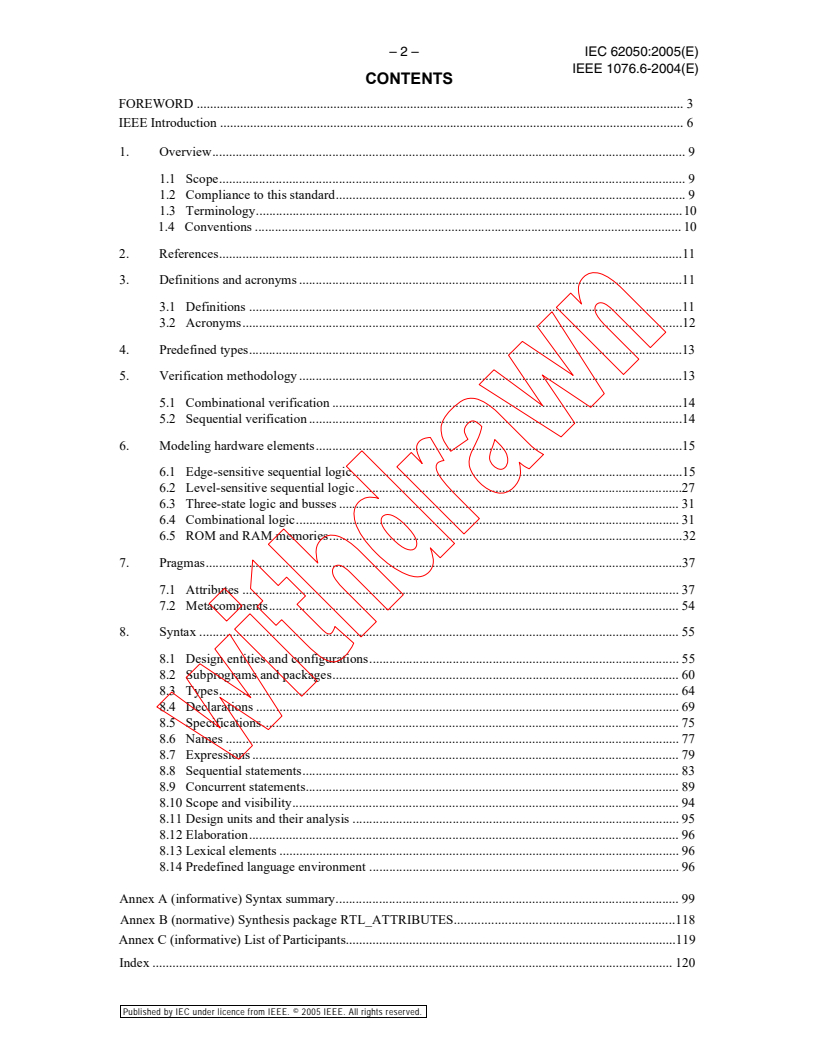
– 2 – IEC 62050:2005(E)
IEEE 1076.6-2004(E)
CONTENTS
FOREWORD . 3
IEEE Introduction . 6
1. Overview. 9
1.1 Scope. 9
1.2 Compliance to this standard. 9
1.3 Terminology. 10
1.4 Conventions . 10
2. References.11
3. Definitions and acronyms .11
3.1 Definitions .11
3.2 Acronyms.12
4. Predefined types.13
5. Verification methodology .13
5.1 Combinational verification .14
5.2 Sequential verification .14
6. Modeling hardware elements.15
6.1 Edge-sensitive sequential logic.15
6.2 Level-sensitive sequential logic.27
6.3 Three-state logic and busses . 31
6.4 Combinational logic. 31
6.5 ROM and RAM memories.32
7. Pragmas.37
7.1 Attributes . 37
7.2 Metacomments. 54
8. Syntax . 55
8.1 Design entities and configurations. 55
8.2 Subprograms and packages. 60
8.3 Types. 64
8.4 Declarations . 69
8.5 Specifications. 75
8.6 Names . 77
8.7 Expressions . 79
8.8 Sequential statements. 83
8.9 Concurrent statements. 89
8.10 Scope and visibility. 94
8.11 Design units and their analysis . 95
8.12 Elaboration. 96
8.13 Lexical elements . 96
8.14 Predefined language environment . 96
Annex A (informative) Syntax summary. 99
Annex B (normative) Synthesis package RTL_ATTRIBUTES.118
Annex C (informative) List of Participants.119
Index . 120
Published by IEC under licence from IEEE. © 2005 IEEE. All rights reserved.
IEEE 1076.6-2004(E)
INTERNATIONAL ELECTROTECHNICAL COMMISSION
___________
VHDL REGISTER TRANSFERT LEVEL (RTL) SYNTHESIS
FOREWORD
1) The International Electrotechnical Commission (IEC) is a worldwide organization for standardization
comprising all national electrotechnical committees (IEC National Committees). The object of IEC is to
promote international co-operation on all questions concerning standardization in the electrical and
electronic fields. To this end and in addition to other activities, IEC publishes International Standards,
Technical Specifications, Technical Reports, Publicly Available Specifications (PAS) and Guides (hereafter
referred to as “IEC Publication(s)”). Their preparation is entrusted to technical committees; any IEC National
Committee interested in the subject dealt with may participate in this preparatory work. International,
governmental and non-governmental organizations liaising with the IEC also participate in this preparation.
IEC collaborates closely with the International Organization for Standardization (ISO) in accordance with
conditions determined by agreement between the two organizations.
2) The formal decisions or agreements of IEC on technical matters express, as nearly as possible, an
international consensus of opinion on the relevant subjects since each technical committee has
representation from all interested IEC National Committees.
3) IEC Publications have the form of recommendations for international use and are accepted by IEC National
Committees in that sense. While all reasonable efforts are made to ensure that the technical content of IEC
Publications is accurate, IEC cannot be held responsible for the way in which they are used or for any
misinterpretation by any end user.
4) In order to promote international uniformity, IEC National Committees undertake to apply IEC Publications
transparently to the maximum extent possible in their national and regional publications. Any divergence
between any IEC Publication and the corresponding national or regional publication shall be clearly
indicated in the latter.
5) IEC provides no marking procedure to indicate its approval and cannot be rendered responsible for any
equipment declared to be in conformity with an IEC Publication.
6) Attention is drawn to the possibility that some of the elements of this IEC Publication may be the subject of
patent rights. IEC shall not be held responsible for identifying any or all such patent rights.
International Standard IEC/IEEE 62050 has been processed through IEC technical
committee 93: Design automation.
The text of this standard is based on the following documents:
IEEE Std FDIS Report on voting
1076.6 (2004) 93/212/FDIS 93/217/RVD
Full information on the voting for the approval of this standard can be found in the report on
voting indicated in the above table.
This publication has been drafted in accordance with the ISO/IEC Directives.
The committee has decided that the contents of this publication will remain unchanged
until 2009.
“Attention!
It should be noted that this International Standard IEC 62050 is totally unrelated to
IEC/PAS 62050 despite the identical numbering.”
Published by IEC under licence from IEEE. © 2005 IEEE. All rights reserved.
– 4 – IEC 62050:2005(E)
IEEE 1076.6-2004(E)
IEC/IEEE Dual Logo International Standards
This Dual Logo International Standard is the result of an agreement between the IEC and the Institute of
Electrical and Electronics Engineers, Inc. (IEEE). The original IEEE Standard was submitted to the IEC for
consideration under the agreement, and the resulting IEC/IEEE Dual Logo International Standard has been
published in accordance with the ISO/IEC Directives.
IEEE Standards documents are developed within the IEEE Societies and the Standards Coordinating
Committees of the IEEE Standards Association (IEEE-SA) Standards Board. The IEEE develops its standards
through a consensus development process, approved by the American National Standards Institute, which
brings together volunteers representing varied viewpoints and interests to achieve the final product. Volunteers
are not necessarily members of the Institute and serve without compensation. While the IEEE administers the
process and establishes rules to promote fairness in the consensus development process, the IEEE does not
independently evaluate, test, or verify the accuracy of any of the information contained in its standards.
Use of an IEC/IEEE Dual Logo International Standard is wholly voluntary. The IEC and IEEE disclaim liability for
any personal injury, property or other damage, of any nature whatsoever, whether special, indirect,
consequential, or compensatory, directly or indirectly resulting from the publication, use of, or reliance upon
this, or any other IEC or IEEE Standard document.
The IEC and IEEE do not warrant or represent the accuracy or content of the material contained herein, and
expressly disclaim any express or implied warranty, including any implied warranty of merchantability or fitness
for a specific purpose, or that the use of the material contained herein is free from patent infringement.
IEC/IEEE Dual Logo International Standards documents are supplied “AS IS”.
The existence of an IEC/IEEE Dual Logo International Standard does not imply that there are no other ways to
produce, test, measure, purchase, market, or provide other goods and services related to the scope of the
IEC/IEEE Dual Logo International Standard. Furthermore, the viewpoint expressed at the time a standard is
approved and issued is subject to change brought about through developments in the state of the art and
comments received from users of the standard.
Every IEEE Standard is subjected to review at least every five years for revision or reaffirmation. When a
document is more than five years old and has not been reaffirmed, it is reasonable to conclude that its contents,
although still of some value, do not wholly reflect the present state of the art. Users are cautioned to check to
determine that they have the latest edition of any IEEE Standard.
In publishing and making this document available, the IEC and IEEE are not suggesting or rendering
professional or other services for, or on behalf of, any person or entity. Neither the IEC nor IEEE is undertaking
to perform any duty owed by any other person or entity to another. Any person utilizing this, and any other
IEC/IEEE Dual Logo International Standards or IEEE Standards document, should rely upon the advice of a
competent professional in determining the exercise of reasonable care in any given circumstances.
Interpretations – Occasionally questions may arise regarding the meaning of portions of standards as they relate
to specific applications. When the need for interpretations is brought to the attention of IEEE, the Institute will
initiate action to prepare appropriate responses. Since IEEE Standards represent a consensus of concerned
interests, it is important to ensure that any interpretation has also received the concurrence of a balance of
interests. For this reason, IEEE and the members of its societies and Standards Coordinating Committees are
not able to provide an instant response to interpretation requests except in those cases where the matter has
previously received formal consideration.
Comments for revision of IEC/IEEE Dual Logo International Standards are welcome from any interested party,
regardless of membership affiliation with the IEC or IEEE. Suggestions for changes in documents should be in
the form of a proposed change of text, together with appropriate supporting comments. Comments on standards
and requests for interpretations should be addressed to:
Secretary, IEEE-SA Standards Board, 445 Hoes Lane, P.O. Box 1331, Piscataway, NJ 08855-1331, USA and/or
General Secretary, IEC, 3, rue de Varembé, PO Box 131, 1211 Geneva 20, Switzerland.
Authorization to photocopy portions of any individual standard for internal or personal use is granted by the
Institute of Electrical and Electronics Engineers, Inc., provided that the appropriate fee is paid to Copyright
Clearance Center. To arrange for payment of licensing fee, please contact Copyright Clearance Center,
Customer Service, 222 Rosewood Drive, Danvers, MA 01923 USA; +1 978 750 8400. Permission to photocopy
portions of any individual standard for educational classroom use can also be obtained through the Copyright
Clearance Center.
NOTE – Attention is called to the possibility that implementation of this standard may require use of subject
matter covered by patent rights. By publication of this standard, no position is taken with respect to the
existence or validity of any patent rights in connection therewith. The IEEE shall not be responsible for
identifying patents for which a license may be required by an IEEE standard or for conducting inquiries into the
legal validity or scope of those patents that are brought to its attention.
Published by IEC under licence from IEEE. © 2005 IEEE. All rights reserved.
IEEE 1076.6-2004(E)
IEEE Standard for VHDL Register
Transfer Level (RTL) Synthesis
Sponsor
Design Automation Standards Committee
of the
IEEE Computer Society
Approved 25 August 2004
American National Standard Institute
Approved 12 May 2004
IEEE-SA Standards Board
Abstract: This document specifies a standard for use of very high-speed integrated circuit hard-
ware description language (VHDL) to model synthesizable register-transfer level digital logic. A
standard syntax and semantics for VHDL register-transfer level synthesis is defined. The subset of
the VHDL language, which is synthesizable, is described, and nonsynthesizable VHDL constructs
are identified that should be ignored or flagged as errors.
Keywords: hardware description language, logic synthesis, register transfer level (RTL), very high-
speed integrated circuit hardware description language (VHDL)
Published by IEC under licence from IEEE. © 2005 IEEE. All rights reserved.
– 6 – IEC 62050:2005(E)
IEEE 1076.6-2004(E)
IEEE Introduction
This standard describes a standard syntax and semantics for VHDL RTL synthesis. It defines the subset of
IEC/IEEE 61691-1-1:2004 (VHDL) that is suitable for RTL synthesis and defines the semantics of that subset
TM
for the synthesis domain. This standard is based on IEC/IEEE 61691-1-1:2004, IEEE Std 1164 -1993,
TM
and IEEE Std 1076.3 -1997.
The purpose of this standard is to define a syntax and semantics that can be used in common by all compliant
RTL synthesis tools to achieve uniformity of results in a similar manner to which simulation tools use
IEC/IEEE 61691-1-1:2004. This will allow users of synthesis tools to produce well-defined designs whose
functional characteristics are independent of a particular synthesis implementation by making their designs
compliant with this standard.
The standard is intended for use by logic designers and electronic engineers.
This document specifies IEEE Std 1076.6-2004, which is a revision of IEEE Std 1076.6-1999. The VHDL
Synthesis Interoperability Working Group (SIWG) of the IEEE Computer Society started the development
of IEEE Std 1076.6-2004 in January 1998. The work initially started as a Level 2 effort (Level 1 being
IEEE Std 1076.6-1999). In fact the work on Level 2 continued right after Level 1 was completed by the
working group. The working group realized that a Level 2 was required and that it would take some time to
develop and continued working on it at regular face-to-face meetings and teleconferences. As the Level 2
draft continued to mature, the working group decided that rather than having two different levels of synthe-
sis subsets, it was better to just have one standard, with IEEE Std 1076.6-2004 becoming Level 2.
The intent of this version was to include a maximum subset of VHDL that could be used to describe synthe-
sizable RTL logic. This included considering new features introduced by IEC/IEEE 61691-1-1:2004,
new semantics based on algorithmic styles rather than template-driven, and a set of synthesis attributes that
could be used to annotate an RTL description. The following team leaders drove this effort:
Syntax: Lance Thompson
Semantics: Vinaya Singh
Attributes: Sanjiv Narayan
In addition, the following provided much-needed additional support:
Web and reflector admin: David Bishop
Documentation: John Michael Williams
A majority of the work conducted by the working group was done via teleconferencing, which was held reg-
ularly and open to all. Also, the working group used an e-mail reflector and its web page effectively to
distribute and share information.
Published by IEC under licence from IEEE. © 2005 IEEE. All rights reserved.
IEEE 1076.6-2004(E)
The following volunteers contributed to the development of this standard:
J. Bhasker, Chair
Jim Lewis, Vice-Chair
Rob Anderson Rich Hatcher Jonas Nilsson
Bill Anker Mohammad Kakoee Alain Raynaud
Victor Berman Masamichi Kawarabayashi Mehrdad Reshadi
Apurva Kalia
David Bishop Fredj Rouatbi
Dominique Borrione Satish Kumar Steve Schultz
Dennis Brophy Evan Lavelle Manish Shrivastava
Andrew Brown Vijay Madisetti Vinaya Singh
Patrick Bryant Erich Marschner Douglas Smith
Ben Cohen Paul Menchini Lance Thompson
Tim Davis Amitabh Menon Alessandro Uber
Colin Dente Egbert Molenkamp Jim Vellenga
Wolfgang Ecker Bob Myers Eugenio Villar
Bob Flatt Sanjana Nair John Michael Williams
Sanjiv Narayan Francisco De Ycaza
Christopher Grimm
Steve Grout Zain Navabi Alex Zamfirescu
Development of IEEE Std 1076.6-1999
Initial work on this standard started as a synthesis interoperability working group under VHDL Interna-
tional. The working group was also chartered by the EDA Industry Council Project Technical Advisory
Board (PTAB) to develop a draft based on the donated subsets by the following companies/groups:
— Cadence
— European Synthesis Working Group
—IBM
— Mentor Graphics
— Synopsys
After the PTAB approved of the draft 1.5 with an overwhelming affirmative response, an IEEE PAR was
obtained to clear its way for IEEE standardization. Most of the members of the original group continued to
be part of the Pilot Group under P1076.6 to lead the technical work.
At the time the 1999 standard was completed, the P1076.6 Pilot Team had the following membership:
Rob Anderson Wolfgang Ecker Doug Perry
Victor Berman Bob Flatt Steve Schultz
J. Bhasker Christopher Grimm Doug Smith
David Bishop Rich Hatcher Lance Thompson
Dominique Borrione Apurva Kalia Fur-Shing Tsai
Dennis Brophy Masamichi Kawarabayashi Jim Vellenga
Ben Cohen Jim Lewis Eugenio Villar
Colin Dente Sanjiv Narayan Nels Vander Zanden
Many individuals from different organizations contributed to the development of this standard. In particular,
in addition to the Pilot Team, the following individuals contributed to the development of the standard by
being part of the working group:
Bill Anker Robert Blackburn John Hillawi
LaNae Avra Pradip Jha
In addition, 95 individuals on the working group e-mail reflector also contributed to this development.
Published by IEC under licence from IEEE. © 2005 IEEE. All rights reserved.
– 8 – IEC 62050:2005(E)
IEEE 1076.6-2004(E)
Notice to users
Errata
Errata, if any, for this and all other standards can be accessed at the following URL: http://
standards.ieee.org/reading/ieee/updates/errata/index.html. Users are encouraged to check this URL for
errata periodically.
Interpretations
Current interpretations can be accessed at the following URL: http://standards.ieee.org/reading/ieee/interp/
index.html.
Patents
Attention is called to the possibility that implementation of this standard may require use of subject matter
covered by patent rights. By publication of this standard, no position is taken with respect to the existence or
validity of any patent rights in connection therewith. The IEEE shall not be responsible for identifying
patents or patent applications for which a license may be required to implement an IEEE standard or for
conducting inquiries into the legal validity or scope of those patents that are brought to its attention.
Published by IEC under licence from IEEE. © 2005 IEEE. All rights reserved.
IEEE 1076.6-2004(E)
VHDL REGISTER TRANSFER LEVEL (RTL)
SYNTHESIS
1. Overview
1.1 Scope
This standard defines a subset of very high-speed integrated circuit hardware description language (VHDL)
that ensures portability of VHDL descriptions between register transfer level synthesis tools. Synthesis tools
may be compliant and yet have features beyond those required by this standard. This standard defines how
the semantics of VHDL shall be used, for example, to model level-sensitive and edge-sensitive logic. It also
describes the syntax of the language with reference to what shall be supported and what shall not be sup-
ported for interoperability.
Use of this standard should minimize the potential for functional simulation mismatches between models
before they are synthesized and after they are synthesized.
1.2 Compliance to this standard
1.2.1 Model compliance
A VHDL model shall be defined as being compliant to this standard if the model
a) Uses only constructs described as supported or ignored in this standard
b) Adheres to the semantics defined in this standard
1.2.2 Tool compliance
A synthesis tool shall be defined as being compliant to this standard if it
a) Accepts all models that adhere to the model compliance definition defined in 1.2.1
b) Supports language related pragmas defined by this standard
c) Produces a circuit model that has the same functionality as the input model based on the verification
process as outlined in Clause 5.
Published by IEC under licence from IEEE. © 2005 IEEE. All rights reserved.
– 10 – IEC 62050:2005(E)
IEEE 1076.6-2004(E)
1.3 Terminology
The word shall indicates mandatory requirements strictly to be followed in order to conform to the standard
and from which no deviation is permitted (shall equals is required to). The word should is used to indicate
that a certain course of action is preferred but not necessarily required; or that (in the negative form) a cer-
tain course of action is deprecated but not prohibited (should equals is recommended that). The word may
indicates a course of action permissible within the limits of the standard (may equals is permitted).
A synthesis tool is said to accept a VHDL construct if it allows that construct to be legal input; it is said to
interpret the construct (or to provide an interpretation of the construct) by producing something that repre-
sents the construct. A synthesis tool is not required to provide an interpretation for every construct that it
accepts, but only for those for which an interpretation is specified by this standard.
The constructs in the standard shall be categorized as follows:
Supported: RTL synthesis shall interpret a construct, that is, map the construct to an equivalent
hardware representation.
Ignored: RTL synthesis shall ignore the construct and produce a warning. Encountering the con-
struct shall not cause synthesis to fail, but synthesis results may not match simulation results. The
mechanism, if any, by which RTL synthesis notifies (warns) the user of such constructs is not
defined by this standard. Ignored constructs may include unsupported constructs.
Not Supported: RTL synthesis does not support the construct. RTL synthesis does not expect to
encounter the construct, and the failure mode shall be undefined. RTL synthesis may fail upon
encountering such a construct. Failure is not mandatory; more specifically, RTL synthesis is allowed
to treat such a construct as ignored.
NOTE—A synthesis tool may interpret constructs that are identified as not supported in this standard. However a model
that contains such unsupported constructs is not compliant with this standard.
1.4 Conventions
This standard uses the following conventions:
a) The body of the text of this standard uses boldface to denote VHDL reserved words (such as
downto).
b) The text of the VHDL examples and code fragments is represented in a fixed-width font.
c) Syntax text that is struck-through (e.g., text) refers to syntax that shall not be supported.
d) Syntax text that is underscored (e.g., text) refers to syntax that shall be ignored.
e) < and > pairs are used to represent text in one of several different, but specific forms. For example,
one of the forms of could be “CLOCK'EVENT and CLOCK = '1'”.
f) Any paragraph starting with “NOTE—” is informative and not part of the standard.
g) The examples that appear in this document under “Example:” are for the sole purpose of demon-
strating the syntax and semantics of VHDL for synthesis. It is not the intent of this standard to
demonstrate, recommend, or emphasize coding styles that are more (or less) efficient in generating
an equivalent hardware representation. In addition, it is not the intent of this standard to present
examples that represent a compliance test suite, or a performance benchmark, even though these
examples are compliant to this standard (except as noted otherwise).
Notes in text, tables, and figures are given for information only and do not contain requirements needed to implement the standard.
Published by IEC under licence from IEEE. © 2005 IEEE. All rights reserved.
IEEE 1076.6-2004(E)
2. References
This standard shall be used in conjunction with the following publications. When the following standards
are superseded by an approved revision, the revision shall apply.
TM 2, 3
IEEE Std 1076.3 -1997, IEEE Standard Synthesis Packages (NUMERIC_BIT and NUMERIC_STD).
TM
IEEE Std 1164 -1993, IEEE Standard Multivalue Logic System for VHDL Model Interoperability
(STD_LOGIC_1164).
IEC/IEEE 61691-1-1:2004, Behavioural languages - Part 1-1: VHDL language reference manual
3. Definitions and acronyms
3.1 Definitions
For the purposes of this standard, the following terms and definitions apply. The Authoritative Dictionary of
IEEE Standards Terms, Seventh Edition should be referenced for terms not defined in this clause.
Terms used within this standard but not defined in this clause are assumed to be from IEC/IEEE
61691-1-1:2004, IEEE Std 1164-1993, or IEEE Std 1076.3-1997.
3.1.1 assignment reference: The occurrence of a literal or expression as the waveform element of a signal
assignment statement or as the right-hand side expression of a variable assignment statement.
3.1.2 combinational logic: Logic that settles to a state entirely determined by the current input values and
therefore that cannot store information. Any change in the input causes a new state completely defined by
the new inputs.
3.1.3 don’t care value: The enumeration literal ‘-’ of the type STD_ULOGIC (or subtype STD_LOGIC).
3.1.4 edge-sensitive storage element: Any storage element mapped to by a synthesis tool that
a) Propagates the value at the data input whenever an appropriate transition in value is detected on a
clock control input
b) Preserves the last value propagated at all other times, except when any asynchronous control inputs
become active (for example, a flip-flop)
3.1.5 high-impedance value: The enumeration literal ‘Z’ of the type STD_ULOGIC (or subtype
STD_LOGIC).
3.1.6 level-sensitive storage element: Any storage element mapped to by a synthesis tool that
a) Propagates the value at the data input whenever an appropriate value is detected on a clock control
input
b) Preserves the last value propagated at all other times, except when any asynchronous control inputs
become active (for example, a latch)
The IEEE standards or products referred to in this clause are trademarks of the Institute of Electrical and Electronics Engineers, Inc.
IEEE publications are available from the Institute of Electrical and Electronics Engineers, 445 Hoes Lane, P.O. Box 1331, Piscataway,
NJ 08855-1331, USA (http://standards.ieee.org/).
IEC/IEEE publications are also available from the Institute of Electrical and Electronics Engineers.
Information on references can be found in Clause 2.
Published by IEC under licence from IEEE. © 2005 IEEE. All rights reserved.
– 12 – IEC 62050:2005(E)
IEEE 1076.6-2004(E)
3.1.7 logical operation: An operation for which the VHDL operator is and, or, nand, nor, xor, xnor, or
not.
3.1.8 metacomment: A VHDL comment (--) that is used to provide synthesis-specific interpretation by a
synthesis tool.
3.1.9 metalogical value: One of the enumeration literals ‘U’, ‘X’, ‘W’, or ‘-’ of the type STD_ULOGIC (or
subtype STD_LOGIC).
3.1.10 pragma: A generic term used to define a construct with no predefined language semantics that influ-
ences how a synthesis tool will synthesize VHDL code into an equivalent hardware representation.
3.1.11 sequential logic: Logic that settles to a state not determined solely by current inputs. The current
state of such logic can be determined only by knowing the current inputs and some history of past inputs in
their sequential order. Sequential logic always stores information from past input and therefore may be used
to implement storage elements.
3.1.12 synchronous assignment: An assignment that takes place when a signal or variable value is updated
as a direct result of a clock edge expression evaluating as true.
3.1.13 synthesis library: A library of digital design objects such as logic gates, chip pads, memory blocks,
or other blocks; instances of these elements are connected together by a synthesis tool to create a synthesized
netlist.
3.1.14 synthesis tool: Any system, process, or tool that interprets register transfer level VHDL source code
as a description of an electronic circuit and derives a netlist description of that circuit.
3.1.15 synthesis-specific attribute: An attribute recognized by a tool compliant to this standard.
3.1.16 user: A person, system, process, or tool that generates the VHDL source code that a synthesis tool
processes.
3.1.17 vector: A one-dimensional array.
3.1.18 well-defined: Containing no metalogical or high-impedance value.
3.2 Acronyms
LRM The IEEE VHDL language reference manual, that is, IEC/IEEE 61691-1-1:2004.
RTL The register transfer level of modeling circuits in VHDL for use with register transfer level
synthesis. Register transfer level is a level of description of a digital design in which the
clocked behavior of the design is expressly described in terms of data transfers between stor-
age elements in sequential logic, which may be implied, and combinational logic, which may
represent any computing or arithmetic-logic-unit logic. RTL modeling allows design hierarchy
that represents a structural description of other RTL models.
Published by IEC under licence from IEEE. © 2005 IEEE. All rights reserved.
IEEE 1076.6-2004(E)
4. Predefined types
A synthesis tool, compliant with this standard, shall support the following predefined types:
a) BIT, BOOLEAN, and BIT_VECTOR as defined by IEC/IEEE 61691-1-1:2004.
b) CHARACTER and STRING as defined in IEC/IEEE 61691-1-1:2004.
c) INTEGER as defined in IEC/IEEE 61691-1-1:2004.
d) STD_ULOGIC, STD_ULOGIC_VECTOR, STD_LOGIC, and STD_LOGIC_VECTOR as defined
by the package STD_LOGIC_1164 (IEEE Std 1164-1993)
e) SIGNED and UNSIGNED as defined by the VHDL package NUMERIC_BIT as part of
IEEE Std 1076.3-1997
f) SIGNED and UNSIGNED as defined by the VHDL package NUMERIC_STD as part of
IEEE Std 1076.3-1997
The synthesis interpretation of the values that belong to type STD_ULOGIC shall be as defined in
IEEE Std 1076.3-1997.
No array type, other than those listed in e) and f), shall be used to represent signed or unsigned numbers.
The synthesis tool shall also support user-defined and other types derived from the predefined types accord-
ing to the rules of 8.3.
By definition, if a type with a metalogical or high-impedance value is used in a model, then this type shall
have as an ancestor a type that belongs to the package STD_LOGIC_1164 (IEEE Std 1164-1993).
5. Verification methodology
Synthesized results may be broadly classified as either combinational or sequential. Sequential logic has
some form of internal storage (latch, register, memory). Combinational logic has outputs that are solely a
function of the inputs with no internal loops and no internal storage. Designs may contain both sequential
and combinational parts.
The process of verifying synthesis results using simulation consists of applying equivalent inputs to both the
original model and synthesized model and then comparing their outputs to ensure that they are equivalent.
Equivalent in this context means that a synthesis tool shall produce a circuit that is equivalent at the input,
output, and bidirectional ports of the model. As synthesis in general does not recognize the same delays as
simulators, the outputs cannot be compared at every simulation time. Rather, they can only be compared at
specific simulation times when all transient delays have settled and all active timeout clauses have been
exceeded. If the outputs do not match at all comparable times, the synthesis tool shall not be compliant.
There shall be no matching requirement placed on any internal nodes.
The input stimulus shall comply with the following criteria:
a) Input data does not contain metalogical or high-impedance values.
b) Input data may only contain ‘H’ and ‘L’ on inputs that are converted to ‘1’ and ‘0’, respectively.
c) For combinational verification, input data must change far enough in advance of sensing times to
allow transient delays to have settled.
d) Clock and/or input data must change after enough time of the asynchronous set/reset signals going
from active to inactive to fulfill the setup/hold times of the sequential elements in the design.
Published by IEC under licence from IEEE. © 2005 IEEE. All rights reserved.
– 14 – IEC 62050:2005(E)
IEEE 1076.6-2004(E)
e) For edge-sensitive designs, primary inputs of the design must change far enough in advance for the
edge-sensitive storage element input data to fulfill the setup times with respect to the active clock
edge. Also, the input data must remain stable for long enough to fulfill the hold times with respect to
the active clock edge.
f) For level-sensitive designs, primary inputs of the design must change far enough in advance for the
level-sensitive storage element input data to fulfill the setup times. Also, the input data must remain
stable for long enough to fulfill the hold times.
NOTE—A synthesis tool may define metalogical or high-impedance values appearing on primary outputs in one model
as equivalent to logical values in the other model. For this reason, the input stimulus may need to reset internal storage
elements to specific logical values before the outputs of both models are compared for logical values.
5.1 Combinational verification
To verify combinational logic, the input stimulus shall be applied first. Sufficient time shall be provided for
the design to settle, and then the outputs examined. To verify the combinational logic portion of a model, the
following sequence of events shall be done repeatedly for each input stimulus application:
a) Apply input stimulus
b) Wait for data to settle
c) Check outputs
Each application of inputs shall include enough delay so that the transient delays and timeout clause delays
have been exceeded. A model is not in compliance with this standard if it is possible for outputs or internal
nodes of the combinational model never to reach a steady state (i.e., oscillatory behavior).
Example:
A <= not A after 5 ns; -- oscillatory behavior, noncompliant
5.2 Sequential verification
The general scheme consists of applying inputs periodically and then comparing the outputs just before the
next set of inputs is applied. Sequential models contain edge-sensitive and/or level-sensitive storage ele-
ments. The sequential design must be reset, if required, before verification can begin.
The verification of designs containing edge-sensitive or level-sensitive storage elements is as follows:
a) Edge-sensitive models: The same sequence of tasks as used for combinatorial verification shall be
performed during verification: Change the inputs, compute the results, and compare the outputs.
However, for sequential verification, these tasks shall be synchronized with one of the inputs, which
is a clock. The inputs must change in an appropriate order with respect to the input that is treated as
a clock, and their consequences must be allowed to settle prior to comparison. Comparison might
best be done just before the active clock edge, and the non-clock inputs can change relatively soon
after the edge. The circuit then has the rest of the clock period to compute the new results before
they are stored at the next clock edge. The period of the clock generated by the stimulus shall be suf-
ficient to allow the input and output signals to settle.
b) Level-sensitive models: These designs are generally less predictable than edge-sensitive models due
to the asynchronous nature of the signal interactions. Verification of synthesized results depends on
the application. With level-sensitive storage elements, a general rule is that data inputs should be
stable before enables go inactive (i.e., latch) and comparing of outputs is best done after enables are
inactive (i.e., latched) and combinational delays have settled. A level-sensitive model in which it is
possible, in the absence of further changes to the inputs of the model, for one or more internal values
or outputs of the model never to reach a steady state (oscillatory behavior) is not in compliance with
this standard.
Published by IEC under licence from IEEE. © 2005 IEEE. All rights reserved.
IEEE 1076.6-2004(E)
6. Modeling hardware elements
This clause specifies styles for modeling hardware elements such as edge-sensitive storage elements, level-
sensitive storage elemen
...