

IEC 62264-3:2007
(Main)Enterprise-control system integration - Part 3: Activity models of manufacturing operations management
General Information
- Abstract
It defines activity models of manufacturing operations management that enable enterprise system to control system integration. The activities defined are consistent with the object models definitions given in IEC 62264-1. The modelled activities operate between business planning and logistics functions, defined as the Level 4 functions and the process control functions, defined as the Level 2 functions of IEC 62264-1. The scope of this standard is limited to: - a model of the activities associated with manufacturing operations management, Level 3 functions; - an identification of some of the data exchanged between Level 3 activities.
- Status
- Published
- Publication Date
- 05-Jun-2007
- Technical Committee
- SC 65E - Devices and integration in enterprise systems
- Current Stage
- DELPUB - Deleted Publication
- Start Date
- 16-Dec-2016
- Completion Date
- 28-Aug-2026
Overview
IEC 62264-3:2007 is a crucial international standard published by the International Electrotechnical Commission (IEC) focusing on enterprise-control system integration through activity models for manufacturing operations management. This part of the IEC 62264 series defines activity models specifically for Level 3 manufacturing operations management (MOM) functions that bridge the gap between enterprise business planning and logistics (Level 4) and process control functions (Level 2). By establishing consistent activity models aligned with object models from IEC 62264-1, this standard enhances interoperability and data exchange between enterprise systems and control systems.
Key Topics
- Manufacturing Operations Management Activities: The standard details models for core Level 3 MOM activities, including production, maintenance, quality, and inventory operations management.
- Data Exchange Identification: It identifies and describes data exchanged among Level 3 activities, enabling seamless integration and coordination.
- Functional Hierarchy Alignment: IEC 62264-3 structures manufacturing operations activities within a multi-level functional hierarchy consistent with the IEC 62264 series.
- Decision and Equipment Hierarchies: The standard elaborates on decision-making hierarchies and expanded equipment models critical for efficient operations scheduling and control.
- Activity Models: Comprehensive activity models provide a blueprint for managing tasks such as scheduling, dispatching, execution, data collection, tracking, and performance analysis.
- Information Categories: Definitions and classifications of production information that support operational decisions and system integration.
- Scope Limitation: The focus is exclusively on Level 3 MOM activities, acting as a liaison between enterprise-level planning and control-level execution systems.
Applications
- Industrial Automation Integration: Facilitates integration between enterprise resource planning (ERP) and manufacturing execution systems (MES).
- Manufacturing Operations Excellence: Provides manufacturers with frameworks to optimize production scheduling, resource management, and quality control.
- Data Consistency and Interoperability: Ensures consistent information exchange across different systems, improving operational visibility and decision-making.
- Maintenance and Quality Management: Supports detailed planning and execution of maintenance operations and quality testing activities.
- Inventory Control: Offers models for effective inventory scheduling, dispatch, execution, and tracking within manufacturing environments.
- MES Design and Implementation: Analysts and system architects utilize this standard to design scalable, interoperable MES aligned with international best practices.
- Supply Chain Coordination: By bridging the gap between Levels 4 and 2, it enhances synchronization across the manufacturing supply chain.
Related Standards
- IEC 62264-1: Object models and attributes used as a foundation for activity modeling in Part 3.
- IEC 62264-2: Interface models that define exchange mechanisms complementing activity models.
- ISA-95: The ANSI/ISA international standard for enterprise-control integration in which IEC 62264 series is harmonized.
- IEC 61512: Standards related to batch control complementing manufacturing execution systems.
- IEC 61511: Functional safety related standards applicable within manufacturing control environments.
- Other IEC 62264 Parts: Covering additional aspects of factory and enterprise integration, such as information exchange and physical model definitions.
By implementing IEC 62264-3:2007, industries can achieve superior integration between their manufacturing control systems and enterprise business systems. This leads to improved operational efficiency, quality assurance, real-time data flow, and strategic resource management - all critical factors in modern smart manufacturing and Industry 4.0 initiatives.
Relations
- Effective Date
- 05-Sep-2023
Get Certified
Connect with accredited certification bodies for this standard

BSI Group
BSI (British Standards Institution) is the business standards company that helps organizations make excellence a habit.

DVS-ZERT GmbH
German welding certification society.
CARES (UK Certification Authority for Reinforcing Steels)
UK certification for reinforcing steels and construction.
Sponsored listings
Frequently Asked Questions
IEC 62264-3:2007 is a standard published by the International Electrotechnical Commission (IEC). Its full title is "Enterprise-control system integration - Part 3: Activity models of manufacturing operations management". This standard covers: It defines activity models of manufacturing operations management that enable enterprise system to control system integration. The activities defined are consistent with the object models definitions given in IEC 62264-1. The modelled activities operate between business planning and logistics functions, defined as the Level 4 functions and the process control functions, defined as the Level 2 functions of IEC 62264-1. The scope of this standard is limited to: - a model of the activities associated with manufacturing operations management, Level 3 functions; - an identification of some of the data exchanged between Level 3 activities.
It defines activity models of manufacturing operations management that enable enterprise system to control system integration. The activities defined are consistent with the object models definitions given in IEC 62264-1. The modelled activities operate between business planning and logistics functions, defined as the Level 4 functions and the process control functions, defined as the Level 2 functions of IEC 62264-1. The scope of this standard is limited to: - a model of the activities associated with manufacturing operations management, Level 3 functions; - an identification of some of the data exchanged between Level 3 activities.
IEC 62264-3:2007 is classified under the following ICS (International Classification for Standards) categories: 25.040.01 - Industrial automation systems in general; 35.240.50 - IT applications in industry. The ICS classification helps identify the subject area and facilitates finding related standards.
IEC 62264-3:2007 has the following relationships with other standards: It is inter standard links to IEC 62264-3:2016. Understanding these relationships helps ensure you are using the most current and applicable version of the standard.
IEC 62264-3:2007 is available in PDF format for immediate download after purchase. The document can be added to your cart and obtained through the secure checkout process. Digital delivery ensures instant access to the complete standard document.
Standards Content (Sample)
INTERNATIONAL IEC
STANDARD
CEI
62264-3
NORME
First edition
INTERNATIONALE
Première édition
2007-06
Enterprise-control system integration –
Part 3:
Activity models of manufacturing
operations management
Intégration du système
de commande d’entreprise –
Partie 3:
Modèles d’activités pour la gestion
des opérations de fabrication
Reference number
Numéro de référence
IEC/CEI 62264-3:2007
All rights reserved. Unless otherwise specified, no part of this publication may be reproduced or utilized in any form
or by any means, electronic or mechanical, including photocopying and microfilm, without permission in writing from
either IEC or IEC's member National Committee in the country of the requester.
If you have any questions about IEC copyright or have an enquiry about obtaining additional rights to this publication,
please contact the address below or your local IEC member National Committee for further information.
Droits de reproduction réservés. Sauf indication contraire, aucune partie de cette publication ne peut être reproduite
ni utilisée sous quelque forme que ce soit et par aucun procédé, électronique ou mécanique, y compris la photocopie
et les microfilms, sans l'accord écrit de la CEI ou du Comité national de la CEI du pays du demandeur.
Si vous avez des questions sur le copyright de la CEI ou si vous désirez obtenir des droits supplémentaires sur cette
publication, utilisez les coordonnées ci-après ou contactez le Comité national de la CEI de votre pays de résidence.
IEC Central Office
3, rue de Varembé
CH-1211 Geneva 20
Switzerland
Email: inmail@iec.ch
Web: www.iec.ch
About the IEC
The International Electrotechnical Commission (IEC) is the leading global organization that prepares and publishes
International Standards for all electrical, electronic and related technologies.
About IEC publications
The technical content of IEC publications is kept under constant review by the IEC. Please make sure that you have the
latest edition, a corrigenda or an amendment might have been published.
ƒ Catalogue of IEC publications: www.iec.ch/searchpub
The IEC on-line Catalogue enables you to search by a variety of criteria (reference number, text, technical committee,…).
It also gives information on projects, withdrawn and replaced publications.
ƒ IEC Just Published: www.iec.ch/online_news/justpub
Stay up to date on all new IEC publications. Just Published details twice a month all new publications released. Available
on-line and also by email.
ƒ Customer Service Centre: www.iec.ch/webstore/custserv
If you wish to give us your feedback on this publication or need further assistance, please visit the Customer Service
Centre FAQ or contact us:
Email: csc@iec.ch
Tel.: +41 22 919 02 11
Fax: +41 22 919 03 00
A propos de la CEI
La Commission Electrotechnique Internationale (CEI) est la première organisation mondiale qui élabore et publie des
normes internationales pour tout ce qui a trait à l'électricité, à l'électronique et aux technologies apparentées.
A propos des publications CEI
Le contenu technique des publications de la CEI est constamment revu. Veuillez vous assurer que vous possédez
l’édition la plus récente, un corrigendum ou amendement peut avoir été publié.
ƒ Catalogue des publications de la CEI: www.iec.ch/searchpub/cur_fut-f.htm
Le Catalogue en-ligne de la CEI vous permet d’effectuer des recherches en utilisant différents critères (numéro de
référence, texte, comité d’études,…). Il donne aussi des informations sur les projets et les publications retirées ou
remplacées.
ƒ Just Published CEI: www.iec.ch/online_news/justpub
Restez informé sur les nouvelles publications de la CEI. Just Published détaille deux fois par mois les nouvelles
publications parues. Disponible en-ligne et aussi par email.
ƒ Service Clients: www.iec.ch/webstore/custserv/custserv_entry-f.htm
Si vous désirez nous donner des commentaires sur cette publication ou si vous avez des questions, visitez le FAQ du
Service clients ou contactez-nous:
Email: csc@iec.ch
Tél.: +41 22 919 02 11
Fax: +41 22 919 03 00
INTERNATIONAL IEC
STANDARD
CEI
62264-3
NORME
First edition
INTERNATIONALE
Première édition
2007-06
Enterprise-control system integration –
Part 3:
Activity models of manufacturing
operations management
Intégration du système
de commande d’entreprise –
Partie 3:
Modèles d’activités pour la gestion
des opérations de fabrication
PRICE CODE
XE
CODE PRIX
For price, see current catalogue
Pour prix, voir catalogue en vigueur
– 2 – 62264-3 © IEC:2007
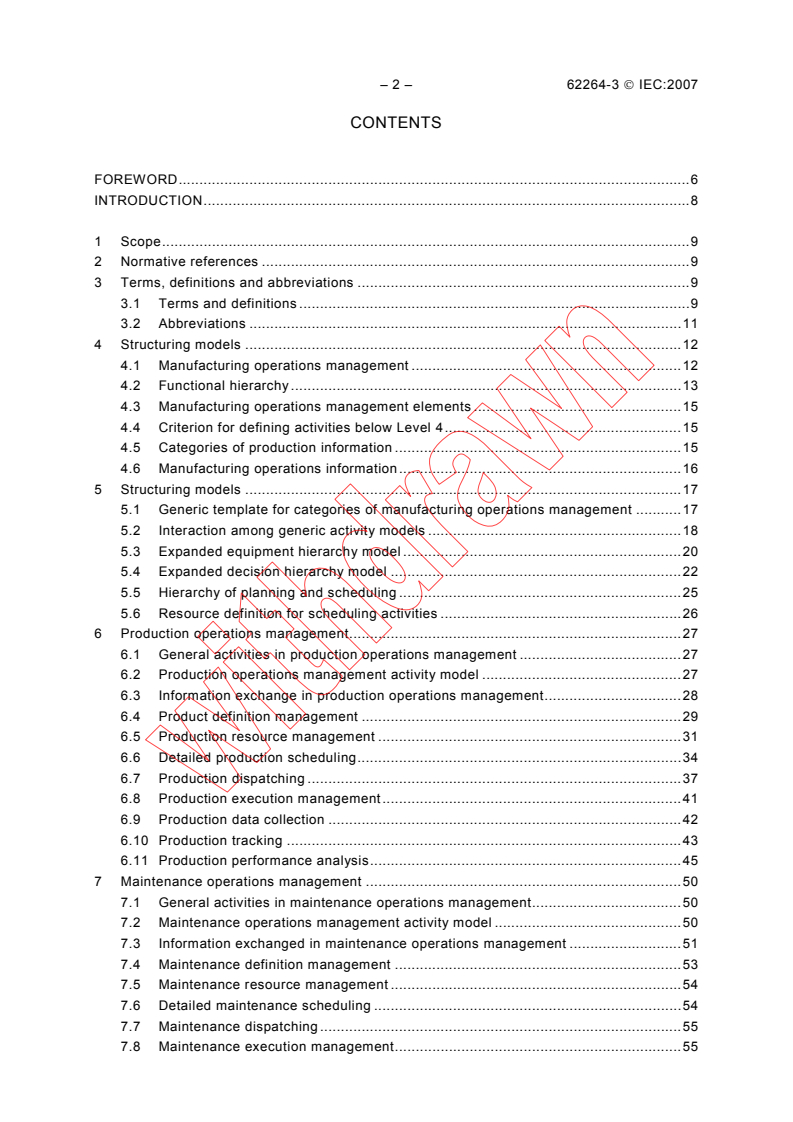
CONTENTS
FOREWORD.6
INTRODUCTION.8
1 Scope.9
2 Normative references .9
3 Terms, definitions and abbreviations .9
3.1 Terms and definitions .9
3.2 Abbreviations .11
4 Structuring models .12
4.1 Manufacturing operations management .12
4.2 Functional hierarchy.13
4.3 Manufacturing operations management elements .15
4.4 Criterion for defining activities below Level 4.15
4.5 Categories of production information .15
4.6 Manufacturing operations information.16
5 Structuring models .17
5.1 Generic template for categories of manufacturing operations management .17
5.2 Interaction among generic activity models .18
5.3 Expanded equipment hierarchy model .20
5.4 Expanded decision hierarchy model .22
5.5 Hierarchy of planning and scheduling .25
5.6 Resource definition for scheduling activities .26
6 Production operations management.27
6.1 General activities in production operations management .27
6.2 Production operations management activity model .27
6.3 Information exchange in production operations management.28
6.4 Product definition management .29
6.5 Production resource management .31
6.6 Detailed production scheduling.34
6.7 Production dispatching .37
6.8 Production execution management.41
6.9 Production data collection .42
6.10 Production tracking .43
6.11 Production performance analysis.45
7 Maintenance operations management .50
7.1 General activities in maintenance operations management.50
7.2 Maintenance operations management activity model .50
7.3 Information exchanged in maintenance operations management .51
7.4 Maintenance definition management .53
7.5 Maintenance resource management .54
7.6 Detailed maintenance scheduling .54
7.7 Maintenance dispatching .55
7.8 Maintenance execution management.55
62264-3 © IEC:2007 – 3 –
7.9 Maintenance data collection .55
7.10 Maintenance tracking .55
7.11 Maintenance analysis .56
8 Quality operations management .57
8.1 General activities in quality operations management .57
8.2 Quality test operations activity model .59
8.3 Information exchanged in quality test operations management .60
8.4 Quality test definition management.62
8.5 Quality test resource management .62
8.6 Detailed quality test scheduling .63
8.7 Quality test dispatching .64
8.8 Quality test execution management.64
8.9 Quality test data collection .65
8.10 Quality test tracking .65
8.11 Quality performance analysis .65
8.12 Supported activities.66
9 Inventory operations management.67
9.1 General activities in inventory operations management .67
9.2 Inventory operations management activity model .68
9.3 Information exchanged in inventory operations management.69
9.4 Inventory definition management.70
9.5 Inventory resource management .70
9.6 Detailed inventory scheduling.71
9.7 Inventory dispatching .72
9.8 Inventory execution management .72
9.9 Inventory tracking.73
9.10 Inventory analysis .74
10 Completeness, compliance and conformance .75
10.1 Completeness .75
10.2 Compliance .75
10.3 Conformance.75
Annex A (informative) Other enterprise activities affecting manufacturing operations .76
Annex B (informative) Technical and responsibility boundaries .81
Annex C (informative) Scheduling hierarchy.86
Annex D (informative) Associated standards.88
Annex E (informative) Frequently asked questions.92
Annex F (informative) Applying the decision hierarchy model to manufacturing
operations management.95
Annex G (informative) Mapping PSLX ontology to manufacturing operations management. 100
Annex H (informative) Advanced planning and scheduling concepts for manufacturing
operations management.105
Bibliography.109
Figure 1 – Manufacturing operations management model .13
– 4 – 62264-3 © IEC:2007
Figure 2 – Multi-level functional hierarchy of activities .14
Figure 3 – Activity relationships .14
Figure 4 – Categories of information exchange .16
Figure 5 – Manufacturing operations information.17
Figure 6 – Generic activity model of manufacturing operations management .18
Figure 7 – Detailed scheduling interactions.20
Figure 8 – Typical expanded equipment hierarchy .21
Figure 9 – Work centres and work units .22
Figure 10 – Decision hierarchy model framework for Level 3.23
Figure 11 – Decision-making with two variables .24
Figure 12 – Schematic relationship of planning and scheduling.25
Figure 13 – Projected inventory for a consumable resource .26
Figure 14 – Activity model of production operations management .28
Figure 15 – Product definition management activity model interfaces.29
Figure 16 – Production resource management activity model interfaces.31
Figure 17 – Resource management capacity reporting.33
Figure 18 – Detailed production scheduling activity model interfaces .35
Figure 19 – Splitting and merging production schedules to detailed production schedules .36
Figure 20 – Detailed production schedule .37
Figure 21 – Production dispatching activity model interfaces .38
Figure 22 – Sample production dispatch list.39
Figure 23 – Work dispatching for mixed process facility .40
Figure 24 – Production execution management activity model interfaces .41
Figure 25 – Production data collection activity model interfaces.43
Figure 26 – Production tracking activity model interfaces.44
Figure 27 – Merging and splitting production tracking information .45
Figure 28 – Production performance analysis activity model interfaces .46
Figure 29 – Activity model of maintenance operations management.51
Figure 30 – Activity model of quality test operations management .60
Figure 31 – Activity model of inventory operations management .68
Figure 32 – Inventory data collection activity model .73
Figure A.1 – Other enterprise activities affecting manufacturing operations .76
Figure A.2 – Functions in management of regulatory compliance .79
Figure B.1 – Different boundaries of responsibility .82
Figure B.2 – Lines of technical integration .84
Figure C.1 – Sample hierarchy of schedules and scheduling activities. .87
Figure E.1 – PRM scope and standard focus .93
Figure F.1 – Decision hierarchy within an operational category.96
Figure F.2 – Decision hierarchy within an activity.96
Figure F.3 – Examples of decision hierarchies for resource management .97
Figure G.1 – PSLX ontology, part 1.103
Figure G.2 – PSLX ontology, part 2.103
Figure G.3 – PSLX ontology, part 3.104
Figure H.1 – Levels of decision-making for production . 107
62264-3 © IEC:2007 – 5 –
Table 1 – Storage zone and storage unit examples.21
Table G.1 – IEC 62264 relationship to PSLX.101
– 6 – 62264-3 © IEC:2007
INTERNATIONAL ELECTROTECHNICAL COMMISSION
____________
ENTERPRISE-CONTROL SYSTEM INTEGRATION –
Part 3: Activity models of manufacturing operations management
FOREWORD
1) The International Electrotechnical Commission (IEC) is a worldwide organization for standardization comprising
all national electrotechnical committees (IEC National Committees). The object of IEC is to promote
international co-operation on all questions concerning standardization in the electrical and electronic fields. To
this end and in addition to other activities, IEC publishes International Standards, Technical Specifications,
Technical Reports, Publicly Available Specifications (PAS) and Guides (hereafter referred to as “IEC
Publication(s)”). Their preparation is entrusted to technical committees; any IEC National Committee interested
in the subject dealt with may participate in this preparatory work. International, governmental and non-
governmental organizations liaising with the IEC also participate in this preparation. IEC collaborates closely
with the International Organization for Standardization (ISO) in accordance with conditions determined by
agreement between the two organizations.
2) The formal decisions or agreements of IEC on technical matters express, as nearly as possible, an international
consensus of opinion on the relevant subjects since each technical committee has representation from all
interested IEC National Committees.
3) IEC Publications have the form of recommendations for international use and are accepted by IEC National
Committees in that sense. While all reasonable efforts are made to ensure that the technical content of IEC
Publications is accurate, IEC cannot be held responsible for the way in which they are used or for any
misinterpretation by any end user.
4) In order to promote international uniformity, IEC National Committees undertake to apply IEC Publications
transparently to the maximum extent possible in their national and regional publications. Any divergence
between any IEC Publication and the corresponding national or regional publication shall be clearly indicated in
the latter.
5) IEC provides no marking procedure to indicate its approval and cannot be rendered responsible for any
equipment declared to be in conformity with an IEC Publication.
6) All users should ensure that they have the latest edition of this publication.
7) No liability shall attach to IEC or its directors, employees, servants or agents including individual experts and
members of its technical committees and IEC National Committees for any personal injury, property damage or
other damage of any nature whatsoever, whether direct or indirect, or for costs (including legal fees) and
expenses arising out of the publication, use of, or reliance upon, this IEC Publication or any other IEC
Publications.
8) Attention is drawn to the Normative references cited in this publication. Use of the referenced publications is
indispensable for the correct application of this publication.
9) Attention is drawn to the possibility that some of the elements of this IEC Publication may be the subject of
patent rights. IEC shall not be held responsible for identifying any or all such patent rights.
International Standard IEC 62264-1 has been prepared by subcommittee 65A: System
aspects, of IEC technical committee 65: Industrial-process measurement and control and
ISO SC5, JWG 15, of ISO technical committee 184: Enterprise-control system integration.
It is published as a double logo standard.
The text of this standard is based on the following documents:
CDV Report on voting
65A/476/CDV 65A/495/RVC
Full information on the voting for the approval of this standard can be found in the report on
voting indicated in the above table. In ISO, the standard has been approved by 10 P-members
out of 10 hving cast a vote.
This publication has been drafted in accordance with the ISO/IEC Directives, Part 2.
62264-3 © IEC:2007 – 7 –
The list of all the parts of the IEC 62264 series, under the general title Enterprise-control
system integration, can be found on the IEC website.
The committee has decided that the contents of this publication will remain unchanged until
the maintenance result date indicated on the IEC web site under "http://webstore.iec.ch" in
the data related to the specific publication. At this date, the publication will be
• reconfirmed,
• withdrawn,
• replaced by a revised edition, or
• amended.
– 8 – 62264-3 © IEC:2007
INTRODUCTION
This part of IEC 62264 shows activity models and data flows for manufacturing information
that enables enterprise-control system integration. The modelled activities operate between
Level 4 logistics and planning functions and Level 2 manual and automated process control
functions. The models are consistent with the object models given in IEC 62264-1 and the
Level 3 (manufacturing operations and control) definitions.
The goal of the standard is to reduce the risk, cost and errors associated with implementing
enterprise systems and manufacturing operations systems in such a way that they inter-
operate and easily integrate. The standard may also be used to reduce the effort associated
with implementing new product offerings.
This standard provides models and terminology for defining the activities of manufacturing
operations management. The models and terminology defined in this standard are:
– to emphasize the good practices of manufacturing operations;
– to be used to improve existing manufacturing operations systems;
– to be applied regardless of the degree of automation.
Some potential benefits produced when applying the standard may include
– reducing the time to reach full production levels for new products;
– enabling vendors to supply appropriate tools for manufacturing operations;
– enabling more uniform and consistent identification of manufacturing needs;
– reducing the cost of automating manufacturing processes;
– optimizing supply chains;
– improving efficiency in life-cycle engineering efforts.
It is not the intent of this part of the standard to
– suggest that there is only one way of implementing manufacturing operations;
– force users to abandon their current way of handling manufacturing operations;
– restrict development in the area of manufacturing operations;
– restrict use only to manufacturing industries.
62264-3 © IEC:2007 – 9 –
ENTERPRISE-CONTROL SYSTEM INTEGRATION –
Part 3: Activity models of manufacturing operations management
1 Scope
This part of IEC 62264 defines activity models of manufacturing operations management that
enable enterprise system to control system integration. The activities defined in this standard
are consistent with the object models definitions given in IEC 62264-1. The modelled activities
operate between business planning and logistics functions, defined as the Level 4 functions
and the process control functions, defined as the Level 2 functions of IEC 62264-1. The
scope of this standard is limited to
– a model of the activities associated with manufacturing operations management, Level 3
functions;
– an identification of some of the data exchanged between Level 3 activities.
2 Normative references
The following referenced documents are indispensable for the application of this document.
For dated references, only the edition cited applies. For undated references, the latest edition
of the referenced document (including any amendments) applies.
IEC 61512-1:1997, Batch control – Part 1: Models and terminology
IEC 62264-1, Enterprise-control system integration – Part 1: Models and terminology
IEC 62264-2, Enterprise-control system integration – Part 2: Object model attributes
ISO 15704:2000, Industrial automation systems – Requirements for enterprise-reference
architecture and methodologies
3 Terms, definitions and abbreviations
For the purposes of this document, the following terms and definitions apply.
3.1 Terms and definitions
3.1.1
detailed production schedule
organized and structured collection of production work orders and sequencing involved in the
production of one or more products
3.1.2
finite capacity scheduling
scheduling methodology where work is scheduled for production equipment, in such a way
that no production equipment capacity requirement exceeds the capacity available to the
production equipment
3.1.3
inventory operations management
activities within Level 3 of a manufacturing facility which coordinate, direct, manage and track
inventory and material movement within manufacturing operations
– 10 – 62264-3 © IEC:2007
3.1.4
Level 0
actual physical process
3.1.5
Level 1
functions involved in sensing and manipulating the physical process
3.1.6
Level 2
functions involved in monitoring and controlling of the physical process
3.1.7
Level 3
functions involved in managing the work flows to produce the desired end-products
3.1.8
Level 4
functions involved in the business-related activities needed to manage a manufacturing
organization
3.1.9
maintenance operations management
activities within Level 3 of a manufacturing facility which coordinate, direct and track the
functions that maintain the equipment, tools and related assets to ensure their availability for
manufacturing and ensure scheduling for reactive, periodic, preventive, or proactive
maintenance
3.1.10
manufacturing facility
site, or area within a site, that includes the resources within the site or area and includes the
activities associated with the use of the resources
3.1.11
manufacturing operations management
activities within Level 3 of a manufacturing facility that coordinate the personnel, equipment
and material in manufacturing
NOTE 1 This standard details manufacturing operations management in terms of four categories (production
operations management, maintenance operations management, quality operations management and inventory
operations management) and provides references for other enterprise activities affecting manufacturing operations.
NOTE 2 In the PERA model, the concept of manufacturing defines the physical resources used in production. The
manufacturing operations management activities defined in this standard pertain to the information-handling
functions of the PERA model.
3.1.12
production dispatch list
set of specific production work orders to be performed on or by a particular set of resources,
at a given location and the time or event to start or stop the activity
NOTE 1 This may take the form of set-up instructions for machines, operating conditions for continuous
processes, material movement instructions, or batches to be started in a batch system.
NOTE 2 Dispatch lists are applicable to other operations management areas, such as maintenance dispatch lists,
quality test dispatch lists and inventory dispatch lists.
3.1.13
production operations management
activities within Level 3 of a manufacturing facility which coordinate, direct, manage and track
the functions that use raw materials, energy, equipment, personnel and information to
produce products, with the required costs, qualities, quantities, safety and timeliness
62264-3 © IEC:2007 – 11 –
3.1.14
production work order
unit of scheduled work that may be dispatched to a work center and which consists of lower-
level elements
3.1.15
quality operations management
activities within Level 3 of a manufacturing facility which coordinate, direct and track the
functions that measure and report on quality
3.1.16
storage unit
subordinate entity within a storage zone that consists of equipment and information required
to contain, move, condition and handle material
NOTE A storage unit is an element of the equipment hierarchy.
3.1.17
storage zone
logical grouping of resources that defines a span of logistical control and includes the
equipment and information required for containing, moving, conditioning and handling of one
or more material items
NOTE A storage zone is an element of the equipment hierarchy.
3.1.18
tracing
activity that provides an organized record of resource and product use from any point, forward
or backward, using tracking information
3.1.19
tracking
activity of recording attributes of resources and products through all steps of instantiation,
use, change and disposition
3.1.20
work center
process cell, production unit, production line, storage zone, or any other equivalent level
equipment element defined as an extension to the equipment hierarchy model
NOTE For compatibility with existing schema implementations the defined term “work center” is used in place of
the UK English spelling “work centre”.
3.2 Abbreviations
For the purposes of this standard, the following abbreviations apply.
AGV Automated guided vehicles
AMS Asset management system
ASRS Automated storage and retrieval system
CAPE Computer-aided process engineering
CAD Computer-aided design
CAE Computer-aided engineering
CASE Computer-aided software engineering
CIM Computer integrated manufacturing
CNC Computerized numerical control
DCS Distributed control system
– 12 – 62264-3 © IEC:2007
ERP Enterprise resource planning
EWI Electronic work instructions
HR Human resources
KPI Key performance indicator
LIMS Laboratory information management system
MES Manufacturing execution system
MPS Master production schedule
MRP Material resource planning
OEE Overall equipment effectiveness
PAT Process analytical technology
PERA Purdue enterprise reference architecture
PDM Product data management
PLC Programmable logic controller
PLM Product life-cycle management
PRM Purdue reference model for computer-integrated manufacturing
QA Quality assurance
R&D Research and development
RFQ Request for quote
ROA Return on assets
SCADA Supervisory control and data acquisition
SOC Standard operating conditions
SOP Standard operating procedure
SQC Statistical quality control
SPC Statistical process control
WIP Work in process
WMS Warehouse management system
4 Structuring concepts
4.1 Manufacturing operations management
The activities of manufacturing operations management are those activities of a
manufacturing facility that coordinate the personnel, equipment, material and energy in the
conversion of raw materials and/or parts into products. Manufacturing operations
management includes activities that may be performed by physical equipment, human effort
and information systems.
Manufacturing operations management shall encompass the activities of managing
information about the schedules, use, capability, definition, history and status of all of the
resources (personnel, equipment and material) within, and associated with, the manufacturing
facility.
NOTE 1 Resources associated with the manufacturing facility but not within it may include, among others,
government inspectors, regulatory certifications, resource coordination with other entities, outsourced activities and
processes.
The manufacturing operations management activities correspond to the activity set defined in
IEC 62264-1. These are the activities contained within the heavy dotted line shown in
Figure 1. The heavy dotted line is equivalent to the Level 3/Level 4 interface defined in IEC
62264-1. Manufacturing operations management shall be subdivided into four categories:
62264-3 © IEC:2007 – 13 –
production operations management, maintenance operations management, quality operations
management and inventory operations management, as shown in shaded areas in Figure 1.
NOTE 2 There are also other activities of a manufacturing facility, not shown in Figure 1, but described in
Annex A.
NOTE 3 The model structure does not reflect a business organizational structure within a company but is a model
of activities. Different companies assign responsibilities for activities or sub-activities to different business
organizational groups.
Order
processing
(1.0)
Product cost Product shipping
accounting administration
(8.0) (9.0)
Production
scheduling
(2.0)
Production
operations
management
Inventory
operations
Material and Production Product
energy control control managementinventory control
(4.0) (3.0) (7.0)
Inventory
Quality
operations
operations
management
management
Procurement Quality
Maintenance
(5.0) assurance
operations
(6.0)
management
Marketing
and sales
Maintenance
management Research
development
(10.0)
and engineering
IEC 988/07
Figure 1 – Manufacturing operations management model
4.2 Functional hierarchy
IEC 62264-1 defines a functional hierarchy model. This standard specifies that each level
shall provide the functions listed below and illustrated in Figure 2.
Level 0 defines the actual physical processes.
Level 1 defines the activities involved in sensing and manipulating the physical processes.
Level 1 typically operates on time frames of seconds and faster.
Level 2 defines the activities of monitoring and controlling the physical processes. Level 2
typically operates on time frames of hours, minutes, seconds and sub-seconds.
Level 3 defines the activities of the work flow to produce the desired end-products. It
includes the activities of maintaining records and coordinating the processes.
Level 3 typically operates on time frames of days, shifts, hours, minutes and
seconds.
Level 4 defines the business-related activities needed to manage a manufacturing
organization. Manufacturing-related activities include establishing the basic plant
schedule (such as material use, delivery and shipping), determining inventory levels
and making sure that materials are delivered on time to the right place for
production. Level 3 information is critical to Level 4 activities. Level 4 typically
operates on time frames of months, weeks and days.
– 14 – 62264-3 © IEC:2007
NOTE 1 There are other business-related activities that may be in Level 4 or higher levels, but these are not
defined in this standard.
Level 4
4 - Establishing the basic plant schedule - production,
Business planning
material use, delivery, and shipping. Determining
and logistics
inventory levels.
Plant production scheduling,
Time frame
operational management, etc.
Months, weeks, days.
Level 3
3 - Work flow/recipe control to produce the desired end
Manufacturing
products. Maintaining records and optimizing
operations management
the production process.
Dispatching production, detailed production
Time frame
scheduling, reliability assurance, .
Days, shifts, hours, minutes, seconds.
Level 2
2 - Monitoring, supervisory control and automated control
of the production process
Time frame
Discrete
Hours, minutes, seconds, subseconds.
Batch Continuous
control
control control
1 - Sensing the production process, manipulating
Level 1
the production process.
0 - The actual production process.
Level 0
IEC 989/07
Figure 2 – Multi-level functional hierarchy of activities
NOTE 2 Figure 3 illustrates the activity models of this standard in relationship to IEC 62246-1 and IEC 62264-2.
The activities in this standard exchange information with activities defined as Level 4 and Level 2 activities. The
grey circles indicate the activities detailed in this standard. The information flows between the activities of this
standard, indicated as heavy dashed lines, are described in general in this standard. In addition, the information
flows between the activities of this standard and dependent Level 2 activities are identified.
Activities inside
the enterprise domain
IEC 62264-1 and IEC 62264-2
(e.g. production scheduling)
information flows of interest
Activity defined in IEC 62264-3
(e.g. production schedule)
Activity not defined in IEC 62264-3
Data flows defined in IEC 62264-1
Enterprise/manufacturing
and IEC 62264-2
operations boundary
Level 4
Data flows discussed in IEC 62264-3
Activities
Data flows not mentioned
within manufacturing
Level 3
operations
IEC 62264-3 information flows
(e.g. production dispatching)
Manufacturing
Level 2
operations process
control system
boundary
IEC 990/07
Figure 3 – Activity relationships
62264-3 © IEC:2007 – 15 –
4.3 Manufacturing operations management elements
The shaded areas in Figure 1 represent the manufacturing operations management activities
modelled in this standard. Manufacturing operations management is the collection of
production operations management, maintenance operations management, quality operations
management, inventory operations management and other activities of a manufacturing
facility.
This standard defines four formal models: production operations management, maintenance
operations management, quality operations management and inventory operations
management. These are detailed in Clauses 6, 7, 8 and 9 and are listed below.
a) The production operations management model, which shall include the activities of
production control (3.0) that operate as Level 3 functions and the subset of the production
scheduling (2.0) that operate as Level 3 functions and as shown in Figure 1.
b) The maintenance operations management model, which shall include the activities of
maintenance management (10.0) that operate as Level 3 functions.
c) The quality operations management model, which shall include the activities of quality
assurance (6.0) that operate as Level 3 functions.
d) The inventory operations management model, which shall include the activities of
management of inventory and material including product inventory control (7.0) and
material and energy control activities (4.0) defined as operating as Level 3 functions and
as shown in Figure 1.
NOTE Other categories of operation management may exist depending on company policy or organization. They
are not formally modelled in this standard but they can make use of the generic standard model.
4.4 Criterion for defining activities below Level 4
The criterion for defining the activities to be included as a Level 3, 2, or 1 activity shall be that
the activity is directly involved in manufacturing and includes information about personnel,
equipment, or material and meets any of the following conditions.
a) The activity is critical to plant safety.
b) The activity is critical to plant reliability.
c) The activity is critical to plant efficiency.
d) The activity is critical to product quality.
e) The activity is critical to maintaining regulatory compliance.
NOTE 1 This includes such factors as safety, environmental and cGMP (current good manufacturing practices)
compliance.
EXAMPLE: Maintaining regional, government and other agency compliance.
NOTE 2 This list is a clarification of the criteria for inclusion of an activity in Level 3, 2, or 1 domain defined in
IEC 62264-1. This list supersedes the criteria defined in IEC 62264-1.
NOTE 3 There are other criteria such as company policy and organizational structure, or the nature of the
operations that could expand the scope of manufacturing operations management. See Annex B.
NOTE 4 Such activities as personnel management of salaries and job titles may be important for running a
manufacturing business, but they are not considered part of manufacturing operations management.
NOTE 5 Absolute plant efficiencies may be dependent upon factors that are outside the control of a facility (MRP
schedules, product mixes, etc.). These activities are not part of Level 3, 2, or 1.
4.5 Categories of production information
IEC 62264-1 defines the models and terminology to be used for enterprise-control system
integration. It contains a definition of three general categories of information that should be
exchanged between the business planning system (Level 4) and the manufacturing operations
system (Level 3). The result of IEC 62264-1 includes object models for the three categories.
– 16 – 62264-3 © IEC:2007
Production information shall have four categories of information as follows and as illustrated
in Figure 4.
a) Product definition information – what must be defined to
...