

IEC 63244-1:2021
(Main)Semiconductor devices - Semiconductor devices for wireless power transfer and charging - Part 1: General requirements and specifications
General Information
- Abstract
IEC 63244-1:2021 provides general requirements and specifications of the semiconductor devices for the performance and reliability evaluations of wireless power transfer and charging systems. For the performance evaluations, this part covers various characterization parameters and symbols, general system diagrams, and test setups and test conditions.
This document also describes classifications of the wireless power transfer technologies.
- Status
- Published
- Publication Date
- 13-Sep-2021
- Technical Committee
- TC 47 - Semiconductor devices
- Drafting Committee
- WG 7 - TC 47/WG 7
- Current Stage
- PPUB - Publication issued
- Start Date
- 14-Sep-2021
- Completion Date
- 01-Oct-2021
Overview
IEC 63244-1:2021 is an international standard published by the International Electrotechnical Commission (IEC) that establishes general requirements and specifications for semiconductor devices used in wireless power transfer (WPT) and charging systems. This standard is the foundational part of the IEC 63244 series and focuses on performance and reliability evaluation methods for these semiconductor devices.
Wireless power transfer technologies are rapidly evolving, and semiconductor components play a crucial role in the efficient, reliable operation and safety of wireless charging systems. IEC 63244-1:2021 facilitates standardized assessment by defining key terms, classifications, test conditions, and performance metrics. It provides essential guidance for manufacturers, designers, and testers to ensure interoperability and high-quality wireless power devices.
Key Topics
Scope and Purpose: The standard covers characterization parameters, system diagrams, and test setups necessary for evaluating semiconductor devices used in wireless power transfer and charging.
Terminology and Symbols: Precise definitions and symbols related to near-field and far-field wireless power technologies enable clear communication and consistency across the industry.
Classification of Technologies: IEC 63244-1 details classifications for wireless power transfer methods, distinguishing near-field magnetic induction and far-field electromagnetic wave approaches based on application and distance.
Reliability Tests:
- Ingress Protection (IP) Rating to assess environmental protection.
- Temperature and Humidity Testing to verify operational stability under varying conditions.
- Mechanical Impact and Vibration Testing to simulate real-world handling.
- Electromagnetic Compatibility (EMC) including emissions and immunity tests to ensure suitability in electromagnetic environments.
Performance Evaluation:
- Assessments of energy conversion efficiencies at component, module, and system levels.
- Detailed test setups for rectifiers, DC/DC converters, inverters, and variable gain amplifiers employed in wireless power transmitters (PTx) and receivers (PRx).
- Methods to measure coupling efficiency between transmitting and receiving coils or antennas.
Applications
IEC 63244-1:2021 is highly relevant for multiple stakeholders involved in the wireless power ecosystem, including:
Semiconductor Manufacturers who design and produce components specifically for wireless power systems, ensuring devices meet international reliability and performance benchmarks.
Wireless Power System Designers and Integrators who utilize standard parameters and test setups to develop efficient and robust wireless chargers for consumer electronics, electric vehicles, and industrial applications.
Quality Assurance and Compliance Testing Laboratories that require a comprehensive framework to evaluate device conformity with international standards.
Regulatory Bodies and Certification Agencies facilitating market access through consistent assessment criteria aligned with IEC standards.
The standard’s focus on generalized requirements makes it adaptable to a wide range of wireless power applications from near-field mobile device charging to far-field energy transfer solutions.
Related Standards
IEC 63244-1 is part of a growing series of standards addressing semiconductor devices for wireless power transfer. Key related standards in this series include:
IEC 63244-2: Focuses on far-field, electromagnetic wave-based wireless power transfer semiconductor devices and their specific requirements.
IEC 63244-3-1: Covers near-field, magnetic-field-based wireless power transfer devices, detailing specialized testing and specifications.
Other relevant IEC standards dealing with electromagnetic compatibility, safety, and system interoperability may also complement the implementation of IEC 63244-1, ensuring comprehensive coverage of wireless power device standards.
By adhering to IEC 63244-1:2021, industry stakeholders can enhance the performance, reliability, and safety of wireless power semiconductor devices-advancing innovation and fostering global harmonization in wireless charging technologies.
Frequently Asked Questions
IEC 63244-1:2021 is a standard published by the International Electrotechnical Commission (IEC). Its full title is "Semiconductor devices - Semiconductor devices for wireless power transfer and charging - Part 1: General requirements and specifications". This standard covers: IEC 63244-1:2021 provides general requirements and specifications of the semiconductor devices for the performance and reliability evaluations of wireless power transfer and charging systems. For the performance evaluations, this part covers various characterization parameters and symbols, general system diagrams, and test setups and test conditions. This document also describes classifications of the wireless power transfer technologies.
IEC 63244-1:2021 provides general requirements and specifications of the semiconductor devices for the performance and reliability evaluations of wireless power transfer and charging systems. For the performance evaluations, this part covers various characterization parameters and symbols, general system diagrams, and test setups and test conditions. This document also describes classifications of the wireless power transfer technologies.
IEC 63244-1:2021 is classified under the following ICS (International Classification for Standards) categories: 31.080.99 - Other semiconductor devices. The ICS classification helps identify the subject area and facilitates finding related standards.
IEC 63244-1:2021 is available in PDF format for immediate download after purchase. The document can be added to your cart and obtained through the secure checkout process. Digital delivery ensures instant access to the complete standard document.
Standards Content (Sample)
IEC 63244-1 ®
Edition 1.0 2021-09
INTERNATIONAL
STANDARD
NORME
INTERNATIONALE
colour
inside
Semiconductor devices – Semiconductor devices for wireless power transfer
and charging –
Part 1: General requirements and specifications
Dispositifs à semiconducteurs – Dispositifs à semiconducteurs pour le transfert
de puissance et la charge sans fil –
Partie 1: Exigences et spécifications générales
All rights reserved. Unless otherwise specified, no part of this publication may be reproduced or utilized in any form
or by any means, electronic or mechanical, including photocopying and microfilm, without permission in writing from
either IEC or IEC's member National Committee in the country of the requester. If you have any questions about IEC
copyright or have an enquiry about obtaining additional rights to this publication, please contact the address below or
your local IEC member National Committee for further information.
Droits de reproduction réservés. Sauf indication contraire, aucune partie de cette publication ne peut être reproduite
ni utilisée sous quelque forme que ce soit et par aucun procédé, électronique ou mécanique, y compris la photocopie
et les microfilms, sans l'accord écrit de l'IEC ou du Comité national de l'IEC du pays du demandeur. Si vous avez des
questions sur le copyright de l'IEC ou si vous désirez obtenir des droits supplémentaires sur cette publication, utilisez
les coordonnées ci-après ou contactez le Comité national de l'IEC de votre pays de résidence.
IEC Central Office Tel.: +41 22 919 02 11
3, rue de Varembé info@iec.ch
CH-1211 Geneva 20 www.iec.ch
Switzerland
About the IEC
The International Electrotechnical Commission (IEC) is the leading global organization that prepares and publishes
International Standards for all electrical, electronic and related technologies.
About IEC publications
The technical content of IEC publications is kept under constant review by the IEC. Please make sure that you have the
latest edition, a corrigendum or an amendment might have been published.
IEC publications search - webstore.iec.ch/advsearchform IEC online collection - oc.iec.ch
The advanced search enables to find IEC publications by a Discover our powerful search engine and read freely all the
variety of criteria (reference number, text, technical publications previews. With a subscription you will always
committee, …). It also gives information on projects, replaced have access to up to date content tailored to your needs.
and withdrawn publications.
Electropedia - www.electropedia.org
IEC Just Published - webstore.iec.ch/justpublished
The world's leading online dictionary on electrotechnology,
Stay up to date on all new IEC publications. Just Published
containing more than 22 000 terminological entries in English
details all new publications released. Available online and
and French, with equivalent terms in 18 additional languages.
once a month by email.
Also known as the International Electrotechnical Vocabulary
(IEV) online.
IEC Customer Service Centre - webstore.iec.ch/csc
If you wish to give us your feedback on this publication or
need further assistance, please contact the Customer Service
Centre: sales@iec.ch.
A propos de l'IEC
La Commission Electrotechnique Internationale (IEC) est la première organisation mondiale qui élabore et publie des
Normes internationales pour tout ce qui a trait à l'électricité, à l'électronique et aux technologies apparentées.
A propos des publications IEC
Le contenu technique des publications IEC est constamment revu. Veuillez vous assurer que vous possédez l’édition la
plus récente, un corrigendum ou amendement peut avoir été publié.
Recherche de publications IEC - IEC online collection - oc.iec.ch
webstore.iec.ch/advsearchform Découvrez notre puissant moteur de recherche et consultez
La recherche avancée permet de trouver des publications IEC gratuitement tous les aperçus des publications. Avec un
en utilisant différents critères (numéro de référence, texte, abonnement, vous aurez toujours accès à un contenu à jour
comité d’études, …). Elle donne aussi des informations sur adapté à vos besoins.
les projets et les publications remplacées ou retirées.
Electropedia - www.electropedia.org
IEC Just Published - webstore.iec.ch/justpublished
Le premier dictionnaire d'électrotechnologie en ligne au
Restez informé sur les nouvelles publications IEC. Just
monde, avec plus de 22 000 articles terminologiques en
Published détaille les nouvelles publications parues.
anglais et en français, ainsi que les termes équivalents dans
Disponible en ligne et une fois par mois par email.
16 langues additionnelles. Egalement appelé Vocabulaire
Electrotechnique International (IEV) en ligne.
Service Clients - webstore.iec.ch/csc
Si vous désirez nous donner des commentaires sur cette
publication ou si vous avez des questions contactez-nous:
sales@iec.ch.
IEC 63244-1 ®
Edition 1.0 2021-09
INTERNATIONAL
STANDARD
NORME
INTERNATIONALE
colour
inside
Semiconductor devices – Semiconductor devices for wireless power transfer
and charging –
Part 1: General requirements and specifications
Dispositifs à semiconducteurs – Dispositifs à semiconducteurs pour le transfert
de puissance et la charge sans fil –
Partie 1: Exigences et spécifications générales
INTERNATIONAL
ELECTROTECHNICAL
COMMISSION
COMMISSION
ELECTROTECHNIQUE
INTERNATIONALE
ICS 31.080.99 ISBN 978-2-8322-1023-2
– 2 – IEC 63244-1:2021 © IEC 2021
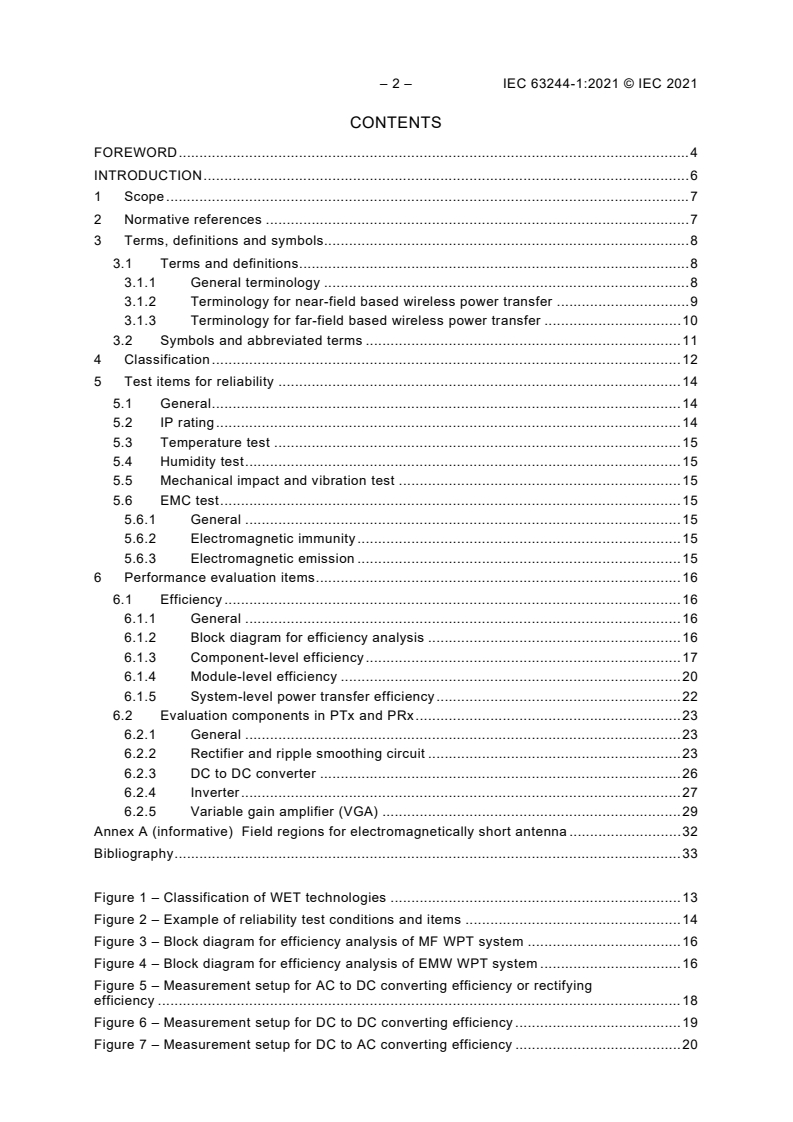
CONTENTS
FOREWORD . 4
INTRODUCTION . 6
1 Scope . 7
2 Normative references . 7
3 Terms, definitions and symbols. 8
3.1 Terms and definitions . 8
3.1.1 General terminology . 8
3.1.2 Terminology for near-field based wireless power transfer . 9
3.1.3 Terminology for far-field based wireless power transfer . 10
3.2 Symbols and abbreviated terms . 11
4 Classification . 12
5 Test items for reliability . 14
5.1 General . 14
5.2 IP rating . 14
5.3 Temperature test . 15
5.4 Humidity test . 15
5.5 Mechanical impact and vibration test . 15
5.6 EMC test . 15
5.6.1 General . 15
5.6.2 Electromagnetic immunity . 15
5.6.3 Electromagnetic emission . 15
6 Performance evaluation items . 16
6.1 Efficiency . 16
6.1.1 General . 16
6.1.2 Block diagram for efficiency analysis . 16
6.1.3 Component-level efficiency . 17
6.1.4 Module-level efficiency . 20
6.1.5 System-level power transfer efficiency . 22
6.2 Evaluation components in PTx and PRx . 23
6.2.1 General . 23
6.2.2 Rectifier and ripple smoothing circuit . 23
6.2.3 DC to DC converter . 26
6.2.4 Inverter . 27
6.2.5 Variable gain amplifier (VGA) . 29
Annex A (informative) Field regions for electromagnetically short antenna . 32
Bibliography . 33
Figure 1 – Classification of WET technologies . 13
Figure 2 – Example of reliability test conditions and items . 14
Figure 3 – Block diagram for efficiency analysis of MF WPT system . 16
Figure 4 – Block diagram for efficiency analysis of EMW WPT system . 16
Figure 5 – Measurement setup for AC to DC converting efficiency or rectifying
efficiency . 18
Figure 6 – Measurement setup for DC to DC converting efficiency . 19
Figure 7 – Measurement setup for DC to AC converting efficiency . 20
Figure 8 – Measurement setup for coupling efficiency between transmitting and
receiving coils . 21
Figure 9 – Measurement setup for power transfer efficiency between power
transmitting and receiving antennas . 22
Figure 10 – Semiconductor components in PTx and PRx . 23
Figure 11 – Half-wave rectifier and input/output waveform . 25
Figure 12 – Full-wave rectifier and input/output waveform . 26
Figure 13 – Diode- bridge rectifier and RC smoothing circuits . 26
Figure 14 – Example of step down converter (Buck converter) and step up converter
(Boost converter) . 27
Figure 15 – Example of equivalent circuit and square AC output signal . 28
Figure 16 – Block diagram of VGA . 29
Figure 17 – 3 dB bandwidth . 30
Figure 18 – P1dB, MDS and dynamic input range of a variable gain amplifier . 30
Figure A.1 – Field regions for electromagnetically short antenna . 32
Table 1 – Letter symbols and abbreviated terms . 12
Table 2 – Example of blank specifications: classification of wireless power transfer
methods and distance according to products and power consumption . 13
Table 3 – Example of blank specifications of a rectifier diode. 24
Table 4 – Example of blank specifications of a step- down DC-to-DC converter . 27
Table 5 – Example of blank specifications of an inverter used for MF WPT . 28
– 4 – IEC 63244-1:2021 © IEC 2021
INTERNATIONAL ELECTROTECHNICAL COMMISSION
____________
SEMICONDUCTOR DEVICES –
SEMICONDUCTOR DEVICES FOR WIRELESS
POWER TRANSFER AND CHARGING –
Part 1: General requirements and specifications
FOREWORD
1) The International Electrotechnical Commission (IEC) is a worldwide organization for standardization comprising
all national electrotechnical committees (IEC National Committees). The object of IEC is to promote international
co-operation on all questions concerning standardization in the electrical and electronic fields. To this end and
in addition to other activities, IEC publishes International Standards, Technical Specifications, Technical Reports,
Publicly Available Specifications (PAS) and Guides (hereafter referred to as “IEC Publication(s)”). Their
preparation is entrusted to technical committees; any IEC National Committee interested in the subject dealt with
may participate in this preparatory work. International, governmental and non-governmental organizations liaising
with the IEC also participate in this preparation. IEC collaborates closely with the International Organization for
Standardization (ISO) in accordance with conditions determined by agreement between the two organizations.
2) The formal decisions or agreements of IEC on technical matters express, as nearly as possible, an international
consensus of opinion on the relevant subjects since each technical committee has representation from all
interested IEC National Committees.
3) IEC Publications have the form of recommendations for international use and are accepted by IEC National
Committees in that sense. While all reasonable efforts are made to ensure that the technical content of IEC
Publications is accurate, IEC cannot be held responsible for the way in which they are used or for any
misinterpretation by any end user.
4) In order to promote international uniformity, IEC National Committees undertake to apply IEC Publications
transparently to the maximum extent possible in their national and regional publications. Any divergence between
any IEC Publication and the corresponding national or regional publication shall be clearly indicated in the latter.
5) IEC itself does not provide any attestation of conformity. Independent certification bodies provide conformity
assessment services and, in some areas, access to IEC marks of conformity. IEC is not responsible for any
services carried out by independent certification bodies.
6) All users should ensure that they have the latest edition of this publication.
7) No liability shall attach to IEC or its directors, employees, servants or agents including individual experts and
members of its technical committees and IEC National Committees for any personal injury, property damage or
other damage of any nature whatsoever, whether direct or indirect, or for costs (including legal fees) and
expenses arising out of the publication, use of, or reliance upon, this IEC Publication or any other IEC
Publications.
8) Attention is drawn to the Normative references cited in this publication. Use of the referenced publications is
indispensable for the correct application of this publication.
9) Attention is drawn to the possibility that some of the elements of this IEC Publication may be the subject of patent
rights. IEC shall not be held responsible for identifying any or all such patent rights.
IEC 63244-1 has been prepared by IEC technical committee 47: Semiconductor devices. It is
an International Standard.
The text of this International Standard is based on the following documents:
Draft Report on voting
47/2706/FDIS 47/2723/RVD
Full information on the voting for its approval can be found in the report on voting indicated in
the above table.
The language used for the development of this International Standard is English.
This document was drafted in accordance with ISO/IEC Directives, Part 2, and developed in
accordance with ISO/IEC Directives, Part 1 and ISO/IEC Directives, IEC Supplement, available
at www.iec.ch/members_experts/refdocs. The main document types developed by IEC are
described in greater detail at www.iec.ch/standardsdev/publications.
A list of all the parts in the IEC 63244 series, published under the general title Semiconductor
devices – Semiconductor devices for wireless power transfer and charging, can be found on
the IEC website.
The committee has decided that the contents of this document will remain unchanged until the
stability date indicated on the IEC website under "http://webstore.iec.ch" in the data related to
the specific document. At this date, the document will be
• reconfirmed,
• withdrawn,
• replaced by a revised edition, or
• amended.
IMPORTANT – The 'colour inside' logo on the cover page of this publication indicates
that it contains colours which are considered to be useful for the correct understanding
of its contents. Users should therefore print this document using a colour printer.
– 6 – IEC 63244-1:2021 © IEC 2021
INTRODUCTION
The IEC 63244 series is planned to comprise the following parts:
• IEC 63244-1: Semiconductor devices – Semiconductor devices for wireless power transfer
and charging – Part 1: General requirements and specifications
• IEC 63244-2: Semiconductor devices – Semiconductor devices for wireless power transfer
and charging – Part 2: Far-field based wireless power transfer – Electromagnetic-wave
based wireless power transfer
• IEC 63244-3-1: Semiconductor devices – Semiconductor devices for wireless power transfer
and charging – Part 3-1: Near-field based wireless power transfer – Magnetic-field based
wireless power transfer
• IEC 63244-3-2: Semiconductor devices – Semiconductor devices for wireless power transfer
and charging – Part 3-2: Near-field based wireless power transfer – Electric-field based
wireless power transfer
The standardization bodies for wireless power transfer and charging technologies is as follow:
1) Wireless power consortium (WPC): Wireless power consortium covers MF WPT technology
such as inductive WPT and magnetic resonance WPT. WPC has Qi certification process to
ensure the safety and quality.
2) AirFuel alliance: AirFuel alliance covers NF WPT technology such as resonant mode of
magnetic-field based wireless power transfer. And also, AirFuel alliance is working on FF
WPT technology such as electromagnetic-wave based wireless power transfer. AirFuel
alliance has Rezence certification process for resonant mode of MF WPT to ensure the
safety and quality. AirFuel alliance was formed by the merge of Alliance for Wireless Power
(A4WP) and Power Matters Alliance (PMA) in 2015.
SEMICONDUCTOR DEVICES –
SEMICONDUCTOR DEVICES FOR WIRELESS
POWER TRANSFER AND CHARGING –
Part 1: General requirements and specifications
1 Scope
This part of IEC 63244 provides general requirements and specifications of the semiconductor
devices for the performance and reliability evaluations of wireless power transfer and charging
systems. For the performance evaluations, this part covers various characterization parameters
and symbols, general system diagrams, and test setups and test conditions.
This document also describes classifications of the wireless power transfer technologies.
2 Normative references
The following documents are referred to in the text in such a way that some or all of their content
constitutes requirements of this document. For dated references, only the edition cited applies.
For undated references, the latest edition of the referenced document (including any
amendments) applies.
IEC 60068-2-1, Environmental testing – Part 2-1: Tests – Test A: Cold
IEC 60068-2-2, Environmental testing – Part 2-2: Tests – Test B: Dry heat
IEC 60068-2-14, Environmental testing – Part 2-14: Tests – Test N: Change of temperature
IEC 60068-2-30, Environmental testing – Part 2-30: Tests – Test Db: Damp heat, cyclic
(12 + 12 h cycle)
IEC 60529, Degrees of protection provided by enclosures (IP Code)
IEC 60749-10, Semiconductor devices – Mechanical and climatic test methods – Part 10:
Mechanical shock
IEC 61967-2, Integrated circuits – Measurement of electromagnetic emissions, 150 kHz to
1 GHz – Part 2: Measurement of radiated emissions – TEM cell and wideband TEM cell method
IEC 61967-4, Integrated circuits – Measurement of electromagnetic emissions – Part 4:
Measurement of conducted emissions – 1 Ω /150 Ω direct coupling method
IEC 61967-8, Integrated circuits – Measurement of electromagnetic emissions – Part 8:
Measurement of radiated emissions – IC stripline method
IEC 62132-2, Integrated circuits – Measurement of electromagnetic immunity – Part 2:
Measurement of radiated immunity – TEM cell and wideband TEM cell method
IEC 62132-4, Integrated circuits – Measurement of electromagnetic immunity 150 kHz to 1 GHz
– Part 4: Direct RF power injection method
– 8 – IEC 63244-1:2021 © IEC 2021
IEC 62132-8, Integrated circuits – Measurement of electromagnetic immunity – Part 8:
Measurement of radiated immunity – IC stripline method
IEC 62262, Degrees of protection provided by enclosures for electrical equipment against
external mechanical impacts (IK code)
IEC 62969-2:2018, Semiconductor devices – Semiconductor interface for automotive vehicles
– Part 2: Efficiency evaluation methods of wireless power transmission using resonance for
automotive vehicles sensors
IEC CISPR 11, Industrial, scientific and medical equipment – Radio-frequency disturbance
characteristics – Limits and methods of measurement
3 Terms, definitions and symbols
For the purposes of this document, the following terms and definitions apply.
ISO and IEC maintain terminological databases for use in standardization at the following
addresses:
• IEC Electropedia: available at http://www.electropedia.org/
• ISO Online browsing platform: available at http://www.iso.org/obp
NOTE The following terms and definitions are classified into general terminology, terminology for near-field based
wireless power transfer, and terminology for far-field based wireless power transfer.
3.1 Terms and definitions
3.1.1 General terminology
3.1.1.1
wireless energy transfer
WET
transfer of electrical, optical, acoustic and other type of energies from a source to an electrical
load via electric and/or magnetic fields, electromagnetic waves, acoustic waves, etc.
3.1.1.2
wireless power transfer
WPT
transfer of electrical energy from a power source to an electrical load via electric and/or
magnetic fields or electromagnetic waves
Note 1 to entry: The alternative term “wireless power transmission” is also often used in technical documents.
3.1.1.3
power receiver
PRx
device receiving electrical power from a transmitting device or transmitting devices
Note 1 to entry: The alternative term “power receiving unit (PRU)” is also often used in technical documents. And
also, “secondary device” is used in CISPR 11.
3.1.1.4
power transmitter
PTx
device sending electrical power to a receiving device or receiving devices
Note 1 to entry: The alternative term “power transmitting unit (PTU)” is also often used in technical documents. And
also, “primary device” is used in CISPR 11.
3.1.2 Terminology for near-field based wireless power transfer
3.1.2.1
power receiving coil
power receiving coiled inductor that is induced by a time-varying magnetic field from a power
transmitting coil(s)
Note 1 to entry: The alternative term “the secondary coil” is also often used in technical documents. And also, the
alternative term “receiving resonator coil” is also used in IEC 62969-2.
3.1.2.2
power transmitting coil
power transmitting coiled inductor that induces a voltage across a power receiving coil(s)
Note 1 to entry: The alternative term “the primary coil” is also often used in technical documents. And also, the
alternative term “transmitting resonator coil” is also used in IEC 62969-2.
3.1.2.3
near-field based wireless power transfer
NF WPT
wireless electrical power transfer from a power transmitter(s) to a power receiver(s) that is(are)
located within an induced magnetic or electric field
3.1.2.4
magnetic-field based wireless power transfer
MF WPT
wireless electrical power transfer from a power transmitter(s) to a power receiver(s) that is(are)
located within an induced magnetic field
3.1.2.5
non-resonant mode of magnetic-field based wireless power transfer
wireless electrical power transfer between power transmitting coiled inductor(s) and power
receiving coiled inductor(s) using an induced magnetic field without a resonance
Note 1 to entry: The alternative term “inductive wireless power transfer” is also often used in technical documents.
3.1.2.6
resonant mode of magnetic-field based wireless power transfer
wireless electrical power transfer between power transmitting coiled inductor(s) and power
receiving coiled inductor(s) using an induced magnetic-field with a resonance
Note 1 to entry: Four coiled inductors system has one source coiled inductor, two resonated coiled inductors and
one load coiled inductor. Two coiled inductors system has only two resonated coiled inductors.
Note 2 to entry: The alternative term “magnetic resonance wireless power transfer” is also often used in technical
documents.
3.1.2.7
electric-field based wireless power transfer
EF WPT
wireless electrical power transfer from a power transmitter(s) to a power receiver(s) that is(are)
located within an induced electric field
Note 1 to entry: The alternative term “capacitive coupling wireless power transfer” is also often used in technical
documents.
– 10 – IEC 63244-1:2021 © IEC 2021
3.1.2.8
resonant frequency
f
R
specific resonated frequency determined by inductance of the coiled inductor and capacitance
of matching capacitor in the resonant mode of magnetic-field based wireless power transfer
Note 1 to entry: AirFuel uses 6,78 MHz ± 15 kHz as a resonant frequency.
3.1.2.9
coupling coefficient
k
coefficient that indicates the degree of magnetic coupling between two coils
Note 1 to entry: The alternative term “coupling factor” is also often used in technical documents and the coupling
coefficient is greater or equal to 0 and less than 1.
3.1.2.10
critically coupled distance
optimum distance between a power transmitting coil(s) and a power receiving coil(s) where
maximum wireless power transfer is obtained
3.1.2.11
loosely coupled distance
distance longer than the critically coupled distance where less magnetic coupling is obtained
because a magnetic flux from a power transmitting coil(s) is not fully reached to a receiving
coil(s)
3.1.2.12
over coupled distance
distance closer than the critically coupled distance where less magnetic coupling is obtained
because a formation of magnetic flux is hindered by the effect of anti-resonance
3.1.2.13
tightly coupled system
MF WPT system having a coupling coefficient of about 1 by using a magnetic core inside the
power transmitting and receiving coils
3.1.2.14
proximity range of magnetic-field based wireless power transfer
wireless power transfer range of MF WPT that has the distance of less than 10 mm between a
power transmitter(s) and a power receiver(s)
3.1.2.15
effective range of magnetic-field based wireless power transfer
wireless power transfer range of MF WPT that having the distance of less than or equal to the
size of receiving coil diameter between a power transmitter(s) and a power receiver(s)
3.1.3 Terminology for far-field based wireless power transfer
3.1.3.1
power transmitting antenna
metal conductor(s) transmitting electrical power via electromagnetic wave propagating through
the air
3.1.3.2
power receiving antenna
metal conductor(s) receiving electrical power from a power transmitting antenna via
electromagnetic wave propagating through the air
3.1.3.3
electromagnetic-wave based wireless power transfer
EMW WPT
wireless electrical power transfer from a power transmitting antenna(s) to a power receiving
antenna(s) using an electromagnetic-wave radiation
3.1.3.4
far-field based wireless power transfer
FF WPT
electrical power transfer from a PTx to a PRx using a radiative electromagnetic wave
3.1.3.5
power transmission frequency
f
PT
frequency at which the wireless power is transmitted and received
Note 1 to entry: The alternative term “fundamental, center or operating frequency” is also often used in technical
documents.
3.1.3.6
short range of electromagnetic-wave based wireless power transfer
power transmission distance up to 5 meters from a power transmitter(s) to a power receiver(s)
3.1.3.7
medium range of electromagnetic-wave based wireless power transfer
power transmission distance up to 10 meters from a power transmitter(s) to a power receiver(s)
Note 1 to entry: The alternative term “locally” is also used in CISPR 11.
3.1.3.8
locally
within close proximity and distances of up to 10 meters
3.1.3.9
long range of electromagnetic-wave based wireless power transfer
power transmission distance more than 10 meters from a power transmitter(s) to a power
receiver(s)
3.2 Symbols and abbreviated terms
The following letter symbols and abbreviations are listed as shown in Table 1.
– 12 – IEC 63244-1:2021 © IEC 2021
Table 1 – Letter symbols and abbreviated terms
Terms Letter symbols Abbreviated
terms
General terms and parameters related to wireless power transfer
wireless energy transfer - WET
wireless power transfer - WPT
power receiver - PRx
power receiving unit - PRU
power transmitter - PTx
power transmitting unit - PTU
Terms and parameters related to near-field based wireless power transfer
magnetic-field based wireless power transfer - MF WPT
electric-field based wireless power transfer - EF WPT
near-field based wireless power transfer - NF WPT
resonant frequency f -
R
coupling coefficient or coupling factor k -
Terms and parameters related far-field based wireless power transfer
electromagnetic-wave based wireless power transfer - EMW WPT
far-field based wireless power transfer - FF WPT
power transmission frequency f -
PT
4 Classification
The WET technology is classified as shown in Figure 1. An energy can be transmitted wirelessly
through electric and/or magnetic fields, electromagnetic waves, acoustic waves, etc. And also,
field regions for electromagnetically short antennas are shown in Figure A.1 of Annex A.
NOTE The red dashed rectangular line indicates commercialized WPT technologies.
Figure 1 – Classification of WET technologies
The examples of blank specifications shall be listed as shown in the Table 2. Products with
respect to power consumption level, wireless power transfer methods and wireless power
transfer distance shall be listed in the table.
Table 2 – Example of blank specifications: classification of wireless power transfer
methods and distance according to products and power consumption
Wireless power transfer methods and distance
MF WPT EMW WPT
Proximity Effective Short Medium Long
Power
Products
range range range range range
consumption
(≤ size of
(≤ 10 mm) receiving coil (≤ 5 m) (≤ 10 m) (10 m ≤)
diameter)
Low power sensors
Low power wireless
≤ 10 mW
communications
(BLE)
Medium power
sensors
Medium power
≤ 500 mW
wireless
communications
(Zigbee)
Wireless headset or
≤ 1 W
earphone
Smart phone ≤ 5 W to 10 W
Tablet PC ≤ 15 W
Laptop PC ≤ 50W
Low power home
appliances and ≤ 100 W
lights
– 14 – IEC 63244-1:2021 © IEC 2021
Wireless power transfer methods and distance
MF WPT EMW WPT
Proximity Effective Short Medium Long
Power
Products
range range range range range
consumption
(≤ size of
(≤ 10 mm) receiving coil (≤ 5 m) (≤ 10 m) (10 m ≤)
diameter)
Kitchen appliances
≤ 1 kW
Low power electric
Vehicles
Medium power
≤ 7,7 kW
electric Vehicles
High power electric
≤ 22 kW
vehicles
Automated in-plant
transportation
>22 kW
systems, trams and
electric buses
NOTE Products, power consumption and wireless power transfer distance can be added and modified.
5 Test items for reliability
5.1 General
All test conditions and items suggested by a manufacturer shall be listed in a table or diagram
as shown as an example in Figure 2.
Figure 2 – Example of reliability test conditions and items
5.2 IP rating
The IP (Ingress Protection) rating result of a wireless power system and components shall be
provided by a manufacturer to ensure users with the water proof and the dust proof reliability.
The test shall be in accordance with IEC 60529.
5.3 Temperature test
The temperature for the ambient, coldest and hottest including damp heat and temperature
cycling results of a wireless power system and components shall be provided by a manufacturer
to ensure users with temperature related reliability.
The test shall be in accordance with IEC 60068-2-1, IEC 60068-2-2 and IEC 60068-2-14.
5.4 Humidity test
The humidity test result of a wireless power system and components shall be provided by a
manufacturer to ensure users with humidity related reliability.
The test shall be carried out at the range between 5 % and 95 %. The test shall be in accordance
with IEC 60068-2-30.
5.5 Mechanical impact and vibration test
The mechanical shock, impact and vibration test result of a wireless power system and
components shall be provided by a manufacturer to ensure users with mechanical impact and
vibration related reliability.
The test shall be in accordance with IEC 62262 and IEC 60749-10.
5.6 EMC test
5.6.1 General
The EMC test of the semiconductor components in the WPT system shall be carried out to
ensure users with EMC related reliability.
Various WPT systems use fundamental frequencies in dedicated frequency ranges to ensure
functional compatibility between transmitting and receiving equipment. However, there are
unwanted harmonics and electromagnetic radiation disturbance from the antenna and
components.
In order to evaluate electromagnetic radiation disturbance produced by WPT applications,
IEC CISPR 11 shall be used to all types of WPT components and systems intended for use in
industrial, scientific or medical (ISM) applications which is operated at frequencies in the
frequency range 0 Hz to 400 GHz. IEC CISPR 11 covers emission requirements for ISM WPT
application for instantaneous power supply or for the charging of power electronic equipment.
5.6.2 Electromagnetic immunity
The electromagnetic immunity test of the semiconductor components in the WPT system shall
be carried out with respect to performance criteria to prevent malfunction and damage.
The test shall be in accordance with IEC 62132-4 for conducted immunity test and IEC 62132-2
or IEC 62132-8 for radiated immunity test.
5.6.3 Electromagnetic emission
The electromagnetic emission test of the semiconductor components in the WPT system shall
be carried out in respect to performance criteria to prevent malfunction and damage.
The test shall be in accordance with IEC 61967-4 for conducted emission measurement and
IEC 61967-2 or IEC61967-8 for radiated emission measurement.
– 16 – IEC 63244-1:2021 © IEC 2021
6 Performance evaluation items
6.1 Efficiency
6.1.1 General
The system-level power transfer efficiency is composed of three module-level efficiencies such
as conversion efficiency of the power transmitter, power transfer efficiency between power
transmitting and receiving antennas or coils, and conversion efficiency of the power receiver.
Three module-level efficiencies shall be calculated using component-level efficiencies.
6.1.2 Block diagram for efficiency analysis
Power conversion or transfer efficiencies at each stage shall be calculated from the efficiency
diagram as shown in Figure 3 and Figure 4.
Figure 3 shows a block diagram for efficiency analysis of MF WPT system and Figure 4 shows
a block diagram for efficiency analysis of electromagnetic-wave based WPT system.
Figure 3 – Block diagram for efficiency analysis of MF WPT system
Figure 4 – Block diagram for efficiency analysis of EMW WPT system
6.1.3 Component-level efficiency
6.1.3.1 AC to DC converting efficiency or rectifying efficiency
A rectifying circuit shall be used in the PTx and PRx to convert AC to DC voltage. In the power
transmitter, an electric power supplied from the outlet on the wall is AC (from 100 V to 440 V
and 50 Hz to 60 Hz depending on the countries). In the power receiver, the received power from
the receiving coil or antenna is also AC.
The AC to DC converting efficiency or rectifying efficiency shall be calculated as shown in
Formula (1), Formula (2) and Figure 5.
P
PTx _ DC
in
η =
(1)
PTx _ rect
P
Supply _ AC
where
η is the rectifying efficiency of the PTx;
PTx _ rect
P is the input power to a DC-to-DC converter in the PTx;
PTx _ DC
in
is the input power to a rectifier in the PTx.
P
Supply_ AC
P
PRx _ DC
in
=
η (2)
PRx _ rect
P
PRx _ AC
where
η
is the rectifying efficiency of the PRx;
PRx _ rect
P is the input power to a DC-to-DC converter in PRx;
PRx _ DC
in
P is the input power to a rectifier in PRx.
PRx _ AC
– 18 – IEC 63244-1:2021 © IEC 2021
Key
R the input resistance of DC-DC converter
IN
Figure 5 – Measurement setup for AC to DC converting
efficiency or rectifying efficiency
6.1.3.2 DC to DC converting efficiency
A DC to DC converting circuit shall be used in the PTx and PRx. In the power transmitter, the
rectified DC is converted to DC having the required value to drive inverter or power amplifier.
In the power receiver, the rectified DC from the rectifier is converted to DC having the required
value by a load.
The DC to DC converting efficiency shall be calculated as shown in Formula (3), Formula (4)
and Figure 6.
P
PTx _ DC
out
η =
(3)
PTx _ DC
P
PTx _ DC
in
where
η
is the DC-to-DC converting efficiency of the PTx;
PTx _ DC
is the output power of DC-to-DC converter of the PTx;
P
PTx _ DC
out
is the input power to DC-to-DC converter of the PTx.
P
PTx _ DC
in
P
PRx _ DC
out
η =
(4)
PRx _ DC
P
PRx _ DC
in
where
is the DC-to-DC converting efficiency of the PRx;
η
PRx_ DC
is the output power of DC-to-DC converter of the PRx;
P
PRx _ DC
out
is the input power to DC-to-DC converter of the PRx.
P
PRx _ DC
in
Key
R the input resistance of inverter, PA(power amplifier) in the PTx or load in the PRx
IN
Figure 6 – Measurement setup for DC to DC converting efficiency
6.1.3.3 DC to AC converting efficiency
An inverter or a power amplifier is used in the PTx to convert DC to AC voltage and the
converted or amplified AC is used to drive the power transmitting coil or antenna.
The DC to AC converting efficiency shall be calculated as shown in Formula (5) and Figure 7.
P
PTx _ AC
=
η
(5)
DC _ AC
P
PTx _ DC
out
where
η is the DC-to-AC converting efficiency of the PTx;
DC_ AC
is the output power of inverter or power amplifier in the PTx;
P
PTx_ AC
is the DC output power and input power to inverter or power amplifier in the PTx.
P
PTx _ DC
out
– 20 – IEC 63244-1:2021 © IEC 2021
Key
DC output power and input power to inverter or power amplifier in the PTx
P
PTx _ DC
out
output power of inverter or power amplifier in the PTx
P
PTx_ AC
R input resistance of the coil or antenna
IN
Z characteristic impedance of the measuring system
Figure 7 – Measurement setup for DC to AC converting efficiency
6.1.4 Module-level efficiency
6.1.4.1 Conversion efficiency of the power transmitter
AC voltage from the outlet on the wall is converted to DC voltage, then the converted DC is
converted to DC value required by an inverter in the power transmitter.
The conversion efficiency of the PTx shall be calculated as shown in Formula (6), and Figure 3
and Figure 4
P
P P
PTx _ DC PTx _ DC
PTx _ AC
in out
ηη= ××η η = × × (6)
PTx PTx _ rect PTx __DC PTx AC
PP η
Supply __AC PTx DC PTx _ DC
in out
6.1.4.2 Conversion efficiency of the PRx
AC from the receiving coil is converted to DC through a rectifier, then the converted DC is
converted to DC value required by a load in the power receiver.
The conversion efficiency of the PRx shall be calculated as shown in Formula (7), Figure 3 and
Figure 4.
P P
PRx _ DC
PRx _ DC
in out
ηη= ×=η × (7)
PRx PRx __rect PRx DC
PP
PRx _ AC PRx _ DC
in
6.1.4.3 Power transfer efficiency between transmitting and receiving coils or
antennas
6.1.4.3.1 Power transfer efficiency between transmitting and receiving coils
A coil(s) shall be used in the PTx and PRx of the MF WPT to transfer the power wirelessly. The
combination of coils can be two coiled system or four coiled system depending on the
application.
The power transfer efficiency shall be measured by measuring s-parameter using Vector
Network Analyser (VNA). The power transfer efficiency shall be calculated as shown in
Formula (8) and Figure 8.
P
PRx_ AC
S
η
(8)
cc
P
PTx_ AC
where
is the coupling efficiency between the PTx and PRx;
η
cc
is the output power of inverter or power amplifier in the PTx;
P
PTx _ AC
is the input power to rectifier in the PRx.
P
PRx _ AC
[SOURCE: Figure 3 of IEC 62969-2:2018]
Figure 8 – Measurement setup for coupling efficiency
between transmitting and receiving coils
==
– 22 – IEC 63244-1:2021 © IEC 2021
6.1.4.3.2 Power transfer
...