

IEC 61937-11:2021
(Main)Digital audio - Interface for non-linear PCM encoded audio bitstreams applying IEC 60958 - Part 11: MPEG-4 AAC and its extensions and MPEG-D USAC in LATM/LOAS
General Information
- Abstract
IEC 61937-11:2021 describes the method to convey non-linear PCM bitstreams encoded in accordance with the MPEG-4 AAC format and its extensions (spectral band replication, parametric stereo and MPEG surround), and non-linear PCM bitstreams encoded in accordance with the MPEG-D USAC format, framed in MPEG-4 LATM/LOAS. IEC 61937-11:2021 cancels and replaces the first edition published in 2010, and Amendment 1:2018. This edition constitutes a technical revision.
This edition includes the following significant technical changes with respect to the previous edition:
a) MPEG-D USAC has been added.
- Status
- Published
- Publication Date
- 14-Jul-2021
- Technical Committee
- TA 20 - Analogue and digital audio
- Drafting Committee
- MT 61937-11 - TC 100/TA 20/MT 61937-11
- Current Stage
- PPUB - Publication issued
- Start Date
- 15-Jul-2021
- Completion Date
- 29-Jul-2021
Buy Documents
IEC 61937-11:2021 - Digital audio - Interface for non-linear PCM encoded audio bitstreams applying IEC 60958 - Part 11: MPEG-4 AAC and its extensions and MPEG-D USAC in LATM/LOAS Released:7/15/2021
IEC 61937-11:2021 RLV - Digital audio - Interface for non-linear PCM encoded audio bitstreams applying IEC 60958 - Part 11: MPEG-4 AAC and its extensions and MPEG-D USAC in LATM/LOAS Released:7/15/2021
Overview
IEC 61937-11:2021 is Part 11 of the IEC 61937 series and defines how to transport non-linear PCM audio bitstreams - specifically MPEG‑4 AAC (and its extensions) and MPEG‑D USAC - over the IEC 60958 digital audio interface using the MPEG‑4 LATM/LOAS framing. This second edition (2021) is a technical revision of the 2010 edition (with 2018 amendment) and notably adds MPEG‑D USAC support. The standard enables passing AAC/USAC bitstreams from devices such as set‑top boxes to A/V receivers without reframing into ADTS, and supports both normal and high‑speed transmission modes.
Key topics and technical requirements
- Mapping to IEC 61937-1: Specifies how LATM/LOAS framed audio is encapsulated into IEC 61937 data‑bursts for transport over IEC 60958 physical interfaces.
- Data‑burst format: Defines structure for pause data‑bursts and audio data‑bursts, including burst‑info and data‑type signalling for AAC, HE‑AAC, HE‑AAC v2 and USAC in LATM/LOAS.
- Framing and LATM/LOAS details: Requirements for multiplex elements (AudioMuxElement), access unit handling and payload mapping so decoders can extract and decode streams.
- Latency and timing: Guidance and formulas (Annex A) for calculating decoding delay and required data‑burst repetition rates to ensure synchronized playback.
- High‑speed transmission: Annex B describes signalling and handling when the IEC 60958 interface does not carry an embedded sampling clock (useful for higher channel counts and modern broadcast workflows).
- Profiles and object types: Informative annex (C) summarises MPEG‑4 and MPEG‑D audio profiles and audio object types relevant to this part.
- Normative references: Requires alignment with IEC 60958 (digital audio interface), IEC 61937‑1/2 (general and burst‑info), ISO/IEC 14496‑3 (MPEG‑4 audio) and ISO/IEC 23003‑3 (MPEG‑D USAC).
Practical applications and users
Who uses IEC 61937-11:2021:
- Consumer electronics manufacturers (set‑top boxes, A/V receivers, soundbars)
- Broadcast equipment vendors and system integrators (DVB / digital TV headends)
- Firmware and codec developers implementing AAC/USAC decoders and LATM/LOAS encapsulation
- Test labs and compliance engineers verifying interoperability over IEC 60958 (S/PDIF) links
- Product architects designing low‑latency, multichannel audio transport solutions
Practical benefits:
- Enables interoperable delivery of advanced AAC and USAC audio over existing digital audio interfaces
- Avoids the need to reframe streams (no ADTS conversion)
- Supports modern broadcasting requirements and higher channel counts via high‑speed mode
- Provides timing and burst guidelines to manage latency and robust decoding
Related standards
- IEC 61937‑1: General requirements for non‑linear PCM bitstreams over IEC 60958
- IEC 61937‑2: Burst‑info definitions
- IEC 60958 (all parts): Digital audio interface (consumer/professional)
- ISO/IEC 14496‑3: MPEG‑4 AAC audio specification
- ISO/IEC 23003‑3: MPEG‑D USAC specification
Keywords: IEC 61937-11:2021, MPEG‑4 AAC, MPEG‑D USAC, LATM/LOAS, IEC 60958, digital audio interface, data‑burst, high‑speed transmission, non‑linear PCM.
Relations
- Effective Date
- 05-Sep-2023
- Effective Date
- 05-Sep-2023
Buy Documents
IEC 61937-11:2021 - Digital audio - Interface for non-linear PCM encoded audio bitstreams applying IEC 60958 - Part 11: MPEG-4 AAC and its extensions and MPEG-D USAC in LATM/LOAS Released:7/15/2021
IEC 61937-11:2021 RLV - Digital audio - Interface for non-linear PCM encoded audio bitstreams applying IEC 60958 - Part 11: MPEG-4 AAC and its extensions and MPEG-D USAC in LATM/LOAS Released:7/15/2021
Get Certified
Connect with accredited certification bodies for this standard

ANCE
Mexican certification and testing association.

Intertek Slovenia
Intertek testing, inspection, and certification services in Slovenia.

LNE (Laboratoire National de Métrologie et d'Essais)
French national laboratory for metrology and testing.
Sponsored listings
Frequently Asked Questions
IEC 61937-11:2021 is a standard published by the International Electrotechnical Commission (IEC). Its full title is "Digital audio - Interface for non-linear PCM encoded audio bitstreams applying IEC 60958 - Part 11: MPEG-4 AAC and its extensions and MPEG-D USAC in LATM/LOAS". This standard covers: IEC 61937-11:2021 describes the method to convey non-linear PCM bitstreams encoded in accordance with the MPEG-4 AAC format and its extensions (spectral band replication, parametric stereo and MPEG surround), and non-linear PCM bitstreams encoded in accordance with the MPEG-D USAC format, framed in MPEG-4 LATM/LOAS. IEC 61937-11:2021 cancels and replaces the first edition published in 2010, and Amendment 1:2018. This edition constitutes a technical revision. This edition includes the following significant technical changes with respect to the previous edition: a) MPEG-D USAC has been added.
IEC 61937-11:2021 describes the method to convey non-linear PCM bitstreams encoded in accordance with the MPEG-4 AAC format and its extensions (spectral band replication, parametric stereo and MPEG surround), and non-linear PCM bitstreams encoded in accordance with the MPEG-D USAC format, framed in MPEG-4 LATM/LOAS. IEC 61937-11:2021 cancels and replaces the first edition published in 2010, and Amendment 1:2018. This edition constitutes a technical revision. This edition includes the following significant technical changes with respect to the previous edition: a) MPEG-D USAC has been added.
IEC 61937-11:2021 is classified under the following ICS (International Classification for Standards) categories: 33.160.30 - Audio systems; 33.170 - Television and radio broadcasting. The ICS classification helps identify the subject area and facilitates finding related standards.
IEC 61937-11:2021 has the following relationships with other standards: It is inter standard links to IEC 61937-11:2010/AMD1:2018, IEC 61937-11:2010. Understanding these relationships helps ensure you are using the most current and applicable version of the standard.
IEC 61937-11:2021 is available in PDF format for immediate download after purchase. The document can be added to your cart and obtained through the secure checkout process. Digital delivery ensures instant access to the complete standard document.
Standards Content (Sample)
IEC 61937-11 ®
Edition 2.0 2021-07
INTERNATIONAL
STANDARD
Digital audio – Interface for non-linear PCM encoded audio bitstreams applying
IEC 60958 –
Part 11: MPEG-4 AAC and its extensions and MPEG-D USAC in LATM/LOAS
All rights reserved. Unless otherwise specified, no part of this publication may be reproduced or utilized in any form
or by any means, electronic or mechanical, including photocopying and microfilm, without permission in writing from
either IEC or IEC's member National Committee in the country of the requester. If you have any questions about IEC
copyright or have an enquiry about obtaining additional rights to this publication, please contact the address below or
your local IEC member National Committee for further information.
IEC Central Office Tel.: +41 22 919 02 11
3, rue de Varembé info@iec.ch
CH-1211 Geneva 20 www.iec.ch
Switzerland
About the IEC
The International Electrotechnical Commission (IEC) is the leading global organization that prepares and publishes
International Standards for all electrical, electronic and related technologies.
About IEC publications
The technical content of IEC publications is kept under constant review by the IEC. Please make sure that you have the
latest edition, a corrigendum or an amendment might have been published.
IEC publications search - webstore.iec.ch/advsearchform IEC online collection - oc.iec.ch
The advanced search enables to find IEC publications by a Discover our powerful search engine and read freely all the
variety of criteria (reference number, text, technical publications previews. With a subscription you will always
committee, …). It also gives information on projects, replaced have access to up to date content tailored to your needs.
and withdrawn publications.
Electropedia - www.electropedia.org
IEC Just Published - webstore.iec.ch/justpublished
The world's leading online dictionary on electrotechnology,
Stay up to date on all new IEC publications. Just Published
containing more than 22 000 terminological entries in English
details all new publications released. Available online and
and French, with equivalent terms in 18 additional languages.
once a month by email.
Also known as the International Electrotechnical Vocabulary
(IEV) online.
IEC Customer Service Centre - webstore.iec.ch/csc
If you wish to give us your feedback on this publication or
need further assistance, please contact the Customer Service
Centre: sales@iec.ch.
IEC 61937-11 ®
Edition 2.0 2021-07
INTERNATIONAL
STANDARD
Digital audio – Interface for non-linear PCM encoded audio bitstreams applying
IEC 60958 –
Part 11: MPEG-4 AAC and its extensions and MPEG-D USAC in LATM/LOAS
INTERNATIONAL
ELECTROTECHNICAL
COMMISSION
ICS 33.160.30; 33.170 ISBN 978-2-8322-9950-0
– 2 – IEC 61937-11:2021 © IEC 2021
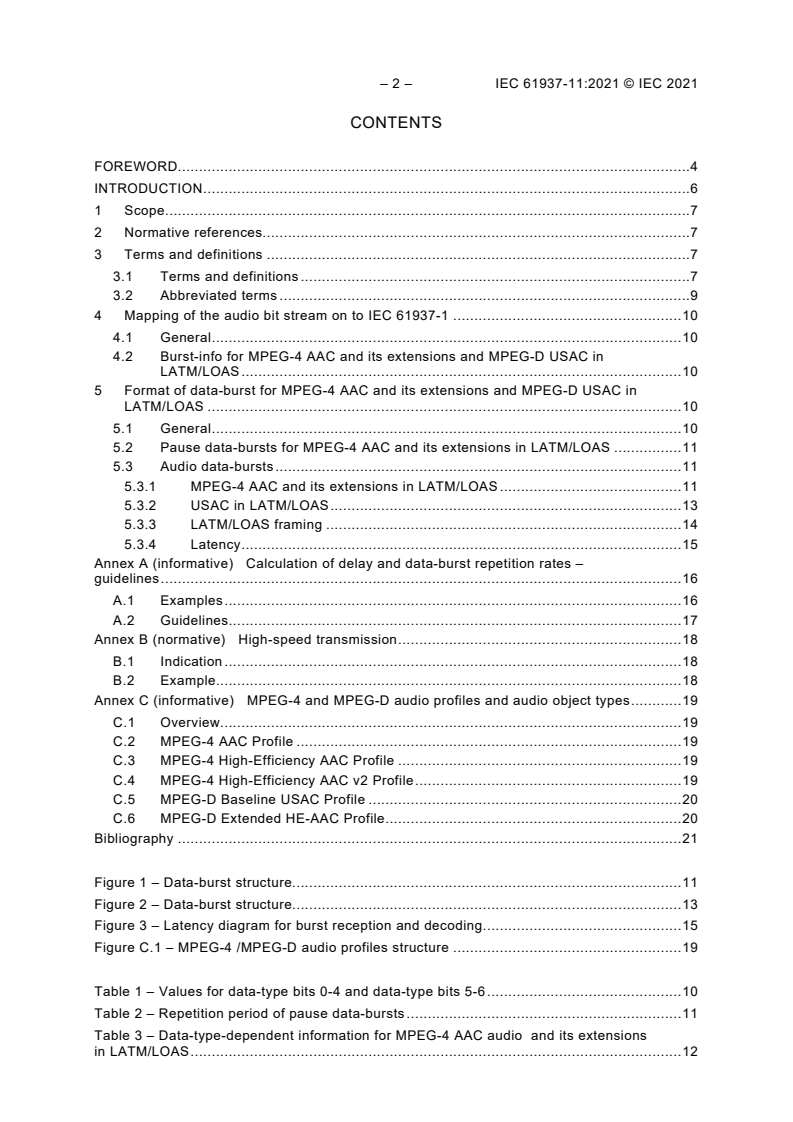
CONTENTS
FOREWORD . 4
INTRODUCTION . 6
1 Scope . 7
2 Normative references. 7
3 Terms and definitions . 7
3.1 Terms and definitions . 7
3.2 Abbreviated terms . 9
4 Mapping of the audio bit stream on to IEC 61937-1 . 10
4.1 General . 10
4.2 Burst-info for MPEG-4 AAC and its extensions and MPEG-D USAC in
LATM/LOAS . 10
5 Format of data-burst for MPEG-4 AAC and its extensions and MPEG-D USAC in
LATM/LOAS . 10
5.1 General . 10
5.2 Pause data-bursts for MPEG-4 AAC and its extensions in LATM/LOAS . 11
5.3 Audio data-bursts . 11
5.3.1 MPEG-4 AAC and its extensions in LATM/LOAS . 11
5.3.2 USAC in LATM/LOAS . 13
5.3.3 LATM/LOAS framing . 14
5.3.4 Latency . 15
Annex A (informative) Calculation of delay and data-burst repetition rates –
guidelines . 16
A.1 Examples . 16
A.2 Guidelines. 17
Annex B (normative) High-speed transmission . 18
B.1 Indication . 18
B.2 Example. 18
Annex C (informative) MPEG-4 and MPEG-D audio profiles and audio object types . 19
C.1 Overview. 19
C.2 MPEG-4 AAC Profile . 19
C.3 MPEG-4 High-Efficiency AAC Profile . 19
C.4 MPEG-4 High-Efficiency AAC v2 Profile . 19
C.5 MPEG-D Baseline USAC Profile . 20
C.6 MPEG-D Extended HE-AAC Profile . 20
Bibliography . 21
Figure 1 – Data-burst structure. 11
Figure 2 – Data-burst structure. 13
Figure 3 – Latency diagram for burst reception and decoding . 15
Figure C.1 – MPEG-4 /MPEG-D audio profiles structure . 19
Table 1 – Values for data-type bits 0-4 and data-type bits 5-6 . 10
Table 2 – Repetition period of pause data-bursts . 11
Table 3 – Data-type-dependent information for MPEG-4 AAC audio and its extensions
in LATM/LOAS . 12
Table 4 – Data-type-dependent information for USAC audio in LATM/LOAS . 14
Table A.1 – Examples – Calculation of delay and data-burst repetition rates for
AAC_LC and HE AAC . 16
Table A.2 – Examples – Calculation of delay and data-burst repetition rates for USAC . 17
Table B.1 – Indication fields . 18
Table B.2 – Signalling example . 18
– 4 – IEC 61937-11:2021 © IEC 2021
INTERNATIONAL ELECTROTECHNICAL COMMISSION
____________
DIGITAL AUDIO – INTERFACE FOR NON-LINEAR PCM
ENCODED AUDIO BITSTREAMS APPLYING IEC 60958 –
Part 11: MPEG-4 AAC and its extensions
and MPEG-D USAC in LATM/LOAS
FOREWORD
1) The International Electrotechnical Commission (IEC) is a worldwide organization for standardization comprising
all national electrotechnical committees (IEC National Committees). The object of IEC is to promote international
co-operation on all questions concerning standardization in the electrical and electronic fields. To this end and
in addition to other activities, IEC publishes International Standards, Technical Specifications, Technical Reports,
Publicly Available Specifications (PAS) and Guides (hereafter referred to as "IEC Publication(s)"). Their
preparation is entrusted to technical committees; any IEC National Committee interested in the subject dealt with
may participate in this preparatory work. International, governmental and non-governmental organizations liaising
with the IEC also participate in this preparation. IEC collaborates closely with the International Organization for
Standardization (ISO) in accordance with conditions determined by agreement between the two organizations.
2) The formal decisions or agreements of IEC on technical matters express, as nearly as possible, an international
consensus of opinion on the relevant subjects since each technical committee has representation from all
interested IEC National Committees.
3) IEC Publications have the form of recommendations for international use and are accepted by IEC National
Committees in that sense. While all reasonable efforts are made to ensure that the technical content of IEC
Publications is accurate, IEC cannot be held responsible for the way in which they are used or for any
misinterpretation by any end user.
4) In order to promote international uniformity, IEC National Committees undertake to apply IEC Publications
transparently to the maximum extent possible in their national and regional publications. Any divergence between
any IEC Publication and the corresponding national or regional publication shall be clearly indicated in the latter.
5) IEC itself does not provide any attestation of conformity. Independent certification bodies provide conformity
assessment services and, in some areas, access to IEC marks of conformity. IEC is not responsible for any
services carried out by independent certification bodies.
6) All users should ensure that they have the latest edition of this publication.
7) No liability shall attach to IEC or its directors, employees, servants or agents including individual experts and
members of its technical committees and IEC National Committees for any personal injury, property damage or
other damage of any nature whatsoever, whether direct or indirect, or for costs (including legal fees) and
expenses arising out of the publication, use of, or reliance upon, this IEC Publication or any other IEC
Publications.
8) Attention is drawn to the Normative references cited in this publication. Use of the referenced publications is
indispensable for the correct application of this publication.
9) Attention is drawn to the possibility that some of the elements of this IEC Publication may be the subject of patent
rights. IEC shall not be held responsible for identifying any or all such patent rights.
IEC 61937-11 has been prepared by technical area 20: Analogue and digital audio, of IEC
technical committee 100: Audio, video and multimedia systems and equipment. It is an
International Standard.
This second edition cancels and replaces the first edition published in 2010, and
Amendment 1:2018. This edition constitutes a technical revision.
This edition includes the following significant technical changes with respect to the previous
edition:
a) MPEG-D USAC has been added.
The text of this International Standard is based on the following documents:
Draft Report on voting
100/3523/CDV 100/3582/RVC
Full information on the voting for its approval can be found in the report on voting indicated in
the above table.
The language used for the development of this International Standard is English.
A list of all parts in the IEC 61937 series, published under the general title Digital audio –
Interface for non-linear PCM encoded audio bitstreams applying IEC 60958, can be found on
the IEC website.
This document was drafted in accordance with ISO/IEC Directives, Part 2, and developed in
accordance with ISO/IEC Directives, Part 1 and ISO/IEC Directives, IEC Supplement, available
at www.iec.ch/members_experts/refdocs. The main document types developed by IEC are
described in greater detail at www.iec.ch/standardsdev/publications.
The committee has decided that the contents of this document will remain unchanged until the
stability date indicated on the IEC website under webstore.iec.ch in the data related to the
specific document. At this date, the document will be
• reconfirmed,
• withdrawn,
• replaced by a revised edition, or
• amended.
– 6 – IEC 61937-11:2021 © IEC 2021
INTRODUCTION
Modern digital video broadcasting standards, such as DVB, include support for the MPEG-4
HE AAC and/or HE AAC v2 audio codecs specified in ISO/IEC 14496-3. An increasing number
of countries are adopting these new codecs for their standard-definition and high-definition
digital video broadcasting services and have started with implementations.
For MPEG-2 AAC audio (ISO/IEC 13818-7), the specified framing format for the audio bit stream
is ADTS and its transport over an IEC 60958 interface is specified in IEC 61937-6.
However, the MPEG-4 (ISO/IEC 14496-3) and MPEG-D (ISO/IEC 23003-3) audio codecs
introduce new features and capabilities that require a framing format that supports more flexible
signalling and delivery mechanisms. Therefore, MPEG-2 systems (ISO/IEC 13818-1) specify
the MPEG-4 LATM/LOAS framing format for MPEG-4 audio codecs to overcome the limitations
of ADTS.
In order to be able to pass the MPEG-4 or MPEG-D audio bit stream from a set-top box to an
A/V receiver connected via the IEC 60958 interface without needing to reframe the audio bit
stream within ADTS, the MPEG-4 LATM/LOAS framing format needs to be supported by
IEC 61937, including the high-speed transmission protocol where the interface does not carry
an embedded sampling frequency clock.
DIGITAL AUDIO – INTERFACE FOR NON-LINEAR PCM
ENCODED AUDIO BITSTREAMS APPLYING IEC 60958 –
Part 11: MPEG-4 AAC and its extensions
and MPEG-D USAC in LATM/LOAS
1 Scope
This part of IEC 61937 describes the method to convey non-linear PCM bitstreams encoded in
accordance with the MPEG-4 AAC format and its extensions (spectral band replication,
parametric stereo and MPEG surround), and non-linear PCM bitstreams encoded in accordance
with the MPEG-D USAC format, framed in MPEG-4 LATM/LOAS.
2 Normative references
The following documents are referred to in the text in such a way that some or all of their content
constitutes requirements of this document. For dated references, only the edition cited applies.
For undated references, the latest edition of the referenced document (including any
amendments) applies.
IEC 60958-3:2021, Digital audio interface – Part 3: Consumer applications
IEC 61937-1:2021, Digital audio – Interface for non-linear PCM encoded audio bitstreams
applying IEC 60958 – Part 1: General
IEC 61937-2:2021, Digital audio – Interface for non-linear PCM encoded audio bitstreams
applying IEC 60958 – Part 2: Burst-info
ISO/IEC 14496-3:2019, Information technology – Coding of audio-visual objects – Part 3: Audio
ISO/IEC 23003-3:2020, Information technology – MPEG audio technologies – Part 3: Unified
speech and audio coding
3 Terms and definitions
For the purposes of this document, the terms, definitions and abbreviated terms of IEC 61937-1
and IEC 61937-2, and the following apply.
ISO and IEC maintain terminological databases for use in standardization at the following
addresses:
• IEC Electropedia: available at http://www.electropedia.org/
• ISO Online browsing platform: available at http://www.iso.org/obp
3.1 Terms and definitions
3.1.1
access unit
smallest entity to which timing information can be attributed
Note 1 to entry: An access unit is the smallest individually decodable unit.
Note 2 to entry: A decoder consumes access units.
– 8 – IEC 61937-11:2021 © IEC 2021
3.1.2
AudioMuxElement
LATM element that carries payload data for at least one audio elementary stream, related
payload length information, and multiplex configuration information
Note 1 to entry: This element carries payload data in form of PayloadMux elements. If the term is followed by a
number in parentheses, a "1" indicates that the multiplexing configuration (StreamMuxConfig) is multiplexed into the
AudioMuxElement, i.e. the multiplexing configuration (StreamMuxConfig) is transmitted "in-band". A "0" indicates
that the multiplexing configuration (StreamMuxConfig) is not present in the AudioMuxElement and needs to be
transmitted by other means ("out-of-band").
3.1.3
AudioSpecificConfig
configuration structure used to convey parameters to initialize the MPEG-4 audio decoder
3.1.4
LATM
low overhead MPEG-4 audio transport multiplex
multiplexing layer defined by ISO/IEC 14496-3 used for multiplexing of audio elementary
streams
3.1.5
LOAS
low overhead audio stream
synchronisation layer defined by ISO/IEC 14496-3
Note 1 to entry: Three different formats of LOAS are defined, each of which is designed to address the specific
characteristics of the underlying transmission layer.
3.1.6
MPEG-4 AAC profile
contains only the MPEG-4 AAC low complexity audio object type
Note 1 to entry: The MPEG-4 AAC low complexity object type is the counterpart to the MPEG-2 AAC low complexity
profile. In addition to the MPEG-2 AAC LC profile, the MPEG-4 AAC low complexity object type enables the usage
of the PNS tool.
Note 2 to entry: The MPEG-4 AAC low complexity object type is used when there are restrictions on the usage of
RAM and processing complexity.
3.1.7
MPEG-4 high-efficiency AAC profile
contains the spectral band replication object type in conjunction with the MPEG-4 AAC low
complexity object type
Note 1 to entry: For further information, see ISO/IEC 14496-3. The MPEG-4 high-efficiency AAC profile is a superset
of the MPEG-4 AAC profile.
3.1.8
MPEG-4 high-efficiency AAC profile version 2
contains the parametric stereo object type and the spectral band replication object type in
conjunction with the AAC low complexity object type
Note 1 to entry: The MPEG-4 high-efficiency AAC profile version 2 is a superset of the MPEG-4 high-efficiency AAC
profile.
3.1.9
MPEG-D Baseline USAC profile
profile that contains the Unified Speech and Audio Coding object type
3.1.10
MPEG-D extended high-efficiency AAC profile
profile that contains the parametric stereo object type and the spectral band replication object
type in conjunction with the AAC low complexity object type, as well as the USAC object type
Note 1 to entry: The MPEG-D extended high-efficiency AAC profile is a superset of the MPEG-4 high-efficiency
AAC profile version 2 and the MPEG-D Baseline USAC profile.
3.1.11
MPEG surround
technology used for coding of multichannel signals based on a downmixed signal of the original
multichannel signal, and associated spatial parameters
Note 1 to entry: MPEG surround is defined in ISO/IEC 23003-1.
3.1.12
PayloadMux
payload data chunk in an AudioMuxElement that contains potentially multiplexed payload data
for multiple audio elementary streams
Note 1 to entry: In general, PayloadMux elements can be concatenated inside AudioMuxElements.
3.1.13
SpatialSpecificConfig
configuration structure used to initialize the MPEG surround decoder
3.1.14
StreamMuxConfig
configuration structure that describes the structure of the LATM payload multiplex
3.1.15
MDCT
modified discrete cosine transformation
transformation schema used by AAC
3.1.16
transformation length
number of audio samples or corresponding MDCT lines that are processed as a block per each
audio frame
Note 1 to entry: An MDCT line is a spectral component described by frequency, amplitude and phase.
3.1.17
USAC frame length
number of PCM audio samples per USAC frame
Note 1 to entry: USAC can operate in several modes using 1 024, 2 048, 4 096 or 768 linear PCM samples per
USAC frame.
3.2 Abbreviated terms
AAC Advanced Audio Coding
AAC LC MPEG-4 AAC Low Complexity
HE AAC MPEG-4 High-Efficiency AAC and MPEG-4 High-Efficiency AAC Version 2
ADTS Audio Data Transport Stream
DVB Digital Video Broadcasting
MDCT modified discrete cosine transformation
MPEG Moving Picture Experts Group
MPS MPEG Surround
– 10 – IEC 61937-11:2021 © IEC 2021
PNS Perceptual Noise Substitution
PS parametric stereo
SBR spectral band replication
USAC Unified Speech and Audio Coding
LT AAC transformation length
4 Mapping of the audio bit stream on to IEC 61937-1
4.1 General
The coding of the bit stream and data-burst is in accordance with IEC 61937-1 and IEC 61937-2.
4.2 Burst-info for MPEG-4 AAC and its extensions and MPEG-D USAC in LATM/LOAS
The 16-bit burst-info contains information about the data found in the data-burst (see Table 1).
Table 1 – Values for data-type bits 0-4 and data-type bits 5-6
Data-type bits 0-
Data-type bits
4 according to
Repetition period
5-6
Reference
IEC 61937-2
Contents of data-bursts
point R
Value of Pc
in IEC 60958 frames
Value of
bits 5–6
Pc bits 0–4
0–22 0–3 According to IEC 61937
23 0 According to IEC 61937
1 AAC LC Bit 0 of Pa 960 / 1 024
2 HE AAC Bit 0 of Pa 1 920 / 2 048
3 According to IEC 61937
24 0–3 According to IEC 61937
25 0–2 According to IEC 61937
3 USAC Bit 0 of Pa 768 / 1 024 / 2 048 / 4 096
26-31 0–3 According to IEC 61937
Bits 0–4 of the burst-info (Pc) signal the data-type bits 0-4 used for transmission. For MPEG-4 AAC-based audio
in LATM/LOAS, the signalled data-type bits 0-4 is 23 (for AAC LC and HE AAC) or 25 (for USAC). Annex C gives
a brief overview of MPEG-4 AAC, its extensions, and MPEG-D USAC.
If the Pc bits 0-4 are equal to 23, the Pc bits 5–6 indicate if the transmitted data stream contains audio encoded
in AAC LC or HE AAC (including high-efficiency AAC version 2). Only values 1 and 2 refer to the transmission of
AAC LC or HE AAC based audio. The values 0 and 3 are used for ind
...
IEC 61937-11 ®
Edition 2.0 2021-07
REDLINE VERSION
INTERNATIONAL
STANDARD
colour
inside
Digital audio – Interface for non-linear PCM encoded audio bitstreams applying
IEC 60958 –
Part 11: MPEG-4 AAC and its extensions and MPEG-D USAC in LATM/LOAS
All rights reserved. Unless otherwise specified, no part of this publication may be reproduced or utilized in any form
or by any means, electronic or mechanical, including photocopying and microfilm, without permission in writing from
either IEC or IEC's member National Committee in the country of the requester. If you have any questions about IEC
copyright or have an enquiry about obtaining additional rights to this publication, please contact the address below or
your local IEC member National Committee for further information.
IEC Central Office Tel.: +41 22 919 02 11
3, rue de Varembé info@iec.ch
CH-1211 Geneva 20 www.iec.ch
Switzerland
About the IEC
The International Electrotechnical Commission (IEC) is the leading global organization that prepares and publishes
International Standards for all electrical, electronic and related technologies.
About IEC publications
The technical content of IEC publications is kept under constant review by the IEC. Please make sure that you have the
latest edition, a corrigendum or an amendment might have been published.
IEC publications search - webstore.iec.ch/advsearchform IEC online collection - oc.iec.ch
The advanced search enables to find IEC publications by a Discover our powerful search engine and read freely all the
variety of criteria (reference number, text, technical publications previews. With a subscription you will always
committee, …). It also gives information on projects, replaced have access to up to date content tailored to your needs.
and withdrawn publications.
Electropedia - www.electropedia.org
IEC Just Published - webstore.iec.ch/justpublished
The world's leading online dictionary on electrotechnology,
Stay up to date on all new IEC publications. Just Published
containing more than 22 000 terminological entries in English
details all new publications released. Available online and
and French, with equivalent terms in 18 additional languages.
once a month by email.
Also known as the International Electrotechnical Vocabulary
(IEV) online.
IEC Customer Service Centre - webstore.iec.ch/csc
If you wish to give us your feedback on this publication or
need further assistance, please contact the Customer Service
Centre: sales@iec.ch.
IEC 61937-11 ®
Edition 2.0 2021-07
REDLINE VERSION
INTERNATIONAL
STANDARD
colour
inside
Digital audio – Interface for non-linear PCM encoded audio bitstreams applying
IEC 60958 –
Part 11: MPEG-4 AAC and its extensions and MPEG-D USAC in LATM/LOAS
INTERNATIONAL
ELECTROTECHNICAL
COMMISSION
ICS 33.160.30; 33.170 ISBN 978-2-8322-5016-7
– 2 – IEC 61937-11:2021 RLV © IEC 2021
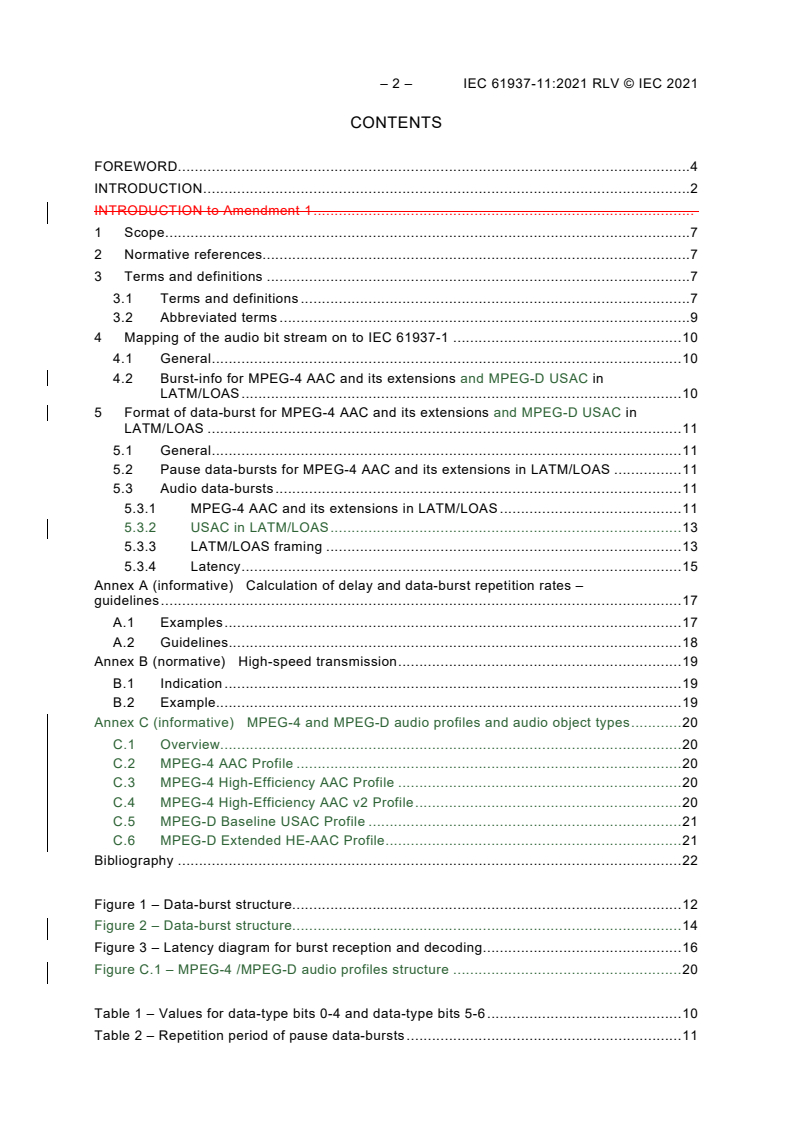
CONTENTS
FOREWORD . 4
INTRODUCTION . 2
INTRODUCTION to Amendment 1 .
1 Scope . 7
2 Normative references. 7
3 Terms and definitions . 7
3.1 Terms and definitions . 7
3.2 Abbreviated terms . 9
4 Mapping of the audio bit stream on to IEC 61937-1 . 10
4.1 General . 10
4.2 Burst-info for MPEG-4 AAC and its extensions and MPEG-D USAC in
LATM/LOAS . 10
5 Format of data-burst for MPEG-4 AAC and its extensions and MPEG-D USAC in
LATM/LOAS . 11
5.1 General . 11
5.2 Pause data-bursts for MPEG-4 AAC and its extensions in LATM/LOAS . 11
5.3 Audio data-bursts . 11
5.3.1 MPEG-4 AAC and its extensions in LATM/LOAS . 11
5.3.2 USAC in LATM/LOAS . 13
5.3.3 LATM/LOAS framing . 13
5.3.4 Latency . 15
Annex A (informative) Calculation of delay and data-burst repetition rates –
guidelines . 17
A.1 Examples . 17
A.2 Guidelines. 18
Annex B (normative) High-speed transmission . 19
B.1 Indication . 19
B.2 Example. 19
Annex C (informative) MPEG-4 and MPEG-D audio profiles and audio object types . 20
C.1 Overview. 20
C.2 MPEG-4 AAC Profile . 20
C.3 MPEG-4 High-Efficiency AAC Profile . 20
C.4 MPEG-4 High-Efficiency AAC v2 Profile . 20
C.5 MPEG-D Baseline USAC Profile . 21
C.6 MPEG-D Extended HE-AAC Profile . 21
Bibliography . 22
Figure 1 – Data-burst structure. 12
Figure 2 – Data-burst structure. 14
Figure 3 – Latency diagram for burst reception and decoding . 16
Figure C.1 – MPEG-4 /MPEG-D audio profiles structure . 20
Table 1 – Values for data-type bits 0-4 and data-type bits 5-6 . 10
Table 2 – Repetition period of pause data-bursts . 11
Table 3 – Data-type-dependent information for MPEG-4 AAC audio and its extensions
in LATM/LOAS . 12
Table 4 – Data-type-dependent information for USAC audio in LATM/LOAS . 14
Table A.1 – Examples – Calculation of delay and data-burst repetition rates for
AAC_LC and HE AAC . 17
Table A.2 – Examples – Calculation of delay and data-burst repetition rates for USAC . 18
Table B.1 – Indication fields . 19
Table B.2 – Signalling example . 19
– 4 – IEC 61937-11:2021 RLV © IEC 2021
INTERNATIONAL ELECTROTECHNICAL COMMISSION
____________
DIGITAL AUDIO – INTERFACE FOR NON-LINEAR PCM
ENCODED AUDIO BITSTREAMS APPLYING IEC 60958 –
Part 11: MPEG-4 AAC and its extensions
and MPEG-D USAC in LATM/LOAS
FOREWORD
1) The International Electrotechnical Commission (IEC) is a worldwide organization for standardization comprising
all national electrotechnical committees (IEC National Committees). The object of IEC is to promote international
co-operation on all questions concerning standardization in the electrical and electronic fields. To this end and
in addition to other activities, IEC publishes International Standards, Technical Specifications, Technical Reports,
Publicly Available Specifications (PAS) and Guides (hereafter referred to as "IEC Publication(s)"). Their
preparation is entrusted to technical committees; any IEC National Committee interested in the subject dealt with
may participate in this preparatory work. International, governmental and non-governmental organizations liaising
with the IEC also participate in this preparation. IEC collaborates closely with the International Organization for
Standardization (ISO) in accordance with conditions determined by agreement between the two organizations.
2) The formal decisions or agreements of IEC on technical matters express, as nearly as possible, an international
consensus of opinion on the relevant subjects since each technical committee has representation from all
interested IEC National Committees.
3) IEC Publications have the form of recommendations for international use and are accepted by IEC National
Committees in that sense. While all reasonable efforts are made to ensure that the technical content of IEC
Publications is accurate, IEC cannot be held responsible for the way in which they are used or for any
misinterpretation by any end user.
4) In order to promote international uniformity, IEC National Committees undertake to apply IEC Publications
transparently to the maximum extent possible in their national and regional publications. Any divergence between
any IEC Publication and the corresponding national or regional publication shall be clearly indicated in the latter.
5) IEC itself does not provide any attestation of conformity. Independent certification bodies provide conformity
assessment services and, in some areas, access to IEC marks of conformity. IEC is not responsible for any
services carried out by independent certification bodies.
6) All users should ensure that they have the latest edition of this publication.
7) No liability shall attach to IEC or its directors, employees, servants or agents including individual experts and
members of its technical committees and IEC National Committees for any personal injury, property damage or
other damage of any nature whatsoever, whether direct or indirect, or for costs (including legal fees) and
expenses arising out of the publication, use of, or reliance upon, this IEC Publication or any other IEC
Publications.
8) Attention is drawn to the Normative references cited in this publication. Use of the referenced publications is
indispensable for the correct application of this publication.
9) Attention is drawn to the possibility that some of the elements of this IEC Publication may be the subject of patent
rights. IEC shall not be held responsible for identifying any or all such patent rights.
This redline version of the official IEC Standard allows the user to identify the changes made to
the previous edition IEC 61937-11:2010+AMD1:2018 CSV. A vertical bar appears in the margin
wherever a change has been made. Additions are in green text, deletions are in strikethrough
red text.
IEC 61937-11 has been prepared by technical area 20: Analogue and digital audio, of IEC
technical committee 100: Audio, video and multimedia systems and equipment. It is an
International Standard.
This second edition cancels and replaces the first edition published in 2010, and
Amendment 1:2018. This edition constitutes a technical revision.
This edition includes the following significant technical changes with respect to the previous
edition:
a) MPEG-D USAC has been added.
The text of this International Standard is based on the following documents:
Draft Report on voting
100/3523/CDV 100/3582/RVC
Full information on the voting for its approval can be found in the report on voting indicated in
the above table.
The language used for the development of this International Standard is English.
A list of all parts in the IEC 61937 series, published under the general title Digital audio –
Interface for non-linear PCM encoded audio bitstreams applying IEC 60958, can be found on
the IEC website.
This document was drafted in accordance with ISO/IEC Directives, Part 2, and developed in
accordance with ISO/IEC Directives, Part 1 and ISO/IEC Directives, IEC Supplement, available
at www.iec.ch/members_experts/refdocs. The main document types developed by IEC are
described in greater detail at www.iec.ch/standardsdev/publications.
The committee has decided that the contents of this document will remain unchanged until the
stability date indicated on the IEC website under webstore.iec.ch in the data related to the
specific document. At this date, the document will be
• reconfirmed,
• withdrawn,
• replaced by a revised edition, or
• amended.
IMPORTANT – The 'colour inside' logo on the cover page of this publication indicates that it
contains colours which are considered to be useful for the correct understanding of its
contents. Users should therefore print this document using a colour printer.
– 6 – IEC 61937-11:2021 RLV © IEC 2021
INTRODUCTION
Modern digital video broadcasting standards, such as DVB, include support for the MPEG-4
HE AAC and/or HE AAC v2 audio codecs specified in ISO/IEC 14496-3. An increasing number
of countries are adopting these new codecs for their standard-definition and high-definition
digital video broadcasting services and have started with implementations.
For MPEG-2 AAC audio (ISO/IEC 13818-7), the specified framing format for the audio bit stream
is ADTS and its transport over an IEC 60958 interface is specified in IEC 61937-6.
However, the MPEG-4 (ISO/IEC 14496-3) and MPEG-D (ISO/IEC 23003-3) audio codecs
introduce new features and capabilities that require a framing format that supports more flexible
signalling and delivery mechanisms. Therefore, MPEG-2 systems (ISO/IEC 13818-1) specify
the MPEG-4 LATM/LOAS framing format for MPEG-4 audio codecs to overcome the limitations
of ADTS.
In order to be able to pass the MPEG-4 or MPEG-D audio bit stream from a set-top box to an
A/V receiver connected via the IEC 60958 interface without needing to reframe the audio bit
stream within ADTS, the MPEG-4 LATM/LOAS framing format needs to be supported by
IEC 61937, including the high-speed transmission protocol where the interface does not carry
an embedded sampling frequency clock.
INTRODUCTION to Amendment 1
The revision of IEC 61937-11:2010 has become necessary to specify the protocol where the
interface does not carry an embedded sampling frequency clock. The purpose is primarily to
support stereophonic multichannel audio applications increasing their channel counts. It is
justified in that ARIB introduces 22.2/7.1 audio channel applications, as given in ITU-R
BS.2051-0, into the market in 2018. This Amendment 1 contains the following significant
technical changes with respect to IEC 61937-11:2010:
• new Annex B specifies new high-speed transmission;
• the term "Sub-data-type" is discontinued.
DIGITAL AUDIO – INTERFACE FOR NON-LINEAR PCM
ENCODED AUDIO BITSTREAMS APPLYING IEC 60958 –
Part 11: MPEG-4 AAC and its extensions
and MPEG-D USAC in LATM/LOAS
1 Scope
This part of IEC 61937 describes the method to convey non-linear PCM bitstreams encoded in
accordance with the MPEG-4 AAC format and its extensions (spectral band replication,
parametric stereo and MPEG surround), and non-linear PCM bitstreams encoded in accordance
with the MPEG-D USAC format, framed in MPEG-4 LATM/LOAS.
2 Normative references
The following documents are referred to in the text in such a way that some or all of their content
constitutes requirements of this document. For dated references, only the edition cited applies.
For undated references, the latest edition of the referenced document (including any
amendments) applies.
IEC 60958 (all parts), Digital audio interface
IEC 60958-3:2021, Digital audio interface – Part 3: Consumer applications
IEC 61937-1:2021, Digital audio – Interface for non-linear PCM encoded audio bitstreams
applying IEC 60958 – Part 1: General
IEC 61937-2:2021, Digital audio – Interface for non-linear PCM encoded audio bitstreams
applying IEC 60958 – Part 2: Burst-info
ISO/IEC 14496-3:20092019, Information technology – Coding of audio-visual objects – Part 3:
Audio
ISO/IEC 23003-3:2020, Information technology – MPEG audio technologies – Part 3: Unified
speech and audio coding
3 Terms and definitions
For the purposes of this document, the terms, definitions and abbreviated terms of IEC 61937-1
and IEC 61937-2, and the following apply.
ISO and IEC maintain terminological databases for use in standardization at the following
addresses:
• IEC Electropedia: available at http://www.electropedia.org/
• ISO Online browsing platform: available at http://www.iso.org/obp
3.1 Terms and definitions
3.1.1
access unit
smallest entity to which timing information can be attributed
– 8 – IEC 61937-11:2021 RLV © IEC 2021
Note 1 to entry: An access unit is the smallest individually decodable unit.
Note 2 to entry: A decoder consumes access units.
3.1.2
AudioMuxElement(1)
LATM element that carries payload data for at least one audio elementary stream, related
payload length information, and multiplex configuration information
Note 1 to entry: This element carries payload data in form of PayloadMux elements. The number in brackets
indicates multiplexing configuration (StreamMuxConfig) is multiplexed into AudioMuxElements, that is in-band
transmission. If the term is followed by a number in parentheses, a "1" indicates that the multiplexing configuration
(StreamMuxConfig) is multiplexed into the AudioMuxElement, i.e. the multiplexing configuration (StreamMuxConfig)
is transmitted "in-band". A "0" indicates that the multiplexing configuration (StreamMuxConfig) is not present in the
AudioMuxElement and needs to be transmitted by other means ("out-of-band").
3.1.3
AudioSpecificConfig
configuration structure used to convey parameters to initialize the MPEG-4 audio decoder
3.1.4
LATM
low overhead MPEG-4 audio transport multiplex
multiplexing layer defined by ISO/IEC 14496-3 used for multiplexing of audio elementary
streams
3.1.5
LOAS
low overhead audio stream
synchronisation layer defined by ISO/IEC 14496-3
Note 1 to entry: Three different formats of LOAS are defined, each of which is designed to address the specific
characteristics of the underlying transmission layer.
3.1.6
MPEG-4 AAC profile
contains only the MPEG-4 AAC low complexity audio object type
Note 1 to entry: The MPEG-4 AAC low complexity object type is the counterpart to the MPEG-2 AAC low complexity
profile. In addition to the MPEG-2 AAC LC profile, the MPEG-4 AAC low complexity object type enables the usage
of the PNS tool.
Note 2 to entry: The MPEG-4 AAC low complexity object type is used when there are restrictions on the usage of
RAM and processing complexity.
3.1.7
MPEG-4 high-efficiency AAC profile
contains the spectral band replication object type in conjunction with the MPEG-4 AAC low
complexity object type
Note 1 to entry: For further information, see ISO/IEC 14496-3. The MPEG-4 high-efficiency AAC profile is a superset
of the MPEG-4 AAC profile.
3.1.8
MPEG-4 high-efficiency AAC profile version 2
contains the parametric stereo object type and the spectral band replication object type in
conjunction with the AAC low complexity object type
Note 1 to entry: The MPEG-4 high-efficiency AAC profile version 2 is a superset of the MPEG-4 high-efficiency AAC
profile.
3.1.9
MPEG-D Baseline USAC profile
profile that contains the Unified Speech and Audio Coding object type
3.1.10
MPEG-D extended high-efficiency AAC profile
profile that contains the parametric stereo object type and the spectral band replication object
type in conjunction with the AAC low complexity object type, as well as the USAC object type
Note 1 to entry: The MPEG-D extended high-efficiency AAC profile is a superset of the MPEG-4 high-efficiency
AAC profile version 2 and the MPEG-D Baseline USAC profile.
3.1.11
MPEG surround
technology used for coding of multichannel signals based on a downmixed signal of the original
multichannel signal, and associated spatial parameters
Note 1 to entry: MPEG surround is defined in ISO/IEC 23003-1.
3.1.12
PayloadMux
payload data chunk in an AudioMuxElement that contains potentially multiplexed payload data
for multiple audio elementary streams
Note 1 to entry: In general, PayloadMux elements can be concatenated inside AudioMuxElements.
3.1.13
SpatialSpecificConfig
configuration structure used to initialize the MPEG surround decoder
3.1.14
StreamMuxConfig
configuration structure that describes the structure of the LATM payload multiplex
3.1.15
MDCT
modified discrete cosine transformation
transformation schema used by AAC
3.1.16
transformation length (of the AAC codec or core codec)
AAC can operate in two modes using either a 960 lines or 1 024 lines MDCT transformation for
long blocks number of audio samples or corresponding MDCT lines that are processed as a
block per each audio frame
Note 1 to entry: An MDCT line is a spectral component described by frequency, amplitude and phase.
3.1.17
USAC frame length
number of PCM audio samples per USAC frame
Note 1 to entry: USAC can operate in several modes using 1 024, 2 048, 4 096 or 768 linear PCM samples per
USAC frame.
3.2 Abbreviated terms
AAC Advanced Audio Coding
AAC LC MPEG-4 AAC Low Complexity
HE AAC MPEG-4 High-Efficiency AAC and MPEG-4 High-Efficiency AAC Version 2
ADTS Audio Data Transport Stream
DVB Digital Video Broadcasting
MDCT modified discrete cosine transformation
MPEG Moving Picture Experts Group
– 10 – IEC 61937-11:2021 RLV © IEC 2021
MPS MPEG Surround
PNS Perceptual Noise Substitution
PS parametric stereo
SBR spectral band replication
USAC Unified Speech and Audio Coding
TL LT AAC transformation length
4 Mapping of the audio bit stream on to IEC 61937-1
4.1 General
The coding of the bit stream and data-burst is in accordance with IEC 61937-1 and IEC 61937-2.
4.2 Burst-info for MPEG-4 AAC and its extensions and MPEG-D USAC in LATM/LOAS
The 16-bit burst-info contains information about the data found in the data-burst (see Table 1).
Table 1 – Values for data-type bits 0-4 and data-type bits 5-6
Data-type bits 0-
Data-type bits
4 according to
Repetition period
5-6
Reference
IEC 61937-2
Contents of data-bursts
point R
Value of Pc
in IEC 60958 frames
Value of
bits 5–6
Pc bits 0–4
0–22 0–3 According to IEC 61937
23 0 According to Definition specific to
IEC 61937-10 IEC 61937-10
1 AAC LC Bit 0 of Pa 960 / 1 024
2 HE AAC Bit 0 of Pa 1 920 / 2 048
3 Reserved for future reserved Reserved for future definition
definition of other of other applications
applications
According to IEC 61937
24–31 0–3 According to IEC 61937
24 0–3 According to IEC 61937
25 0–2 According to IEC 61937
3 USAC Bit 0 of Pa 768 / 1 024 / 2 048 / 4 096
26-31 0-3 According to IEC 61937
Bits 0–4 of the burst-info (Pc) signal the data-type bits 0-4 used for transmission. For MPEG-4 AAC-based audio
in LATM/LOAS, the signalled data-type bits 0-4 is 23 (for AAC LC and HE AAC) or 25 (for USAC). Annex C gives
a brief overview of MPEG-4 AAC, its extensions, and MPEG-D USAC.
If the Pc bits 0-4 are equal to 23, the Pc bits 5–6 indicate if the transmitted data stream contains audio encoded
in AAC LC or HE AAC (including high-efficiency AAC version 2). Only values 1 and 2 refer to the transmission of
AAC LC or HE AAC based audio. The values 0 and 3 are used for indication of codec types which are described
by other or future parts of IEC 61937.
If the Pc bits 0-4 are equal to 25, the Pc bits 5–6 indicate if the transmitted data stream contains audio encoded
in USAC. Only value 3 refer to the transmission of USAC based audio. The values 0, 1 and 2 are used for indication
of codec types which are described by other or future parts of IEC 61937.
5 Format of data-burst for MPEG-4 AAC and its extensions and MPEG-D USAC
in LATM/LOAS
5.1 General
Clause 5 specifies the data-burst for MPEG-4 AAC audio and its extensions and MPEG-D USAC
in LATM/LOAS. Specific properties such as reference points, repetition period, the method of
filling stream gaps, and decoding latency are specified.
The decoding latency (or delay), indicated for the data-type bits 5-6, should be taken into
account by the transmitter to schedule data-bursts as necessary to establish synchronisation
between picture and decoded audio.
5.2 Pause data-bursts for MPEG-4 AAC and its extensions in LATM/LOAS
Pause data-bursts for MPEG-4 AAC and its extensions in LATM/LOAS are defined in Table 2.
Table 2 – Repetition period of pause data-bursts
Repetition period of pause data-burst
Data-type of audio data-burst
Mandatory Recommended
Data-type bits 5-6 for MPEG-4 audio in
— 64 IEC 60958 frames
LATM/LOAS based on MPEG-4 AAC core codec
If regular audio data-bursts are not being transmitted due to for example a pause condition, it
is recommended to use pause data-bursts to fill such stream gaps. The repetition period of the
pause data-bursts should be selected in accordance with Table 2. If other repetition periods are
necessary to precisely fill the stream gap length, or to meet the requirement on audio data-
bursts spacing (see IEC 61937), pause data-bursts may have other lengths which may can or
not be an integer multiple of 64 IEC 60958 frames.
When a stream gap in an audio stream is filled by a sequence of pause data-bursts, the Pa of
the first pause data-burst shall occur after exactly that amount of IEC 60958 frames as indicated
by the AAC transformation length in conjunction with the codec type information from Table 3.
It is recommended that the sequence(s) of pause data-bursts which fill the stream gap should
continue from this point up to the Pa of the first audio data-burst which follows the stream gap,
or as close as possible considering the specific IEC 60958 frame length of the pause data-burst
with respect to the AAC core codec transformation length. The repetition-period-length
parameter contained in the pause data-burst is intended to be interpreted by the receiver as an
indication of the number of decoded PCM samples that are missing (due to the resulting audio
gap).
5.3 Audio data-bursts
5.3.1 MPEG-4 AAC and its extensions in LATM/LOAS
The stream of data-bursts, as shown in Figure 1, consists of sequences of MPEG-4 AAC and
its extensions in LATM/LOAS frames. Each data-burst consists of a preamble followed by the
payload and stuffing. The data-type of a data-burst according to this specification is 23.
– 12 – IEC 61937-11:2021 RLV © IEC 2021
Figure 1 – Data-burst structure
The length of the audio payload data in the data-burst depends on the bit rate and other
parameters of the encoded audio. The size of the data-burst payload is indicated by the Pd
preamble word and is measured in bits.
P = 4 × 16 bit (P is the size of the preamble words Pa Pd measured in bits)
AD
AD –
B = 4 × 16 bit (B is the size of the burst spacing measured in bits)
S
S
TL L = 1 024 or 960 lines (TL L is the used MDCT transformation length in MDCT
T T
lines)
The maximum data-burst payload size for AAC not utilizing SBR is calculated according to the
following equation:
2 × 16 bit × TL L – ( P + B ) = maximum payload size in bits.
T AD S
If HE AAC is used, the maximum data-burst payload size is calculated according to the following
equation:
4 × 16 bit × TL L – ( P + B ) = maximum payload size in bits.
T AD S
The data-type-dependent information for MPEG-4 AAC and its extensions in LATM/LOAS is
given in Table 3. Bits 8–12 of Pc contain information about the audio codec used and about the
LATM configuration.
Table 3 – Data-type-dependent information for MPEG-4 AAC audio
and its extensions in LATM/LOAS
Bits of Pc
Value Definition Description
LSB…MSB
8 0 AAC Transformation 1 024 lines
Length
1 960 lines
9 0 PS PS data not present
1 PS data present
10–11 0 MPS MPS data not present
1 Embedded MPS data present / LATM single layer
transport mode (implicit MPS signalling)
2 Embedded MPS data present / explicit signalling
of MPS in second LATM layer
3 Do not use until further definition
12 0 Reserved Set to "0" until further definition
1 Do not use until further definition
The Pc bit 8 indicates the transformation length of the AAC core codec which is used to encode
the transmitted audio stream. Information from Pc bit 8 does not define the repetition period of
data-bursts on its own. This information is required in conjunction with the codec signalled by
the data-type bits 5-6 to calculate the data-burst repetition period. Receivers shall read the
data-type bits 5-6 as well as the data-type-dependent information in order to compute the
repetition period of data-bursts. Examples can be found in Annex A.
The Pc bit 9 indicates whether PS data is present in the encoded audio stream.
The two Pc bits 10–11 indicate the presence and transport configuration of MPS data in the
encoded audio stream. The value 0 indicates that no MPS data is present. Values 1 and 2
indicate that MPS data is present in the audio bit stream. Pc bits 10-11 signalling 1 indicate that
the MPS payload as well as the MPS SpatialSpecificConfig are embedded inside the payload
of the first LATM layer, which conveys the AAC LC or HE AAC data stream. Pc bits 10–11
signalling 2 indicate that the MPS payload is also embedded inside the payload of the first layer.
But in this case, the MPS SpatialSpecificConfig is signalled as being explicitly associated to the
second layer inside the LATM StreamMuxConfig. The value 3 signalled by the Pc bits 10–11 is
reserved for future use.
This specification does not allow the transmission of MPS payload that is not embedded inside
the AAC LC or HE AAC payload, but resides separated from the AAC LC or HE AAC payload
inside another LATM layer.
The presence of the PS or MPS extensions does not influence the data-burst repetition rate or
the calculation of the transmission and decoding latency as described in 5.3.3.
The Pc bit 12 is reserved for future use. This bit shall be set to 0.
One complete AAC access unit represents a time interval of 1 024 or 960 audio samples
embedded into the data-burst payload. When transmitting MPEG-4 HE AAC encoded audio
programmes, SBR is used as an extension to AAC. In this case, the sampling frequency of the
MPEG-4 AAC core component is usually half the sampling frequency of the SBR tool and audio
program. One complete HE AAC access unit represents a time interval of 2 048 or 1 920 audio
samples embedded into the data-burst payload.
HE AAC bit streams with downsampled SBR shall be transmitted signalling AAC LC in the data-
type bits 5-6. Therefore, one access unit corresponds to 1 024 or 960 AAC encoded audio
samples.
If HE AAC is signalled by the data-type bits 5-6, the IEC 60958 frame rate shall be equal to the
sampling frequency of the SBR tool. If AAC LC is signalled, the IEC 60958 frame rate shall
correspond to the sampling frequency of AAC. Annex B details the signalling of different
IEC 60958 framerates and audio sample rates.
The reference point of a data-burst is bit 0 of Pa and occurs exactly once every number of
IEC 60958 sampling periods, which is computed using the information from Table 1 Table 2 and
Table 3. The data-burst containing one LATM/LOAS audio frame shall occur at a constant rate.
The intervals for data-bursts sharing the same bit-stream number shall correspond exactly to
the amount of IEC 60958 frames calculated by using the information from Table 1 Table 2 and
Table 3.
It is not allowed to transmit audio data streams using IEC 60958 frame rates below 32 kHz.
5.3.2 USAC in LATM/LOAS
The stream of data-bursts as shown in Figure 2 consists of sequences of USAC in LATM/LOAS
frames. Each data-burst consists of a preamble followed by the payload and stuffing. The data-
type of a data-burst according to this specification is 25.
– 14 – IEC 61937-11:2021 RLV © IEC 2021
Figure 2 – Data-burst structure
The length of the audio payload data in the data-burst depends on the bit rate and other
parameters of the encoded audio. The size of the data-burst payload is indicated by the Pd
preamble word and is measured in bits.
The IEC 60958 frame rate for data-type USAC shall be equal to the audio sample rate, if the
audio sample rate is between and including 32 kHz and 48 kHz. The IEC 60958 frame rate for
data-type USAC shall be equal to twice the audio sample rate, if the audio sample rate is
between and including 16 kHz and 24 kHz. The IEC 60958 frame rate for data-type USAC shall
be equal to four times the audio sample rate, if the audio sample rate is between and including
8 kHz and 12 kHz. Annex B details the signalling of different IEC 60958 framerates and audio
sample rates. The repetition period of data-bursts in IEC 60958 frames shall be determined
from the Pc bits 8-10, in accordance with Table 4.
The maximum data-burst payload size in bits is determined from 2 × 16 bit × R – (P + B ),
p AD S
where
P = 4 × 16 bit (P is the size of the preamble words Pa Pd measured in bits)
–
AD
AD
B = 4 × 16 bit (B is the size of the burst spacing measured in bits.)
S
S
R (Repetition period of data-bursts in IEC 60958 frames)
p
The data-type-dependent information for USAC in LATM/LOAS is given in Table 4. Bits 8–10 of
Pc contain information about the repetition period.
Table 4 – Data-type-dependent information for USAC audio in LATM/LOAS
Bits of Pc Value Meaning
LSB.MSB
8-10 0 1 024 IEC 60958 frames repetition period
1 2 048 IEC 60958 frames repetition period
2 4 096 IEC 60958 frames repetition period
3 768 IEC 60958 frames repetition period
4-7 Reserved
11-12 0-3 Reserved
The reference point of a data-burst is bit 0 of Pa and occurs exactly once every number of
IEC 60958 sampling periods, which is computed using the information from Table 1 and
Table 4. The data-burst containing one LATM/LOAS audio frame shall occur at a constant rate.
The intervals for data-bursts sharing the same bit-stream number shall correspond exactly to
the amount of IEC 60958 frames, which is calculated using the information from Table 1 and
Table 4.
It is not allowed to transmit USAC audio data streams using IEC 60958 frame rates below
32 kHz.
5.3.3 LATM/LOAS framing
The LOAS frame as described in ISO/IEC 14496-3 shall be mapped directly to the payload
section, right after the preamble words of the data-burst. The first bit of the LOAS frame shall
always correspond to the first bit after the preamble section in the data-burst.
The payload in a data-burst consists of one complete LOAS frame containing one LATM
AudioMuxElement. It is not allowed to convey one LATM/LOAS frame using multiple data-
bursts. LOAS frames exceeding the payload capacity of a data-burst shall be dropped and the
actual data-burst shall be replaced by a sequence of pause-bursts to match the duration of that
data-burst.
The parameter numSubFrames from the LATM StreamMuxConfig shall be 0. The parameter
numProgram from the LATM StreamMuxConfig shall be 0. The parameter numLayer from the
LATM StreamMuxConfig shall be 0 except for audio streams signalling the availability of MPS
with payload embedding and explicit signalling of MPS in the second LATM layer. In such cases,
the presence of a second layer in LATM frames is allowed and, therefore, numLayer shall be 1,
indicating 2 layers. In this configuration, there exists no payload associated to the second LATM
layer and, therefore, the payload size indication for the second layer in LATM is set to zero.
Only the LOAS AudioSyncStream() scheme shall be used in the context of this specification.
The LATM StreamMuxConfig structure shall be conveyed inside the LATM multiplex. This is the
main structure that is used by the decoder for configuration. The StreamMuxConfig may not be
present in each LATM frame in order to save bandwidth. It may be sent in intervals to allow
decoders to tune in to a running stream.
5.3.4 Latency
The latency of an external audio decoder to decode MPEG-4 AAC and its extensions in
LATM/LOAS is defined as the sum of the receiving time of the audio payload in one data-burst
and the time used for decoding of one access unit.
Each data-burst contains a minimum of 4 stuffing words (Pz of 16 bits). The repetition period of
data-bursts in IEC 60958 frames is computed according to information from Table 1 and
Table 3. The reception delay for one audio access unit is calculated as the time elapsed
counting from the first bit of the data-burst until the last bit of the actual audio payload inside
the data-burst received. Subsequent stuffing is not taken into account. After a complete frame
is received, immediate decoding and subsequent rendering of the audio frame is not
recommended as the size of the next audio frame, and therefore the time required for receiving
it completely, cannot be determined accurately.
In order to simplify the timing mechanism for receiving and decoding of content of data-bursts,
the receiving delay should be calculated as the time necessary to receive the complete data-
burst including the stuffing. The maximum time available to decode (the decoding delay) should
be selected to correspond to the length of one full data-burst. This results in an overall delay
corresponding to two complete data-bursts for reception and decoding.
For synchronisation (for example with video), the recommended value for latency corresponds
to the time necessary to receive two complete data-bursts. Figure 3 shows the simplified and
recommended method for calculating the latency for reception and decoding.
A shorter latency may be acceptable if synchronisation is not required.
– 16 – IEC 61937-11:2021 RLV © IEC 2021
NOTE This diagram shows the recommended method.
Figure 3 – Latency diagram for burst reception and decoding
Annex A
(informative)
Calculation of delay and data-burst repetition rates – guidelines
A.1 Examples
Some examples for the calculation of data-burst-repetition rates and latencies for AAC LC and
HE AAC can be found in Table A.1.
Table A.1 – Examples – Calculation of delay and data-burst
repetition rates for AAC_LC and HE AAC
Data-burst
Bit 8 of Pc AAC SBR sampling IEC 60958 repetition Overall
Bits 5-6
TL sampling rate rate frame rate rate latency
of Pc codec
indication
lines kHz kHz kHz IEC 60958 ms
frames
32 n/a 32 64
44,1 n/a 44,1 46,44
1 024 1 024
48 n/a 48 42,67
96 n/a 96 21,33
AAC LC
32 n/a 32 60
44,1 n/a 44,1 43,54
960 960
48 n/a 48 40
96 n/a 96 20
16 32 32 128
22,05 44,1 44,1 2 048 92,88
1 024
24 48 48 85,33
48 96 96 42,67
HE AAC
16 32 32 120
960 22,05 44,1 44,1 1 920 87,07
24 48 48 80
48 96 96 40
The presence of the PS or MPS extensions signaled by Pc bits 9–11 does not influence the
data-burst repetition rate or the calculation of the transmission and decoding latency as
described in 5.3.4.
Some examples for the calculation of data-burst-repetition rates and latencies for USAC can be
found in Table A.2.
– 18 – IEC 61937-11:2021 RLV © IEC 2021
Table A.2 – Examples – Calculation of delay and data-burst repetition rates for USAC
Bit 8-10 of Pc USAC USAC IEC 60958 Data-burst Overall
sampling rate frame length frame rate repetition latency
IEC 60958 frames repetition
rate
period kHz PCM samples kHz ms
IEC 60958
frames
32 32 64
1 024 44,1 1 024 44,1 1 024 46,44
48 48 42,67
16 32 128
22,05 1 024 44,1 92,88
2 048 24 48 2 048 85,33
32 32 128
44,1 2 048 44,1 92,88
48 48 85,33
8 32 256
11,025 1 024 44,1 185,76
12 48 170,66
16 32 256
4 096
4 096 22,05 2 048 44,1 185,76
24 48 170,66
32 32 256
44,1 4 096 44,1 185,76
48 48 170,66
A.2 Guidelines
The following guidelines should be taken into account.
a) Receivers that receive an indication in the data-burst-dependent information that signals the
presence of MPS, but that are not capable of decoding MPS, should not refuse decoding of
that stream. It is highly recommended that non-MPS capable decoders decode just the AAC
LC/HE AAC channel configuration as indicated by the downmix codec configuration record
and ignore the MPS extension in the bit stream.
b) The IEC 60958 frame rate may be calculated by making use of the audio sampling rate
indication from the AudioSpecificConfig inside the LATM StreamMuxConfig. It is highly
recommended that the correct codec indication, as well as the matching sampling frequency
or IEC 60958 frame rate indication, be available before starting transmission of
IEC 61937-11 data-bursts. In the case of signalled audio configuration changes upstream,
it is highly recommended that audio data-bursts referring to the new programme are only
transmitted after the relevant information (new codec and new sampling frequency) is
available to the transmitter and signalled properly.
It is highly recommended that decoders do not attempt to decode an audio stream before they
have received the corresponding decoder configuration records (e.g. AudioSpecificConfig).
Annex B
(normative)
High-speed transmission
B.1 Indication
Typically, the transmitting interface frame rate equals the sampling frequency for the
IEC 61937-11 protocol. In the case of a mismatch, IEC 61937-11 uses channel status fields to
identify their relationship, as shown in Table B.1 and in the following scheme.
Table B.1 – Indicat
...