


IEC TS 62764-1:2019
(Main)Measurement procedures of magnetic field levels generated by electronic and electrical equipment in the automotive environment with respect to human exposure - Part 1: Low frequency magnetic fields
General Information
- Abstract
IEC TS 62764-1:2019(E) applies to the assessment of human exposure to low frequency magnetic fields generated by automotive vehicles. For plug-in vehicles, this includes the electric vehicle supply equipment (EVSE) and associated cables provided by the car manufacturer.
The scope of this document establishes the measurement procedure for the evaluation of magnetic field levels in the automotive environment, for passenger cars and commercial vehicles of categories M1 and N1 as defined in ECE/TRANS/WP.29/78/Rev.3 [1] , with respect to human exposure. It provides standardized operating conditions and defines recommended measurements to assess compliance to the applicable exposure requirements.
This document covers the frequency range 1 Hz to 400 kHz and is applicable to any type of engine and/or internal energy source.
It is not the scope of this document to define procedures for wireless power transfer (WPT). Human exposure due to WPT is covered by IEC 61980-1 [2].
Abnormal operation of the vehicle or equipment under test is not taken into consideration.
Key Words:Human Exposure, Low Frequency Magnetic Fields, Electric vehicle Supply Equipment
- Status
- Replaced
- Publication Date
- 12-Sep-2019
- Technical Committee
- TC 106 - Methods for the assessment of electric, magnetic and electromagnetic fields associated with human exposure
- Drafting Committee
- PT 62764-1 - TC 106/PT 62764-1
- Current Stage
- DELPUB - Deleted Publication
- Start Date
- 15-Sep-2022
- Completion Date
- 14-Feb-2026
Buy Documents
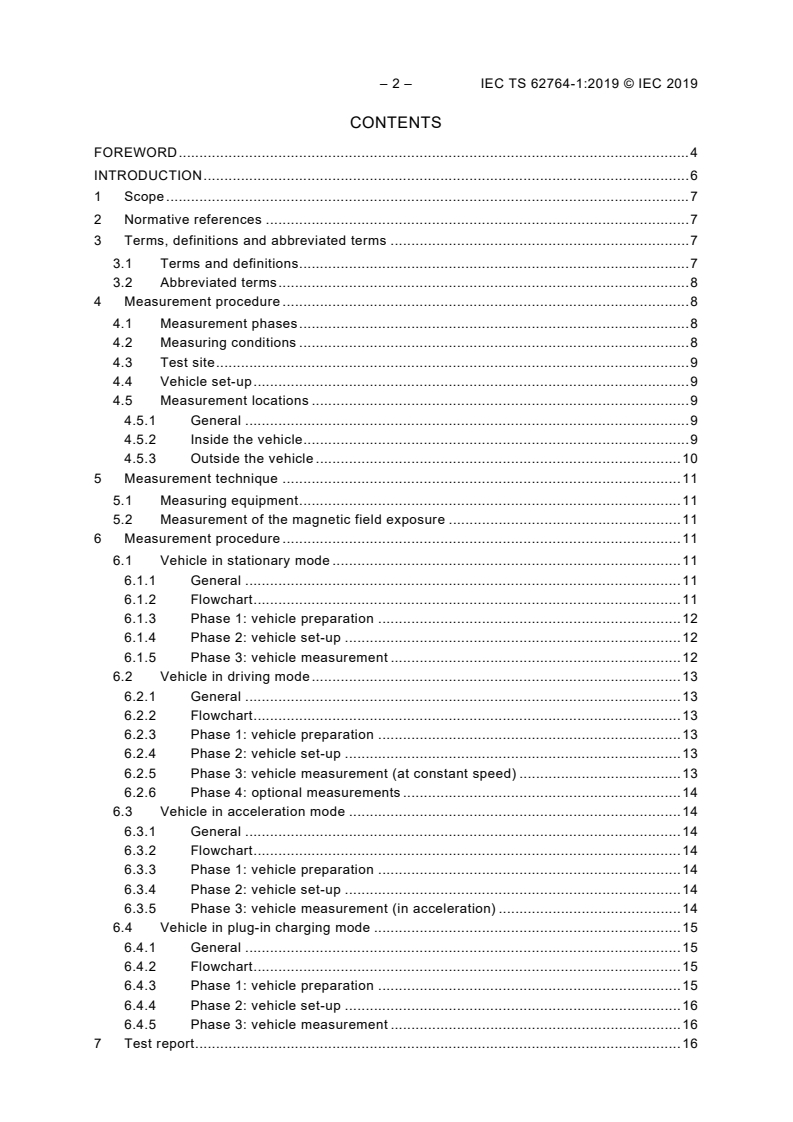
IEC TS 62764-1:2019 - Measurement procedures of magnetic field levels generated by electronic and electrical equipment in the automotive environment with respect to human exposure - Part 1: Low frequency magnetic fields
Relations
- Effective Date
- 05-Sep-2023
Buy Documents
IEC TS 62764-1:2019 - Measurement procedures of magnetic field levels generated by electronic and electrical equipment in the automotive environment with respect to human exposure - Part 1: Low frequency magnetic fields
Get Certified
Connect with accredited certification bodies for this standard

BSMI (Bureau of Standards, Metrology and Inspection)
Taiwan's standards and inspection authority.
Sponsored listings
Frequently Asked Questions
IEC TS 62764-1:2019 is a technical specification published by the International Electrotechnical Commission (IEC). Its full title is "Measurement procedures of magnetic field levels generated by electronic and electrical equipment in the automotive environment with respect to human exposure - Part 1: Low frequency magnetic fields". This standard covers: IEC TS 62764-1:2019(E) applies to the assessment of human exposure to low frequency magnetic fields generated by automotive vehicles. For plug-in vehicles, this includes the electric vehicle supply equipment (EVSE) and associated cables provided by the car manufacturer. The scope of this document establishes the measurement procedure for the evaluation of magnetic field levels in the automotive environment, for passenger cars and commercial vehicles of categories M1 and N1 as defined in ECE/TRANS/WP.29/78/Rev.3 [1] , with respect to human exposure. It provides standardized operating conditions and defines recommended measurements to assess compliance to the applicable exposure requirements. This document covers the frequency range 1 Hz to 400 kHz and is applicable to any type of engine and/or internal energy source. It is not the scope of this document to define procedures for wireless power transfer (WPT). Human exposure due to WPT is covered by IEC 61980-1 [2]. Abnormal operation of the vehicle or equipment under test is not taken into consideration. Key Words:Human Exposure, Low Frequency Magnetic Fields, Electric vehicle Supply Equipment
IEC TS 62764-1:2019(E) applies to the assessment of human exposure to low frequency magnetic fields generated by automotive vehicles. For plug-in vehicles, this includes the electric vehicle supply equipment (EVSE) and associated cables provided by the car manufacturer. The scope of this document establishes the measurement procedure for the evaluation of magnetic field levels in the automotive environment, for passenger cars and commercial vehicles of categories M1 and N1 as defined in ECE/TRANS/WP.29/78/Rev.3 [1] , with respect to human exposure. It provides standardized operating conditions and defines recommended measurements to assess compliance to the applicable exposure requirements. This document covers the frequency range 1 Hz to 400 kHz and is applicable to any type of engine and/or internal energy source. It is not the scope of this document to define procedures for wireless power transfer (WPT). Human exposure due to WPT is covered by IEC 61980-1 [2]. Abnormal operation of the vehicle or equipment under test is not taken into consideration. Key Words:Human Exposure, Low Frequency Magnetic Fields, Electric vehicle Supply Equipment
IEC TS 62764-1:2019 is classified under the following ICS (International Classification for Standards) categories: 17.220.20 - Measurement of electrical and magnetic quantities. The ICS classification helps identify the subject area and facilitates finding related standards.
IEC TS 62764-1:2019 has the following relationships with other standards: It is inter standard links to IEC 62764-1:2022. Understanding these relationships helps ensure you are using the most current and applicable version of the standard.
IEC TS 62764-1:2019 is available in PDF format for immediate download after purchase. The document can be added to your cart and obtained through the secure checkout process. Digital delivery ensures instant access to the complete standard document.
Standards Content (Sample)
IEC TS 62764-1 ®
Edition 1.0 2019-09
TECHNICAL
SPECIFICATION
colour
inside
Measurement procedures of magnetic field levels generated by electronic and
electrical equipment in the automotive environment with respect to human
exposure –
Part 1: Low frequency magnetic fields
All rights reserved. Unless otherwise specified, no part of this publication may be reproduced or utilized in any form
or by any means, electronic or mechanical, including photocopying and microfilm, without permission in writing from
either IEC or IEC's member National Committee in the country of the requester. If you have any questions about IEC
copyright or have an enquiry about obtaining additional rights to this publication, please contact the address below or
your local IEC member National Committee for further information.
IEC Central Office Tel.: +41 22 919 02 11
3, rue de Varembé info@iec.ch
CH-1211 Geneva 20 www.iec.ch
Switzerland
About the IEC
The International Electrotechnical Commission (IEC) is the leading global organization that prepares and publishes
International Standards for all electrical, electronic and related technologies.
About IEC publications
The technical content of IEC publications is kept under constant review by the IEC. Please make sure that you have the
latest edition, a corrigendum or an amendment might have been published.
IEC publications search - webstore.iec.ch/advsearchform Electropedia - www.electropedia.org
The advanced search enables to find IEC publications by a The world's leading online dictionary on electrotechnology,
variety of criteria (reference number, text, technical containing more than 22 000 terminological entries in English
committee,…). It also gives information on projects, replaced and French, with equivalent terms in 16 additional languages.
and withdrawn publications. Also known as the International Electrotechnical Vocabulary
(IEV) online.
IEC Just Published - webstore.iec.ch/justpublished
Stay up to date on all new IEC publications. Just Published IEC Glossary - std.iec.ch/glossary
details all new publications released. Available online and once 67 000 electrotechnical terminology entries in English and
a month by email. French extracted from the Terms and Definitions clause of IEC
publications issued since 2002. Some entries have been
IEC Customer Service Centre - webstore.iec.ch/csc collected from earlier publications of IEC TC 37, 77, 86 and
If you wish to give us your feedback on this publication or need CISPR.
further assistance, please contact the Customer Service
Centre: sales@iec.ch.
IEC TS 62764-1 ®
Edition 1.0 2019-09
TECHNICAL
SPECIFICATION
colour
inside
Measurement procedures of magnetic field levels generated by electronic and
electrical equipment in the automotive environment with respect to human
exposure –
Part 1: Low frequency magnetic fields
INTERNATIONAL
ELECTROTECHNICAL
COMMISSION
ICS 17.220.20 ISBN 978-2-8322-7248-0
– 2 – IEC TS 62764-1:2019 © IEC 2019
CONTENTS
FOREWORD . 4
INTRODUCTION . 6
1 Scope . 7
2 Normative references . 7
3 Terms, definitions and abbreviated terms . 7
3.1 Terms and definitions . 7
3.2 Abbreviated terms . 8
4 Measurement procedure . 8
4.1 Measurement phases . 8
4.2 Measuring conditions . 8
4.3 Test site . 9
4.4 Vehicle set-up . 9
4.5 Measurement locations . 9
4.5.1 General . 9
4.5.2 Inside the vehicle . 9
4.5.3 Outside the vehicle . 10
5 Measurement technique . 11
5.1 Measuring equipment . 11
5.2 Measurement of the magnetic field exposure . 11
6 Measurement procedure . 11
6.1 Vehicle in stationary mode . 11
6.1.1 General . 11
6.1.2 Flowchart . 11
6.1.3 Phase 1: vehicle preparation . 12
6.1.4 Phase 2: vehicle set-up . 12
6.1.5 Phase 3: vehicle measurement . 12
6.2 Vehicle in driving mode . 13
6.2.1 General . 13
6.2.2 Flowchart . 13
6.2.3 Phase 1: vehicle preparation . 13
6.2.4 Phase 2: vehicle set-up . 13
6.2.5 Phase 3: vehicle measurement (at constant speed) . 13
6.2.6 Phase 4: optional measurements . 14
6.3 Vehicle in acceleration mode . 14
6.3.1 General . 14
6.3.2 Flowchart . 14
6.3.3 Phase 1: vehicle preparation . 14
6.3.4 Phase 2: vehicle set-up . 14
6.3.5 Phase 3: vehicle measurement (in acceleration) . 14
6.4 Vehicle in plug-in charging mode . 15
6.4.1 General . 15
6.4.2 Flowchart . 15
6.4.3 Phase 1: vehicle preparation . 15
6.4.4 Phase 2: vehicle set-up . 16
6.4.5 Phase 3: vehicle measurement . 16
7 Test report . 16
8 Assessment . 16
Annex A (informative) Practical measurement advice . 17
A.1 Motivation . 17
A.2 Measurement adaptor . 17
Annex B (informative) Maximum extents of measurement volumes inside the vehicle . 18
B.1 Motivation . 18
B.2 Anthropometrical information . 18
B.3 Maximum extents of measurement volumes . 19
Bibliography . 20
Figure 1 – Example of test volumes taking account of all body parts for a left-hand
drive vehicle . 10
Figure 2 – Specific stationary mode set-up and test . 12
Figure 3 – Specific driving mode set-up and test . 13
Figure 4 – Specific acceleration mode set-up and test . 14
Figure 5 – Specific plug-in charging mode set-up and test . 15
Figure 6 – Plug-in charging supply cable positioning . 16
Figure A.1 – Disc spacer around two types of measurement probes . 17
Figure A.2 – Hemispherical spacer around two types of measurement probes . 17
Figure B.1 – Summary of relevant anthropometrical data . 18
– 4 – IEC TS 62764-1:2019 © IEC 2019
INTERNATIONAL ELECTROTECHNICAL COMMISSION
____________
MEASUREMENT PROCEDURES OF MAGNETIC FIELD LEVELS
GENERATED BY ELECTRONIC AND ELECTRICAL EQUIPMENT IN THE
AUTOMOTIVE ENVIRONMENT WITH RESPECT TO HUMAN EXPOSURE –
Part 1: Low frequency magnetic fields
FOREWORD
1) The International Electrotechnical Commission (IEC) is a worldwide organization for standardization comprising
all national electrotechnical committees (IEC National Committees). The object of IEC is to promote international
co-operation on all questions concerning standardization in the electrical and electronic fields. To this end and
in addition to other activities, IEC publishes International Standards, Technical Specifications, Technical Reports,
Publicly Available Specifications (PAS) and Guides (hereafter referred to as “IEC Publication(s)”). Their
preparation is entrusted to technical committees; any IEC National Committee interested in the subject dealt with
may participate in this preparatory work. International, governmental and non-governmental organizations liaising
with the IEC also participate in this preparation. IEC collaborates closely with the International Organization for
Standardization (ISO) in accordance with conditions determined by agreement between the two organizations.
2) The formal decisions or agreements of IEC on technical matters express, as nearly as possible, an international
consensus of opinion on the relevant subjects since each technical committee has representation from all
interested IEC National Committees.
3) IEC Publications have the form of recommendations for international use and are accepted by IEC National
Committees in that sense. While all reasonable efforts are made to ensure that the technical content of IEC
Publications is accurate, IEC cannot be held responsible for the way in which they are used or for any
misinterpretation by any end user.
4) In order to promote international uniformity, IEC National Committees undertake to apply IEC Publications
transparently to the maximum extent possible in their national and regional publications. Any divergence between
any IEC Publication and the corresponding national or regional publication shall be clearly indicated in the latter.
5) IEC itself does not provide any attestation of conformity. Independent certification bodies provide conformity
assessment services and, in some areas, access to IEC marks of conformity. IEC is not responsible for any
services carried out by independent certification bodies.
6) All users should ensure that they have the latest edition of this publication.
7) No liability shall attach to IEC or its directors, employees, servants or agents including individual experts and
members of its technical committees and IEC National Committees for any personal injury, property damage or
other damage of any nature whatsoever, whether direct or indirect, or for costs (including legal fees) and
expenses arising out of the publication, use of, or reliance upon, this IEC Publication or any other IEC Publications.
8) Attention is drawn to the Normative references cited in this publication. Use of the referenced publications is
indispensable for the correct application of this publication.
9) Attention is drawn to the possibility that some of the elements of this IEC Publication may be the subject of patent
rights. IEC shall not be held responsible for identifying any or all such patent rights.
The main task of IEC technical committees is to prepare International Standards. In exceptional
circumstances, a technical committee may propose the publication of a Technical Specification
when
• the required support cannot be obtained for the publication of an International Standard,
despite repeated efforts, or
• the subject is still under technical development or where, for any other reason, there is the
future but no immediate possibility of an agreement on an International Standard.
Technical Specifications are subject to review within three years of publication to decide
whether they can be transformed into International Standards.
IEC TS 62764-1, which is a Technical Specification, has been prepared by IEC technical
committee 106: Methods for the assessment of electric, magnetic and electromagnetic fields
associated with human exposure.
The text of this Technical Specification is based on the following documents:
Draft TS Report on voting
106/477/DTS 106/493/RVDTS
Full information on the voting for the approval of this Technical Specification can be found in
the report on voting indicated in the above table.
This document has been drafted in accordance with the ISO/IEC Directives, Part 2.
A list of all parts in the IEC 62764 series, published under the general title Measurement
procedures of magnetic field levels generated by electronic and electrical equipment in the
automotive environment with respect to human exposure, can be found on the IEC website.
The committee has decided that the contents of this publication will remain unchanged until the
maintenance result date indicated on the IEC web site under "http://webstore.iec.ch" in the data
related to the specific publication. At this date, the publication will be
• reconfirmed,
• withdrawn,
• replaced by a revised edition, or
• amended.
A bilingual version of this publication may be issued at a later date.
IMPORTANT – The 'colour inside' logo on the cover page of this publication indicates
that it contains colours which are considered to be useful for the correct understanding
of its contents. Users should therefore print this document using a colour printer.
– 6 – IEC TS 62764-1:2019 © IEC 2019
INTRODUCTION
This document specifies a methodology for determining the exposure to multiple magnetic field
sources for passenger cars and light commercial vehicles including standardized operating
conditions and measurement volumes and/or surfaces.
MEASUREMENT PROCEDURES OF MAGNETIC FIELD LEVELS
GENERATED BY ELECTRONIC AND ELECTRICAL EQUIPMENT IN THE
AUTOMOTIVE ENVIRONMENT WITH RESPECT TO HUMAN EXPOSURE –
Part 1: Low frequency magnetic fields
1 Scope
This part of IEC 62764 applies to the assessment of human exposure to low frequency magnetic
fields generated by automotive vehicles. For plug-in vehicles, this includes the electric vehicle
supply equipment (EVSE) and associated cables provided by the car manufacturer.
The scope of this document establishes the measurement procedure for the evaluation of
magnetic field levels in the automotive environment, for passenger cars and commercial
vehicles of categories M1 and N1 as defined in ECE/TRANS/WP.29/78/Rev.3 [1] , with respect
to human exposure. It provides standardized operating conditions and defines recommended
measurements to assess compliance to the applicable exposure requirements.
This document covers the frequency range 1 Hz to 400 kHz and is applicable to any type of
engine and/or internal energy source.
It is not the scope of this document to define procedures for wireless power transfer (WPT).
Human exposure due to WPT is covered by IEC 61980-1 [2].
Abnormal operation of the vehicle or equipment under test is not taken into consideration.
2 Normative references
The following documents are referred to in the text in such a way that some or all of their content
constitutes requirements of this document. For dated references, only the edition cited applies.
For undated references, the latest edition of the referenced document (including any
amendments) applies.
IEC 61786-1:2013, Measurement of DC magnetic, AC magnetic and AC electric fields from 1 Hz
to 100 kHz with regard to exposure of human beings – Part 1: Requirements for measuring
instruments
IEC 62311:2019, Assessment of electronic and electrical equipment related to human exposure
restrictions for electromagnetic fields (0 Hz to 300 GHz)
3 Terms, definitions and abbreviated terms
3.1 Terms and definitions
For the purposes of this document, the following terms and definitions apply.
ISO and IEC maintain terminological databases for use in standardization at the following
addresses:
• IEC Electropedia: available at http://www.electropedia.org/
• ISO Online browsing platform: available at http://www.iso.org/obp
____________
Numbers in square brackets refer to the Bibliography.
– 8 – IEC TS 62764-1:2019 © IEC 2019
3.1.1
applicable requirement
particular requirement regarding human exposure to low-frequency magnetic fields against
which the vehicle under test is to be assessed using the methods outlined in this document
Note 1 to entry: Examples of such requirements can be found in [3] to [9].
3.1.2
magnetic field exposure
specific metric(s) that are used to quantify human exposure to low-frequency magnetic fields in
the applicable requirements
Note 1 to entry: Examples of such metrics can be found in [3] to [9].
3.1.3
powertrain
main system that generates power and delivers it to the road surface
3.2 Abbreviated terms
EV electric vehicle
EVSE electric vehicle supply equipment
HEV hybrid electric vehicle, including mild hybrid electric vehicle (MHEV)
ICEV internal combustion engine vehicle
SOC state of charge indicated to the driver
WPT wireless power transfer
4 Measurement procedure
4.1 Measurement phases
The measurement procedure is divided into four parts regarding the operational vehicle use:
1) vehicle in stationary mode;
2) vehicle in driving mode;
3) vehicle in acceleration mode;
4) vehicle in plug-in charging mode.
These four parts are described in detail in Clause 6.
4.2 Measuring conditions
The measurements cover only sources of persistent magnetic field exposure. Continuous
occurring sources, or repetitive transient sources such as fan, wipers are included. Transient
electrical functions of short duration activated occasionally by the driver, passengers or the
vehicle itself are not considered in this document, in particular the horn, the motorized mirror
and the door-lock motor.
NOTE The rotation of the tyres can produce low-frequency magnetic fields (typically below 50 Hz, depending on
the speed of the vehicle) in and surrounding the vehicle, due to the static magnetization of the tyres [10][11]. This
can only contribute to measurements inside the vehicle (since no measurements are to be performed around the
vehicle in dynamic mode).
The measurements are performed in the vehicle’s standard modes of operation, generating the
expected highest levels of magnetic field exposure in measuring volumes that are
representative of the occupant (Annex B) and bystander locations.
4.3 Test site
Measurements shall be performed in an area having ambient magnetic field exposure values of
less than 10 % of the values given in the requirements in the measurement volumes.
The ambient magnetic field exposure shall be measured with or without the vehicle under test,
but in conditions that are representative of the vehicle test. This measurement can be performed
before each test or periodically in accordance with the laboratory’s quality management
processes.
A dynamometer (or roller bench) may be used if it rotates all the driven wheels of the vehicle.
It shall be set to simulate the outdoor dynamics of the vehicle including at least its steady-state
torque in driving mode and its inertial mass during acceleration mode.
If an outdoor track is used, the grade of the portion used for the tests shall be in the range ±2 %.
NOTE
...