

IEC/IEEE 62704-2:2017
(Main)Determining the peak spatial-average specific absorption rate (SAR) in the human body from wireless communications devices, 30 MHz to 6 GHz - Part 2: Specific requirements for finite difference time domain (FDTD) modelling of exposure from vehicle mounted antennas
General Information
- Abstract
IEC/IEEE 62704-2:2017 establishes the concepts, techniques, validation procedures, uncertainties and limitations of the finite difference time domain technique (FDTD) when used for determining the peak spatial-average and whole-body average specific absorption rate (SAR) in a standardized human anatomical model exposed to the electromagnetic field emitted by vehicle mounted antennas in the frequency range from 30 MHz to 1 GHz, which covers typical high power mobile radio products and applications. This document specifies and provides the test vehicle, human body models and the general benchmark data for those models. It defines antenna locations, operating configurations, exposure conditions, and positions that are typical of persons exposed to the fields generated by vehicle mounted antennas. The extended frequency range up to 6 GHz will be considered in future revisions of this document. This document does not recommend specific peak spatial-average and whole-body average SAR limits since these are found in other documents, e.g. IEEE C95.1-2005, ICNIRP (1998).
Key words: Electromagnetic Field, Finite-Difference Time Domain (FDTD), Spatial-Average Specific Absorption Rate (SAR), vehicle mounted antennas
- Status
- Published
- Publication Date
- 14-Sep-2025
- Technical Committee
- TC 106 - Methods for the assessment of electric, magnetic and electromagnetic fields associated with human exposure
- Drafting Committee
- PT 62704-2 - TC 106/PT 62704-2
- Current Stage
- PPUB - Publication issued
- Start Date
- 28-Jun-2017
- Completion Date
- 28-Apr-2017
Buy Documents
IEC/IEEE 62704-2:2017+AMD1:2025 CSV - Determining the peak spatial-average specific absorption rate (SAR) in the human body from wireless communications devices, 30 MHz to 6 GHz – Part 2: Specific requirements for finite difference time domain (FDTD) modelling of exposure from vehicle mounted antennas Released:9/15/2025
IEC/IEEE 62704-2:2017 - Determining the peak spatial-average specific absorption rate (SAR) in the human body from wireless communications devices, 30 MHz to 6 GHz - Part 2: Specific requirements for finite difference time domain (FDTD) modelling of exposure from vehicle mounted antennas Released:6/28/2017
Overview
IEC/IEEE 62704-2:2017 (amended) specifies finite-difference time domain (FDTD) modelling requirements for assessing the peak spatial-average specific absorption rate (SAR) and whole-body average SAR in standardized human anatomical models exposed to electromagnetic fields from vehicle mounted antennas. The standard covers modelling concepts, validation procedures, uncertainty assessment, benchmark datasets, and typical exposure configurations for the frequency range 30 MHz to 1 GHz (extension to 6 GHz planned in future revisions). It does not set exposure limits (see IEEE C95.1, ICNIRP).
Key Topics and Requirements
- FDTD modelling procedures: guidance on numerical implementation and simulation settings for SAR evaluation using voxel human models.
- Standard exposure configurations: defined antenna locations, operating configurations, pavement/vehicle environments, and bystander/passenger positions typical of vehicle-mounted antenna exposures.
- Human and vehicle models: supplied standard human anatomical voxel files, tissue parameters, and a test vehicle model for reproducible simulations.
- Validation and benchmarking: experimental and numerical validation procedures for antenna, human body and vehicle models; benchmark simulation cases with reference SAR values.
- Uncertainty analysis: contributors to computational uncertainty, uncertainty budgets, and recommended documentation practices for reproducible results.
- Adjustment factors: guidance on whole-body and peak spatial-average SAR adjustment factors to account for population variability and different exposure scenarios.
- Documentation: reporting requirements for test devices, simulation configurations, software validation, antenna validation, benchmark results and SAR summaries.
Applications
- Ensuring compliance of vehicle-mounted radio systems (public safety radios, trunk/roof antennas, vehicle-to-everything - V2X prototypes) with SAR-based exposure assessments.
- RF/EMF exposure assessment in automotive design, antenna placement optimization, and safety-by-design for high-power mobile radio installations.
- Regulatory and laboratory benchmark testing where FDTD is the chosen numerical method for SAR evaluation.
- Research and development in computational dosimetry, EM safety, and exposure mitigation strategies around vehicles.
Who Should Use This Standard
- RF engineers and antenna designers working on vehicle-mounted communications equipment.
- Computational dosimetry experts and FDTD modelers validating SAR simulations.
- EMC and compliance labs performing SAR assessments for type approval or safety documentation.
- Automotive OEMs, public safety agencies, and standards bodies assessing human exposure from vehicular transmitters.
Related Standards
- Other parts of the IEC/IEEE 62704 series (related FDTD guidance for different device types).
- Exposure limit guidance referenced (examples): IEEE C95.1 and ICNIRP guidelines.
Keywords: Electromagnetic Field, Finite-Difference Time Domain (FDTD), Spatial-Average Specific Absorption Rate (SAR), vehicle mounted antennas, SAR benchmarking, computational dosimetry.
Relations
- Effective Date
- 05-Sep-2023
Buy Documents
IEC/IEEE 62704-2:2017+AMD1:2025 CSV - Determining the peak spatial-average specific absorption rate (SAR) in the human body from wireless communications devices, 30 MHz to 6 GHz – Part 2: Specific requirements for finite difference time domain (FDTD) modelling of exposure from vehicle mounted antennas Released:9/15/2025
IEC/IEEE 62704-2:2017 - Determining the peak spatial-average specific absorption rate (SAR) in the human body from wireless communications devices, 30 MHz to 6 GHz - Part 2: Specific requirements for finite difference time domain (FDTD) modelling of exposure from vehicle mounted antennas Released:6/28/2017
Get Certified
Connect with accredited certification bodies for this standard

BSMI (Bureau of Standards, Metrology and Inspection)
Taiwan's standards and inspection authority.
Sponsored listings
Frequently Asked Questions
IEC/IEEE 62704-2:2017 is a standard published by the International Electrotechnical Commission (IEC). Its full title is "Determining the peak spatial-average specific absorption rate (SAR) in the human body from wireless communications devices, 30 MHz to 6 GHz - Part 2: Specific requirements for finite difference time domain (FDTD) modelling of exposure from vehicle mounted antennas". This standard covers: IEC/IEEE 62704-2:2017 establishes the concepts, techniques, validation procedures, uncertainties and limitations of the finite difference time domain technique (FDTD) when used for determining the peak spatial-average and whole-body average specific absorption rate (SAR) in a standardized human anatomical model exposed to the electromagnetic field emitted by vehicle mounted antennas in the frequency range from 30 MHz to 1 GHz, which covers typical high power mobile radio products and applications. This document specifies and provides the test vehicle, human body models and the general benchmark data for those models. It defines antenna locations, operating configurations, exposure conditions, and positions that are typical of persons exposed to the fields generated by vehicle mounted antennas. The extended frequency range up to 6 GHz will be considered in future revisions of this document. This document does not recommend specific peak spatial-average and whole-body average SAR limits since these are found in other documents, e.g. IEEE C95.1-2005, ICNIRP (1998). Key words: Electromagnetic Field, Finite-Difference Time Domain (FDTD), Spatial-Average Specific Absorption Rate (SAR), vehicle mounted antennas
IEC/IEEE 62704-2:2017 establishes the concepts, techniques, validation procedures, uncertainties and limitations of the finite difference time domain technique (FDTD) when used for determining the peak spatial-average and whole-body average specific absorption rate (SAR) in a standardized human anatomical model exposed to the electromagnetic field emitted by vehicle mounted antennas in the frequency range from 30 MHz to 1 GHz, which covers typical high power mobile radio products and applications. This document specifies and provides the test vehicle, human body models and the general benchmark data for those models. It defines antenna locations, operating configurations, exposure conditions, and positions that are typical of persons exposed to the fields generated by vehicle mounted antennas. The extended frequency range up to 6 GHz will be considered in future revisions of this document. This document does not recommend specific peak spatial-average and whole-body average SAR limits since these are found in other documents, e.g. IEEE C95.1-2005, ICNIRP (1998). Key words: Electromagnetic Field, Finite-Difference Time Domain (FDTD), Spatial-Average Specific Absorption Rate (SAR), vehicle mounted antennas
IEC/IEEE 62704-2:2017 is classified under the following ICS (International Classification for Standards) categories: 17.220.20 - Measurement of electrical and magnetic quantities. The ICS classification helps identify the subject area and facilitates finding related standards.
IEC/IEEE 62704-2:2017 has the following relationships with other standards: It is inter standard links to IEC/IEEE 62704-2:2017/AMD1:2025. Understanding these relationships helps ensure you are using the most current and applicable version of the standard.
IEC/IEEE 62704-2:2017 is available in PDF format for immediate download after purchase. The document can be added to your cart and obtained through the secure checkout process. Digital delivery ensures instant access to the complete standard document.
Standards Content (Sample)
IEC/IEEE 62704-2
Edition 1.1 2025-09
CONSOLIDATED VERSION
INTERNATIONAL
STANDARD
Determining the peak spatial-average specific absorption rate (SAR) in the
human body from wireless communications devices, 30 MHz to 6 GHz -
Part 2: Specific requirements for finite difference time domain (FDTD) modelling
of exposure from vehicle mounted antennas
ICS 17.220.20 ISBN 978-2-8327-0726-5
EC/IEEE 62704-2:2017-06/AMD1:2025-09(en)
All rights reserved. Unless otherwise specified, no part of this publication may be reproduced or utilized in any form or
by any means, electronic or mechanical, including photocopying and microfilm, without permission in writing being
secured. Requests for permission to reproduce should be addressed to either IEC at the address below or IEC’s
member Natio nal Committee in the country of the requester or from IEEE.
IEC Secretariat Institute of Electrical and Electronics Engineers, Inc.
3, rue de Varembé 3 Park Avenue
CH-1211 Geneva 20 New York, NY 10016-5997
Switzerland United States of America
Tel.: +41 22 919 02 11 stds.ipr@ieee.org
info@iec.ch www.ieee.org
www.iec.ch
About the IEC
The International Electrotechnical Commission (IEC) is the leading global organization that prepares and publishes
International Standards for all electrical, electronic and related technologies.
About the IEEE
IEEE is the world’s largest professional association dedicated to advancing technological innovation and excellence for the
benefit of humanity. IEEE and its members inspire a global community through its highly cited publications, conferences,
technology standards, and professional and educational activities.
About IEC/IEEE publications
The technical content of IEC/IEEE publications is kept under constant review by the IEC and IEEE. Please make sure that
you have the latest edition, a corrigendum or an amendment might have been published.
IEC publications search webstore.iec.ch/advsearchform IEC Products & Services Portal - products.iec.ch
The advanced search enables to find IEC publications by a Discover our powerful search engine and read freely all the
variety of criteria (reference number, text, technical publications previews, graphical symbols and the glossary.
committee, …). It also gives information on projects, With a subscription you will always have access to up to date
replaced and withdrawn publications. content tailored to your needs.
IEC Just Published - webstore.iec.ch/justpublished
Electropedia - www.electropedia.org
Stay up to date on all new IEC publications. Just Published
The world's leading online dictionary on electrotechnology,
details all new publications released. Available online and
containing more than 22 500 terminological entries in English
once a month by email.
and French, with equivalent terms in 25 additional languages.
Also known as the International Electrotechnical Vocabulary
IEC Customer Service Centre - webstore.iec.ch/csc
(IEV) online.
If you wish to give us your feedback on this publication or
need further assistance, please contact the Customer
Service Centre: sales@iec.ch.
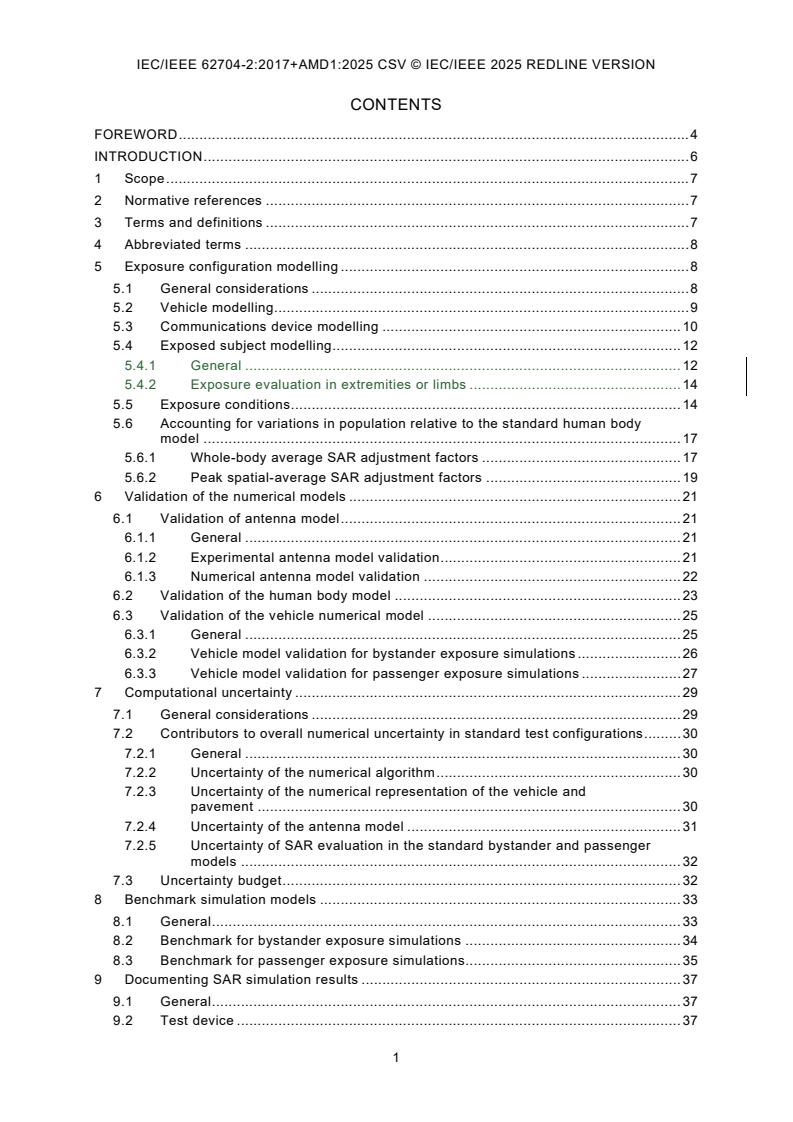
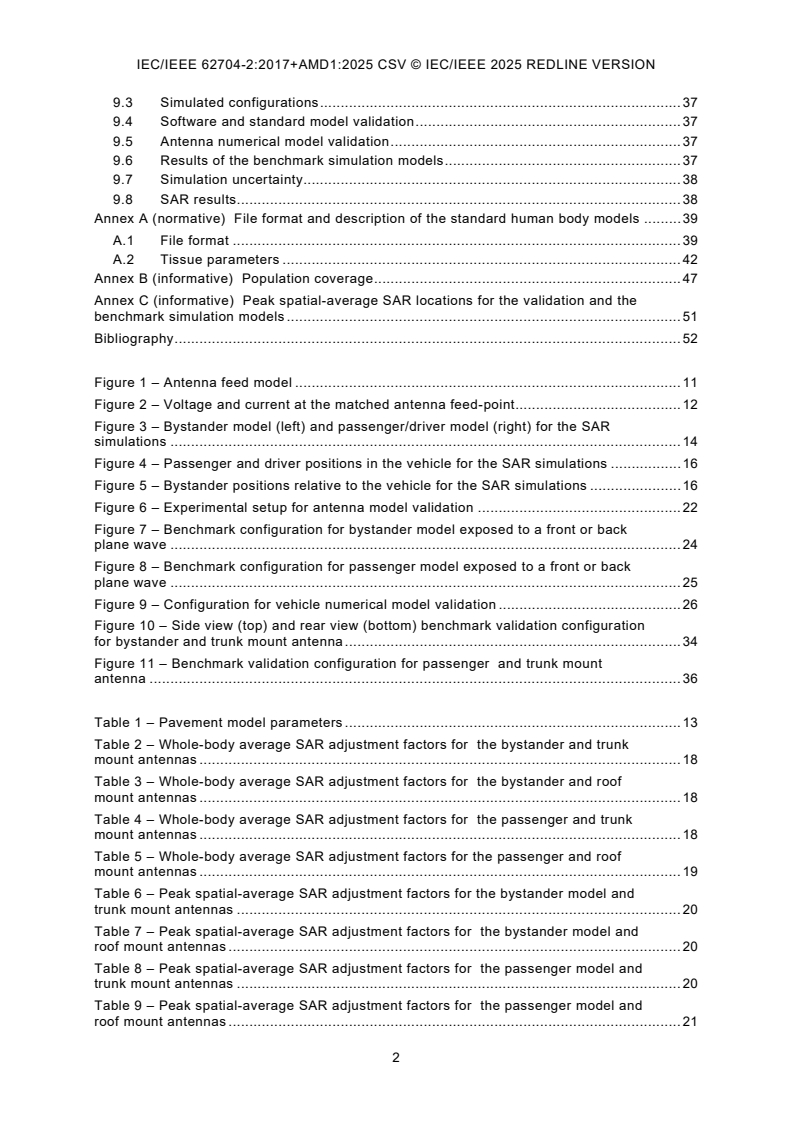
CONTENTS
FOREWORD . 4
INTRODUCTION . 6
1 Scope . 7
2 Normative references . 7
3 Terms and definitions . 7
4 Abbreviated terms . 8
5 Exposure configuration modelling . 8
5.1 General considerations . 8
5.2 Vehicle modelling . 9
5.3 Communications device modelling . 10
5.4 Exposed subject modelling . 12
5.4.1 General . 12
5.4.2 Exposure evaluation in extremities or limbs . 14
5.5 Exposure conditions . 14
5.6 Accounting for variations in population relative to the standard human body
model . 17
5.6.1 Whole-body average SAR adjustment factors . 17
5.6.2 Peak spatial-average SAR adjustment factors . 19
6 Validation of the numerical models . 21
6.1 Validation of antenna model . 21
6.1.1 General . 21
6.1.2 Experimental antenna model validation . 21
6.1.3 Numerical antenna model validation . 22
6.2 Validation of the human body model . 23
6.3 Validation of the vehicle numerical model . 25
6.3.1 General . 25
6.3.2 Vehicle model validation for bystander exposure simulations . 26
6.3.3 Vehicle model validation for passenger exposure simulations . 27
7 Computational uncertainty . 29
7.1 General considerations . 29
7.2 Contributors to overall numerical uncertainty in standard test configurations . 30
7.2.1 General . 30
7.2.2 Uncertainty of the numerical algorithm . 30
7.2.3 Uncertainty of the numerical representation of the vehicle and
pavement . 30
7.2.4 Uncertainty of the antenna model . 31
7.2.5 Uncertainty of SAR evaluation in the standard bystander and passenger
models . 32
7.3 Uncertainty budget . 32
8 Benchmark simulation models . 33
8.1 General . 33
8.2 Benchmark for bystander exposure simulations . 34
8.3 Benchmark for passenger exposure simulations. 35
9 Documenting SAR simulation results . 37
9.1 General . 37
9.2 Test device . 37
9.3 Simulated configurations . 37
9.4 Software and standard model validation . 37
9.5 Antenna numerical model validation . 37
9.6 Results of the benchmark simulation models . 37
9.7 Simulation uncertainty. 38
9.8 SAR results. 38
Annex A (normative) File format and description of the standard human body models . 39
A.1 File format . 39
A.2 Tissue parameters . 42
Annex B (informative) Population coverage . 47
Annex C (informative) Peak spatial-average SAR locations for the validation and the
benchmark simulation models . 51
Bibliography . 52
Figure 1 – Antenna feed model . 11
Figure 2 – Voltage and current at the matched antenna feed-point . 12
Figure 3 – Bystander model (left) and passenger/driver model (right) for the SAR
simulations . 14
Figure 4 – Passenger and driver positions in the vehicle for the SAR simulations . 16
Figure 5 – Bystander positions relative to the vehicle for the SAR simulations . 16
Figure 6 – Experimental setup for antenna model validation . 22
Figure 7 – Benchmark configuration for bystander model exposed to a front or back
plane wave . 24
Figure 8 – Benchmark configuration for passenger model exposed to a front or back
plane wave . 25
Figure 9 – Configuration for vehicle numerical model validation . 26
Figure 10 – Side view (top) and rear view (bottom) benchmark validation configuration
for bystander and trunk mount antenna . 34
Figure 11 – Benchmark validation configuration for passenger and trunk mount
antenna . 36
Table 1 – Pavement model parameters . 13
Table 2 – Whole-body average SAR adjustment factors for the bystander and trunk
mount antennas . 18
Table 3 – Whole-body average SAR adjustment factors for the bystander and roof
mount antennas . 18
Table 4 – Whole-body average SAR adjustment factors for the passenger and trunk
mount antennas . 18
Table 5 – Whole-body average SAR adjustment factors for the passenger and roof
mount antennas . 19
Table 6 – Peak spatial-average SAR adjustment factors for the bystander model and
trunk mount antennas . 20
Table 7 – Peak spatial-average SAR adjustment factors for the bystander model and
roof mount antennas . 20
Table 8 – Peak spatial-average SAR adjustment factors for the passenger model and
trunk mount antennas . 20
Table 9 – Peak spatial-average SAR adjustment factors for the passenger model and
roof mount antennas . 21
Table 10 – Peak spatial-average SAR for 1 g and 10 g and whole-body average SAR
for the front and back plane wave exposure of the 3-mm resolution bystander model . 24
Table 11 – Peak spatial-average SAR for 1 g and 10 g and whole-body average SAR
for the front and back plane wave exposure of the 3-mm resolution passenger model . 25
Table 12 – Antenna length for the vehicle model validation configurations . 26
Table 13 – The reference electric field (top) and magnetic field (bottom) values for the
numerical validation of the vehicle model for bystander exposure . 27
Table 14 – Coordinates of the test points for the standard vehicle validation
simulations for the passenger . 28
Table 15 – The reference electric field (top) and magnetic field (bottom) values for the
numerical validation of the vehicle model for passenger exposure . 29
Table 16 – Numerical uncertainty budget for exposure simulations with vehicle
mounted antennas and bystander and/or passenger models . 33
Table 17 – Reference SAR values for the bystander benchmark validation model . 35
Table 18 – Reference SAR values for the passenger benchmark validation model . 36
Table A.1 – Voxel counts in each data file . 40
Table A.2 – Tissues and the associated RGB colours indices in the binary data file . 41
Table A.3 – Cole–Cole parameters and density for the standard human body model
tissues . 43
Table A.4 – Relative dielectric constant and conductivity for the standard human body
model at selected reference frequencies . 45
Table B.1 – Whole-body average SAR adjustment factors for the bystander model and
trunk mount antenna . 47
Table B.2 – Whole-body average SAR adjustment factors for the bystander model and
roof mount antenna . 48
Table B.3 – Whole-body average SAR adjustment factors for the passenger model
and trunk mount antenna . 48
Table B.4 – Whole-body average SAR adjustment factors for the passenger model and
roof mount antenna . 48
Table B.5 – Peak spatial-average SAR adjustment factors for the bystander model and
trunk mount antenna . 49
Table B.6 – Peak spatial-average SAR adjustment factors for the bystander model and
roof mount antenna . 49
Table B.7 – Peak spatial-average SAR adjustment factors for the passenger model and
trunk mount antenna . 49
Table B.8 – Peak spatial-average SAR adjustment factors for the passenger model
and roof mount antenna . 50
Table C.1 – Location of the peak spatial-average SAR for the front and back plane
wave exposure of the standard human body models . 51
Table C.2 – Location of the peak spatial-average SAR for the vehicle mounted antenna
benchmark simulation models . 51
Determining the peak spatial-average specific absorption rate (SAR) in the
human body from wireless communications devices, 30 MHz to 6 GHz -
Part 2: Specific requirements for finite difference time domain
(FDTD) modelling of exposure from vehicle mounted antennas
FOREWORD
1) The International Electrotechnical Commission (IEC) is a worldwide organization for standardization comprising
all national electrotechnical committees (IEC National Committees). The object of IEC is to promote
international co-operation on all questions concerning standardization in the electrical and electronic fields. To
this end and in addition to other activities, IEC publishes International Standards, Technical Specifications,
Technical Reports, Publicly Available Specifications (PAS) and Guides (hereafter referred to as “IEC
Publication(s)”). Their preparation is entrusted to technical committees; any IEC National Committee interested
in the subject dealt with may participate in this preparatory work. International, governmental and non-
governmental organizations liaising with the IEC also participate in this preparation.
IEEE Standards documents are developed within IEEE Societies and Standards Coordinating Committees of the
IEEE Standards Association (IEEE-SA) Standards Board. IEEE develops its standards through a consensus
development process, approved by the American National Standards Institute, which brings together volunteers
representing varied viewpoints and interests to achieve the final product. Volunteers are not necessarily
members of IEEE and serve without compensation. While IEEE administers the process and establishes rules
to promote fairness in the consensus development process, IEEE does not independently evaluate, test, or
verify the accuracy of any of the information contained in its standards. Use of IEEE Standards documents is
wholly voluntary. IEEE documents are made available for use subject to important notices and legal disclaimers
(see http://standards.ieee.org/IPR/disclaimers.html for more information).
IEC collaborates closely with IEEE in accordance with conditions determined by agreement between the two
organizations. This Dual Logo International Standard was jointly developed by the IEC and IEEE under the
terms of that agreement.
2) The formal decisions of IEC on technical matters express, as nearly as possible, an international consensus of
opinion on the relevant subjects since each technical committee has representation from all interested IEC
National Committees. The formal decisions of IEEE on technical matters, once consensus within IEEE Societies
and Standards Coordinating Committees has been reached, is determined by a balanced ballot of materially
interested parties who indicate interest in reviewing the proposed standard. Final approval of the IEEE
standards document is given by the IEEE Standards Association (IEEE-SA) Standards Board.
3) IEC/IEEE Publications have the form of recommendations for international use and are accepted by IEC
National Committees/IEEE Societies in that sense. While all reasonable efforts are made to ensure that the
technical content of IEC/IEEE Publications is accurate, IEC or IEEE cannot be held responsible for the way in
which they are used or for any misinterpretation by any end user.
4) In order to promote international uniformity, IEC National Committees undertake to apply IEC Publications
(including IEC/IEEE Publications) transparently to the maximum extent possible in their national and regional
publications. Any divergence between any IEC/IEEE Publication and the corresponding national or regional
publication shall be clearly indicated in the latter.
5) IEC and IEEE do not provide any attestation of conformity. Independent certification bodies provide conformity
assessment services and, in some areas, access to IEC marks of conformity. IEC and IEEE are not responsible
for any services carried out by independent certification bodies.
6) All users should ensure that they have the latest edition of this publication.
7) No liability shall attach to IEC or IEEE or their directors, employees, servants or agents including individual
experts and members of technical committees and IEC National Committees, or volunteers of IEEE Societies
and the Standards Coordinating Committees of the IEEE Standards Association (IEEE-SA) Standards Board,
for any personal injury, property damage or other damage of any nature whatsoever, whether direct or indirect,
or for costs (including legal fees) and expenses arising out of the publication, use of, or reliance upon, this
IEC/IEEE Publication or any other IEC or IEEE Publications.
8) Attention is drawn to the normative references cited in this publication. Use of the referenced publications is
indispensable for the correct application of this publication.
9) Attention is drawn to the possibility that implementation of this IEC/IEEE Publication may require use of
material covered by patent rights. By publication of this standard, no position is taken with respect to the
existence or validity of any patent rights in connection therewith. IEC or IEEE shall not be held responsible for
identifying Essential Patent Claims for which a license may be required, for conducting inquiries into the legal
validity or scope of Patent Claims or determining whether any licensing terms or conditions provided in
connection with submission of a Letter of Assurance, if any, or in any licensing agreements are reasonable or
non-discriminatory. Users of this standard are expressly advised that determination of the validity of any patent
rights, and the risk of infringement of such rights, is entirely their own responsibility.
This consolidated version of the official IEC Standard and its amendment has been
prepared for user convenience.
IEC/IEEE 62704-2 edition 1.1 contains the first edition (2017-06) [documents
106/391/FDIS and 106/392/RVD] and its amendment 1 (2025-09)
[documents 106/698/FDIS and 106/700/RVD].
In this Redline version, a vertical line in the margin shows where the technical
content is modified by amendment 1. Additions are in green text, deletions are in
strikethrough red text. A separate Final version with all changes accepted is
available in this publication.
International Standard IEC/IEEE 62704-2 has been prepared by IEC technical committee
106: Methods for the assessment of electric, magnetic, and electromagnetic fields associated
with human exposure, in cooperation with International Committee on Electromagnetic
Safety of the IEEE Standards Association , under the IEC/IEEE Dual Logo Agreement.
This publication is published as an IEC/IEEE Dual Logo standard.
The text of this standard is based on the following IEC documents:
FDIS Report on voting
106/391/FDIS 106/392/RVD
Full information on the voting for the approval of this standard can be found in the report on
voting indicated in the above table.
International Standards are drafted in accordance with the rules given in the ISO/IEC
Directives, Part 2.
This standard contains attached files in the form of CAD model datasets described in Annex A.
These files are available at:
http://www.iec.ch/dyn/www/f?p=103:227:0::::FSP_ORG_ID,FSP_LANG_ID:1303,25
A list of all parts in the IEC/IEEE 62704 series, published under the general title Determining
the peak spatial-average specific absorption rate (SAR) in the human body from wireless
communications devices, 30 MHz to 6 GHz, can be found on the IEC website.
The IEC technical committee and IEEE technical committee have decided that the contents of
this document and its amendment will remain unchanged until the stability date indicated on
the IEC website under "http://webstore.iec.ch" in the data related to the specific publication.
At this date, the publication will be
• reconfirmed,
• withdrawn, or
• revised.
___________
A list of IEEE participants can be found at the following URL: http://standards.ieee.org/downloads/24748-
5/24748-5-2017/24748-5-2017_wg-participants.pdf
INTRODUCTION
Computational techniques have reached a level of maturity which allows their use in
compliance assessments of wireless communication devices with vehicle mounted antennas.
The increasing complexity of assessing product compliance with exposure standards
according to specific absorption rate (SAR) limits calls for new compliance techniques. This
technique should be time efficient and cost effective. Experimental compliance assessments
for wireless communication devices used in combination with vehicles are extremely complex
to perform or even not possible at all. National regulatory bodies (e.g. US Federal
Communications Commission) encouraged the development of consensus standards as well
as the establishment of the related IEEE TC34 SC2 subcommittee and IEC PT62704-2
working group. The benefits to the user include standardized and accepted protocols,
standardized anatomical models, validation techniques, benchmark data, reporting format,
means for estimating the overall uncertainty in order to produce valid, accurate, repeatable,
and reproducible results.
The results obtained by following the protocols specified in this document represent a
conservative estimate of the peak spatial-average and whole-body average SAR induced in
the standard human body models and exposure conditions established for this document
inside or nearby the vehicles representing typical use cases with transmitting mobile radios.
The protocols set forth in this document produce results subject to modelling, simulations and
other uncertainties that are defined in this document.
The standardized vehicle and human models, test configurations, and related results are
representative of the typical exposure conditions expected by the passengers and bystanders
near the vehicle with vehicle mounted antennas. It is not the intent of this document to
provide a result representative of the absolute maximum SAR value possible under every
conceivable combination of body size, posture, vehicle model, and distance from the vehicle
and antenna. The following items are described in detail: simulation concepts, simulation
techniques, finite difference time domain (FDTD) numerical method, benchmarking techniques,
standardized anatomically correct human body models of the passenger and bystander,
exposure conditions, reference exposure configurations for validation of the SAR simulation
software, and the limitations of these models and tools when used for simulating the peak
spatial-average and whole-body average SAR. Procedures for validating the numerical tools
used for SAR simulations and assessing the SAR simulation uncertainties are provided. This
document is intended primarily for use by engineers and other specialists who are familiar
with electromagnetic (EM) theory, numerical methods, and, in particular, FDTD techniques.
This document does not recommend specific SAR limit values since these are found in other
documents.
1 Scope
This part of IEC/IEEE 62704 establishes the concepts, techniques, validation procedures,
uncertainties and limitations of the finite difference time domain technique (FDTD) when used
for determining the peak spatial-average and whole-body average specific absorption rate
(SAR) in a standardized human anatomical model exposed to the electromagnetic field
emitted by vehicle mounted antennas in the frequency range from 30 MHz to 1 GHz, which
covers typical high power mobile radio products and applications. This document specifies
and provides the test vehicle, human body models and the general benchmark data for those
models. It defines antenna locations, operating configurations, exposure conditions, and
positions that are typical of persons exposed to the fields generated by vehicle mounted
antennas. The extended frequency range up to 6 GHz will be considered in future revisions of
this document. This document does not recommend specific peak spatial-average and whole-
body average SAR limits since these are found in other documents, e.g. IEEE C95.1-2005,
ICNIRP (1998).
2 Normative references
The following documents are referred to in the text in such a way that some or all of their
content constitutes requirements of this document. For dated references, only the edition
cited applies. For undated references, the latest edition of the referenced document (including
any amendments) applies.
IEC 60050 (all parts), International Electrotechnical Vocabulary (IEV) (available at:
http://www.electropedia.org)
IEC/IEEE 62704-1:— 2017, Determining the peak spatial-average specific absorption rate
(SAR) in the human body from wireless communications devices, 30 MHz to 6 GHz – Part 1:
General requirements for using the finite difference time domain (FDTD) method for SAR
calculations
IEC/IEEE 62704-1:— , Determining the peak spatial-average specific absorption rate (SAR)
in the human body from wireless communications devices, 30 MHz to 6 GHz – Part 1: General
requirements for using the finite difference time domain (FDTD) method for SAR calculations
IEEE Standards Dictionary Online (subscription available at:
http://ieeexplore.ieee.org/xpls/dictionary.jsp)
3 Terms and definitions
For the purposes of this document, the terms and definitions given in IEC/IEEE 62704-1:—
2017, the IEEE Standards Dictionary Online, IEC 60050 (all parts) and the following apply.
3.1
bystander model
heterogeneous human body model in the standing posture defined in this document to
represent a bystander near the standardized vehicle
3.2
conservative estimate
estimate of the peak spatial-average SAR and whole-body average SAR as defined in this
document that is representative of what is expected to occur in the body of the bystanders
___________
Under preparation. Stage at time of publication: IEC/IEEE FDIS 62704-1:2016.
Under preparation. Stage at time of publication: IEC/IEEE CDV 62704-1:2023.
and passengers of a significant majority of the population during normal operating conditions
of mobile radios with vehicle mounted antennas
Note 1 to entry: Conservative estimate does not mean the absolute maximum SAR value that could possibly occur
under every conceivable combination in the human body size, shape, separation from the antenna and/or vehicle.
3.3
heterogeneous standard human body model
anthropomorphic model of the human body with multiple anatomical structures, each of which
is composed of the appropriate single, simulated-tissue type, such as skin, skull (bone),
muscle, brain, eye tissue, etc., as defined by this document
Note 1 to entry: The standard human body model is based on the Visible Human dataset [1] .
3.4
insertion loss
loss resulting from the insertion of a component in a transmission system calculated as the
ratio of the power delivered to the load when connected to the generator to the power
delivered to the load when the component is inserted
Note 1 to entry: Insertion loss is usually expressed in decibels (dB).
3.5
passenger model
heterogeneous human body model in the seating posture defined in this document to
represent a passenger inside the standardized vehicle
3.6
vehicle model
numerical CAD-based model of the vehicle suitable for electromagnetic numerical simulations
developed specifically for this document
4 Abbreviated terms
CAD computer-aided design
FDTD finite difference time domain
MPE maximum permissible exposure
PEC perfect electric conductor
PML perfectly matched layers
PTT push-to-talk
RF radio frequency
RSS root sum square
SAR specific absorption rate
5 Exposure configuration modelling
5.1 General considerations
The three relevant elements that define the exposure conditions in vehicular environments are:
the communication device(s) with antenna(s), the vehicle model, and the location of the
exposed subject.
The communication device or devices typically consist of one or more transceivers connected
to a single antenna. The connection of multiple transceivers may require multiplexers and/or
___________
Numbers in square brackets refer to the Bibliography.
power combiners, in addition to the RF transmission line (e.g. section of coaxial cable) routed
from the transceiver (or the combiner) to the antenna connector.
The term “transceiver” in the following refers to a single transceiver or a more complex
system comprising an arbitrary number of transceivers and combiners, and possibly other
devices along the RF signal path. Conventionally, any components inserted before the cable
(if any) leading to the antenna will be considered part of the transceiver. The transceiver
features an RF port (typically the connector where the cable is attached). The relevant RF
signal characteristics (frequency, bandwidth, average power) at this port shall be known.
Relevant features of the antenna(s) are the geometrical dimensions, physical construction
(e.g. materials), electrical characteristics (e.g. frequency response of the return loss, gain and
radiation pattern), electrical/mechanical tuning mechanisms (if any), and mounting locations.
The metallic portions of the vehicle body and the antenna location are the most important
parameters that define an exposure scenario. The shape and features of the vehicle body
(e.g. windows) shall be representative of the typical application of the communication device
without complicating the computational modelling unnecessarily. The model of the pavement
shall also be included in the simulation.
5.2 Vehicle modelling
To obtain reliable and repeatable simulation results, a specific CAD model of the vehicle has
been defined and is available with this document. To conduct a successful simulation
according to this document, the CAD model of this standardized vehicle shall be used. Some
results obtained using this standardized vehicle model may not be applicable for certain other
vehicle types or different antenna installation conditions, e.g. if non-metallic roof installation is
allowed.
The standardized vehicle model defined in this document for compliance assessment is
applicable to all vehicle models when the following conditions are met. For either roof mount
or trunk mount antenna, the distance to the bystander shall be defined with the antenna
mounted according to the installation requirements. To help ensure the most conservative
configuration(s) are considered for exposure assessment, the bystander separation distance
shall be no greater than the minimum separation distance required for compliance as stated in
the installation instructions. The same conditions shall apply to the separation distance
between the antenna and the passenger except for the roof mount antenna configurations
where the passenger is partially shielded by the metal roof. With such considerations, the
impact of the vehicle model does not need to be considered when performing simulations
using the standardized vehicle model, which makes this evaluation process practical.
Depending on the FDTD code, uniform or graded meshing algorithms can be employed. In the
former case, the computational model resolution is usually determined by the anatomical
details of the human model employed to represent the exposed subject. In the latter case,
outside of the human body model, it is possible to relax the mesh resolution in some regions
of the computational model (following the guidelines for graded mesh set forth in 5.2) in order
to increase the execution speed of the numerical simulations and/or increase the geometrical
dimensions of the computational domain. However, it is important that the same meshing
resolutions as defined and used for the validation and reference models are also used for all
related exposure simulations.
The computational model of the vehicle body comprises mainly metal sheets with perfect
electric conductor (PEC) properties. It is important that the meshed representation of the
standard CAD model be inspected to help ensure continuity of the metal sheets forming the
vehicle body and also to ensure that the required gaps and small separations between the
different metal parts in the vehicle are not shorted and become continuous in the meshing
process. The metal sheets can be modelled as a collection of thin layers, i.e. where the PEC
condition is enforced only on a series of contiguous voxel faces along one coordinate plane,
properly interconnected among them; or as a combination of thin and volumetric objects. For
consistency and to help ensure that the mesh generated for the standard vehicle model
defined in this document is valid, a maximum mesh step of 10 mm shall be used.
Compared to PEC, electromagnetic field scattered by the glass surfaces and other dielectric
parts is a second order effect; therefore, they are not present in the standard vehicle model.
Likewise, rear window defogger elements contain high resistivity conductors and are
electromagnetic scatterers, which may attenuate the flow of RF energy through the window.
For the purpose of this document, the effect of defoggers is neglected.
5.3 Communications device modelling
Before addressing the exposure to the RF energy emitted by the mobile radio antenna, it shall
be verified that electromagnetic emissions contributed by the transceiver equipment are
insignificant compared to the exposure level. This can be done by referring to the available
radiated emission data in the EMC compliance report for the transceiver evaluated according
to measurements or other suitable means recommended by internationally recognized EMC
standards.
The general guidelines set forth in IEC/IEEE 62704-1 for modelling the RF source as a
resistive generator in the FDTD model should be applied. Except for special or unique
circumstances, which shall be explained and justified in the assessment report, source
excitation should be applied at the antenna feed-point.
The fixed losses should be identified and quantified when possible to determine
overestimation of exposure. The effect of the cable insertion losses leading to the antenna
feed-point may be neglected in computations through proper RF power scaling at the feed
point. This introduces a conservative bias in RF exposure assessment. However, if cable
losses can be reasonably well quantified according to cable specifications and length required
for mounting the antenna at specific locations, the effect of cable losses can be considered in
the assessment by reducing the net input power, by an amount equal to the cable loss minus
0,5 dB. For instance, if the cable loss is 1,25 dB, a radiated power of 0,75 dB less than the
power available at the transceiver port is applied to the antenna feed-point in the simulation. If
the cable loss is less than 0,5 dB, it shall be neglected. This intentional bias is introduced to
account for minor variations in cable lengths and cable specifications or properties to help
ensure the conservative nature of the RF exposure assessment. Furthermore, return loss due
to the antenna mismatch may also be neglected, thus introducing additional conservative bias.
In any case, proper justification shall be provided to quantify the cable insertion losses and
return loss if they are introduced in the computational analysis.
Because of the linearity of the simulated fields in a defined electromagnetic exposure
condition, FDTD simulations can be performed at any desired power level and then scaled to
the actual maximum average output power of the communication device.
The antenna shall be modelled to represent the physical antenna to help ensure the results
are valid. This might require assembling the model as a collection of wires, patches,
volumetric dielectric or metallic objects, etc. It is possible to introduce simplifications to
reduce the complexity of the antenna model. For instance, it may be possible to introduce
lumped reactive elements in the FDTD model in lieu of electrically small reactances, such as
loading coils (sometimes called “traps”) used to phase different wire sections of electrically
long antennas. The antenna components that are smaller than one-tenth of the wavelength in
the local dielectric material shall be deemed electrically small. Any such lumped element in
the antenna model shall be validated according to the procedures set forth in 6.1.
Antenna models shall be located on the vehicle at the locations consistent with the test setup
supported by this document and according to the antenna installation and product manual
requirements. Test requirements for roof top and trunk mount antennas are specified in this
document. The antenna and vehicle both contribute as radiating structures. In most cases, the
antenna feed-point is located at the base of the antenna, where it makes contact with the
vehicle body. This configuration is the one most frequently encountered. However, there might
be cases where the feed-point is located elsewhere, for instance in the middle of a sleeve
dipole antenna. Proper justification for the choice of antenna feed-point location shall be
provided in the simulation report. There are also cases where matching networks
...
IEC/IEEE 62704-2 ®
Edition 1.0 2017-06
INTERNATIONAL
STANDARD
NORME
INTERNATIONALE
colour
inside
Determining the peak spatial-average specific absorption rate (SAR) in the
human body from wireless communications devices, 30 MHz to 6 GHz –
Part 2: Specific requirements for finite difference time domain (FDTD) modelling
of exposure from vehicle mounted antennas
Détermination du débit d’absorption spécifique (DAS) maximal moyenné dans le
corps humain, produit par les dispositifs de communications sans fil, 30 MHz à
6 GHz –
Partie 2: Exigences spécifiques relatives à la modélisation de l’exposition des
antennes sur véhicule, à l’aide de la méthode des différences finies dans le
domaine temporel (FDTD)
All rights reserved. Unless otherwise specified, no part of this publication may be reproduced or utilized in any form
or by any means, electronic or mechanical, including photocopying and microfilm, without permission in writing being
secured. Requests for permission to reproduce should be addressed to either IEC at the address below or IEC’s
member National Committee in the country of the requester or from IEEE.
IEC Central Office Institute of Electrical and Electronics Engineers, Inc.
3, rue de Varembé 3 Park Avenue
CH-1211 Geneva 20 New York, NY 10016-5997
Switzerland United States of America
Tel.: +41 22 919 02 11 stds.ipr@ieee.org
Fax: +41 22 919 03 00 www.ieee.org
info@iec.ch
www.iec.ch
About the IEC
The International Electrotechnical Commission (IEC) is the leading global organization that prepares and publishes
International Standards for all electrical, electronic and related technologies.
About the IEEE
IEEE is the world’s largest professional association dedicated to advancing technological innovation and excellence for
the benefit of humanity. IEEE and its members inspire a global community through its highly cited publications,
conferences, technology standards, and professional and educational activities.
About IEC/IEEE publications
The technical content of IEC/IEEE publications is kept under constant review by the IEC and IEEE. Please make sure
that you have the latest edition, a corrigendum or an amendment might have been published.
IEC Catalogue - webstore.iec.ch/catalogue Electropedia - www.electropedia.org
The stand-alone application for consulting the entire The world's leading online dictionary of electronic and
bibliographical information on IEC International Standards, electrical terms containing 20 000 terms and definitions in
Technical Specifications, Technical Reports and other English and French, with equivalent terms in 16 additional
documents. Available for PC, Mac OS, Android Tablets languages. Also known as the International
and iPad. Electrotechnical Vocabulary (IEV) online.
IEC publications search - www.iec.ch/searchpub IEC Glossary - std.iec.ch/glossary
The advanced search enables to find IEC publications by a 65 000 electrotechnical terminology entries in English and
variety of criteria (reference number, text, technical French extracted from the Terms and Definitions clause of
committee,…). It also gives information on projects, IEC publications issued since 2002. Some entries have
replaced and withdrawn publications. been collected from earlier publications of IEC TC 37, 77,
86 and CISPR.
IEC Just Published - webstore.iec.ch/justpublished
Stay up to date on all new IEC publications. Just Published IEC Customer Service Centre - webstore.iec.ch/csc
details all new publications released. Available online and If you wish to give us your feedback on this publication or
also once a month by email. need further assistance, please contact the Customer
Service Centre: csc@iec.ch.
IEC/IEEE 62704-2 ®
Edition 1.0 2017-06
INTERNATIONAL
STANDARD
NORME
INTERNATIONALE
colour
inside
Determining the peak spatial-average specific absorption rate (SAR) in the
human body from wireless communications devices, 30 MHz to 6 GHz –
Part 2: Specific requirements for finite difference time domain (FDTD) modelling
of exposure from vehicle mounted antennas
Détermination du débit d’absorption spécifique (DAS) maximal moyenné dans le
corps humain, produit par les dispositifs de communications sans fil, 30 MHz à
6 GHz –
Partie 2: Exigences spécifiques relatives à la modélisation de l’exposition des
antennes sur véhicule, à l’aide de la méthode des différences finies dans le
domaine temporel (FDTD)
INTERNATIONAL
ELECTROTECHNICAL
COMMISSION
COMMISSION
ELECTROTECHNIQUE
INTERNATIONALE
ICS 17.220.20 ISBN 978-2-8322-4259-9
– 2 – IEC/IEEE 62704-2:2017
© IEC/IEEE 2017
CONTENTS
FOREWORD . 5
INTRODUCTION . 7
1 Scope . 8
2 Normative references . 8
3 Terms and definitions . 8
4 Abbreviated terms . 9
5 Exposure configuration modelling . 10
5.1 General considerations . 10
5.2 Vehicle modelling . 10
5.3 Communications device modelling . 11
5.4 Exposed subject modelling . 14
5.5 Exposure conditions . 15
5.6 Accounting for variations in population relative to the standard human body
model. 18
5.6.1 Whole-body average SAR adjustment factors . 18
5.6.2 Peak spatial-average SAR adjustment factors . 20
6 Validation of the numerical models . 22
6.1 Validation of antenna model . 22
6.1.1 General . 22
6.1.2 Experimental antenna model validation . 22
6.1.3 Numerical antenna model validation . 23
6.2 Validation of the human body model . 24
6.3 Validation of the vehicle numerical model . 26
6.3.1 General . 26
6.3.2 Vehicle model validation for bystander exposure simulations . 27
6.3.3 Vehicle model validation for passenger exposure simulations . 28
7 Computational uncertainty . 30
7.1 General considerations . 30
7.2 Contributors to overall numerical uncertainty in standard test configurations . 31
7.2.1 General . 31
7.2.2 Uncertainty of the numerical algorithm . 31
7.2.3 Uncertainty of the numerical representation of the vehicle and
pavement. 31
7.2.4 Uncertainty of the antenna model . 32
7.2.5 Uncertainty of SAR evaluation in the standard bystander and passenger
models. 33
7.3 Uncertainty budget . 33
8 Benchmark simulation models . 34
8.1 General . 34
8.2 Benchmark for bystander exposure simulations . 35
8.3 Benchmark for passenger exposure simulations . 36
9 Documenting SAR simulation results . 38
9.1 General . 38
9.2 Test device . 38
9.3 Simulated configurations . 38
9.4 Software and standard model validation . 38
© IEC/IEEE 2017
9.5 Antenna numerical model validation . 38
9.6 Results of the benchmark simulation models . 38
9.7 Simulation uncertainty . 39
9.8 SAR results . 39
Annex A (normative) File format and description of the standard human body models . 40
A.1 File format . 40
A.2 Tissue parameters . 42
Annex B (informative) Population coverage . 47
Annex C (informative) Peak spatial-average SAR locations for the validation and the
benchmark simulation models . 51
Bibliography . 52
Figure 1 – Antenna feed model . 12
Figure 2 – Voltage and current at the matched antenna feed-point . 13
Figure 3 – Bystander model (left) and passenger/driver model (right) for the SAR
simulations . 15
Figure 4 – Passenger and driver positions in the vehicle for the SAR simulations . 17
Figure 5 – Bystander positions relative to the vehicle for the SAR simulations . 17
Figure 6 – Experimental setup for antenna model validation . 23
Figure 7 – Benchmark configuration for bystander model exposed to a front or back
plane wave . 25
Figure 8 – Benchmark configuration for passenger model exposed to a front or back
plane wave . 26
Figure 9 – Configuration for vehicle numerical model validation . 27
Figure 10 – Side view (top) and rear view (bottom) benchmark validation configuration
for bystander and trunk mount antenna . 35
Figure 11 – Benchmark validation configuration for passenger and trunk mount
antenna . 37
Table 1 – Pavement model parameters . 14
Table 2 – Whole-body average SAR adjustment factors for the bystander and trunk
mount antennas . 19
Table 3 – Whole-body average SAR adjustment factors for the bystander and roof
mount antennas . 19
Table 4 – Whole-body average SAR adjustment factors for the passenger and trunk
mount antennas . 19
Table 5 – Whole-body average SAR adjustment factors for the passenger and roof
mount antennas . 20
Table 6 – Peak spatial-average SAR adjustment factors for the bystander model and
trunk mount antennas . 21
Table 7 – Peak spatial-average SAR adjustment factors for the bystander model and
roof mount antennas . 21
Table 8 – Peak spatial-average SAR adjustment factors for the passenger model and
trunk mount antennas . 21
Table 9 – Peak spatial-average SAR adjustment factors for the passenger model and
roof mount antennas . 22
Table 10 – Peak spatial-average SAR for 1 g and 10 g and whole-body average SAR
for the front and back plane wave exposure of the 3-mm resolution bystander model . 25
– 4 – IEC/IEEE 62704-2:2017
© IEC/IEEE 2017
Table 11 – Peak spatial-average SAR for 1 g and 10 g and whole-body average SAR
for the front and back plane wave exposure of the 3-mm resolution passenger model . 26
Table 12 – Antenna length for the vehicle model validation configurations . 27
Table 13 – The reference electric field (top) and magnetic field (bottom) values for the
numerical validation of the vehicle model for bystander exposure . 28
Table 14 – Coordinates of the test points for the standard vehicle validation
simulations for the passenger . 29
Table 15 – The reference electric field (top) and magnetic field (bottom) values for the
numerical validation of the vehicle model for passenger exposure . 30
Table 16 – Numerical uncertainty budget for exposure simulations with vehicle
mounted antennas and bystander and/or passenger models . 34
Table 17 – Reference SAR values for the bystander benchmark validation model . 36
Table 18 – Reference SAR values for the passenger benchmark validation model . 37
Table A.1 – Voxel counts in each data file . 41
Table A.2 – Tissues and the associated RGB colours in the binary data file . 41
Table A.3 – Cole–Cole parameters and density for the standard human body model
tissues . 43
Table A.4 – Relative dielectric constant and conductivity for the standard human body
model at selected reference frequencies . 45
Table B.1 – Whole-body average SAR adjustment factors for the bystander model and
trunk mount antenna . 47
Table B.2 – Whole-body average SAR adjustment factors for the bystander model and
roof mount antenna . 48
Table B.3 – Whole-body average SAR adjustment factors for the passenger model
and trunk mount antenna . 48
Table B.4 – Whole-body average SAR adjustment factors for the passenger model and
roof mount antenna . 48
Table B.5 – Peak spatial-average SAR adjustment factors for the bystander model and
trunk mount antenna . 49
Table B.6 – Peak spatial-average SAR adjustment factors for the bystander model and
roof mount antenna . 49
Table B.7 – Peak spatial-average SAR adjustment factors for the passenger model and
trunk mount antenna . 49
Table B.8 – Peak spatial-average SAR adjustment factors for the passenger model
and roof mount antenna . 50
Table C.1 – Location of the peak spatial-average SAR for the front and back plane
wave exposure of the standard human body models . 51
Table C.2 – Location of the peak spatial-average SAR for the vehicle mounted antenna
benchmark simulation models . 51
© IEC/IEEE 2017
DETERMINING THE PEAK SPATIAL-AVERAGE SPECIFIC
ABSORPTION RATE (SAR) IN THE HUMAN BODY FROM
WIRELESS COMMUNICATIONS DEVICES, 30 MHz TO 6 GHz –
Part 2: Specific requirements for finite difference time domain
(FDTD) modelling of exposure from vehicle mounted antennas
FOREWORD
1) The International Electrotechnical Commission (IEC) is a worldwide organization for standardization comprising
all national electrotechnical committees (IEC National Committees). The object of IEC is to promote
international co-operation on all questions concerning standardization in the electrical and electronic fields. To
this end and in addition to other activities, IEC publishes International Standards, Technical Specifications,
Technical Reports, Publicly Available Specifications (PAS) and Guides (hereafter referred to as “IEC
Publication(s)”). Their preparation is entrusted to technical committees; any IEC National Committee interested
in the subject dealt with may participate in this preparatory work. International, governmental and non-
governmental organizations liaising with the IEC also participate in this preparation.
IEEE Standards documents are developed within IEEE Societies and Standards Coordinating Committees of the
IEEE Standards Association (IEEE-SA) Standards Board. IEEE develops its standards through a consensus
development process, approved by the American National Standards Institute, which brings together volunteers
representing varied viewpoints and interests to achieve the final product. Volunteers are not necessarily
members of IEEE and serve without compensation. While IEEE administers the process and establishes rules
to promote fairness in the consensus development process, IEEE does not independently evaluate, test, or
verify the accuracy of any of the information contained in its standards. Use of IEEE Standards documents is
wholly voluntary. IEEE documents are made available for use subject to important notices and legal disclaimers
(see http://standards.ieee.org/IPR/disclaimers.html for more information).
IEC collaborates closely with IEEE in accordance with conditions determined by agreement between the two
organizations. This Dual Logo International Standard was jointly developed by the IEC and IEEE under the
terms of that agreement.
2) The formal decisions of IEC on technical matters express, as nearly as possible, an international consensus of
opinion on the relevant subjects since each technical committee has representation from all interested IEC
National Committees. The formal decisions of IEEE on technical matters, once consensus within IEEE Societies
and Standards Coordinating Committees has been reached, is determined by a balanced ballot of materially
interested parties who indicate interest in reviewing the proposed standard. Final approval of the IEEE
standards document is given by the IEEE Standards Association (IEEE-SA) Standards Board.
3) IEC/IEEE Publications have the form of recommendations for international use and are accepted by IEC
National Committees/IEEE Societies in that sense. While all reasonable efforts are made to ensure that the
technical content of IEC/IEEE Publications is accurate, IEC or IEEE cannot be held responsible for the way in
which they are used or for any misinterpretation by any end user.
4) In order to promote international uniformity, IEC National Committees undertake to apply IEC Publications
(including IEC/IEEE Publications) transparently to the maximum extent possible in their national and regional
publications. Any divergence between any IEC/IEEE Publication and the corresponding national or regional
publication shall be clearly indicated in the latter.
5) IEC and IEEE do not provide any attestation of conformity. Independent certification bodies provide conformity
assessment services and, in some areas, access to IEC marks of conformity. IEC and IEEE are not responsible
for any services carried out by independent certification bodies.
6) All users should ensure that they have the latest edition of this publication.
7) No liability shall attach to IEC or IEEE or their directors, employees, servants or agents including individual
experts and members of technical committees and IEC National Committees, or volunteers of IEEE Societies
and the Standards Coordinating Committees of the IEEE Standards Association (IEEE-SA) Standards Board,
for any personal injury, property damage or other damage of any nature whatsoever, whether direct or indirect,
or for costs (including legal fees) and expenses arising out of the publication, use of, or reliance upon, this
IEC/IEEE Publication or any other IEC or IEEE Publications.
8) Attention is drawn to the normative references cited in this publication. Use of the referenced publications is
indispensable for the correct application of this publication.
9) Attention is drawn to the possibility that implementation of this IEC/IEEE Publication may require use of
material covered by patent rights. By publication of this standard, no position is taken with respect to the
existence or validity of any patent rights in connection therewith. IEC or IEEE shall not be held responsible for
identifying Essential Patent Claims for which a license may be required, for conducting inquiries into the legal
validity or scope of Patent Claims or determining whether any licensing terms or conditions provided in
connection with submission of a Letter of Assurance, if any, or in any licensing agreements are reasonable or
non-discriminatory. Users of this standard are expressly advised that determination of the validity of any patent
rights, and the risk of infringement of such rights, is entirely their own responsibility.
International Standard IEC/IEEE 62704-2 has been prepared by IEC technical committee 106:
Methods for the assessment of electric, magnetic, and electromagnetic fields associated with
– 6 – IEC/IEEE 62704-2:2017
© IEC/IEEE 2017
human exposure, in cooperation with International Committee on Electromagnetic Safety of
the IEEE Standards Association , under the IEC/IEEE Dual Logo Agreement.
This publication is published as an IEC/IEEE Dual Logo standard.
The text of this standard is based on the following IEC documents:
FDIS Report on voting
106/391/FDIS 106/392/RVD
Full information on the voting for the approval of this standard can be found in the report on
voting indicated in the above table.
International Standards are drafted in accordance with the rules given in the ISO/IEC
Directives, Part 2.
This standard contains attached files in the form of CAD model datasets described in Annex
A. These files are available at:
http://www.iec.ch/dyn/www/f?p=103:227:0::::FSP_ORG_ID,FSP_LANG_ID:1303,25
A list of all parts in the IEC/IEEE 62704 series, published under the general title Determining
the peak spatial-average specific absorption rate (SAR) in the human body from wireless
communications devices, 30 MHz to 6 GHz, can be found on the IEC website.
The IEC technical committee and IEEE technical committee have decided that the contents of
this publication will remain unchanged until the stability date indicated on the IEC website
under "http://webstore.iec.ch" in the data related to the specific publication. At this date, the
publication will be
• reconfirmed,
• withdrawn,
• replaced by a revised edition, or
• amended.
IMPORTANT – The 'colour inside' logo on the cover page of this publication indicates
that it contains colours which are considered to be useful for the correct
understanding of its contents. Users should therefore print this document using a
colour printer.
___________
A list of IEEE participants can be found at the following URL: http://standards.ieee.org/downloads/24748-
5/24748-5-2017/24748-5-2017_wg-participants.pdf
© IEC/IEEE 2017
INTRODUCTION
Computational techniques have reached a level of maturity which allows their use in
compliance assessments of wireless communication devices with vehicle mounted antennas.
The increasing complexity of assessing product compliance with exposure standards
according to specific absorption rate (SAR) limits calls for new compliance techniques. This
technique should be time efficient and cost effective. Experimental compliance assessments
for wireless communication devices used in combination with vehicles are extremely complex
to perform or even not possible at all. National regulatory bodies (e.g. US Federal
Communications Commission) encouraged the development of consensus standards as well
as the establishment of the related IEEE TC34 SC2 subcommittee and IEC PT62704-2
working group. The benefits to the user include standardized and accepted protocols,
standardized anatomical models, validation techniques, benchmark data, reporting format,
means for estimating the overall uncertainty in order to produce valid, accurate, repeatable,
and reproducible results.
The results obtained by following the protocols specified in this document represent a
conservative estimate of the peak spatial-average and whole-body average SAR induced in
the standard human body models and exposure conditions established for this document
inside or nearby the vehicles representing typical use cases with transmitting mobile radios.
The protocols set forth in this document produce results subject to modelling, simulations and
other uncertainties that are defined in this document.
The standardized vehicle and human models, test configurations, and related results are
representative of the typical exposure conditions expected by the passengers and bystanders
near the vehicle with vehicle mounted antennas. It is not the intent of this document to provide
a result representative of the absolute maximum SAR value possible under every conceivable
combination of body size, posture, vehicle model, and distance from the vehicle and antenna.
The following items are described in detail: simulation concepts, simulation techniques, finite
difference time domain (FDTD) numerical method, benchmarking techniques, standardized
anatomically correct human body models of the passenger and bystander, exposure
conditions, reference exposure configurations for validation of the SAR simulation software,
and the limitations of these models and tools when used for simulating the peak spatial-
average and whole-body average SAR. Procedures for validating the numerical tools used for
SAR simulations and assessing the SAR simulation uncertainties are provided. This document
is intended primarily for use by engineers and other specialists who are familiar with
electromagnetic (EM) theory, numerical methods, and, in particular, FDTD techniques. This
document does not recommend specific SAR limit values since these are found in other
documents.
– 8 – IEC/IEEE 62704-2:2017
© IEC/IEEE 2017
DETERMINING THE PEAK SPATIAL-AVERAGE SPECIFIC
ABSORPTION RATE (SAR) IN THE HUMAN BODY FROM
WIRELESS COMMUNICATIONS DEVICES, 30 MHz TO 6 GHz –
Part 2: Specific requirements for finite difference time domain
(FDTD) modelling of exposure from vehicle mounted antennas
1 Scope
This part of IEC/IEEE 62704 establishes the concepts, techniques, validation procedures,
uncertainties and limitations of the finite difference time domain technique (FDTD) when used
for determining the peak spatial-average and whole-body average specific absorption rate
(SAR) in a standardized human anatomical model exposed to the electromagnetic field
emitted by vehicle mounted antennas in the frequency range from 30 MHz to 1 GHz, which
covers typical high power mobile radio products and applications. This document specifies
and provides the test vehicle, human body models and the general benchmark data for those
models. It defines antenna locations, operating configurations, exposure conditions, and
positions that are typical of persons exposed to the fields generated by vehicle mounted
antennas. The extended frequency range up to 6 GHz will be considered in future revisions of
this document. This document does not recommend specific peak spatial-average and whole-
body average SAR limits since these are found in other documents, e.g. IEEE C95.1-2005,
ICNIRP (1998).
2 Normative references
The following documents are referred to in the text in such a way that some or all of their
content constitutes requirements of this document. For dated references, only the edition
cited applies. For undated references, the latest edition of the referenced document (including
any amendments) applies.
IEC 60050 (all parts), International Electrotechnical Vocabulary (IEV) (available at:
http://www.electropedia.org)
IEC/IEEE 62704-1:— , Determining the peak spatial-average specific absorption rate (SAR) in
the human body from wireless communications devices, 30 MHz to 6 GHz – Part 1: General
requirements for using the finite difference time domain (FDTD) method for SAR calculations
IEEE Standards Dictionary Online (subscription available at:
http://ieeexplore.ieee.org/xpls/dictionary.jsp)
3 Terms and definitions
For the purposes of this document, the terms and definitions given in IEC/IEEE 62704-1:—,
the IEEE Standards Dictionary Online, IEC 60050 (all parts) and the following apply.
3.1
bystander model
heterogeneous human body model in the standing posture defined in this document to
represent a bystander near the standardized vehicle
___________
Under preparation. Stage at time of publication: IEC/IEEE FDIS 62704-1:2016.
© IEC/IEEE 2017
3.2
conservative estimate
estimate of the peak spatial-average SAR and whole-body average SAR as defined in this
document that is representative of what is expected to occur in the body of the bystanders
and passengers of a significant majority of the population during normal operating conditions
of mobile radios with vehicle mounted antennas
Note 1 to entry: Conservative estimate does not mean the absolute maximum SAR value that could possibly occur
under every conceivable combination in the human body size, shape, separation from the antenna and/or vehicle.
3.3
heterogeneous standard human body model
anthropomorphic model of the human body with multiple anatomical structures, each of which
is composed of the appropriate single, simulated-tissue type, such as skin, skull (bone),
muscle, brain, eye tissue, etc., as defined by this document
Note 1 to entry: The standard human body model is based on the Visible Human dataset [1] .
3.4
insertion loss
loss resulting from the insertion of a component in a transmission system calculated as the
ratio of the power delivered to the load when connected to the generator to the power
delivered to the load when the component is inserted
Note 1 to entry: Insertion loss is usually expressed in decibels (dB).
3.5
passenger model
heterogeneous human body model in the seating posture defined in this document to
represent a passenger inside the standardized vehicle
3.6
vehicle model
numerical CAD-based model of the vehicle suitable for electromagnetic numerical simulations
developed specifically for this document
4 Abbreviated terms
CAD computer-aided design
FDTD finite difference time domain
MPE maximum permissible exposure
PEC perfect electric conductor
PML perfectly matched layers
PTT push-to-talk
RF radio frequency
RSS root sum square
SAR specific absorption rate
___________
Numbers in square brackets refer to the Bibliography.
– 10 – IEC/IEEE 62704-2:2017
© IEC/IEEE 2017
5 Exposure configuration modelling
5.1 General considerations
The three relevant elements that define the exposure conditions in vehicular environments are:
the communication device(s) with antenna(s), the vehicle model, and the location of the
exposed subject.
The communication device or devices typically consist of one or more transceivers connected
to a single antenna. The connection of multiple transceivers may require multiplexers and/or
power combiners, in addition to the RF transmission line (e.g. section of coaxial cable) routed
from the transceiver (or the combiner) to the antenna connector.
The term “transceiver” in the following refers to a single transceiver or a more complex
system comprising an arbitrary number of transceivers and combiners, and possibly other
devices along the RF signal path. Conventionally, any components inserted before the cable
(if any) leading to the antenna will be considered part of the transceiver. The transceiver
features an RF port (typically the connector where the cable is attached). The relevant RF
signal characteristics (frequency, bandwidth, average power) at this port shall be known.
Relevant features of the antenna(s) are the geometrical dimensions, physical construction
(e.g. materials), electrical characteristics (e.g. frequency response of the return loss, gain and
radiation pattern), electrical/mechanical tuning mechanisms (if any), and mounting locations.
The metallic portions of the vehicle body and the antenna location are the most important
parameters that define an exposure scenario. The shape and features of the vehicle body
(e.g. windows) shall be representative of the typical application of the communication device
without complicating the computational modelling unnecessarily. The model of the pavement
shall also be included in the simulation.
5.2 Vehicle modelling
To obtain reliable and repeatable simulation results, a specific CAD model of the vehicle has
been defined and is available with this document. To conduct a successful simulation
according to this document, the CAD model of this standardized vehicle shall be used. Some
results obtained using this standardized vehicle model may not be applicable for certain other
vehicle types or different antenna installation conditions, e.g. if non-metallic roof installation is
allowed.
The standardized vehicle model defined in this document for compliance assessment is
applicable to all vehicle models when the following conditions are met. For either roof mount
or trunk mount antenna, the distance to the bystander shall be defined with the antenna
mounted according to the installation requirements. To help ensure the most conservative
configuration(s) are considered for exposure assessment, the bystander separation distance
shall be no greater than the minimum separation distance required for compliance as stated in
the installation instructions. The same conditions shall apply to the separation distance
between the antenna and the passenger except for the roof mount antenna configurations
where the passenger is partially shielded by the metal roof. With such considerations, the
impact of the vehicle model does not need to be considered when performing simulations
using the standardized vehicle model, which makes this evaluation process practical.
Depending on the FDTD code, uniform or graded meshing algorithms can be employed. In the
former case, the computational model resolution is usually determined by the anatomical
details of the human model employed to represent the exposed subject. In the latter case,
outside of the human body model, it is possible to relax the mesh resolution in some regions
of the computational model (following the guidelines for graded mesh set forth in 5.2) in order
to increase the execution speed of the numerical simulations and/or increase the geometrical
dimensions of the computational domain. However, it is important that the same meshing
© IEC/IEEE 2017
resolutions as defined and used for the validation and reference models are also used for all
related exposure simulations.
The computational model of the vehicle body comprises mainly metal sheets with perfect
electric conductor (PEC) properties. It is important that the meshed representation of the
standard CAD model be inspected to help ensure continuity of the metal sheets forming the
vehicle body and also to ensure that the required gaps and small separations between the
different metal parts in the vehicle are not shorted and become continuous in the meshing
process. The metal sheets can be modelled as a collection of thin layers, i.e. where the PEC
condition is enforced only on a series of contiguous voxel faces along one coordinate plane,
properly interconnected among them; or as a combination of thin and volumetric objects. For
consistency and to help ensure that the mesh generated for the standard vehicle model
defined in this document is valid, a maximum mesh step of 10 mm shall be used.
Compared to PEC, electromagnetic field scattered by the glass surfaces and other dielectric
parts is a second order effect; therefore, they are not present in the standard vehicle model.
Likewise, rear window defogger elements contain high resistivity conductors and are
electromagnetic scatterers, which may attenuate the flow of RF energy through the window.
For the purpose of this document, the effect of defoggers is neglected.
5.3 Communications device modelling
Before addressing the exposure to the RF energy emitted by the mobile radio antenna, it shall
be verified that electromagnetic emissions contributed by the transceiver equipment are
insignificant compared to the exposure level. This can be done by referring to the available
radiated emission data in the EMC compliance report for the transceiver evaluated according
to measurements or other suitable means recommended by internationally recognized EMC
standards.
The general guidelines set forth in IEC/IEEE 62704-1 for modelling the RF source as a
resistive generator in the FDTD model should be applied. Except for special or unique
circumstances, which shall be explained and justified in the assessment report, source
excitation should be applied at the antenna feed-point.
The fixed losses should be identified and quantified when possible to determine
overestimation of exposure. The effect of the cable insertion losses leading to the antenna
feed-point may be neglected in computations through proper RF power scaling at the feed
point. This introduces a conservative bias in RF exposure assessment. However, if cable
losses can be reasonably well quantified according to cable specifications and length required
for mounting the antenna at specific locations, the effect of cable losses can be considered in
the assessment by reducing the net input power, by an amount equal to the cable loss minus
0,5 dB. For instance, if the cable loss is 1,25 dB, a radiated power of 0,75 dB less than the
power available at the transceiver port is applied to the antenna feed-point in the simulation. If
the cable loss is less than 0,5 dB, it shall be neglected. This intentional bias is introduced to
account for minor variations in cable lengths and cable specifications or properties to help
ensure the conservative nature of the RF exposure assessment. Furthermore, return loss due
to the antenna mismatch may also be neglected, thus introducing additional conservative bias.
In any case, proper justification shall be provided to quantify the cable insertion losses and
return loss if they are introduced in the computational analysis.
Because of the linearity of the simulated fields in a defined electromagnetic exposure
condition, FDTD simulations can be performed at any desired power level and then scaled to
the actual maximum average output power of the communication device.
The antenna shall be modelled to represent the physical antenna to help ensure the results
are valid. This might require assembling the model as a collection of wires, patches,
volumetric dielectric or metallic objects, etc. It is possible to introduce simplifications to
reduce the complexity of the antenna model. For instance, it may be possible to introduce
lumped reactive elements in the FDTD model in lieu of electrically small reactances, such as
loading coils (sometimes called “traps”) used to phase different wire sections of electrically
– 12 – IEC/IEEE 62704-2:2017
© IEC/IEEE 2017
long antennas. The antenna components that are smaller than one-tenth of the wavelength in
the local dielectric material shall be deemed electrica
...