

IEC PAS 63184:2021
(Main)Assessment methods of the human exposure to electric and magnetic fields from wireless power transfer systems - Models, instrumentation, measurement and numerical methods and procedures (frequency range of 1 kHz to 30 MHz)
General Information
- Abstract
IEC PAS 63184:2021 specifies the assessment methods to evaluate compliance of stationary and dynamic wireless power transfer (WPT) systems with electromagnetic human exposure guidelines (external electric and magnetic fields, specific absorption rate (SAR), internal electric fields or current density including contact currents). The frequency range of this document is from 1 kHz to 30 MHz.
- Status
- Replaced
- Publication Date
- 26-May-2021
- Current Stage
- DELPUB - Deleted Publication
- Start Date
- 25-Feb-2025
- Completion Date
- 28-Aug-2026
Buy Documents
IEC PAS 63184:2021 - Assessment methods of the human exposure to electric and magnetic fields from wireless power transfer systems - Models, instrumentation, measurement and numerical methods and procedures (frequency range of 1 kHz to 30 MHz) Released:5/27/2021
Overview
IEC PAS 63184:2021 provides assessment methods for evaluating human exposure to electric and magnetic fields generated by wireless power transfer (WPT) systems in the 1 kHz to 30 MHz frequency range. It specifies models, instrumentation, measurement procedures, numerical methods and uncertainty evaluation to determine compliance with electromagnetic human exposure guidelines - covering external fields, specific absorption rate (SAR), internal electric fields, current density and contact currents for both stationary and dynamic WPT systems.
Key topics and requirements
- Assessment procedures and conformity - workflows for evaluating direct and indirect effects of WPT systems, including coil-current based evaluation and incident-field comparison against reference levels and basic restrictions.
- Measurement methods - standardized approaches to measure incident E- and H-fields, SAR in phantoms, and contact currents; equipment, setup and verification procedures.
- Computational assessment - numerical modeling methods (quasi-static approximations, FEM, FDTD and hybrid approaches referenced in informative annexes) to compute induced fields, SAR and current density.
- Combination methods - guidance on integrating measurement and simulation to assess induced quantities and validate results.
- Calibration & verification - dosimetric probe calibration, E/H-field calibration methods and measurement system validation (normative annexes).
- Uncertainty and validation - protocols for uncertainty estimation of measurements and numerical results, code verification, model validation and averaging algorithms for spatial/volume averaging of fields.
- Use cases & examples - informative annexes with practical examples such as electric vehicle (EV) WPT, heavy-duty vehicle procedures and drone WPT assessments.
Applications
- Demonstrating regulatory compliance of WPT chargers (EV charging pads, industrial contactless power systems, drone charging) with human exposure limits.
- Defining test methods for EMF test laboratories to measure fields, SAR and contact currents around WPT products.
- Guiding product designers and system integrators to evaluate exposure early in design using numerical modeling and combined measurement approaches.
- Supporting regulatory bodies and conformity assessors in creating reproducible, validated exposure assessments for deployment and certification.
Who should use this standard
- Manufacturers of wireless power transfer systems
- EMC/EMF testing laboratories and certification bodies
- Dosimetry and computational electromagnetics engineers
- Regulatory agencies and safety assessors
- Researchers developing WPT technologies and exposure mitigation strategies
Related standards
IEC PAS 63184:2021 is intended to be used together with relevant national and international electromagnetic exposure guidelines and standards on measurement equipment and human exposure limits (for example, applicable ICNIRP or IEEE exposure limits where referenced by regulators).
Relations
- Effective Date
- 05-Sep-2023
Buy Documents
IEC PAS 63184:2021 - Assessment methods of the human exposure to electric and magnetic fields from wireless power transfer systems - Models, instrumentation, measurement and numerical methods and procedures (frequency range of 1 kHz to 30 MHz) Released:5/27/2021
Get Certified
Connect with accredited certification bodies for this standard

BSMI (Bureau of Standards, Metrology and Inspection)
Taiwan's standards and inspection authority.
Sponsored listings
Frequently Asked Questions
IEC PAS 63184:2021 is a technical specification published by the International Electrotechnical Commission (IEC). Its full title is "Assessment methods of the human exposure to electric and magnetic fields from wireless power transfer systems - Models, instrumentation, measurement and numerical methods and procedures (frequency range of 1 kHz to 30 MHz)". This standard covers: IEC PAS 63184:2021 specifies the assessment methods to evaluate compliance of stationary and dynamic wireless power transfer (WPT) systems with electromagnetic human exposure guidelines (external electric and magnetic fields, specific absorption rate (SAR), internal electric fields or current density including contact currents). The frequency range of this document is from 1 kHz to 30 MHz.
IEC PAS 63184:2021 specifies the assessment methods to evaluate compliance of stationary and dynamic wireless power transfer (WPT) systems with electromagnetic human exposure guidelines (external electric and magnetic fields, specific absorption rate (SAR), internal electric fields or current density including contact currents). The frequency range of this document is from 1 kHz to 30 MHz.
IEC PAS 63184:2021 is classified under the following ICS (International Classification for Standards) categories: 17.220.20 - Measurement of electrical and magnetic quantities. The ICS classification helps identify the subject area and facilitates finding related standards.
IEC PAS 63184:2021 has the following relationships with other standards: It is inter standard links to IEC/IEEE 63184:2025. Understanding these relationships helps ensure you are using the most current and applicable version of the standard.
IEC PAS 63184:2021 is available in PDF format for immediate download after purchase. The document can be added to your cart and obtained through the secure checkout process. Digital delivery ensures instant access to the complete standard document.
Standards Content (Sample)
IEC PAS 63184 ®
Edition 1.0 2021-05
PUBLICLY AVAILABLE
SPECIFICATION
PRE-STANDARD
colour
inside
Assessment methods of the human exposure to electric and magnetic fields
from wireless power transfer systems – Models, instrumentation, measurement
and numerical methods and procedures (frequency range of 1 kHz to 30 MHz)
All rights reserved. Unless otherwise specified, no part of this publication may be reproduced or utilized in any form
or by any means, electronic or mechanical, including photocopying and microfilm, without permission in writing from
either IEC or IEC's member National Committee in the country of the requester. If you have any questions about IEC
copyright or have an enquiry about obtaining additional rights to this publication, please contact the address below or
your local IEC member National Committee for further information.
IEC Central Office Tel.: +41 22 919 02 11
3, rue de Varembé info@iec.ch
CH-1211 Geneva 20 www.iec.ch
Switzerland
About the IEC
The International Electrotechnical Commission (IEC) is the leading global organization that prepares and publishes
International Standards for all electrical, electronic and related technologies.
About IEC publications
The technical content of IEC publications is kept under constant review by the IEC. Please make sure that you have the
latest edition, a corrigendum or an amendment might have been published.
IEC publications search - webstore.iec.ch/advsearchform IEC online collection - oc.iec.ch
The advanced search enables to find IEC publications by a Discover our powerful search engine and read freely all the
variety of criteria (reference number, text, technical publications previews. With a subscription you will always
committee, …). It also gives information on projects, replaced have access to up to date content tailored to your needs.
and withdrawn publications.
Electropedia - www.electropedia.org
IEC Just Published - webstore.iec.ch/justpublished
The world's leading online dictionary on electrotechnology,
Stay up to date on all new IEC publications. Just Published
containing more than 22 000 terminological entries in English
details all new publications released. Available online and
and French, with equivalent terms in 18 additional languages.
once a month by email.
Also known as the International Electrotechnical Vocabulary
(IEV) online.
IEC Customer Service Centre - webstore.iec.ch/csc
If you wish to give us your feedback on this publication or
need further assistance, please contact the Customer Service
Centre: sales@iec.ch.
IEC PAS 63184 ®
Edition 1.0 2021-05
PUBLICLY AVAILABLE
SPECIFICATION
PRE-STANDARD
colour
inside
Assessment methods of the human exposure to electric and magnetic fields
from wireless power transfer systems – Models, instrumentation, measurement
and numerical methods and procedures (frequency range of 1 kHz to 30 MHz)
INTERNATIONAL
ELECTROTECHNICAL
COMMISSION
ICS 17.220.20 ISBN 978-2-8322-9542-7
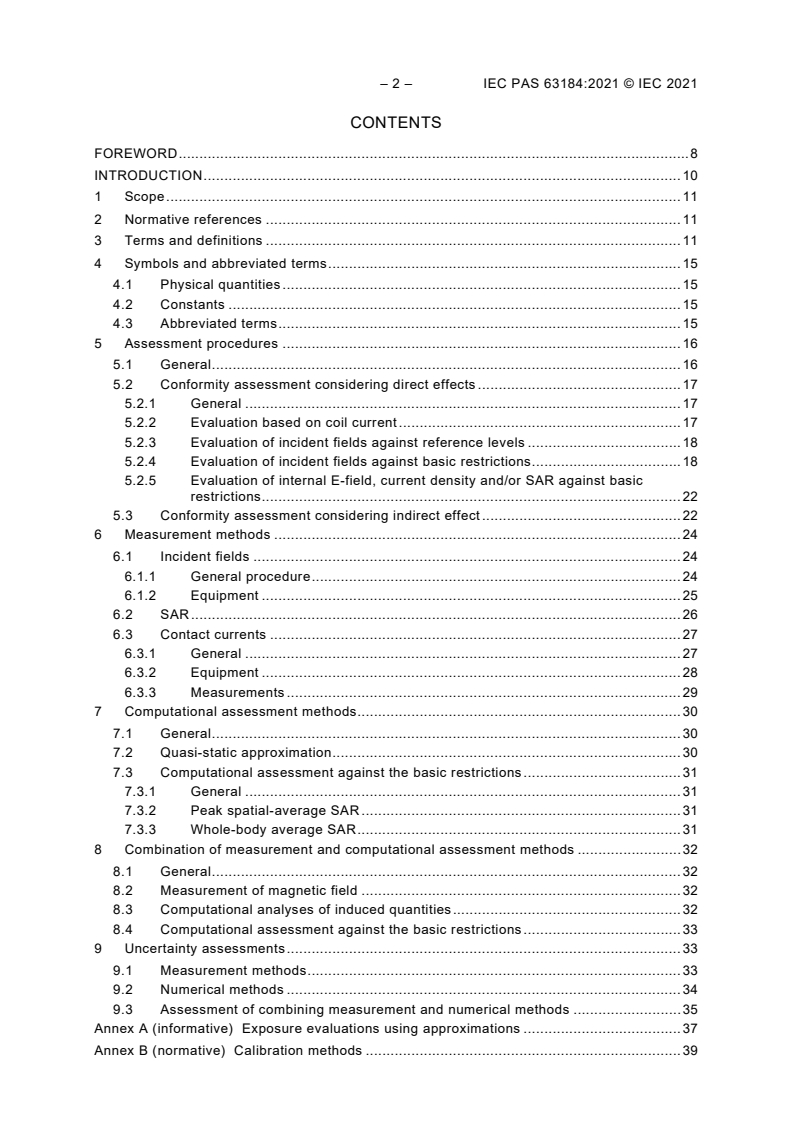
– 2 – IEC PAS 63184:2021 © IEC 2021
CONTENTS
FOREWORD . 8
INTRODUCTION . 10
1 Scope . 11
2 Normative references . 11
3 Terms and definitions . 11
4 Symbols and abbreviated terms . 15
4.1 Physical quantities . 15
4.2 Constants . 15
4.3 Abbreviated terms . 15
5 Assessment procedures . 16
5.1 General . 16
5.2 Conformity assessment considering direct effects . 17
5.2.1 General . 17
5.2.2 Evaluation based on coil current . 17
5.2.3 Evaluation of incident fields against reference levels . 18
5.2.4 Evaluation of incident fields against basic restrictions . 18
5.2.5 Evaluation of internal E-field, current density and/or SAR against basic
restrictions . 22
5.3 Conformity assessment considering indirect effect . 22
6 Measurement methods . 24
6.1 Incident fields . 24
6.1.1 General procedure . 24
6.1.2 Equipment . 25
6.2 SAR . 26
6.3 Contact currents . 27
6.3.1 General . 27
6.3.2 Equipment . 28
6.3.3 Measurements . 29
7 Computational assessment methods . 30
7.1 General . 30
7.2 Quasi-static approximation . 30
7.3 Computational assessment against the basic restrictions . 31
7.3.1 General . 31
7.3.2 Peak spatial-average SAR . 31
7.3.3 Whole-body average SAR . 31
8 Combination of measurement and computational assessment methods . 32
8.1 General . 32
8.2 Measurement of magnetic field . 32
8.3 Computational analyses of induced quantities . 32
8.4 Computational assessment against the basic restrictions . 33
9 Uncertainty assessments . 33
9.1 Measurement methods . 33
9.2 Numerical methods . 34
9.3 Assessment of combining measurement and numerical methods . 35
Annex A (informative) Exposure evaluations using approximations . 37
Annex B (normative) Calibration methods . 39
B.1 General . 39
B.2 E-field and H-field calibration . 39
B.2.1 Standard field generation methods . 39
B.2.2 Characteristics to be measured . 39
B.2.3 Frequency domain calibration . 40
B.2.4 E-field calibration . 44
B.3 Gradient response verification . 48
B.3.1 General . 48
B.3.2 H-field gradient verification: Main steps . 48
B.3.3 Uncertainty for H-field gradient verification . 48
B.4 Dosimetric probe calibration . 49
B.4.1 General . 49
B.4.2 Calibration with short dipole antennas via transmit antenna factor . 49
B.4.3 Uncertainty . 52
Annex C (normative) Verification and validation methods for measurement . 53
C.1 General . 53
C.2 Objective . 53
C.3 Measurement setup and procedure for system verification and system
validation . 53
C.4 Measurement system verification: test procedure . 54
C.5 Measurement system validation: test procedure . 54
Annex D (informative) Dependency of SAR on phantom property and size . 55
D.1 Phantom property . 55
D.2 Phantom size . 58
Annex E (informative) Extrapolation methods of SAR measurement . 61
E.1 General . 61
E.2 Measurement and interpolation of electric field inside a phantom . 61
E.2.1 General . 61
E.2.2 Extrapolation functions . 61
E.2.3 Three steps for determination of spatial-peak SAR . 62
E.2.4 Validation of measurement methods using extrapolation . 62
E.2.5 Uncertainty . 64
Annex F (informative) Numerical calculation methods . 66
F.1 General . 66
F.2 Quasi-static finite element method . 66
F.3 Scalar potential finite difference method . 67
F.4 Impedance method . 67
F.5 Finite-difference time-domain method . 68
F.6 Hybrid technique of MoM and FDTD method . 68
F.7 Hybrid technique of FEM and SPFD method . 69
Annex G (informative) Averaging algorithms . 70
G.1 Current density averaging over an area . 70
G.1.1 General . 70
G.1.2 Calculation of the current density in a Cartesian voxel . 70
G.1.3 Calculation of the current density in a tetrahedron . 71
G.1.4 Calculation of J . 71
av
G.2 E-field averaging in a cubical volume . 72
G.3 E-field averaging along an averaging distance . 72
– 4 – IEC PAS 63184:2021 © IEC 2021
G.3.1 General . 72
G.3.2 Algorithm to construct the integration path . 73
Annex H (informative) Code verification and model validations . 74
H.1 Code verification . 74
H.1.1 Introduction . 74
H.1.2 Quasi-static codes . 74
H.1.3 Quasi-static codes for the calculation of the incident magnetic field . 75
H.1.4 Averaging algorithms . 76
H.2 Model validation . 77
H.2.1 Introduction . 77
H.2.2 Recommendations for the development of the numerical model . 78
H.2.3 Determining the validity of the field source . 78
Annex I (informative) Use cases . 80
I.1 EV (SWPT) . 80
I.1.1 Determination of user position . 80
I.1.2 Assessment procedures considering direct effects for WPT system for
EV . 81
I.1.3 Assessment procedures considering indirect effects for WPT system for
EV . 86
I.2 Heavy duty vehicle EMF measurement procedure . 91
I.2.1 General . 91
I.2.2 Step 1 . 91
I.2.3 Step 2 . 93
I.2.4 Step 3 . 93
I.3 Drone . 94
I.3.1 Introduction . 94
I.3.2 Assessment procedures of WPT system for drone . 94
Annex J (informative) Examples of assessment results . 98
J.1 General . 98
J.2 Assessment procedure of heavy-duty WPT EV system . 98
J.2.1 Outline of assessment procedure . 98
J.2.2 Test condition . 98
J.2.3 Test result 1 . 99
J.2.4 Test result 2 . 99
J.3 Drone . 100
J.3.1 Introduction . 100
J.3.2 Description of WPT system for drone . 100
J.3.3 Measurement of magnetic field around the WPT system for drone . 100
J.3.4 Modelling for the WPT system for drone . 101
J.3.5 Evaluation of incident field against basic restrictions . 102
J.3.6 Evaluation of current density, internal electric field, and SAR against
basic restrictions . 104
J.4 Combined method of experimental and numerical analysis . 105
J.4.1 General . 105
J.4.2 Measurement of magnetic field . 105
J.4.3 Numerical analyses of induced quantities . 106
J.4.4 Example of exposure assessment for WPT systems using combined
method . 106
J.5 SAR measurement for WPT system . 110
Annex K (informative) Proximity detection sensor considerations for compliance
assessment . 112
K.1 Proximity detection sensor considerations . 112
K.1.1 General . 112
K.1.2 Phantom definition . 112
K.1.3 Test preparation . 112
K.1.4 Procedures for determining stationary living objects . 113
K.1.5 Procedures for determining proximity detection sensor triggering
distance . 114
Bibliography . 115
Figure 1 – Flowchart for the assessment procedure . 16
Figure 2 – Flowchart for the assessment procedure considering the direct effect . 17
Figure 3 – Trend of the approximation formulas as a function of the gradient [10] . 22
Figure 4 – Two exposure situations for ungrounded and grounded metal objects . 23
Figure 5 – Flowchart for assessment procedures for indirect effects . 23
Figure 6 – Human body equivalent circuit proposed in IEC 60990 [23] . 28
Figure 7 – Impedance frequency characteristics of adult male and equivalent circuits
proposed in IEC 60990 [23] and evaluated values [24], [25], [26], [27] . 28
Figure 8 – Example of contact current measurement equipment . 29
Figure B.1 – H-field and E-field generation setup for probe calibration . 41
Figure B.2 – H-field generation setup for dynamic range calibration . 42
Figure B.3 – E-field generation setup for frequency response calibration . 44
Figure B.4 – E-field generation setup for dynamic range calibration . 45
Figure B.5 – Illustration of the transmit antenna factor evaluation setup [38] . 51
Figure B.6 – Illustration of the sensitivity coefficients evaluation setup [38] . 52
Figure C.1 – A recommended magnetic and electric field setup for measurement
system verification and validation . 54
Figure D.1 – Simulation model of large WPT system operating close to a) elliptical
phantom and b) human body model . 56
Figure D.2 – Different exposure conditions for human body model . 56
Figure D.3 – Calculated SAR for circular coils with a 50 cm diameter operating at 6 cm
from the elliptical phantom and heterogeneous human model . 57
Figure D.4 – Simulation model of small WPT system operating close to a) elliptical
phantom and b) human body model . 57
Figure D.5 – Calculated SAR for the small squared coils with dimensions 10 cm ×
10 cm operating at 2 cm from the elliptical phantom and heterogeneous human model . 58
Figure D.6 – Layout of large WPT system for exposure condition of a) case A and b)
case C with respect to the elliptical phantom surface . 59
Figure D.7 – Calculated 10 g-averaged SAR versus the smaller axis of elliptical
phantom v normalized by coil outer diameter D for a) case A (f = 7,54 MHz) and b)
high
case C (f = 6,14 MHz, f = 7,18 MHz) . 59
low high
Figure D.8 – Layout of small WPT system for exposure conditions of case C with
respect to a) elliptical phantom and b) rectangular phantom . 60
Figure D.9 – Calculated 10 g-averaged SAR versus the smaller axis v or width W
normalized by square coil diagonal K for a) elliptical phantom (f = 6,6 MHz, f =
low high
7,64 MHz) and b) rectangular phantom (f = 6,59 MHz) . 60
low
– 6 – IEC PAS 63184:2021 © IEC 2021
Figure E.1 – Schematic diagram of measurement system . 63
Figure E.2 – Measurement system . 63
Figure E.3 – Measured and simulated electric field distributions in the measurement
plane 2,5 cm away from the phantom boundary in the case of the solenoid-type WPT
system . 63
Figure E.4 – Measured and simulated electric field distributions in the measurement
plane 2,5 cm away from the phantom boundary in the case of the flat-spiral-type WPT
system . 64
Figure E.5 – 10 g averaged SAR obtained by measurement with extrapolation and
MoM-derived 10 g averaged SAR . 64
Figure G.1 – Field components on voxel edges . 71
Figure I.1 – Example for areas of protection, for ground mounted systems (vehicle) [61] . 80
Figure I.2 – Example for areas of protection, for ground mounted systems (using
vehicle mimic plate) . 81
Figure I.3 – Flowchart for EV and vehicle mimic plate assessment (direct effect) . 82
Figure I.4 – Area 2 measurement position (SWPT). 83
Figure I.5 – Area 3 measurement position . 84
Figure I.6 – Area 2 measurement position of vehicle mimic plate (SWPT) . 85
Figure I.7 – Area 2 measurement position of vehicle mimic plate (SWPT) . 85
Figure I.8 – Flowchart for EV use and vehicle mimic plate assessment (indirect effect) . 87
Figure I.9 – Configuration example of contact current with grounded condition: (1) with
vehicle . 88
Figure I.10 – Configuration example of contact current with grounded condition:
(2) with vehicle mimic plate . 89
Figure I.11 – Configuration example of contact current with ungrounded condition:
(1) with vehicle . 90
Figure I.12 – Configuration example of contact current with ungrounded condition:
(2) with vehicle mimic plate . 91
Figure I.13 – EMF measurement for heavy duty vehicle: top view . 92
Figure I.14 – EMF measurement for heavy duty vehicle: side view . 92
Figure I.15 – Measurement points on the inside floor of WPT bus . 94
Figure I.16 – Measurement position . 95
Figure J.1 – EMF test of an electrical bus (August 7, 2015, Sejong City) . 98
Figure J.2 – Test result 1 from side-view . 99
Figure J.3 – Test result 2 on separation distance from bus surface . 99
Figure J.4 – Geometry and measurement position of WPT system for drone . 101
Figure J.5 – Measured magnetic field strength . 101
Figure J.6 – Measured and computed magnetic field strength . 102
Figure J.7 – Measurement system for the magnetic near-field of WPT systems [33] . 106
Figure J.8 – Schematic view and picture of the fabricated magnetic-field probes [33] . 106
Figure J.9 – Schematic view (left) and picture (right) of WPT systems [33] . 107
Figure J.10 – Exposure conditions for WPT coils [33] . 108
Figure J.11 – Amplitude and phase distributions of magnetic fields measured near
WPT systems without and with ferrite tiles [33] . 109
Figure J.12 – Distribution of the internal electric field strength with adult male model
for an input power of 7,7 kW [33] . 109
Figure J.13 – WPT system operating at 6,78 MHz . 110
Figure J.14 – SAR distribution on a plane at 25 mm from the bottom of the phantom . 111
Figure K.1 – Test side consideration drawing . 113
Figure K.2 – Positioning of the phantom and the DUT WPT for determining the
detection sensor triggering distance, an example of charging an electric vehicle with a
WPT system . 113
Table 1 – Dielectric properties of the tissue equivalent liquid as specified in IEC/IEEE
62209-1528 . 27
Table 2 – Dielectric properties of the tissue equivalent NaCl solution of 0,074 mol/L . 27
Table 3 – Computational methods . 30
Table 4 – Example of uncertainty evaluation of the exposure assessment using
measurement methods . 33
Table 5 – Example of uncertainty evaluation of numerical methods . 34
Table 6 – Example of uncertainty evaluation of the exposure assessment combining
measurements and numerical methods . 35
Table B.1 – EM field generation setups for probe and sensor calibrations . 39
Table B.2 – Main components of H-field and E-field generation setup for frequency
response calibration. 41
Table B.3 – Template for uncertainty in frequency response calibration . 42
Table B.4 – Main components of H-field generation setup for dynamic range calibration . 43
Table B.5 – Template for uncertainty in H-field dynamic range calibration . 43
Table B.6 – Main components of E-field generation setup for frequency response
calibration . 44
Table B.7 – Template for uncertainty in E-field frequency response calibration . 45
Table B.8 – Main components of E-field generation setup for dynamic range calibration . 46
Table B.9 – Template for uncertainty in E-field frequency response calibration . 47
Table B.10 – Template for uncertainty in H-field dynamic range calibration . 49
Table B.11 – Uncertainty template for evaluation of average electric field produced by
short dipole antenna via transmit antenna factor . 52
Table E.1 – Measurement uncertainty of 10 g averaged SAR . 65
Table H.1 – Interpolation and superposition of vector field components; maximum
permissible deviation from the reference results is ±1,0 % . 76
Table J.1 – Computed coupling factor k . 103
L
Table J.2 – Evaluation results using coupling factor k . 103
L
Table J.3 – Evaluation results using coupling factor k . 104
G
Table J.4 – Numerical computation results of current density (J), internal electric field
(E), and spatial peak 10 g average SAR (SAR ). 105
10 g
– 8 – IEC PAS 63184:2021 © IEC 2021
INTERNATIONAL ELECTROTECHNICAL COMMISSION
____________
ASSESSMENT METHODS OF THE HUMAN EXPOSURE TO ELECTRIC AND
MAGNETIC FIELDS FROM WIRELESS POWER TRANSFER SYSTEMS –
MODELS, INSTRUMENTATION, MEASUREMENT AND
NUMERICAL METHODS AND PROCEDURES
(FREQUENCY RANGE OF 1 kHz TO 30 MHz)
FOREWORD
1) The International Electrotechnical Commission (IEC) is a worldwide organization for standardization comprising
all national electrotechnical committees (IEC National Committees). The object of IEC is to promote international
co-operation on all questions concerning standardization in the electrical and electronic fields. To this end and
in addition to other activities, IEC publishes International Standards, Technical Specifications, Technical Reports,
Publicly Available Specifications (PAS) and Guides (hereafter referred to as “IEC Publication(s)”). Their
preparation is entrusted to technical committees; any IEC National Committee interested in the subject dealt with
may participate in this preparatory work. International, governmental and non-governmental organizations liaising
with the IEC also participate in this preparation. IEC collaborates closely with the International Organization for
Standardization (ISO) in accordance with conditions determined by agreement between the two organizations.
2) The formal decisions or agreements of IEC on technical matters express, as nearly as possible, an international
consensus of opinion on the relevant subjects since each technical committee has representation from all
interested IEC National Committees.
3) IEC Publications have the form of recommendations for international use and are accepted by IEC National
Committees in that sense. While all reasonable efforts are made to ensure that the technical content of IEC
Publications is accurate, IEC cannot be held responsible for the way in which they are used or for any
misinterpretation by any end user.
4) In order to promote international uniformity, IEC National Committees undertake to apply IEC Publications
transparently to the maximum extent possible in their national and regional publications. Any divergence between
any IEC Publication and the corresponding national or regional publication shall be clearly indicated in the latter.
5) IEC itself does not provide any attestation of conformity. Independent certification bodies provide conformity
assessment services and, in some areas, access to IEC marks of conformity. IEC is not responsible for any
services carried out by independent certification bodies.
6) All users should ensure that they have the latest edition of this publication.
7) No liability shall attach to IEC or its directors, employees, servants or agents including individual experts and
members of its technical committees and IEC National Committees for any personal injury, property damage or
other damage of any nature whatsoever, whether direct or indirect, or for costs (including legal fees) and
expenses arising out of the publication, use of, or reliance upon, this IEC Publication or any other IEC
Publications.
8) Attention is drawn to the Normative references cited in this publication. Use of the referenced publications is
indispensable for the correct application of this publication.
9) Attention is drawn to the possibility that some of the elements of this IEC Publication may be the subject of patent
rights. IEC shall not be held responsible for identifying any or all such patent rights.
A PAS is an intermediate specification made available to the public and needing a lower level
of consensus than an International Standard to be approved by vote (simple majority).
IEC PAS 63184 has been processed by IEC technical committee 106: Methods for the
assessment of electric, magnetic and electromagnetic fields associated with human exposure.
The text of this PAS is based on the This PAS was approved for
following document: publication by the P-members of the
committee concerned as indicated in
the following document
Draft PAS Report on voting
106/529/DPAS 106/532/RVDPAS
Following publication of this PAS, which is a pre-standard publication, the technical committee
or subcommittee concerned may transform it into an International Standard.
This PAS shall remain valid for an initial maximum period of 2 years starting from the publication
date. The validity may be extended for a single period up to a maximum of 2 years, at the end
of which it shall be published as another type of normative document, or shall be withdrawn.
IMPORTANT – The "colour inside" logo on the cover page of this document indicates that it
contains colours which are considered to be useful for the correct understanding of its
contents. Users should therefore print this document using a colour printer.
– 10 – IEC PAS 63184:2021 © IEC 2021
INTRODUCTION
The scope of this document falls under the IEC work item "development of standard for
measurement and calculation methods used to assess human exposure to electric, magnetic
and electromagnetic fields." Wireless power transfer (WPT) is the transmission of electrical
power from a transmitter to a receiver without current-carrying wires. This technology is
increasingly being implemented in a wide range of applications at different frequency ranges
from consumer electronics (e.g. mobile phones, tablet PCs) to automotive (electric vehicles
(EVs)). The human exposure is limited to avoid hazardous nerve effects (< 10 MHz) and thermal
effects (> 100 kHz). An ITU-R published report (ITU-R SM. 2303-1) from June 2015 on WPT
systems describes RF exposure assessment methodologies, yet no definitive assessment
method was introduced. An exposure assessment method of WPT for EV was described in
IEC 61980-3:2019, however, there is currently no other product standard related to WPT. As
WPT systems will become ubiquitous in a multitude of applications in the near future, IEC and
IEEE established a joint working group to address WPT assessment methods related to human
exposures to electric, magnetic and electromagnetic fields.
In this document, IEC TC 106 describes the basic methods to assess the direct and indirect
effects of exposure to WPT systems, case studies, and relevant research. These methods
mainly focus on frequency up to 30 MHz to consider both stimulation and thermal effects. The
document specifies:
• assessment procedures (Clause 5);
• measurement methods (Clause 6);
• numerical assessment methods (Clause 7);
• assessment combining measurement and numerical methods (Clause 8).
ASSESSMENT METHODS OF THE HUMAN EXPOSURE TO ELECTRIC AND
MAGNETIC FIELDS FROM WIRELESS POWER TRANSFER SYSTEMS –
MODELS, INSTRUMENTATION, MEASUREMENT AND
NUMERICAL METHODS AND PROCEDURES
(FREQUENCY RANGE OF 1 kHz TO 30 MHz)
1 Scope
The objective of this document is to specify the assessment methods to evaluate compliance
of stationary and dynamic wireless power transfer (WPT) systems with electromagnetic human
exposure guidelines (external electric and magnetic fields, specific absorption rate (SAR),
internal electric fields or current density including contact currents). The frequency range of this
document is from 1 kHz to 30 MHz.
2 Normative references
The following documents are referred to in the text in such a way that some or all of their content
constitutes requirements of this document. For dated references, only the edition cited applies.
For undated references, the latest edition of the referenced document (including any
amendments) applies.
IEC 60050 (all parts), International Electrotechnical Vocabulary (available at
http://www.electropedia.org)
ISO/IEC Guide 98-1:2009, Uncertainty of measurement – Part 1: Introduction to the expression
of uncertainty in measurement
ISO/IEC Guide 98-3:2008, Uncertainty of measurement – Part 3: Guide to the expression of
uncertainty in measurement (GUM:1995)
IEC 61786-1:2013, Measurement of DC magnetic, AC magnetic and AC electric fields from 1 Hz
to 100 kHz with regard to exposure of human beings – Part 1: Requirements for measuring
instruments
IEC 61786-2:2014, Measurement of DC magnetic, AC magnetic and AC electric fields from 1 Hz
to 100 kHz with regard to exposure of human beings – Part 2: Basic standard for measurements
3 Terms and definitions
For the purposes of this document, the following terms and definitions apply.
ISO and IEC maintain terminological databases for use in standardization at the following
addresses:
• IEC Electropedia: available at http://www.electropedia.org/
• ISO Online browsing platform: available at http://www.iso.org/obp
– 12 – IEC PAS 63184:2021 © IEC 2021
3.1
basic restriction
BR
restriction on exposure to time-varying electric, magnetic and electromagnetic fields that is
based directly on established health effects.
Note 1 to entry: Examples of basic restrictions can be found in Annex II of the Council Recommendation
1999/519/EC [1], ICNIRP Guidelines [2], [3], [4], IEEE Std C95.6 [5] and IEEE Std C95.1 [6], [7], [8].
[SOURCE: IEC 62311:2019 [12], 3.1.2]
3.2
complex relative permittivity
under sinusoidal conditions in a medium where the phasors D and E representing respectively
the electric flux density and the electric field strength are linearly related, complex quantity ε
r
defined by the relation
DE= εε
0r
where ε is the electric constant
Note 1 to entry: The complex relative permittivity is generally frequency dependent. For an isotropic medium the
complex relative permittivity is a scalar; for an anisotropic medium it is a tensor.
′ ′′ ′ ′′
Note 2 to entry: Generally ε is expressed as εε− jε where ε is the real relative permittivity and ε is the
r r r r r r
dielectric loss index which represents dielectric losses.
[SOURCE: IEC 60050-121:2019, 121-12-14]
3.3
contact current
current flowing into the body resulting from contact with a conductive object
in an electromagnetic field.
Note 1 to entry: This is the localized current flow into the body (usually the hand, for a light brushing contact).
3.4
coupling factor
factor which correlates the measured incident field to the induced field in the human body
3.5
current density
current density induced inside the body as a result of exposure to electromagnetic
fi
...