

IEC/IEEE 63195-1:2022
(Main)Assessment of power density of human exposure to radio frequency fields from wireless devices in close proximity to the head and body (frequency range of 6 GHz to 300 GHz) - Part 1: Measurement procedure
General Information
- Abstract
IEC/IEEE 63195-1:2022 specifies protocols and test procedures for repeatable and reproducible measurements of power density (PD) that provide conservative estimates of exposure incident to a human head or body due to radio-frequency (RF) electromagnetic field (EMF) transmitting communication devices, with a specified measurement uncertainty. These protocols and procedures apply for exposure evaluations of a significant majority of the population during the use of hand-held and body-worn RF transmitting communication devices. The methods apply for devices that can feature single or multiple transmitters or antennas, and can be operated with their radiating structure(s) at distances up to 200 mm from a human head or body.
The methods of this document can be used to determine conformity with applicable maximum PD requirements of different types of RF transmitting communication devices being used in close proximity to the head and body, including if combined with other RF transmitting or non-transmitting devices or accessories (e.g. belt-clip), or embedded in garments. The overall applicable frequency range of these protocols and procedures is from 6 GHz to 300 GHz.
The RF transmitting communication device categories covered in this document include but are not limited to mobile telephones, radio transmitters in personal computers, desktop and laptop devices, and multi-band and multi-antenna devices.
NOTE 1 The protocols and test procedures in this document can be adapted to evaluate exposure also due to non-communication types of devices operating in close proximity to the head and body, but these devices are not in the scope of this document.
NOTE 2 For the assessment of the combined exposure from simultaneous transmitters at frequencies below 6 GHz, the relevant standards for SAR measurements are IEC/IEEE 62209-1528:2020 and IEC/IEEE 62209-3:2019 [1].
NOTE 3 Between 6 GHz and 10 GHz, the scopes of this document and IEC/IEEE 62209-1528:2020 overlap. According to ICNIRP [2] and IEEE ICES TC95 [3] exposure guidelines, power density is the conformity metric in this frequency range. SAR can be used as conformity metric if local regulatory requirements allow it. (e.g. in case where a single transmit band includes test channels at both below and above 6 GHz).
The procedures of this document do not apply for EMF measurements of devices or objects intended to be implanted in the body.
This publication is published as an IEC/IEEE Dual Logo standard.
- Status
- Published
- Publication Date
- 10-May-2022
- Technical Committee
- TC 106 - Methods for the assessment of electric, magnetic and electromagnetic fields associated with human exposure
- Drafting Committee
- JWG 12 - TC 106/JWG 12
- Current Stage
- PPUB - Publication issued
- Start Date
- 11-May-2022
- Completion Date
- 27-May-2022
Buy Documents
IEC/IEEE 63195-1:2022 - Assessment of power density of human exposure to radio frequency fields from wireless devices in close proximity to the head and body (frequency range of 6 GHz to 300 GHz) - Part 1: Measurement procedure Released:5/11/2022
Overview
IEC/IEEE 63195-1:2022 provides standardized test protocols for the assessment of power density (PD) from radio-frequency (RF) electromagnetic fields emitted by wireless communication devices operating in the frequency range of 6 GHz to 300 GHz. The document outlines measurement procedures to conservatively estimate human exposure to RF fields, focusing on devices held or worn near the head and body. The standard ensures repeatable, reproducible, and reliable exposure evaluations for regulatory compliance and safety, specifying how to account for measurement uncertainty.
Key Topics
Scope of Measurement:
The standard covers protocols for evaluating power density exposure from hand-held and body-worn wireless devices, including those with single or multiple antennas, used up to 200 mm from the body or head.Device Types:
Applicable to a wide range of RF transmitting communications devices such as mobile phones, personal computers, laptops, multi-band/multi-antenna devices, and others worn or used close to the user.Measurement Protocols:
Defines clear procedures for laboratory setup, selecting evaluation surfaces, preparing devices under test, and performing exposure measurements with specified measurement uncertainty.Uncertainty Management:
Comprehensive instructions and models for estimating, combining, and documenting measurement uncertainties, ensuring accurate and comparable results.Exposure Metrics:
Power density is the conformity metric for frequencies from 6 GHz to 300 GHz, in line with current exposure guidelines (e.g., ICNIRP, IEEE ICES TC95).Reporting:
Lists necessary details to be recorded in measurement reports, supporting transparency and regulatory assessment.Limitations:
Not applicable to implanted devices or non-communication equipment, and does not replace standards relevant to lower frequencies (below 6 GHz) where Specific Absorption Rate (SAR) is the primary assessment metric.
Applications
IEC/IEEE 63195-1:2022 has practical value for:
Manufacturers:
Assists device developers in ensuring their wireless products comply with RF exposure limits, especially for new technologies operating in high-frequency bands (e.g., 5G, WiGig).Testing Laboratories:
Provides a standardized approach to exposure testing, covering system setup, data acquisition, probe calibration, and handling measurement uncertainty, improving the reliability and repeatability of results.Regulatory Bodies:
Supports authorities in setting and verifying compliance to RF safety standards for devices operating in the 6 GHz to 300 GHz spectrum.Research & Development:
Offers a framework for evaluating human RF exposure from innovative wireless devices, including wearables and devices embedded in clothing or used with accessories like belt clips.Multi-Antenna Systems Assessment:
Suitable for devices with complex configurations, handling combined exposures from multiple RF transmitters and antennas according to harmonized procedures.
Related Standards
For comprehensive RF exposure assessment, these related standards may also be relevant:
IEC/IEEE 62209-1528:2020:
Protocols for SAR measurements below 6 GHz and overlapping frequencies (6-10 GHz) in accordance with local regulatory requirements.IEC/IEEE 62209-3:2019:
SAR measurement methods for multiple transmitters and body-worn device scenarios.ICNIRP and IEEE ICES TC95:
International exposure guidelines referenced for conformity assessment in the 6 GHz to 300 GHz range.
Summary
IEC/IEEE 63195-1:2022 is a key international standard for the safety assessment of human exposure to RF electromagnetic fields from wireless devices in close proximity to the body within the 6 GHz to 300 GHz spectrum. By offering detailed measurement procedures, uncertainty evaluation, and reporting requirements, it ensures consistent, transparent, and reliable power density exposure assessments, supporting innovation and regulatory compliance in telecommunications and emerging wireless device markets.
Buy Documents
IEC/IEEE 63195-1:2022 - Assessment of power density of human exposure to radio frequency fields from wireless devices in close proximity to the head and body (frequency range of 6 GHz to 300 GHz) - Part 1: Measurement procedure Released:5/11/2022
Get Certified
Connect with accredited certification bodies for this standard

BSMI (Bureau of Standards, Metrology and Inspection)
Taiwan's standards and inspection authority.
Sponsored listings
Frequently Asked Questions
IEC/IEEE 63195-1:2022 is a standard published by the International Electrotechnical Commission (IEC). Its full title is "Assessment of power density of human exposure to radio frequency fields from wireless devices in close proximity to the head and body (frequency range of 6 GHz to 300 GHz) - Part 1: Measurement procedure". This standard covers: IEC/IEEE 63195-1:2022 specifies protocols and test procedures for repeatable and reproducible measurements of power density (PD) that provide conservative estimates of exposure incident to a human head or body due to radio-frequency (RF) electromagnetic field (EMF) transmitting communication devices, with a specified measurement uncertainty. These protocols and procedures apply for exposure evaluations of a significant majority of the population during the use of hand-held and body-worn RF transmitting communication devices. The methods apply for devices that can feature single or multiple transmitters or antennas, and can be operated with their radiating structure(s) at distances up to 200 mm from a human head or body. The methods of this document can be used to determine conformity with applicable maximum PD requirements of different types of RF transmitting communication devices being used in close proximity to the head and body, including if combined with other RF transmitting or non-transmitting devices or accessories (e.g. belt-clip), or embedded in garments. The overall applicable frequency range of these protocols and procedures is from 6 GHz to 300 GHz. The RF transmitting communication device categories covered in this document include but are not limited to mobile telephones, radio transmitters in personal computers, desktop and laptop devices, and multi-band and multi-antenna devices. NOTE 1 The protocols and test procedures in this document can be adapted to evaluate exposure also due to non-communication types of devices operating in close proximity to the head and body, but these devices are not in the scope of this document. NOTE 2 For the assessment of the combined exposure from simultaneous transmitters at frequencies below 6 GHz, the relevant standards for SAR measurements are IEC/IEEE 62209-1528:2020 and IEC/IEEE 62209-3:2019 [1]. NOTE 3 Between 6 GHz and 10 GHz, the scopes of this document and IEC/IEEE 62209-1528:2020 overlap. According to ICNIRP [2] and IEEE ICES TC95 [3] exposure guidelines, power density is the conformity metric in this frequency range. SAR can be used as conformity metric if local regulatory requirements allow it. (e.g. in case where a single transmit band includes test channels at both below and above 6 GHz). The procedures of this document do not apply for EMF measurements of devices or objects intended to be implanted in the body. This publication is published as an IEC/IEEE Dual Logo standard.
IEC/IEEE 63195-1:2022 specifies protocols and test procedures for repeatable and reproducible measurements of power density (PD) that provide conservative estimates of exposure incident to a human head or body due to radio-frequency (RF) electromagnetic field (EMF) transmitting communication devices, with a specified measurement uncertainty. These protocols and procedures apply for exposure evaluations of a significant majority of the population during the use of hand-held and body-worn RF transmitting communication devices. The methods apply for devices that can feature single or multiple transmitters or antennas, and can be operated with their radiating structure(s) at distances up to 200 mm from a human head or body. The methods of this document can be used to determine conformity with applicable maximum PD requirements of different types of RF transmitting communication devices being used in close proximity to the head and body, including if combined with other RF transmitting or non-transmitting devices or accessories (e.g. belt-clip), or embedded in garments. The overall applicable frequency range of these protocols and procedures is from 6 GHz to 300 GHz. The RF transmitting communication device categories covered in this document include but are not limited to mobile telephones, radio transmitters in personal computers, desktop and laptop devices, and multi-band and multi-antenna devices. NOTE 1 The protocols and test procedures in this document can be adapted to evaluate exposure also due to non-communication types of devices operating in close proximity to the head and body, but these devices are not in the scope of this document. NOTE 2 For the assessment of the combined exposure from simultaneous transmitters at frequencies below 6 GHz, the relevant standards for SAR measurements are IEC/IEEE 62209-1528:2020 and IEC/IEEE 62209-3:2019 [1]. NOTE 3 Between 6 GHz and 10 GHz, the scopes of this document and IEC/IEEE 62209-1528:2020 overlap. According to ICNIRP [2] and IEEE ICES TC95 [3] exposure guidelines, power density is the conformity metric in this frequency range. SAR can be used as conformity metric if local regulatory requirements allow it. (e.g. in case where a single transmit band includes test channels at both below and above 6 GHz). The procedures of this document do not apply for EMF measurements of devices or objects intended to be implanted in the body. This publication is published as an IEC/IEEE Dual Logo standard.
IEC/IEEE 63195-1:2022 is classified under the following ICS (International Classification for Standards) categories: 17.220.20 - Measurement of electrical and magnetic quantities. The ICS classification helps identify the subject area and facilitates finding related standards.
IEC/IEEE 63195-1:2022 is available in PDF format for immediate download after purchase. The document can be added to your cart and obtained through the secure checkout process. Digital delivery ensures instant access to the complete standard document.
Standards Content (Sample)
IEC/IEEE 63195-1 ®
Edition 1.0 2022-05
INTERNATIONAL
STANDARD
NORME
INTERNATIONALE
colour
inside
Assessment of power density of human exposure to radio frequency fields from
wireless devices in close proximity to the head and body (frequency range of
6 GHz to 300 GHz) –
Part 1: Measurement procedure
Évaluation de la densité de puissance de l'exposition humaine aux champs
radiofréquences provenant de dispositifs sans fil à proximité immédiate de la
tête et du corps (plage de fréquences de 6 GHz à 300 GHz) –
Partie 1: Procédure de mesure
All rights reserved. Unless otherwise specified, no part of this publication may be reproduced or utilized in any form or
by any means, electronic or mechanical, including photocopying and microfilm, without permission in writing being
secured. Requests for permission to reproduce should be addressed to either IEC at the address below or IEC’s
member National Committee in the country of the requester or from IEEE.
IEC Secretariat Institute of Electrical and Electronics Engineers, Inc.
3, rue de Varembé 3 Park Avenue
CH-1211 Geneva 20 New York, NY 10016-5997
Switzerland United States of America
Tel.: +41 22 919 02 11 stds.ipr@ieee.org
info@iec.ch www.ieee.org
www.iec.ch
About the IEC
The International Electrotechnical Commission (IEC) is the leading global organization that prepares and publishes
International Standards for all electrical, electronic and related technologies.
About IEC publications
The technical content of IEC publications is kept under constant review by the IEC. Please make sure that you have the
latest edition, a corrigendum or an amendment might have been published.
IEC publications search - webstore.iec.ch/advsearchform IEC Products & Services Portal - products.iec.ch
The advanced search enables to find IEC publications by a Discover our powerful search engine and read freely all the
variety of criteria (reference number, text, technical publications previews. With a subscription you will always have
committee, …). It also gives information on projects, replaced access to up to date content tailored to your needs.
and withdrawn publications.
Electropedia - www.electropedia.org
IEC Just Published - webstore.iec.ch/justpublished
The world's leading online dictionary on electrotechnology,
Stay up to date on all new IEC publications. Just Published
containing more than 22 300 terminological entries in English
details all new publications released. Available online and once
and French, with equivalent terms in 19 additional languages.
a month by email.
Also known as the International Electrotechnical Vocabulary
(IEV) online.
IEC Customer Service Centre - webstore.iec.ch/csc
If you wish to give us your feedback on this publication or need
further assistance, please contact the Customer Service
Centre: sales@iec.ch.
A propos de l'IEC
La Commission Electrotechnique Internationale (IEC) est la première organisation mondiale qui élabore et publie des
Normes internationales pour tout ce qui a trait à l'électricité, à l'électronique et aux technologies apparentées.
A propos des publications IEC
Le contenu technique des publications IEC est constamment revu. Veuillez vous assurer que vous possédez l’édition la
plus récente, un corrigendum ou amendement peut avoir été publié.
Recherche de publications IEC - Découvrez notre puissant moteur de recherche et consultez
webstore.iec.ch/advsearchform gratuitement tous les aperçus des publications. Avec un
La recherche avancée permet de trouver des publications IEC abonnement, vous aurez toujours accès à un contenu à jour
en utilisant différents critères (numéro de référence, texte, adapté à vos besoins.
comité d’études, …). Elle donne aussi des informations sur les
projets et les publications remplacées ou retirées. Electropedia - www.electropedia.org
Le premier dictionnaire d'électrotechnologie en ligne au monde,
IEC Just Published - webstore.iec.ch/justpublished
avec plus de 22 300 articles terminologiques en anglais et en
Restez informé sur les nouvelles publications IEC. Just
français, ainsi que les termes équivalents dans 19 langues
Published détaille les nouvelles publications parues.
additionnelles. Egalement appelé Vocabulaire
Disponible en ligne et une fois par mois par email.
Electrotechnique International (IEV) en ligne.
Service Clients - webstore.iec.ch/csc
Si vous désirez nous donner des commentaires sur cette
publication ou si vous avez des questions contactez-nous:
sales@iec.ch.
IEC Products & Services Portal - products.iec.ch
IEC/IEEE 63195-1 ®
Edition 1.0 2022-05
INTERNATIONAL
STANDARD
NORME
INTERNATIONALE
colour
inside
Assessment of power density of human exposure to radio frequency fields from
wireless devices in close proximity to the head and body (frequency range of
6 GHz to 300 GHz) –
Part 1: Measurement procedure
Évaluation de la densité de puissance de l'exposition humaine aux champs
radiofréquences provenant de dispositifs sans fil à proximité immédiate de la
tête et du corps (plage de fréquences de 6 GHz à 300 GHz) –
Partie 1: Procédure de mesure
INTERNATIONAL
ELECTROTECHNICAL
COMMISSION
COMMISSION
ELECTROTECHNIQUE
INTERNATIONALE
ICS 17.220.20 ISBN 978-2-8322-0123-7
– 2 – IEC/IEEE 63195-1:2022 © IEC/IEEE 2022
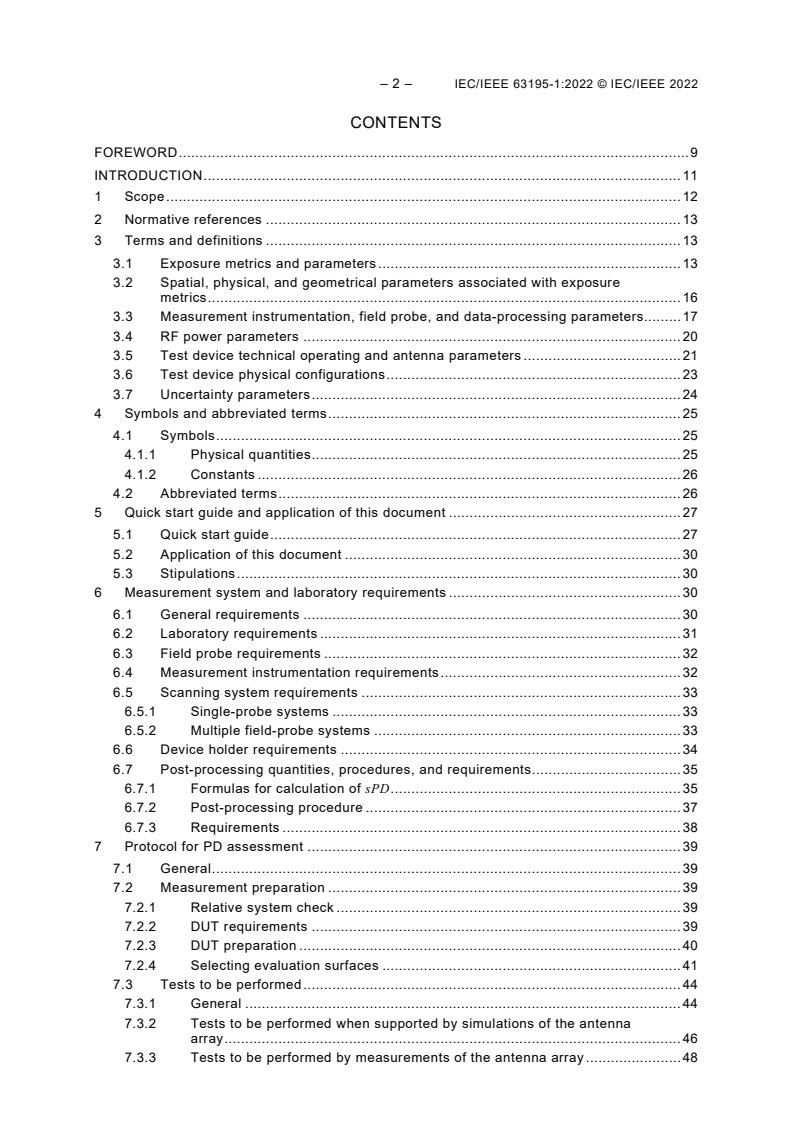
CONTENTS
FOREWORD . 9
INTRODUCTION . 11
1 Scope . 12
2 Normative references . 13
3 Terms and definitions . 13
3.1 Exposure metrics and parameters . 13
3.2 Spatial, physical, and geometrical parameters associated with exposure
metrics . 16
3.3 Measurement instrumentation, field probe, and data-processing parameters . 17
3.4 RF power parameters . 20
3.5 Test device technical operating and antenna parameters . 21
3.6 Test device physical configurations . 23
3.7 Uncertainty parameters . 24
4 Symbols and abbreviated terms . 25
4.1 Symbols . 25
4.1.1 Physical quantities . 25
4.1.2 Constants . 26
4.2 Abbreviated terms . 26
5 Quick start guide and application of this document . 27
5.1 Quick start guide . 27
5.2 Application of this document . 30
5.3 Stipulations . 30
6 Measurement system and laboratory requirements . 30
6.1 General requirements . 30
6.2 Laboratory requirements . 31
6.3 Field probe requirements . 32
6.4 Measurement instrumentation requirements . 32
6.5 Scanning system requirements . 33
6.5.1 Single-probe systems . 33
6.5.2 Multiple field-probe systems . 33
6.6 Device holder requirements . 34
6.7 Post-processing quantities, procedures, and requirements . 35
6.7.1 Formulas for calculation of sPD . 35
6.7.2 Post-processing procedure . 37
6.7.3 Requirements . 38
7 Protocol for PD assessment . 39
7.1 General . 39
7.2 Measurement preparation . 39
7.2.1 Relative system check . 39
7.2.2 DUT requirements . 39
7.2.3 DUT preparation . 40
7.2.4 Selecting evaluation surfaces . 41
7.3 Tests to be performed . 44
7.3.1 General . 44
7.3.2 Tests to be performed when supported by simulations of the antenna
array . 46
7.3.3 Tests to be performed by measurements of the antenna array . 48
7.4 Measurement procedure . 48
7.4.1 General measurement procedure . 48
7.4.2 Power density assessment methods . 49
7.4.3 Power scaling for operating mode and channel . 51
7.4.4 Correction for DUT drift . 53
7.5 Exposure combining. 54
7.5.1 General . 54
7.5.2 Combining power density and SAR results . 55
8 Uncertainty estimation . 58
8.1 General . 58
8.2 Requirements for uncertainty evaluations . 58
8.3 Description of uncertainty models . 58
8.4 Uncertainty terms dependent on the measurement system . 59
8.4.1 CAL – Calibration of the measurement equipment . 59
8.4.2 COR – Probe correction . 59
8.4.3 FRS – Frequency response . 59
8.4.4 SCC – Sensor cross coupling . 60
8.4.5 ISO – Isotropy . 61
8.4.6 LIN – System linearity error . 61
8.4.7 PSC – Probe scattering . 61
8.4.8 PPO – Probe positioning offset . 62
8.4.9 PPR – Probe positioning repeatability . 62
8.4.10 SMO – Sensor mechanical offset . 63
8.4.11 PSR – Probe spatial resolution . 63
8.4.12 FLD – Field impedance dependence (ratio |E|/|H|) . 63
8.4.13 MED – Measurement drift . 63
8.4.14 APN – Amplitude and phase noise . 64
8.4.15 TR – Measurement area truncation . 64
8.4.16 DAQ – Data acquisition . 64
8.4.17 SMP – Sampling . 64
8.4.18 REC – Field reconstruction . 64
8.4.19 SNR – Signal-to-noise ratio . 65
8.4.20 TRA – Forward transformation and backward transformation . 65
8.4.21 SCA – Power density scaling . 66
8.4.22 SAV – Spatial averaging . 66
8.4.23 COM – Exposure combining . 66
8.5 Uncertainty terms dependent on the DUT and environmental factors . 66
8.5.1 PC – Probe coupling with DUT . 66
8.5.2 MOD – Modulation response . 67
8.5.3 IT – Integration time . 67
8.5.4 RT – Response time . 68
8.5.5 DH – Device holder influence . 68
8.5.6 DA – DUT alignment . 68
8.5.7 AC – RF ambient conditions . 68
8.5.8 TEM – Laboratory temperature. 68
8.5.9 REF – Reflections in laboratory . 69
8.5.10 MSI – Measurement system immunity/secondary reception . 69
8.5.11 DRI – DUT drift . 69
8.6 Combined and expanded uncertainty . 69
– 4 – IEC/IEEE 63195-1:2022 © IEC/IEEE 2022
9 Measurement report . 73
9.1 General . 73
9.2 Items to be recorded in measurement reports . 73
Annex A (normative) Measurement system check and system validation tests . 76
A.1 Overview . 76
A.2 Normalization to total radiated power . 77
A.2.1 General . 77
A.2.2 Option 1: Accepted power measurement . 77
A.2.3 Option 2: Total radiated power measurement . 81
A.3 Relative system check . 82
A.3.1 Purpose . 82
A.3.2 Antenna and test conditions . 82
A.3.3 Procedure . 83
A.3.4 Acceptance criteria . 83
A.4 Absolute system check . 85
A.4.1 Purpose . 85
A.4.2 Antenna and test conditions . 85
A.4.3 Procedure . 85
A.4.4 Acceptance criteria . 85
A.5 System validation . 86
A.5.1 Purpose . 86
A.5.2 Procedure . 86
A.5.3 Validation of modulation response . 87
A.5.4 Acceptance criteria . 87
Annex B (normative) Antennas for system check and system validation tests . 89
B.1 General . 89
B.2 Pyramidal horn antennas for system checks . 90
B.3 Cavity-fed dipole arrays for system validation . 91
B.3.1 Description . 91
B.3.2 Numerical target values for cavity-fed dipole arrays . 94
B.3.3 Field and power density distribution patterns . 94
B.3.4 Far-field radiation patterns . 99
B.4 Pyramidal horns with slot arrays for system validation . 101
B.4.1 Description . 101
B.4.2 Numerical target values for pyramidal horns loaded with a slot array . 103
B.4.3 Field and power density distribution patterns . 104
B.4.4 Far-field radiation patterns . 109
B.5 Antenna validation procedure . 110
B.5.1 General . 110
B.5.2 Objectives, scope, and usage specifications . 111
B.5.3 Antenna design. 111
B.5.4 Numerical targets . 111
B.5.5 Reference antennas calibration . 111
B.5.6 Antenna verification and life expectation . 111
B.5.7 Uncertainty budget considerations . 111
B.6 Validation procedure for wideband signals . 112
B.6.1 General . 112
B.6.2 Validation signals . 112
B.6.3 Validation antennas and setup . 112
B.6.4 Target values for validation antennas transmitting wideband signals . 112
B.6.5 Wideband signal uncertainty . 112
B.6.6 Validation procedure . 113
Annex C (normative) Calibration and characterization of measurement probes . 114
C.1 General . 114
C.2 Calibration of waveguide probes . 114
C.2.1 General . 114
C.2.2 Sensitivity . 114
C.2.3 Linearity . 114
C.2.4 Lower detection limit . 115
C.2.5 Isotropy . 115
C.2.6 Response time . 115
C.3 Calibration for isotropic scalar E-field or H-field probes . 115
C.3.1 General . 115
C.3.2 Sensitivity . 115
C.3.3 Isotropy . 115
C.3.4 Linearity . 116
C.3.5 Lower detection limit . 116
C.3.6 Response time . 116
C.4 Calibration of phasor E-field or H-field probes . 116
C.4.1 General . 116
C.4.2 Sensitivity . 116
C.4.3 Isotropy . 117
C.4.4 Linearity . 117
C.4.5 Lower detection limit . 117
C.5 Calibration uncertainty parameters. 117
C.5.1 General . 117
C.5.2 Input power to the antenna . 117
C.5.3 Mismatch effect (input power measurement) . 117
C.5.4 Gain and offset distance . 118
C.5.5 Signal spectrum . 118
C.5.6 Setup stability . 118
C.5.7 Uncertainty for field impedance variations . 119
C.6 Uncertainty budget template . 119
Annex D (informative) Information on use of square or circular shapes for power
density averaging area in conformity evaluations . 121
D.1 General . 121
D.2 Method using computational analysis . 121
D.3 Areas averaged with square and circular shapes on planar evaluation
surface . 121
D.4 Areas averaged with square and circular shapes on nonplanar evaluation
surface . 123
Annex E (informative) Reconstruction algorithms . 125
E.1 General . 125
E.2 Methodologies to extract local field components and power densities . 125
E.2.1 General . 125
E.2.2 Phase-less approaches . 126
E.2.3 Approaches using E-field polarization ellipse measurements . 126
E.2.4 Direct near-field measurements . 126
– 6 – IEC/IEEE 63195-1:2022 © IEC/IEEE 2022
E.3 Forward transformation (propagation) of the fields . 127
E.3.1 General . 127
E.3.2 Field expansion methods . 128
E.3.3 Field integral equation methods . 128
E.4 Backward transformation (propagation) of the fields . 129
E.4.1 General . 129
E.4.2 Field expansion methods – the plane wave expansion . 129
E.4.3 Inverse source methods . 130
E.5 Analytical reference functions . 131
Annex F (normative) Interlaboratory comparisons . 133
F.1 Purpose . 133
F.2 Reference devices . 133
F.3 Power setup . 133
F.4 Interlaboratory comparison – procedure . 133
Annex G (informative) PD test and verification example . 134
G.1 Purpose . 134
G.2 DUT overview . 134
G.3 Test system verification . 134
G.4 Test setup . 134
G.5 Power density results . 134
G.6 Combined exposure (Total Exposure Ratio) . 134
Annex H (informative) Applicability of plane-wave equivalent approximations . 135
H.1 Objective . 135
H.2 Method . 135
H.3 Results . 135
H.4 Discussion . 137
Annex I (informative) Rationales for concepts and methods applied in this document
and IEC/IEEE 63195-2 . 138
I.1 Frequency range . 138
I.2 Calculation of sPD . 138
I.2.1 Application of the Poynting vector for calculation of incident power
density . 138
I.2.2 Averaging area . 139
Bibliography . 140
Figure 1 – Quick Start Guide . 29
Figure 2 – Simplified view of a generic measurement setup involving the use of
reconstruction algorithms . 38
Figure 3 – Cross-sectional view of SAM phantom for SAR evaluations at the reference
plane, as described in IEC/IEEE 62209-1528:2020 . 42
Figure 4 – Cross-sectional view of SAM virtual phantom for PD evaluations at the
reference plane (shell thickness is 2 mm everywhere, including at the pinna) . 42
Figure 5 – Example reference coordinate system for the left-ear ERP of the SAM
phantom . 44
Figure 6 – Example reference points and vertical and horizontal lines on a DUT . 44
Figure 7 – Flow chart for test procedure in 7.3 . 46
Figure 8 – Flow chart for general measurement procedure in 7.4.1 . 49
Figure 9 – Flow chart for power density assessment methods in 7.4.2 . 50
Figure 10 – SAR and power density evaluation at a point r . 57
Figure 11 – Combining SAR (top) and power density (bottom) for the SAM phantom . 57
Figure A.1 – Recommended accepted power measurement setup for relative system
check, absolute system check and system validation . 78
Figure A.2 – Equipment setup for measurement of forward power P and forward
f
coupled power P . 78
fc
Figure A.3 – Equipment setup for measuring the shorted reverse coupled power P . 78
rcs
Figure A.4 – Equipment setup for measuring the power with the reference antenna . 79
Figure A.5 – Port numbering for the S-parameter measurements of the directional
coupler . 80
Figure B.1 – Main dimensions for the cavity-fed dipole arrays – 30 GHz design . 92
Figure B.2 – 10 GHz patterns of |E | and Re{S} for the cavity-fed dipole arrays
total total
at distances of a) 2 mm, b) 5 mm, c) 10 mm, and d) 50 mm from the upper surface of
the dielectric substrate . 95
Figure B.3 – 30 GHz patterns of |E | and Re{S} for the cavity-fed dipole arrays
total total
at distances of a) 2 mm, b) 5 mm, c) 10 mm, and d) 50 mm from the upper surface of
the dielectric substrate . 96
Figure B.4 – 60 GHz patterns of |E | and Re{S} for the cavity-fed dipole arrays
total total
at distances of a) 2 mm, b) 5 mm, c) 10 mm, and d) 50 mm from the upper surface of
the dielectric substrate . 97
Figure B.5 – 90 GHz patterns of |E | and Re{S} for the cavity-fed dipole arrays
total total
at distances of a) 2 mm, b) 5 mm, c) 10 mm, and d) 50 mm from the upper surface of
the dielectric substrate . 98
Figure B.6 – Far-field radiation patterns of a) 10 GHz, b) 30 GHz, c) 60 GHz, and d) 90
GHz cavity-fed dipole arrays . 100
Figure B.7 – Main dimensions for the 0,15 mm stainless steel stencil with slot array . 101
Figure B.8 – Main dimensions for the pyramidal horn antennas. 102
Figure B.9 – 10 GHz patterns of |E | and Re{S} for the pyramidal horn loaded
total total
with a slot array at distances of a) 2 mm, b) 5 mm, c) 10 mm, and d) 50 mm from the
upper surface of the slot array . 105
Figure B.10 – 30 GHz patterns of |E | and Re{S} for the pyramidal horn loaded
total total
with a slot array at distances of a) 2 mm, b) 5 mm, c) 10 mm, and d) 50 mm from the
upper surface of the slot array . 106
Figure B.11 – 60 GHz patterns of |E | and Re{S} for the pyramidal horn loaded
total total
with a slot array at distances of a) 2 mm, b) 5 mm, c) 10 mm, and d) 50 mm from the
upper surface of the slot array . 107
Figure B.12 – 90 GHz patterns of |E | and Re{S} for the pyramidal horn loaded
total total
with a slot array at distances of a) 2 mm, b) 5 mm, c) 10 mm, and d) 50 mm from the
upper surface of the slot array . 108
Figure B.13 – Far-field radiation patterns of a) 10 GHz, b) 30 GHz, c) 60 GHz, and d)
90 GHz pyramidal horn loaded with a slot array . 110
Figure D.1 – Schematic view of the assessment of the variation of sPD using square
shape by rotating AUT (antenna under test) . 121
Figure D.2 – Comparison of psPD averaged using square versus circular shaped areas
on planar evaluation surfaces . 122
Figure D.3 – Example PD distributions with device next to ear evaluation surface . 123
Figure D.4 – Comparison of psPD averaged using cube cross-section (square-like)
versus sphere cross-section (circular-like) shaped areas for device next to ear
evaluation surface . 124
– 8 – IEC/IEEE 63195-1:2022 © IEC/IEEE 2022
Figure E.1 – Simulation (left) and forward transformation from measurements applying
methods described in [29] (right) of power density in the xz-plane (above) and yz-plane
(below) at a distance of 2 mm for a cavity-fed dipole array at 30 GHz (see Annex B) . 127
Figure H.1 – psPD / psPD as function of distance (in units of λ) from cavity-fed
pwe tot
dipole array (CDA##G, left-side) and pyramidal horn with slot arrays (SH##G, right-
side) operating at 10 GHz, 30 GHz, 60 GHz, and 90 GHz . 137
Table 1 – Evaluation plan check-list . 28
Table 2 – Minimum evaluation distance between the DUT antenna and the evaluation
surface for which the plane wave equivalent approximation applies . 50
Table 3 – Template of measurement uncertainty for power density measurements . 70
Table 4 – Example measurement uncertainty budget for power density measurement
results . 72
Table A.1 – Example of power measurement uncertainty . 81
Table A.2 – Communication signals for modulation response test . 87
Table B.1 – Target values for pyramidal horn antennas at different frequencies . 90
Table B.2 – Main dimensions for the cavity-fed dipole arrays at each frequency of
interest . 91
Table B.3 – Geometrical parameters of the cavity-fed dipole arrays at each frequency
of interest . 93
Table B.4 – Substrate and metallic block parameters for the cavity-fed dipole arrays at
each frequency of interest . 93
Table B.5 – Target values for the cavity-fed dipole arrays at 10 GHz, 30 GHz, 60 GHz,
and 90 GHz . 94
Table B.6 – Main dimensions for the stencil with slot array for each frequency . 102
Table B.7 – Primary dimensions for the corresponding pyramidal horns at each
frequency . 103
Table B.8 – Target values for the pyramidal horns loaded with slot arrays at 10 GHz,
30 GHz, 60 GHz, and 90 GHz . 104
Table C.1 – Uncertainty analysis of the probe calibration . 119
Table D.1 – Phase shift values for the array antenna . 123
Table E.1 – List of analytical reference functions and associated psPD target values . 131
n+
Table E.2 – List of analytical reference functions and associated psPD target
tot+
values . 132
Table E.3 – List of analytical reference functions and associated psPD target
mod+
values . 132
INTERNATIONAL ELECTROTECHNICAL COMMISSION
____________
ASSESSMENT OF POWER DENSITY OF HUMAN EXPOSURE TO RADIO
FREQUENCY FIELDS FROM WIRELESS DEVICES IN CLOSE PROXIMITY
TO THE HEAD AND BODY (FREQUENCY RANGE OF 6 GHz TO 300 GHz) –
Part 1: Measurement procedure
FOREWORD
1) The International Electrotechnical Commission (IEC) is a worldwide organization for standardization comprising
all national electrotechnical committees (IEC National Committees). The object of IEC is to promote international
co-operation on all questions concerning standardization in the electrical and electronic fields. To this end and
in addition to other activities, IEC publishes International Standards, Technical Specifications, Technical Reports,
Publicly Available Specifications (PAS) and Guides (hereafter referred to as "IEC document(s)"). Their
preparation is entrusted to technical committees; any IEC National Committee interested in the subject dealt with
may participate in this preparatory work. International, governmental and non-governmental organizations liaising
with the IEC also participate in this preparation.
IEEE Standards documents are developed within IEEE Societies and Standards Coordinating Committees of the
IEEE Standards Association (IEEE SA) Standards Board. IEEE develops its standards through a consensus
development process, approved by the American National Standards Institute, which brings together volunteers
representing varied viewpoints and interests to achieve the final product. Volunteers are not necessarily members
of IEEE and serve without compensation. While IEEE administers the process and
...