


IEC 60182-4:1971
(Main)Basic dimensions of winding wires - Part 4: Diameters of conductors for round resistance wires
Basic dimensions of winding wires - Part 4: Diameters of conductors for round resistance wires
Relates to the sizes of the conductors of round resistance wires irrespective of the conductor material, the type of insulation and the intended application.
Dimensions de base des fils de bobinage - Quatrième partie: Diamètres de conducteurs pour fils de résistance de section circulaire.
L'IEC 60601-1-2:2014 s'applique à la sécurité de base et aux performances essentielles des appareils Electro Médicaux (EM) et systèmes EM en présence de perturbations électromagnétiques, ainsi qu'aux perturbations électromagnétiques émises par les appareils EM et systèmes EM. La présente norme collatérale à la norme générale IEC 60601-1 a pour objet de spécifier des exigences générales et des essais applicables à la sécurité de base et aux performances essentielles eu égard aux perturbations électromagnétiques et pour les émissions électromagnétiques des appareils EM et des systèmes EM. Ils viennent en complément des exigences de la norme générale IEC 60601-1 et servent de base pour les normes particulières. Cette quatrième édition annule et remplace la troisième édition de l'IEC 60601-1-2, dont elle constitue une révision technique. Les modifications majeures par rapport à l'édition précédente sont les suivantes:
- spécification des niveaux d'essai d'immunité selon les environnements d'utilisation prévue catégorisés selon les emplacements qui sont harmonisés avec l'IEC 60601-1-11: l'environnement d'un établissement de soins de santé professionnel, l'environnement de soins de santé a domicile et les environnements spéciaux;
- spécification des essais et des niveaux d'essai pour améliorer la sécurité des appareils électromédicaux et des systèmes électromédicaux lorsque des appareils de communication portatifs RF sont utilisés plus près des appareils électromédicaux qu'il n'a été recommandé sur la base des niveaux d'essai d'immunité qui ont été spécifiés dans la troisième édition;
- spécification des essais d'immunité et des niveaux d'essai d'immunité selon les accès des appareils électromédicaux ou des systèmes électromédicaux;
- spécification des niveaux d'essai d'immunité basés sur le niveau maximum raisonnablement prévisible des perturbations électromagnétiques dans les environnements d'utilisation prévue, résultant en des niveaux d'essai d'immunité qui sont supérieurs à ceux de l'édition précédente; et
- une meilleure harmonisation avec les concepts de risque de sécurité de base et des performances essentielles incluant la suppression du terme défini "maintien de la vie". Cette nouvelle édition inclut les ajouts majeurs suivants:
- lignes directrices pour la détermination des niveaux d'essai d'immunité pour les environnements spéciaux;
- lignes directrices pour l'ajustement des niveaux d'essai d'immunité lorsque des considérations spéciales d'atténuation ou d'utilisation prévue sont applicables;
- lignes directrices relatives à la gestion des risques pour la sécurité de base et les performances essentielles eu égard aux perturbations électromagnétiques; et
- lignes directrices relatives à l'identification des critères d'échec/réussite à l'essai d'immunité.
General Information
- Status
- Published
- Publication Date
- 31-Dec-1970
- Technical Committee
- SC 62A - Common aspects of medical equipment, software, and systems
- Current Stage
- DELPUB - Deleted Publication
- Start Date
- 01-Apr-1993
- Completion Date
- 26-Oct-2025
Relations
- Effective Date
- 05-Sep-2023
- Effective Date
- 05-Sep-2023
- Effective Date
- 05-Sep-2023
Overview
IEC 60182-4:1971 - Basic dimensions of winding wires - Part 4: Diameters of conductors for round resistance wires - defines standardized conductor sizes for round resistance wires. The standard addresses the diameters of conductors used in resistance-type winding wires and applies irrespective of conductor material, type of insulation, or intended application. It provides a common dimensional reference to support interchangeability, specification, manufacturing and quality control in wire production and downstream uses.
Key Topics
- Scope and applicability: Clarifies that the dimensional rules apply to round resistance conductors regardless of material (e.g., copper, nickel alloys), insulation system, or end-use.
- Conductor diameters: Establishes nominal diameters and basic dimensions used to classify round resistance wires for winding, element and resistor manufacture.
- Dimensional consistency: Promotes uniform wire sizing for compatibility across manufacturers and designs, easing procurement and part interchange.
- Specification language: Guides how to reference conductor diameter in technical drawings, bills of materials and product specifications.
- Quality and inspection: Provides the dimensional baseline used by production, inspection and test processes to verify conformance.
(Note: IEC 60182-4 sets dimensional requirements; it does not prescribe material-specific mechanical, electrical or thermal properties.)
Applications
IEC 60182-4 is practical for anyone specifying, producing or using round resistance winding wires:
- Electrical and electronic component manufacturers (resistors, heating elements, sensor coils)
- Winding and transformer manufacturers needing standardized resistance wire sizes
- Design engineers specifying conductor diameters for thermal, resistance and reliability targets
- Purchasing and quality teams creating procurement specs and incoming inspection criteria
- Test laboratories and certification bodies verifying dimensional conformity
Using standardized conductor diameters helps ensure predictable resistance per unit length, consistent winding behavior, and interchangeability of wire from different suppliers - critical in high-volume manufacturing and regulated industries.
Related Standards
- Other parts of the IEC 60182 series (basic dimensions of various winding wires)
- General IEC publications on wire and cable standards and electrotechnical terminology
Keywords: IEC 60182-4, winding wires, round resistance wires, conductor diameters, wire sizing, electrical manufacturing standards, wire dimensions, resistance wire specification.

IEC 60601-1-2:2014+AMD1:2020 CSV - Medical electrical equipment - Part 1-2: General requirements for basic safety and essential performance - Collateral Standard: Electromagnetic disturbances - Requirements and tests Released:9/1/2020
IEC 60601-1-2:2014 - Medical electrical equipment - Part 1-2: General requirements for basic safety and essential performance - Collateral Standard: Electromagnetic disturbances - Requirements and tests



IEC 60601-1-2:2014+AMD1:2020 CSV - Medical electrical equipment - Part 1-2: General requirements for basic safety and essential performance - Collateral Standard: Electromagnetic disturbances - Requirements and tests Released:9/1/2020
Frequently Asked Questions
IEC 60182-4:1971 is a standard published by the International Electrotechnical Commission (IEC). Its full title is "Basic dimensions of winding wires - Part 4: Diameters of conductors for round resistance wires". This standard covers: Relates to the sizes of the conductors of round resistance wires irrespective of the conductor material, the type of insulation and the intended application.
Relates to the sizes of the conductors of round resistance wires irrespective of the conductor material, the type of insulation and the intended application.
IEC 60182-4:1971 is classified under the following ICS (International Classification for Standards) categories: 11.040.01 - Medical equipment in general; 33.100.10 - Emission; 33.100.20 - Immunity. The ICS classification helps identify the subject area and facilitates finding related standards.
IEC 60182-4:1971 has the following relationships with other standards: It is inter standard links to IEC 60601-1-2:2014/AMD1:2020, IEC 60601-1-2:2007, IEC 60601-1-2:2007/ISH1:2010. Understanding these relationships helps ensure you are using the most current and applicable version of the standard.
IEC 60182-4:1971 is available in PDF format for immediate download after purchase. The document can be added to your cart and obtained through the secure checkout process. Digital delivery ensures instant access to the complete standard document.
Standards Content (Sample)
IEC 60601-1-2 ®
Edition 4.1 2020-09
CONSOLIDATED VERSION
INTERNATIONAL
STANDARD
colour
inside
Medical electrical equipment –
Part 1-2: General requirements for basic safety and essential performance –
Collateral Standard: Electromagnetic disturbances – Requirements and tests
IEC 60601-1-2:2014-02+AMD1:2020-09 CSV(en)
All rights reserved. Unless otherwise specified, no part of this publication may be reproduced or utilized in any form
or by any means, electronic or mechanical, including photocopying and microfilm, without permission in writing from
either IEC or IEC's member National Committee in the country of the requester. If you have any questions about IEC
copyright or have an enquiry about obtaining additional rights to this publication, please contact the address below or
your local IEC member National Committee for further information.
IEC Central Office Tel.: +41 22 919 02 11
3, rue de Varembé info@iec.ch
CH-1211 Geneva 20 www.iec.ch
Switzerland
About the IEC
The International Electrotechnical Commission (IEC) is the leading global organization that prepares and publishes
International Standards for all electrical, electronic and related technologies.
About IEC publications
The technical content of IEC publications is kept under constant review by the IEC. Please make sure that you have the
latest edition, a corrigendum or an amendment might have been published.
IEC publications search - webstore.iec.ch/advsearchform Electropedia - www.electropedia.org
The advanced search enables to find IEC publications by a The world's leading online dictionary on electrotechnology,
variety of criteria (reference number, text, technical containing more than 22 000 terminological entries in English
committee,…). It also gives information on projects, replaced and French, with equivalent terms in 16 additional languages.
and withdrawn publications. Also known as the International Electrotechnical Vocabulary
(IEV) online.
IEC Just Published - webstore.iec.ch/justpublished
Stay up to date on all new IEC publications. Just Published IEC Glossary - std.iec.ch/glossary
details all new publications released. Available online and 67 000 electrotechnical terminology entries in English and
once a month by email. French extracted from the Terms and definitions clause of
IEC publications issued between 2002 and 2015. Some
IEC Customer Service Centre - webstore.iec.ch/csc entries have been collected from earlier publications of IEC
If you wish to give us your feedback on this publication or TC 37, 77, 86 and CISPR.
need further assistance, please contact the Customer Service
Centre: sales@iec.ch.
IEC 60601-1-2 ®
Edition 4.1 2020-09
CONSOLIDATED VERSION
INTERNATIONAL
STANDARD
colour
inside
Medical electrical equipment –
Part 1-2: General requirements for basic safety and essential performance –
Collateral Standard: Electromagnetic disturbances – Requirements and tests
INTERNATIONAL
ELECTROTECHNICAL
COMMISSION
ICS 11.040.01; 33.100.10; 33.100.20 ISBN 978-2-8322-8836-8
IEC 60601-1-2 ®
Edition 4.1 2020-09
CONSOLIDATED VERSION
REDLINE VERSION
colour
inside
Medical electrical equipment –
Part 1-2: General requirements for basic safety and essential performance –
Collateral Standard: Electromagnetic disturbances – Requirements and tests
IEC 60601-1-2:2014-02+AMD1:2020-09 CSV(en)
– 2 – IEC 60601-1-2:2014+AMD1:2020 CSV
© IEC 2020
CONTENTS
FOREWORD . 6
INTRODUCTION . 9
INTRODUCTION to Amendment 1 . 10
1 Scope, object and related standards . 11
1.1 * Scope . 11
1.2 Object . 11
1.3 Related standards . 11
1.3.1 IEC 60601-1 . 11
1.3.2 Particular standards . 11
2 Normative references . 11
3 Terms and definitions . 14
4 General requirements . 17
4.1 RISK MANAGEMENT PROCESS for ME EQUIPMENT and ME SYSTEMS . 17
4.2 * Non-ME EQUIPMENT used in an ME SYSTEM . 17
4.3 General test conditions . 18
4.3.1 * Configurations . 18
4.3.2 Artificial hand. 18
4.3.3 * Power input voltages and frequencies . 19
5 ME EQUIPMENT and ME SYSTEMS identification, marking and documents . 22
5.1 Additional requirements for marking on the outside of ME EQUIPMENT and
ME SYSTEMS that are specified for use only in a shielded location SPECIAL
ENVIRONMENT . 22
5.2 ACCOMPANYING DOCUMENTS . 22
5.2.1 Instructions for use . 22
5.2.2 Technical description . 23
6 Documentation of the tests . 25
6.1 General . 25
6.2 Test plan . 25
6.3 Test report . 25
7 ELECTROMAGNETIC EMISSIONS requirements for ME EQUIPMENT and ME SYSTEMS . 25
7.1 Protection of radio services and other equipment . 25
7.1.1 * General . 25
7.1.2 Operating modes . 25
7.1.3 Multimedia equipment . 25
7.1.4 * Subsystems . 26
7.1.5 ME EQUIPMENT and ME SYSTEMS specified for use only in a
shielded location SPECIAL ENVIRONMENT . 26
7.1.6 ME EQUIPMENT and ME SYSTEMS that include radio equipment . 26
7.1.7 * ME EQUIPMENT whose main functions are performed by
motors and switching or regulating devices . 26
7.1.8 ME EQUIPMENT and ME SYSTEMS containing X-ray generators . 27
7.1.9 PATIENT physiological simulation . 27
7.1.10 Artificial hand. 27
7.1.11 PATIENT-coupled cables . 27
7.1.12 * PERMANENTLY INSTALLED LARGE ME EQUIPMENT and LARGE
ME SYSTEMS . 27
IEC 60601-1-2:2014+AMD1:2020 CSV – 3 –
© IEC 2020
7.2 Protection of the PUBLIC MAINS NETWORK . 27
7.2.1 * Harmonic distortion . 27
7.2.2 * Voltage fluctuations and flicker . 28
7.3 EMISSIONS requirements summary . 28
8 Electromagnetic IMMUNITY requirements for ME EQUIPMENT and ME SYSTEMS . 28
8.1 * General . 28
8.2 PATIENT physiological simulation . 32
8.3 Termination of PATIENT-COUPLED parts . 32
8.4 HAND-HELD ME EQUIPMENT and parts intended to be HAND-HELD . 32
8.5 * Subsystems . 33
8.6 * PERMANENTLY INSTALLED LARGE ME EQUIPMENT and LARGE ME SYSTEMS . 33
8.7 * Operating modes . 33
8.8 * Non-ME EQUIPMENT . 34
8.9 * IMMUNITY TEST LEVELS . 34
8.10 * IMMUNITY to proximity fields from RF wireless communications
equipment . 41
8.11 * IMMUNITY to proximity magnetic fields in the frequency range 9 kHz to
13,56 MHz . 43
9 * Test report . 44
Annex A (informative) General guidance and rationale . 47
A.1 Safety and performance . 47
A.2 Testing of normally non-observable functions. 47
A.3 Rationale for particular clauses and subclauses . 47
Annex B (informative) Guide to marking and labelling requirements for ME EQUIPMENT
and ME SYSTEMS. 71
B.1 Marking on the outside of ME EQUIPMENT, ME SYSTEMS or their parts . 71
B.2 ACCOMPANYING DOCUMENTS, instructions for use . 71
B.3 ACCOMPANYING DOCUMENTS, technical description . 71
Annex C (informative) Guidance in classification according to CISPR 11 . 73
C.1 General . 73
C.2 Separation into groups . 73
C.3 Division into classes . 74
Annex D (informative) Guidance in the application of IEC 60601-1-2 to particular
standards . 75
D.1 General . 75
D.2 Recommended modifications . 75
D.2.1 Testing requirements . 75
D.2.2 ACCOMPANYING DOCUMENTS . 75
D.3 Cautions . 75
Annex E (informative) Determination of IMMUNITY TEST LEVELS for SPECIAL
ENVIRONMENTS . 77
E.1 General . 77
E.2 Summary of method for E.1 a) . 80
E.3 Summary of method for E.1 b), c) and d) . 80
E.4 Determination of EM DISTURBANCE level reduction . 80
E.5 Assessment of EM DISTURBANCE sources . 80
E.6 Reasonably foreseeable maximum EM DISTURBANCE levels . 81
E.7 Determination of IMMUNITY TEST LEVELS . 81
E.8 RF radiators in SPECIAL ENVIRONMENTS . 81
– 4 – IEC 60601-1-2:2014+AMD1:2020 CSV
© IEC 2020
E.9 Examples of mitigations and special conditions . 82
Annex F (informative) RISK MANAGEMENT for BASIC SAFETY and ESSENTIAL PERFORMANCE
with regard to ELECTROMAGNETIC DISTURBANCES .
F.1 General .
F.2 General requirements for RISK MANAGEMENT .
F.3 RISK ANALYSIS .
F.4 RISK EVALUATION .
F.5 RISK CONTROL .
F.5.1 RISK CONTROL option analysis .
F.5.2 Implementation of RISK CONTROL measure(s).
F.5.3 RESIDUAL RISK EVALUATION .
F.5.4 RISK/benefit analysis .
F.5.5 RISKS arising from RISK CONTROL measures .
F.5.6 Completeness of RISK CONTROL .
F.6 Evaluation of overall RESIDUAL RISK acceptability .
F.7 RISK MANAGEMENT report .
F.8 Production and post-production information .
Annex F (informative) Guidance on the application of RISK MANAGEMENT with regard to
ELECTROMAGNETIC DISTURBANCES in this collateral standard . 92
Annex G (informative) Guidance: Test plan . 101
G.1 Test plan contents . 101
Annex H (informative) PATIENT-coupled cables EMISSIONS . 103
H.1 * Protection of other equipment from PATIENT cable conducted EMISSIONS . 103
H.2 Test method . 103
H.3 Rationale . 103
Annex I (informative) Identification of IMMUNITY pass/fail criteria . 105
I.1 General . 105
I.2 IMMUNITY pass/fail criteria principles . 105
I.2.1 General . 105
I.2.2 IMMUNITY pass/fail criteria for non-ME EQUIPMENT used in an
ME SYSTEM . 105
I.2.3 IMMUNITY pass/fail criteria determination . 105
I.3 IMMUNITY pass/fail criteria examples . 106
I.3.1 General examples . 106
I.3.2 Example of IMMUNITY pass/fail criteria for a radiological table
system . 107
Bibliography . 109
Index of defined terms used in this collateral standard . 113
Figure 1 – RC element of the artificial hand . 19
Figure 2 – PORTS of ME EQUIPMENT and ME SYSTEMS . 29
Figure 3 – Examples of environments of INTENDED USE locations within EM
ENVIRONMENTS . 35
Figure A.1 – Examples of PORTS (from IEC 61000-6-1:2005) . 53
Figure A.2 – IEC 61000-4-2 Figure A.1 – Maximum values of electrostatic voltages to
which OPERATORS can be charged while in contact with the materials mentioned in A.2 . 60
Figure A.3 – Steps for evaluation of IMMUNITY to proximity magnetic fields . 65
IEC 60601-1-2:2014+AMD1:2020 CSV – 5 –
© IEC 2020
Figure A.4 – Magnetic field roll-off characteristics along the x-axis for a thin planar coil
and various coil radii . 67
Figure A.5 – Voltage induced in a 1-turn, 6 cm radius coil by a 6 cm radiating coil
operating at 134,2 kHz and H of 82,65 A/m (r.m.s.) . 68
Figure A.6 – Voltage induced in a 1-turn, 2 cm radius coil by a 2 cm radiating coil
operating at 13,56 MHz and H of 7,5 A/m (r.m.s.) . 68
Figure E.1 – Test plan development flow when SPECIAL ENVIRONMENTS are known . 78
Figure E.2 – Sub-process for determination of IMMUNITY TEST LEVELS for SPECIAL
ENVIRONMENTS . 79
Figure F.1 – Function of this collateral standard in the RISK MANAGEMENT PROCESS .
Figure F.2 – Examples of multiple VERIFICATION methods for improving confidence in
RISK levels .
Figure F.1 – RISK MANAGEMENT flow in IEC 60601-1-2 (1 of 3) . 98
Figure H.1 – Setup for PATIENT-COUPLED cables conducted EMISSIONS test for
ME EQUIPMENT and ME SYSTEMS that conform to IEC 60601-2-27 . 104
Table 1 – Power input voltages and frequencies during the tests (1 of 2) . 20
Table 2 – EMISSION limits per environment . 28
Table 3 – Procedure for continuing to test ME EQUIPMENT or ME SYSTEMS that are
damaged by an IMMUNITY test signal . 30
Table 4 – * ENCLOSURE PORT . 36
Table 5 – * Input a.c. power PORT (1 of 2) . 37
Table 6 – Input d.c. power PORT . 39
Table 7 – * PATIENT coupling PORT . 40
Table 8 – Signal input/output parts SIP/SOP PORT . 41
Table 9 – Test specifications for ENCLOSURE PORT IMMUNITY to RF wireless
communications equipment . 42
Table 11 – Test specifications for ENCLOSURE PORT IMMUNITY to proximity magnetic
fields . 44
Table 10 – * Minimum test report contents (1 of 2) . 45
Table A.2 – Example calculations for applying the allowance to test at a single RATED
power input voltage . 49
Table A.1 – IEC/TR 61000-2-5 information considered in specifying IMMUNITY TEST
for each IMMUNITY TEST . 56
LEVELS
Table A.3 – Test specifications for ENCLOSURE PORT IMMUNITY to RF wireless
communications equipment . 63
Table B.1 – Marking on the outside of ME EQUIPMENT, ME SYSTEMS or their parts . 71
Table B.2 – ACCOMPANYING DOCUMENTS, instructions for use . 71
Table B.3 – ACCOMPANYING DOCUMENTS, technical description . 72
Table E.1 – Examples of specific mitigations / environmental conditions . 82
Table F.1 – Examples of EM phenomena that should be considered in a RISK ANALYSIS .
Table F.1 – Specific guidance for subclauses of this collateral standard that reference
RISK MANAGEMENT (1 of 6) . 92
Table G.1 – Recommended minimum test plan contents (1 of 2) . 101
Table H.1 – PATIENT-COUPLED conducted EMISSIONS recommended limit. 103
Table I.1 – Example of IMMUNITY pass criteria for a radiological table system . 108
– 6 – IEC 60601-1-2:2014+AMD1:2020 CSV
© IEC 2020
INTERNATIONAL ELECTROTECHNICAL COMMISSION
____________
MEDICAL ELECTRICAL EQUIPMENT –
Part 1-2: General requirements for basic safety and essential
performance – Collateral Standard: Electromagnetic
disturbances – Requirements and tests
FOREWORD
1) The International Electrotechnical Commission (IEC) is a worldwide organization for standardization comprising
all national electrotechnical committees (IEC National Committees). The object of IEC is to promote
international co-operation on all questions concerning standardization in the electrical and electronic fields. To
this end and in addition to other activities, IEC publishes International Standards, Technical Specifications,
Technical Reports, Publicly Available Specifications (PAS) and Guides (hereafter referred to as “IEC
Publication(s)”). Their preparation is entrusted to technical committees; any IEC National Committee interested
in the subject dealt with may participate in this preparatory work. International, governmental and non-
governmental organizations liaising with the IEC also participate in this preparation. IEC collaborates closely
with the International Organization for Standardization (ISO) in accordance with conditions determined by
agreement between the two organizations.
2) The formal decisions or agreements of IEC on technical matters express, as nearly as possible, an international
consensus of opinion on the relevant subjects since each technical committee has representation from all
interested IEC National Committees.
3) IEC Publications have the form of recommendations for international use and are accepted by IEC National
Committees in that sense. While all reasonable efforts are made to ensure that the technical content of IEC
Publications is accurate, IEC cannot be held responsible for the way in which they are used or for any
misinterpretation by any end user.
4) In order to promote international uniformity, IEC National Committees undertake to apply IEC Publications
transparently to the maximum extent possible in their national and regional publications. Any divergence
between any IEC Publication and the corresponding national or regional publication shall be clearly indicated in
the latter.
5) IEC itself does not provide any attestation of conformity. Independent certification bodies provide conformity
assessment services and, in some areas, access to IEC marks of conformity. IEC is not responsible for any
services carried out by independent certification bodies.
6) All users should ensure that they have the latest edition of this publication.
7) No liability shall attach to IEC or its directors, employees, servants or agents including individual experts and
members of its technical committees and IEC National Committees for any personal injury, property damage or
other damage of any nature whatsoever, whether direct or indirect, or for costs (including legal fees) and
expenses arising out of the publication, use of, or reliance upon, this IEC Publication or any other IEC
Publications.
8) Attention is drawn to the Normative references cited in this publication. Use of the referenced publications is
indispensable for the correct application of this publication.
9) Attention is drawn to the possibility that some of the elements of this IEC Publication may be the subject of
patent rights. IEC shall not be held responsible for identifying any or all such patent rights.
This consolidated version of the official IEC Standard and its amendment has been
prepared for user convenience.
IEC 60601-1-2 edition 4.1 contains the fourth edition (2014-04) [documents 62A/916/FDIS
and 62A/924/RVD] and its amendment 1 (2020-09) [documents 62A/1390/FDIS and
62A/1405/RVD].
In this Redline version, a vertical line in the margin shows where the technical content
is modified by amendment 1. Additions are in green text, deletions are in strikethrough
red text. A separate Final version with all changes accepted is available in this
publication.
IEC 60601-1-2:2014+AMD1:2020 CSV – 7 –
© IEC 2020
International standard IEC 60601-1-2 has been prepared by IEC subcommittee 62A: Common
aspects of electrical equipment used in medical practice of IEC technical committee 62:
Electrical equipment in medical practice.
This fourth edition constitutes a technical revision.
This fourth edition constitutes a collateral standard to IEC 60601-1: Medical electrical
equipment – Part 1: General requirements for safety and essential performance hereafter
referred to as the general standard.
The most significant changes with respect to the previous edition include the following
modifications:
– specification of IMMUNITY TEST LEVELS according to the environments of INTENDED USE,
categorized according to locations that are harmonized with IEC 60601-1-11: the
HOME HEALTHCARE ENVIRONMENT and
professional healthcare facility environment, the
SPECIAL ENVIRONMENTS;
– specification of tests and test levels to improve the safety of MEDICAL ELECTRICAL
EQUIPMENT and MEDICAL ELECTRICAL SYSTEMS when PORTABLE RF communications
MEDICAL ELECTRICAL EQUIPMENT than was recommended
equipment is used closer to the
based on the IMMUNITY TEST LEVELS that were specified in the third edition;
– specification of IMMUNITY tests and IMMUNITY TEST LEVELS according to the PORTS of the
MEDICAL ELECTRICAL EQUIPMENT or MEDICAL ELECTRICAL SYSTEM;
– specification of IMMUNITY TEST LEVELS based on the reasonably foreseeable maximum level
of ELECTROMAGNETIC DISTURBANCES in the environments of INTENDED USE, resulting in some
IMMUNITY TEST LEVELS that are higher than in the previous edition; and
– better harmonization with the RISK concepts of BASIC SAFETY and ESSENTIAL PERFORMANCE,
including deletion of the defined term “life-supporting”;
and the following additions:
IMMUNITY TEST LEVELS for SPECIAL ENVIRONMENTS;
– guidance for determination of
– guidance for adjustment of IMMUNITY TEST LEVELS when special considerations of
mitigations or INTENDED USE are applicable;
– guidance on RISK MANAGEMENT for BASIC SAFETY and ESSENTIAL PERFORMANCE with regard
to ELECTROMAGNETIC DISTURBANCES; and
– guidance on identification of IMMUNITY pass/fail criteria.
This publication has been drafted in accordance with the ISO/IEC Directives, Part 2.
In the 60601 series of publications, collateral standards specify general requirements for
safety applicable to:
– a subgroup of MEDICAL ELECTRICAL EQUIPMENT (e.g. radiological equipment); or
– a specific characteristic of all MEDICAL ELECTRICAL EQUIPMENT, not fully addressed in the
general standard (e.g. ALARM SYSTEMS).
In this collateral standard, the following print types are used:
– Requirements and definitions: roman type.
– Test specifications: italic type.
– Informative material appearing outside of tables, such as notes, examples and references: in smaller type.
Normative text of tables is also in a smaller type.
– TERMS DEFINED IN CLAUSE 3 OF THE GENERAL STANDARD, IN THIS COLLATERAL STANDARD OR AS
NOTED: SMALL CAPITALS.
– 8 – IEC 60601-1-2:2014+AMD1:2020 CSV
© IEC 2020
In referring to the structure of this collateral standard, the term
– “clause” means one of the numbered divisions within the table of contents, inclusive of all
subdivisions (e.g. Clause 1 includes 1.1, 1.2, etc.);
– “subclause” means a numbered subdivision of a clause (e.g. 1.1, 1.2 and 1.3.1 are all
subclauses of Clause 1).
References to clauses within this collateral standard are preceded by the term “Clause”
followed by the clause number. References to subclauses within this collateral standard are
by number only.
In this collateral standard, the conjunctive “or” is used as an “inclusive or” so a statement is
true if any combination of the conditions is true.
The verbal forms used in this collateral standard conform to usage described in Annex H of
the ISO/IEC Directives, Part 2. For the purposes of this collateral standard, the auxiliary verb:
– “shall” means that compliance with a requirement or a test is mandatory for compliance
with this collateral standard;
– “should” means that compliance with a requirement or a test is recommended but is not
mandatory for compliance with this collateral standard;
– “may” is used to describe a permissible way to achieve compliance with a requirement or
test.
An asterisk (*) as the first character of a title or at the beginning of a paragraph or table title
indicates that there is guidance or rationale related to that item in Annex A.
A list of all parts of the IEC 60601 series, published under the general title Medical electrical
equipment, can be found on the IEC website.
The committee has decided that the contents of the base publication and its amendment will
remain unchanged until the stability date indicated on the IEC web site under
"http://webstore.iec.ch" in the data related to the specific publication. At this date, the
publication will be
• reconfirmed,
• withdrawn,
• replaced by a revised edition, or
• amended.
NOTE The attention of National Committees is drawn to the fact that equipment manufacturers and testing
organizations may need a transitional period following publication of a new, amended or revised IEC publication in
which to make products in accordance with the new requirements and to equip them for conducting new or revised
tests. It is the recommendation of the committee that the content of this publication be adopted for mandatory
implementation nationally not earlier than 3 years from the date of publication.
IMPORTANT – The “colour inside” logo on the cover page of this publication indicates
that it contains colours which are considered to be useful for the correct understanding
of its contents. Users should therefore print this publication using a colour printer.
IEC 60601-1-2:2014+AMD1:2020 CSV – 9 –
© IEC 2020
INTRODUCTION
The need for establishing specific standards for BASIC SAFETY and ESSENTIAL PERFORMANCE
with regard to ELECTROMAGNETIC DISTURBANCES for MEDICAL ELECTRICAL EQUIPMENT and
MEDICAL ELECTRICAL SYSTEMS is well recognized.
The requirements and tests specified by this collateral standard are generally applicable to
MEDICAL ELECTRICAL EQUIPMENT and MEDICAL ELECTRICAL SYSTEMS as defined in 3.63 and 3.64
in the general standard. For certain types of MEDICAL ELECTRICAL EQUIPMENT and MEDICAL
ELECTRICAL SYSTEMS, these requirements might need to be modified by the special
requirements of a particular standard. Writers of particular standards are encouraged to refer
to Annex D for guidance in the application of this collateral standard.
MEDICAL ELECTRICAL EQUIPMENT and MEDICAL ELECTRICAL SYSTEMS are expected to provide their
BASIC SAFETY and ESSENTIAL PERFORMANCE without interfering with other equipment and
systems in the ELECTROMAGNETIC ENVIRONMENTS in which they are intended by their
MANUFACTURER to be used. The application of ELECTROMAGNETIC EMISSION standards is
essential for the protection of:
– safety services;
– other MEDICAL ELECTRICAL EQUIPMENT and MEDICAL ELECTRICAL SYSTEMS;
– non-ME EQUIPMENT (e.g. computers);
– telecommunications (e.g. radio/TV, telephone, radio-navigation).
Of even more importance, the application of ELECTROMAGNETIC IMMUNITY standards is
essential to ensure safety of MEDICAL ELECTRICAL EQUIPMENT and MEDICAL ELECTRICAL SYSTEMS.
To ensure safety, MEDICAL ELECTRICAL EQUIPMENT and MEDICAL ELECTRICAL SYSTEMS are
expected to provide their BASIC SAFETY and ESSENTIAL PERFORMANCE in the ELECTROMAGNETIC
ENVIRONMENTS of INTENDED USE throughout their EXPECTED SERVICE LIFE.
This collateral standard specifies IMMUNITY TEST LEVELS for safety for ME EQUIPMENT and ME
SYSTEMS intended by their MANUFACTURER for use in the professional healthcare facility
environment or the HOME HEALTHCARE ENVIRONMENT. It recognizes that RF wireless
communications equipment can no longer be prohibited from most PATIENT ENVIRONMENTS
because in many cases it has become essential to the efficient provision of healthcare. This
collateral standard also recognizes that, for certain SPECIAL ENVIRONMENTS, higher or lower
IMMUNITY TEST LEVELS than those specified for the professional healthcare facility environment
and the HOME HEALTHCARE ENVIRONMENT might be appropriate. This collateral standard
provides guidance in determining appropriate IMMUNITY TEST LEVELS for SPECIAL ENVIRONMENTS.
The IMMUNITY TEST LEVELS specified for BASIC SAFETY and ESSENTIAL PERFORMANCE are based
on the reasonably foreseeable maximum of the ELECTROMAGNETIC DISTURBANCE phenomena in
the applicable environments of INTENDED USE.
Not all ELECTROMAGNETIC DISTURBANCE phenomena are covered by this collateral standard, as
it is not practical to do so. MANUFACTURERS of MEDICAL ELECTRICAL EQUIPMENT and MEDICAL
ELECTRICAL SYSTEMS need to address this during their RISK ASSESSMENT and evaluate if other
ELECTROMAGNETIC DISTURBANCE phenomena could make their product unsafe. This evaluation
should be based on the environments of INTENDED USE and the reasonably foreseeable
maximum levels of ELECTROMAGNETIC DISTURBANCES expected throughout the EXPECTED
SERVICE LIFE.
This collateral standard recognizes that the MANUFACTURER has the responsibility to design
and perform VERIFICATION of MEDICAL ELECTRICAL EQUIPMENT and MEDICAL ELECTRICAL SYSTEMS
to meet the requirements of this collateral standard and to disclose information to the
RESPONSIBLE ORGANIZATION or OPERATOR so that the MEDICAL ELECTRICAL EQUIPMENT or MEDICAL
ELECTRICAL SYSTEM will remain safe throughout its EXPECTED SERVICE LIFE.
– 10 – IEC 60601-1-2:2014+AMD1:2020 CSV
© IEC 2020
This collateral standard provides guidance in incorporating considerations regarding
ELECTROMAGNETIC DISTURBANCES into the RISK MANAGEMENT PROCESS.
This collateral standard is based on existing IEC standards prepared by subcommittee 62A,
technical committee 77 (ELECTROMAGNETIC COMPATIBILITY between electrical equipment
including networks), ISO (International standards organization), and CISPR (International
special committee on radio interference).
INTRODUCTION to Amendment 1
The fourth edition of IEC 60601-1-2 was published in 2014. Since the publication of
IEC 60601-1-2:2014, the IEC Subcommittee (SC) 62A Secretariat has been collecting issues
from a variety of sources including comments from National Committees. At the November
2015 meeting of IEC/SC 62A in Kobe, Japan, the subcommittee initiated a process to identify
high-priority issues that need to be considered in an amendment and should not wait until the
fifth edition of IEC 60601-1-2, which is presently targeted for publication sometime after 2024.
Those issues selected for inclusion on the final "short list" to be addressed in Amendment 1
were those approved by a 2/3 majority of the National Committees present and voting at the
Frankfurt meeting of SC 62A. At the meeting held on 10 October 2016, 15 items were
presented to the National Committees present. All 15 items received the required 2/3 majority
of the National Committees present and voting and have been included in the "short list" for
consideration in preparing Amendment 1. All remaining issues have been placed on a "long
list" for consideration in the fifth edition of IEC 60601-1-2.
The "short list" of issues was documented in the design specification for Amendment 1. MT 23
was directed to consider each issue described in Clause 6 of the design specification and
develop an appropriate solution for the identified problem. That final solution in this
amendment can encompass any technical solution proposed by the author of the issue or it
can involve a different solution developed by the expert group. The expert group can also
have recommended that no change to the standard was justified by the problem statement.
Because this is an amendment to IEC 60601-1-2:2014, the style in force at the time of
publication of IEC 60601-1-2 has been applied to this amendment. The style specified in
ISO/IEC Directives Part 2:2018 has only been applied when implementing the new style
guidance would not result in additional editorial changes.
Users of this document should note that when constructing the dated references to specific
elements in a standard, such as definitions, amendments are only referenced if they modified
the text being cited. For example, if a reference is made to a definition that has not been
modified by an amendment, then the reference to the amendment is not included in the dated
reference.
IEC 60601-1-2:2014+AMD1:2020 CSV – 11 –
© IEC 2020
MEDICAL ELECTRICAL EQUIPMENT –
Part 1-2: General requirements for basic safety and essential
performance – Collateral Standard: Electromagnetic
disturbances – Requirements and tests
1 Scope, object and related standards
1.1 * Scope
This International Standard applies to the BASIC SAFETY and ESSENTIAL PERFORMANCE of
MEDICAL ELECTRICAL EQUIPMENT and MEDICAL ELECTRICAL SYSTEMS, hereafter referred to as
ME EQUIPMENT and ME SYSTEMS.
This collateral standard applies to the BASIC SAFETY and ESSENTIAL PERFORMANCE of
ME EQUIPMENT and ME SYSTEMS in the presence of ELECTROMAGNETIC DISTURBANCES and to
ELECTROMAGNETIC DISTURBANCES emitted by ME EQUIPMENT and ME SYSTEMS.
BASIC SAFETY with regard to ELECTROMAGNETIC DISTURBANCES is applicable to all ME EQUIPMENT
and ME SYSTEMS.
1.2 Object
The object of this collateral standard is to specify general requirements and tests for BASIC
and ESSENTIAL PERFORMANCE with regard to ELECTROMAGNETIC DISTURBANCES and for
SAFETY
ELECTROMAGNETIC EMISSIONS of ME EQUIPMENT and ME SYSTEMS. They are in addition to the
requirements of the general standard and serve as the basis for particular standards.
1.3 Related standards
1.3.1 IEC 60601-1
For ME EQUIPMENT and ME SYSTEMS, this collateral standard complements IEC 60601-1.
When referring to IEC 60601-1 or to this collateral standard, either individually or in
combination, the following conventions are used:
– "the general standard" designates IEC 60601-1 alone (IEC 60601-1:2005+A1:2012),
including any amendments;
– "this collateral standard" designates IEC 60601-1-2 alone, including any amendments;
– "this standard" designates the combination of the general standard and this collateral
standard.
1.3.2 Particular standards
A requirement in a particular standard takes priority over the corresponding requirement in
this collateral standard.
2 Normative references
The following documents, in whole or in part, are normatively referenced in this document and
are indispensable for its application. For dated references, only the edition cited applies. For
undated references, the latest edition of the referenced document (including any
amendments) applies.
– 12 – IEC 60601-1-2:2014+AMD1:2020 CSV
© IEC 2020
NOTE The way in which these referenced documents are cited in normative requirements determines the extent
(in whole or in part) to which they apply.
1)
IEC 60601-1:2005 , Medical electrical equipment – Part 1: General requirements for basic
safety and essential performance
Amendment 1:2012
Amendment 2:2020
2 )
IEC 60601-1-8:2006 , Medical electrical equipment – Part 1-8: General requirements for
basic safety and essential performance – Collateral standard: General requirements, tests
and guidance for alarm systems in medical electrical equipment and medical electrical
systems
Amendment 1:2012
Amendment 2:2020
IEC 60601-1-11:20102015, Medical electrical equipment – Part 1-11: General requirements
for basic safety and essential performance – Collateral Standard: Requirements for medical
electrical equipment and medical electrical systems used in the home healthcare environment
Amendment 1:2020
3)
IEC 60601-1-12:2014 Medical electrical equipment – Part 1-12: General requirements for
basic safety and essential performance – Collateral Standard: Requirements for medical
electrical equipment and medical electrical systems intended for use in the emergency
medical services environment
Amendment 1:2020
IEC 60601-2-2:2009
...
IEC 60601-1-2 ®
Edition 4.0 2014-02
INTERNATIONAL
STANDARD
NORME
INTERNATIONALE
colour
inside
Medical electrical equipment –
Part 1-2: General requirements for basic safety and essential performance –
Collateral Standard: Electromagnetic disturbances – Requirements and tests
Appareils électromédicaux –
Partie 1-2: Exigences générales pour la sécurité de base et les performances
essentielles – Norme collatérale: Perturbations électromagnétiques – Exigences
et essais
IEC 60601-1-2:2014-02(en-fr)
All rights reserved. Unless otherwise specified, no part of this publication may be reproduced or utilized in any form
or by any means, electronic or mechanical, including photocopying and microfilm, without permission in writing from
either IEC or IEC's member National Committee in the country of the requester. If you have any questions about IEC
copyright or have an enquiry about obtaining additional rights to this publication, please contact the address below or
your local IEC member National Committee for further information.
Droits de reproduction réservés. Sauf indication contraire, aucune partie de cette publication ne peut être reproduite
ni utilisée sous quelque forme que ce soit et par aucun procédé, électronique ou mécanique, y compris la photocopie
et les microfilms, sans l'accord écrit de l'IEC ou du Comité national de l'IEC du pays du demandeur. Si vous avez des
questions sur le copyright de l'IEC ou si vous désirez obtenir des droits supplémentaires sur cette publication, utilisez
les coordonnées ci-après ou contactez le Comité national de l'IEC de votre pays de résidence.
IEC Central Office Tel.: +41 22 919 02 11
3, rue de Varembé Fax: +41 22 919 03 00
CH-1211 Geneva 20 info@iec.ch
Switzerland www.iec.ch
About the IEC
The International Electrotechnical Commission (IEC) is the leading global organization that prepares and publishes
International Standards for all electrical, electronic and related technologies.
About IEC publications
The technical content of IEC publications is kept under constant review by the IEC. Please make sure that you have the
latest edition, a corrigenda or an amendment might have been published.
IEC Catalogue - webstore.iec.ch/catalogue Electropedia - www.electropedia.org
The stand-alone application for consulting the entire The world's leading online dictionary of electronic and
bibliographical information on IEC International Standards, electrical terms containing more than 30 000 terms and
Technical Specifications, Technical Reports and other definitions in English and French, with equivalent terms in 14
documents. Available for PC, Mac OS, Android Tablets and additional languages. Also known as the International
iPad. Electrotechnical Vocabulary (IEV) online.
IEC publications search - www.iec.ch/searchpub IEC Glossary - std.iec.ch/glossary
The advanced search enables to find IEC publications by a More than 55 000 electrotechnical terminology entries in
variety of criteria (reference number, text, technical English and French extracted from the Terms and Definitions
committee,…). It also gives information on projects, replaced clause of IEC publications issued since 2002. Some entries
and withdrawn publications. have been collected from earlier publications of IEC TC 37,
77, 86 and CISPR.
IEC Just Published - webstore.iec.ch/justpublished
Stay up to date on all new IEC publications. Just Published IEC Customer Service Centre - webstore.iec.ch/csc
details all new publications released. Available online and If you wish to give us your feedback on this publication or
also once a month by email. need further assistance, please contact the Customer Service
Centre: csc@iec.ch.
A propos de l'IEC
La Commission Electrotechnique Internationale (IEC) est la première organisation mondiale qui élabore et publie des
Normes internationales pour tout ce qui a trait à l'électricité, à l'électronique et aux technologies apparentées.
A propos des publications IEC
Le contenu technique des publications IEC est constamment revu. Veuillez vous assurer que vous possédez l’édition la
plus récente, un corrigendum ou amendement peut avoir été publié.
Catalogue IEC - webstore.iec.ch/catalogue Electropedia - www.electropedia.org
Application autonome pour consulter tous les renseignements
Le premier dictionnaire en ligne de termes électroniques et
bibliographiques sur les Normes internationales,
électriques. Il contient plus de 30 000 termes et définitions en
Spécifications techniques, Rapports techniques et autres
anglais et en français, ainsi que les termes équivalents dans
documents de l'IEC. Disponible pour PC, Mac OS, tablettes
14 langues additionnelles. Egalement appelé Vocabulaire
Android et iPad.
Electrotechnique International (IEV) en ligne.
Recherche de publications IEC - www.iec.ch/searchpub
Glossaire IEC - std.iec.ch/glossary
Plus de 55 000 entrées terminologiques électrotechniques, en
La recherche avancée permet de trouver des publications IEC
en utilisant différents critères (numéro de référence, texte, anglais et en français, extraites des articles Termes et
comité d’études,…). Elle donne aussi des informations sur les Définitions des publications IEC parues depuis 2002. Plus
projets et les publications remplacées ou retirées. certaines entrées antérieures extraites des publications des
CE 37, 77, 86 et CISPR de l'IEC.
IEC Just Published - webstore.iec.ch/justpublished
Service Clients - webstore.iec.ch/csc
Restez informé sur les nouvelles publications IEC. Just
Published détaille les nouvelles publications parues. Si vous désirez nous donner des commentaires sur cette
Disponible en ligne et aussi une fois par mois par email. publication ou si vous avez des questions contactez-nous:
csc@iec.ch.
IEC 60601-1-2 ®
Edition 4.0 2014-02
INTERNATIONAL
STANDARD
NORME
INTERNATIONALE
colour
inside
Medical electrical equipment –
Part 1-2: General requirements for basic safety and essential performance –
Collateral Standard: Electromagnetic disturbances – Requirements and tests
Appareils électromédicaux –
Partie 1-2: Exigences générales pour la sécurité de base et les performances
essentielles – Norme collatérale: Perturbations électromagnétiques – Exigences
et essais
INTERNATIONAL
ELECTROTECHNICAL
COMMISSION
COMMISSION
ELECTROTECHNIQUE
PRICE CODE
INTERNATIONALE
CODE PRIX XD
ICS 11.040.01, 33.100.10, 33.100.20 ISBN 978-2-8322-1413-8
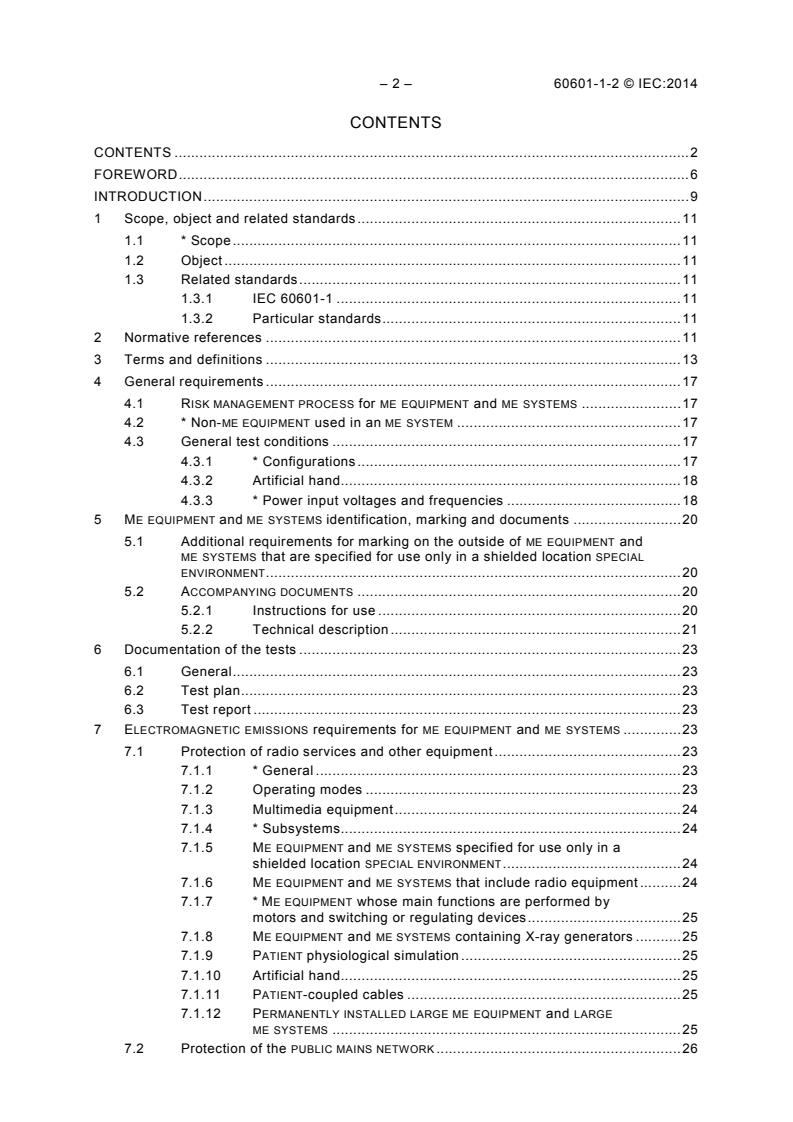
– 2 – 60601-1-2 © IEC:2014
CONTENTS
CONTENTS . 2
FOREWORD . 6
INTRODUCTION . 9
1 Scope, object and related standards . 11
1.1 * Scope . 11
1.2 Object . 11
1.3 Related standards . 11
1.3.1 IEC 60601-1 . 11
1.3.2 Particular standards . 11
2 Normative references . 11
3 Terms and definitions . 13
4 General requirements . 17
4.1 RISK MANAGEMENT PROCESS for ME EQUIPMENT and ME SYSTEMS . 17
4.2 * Non-ME EQUIPMENT used in an ME SYSTEM . 17
4.3 General test conditions . 17
4.3.1 * Configurations . 17
4.3.2 Artificial hand. 18
4.3.3 * Power input voltages and frequencies . 18
5 ME EQUIPMENT and ME SYSTEMS identification, marking and documents . 20
5.1 Additional requirements for marking on the outside of ME EQUIPMENT and
ME SYSTEMS that are specified for use only in a shielded location SPECIAL
ENVIRONMENT . 20
5.2 ACCOMPANYING DOCUMENTS . 20
5.2.1 Instructions for use . 20
5.2.2 Technical description . 21
6 Documentation of the tests . 23
6.1 General . 23
6.2 Test plan . 23
6.3 Test report . 23
7 ELECTROMAGNETIC EMISSIONS requirements for ME EQUIPMENT and ME SYSTEMS . 23
7.1 Protection of radio services and other equipment . 23
7.1.1 * General . 23
7.1.2 Operating modes . 23
7.1.3 Multimedia equipment . 24
7.1.4 * Subsystems . 24
7.1.5 ME EQUIPMENT and ME SYSTEMS specified for use only in a
shielded location SPECIAL ENVIRONMENT . 24
7.1.6 ME EQUIPMENT and ME SYSTEMS that include radio equipment . 24
7.1.7 * ME EQUIPMENT whose main functions are performed by
motors and switching or regulating devices . 25
7.1.8 ME EQUIPMENT and ME SYSTEMS containing X-ray generators . 25
7.1.9 PATIENT physiological simulation . 25
7.1.10 Artificial hand. 25
7.1.11 PATIENT-coupled cables . 25
7.1.12 PERMANENTLY INSTALLED LARGE ME EQUIPMENT and LARGE
ME SYSTEMS . 25
7.2 Protection of the PUBLIC MAINS NETWORK . 26
60601-1-2 © IEC:2014 – 3 –
7.2.1 * Harmonic distortion . 26
7.2.2 * Voltage fluctuations and flicker . 26
7.3 EMISSIONS requirements summary . 26
8 Electromagnetic IMMUNITY requirements for ME EQUIPMENT and ME SYSTEMS . 27
8.1 * General . 27
8.2 PATIENT physiological simulation . 30
8.3 Termination of PATIENT-COUPLED parts . 30
8.4 HAND-HELD ME EQUIPMENT and parts intended to be HAND-HELD . 30
8.5 * Subsystems . 31
8.6 PERMANENTLY INSTALLED LARGE ME EQUIPMENT and LARGE ME SYSTEMS . 31
8.7 * Operating modes . 31
8.8 * Non-ME EQUIPMENT . 32
8.9 * IMMUNITY TEST LEVELS . 32
8.10 * IMMUNITY to proximity fields from RF wireless communications
equipment . 39
9 * Test report . 41
Annex A (informative) General guidance and rationale . 43
A.1 Safety and performance . 43
A.2 Testing of normally non-observable functions. 43
A.3 Rationale for particular clauses and subclauses . 43
Annex B (informative) Guide to marking and labelling requirements for ME EQUIPMENT
and ME SYSTEMS . 57
B.1 Marking on the outside of ME EQUIPMENT, ME SYSTEMS or their parts . 57
B.2 ACCOMPANYING DOCUMENTS, instructions for use . 57
B.3 ACCOMPANYING DOCUMENTS, technical description . 57
Annex C (informative) Guidance in classification according to CISPR 11 . 59
C.1 General . 59
C.2 Separation into groups . 59
C.3 Division into classes . 60
Annex D (informative) Guidance in the application of IEC 60601-1-2 to particular
standards . 61
D.1 General . 61
D.2 Recommended modifications . 61
D.2.1 Testing requirements . 61
D.2.2 ACCOMPANYING DOCUMENTS . 61
D.3 Cautions . 61
Annex E (informative) Determination of IMMUNITY TEST LEVELS for SPECIAL
ENVIRONMENTS . 63
E.1 General . 63
E.2 Summary of method for E.1 a) . 66
E.3 Summary of method for E.1 b), c) and d) . 66
E.4 Determination of EM DISTURBANCE level reduction . 66
E.5 Assessment of EM DISTURBANCE sources . 66
E.6 Reasonably foreseeable maximum EM DISTURBANCE levels . 67
E.7 Determination of IMMUNITY TEST LEVELS . 67
E.8 RF radiators in SPECIAL ENVIRONMENTS . 67
E.9 Examples of mitigations and special conditions . 68
Annex F (informative) RISK MANAGEMENT for BASIC SAFETY and ESSENTIAL PERFORMANCE
with regard to ELECTROMAGNETIC DISTURBANCES . 69
– 4 – 60601-1-2 © IEC:2014
F.1 General . 69
F.2 General requirements for RISK MANAGEMENT . 70
F.3 RISK ANALYSIS . 71
F.4 RISK EVALUATION . 74
F.5 RISK CONTROL . 75
F.5.1 RISK CONTROL option analysis . 75
F.5.2 Implementation of RISK CONTROL measure(s). 75
F.5.3 RESIDUAL RISK EVALUATION . 75
F.5.4 RISK/benefit analysis . 76
F.5.5 RISKS arising from RISK CONTROL measures . 76
F.5.6 Completeness of RISK CONTROL . 76
F.6 Evaluation of overall RESIDUAL RISK acceptability . 76
F.7 RISK MANAGEMENT report . 76
F.8 Production and post-production information . 77
Annex G (informative) Guidance: Test plan . 78
G.1 Test plan contents . 78
Annex H (informative) PATIENT-coupled cables EMISSIONS . 80
H.1 * Protection of other equipment from PATIENT cable conducted EMISSIONS . 80
H.2 Test method . 80
H.3 Rationale . 80
Annex I (informative) Identification of IMMUNITY pass/fail criteria . 82
I.1 General . 82
I.2 IMMUNITY pass/fail criteria principles . 82
I.2.1 General . 82
I.2.2 IMMUNITY pass/fail criteria for non-ME EQUIPMENT used in an
ME SYSTEM . 82
I.2.3 IMMUNITY pass/fail criteria determination . 82
I.3 IMMUNITY pass/fail criteria examples . 83
I.3.1 General examples . 83
I.3.2 Example of IMMUNITY pass/fail criteria for a radiological table
system . 84
Bibliography . 86
Index of defined terms used in this collateral standard . 89
Figure 1 – RC element of the artificial hand . 18
Figure 2 – PORTS of ME EQUIPMENT and ME SYSTEMS . 27
Figure 3 – Examples of environments of INTENDED USE . 33
Figure A.1 – Examples of PORTS (from IEC 61000-6-1:2005) . 47
Figure A.2 – IEC 61000-4-2 Figure A.1 – Maximum values of electrostatic voltages to
which OPERATORS can be charged while in contact with the materials mentioned in A.2 . 54
Figure E.1 – Test plan development flow when SPECIAL ENVIRONMENTS are known . 64
Figure E.2 – Sub-process for determination of IMMUNITY TEST LEVELS for SPECIAL
ENVIRONMENTS . 65
Figure F.1 – Function of this collateral standard in the RISK MANAGEMENT PROCESS . 69
Figure F.2 – Examples of multiple VERIFICATION methods for improving confidence in
RISK levels . 70
Figure H.1 – Setup for PATIENT-COUPLED cables conducted EMISSIONS test for
ME EQUIPMENT and ME SYSTEMS that conform to IEC 60601-2-27 . 81
60601-1-2 © IEC:2014 – 5 –
Table 1 – Power input voltages and frequencies during the tests (1 of 2) . 19
Table 2 – EMISSION limits per environment . 26
Table 3 – Procedure for continuing to test ME EQUIPMENT or ME SYSTEMS that are
damaged by an IMMUNITY test signal . 28
Table 4 – * ENCLOSURE PORT . 34
Table 5 – * Input a.c. power PORT (1 of 2) . 35
Table 6 – Input d.c. power PORT . 37
Table 7 – * PATIENT coupling PORT . 38
Table 8 – Signal input/output parts PORT . 39
Table 9 – Test specifications for ENCLOSURE PORT IMMUNITY to RF wireless
communications equipment . 40
Table 10 – * Minimum test report contents (1 of 2) . 41
Table A.1 – IEC/TR 61000-2-5 information considered in specifying IMMUNITY TEST
LEVELS for each IMMUNITY TEST . 49
Table B.1 – Marking on the outside of ME EQUIPMENT, ME SYSTEMS or their parts . 57
Table B.2 – ACCOMPANYING DOCUMENTS, instructions for use . 57
Table B.3 – ACCOMPANYING DOCUMENTS, technical description . 58
Table E.1 – Examples of specific mitigations / environmental conditions . 68
Table F.1 – Examples of EM phenomena that should be considered in a RISK ANALYSIS . 72
Table G.1 – Recommended minimum test plan contents (1 of 2) . 78
Table H.1 – PATIENT-COUPLED conducted EMISSIONS recommended limit. 80
Table I.1 – Example of IMMUNITY pass criteria for a radiological table system . 85
– 6 – 60601-1-2 © IEC:2014
INTERNATIONAL ELECTROTECHNICAL COMMISSION
____________
MEDICAL ELECTRICAL EQUIPMENT –
Part 1-2: General requirements for basic safety and essential
performance – Collateral Standard: Electromagnetic
disturbances – Requirements and tests
FOREWORD
1) The International Electrotechnical Commission (IEC) is a worldwide organization for standardization comprising
all national electrotechnical committees (IEC National Committees). The object of IEC is to promote
international co-operation on all questions concerning standardization in the electrical and electronic fields. To
this end and in addition to other activities, IEC publishes International Standards, Technical Specifications,
Technical Reports, Publicly Available Specifications (PAS) and Guides (hereafter referred to as “IEC
Publication(s)”). Their preparation is entrusted to technical committees; any IEC National Committee interested
in the subject dealt with may participate in this preparatory work. International, governmental and non-
governmental organizations liaising with the IEC also participate in this preparation. IEC collaborates closely
with the International Organization for Standardization (ISO) in accordance with conditions determined by
agreement between the two organizations.
2) The formal decisions or agreements of IEC on technical matters express, as nearly as possible, an international
consensus of opinion on the relevant subjects since each technical committee has representation from all
interested IEC National Committees.
3) IEC Publications have the form of recommendations for international use and are accepted by IEC National
Committees in that sense. While all reasonable efforts are made to ensure that the technical content of IEC
Publications is accurate, IEC cannot be held responsible for the way in which they are used or for any
misinterpretation by any end user.
4) In order to promote international uniformity, IEC National Committees undertake to apply IEC Publications
transparently to the maximum extent possible in their national and regional publications. Any divergence
between any IEC Publication and the corresponding national or regional publication shall be clearly indicated in
the latter.
5) IEC itself does not provide any attestation of conformity. Independent certification bodies provide conformity
assessment services and, in some areas, access to IEC marks of conformity. IEC is not responsible for any
services carried out by independent certification bodies.
6) All users should ensure that they have the latest edition of this publication.
7) No liability shall attach to IEC or its directors, employees, servants or agents including individual experts and
members of its technical committees and IEC National Committees for any personal injury, property damage or
other damage of any nature whatsoever, whether direct or indirect, or for costs (including legal fees) and
expenses arising out of the publication, use of, or reliance upon, this IEC Publication or any other IEC
Publications.
8) Attention is drawn to the Normative references cited in this publication. Use of the referenced publications is
indispensable for the correct application of this publication.
9) Attention is drawn to the possibility that some of the elements of this IEC Publication may be the subject of
patent rights. IEC shall not be held responsible for identifying any or all such patent rights.
International standard IEC 60601-1-2 has been prepared by IEC subcommittee 62A: Common
aspects of electrical equipment used in medical practice of IEC technical committee 62:
Electrical equipment in medical practice.
This fourth edition cancels and replaces the third edition of IEC 60601-1-2, published in 2007,
and constitutes a technical revision.
This fourth edition constitutes a collateral standard to IEC 60601-1: Medical electrical
equipment – Part 1: General requirements for safety and essential performance hereafter
referred to as the general standard.
The most significant changes with respect to the previous edition include the following
modifications:
60601-1-2 © IEC:2014 – 7 –
– specification of IMMUNITY TEST LEVELS according to the environments of INTENDED USE,
categorized according to locations that are harmonized with IEC 60601-1-11: the
professional healthcare facility environment, the HOME HEALTHCARE ENVIRONMENT and
SPECIAL ENVIRONMENTS;
– specification of tests and test levels to improve the safety of MEDICAL ELECTRICAL
EQUIPMENT and MEDICAL ELECTRICAL SYSTEMS when PORTABLE RF communications
equipment is used closer to the MEDICAL ELECTRICAL EQUIPMENT than was recommended
based on the IMMUNITY TEST LEVELS that were specified in the third edition;
– specification of IMMUNITY tests and IMMUNITY TEST LEVELS according to the PORTS of the
MEDICAL ELECTRICAL EQUIPMENT or MEDICAL ELECTRICAL SYSTEM;
– specification of IMMUNITY TEST LEVELS based on the reasonably foreseeable maximum level
of ELECTROMAGNETIC DISTURBANCES in the environments of INTENDED USE, resulting in some
IMMUNITY TEST LEVELS that are higher than in the previous edition; and
– better harmonization with the RISK concepts of BASIC SAFETY and ESSENTIAL PERFORMANCE,
including deletion of the defined term “life-supporting”;
and the following additions:
– guidance for determination of IMMUNITY TEST LEVELS for SPECIAL ENVIRONMENTS;
– guidance for adjustment of IMMUNITY TEST LEVELS when special considerations of
mitigations or INTENDED USE are applicable;
– guidance on RISK MANAGEMENT for BASIC SAFETY and ESSENTIAL PERFORMANCE with regard
to ELECTROMAGNETIC DISTURBANCES; and
– guidance on identification of IMMUNITY pass/fail criteria.
The text of this collateral standard is based on the following documents:
FDIS Report on voting
62A/916/FDIS 62A/924/RVD
Full information on the voting for the approval of this standard can be found in the report on
voting indicated in the above table.
This publication has been drafted in accordance with the ISO/IEC Directives, Part 2.
In the 60601 series of publications, collateral standards specify general requirements for
safety applicable to:
– a subgroup of MEDICAL ELECTRICAL EQUIPMENT (e.g. radiological equipment); or
– a specific characteristic of all MEDICAL ELECTRICAL EQUIPMENT, not fully addressed in the
general standard (e.g. ALARM SYSTEMS).
In this collateral standard, the following print types are used:
– Requirements and definitions: roman type.
– Test specifications: italic type.
– Informative material appearing outside of tables, such as notes, examples and references: in smaller type.
Normative text of tables is also in a smaller type.
– TERMS DEFINED IN CLAUSE 3 OF THE GENERAL STANDARD, IN THIS COLLATERAL STANDARD OR AS
NOTED: SMALL CAPITALS.
In referring to the structure of this collateral standard, the term
– “clause” means one of the numbered divisions within the table of contents, inclusive of all
subdivisions (e.g. Clause 1 includes 1.1, 1.2, etc.);
– 8 – 60601-1-2 © IEC:2014
– “subclause” means a numbered subdivision of a clause (e.g. 1.1, 1.2 and 1.3.1 are all
subclauses of Clause 1).
References to clauses within this collateral standard are preceded by the term “Clause”
followed by the clause number. References to subclauses within this collateral standard are
by number only.
In this collateral standard, the conjunctive “or” is used as an “inclusive or” so a statement is
true if any combination of the conditions is true.
The verbal forms used in this collateral standard conform to usage described in Annex H of
the ISO/IEC Directives, Part 2. For the purposes of this collateral standard, the auxiliary verb:
– “shall” means that compliance with a requirement or a test is mandatory for compliance
with this collateral standard;
– “should” means that compliance with a requirement or a test is recommended but is not
mandatory for compliance with this collateral standard;
– “may” is used to describe a permissible way to achieve compliance with a requirement or
test.
An asterisk (*) as the first character of a title or at the beginning of a paragraph or table title
indicates that there is guidance or rationale related to that item in Annex A.
A list of all parts of the IEC 60601 series, published under the general title Medical electrical
equipment, can be found on the IEC website.
The committee has decided that the contents of this publication will remain unchanged until
the stability date indicated on the IEC web site under "http://webstore.iec.ch" in the data
related to the specific publication. At this date, the publication will be
reconfirmed,
withdrawn,
replaced by a revised edition, or
amended.
NOTE The attention of National Committees is drawn to the fact that equipment manufacturers and testing
organizations may need a transitional period following publication of a new, amended or revised IEC publication in
which to make products in accordance with the new requirements and to equip them for conducting new or revised
tests. It is the recommendation of the committee that the content of this publication be adopted for mandatory
implementation nationally not earlier than 3 years from the date of publication.
IMPORTANT – The “colour inside” logo on the cover page of this publication indicates
that it contains colours which are considered to be useful for the correct understanding
of its contents. Users should therefore print this publication using a colour printer.
60601-1-2 © IEC:2014 – 9 –
INTRODUCTION
The need for establishing specific standards for BASIC SAFETY and ESSENTIAL PERFORMANCE
with regard to ELECTROMAGNETIC DISTURBANCES for MEDICAL ELECTRICAL EQUIPMENT and
MEDICAL ELECTRICAL SYSTEMS is well recognized.
The requirements and tests specified by this collateral standard are generally applicable to
MEDICAL ELECTRICAL EQUIPMENT and MEDICAL ELECTRICAL SYSTEMS as defined in 3.63 and 3.64
in the general standard. For certain types of MEDICAL ELECTRICAL EQUIPMENT and MEDICAL
ELECTRICAL SYSTEMS, these requirements might need to be modified by the special
requirements of a particular standard. Writers of particular standards are encouraged to refer
to Annex D for guidance in the application of this collateral standard.
MEDICAL ELECTRICAL EQUIPMENT and MEDICAL ELECTRICAL SYSTEMS are expected to provide their
BASIC SAFETY and ESSENTIAL PERFORMANCE without interfering with other equipment and
systems in the ELECTROMAGNETIC ENVIRONMENTS in which they are intended by their
MANUFACTURER to be used. The application of ELECTROMAGNETIC EMISSION standards is
essential for the protection of:
– safety services;
– other MEDICAL ELECTRICAL EQUIPMENT and MEDICAL ELECTRICAL SYSTEMS;
– non-ME EQUIPMENT (e.g. computers);
– telecommunications (e.g. radio/TV, telephone, radio-navigation).
Of even more importance, the application of ELECTROMAGNETIC IMMUNITY standards is
essential to ensure safety of MEDICAL ELECTRICAL EQUIPMENT and MEDICAL ELECTRICAL SYSTEMS.
To ensure safety, MEDICAL ELECTRICAL EQUIPMENT and MEDICAL ELECTRICAL SYSTEMS are
expected to provide their BASIC SAFETY and ESSENTIAL PERFORMANCE in the ELECTROMAGNETIC
ENVIRONMENTS of INTENDED USE throughout their EXPECTED SERVICE LIFE.
This collateral standard specifies IMMUNITY TEST LEVELS for safety for ME EQUIPMENT and ME
SYSTEMS intended by their MANUFACTURER for use in the professional healthcare facility
environment or the HOME HEALTHCARE ENVIRONMENT. It recognizes that RF wireless
communications equipment can no longer be prohibited from most PATIENT ENVIRONMENTS
because in many cases it has become essential to the efficient provision of healthcare. This
collateral standard also recognizes that, for certain SPECIAL ENVIRONMENTS, higher or lower
IMMUNITY TEST LEVELS than those specified for the professional healthcare facility environment
and the HOME HEALTHCARE ENVIRONMENT might be appropriate. This collateral standard
provides guidance in determining appropriate IMMUNITY TEST LEVELS for SPECIAL ENVIRONMENTS.
The IMMUNITY TEST LEVELS specified for BASIC SAFETY and ESSENTIAL PERFORMANCE are based
on the reasonably foreseeable maximum of the ELECTROMAGNETIC DISTURBANCE phenomena in
the applicable environments of INTENDED USE.
Not all ELECTROMAGNETIC DISTURBANCE phenomena are covered by this collateral standard, as
it is not practical to do so. MANUFACTURERS of MEDICAL ELECTRICAL EQUIPMENT and MEDICAL
ELECTRICAL SYSTEMS need to address this during their RISK ASSESSMENT and evaluate if other
ELECTROMAGNETIC DISTURBANCE phenomena could make their product unsafe. This evaluation
should be based on the environments of INTENDED USE and the reasonably foreseeable
maximum levels of ELECTROMAGNETIC DISTURBANCES expected throughout the EXPECTED
SERVICE LIFE.
This collateral standard recognizes that the MANUFACTURER has the responsibility to design
and perform VERIFICATION of MEDICAL ELECTRICAL EQUIPMENT and MEDICAL ELECTRICAL SYSTEMS
to meet the requirements of this collateral standard and to disclose information to the
RESPONSIBLE ORGANIZATION or OPERATOR so that the MEDICAL ELECTRICAL EQUIPMENT or MEDICAL
ELECTRICAL SYSTEM will remain safe throughout its EXPECTED SERVICE LIFE.
– 10 – 60601-1-2 © IEC:2014
This collateral standard provides guidance in incorporating considerations regarding
ELECTROMAGNETIC DISTURBANCES into the RISK MANAGEMENT PROCESS.
This collateral standard is based on existing IEC standards prepared by subcommittee 62A,
technical committee 77 (ELECTROMAGNETIC COMPATIBILITY between electrical equipment
including networks), ISO (International standards organization), and CISPR (International
special committee on radio interference).
60601-1-2 © IEC:2014 – 11 –
MEDICAL ELECTRICAL EQUIPMENT –
Part 1-2: General requirements for basic safety and essential
performance – Collateral Standard: Electromagnetic
disturbances – Requirements and tests
1 Scope, object and related standards
1.1 * Scope
This International Standard applies to the BASIC SAFETY and ESSENTIAL PERFORMANCE of
MEDICAL ELECTRICAL EQUIPMENT and MEDICAL ELECTRICAL SYSTEMS, hereafter referred to as
ME EQUIPMENT and ME SYSTEMS.
This collateral standard applies to the BASIC SAFETY and ESSENTIAL PERFORMANCE of
ME EQUIPMENT and ME SYSTEMS in the presence of ELECTROMAGNETIC DISTURBANCES and to
ELECTROMAGNETIC DISTURBANCES emitted by ME EQUIPMENT and ME SYSTEMS.
BASIC SAFETY with regard to ELECTROMAGNETIC DISTURBANCES is applicable to all ME EQUIPMENT
and ME SYSTEMS.
1.2 Object
The object of this collateral standard is to specify general requirements and tests for BASIC
SAFETY and ESSENTIAL PERFORMANCE with regard to ELECTROMAGNETIC DISTURBANCES and for
ELECTROMAGNETIC EMISSIONS of ME EQUIPMENT and ME SYSTEMS. They are in addition to the
requirements of the general standard and serve as the basis for particular standards.
1.3 Related standards
1.3.1 IEC 60601-1
For ME EQUIPMENT and ME SYSTEMS, this collateral standard complements IEC 60601-1.
When referring to IEC 60601-1 or to this collateral standard, either individually or in
combination, the following conventions are used:
– "the general standard" designates IEC 60601-1 alone (IEC 60601-1:2005+A1:2012);
– "this collateral standard" designates IEC 60601-1-2 alone;
– "this standard" designates the combination of the general standard and this collateral
standard.
1.3.2 Particular standards
A requirement in a particular standard takes priority over the corresponding requirement in
this collateral standard.
2 Normative references
The following documents, in whole or in part, are normatively referenced in this document and
are indispensable for its application. For dated references, only the edition cited applies. For
undated references, the latest edition of the referenced document (including any
amendments) applies.
– 12 – 60601-1-2 © IEC:2014
NOTE The way in which these referenced documents are cited in normative requirements determines the extent
(in whole or in part) to which they apply.
1)
IEC 60601-1:2005 , Medical electrical equipment – Part 1: General requirements for basic
safety and essential performance
Amendment 1:2012
2 )
IEC 60601-1-8:2006 , Medical electrical equipment – Part 1-8: General requirements for
basic safety and essential performance – Collateral standard: General requirements, tests
and guidance for alarm systems in medical electrical equipment and medical electrical
systems
Amendment 1:2012
IEC 60601-1-11:2010, Medical electrical equipment – Part 1-11: General requirements for
basic safety and essential performance – Collateral Standard: Requirements for medical
electrical equipment and medical electrical systems used in the home healthcare environment
3)
IEC 60601-1-12__ Medical electrical equipment – Part 1-12: General requirements for basic
safety and essential performance – Collateral Standard: Requirements for medical electrical
equipment and medical electrical systems intended for use in the emergency medical services
environment
IEC 60601-2-2:2009, Medical electrical equipment – Part 2-2: Particular requirements for the
basic safety and essential performance of high frequency surgical equipment and high
frequency surgical accessories
IEC 60601-2-3:2012, Medical electrical equipment – Part 2-3: Particular requirements for the
basic safety and essential performance of short-wave therapy equipment
4)
, Electromagnetic compatibility (EMC) – Part 3-2: Limits – Limits for
IEC 61000-3-2:2005
harmonic current emissions (equipment input current ≤ 16 A per phase)
Amendment 1:2008
Amendment 2:2009
IEC 61000-3-3:2013, Electromagnetic compatibility (EMC) – Part 3-3: Limits – Limitation
of voltage changes, voltage fluctuations and flicker in public low-voltage supply systems, for
equipment with rated current ≤ 16 A per phase and not subject to conditional connection
IEC 61000-4-2:2008, Electromagnetic compatibility (EMC) – Part 4-2: Testing and
measurement techniques – Electrostatic discharge immunity test
)
IEC 61000-4-3:2006 , Electromagnetic compatibility (EMC) – Part 4-3: Testing and measure-
ment techniques – Radiated, radio-frequency, electromagnetic field immunity test
Amendment 1:2007
Amendment 2:2010
IEC 61000-4-4:2012, Electromagnetic compatibility (EMC) – Part 4-4: Testing and
measurement techniques – Electrical fast transient/burst immunity test
___________
1) There exists a consolidated edition 3.1, including IEC 60601-1:2005 and its Amendment 1:2012.
2) There exists a consolidated edition 2.1, including IEC 60601-1-8:2006 and its Amendment 1:2012.
3) To be published.
4) There exists a consolidated edition 3.2, including IEC 61000-3-2:2005 and its Amendment 1:2008 and
Amendment 2:2009.
5) There exists a consolidated edition 3.2, including IEC 61000-4-3:2006 and its Amendment 1:2007 and
Amendment 2:2010.
60601-1-2 © IEC:2014 – 13 –
IEC 61000-4-5:2005, Electromagnetic compatibility (EMC) – Part 4-5: Testing and
measurement techniques – Surge immunity test
IEC 61000-4-6:2013, Electromagnetic compatibility (EMC) – Part 4-6: Testing and
measurem
...
IEC 60601-1-2 ®
Edition 4.1 2020-09
CONSOLIDATED VERSION
INTERNATIONAL
STANDARD
NORME
INTERNATIONALE
colour
inside
Medical electrical equipment –
Part 1-2: General requirements for basic safety and essential performance –
Collateral Standard: Electromagnetic disturbances – Requirements and tests
Appareils électromédicaux –
Partie 1-2: Exigences générales pour la sécurité de base et les performances
essentielles – Norme collatérale: Perturbations électromagnétiques – Exigences
et essais
IEC 60601-1-2:2014-02+AMD1:2021-09 CSV(en-fr)
All rights reserved. Unless otherwise specified, no part of this publication may be reproduced or utilized in any form
or by any means, electronic or mechanical, including photocopying and microfilm, without permission in writing from
either IEC or IEC's member National Committee in the country of the requester. If you have any questions about IEC
copyright or have an enquiry about obtaining additional rights to this publication, please contact the address below or
your local IEC member National Committee for further information.
Droits de reproduction réservés. Sauf indication contraire, aucune partie de cette publication ne peut être reproduite
ni utilisée sous quelque forme que ce soit et par aucun procédé, électronique ou mécanique, y compris la photocopie
et les microfilms, sans l'accord écrit de l'IEC ou du Comité national de l'IEC du pays du demandeur. Si vous avez des
questions sur le copyright de l'IEC ou si vous désirez obtenir des droits supplémentaires sur cette publication, utilisez
les coordonnées ci-après ou contactez le Comité national de l'IEC de votre pays de résidence.
IEC Central Office Tel.: +41 22 919 02 11
3, rue de Varembé info@iec.ch
CH-1211 Geneva 20 www.iec.ch
Switzerland
About the IEC
The International Electrotechnical Commission (IEC) is the leading global organization that prepares and publishes
International Standards for all electrical, electronic and related technologies.
About IEC publications
The technical content of IEC publications is kept under constant review by the IEC. Please make sure that you have the
latest edition, a corrigendum or an amendment might have been published.
IEC publications search - webstore.iec.ch/advsearchform IEC online collection - oc.iec.ch
The advanced search enables to find IEC publications by a Discover our powerful search engine and read freely all the
variety of criteria (reference number, text, technical publications previews. With a subscription you will always
committee, …). It also gives information on projects, replaced have access to up to date content tailored to your needs.
and withdrawn publications.
Electropedia - www.electropedia.org
IEC Just Published - webstore.iec.ch/justpublished
The world's leading online dictionary on electrotechnology,
Stay up to date on all new IEC publications. Just Published
containing more than 22 000 terminological entries in English
details all new publications released. Available online and
and French, with equivalent terms in 18 additional languages.
once a month by email.
Also known as the International Electrotechnical Vocabulary
(IEV) online.
IEC Customer Service Centre - webstore.iec.ch/csc
If you wish to give us your feedback on this publication or
need further assistance, please contact the Customer Service
Centre: sales@iec.ch.
A propos de l'IEC
La Commission Electrotechnique Internationale (IEC) est la première organisation mondiale qui élabore et publie des
Normes internationales pour tout ce qui a trait à l'électricité, à l'électronique et aux technologies apparentées.
A propos des publications IEC
Le contenu technique des publications IEC est constamment revu. Veuillez vous assurer que vous possédez l’édition la
plus récente, un corrigendum ou amendement peut avoir été publié.
Recherche de publications IEC - IEC online collection - oc.iec.ch
webstore.iec.ch/advsearchform Découvrez notre puissant moteur de recherche et consultez
La recherche avancée permet de trouver des publications IEC gratuitement tous les aperçus des publications. Avec un
en utilisant différents critères (numéro de référence, texte, abonnement, vous aurez toujours accès à un contenu à jour
comité d’études, …). Elle donne aussi des informations sur adapté à vos besoins.
les projets et les publications remplacées ou retirées.
Electropedia - www.electropedia.org
IEC Just Published - webstore.iec.ch/justpublished
Le premier dictionnaire d'électrotechnologie en ligne au
Restez informé sur les nouvelles publications IEC. Just
monde, avec plus de 22 000 articles terminologiques en
Published détaille les nouvelles publications parues.
anglais et en français, ainsi que les termes équivalents dans
Disponible en ligne et une fois par mois par email.
16 langues additionnelles. Egalement appelé Vocabulaire
Electrotechnique International (IEV) en ligne.
Service Clients - webstore.iec.ch/csc
Si vous désirez nous donner des commentaires sur cette
publication ou si vous avez des questions contactez-nous:
sales@iec.ch.
IEC 60601-1-2 ®
Edition 4.1 2020-09
CONSOLIDATED VERSION
INTERNATIONAL
STANDARD
NORME
INTERNATIONALE
colour
inside
Medical electrical equipment –
Part 1-2: General requirements for basic safety and essential performance –
Collateral Standard: Electromagnetic disturbances – Requirements and tests
Appareils électromédicaux –
Partie 1-2: Exigences générales pour la sécurité de base et les performances
essentielles – Norme collatérale: Perturbations électromagnétiques – Exigences
et essais
INTERNATIONAL
ELECTROTECHNICAL
COMMISSION
COMMISSION
ELECTROTECHNIQUE
INTERNATIONALE
ICS 11.040.01; 33.100.10; 33.100.20 ISBN 978-2-8322-4271-1
IEC 60601-1-2 ®
Edition 4.1 2020-09
CONSOLIDATED VERSION
REDLINE VERSION
VERSION REDLINE
colour
inside
Medical electrical equipment –
Part 1-2: General requirements for basic safety and essential performance –
Collateral Standard: Electromagnetic disturbances – Requirements and tests
Appareils électromédicaux –
Partie 1-2: Exigences générales pour la sécurité de base et les performances
essentielles – Norme collatérale: Perturbations électromagnétiques – Exigences
et essais
IEC 60601-1-2:2014-02+AMD1:2021-09 CSV(en-fr)
– 2 – IEC 60601-1-2:2014+AMD1:2020 CSV
© IEC 2020
CONTENTS
FOREWORD . 6
INTRODUCTION . 9
INTRODUCTION to Amendment 1 . 10
1 Scope, object and related standards . 11
1.1 * Scope . 11
1.2 Object . 11
1.3 Related standards . 11
1.3.1 IEC 60601-1 . 11
1.3.2 Particular standards . 11
2 Normative references . 11
3 Terms and definitions . 14
4 General requirements . 17
4.1 RISK MANAGEMENT PROCESS for ME EQUIPMENT and ME SYSTEMS . 17
4.2 * Non-ME EQUIPMENT used in an ME SYSTEM . 17
4.3 General test conditions . 18
4.3.1 * Configurations . 18
4.3.2 Artificial hand. 18
4.3.3 * Power input voltages and frequencies . 19
5 ME EQUIPMENT and ME SYSTEMS identification, marking and documents . 22
5.1 Additional requirements for marking on the outside of ME EQUIPMENT and
ME SYSTEMS that are specified for use only in a shielded location SPECIAL
ENVIRONMENT . 22
5.2 ACCOMPANYING DOCUMENTS . 22
5.2.1 Instructions for use . 22
5.2.2 Technical description . 23
6 Documentation of the tests . 25
6.1 General . 25
6.2 Test plan . 25
6.3 Test report . 25
7 ELECTROMAGNETIC EMISSIONS requirements for ME EQUIPMENT and ME SYSTEMS . 25
7.1 Protection of radio services and other equipment . 25
7.1.1 * General . 25
7.1.2 Operating modes . 25
7.1.3 Multimedia equipment . 25
7.1.4 * Subsystems . 26
7.1.5 ME EQUIPMENT and ME SYSTEMS specified for use only in a
shielded location SPECIAL ENVIRONMENT . 26
7.1.6 ME EQUIPMENT and ME SYSTEMS that include radio equipment . 26
7.1.7 * ME EQUIPMENT whose main functions are performed by
motors and switching or regulating devices . 26
7.1.8 ME EQUIPMENT and ME SYSTEMS containing X-ray generators . 27
7.1.9 PATIENT physiological simulation . 27
7.1.10 Artificial hand. 27
7.1.11 PATIENT-coupled cables . 27
7.1.12 * PERMANENTLY INSTALLED LARGE ME EQUIPMENT and LARGE
ME SYSTEMS . 27
IEC 60601-1-2:2014+AMD1:2020 CSV – 3 –
© IEC 2020
7.2 Protection of the PUBLIC MAINS NETWORK . 27
7.2.1 * Harmonic distortion . 27
7.2.2 * Voltage fluctuations and flicker . 28
7.3 EMISSIONS requirements summary . 28
8 Electromagnetic IMMUNITY requirements for ME EQUIPMENT and ME SYSTEMS . 28
8.1 * General . 28
8.2 PATIENT physiological simulation . 32
8.3 Termination of PATIENT-COUPLED parts . 32
8.4 HAND-HELD ME EQUIPMENT and parts intended to be HAND-HELD . 32
8.5 * Subsystems . 33
8.6 * PERMANENTLY INSTALLED LARGE ME EQUIPMENT and LARGE ME SYSTEMS . 33
8.7 * Operating modes . 33
8.8 * Non-ME EQUIPMENT . 34
8.9 * IMMUNITY TEST LEVELS . 34
8.10 * IMMUNITY to proximity fields from RF wireless communications
equipment . 41
8.11 * IMMUNITY to proximity magnetic fields in the frequency range 9 kHz to
13,56 MHz . 43
9 * Test report . 44
Annex A (informative) General guidance and rationale . 47
A.1 Safety and performance . 47
A.2 Testing of normally non-observable functions. 47
A.3 Rationale for particular clauses and subclauses . 47
Annex B (informative) Guide to marking and labelling requirements for ME EQUIPMENT
and ME SYSTEMS. 71
B.1 Marking on the outside of ME EQUIPMENT, ME SYSTEMS or their parts . 71
B.2 ACCOMPANYING DOCUMENTS, instructions for use . 71
B.3 ACCOMPANYING DOCUMENTS, technical description . 71
Annex C (informative) Guidance in classification according to CISPR 11 . 73
C.1 General . 73
C.2 Separation into groups . 73
C.3 Division into classes . 74
Annex D (informative) Guidance in the application of IEC 60601-1-2 to particular
standards . 75
D.1 General . 75
D.2 Recommended modifications . 75
D.2.1 Testing requirements . 75
D.2.2 ACCOMPANYING DOCUMENTS . 75
D.3 Cautions . 75
Annex E (informative) Determination of IMMUNITY TEST LEVELS for SPECIAL
ENVIRONMENTS . 77
E.1 General . 77
E.2 Summary of method for E.1 a) . 80
E.3 Summary of method for E.1 b), c) and d) . 80
E.4 Determination of EM DISTURBANCE level reduction . 80
E.5 Assessment of EM DISTURBANCE sources . 80
E.6 Reasonably foreseeable maximum EM DISTURBANCE levels . 81
E.7 Determination of IMMUNITY TEST LEVELS . 81
E.8 RF radiators in SPECIAL ENVIRONMENTS . 81
– 4 – IEC 60601-1-2:2014+AMD1:2020 CSV
© IEC 2020
E.9 Examples of mitigations and special conditions . 82
Annex F (informative) RISK MANAGEMENT for BASIC SAFETY and ESSENTIAL PERFORMANCE
with regard to ELECTROMAGNETIC DISTURBANCES .
F.1 General .
F.2 General requirements for RISK MANAGEMENT .
F.3 RISK ANALYSIS .
F.4 RISK EVALUATION .
F.5 RISK CONTROL .
F.5.1 RISK CONTROL option analysis .
F.5.2 Implementation of RISK CONTROL measure(s).
F.5.3 RESIDUAL RISK EVALUATION .
F.5.4 RISK/benefit analysis .
F.5.5 RISKS arising from RISK CONTROL measures .
F.5.6 Completeness of RISK CONTROL .
F.6 Evaluation of overall RESIDUAL RISK acceptability .
F.7 RISK MANAGEMENT report .
F.8 Production and post-production information .
Annex F (informative) Guidance on the application of RISK MANAGEMENT with regard to
ELECTROMAGNETIC DISTURBANCES in this collateral standard . 92
Annex G (informative) Guidance: Test plan . 101
G.1 Test plan contents . 101
Annex H (informative) PATIENT-coupled cables EMISSIONS . 103
H.1 * Protection of other equipment from PATIENT cable conducted EMISSIONS . 103
H.2 Test method . 103
H.3 Rationale . 103
Annex I (informative) Identification of IMMUNITY pass/fail criteria . 105
I.1 General . 105
I.2 IMMUNITY pass/fail criteria principles . 105
I.2.1 General . 105
I.2.2 IMMUNITY pass/fail criteria for non-ME EQUIPMENT used in an
ME SYSTEM . 105
I.2.3 IMMUNITY pass/fail criteria determination . 105
I.3 IMMUNITY pass/fail criteria examples . 106
I.3.1 General examples . 106
I.3.2 Example of IMMUNITY pass/fail criteria for a radiological table
system . 107
Bibliography . 109
Index of defined terms used in this collateral standard . 113
Figure 1 – RC element of the artificial hand . 19
Figure 2 – PORTS of ME EQUIPMENT and ME SYSTEMS . 29
Figure 3 – Examples of environments of INTENDED USE locations within EM
ENVIRONMENTS . 35
Figure A.1 – Examples of PORTS (from IEC 61000-6-1:2005) . 53
Figure A.2 – IEC 61000-4-2 Figure A.1 – Maximum values of electrostatic voltages to
which OPERATORS can be charged while in contact with the materials mentioned in A.2 . 60
Figure A.3 – Steps for evaluation of IMMUNITY to proximity magnetic fields . 65
IEC 60601-1-2:2014+AMD1:2020 CSV – 5 –
© IEC 2020
Figure A.4 – Magnetic field roll-off characteristics along the x-axis for a thin planar coil
and various coil radii . 67
Figure A.5 – Voltage induced in a 1-turn, 6 cm radius coil by a 6 cm radiating coil
operating at 134,2 kHz and H of 82,65 A/m (r.m.s.) . 68
Figure A.6 – Voltage induced in a 1-turn, 2 cm radius coil by a 2 cm radiating coil
operating at 13,56 MHz and H of 7,5 A/m (r.m.s.) . 68
Figure E.1 – Test plan development flow when SPECIAL ENVIRONMENTS are known . 78
Figure E.2 – Sub-process for determination of IMMUNITY TEST LEVELS for SPECIAL
ENVIRONMENTS . 79
Figure F.1 – Function of this collateral standard in the RISK MANAGEMENT PROCESS .
Figure F.2 – Examples of multiple VERIFICATION methods for improving confidence in
RISK levels .
Figure F.1 – RISK MANAGEMENT flow in IEC 60601-1-2 (1 of 3) . 98
Figure H.1 – Setup for PATIENT-COUPLED cables conducted EMISSIONS test for
ME EQUIPMENT and ME SYSTEMS that conform to IEC 60601-2-27 . 104
Table 1 – Power input voltages and frequencies during the tests (1 of 2) . 20
Table 2 – EMISSION limits per environment . 28
Table 3 – Procedure for continuing to test ME EQUIPMENT or ME SYSTEMS that are
damaged by an IMMUNITY test signal . 30
Table 4 – * ENCLOSURE PORT . 36
Table 5 – * Input a.c. power PORT (1 of 2) . 37
Table 6 – Input d.c. power PORT . 39
Table 7 – * PATIENT coupling PORT . 40
Table 8 – Signal input/output parts SIP/SOP PORT . 41
Table 9 – Test specifications for ENCLOSURE PORT IMMUNITY to RF wireless
communications equipment . 42
Table 11 – Test specifications for ENCLOSURE PORT IMMUNITY to proximity magnetic
fields . 44
Table 10 – * Minimum test report contents (1 of 2) . 45
Table A.2 – Example calculations for applying the allowance to test at a single RATED
power input voltage . 49
Table A.1 – IEC/TR 61000-2-5 information considered in specifying IMMUNITY TEST
for each IMMUNITY TEST . 56
LEVELS
Table A.3 – Test specifications for ENCLOSURE PORT IMMUNITY to RF wireless
communications equipment . 63
Table B.1 – Marking on the outside of ME EQUIPMENT, ME SYSTEMS or their parts . 71
Table B.2 – ACCOMPANYING DOCUMENTS, instructions for use . 71
Table B.3 – ACCOMPANYING DOCUMENTS, technical description . 72
Table E.1 – Examples of specific mitigations / environmental conditions . 82
Table F.1 – Examples of EM phenomena that should be considered in a RISK ANALYSIS .
Table F.1 – Specific guidance for subclauses of this collateral standard that reference
RISK MANAGEMENT (1 of 6) . 92
Table G.1 – Recommended minimum test plan contents (1 of 2) . 101
Table H.1 – PATIENT-COUPLED conducted EMISSIONS recommended limit. 103
Table I.1 – Example of IMMUNITY pass criteria for a radiological table system . 108
– 6 – IEC 60601-1-2:2014+AMD1:2020 CSV
© IEC 2020
INTERNATIONAL ELECTROTECHNICAL COMMISSION
____________
MEDICAL ELECTRICAL EQUIPMENT –
Part 1-2: General requirements for basic safety and essential
performance – Collateral Standard: Electromagnetic
disturbances – Requirements and tests
FOREWORD
1) The International Electrotechnical Commission (IEC) is a worldwide organization for standardization comprising
all national electrotechnical committees (IEC National Committees). The object of IEC is to promote
international co-operation on all questions concerning standardization in the electrical and electronic fields. To
this end and in addition to other activities, IEC publishes International Standards, Technical Specifications,
Technical Reports, Publicly Available Specifications (PAS) and Guides (hereafter referred to as “IEC
Publication(s)”). Their preparation is entrusted to technical committees; any IEC National Committee interested
in the subject dealt with may participate in this preparatory work. International, governmental and non-
governmental organizations liaising with the IEC also participate in this preparation. IEC collaborates closely
with the International Organization for Standardization (ISO) in accordance with conditions determined by
agreement between the two organizations.
2) The formal decisions or agreements of IEC on technical matters express, as nearly as possible, an international
consensus of opinion on the relevant subjects since each technical committee has representation from all
interested IEC National Committees.
3) IEC Publications have the form of recommendations for international use and are accepted by IEC National
Committees in that sense. While all reasonable efforts are made to ensure that the technical content of IEC
Publications is accurate, IEC cannot be held responsible for the way in which they are used or for any
misinterpretation by any end user.
4) In order to promote international uniformity, IEC National Committees undertake to apply IEC Publications
transparently to the maximum extent possible in their national and regional publications. Any divergence
between any IEC Publication and the corresponding national or regional publication shall be clearly indicated in
the latter.
5) IEC itself does not provide any attestation of conformity. Independent certification bodies provide conformity
assessment services and, in some areas, access to IEC marks of conformity. IEC is not responsible for any
services carried out by independent certification bodies.
6) All users should ensure that they have the latest edition of this publication.
7) No liability shall attach to IEC or its directors, employees, servants or agents including individual experts and
members of its technical committees and IEC National Committees for any personal injury, property damage or
other damage of any nature whatsoever, whether direct or indirect, or for costs (including legal fees) and
expenses arising out of the publication, use of, or reliance upon, this IEC Publication or any other IEC
Publications.
8) Attention is drawn to the Normative references cited in this publication. Use of the referenced publications is
indispensable for the correct application of this publication.
9) Attention is drawn to the possibility that some of the elements of this IEC Publication may be the subject of
patent rights. IEC shall not be held responsible for identifying any or all such patent rights.
This consolidated version of the official IEC Standard and its amendment has been
prepared for user convenience.
IEC 60601-1-2 edition 4.1 contains the fourth edition (2014-04) [documents 62A/916/FDIS
and 62A/924/RVD] and its amendment 1 (2020-09) [documents 62A/1390/FDIS and
62A/1405/RVD].
In this Redline version, a vertical line in the margin shows where the technical content
is modified by amendment 1. Additions are in green text, deletions are in strikethrough
red text. A separate Final version with all changes accepted is available in this
publication.
IEC 60601-1-2:2014+AMD1:2020 CSV – 7 –
© IEC 2020
International standard IEC 60601-1-2 has been prepared by IEC subcommittee 62A: Common
aspects of electrical equipment used in medical practice of IEC technical committee 62:
Electrical equipment in medical practice.
This fourth edition constitutes a technical revision.
This fourth edition constitutes a collateral standard to IEC 60601-1: Medical electrical
equipment – Part 1: General requirements for safety and essential performance hereafter
referred to as the general standard.
The most significant changes with respect to the previous edition include the following
modifications:
– specification of IMMUNITY TEST LEVELS according to the environments of INTENDED USE,
categorized according to locations that are harmonized with IEC 60601-1-11: the
HOME HEALTHCARE ENVIRONMENT and
professional healthcare facility environment, the
SPECIAL ENVIRONMENTS;
– specification of tests and test levels to improve the safety of MEDICAL ELECTRICAL
EQUIPMENT and MEDICAL ELECTRICAL SYSTEMS when PORTABLE RF communications
MEDICAL ELECTRICAL EQUIPMENT than was recommended
equipment is used closer to the
based on the IMMUNITY TEST LEVELS that were specified in the third edition;
– specification of IMMUNITY tests and IMMUNITY TEST LEVELS according to the PORTS of the
MEDICAL ELECTRICAL EQUIPMENT or MEDICAL ELECTRICAL SYSTEM;
– specification of IMMUNITY TEST LEVELS based on the reasonably foreseeable maximum level
of ELECTROMAGNETIC DISTURBANCES in the environments of INTENDED USE, resulting in some
IMMUNITY TEST LEVELS that are higher than in the previous edition; and
– better harmonization with the RISK concepts of BASIC SAFETY and ESSENTIAL PERFORMANCE,
including deletion of the defined term “life-supporting”;
and the following additions:
IMMUNITY TEST LEVELS for SPECIAL ENVIRONMENTS;
– guidance for determination of
– guidance for adjustment of IMMUNITY TEST LEVELS when special considerations of
mitigations or INTENDED USE are applicable;
– guidance on RISK MANAGEMENT for BASIC SAFETY and ESSENTIAL PERFORMANCE with regard
to ELECTROMAGNETIC DISTURBANCES; and
– guidance on identification of IMMUNITY pass/fail criteria.
This publication has been drafted in accordance with the ISO/IEC Directives, Part 2.
In the 60601 series of publications, collateral standards specify general requirements for
safety applicable to:
– a subgroup of MEDICAL ELECTRICAL EQUIPMENT (e.g. radiological equipment); or
– a specific characteristic of all MEDICAL ELECTRICAL EQUIPMENT, not fully addressed in the
general standard (e.g. ALARM SYSTEMS).
In this collateral standard, the following print types are used:
– Requirements and definitions: roman type.
– Test specifications: italic type.
– Informative material appearing outside of tables, such as notes, examples and references: in smaller type.
Normative text of tables is also in a smaller type.
– TERMS DEFINED IN CLAUSE 3 OF THE GENERAL STANDARD, IN THIS COLLATERAL STANDARD OR AS
NOTED: SMALL CAPITALS.
– 8 – IEC 60601-1-2:2014+AMD1:2020 CSV
© IEC 2020
In referring to the structure of this collateral standard, the term
– “clause” means one of the numbered divisions within the table of contents, inclusive of all
subdivisions (e.g. Clause 1 includes 1.1, 1.2, etc.);
– “subclause” means a numbered subdivision of a clause (e.g. 1.1, 1.2 and 1.3.1 are all
subclauses of Clause 1).
References to clauses within this collateral standard are preceded by the term “Clause”
followed by the clause number. References to subclauses within this collateral standard are
by number only.
In this collateral standard, the conjunctive “or” is used as an “inclusive or” so a statement is
true if any combination of the conditions is true.
The verbal forms used in this collateral standard conform to usage described in Annex H of
the ISO/IEC Directives, Part 2. For the purposes of this collateral standard, the auxiliary verb:
– “shall” means that compliance with a requirement or a test is mandatory for compliance
with this collateral standard;
– “should” means that compliance with a requirement or a test is recommended but is not
mandatory for compliance with this collateral standard;
– “may” is used to describe a permissible way to achieve compliance with a requirement or
test.
An asterisk (*) as the first character of a title or at the beginning of a paragraph or table title
indicates that there is guidance or rationale related to that item in Annex A.
A list of all parts of the IEC 60601 series, published under the general title Medical electrical
equipment, can be found on the IEC website.
The committee has decided that the contents of the base publication and its amendment will
remain unchanged until the stability date indicated on the IEC web site under
"http://webstore.iec.ch" in the data related to the specific publication. At this date, the
publication will be
• reconfirmed,
• withdrawn,
• replaced by a revised edition, or
• amended.
NOTE The attention of National Committees is drawn to the fact that equipment manufacturers and testing
organizations may need a transitional period following publication of a new, amended or revised IEC publication in
which to make products in accordance with the new requirements and to equip them for conducting new or revised
tests. It is the recommendation of the committee that the content of this publication be adopted for mandatory
implementation nationally not earlier than 3 years from the date of publication.
IMPORTANT – The “colour inside” logo on the cover page of this publication indicates
that it contains colours which are considered to be useful for the correct understanding
of its contents. Users should therefore print this publication using a colour printer.
IEC 60601-1-2:2014+AMD1:2020 CSV – 9 –
© IEC 2020
INTRODUCTION
The need for establishing specific standards for BASIC SAFETY and ESSENTIAL PERFORMANCE
with regard to ELECTROMAGNETIC DISTURBANCES for MEDICAL ELECTRICAL EQUIPMENT and
MEDICAL ELECTRICAL SYSTEMS is well recognized.
The requirements and tests specified by this collateral standard are generally applicable to
MEDICAL ELECTRICAL EQUIPMENT and MEDICAL ELECTRICAL SYSTEMS as defined in 3.63 and 3.64
in the general standard. For certain types of MEDICAL ELECTRICAL EQUIPMENT and MEDICAL
ELECTRICAL SYSTEMS, these requirements might need to be modified by the special
requirements of a particular standard. Writers of particular standards are encouraged to refer
to Annex D for guidance in the application of this collateral standard.
MEDICAL ELECTRICAL EQUIPMENT and MEDICAL ELECTRICAL SYSTEMS are expected to provide their
BASIC SAFETY and ESSENTIAL PERFORMANCE without interfering with other equipment and
systems in the ELECTROMAGNETIC ENVIRONMENTS in which they are intended by their
MANUFACTURER to be used. The application of ELECTROMAGNETIC EMISSION standards is
essential for the protection of:
– safety services;
– other MEDICAL ELECTRICAL EQUIPMENT and MEDICAL ELECTRICAL SYSTEMS;
– non-ME EQUIPMENT (e.g. computers);
– telecommunications (e.g. radio/TV, telephone, radio-navigation).
Of even more importance, the application of ELECTROMAGNETIC IMMUNITY standards is
essential to ensure safety of MEDICAL ELECTRICAL EQUIPMENT and MEDICAL ELECTRICAL SYSTEMS.
To ensure safety, MEDICAL ELECTRICAL EQUIPMENT and MEDICAL ELECTRICAL SYSTEMS are
expected to provide their BASIC SAFETY and ESSENTIAL PERFORMANCE in the ELECTROMAGNETIC
ENVIRONMENTS of INTENDED USE throughout their EXPECTED SERVICE LIFE.
This collateral standard specifies IMMUNITY TEST LEVELS for safety for ME EQUIPMENT and ME
SYSTEMS intended by their MANUFACTURER for use in the professional healthcare facility
environment or the HOME HEALTHCARE ENVIRONMENT. It recognizes that RF wireless
communications equipment can no longer be prohibited from most PATIENT ENVIRONMENTS
because in many cases it has become essential to the efficient provision of healthcare. This
collateral standard also recognizes that, for certain SPECIAL ENVIRONMENTS, higher or lower
IMMUNITY TEST LEVELS than those specified for the professional healthcare facility environment
and the HOME HEALTHCARE ENVIRONMENT might be appropriate. This collateral standard
provides guidance in determining appropriate IMMUNITY TEST LEVELS for SPECIAL ENVIRONMENTS.
The IMMUNITY TEST LEVELS specified for BASIC SAFETY and ESSENTIAL PERFORMANCE are based
on the reasonably foreseeable maximum of the ELECTROMAGNETIC DISTURBANCE phenomena in
the applicable environments of INTENDED USE.
Not all ELECTROMAGNETIC DISTURBANCE phenomena are covered by this collateral standard, as
it is not practical to do so. MANUFACTURERS of MEDICAL ELECTRICAL EQUIPMENT and MEDICAL
ELECTRICAL SYSTEMS need to address this during their RISK ASSESSMENT and evaluate if other
ELECTROMAGNETIC DISTURBANCE phenomena could make their product unsafe. This evaluation
should be based on the environments of INTENDED USE and the reasonably foreseeable
maximum levels of ELECTROMAGNETIC DISTURBANCES expected throughout the EXPECTED
SERVICE LIFE.
This collateral standard recognizes that the MANUFACTURER has the responsibility to design
and perform VERIFICATION of MEDICAL ELECTRICAL EQUIPMENT and MEDICAL ELECTRICAL SYSTEMS
to meet the requirements of this collateral standard and to disclose information to the
RESPONSIBLE ORGANIZATION or OPERATOR so that the MEDICAL ELECTRICAL EQUIPMENT or MEDICAL
ELECTRICAL SYSTEM will remain safe throughout its EXPECTED SERVICE LIFE.
– 10 – IEC 60601-1-2:2014+AMD1:2020 CSV
© IEC 2020
This collateral standard provides guidance in incorporating considerations regarding
ELECTROMAGNETIC DISTURBANCES into the RISK MANAGEMENT PROCESS.
This collateral standard is based on existing IEC standards prepared by subcommittee 62A,
technical committee 77 (ELECTROMAGNETIC COMPATIBILITY between electrical equipment
including networks), ISO (International standards organization), and CISPR (International
special committee on radio interference).
INTRODUCTION to Amendment 1
The fourth edition of IEC 60601-1-2 was published in 2014. Since the publication of
IEC 60601-1-2:2014, the IEC Subcommittee (SC) 62A Secretariat has been collecting issues
from a variety of sources including comments from National Committees. At the November
2015 meeting of IEC/SC 62A in Kobe, Japan, the subcommittee initiated a process to identify
high-priority issues that need to be considered in an amendment and should not wait until the
fifth edition of IEC 60601-1-2, which is presently targeted for publication sometime after 2024.
Those issues selected for inclusion on the final "short list" to be addressed in Amendment 1
were those approved by a 2/3 majority of the National Committees present and voting at the
Frankfurt meeting of SC 62A. At the meeting held on 10 October 2016, 15 items were
presented to the National Committees present. All 15 items received the required 2/3 majority
of the National Committees present and voting and have been included in the "short list" for
consideration in preparing Amendment 1. All remaining issues have been placed on a "long
list" for consideration in the fifth edition of IEC 60601-1-2.
The "short list" of issues was documented in the design specification for Amendment 1. MT 23
was directed to consider each issue described in Clause 6 of the design specification and
develop an appropriate solution for the identified problem. That final solution in this
amendment can encompass any technical solution proposed by the author of the issue or it
can involve a different solution developed by the expert group. The expert group can also
have recommended that no change to the standard was justified by the problem statement.
Because this is an amendment to IEC 60601-1-2:2014, the style in force at the time of
publication of IEC 60601-1-2 has been applied to this amendment. The style specified in
ISO/IEC Directives Part 2:2018 has only been applied when implementing the new style
guidance would not result in additional editorial changes.
Users of this document should note that when constructing the dated references to specific
elements in a standard, such as definitions, amendments are only referenced if they modified
the text being cited. For example, if a reference is made to a definition that has not been
modified by an amendment, then the reference to the amendment is not included in the dated
reference.
IEC 60601-1-2:2014+AMD1:2020 CSV – 11 –
© IEC 2020
MEDICAL ELECTRICAL EQUIPMENT –
Part 1-2: General requirements for basic safety and essential
performance – Collateral Standard: Electromagnetic
disturbances – Requirements and tests
1 Scope, object and related standards
1.1 * Scope
This International Standard applies to the BASIC SAFETY and ESSENTIAL PERFORMANCE of
MEDICAL ELECTRICAL EQUIPMENT and MEDICAL ELECTRICAL SYSTEMS, hereafter referred to as
ME EQUIPMENT and ME SYSTEMS.
This collateral standard applies to the BASIC SAFETY and ESSENTIAL PERFORMANCE of
ME EQUIPMENT and ME SYSTEMS in the presence of ELECTROMAGNETIC DISTURBANCES
...
Questions, Comments and Discussion
Ask us and Technical Secretary will try to provide an answer. You can facilitate discussion about the standard in here.
Loading comments...