

IEC 60695-2-12:2010/AMD1:2014
(Amendment)Amendment 1 - Fire hazard testing - Part 2-12: Glowing/hot-wire based test methods - Glow-wire flammability index (GWFI) test method for materials
General Information
- Abstract
IEC 60695-2-12:2014 Amendment 1
- Status
- Published
- Publication Date
- 11-Feb-2014
- Technical Committee
- TC 89 - Fire hazard testing
- Drafting Committee
- WG 12 - TC 89/WG 12
- Current Stage
- DELPUB - Deleted Publication
- Start Date
- 08-Oct-2021
- Completion Date
- 28-Aug-2026
Buy Documents
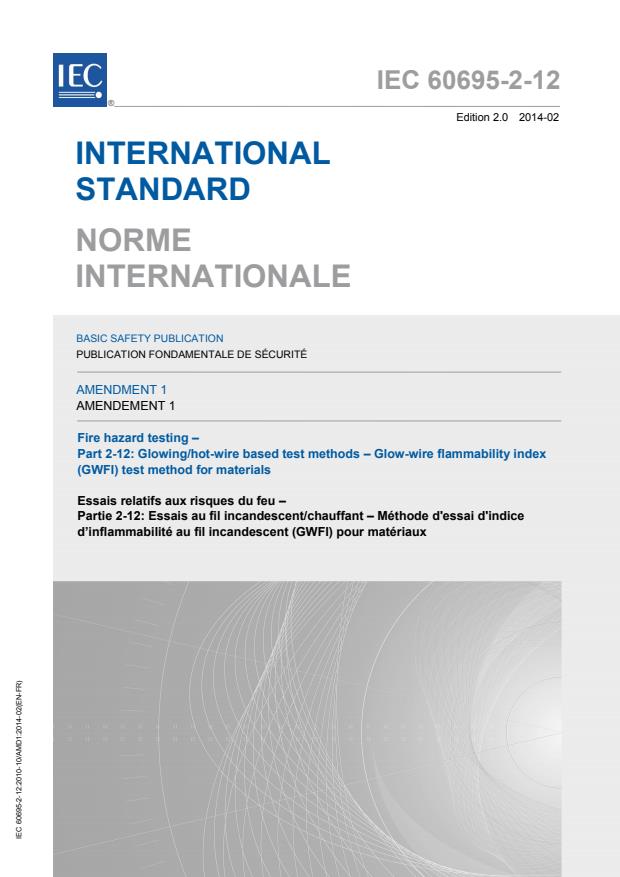
IEC 60695-2-12:2010/AMD1:2014 - Amendment 1 - Fire hazard testing - Part 2-12: Glowing/hot-wire based test methods - Glow-wire flammability index (GWFI) test method for materials Released:2/12/2014
Overview
IEC 60695-2-12:2010/AMD1:2014 is an important amendment to the international standard governing fire hazard testing focused on glowing/hot-wire based test methods. It specifically updates the Glow-wire Flammability Index (GWFI) test method for materials, which measures the flammability characteristics of materials when exposed to heat from an electrically heated wire under controlled laboratory conditions. Developed by the International Electrotechnical Commission (IEC), this amendment aims to enhance safety and reliability in evaluating materials used in electrotechnical products vulnerable to thermal stress.
This standard plays a critical role in fire hazard assessment by providing a repeatable, standardized test method to quantify how materials react to glowing wire ignition, simulating scenarios such as electrical faults, component overloading, and poor connections. The GWFI results are valuable for manufacturers and safety professionals seeking to ensure product compliance with fire safety expectations.
Key Topics
Scope and Purpose: The standard concentrates on materials' response to a hot wire source rather than assessing the entire fire risk of assembled products under real fire conditions. GWFI testing is intended as part of an overall fire hazard evaluation strategy.
Test Specimen Preparation: Materials are shaped via standardized ISO methods, including casting, injection molding (ISO 294 series), compression molding (ISO 293 and ISO 295), or transfer molding. When molding is not feasible, specimens are cut from representative samples fabricated by the same process as the final product material.
Testing Conditions: Specimens are tested in labs maintaining temperatures between 15 °C and 35 °C, with relative humidity ≤ 75%. The glow-wire temperatures used range from 550 °C to 960 °C with precise tolerances to ensure accuracy.
Test Procedure and Observations: The test measures the longest sustained flaming or glowing combustion after removal of the heated wire, with ignition time recorded to the nearest 0.5 seconds. Key criteria include extinguishment within 30 seconds post wire removal.
Reporting Results: GWFI values are reported along with material thickness ranges, for example, "GWFI: 850 / 0.75 – 3.0", indicating the glow-wire flammability temperature and applicable specimen thickness spectrum.
Normative References: Relevant ISO and IEC guides and standards are referenced for specimen preparation and safety considerations to maintain consistency and complementarity across testing protocols.
Applications
Material Selection for Electrotechnical Products: GWFI testing guides designers and manufacturers in selecting materials that resist ignition and sustain minimal combustion when exposed to excess thermal stress in electrical environments.
Fire Safety Engineering: Results help safety engineers evaluate fire hazard elements related to electrical faults or overheating components, critical in preventing fires originating from electrical equipment.
Product Compliance and Certification: Incorporating IEC 60695-2-12 GWFI testing into quality assurance processes supports compliance with international fire safety standards during product development.
Risk Assessment for Electrical Installations: Using GWFI data contributes to comprehensive fire risk assessments, especially for products used in environments with potential electrical overcurrent or faulty connections.
Related Standards
IEC 60695-2-11: Glow-wire flammability test method for end-products - complements GWFI by focusing on the behavior of final products rather than raw materials.
IEC 60695-2-13: Glow-wire ignition temperature (GWIT) test method - measures the ignition point of materials when exposed to a heated wire, closely related to GWFI.
ISO/IEC 13943:2008: Fire safety vocabulary - provides standardized terms and definitions relevant to the fire hazard testing community.
ISO 293 & ISO 295: Plastics compression molding methods - essential for preparing test specimens in accordance with IEC 60695-2-12 requirements.
Practical Value
Adopting the IEC 60695-2-12 Amendment 1 in fire hazard testing ensures:
Consistent, reliable assessment of material flammability characteristics relevant to electrical products.
Enhanced safety evaluation aligned with international best practices, reducing risk of fire hazards initiated by electrical faults.
Improved material selection and product design processes, driving safer and more resilient electrotechnical equipment.
Clear communication and documentation within the supply chain facilitated by standardized testing, reporting, and interpretation of glow-wire flammability data.
By integrating this standardized glow-wire flammability index test, industries can mitigate fire risks more effectively, fostering safer products and environments worldwide.
Relations
- Effective Date
- 05-Sep-2023
- Effective Date
- 05-Sep-2023
Buy Documents
IEC 60695-2-12:2010/AMD1:2014 - Amendment 1 - Fire hazard testing - Part 2-12: Glowing/hot-wire based test methods - Glow-wire flammability index (GWFI) test method for materials Released:2/12/2014
Frequently Asked Questions
IEC 60695-2-12:2010/AMD1:2014 is a standard published by the International Electrotechnical Commission (IEC). Its full title is "Amendment 1 - Fire hazard testing - Part 2-12: Glowing/hot-wire based test methods - Glow-wire flammability index (GWFI) test method for materials". This standard covers: IEC 60695-2-12:2014 Amendment 1
IEC 60695-2-12:2014 Amendment 1
IEC 60695-2-12:2010/AMD1:2014 has the following relationships with other standards: It is inter standard links to IEC 60695-2-12:2010, IEC 60695-2-12:2021. Understanding these relationships helps ensure you are using the most current and applicable version of the standard.
IEC 60695-2-12:2010/AMD1:2014 is available in PDF format for immediate download after purchase. The document can be added to your cart and obtained through the secure checkout process. Digital delivery ensures instant access to the complete standard document.
Standards Content (Sample)
IEC 60695-2-12 ®
Edition 2.0 2014-02
INTERNATIONAL
STANDARD
NORME
INTERNATIONALE
BA SIC SAFETY PUBLICATION
PU BLICATION FONDAMENTALE DE SÉCURITÉ
AMENDMENT 1
AMENDEMENT 1
Fire hazard testing –
Part 2-12: Glowing/hot-wire based test methods – Glow-wire flammability index
(GWFI) test method for materials
Essais relatifs aux risques du feu –
Partie 2-12: Essais au fil incandescent/chauffant – Méthode d'essai d'indice
d’inflammabilité au fil incandescent (GWFI) pour matériaux
IEC 60695-2-12:2010-10/AMD1:2014-02(EN-FR)
All rights reserved. Unless otherwise specified, no part of this publication may be reproduced or utilized in any form
or by any means, electronic or mechanical, including photocopying and microfilm, without permission in writing from
either IEC or IEC's member National Committee in the country of the requester. If you have any questions about IEC
copyright or have an enquiry about obtaining additional rights to this publication, please contact the address below or
your local IEC member National Committee for further information.
Droits de reproduction réservés. Sauf indication contraire, aucune partie de cette publication ne peut être reproduite
ni utilisée sous quelque forme que ce soit et par aucun procédé, électronique ou mécanique, y compris la photocopie
et les microfilms, sans l'accord écrit de l'IEC ou du Comité national de l'IEC du pays du demandeur. Si vous avez des
questions sur le copyright de l'IEC ou si vous désirez obtenir des droits supplémentaires sur cette publication, utilisez
les coordonnées ci-après ou contactez le Comité national de l'IEC de votre pays de résidence.
IEC Central Office Tel.: +41 22 919 02 11
3, rue de Varembé Fax: +41 22 919 03 00
CH-1211 Geneva 20 info@iec.ch
Switzerland www.iec.ch
About the IEC
The International Electrotechnical Commission (IEC) is the leading global organization that prepares and publishes
International Standards for all electrical, electronic and related technologies.
About IEC publications
The technical content of IEC publications is kept under constant review by the IEC. Please make sure that you have the
latest edition, a corrigenda or an amendment might have been published.
IEC Catalogue - webstore.iec.ch/catalogue Electropedia - www.electropedia.org
The stand-alone application for consulting the entire The world's leading online dictionary of electronic and
bibliographical information on IEC International Standards, electrical terms containing more than 30 000 terms and
Technical Specifications, Technical Reports and other definitions in English and French, with equivalent terms in 14
documents. Available for PC, Mac OS, Android Tablets and additional languages. Also known as the International
iPad. Electrotechnical Vocabulary (IEV) online.
IEC publications search - www.iec.ch/searchpub IEC Glossary - std.iec.ch/glossary
The advanced search enables to find IEC publications by a More than 55 000 electrotechnical terminology entries in
variety of criteria (reference number, text, technical English and French extracted from the Terms and Definitions
committee,…). It also gives information on projects, replaced clause of IEC publications issued since 2002. Some entries
and withdrawn publications. have been collected from earlier publications of IEC TC 37,
77, 86 and CISPR.
IEC Just Published - webstore.iec.ch/justpublished
Stay up to date on all new IEC publications. Just Published IEC Customer Service Centre - webstore.iec.ch/csc
details all new publications released. Available online and If you wish to give us your feedback on this publication or
also once a month by email. need further assistance, please contact the Customer Service
Centre: csc@iec.ch.
A propos de l'IEC
La Commission Electrotechnique Internationale (IEC) est la première organisation mondiale qui élabore et publie des
Normes internationales pour tout ce qui a trait à l'électricité, à l'électronique et aux technologies apparentées.
A propos des publications IEC
Le contenu technique des publications IEC est constamment revu. Veuillez vous assurer que vous possédez l’édition la
plus récente, un corrigendum ou amendement peut avoir été publié.
Catalogue IEC - webstore.iec.ch/catalogue Electropedia - www.electropedia.org
Application autonome pour consulter tous les renseignements
Le premier dictionnaire en ligne de termes électroniques et
bibliographiques sur les Normes internationales,
électriques. Il contient plus de 30 000 termes et définitions en
Spécifications techniques, Rapports techniques et autres
anglais et en français, ainsi que les termes équivalents dans
documents de l'IEC. Disponible pour PC, Mac OS, tablettes
14 langues additionnelles. Egalement appelé Vocabulaire
Android et iPad.
Electrotechnique International (IEV) en ligne.
Recherche de publications IEC - www.iec.ch/searchpub
Glossaire IEC - std.iec.ch/glossary
Plus de 55 000 entrées terminologiques électrotechniques, en
La recherche avancée permet de trouver des publications IEC
en utilisant différents critères (numéro de référence, texte, anglais et en français, extraites des articles Termes et
comité d’études,…). Elle donne aussi des informations sur les Définitions des publications IEC parues depuis 2002. Plus
projets et les publications remplacées ou retirées. certaines entrées antérieures extraites des publications des
CE 37, 77, 86 et CISPR de l'IEC.
IEC Just Published - webstore.iec.ch/justpublished
Service Clients - webstore.iec.ch/csc
Restez informé sur les nouvelles publications IEC. Just
Published détaille les nouvelles publications parues. Si vous désirez nous donner des commentaires sur cette
Disponible en ligne et aussi une fois par mois par email. publication ou si vous avez des questions contactez-nous:
csc@iec.ch.
IEC 60695-2-12 ®
Edition 2.0 2014-02
INTERNATIONAL
STANDARD
NORME
INTERNATIONALE
BA SIC SAFETY PUBLICATION
PU BLICATION FONDAMENTALE DE SÉCURITÉ
AMENDMENT 1
AMENDEMENT 1
Fire hazard testing –
Part 2-12: Glowing/hot-wire based test methods – Glow-wire flammability index
(GWFI) test method for materials
Essais relatifs aux risques du feu –
Partie 2-12: Essais au fil incandescent/chauffant – Méthode d'essai d'indice
d’inflammabilité au fil incandescent (GWFI) pour matériaux
INTERNATIONAL
ELECTROTECHNICAL
COMMISSION
COMMISSION
ELECTROTECHNIQUE
PRICE CODE
INTERNATIONALE
CODE PRIX E
ICS 13.220.40, 29.020 ISBN 978-2-8322-1366-7
– 2 – 60695-2-12 Amend.1 IEC:2014
FOREWORD
This amendment has been prepared by technical committee 89: Fire hazard testing.
The text of this amendment is based on the following documents:
FDIS Report on voting
89/1198/FDIS 89/1207/RVD
Full information on the voting for the approval of this amendment can be found in the report
on voting indicated in the above table.
The committee has decided that the contents of this amendment and the base publication will
remain unchanged until the stability date indicated on the IEC web site under
"http://webstore.iec.ch" in the data related to the specific publication. At this date, the
publication will be
• reconfirmed,
• withdrawn,
• replaced by a revised edition, or
• amended.
_____________
60695-2-12 Amend.1 IEC:2014 – 3 –
INTRODUCTION
Replace the fourth paragraph of the Introduction by the following:
Fires involving electrotechnical products can also be initiated from external non-electrical
sources. Considerations of this nature should be dealt with in the overall fire hazard
assessment.
Replace the seventh paragraph by the following:
This part of IEC 60695 describes a glow-wire flammability index test for materials. It should be
used to measure, describe, and rank the properties of materials in response to heat caused
by contact with an electrically heated wire under controlled laboratory conditions. This may be
useful for the evaluation of materials for use in products that may be exposed to excess
thermal stress such as a fault current flowing through a wire, overloading of components,
and/or bad connections. It should not be used to solely describe or appraise the fire hazard or
fire risk of materials, products, or assemblies under actual fire conditions. However, results of
this test may be used as elements of a fire hazard assessment which takes into account all of
the factors which are pertinent to a particular end use.
2 Normative references
Remove the dates from the following existing referen
...