

IEC 60599:2022
(Main)Mineral oil-filled electrical equipment in service - Guidance on the interpretation of dissolved and free gases analysis
General Information
- Abstract
IEC 60599:2022 describes how the concentrations of dissolved gases or free gases can be interpreted to diagnose the condition of oil-filled electrical equipment in service and suggest future action. This document is applicable to electrical equipment filled with mineral insulating oil and insulated with cellulosic paper or pressboard-based solid insulation. Information about specific types of equipment such as transformers (power, instrument, industrial, railways, distribution), reactors, bushings, switchgear and oil-filled cables is given only as an indication in the application notes. This document can be applied, but only with caution, to other liquid-solid insulating systems. In any case, the indications obtained are given only as guidance with resulting action undertaken only with proper engineering judgment.
- Status
- Published
- Publication Date
- 24-May-2022
- Technical Committee
- TC 10 - Fluids for electrotechnical applications
- Drafting Committee
- MT 20 - TC 10/MT 20
- Current Stage
- PPUB - Publication issued
- Start Date
- 25-May-2022
- Completion Date
- 17-Jun-2022
Buy Documents
REDLINE IEC 60599:2022 CMV - Mineral oil-filled electrical equipment in service - Guidance on the interpretation of dissolved and free gases analysis Released:5/25/2022
IEC 60599:2022 - Mineral oil-filled electrical equipment in service - Guidance on the interpretation of dissolved and free gases analysis Released:5/25/2022
Overview
IEC 60599:2022 offers internationally recognized guidance for interpreting dissolved gas analysis (DGA) and free gas analysis in mineral oil-filled electrical equipment. Published by the International Electrotechnical Commission (IEC), this standard is essential for diagnosing the operational condition of critical assets such as transformers, reactors, bushings, switchgear, and oil-filled cables. The document aids asset managers, engineers, and maintenance professionals in decision-making processes by providing a structured approach for assessing insulating oil degradation and identifying potential faults. Its purpose is to support reliable operation and proactive maintenance of oil-filled electrical equipment, ensuring system safety and longevity.
Key Topics
- Scope of Application: The standard is applicable to operational electrical equipment insulated with mineral oil and solid cellulose-based materials like paper or pressboard. Its primary focus includes power transformers, instrument transformers, reactors, switchgear, oil-filled cables, and bushings.
- Diagnosis via DGA: IEC 60599 outlines how concentrations of dissolved and free gases can be interpreted to assess insulation health, identify operational stress, and diagnose incipient faults.
- Fault Identification: The standard distinguishes between different types of faults, such as electrical (e.g., partial discharge, arcing) and thermal (e.g., overheating), using gas composition and concentration as diagnostic markers.
- Assessment of Gas Formation Mechanisms: It provides insights on the chemical and physical processes leading to gas generation within insulating fluids and materials, including decomposition of oil and cellulose under electrical and thermal stress.
- Guidance and Caution: While indicative and widely adopted, the guidance is not prescriptive action but should form one part of a holistic engineering judgment. Caution is advised when applying its principles to systems not specifically covered.
- Definitions and Abbreviations: The standard introduces precise terms to support clear communication and understanding in equipment diagnosis and reporting.
Applications
IEC 60599:2022 finds practical value across utility, industrial, and infrastructure sectors where mineral oil-filled electrical equipment operates. Major applications include:
- Condition Monitoring: Routine DGA testing is used to monitor fluid and insulation system health for power transformers, reactors, instrument transformers, bushings, cables, and switchgear.
- Maintenance Strategy Development: By interpreting gas patterns and concentration levels, asset managers can prioritize interventions, plan maintenance, or initiate further diagnostics, thus potentially preventing costly failures and unplanned outages.
- Fault Investigation: The guidance supports incident investigation following alarms, abnormal readings, or operational events, helping distinguish between non-damaging phenomena and critical failures.
- Supporting Lifespan Extension: Early detection of thermal or electrical degradation can inform refurbishment or oil treatment programs, thereby extending equipment lifecycle.
- Specification and Procurement: Utilities and manufacturers incorporate IEC 60599 criteria in technical specifications and procurement documents for new and retrofitted oil-filled assets.
Note: While primarily for mineral oil-filled systems, the standard notes that application to other liquid-solid insulation systems requires engineering discretion.
Related Standards
For robust diagnostic and maintenance programs, IEC 60599:2022 is most effective when used in combination with related IEC standards, including:
- IEC 60475: Method of sampling insulating liquids
- IEC 60567: Oil-filled electrical equipment - Sampling of gases and analysis of free and dissolved gases
- IEC 61198: Mineral insulating oils - Determination of 2-furfural and related compounds (important for paper insulation assessment)
- IEC 60050 Series: International Electrotechnical Vocabulary for standardized terminology in dependability, insulating materials, and electrical operation
By integrating IEC 60599:2022 with these complementary standards, organizations can achieve a comprehensive and internationally aligned approach to condition monitoring and maintenance of oil-filled electrical equipment.
Keywords: IEC 60599:2022, dissolved gas analysis, DGA, mineral oil-filled electrical equipment, transformer condition monitoring, oil-filled switchgear, bushing diagnostics, fault identification, oil analysis standard, maintenance strategy, insulating oil, IEC standards.
Relations
- Effective Date
- 05-Sep-2023
Buy Documents
REDLINE IEC 60599:2022 CMV - Mineral oil-filled electrical equipment in service - Guidance on the interpretation of dissolved and free gases analysis Released:5/25/2022
IEC 60599:2022 - Mineral oil-filled electrical equipment in service - Guidance on the interpretation of dissolved and free gases analysis Released:5/25/2022
Get Certified
Connect with accredited certification bodies for this standard

IMQ S.p.A. (Certification)
Italian electrical product certification.

SLG Prüf- und Zertifizierungs GmbH
German testing and certification body.

UL Solutions
Global safety science company with testing, inspection and certification.
Sponsored listings
Frequently Asked Questions
IEC 60599:2022 is a standard published by the International Electrotechnical Commission (IEC). Its full title is "Mineral oil-filled electrical equipment in service - Guidance on the interpretation of dissolved and free gases analysis". This standard covers: IEC 60599:2022 describes how the concentrations of dissolved gases or free gases can be interpreted to diagnose the condition of oil-filled electrical equipment in service and suggest future action. This document is applicable to electrical equipment filled with mineral insulating oil and insulated with cellulosic paper or pressboard-based solid insulation. Information about specific types of equipment such as transformers (power, instrument, industrial, railways, distribution), reactors, bushings, switchgear and oil-filled cables is given only as an indication in the application notes. This document can be applied, but only with caution, to other liquid-solid insulating systems. In any case, the indications obtained are given only as guidance with resulting action undertaken only with proper engineering judgment.
IEC 60599:2022 describes how the concentrations of dissolved gases or free gases can be interpreted to diagnose the condition of oil-filled electrical equipment in service and suggest future action. This document is applicable to electrical equipment filled with mineral insulating oil and insulated with cellulosic paper or pressboard-based solid insulation. Information about specific types of equipment such as transformers (power, instrument, industrial, railways, distribution), reactors, bushings, switchgear and oil-filled cables is given only as an indication in the application notes. This document can be applied, but only with caution, to other liquid-solid insulating systems. In any case, the indications obtained are given only as guidance with resulting action undertaken only with proper engineering judgment.
IEC 60599:2022 is classified under the following ICS (International Classification for Standards) categories: 17.220.99 - Other standards related to electricity and magnetism; 29.040.10 - Insulating oils; 29.180 - Transformers. Reactors. The ICS classification helps identify the subject area and facilitates finding related standards.
IEC 60599:2022 has the following relationships with other standards: It is inter standard links to IEC 60599:2015. Understanding these relationships helps ensure you are using the most current and applicable version of the standard.
IEC 60599:2022 is available in PDF format for immediate download after purchase. The document can be added to your cart and obtained through the secure checkout process. Digital delivery ensures instant access to the complete standard document.
Standards Content (Sample)
IEC 60599 ®
Edition 4.0 2022-05
COMMENTED VERSION
INTERNATIONAL
STANDARD
colour
inside
Mineral oil-filled electrical equipment in service – Guidance on the interpretation
of dissolved and free gases analysis
All rights reserved. Unless otherwise specified, no part of this publication may be reproduced or utilized in any form
or by any means, electronic or mechanical, including photocopying and microfilm, without permission in writing from
either IEC or IEC's member National Committee in the country of the requester. If you have any questions about IEC
copyright or have an enquiry about obtaining additional rights to this publication, please contact the address below or
your local IEC member National Committee for further information.
IEC Secretariat Tel.: +41 22 919 02 11
3, rue de Varembé info@iec.ch
CH-1211 Geneva 20 www.iec.ch
Switzerland
About the IEC
The International Electrotechnical Commission (IEC) is the leading global organization that prepares and publishes
International Standards for all electrical, electronic and related technologies.
About IEC publications
The technical content of IEC publications is kept under constant review by the IEC. Please make sure that you have the
latest edition, a corrigendum or an amendment might have been published.
IEC publications search - webstore.iec.ch/advsearchform IEC Products & Services Portal - products.iec.ch
The advanced search enables to find IEC publications by a
Discover our powerful search engine and read freely all the
variety of criteria (reference number, text, technical publications previews. With a subscription you will always
committee, …). It also gives information on projects, replaced have access to up to date content tailored to your needs.
and withdrawn publications.
Electropedia - www.electropedia.org
IEC Just Published - webstore.iec.ch/justpublished
The world's leading online dictionary on electrotechnology,
Stay up to date on all new IEC publications. Just Published
containing more than 22 300 terminological entries in English
details all new publications released. Available online and
and French, with equivalent terms in 19 additional languages.
once a month by email.
Also known as the International Electrotechnical Vocabulary
(IEV) online.
IEC Customer Service Centre - webstore.iec.ch/csc
If you wish to give us your feedback on this publication or
need further assistance, please contact the Customer Service
Centre: sales@iec.ch.
IEC 60599 ®
Edition 4.0 2022-05
COMMENTED VERSION
INTERNATIONAL
STANDARD
colour
inside
Mineral oil-filled electrical equipment in service – Guidance on the interpretation
of dissolved and free gases analysis
INTERNATIONAL
ELECTROTECHNICAL
COMMISSION
ICS 17.220.99; 29.040.10; 29.180 ISBN 978-2-8322-3798-4
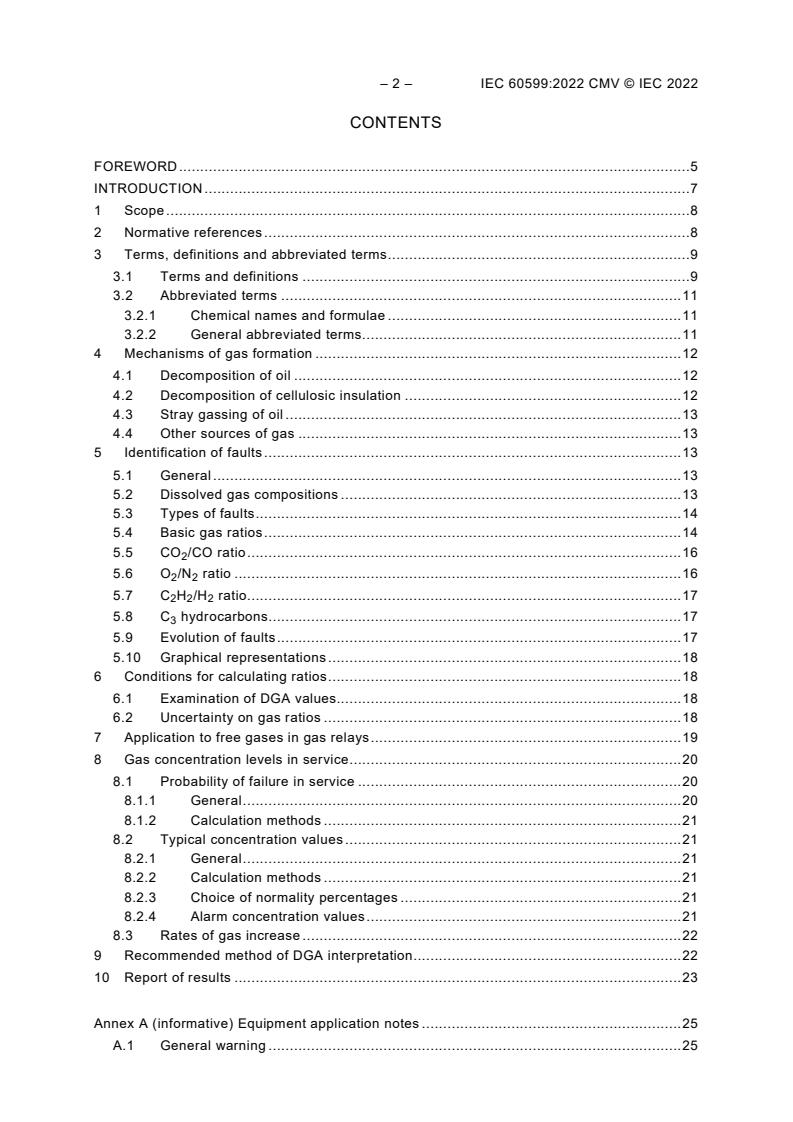
– 2 – IEC 60599:2022 CMV © IEC 2022
CONTENTS
FOREWORD .5
INTRODUCTION .7
1 Scope .8
2 Normative references .8
3 Terms, definitions and abbreviated terms .9
3.1 Terms and definitions .9
3.2 Abbreviated terms . 11
3.2.1 Chemical names and formulae . 11
3.2.2 General abbreviated terms . 11
4 Mechanisms of gas formation . 12
4.1 Decomposition of oil . 12
4.2 Decomposition of cellulosic insulation . 12
4.3 Stray gassing of oil . 13
4.4 Other sources of gas . 13
5 Identification of faults . 13
5.1 General . 13
5.2 Dissolved gas compositions . 13
5.3 Types of faults . 14
5.4 Basic gas ratios . 14
5.5 CO /CO ratio . 16
5.6 O /N ratio . 16
2 2
5.7 C H /H ratio. 17
2 2 2
5.8 C hydrocarbons . 17
5.9 Evolution of faults . 17
5.10 Graphical representations . 18
6 Conditions for calculating ratios . 18
6.1 Examination of DGA values . 18
6.2 Uncertainty on gas ratios . 18
7 Application to free gases in gas relays . 19
8 Gas concentration levels in service . 20
8.1 Probability of failure in service . 20
8.1.1 General . 20
8.1.2 Calculation methods . 21
8.2 Typical concentration values . 21
8.2.1 General . 21
8.2.2 Calculation methods . 21
8.2.3 Choice of normality percentages . 21
8.2.4 Alarm concentration values . 21
8.3 Rates of gas increase . 22
9 Recommended method of DGA interpretation . 22
10 Report of results . 23
Annex A (informative) Equipment application notes . 25
A.1 General warning . 25
A.2 Power transformers . 25
A.2.1 Specific subtypes . 25
A.2.2 Typical faults . 25
A.2.3 Identification of faults by DGA . 26
A.2.4 Typical concentration values . 26
A.2.5 Typical rates of gas increase . 27
A.2.6 Specific information to be added to the DGA report. 28
A.3 Industrial and special transformers . 28
A.3.1 Specific subtypes . 28
A.3.2 Typical faults . 28
A.3.3 Identification of faults by DGA . 29
A.3.4 Typical concentration values . 29
A.4 Instrument transformers . 30
A.4.1 Specific subtypes . 30
A.4.2 Typical faults . 30
A.4.3 Identification of faults by DGA . 31
A.4.4 Typical concentration values . 31
A.5 Oil-impregnated paper bushings . 32
A.5.1 Specific subtypes . 32
A.5.2 Typical faults . 32
A.5.3 Identification of faults by DGA . 32
A.5.4 Typical concentration values . 33
A.6 Oil-filled cables . 34
A.6.1 Typical faults . 34
A.6.2 Identification of faults by DGA . 34
A.6.3 Typical concentration values . 34
A.7 Switching equipment . 35
A.7.1 Specific subtypes . 35
A.7.2 Normal operation . 35
A.7.3 Typical faults . 35
A.7.4 Identification of faults by DGA . 35
A.8 Equipment filled with non-mineral fluids . 36
Annex B (informative) Graphical representations of gas ratios . 37
Bibliography . 41
List of comments . 42
Figure 1 – Flow chart . 24
Figure B.1 – Graphical representation 1 of gas ratios (see [3]) . 37
Figure B.2 – Graphical representation 2 of gas ratios . 38
Figure B.3 – Graphical representation 3 of gas ratios – Duval's triangle 1 for
transformers, bushings and cables (see [4]) . 39
Figure B.4 – Graphical representation 4 of gas ratios – Duval's triangle 2 for OLTCs
(see A.7.2) . 40
Table 1 – DGA interpretation table . 15
Table 2 – Simplified scheme of interpretation . 15
Table 3 – Ostwald solubility coefficients for various gases in mineral insulating oils . 20
Table A.1 – Typical faults in power transformers . 26
– 4 – IEC 60599:2022 CMV © IEC 2022
Table A.2 – Ranges of 90 % typical gas concentration values observed in power
transformers, in µl/l . 27
Table A.3 – Ranges of 90 % typical rates of gas increase observed in power
transformers (all types), in µl/l . 27
Table A.4 – Examples of 90 % typical concentration values observed on individual
networks . 29
Table A.5 – Ranges of 90 % typical concentration values observed in WTTs . 30
Table A.6 – Typical faults in instrument transformers. 31
Table A.7 – Ranges of 90 % typical concentration values observed in instrument
transformers . 31
Table A.8 – Maximum admissible values for sealed instrument transformers . 32
Table A.9 – Typical faults in bushings . 32
Table A.10 – Simplified interpretation scheme for bushings . 33
Table A.10 – 95 % typical concentration values in bushings.
Table A.11 – Ranges of 90 % typical concentration values in bushings . 33
Table A.12 – Ranges of 95 % typical concentration values observed on cables . 34
Table A.13 – Typical faults in switching equipment . 35
INTERNATIONAL ELECTROTECHNICAL COMMISSION
____________
MINERAL OIL-FILLED ELECTRICAL EQUIPMENT IN SERVICE –
GUIDANCE ON THE INTERPRETATION OF DISSOLVED AND
FREE GASES ANALYSIS
FOREWORD
1) The International Electrotechnical Commission (IEC) is a worldwide organization for standardization comprising
all national electrotechnical committees (IEC National Committees). The object of IEC is to promote international
co-operation on all questions concerning standardization in the electrical and electronic fields. To this end and
in addition to other activities, IEC publishes International Standards, Technical Specifications, Technical Reports,
Publicly Available Specifications (PAS) and Guides (hereafter referred to as “IEC Publication(s)”). Their
preparation is entrusted to technical committees; any IEC National Committee interested in the subject dealt with
may participate in this preparatory work. International, governmental and non-governmental organizations liaising
with the IEC also participate in this preparation. IEC collaborates closely with the International Organization for
Standardization (ISO) in accordance with conditions determined by agreement between the two organizations.
2) The formal decisions or agreements of IEC on technical matters express, as nearly as possible, an international
consensus of opinion on the relevant subjects since each technical committee has representation from all
interested IEC National Committees.
3) IEC Publications have the form of recommendations for international use and are accepted by IEC National
Committees in that sense. While all reasonable efforts are made to ensure that the technical content of IEC
Publications is accurate, IEC cannot be held responsible for the way in which they are used or for any
misinterpretation by any end user.
4) In order to promote international uniformity, IEC National Committees undertake to apply IEC Publications
transparently to the maximum extent possible in their national and regional publications. Any divergence between
any IEC Publication and the corresponding national or regional publication shall be clearly indicated in the latter.
5) IEC itself does not provide any attestation of conformity. Independent certification bodies provide conformity
assessment services and, in some areas, access to IEC marks of conformity. IEC is not responsible for any
services carried out by independent certification bodies.
6) All users should ensure that they have the latest edition of this publication.
7) No liability shall attach to IEC or its directors, employees, servants or agents including individual experts and
members of its technical committees and IEC National Committees for any personal injury, property damage or
other damage of any nature whatsoever, whether direct or indirect, or for costs (including legal fees) and
expenses arising out of the publication, use of, or reliance upon, this IEC Publication or any other IEC
Publications.
8) Attention is drawn to the Normative references cited in this publication. Use of the referenced publications is
indispensable for the correct application of this publication.
9) Attention is drawn to the possibility that some of the elements of this IEC Publication may be the subject of patent
rights. IEC shall not be held responsible for identifying any or all such patent rights.
This commented version (CMV) of the official standard IEC 60599:2022 edition 4.0 allows
the user to identify the changes made to the previous IEC 60599:2015 edition 3.0.
Futhermore, comments from IEC TC 10 experts are provided to explain the reasons of the
most relevant changes, or to clarify any part of the content.
A vertical bar appears in the margin wherever a change has been made. Additions are in
green text, deletions are in strikethrough red text. Experts' comments are identified by a
blue-background number. Mouse over a number to display a pop-up note with the
comment.
This publication contains the CMV and the official standard. The full list of comments is
available at the end of the CMV.
– 6 – IEC 60599:2022 CMV © IEC 2022
IEC 60599 has been prepared by IEC technical committee 10: Fluids for electrotechnical
applications. It is an International Standard.
This fourth edition cancels and replaces the third edition published in 2015. This edition
constitutes a technical revision.
This edition includes the following significant technical changes with respect to the previous
edition:
a) revision of Clause A.5 on bushings, at the request of IEC subcommittee 36A, in order to
transfer to IEC 60599 the corresponding contents of IEC TR 61464 [1] relating to DGA in
bushings and include the new information on DGA in bushings available in CIGRE Technical
Brochure 771 (2019) [2];
b) revision of Clause A.3 on wind turbine transformers, in order to include in IEC 60599 the
new information on DGA in wind turbine transformers available in CIGRE Technical
Brochure 771 (2019) [2].
The text of this International Standard is based on the following documents:
Draft Report on voting
10/1164/FDIS 10/1174/RVD
Full information on the voting for its approval can be found in the report on voting indicated in
the above table.
The language used for the development of this International Standard is English.
This document was drafted in accordance with ISO/IEC Directives, Part 2, and developed in
accordance with ISO/IEC Directives, Part 1 and ISO/IEC Directives, IEC Supplement, available
at www.iec.ch/members_experts/refdocs. The main document types developed by IEC are
described in greater detail at www.iec.ch/publications.
The committee has decided that the contents of this document will remain unchanged until the
stability date indicated on the IEC website under webstore.iec.ch in the data related to the
specific document. At this date, the document will be
• reconfirmed,
• withdrawn,
• replaced by a revised edition, or
• amended.
IMPORTANT – The 'colour inside' logo on the cover page of this publication indicates that it
contains colours which are considered to be useful for the correct understanding of its
contents. Users should therefore print this document using a colour printer.
___________
Numbers in square brackets refer to the Bibliography.
INTRODUCTION
Dissolved and free gas analysis (DGA) is one of the most widely used diagnostic tools for
detecting and evaluating faults in electrical equipment filled with insulating liquid. However,
interpretation of DGA results is often complex and should always be done with care, involving
experienced insulation maintenance personnel.
This document gives information for facilitating this interpretation. The first edition, published
in 1978, has served the industry well, but had its limitations, such as the absence of a diagnosis
in some cases, the absence of concentration levels and the fact that it was based mainly on
experience gained from power transformers. The second edition (2015) attempted to address
some of these shortcomings. Interpretation schemes were based on observations made after
inspection of a large number of faulty oil-filled equipment in service and concentrations levels
deduced from analyses collected worldwide.
– 8 – IEC 60599:2022 CMV © IEC 2022
MINERAL OIL-FILLED ELECTRICAL EQUIPMENT IN SERVICE –
GUIDANCE ON THE INTERPRETATION OF DISSOLVED AND
FREE GASES ANALYSIS
1 Scope
This document describes how the concentrations of dissolved gases or free gases may can be
interpreted to diagnose the condition of oil-filled electrical equipment in service and suggest
future action.
This document is applicable to electrical equipment filled with mineral insulating oil and
insulated with cellulosic paper or pressboard-based solid insulation. Information about specific
types of equipment such as transformers (power, instrument, industrial, railways, distribution),
reactors, bushings, switchgear and oil-filled cables is given only as an indication in the
application notes (see Annex A).
This document may can be applied, but only with caution, to other liquid-solid insulating systems.
In any case, the indications obtained should be viewed are given only as guidance and any with
resulting action should be undertaken only with proper engineering judgment.
2 Normative references
The following documents are referred to in the text in such a way that some or all of their content
constitutes requirements of this document. For dated references, only the edition cited applies.
For undated references, the latest edition of the referenced document (including any
amendments) applies.
IEC 60050-191:1990, International Electrotechnical Vocabulary – Chapter 191: Dependability
and quality of service (available at http://www.electropedia.org)
IEC 60050-192:2015, International Electrotechnical Vocabulary – Part 192: Dependability
(available at http://www.electropedia.org)
IEC 60050-212:2010, International Electrotechnical Vocabulary – Part 212: Electrical insulating
solids, liquids and gases (available at http://www.electropedia.org)
IEC 60050-604:1987, International Electrotechnical Vocabulary – Chapter 604: Generation,
transmission and distribution of electricity – Operation (available at http://www.electropedia.org)
IEC 60475, Method of sampling insulating liquids
IEC 60567:2011, Oil-filled electrical equipment – Sampling of gases and analysis of free and
dissolved gases – Guidance
IEC 61198, Mineral insulating oils – Methods for the determination of 2-furfural and related
compounds
3 Terms, definitions and abbreviated terms
3.1 Terms and definitions
For the purposes of this document, the following terms and definitions, some of which are based
on IEC 60050-191, IEC 60050-192, IEC 60050-212 and IEC 60050-604, apply.
For the purposes of this document, the following terms and definitions apply.
ISO and IEC maintain terminology databases for use in standardization at the following
addresses:
• IEC Electropedia: available at https://www.electropedia.org/
• ISO Online browsing platform: available at https://www.iso.org/obp
3.1.1
fault
unplanned occurrence or defect in an item which may result in one or more failures of the item
itself or of other associated equipment
[SOURCE: IEC 60050-604:1987, 604-02-01]
3.1.2
non-damage fault
fault which does not involve repair or replacement action at the point of the fault
Note 1 to entry: Typical examples are self-extinguishing arcs in switching equipment or general overheating without
paper carbonization or stray gassing of oil.
[SOURCE: IEC 60050-604:1987, 604-02-09]
3.1.3
damage fault
fault that involves repair or replacement action at the point of the fault
[SOURCE: IEC 60050-604:1987, 604-02-08]
3.1.4
incident
event of external or internal origin, affecting equipment or the supply system and which disturbs
its normal operation
Note 1 to entry: For the purposes of this document "incidents" are related to internal faults.
Note 2 to entry: For the purposes of this document typical examples of "incidents" are gas alarms, equipment
tripping or equipment leakage.
[SOURCE: IEC 60050-604:1987, 604-02-03]
3.1.5
failure
loss of ability to perform as required
Note 1 to entry: In electrical equipment, failure will result from a damage fault or incident necessitating outage,
repair or replacement of the equipment, such as internal breakdown, rupture of tank, fire or explosion.
[SOURCE: IEC 60050-192:2015, 192-03-01]
– 10 – IEC 60599:2022 CMV © IEC 2022
3.1.6
electrical fault
partial or disruptive discharge through the insulation
3.1.7
partial discharge
electric discharge that only partially bridges the insulation between conductors
Note 1 to entry: A partial discharge may occur inside the insulation or adjacent to a conductor.
Note 2 to entry: Scintillations of low energy on the surface of insulating materials are often described as partial
discharges but should rather be considered as disruptive discharges of low energy, since they are the result of local
dielectric breakdowns of high ionization density, or small arcs, according to the conventions of physics.
Note 3 to entry: For the purposes of this document the following consideration may can also be added:
– Corona is a form of partial discharge that occurs in gaseous media around conductors that are remote from solid
or liquid insulation. This term shall not be used as a general term for all forms of partial discharges.
– As a result of corona discharges, X-wax, a solid material consisting of polymerized fragments of the molecules
of the original liquid, can be formed.
[SOURCE: IEC 60050-212:2010, 212-11-39]
3.1.8
discharge (disruptive) discharge
passage of an arc following the breakdown
Note 1 to entry: The term "sparkover" (in French: "amorçage") is used when a disruptive discharge occurs in a
gaseous or liquid dielectric.
The term "flashover" (in French: "contournement") is used when a disruptive discharge occurs over the surface of a
solid dielectric surrounded by a gaseous or liquid medium.
The term "puncture" (in French: "perforation") is used when a disruptive discharge occurs through a solid dielectric.
Note 2 to entry: Discharges are often described as arcing, breakdown or short circuits. The following other specific
terms are also used in some countries:
– tracking (the progressive degradation of the surface of solid insulation by local discharges to form conducting or
partially conducting paths);
– sparking discharges that, in the conventions of physics, are local dielectric breakdowns of high ionization density
or small arcs.
[SOURCE: IEC 60050-604:1987, 604-03-38]
3.1.9
thermal fault
excessive temperature rise in the insulation
Note 1 to entry: Typical causes are
– insufficient cooling;
– excessive currents circulating in adjacent metal parts (as a result of bad contacts, eddy currents, stray losses or
leakage flux);
– excessive currents circulating through the insulation (as a result of high dielectric losses), leading to a thermal
runaway;
– overheating of internal winding or bushing connection lead;
– overloading.
3.1.10
typical values of gas concentrations
gas concentrations normally found in the equipment in service that have no symptoms of failure,
and that are exceeded by only an arbitrary percentage of higher gas contents (for example 10%)
Note 1 to entry: See 8.2.1.
Note 2 to entry: Typical values will differ in different types of equipment and in different networks, depending on
operating practices (load levels, climate, etc.).
Note 3 to entry: Typical values, in many countries and by many users, are quoted as "normal values", but this term
has not been used in this document to avoid possible misinterpretations.
3.2 Abbreviated terms
3.2.1 Chemical names and formulae
Name Formula
Nitrogen N
Oxygen O
Hydrogen H
Carbon monoxide CO
Carbon dioxide CO
Methane CH
Ethane C H
2 6
Ethylene C H
2 4
Acetylene C H
2 2
NOTE Acetylene and ethyne are both used for C H ; ethylene and ethene are both used for C H .
2 2 2 4
3.2.2 General abbreviated terms
CT current transformer
CTCV combined transformer (current-voltage)
CIVT cascade (inductive) voltage transformer
CVT capacitor voltage transformer
MVT magnetic voltage transformer
VT voltage transformer
ONAN oil natural air natural
OFAF oil forced air forced
DDB dodecylbenzene
WTT wind turbine transformer
D1 discharges of low energy
D2 discharges of high energy
DGA dissolved gas analysis
CIGRE Conseil International des Grands Réseaux Électriques
PD corona partial discharges
S analytical detection limit
T1 thermal fault, t < 300 °C
T2 thermal fault, 300 °C < t < 700 °C
T3 thermal fault, t > 700 °C
T thermal fault
D electrical fault
TP thermal fault in paper
– 12 – IEC 60599:2022 CMV © IEC 2022
ppm parts per million by volume of gas in oil, equivalent to µl (of gas)/l (of oil). See
IEC 60567:2011, 8.7, Note 1.
OLTC on-load tap-changer
4 Mechanisms of gas formation
4.1 Decomposition of oil
Mineral insulating oils are made of a blend of different hydrocarbon molecules containing CH ,
CH and CH chemical groups linked together by carbon-carbon molecular bonds.
Scission of some of the C-H and C-C bonds may can occur as a result of electrical and thermal
faults, with the formation of small unstable fragments, in radical or ionic form, such as
• •
• • •
H , CH , CH , CH or C (among many other more complex forms), which recombine rapidly,
3 2
through complex reactions, into gas molecules such as hydrogen (H-H), methane (CH -H),
ethane (CH -CH ), ethylene (CH = CH ) or acetylene (CH ≡ CH). C and C hydrocarbon
3 3 2 2 3 4
gases, as well as solid particles of carbon and hydrocarbon polymers (X-wax), are other
possible recombination products. The gases formed dissolve in oil, or accumulate as free gases
if produced rapidly in large quantities, and may can be analysed by DGA according to IEC 60567.
Low-energy faults, such as partial discharges of the cold plasma type (corona discharges),
favour the scission of the weakest C-H bonds (338 kJ/mol) through ionization reactions and the
accumulation of hydrogen as the main recombination gas. More and more energy and/or higher
temperatures are needed necessary for the scission of the C-C bonds and their recombination
into gases with a C-C single bond (607 kJ/mol), C=C double bond (720 kJ/mol) or C≡C triple
bond (960 kJ/mol), following processes bearing some similarities with those observed in the
petroleum oil-cracking industry.
Ethylene is thus favoured over ethane and methane above temperatures of approximately
500 °C (although still present in lower quantities below these temperatures). Acetylene requires
temperatures of at least 800 °C to 1 200 °C, and a rapid quenching to lower temperatures, in
order to accumulate as a stable recombination product. Acetylene is thus formed in significant
quantities mainly in arcs, where the conductive ionized channel is at several thousands of
degrees Celsius, and the interface with the surrounding liquid oil necessarily below 400 °C
(above which oil vaporizes completely), with a layer of oil vapour and/or decomposition gases
in between. Acetylene may can still be formed at lower temperatures (< 800 °C), but in very
minor quantities. Carbon particles form at 500 °C to 800 °C and are indeed observed after
arcing in oil or around very hot spots.
Oil may can oxidize with the formation of small quantities of CO and CO , which can accumulate
over long periods of time into more substantial amounts.
4.2 Decomposition of cellulosic insulation
The polymeric chains of solid cellulosic insulation (paper, pressboard, wood blocks) contain a
large number of anhydroglucose rings, and weak C-O molecular bonds and glycosidic bonds
which are thermally less stable than the hydrocarbon bonds in oil, and which decompose at
lower temperatures. Significant rates of polymer chain scission occur at temperatures higher
than 105 °C, with complete decomposition and carbonization above 300 °C (damage fault).
Carbon monoxide and dioxide, as well as water, is formed, together with minor amounts of
hydrocarbon gases, furanic and other compounds. Furanic compounds are analysed according
to IEC 61198, and used to complement DGA interpretation and confirm whether or not cellulosic
insulation is involved in a fault. CO and CO formation increases not only with temperature but
also with the oxygen content of oil and the moisture content of paper.
4.3 Stray gassing of oil
Stray gassing of oil has been defined by CIGRE [3] as the formation of gases in oil heated to
moderate temperatures (< 200 °C). H , CH and C H may can be formed in all equipment at
2 4 2 6
such temperatures or as a result of oil oxidation, depending on oil chemical structure. Stray
gassing is a non-damage fault. It can be evaluated using methods described in references [3]
and [4].
NOTE Stray gassing of oil has been observed in some cases to be enhanced by the presence in oil of a metal
passivator or other additives.
4.4 Other sources of gas
Gases may can be generated in some cases not as a result of faults in the equipment, but
through rusting corrosion or other chemical reactions involving steel, uncoated surfaces or
protective paints.
Hydrogen may can be produced by reaction of steel and galvanized steel with water, as long
as oxygen is available from the oil nearby. Large quantities of hydrogen have thus been reported
in some transformers that had never been energized. Hydrogen may can also be formed by
reaction of free water with special coatings on metal surfaces, or by catalytic reaction of some
types of stainless steel with oil, in particular oil containing dissolved oxygen at elevated
temperatures. Hydrogen, acetylene and other gases may can also be formed in new stainless
steel, absorbed during its manufacturing process, or produced by welding, and released slowly
into the oil. Internal transformer paints, such as alkyd resins and modified polyurethanes
containing fatty acids in their formulation, may can also form gases.
Gases may can also be produced, and oxygen consumed, by exposure of oil to sunlight.
These occurrences, however, are very unusual, and can be detected by performing DGA
analyses on new equipment which has never been energized, and by material compatibility
tests. The presence of hydrogen with the total absence of other hydrocarbon gases, for example,
may can be an indication of such a problem.
NOTE The case of gases formed at a previous fault and remnant in the transformer is dealt with in 5.4.
5 Identification of faults
5.1 General
Any gas formation in service, be it minimal, results from a stress of some kind, even if it is a
very mild one, like normal temperature ageing. However, as long as gas concentration is below
typical values and not significantly increasing, it should not be considered as an indication of a
"fault", but rather as the result of typical gas formation (see Figure 1). Typical values are specific
for each kind of equipment.
5.2 Dissolved gas compositions
Although the formation of some gases is favoured, depending on the temperature reached or
the energy contained in a fault (see 4.1), in practice mixtures of gases are almost always
obtained. One reason is thermodynamic: although not favoured, secondary gases are still
formed, albeit in minor quantities. Existing thermodynamic models derived from the petroleum
industry, however, cannot predict accurately the gas compositions formed, because they
correspond to ideal gas and/or temperature equilibria that do not exist in actual faults. Large
temperature gradients also occur in practice, for instance as a result of oil flow or vaporization
along a hot surface. This is particularly true in the case of arcs with power follow-through, which
transfer a lot of heat to the oil vapour and/or decomposition gas layer between the arc and the
oil, probably explaining the increasing formation of ethylene observed in addition to acetylene.
In addition, existing thermodynamic models do not apply to paper that turns irreversibly to
carbon above 300 °C.
– 14 – IEC 60599:2022 CMV © IEC 2022
5.3 Types of faults
Internal inspection of hundreds of faulty equipment has led to the following broad classes of
visually detectable faults:
– partial discharges (PD) of the cold plasma (corona) type, resulting in possible X-wax
deposition on paper insulation;
– discharges of low energy (D1), in oil and/or paper, evidenced by larger carbonized
perforations through paper (punctures), carbonization of the paper surface (tracking) or
carbon particles in oil (as in tap changer diverter operation); also, partial discharges of the
sparking type, inducing pinhole, carbonized perforations (punctures) in paper, which,
however, may be difficult to find;
– discharges of high energy (D2), in oil and/or paper, with power follow-through, evidenced
by extensive destruction and carbonization of paper, metal fusion at the discharge
extremities, extensive carbonization in oil and, in some cases, tripping of the equipment,
confirming the large current follow-through;
– thermal faults, in oil and/or paper, below 300 °C if the paper has turned brownish (T1), and
above 300 °C if it has carbonized (T2);
– thermal faults of temperatures above 700 °C (T3) if there is strong evidence of carbonization
of the oil, metal coloration (800 °C) or metal fusion (> 1 000 °C).
5.4 Basic gas ratios
Each of the six broad classes of faults leads to a characteristic pattern of hydrocarbon gas
composition, which can be translated into a DGA interpretation table, such as the one
recommended in Table 1 and based on the use of three basic gas ratios:
C H CH C H
2 2 4 2 4
C H H C H
2 4 2 2 6
Table 1 applies to all types of equipment, with a few differences in gas ratio limits depending
on the specific type of equipment.
Table 1 – DGA interpretation table
Case Characteristic fault
C H CH C H
2 2 4 2 4
C H H C H
2 4 2 2 6
a
PD Partial discharges (see Notes 3 and 4) < 0,1 < 0,2
NS
D1 Discharges of low energy > 1 0,1 to 0,5 > 1
D2 Discharges of high energy 0,6 to 2,5 0,1 to 1 > 2
a a
T1 < 1
Thermal fault t < 300 °C
NS > 1 but NS
T2 Thermal fault 300 °C < t < 700 °C < 0,1 > 1 1 to 4
b
T3 Thermal fault t > 700 °C > 1 > 4
< 0,2
NOTE 1 In some countries, the ratio C H /C H is used, rather than the ratio CH /H . Also in some countries,
2 2 2 6 4 2
slightly different ratio limits are used.
NOTE 2 Conditions for calculating gas ratios are indicated in 6.1 c).
NOTE 3 CH /H < 0,2 for partial discharges in instrument transformers. CH /H < 0,07 for partial discharges in
4 2 4 2
bushings.
NOTE 4 Gas decomposition patterns similar to partial discharges have been reported as a result of stray gassing
of oil (see 4.3).
a
NS = Non-significant whatever the value.
b
An increasing value of the amount of C H may can indicate that the hot spot temperature is higher than
2 2
1 000 °C.
Typical examples of faults in the various types of equipment (power transformers, instrument
transformers, etc.), corresponding to the six cases of Table 1, may can be found in Table A.1,
Table A.5, Table A.8 and Table A.12.
Some overlap between faults D1 and D2 is apparent in Table 1, meaning that a dual attribution
of D1 or D2 must should be given in some cases of DGA results. The distinction between D1
and D2 has been kept, however, as the amount of energy in the discharge may can significantly
increase the potential damage to the equipment and necessitate different preventive measures.
Table 1 applies to transformers. For switching equipment see Clause A.7 and reference [5] in
the bibliography.
NOTE Combinations of gas ratios that fall outside the range limits of Table 1 and do not correspond to a
characteristic fault of this table can be considered a mixture of faults, or new faults that combine with a high
background gas level (see 6.1).
In such a case, Table 1 cannot provide a diagnosis, but the graphical representations given in Annex B can be used
to visualize which characteristic fault of Table 1 is closest to the case.
The less detailed scheme of Table 2 can also be used in such a case in order to get at least a rough distinction
between partial discharges (PD), discharges (D) and thermal fault (T), rather than no diagnosis at all.
Table 2 – Simplified scheme of interpretation
Case
C H CH C H
2 2 4 2 4
C H H C H
2 4 2 2 6
PD < 0,2
D > 0,2
T < 0,2
– 16 – IEC 60599:2022 CMV © IEC 2022
5.5 CO /CO ratio
The formation of CO and CO from oil-impregnated paper insulation increases rapidly with
temperature. High values of CO (e.g. 1 000 ppm) and CO /CO ratios less than 3 are generally
considered as an indication of probable paper involvement in a fault, with possible carbonization,
in the presence of other fault gases.
However, in some recent transformers of the
...
IEC 60599 ®
Edition 4.0 2022-05
INTERNATIONAL
STANDARD
NORME
INTERNATIONALE
Mineral oil-filled electrical equipment in service – Guidance on the interpretation
of dissolved and free gases analysis
Matériels électriques remplis d'huile minérale en service – Recommandations
relatives à l'interprétation de l'analyse des gaz dissous et des gaz libres
All rights reserved. Unless otherwise specified, no part of this publication may be reproduced or utilized in any form
or by any means, electronic or mechanical, including photocopying and microfilm, without permission in writing from
either IEC or IEC's member National Committee in the country of the requester. If you have any questions about IEC
copyright or have an enquiry about obtaining additional rights to this publication, please contact the address below or
your local IEC member National Committee for further information.
Droits de reproduction réservés. Sauf indication contraire, aucune partie de cette publication ne peut être reproduite
ni utilisée sous quelque forme que ce soit et par aucun procédé, électronique ou mécanique, y compris la photocopie
et les microfilms, sans l'accord écrit de l'IEC ou du Comité national de l'IEC du pays du demandeur. Si vous avez des
questions sur le copyright de l'IEC ou si vous désirez obtenir des droits supplémentaires sur cette publication, utilisez
les coordonnées ci-après ou contactez le Comité national de l'IEC de votre pays de résidence.
IEC Secretariat Tel.: +41 22 919 02 11
3, rue de Varembé info@iec.ch
CH-1211 Geneva 20 www.iec.ch
Switzerland
About the IEC
The International Electrotechnical Commission (IEC) is the leading global organization that prepares and publishes
International Standards for all electrical, electronic and related technologies.
About IEC publications
The technical content of IEC publications is kept under constant review by the IEC. Please make sure that you have the
latest edition, a corrigendum or an amendment might have been published.
IEC publications search - webstore.iec.ch/advsearchform IEC Products & Services Portal - products.iec.ch
The advanced search enables to find IEC publications by a Discover our powerful search engine and read freely all the
variety of criteria (reference number, text, technical publications previews. With a subscription you will always
committee, …). It also gives information on projects, replaced have access to up to date content tailored to your needs.
and withdrawn publications.
Electropedia - www.electropedia.org
IEC Just Published - webstore.iec.ch/justpublished
The world's leading online dictionary on electrotechnology,
Stay up to date on all new IEC publications. Just Published
containing more than 22 300 terminological entries in English
details all new publications released. Available online and
and French, with equivalent terms in 19 additional languages.
once a month by email.
Also known as the International Electrotechnical Vocabulary
(IEV) online.
IEC Customer Service Centre - webstore.iec.ch/csc
If you wish to give us your feedback on this publication or
need further assistance, please contact the Customer Service
Centre: sales@iec.ch.
A propos de l'IEC
La Commission Electrotechnique Internationale (IEC) est la première organisation mondiale qui élabore et publie des
Normes internationales pour tout ce qui a trait à l'électricité, à l'électronique et aux technologies apparentées.
A propos des publications IEC
Le contenu technique des publications IEC est constamment revu. Veuillez vous assurer que vous possédez l’édition la
plus récente, un corrigendum ou amendement peut avoir été publié.
Recherche de publications IEC - IEC Products & Services Portal - products.iec.ch
webstore.iec.ch/advsearchform Découvrez notre puissant moteur de recherche et consultez
La recherche avancée permet de trouver des publications IEC gratuitement tous les aperçus des publications. Avec un
en utilisant différents critères (numéro de référence, texte, abonnement, vous aurez toujours accès à un contenu à jour
comité d’études, …). Elle donne aussi des informations sur adapté à vos besoins.
les projets et les publications remplacées ou retirées.
Electropedia - www.electropedia.org
IEC Just Published - webstore.iec.ch/justpublished
Le premier dictionnaire d'électrotechnologie en ligne au
Restez informé sur les nouvelles publications IEC. Just
monde, avec plus de 22 300 articles terminologiques en
Published détaille les nouvelles publications parues.
anglais et en français, ainsi que les termes équivalents dans
Disponible en ligne et une fois par mois par email.
19 langues additionnelles. Egalement appelé Vocabulaire
Electrotechnique International (IEV) en ligne.
Service Clients - webstore.iec.ch/csc
Si vous désirez nous donner des commentaires sur cette
publication ou si vous avez des questions contactez-nous:
sales@iec.ch.
IEC 60599 ®
Edition 4.0 2022-05
INTERNATIONAL
STANDARD
NORME
INTERNATIONALE
Mineral oil-filled electrical equipment in service – Guidance on the interpretation
of dissolved and free gases analysis
Matériels électriques remplis d'huile minérale en service – Recommandations
relatives à l'interprétation de l'analyse des gaz dissous et des gaz libres
INTERNATIONAL
ELECTROTECHNICAL
COMMISSION
COMMISSION
ELECTROTECHNIQUE
INTERNATIONALE
ICS 17.220.99; 29.040.10; 29.180 ISBN 978-2-8322-3696-3
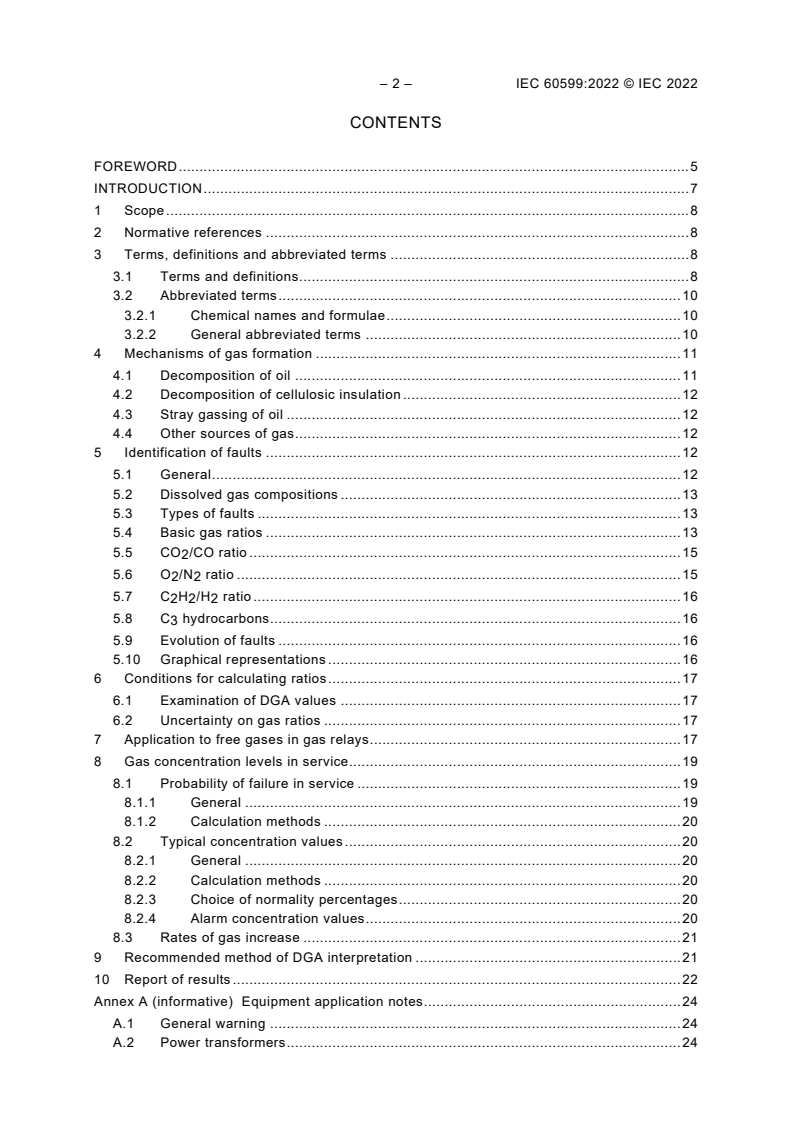
– 2 – IEC 60599:2022 © IEC 2022
CONTENTS
FOREWORD . 5
INTRODUCTION . 7
1 Scope . 8
2 Normative references . 8
3 Terms, definitions and abbreviated terms . 8
3.1 Terms and definitions . 8
3.2 Abbreviated terms . 10
3.2.1 Chemical names and formulae . 10
3.2.2 General abbreviated terms . 10
4 Mechanisms of gas formation . 11
4.1 Decomposition of oil . 11
4.2 Decomposition of cellulosic insulation . 12
4.3 Stray gassing of oil . 12
4.4 Other sources of gas . 12
5 Identification of faults . 12
5.1 General . 12
5.2 Dissolved gas compositions . 13
5.3 Types of faults . 13
5.4 Basic gas ratios . 13
5.5 CO /CO ratio . 15
5.6 O /N ratio . 15
2 2
5.7 C H /H ratio . 16
2 2 2
5.8 C hydrocarbons . 16
5.9 Evolution of faults . 16
5.10 Graphical representations . 16
6 Conditions for calculating ratios . 17
6.1 Examination of DGA values . 17
6.2 Uncertainty on gas ratios . 17
7 Application to free gases in gas relays . 17
8 Gas concentration levels in service . 19
8.1 Probability of failure in service . 19
8.1.1 General . 19
8.1.2 Calculation methods . 20
8.2 Typical concentration values . 20
8.2.1 General . 20
8.2.2 Calculation methods . 20
8.2.3 Choice of normality percentages . 20
8.2.4 Alarm concentration values . 20
8.3 Rates of gas increase . 21
9 Recommended method of DGA interpretation . 21
10 Report of results . 22
Annex A (informative) Equipment application notes . 24
A.1 General warning . 24
A.2 Power transformers . 24
A.2.1 Specific subtypes. 24
A.2.2 Typical faults . 24
A.2.3 Identification of faults by DGA . 25
A.2.4 Typical concentration values . 25
A.2.5 Typical rates of gas increase . 26
A.2.6 Specific information to be added to the DGA report . 27
A.3 Industrial and special transformers . 27
A.3.1 Specific subtypes. 27
A.3.2 Typical faults . 27
A.3.3 Identification of faults by DGA . 28
A.3.4 Typical concentration values . 28
A.4 Instrument transformers . 29
A.4.1 Specific subtypes. 29
A.4.2 Typical faults . 29
A.4.3 Identification of faults by DGA . 29
A.4.4 Typical concentration values . 30
A.5 Oil-impregnated paper bushings . 30
A.5.1 Specific subtypes. 30
A.5.2 Typical faults . 30
A.5.3 Identification of faults by DGA . 31
A.5.4 Typical concentration values . 31
A.6 Oil-filled cables . 32
A.6.1 Typical faults . 32
A.6.2 Identification of faults by DGA . 32
A.6.3 Typical concentration values . 32
A.7 Switching equipment . 33
A.7.1 Specific subtypes. 33
A.7.2 Normal operation . 33
A.7.3 Typical faults . 33
A.7.4 Identification of faults by DGA . 33
A.8 Equipment filled with non-mineral fluids . 34
Annex B (informative) Graphical representations of gas ratios . 35
Bibliography . 39
Figure 1 – Flow chart . 23
Figure B.1 – Graphical representation 1 of gas ratios . 35
Figure B.2 – Graphical representation 2 of gas ratios . 36
Figure B.3 – Graphical representation 3 of gas ratios – Duval's triangle 1 for
transformers, bushings and cables . 37
Figure B.4 – Graphical representation 4 of gas ratios – Duval's triangle 2 for OLTCs
(see A.7.2) . 38
Table 1 – DGA interpretation table . 14
Table 2 – Simplified scheme of interpretation . 14
Table 3 – Ostwald solubility coefficients for various gases in mineral insulating oils . 19
Table A.1 – Typical faults in power transformers . 25
Table A.2 – Ranges of 90 % typical gas concentration values observed in power
transformers . 26
– 4 – IEC 60599:2022 © IEC 2022
Table A.3 – Ranges of 90 % typical rates of gas increase observed in power
transformers (all types) . 26
Table A.4 – Examples of 90 % typical concentration values observed on individual
networks . 28
Table A.5 – Ranges of 90 % typical concentration values observed in WTTs . 28
Table A.6 – Typical faults in instrument transformers . 29
Table A.7 – Ranges of 90 % typical concentration values observed in instrument
transformers . 30
Table A.8 – Maximum admissible values for sealed instrument transformers. 30
Table A.9 – Typical faults in bushings . 31
Table A.10 – Simplified interpretation scheme for bushings . 31
Table A.11 – Ranges of 90 % typical concentration values in bushings . 32
Table A.12 – Ranges of 95 % typical concentration values observed on cables . 33
Table A.13 – Typical faults in switching equipment . 33
INTERNATIONAL ELECTROTECHNICAL COMMISSION
____________
MINERAL OIL-FILLED ELECTRICAL EQUIPMENT
IN SERVICE – GUIDANCE ON THE INTERPRETATION
OF DISSOLVED AND FREE GASES ANALYSIS
FOREWORD
1) The International Electrotechnical Commission (IEC) is a worldwide organization for standardization comprising
all national electrotechnical committees (IEC National Committees). The object of IEC is to promote international
co-operation on all questions concerning standardization in the electrical and electronic fields. To this end and
in addition to other activities, IEC publishes International Standards, Technical Specifications, Technical Reports,
Publicly Available Specifications (PAS) and Guides (hereafter referred to as “IEC Publication(s)”). Their
preparation is entrusted to technical committees; any IEC National Committee interested in the subject dealt with
may participate in this preparatory work. International, governmental and non-governmental organizations liaising
with the IEC also participate in this preparation. IEC collaborates closely with the International Organization for
Standardization (ISO) in accordance with conditions determined by agreement between the two organizations.
2) The formal decisions or agreements of IEC on technical matters express, as nearly as possible, an international
consensus of opinion on the relevant subjects since each technical committee has representation from all
interested IEC National Committees.
3) IEC Publications have the form of recommendations for international use and are accepted by IEC National
Committees in that sense. While all reasonable efforts are made to ensure that the technical content of IEC
Publications is accurate, IEC cannot be held responsible for the way in which they are used or for any
misinterpretation by any end user.
4) In order to promote international uniformity, IEC National Committees undertake to apply IEC Publications
transparently to the maximum extent possible in their national and regional publications. Any divergence between
any IEC Publication and the corresponding national or regional publication shall be clearly indicated in the latter.
5) IEC itself does not provide any attestation of conformity. Independent certification bodies provide conformity
assessment services and, in some areas, access to IEC marks of conformity. IEC is not responsible for any
services carried out by independent certification bodies.
6) All users should ensure that they have the latest edition of this publication.
7) No liability shall attach to IEC or its directors, employees, servants or agents including individual experts and
members of its technical committees and IEC National Committees for any personal injury, property damage or
other damage of any nature whatsoever, whether direct or indirect, or for costs (including legal fees) and
expenses arising out of the publication, use of, or reliance upon, this IEC Publication or any other IEC
Publications.
8) Attention is drawn to the Normative references cited in this publication. Use of the referenced publications is
indispensable for the correct application of this publication.
9) Attention is drawn to the possibility that some of the elements of this IEC Publication may be the subject of patent
rights. IEC shall not be held responsible for identifying any or all such patent rights.
IEC 60599 has been prepared by IEC technical committee 10: Fluids for electrotechnical
applications. It is an International Standard.
This fourth edition cancels and replaces the third edition published in 2015. This edition
constitutes a technical revision.
This edition includes the following significant technical changes with respect to the previous
edition:
a) revision of Clause A.5 on bushings, at the request of IEC subcommittee 36A, in order to
transfer to IEC 60599 the corresponding contents of IEC TR 61464 [1] relating to DGA in
bushings and include the new information on DGA in bushings available in CIGRE Technical
Brochure 771 (2019) [2];
___________
Numbers in square brackets refer to the Bibliography.
– 6 – IEC 60599:2022 © IEC 2022
b) revision of Clause A.3 on wind turbine transformers, in order to include in IEC 60599 the
new information on DGA in wind turbine transformers available in CIGRE Technical
Brochure 771 (2019) [2].
The text of this International Standard is based on the following documents:
Draft Report on voting
10/1164/FDIS 10/1174/RVD
Full information on the voting for its approval can be found in the report on voting indicated in
the above table.
The language used for the development of this International Standard is English.
This document was drafted in accordance with ISO/IEC Directives, Part 2, and developed in
accordance with ISO/IEC Directives, Part 1 and ISO/IEC Directives, IEC Supplement, available
at www.iec.ch/members_experts/refdocs. The main document types developed by IEC are
described in greater detail at www.iec.ch/publications.
The committee has decided that the contents of this document will remain unchanged until the
stability date indicated on the IEC website under webstore.iec.ch in the data related to the
specific document. At this date, the document will be
• reconfirmed,
• withdrawn,
• replaced by a revised edition, or
• amended.
INTRODUCTION
Dissolved and free gas analysis (DGA) is one of the most widely used diagnostic tools for
detecting and evaluating faults in electrical equipment filled with insulating liquid. However,
interpretation of DGA results is often complex and should always be done with care, involving
experienced insulation maintenance personnel.
This document gives information for facilitating this interpretation. The first edition, published
in 1978, has served the industry well, but had its limitations, such as the absence of a diagnosis
in some cases, the absence of concentration levels and the fact that it was based mainly on
experience gained from power transformers. The second edition (2015) attempted to address
some of these shortcomings. Interpretation schemes were based on observations made after
inspection of a large number of faulty oil-filled equipment in service and concentrations levels
deduced from analyses collected worldwide.
– 8 – IEC 60599:2022 © IEC 2022
MINERAL OIL-FILLED ELECTRICAL EQUIPMENT
IN SERVICE – GUIDANCE ON THE INTERPRETATION
OF DISSOLVED AND FREE GASES ANALYSIS
1 Scope
This document describes how the concentrations of dissolved gases or free gases can be
interpreted to diagnose the condition of oil-filled electrical equipment in service and suggest
future action.
This document is applicable to electrical equipment filled with mineral insulating oil and
insulated with cellulosic paper or pressboard-based solid insulation. Information about specific
types of equipment such as transformers (power, instrument, industrial, railways, distribution),
reactors, bushings, switchgear and oil-filled cables is given only as an indication in the
application notes.
This document can be applied, but only with caution, to other liquid-solid insulating systems.
In any case, the indications obtained are given only as guidance with resulting action
undertaken only with proper engineering judgment.
2 Normative references
The following documents are referred to in the text in such a way that some or all of their content
constitutes requirements of this document. For dated references, only the edition cited applies.
For undated references, the latest edition of the referenced document (including any
amendments) applies.
IEC 60475, Method of sampling insulating liquids
IEC 60567:2011, Oil-filled electrical equipment – Sampling of gases and analysis of free and
dissolved gases – Guidance
IEC 61198, Mineral insulating oils – Methods for the determination of 2-furfural and related
compounds
3 Terms, definitions and abbreviated terms
3.1 Terms and definitions
For the purposes of this document, the following terms and definitions apply.
ISO and IEC maintain terminology databases for use in standardization at the following
addresses:
• IEC Electropedia: available at https://www.electropedia.org/
• ISO Online browsing platform: available at https://www.iso.org/obp
3.1.1
fault
unplanned occurrence or defect in an item which may result in one or more failures of the item
itself or of other associated equipment
3.1.2
non-damage fault
fault which does not involve repair or replacement action at the point of the fault
Note 1 to entry: Typical examples are self-extinguishing arcs in switching equipment or general overheating without
paper carbonization or stray gassing of oil.
3.1.3
damage fault
fault that involves repair or replacement action at the point of the fault
3.1.4
incident
event of external or internal origin, affecting equipment or the supply system and which disturbs
its normal operation
Note 1 to entry: For the purposes of this document "incidents" are related to internal faults.
Note 2 to entry: For the purposes of this document typical examples of "incidents" are gas alarms, equipment
tripping or equipment leakage.
3.1.5
failure
loss of ability to perform as required
Note 1 to entry: In electrical equipment, failure will result from a damage fault or incident necessitating outage,
repair or replacement of the equipment, such as internal breakdown, rupture of tank, fire or explosion.
3.1.6
electrical fault
partial or disruptive discharge through the insulation
3.1.7
partial discharge
electric discharge that only partially bridges the insulation between conductors
Note 1 to entry: A partial discharge may occur inside the insulation or adjacent to a conductor.
Note 2 to entry: Scintillations of low energy on the surface of insulating materials are often described as partial
discharges but should rather be considered as disruptive discharges of low energy, since they are the result of local
dielectric breakdowns of high ionization density, or small arcs, according to the conventions of physics.
Note 3 to entry: For the purposes of this document the following consideration can also be added:
– Corona is a form of partial discharge that occurs in gaseous media around conductors that are remote from solid
or liquid insulation. This term shall not be used as a general term for all forms of partial discharges.
– As a result of corona discharges, X-wax, a solid material consisting of polymerized fragments of the molecules
of the original liquid, can be formed.
3.1.8
disruptive discharge
passage of an arc following the breakdown
Note 1 to entry: The term "sparkover" (in French: "amorçage") is used when a disruptive discharge occurs in a
gaseous or liquid dielectric.
The term "flashover" (in French: "contournement") is used when a disruptive discharge occurs over the surface of a
solid dielectric surrounded by a gaseous or liquid medium.
The term "puncture" (in French: "perforation") is used when a disruptive discharge occurs through a solid dielectric.
Note 2 to entry: Discharges are often described as arcing, breakdown or short circuits. The following other specific
terms are also used in some countries:
– tracking (the progressive degradation of the surface of solid insulation by local discharges to form conducting or
partially conducting paths);
– 10 – IEC 60599:2022 © IEC 2022
– sparking discharges that, in the conventions of physics, are local dielectric breakdowns of high ionization density
or small arcs.
3.1.9
thermal fault
excessive temperature rise in the insulation
Note 1 to entry: Typical causes are
– insufficient cooling;
– excessive currents circulating in adjacent metal parts (as a result of bad contacts, eddy currents, stray losses or
leakage flux);
– excessive currents circulating through the insulation (as a result of high dielectric losses), leading to a thermal
runaway;
– overheating of internal winding or bushing connection lead;
– overloading.
3.1.10
typical values of gas concentrations
gas concentrations normally found in the equipment in service that have no symptoms of failure,
and that are exceeded by only an arbitrary percentage of higher gas contents (for example
10 %)
Note 1 to entry: See 8.2.1.
Note 2 to entry: Typical values will differ in different types of equipment and in different networks, depending on
operating practices (load levels, climate, etc.).
Note 3 to entry: Typical values, in many countries and by many users, are quoted as "normal values", but this term
has not been used in this document to avoid possible misinterpretations.
3.2 Abbreviated terms
3.2.1 Chemical names and formulae
Name Formula
Nitrogen N
Oxygen O
Hydrogen H
Carbon monoxide CO
Carbon dioxide CO
Methane CH
Ethane C H
2 6
Ethylene C H
2 4
Acetylene C H
2 2
NOTE Acetylene and ethyne are both used for C H ; ethylene and ethene are both used for C H .
2 2 2 4
3.2.2 General abbreviated terms
CT current transformer
CTCV combined transformer (current-voltage)
CIVT cascade (inductive) voltage transformer
CVT capacitor voltage transformer
MVT magnetic voltage transformer
VT voltage transformer
ONAN oil natural air natural
OFAF oil forced air forced
DDB dodecylbenzene
WTT wind turbine transformer
D1 discharges of low energy
D2 discharges of high energy
DGA dissolved gas analysis
CIGRE Conseil International des Grands Réseaux Électriques
PD corona partial discharges
S analytical detection limit
T1 thermal fault, t < 300 °C
T2 thermal fault, 300 °C < t < 700 °C
T3 thermal fault, t > 700 °C
T thermal fault
D electrical fault
TP thermal fault in paper
ppm parts per million by volume of gas in oil, equivalent to µl (of gas)/l (of oil). See
IEC 60567:2011, 8.7, Note 1.
OLTC on-load tap-changer
4 Mechanisms of gas formation
4.1 Decomposition of oil
Mineral insulating oils are made of a blend of different hydrocarbon molecules containing CH ,
CH and CH chemical groups linked together by carbon-carbon molecular bonds.
Scission of some of the C-H and C-C bonds can occur as a result of electrical and thermal faults,
with the formation of small unstable fragments, in radical or ionic form, such as
• •
• • •
H , CH , CH , CH or C (among many other more complex forms), which recombine rapidly,
3 2
through complex reactions, into gas molecules such as hydrogen (H-H), methane (CH -H),
ethane (CH -CH ), ethylene (CH = CH ) or acetylene (CH ≡ CH). C and C hydrocarbon
3 3 2 2 3 4
gases, as well as solid particles of carbon and hydrocarbon polymers (X-wax), are other
possible recombination products. The gases formed dissolve in oil, or accumulate as free gases
if produced rapidly in large quantities, and can be analysed by DGA according to IEC 60567.
Low-energy faults, such as partial discharges of the cold plasma type (corona discharges),
favour the scission of the weakest C-H bonds (338 kJ/mol) through ionization reactions and the
accumulation of hydrogen as the main recombination gas. More and more energy and/or higher
temperatures are necessary for the scission of the C-C bonds and their recombination into
gases with a C-C single bond (607 kJ/mol), C=C double bond (720 kJ/mol) or C≡C triple bond
(960 kJ/mol), following processes bearing some similarities with those observed in the
petroleum oil-cracking industry.
Ethylene is thus favoured over ethane and methane above temperatures of approximately
500 °C (although still present in lower quantities below these temperatures). Acetylene requires
temperatures of at least 800 °C to 1 200 °C, and a rapid quenching to lower temperatures, in
order to accumulate as a stable recombination product. Acetylene is thus formed in significant
quantities mainly in arcs, where the conductive ionized channel is at several thousands of
degrees Celsius, and the interface with the surrounding liquid oil necessarily below 400 °C
(above which oil vaporizes completely), with a layer of oil vapour and/or decomposition gases
in between. Acetylene can still be formed at lower temperatures (< 800 °C), but in very minor
– 12 – IEC 60599:2022 © IEC 2022
quantities. Carbon particles form at 500 °C to 800 °C and are indeed observed after arcing in
oil or around very hot spots.
Oil can oxidize with the formation of small quantities of CO and CO , which can accumulate
over long periods of time into more substantial amounts.
4.2 Decomposition of cellulosic insulation
The polymeric chains of solid cellulosic insulation (paper, pressboard, wood blocks) contain a
large number of anhydroglucose rings, and weak C-O molecular bonds and glycosidic bonds
which are thermally less stable than the hydrocarbon bonds in oil, and which decompose at
lower temperatures. Significant rates of polymer chain scission occur at temperatures higher
than 105 °C, with complete decomposition and carbonization above 300 °C (damage fault).
Carbon monoxide and dioxide, as well as water, is formed, together with minor amounts of
hydrocarbon gases, furanic and other compounds. Furanic compounds are analysed according
to IEC 61198, and used to complement DGA interpretation and confirm whether or not cellulosic
insulation is involved in a fault. CO and CO formation increases not only with temperature but
also with the oxygen content of oil and the moisture content of paper.
4.3 Stray gassing of oil
Stray gassing of oil has been defined by CIGRE [3] as the formation of gases in oil heated to
moderate temperatures (< 200 °C). H , CH and C H can be formed in all equipment at such
2 4 2 6
temperatures or as a result of oil oxidation, depending on oil chemical structure. Stray gassing
is a non-damage fault. It can be evaluated using methods described in references [3] and [4].
NOTE Stray gassing of oil has been observed in some cases to be enhanced by the presence in oil of a metal
passivator or other additives.
4.4 Other sources of gas
Gases can be generated in some cases not as a result of faults in the equipment, but through
corrosion or other chemical reactions involving steel, uncoated surfaces or protective paints.
Hydrogen can be produced by reaction of steel and galvanized steel with water, as long as
oxygen is available from the oil nearby. Large quantities of hydrogen have thus been reported
in some transformers that had never been energized. Hydrogen can also be formed by reaction
of free water with special coatings on metal surfaces, or by catalytic reaction of some types of
stainless steel with oil, in particular oil containing dissolved oxygen at elevated temperatures.
Hydrogen, acetylene and other gases can also be formed in new stainless steel, absorbed
during its manufacturing process, or produced by welding, and released slowly into the oil.
Internal transformer paints, such as alkyd resins and modified polyurethanes containing fatty
acids in their formulation, can also form gases.
Gases can also be produced, and oxygen consumed, by exposure of oil to sunlight.
These occurrences, however, are very unusual, and can be detected by performing DGA
analyses on new equipment which has never been energized, and by material compatibility
tests. The presence of hydrogen with the total absence of other hydrocarbon gases, for example,
can be an indication of such a problem.
NOTE The case of gases formed at a previous fault and remnant in the transformer is dealt with in 5.4.
5 Identification of faults
5.1 General
Any gas formation in service, be it minimal, results from a stress of some kind, even if it is a
very mild one, like normal temperature ageing. However, as long as gas concentration is below
typical values and not significantly increasing, it should not be considered as an indication of a
"fault", but rather as the result of typical gas formation (see Figure 1). Typical values are specific
for each kind of equipment.
5.2 Dissolved gas compositions
Although the formation of some gases is favoured, depending on the temperature reached or
the energy contained in a fault (see 4.1), in practice mixtures of gases are almost always
obtained. One reason is thermodynamic: although not favoured, secondary gases are still
formed, albeit in minor quantities. Existing thermodynamic models derived from the petroleum
industry, however, cannot predict accurately the gas compositions formed, because they
correspond to ideal gas and/or temperature equilibria that do not exist in actual faults. Large
temperature gradients also occur in practice, for instance as a result of oil flow or vaporization
along a hot surface. This is particularly true in the case of arcs with power follow-through, which
transfer a lot of heat to the oil vapour and/or decomposition gas layer between the arc and the
oil, probably explaining the increasing formation of ethylene observed in addition to acetylene.
In addition, existing thermodynamic models do not apply to paper that turns irreversibly to
carbon above 300 °C.
5.3 Types of faults
Internal inspection of hundreds of faulty equipment has led to the following broad classes of
visually detectable faults:
– partial discharges (PD) of the cold plasma (corona) type, resulting in possible X-wax
deposition on paper insulation;
– discharges of low energy (D1), in oil and/or paper, evidenced by larger carbonized
perforations through paper (punctures), carbonization of the paper surface (tracking) or
carbon particles in oil (as in tap changer diverter operation); also, partial discharges of the
sparking type, inducing pinhole, carbonized perforations (punctures) in paper, which,
however, may be difficult to find;
– discharges of high energy (D2), in oil and/or paper, with power follow-through, evidenced
by extensive destruction and carbonization of paper, metal fusion at the discharge
extremities, extensive carbonization in oil and, in some cases, tripping of the equipment,
confirming the large current follow-through;
– thermal faults, in oil and/or paper, below 300 °C if the paper has turned brownish (T1), and
above 300 °C if it has carbonized (T2);
– thermal faults of temperatures above 700 °C (T3) if there is strong evidence of carbonization
of the oil, metal coloration (800 °C) or metal fusion (> 1 000 °C).
5.4 Basic gas ratios
Each of the six broad classes of faults leads to a characteristic pattern of hydrocarbon gas
composition, which can be translated into a DGA interpretation table, such as the one
recommended in Table 1 and based on the use of three basic gas ratios:
C H CH C H
2 2 4 2 4
C H H C H
2 4 2 2 6
Table 1 applies to all types of equipment, with a few differences in gas ratio limits depending
on the specific type of equipment.
– 14 – IEC 60599:2022 © IEC 2022
Table 1 – DGA interpretation table
Case Characteristic fault
C H CH C H
2 2 4 2 4
C H H C H
2 4 2 2 6
a
PD Partial discharges (see Notes 3 and 4) < 0,1 < 0,2
NS
D1 Discharges of low energy > 1 0,1 to 0,5 > 1
D2 Discharges of high energy 0,6 to 2,5 0,1 to 1 > 2
a a
T1 < 1
Thermal fault t < 300 °C
NS > 1 but NS
T2 Thermal fault 300 °C < t < 700 °C < 0,1 > 1 1 to 4
b
T3
Thermal fault t > 700 °C > 1 > 4
< 0,2
NOTE 1 In some countries, the ratio C H /C H is used, rather than the ratio CH /H . Also in some countries,
2 2 2 6 4 2
slightly different ratio limits are used.
NOTE 2 Conditions for calculating gas ratios are indicated in 6.1 c).
NOTE 3 CH /H < 0,2 for partial discharges in instrument transformers. CH /H < 0,07 for partial discharges in
4 2 4 2
bushings.
NOTE 4 Gas decomposition patterns similar to partial discharges have been reported as a result of stray gassing
of oil (see 4.3).
a
NS = Non-significant whatever the value.
b
An increasing value of the amount of C H can indicate that the hot spot temperature is higher than 1 000 °C.
2 2
Typical examples of faults in the various types of equipment (power transformers, instrument
transformers, etc.), corresponding to the six cases of Table 1, can be found in Table A.1,
Table A.5, Table A.8 and Table A.12.
Some overlap between faults D1 and D2 is apparent in Table 1, meaning that a dual attribution
of D1 or D2 should be given in some cases of DGA results. The distinction between D1 and D2
has been kept, however, as the amount of energy in the discharge can significantly increase
the potential damage to the equipment and necessitate different preventive measures. Table 1
applies to transformers. For switching equipment see Clause A.7 and reference [5] in the
bibliography.
NOTE Combinations of gas ratios that fall outside the range limits of Table 1 and do not correspond to a
characteristic fault of this table can be considered a mixture of faults, or new faults that combine with a high
background gas level (see 6.1).
In such a case, Table 1 cannot provide a diagnosis, but the graphical representations given in Annex B can be used
to visualize which characteristic fault of Table 1 is closest to the case.
The less detailed scheme of Table 2 can also be used in such a case in order to get at least a rough distinction
between partial discharges (PD), discharges (D) and thermal fault (T), rather than no diagnosis at all.
Table 2 – Simplified scheme of interpretation
Case
C H CH C H
2 2 4 2 4
C H H C H
2 4 2 2 6
PD < 0,2
D > 0,2
T < 0,2
5.5 CO /CO ratio
The formation of CO and CO from oil-impregnated paper insul
...