


CISPR 20:1996/AMD2:1997
(Amendment)Amendment 2 - Limits and methods of measurement of immunity characteristics of sound and television broadcast receivers and associated equipment
Amendment 2 - Limits and methods of measurement of immunity characteristics of sound and television broadcast receivers and associated equipment
Describes the measurement methods to evaluate the chrominance performance in SECAM non-broadcast video tape recorders. Because of the frequency modulation used in the SECAM system, special methods of measurement are required for testing the chrominance performance.
Amendement 2 - Limites et méthodes de mesure des caractéristiques d immunité des récepteurs de radiodiffusion et de télévision et équipements associés
Décrit les méthodes de mesure pour évaluer les performances des voies chrominance des magnétoscopes SECAM hors radiodiffusion. La modulation de fréquence étant utilisée dans le système SECAM, des méthodes spéciales de mesure sont exigées pour relever les performances des voies chrominance.
General Information
- Status
- Published
- Publication Date
- 31-Jul-1997
- Current Stage
- DELPUB - Deleted Publication
- Start Date
- 12-Aug-1998
- Completion Date
- 14-Feb-2026
Relations
- Effective Date
- 05-Sep-2023
- Effective Date
- 05-Sep-2023
Overview
CISPR 20:1996/AMD2:1997 is an important amendment published by the International Electrotechnical Commission (IEC) that focuses on the limits and methods of measurement of immunity characteristics of sound and television broadcast receivers along with associated equipment. This amendment specifically addresses the immunity testing methodologies for outdoor units of Direct-To-Home (DTH) satellite receiving systems designed for individual reception.
Enhanced measurement techniques are detailed to evaluate the chrominance performance in SECAM non-broadcast video tape recorders, considering the particular challenges posed by frequency modulation used in the SECAM system. This standard is vital for manufacturers and testing laboratories involved in the design, development, and certification of broadcast receivers and satellite equipment, ensuring compliance with electromagnetic compatibility (EMC) requirements and robustness against interference.
Key Topics
Immunity Characteristics: Establishes the immunity limits for both sound and television receivers, particularly for outdoor satellite reception units, to withstand undesired signals without performance degradation.
Measurement Methods: Introduces advanced measurement setups for satellite television and sound receivers, including modulation by frequency using color bar signals for TV and audio frequency signals for sound receivers. Frequency modulated signals closely reflect real broadcast conditions.
Satellite Receiver Testing: Specifies detailed procedures for testing satellite receivers at tuned channels under conditions of unwanted signal interference in adjacent channels according to precise limits (see Table 17 in the standard).
Signal Types and Parameters: Defines signal types A1, A2, A3, and A4 with varied channel spacing, deviation sensitivity, and energy dispersion designed for MAC/packet, PAL, and SECAM receivers. This differentiation ensures meaningful and accurate immunity evaluations for different broadcast systems.
Modular Equipment Considerations: Clarifies that tuners, frequency converters, and other modular units performing parts of the receiving function are encompassed within the scope as they affect immunity characteristics.
Screening Effectiveness: Provides limits for the shielding effectiveness of both terrestrial and satellite receivers to prevent unwanted electromagnetic interference, enhancing reliability and signal integrity.
Applications
Broadcast Receiver Development: Electronics companies can apply CISPR 20 amendment 2 standards during design and production phases to meet international EMC immunity limits for satellite and terrestrial sound and television systems.
EMC Testing & Certification: Test laboratories use the standardized measurement methods and immunity limits to assess broadcast receivers, ensuring compliance and enabling equipment certification for global markets.
Satellite Reception Systems: Manufacturers of DTH satellite outdoor units benefit from this guidance to validate immunity against adjacent channel interference, improving user reception quality.
Modular Tuner and Converter Design: Component suppliers develop tuners and frequency converters aligned with these immunity criteria, facilitating integration into compliant broadcast reception devices.
Quality Assurance: Service centers and quality departments adopt the immunity test methods to diagnose and improve receiver robustness against radiofrequency disturbances.
Related Standards
IEC 60728-2: Covers cabled distribution systems for television and sound, particularly the electromagnetic compatibility of equipment involved in collective satellite reception such as cable distribution headends and community antenna television (CATV) or master antenna television (MATV) systems.
CISPR 11 and CISPR 22: Address EMC requirements for industrial, scientific, medical equipment and information technology equipment that may interface with broadcast receivers.
IEC 62132 Series: EMC test methodologies applicable to radio receivers and transceivers, complementing CISPR 20's focus on immunity measurement.
IEC Electropedia: The IEC's Online Electrotechnical Vocabulary provides detailed definitions of terms referenced in CISPR 20, supporting clear understanding and uniform interpretation.
By adhering to CISPR 20:1996/AMD2:1997, stakeholders in the broadcast and satellite receiver industries can ensure their products maintain optimal immunity performance in complex electromagnetic environments. This leads to improved user experience, regulatory compliance, and enhanced global market acceptance.
Buy Documents
CISPR 20:1996/AMD2:1997 - Amendment 2 - Limits and methods of measurement of immunity characteristics of sound and television broadcast receivers and associated equipment Released:8/1/1997
Get Certified
Connect with accredited certification bodies for this standard

TL 9000 QuEST Forum
Telecommunications quality management system.

ANCE
Mexican certification and testing association.

Intertek Slovenia
Intertek testing, inspection, and certification services in Slovenia.
Sponsored listings
Frequently Asked Questions
CISPR 20:1996/AMD2:1997 is a standard published by the International Electrotechnical Commission (IEC). Its full title is "Amendment 2 - Limits and methods of measurement of immunity characteristics of sound and television broadcast receivers and associated equipment". This standard covers: Describes the measurement methods to evaluate the chrominance performance in SECAM non-broadcast video tape recorders. Because of the frequency modulation used in the SECAM system, special methods of measurement are required for testing the chrominance performance.
Describes the measurement methods to evaluate the chrominance performance in SECAM non-broadcast video tape recorders. Because of the frequency modulation used in the SECAM system, special methods of measurement are required for testing the chrominance performance.
CISPR 20:1996/AMD2:1997 is classified under the following ICS (International Classification for Standards) categories: 33.100.20 - Immunity; 33.160.40 - Video systems. The ICS classification helps identify the subject area and facilitates finding related standards.
CISPR 20:1996/AMD2:1997 has the following relationships with other standards: It is inter standard links to CISPR 20:1996, CISPR 20:1998. Understanding these relationships helps ensure you are using the most current and applicable version of the standard.
CISPR 20:1996/AMD2:1997 is available in PDF format for immediate download after purchase. The document can be added to your cart and obtained through the secure checkout process. Digital delivery ensures instant access to the complete standard document.
Standards Content (Sample)
CISPR 20 ®
Edition 3.0 1997-08
INTERNATIONAL
STANDARD
NORME
INTERNATIONALE
INTERNATIONAL SPECIAL COMMITTEE ON RADIO INTERFERENCE
COMITÉ INTERNATIONAL SPÉCIAL DES PERTURBATIONS RADIOÉLECTRIQUES
AMENDMENT 2
AMENDEMENT 2
Limits and methods of measurement of immunity characteristics of sound and
television broadcast receivers and associated equipment
Limites et méthodes de mesure des caractéristiques d’immunité des récepteurs
de radiodiffusion et de télévision et équipements associés
CISPR 20:1996/A2:1997
Copyright © 1997 IEC, Geneva, Switzerland
All rights reserved. Unless otherwise specified, no part of this publication may be reproduced or utilized in any form or by
any means, electronic or mechanical, including photocopying and microfilm, without permission in writing from either IEC or
IEC's member National Committee in the country of the requester.
If you have any questions about IEC copyright or have an enquiry about obtaining additional rights to this publication,
please contact the address below or your local IEC member National Committee for further information.
Droits de reproduction réservés. Sauf indication contraire, aucune partie de cette publication ne peut être reproduite
ni utilisée sous quelque forme que ce soit et par aucun procédé, électronique ou mécanique, y compris la photocopie
et les microfilms, sans l'accord écrit de la CEI ou du Comité national de la CEI du pays du demandeur.
Si vous avez des questions sur le copyright de la CEI ou si vous désirez obtenir des droits supplémentaires sur cette
publication, utilisez les coordonnées ci-après ou contactez le Comité national de la CEI de votre pays de résidence.
IEC Central Office
3, rue de Varembé
CH-1211 Geneva 20
Switzerland
Email: inmail@iec.ch
Web: www.iec.ch
About the IEC
The International Electrotechnical Commission (IEC) is the leading global organization that prepares and publishes
International Standards for all electrical, electronic and related technologies.
About IEC publications
The technical content of IEC publications is kept under constant review by the IEC. Please make sure that you have the
latest edition, a corrigenda or an amendment might have been published.
Catalogue of IEC publications: www.iec.ch/searchpub
The IEC on-line Catalogue enables you to search by a variety of criteria (reference number, text, technical committee,…).
It also gives information on projects, withdrawn and replaced publications.
IEC Just Published: www.iec.ch/online_news/justpub
Stay up to date on all new IEC publications. Just Published details twice a month all new publications released. Available
on-line and also by email.
Electropedia: www.electropedia.org
The world's leading online dictionary of electronic and electrical terms containing more than 20 000 terms and definitions
in English and French, with equivalent terms in additional languages. Also known as the International Electrotechnical
Vocabulary online.
Customer Service Centre: www.iec.ch/webstore/custserv
If you wish to give us your feedback on this publication or need further assistance, please visit the Customer Service
Centre FAQ or contact us:
Email: csc@iec.ch
Tel.: +41 22 919 02 11
Fax: +41 22 919 03 00
A propos de la CEI
La Commission Electrotechnique Internationale (CEI) est la première organisation mondiale qui élabore et publie des
normes internationales pour tout ce qui a trait à l'électricité, à l'électronique et aux technologies apparentées.
A propos des publications CEI
Le contenu technique des publications de la CEI est constamment revu. Veuillez vous assurer que vous possédez
l’édition la plus récente, un corrigendum ou amendement peut avoir été publié.
Catalogue des publications de la CEI: www.iec.ch/searchpub/cur_fut-f.htm
Le Catalogue en-ligne de la CEI vous permet d’effectuer des recherches en utilisant différents critères (numéro de référence,
texte, comité d’études,…). Il donne aussi des informations sur les projets et les publications retirées ou remplacées.
Just Published CEI: www.iec.ch/online_news/justpub
Restez informé sur les nouvelles publications de la CEI. Just Published détaille deux fois par mois les nouvelles
publications parues. Disponible en-ligne et aussi par email.
Electropedia: www.electropedia.org
Le premier dictionnaire en ligne au monde de termes électroniques et électriques. Il contient plus de 20 000 termes et
définitions en anglais et en français, ainsi que les termes équivalents dans les langues additionnelles. Egalement appelé
Vocabulaire Electrotechnique International en ligne.
Service Clients: www.iec.ch/webstore/custserv/custserv_entry-f.htm
Si vous désirez nous donner des commentaires sur cette publication ou si vous avez des questions, visitez le FAQ du
Service clients ou contactez-nous:
Email: csc@iec.ch
Tél.: +41 22 919 02 11
Fax: +41 22 919 03 00
CISPR 20 ®
Edition 3.0 1997-08
INTERNATIONAL
STANDARD
NORME
INTERNATIONALE
INTERNATIONAL SPECIAL COMMITTEE ON RADIO INTERFERENCE
COMITÉ INTERNATIONAL SPÉCIAL DES PERTURBATIONS RADIOÉLECTRIQUES
AMENDMENT 2
AMENDEMENT 2
Limits and methods of measurement of immunity characteristics of sound and
television broadcast receivers and associated equipment
Limites et méthodes de mesure des caractéristiques d’immunité des récepteurs
de radiodiffusion et de télévision et équipements associés
INTERNATIONAL
ELECTROTECHNICAL
COMMISSION
COMMISSION
ELECTROTECHNIQUE
PRICE CODE
INTERNATIONALE
CODE PRIX E
ICS 33.100 ISBN 2-8318-3974-2
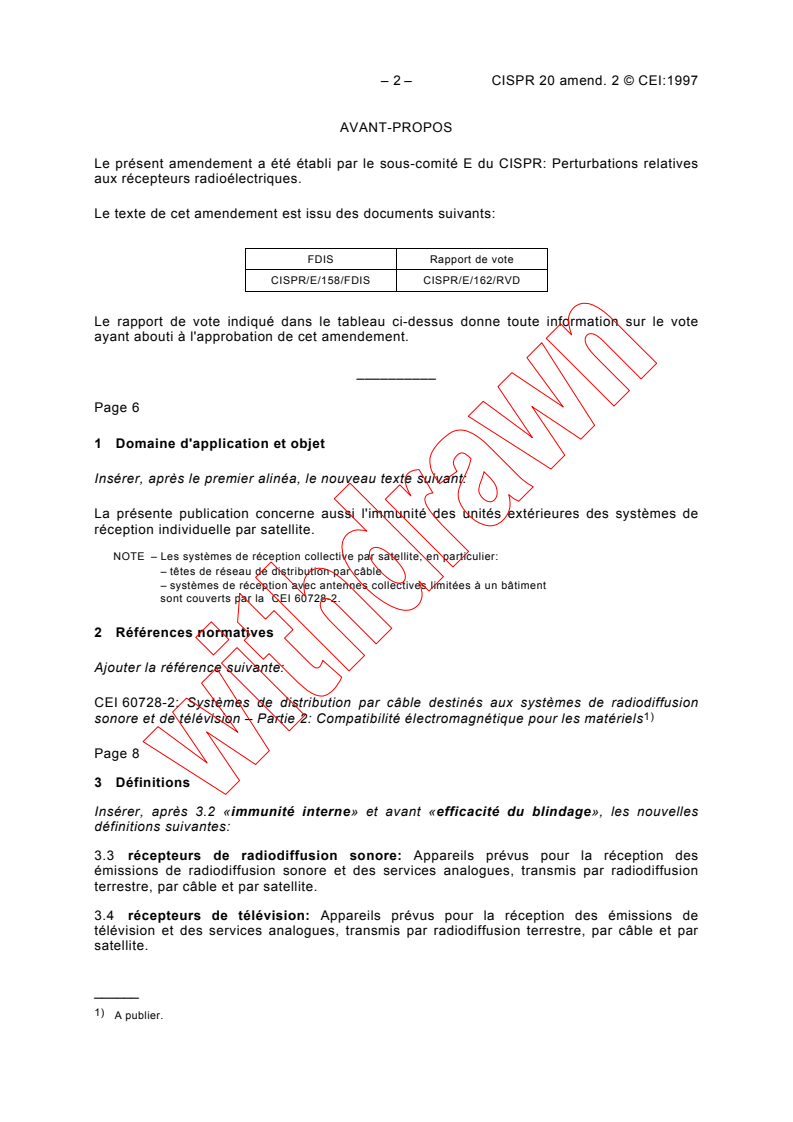
– 2 – CISPR 20 amend. 2 © CEI:1997
AVANT-PROPOS
Le présent amendement a été établi par le sous-comité E du CISPR: Perturbations relatives
aux récepteurs radioélectriques.
Le texte de cet amendement est issu des documents suivants:
FDIS Rapport de vote
CISPR/E/158/FDIS CISPR/E/162/RVD
Le rapport de vote indiqué dans le tableau ci-dessus donne toute information sur le vote
ayant abouti à l'approbation de cet amendement.
__________
Page 6
1 Domaine d'application et objet
Insérer, après le premier alinéa, le nouveau texte suivant:
La présente publication concerne aussi l'immunité des unités extérieures des systèmes de
réception individuelle par satellite.
NOTE – Les systèmes de réception collective par satellite, en particulier:
– têtes de réseau de distribution par câble
– systèmes de réception avec antennes collectives limitées à un bâtiment
sont couverts par la CEI 60728-2.
2 Références normatives
Ajouter la référence suivante:
CEI 60728-2: Systèmes de distribution par câble destinés aux systèmes de radiodiffusion
1)
sonore et de télévision – Partie 2: Compatibilité électromagnétique pour les matériels
Page 8
3 Définitions
Insérer, après 3.2 «immunité interne» et avant «efficacité du blindage», les nouvelles
définitions suivantes:
3.3 récepteurs de radiodiffusion sonore: Appareils prévus pour la réception des
émissions de radiodiffusion sonore et des services analogues, transmis par radiodiffusion
terrestre, par câble et par satellite.
3.4 récepteurs de télévision: Appareils prévus pour la réception des émissions de
télévision et des services analogues, transmis par radiodiffusion terrestre, par câble et par
satellite.
______
1)
A publier.
CISPR 20 Amend. 2 © IEC:1997 – 3 –
FOREWORD
This amendment has been prepared by CISPR subcommittee E: Interference relating to radio
receivers.
The text of this amendment is based on the following documents:
FDIS Report on voting
CISPR/E/158/FDIS CISPR/E/162/RVD
Full information on the voting for the approval of this amendment can be found in the report
on voting indicated in the above table.
__________
Page 7
1 Scope and object
Insert, after the first paragraph, the following new paragraph:
This publication is also applicable to the immunity of outdoor units of direct to home (DTH)
satellite receiving systems for individual reception.
NOTE – Satellite receiving systems for collective reception, in particular:
– cable distribution head ends (Community Antenna Television, CATV)
– community reception systems (Master Antenna Television, MATV)
are covered by IEC 60728-2.
2 Normative references
Add the following reference:
IEC 60728-2: Cabled distribution systems for television and sound systems – Part 2:
1)
Electromagnetic compatibility of equipment
Page 9
3 Definitions
Insert, after 3.2 "internal immunity" and before "screening effectiveness", the following
additional definitions:
3.3 sound receivers: Appliances intended for the reception of sound broadcast and similar
services for terrestrial, cable and satellite transmissions.
3.4 television receivers: Appliances intended for the reception of television broadcast and
similar services for terrestrial, cable and satellite transmissions.
______
1)
To be published.
– 4 – CISPR 20 amend. 2 © CEI:1997
NOTES
1 Les éléments modulaires qui réalisent une partie des fonctions des systèmes de réception de radiodiffusion
sonore ou de télévision (comme les syntoniseurs, les convertisseurs de fréquence, les amplificateurs, les
modulateurs, etc.) sont considérés comme des récepteurs de radiodiffusion sonore ou comme des récepteurs
de télévision selon le cas.
2 Les syntoniseurs peuvent être équipés d'un étage de réception pour la radiodiffusion par satellite et de
démodulateurs, décodeurs, démultiplexeurs, convertisseurs numérique/analogique, codeurs (par exemple
codeurs NTSC, PAL ou SECAM), etc.
3 Les convertisseurs de fréquence peuvent être équipés d'un étage de réception pour la radiodiffusion par
satellite et de dispositifs qui convertissent les signaux dans d'autres bandes de fréquence.
4 Les récepteurs, les syntoniseurs ou les convertisseurs de fréquence peuvent être accordables ou peuvent
être conçus pour recevoir uniquement une fréquence fixe.
Page 26
Ajouter après le paragraphe 4.2.4 les nouveaux paragraphes suivants:
4.2.5 Récepteurs de télévision par satellite
Les récepteurs de télévision par satellite doivent être essayés selon 5.6.4 après réglage sur
le canal N et soumis à un signal non désiré dans le canal M comme indiqué dans le tableau
17, du type sélectionné entre A , A , A , A selon le cas.
1 2 3 4
Tableau 17 – Limites de l'immunité interne des récepteurs par satellite
Signal non désiré dans le canal M
Canal utile Niveau dB(µV) Type
N N – 2 N – 1 N + 1 N + 2
70 66 66 70 A ou A ou
N + 3
1 2
min
A ou A
70 66 66 70
3 4
N
cent
70 66 66 70
...
Questions, Comments and Discussion
Ask us and Technical Secretary will try to provide an answer. You can facilitate discussion about the standard in here.
Loading comments...