

IEC TR 61200-52:2013
(Main)Electrical installation guide - Part 52: Selection and erection of electrical equipment - Wiring systems
General Information
- Abstract
IEC/TR 61200-52:2013 is Technical Report which serves as a supplement to IEC 60364-5-52:2009 and explains the rules so as to facilitate the design, selection, erection and maintenance of wiring systems. It follows the numbering of that standard. This technical report is written for everyone concerned with the design, the selection and supply of equipment, as well as the persons who install, maintain and use electrical installations. This second edition cancels and replaces the first edition, published in 1993, and constitutes a technical revision. This edition includes the following significant technical changes with respect to the previous edition:
- guidance associated with conduit systems, cable ducting systems, cable trunking systems, cable tray systems and cable ladder systems has been added giving, for example, recommended maximum straight lengths of conduit to ease the installation circuit wiring;
- guidance associated with selection and erection of wiring systems in relation to external influences has been extended to cover impact, and other mechanical stresses;
- guidance for grouping of cables has been added; and
- guidance on maximum temperatures of terminals in normal service conditions has been extended.
- Status
- Published
- Publication Date
- 09-Jul-2013
- Technical Committee
- TC 64 - Electrical installations and protection against electric shock
- Drafting Committee
- MT 2 - TC 64/MT 2
- Current Stage
- PPUB - Publication issued
- Start Date
- 10-Jul-2013
- Completion Date
- 28-Aug-2026

Overview
IEC TR 61200-52:2013 is a Technical Report published by IEC that supplements IEC 60364-5-52:2009. It explains rules to facilitate the design, selection, erection and maintenance of wiring systems used in low-voltage electrical installations. Written for designers, equipment suppliers, installers and maintenance personnel, the document updates and expands guidance on conduit and cable management, mechanical stresses, cable grouping and terminal temperature considerations.
Key topics and requirements
- Wiring system types - guidance for conduit systems, cable ducting, cable trunking, cable tray and cable ladder systems, including practical installation tips.
- Conduit installation - recommended maximum straight lengths (typically up to 25 m between access points; runs with direction changes limited to 15 m and no more than three changes in direction), minimise bends, use large bending radii and follow manufacturers’ instructions.
- Conduit fill - cables or insulated conductors should not exceed one-third of the conduit’s internal cross-sectional area.
- External influences - extended guidance on mechanical impacts, stresses, ingress of solid foreign bodies (protection degree at least IP2X required to prevent solid ingress), and effects of solar and UV radiation on outdoor wiring.
- Grouping and proximity - rules and recommendations for grouping of cables, proximity to other services and separation of communication cables to limit interference and thermal impact.
- Current-carrying capacity & thermal effects - notes on assessing current-carrying capacity (including effects of solar heating) and extended guidance on maximum terminal temperatures in normal service to ensure safe connections.
- Connections - added guidance for connection of multiwire, fine wire and very fine wire conductors and reduction of short-circuit/earth-fault risk by suitable conductor arrangements.
- Protection & environment - measures for installations under floors, in skirting trunking, embedded conduit in concrete, or where covers for cable trays are necessary (e.g., public areas).
Applications and users
Who uses IEC TR 61200-52:2013:
- Electrical designers and specifiers selecting wiring systems for buildings and industrial sites
- Installers and contractors implementing conduit, trunking and tray systems
- Maintenance engineers assessing thermal performance and mechanical protection
- Manufacturers and suppliers of conduit, trunking and cable management products Practical applications include building wiring design, underfloor and skirting trunking installations, outdoor cable routing, and layout decisions to optimize current‑carrying capacity and protect against mechanical/thermal damage.
Related standards
- IEC 60364-5-52:2009 (primary series for wiring systems)
- IEC 60364-5-51, IEC 60364-4-43 (selection/erection and protection)
- IEC 61386 series (conduit systems)
- IEC 61084 series (cable trunking and ducting)
- IEC 60227-4, IEC 60245-4, IEC 60502-1 (cable product standards)
- IEC/TR 60943, IEC/TR 60890, IEC 61439
IEC TR 61200-52:2013 is a practical, application-focused guide for safe, maintainable wiring-system design and installation, helping professionals meet regulatory and performance expectations for modern electrical installations.
Get Certified
Connect with accredited certification bodies for this standard

DIBt (Deutsches Institut für Bautechnik)
German Institute for Building Technology.
DIN CERTCO
DIN Group product certification.

IMQ S.p.A. (Certification)
Italian electrical product certification.
Sponsored listings
Frequently Asked Questions
IEC TR 61200-52:2013 is a technical report published by the International Electrotechnical Commission (IEC). Its full title is "Electrical installation guide - Part 52: Selection and erection of electrical equipment - Wiring systems". This standard covers: IEC/TR 61200-52:2013 is Technical Report which serves as a supplement to IEC 60364-5-52:2009 and explains the rules so as to facilitate the design, selection, erection and maintenance of wiring systems. It follows the numbering of that standard. This technical report is written for everyone concerned with the design, the selection and supply of equipment, as well as the persons who install, maintain and use electrical installations. This second edition cancels and replaces the first edition, published in 1993, and constitutes a technical revision. This edition includes the following significant technical changes with respect to the previous edition: - guidance associated with conduit systems, cable ducting systems, cable trunking systems, cable tray systems and cable ladder systems has been added giving, for example, recommended maximum straight lengths of conduit to ease the installation circuit wiring; - guidance associated with selection and erection of wiring systems in relation to external influences has been extended to cover impact, and other mechanical stresses; - guidance for grouping of cables has been added; and - guidance on maximum temperatures of terminals in normal service conditions has been extended.
IEC/TR 61200-52:2013 is Technical Report which serves as a supplement to IEC 60364-5-52:2009 and explains the rules so as to facilitate the design, selection, erection and maintenance of wiring systems. It follows the numbering of that standard. This technical report is written for everyone concerned with the design, the selection and supply of equipment, as well as the persons who install, maintain and use electrical installations. This second edition cancels and replaces the first edition, published in 1993, and constitutes a technical revision. This edition includes the following significant technical changes with respect to the previous edition: - guidance associated with conduit systems, cable ducting systems, cable trunking systems, cable tray systems and cable ladder systems has been added giving, for example, recommended maximum straight lengths of conduit to ease the installation circuit wiring; - guidance associated with selection and erection of wiring systems in relation to external influences has been extended to cover impact, and other mechanical stresses; - guidance for grouping of cables has been added; and - guidance on maximum temperatures of terminals in normal service conditions has been extended.
IEC TR 61200-52:2013 is classified under the following ICS (International Classification for Standards) categories: 29.060.01 - Electrical wires and cables in general; 33.160.50 - Accessories; 91.140.50 - Electricity supply systems. The ICS classification helps identify the subject area and facilitates finding related standards.
IEC TR 61200-52:2013 is available in PDF format for immediate download after purchase. The document can be added to your cart and obtained through the secure checkout process. Digital delivery ensures instant access to the complete standard document.
Standards Content (Sample)
SLOVENSKI STANDARD
01-marec-2024
Vodilo za električne inštalacije – 52. del: Izbira in namestitev električne opreme –
Inštalacijski sistem (IEC TR 61200-52:2013)
Electrical installation guide - Part 52: Selection and erection of electrical equipment -
Wiring systems (IEC TR 61200-52:2013)
Guide pour les installations électriques - Partie 52: Choix et mise en oeuvre des
matériels électriques - Canalisations (IEC TR 61200-52:2013)
Ta slovenski standard je istoveten z: IEC TR 61200-52:2013
ICS:
29.060.01 Električne žice in kabli na Electrical wires and cables in
splošno general
91.140.50 Sistemi za oskrbo z elektriko Electricity supply systems
2003-01.Slovenski inštitut za standardizacijo. Razmnoževanje celote ali delov tega standarda ni dovoljeno.
IEC/TR 61200-52 ®
Edition 2.0 2013-07
TECHNICAL
REPORT
RAPPORT
TECHNIQUE
Electrical installation guide –
Part 52: Selection and erection of electrical equipment – Wiring systems
Guide pour les installations électriques –
Partie 52: Choix et mise en œuvre des matériels électriques – Canalisations
INTERNATIONAL
ELECTROTECHNICAL
COMMISSION
COMMISSION
ELECTROTECHNIQUE
PRICE CODE
INTERNATIONALE
CODE PRIX M
ICS 29.060.01; 91.140.50 ISBN 978-2-8322-0882-3
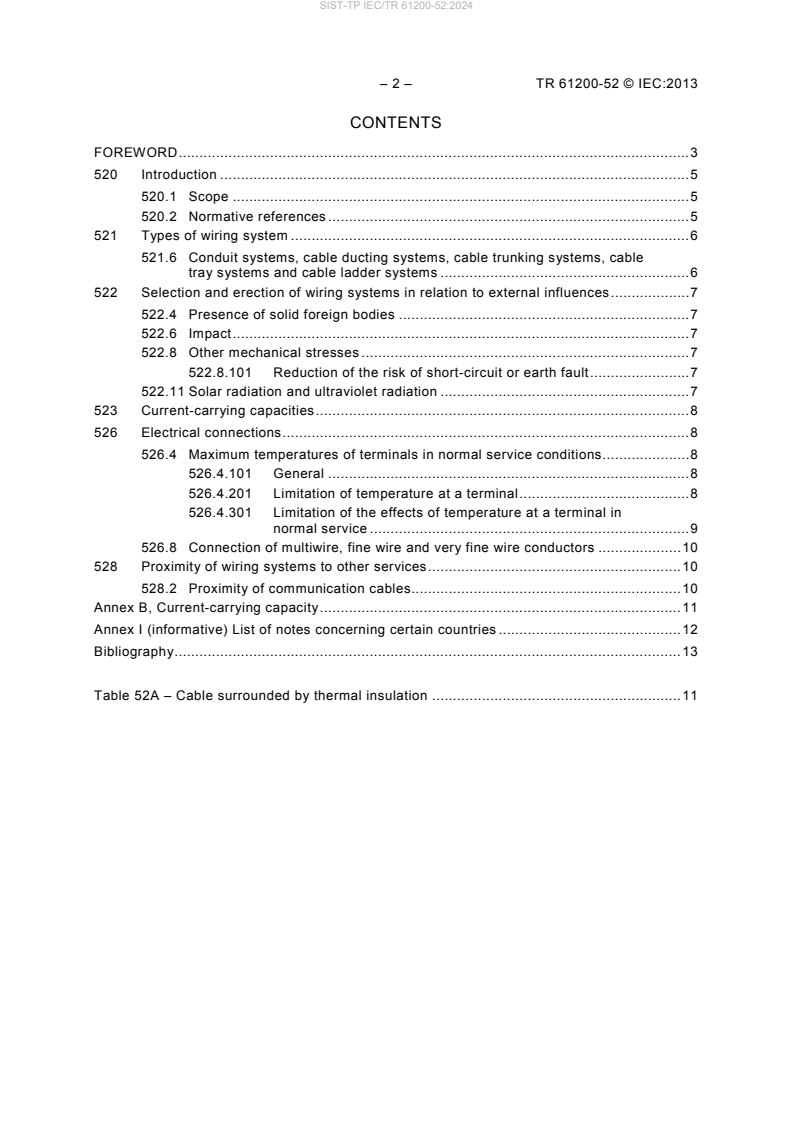
– 2 – TR 61200-52 © IEC:2013
CONTENTS
FOREWORD . 3
520 Introduction . 5
520.1 Scope . 5
520.2 Normative references . 5
521 Types of wiring system . 6
521.6 Conduit systems, cable ducting systems, cable trunking systems, cable
tray systems and cable ladder systems . 6
522 Selection and erection of wiring systems in relation to external influences . 7
522.4 Presence of solid foreign bodies . 7
522.6 Impact . 7
522.8 Other mechanical stresses . 7
522.8.101 Reduction of the risk of short-circuit or earth fault . 7
522.11 Solar radiation and ultraviolet radiation . 7
523 Current-carrying capacities . 8
526 Electrical connections . 8
526.4 Maximum temperatures of terminals in normal service conditions . 8
526.4.101 General . 8
526.4.201 Limitation of temperature at a terminal . 8
526.4.301 Limitation of the effects of temperature at a terminal in
normal service . 9
526.8 Connection of multiwire, fine wire and very fine wire conductors . 10
528 Proximity of wiring systems to other services . 10
528.2 Proximity of communication cables. 10
Annex B, Current-carrying capacity . 11
Annex I (informative) List of notes concerning certain countries . 12
Bibliography . 13
Table 52A – Cable surrounded by thermal insulation . 11
TR 61200-52 © IEC:2013 – 3 –
INTERNATIONAL ELECTROTECHNICAL COMMISSION
____________
ELECTRICAL INSTALLATION GUIDE –
Part 52: Selection and erection of electrical equipment –
Wiring systems
FOREWORD
1) The International Electrotechnical Commission (IEC) is a worldwide organization for standardization comprising
all national electrotechnical committees (IEC National Committees). The object of IEC is to promote
international co-operation on all questions concerning standardization in the electrical and electronic fields. To
this end and in addition to other activities, IEC publishes International Standards, Technical Specifications,
Technical Reports, Publicly Available Specifications (PAS) and Guides (hereafter referred to as “IEC
Publication(s)”). Their preparation is entrusted to technical committees; any IEC National Committee interested
in the subject dealt with may participate in this preparatory work. International, governmental and non-
governmental organizations liaising with the IEC also participate in this preparation. IEC collaborates closely
with the International Organization for Standardization (ISO) in accordance with conditions determined by
agreement between the two organizations.
2) The formal decisions or agreements of IEC on technical matters express, as nearly as possible, an international
consensus of opinion on the relevant subjects since each technical committee has representation from all
interested IEC National Committees.
3) IEC Publications have the form of recommendations for international use and are accepted by IEC National
Committees in that sense. While all reasonable efforts are made to ensure that the technical content of IEC
Publications is accurate, IEC cannot be held responsible for the way in which they are used or for any
misinterpretation by any end user.
4) In order to promote international uniformity, IEC National Committees undertake to apply IEC Publications
transparently to the maximum extent possible in their national and regional publications. Any divergence
between any IEC Publication and the corresponding national or regional publication shall be clearly indicated in
the latter.
5) IEC itself does not provide any attestation of conformity. Independent certification bodies provide conformity
assessment services and, in some areas, access to IEC marks of conformity. IEC is not responsible for any
services carried out by independent certification bodies.
6) All users should ensure that they have the latest edition of this publication.
7) No liability shall attach to IEC or its directors, employees, servants or agents including individual experts and
members of its technical committees and IEC National Committees for any personal injury, property damage or
other damage of any nature whatsoever, whether direct or indirect, or for costs (including legal fees) and
expenses arising out of the publication, use of, or reliance upon, this IEC Publication or any other IEC
Publications.
8) Attention is drawn to the Normative references cited in this publication. Use of the referenced publications is
indispensable for the correct application of this publication.
9) Attention is drawn to the possibility that some of the elements of this IEC Publication may be the subject of
patent rights. IEC shall not be held responsible for identifying any or all such patent rights.
The main task of IEC technical committees is to prepare International Standards. However, a
technical committee may propose the publication of a technical report when it has collected
data of a different kind from that which is normally published as an International Standard, for
example "state of the art".
IEC 61200-52, which is a technical report, has been prepared by IEC technical
committee 64: Electrical installations and protection against electric shock.
This second edition cancels and replaces the first edition, published in 1993, and constitutes
a technical revision.
This edition includes the following significant technical changes with respect to the previous
edition:
– 4 – TR 61200-52 © IEC:2013
a) the scope has been modified; whilst the Guide does not form part of the IEC 60364 series,
it serves as a supplement to IEC 60364-5-52:2009 and explains the rules so as to facilitate
the design, selection, erection and maintenance of wiring systems;
b) guidance associated with conduit systems, cable ducting systems, cable trunking systems,
cable tray systems and cable ladder systems has been added giving, for example,
recommended maximum straight lengths of conduit to ease the installation circuit wiring;
c) guidance associated with selection and erection of wiring systems in relation to external
influences has been extended to cover impact, and other mechanical stresses.
d) guidance for grouping of cables has been added.
e) guidance on maximum temperatures of terminals in normal service conditions has been
extended;
f) guidance on the connection of multi wire, fine wire and very fine wire conductors has been
added;
g) guidance on proximity of communication cables has been added;
h) guidance on cables in contact with thermal insulation has been added.
This technical report serves as a supplement to IEC 60364-5-52:2009 and follows the
numbering of that standard.
The text of this technical report is based on the following documents:
Enquiry draft Report on voting
64/1875/DTR 64/1887/RVC
Full information on the voting for the approval of this technical report can be found in the
report on voting indicated in the above table.
This publication has been drafted in accordance with the ISO/IEC Directives, Part 2.
The committee has decided that the contents of this publication will remain unchanged until
the stability date indicated on the IEC web site under "http://webstore.iec.ch" in the data
related to the specific publication. At this date, the publication will be
• reconfirmed,
• withdrawn,
• replaced by a revised edition, or
• amended.
TR 61200-52 © IEC:2013 – 5 –
ELECTRICAL INSTALLATION GUIDE –
Part 52: Selection and erection of electrical equipment –
Wiring systems
520 Introduction
520.1 Scope
This Technical Report serves as a supplement to IEC 60364-5-52:2009 and explains the rules
so as to facilitate the design, selection, erection and maintenance of wiring systems.
It is written for everyone concerned with the design, the selection and supply of equipment, as
well as the persons who install, maintain and use electrical installations.
520.2 Normative references
The following documents, in whole or in part, are normatively referenced in this document and
are indispensable for its application. For dated references, only the edition cited applies. For
undated references, the latest edition of the referenced document (including any
amendments) applies.
IEC 60227-4, Polyvinyl chloride insulated cables of rated voltages up to and including
450/750 V – Part 4: Sheathed cables for fixed wiring
IEC 60245-4, Rubber insulated cables – Rated voltages up to and including 450/750 V –
Part 4: Cords and flexible cables
IEC 60364-4-43:2008, Low-voltage electrical installations – Part 4-43 Protection for safety –
Protection against overcurrent
IEC 60364-5-51:2005, Electrical installations of buildings – Part 5-51: Selection and erection
of electrical equipment – Common rules
IEC 60364-5-52:2009, Low-voltage electrical installations – Part 5-52: Selection and erection
of electrical equipment – Wiring systems
IEC 60502-1, Power cables with extruded insulation and their accessories for rated voltages
from 1 kV (U = 1,2 kV) up to 30 kV (U = 36 kV) – Part 1: Cables for rated voltages of 1 kV
m m
(U = 1,2 kV) and 3 kV (U = 3,6 kV)
m m
IEC/TR 60890, A method of temperature-rise assessment by extrapolation for partially type-
tested assemblies (PTTA) of low-voltage switchgear and controlgear
IEC/TR 60943, Guidance concerning the permissible temperature rise for parts of electrical
equipment, in particular for terminals
IEC 61084 (all parts), Cable trunking and ducting systems for electrical installations
IEC 61084-2-2, Cable trunking and ducting systems for electrical installations – Part 2-2:
Particular requirements – Cable trunking systems and cable ducting systems intended for
underfloor and flushfloor installations
– 6 – TR 61200-52 © IEC:2013
IEC 61386 (all parts), Conduit systems for cable management
IEC 61386-21, Conduit systems for cable management – Part 21: Particular requirements –
Rigid conduit systems
IEC 61386-22, Conduit systems for cable management – Part 22: Particular requirements –
Pliable conduit systems
IEC 61386-23, Conduit systems for cable management – Part 23: Particular requirements –
Flexible conduit systems
IEC 61439 (all parts), Low-voltage switchgear and controlgear assemblies
521 Types of wiring system
521.6 Conduit systems, cable ducting systems, cable trunking systems, cable tray
systems and cable ladder systems
The following includes recommendations to ease the installation, or replacement, of circuits
installed in conduit.
a) Straight conduit lengths between access points should not exceed 25 m. Conduit lengths
which include changes in direction should not exceed 15 m between access points. There
should be no more than three changes in direction between access points.
b) The number of bends in any run should be minimized.
c) Any bending radius should be as large as possible and in accordance with the
manufacturer's instructions.
d) The cables or insulated conductors should not occupy more than one-third of the total
internal cross-sectional area of the conduit.
e) Conduit systems should be installed so as to minimize the mechanical stress on the
conduit.
f) If conduit systems are to be installed outdoors, consideration should be given to the
ambient temperature and effects of solar radiation as indicated in 522.1 and 522.11.
g) Where self-recovering conduit has to be embedded in concrete, consideration should be
given to the possibility of permanent deformation of the cross-section of the conduit that
might result in damage to the enclosed cables or insulated conductors. Where necessary,
measures should be taken such as additional mechanical protection or the use of conduit
having suitably increased diameter or resistance to compression.
When electrical accessories are mounted in trunking or ducting systems that are installed in
or under a floor, the type of floor treatment likely to be used (wet or dry) should be taken into
consideration.
Where cable trunking systems are
...
IEC/TR 61200-52 ®
Edition 2.0 2013-07
TECHNICAL
REPORT
RAPPORT
TECHNIQUE
Electrical installation guide –
Part 52: Selection and erection of electrical equipment – Wiring systems
Guide pour les installations électriques –
Partie 52: Choix et mise en œuvre des matériels électriques – Canalisations
IEC/TR 61200-52:2013
All rights reserved. Unless otherwise specified, no part of this publication may be reproduced or utilized in any form
or by any means, electronic or mechanical, including photocopying and microfilm, without permission in writing from
either IEC or IEC's member National Committee in the country of the requester.
If you have any questions about IEC copyright or have an enquiry about obtaining additional rights to this publication,
please contact the address below or your local IEC member National Committee for further information.
Droits de reproduction réservés. Sauf indication contraire, aucune partie de cette publication ne peut être reproduite ni
utilisée sous quelque forme que ce soit et par aucun procédé, électronique ou mécanique, y compris la photocopie et les
microfilms, sans l'accord écrit de la CEI ou du Comité national de la CEI du pays du demandeur.
Si vous avez des questions sur le copyright de la CEI ou si vous désirez obtenir des droits supplémentaires sur cette
publication, utilisez les coordonnées ci-après ou contactez le Comité national de la CEI de votre pays de résidence.
IEC Central Office Tel.: +41 22 919 02 11
3, rue de Varembé Fax: +41 22 919 03 00
CH-1211 Geneva 20 info@iec.ch
Switzerland www.iec.ch
About the IEC
The International Electrotechnical Commission (IEC) is the leading global organization that prepares and publishes
International Standards for all electrical, electronic and related technologies.
About IEC publications
The technical content of IEC publications is kept under constant review by the IEC. Please make sure that you have the
latest edition, a corrigenda or an amendment might have been published.
Useful links:
IEC publications search - www.iec.ch/searchpub Electropedia - www.electropedia.org
The advanced search enables you to find IEC publications The world's leading online dictionary of electronic and
by a variety of criteria (reference number, text, technical electrical terms containing more than 30 000 terms and
committee,…). definitions in English and French, with equivalent terms in
It also gives information on projects, replaced and additional languages. Also known as the International
withdrawn publications. Electrotechnical Vocabulary (IEV) on-line.
IEC Just Published - webstore.iec.ch/justpublished Customer Service Centre - webstore.iec.ch/csc
Stay up to date on all new IEC publications. Just Published If you wish to give us your feedback on this publication
details all new publications released. Available on-line and or need further assistance, please contact the
also once a month by email. Customer Service Centre: csc@iec.ch.
A propos de la CEI
La Commission Electrotechnique Internationale (CEI) est la première organisation mondiale qui élabore et publie des
Normes internationales pour tout ce qui a trait à l'électricité, à l'électronique et aux technologies apparentées.
A propos des publications CEI
Le contenu technique des publications de la CEI est constamment revu. Veuillez vous assurer que vous possédez
l’édition la plus récente, un corrigendum ou amendement peut avoir été publié.
Liens utiles:
Recherche de publications CEI - www.iec.ch/searchpub Electropedia - www.electropedia.org
La recherche avancée vous permet de trouver des Le premier dictionnaire en ligne au monde de termes
publications CEI en utilisant différents critères (numéro de électroniques et électriques. Il contient plus de 30 000
référence, texte, comité d’études,…). termes et définitions en anglais et en français, ainsi que
Elle donne aussi des informations sur les projets et les les termes équivalents dans les langues additionnelles.
publications remplacées ou retirées. Egalement appelé Vocabulaire Electrotechnique
International (VEI) en ligne.
Just Published CEI - webstore.iec.ch/justpublished
Service Clients - webstore.iec.ch/csc
Restez informé sur les nouvelles publications de la CEI.
Just Published détaille les nouvelles publications parues. Si vous désirez nous donner des commentaires sur
Disponible en ligne et aussi une fois par mois par email. cette publication ou si vous avez des questions
contactez-nous: csc@iec.ch.
IEC/TR 61200-52 ®
Edition 2.0 2013-07
TECHNICAL
REPORT
RAPPORT
TECHNIQUE
Electrical installation guide –
Part 52: Selection and erection of electrical equipment – Wiring systems
Guide pour les installations électriques –
Partie 52: Choix et mise en œuvre des matériels électriques – Canalisations
INTERNATIONAL
ELECTROTECHNICAL
COMMISSION
COMMISSION
ELECTROTECHNIQUE
PRICE CODE
INTERNATIONALE
CODE PRIX M
ICS 29.060.01; 91.140.50 ISBN 978-2-8322-0882-3
– 2 – TR 61200-52 © IEC:2013
CONTENTS
FOREWORD . 3
520 Introduction . 5
520.1 Scope . 5
520.2 Normative references . 5
521 Types of wiring system . 6
521.6 Conduit systems, cable ducting systems, cable trunking systems, cable
tray systems and cable ladder systems . 6
522 Selection and erection of wiring systems in relation to external influences . 7
522.4 Presence of solid foreign bodies . 7
522.6 Impact . 7
522.8 Other mechanical stresses . 7
522.8.101 Reduction of the risk of short-circuit or earth fault . 7
522.11 Solar radiation and ultraviolet radiation . 7
523 Current-carrying capacities . 8
526 Electrical connections . 8
526.4 Maximum temperatures of terminals in normal service conditions . 8
526.4.101 General . 8
526.4.201 Limitation of temperature at a terminal . 8
526.4.301 Limitation of the effects of temperature at a terminal in
normal service . 9
526.8 Connection of multiwire, fine wire and very fine wire conductors . 10
528 Proximity of wiring systems to other services . 10
528.2 Proximity of communication cables. 10
Annex B, Current-carrying capacity . 11
Annex I (informative) List of notes concerning certain countries . 12
Bibliography . 13
Table 52A – Cable surrounded by thermal insulation . 11
TR 61200-52 © IEC:2013 – 3 –
INTERNATIONAL ELECTROTECHNICAL COMMISSION
____________
ELECTRICAL INSTALLATION GUIDE –
Part 52: Selection and erection of electrical equipment –
Wiring systems
FOREWORD
1) The International Electrotechnical Commission (IEC) is a worldwide organization for standardization comprising
all national electrotechnical committees (IEC National Committees). The object of IEC is to promote
international co-operation on all questions concerning standardization in the electrical and electronic fields. To
this end and in addition to other activities, IEC publishes International Standards, Technical Specifications,
Technical Reports, Publicly Available Specifications (PAS) and Guides (hereafter referred to as “IEC
Publication(s)”). Their preparation is entrusted to technical committees; any IEC National Committee interested
in the subject dealt with may participate in this preparatory work. International, governmental and non-
governmental organizations liaising with the IEC also participate in this preparation. IEC collaborates closely
with the International Organization for Standardization (ISO) in accordance with conditions determined by
agreement between the two organizations.
2) The formal decisions or agreements of IEC on technical matters express, as nearly as possible, an international
consensus of opinion on the relevant subjects since each technical committee has representation from all
interested IEC National Committees.
3) IEC Publications have the form of recommendations for international use and are accepted by IEC National
Committees in that sense. While all reasonable efforts are made to ensure that the technical content of IEC
Publications is accurate, IEC cannot be held responsible for the way in which they are used or for any
misinterpretation by any end user.
4) In order to promote international uniformity, IEC National Committees undertake to apply IEC Publications
transparently to the maximum extent possible in their national and regional publications. Any divergence
between any IEC Publication and the corresponding national or regional publication shall be clearly indicated in
the latter.
5) IEC itself does not provide any attestation of conformity. Independent certification bodies provide conformity
assessment services and, in some areas, access to IEC marks of conformity. IEC is not responsible for any
services carried out by independent certification bodies.
6) All users should ensure that they have the latest edition of this publication.
7) No liability shall attach to IEC or its directors, employees, servants or agents including individual experts and
members of its technical committees and IEC National Committees for any personal injury, property damage or
other damage of any nature whatsoever, whether direct or indirect, or for costs (including legal fees) and
expenses arising out of the publication, use of, or reliance upon, this IEC Publication or any other IEC
Publications.
8) Attention is drawn to the Normative references cited in this publication. Use of the referenced publications is
indispensable for the correct application of this publication.
9) Attention is drawn to the possibility that some of the elements of this IEC Publication may be the subject of
patent rights. IEC shall not be held responsible for identifying any or all such patent rights.
The main task of IEC technical committees is to prepare International Standards. However, a
technical committee may propose the publication of a technical report when it has collected
data of a different kind from that which is normally published as an International Standard, for
example "state of the art".
IEC 61200-52, which is a technical report, has been prepared by IEC technical
committee 64: Electrical installations and protection against electric shock.
This second edition cancels and replaces the first edition, published in 1993, and constitutes
a technical revision.
This edition includes the following significant technical changes with respect to the previous
edition:
– 4 – TR 61200-52 © IEC:2013
a) the scope has been modified; whilst the Guide does not form part of the IEC 60364 series,
it serves as a supplement to IEC 60364-5-52:2009 and explains the rules so as to facilitate
the design, selection, erection and maintenance of wiring systems;
b) guidance associated with conduit systems, cable ducting systems, cable trunking systems,
cable tray systems and cable ladder systems has been added giving, for example,
recommended maximum straight lengths of conduit to ease the installation circuit wiring;
c) guidance associated with selection and erection of wiring systems in relation to external
influences has been extended to cover impact, and other mechanical stresses.
d) guidance for grouping of cables has been added.
e) guidance on maximum temperatures of terminals in normal service conditions has been
extended;
f) guidance on the connection of multi wire, fine wire and very fine wire conductors has been
added;
g) guidance on proximity of communication cables has been added;
h) guidance on cables in contact with thermal insulation has been added.
This technical report serves as a supplement to IEC 60364-5-52:2009 and follows the
numbering of that standard.
The text of this technical report is based on the following documents:
Enquiry draft Report on voting
64/1875/DTR 64/1887/RVC
Full information on the voting for the approval of this technical report can be found in the
report on voting indicated in the above table.
This publication has been drafted in accordance with the ISO/IEC Directives, Part 2.
The committee has decided that the contents of this publication will remain unchanged until
the stability date indicated on the IEC web site under "http://webstore.iec.ch" in the data
related to the specific publication. At this date, the publication will be
• reconfirmed,
• withdrawn,
• replaced by a revised edition, or
• amended.
TR 61200-52 © IEC:2013 – 5 –
ELECTRICAL INSTALLATION GUIDE –
Part 52: Selection and erection of electrical equipment –
Wiring systems
520 Introduction
520.1 Scope
This Technical Report serves as a supplement to IEC 60364-5-52:2009 and explains the rules
so as to facilitate the design, selection, erection and maintenance of wiring systems.
It is written for everyone concerned with the design, the selection and supply of equipment, as
well as the persons who install, maintain and use electrical installations.
520.2 Normative references
The following documents, in whole or in part, are normatively referenced in this document and
are indispensable for its application. For dated references, only the edition cited applies. For
undated references, the latest edition of the referenced document (including any
amendments) applies.
IEC 60227-4, Polyvinyl chloride insulated cables of rated voltages up to and including
450/750 V – Part 4: Sheathed cables for fixed wiring
IEC 60245-4, Rubber insulated cables – Rated voltages up to and including 450/750 V –
Part 4: Cords and flexible cables
IEC 60364-4-43:2008, Low-voltage electrical installations – Part 4-43 Protection for safety –
Protection against overcurrent
IEC 60364-5-51:2005, Electrical installations of buildings – Part 5-51: Selection and erection
of electrical equipment – Common rules
IEC 60364-5-52:2009, Low-voltage electrical installations – Part 5-52: Selection and erection
of electrical equipment – Wiring systems
IEC 60502-1, Power cables with extruded insulation and their accessories for rated voltages
from 1 kV (U = 1,2 kV) up to 30 kV (U = 36 kV) – Part 1: Cables for rated voltages of 1 kV
m m
(U = 1,2 kV) and 3 kV (U = 3,6 kV)
m m
IEC/TR 60890, A method of temperature-rise assessment by extrapolation for partially type-
tested assemblies (PTTA) of low-voltage switchgear and controlgear
IEC/TR 60943, Guidance concerning the permissible temperature rise for parts of electrical
equipment, in particular for terminals
IEC 61084 (all parts), Cable trunking and ducting systems for electrical installations
IEC 61084-2-2, Cable trunking and ducting systems for electrical installations – Part 2-2:
Particular requirements – Cable trunking systems and cable ducting systems intended for
underfloor and flushfloor installations
– 6 – TR 61200-52 © IEC:2013
IEC 61386 (all parts), Conduit systems for cable management
IEC 61386-21, Conduit systems for cable management – Part 21: Particular requirements –
Rigid conduit systems
IEC 61386-22, Conduit systems for cable management – Part 22: Particular requirements –
Pliable conduit systems
IEC 61386-23, Conduit systems for cable management – Part 23: Particular requirements –
Flexible conduit systems
IEC 61439 (all parts), Low-voltage switchgear and controlgear assemblies
521 Types of wiring system
521.6 Conduit systems, cable ducting systems, cable trunking systems, cable tray
systems and cable ladder systems
The following includes recommendations to ease the installation, or replacement, of circuits
installed in conduit.
a) Straight conduit lengths between access points should not exceed 25 m. Conduit lengths
which include changes in direction should not exceed 15 m between access points. There
should be no more than three changes in direction between access points.
b) The number of bends in any run should be minimized.
c) Any bending radius should be as large as possible and in accordance with the
manufacturer's instructions.
d) The cables or insulated conductors should not occupy more than one-third of the total
internal cross-sectional area of the conduit.
e) Conduit systems should be installed so as to minimize the mechanical stress on the
conduit.
f) If conduit systems are to be installed outdoors, consideration should be given to the
ambient temperature and effects of solar radiation as indicated in 522.1 and 522.11.
g) Where self-recovering conduit has to be embedded in concrete, consideration should be
given to the possibility of permanent deformation of the cross-section of the conduit that
might result in damage to the enclosed cables or insulated conductors. Where necessary,
measures should be taken such as additional mechanical protection or the use of conduit
having suitably increased diameter or resistance to compression.
When electrical accessories are mounted in trunking or ducting systems that are installed in
or under a floor, the type of floor treatment likely to be used (wet or dry) should be taken into
consideration.
Where cable trunking systems are installed in a skirting position (e.g. Item 6 of Table A52.3 of
IEC 60364-5-52:2009), damage caused by the ingress of water can be avoided by placing the
insulated conductors laid within at least 10 mm above the floor level.
Cable trunking systems and cable ducting systems intended for underfloor and flushfloor
installations are covered by IEC 61084-2-2.
Where cable tray systems are used, the use of a cover can also be necessary, for example for
mechanical protection or design reasons or preventing access (e.g. in the basin of public
fountains).
TR 61200-52 © IEC:2013 – 7 –
522 Selection and erection of wiring systems in relation to external
influences
522.4 Presence of solid foreign bodies (AE)
Cable management systems will not protect against ingress of solid foreign bodies unless they
comply with a protection degree at least IP2X.
522.6 Impact
Trunking, ducting and conduit systems provide mechanical protection to the cable, but cable
tray and cable tray with cover might not provide such mechanical protection, as, according to
the product standard, they are not tested for this purpose.
522.8 Other mechanical stresses (AJ)
522.8.101 Reduction of the risk of short-circuit or earth fault
Where devices for short-circuit protection are placed in accordance with 434.2.1 of
IEC 60364-4-43:2008, it is required that the conductors shall be installed so as to reduce the
risk of a short-circuit to a minimum.
This implies that conductor arrangements should be made so as to minimize the risk of
contact between the conductors and contact of live conductors with earthed parts and to
provide protection against damage due to external influences (e.g. mechanical damage).
Examples of such arrangements are as follows:
a) Arrangement consisting of single-core cables in accordance with IEC 60502-1, single-core
non-metallic sheathed cables in accordance with IEC 60227-4 or single-core rubber
insulated and sheathed flexible cables in accordance with IEC 60245-4 and where the risk
of mechanical damage is prevented.
b) Cables and rubber-insulated and sheathed flexible cables laid so that they are accessible
but not in the vicinity of combustible materials and where the risk of mechanical damage is
prevented.
c) Cables with non-metallic sheath installed in rigid, flexible or pliable conduits in accordance
with IEC 61386-21, IEC 61386-22 or IEC 61386-23.
d) Cables with non-metallic sheath installed in trunking or ducting systems in accordance
with the IEC 61084 series.
With regard to safety, an arrangement of cables or insulated conductors which could burn out
without endangering their environment (e.g. buried cables) is considered to be equivalent to a
circuit installed so as to reduce the risk of a short-circuit to a minimum.
522.11 Solar radiation (AN) and ultraviolet radiation
Where wiring systems are installed outdoors, particular attention should be given to the
effects of solar radiation. The two main effects to be considered are the heating effects and
the UV stability. As indicated in 512.2.2 of IEC 60364-5-51:2005 and Table 51A of that
standard, if the product does not, by its construction, have the characteristics relevant to the
external influences of its location, it may nevertheless be used on condition that it is provided
with appropriate additional protection in the erection of the installation, such as interposition
of screens.
NOTE The IEC 60287 [1] series gives a method for determining the current-carrying capacity in case of solar
radiation.
Figures in square brackets refer to the Bibliography.
– 8 – TR 61200-52 © IEC:2013
523 Current-carrying capacities
The current-carrying capacity of a cable is affected by the type of insulation material of the
cable, ambient temperature, installation method, grouping and presence of thermal insulation.
See the NOTE in 522.11.
Annex B of IEC 60364-52:2009 includes tabulated reduction factors for a limited number of
circuits. Increasing the number of circuits in a group (conductors within a single installation
method) will require further reduction in the current-carrying capacity of those conductors
(smaller reduction factors than specified for the maximum number of circuits or conductors),
due to increased heating effects. Because of this, it is recommended that such groups, with
more circuits or conductors than the maximum indicated in the tables, be divided into smaller
groups of circuits or conductors with spacing provided between the groups.
526 Electrical connections
526.4 Maximum temperatures of terminals in normal service conditions
526.4.101 General
The temperature of a terminal is the sum of the ambient temperature and its temperature rise
in normal service.
Product standards give conventional limit values for temperature rise under defined test
conditions. For installation conditions that differ from the defined test conditions, rating factors
may need to be applied and guidance should be obtained from the manufacturer. Relevant
standards in this respect are the IEC 61439 series and IEC 60890.
The temperature at a terminal is affected by the heat dissipated in normal service by the
equipment. This heat may be caused by internal losses dissipated in the equipment and by
neighbouring internal and external heat sources, if any. A possible external heat source is the
cable of the wiring system connected to the terminal equipment.
Compatibility between the temperature achieved at the terminals of equipment and the
temperature permitted for the insulation of the conductors and cables should be obtained by
appropriate arrangement during design/installation.
Current-carrying capacities of conductors, the values of which are tabulated in
IEC 60364-5-52, are calculated so that the temperature on the cores does not exceed the
permissible temperature determined by the selection of the insulation. These current-carrying
capacities do not take account of any temperature rise at a termination.
526.4.201 Limitation of temperature at a terminal
It is necessary to limit the temperature at a terminal so that the maximum steady-state or
peak temperature limits of the insulation of the conductors connected to the terminal and of
any insulating material used to support the connection are not exceeded. The temperature at
a terminal can be limited by one or more of the following measures:
a) Limitation of contents of enclosures (cubicles, cabinets, trunkings, conduits). The
limitation of contents of trunkings and conduits is recommended when a large number of
circuits issue from the same panel; in this case it is preferable to divide the circuits
between several runs of trunking or conduit.
b) Spacing between equipment in order to improve natural ventilation. Spacing between
adjacent equipment permits better dissipation of heat. It is necessary to refer to the
manufacturer's instructions. This solution is especially recommended when a great
number of items of equipment are installed in the same enclosure (cubicle or cabinet).
TR 61200-52 © IEC:2013 – 9 –
c) Appropriate arrangement of equipment dissipating heat inside enclosures. It is
recommended that equipment dissipating heat is installed in an appropriate way so that
the correct operation of other equipment will not be impaired. Other means, such as the
interposition of screens or deflectors, may be used for this purpose.
d) Natural or forced ventilation or air-conditioning of cubicles, cabinets or locations. Forced
ventilation of the equipment may be necessary, for reasons other than cooling, in specific
applications, for example to protect against ingress of dust.
e) Derating of equipment by use of equipment having higher rated current, consequently
dissipating less heat. Derating of equipment can be used to reduce the temperature of
terminals, provided that such derating is permitted for the equipment.
f) Selection of material for enclosures of cubicles or cabinets in which terminals are installed
in order to improve the thermal dissipation. Thin metallic enclosures will dissipate heat
more readily than thick walled enclosures manufactured from insulation materials.
g) Maintenance of correct clamping of conductors in the terminals. Arrangements should be
made to ensure the maintenance of clamping pressure of conductors in their terminals.
Such arrangements may be built in (for example, use of resilient connections) or result
from instructions for the inspection of the installation.
h) Introduction of an intermediate terminal (of the appropriate rated operating temperature)
outside the current-using equipment enables a conductor of larger cross-sectional area or
a higher temperature type of cable to be connected.
i) Where cables that are permitted to run at a temperature exceeding 70 °C (such as cross-
linked insulated cables) are connected to equipment or accessories designed to operate
at a temperature not exceeding 70 °C, the conductor size should be chosen based on the
current ratings for 70 °C cables of a similar construction.
j) Separation of conductors of multicore cables between the end of the sheath and the
terminal will lead to a decrease in the terminal temperature. Choice of a sufficient length
for the separation may be based on experiment or on a calculation according to
IEC/TR 60943.
k) Connection of a short length of conductor, at the termination, whose cross-sectional area
is larger than that required by the current, will reduce the temperature at the termination.
Increasing the cross-sectional area of conductors for other reasons (voltage drop,
withstand of short-circuit currents, reduction of the fault loop impedance) improves the
thermal withstand of the conductors and hence reduces the possibility of excessive
temperatures at terminations.
526.4.301 Limitation of the effects of temperature at a terminal in normal service
The effect of temperature rise of terminals can be limited by one or more of the following:
a) Selection of the insulation of the conductors having due regard to the temperature of the
terminals. Permissible temperatures in steady-state service for some types of insulation of
conductors are determined by TC 20: Electric cables. If cables with elastomeric insulation
rather than thermoplastic are used, in order to utilize their higher operating temperature, it
may be necessary to derate the equipment to which they are connected. Seek advice from
the equipment manufacturer in this case. Temperatures for commonly used insulation
materials are given below:
– thermoplastic (PVC): 70 °C;
– cross-linked (XLPE, EPR): 90 °C;
– cross-linked (silicone): 120 °C.
b) Reinforcement or substitution of the insulation of the conductors close to a termination by
a sleeve that permits a higher temperature reduces the risk of thermal degradation of the
insulation at a termination. Insulated conductors which permit temperatures at least equal
to 110 °C are recommended for the supply to equipment operating at a high temperature,
such as heating appliances.
c) Selection of the means of connection to the terminals having due regard to their
temperature.
– 10 – TR 61200-52 © IEC:2013
526.8 Connection of multiwire, fine wire and very fine wire conductors
Subclause 526.8 of IEC 60364-5-52:2009 concerns the suitable selection of the means of
connection. Where multi-stranded, fine wire conductors are to be terminated, measures
should be taken to prevent the individual conductor strands spreading. The manufacturer’s
instructions for termination of conductors should be followed.
Crimped ferrules fitted to the conductors are a suitable means of terminating multi-stranded
fine wire conductors, provided that care is taken to ensure that all strands are inserted into
the ferrule. Crimped ferrules shall not be used with screwless terminals.
528 Proximity of wiring systems to other services
528.2 Proximity of communication cables
Refer to 528.2 for requirements.
When power cables buried in the ground approach underground components of overhead
telecommunication lines including their anchorage, stays and earth connections, a minimum
clearance of 800 mm is recommended. This clearance may be reduced if the power cables
have additional protection against mechanical damage. The protection should extend at least
500 mm on either side beyond the point of proximity.
TR 61200-52 © IEC:2013 – 11 –
Annex B
(informative)
Current-carrying capacities
B.52.6 Methods of installation
Where a cable is to be run in a space to which thermal insulation is likely to be applied, the
cable should, wherever practicable, be fixed in a position such that it will not be covered by
the thermal insulation. Where fixing in such a position is impracticable, the cross-sectional
area of the cable should be increased appropriately.
For a cable installed in a thermally insulated wall or above a thermally insulated ceiling, the
cable being in contact with a thermally conductive surface on one side, current-carrying
capacities are tabulated in Annex B of IEC 60364-5-52:2009, the appropriate reference
methods being A1 and A2.
For a single cable likely to be totally surrounded by thermally insulating material over a length
of more than 0,5 m, the current-carrying capacity can be taken, in the absence of more
precise information, as 0,5 times the current-carrying capacity for that cable, clipped direct to
a surface and open (reference method C).
Where a cable is to be totally surrounded by thermal insulation for less than 0,5 m the current-
carrying capacity of the cable shall be reduced appropriately, depending on the size of cable,
length in insulation and thermal properties of the insulation. The derating factors in Table 52A
are appropriate to conductor sizes up to 10 mm in thermal insulation having a thermal
–1 –1
conductivity greater than 0,062 5 Wm K .
Table 52A – Cable surrounded by thermal insulation
a
Length in insulation Derating factor
mm
50 0,89
100 0,81
200 0,68
400 0,55
a
The derating factors shall be applied to the current-carrying capacity
according to reference method C.
– 12 – TR 61200-52 © IEC:2013
Annex I
(informative)
List of notes concerning certain countries
Country Clause Nature(permanent Rational (detailed Wording
No. or less permanent justification for the
according to requested country
IEC Directives) note)
In the UK, where both the specification of the
information technology cabling and its intended
528.6 application is known, the requirements of 6.2 of
BS EN 50174-2:2008 [2] and BS EN 50174-3 [3]
UK
standards apply.
The recommendations of this report (IEC/TR
General
61200-52) are not accepted in the UK.
In the USA, guidance for the installation in
US 521.6 conduit is provided in NFPA 70, the National
Electrical Code [4].
TR 61200-52 © IEC:2013 – 13 –
Bibliography
[1] IEC 60287 (all parts), Electric cables – Calculation of the current rating
[2] BS EN 50174-2:2008, Information technology – Cabling installation – Part 2:
Installation planning and practices inside buildings
[3] BS EN 50174-3, Information technology – Cabling installation – Part 3: Installation
planning and practices outside buildings
[4] NFPA 70, National Electrical Code
_____________
– 14 – TR 61200-52 © CEI:2013
SOMMAIRE
AVANT-PROPOS . 15
520 Introduction . 17
520.1 Domaine d’application . 17
520.2 Références normatives . 17
521 Types de canalisations . 18
521.6 Systèmes de conduits, systèmes de conduits-profilés, systèmes de
goulottes, systèmes de chemins de câbles et systèmes d'échelles à
câbles . 18
522 Choix et mise en œuvre des canalisations en fonction des influences externes . 19
522.4 Présence de corps solides étrangers . 19
522.6 Impact . 19
522.8 Autres contraintes mécaniques . 19
522.8.101 Réduction du risque de court-circuit ou de défaut à la terre . 19
522.11 Rayonnements solaires et ultraviolets . 19
523 Courants admissibles . 20
526 Connexions électriques . 20
526.4 Températures maximales des bornes dans les conditions de
fonctionnement normal . 20
526.4.101 Généralités . 20
526.4.201 Limitation de température au niveau d'une borne . 21
526.4.301 Limitation des effets de la température au niveau d'une borne
en fonctionnement normal . 22
526.8 Connexion de conducteurs multibrins, à brins fins et à brins très fins . 22
528 Voisinage avec d'autres canalisations . 22
528.2 Voisinage avec des canalisations de communication . 22
Annexe B – Courants admissibles . 23
Annexe I (informative) Liste des notes concernant certains pays . 24
Bibliographie . 25
Tableau 52A – Câble entouré par l'isolation thermique. 23
TR 61200-52 © CEI:2013 – 15 –
COMMISSION ÉLECTROTECHNIQUE INTERNATIONALE
____________
GUIDE POUR LES INSTALLATIONS ÉLECTRIQUES –
Partie 52: Choix et mise en œuvre des matériels électriques –
Canalisations
AVANT-PROPOS
1) La Commission Electrotechnique Internationale (CEI) est une organisation mondiale de normalisation
composée de l'ensemble des comités électrotechniques nationaux (Comités nationaux de la CEI). La CEI a
pour objet de favoriser la coopération internationale pour toutes les questions de normalisation dans les
domaines de l'électricité et de l'électronique. A cet effet, la CEI – entre autres activités – publie des Normes
internationales, des Spécifications techniques, des Rapports techniques, des Spécifications accessibles au
public (PAS) et des Guides (ci-après dénommés "Publication(s) de la CEI"). Leur élaboration est confiée à des
comités d'études, aux travaux desquels tout Comité national intéressé par le sujet traité peut participer. Les
organisations internationales, gouvernementales et non gouvernementales, en liaison avec la CEI, participent
également aux travaux. La CEI collabore étroitement avec l'Organisation Internationale de Normalisation (ISO),
selon des conditions fixées par accord entre les deux organisations.
2) Les décisions ou accords officiels de la CEI concernant les questions techniques représentent, dans la mesure
du possible, un accord international sur les sujets étudiés, étant donné que les Comités nationaux de la CEI
intéressés sont représentés dans chaque comité d’études.
3) Les Publications de la CEI se présentent sous la forme de recommandations internationales et sont agréées
comme telles par les Comités nationaux de la CEI. Tous les efforts raisonnables sont entrepris afin que la CEI
s'assure de l'exactitude du contenu technique de ses publications; la CEI ne peut pas être tenue responsable
de l'éventuelle mauvaise utilisation ou interprétation qui en est faite par un quelconque utilisateur final.
4) Dans le but d'encourager l'uniformité internationale, les Comités nationaux de la CEI s'engagent, dans toute la
mesure possible, à appliquer de façon transparente les Publications de la CEI dans leurs publications
nationales et régionales. Toutes divergences entre toutes Publications de la CEI et toutes publications
nationales ou régionales correspondantes doivent être indiquées en termes clairs dans ces dernières.
5) La CEI elle-même ne fournit aucune attestation de conformité. Des organismes de certification indépendants
fournissent des services d'évaluation de conformité et, dans certains secteurs, accèdent aux marques de
conformité de la CEI. La CEI n'est responsable d'aucun des services effectués par les organismes de
certification indépendants.
6) Tous les utilisateurs doivent s'assurer qu'ils sont en possession de la dernière édition de cette publication.
7) Aucune responsabilité ne doit être imputée à la CEI, à ses administrateurs, employés, auxiliaires ou
mandataires, y compris ses experts particuliers et les membres de ses comités d'études et des Comités
nationaux de la CEI, pour tout préjudice causé en cas de dommages corporels et matériels, ou de tout autre
dommage de quelque nature que ce soit, directe ou indirecte, ou pour supporter les coûts (y compris les frais
de justice) et les dépenses découlant de la publication ou de l'utilisation de cette Publication de la CEI ou de
toute autre Publication de la CEI, ou au crédit qui lui est accordé.
8) L'attention est attirée sur les références normatives citées dans cette publication. L'utilisation de publications
référencées est obligatoire pour une application correcte de la présente publication.
9) L’attention est attirée sur le fait que certains des éléments de la présente Publication de la CEI peuvent faire
l’objet de droits de brevet. La CEI ne saurait être tenue pour responsable de ne pas avoir identifié de tels droits
de brevets et de ne pas avoir signalé leur existence.
La tâche principale des comités d’études de la CEI est l’élaboration des Normes
internationales. Toutefois, un comité d’études peut proposer la publication d’un rapport
technique lorsqu’il a réuni des données de nature différente de celles qui sont normalement
publiées comme Normes internationales, cela pouvant comprendre, par exemple, des
informations sur l’état de la technique.
La CEI 61200-52, qui est un rapport technique, a été établie par le comité d'études 64 de la
CEI: Installations électriques et protection contre les chocs électriques.
Cette deuxième édition annule et remplace la première édition, parue en 1993, et constitue
une révision technique.
– 16 – TR 61200-52 © CEI:2013
Cette édition inclut les modifications techniques majeures suivantes par rapport à l'édition
précédente:
a) le domaine d’application a été modifié, puisque le Guide ne fait pas partie de la série
CEI 60364, mais il constitue un supplément à la CEI 60364-5-52:2009 et explique les
règles afin de faciliter la conception, le choix, la mise en œuvre et la maintenance des
canalisations;
b) des recommandations concernant les systèmes de conduits, systèmes de conduits-
profilés, systèmes de goulottes, systèmes de chemins de câbles et systèmes d'échelles à
câbles ont été ajoutées pour donner, par exemple, les longueurs maximales
recommandées pour les conduits afin de faciliter l’installation des circuits;
c) les recommandations pour le choix et la mise en œuvre des canalisations en tenant
compte des influences externes ont été étendues aux impacts et autres contraintes
mécaniques;
d) des recommandations pour les groupements de câbles ont été ajoutées;
e) des recommandations sur les températures maximales des bornes en conditions de
fonctionnement normal ont été étendues;
f) des recommandations sur la connexion de conducteurs multibrins, à brins fins et à brins
très fins ont été ajoutées;
g) des recommandations sur la proximité avec les câbles de communication ont été ajoutées;
h) des recommandations sur les câbles avec isolation thermique ont été a
...