

IEC 61189-3:2007
(Main)Test methods for electrical materials, printed boards and other interconnection structures and assemblies - Part 3: Test methods for interconnection structures (printed boards)
General Information
- Abstract
IEC 61189-3:2007 is a catalogue of test methods representing methodologies and procedures that can be applied to test materials used for manufacturing interconnection structures (printed boards) and assemblies. The major technical changes with regard to the previous edition concern the addition of 25 new tests, as follows:
- 6 V: Visual test methods: 3V01, 3V02 and 3V03;
- 7 D: Dimensional test methods: 3D03;
- 8 C: Chemical test methods: 3C02, 3C13 and 3C14;
- 9 M: Mechanical test methods: 3M01, 3M03, 3M04, 3M07 and 3M09;
- 10 E: Electrical test methods: 3E03, 3E04, 3E05, 3E11, 3E12, 3E13, 3E16, 3E17 and 3E18;
- 11 N: Environmental test methods: 3N03, 3N07 and 3N12;
- 12 X: Miscellaneous test methods: 3X01.
- Status
- Published
- Publication Date
- 08-Oct-2007
- Technical Committee
- TC 91 - Electronics assembly technology
- Drafting Committee
- WG 10 - TC 91/WG 10
- Current Stage
- PPUB - Publication issued
- Start Date
- 09-Oct-2007
- Completion Date
- 15-Dec-2007
Buy Documents
IEC 61189-3:2007 - Test methods for electrical materials, printed boards and other interconnection structures and assemblies - Part 3: Test methods for interconnection structures (printed boards) Released:10/9/2007
IEC 61189-3:2007 - Test methods for electrical materials, printed boards and other interconnection structures and assemblies - Part 3: Test methods for interconnection structures (printed boards) Released:10/9/2007
Overview
IEC 61189-3:2007 is the IEC catalogue of standardized test methods for interconnection structures (printed boards / PCBs). Edition 2.0 (2007) provides a self-contained set of methodologies and procedures to test materials and assemblies used to manufacture printed boards and other interconnection structures. The document groups methods for consistent, reproducible testing and incorporates 25 new tests in this edition to address evolving industry needs.
Key topics
The standard organizes test methods by functional groups (group code + number) and includes detailed procedures, figures and worked examples to ensure repeatability:
- Preparation / Conditioning (P) – specimen handling and conditioning prior to testing.
- Visual (V) – surface and appearance inspections (new tests: 3V01, 3V02, 3V03).
- Dimensional (D) – geometry and feature measurements (new test: 3D03).
- Chemical (C) – chemical analyses and flux/surface-chemistry methods (new tests: 3C02, 3C13, 3C14).
- Mechanical (M) – mechanical integrity, peel, bend and related tests (new tests: 3M01, 3M03, 3M04, 3M07, 3M09).
- Electrical (E) – continuity, insulation, contact and high-voltage methods (new tests: 3E03, 3E04, 3E05, 3E11, 3E12, 3E13, 3E16, 3E17, 3E18).
- Environmental (N) – thermal, humidity and stress testing (new tests: 3N03, 3N07, 3N12).
- Miscellaneous (X) – other test types (new test: 3X01).
The standard emphasizes accuracy, precision and resolution, and contains diagrams (glow wire, flame tests, peel fixtures, waveforms, etc.) and an informative annex with worked examples.
Applications
IEC 61189-3 is practical for professionals and organizations involved in PCB and interconnection structure development, testing and qualification:
- PCB designers specifying testable features and reliability criteria.
- Test engineers & laboratories implementing standard test procedures for acceptance and qualification.
- Quality assurance / compliance teams preparing vendor specs and production inspections.
- Manufacturers and assemblers assessing materials, surface finishes, solderability, and environmental robustness.
- R&D teams validating new materials or processes against established methods.
Using IEC 61189-3 helps ensure reproducible results, consistent pass/fail evaluation, and alignment with international best practice for PCB testing.
Related standards
Use IEC 61189-3 alongside other parts of the IEC 61189 series (Part 1: general methodology; Part 2: materials for interconnection structures; Part 5: printed board assemblies; Part 6: materials for electronic assemblies) and established environmental test standards such as IEC 60068.
Keywords: IEC 61189-3, PCB test methods, printed board testing, interconnection structures, electrical materials, mechanical tests, environmental testing, chemical tests, visual inspection, dimensional measurement.
Relations
- Effective Date
- 05-Sep-2023
- Effective Date
- 05-Sep-2023
Buy Documents
IEC 61189-3:2007 - Test methods for electrical materials, printed boards and other interconnection structures and assemblies - Part 3: Test methods for interconnection structures (printed boards) Released:10/9/2007
IEC 61189-3:2007 - Test methods for electrical materials, printed boards and other interconnection structures and assemblies - Part 3: Test methods for interconnection structures (printed boards) Released:10/9/2007
Frequently Asked Questions
IEC 61189-3:2007 is a standard published by the International Electrotechnical Commission (IEC). Its full title is "Test methods for electrical materials, printed boards and other interconnection structures and assemblies - Part 3: Test methods for interconnection structures (printed boards)". This standard covers: IEC 61189-3:2007 is a catalogue of test methods representing methodologies and procedures that can be applied to test materials used for manufacturing interconnection structures (printed boards) and assemblies. The major technical changes with regard to the previous edition concern the addition of 25 new tests, as follows: - 6 V: Visual test methods: 3V01, 3V02 and 3V03; - 7 D: Dimensional test methods: 3D03; - 8 C: Chemical test methods: 3C02, 3C13 and 3C14; - 9 M: Mechanical test methods: 3M01, 3M03, 3M04, 3M07 and 3M09; - 10 E: Electrical test methods: 3E03, 3E04, 3E05, 3E11, 3E12, 3E13, 3E16, 3E17 and 3E18; - 11 N: Environmental test methods: 3N03, 3N07 and 3N12; - 12 X: Miscellaneous test methods: 3X01.
IEC 61189-3:2007 is a catalogue of test methods representing methodologies and procedures that can be applied to test materials used for manufacturing interconnection structures (printed boards) and assemblies. The major technical changes with regard to the previous edition concern the addition of 25 new tests, as follows: - 6 V: Visual test methods: 3V01, 3V02 and 3V03; - 7 D: Dimensional test methods: 3D03; - 8 C: Chemical test methods: 3C02, 3C13 and 3C14; - 9 M: Mechanical test methods: 3M01, 3M03, 3M04, 3M07 and 3M09; - 10 E: Electrical test methods: 3E03, 3E04, 3E05, 3E11, 3E12, 3E13, 3E16, 3E17 and 3E18; - 11 N: Environmental test methods: 3N03, 3N07 and 3N12; - 12 X: Miscellaneous test methods: 3X01.
IEC 61189-3:2007 is classified under the following ICS (International Classification for Standards) categories: 31.180 - Printed circuits and boards. The ICS classification helps identify the subject area and facilitates finding related standards.
IEC 61189-3:2007 has the following relationships with other standards: It is inter standard links to IEC 61189-3:1997/AMD1:1999, IEC 61189-3:1997. Understanding these relationships helps ensure you are using the most current and applicable version of the standard.
IEC 61189-3:2007 is available in PDF format for immediate download after purchase. The document can be added to your cart and obtained through the secure checkout process. Digital delivery ensures instant access to the complete standard document.
Standards Content (Sample)
IEC 61189-3
Edition 2.0 2007-10
INTERNATIONAL
STANDARD
Test methods for electrical materials, printed boards and other interconnection
structures and assemblies –
Part 3: Test methods for interconnection structures (printed boards)
All rights reserved. Unless otherwise specified, no part of this publication may be reproduced or utilized in any form
or by any means, electronic or mechanical, including photocopying and microfilm, without permission in writing from
either IEC or IEC's member National Committee in the country of the requester.
If you have any questions about IEC copyright or have an enquiry about obtaining additional rights to this publication,
please contact the address below or your local IEC member National Committee for further information.
IEC Central Office
3, rue de Varembé
CH-1211 Geneva 20
Switzerland
Email: inmail@iec.ch
Web: www.iec.ch
About the IEC
The International Electrotechnical Commission (IEC) is the leading global organization that prepares and publishes
International Standards for all electrical, electronic and related technologies.
About IEC publications
The technical content of IEC publications is kept under constant review by the IEC. Please make sure that you have the
latest edition, a corrigenda or an amendment might have been published.
ƒ Catalogue of IEC publications: www.iec.ch/searchpub
The IEC on-line Catalogue enables you to search by a variety of criteria (reference number, text, technical committee,…).
It also gives information on projects, withdrawn and replaced publications.
ƒ IEC Just Published: www.iec.ch/online_news/justpub
Stay up to date on all new IEC publications. Just Published details twice a month all new publications released. Available
on-line and also by email.
ƒ Electropedia: www.electropedia.org
The world's leading online dictionary of electronic and electrical terms containing more than 20 000 terms and definitions
in English and French, with equivalent terms in additional languages. Also known as the International Electrotechnical
Vocabulary online.
ƒ Customer Service Centre: www.iec.ch/webstore/custserv
If you wish to give us your feedback on this publication or need further assistance, please visit the Customer Service
Centre FAQ or contact us:
Email: csc@iec.ch
Tel.: +41 22 919 02 11
Fax: +41 22 919 03 00
IEC 61189-3
Edition 2.0 2007-10
INTERNATIONAL
STANDARD
Test methods for electrical materials, printed boards and other interconnection
structures and assemblies –
Part 3: Test methods for interconnection structures (printed boards)
INTERNATIONAL
ELECTROTECHNICAL
COMMISSION
PRICE CODE
XE
ICS 31.180 ISBN 2-8318-9324-0
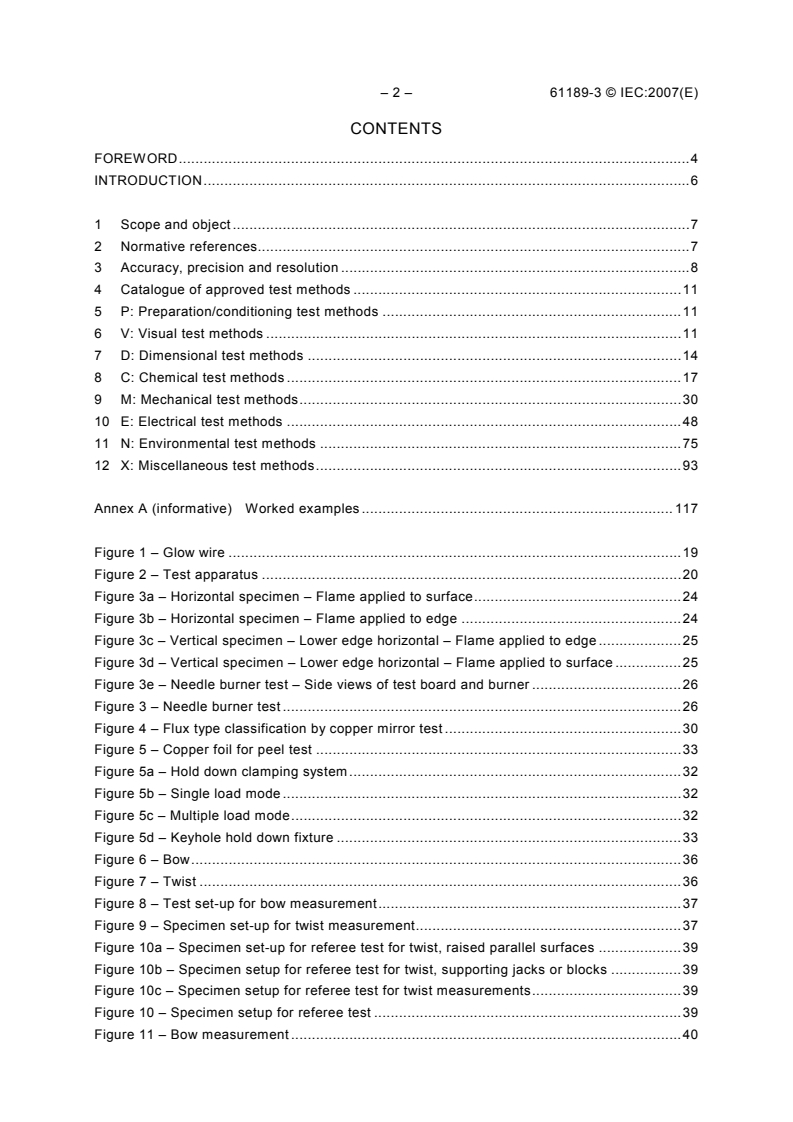
– 2 – 61189-3 © IEC:2007(E)
CONTENTS
FOREWORD.4
INTRODUCTION.6
1 Scope and object .7
2 Normative references.7
3 Accuracy, precision and resolution .8
4 Catalogue of approved test methods .11
5 P: Preparation/conditioning test methods .11
6 V: Visual test methods .11
7 D: Dimensional test methods .14
8 C: Chemical test methods .17
9 M: Mechanical test methods.30
10 E: Electrical test methods .48
11 N: Environmental test methods .75
12 X: Miscellaneous test methods.93
Annex A (informative) Worked examples. 117
Figure 1 – Glow wire .19
Figure 2 – Test apparatus .20
Figure 3a – Horizontal specimen – Flame applied to surface.24
Figure 3b – Horizontal specimen – Flame applied to edge .24
Figure 3c – Vertical specimen – Lower edge horizontal – Flame applied to edge .25
Figure 3d – Vertical specimen – Lower edge horizontal – Flame applied to surface .25
Figure 3e – Needle burner test – Side views of test board and burner .26
Figure 3 – Needle burner test .26
Figure 4 – Flux type classification by copper mirror test .30
Figure 5 – Copper foil for peel test .33
Figure 5a – Hold down clamping system.32
Figure 5b – Single load mode .32
Figure 5c – Multiple load mode.32
Figure 5d – Keyhole hold down fixture .33
Figure 6 – Bow.36
Figure 7 – Twist .36
Figure 8 – Test set-up for bow measurement.37
Figure 9 – Specimen set-up for twist measurement.37
Figure 10a – Specimen set-up for referee test for twist, raised parallel surfaces .39
Figure 10b – Specimen setup for referee test for twist, supporting jacks or blocks .39
Figure 10c – Specimen setup for referee test for twist measurements.39
Figure 10 – Specimen setup for referee test .39
Figure 11 – Bow measurement .40
61189-3 © IEC:2007(E) – 3 –
Figure 12 – Twist measurement .40
Figure 13 – Measuring equipment for peel strength of flexible printed boards.43
Figure 14 – Pencil holder.46
Figure 15a – Location of test specimens.54
Figure 15b – Location of test specimens.55
Figure 15 – Composite test pattern.55
Figure 16 – Test specimen artwork.61
Figure 17 – Fluidized sand bath.64
Figure 18 – Possible equipment configuration.68
Figure 19 – Schematic showing undisturbed interval.68
Figure 20 – Test wave form example .70
Figure 21 – Incident wave voltage showing (2 X) air line delay .70
Figure 22 – Details of test specimen.72
Figure 23 – Circuit diagram for measurement of contact resistance .73
Figure 24 – Keypad contact patterns .75
Figure 25 – Plier fixture for thermal shock test, dip soldering .82
Figure 26 – Temperature cycles for moisture and insulation resistance test graph.92
Figure 27 – Insulation resistance coupon (μm).92
Figure 28 – Typical ‘‘comb pattern’’ .93
Figure 29 – Suggested test specimen for surface mount features . 104
Figure 30 – Suggested test specimen for plated through holes. 104
Figure 31 – Rotary dip solderability test equipment . 107
Figure 32 – Effectiveness of solder wetting of plated through holes. 110
Figure 33 – Test specimen . 116
Table 1 – Student’s "t" distribution.10
Table 2 – Preferred land, hole and wire dimensions.44
Table 3 – Resistance values.61
Table 4 – Chamber temperatures for one cycle.86
Table 5 – Accelerated ageing and test requirements. 105
Table 6 – Maximum limits of solder bath contaminants . 106
– 4 – 61189-3 © IEC:2007(E)
INTERNATIONAL ELECTROTECHNICAL COMMISSION
______________
TEST METHODS FOR ELECTRICAL MATERIALS, PRINTED BOARDS AND
OTHER INTERCONNECTION STRUCTURES AND ASSEMBLIES –
Part 3: Test methods for interconnection structures
(printed boards)
FOREWORD
1) The International Electrotechnical Commission (IEC) is a worldwide organization for standardization comprising
all national electrotechnical committees (IEC National Committees). The object of IEC is to promote
international co-operation on all questions concerning standardization in the electrical and electronic fields. To
this end and in addition to other activities, IEC publishes International Standards, Technical Specifications,
Technical Reports, Publicly Available Specifications (PAS) and Guides (hereafter referred to as “IEC
Publication(s)”). Their preparation is entrusted to technical committees; any IEC National Committee interested
in the subject dealt with may participate in this preparatory work. International, governmental and non-
governmental organizations liaising with the IEC also participate in this preparation. IEC collaborates closely
with the International Organization for Standardization (ISO) in accordance with conditions determined by
agreement between the two organizations.
2) The formal decisions or agreements of IEC on technical matters express, as nearly as possible, an international
consensus of opinion on the relevant subjects since each technical committee has representation from all
interested IEC National Committees.
3) IEC Publications have the form of recommendations for international use and are accepted by IEC National
Committees in that sense. While all reasonable efforts are made to ensure that the technical content of IEC
Publications is accurate, IEC cannot be held responsible for the way in which they are used or for any
misinterpretation by any end user.
4) In order to promote international uniformity, IEC National Committees undertake to apply IEC Publications
transparently to the maximum extent possible in their national and regional publications. Any divergence
between any IEC Publication and the corresponding national or regional publication shall be clearly indicated in
the latter.
5) IEC provides no marking procedure to indicate its approval and cannot be rendered responsible for any
equipment declared to be in conformity with an IEC Publication.
6) All users should ensure that they have the latest edition of this publication.
7) No liability shall attach to IEC or its directors, employees, servants or agents including individual experts and
members of its technical committees and IEC National Committees for any personal injury, property damage or
other damage of any nature whatsoever, whether direct or indirect, or for costs (including legal fees) and
expenses arising out of the publication, use of, or reliance upon, this IEC Publication or any other IEC
Publications.
8) Attention is drawn to the Normative references cited in this publication. Use of the referenced publications is
indispensable for the correct application of this publication.
9) Attention is drawn to the possibility that some of the elements of this IEC Publication may be the subject of
patent rights. IEC shall not be held responsible for identifying any or all such patent rights.
International Standard IEC 61189-3 has been prepared by IEC technical committee 91:
Electronics assembly technology.
This second edition cancels and replaces the first edition, published in 1997, its amendment 1
(1999) and constitutes a technical revision.
The document 91/698/FDIS, circulated to the National Committees as Amendment 2, led to the
publication of the new edition.
The major technical changes with regard to the previous edition concern the addition of 25 new
tests, as follows:
− 6 V: Visual test methods: 3V01, 3V02 and 3V03;
− 7 D: Dimensional test methods: 3D03;
61189-3 © IEC:2007(E) – 5 –
− 8 C: Chemical test methods: 3C02, 3C13 and 3C14;
− 9 M: Mechanical test methods: 3M01, 3M03, 3M04, 3M07 and 3M09;
− 10 E: Electrical test methods: 3E03, 3E04, 3E05, 3E11, 3E12, 3E13, 3E16, 3E17 and 3E18;
− 11 N: Environmental test methods: 3N03, 3N07 and 3N12;
− 12 X: Miscellaneous test methods: 3X01
This edition also includes the deletion of Annex B: Conversion table, as the referred documents
were disbanded in 2005 and do not officially exist. Should any one wish to consult such
information, they should refer to the first edition of IEC 61189-3 (1997).
The text of this standard is based on the first edition, its Amendment 1 and the following
documents:
FDIS Report on voting
91/698/FDIS 91/727/RVD
Full information on the voting for the approval of this amendment can be found in the report on
voting indicated in the above table.
This publication has been drafted in accordance with the ISO/IEC Directives, Part 2.
A list of all the parts in the IEC 61189 series, under the general title Test methods for electrical
materials, printed boards and other interconnection structures and assemblies, can be found
on the IEC website.
NOTE Future standards in this series will carry the new general title as cited above. Titles of existing standards in
this series will be updated at the time of the next edition.
This standard should be used in conjunction with the following parts:
Part 1: General test methods and methodology
Part 2: Test methods for materials for interconnection structures
Part 3: Test methods for electronic components assembling characteristics
Part 5: Test methods printed board assemblies and also the following standard
Part 6: Test methods for materials used in manufacturing electronic assemblies
IEC 60068 (all parts), Environmental testing
The committee has decided that the contents of the base publication and its amendments will
remain unchanged until the maintenance result date indicated on the IEC web site under
"http://webstore.iec.ch" in the data related to the specific publication. At this date, the
publication will be
• reconfirmed,
• withdrawn,
• replaced by a revised edition, or
• amended.
A bilingual version of this publication may be issued at a later date.
– 6 – 61189-3 © IEC:2007(E)
INTRODUCTION
IEC 61189 relates to test methods for printed boards and printed board assemblies, as well as
related materials or component robustness, irrespective of their method of manufacture.
The standard is divided into separate parts, covering information for the designer and the test
methodology engineer or technician. Each part has a specific focus; methods are grouped
according to their application and numbered sequentially as they are developed and released.
In some instances test methods developed by other TCs (e.g. TC 50) have been reproduced
from existing IEC standards in order to provide the reader with a comprehensive set of test
methods. When this situation occurs, it will be noted on the specific test method; if the test
method is reproduced with minor revision, those paragraphs that are different are identified.
This part of IEC 61189 contains test methods for evaluating printed boards and other forms of
interconnection structures. The methods are self-contained, with sufficient detail and
description so as to achieve uniformity and reproducibility in the procedures and test
methodologies.
The tests shown in this standard are grouped according to the following principles:
P: preparation/conditioning methods
V: visual test methods
D: dimensional test methods
C: chemical test methods
M: mechanical test methods
E: electrical test methods
N: environmental test methods
X: miscellaneous test methods
To facilitate reference to the tests, to retain consistency of presentation, and to provide for
future expansion, each test is identified by a number (assigned sequentially) added to the
prefix (group code) letter showing the group to which the test method belongs.
The test method numbers have no significance with respect to an eventual test sequence; that
responsibility rests with the relevant specification that calls for the method being performed.
The relevant specification, in most instances, also describes pass/fail criteria.
The letter and number combinations are for reference purposes, to be used by the relevant
specification. Thus "3D02" represents the second dimensional test method described in this
publication.
In short, for this example, 3 is the part of IEC standard (61189-3), D is the group of methods,
and 02 is the test number.
A list of all test methods included in this standard, as well as those under consideration is given
in Annex B. This annex will be reissued whenever new tests are introduced.
61189-3 © IEC:2007(E) – 7 –
TEST METHODS FOR ELECTRICAL MATERIALS, PRINTED BOARDS AND
OTHER INTERCONNECTION STRUCTURES AND ASSEMBLIES –
Part 3: Test methods for interconnection structures
(printed boards)
1 Scope
This part of IEC 61189 is a catalogue of test methods representing methodologies and
procedures that can be applied to test materials used for manufacturing interconnection
structures (printed boards) and assemblies.
2 Normative references
The following referenced documents are indispensable for the application of this document. For
dated references, only the edition cited applies. For undated references, the latest edition of
the referenced document (including any amendments) applies.
IEC 60051 (all parts), Direct acting indicating analogue electrical measuring instruments and
their accessories
IEC 60068-1: 1988, Environmental testing – Part 1: General and guidance
IEC 60068-2-20: 1979, Environmental testing – Part 2: Tests – Test T: Soldering
Amendment 2 (1987)
IEC 60068-2-78, Environmental testing – Part 2-78: Tests –Test Cab: Damp heat, steady state
IEC 60169–15, Radio-frequency connectors – Part 15: RF coaxial connectors with inner
diameter of outer conductor 4,13 mm (0,163 in) with screw coupling – Characteristic
impedance 50 ohms (Type SMA)
IEC 60454-1:1992, Specifications for pressure-sensitive adhesive tapes for electrical purposes
– Part 1: General requirements
IEC 60454-3-1:1998, Pressure-sensitive adhesive tapes for electrical purposes – Part 3:
Specifications for individual materials – Sheet 1: PVC film tapes with pressure-sensitive
adhesive
IEC 60584-1, Thermocouples – Part 1: reference tables
IEC 60695-11-5, Fire hazard testing – Part 11-5: Test flames – Needle flame test method –
Apparatus, confirmatory test arrangement and guidance
IEC 61188-1-2:1998, Printed boards and printed board assemblies – Design and use –
Part 1-2: Generic requirements – Controlled impedance
IEC 61189-1:1997, Test methods for electrical materials, interconnection structures and
assemblies – Part 1: General test methods and methodology
IEC 61190-1-1, Attachment materials for electronic assembly – Part 1-1: Requirements for
soldering fluxes for high quality interconnections in electronics assembly
IEC 61190-1-2, Attachment materials for electronic assembly – Part 1-2: Requirements for
– 8 – 61189-3 © IEC:2007(E)
solder pastes for high quality interconnections in electronic assembly
IEC 62326-4:1996, Printed boards – Part 4: Rigid multilayer printed boards with interlayer
connections – Sectional specification
IEC 62326-4-1:1996, Printed boards – Part 4: Rigid multilayer printed boards with interlayer
connections – Sectional specification – Section 1: Capability Detail Specification –
Performance levels A, B and C
ISO 4046:1978, Paper, board, pulp and related terms – Vocabulary (withdrawn)
ISO 9002:1994, Quality systems – Model for quality assurance in production, installation and
servicing (withdrawn)
ISO 9453:2006, Soft solder alloys – Chemical compositions and forms
3 Accuracy, precision and resolution
Errors and uncertainties are inherent in all measurement processes. The information given
below enables valid estimates of the amount of error and uncertainty to be taken into account.
Test data serve a number of purposes which include:
– to monitor a process;
– to enhance confidence in quality conformance;
– to arbitrate between customer and supplier.
In any of these circumstances, it is essential that confidence can be placed upon the test data
in terms of:
– accuracy: calibration of the test instruments and/or system;
– precision: the repeatability and uncertainty of the measurement;
– resolution: the suitability of the instruments and/or system for the test.
3.1 Accuracy
The regime by which routine calibration of the test equipment is undertaken shall be clearly
stated in the quality documentation of the supplier or agency conducting the test, and shall
meet the requirements of 4.11 of ISO 9002. The calibration shall be conducted by an agency
having accreditation to a national or international measurement standard institute. There
should be an uninterrupted chain of calibration to a national or international standard.
Where calibration to a national or international standard is not possible, "round robin"
techniques may be used, and documented, to enhance confidence in measurement accuracy.
The calibration interval shall normally be one year. Equipment consistently found to be outside
acceptable limits of accuracy shall be subject to shortened calibration intervals. Equipment
consistently found to be well within acceptable limits may be subject to relaxed calibration
intervals.
A record of the calibration and maintenance history shall be maintained for each instrument.
These records should state the uncertainty of the calibration technique (in ± % deviation) in
order that uncertainties of measurement can be aggregated and determined.
___________
ISO 4046 has been withdrawn and replaced by ISO 4046: Parts 1 to 5.
61189-3 © IEC:2007(E) – 9 –
A procedure shall be implemented to resolve any situation where an instrument is found to be
outside calibration limits.
3.2 Precision
The uncertainty budget of any measurement technique is made up of both systematic and
random uncertainties. All estimates shall be based upon a single confidence level, the
minimum being 95 %.
Systematic uncertainties are usually the predominant contributor, and will include all
uncertainties not subject to random fluctuation. These include:
– calibration uncertainties;
– errors due to the use of an instrument under conditions which differ from those under which
it was calibrated;
– errors in the graduation of a scale of an analogue meter (scale shape error).
Random uncertainties result from numerous sources but can be deduced from repeated
measurement of a standard item. Therefore, it is not necessary to isolate the individual
contributions. These may include:
– random fluctuations such as those due to the variation of an influence parameter. Typically,
changes in atmospheric conditions reduce the repeatability of a measurement;
– uncertainty in discrimination, such as setting a pointer to a fiducial mark, or interpolating
between graduations on an analogue scale.
Aggregation of uncertainties: Geometric addition (root-sum-square) of uncertainties may be
used in most cases. Interpolation error is normally added separately and may be accepted as
being 20 % of the difference between the finest graduations of the scale of the instrument.
2 2
UU= (±+U) + U
ts r i
where
U is the total uncertainty
t
U is the systematic uncertainty
s
U is the random uncertainty
r
U is the interpolation error
i
Determination of random uncertainties: Random uncertainty can be determined by repeated
measurement of a parameter and subsequent statistical manipulation of the measured data.
The technique assumes that the data exhibits a normal (Gaussian) distribution.
U = t σ / n
r
where
U is random uncertainty
r
n is the sample size
t is the percentage point of the "t" distribution (from 3.5, statistic tables)
F is the standard deviation (F )
n–1
3.3 Resolution
It is paramount that the test equipment used is capable of sufficient resolution. Measurement
– 10 – 61189-3 © IEC:2007(E)
systems used should be capable of resolving 10 % (or better) of the test limit tolerance.
It is accepted that some technologies will place a physical limitation upon resolution (e.g.
optical resolution)
3.4 Report
In addition to requirements detailed in the test specification, the report shall detail:
– the test method used;
– the identity of the sample(s);
– the test instrumentation;
– the specified limit(s);
– an estimate of measurement uncertainty, and resultant working limit(s) for the test;
– the detailed test results;
– the test date and operators’ signature.
3.5 Student’s "t" distribution
Table 1 gives values of the factor "t" for 95 % and 99 % confidence levels, as a function of the
number of measurements. It is sufficient to use 95 % limits, as in the case of the worked
examples shown in Annex A.
Table 1 – Student’s "t" distribution
t value t value t value t value
Sample Sample
size size
95 % 99 % 95 % 99 %
2 12,7 63,7 14 2,16 3,01
3 4,3 9,92 15 2,14 2,98
4 3,18 5,84 16 2,13 2,95
5 2,78 4,6 17 2,12 2,92
6 2,57 4,03 18 2,11 2,9
7 2,45 3,71 19 2,1 2,88
8 2,36 3,5 20 2,09 2,86
9 2,31 3,36 21 2,08 2,83
10 2,26 3,25 22 2,075 2,82
11 2,23 3,17 23 2,07 2,81
12 2,2 3,11 24 2,065 2,8
13 2,18 3,05 25 2,06 2,79
3.6 Suggested uncertainty limits
The following target uncertainties are suggested:
a) Voltage < 1 kV: ± 1,5 %
b) Voltage > 1 kV: ± 2,5 %
c) Current < 20 A: ± 1,5 %
d) Current > 20 A: ± 2,5 %
Resistance
61189-3 © IEC:2007(E) – 11 –
e) Earth and continuity: ± 10 %
f) Insulation: ± 10 %
g) Frequency: ± 0,2 %
Time
h) Interval < 60 s: ± 1 s
i) Interval > 60 s: ± 2 %
j) Mass < 10 g: ± 0,5 %
k) Mass 10 g to 100 g: ± 1 %
l) Mass > 100 g: ± 2 %
m) Force: ± 2 %
n) Dimension < 25 mm: ± 0,5 %
o) Dimension > 25 mm: ± 0,1 mm
p) Temperature < 100 °C: ± 1,5 %
q) Temperature > 100 °C: ± 3,5 %
r) Humidity 30 to 75 % RH: ± 5 % RH
Plating thicknesses
s) Backscatter method: ± 10 %
t) Microsection: ± 2 ⎧m
u) Ionic contamination: ± 10 %
4 Catalogue of approved test methods
This standard provides specific test methods in complete detail to permit implementation with
minimal cross-referencing to other specific procedures. The use of generic conditioning
exposures is accomplished in the methods by reference, for example IEC 61189-1 and
IEC 60068 and, when applicable, is a mandatory part of the test method standard.
Each method has its own title, number and revision status to accommodate updating and
improving the methods as industry requirements change or demand new methodology. The
methods are organized in test method groups and individual tests.
5 P: Preparation/conditioning test methods
6 V: Visual test methods
6.1 Test 3V01: Visual examination, 3× magnification
6.1.1 Object
This method describes the procedure for visual examination of materials and finished printed
boards, where 3× magnification is required by the relevant sectional specification (SS) or
customer detail specification (CDS).
6.1.2 Test specimen
Finished printed board(s), portion of finished printed board, or test coupon(s), as specified by
the relevant sectional specification (SS) or customer detail specification (CDS).
– 12 – 61189-3 © IEC:2007(E)
6.1.3 Test apparatus and materials
The following test apparatus and materials shall be used:
a) Optical device capable of providing 3× magnification.
b) Referee optical device capable of providing 10× magnification.
6.1.4 Procedure
The following steps shall be taken:
a) The product shall be carefully examined, per the specified requirement, under 3×
magnification device.
b) In the case of a questionable evaluation at 3×, a referee examination may be performed at
10×.
6.1.5 Report
The report shall include:
a) the test method number and revision;
b) the date of evaluation;
c) identification and description of specimen;
d) the magnification used for the examination;
e) the referee magnification examination, if applicable;
f) the results of evaluation, including requirement(s) failed, failure modes and degree of
failure, in case of failure;
g) any deviation from this test method;
h) the name of the person that conducted the test.
6.1.6 Additional information
In addition to stated requirements, any other objective evidence of defective and/or
substandard conditions should be noted, such as dirt, oil, corrosion, fingerprints, foreign matter,
etc.
6.2 Test 3V02: Visual examination, 10× magnification
6.2.1 Object
This method describes the procedure for visual examination of materials and finished printed
boards where 10× magnification is required by the relevant sectional specification (SS) or
customer detail specification (CDS).
6.2.2 Test specimen
Finished printed board(s) or test coupon(s), as specified in the relevant specification.
6.2.3 Test apparatus and materials
The following test apparatus and materials shall be used:
a) Optical device capable of providing 10× magnification.
b) Referee optical device capable of providing 50× magnification.
61189-3 © IEC:2007(E) – 13 –
6.2.4 Procedure
The following steps shall be taken:
a) The product shall be carefully examined, per the specified requirement, under 10×
magnification device.
b) In the case of a questionable evaluation at 10×, a referee examination may be performed at
50×.
6.2.5 Report
The report shall include:
a) the test method number and revision;
b) the date of evaluation;
c) identification and description of specimen;
d) the magnification used for the examination;
e) the referee magnification examination, if applicable;
f) results of evaluation, including requirement(s) failed, failure modes and degree of failure, in
case of failure;
g) any deviation from this test method;
h) the name of the person that conducted the test.
6.2.6 Additional information
In addition to stated requirements, any other objective evidence of defective and/or sub-
standard conditions should be noted, such as dirt, oil, corrosion, fingerprints, foreign matter,
etc.
6.3 Test 3V03: Visual examination, 250× magnification
6.3.1 Object
This method describes the procedure for visual examination of materials and finished printed
boards, where 250× magnification is required by the relevant sectional specification (SS) or
customer detail specification (CDS).
6.3.2 Test specimen
Finished printed board(s), portion of finished printed board, or test coupon(s), as specified in
the relevant specification.
6.3.3 Test apparatus and materials
The following test apparatus and materials shall be used:
a) Optical device capable of providing 250× magnification.
b) Referee optical device capable of providing at least double the power magnification.
NOTE Caution is advised not to falsely identify problems at this magnification.
6.3.4 Procedure
The following steps shall be taken:
– 14 – 61189-3 © IEC:2007(E)
a) The product shall be carefully examined, per the specified requirement, magnification
device under 250×.
b) In the case of a questionable evaluation at 250×, a referee examination may be performed
at any magnification of at least double the power.
6.3.5 Report
The report shall include:
a) the test method number and revision;
b) the date of evaluation;
c) identification and description of specimen;
d) the magnification used for the examination;
e) the referee magnification examination, if applicable;
f) the results of evaluation, including requirement(s) failed, failure modes and degree of
failure, in case of failure;
g) any deviation from this test method;
i) the name of the person that conducted the test.
6.3.6 Additional information
In addition to stated requirements, any other objective evidence of defective and/or
substandard conditions should be noted, such as dirt, oil, corrosion, inclusions, foreign matter,
etc.
6.4 Test 3V04: General visual (under consideration)
7 D: Dimensional test methods
7.1 Test 3D01: Optical method (under consideration)
7.2 Test 3D02: Conductor width and spacing
7.2.1 Object
The purpose of this test method is to provide a procedure for determining the conductor width
and spacing of a printed board.
7.2.2 Test specimen
The specimen shall be a suitable printed board having conductor patterns for test.
Where the use of test coupons, as specified in IEC 62326-4-1, is agreed between the user and
the supplier, the measurement shall be carried out on specimen F.
7.2.3 Test apparatus and materials
The following test apparatus and materials shall be used:
An illuminated eyepiece or microscope or projector having an ocular micrometer with a
resolution of 0,01 mm or better shall be used.
7.2.4 Procedure
The following steps shall be taken:
61189-3 © IEC:2007(E) – 15 –
The conductor width and spacing between conductors shall be measured at random points,
including central and corner areas, according to the relevant specification, and viewed
vertically from above. The measured value shall be recorded to the nearest 0,01 mm. Edge
defects such as indentations, projections, and slivers shall be excluded from measurement.
7.2.5 Report
The report shall include:
a) the test method number and revision;
b) the date of the test;
c) the identification and description of the specimen;
d) the conductor width and spacing measured;
e) the layer number;
f) the number of measurements;
g) the maximum and minimum observed conductor widths and spaces;
h) the average conductor width and spaces;
i) any deviation from this test method;
j) the name of the person conducting the test.
7.2.6 Additional information
None.
7.3 Test 3D03: Automated optical inspection (AOI)
7.3.1 Object
AOI is an integrated system for the automated visual inspection and verification of printed
boards, printed board inner layers, and printed board artworks. Software and hardware
combinations are available which enable accurate inspection at a high throughput.
AOI is undertaken to ensure that a printed board complies with the customer's requirements.
AOI is capable of detecting many defect types (as listed in 7.3.6), and may be used as a
screening process (100 %), or in accordance with a sampling plan.
The benchmark for AOI verification may be physical ("golden board" or artwork) or theoretical
(design rules or CAD data).
The principal of operation of AOI equipment is the interpretation/comparison of data from the
item under test with the benchmark. The equipment either operated on a "reflected light"
principle, or uses the fluorescence of substrates subjected to laser light.
7.3.2 Test specimen
The test specimens shall comprise of production artwork, printed boards or inner layers.
7.3.3 Test apparatus and materials
The following test apparatus and materials shall be used:
a) Automated equipment capable of viewing an area equal to 500 mm × 700 mm using raster
scanning techniques. The resolution of the machine shall be 4× greater than the feature
size being determined.
– 16 – 61189-3 © IEC:2007(E)
b) Light sensors and recording mechanisms shall be capable of determining feature
ambiguities as programmed into the equipment to facilitate identification of non-conforming
feature sizes of printed boards, artwork, etc.
7.3.4 Procedure
The test procedure differs for new and repeat jobs:
7.3.4.1 Procedure for new jobs
The AOI equipment requires undertaking a learning stage followed by an inspection stage.
7.3.4.1.1 Learning stage
During the learning stage, the AOI equipment acquires the parameters required for the
inspection stage. These typically include:
– inspection areas
– non-inspection areas
– minimum conductor width
– minimum conductor spacing
The AOI uses the data to create a data file for reference during the inspection stage. Data may
be collected from a "golden board" or from CAD data.
A database should be maintained in order to expedite repeat jobs/orders.
7.3.4.1.2 Inspection stage
During the inspection stage, the AOI equipment uses the learned data to perform the
inspection of the test item. Detected defects may be marked, or logged as (X, Y) coordinates.
Detected defects should then be verified by the operator.
7.3.4.2 Repeat jobs
Learned data from previous jobs shall be loaded from the database, and the procedure detailed
in 7.3.4.1.1 shall then be followed.
7.3.5 Report
The report should include:
a) test number and revision
b) date of test
c) description and identification of the test items
d) details of verified defects
e) a statistical analysis of the defect data (optional);
f) identification of AOI apparatus if AOI is subcontracted;
g) the name of the person that conducted the test.
7.3.6 Additional information
AOI apparatus should be capable of detecting:
61189-3 © IEC:2007(E) – 17 –
a) design rule defects
– open circuit
– conductor width violation
– conductor spacing violation
– copper splash
– pin holes
b) reference defects
– short circuits
– missing conductors
– missing spacing
– pad violation (incorrect number of conductors entering a pad)
– errors in clearances in power and ground planes
– multiple line width defects (MLW)
– short circuit between split planes
c) outer layer defects
– annular ring defects
– break out
– missing holes
– conductor dish down
d) general
– dimension error measurements
7.4 Test 3D04: Dimensional examination, general (under consideration)
8 C: Chemical test methods
8.1 Test 3C01: Flammability, rigid printed board metal removal (under consideration)
8.2 Test method 3C02: Flammability; glow wire test, rigid printed boards
8.2.1 Object
The object of the test is to determine the effect upon a printed board of exposure to a glowing
wire under specific conditions.
The intensity of the ignition source is similar to that of an accidentally overheating or glowing
single electronic component.
Timings measured by this test are an indication of the ability of the printed board to self-
extinguish. Correlation with other properties of the material(s), such as Oxygen Index, is not
possible.
Materials suitable for testing in accordance with this technique include rigid printed boards.
8.2.2 Test specimen
The test specimen shall be production board, or a test board that is representative of the
production board in terms of:
a) Base material(s)
– 18 – 61189-3 © IEC:2007(E)
b) Surface coating(s)
c) Type (e.g. multilayer, single-sided etc.)
d) Size
e) Design
f) Surface area
g) Thickness
h) Metal distribution
A minimum of five specimens shall be used.
8.2.3 Test apparatus and materials
The following test apparatus and materials shall be used:
a) The glow-wire shall consist of a loop of nickel/chromium (80 % / 20 %) wire having a
diameter of 4 mm (see Figure 1). Care must be taken when forming the loop to avoid fine
cracking at the tip.
b) A sheathed fine-wire thermocouple, having an overall diameter of 0,5 mm and wires of NiCr
and NiAl with the welded point located inside the sheath, is used for measuring the
temperature of the glow-wire.
c) The sheath consists of a metal which must be resistant to a temperature of at least 960 °C.
The thermocouple is arranged in a pocket hole, 0,6 mm in diameter, drilled in the tip of the
glow wire, as shown in “detail Z” of Figure 1. The thermo-voltages shall comply with
IEC 60584-1; the characteristics given in that publication are practically linear. The cold
connection shall be kept in melting ice unless a reliable reference temperature is obtained
by other means.
d) The instrument for measuring the thermo-voltage should be accurate to 1 % (i.e. Class 0,5
according to IEC 60051).
e) The glow-wire is electrically heated. The current necessary for heating the specified tip to a
temperature of 960 °C is between 120 A and 150 A.
f) The test apparatus shall be so designed that the glow-wire is kept in a horizontal plane and
that it applies a force of between 0,8N and 1,2N to the specimen. The force shall be
maintained at this value whilst the glow-wire or test specimen is moved horizontally in
relation to each other over a distance of at least 7mm.
g) A wooden board shall be placed underneath the specimen. The board shall be covered with
tissue paper which complies with 6.86 of ISO 4046.
h) An example of the test apparatus is shown in Figure 2.
8.2.4 Procedure
The following steps shall be taken:
a) The test specimens shall be pre-conditioned for 24 h at (124 ± 2) °C in an air-circulating
...
IEC 61189-3 ®
Edition 2.0 2007-10
INTERNATIONAL
STANDARD
NORME
INTERNATIONALE
Test methods for electrical materials, printed boards and other interconnection
structures and assemblies –
Part 3: Test methods for interconnection structures (printed boards)
Méthodes d'essai pour les matériaux électriques, les cartes imprimées et autres
structures d'interconnexion et ensembles –
Partie 3: Méthodes d'essai des structures d'interconnexion (cartes imprimées)
All rights reserved. Unless otherwise specified, no part of this publication may be reproduced or utilized in any form
or by any means, electronic or mechanical, including photocopying and microfilm, without permission in writing from
either IEC or IEC's member National Committee in the country of the requester.
If you have any questions about IEC copyright or have an enquiry about obtaining additional rights to this publication,
please contact the address below or your local IEC member National Committee for further information.
Droits de reproduction réservés. Sauf indication contraire, aucune partie de cette publication ne peut être reproduite ni
utilisée sous quelque forme que ce soit et par aucun procédé, électronique ou mécanique, y compris la photocopie et les
microfilms, sans l'accord écrit de la CEI ou du Comité national de la CEI du pays du demandeur.
Si vous avez des questions sur le copyright de la CEI ou si vous désirez obtenir des droits supplémentaires sur cette
publication, utilisez les coordonnées ci-après ou contactez le Comité national de la CEI de votre pays de résidence.
IEC Central Office Tel.: +41 22 919 02 11
3, rue de Varembé Fax: +41 22 919 03 00
CH-1211 Geneva 20 info@iec.ch
Switzerland www.iec.ch
About the IEC
The International Electrotechnical Commission (IEC) is the leading global organization that prepares and publishes
International Standards for all electrical, electronic and related technologies.
About IEC publications
The technical content of IEC publications is kept under constant review by the IEC. Please make sure that you have the
latest edition, a corrigenda or an amendment might have been published.
Useful links:
IEC publications search - www.iec.ch/searchpub Electropedia - www.electropedia.org
The advanced search enables you to find IEC publications The world's leading online dictionary of electronic and
by a variety of criteria (reference number, text, technical electrical terms containing more than 30 000 terms and
committee,…). definitions in English and French, with equivalent terms in
It also gives information on projects, replaced and additional languages. Also known as the International
withdrawn publications. Electrotechnical Vocabulary (IEV) on-line.
IEC Just Published - webstore.iec.ch/justpublished Customer Service Centre - webstore.iec.ch/csc
Stay up to date on all new IEC publications. Just Published If you wish to give us your feedback on this publication
details all new publications released. Available on-line and or need further assistance, please contact the
also once a month by email. Customer Service Centre: csc@iec.ch.
A propos de la CEI
La Commission Electrotechnique Internationale (CEI) est la première organisation mondiale qui élabore et publie des
Normes internationales pour tout ce qui a trait à l'électricité, à l'électronique et aux technologies apparentées.
A propos des publications CEI
Le contenu technique des publications de la CEI est constamment revu. Veuillez vous assurer que vous possédez
l’édition la plus récente, un corrigendum ou amendement peut avoir été publié.
Liens utiles:
Recherche de publications CEI - www.iec.ch/searchpub Electropedia - www.electropedia.org
La recherche avancée vous permet de trouver des Le premier dictionnaire en ligne au monde de termes
publications CEI en utilisant différents critères (numéro de électroniques et électriques. Il contient plus de 30 000
référence, texte, comité d’études,…). termes et définitions en anglais et en français, ainsi que
Elle donne aussi des informations sur les projets et les les termes équivalents dans les langues additionnelles.
publications remplacées ou retirées. Egalement appelé Vocabulaire Electrotechnique
International (VEI) en ligne.
Just Published CEI - webstore.iec.ch/justpublished
Service Clients - webstore.iec.ch/csc
Restez informé sur les nouvelles publications de la CEI.
Just Published détaille les nouvelles publications parues. Si vous désirez nous donner des commentaires sur
Disponible en ligne et aussi une fois par mois par email. cette publication ou si vous avez des questions
contactez-nous: csc@iec.ch.
IEC 61189-3 ®
Edition 2.0 2007-10
INTERNATIONAL
STANDARD
NORME
INTERNATIONALE
Test methods for electrical materials, printed boards and other interconnection
structures and assemblies –
Part 3: Test methods for interconnection structures (printed boards)
Méthodes d'essai pour les matériaux électriques, les cartes imprimées et autres
structures d'interconnexion et ensembles –
Partie 3: Méthodes d'essai des structures d'interconnexion (cartes imprimées)
INTERNATIONAL
ELECTROTECHNICAL
COMMISSION
COMMISSION
ELECTROTECHNIQUE
PRICE CODE
INTERNATIONALE
CODE PRIX XE
ICS 31.180 ISBN 978-2-83220-349-1
– 2 – 61189-3 © IEC:2007
CONTENTS
FOREWORD . 4
INTRODUCTION . 6
1 Scope and object . 7
2 Normative references. 7
3 Accuracy, precision and resolution . 8
4 Catalogue of approved test methods . 11
5 P: Preparation/conditioning test methods . 11
6 V: Visual test methods . 11
7 D: Dimensional test methods . 14
8 C: Chemical test methods . 17
9 M: Mechanical test methods . 30
10 E: Electrical test methods . 48
11 N: Environmental test methods . 75
12 X: Miscellaneous test methods . 93
Annex A (informative) Worked examples . 117
Figure 1 – Glow wire . 19
Figure 2 – Test apparatus . 20
Figure 3a – Horizontal specimen – Flame applied to surface . 24
Figure 3b – Horizontal specimen – Flame applied to edge . 24
Figure 3c – Vertical specimen – Lower edge horizontal – Flame applied to edge . 25
Figure 3d – Vertical specimen – Lower edge horizontal – Flame applied to surface . 25
Figure 3e – Needle burner test – Side views of test board and burner . 26
Figure 3 – Needle burner test . 26
Figure 4 – Flux type classification by copper mirror test . 30
Figure 5a – Hold down clamping system . 32
Figure 5b – Single load mode . 32
Figure 5c – Multiple load mode . 32
Figure 5d – Keyhole hold down fixture . 33
Figure 5 – Copper foil for peel test . 33
Figure 6 – Bow . 36
Figure 7 – Twist . 36
Figure 8 – Test set-up for bow measurement . 37
Figure 9 – Specimen set-up for twist measurement . 37
Figure 10a – Specimen set-up for referee test for twist, raised parallel surfaces . 38
Figure 10b – Specimen set-up for referee test for twist, supporting jacks or blocks . 39
Figure 10c – Specimen set-up for referee test for twist measurements . 39
Figure 10 – Specimen set-up for referee test . 39
Figure 11 – Bow measurement . 39
Figure 12 – Twist measurement . 40
61189-3 © IEC:2007 – 3 –
Figure 13 – Measuring equipment for peel strength of flexible printed boards . 43
Figure 14 – Pencil holder. 46
Figure 15a – Location of test specimens . 54
Figure 15b – Location of test specimens . 55
Figure 15 – Composite test pattern . 55
Figure 16 – Test specimen artwork . 61
Figure 17 – Fluidized sand bath . 64
Figure 18 – Possible equipment configuration . 68
Figure 19 – Schematic showing undisturbed interval . 68
Figure 20 – Test wave form example . 70
Figure 21 – Incident wave voltage showing (2 X) air line delay . 70
Figure 22 – Details of test specimen . 72
Figure 23 – Circuit diagram for measurement of contact resistance . 73
Figure 24 – Keypad contact patterns . 75
Figure 25 – Plier fixture for thermal shock test, dip soldering . 82
Figure 26 – Temperature cycles for moisture and insulation resistance test graph . 92
Figure 27 – Insulation resistance coupon (µm) . 92
Figure 28 – Typical ‘‘comb pattern’’ . 93
Figure 29 – Suggested test specimen for surface mount features . 104
Figure 30 – Suggested test specimen for plated through holes . 104
Figure 31 – Rotary dip solderability test equipment . 107
Figure 32 – Effectiveness of solder wetting of plated through holes . 110
Figure 33 – Test specimen . 116
Table 1 – Student’s "t" distribution . 10
Table 2 – Preferred land, hole and wire dimensions . 44
Table 3 – Resistance values . 61
Table 4 – Chamber temperatures for one cycle . 86
Table 5 – Accelerated ageing and test requirements . 105
Table 6 – Maximum limits of solder bath contaminants . 106
– 4 – 61189-3 © IEC:2007
INTERNATIONAL ELECTROTECHNICAL COMMISSION
______________
TEST METHODS FOR ELECTRICAL MATERIALS, PRINTED BOARDS AND
OTHER INTERCONNECTION STRUCTURES AND ASSEMBLIES –
Part 3: Test methods for interconnection structures
(printed boards)
FOREWORD
1) The International Electrotechnical Commission (IEC) is a worldwide organization for standardization comprising
all national electrotechnical committees (IEC National Committees). The object of IEC is to promote
international co-operation on all questions concerning standardization in the electrical and electronic fields. To
this end and in addition to other activities, IEC publishes International Standards, Technical Specifications,
Technical Reports, Publicly Available Specifications (PAS) and Guides (hereafter referred to as “IEC
Publication(s)”). Their preparation is entrusted to technical committees; any IEC National Committee interested
in the subject dealt with may participate in this preparatory work. International, governmental and non-
governmental organizations liaising with the IEC also participate in this preparation. IEC collaborates closely
with the International Organization for Standardization (ISO) in accordance with conditions determined by
agreement between the two organizations.
2) The formal decisions or agreements of IEC on technical matters express, as nearly as possible, an international
consensus of opinion on the relevant subjects since each technical committee has representation from all
interested IEC National Committees.
3) IEC Publications have the form of recommendations for international use and are accepted by IEC National
Committees in that sense. While all reasonable efforts are made to ensure that the technical content of IEC
Publications is accurate, IEC cannot be held responsible for the way in which they are used or for any
misinterpretation by any end user.
4) In order to promote international uniformity, IEC National Committees undertake to apply IEC Publications
transparently to the maximum extent possible in their national and regional publications. Any divergence
between any IEC Publication and the corresponding national or regional publication shall be clearly indicated in
the latter.
5) IEC provides no marking procedure to indicate its approval and cannot be rendered responsible for any
equipment declared to be in conformity with an IEC Publication.
6) All users should ensure that they have the latest edition of this publication.
7) No liability shall attach to IEC or its directors, employees, servants or agents including individual experts and
members of its technical committees and IEC National Committees for any personal injury, property damage or
other damage of any nature whatsoever, whether direct or indirect, or for costs (including legal fees) and
expenses arising out of the publication, use of, or reliance upon, this IEC Publication or any other IEC
Publications.
8) Attention is drawn to the Normative references cited in this publication. Use of the referenced publications is
indispensable for the correct application of this publication.
9) Attention is drawn to the possibility that some of the elements of this IEC Publication may be the subject of
patent rights. IEC shall not be held responsible for identifying any or all such patent rights.
International Standard IEC 61189-3 has been prepared by IEC technical committee 91:
Electronics assembly technology.
This second edition cancels and replaces the first edition, published in 1997, its amendment 1
(1999) and constitutes a technical revision.
The document 91/698/FDIS, circulated to the National Committees as Amendment 2, led to the
publication of the new edition.
The major technical changes with regard to the previous edition concern the addition of 25 new
tests, as follows:
− 6 V: Visual test methods: 3V01, 3V02 and 3V03;
− 7 D: Dimensional test methods: 3D03;
61189-3 © IEC:2007 – 5 –
− 8 C: Chemical test methods: 3C02, 3C13 and 3C14;
− 9 M: Mechanical test methods: 3M01, 3M03, 3M04, 3M07 and 3M09;
− 10 E: Electrical test methods: 3E03, 3E04, 3E05, 3E11, 3E12, 3E13, 3E16, 3E17 and 3E18;
− 11 N: Environmental test methods: 3N03, 3N07 and 3N12;
− 12 X: Miscellaneous test methods: 3X01.
This edition also includes the deletion of Annex B: Conversion table, as the referred documents
were disbanded in 2005 and do not officially exist. Should any one wish to consult such
information, they should refer to the first edition of IEC 61189-3 (1997).
This bilingual version (2012-09) corresponds to the monolingual English version, published in
2007-10.
The text of this standard is based on the first edition, its Amendment 1 and the following
documents:
FDIS Report on voting
91/698/FDIS 91/727/RVD
Full information on the voting for the approval of this amendment can be found in the report on
voting indicated in the above table.
The French version of this standard has not been voted upon.
This publication has been drafted in accordance with the ISO/IEC Directives, Part 2.
A list of all the parts in the IEC 61189 series, under the general title Test methods for electrical
materials, printed boards and other interconnection structures and assemblies, can be found
on the IEC website.
NOTE Future standards in this series will carry the new general title as cited above. Titles of existing standards in
this series will be updated at the time of the next edition.
This standard should be used in conjunction with the following parts:
Part 1: General test methods and methodology
Part 2: Test methods for materials for interconnection structures
Part 4: Test methods for electronic components assembling characteristics
Part 5: Test methods for printed board assemblies and also the following standard
Part 6: Test methods for materials used in manufacturing electronic assemblies
IEC 60068 (all parts), Environmental testing
The committee has decided that the contents of the base publication and its amendments will
remain unchanged until the maintenance result date indicated on the IEC web site under
"http://webstore.iec.ch" in the data related to the specific publication. At this date, the
publication will be
• reconfirmed,
• withdrawn,
• replaced by a revised edition, or
• amended.
– 6 – 61189-3 © IEC:2007
INTRODUCTION
IEC 61189 relates to test methods for printed boards and printed board assemblies, as well as
related materials or component robustness, irrespective of their method of manufacture.
The standard is divided into separate parts, covering information for the designer and the test
methodology engineer or technician. Each part has a specific focus; methods are grouped
according to their application and numbered sequentially as they are developed and released.
In some instances test methods developed by other TCs (e.g. TC 50) have been reproduced
from existing IEC standards in order to provide the reader with a comprehensive set of test
methods. When this situation occurs, it will be noted on the specific test method; if the test
method is reproduced with minor revision, those paragraphs that are different are identified.
This part of IEC 61189 contains test methods for evaluating printed boards and other forms of
interconnection structures. The methods are self-contained, with sufficient detail and
description so as to achieve uniformity and reproducibility in the procedures and test
methodologies.
The tests shown in this standard are grouped according to the following principles:
P: preparation/conditioning methods
V: visual test methods
D: dimensional test methods
C: chemical test methods
M: mechanical test methods
E: electrical test methods
N: environmental test methods
X: miscellaneous test methods
To facilitate reference to the tests, to retain consistency of presentation, and to provide for
future expansion, each test is identified by a number (assigned sequentially) added to the
prefix (group code) letter showing the group to which the test method belongs.
The test method numbers have no significance with respect to an eventual test sequence; that
responsibility rests with the relevant specification that calls for the method being performed.
The relevant specification, in most instances, also describes pass/fail criteria.
The letter and number combinations are for reference purposes, to be used by the relevant
specification. Thus "3D02" represents the second dimensional test method described in this
publication.
In short, for this example, 3 is the part of IEC standard (61189-3), D is the group of methods,
and 02 is the test number.
A list of all test methods included in this standard, as well as those under consideration is given
in Annex B. This annex will be reissued whenever new tests are introduced.
61189-3 © IEC:2007 – 7 –
TEST METHODS FOR ELECTRICAL MATERIALS, PRINTED BOARDS AND
OTHER INTERCONNECTION STRUCTURES AND ASSEMBLIES –
Part 3: Test methods for interconnection structures
(printed boards)
1 Scope
This part of IEC 61189 is a catalogue of test methods representing methodologies and
procedures that can be applied to test materials used for manufacturing interconnection
structures (printed boards) and assemblies.
2 Normative references
The following referenced documents are indispensable for the application of this document. For
dated references, only the edition cited applies. For undated references, the latest edition of
the referenced document (including any amendments) applies.
IEC 60051 (all parts), Direct acting indicating analogue electrical measuring instruments and
their accessories
IEC 60068-1: 1988, Environmental testing – Part 1: General and guidance
IEC 60068-2-20: 1979, Environmental testing – Part 2: Tests – Test T: Soldering
Amendment 2 (1987)
IEC 60068-2-78, Environmental testing – Part 2-78: Tests –Test Cab: Damp heat, steady state
IEC 60169–15, Radio-frequency connectors – Part 15: RF coaxial connectors with inner
diameter of outer conductor 4,13 mm (0,163 in) with screw coupling – Characteristic
impedance 50 ohms (Type SMA)
IEC 60454-1:1992, Specifications for pressure-sensitive adhesive tapes for electrical purposes
– Part 1: General requirements
IEC 60454-3-1:1998, Pressure-sensitive adhesive tapes for electrical purposes – Part 3:
Specifications for individual materials – Sheet 1: PVC film tapes with pressure-sensitive
adhesive
IEC 60584-1, Thermocouples – Part 1: reference tables
IEC 60695-11-5, Fire hazard testing – Part 11-5: Test flames – Needle flame test method –
Apparatus, confirmatory test arrangement and guidance
IEC 61188-1-2:1988, Printed boards and printed board assemblies – Design and use – Part 1-2:
Generic requirements – Controlled impedance
IEC 61189-1:1997, Test methods for electrical materials, interconnection structures and
assemblies – Part 1: General test methods and methodology
IEC 61190-1-1, Attachment materials for electronic assembly – Part 1-1: Requirements for
soldering fluxes for high quality interconnections in electronics assembly
– 8 – 61189-3 © IEC:2007
IEC 61190-1-2, Attachment materials for electronic assembly – Part 1-2: Requirements for
solder pastes for high quality interconnections in electronic assembly
IEC 62326-4:1996, Printed boards – Part 4: Rigid multilayer printed boards with interlayer
connections – Sectional specification
IEC 62326-4-1:1996, Printed boards – Part 4: Rigid multilayer printed boards with interlayer
connections – Sectional specification – Section 1: Capability Detail Specification –
Performance levels A, B and C
ISO 4046:1978, Paper, board, pulp and related terms – Vocabulary (withdrawn)
ISO 9002:1994, Quality systems – Model for quality assurance in production, installation and
servicing (withdrawn)
ISO 9453:2006, Soft solder alloys – Chemical compositions and forms
3 Accuracy, precision and resolution
Errors and uncertainties are inherent in all measurement processes. The information given
below enables valid estimates of the amount of error and uncertainty to be taken into account.
Test data serve a number of purposes which include:
– to monitor a process;
– to enhance confidence in quality conformance;
– to arbitrate between customer and supplier.
In any of these circumstances, it is essential that confidence can be placed upon the test data
in terms of:
– accuracy: calibration of the test instruments and/or system;
– precision: the repeatability and uncertainty of the measurement;
– resolution: the suitability of the instruments and/or system for the test.
3.1 Accuracy
The regime by which routine calibration of the test equipment is undertaken shall be clearly
stated in the quality documentation of the supplier or agency conducting the test, and shall
meet the requirements of 4.11 of ISO 9002. The calibration shall be conducted by an agency
having accreditation to a national or international measurement standard institute. There
should be an uninterrupted chain of calibration to a national or international standard.
Where calibration to a national or international standard is not possible, "round robin"
techniques may be used, and documented, to enhance confidence in measurement accuracy.
The calibration interval shall normally be one year. Equipment consistently found to be outside
acceptable limits of accuracy shall be subject to shortened calibration intervals. Equipment
consistently found to be well within acceptable limits may be subject to relaxed calibration
intervals.
A record of the calibration and maintenance history shall be maintained for each instrument.
These records should state the uncertainty of the calibration technique (in ± % deviation) in
order that uncertainties of measurement can be aggregated and determined.
___________
ISO 4046 has been withdrawn and replaced by ISO 4046: Parts 1 to 5.
61189-3 © IEC:2007 – 9 –
A procedure shall be implemented to resolve any situation where an instrument is found to be
outside calibration limits.
3.2 Precision
The uncertainty budget of any measurement technique is made up of both systematic and
random uncertainties. All estimates shall be based upon a single confidence level, the
minimum being 95 %.
Systematic uncertainties are usually the predominant contributor, and will include all
uncertainties not subject to random fluctuation. These include:
– calibration uncertainties;
– errors due to the use of an instrument under conditions which differ from those under which
it was calibrated;
– errors in the graduation of a scale of an analogue meter (scale shape error).
Random uncertainties result from numerous sources but can be deduced from repeated
measurement of a standard item. Therefore, it is not necessary to isolate the individual
contributions. These may include:
– random fluctuations such as those due to the variation of an influence parameter. Typically,
changes in atmospheric conditions reduce the repeatability of a measurement;
– uncertainty in discrimination, such as setting a pointer to a fiducial mark, or interpolating
between graduations on an analogue scale.
Aggregation of uncertainties: Geometric addition (root-sum-square) of uncertainties may be
used in most cases. Interpolation error is normally added separately and may be accepted as
being 20 % of the difference between the finest graduations of the scale of the instrument.
2 2
U = ± (U + U ) + U
t s r i
where
U is the total uncertainty
t
U is the systematic uncertainty
s
U is the random uncertainty
r
U is the interpolation error
i
Determination of random uncertainties: Random uncertainty can be determined by repeated
measurement of a parameter and subsequent statistical manipulation of the measured data.
The technique assumes that the data exhibits a normal (Gaussian) distribution.
U = t σ / n
r
where
is random uncertainty
U
r
n is the sample size
t is the percentage point of the "t" distribution (from 3.5, statistic tables)
F is the standard deviation (F )
n–1
3.3 Resolution
It is paramount that the test equipment used is capable of sufficient resolution. Measurement
systems used should be capable of resolving 10 % (or better) of the test limit tolerance.
– 10 – 61189-3 © IEC:2007
It is accepted that some technologies will place a physical limitation upon resolution (e.g.
optical resolution)
3.4 Report
In addition to requirements detailed in the test specification, the report shall detail:
– the test method used;
– the identity of the sample(s);
– the test instrumentation;
– the specified limit(s);
– an estimate of measurement uncertainty, and resultant working limit(s) for the test;
– the detailed test results;
– the test date and operators’ signature.
3.5 Student’s "t" distribution
Table 1 gives values of the factor "t" for 95 % and 99 % confidence levels, as a function of the
number of measurements. It is sufficient to use 95 % limits, as in the case of the worked
examples shown in Annex A.
Table 1 – Student’s "t" distribution
t value t value t value t value
Sample Sample
size size
95 % 99 % 95 % 99 %
2 12,7 63,7 14 2,16 3,01
3 4,3 9,92 15 2,14 2,98
4 3,18 5,84 16 2,13 2,95
5 2,78 4,6 17 2,12 2,92
6 2,57 4,03 18 2,11 2,9
7 2,45 3,71 19 2,1 2,88
8 2,36 3,5 20 2,09 2,86
9 2,31 3,36 21 2,08 2,83
10 2,26 3,25 22 2,075 2,82
11 2,23 3,17 23 2,07 2,81
12 2,2 3,11 24 2,065 2,8
13 2,18 3,05 25 2,06 2,79
3.6 Suggested uncertainty limits
The following target uncertainties are suggested:
a) Voltage < 1 kV: ± 1,5 %
b) Voltage > 1 kV: ± 2,5 %
c) Current < 20 A: ± 1,5 %
d) Current > 20 A: ± 2,5 %
Resistance
e) Earth and continuity: ± 10 %
61189-3 © IEC:2007 – 11 –
f) Insulation: ± 10 %
g) Frequency: ± 0,2 %
Time
h) Interval < 60 s: ± 1 s
i) Interval > 60 s: ± 2 %
j) Mass < 10 g: ± 0,5 %
k) Mass 10 g to 100 g: ± 1 %
l) Mass > 100 g: ± 2 %
m) Force: ± 2 %
n) Dimension < 25 mm: ± 0,5 %
o) Dimension > 25 mm: ± 0,1 mm
p) Temperature < 100 °C: ± 1,5 %
q) Temperature > 100 °C: ± 3,5 %
r) Humidity 30 to 75 % RH: ± 5 % RH
Plating thicknesses
s) Backscatter method: ± 10 %
t) Microsection: ± 2 m
u) Ionic contamination: ± 10 %
4 Catalogue of approved test methods
This standard provides specific test methods in complete detail to permit implementation with
minimal cross-referencing to other specific procedures. The use of generic conditioning
exposures is accomplished in the methods by reference, for example IEC 61189-1 and
IEC 60068 and, when applicable, is a mandatory part of the test method standard.
Each method has its own title, number and revision status to accommodate updating and
improving the methods as industry requirements change or demand new methodology. The
methods are organized in test method groups and individual tests.
5 P: Preparation/conditioning test methods
6 V: Visual test methods
6.1 Test 3V01: Visual examination, 3× magnification
6.1.1 Object
This method describes the procedure for visual examination of materials and finished printed
boards, where 3× magnification is required by the relevant sectional specification (SS) or
customer detail specification (CDS).
6.1.2 Test specimen
Finished printed board(s), portion of finished printed board, or test coupon(s), as specified by
the relevant sectional specification (SS) or customer detail specification (CDS).
– 12 – 61189-3 © IEC:2007
6.1.3 Test apparatus and materials
The following test apparatus and materials shall be used:
a) Optical device capable of providing 3× magnification.
b) Referee optical device capable of providing 10× magnification.
6.1.4 Procedure
The following steps shall be taken:
a) The product shall be carefully examined, per the specified requirement, under 3×
magnification device.
b) In the case of a questionable evaluation at 3×, a referee examination may be performed at
10×.
6.1.5 Report
The report shall include:
a) the test method number and revision;
b) the date of evaluation;
c) identification and description of specimen;
d) the magnification used for the examination;
e) the referee magnification examination, if applicable;
f) the results of evaluation, including requirement(s) failed, failure modes and degree of
failure, in case of failure;
g) any deviation from this test method;
h) the name of the person that conducted the test.
6.1.6 Additional information
In addition to stated requirements, any other objective evidence of defective and/or
substandard conditions should be noted, such as dirt, oil, corrosion, fingerprints, foreign matter,
etc.
6.2 Test 3V02: Visual examination, 10× magnification
6.2.1 Object
This method describes the procedure for visual examination of materials and finished printed
boards where 10× magnification is required by the relevant sectional specification (SS) or
customer detail specification (CDS).
6.2.2 Test specimen
Finished printed board(s) or test coupon(s), as specified in the relevant specification.
6.2.3 Test apparatus and materials
The following test apparatus and materials shall be used:
a) Optical device capable of providing 10× magnification.
b) Referee optical device capable of providing 50× magnification.
61189-3 © IEC:2007 – 13 –
6.2.4 Procedure
The following steps shall be taken:
a) The product shall be carefully examined, per the specified requirement, under 10×
magnification device.
b) In the case of a questionable evaluation at 10×, a referee examination may be performed at
50×.
6.2.5 Report
The report shall include:
a) the test method number and revision;
b) the date of evaluation;
c) identification and description of specimen;
d) the magnification used for the examination;
e) the referee magnification examination, if applicable;
f) results of evaluation, including requirement(s) failed, failure modes and degree of failure, in
case of failure;
g) any deviation from this test method;
h) the name of the person that conducted the test.
6.2.6 Additional information
In addition to stated requirements, any other objective evidence of defective and/or sub-
standard conditions should be noted, such as dirt, oil, corrosion, fingerprints, foreign matter,
etc.
6.3 Test 3V03: Visual examination, 250× magnification
6.3.1 Object
This method describes the procedure for visual examination of materials and finished printed
boards, where 250× magnification is required by the relevant sectional specification (SS) or
customer detail specification (CDS).
6.3.2 Test specimen
Finished printed board(s), portion of finished printed board, or test coupon(s), as specified in
the relevant specification.
6.3.3 Test apparatus and materials
The following test apparatus and materials shall be used:
a) Optical device capable of providing 250× magnification.
b) Referee optical device capable of providing at least double the power magnification.
NOTE Caution is advised not to falsely identify problems at this magnification.
6.3.4 Procedure
The following steps shall be taken:
– 14 – 61189-3 © IEC:2007
a) The product shall be carefully examined, per the specified requirement, magnification
device under 250×.
b) In the case of a questionable evaluation at 250×, a referee examination may be performed
at any magnification of at least double the power.
6.3.5 Report
The report shall include:
a) the test method number and revision;
b) the date of evaluation;
c) identification and description of specimen;
d) the magnification used for the examination;
e) the referee magnification examination, if applicable;
f) the results of evaluation, including requirement(s) failed, failure modes and degree of
failure, in case of failure;
g) any deviation from this test method;
i) the name of the person that conducted the test.
6.3.6 Additional information
In addition to stated requirements, any other objective evidence of defective and/or
substandard conditions should be noted, such as dirt, oil, corrosion, inclusions, foreign matter,
etc.
6.4 Test 3V04: General visual (under consideration)
7 D: Dimensional test methods
7.1 Test 3D01: Optical method (under consideration)
7.2 Test 3D02: Conductor width and spacing
7.2.1 Object
The purpose of this test method is to provide a procedure for determining the conductor width
and spacing of a printed board.
7.2.2 Test specimen
The specimen shall be a suitable printed board having conductor patterns for test.
Where the use of test coupons, as specified in IEC 62326-4-1, is agreed between the user and
the supplier, the measurement shall be carried out on specimen F.
7.2.3 Test apparatus and materials
The following test apparatus and materials shall be used:
An illuminated eyepiece or microscope or projector having an ocular micrometer with a
resolution of 0,01 mm or better shall be used.
7.2.4 Procedure
The following steps shall be taken:
61189-3 © IEC:2007 – 15 –
The conductor width and spacing between conductors shall be measured at random points,
including central and corner areas, according to the relevant specification, and viewed
vertically from above. The measured value shall be recorded to the nearest 0,01 mm. Edge
defects such as indentations, projections, and slivers shall be excluded from measurement.
7.2.5 Report
The report shall include:
a) the test method number and revision;
b) the date of the test;
c) the identification and description of the specimen;
d) the conductor width and spacing measured;
e) the layer number;
f) the number of measurements;
g) the maximum and minimum observed conductor widths and spaces;
h) the average conductor width and spaces;
i) any deviation from this test method;
j) the name of the person conducting the test.
7.2.6 Additional information
None.
7.3 Test 3D03: Automated optical inspection (AOI)
7.3.1 Object
AOI is an integrated system for the automated visual inspection and verification of printed
boards, printed board inner layers, and printed board artworks. Software and hardware
combinations are available which enable accurate inspection at a high throughput.
AOI is undertaken to ensure that a printed board complies with the customer's requirements.
AOI is capable of detecting many defect types (as listed in 7.3.6), and may be used as a
screening process (100 %), or in accordance with a sampling plan.
The benchmark for AOI verification may be physical ("golden board" or artwork) or theoretical
(design rules or CAD data).
The principal of operation of AOI equipment is the interpretation/comparison of data from the
item under test with the benchmark. The equipment either operated on a "reflected light"
principle, or uses the fluorescence of substrates subjected to laser light.
7.3.2 Test specimen
The test specimens shall comprise of production artwork, printed boards or inner layers.
7.3.3 Test apparatus and materials
The following test apparatus and materials shall be used:
a) Automated equipment capable of viewing an area equal to 500 mm × 700 mm using raster
scanning techniques. The resolution of the machine shall be 4× greater than the feature
size being determined.
– 16 – 61189-3 © IEC:2007
b) Light sensors and recording mechanisms shall be capable of determining feature
ambiguities as programmed into the equipment to facilitate identification of non-conforming
feature sizes of printed boards, artwork, etc.
7.3.4 Procedure
The test procedure differs for new and repeat jobs:
7.3.4.1 Procedure for new jobs
The AOI equipment requires undertaking a learning stage followed by an inspection stage.
7.3.4.1.1 Learning stage
During the learning stage, the AOI equipment acquires the parameters required for the
inspection stage. These typically include:
– inspection areas
– non-inspection areas
– minimum conductor width
– minimum conductor spacing
The AOI uses the data to create a data file for reference during the inspection stage. Data may
be collected from a "golden board" or from CAD data.
A database should be maintained in order to expedite repeat jobs/orders.
7.3.4.1.2 Inspection stage
During the inspection stage, the AOI equipment uses the learned data to perform the
inspection of the test item. Detected defects may be marked, or logged as (X, Y) coordinates.
Detected defects should then be verified by the operator.
7.3.4.2 Repeat jobs
Learned data from previous jobs shall be loaded from the database, and the procedure detailed
in 7.3.4.1.1 shall then be followed.
7.3.5 Report
The report should include:
a) test number and revision
b) date of test
c) description and identification of the test items
d) details of verified defects
e) a statistical analysis of the defect data (optional);
f) identification of AOI apparatus if AOI is subcontracted;
g) the name of the person that conducted the test.
7.3.6 Additional information
AOI apparatus should be capable of detecting:
a) design rule defects
61189-3 © IEC:2007 – 17 –
– open circuit
– conductor width violation
– conductor spacing violation
– copper splash
– pin holes
b) reference defects
– short circuits
– missing conductors
– missing spacing
– pad violation (incorrect number of conductors entering a pad)
– errors in clearances in power and ground planes
– multiple line width defects (MLW)
– short circuit between split planes
c) outer layer defects
– annular ring defects
– break out
– missing holes
– conductor dish down
d) general
– dimension error m
...