

IEC/IEEE 60076-16:2018
(Main)Power transformers - Part 16: Transformers for wind turbine applications
General Information
- Abstract
IEC/IEEE 60076-16:2018 applies to dry-type and liquid-immersed transformers for wind turbine step-up application having a winding with highest voltage for equipment up to and including 72,5 kV. This document applies to the transformer used to connect the wind turbine generator to the wind farm power collection system or adjacent distribution network and not the transformer used to connect several wind turbines to a distribution or transmission network. Transformers covered by this document comply with the relevant requirements prescribed in the IEC 60076 standards or IEEE C57 standards. This second edition of IEC/IEEE 60076-16 cancels and replaces IEC 60076-16:2011, and constitutes a technical revision. The main changes with respect to the previous edition are as follows:
1) relationship between transformer rated power and the output current from the associated generator is introduced;
2) thermal correction of the effective cooling medium has been introduced;
3) testing regime has been strengthened to ensure transformers are suitable for the harsh electrical environment to which they are subjected.
Keywords: transformers for wind turbine applications
- Status
- Published
- Publication Date
- 27-Sep-2018
- Technical Committee
- TC 14 - Power transformers
- Drafting Committee
- MT 60076-16 - TC 14/MT 60076-16
- Current Stage
- PPUB - Publication issued
- Start Date
- 28-Sep-2018
- Completion Date
- 06-Jul-2018
Buy Documents
IEC/IEEE 60076-16:2018 - Power transformers - Part 16: Transformers for wind turbine applications Released:9/28/2018
IEC/IEEE 60076-16:2018 RLV - Power transformers - Part 16: Transformers for wind turbine applications Released:9/28/2018
Overview - IEC/IEEE 60076-16:2018 (Transformers for wind turbine applications)
IEC/IEEE 60076-16:2018 is the second edition international standard that specifies requirements for power transformers for wind turbine step‑up applications. It applies to both dry‑type and liquid‑immersed transformers whose highest voltage for equipment is up to and including 72.5 kV. The standard covers transformers used to connect a wind turbine generator to the wind‑farm power collection system or an adjacent distribution network (not the inter‑turbine collection transformers). This edition replaces IEC 60076‑16:2011 and introduces important technical revisions to rating, thermal correction and testing.
Key topics and technical requirements
- Scope & applicability: Wind turbine step‑up transformers - dry and liquid types, highest voltage ≤72.5 kV.
- Ratings & service conditions: Rated power, altitude, external cooling air temperature and corrections, and particular service conditions for transformers mounted in tower or nacelle (including temperature‑rise corrections).
- Electrical environment: Harmonic content and effects, over‑excitation, transient over/under voltages, inrush current, frequency of energization, short‑circuit withstand and impedance requirements.
- Mechanical & environmental: Vibration levels, humidity, salinity, corrosion protection, thermal cycling, flammability for tower/nacelle installation, transportation and storage conditions.
- Design & protection: Tap‑changers, connection groups, neutral terminal dimensioning, insulation levels, overload capability, forced cooling operation and over‑temperature protection.
- Testing regime: Strengthened type, routine and special tests to ensure suitability for harsh electrical environments. Includes chopped‑wave tests, electrical resonance frequency, lightning impulse (type and sample routine), partial discharge tests for liquid‑immersed units, climatic/environmental tests for dry‑type units, fire behavior tests and other sample/acceptance tests.
- New/updated provisions:
- Introduces the relationship between transformer rated power and the generator output current.
- Adds thermal correction of the effective cooling medium.
- Strengthens testing to address harsh electrical environments typical of wind turbine installations.
Applications and users
This standard is essential for:
- Transformer manufacturers designing wind turbine step‑up transformers.
- Wind turbine OEMs and wind‑farm developers specifying on‑nacelle or tower‑mounted units.
- Design and commissioning engineers, electrical specifiers and integrators.
- Test laboratories, certification bodies and maintenance teams validating performance, environmental robustness and safety. Using IEC/IEEE 60076‑16 helps ensure reliable connection of wind generators to collection systems and distribution networks under real operational stresses (harmonics, vibration, temperature, lightning).
Related standards
- IEC 60076 family (general power transformer requirements) - referenced for general design and testing provisions.
- IEEE C57 series - alternate/referenced transformer standards used for compliance where applicable.
Keywords: IEC/IEEE 60076-16:2018, transformers for wind turbine applications, wind turbine step‑up transformer, dry‑type transformer, liquid‑immersed transformer, wind farm transformer, transformer testing, power transformers.
Relations
- Replaces
IEC 60076-16:2011 - Power transformers - Part 16: Transformers for wind turbine applications - Effective Date
- 05-Sep-2023
Buy Documents
IEC/IEEE 60076-16:2018 - Power transformers - Part 16: Transformers for wind turbine applications Released:9/28/2018
IEC/IEEE 60076-16:2018 RLV - Power transformers - Part 16: Transformers for wind turbine applications Released:9/28/2018
Get Certified
Connect with accredited certification bodies for this standard

DNV
DNV is an independent assurance and risk management provider.

Lloyd's Register
Lloyd's Register is a global professional services organisation specialising in engineering and technology.
DNV Energy Systems
Energy and renewable energy certification.
Sponsored listings
Frequently Asked Questions
IEC/IEEE 60076-16:2018 is a standard published by the International Electrotechnical Commission (IEC). Its full title is "Power transformers - Part 16: Transformers for wind turbine applications". This standard covers: IEC/IEEE 60076-16:2018 applies to dry-type and liquid-immersed transformers for wind turbine step-up application having a winding with highest voltage for equipment up to and including 72,5 kV. This document applies to the transformer used to connect the wind turbine generator to the wind farm power collection system or adjacent distribution network and not the transformer used to connect several wind turbines to a distribution or transmission network. Transformers covered by this document comply with the relevant requirements prescribed in the IEC 60076 standards or IEEE C57 standards. This second edition of IEC/IEEE 60076-16 cancels and replaces IEC 60076-16:2011, and constitutes a technical revision. The main changes with respect to the previous edition are as follows: 1) relationship between transformer rated power and the output current from the associated generator is introduced; 2) thermal correction of the effective cooling medium has been introduced; 3) testing regime has been strengthened to ensure transformers are suitable for the harsh electrical environment to which they are subjected. Keywords: transformers for wind turbine applications
IEC/IEEE 60076-16:2018 applies to dry-type and liquid-immersed transformers for wind turbine step-up application having a winding with highest voltage for equipment up to and including 72,5 kV. This document applies to the transformer used to connect the wind turbine generator to the wind farm power collection system or adjacent distribution network and not the transformer used to connect several wind turbines to a distribution or transmission network. Transformers covered by this document comply with the relevant requirements prescribed in the IEC 60076 standards or IEEE C57 standards. This second edition of IEC/IEEE 60076-16 cancels and replaces IEC 60076-16:2011, and constitutes a technical revision. The main changes with respect to the previous edition are as follows: 1) relationship between transformer rated power and the output current from the associated generator is introduced; 2) thermal correction of the effective cooling medium has been introduced; 3) testing regime has been strengthened to ensure transformers are suitable for the harsh electrical environment to which they are subjected. Keywords: transformers for wind turbine applications
IEC/IEEE 60076-16:2018 is classified under the following ICS (International Classification for Standards) categories: 27.180 - Wind turbine energy systems; 29.180 - Transformers. Reactors. The ICS classification helps identify the subject area and facilitates finding related standards.
IEC/IEEE 60076-16:2018 has the following relationships with other standards: It is inter standard links to IEC 60076-16:2011. Understanding these relationships helps ensure you are using the most current and applicable version of the standard.
IEC/IEEE 60076-16:2018 is available in PDF format for immediate download after purchase. The document can be added to your cart and obtained through the secure checkout process. Digital delivery ensures instant access to the complete standard document.
Standards Content (Sample)
IEC/IEEE 60076-16 ®
Edition 2.0 2018-09
INTERNATIONAL
STANDARD
Power transformers –
Part 16: Transformers for wind turbine applications
All rights reserved. Unless otherwise specified, no part of this publication may be reproduced or utilized in any form
or by any means, electronic or mechanical, including photocopying and microfilm, without permission in writing being
secured. Requests for permission to reproduce should be addressed to either IEC at the address below or IEC’s
member National Committee in the country of the requester or from IEEE.
IEC Central Office Institute of Electrical and Electronics Engineers, Inc.
3, rue de Varembé 3 Park Avenue
CH-1211 Geneva 20 New York, NY 10016-5997
Switzerland United States of America
Tel.: +41 22 919 02 11 stds.ipr@ieee.org
info@iec.ch www.ieee.org
www.iec.ch
About the IEC
The International Electrotechnical Commission (IEC) is the leading global organization that prepares and publishes
International Standards for all electrical, electronic and related technologies.
About the IEEE
IEEE is the world’s largest professional association dedicated to advancing technological innovation and excellence for
the benefit of humanity. IEEE and its members inspire a global community through its highly cited publications,
conferences, technology standards, and professional and educational activities.
About IEC/IEEE publications
The technical content of IEC/IEEE publications is kept under constant review by the IEC and IEEE. Please make sure
that you have the latest edition, a corrigendum or an amendment might have been published.
IEC Catalogue - webstore.iec.ch/catalogue Electropedia - www.electropedia.org
The stand-alone application for consulting the entire The world's leading online dictionary of electronic and
bibliographical information on IEC International Standards, electrical terms containing 21 000 terms and definitions in
Technical Specifications, Technical Reports and other English and French, with equivalent terms in 16 additional
documents. Available for PC, Mac OS, Android Tablets and languages. Also known as the International Electrotechnical
iPad. Vocabulary (IEV) online.
IEC publications search - webstore.iec.ch/advsearchform IEC Glossary - std.iec.ch/glossary
The advanced search enables to find IEC publications by a 67 000 electrotechnical terminology entries in English and
variety of criteria (reference number, text, technical French extracted from the Terms and Definitions clause of
committee,…). It also gives information on projects, replaced IEC publications issued since 2002. Some entries have been
and withdrawn publications. collected from earlier publications of IEC TC 37, 77, 86 and
CISPR.
IEC Just Published - webstore.iec.ch/justpublished
Stay up to date on all new IEC publications. Just Published IEC Customer Service Centre - webstore.iec.ch/csc
details all new publications released. Available online and If you wish to give us your feedback on this publication or
also once a month by email. need further assistance, please contact the Customer Service
Centre: sales@iec.ch.
IEC/IEEE 60076-16 ®
Edition 2.0 2018-09
INTERNATIONAL
STANDARD
Power transformers –
Part 16: Transformers for wind turbine applications
INTERNATIONAL
ELECTROTECHNICAL
COMMISSION
ICS 27.180; 29.180 ISBN 978-2-8322-5807-1
– 2 – IEC/IEEE 60076-16:2018
IEC/IEEE 2018
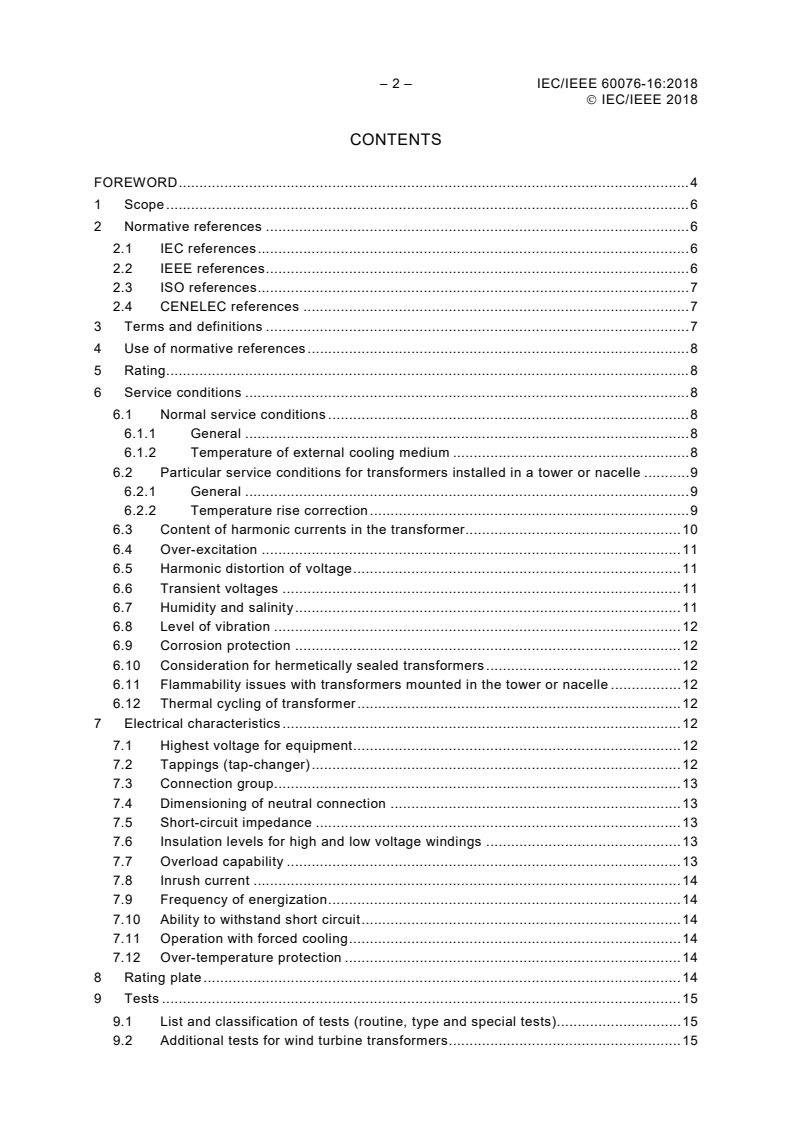
CONTENTS
FOREWORD . 4
1 Scope . 6
2 Normative references . 6
2.1 IEC references . 6
2.2 IEEE references . 6
2.3 ISO references . 7
2.4 CENELEC references . 7
3 Terms and definitions . 7
4 Use of normative references . 8
5 Rating. 8
6 Service conditions . 8
6.1 Normal service conditions . 8
6.1.1 General . 8
6.1.2 Temperature of external cooling medium . 8
6.2 Particular service conditions for transformers installed in a tower or nacelle . 9
6.2.1 General . 9
6.2.2 Temperature rise correction . 9
6.3 Content of harmonic currents in the transformer . 10
6.4 Over-excitation . 11
6.5 Harmonic distortion of voltage . 11
6.6 Transient voltages . 11
6.7 Humidity and salinity . 11
6.8 Level of vibration . 12
6.9 Corrosion protection . 12
6.10 Consideration for hermetically sealed transformers . 12
6.11 Flammability issues with transformers mounted in the tower or nacelle . 12
6.12 Thermal cycling of transformer . 12
7 Electrical characteristics . 12
7.1 Highest voltage for equipment . 12
7.2 Tappings (tap-changer) . 12
7.3 Connection group . 13
7.4 Dimensioning of neutral connection . 13
7.5 Short-circuit impedance . 13
7.6 Insulation levels for high and low voltage windings . 13
7.7 Overload capability . 13
7.8 Inrush current . 14
7.9 Frequency of energization . 14
7.10 Ability to withstand short circuit . 14
7.11 Operation with forced cooling . 14
7.12 Over-temperature protection . 14
8 Rating plate . 14
9 Tests . 15
9.1 List and classification of tests (routine, type and special tests). 15
9.2 Additional tests for wind turbine transformers . 15
IEC/IEEE 2018
9.2.1 General . 15
9.2.2 Lightning impulse type tests. 15
9.2.3 Lightning impulse routine sample tests . 15
9.2.4 Partial discharge test for liquid-immersed transformers . 15
9.2.5 Climatic and environmental tests for dry-type transformers . 15
Annex A (informative) Effects of voltage harmonics . 16
A.1 Design and specification considerations . 16
A.2 Effects of voltage harmonics . 16
Bibliography . 19
Table 1 – Recommended minimum values of short-circuit impedance for transformers
with two separate windings . 13
Table A.1 – Example of voltage harmonic order . 17
– 4 – IEC/IEEE 60076-16:2018
IEC/IEEE 2018
INTERNATIONAL ELECTROTECHNICAL COMMISSION
_____________
POWER TRANSFORMERS –
Part 16: Transformers for wind turbine applications
FOREWORD
1) The International Electrotechnical Commission (IEC) is a worldwide organization for standardization comprising
all national electrotechnical committees (IEC National Committees). The object of IEC is to promote
international co-operation on all questions concerning standardization in the electrical and electronic fields. To
this end and in addition to other activities, IEC publishes International Standards, Technical Specifications,
Technical Reports, Publicly Available Specifications (PAS) and Guides (hereafter referred to as “IEC
Publication(s)”). Their preparation is entrusted to technical committees; any IEC National Committee interested
in the subject dealt with may participate in this preparatory work. International, governmental and non-
governmental organizations liaising with the IEC also participate in this preparation.
IEEE Standards documents are developed within IEEE Societies and Standards Coordinating Committees of the
IEEE Standards Association (IEEE-SA) Standards Board. IEEE develops its standards through a consensus
development process, approved by the American National Standards Institute, which brings together volunteers
representing varied viewpoints and interests to achieve the final product. Volunteers are not necessarily
members of IEEE and serve without compensation. While IEEE administers the process and establishes rules
to promote fairness in the consensus development process, IEEE does not independently evaluate, test, or
verify the accuracy of any of the information contained in its standards. Use of IEEE Standards documents is
wholly voluntary. IEEE documents are made available for use subject to important notices and legal disclaimers
(see http://standards.ieee.org/IPR/disclaimers.html for more information).
IEC collaborates closely with IEEE in accordance with conditions determined by agreement between the two
organizations. This Dual Logo International Standard was jointly developed by the IEC and IEEE under the
terms of that agreement.
2) The formal decisions of IEC on technical matters express, as nearly as possible, an international consensus of
opinion on the relevant subjects since each technical committee has representation from all interested IEC
National Committees. The formal decisions of IEEE on technical matters, once consensus within IEEE Societies
and Standards Coordinating Committees has been reached, is determined by a balanced ballot of materially
interested parties who indicate interest in reviewing the proposed standard. Final approval of the IEEE
standards document is given by the IEEE Standards Association (IEEE-SA) Standards Board.
3) IEC/IEEE Publications have the form of recommendations for international use and are accepted by IEC
National Committees/IEEE Societies in that sense. While all reasonable efforts are made to ensure that the
technical content of IEC/IEEE Publications is accurate, IEC or IEEE cannot be held responsible for the way in
which they are used or for any misinterpretation by any end user.
4) In order to promote international uniformity, IEC National Committees undertake to apply IEC Publications
(including IEC/IEEE Publications) transparently to the maximum extent possible in their national and regional
publications. Any divergence between any IEC/IEEE Publication and the corresponding national or regional
publication shall be clearly indicated in the latter.
5) IEC and IEEE do not provide any attestation of conformity. Independent certification bodies provide conformity
assessment services and, in some areas, access to IEC marks of conformity. IEC and IEEE are not responsible
for any services carried out by independent certification bodies.
6) All users should ensure that they have the latest edition of this publication.
7) No liability shall attach to IEC or IEEE or their directors, employees, servants or agents including individual
experts and members of technical committees and IEC National Committees, or volunteers of IEEE Societies
and the Standards Coordinating Committees of the IEEE Standards Association (IEEE-SA) Standards Board,
for any personal injury, property damage or other damage of any nature whatsoever, whether direct or indirect,
or for costs (including legal fees) and expenses arising out of the publication, use of, or reliance upon, this
IEC/IEEE Publication or any other IEC or IEEE Publications.
8) Attention is drawn to the normative references cited in this publication. Use of the referenced publications is
indispensable for the correct application of this publication.
9) Attention is drawn to the possibility that implementation of this IEC/IEEE Publication may require use of
material covered by patent rights. By publication of this standard, no position is taken with respect to the
existence or validity of any patent rights in connection therewith. IEC or IEEE shall not be held responsible for
identifying Essential Patent Claims for which a license may be required, for conducting inquiries into the legal
validity or scope of Patent Claims or determining whether any licensing terms or conditions provided in
connection with submission of a Letter of Assurance, if any, or in any licensing agreements are reasonable or
non-discriminatory. Users of this standard are expressly advised that determination of the validity of any patent
rights, and the risk of infringement of such rights, is entirely their own responsibility.
IEC/IEEE 2018
International Standard IEC/IEEE 60076-16 has been prepared by IEC technical committee 14:
Power transformers, in cooperation with Performance Characteristics Subcommittee of the
IEEE Power and Energy Society , under the IEC/IEEE Dual Logo Agreement between IEC
and IEEE.
This second edition of IEC/IEEE 60076-16 cancels and replaces IEC 60076-16:2011, and
constitutes a technical revision.
The main changes with respect to the previous edition are as follows:
1) relationship between transformer rated power and the output current from the associated
generator is introduced;
2) thermal correction of the effective cooling medium has been introduced;
3) testing regime has been strengthened to ensure transformers are suitable for the harsh
electrical environment to which they are subjected.
This publication is published as an IEC/IEEE Dual Logo standard.
The text of this standard is based on the following IEC documents:
FDIS Report on voting
14/959/FDIS 14/965/RVD
Full information on the voting for the approval of this standard can be found in the report on
voting indicated in the above table.
International Standards are drafted in accordance with the rules given in the ISO/IEC
Directives, Part 2.
A list of all parts in the IEC/IEEE 60076 series, published under the general title Power
transformers, can be found on the IEC website.
The IEC Technical Committee and IEEE Technical Committee have decided that the contents
of this publication will remain unchanged until the stability date indicated on the IEC website
under "http://webstore.iec.ch" in the data related to the specific publication. At this date, the
publication will be
• reconfirmed,
• withdrawn,
• replaced by a revised edition, or
• amended.
A bilingual version of this publication may be issued at a later date.
___________
1 A list of IEEE participants can be found at the following URL: https://standards.ieee.org/project/60076-16.html
– 6 – IEC/IEEE 60076-16:2018
IEC/IEEE 2018
POWER TRANSFORMERS –
Part 16: Transformers for wind turbine applications
1 Scope
This part of IEC 60076 applies to dry-type and liquid-immersed transformers for wind turbine
step-up applications having a winding with highest voltage for equipment up to and including
72,5 kV. This document applies to the transformer used to connect the wind turbine generator
to the wind farm power collection system or adjacent distribution network and not the
transformer used to connect several wind turbines to a distribution or transmission network.
Transformers covered by this document comply with the relevant requirements prescribed in
the IEC 60076 standards or IEEE C57 standards.
2 Normative references
The following documents are referred to in the text in such a way that some or all of their
content constitutes requirements of this document. For dated references, only the edition
cited applies. For undated references, the latest edition of the referenced document (including
any amendments) applies.
2.1 IEC references
IEC 60076-1, Power transformers – Part 1: General
IEC 60076-2, Power transformers – Part 2: Temperature rise for liquid-immersed transformers
IEC 60076-3, Power transformers – Part 3: Insulation levels, dielectric tests and external
clearances in air
IEC 60076-5, Power transformers – Part 5: Ability to withstand short circuit
IEC 60076-7, Power transformers – Part 7: Loading guide for mineral-oil-immersed power
transformers
IEC 60076-11, Power transformers – Part 11: Dry-type transformers
IEC 60076-12, Power transformers – Part 12: Loading guide for dry-type power transformers
IEC 60076-14, Power transformers – Part 14: Liquid-immersed power transformers using
high-temperature insulating materials
IEC 61378-1, Converter transformers – Part 1: Transformers for industrial applications
2.2 IEEE references
IEEE Std C57.12.00™, IEEE Standard for General Requirements for Liquid-Immersed
Distribution, Power, and Regulating Transformers
IEEE Std C57.12.01™, IEEE Standard for General Requirements for Dry-Type Distribution
and Power Transformers
IEC/IEEE 2018
IEEE Std C57.12.80™, IEEE Standard Terminology for Power and Distribution Transformers
IEEE Std C57.91™, IEEE Guide for Loading Mineral-Oil-Immersed Transformers and Step-
Voltage Regulators
IEEE Std C57.96™, IEEE Guide for Loading Dry-Type Distribution and Power Transformers
IEEE Std C57.110™, IEEE Recommended Practice for Establishing Liquid-Filled and Dry-
Type Power and Distribution Transformer Capability When Supplying Nonsinusoidal Load
Currents
IEEE Std C57.154™, IEEE Standard for the Design, Testing, and Application of Liquid-
Immersed Distribution, Power, and Regulating Transformers Using High-Temperature
Insulation Systems and Operating at Elevated Temperatures
ANSI C84.1, Electric Power Systems and Equipment – Voltage Ratings (60 Hz)
2.3 ISO references
ISO 12944 (all parts), Paints and varnishes – Corrosion protection of steel structures by
protective paint systems
ISO 12944-4, Paints and varnishes – Corrosion protection of steel structures by protective
paint systems – Part 4: Types of surface and surface preparation
2.4 CENELEC references
EN 50588-1:2015, Medium power transformers 50 Hz, with highest voltage for equipment not
exceeding 36 kV – Part 1: General requirements
3 Terms and definitions
For the purposes of this document, the following terms and definitions apply.
ISO and IEC maintain terminological databases for use in standardization at the following
addresses:
• IEC Electropedia: available at http://www.electropedia.org/
• ISO Online browsing platform: available at http://www.iso.org/obp
3.1
wind turbine transformer
generator step up transformer connecting the wind turbine to the power collection system of
the wind farm or the adjacent distribution network for single turbine installations
3.2
tower
supporting structure of the wind turbine on top of which the nacelle with generator and other
equipment is located
3.3
nacelle
housing that contains the drive-train and other elements on top of a horizontal-axis wind
turbine tower
[SOURCE: IEC 60050-415:1999, 415-01-07]
– 8 – IEC/IEEE 60076-16:2018
IEC/IEEE 2018
3.4
effective cooling medium
ambient air, either internal or external to the tower or nacelle, or cooling water that comes into
contact with the cooling surface of the transformer
3.5
compartmentalized type transformer
transformer with integral enclosure comprised of multiple independent compartments, usually
with separate entrances into the HV and LV termination compartments
3.6
sealed transformer
transformer which is so constructed that the external atmosphere is not intended to gain
access to the interior
3.7
routine sample test
test which is usually defined as a type test or special test but carried out as an additional
routine test on a random sample of transformers
4 Use of normative references
This standard can be used with either the IEC or IEEE normative references but the
references shall not be mixed. The purchaser shall include in the enquiry and order which
normative references are to be used. If the choice of normative references is not specified,
then IEC standards shall be used except for wind turbine transformers intended for installation
in North America where IEEE standards shall be used.
5 Rating
The transformer rating specified by the purchaser shall take into account the maximum
current delivered to the transformer by the associated wind turbine generator system
irrespective of the operating voltage and power factor.
6 Service conditions
6.1 Normal service conditions
6.1.1 General
The normal service conditions detailed in IEC 60076-1 or IEEE Std C57.12.00 for
liquid-immersed transformers or the normal service conditions in IEC 60076-11 or
IEEE Std C57.12.01 for dry-type transformers shall apply unless otherwise stated in this
document or specified by the purchaser.
6.1.2 Temperature of external cooling medium
If the transformer is installed external to the tower or nacelle, the normal conditions specified
in IEC 60076-1 or IEEE Std C57.12.00 for liquid-immersed transformers and IEC 60076-11 or
IEEE Std C57.12.01 for dry-type transformers shall apply, unless otherwise specified. If the
transformer is installed within the tower or nacelle then particular conditions apply as shown
in 6.2.
IEC/IEEE 2018
6.2 Particular service conditions for transformers installed in a tower or nacelle
6.2.1 General
Where the transformer is installed in a tower or nacelle then higher temperatures of the
cooling medium local to the transformer may be expected.
6.2.2 Temperature rise correction
Based on the ambient conditions of the installation, the purchaser shall specify the yearly
average and maximum temperature of the effective cooling medium (e.g. air or water). If the
yearly average or maximum temperature of the cooling medium exceeds the relevant value in
the respective standard, the difference between the values and the “normal service conditions”
values shall be subtracted from the temperature rise limits specified in IEC 60076-2,
IEC 60076-11 or IEEE Std C57.12.00 as follows:
K = T − T
max max ecm max std
K = T − T
av av ecm av std
where
K is the temperature correction for the maximum ambient temperature;
max
K is the temperature correction for the yearly average ambient temperature;
av
T is the maximum temperature of the effective cooling medium;
max ecm
T is the maximum ambient temperature of the effective cooling medium according to
max std
the relevant standard;
T is the average temperature of the effective cooling medium;
av ecm
T
...
IEC/IEEE 60076-16 ®
Edition 2.0 2018-09
REDLINE VERSION
INTERNATIONAL
STANDARD
colour
inside
Power transformers –
Part 16: Transformers for wind turbine applications
All rights reserved. Unless otherwise specified, no part of this publication may be reproduced or utilized in any form
or by any means, electronic or mechanical, including photocopying and microfilm, without permission in writing being
secured. Requests for permission to reproduce should be addressed to either IEC at the address below or IEC’s
member National Committee in the country of the requester or from IEEE.
IEC Central Office Institute of Electrical and Electronics Engineers, Inc.
3, rue de Varembé 3 Park Avenue
CH-1211 Geneva 20 New York, NY 10016-5997
Switzerland United States of America
Tel.: +41 22 919 02 11 stds.ipr@ieee.org
info@iec.ch www.ieee.org
www.iec.ch
About the IEC
The International Electrotechnical Commission (IEC) is the leading global organization that prepares and publishes
International Standards for all electrical, electronic and related technologies.
About the IEEE
IEEE is the world’s largest professional association dedicated to advancing technological innovation and excellence for
the benefit of humanity. IEEE and its members inspire a global community through its highly cited publications,
conferences, technology standards, and professional and educational activities.
About IEC/IEEE publications
The technical content of IEC/IEEE publications is kept under constant review by the IEC and IEEE. Please make sure
that you have the latest edition, a corrigendum or an amendment might have been published.
IEC Catalogue - webstore.iec.ch/catalogue Electropedia - www.electropedia.org
The stand-alone application for consulting the entire The world's leading online dictionary of electronic and
bibliographical information on IEC International Standards, electrical terms containing 21 000 terms and definitions in
Technical Specifications, Technical Reports and other English and French, with equivalent terms in 16 additional
documents. Available for PC, Mac OS, Android Tablets and languages. Also known as the International Electrotechnical
iPad. Vocabulary (IEV) online.
IEC publications search - webstore.iec.ch/advsearchform IEC Glossary - std.iec.ch/glossary
The advanced search enables to find IEC publications by a 67 000 electrotechnical terminology entries in English and
variety of criteria (reference number, text, technical French extracted from the Terms and Definitions clause of
committee,…). It also gives information on projects, replaced IEC publications issued since 2002. Some entries have been
and withdrawn publications. collected from earlier publications of IEC TC 37, 77, 86 and
CISPR.
IEC Just Published - webstore.iec.ch/justpublished
Stay up to date on all new IEC publications. Just Published IEC Customer Service Centre - webstore.iec.ch/csc
details all new publications released. Available online and If you wish to give us your feedback on this publication or
also once a month by email. need further assistance, please contact the Customer Service
Centre: sales@iec.ch.
IEC/IEEE 60076-16 ®
Edition 2.0 2018-09
REDLINE VERSION
INTERNATIONAL
STANDARD
colour
inside
Power transformers –
Part 16: Transformers for wind turbine applications
INTERNATIONAL
ELECTROTECHNICAL
COMMISSION
ICS 27.180; 29.180 ISBN 978-2-8322-6094-4
– 2 – IEC/IEEE 60076-16:2018 RLV
IEC/IEEE 2018
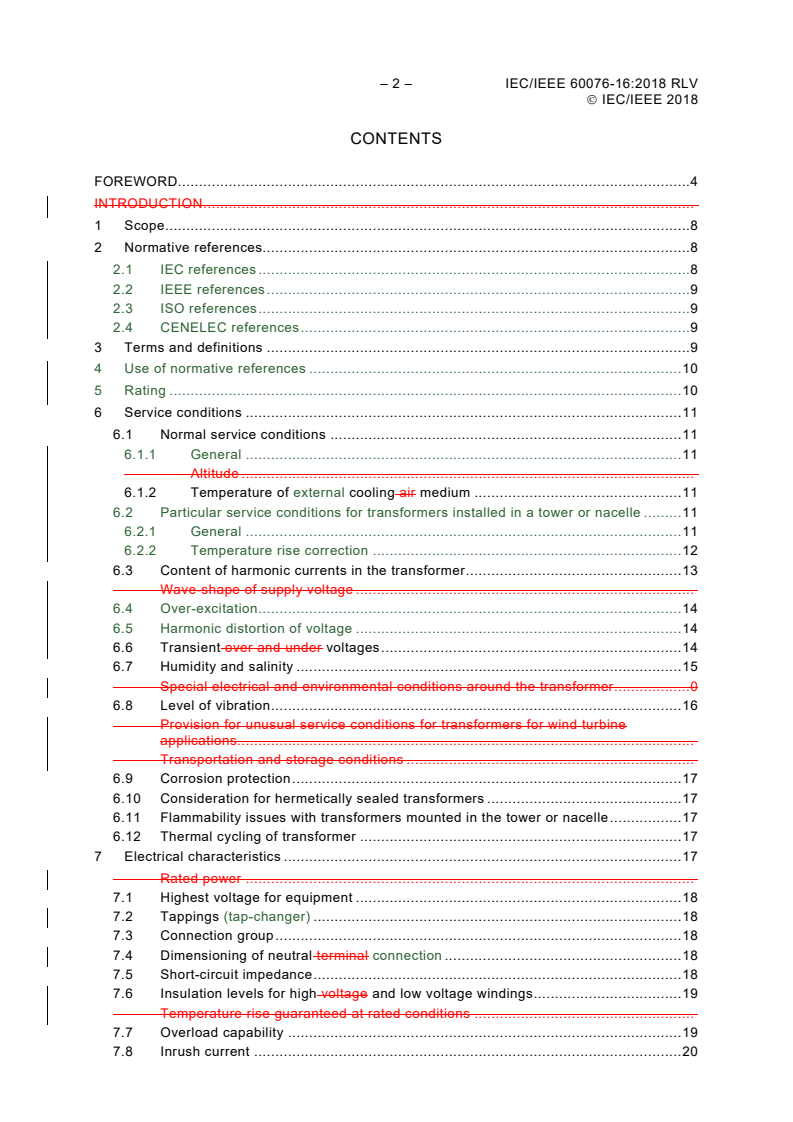
CONTENTS
FOREWORD . 4
INTRODUCTION .
1 Scope . 8
2 Normative references. 8
2.1 IEC references . 8
2.2 IEEE references . 9
2.3 ISO references . 9
2.4 CENELEC references . 9
3 Terms and definitions . 9
4 Use of normative references . 10
5 Rating . 10
6 Service conditions . 11
6.1 Normal service conditions . 11
6.1.1 General . 11
Altitude .
6.1.2 Temperature of external cooling air medium . 11
6.2 Particular service conditions for transformers installed in a tower or nacelle . 11
6.2.1 General . 11
6.2.2 Temperature rise correction . 12
6.3 Content of harmonic currents in the transformer . 13
Wave-shape of supply voltage .
6.4 Over-excitation . 14
6.5 Harmonic distortion of voltage . 14
6.6 Transient over and under voltages . 14
6.7 Humidity and salinity . 15
Special electrical and environmental conditions around the transformer . 0
6.8 Level of vibration . 16
Provision for unusual service conditions for transformers for wind turbine
applications.
Transportation and storage conditions .
6.9 Corrosion protection . 17
6.10 Consideration for hermetically sealed transformers . 17
6.11 Flammability issues with transformers mounted in the tower or nacelle . 17
6.12 Thermal cycling of transformer . 17
7 Electrical characteristics . 17
Rated power .
7.1 Highest voltage for equipment . 18
7.2 Tappings (tap-changer) . 18
7.3 Connection group . 18
7.4 Dimensioning of neutral terminal connection . 18
7.5 Short-circuit impedance . 18
7.6 Insulation levels for high voltage and low voltage windings . 19
Temperature rise guaranteed at rated conditions .
7.7 Overload capability . 19
7.8 Inrush current . 20
IEC/IEEE 2018
7.9 Frequency of energization . 20
7.10 Ability to withstand short circuit . 20
7.11 Operation with forced cooling . 20
7.12 Over-temperature protection . 21
8 Rating plate . 21
9 Tests . 21
9.1 List and classification of tests (routine, type and special tests) . 21
Routine tests .
Type tests .
Special tests .
General .
Chopped wave test .
Electrical resonance frequency test .
Climatic tests .
Environmental test E3 .
Fire behavior test .
9.2 Additional tests for wind turbine transformers . 23
9.2.1 General . 23
9.2.2 Lightning impulse type tests . 23
9.2.3 Lightning impulse routine sample tests . 23
9.2.4 Partial discharge test for liquid-immersed transformers . 23
9.2.5 Climatic and environmental tests for dry-type transformers . 23
Annex A (informative) Calculation method and tables .
Annex A (informative) Effects of voltage harmonics . 44
A.1 Design and specification considerations . 44
A.2 Effects of voltage harmonics . 44
Bibliography . 47
Figure – Heat dissipation in a natural ventilated room .
Figure – Schematic diagram of power frequency current injection apparatus .
Figure – Switched transformer winding voltage responses with capacitor injection .
Figure – HV Injection test figure .
Figure – Example of measurement device .
Table – Insulation levels .
Table 1 – Recommended minimum values of short-circuit impedance for transformers
with two separate windings . 19
Table – Impact of harmonics content on liquid-immersed transformer losses .
Table – Impact of harmonics content on dry type transformers losses .
Table A.1 – Example of voltage harmonic order . 45
– 4 – IEC/IEEE 60076-16:2018 RLV
IEC/IEEE 2018
INTERNATIONAL ELECTROTECHNICAL COMMISSION
_____________
POWER TRANSFORMERS –
Part 16: Transformers for wind turbine applications
FOREWORD
1) The International Electrotechnical Commission (IEC) is a worldwide organization for standardization comprising
all national electrotechnical committees (IEC National Committees). The object of IEC is to promote
international co-operation on all questions concerning standardization in the electrical and electronic fields. To
this end and in addition to other activities, IEC publishes International Standards, Technical Specifications,
Technical Reports, Publicly Available Specifications (PAS) and Guides (hereafter referred to as “IEC
Publication(s)”). Their preparation is entrusted to technical committees; any IEC National Committee interested
in the subject dealt with may participate in this preparatory work. International, governmental and non-
governmental organizations liaising with the IEC also participate in this preparation.
IEEE Standards documents are developed within IEEE Societies and Standards Coordinating Committees of the
IEEE Standards Association (IEEE-SA) Standards Board. IEEE develops its standards through a consensus
development process, approved by the American National Standards Institute, which brings together volunteers
representing varied viewpoints and interests to achieve the final product. Volunteers are not necessarily
members of IEEE and serve without compensation. While IEEE administers the process and establishes rules
to promote fairness in the consensus development process, IEEE does not independently evaluate, test, or
verify the accuracy of any of the information contained in its standards. Use of IEEE Standards documents is
wholly voluntary. IEEE documents are made available for use subject to important notices and legal disclaimers
(see http://standards.ieee.org/IPR/disclaimers.html for more information).
IEC collaborates closely with IEEE in accordance with conditions determined by agreement between the two
organizations. This Dual Logo International Standard was jointly developed by the IEC and IEEE under the
terms of that agreement.
2) The formal decisions of IEC on technical matters express, as nearly as possible, an international consensus of
opinion on the relevant subjects since each technical committee has representation from all interested IEC
National Committees. The formal decisions of IEEE on technical matters, once consensus within IEEE Societies
and Standards Coordinating Committees has been reached, is determined by a balanced ballot of materially
interested parties who indicate interest in reviewing the proposed standard. Final approval of the IEEE
standards document is given by the IEEE Standards Association (IEEE-SA) Standards Board.
3) IEC/IEEE Publications have the form of recommendations for international use and are accepted by IEC
National Committees/IEEE Societies in that sense. While all reasonable efforts are made to ensure that the
technical content of IEC/IEEE Publications is accurate, IEC or IEEE cannot be held responsible for the way in
which they are used or for any misinterpretation by any end user.
4) In order to promote international uniformity, IEC National Committees undertake to apply IEC Publications
(including IEC/IEEE Publications) transparently to the maximum extent possible in their national and regional
publications. Any divergence between any IEC/IEEE Publication and the corresponding national or regional
publication shall be clearly indicated in the latter.
5) IEC and IEEE do not provide any attestation of conformity. Independent certification bodies provide conformity
assessment services and, in some areas, access to IEC marks of conformity. IEC and IEEE are not responsible
for any services carried out by independent certification bodies.
6) All users should ensure that they have the latest edition of this publication.
7) No liability shall attach to IEC or IEEE or their directors, employees, servants or agents including individual
experts and members of technical committees and IEC National Committees, or volunteers of IEEE Societies
and the Standards Coordinating Committees of the IEEE Standards Association (IEEE-SA) Standards Board,
for any personal injury, property damage or other damage of any nature whatsoever, whether direct or indirect,
or for costs (including legal fees) and expenses arising out of the publication, use of, or reliance upon, this
IEC/IEEE Publication or any other IEC or IEEE Publications.
8) Attention is drawn to the normative references cited in this publication. Use of the referenced publications is
indispensable for the correct application of this publication.
9) Attention is drawn to the possibility that implementation of this IEC/IEEE Publication may require use of
material covered by patent rights. By publication of this standard, no position is taken with respect to the
existence or validity of any patent rights in connection therewith. IEC or IEEE shall not be held responsible for
identifying Essential Patent Claims for which a license may be required, for conducting inquiries into the legal
validity or scope of Patent Claims or determining whether any licensing terms or conditions provided in
connection with submission of a Letter of Assurance, if any, or in any licensing agreements are reasonable or
non-discriminatory. Users of this standard are expressly advised that determination of the validity of any patent
rights, and the risk of infringement of such rights, is entirely their own responsibility.
IEC/IEEE 2018
This redline version of the official IEC Standard allows the user to identify the changes
made to the previous edition. A vertical bar appears in the margin wherever a change
has been made. Additions are in green text, deletions are in strikethrough red text.
International Standard IEC/IEEE 60076-16 has been prepared by IEC technical committee 14:
Power transformers, in cooperation with Performance Characteristics Subcommittee of the
IEEE Power and Energy Society , under the IEC/IEEE Dual Logo Agreement between IEC
and IEEE.
This second edition of IEC/IEEE 60076-16 cancels and replaces IEC 60076-16:2011, and
constitutes a technical revision.
The main changes with respect to the previous edition are as follows:
1) relationship between transformer rated power and the output current from the associated
generator is introduced;
2) thermal correction of the effective cooling medium has been introduced;
3) testing regime has been strengthened to ensure transformers are suitable for the harsh
electrical environment to which they are subjected.
This publication is published as an IEC/IEEE Dual Logo standard.
The text of this standard is based on the following IEC documents:
FDIS Report on voting
14/959/FDIS 14/965/RVD
Full information on the voting for the approval of this standard can be found in the report on
voting indicated in the above table.
International Standards are drafted in accordance with the rules given in the ISO/IEC
Directives, Part 2.
A list of all parts in the IEC/IEEE 60076 series, published under the general title Power
transformers, can be found on the IEC website.
___________
1 A list of IEEE participants can be found at the following URL: https://standards.ieee.org/project/60076-16.html
– 6 – IEC/IEEE 60076-16:2018 RLV
IEC/IEEE 2018
The IEC Technical Committee and IEEE Technical Committee have decided that the contents
of this publication will remain unchanged until the stability date indicated on the IEC website
under "http://webstore.iec.ch" in the data related to the specific publication. At this date, the
publication will be
• reconfirmed,
• withdrawn,
• replaced by a revised edition, or
• amended.
IMPORTANT – The “colour inside” logo on the cover page of this publication indicates
that it contains colours which are considered to be useful for the correct understanding
of its contents. Users should therefore print this publication using a colour printer.
IEC/IEEE 2018
INTRODUCTION
This part of IEC 60076 is intended to specify the additional requirements for the transformers
for installation in wind turbine applications.
Wind turbines use generator step-up transformers to connect the turbines to a network. These
transformers can be installed in the nacelle or in the tower or outside close to the wind turbine.
This standard covers transformers for wind turbine applications or wind farms where the
constraints on transformers exceed the requirement of the present IEC 60076 series. The
constraints are not often known or recognized by the transformer manufacturers, wind turbine
manufacturers and operators and as a result the level of reliability of these transformers can
be lower than those used for conventional applications.
The transformers for wind turbine applications are not included in the present list of
IEC 60076 standard series.
The purpose of this standard is help to obtain the same level of reliability as transformers for
more common applications.
This standard deals particularly with the effects of repeated high frequency transient over-
voltages, electrical, environmental, thermal, loading, installation and maintenance conditions
that are specific for wind turbines or wind farms.
On site measurements, investigations and observations in wind turbines have detected risks
for some different kind of installations:
– repeated high frequency transient over or under voltages in the range of kHz;
– over and under frequency due to turbine control;
– values of over voltage;
– over voltage or under voltage coming from LV side;
– high level of transient over voltages due to switching;
– presence of partial discharge around the transformer;
– harmonic contents current and voltage;
– overloading under ambient conditions;
– fast transient overload;
– clearances not in compliance with the minimum prescribed;
– installation conditions and connections;
– restricted conditions of cooling;
– water droplets;
– humidity levels that exceed the maximum permissible values;
– salt and dust pollution and extreme climatic conditions;
– high levels of vibration;
– mechanical stresses.
Therefore it is necessary to take into account in the design of the transformer the constraints
of this application, or to define some protective devices to protect the transformer. Additional
or improved routine, type or special tests for these transformers have to be specified to be in
compliance with the constraints on the network.
– 8 – IEC/IEEE 60076-16:2018 RLV
IEC/IEEE 2018
POWER TRANSFORMERS –
Part 16: Transformers for wind turbine applications
1 Scope
This part of IEC 60076 applies to dry-type and liquid-immersed transformers for rated power
100 kVA up to 10 000 kVA for wind turbine step-up applications having a winding with highest
voltage for equipment up to and including 36 72,5 kV and at least one winding operating at a
voltage greater than 1,1 kV. This document applies to the transformer used to connect the
wind turbine generator to the wind farm power collection system or adjacent distribution
network and not the transformer used to connect several wind turbines to a distribution or
transmission network.
Transformers covered by this document comply with the relevant requirements prescribed in
the IEC 60076 standards or IEEE C57 standards.
2 Normative references
The following documents are referred to in the text in such a way that some or all of their
content constitutes requirements of this document. For dated references, only the edition
cited applies. For undated references, the latest edition of the referenced document (including
any amendments) applies.
2.1 IEC references
IEC 60076-1:2011, Power transformers – Part 1: General
IEC 60076-2:2011, Power transformers – Part 2: Temperature rise for liquid-immersed
transformers
IEC 60076-3:2000, Power transformers – Part 3: Insulation levels, dielectric tests and external
clearances in air
IEC 60076-5:2006, Power transformers – Part 5: Ability to withstand short circuit
IEC 60076-7:2005, Power transformers – Part 7: Loading guide for mineral-oil-immersed
power transformers
IEC 60076-8:1997, Power transformers – Application guide
IEC 60076-11:2004, Power transformers – Part 11: Dry-type transformers
IEC 60076-12:2008, Power transformers – Part 12: Loading guide for dry-type power
transformers
IEC 60076-13:2006, Power transformers – Part 13: Self-protected liquid-filled transformers
IEC 60076-14, Power transformers – Part 14: Liquid-immersed power transformers using
high-temperature insulating materials
IEC 61100, Classification of insulating liquids according to fire-point and net calorific value
IEC/IEEE 2018
IEC 61378-1:2011, Converter transformers – Part 1: Transformers for industrial applications
IEC 61378-3:2006, Converter transformers – Part 3: Application guide
IEC 61400-1:2005, Wind turbines – Part 1: Design requirements
2.2 IEEE references
IEEE Std C57.12.00™, IEEE Standard for General Requirements for Liquid-Immersed
Distribution, Power, and Regulating Transformers
IEEE Std C57.12.01™, IEEE Standard for General Requirements for Dry-Type Distribution
and Power Transformers
IEEE Std C57.12.80™, IEEE Standard Terminology for Power and Distribution Transformers
IEEE Std C57.91™, IEEE Guide for Loading Mineral-Oil-Immersed Transformers and Step-
Voltage Regulators
IEEE Std C57.96™, IEEE Guide for Loading Dry-Type Distribution and Power Transformers
IEEE Std C57.110™, IEEE Recommended Practice for Establishing Liquid-Filled and Dry-
Type Power and Distribution Transformer Capability When Supplying Nonsinusoidal Load
Currents
IEEE Std C57.154™, IEEE Standard for the Design, Testing, and Application of Liquid-
Immersed Distribution, Power, and Regulating Transformers Using High-Temperature
Insulation Systems and Operating at Elevated Temperatures
ANSI C84.1, Electric Power Systems and Equipment – Voltage Ratings (60 Hz)
2.3 ISO references
ISO 12944 (all parts), Paints and varnishes – Corrosion protection of steel structures by
protective paint systems
ISO 12944-4, Paints and varnishes – Corrosion protection of steel structures by protective
paint systems – Part 4: Types of surface and surface preparation
2.4 CENELEC references
EN 50588-1:2015, Medium power transformers 50 Hz, with highest voltage for equipment not
exceeding 36 kV – Part 1: General requirements
3 Terms and definitions
For the purposes of this document, the following terms and definitions apply.
ISO and IEC maintain terminological databases for use in standardization at the following
addresses:
• IEC Electropedia: available at http://www.electropedia.org/
• ISO Online browsing platform: available at http://www.iso.org/obp
– 10 – IEC/IEEE 60076-16:2018 RLV
IEC/IEEE 2018
3.1
wind turbine transformer
generator step up transformer connecting the wind turbine to the power collection network
system of the wind farm or the adjacent distribution network for single turbine installations
3.2
tower
part of the supporting structure of the wind turbine on top of which the nacelle with generator
and other equipments are is located
3.3
nacelle
housing that contains the drive-train and other elements on top of a horizontal-axis wind
turbine tower
[SOURCE: IEC 60050-415:1999, 415-01-07]
3.4
effective cooling medium
ambient air, either internal or external to the tower or nacelle, or cooling water that comes into
contact with the cooling surface of the transformer
3.5
compartmentalized type transformer
transformer with integral enclosure comprised of multiple independent compartments, usually
with separate entrances into the HV and LV termination compartments
3.6
sealed transformer
transformer which is so constructed that the external atmosphere is not intended to gain
access to the interior
3.7
routine sample test
test which is usually defined as a type test or special test but carried out as an additional
routine test on a random sample of transformers
4 Use of normative references
This standard can be used with either the IEC or IEEE normative references but the
references shall not be mixed. The purchaser shall include in the enquiry and order which
normative references are to be used. If the choice of normative references is not specified,
then IEC standards shall be used except for wind turbine transformers intended for installation
in North America where IEEE standards shall be used.
5 Rating
The transformer rating specified by the purchaser shall take into account the maximum
current delivered to the transformer by the associated wind turbine generator system
irrespective of the operating voltage and power factor.
IEC/IEEE 2018
6 Service conditions
6.1 Normal service conditions
6.1.1 General
Unless otherwise stated in this standard, the service conditions in IEC 60076-11 and
IEC 60076-1 apply.
The normal service conditions detailed in IEC 60076-1 or IEEE Std C57.12.00 for
liquid-immersed transformers or the normal service conditions in IEC 60076-11 or
IEEE Std C57.12.01 for dry-type transformers shall apply unless otherwise stated in this
document or specified by the purchaser.
4.2 Altitude
IEC 60076 series applies.
6.1.2 Temperature of external cooling air medium
The installation of transformers inside an enclosure without active cooling systems increases
the transformer temperature.
The purchaser shall specify the maximum cooling air temperatures if they are different from
those stated in IEC 60076-2.
The transformer shall be designed according to real ambient temperatures and installation
real conditions as described by the purchaser at enquiry stage.
Clause A.1 provides considerations for transformers installed in a naturally ventilated area
like at the rear of the nacelle or in a separate enclosure installed outside the tower and
equipped with air inlet and outlet.
In case of transformer installed in the tower or in an enclosure where natural ventilation is not
provided the formula in A.1 is not applicable. For transformers operating under these
conditions, the effects of air inlet and outlet, cooling conditions, efficiency of air cooling and
ventilation shall be considered.
The purchaser shall prescribe the air ambient temperature and air flow inside the tower at the
enquiry stage. If no temperature or air flow is specified, an internal ambient temperature
inside the tower of 10 K higher than external temperature shall be assumed and not limited air
circulation around the transformers.
The effect of external direct solar radiation is not taken into account at the design stage. This
can increase the temperature of transformers parts and therefore information should be given
by purchaser at enquiry time.
If the transformer is installed external to the tower or nacelle, the normal conditions specified
in IEC 60076-1 or IEEE Std C57.12.00 for liquid-immersed transformers and IEC 60076-11 or
IEEE Std C57.12.01 for dry-type transformers shall apply, unless otherwise specified. If the
transformer is installed within the tower or nacelle then particular conditions apply as shown
in 6.2.
6.2 Particular service conditions for transformers installed in a tower or nacelle
6.2.1 General
Where the transformer is installed in a tower or nacelle then higher temperatures of the
cooling medium local to the transformer may be expected.
– 12 – IEC/IEEE 60076-16:2018 RLV
IEC/IEEE 2018
6.2.2 Temperature rise correction
Based on the ambient conditions of the installation, the purchaser shall specify the yearly
average and maximum temperature of the effective cooling medium (e.g. air or water). If the
yearly average or maximum temperature of the cooling medium exceeds the relevant value in
the respective standard, the difference between the values and the “normal service conditions”
values shall be subtracted from the temperature rise limits specified in IEC 60076-2,
IEC 60076-11 or IEEE Std C57.12.00 as follows:
= T − T
K
max max ecm max std
K = T − T
av av ecm av std
where
K is the temperature correction for the maximum ambient temperature;
max
K is the temperature correction for the yearly average ambient temperature;
av
T is the maximum temperature of the effective cooling medium;
max ecm
T is the maximum ambient temperature of the effective cooling medium according to
max std
the relevant standard;
T is the average temperature of the effective cooling medium;
av ecm
T is the yearly average ambient temperature of the effective cooling medium
av std
according to the relevant standard.
K can be used in determining the temperature rise limit of average winding and winding
av
hot-spot temperatures in all transformers. In liquid-immersed transformers K can be used
max
in determining the temperature rise limit for the top liquid temperature.
If the only available information is the maximum ambient temperature, the increase of the
yearly average ambient temperature can be assumed to be the same as the increase of the
maximum ambient temperature, making K and K equal.
av max
For example, for a transformer using insulation material of thermal class 105 (regular kraft
paper immersed in mineral oil) installed in an environment where the average temperature is
32 °C and the maximum ambient temperature is 48 °C, the corrected temperature rise limits
based on IEC 60076-2 would be:
K = (32 − 20) = 12 K
av
∆θ = 65 − K = 65 − 12 = 53 K
w av
∆θ = 78 − K = 78 − 12 = 66 K
h av
For liquid-immersed transformers K can be applied:
max
K = (48 − 40) = 8 K
max
∆θ = 60 − K = 60 − 8 = 52 K
o max
Another example, for a transformer using thermally upgraded insulation material (thermally
upgraded kraft paper immersed in mineral oil) with similar conditions to the previous example,
the corrected temperature rise limits based on IEEE Std C57.12.00 would be:
IEC/IEEE 2018
K = (32 − 30) = 2 K
av
∆θ = 65 − K = 65 − 2 = 63 K
w av
∆θ = 80 − K = 80 − 2 = 78 K
h av
For liquid-immersed transformers K can be applied:
max
K = (48 − 40) = 8 K
max
∆θ = 65 − K = 65 − 8 = 57 K
o max
where,
∆θ is the average winding temperature rise;
w
∆θ is the winding hot-spot temperature rise;
h
∆θ is the top liquid temperature rise.
o
For the transformers installed in a tower or nacelle, the purchaser shall carefully consider the
influence on the temperature of the enclosure, heat generated by other equipment and by the
transformer itself, and the cooling system / air renovation system, if applicable. As reference,
if no better information is available, the thermal loading of the transformer, in kilowatts, can
be estimated as 1,5 % of its rated power (kVA).
The effect of external direct solar radiation should be taken into account by the purchaser
when calculating the temperature of the effective cooling medium. Methods for determining
the effect are given in IEC 60721-3-4.
6.3 Content of harmonic currents in the transformer
At the enquiry stage the purchaser shall specify the magnitude and frequency of all harmonic
currents supplied to the transformer. The manufacturer shall take the losses caused by these
harmonic currents into account in the transformer design to prevent that the winding and
liquid temperature rises exceed the permissible limits.
The transformer shall be designed to take into account the increased rating required due to
the harmonic currents. The temperature rise test shall be carried out with the equivalent rated
power due to the harmonics defined in A.2. The result of the test shall be in compliance with
temperature limits guaranteed for the transformer and related to the transformer insulation
thermal class.
The purchaser shall evaluate the magnitude and frequency of the harmonic currents supplied
to the transformer.
Where total harmonic content is less than 5 % of rated current no additional information is
required.
Where total harmonic content is greater than 5 % the purchaser shall specify the magnitude
and frequencies of all harmonic currents supplied to the transformer. The manufacturer shall
calculate the additional losses at rated power caused by these currents using the method
given in IEC 61378-1 or IEEE Std C57.110 or as agreed between the purchaser and
manufacturer.
During the temperature rise test the transformer shall be supplied with an additional current to
represent the additional harmonic losses for the purpose of determining the temperature rises.
– 14 – IEC/IEEE 60076-16:2018 RLV
IEC/IEEE 2018
A method to calculate the impact of the harmonic currents on the design of the transformer is
given in A.2 IEC 61378-1 or IEEE Std C57.110.
4.5 Wave-shape of supply voltage
U
Within the prescribed value of a transformer shall be capable of continuous service at full
m
load without damage under conditions of ‘overfluxing’ where the ratio of voltage over
frequency exceeds the corresponding ratio at rated voltage and rated frequency according to
IEC 60076-1.
The wind turbine manufacturer shall state at enquiry stage the maximum ratio between the
voltage and the frequency. The transformer manufacturer shall take into account this value in
the design of the transformer.
The purchaser shall specify in the inquiry the magnitude and frequency of any harmonic
voltages present in the supply. A method to calculate the impact of the voltage harmonics on
the design of the transformer is given in A.3.
6.4 Over-excitation
Unless otherwise specified by purchaser, transformers shall be capable of operating
continuously above rated voltage or below rated frequency, at maximum rated power (kVA) for
any tap, without exceeding the limits of temperature rise when all of the following conditions
prevail.
a) When operating under load:
1) secondary voltage and volts per hertz do not exceed 115 % of rated values and with a
minimum frequency of 95 % of rated value;
2) power factor is 0,8 or higher.
b) When operating under no load, transformers shall be capable of operating continuously
above rated voltage or below rated frequency, on any tap, without over-exciting or
exceeding limits of observable temperature rise, when neither the voltage nor volts per
hertz exceed 120 % of rated values.
6.5 Harmonic distortion of voltage
When supply voltage harmonics are expected to be in excess of 5 % of rated voltage the
purchaser shall specify the magnitude and frequency of any harmonic voltages present in the
supply. The transformer shall be designed to withstand the specified condition or 5 % of rated
voltage, whichever is higher, without damage.
6.6 Transient over and under voltages
The risk of failures of a wind turbine transformer is higher due to the fact of repeated transient
over and under voltages on each side on transformer.
Several solutions are available to increase the reliability of the transformer against these fast
transient interactions:
– to evaluate the insulation level of the transformer and if necessary apply one or more of
the following solutions. This can be done by modeling or measuring the system by high
frequency resonance analysis. The resonance frequency test is a special test. The test
method shall be agreed between manufacturer and purchaser. One method is described in
A.4;
– to install standard protection technique such as surge arresters (HV, LV), or RC circuit or
surge capacitor.
The choice of the lists 2 or 3 in Table 1 shall be the responsibility of the system engineer
based on specific insulation co-ordination (IEC 60071-1 and -2) and risk assessment.
IEC/IEEE 2018
The list 3 covers transformers with increased ability to withstand repeated transient over
voltages and increases the reliability of the transformer.
Table 1 – Insulation levels
Highest voltage Rated short Rated lightning impulse
for equipment duration withstand voltage (peak
separated source value) in kV
U
(rms) kV
m
AC withstand
List 2 List 3
voltage (RMS) kV
≤ 1,1 3 - 20
3,6 10 40 50
7,2 20 60 75
12 28 75 95
17,5 38 95 125
24 50 125 150
36 70 170 200
High frequency steep surges can be generated by switching operation on LV or HV side.
These surges are transferred by cables to the terminals of the transformer. Transformers have
different values of resonance frequency. See A.4.
If the high frequency steep surges generated by switching operation on LV and HV side
coincide with the internal frequency of the winding, the result of these surges can resonate
with the winding internal frequencies and cause higher electric stresses than the dielectric
withstand strength of the windings
NOTE For U ≤ 1,1 kV a.c. withstand voltage should have higher value as 10 kV.
m
a) Normal impulse protection
Transformer lightning impulse (LI) (see IEC 60076-3) or basic lightning impulse level (BIL)
(see IEEE Std C57.12.80) shall be specified. Increased transformer BIL levels by one step
should be considered unless system study indicates otherwise.
b) Switching induced overvoltages
Switching transient voltages, produced by vacuum interrupters and/or SF switching
devices, have resulted in dielectric failures of some wind turbine transformers. The first
and last transformers in a daisy chain are typically the most vulnerable and are most at
risk when currents are light and power factor is particularly low. IEEE Std C57.142
addresses this issue in depth and relates the vulnerability to current chops and voltage
restrikes by vacuum or SF interrupters. This is a complex phenomenon that is not
covered in depth in this document but should be evaluated by a system study. If system
study warrants action, mitigation techniques should be employed.
NOTE The above reference to IEEE Std C57.142 is applicable to both IEC and IEEE applications as there is
no current IEC standard that covers this issue.
6.7 Humidity and salinity
An abnormal lev
...