

IEC 62718:2013
(Main)Railway applications - Rolling stock - DC supplied electronic ballasts for lighting fluorescent lamps
General Information
- Abstract
IEC 62718:2013 specifies the performance and constructional requirements, and associated tests, for d.c. supplied electronic ballasts used to supply fluorescent lamps for lighting on railway rolling stock. Its requirements replace those of IEC 61347 for all railway rolling stock applications and specify and complete those of IEC 61347 for the specific needs of railway rolling stock applications. The contents of the corrigendum of February 2016 have been included in this copy.
- Status
- Published
- Publication Date
- 28-Apr-2013
- Technical Committee
- TC 9 - Electrical equipment and systems for railways
- Drafting Committee
- PT 62718 - TC 9/PT 62718
- Current Stage
- PPUB - Publication issued
- Start Date
- 29-Apr-2013
- Completion Date
- 15-May-2013
Overview
IEC 62718:2013 is an International Standard developed by the International Electrotechnical Commission (IEC) specifically for railway applications. This standard outlines the performance, constructional requirements, and testing procedures for direct current (DC) supplied electronic ballasts used to power fluorescent lamps on railway rolling stock. By addressing the distinctive operational and environmental needs of railway rolling stock, IEC 62718:2013 supersedes and supplements general ballast standards like IEC 61347 for these specialized applications. Compliance with this standard ensures the safe, reliable, and efficient operation of fluorescent lighting systems throughout the lifecycle of railway vehicles.
Key Topics
IEC 62718:2013 focuses on several core areas crucial to the performance and safety of DC-supplied electronic ballasts for railway rolling stock:
- Performance and Constructional Requirements: Defines essential criteria for the construction, operation, and electrical characteristics of electronic ballasts, ensuring suitability for railway environments.
- Safety and Protective Measures: Specifies protective functions, including provisions for overvoltage, inrush current limitation, and polarity reversal protection, tailored to the unique challenges of mobile railway systems.
- Environmental and Service Conditions: Addresses resilience to extreme temperatures, vibration, shock, and humidity typical of railway environments, referencing standards such as IEC 60571 and IEC 62498-1 for service conditions.
- Testing Procedures: Outlines standardized test methods, including type, routine, and investigatory tests, to verify compliance with performance and safety requirements.
- Product Information and Marking: Details labeling and traceability requirements, ensuring that all relevant operational and safety information is clearly communicated to operators and maintainers.
- Compatibility with Lamps: Discusses ballast compatibility with tubular and single-capped pre-heated cathode fluorescent lamps, ensuring stable operation and longevity under DC supply.
- Interchangeability and Maintenance: Recommends standardization of dimensions, wiring diagrams, and terminal types to facilitate maintenance and replacement in the field.
Applications
This standard has practical value and broad applications in the railway sector:
- Railway Rolling Stock Lighting: Ensures that fluorescent lighting systems powered by DC-supplied electronic ballasts are safe, robust, and efficient for use in passenger cars, locomotives, and other rail vehicles.
- Upgrading Existing Fleets: Provides guidance for retrofitting or upgrading older rolling stock lighting systems to improved safety and performance standards.
- Design and Procurement: Offers a definitive specification for manufacturers and purchasers to ensure supplied electronic ballasts meet the stringent requirements of the railway industry.
- Maintenance and Repair: Facilitates straightforward maintenance practices and replacement procedures due to harmonized dimensions, wiring, and clear identification markings.
Implementing IEC 62718 in railway projects helps ensure the compatibility and reliability of lighting systems under the diverse and demanding conditions encountered by modern rail vehicles.
Related Standards
IEC 62718:2013 references and builds upon several related international standards to establish a comprehensive regulatory framework:
- IEC 60571: Electronic equipment used on rolling stock
- IEC 61347 Series: General and safety requirements for lamp controlgear
- IEC 60929: Performance requirements for AC and/or DC supplied electronic control gear for fluorescent lamps
- IEC 62497-1: Insulation coordination for railway applications
- IEC 62498-1: Environmental conditions for equipment on board rolling stock
- IEC 60068 Series: Environmental testing
- IEC 61373: Railway rolling stock equipment - Shock and vibration tests
- IEC 62236-3-2: Electromagnetic compatibility for rolling stock - Apparatus
By harmonizing with these established standards, IEC 62718:2013 ensures comprehensive coverage of performance, safety, and interoperability requirements for DC-supplied electronic ballasts in railway applications.
Keywords: IEC 62718, railway electronic ballasts, DC supplied ballasts, rolling stock lighting, fluorescent lamp standards, railway lighting compliance, railway electrical standards, railway applications, safety requirements, international railway ballast standards.
Relations
- Effective Date
- 05-Sep-2023
Get Certified
Connect with accredited certification bodies for this standard

DNV
DNV is an independent assurance and risk management provider.

Lloyd's Register
Lloyd's Register is a global professional services organisation specialising in engineering and technology.
DNV Energy Systems
Energy and renewable energy certification.
Sponsored listings
Frequently Asked Questions
IEC 62718:2013 is a standard published by the International Electrotechnical Commission (IEC). Its full title is "Railway applications - Rolling stock - DC supplied electronic ballasts for lighting fluorescent lamps". This standard covers: IEC 62718:2013 specifies the performance and constructional requirements, and associated tests, for d.c. supplied electronic ballasts used to supply fluorescent lamps for lighting on railway rolling stock. Its requirements replace those of IEC 61347 for all railway rolling stock applications and specify and complete those of IEC 61347 for the specific needs of railway rolling stock applications. The contents of the corrigendum of February 2016 have been included in this copy.
IEC 62718:2013 specifies the performance and constructional requirements, and associated tests, for d.c. supplied electronic ballasts used to supply fluorescent lamps for lighting on railway rolling stock. Its requirements replace those of IEC 61347 for all railway rolling stock applications and specify and complete those of IEC 61347 for the specific needs of railway rolling stock applications. The contents of the corrigendum of February 2016 have been included in this copy.
IEC 62718:2013 is classified under the following ICS (International Classification for Standards) categories: 17.240 - Radiation measurements; 27.120 - Nuclear energy engineering; 45.060.01 - Railway rolling stock in general. The ICS classification helps identify the subject area and facilitates finding related standards.
IEC 62718:2013 has the following relationships with other standards: It is inter standard links to IEC 62718:2013/COR1:2016. Understanding these relationships helps ensure you are using the most current and applicable version of the standard.
IEC 62718:2013 is available in PDF format for immediate download after purchase. The document can be added to your cart and obtained through the secure checkout process. Digital delivery ensures instant access to the complete standard document.
Standards Content (Sample)
IEC 62718 ®
Edition 1.0 2013-04
INTERNATIONAL
STANDARD
NORME
INTERNATIONALE
Railway applications – Rolling stock – DC supplied electronic ballasts for
lighting fluorescent lamps
Applications ferroviaires – Matériel roulant – Ballasts électroniques à courant
continu pour lampes fluorescentes d'éclairage
All rights reserved. Unless otherwise specified, no part of this publication may be reproduced or utilized in any form
or by any means, electronic or mechanical, including photocopying and microfilm, without permission in writing from
either IEC or IEC's member National Committee in the country of the requester.
If you have any questions about IEC copyright or have an enquiry about obtaining additional rights to this publication,
please contact the address below or your local IEC member National Committee for further information.
Droits de reproduction réservés. Sauf indication contraire, aucune partie de cette publication ne peut être reproduite ni
utilisée sous quelque forme que ce soit et par aucun procédé, électronique ou mécanique, y compris la photocopie et les
microfilms, sans l'accord écrit de la CEI ou du Comité national de la CEI du pays du demandeur.
Si vous avez des questions sur le copyright de la CEI ou si vous désirez obtenir des droits supplémentaires sur cette
publication, utilisez les coordonnées ci-après ou contactez le Comité national de la CEI de votre pays de résidence.
IEC Central Office Tel.: +41 22 919 02 11
3, rue de Varembé Fax: +41 22 919 03 00
CH-1211 Geneva 20 info@iec.ch
Switzerland www.iec.ch
About the IEC
The International Electrotechnical Commission (IEC) is the leading global organization that prepares and publishes
International Standards for all electrical, electronic and related technologies.
About IEC publications
The technical content of IEC publications is kept under constant review by the IEC. Please make sure that you have the
latest edition, a corrigenda or an amendment might have been published.
Useful links:
IEC publications search - www.iec.ch/searchpub Electropedia - www.electropedia.org
The advanced search enables you to find IEC publications The world's leading online dictionary of electronic and
by a variety of criteria (reference number, text, technical electrical terms containing more than 30 000 terms and
committee,…). definitions in English and French, with equivalent terms in
It also gives information on projects, replaced and additional languages. Also known as the International
withdrawn publications. Electrotechnical Vocabulary (IEV) on-line.
IEC Just Published - webstore.iec.ch/justpublished Customer Service Centre - webstore.iec.ch/csc
Stay up to date on all new IEC publications. Just Published If you wish to give us your feedback on this publication
details all new publications released. Available on-line and or need further assistance, please contact the
also once a month by email. Customer Service Centre: csc@iec.ch.
A propos de la CEI
La Commission Electrotechnique Internationale (CEI) est la première organisation mondiale qui élabore et publie des
Normes internationales pour tout ce qui a trait à l'électricité, à l'électronique et aux technologies apparentées.
A propos des publications CEI
Le contenu technique des publications de la CEI est constamment revu. Veuillez vous assurer que vous possédez
l’édition la plus récente, un corrigendum ou amendement peut avoir été publié.
Liens utiles:
Recherche de publications CEI - www.iec.ch/searchpub Electropedia - www.electropedia.org
La recherche avancée vous permet de trouver des Le premier dictionnaire en ligne au monde de termes
publications CEI en utilisant différents critères (numéro de électroniques et électriques. Il contient plus de 30 000
référence, texte, comité d’études,…). termes et définitions en anglais et en français, ainsi que
Elle donne aussi des informations sur les projets et les les termes équivalents dans les langues additionnelles.
publications remplacées ou retirées. Egalement appelé Vocabulaire Electrotechnique
International (VEI) en ligne.
Just Published CEI - webstore.iec.ch/justpublished
Service Clients - webstore.iec.ch/csc
Restez informé sur les nouvelles publications de la CEI.
Just Published détaille les nouvelles publications parues. Si vous désirez nous donner des commentaires sur
Disponible en ligne et aussi une fois par mois par email. cette publication ou si vous avez des questions
contactez-nous: csc@iec.ch.
IEC 62718 ®
Edition 1.0 2013-04
INTERNATIONAL
STANDARD
NORME
INTERNATIONALE
Railway applications – Rolling stock – DC supplied electronic ballasts for
lighting fluorescent lamps
Applications ferroviaires – Matériel roulant – Ballasts électroniques à courant
continu pour lampes fluorescentes d'éclairage
INTERNATIONAL
ELECTROTECHNICAL
COMMISSION
COMMISSION
ELECTROTECHNIQUE
PRICE CODE
INTERNATIONALE
CODE PRIX W
ICS 45.060 ISBN 978-2-83220-752-9
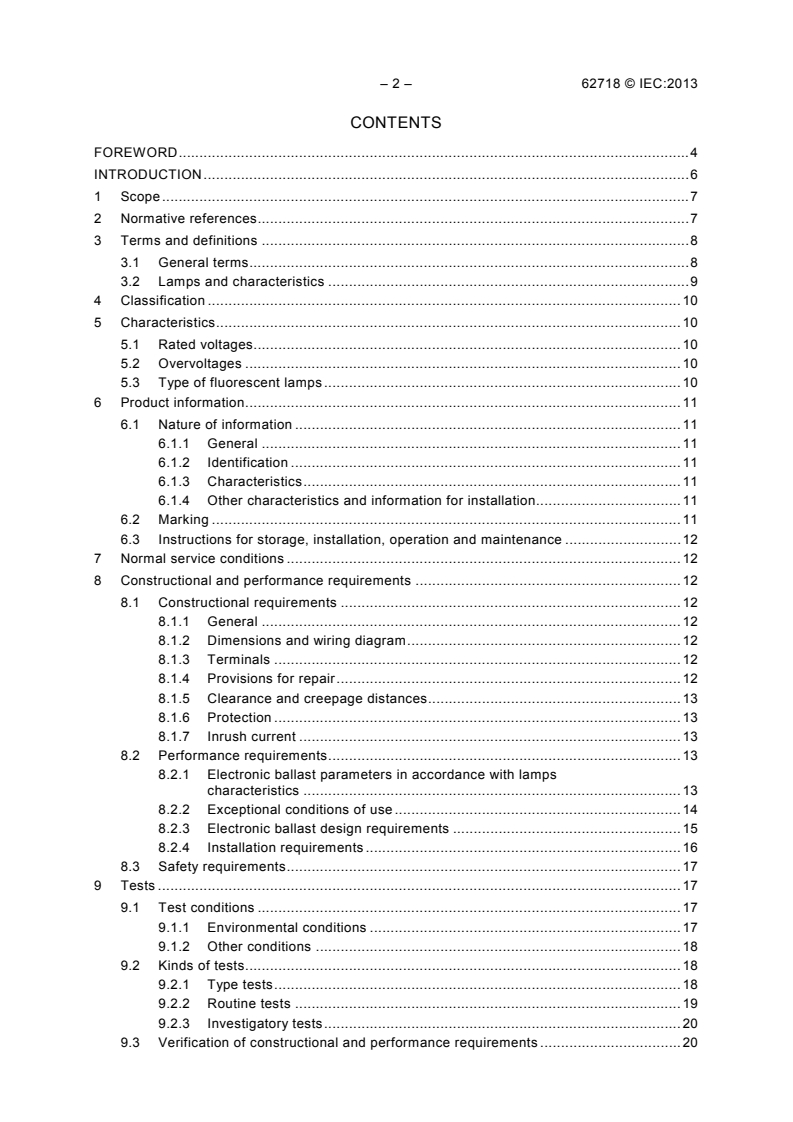
– 2 – 62718 © IEC:2013
CONTENTS
FOREWORD . 4
INTRODUCTION . 6
1 Scope . 7
2 Normative references . 7
3 Terms and definitions . 8
3.1 General terms . 8
3.2 Lamps and characteristics . 9
4 Classification . 10
5 Characteristics . 10
5.1 Rated voltages. 10
5.2 Overvoltages . 10
5.3 Type of fluorescent lamps . 10
6 Product information . 11
6.1 Nature of information . 11
6.1.1 General . 11
6.1.2 Identification . 11
6.1.3 Characteristics . 11
6.1.4 Other characteristics and information for installation. 11
6.2 Marking . 11
6.3 Instructions for storage, installation, operation and maintenance . 12
7 Normal service conditions . 12
8 Constructional and performance requirements . 12
8.1 Constructional requirements . 12
8.1.1 General . 12
8.1.2 Dimensions and wiring diagram . 12
8.1.3 Terminals . 12
8.1.4 Provisions for repair . 12
8.1.5 Clearance and creepage distances . 13
8.1.6 Protection . 13
8.1.7 Inrush current . 13
8.2 Performance requirements . 13
8.2.1 Electronic ballast parameters in accordance with lamps
characteristics . 13
8.2.2 Exceptional conditions of use . 14
8.2.3 Electronic ballast design requirements . 15
8.2.4 Installation requirements . 16
8.3 Safety requirements . 17
9 Tests . 17
9.1 Test conditions . 17
9.1.1 Environmental conditions . 17
9.1.2 Other conditions . 18
9.2 Kinds of tests . 18
9.2.1 Type tests . 18
9.2.2 Routine tests . 19
9.2.3 Investigatory tests . 20
9.3 Verification of constructional and performance requirements . 20
62718 © IEC:2013 – 3 –
9.3.1 General . 20
9.3.2 Sequence 1 . 20
9.3.3 Sequence 2 . 22
9.3.4 Sequence 3 . 24
9.3.5 Sequence 4 . 25
9.3.6 Sequence 5 . 27
Annex A (informative) Distance between lamp and metallic support . 29
Annex B (informative) Electronic ballast for lamps up to 40 W (case 1) . 30
Annex C (informative) Electronic ballast for lamps up to 40 W (case 2) . 31
Annex D (informative) Electronic ballast for lamps up to 15 W . 32
Annex E (informative) Electronic ballast for lamps up to 20 W. 33
Annex F (informative) Electronic ballast for lamps up to 10 W . 34
Annex G (informative) Basic schematic diagrams . 35
Bibliography . 38
Figure 1 – Test circuit . 22
Figure 2 – Current limiting curve . 23
Figure 3 – Circuit for leakage current measurement . 24
Figure 4 – Circuit for test B: Cathode deactivated (rectifying effect) . 26
Figure B.1 – Overall dimensions for electronic ballast . 30
Figure C.1 – Overall dimensions for electronic ballast . 31
Figure D.1 – Overall dimensions for electronic ballast . 32
Figure E.1 – Overall dimensions for electronic ballast . 33
Figure F.1 – Overall dimensions for electronic ballast . 34
Figure G.1 – One or two tubular lamps . 35
Figure G.2 – One or two tubular lamps . 35
Figure G.3 – One or two tubular lamps . 36
Figure G.4 – One tubular lamp . 36
Figure G.5 – One tubular lamp . 36
Figure G.6 – One or two single capped lamps . 36
Figure G.7 – One single capped lamp . 37
Table 1 – Type tests . 19
Table 2 – Routine tests . 20
Table 3 – Dielectric test voltage values . 22
– 4 – 62718 © IEC:2013
INTERNATIONAL ELECTROTECHNICAL COMMISSION
____________
RAILWAY APPLICATIONS – ROLLING STOCK – DC SUPPLIED
ELECTRONIC BALLASTS FOR LIGHTING FLUORESCENT LAMPS
FOREWORD
1) The International Electrotechnical Commission (IEC) is a worldwide organization for standardization comprising
all national electrotechnical committees (IEC National Committees). The object of IEC is to promote
international co-operation on all questions concerning standardization in the electrical and electronic fields. To
this end and in addition to other activities, IEC publishes International Standards, Technical Specifications,
Technical Reports, Publicly Available Specifications (PAS) and Guides (hereafter referred to as “IEC
Publication(s)”). Their preparation is entrusted to technical committees; any IEC National Committee interested
in the subject dealt with may participate in this preparatory work. International, governmental and non-
governmental organizations liaising with the IEC also participate in this preparation. IEC collaborates closely
with the International Organization for Standardization (ISO) in accordance with conditions determined by
agreement between the two organizations.
2) The formal decisions or agreements of IEC on technical matters express, as nearly as possible, an international
consensus of opinion on the relevant subjects since each technical committee has representation from all
interested IEC National Committees.
3) IEC Publications have the form of recommendations for international use and are accepted by IEC National
Committees in that sense. While all reasonable efforts are made to ensure that the technical content of IEC
Publications is accurate, IEC cannot be held responsible for the way in which they are used or for any
misinterpretation by any end user.
4) In order to promote international uniformity, IEC National Committees undertake to apply IEC Publications
transparently to the maximum extent possible in their national and regional publications. Any divergence
between any IEC Publication and the corresponding national or regional publication shall be clearly indicated in
the latter.
5) IEC itself does not provide any attestation of conformity. Independent certification bodies provide conformity
assessment services and, in some areas, access to IEC marks of conformity. IEC is not responsible for any
services carried out by independent certification bodies.
6) All users should ensure that they have the latest edition of this publication.
7) No liability shall attach to IEC or its directors, employees, servants or agents including individual experts and
members of its technical committees and IEC National Committees for any personal injury, property damage or
other damage of any nature whatsoever, whether direct or indirect, or for costs (including legal fees) and
expenses arising out of the publication, use of, or reliance upon, this IEC Publication or any other IEC
Publications.
8) Attention is drawn to the Normative references cited in this publication. Use of the referenced publications is
indispensable for the correct application of this publication.
9) Attention is drawn to the possibility that some of the elements of this IEC Publication may be the subject of
patent rights. IEC shall not be held responsible for identifying any or all such patent rights.
International Standard IEC 62718 has been prepared by IEC technical committee 9: Electrical
equipment and systems for railways.
This standard is based on EN 50311:2003.
The text of this standard is based on the following documents:
FDIS Report on voting
9/1769A/FDIS 9/1798/RVD
Full information on the voting for the approval of this standard can be found in the report on
voting indicated in the above table.
This publication has been drafted in accordance with the ISO/IEC Directives, Part 2.
62718 © IEC:2013 – 5 –
The committee has decided that the contents of this publication will remain unchanged until the
stability date indicated on the IEC web site under "http://webstore.iec.ch" in the data related to
the specific publication. At this date, the publication will be
• reconfirmed,
• withdrawn,
• replaced by a revised edition, or
• amended.
The contents of the corrigendum of February 2016 have been included in this copy.
– 6 – 62718 © IEC:2013
INTRODUCTION
This International Standard has been developed specifically for railway applications, to
supplement the current standards. It covers general safety and performance requirements in
addition to or in place of those contained in IEC 61347-1, IEC 61347-2-3 and 61347-2-7.
NOTE 1 When applied unchanged, the clauses of IEC 61347 are either referred in this standard or introduced into
it if they are short texts.
NOTE 2 When a clause of IEC 61347 applies with changes or is replaced by more specific requirements, generally
a short note explains the difference or the reason for that.
62718 © IEC:2013 – 7 –
RAILWAY APPLICATIONS – ROLLING STOCK – DC SUPPLIED
ELECTRONIC BALLASTS FOR LIGHTING FLUORESCENT LAMPS
1 Scope
This International Standard specifies the performance and constructional requirements, and
associated tests, for d.c. supplied electronic ballasts used to supply fluorescent lamps for
lighting on railway rolling stock. Its requirements replace those of IEC 61347 for all railway
rolling stock applications and specify and complete those of IEC 61347 for the specific needs
of railway rolling stock applications.
This international standard applies to electronic ballasts
– supplying pre-heated cathode fluorescent lamps without integrated starters, tubular or
single capped, according to IEC 60081 and IEC 60901 respectively,
– having a single and non adjustable luminous flux level.
It does not apply to electronic ballasts supplying non pre-heated cathode lamps and/or lamps
with integrated starters.
2 Normative references
The following documents, in whole or in part, are normatively referenced in this document and
are indispensable for its application. For dated references, only the edition cited applies. For
undated references, the latest edition of the referenced document (including any amendments)
applies.
IEC 60068-2-1:2007, Environmental testing – Part 2-1: Tests – Test A: Cold
IEC 60068-2-2:2007, Environmental testing – Part 2-2: Tests – Test B: Dry heat
IEC 60068-2-30:2005, Environmental testing – Part 2-30: Tests – Test Db: Damp heat, cyclic
(12h + 12h cycle)
IEC 60077-1:1999, Railway applications – Electric equipment for rolling stock – Part 1: General
service conditions and general rules
IEC 60417, Graphical symbols for use on equipment – Available from:http/www.graphical-
symbols.info/equipment
IEC 60529:1989, Degrees of protection provided by enclosures (IP code)
IEC 60571:2012, Railway applications – Electronic equipment used on rolling stock
IEC 60598-1:2008, Luminaries – Part 1: General requirements and tests
IEC 60929, AC and/or DC-supplied electronic control gear for tubular fluorescent lamps –
Performance requirements
IEC 61140, Protection against electric shock – Common aspects for installation and equipment
There is a consolidated edition 2.1 (2001), comprising edition 2 (1989) and Amendment 1 (1999).
– 8 – 62718 © IEC:2013
NOTE IEC 60536 was replaced by IEC 61140.
IEC 61347-1:2007, Lamp controlgear – Part 1: General and safety requirements
IEC 61347-2-3, Lamp controlgear – Part 2-3: Particular requirements for a.c. and d.c. supplied
electronic controlgear for fluorescent lamps
IEC 61373, Railway applications – Rolling stock equipment – Shock and vibration tests
IEC 62236-3-2:2008, Railway applications – Electromagnetic compatibility – Part 3-2: Rolling
stock – Apparatus
IEC 62497-1, Railway applications – Insulation coordination – Part 1: Basic requirements –
Clearances and creepage distances for all electrical and electronic equipment
IEC 62498-1, Railway applications – Environmental conditions for equipment – Part 1:
Equipment on board rolling stock
3 Terms and definitions
For the purposes of this document, the following terms and definitions apply.
3.1 General terms
3.1.1
nominal value
a suitable approximate quantity value used to designate or identify a characteristic of a
component, device or equipment
[SOURCE: IEC 60050-811:1991, 811-11-01]
3.1.2
rated value
a quantity value assigned, generally by a manufacturer, for a specified operating condition of a
component, device or equipment
[SOURCE: IEC 60050-811:1991, 811-11-02]
3.1.3
voltage range
range of supply voltage over which the electronic ballast is intended to be operated
[SOURCE: IEC 61347-1:2007, 3.8]
3.1.4
rated voltage
voltage declared by the manufacturer to which all the electronic ballast characteristics are
related and which is not less than 85 % of the maximum value of the rated voltage range
Note 1 to entry: The term « rated voltage » generally used in railway applications has been preferred to « design
voltage » defined in 3.7 of IEC 61347-1:2007.
There is a consolidated edition 2.2 (2012), comprising edition 2 (2007), Amendment 1 (2010) and Amendment 2
(2012).
62718 © IEC:2013 – 9 –
3.1.5
rated maximum operating temperature of a ballast case
t
c
highest permissible temperature which may occur on the outer surface (at the indicated place,
if marked) under normal operating conditions and at the rated voltage or maximum of the rated
voltage range
3.1.6
type test
a test of one or more devices made to a certain design to show that the design meets certain
specifications
[SOURCE: IEC 60050-811:1991, 811-10-04]
3.1.7
routine test
a test to which each individual device is subjected during or after manufacture to ascertain
whether it complies with certain criteria
[SOURCE: IEC 60050-811:1991, 811-10-05]
3.1.8
sampling test
a test on a number of devices taken at random from a batch
[SOURCE: IEC 60050-811:1991, 811-10-06]
3.1.9
investigation test
a special test of an optional character carried out in order to obtain additional information
[SOURCE: IEC 60050-811:1991, 811-10-07]
3.1.10
exposed conductive part
any metallic or other form of conductive material which is not energised except in case of
failure, and which may be accessible to touch
[SOURCE: IEC 61991:2000, 3.2.8]
3.1.11
protective bonding
equipotential connection for protective purpose
[SOURCE: IEC 61991:2000, 3.2.17]
3.2 Lamps and characteristics
3.2.1
d.c. supplied electronic ballast
electronic ballast
d.c. to a.c. inverter using semi-conductor devices which may include stabilising elements for
supplying power to one or more fluorescent lamps
Note 1 to entry: For the purposes of this standard d.c. supplied electronic ballast includes starter and ballast
functions.
Note 2 to entry: The term « electronic ballast » is more commonly used than d.c. supplied electronic ballast and
will be used in this standard.
[SOURCE: IEC 61347-1:2007, 3.2.1]
– 10 – 62718 © IEC:2013
3.2.2
started fluorescent lamp
a fluorescent lamp when a current is crossing the space between the two cathodes
3.2.3
lighted fluorescent lamp
a fluorescent lamp emitting light that can be observed visually, uniformly distributed within the
space between the two cathodes. A lamp is not lighted when the light emitted is only localised
around the cathodes
3.2.4
extinguished fluorescent lamp
a fluorescent lamp emitting no light, when visually observed
Note 1 to entry: A lamp which emits light around the cathode(s) is not considered as extinguished.
3.2.5
switching cycle
the complete power cycle between extinguished, started, lighted and extinguished states
4 Classification
Electronic ballasts are classified according to parameters determined by the performance
required and the mechanical characteristics. These parameters which may be chosen or
specified by the purchaser are the following:
– nominal supply voltage;
– number and type (power) of lamps;
– temperature operating class;
– bare or housed ballast;
– size and fixations;
– wiring diagram;
– type of terminals.
Other requirements (e.g. special length cables, burn-in, etc.) shall be defined by the purchaser.
5 Characteristics
5.1 Rated voltages
Rated voltages and rated voltage ranges are defined in IEC 60571.
For maintenance of existing rolling stock, other nominal voltage values and widened ranges
should be agreed between user and manufacturer.
5.2 Overvoltages
Electronic ballasts shall withstand supply overvoltages as defined in IEC 60571.
5.3 Type of fluorescent lamps
The manufacturer shall declare the types of lamps for which the ballast is designed and, from
these types, those which shall be considered as reference for design and used for testing the
ballast.
62718 © IEC:2013 – 11 –
6 Product information
6.1 Nature of information
6.1.1 General
The following information, which includes that required by IEC 61347-2-3 when appropriate,
shall be given by the manufacturer.
6.1.2 Identification
– manufacturer’s name or trademark;
– mode number or type reference of the manufacturer;
– modification status given by letters or figures (e.g. A, B, C, etc., to tick off).
6.1.3 Characteristics
– rated voltage and voltage range;
– all possible wiring diagrams showing and identifying the terminals;
– open circuit voltage;
– temperature operating class;
Temperature operating class has been preferred to rated maximum operating temperature (t ),
c
see 8.2.1.5.
– symbol for earthing (protective bonding to the car body) as applicable; graphic symbol
IEC 60417–5019(2012-11);
– reference to this standard (instead of category defined in Clause 6 of IEC 61347-1:2007);
– type and nominal value of replaceable fuse, if any.
6.1.4 Other characteristics and information for installation
In addition to the above mandatory markings, the following information, if applicable, shall be
given either on the electronic ballast or be made available in the manufacturer’s catalogue or
the like:
– nominal working frequency of lamp operation and its range;
– mechanical characteristics;
– weight;
– installation recommendation such as
• type of cable and wiring between electronic ballast and lamp,
• type of terminals, etc.
– rated input withstand voltage;
– supplementary information if required.
6.2 Marking
All relevant information, as detailed in 6.1.2 and 6.1.3, shall be marked on the nameplate, away
from the base plate and preferably on top of the electronic ballast. Marking shall be indelible
and easily legible. Test of compliance is described in 7.1 of IEC 61347-1:2007.
The symbol for earthing (protective bonding) shall be marked as close as possible to the earth
terminal or one of the bolted fixation, if they are used as such. It may be marked away from the
nameplate but shall not be marked on screws or other easily removable parts. It shall be visible
after installation.
– 12 – 62718 © IEC:2013
For traceability, markings shall also contain at least one of the following:
– the manufacturing serial number;
– the manufacturing date;
– the code of manufacturing.
It is preferred that all markings are placed on a nameplate. The nameplate shall not be
conductive, if only stuck.
6.3 Instructions for storage, installation, operation and maintenance
Only instructions needed to comply with the requirements shall be given by the manufacturer.
Any other instructions are at the manufacturer’s discretion.
7 Normal service conditions
Where relevant, requirements of IEC 60571, which refers to IEC 62498-1, shall apply.
8 Constructional and performance requirements
8.1 Constructional requirements
8.1.1 General
Construction shall comply with the constructional requirements given in IEC 60571, where
relevant, with the following additions.
8.1.2 Dimensions and wiring diagram
For maintenance purposes and in order to achieve interchangeability with existing units, it is
recommended that the electronic ballasts comply with dimensions and wiring diagrams given in
one of the informative Annexes B to G, depending on the type of unit.
Electronic ballasts without housing shall comply with the requirements agreed between the
purchaser and the manufacturer.
8.1.3 Terminals
Type of terminals to be provided for the ballasts may be chosen by the purchaser.
Screws, current-carrying parts and mechanical connections shall comply with the requirements
of Clause 8 and Clause 17 of IEC 61347-1:2007 when appropriate.
Electronic ballasts without housing shall comply with the requirements agreed between the
purchaser and the manufacturer.
8.1.4 Provisions for repair
Unless the electronic ballast unit is the agreed lowest replaceable unit for repairing, electronic
ballast shall be designed such that all necessary access for diagnosis and repair is possible
without damage or undue deterioration to the components or wiring.
The enclosure shall provide the necessary protection against the environmental influences. It
shall be possible to dismantle and repair or replace the components.
62718 © IEC:2013 – 13 –
8.1.5 Clearance and creepage distances
Clearance and creepage distances shall comply with IEC 62497-1 considering
– pollution degree PD1 for housed printed circuit board and PD2 for external parts,
– overvoltage category OV2.
The values shall not be lower than those required by Clause 16 of IEC 61347-1:2007.
8.1.6 Protection
In order to maintain operability of the lighting equipment, the electronic ballast shall isolate
itself from the circuit in case of an internal short-circuit and may include, for example
– either a calibrated fuse fitted as a replaceable component,
– or three printed tracks used as fuses which can be changed over during repair; then they
shall not be used to protect against incorrect connection of polarity (see 8.2.2.2).
The protection calibration shall be, in case of short-circuit, such that the peak current value is
limited to 20 times the continuous current I at the rated voltage.
r
The general protection value of the lighting circuit, chosen by the customer, should be at least
equal to 25 times the current absorbed by one electronic ballast.
8.1.7 Inrush current
The peak inrush current which may occur at the time of switch-on, measured in specified
conditions of low impedance source, shall be less than 20 times the continuous current I of the
r
electronic ballast supplied at the rated voltage. Before 1,5 ms, the current shall be at its
permanent value.
A more restrictive limit of inrush current may be specified by the customer.
8.2 Performance requirements
8.2.1 Electronic ballast parameters in accordance with lamps characteristics
8.2.1.1 General
All requirements given hereinafter are only applicable for appropriate type(s) of lamp(s) for
which the electronic ballast is designed, and the characteristics which comply with the
requirements of their relevant standard.
8.2.1.2 Current wave form supplied to lamps
The current wave form supplied to the lamps shall be such that the electronic ballast complies
with the electromagnetic compatibility requirements (see 8.2.3.4). In any case the ratio
between the peak value and the r.m.s value shall not exceed 1,7.
NOTE In Japan, a crest factor of 2,1 maximum is permitted, when additional cathode heating is applied.
8.2.1.3 Luminous flux – Luminance
At the ambient air temperature of 22 °C ± 5 K, the lamp supplied by the electronic ballast at the
rated voltage shall emit a luminous flux at least equal to those emitted by the same lamp
supplied by any 50 Hz or 60 Hz a.c. reference ballast as defined in IEC 61347-1, the voltage of
which being set to obtain the nominal power in the lamp.
– 14 – 62718 © IEC:2013
8.2.1.4 Efficiency
At the ambient air temperature of 22 °C ± 5 K, the power supplied to the lamp(s) by the
electronic ballast at the rated voltage shall be at least equal to 0,75 time the power absorbed
by the electronic ballast input.
8.2.1.5 Frequency
The operating frequency shall be at least 18 kHz, irrespective of the working conditions
considered as possible in this standard.
If needed to avoid EMC problems, the purchaser can either fix on special request the
frequency range in which the electronic ballast operates or exclude a special frequency range.
8.2.1.6 Temperature
The electronic ballast shall withstand, without requiring any additional heat sink, the whole
temperature range for which it is designed irrespective of the supply voltage within the rated
voltage range.
The electronic ballast shall start the lamp for all temperatures equal to or higher than –5 °C
irrespective of the applied supply voltage within the rated voltage range.
In addition, for operating classes T2 and TX, the electronic ballast shall start the lamp at
temperatures equal to or higher than –25 °C irrespective of the applied supply voltage between
the nominal voltage and the maximum voltage.
No damage shall occur to electronic ballast or to the lamp(s) at temperatures outside the range
required for lamp starting.
Reduced lighting performance is accepted when the temperature around the lamp is less than
–5 °C.
8.2.2 Exceptional conditions of use
8.2.2.1 General
In addition to normal conditions of use, electronic ballasts are required to endure the following
exceptional conditions without any damage to the electronic ballasts or to the lamps.
8.2.2.2 Polarity reversal protection
Electronic ballasts shall be provided with protection against an incorrect polarity of the supply
voltage at the input terminals. A continuous supply with incorrect polarity shall not damage the
unit. During this period the electronic ballast shall withstand the overvoltage requirements
without failure.
If any fuses are allowed to be blown then the fuse shall be replaceable without removing the
electronic ballast. Following the correct polarity connection and the replacement of the fuse,
the electronic ballast shall operate properly.
8.2.2.3 Changing of lamps
Electronic ballasts shall be able to withstand the effects of removing one or more lamps, at any
voltage within the rated voltage range.
They shall be able to light one or more new lamps, as soon as fitted, at the minimum
temperature of 15 °C and at the rated voltage. At lower temperature and voltage values, the
lighting of the new lamp may require a new switching cycle.
62718 © IEC:2013 – 15 –
8.2.2.4 Abnormal function of the lamp
Electronic ballasts shall be able to withstand the effects of any failure of a lamp or lamps such
as
– non-lighting of one or more lamps,
– lamps with one or both filaments cut,
– abnormal variation of filament resistance,
– lamps functioning as a diode.
8.2.2.5 Output voltage without lamps
Independent of either being on load or off load, the insulation of cables connecting the lamps to
the ballast shall not be exposed to excessive dielectric stress.
At the rated voltage and 5 s after switching on, electronic ballasts peak voltages between any
cable and car body shall be less than 800 V.
8.2.2.6 Short-circuit
Electronic ballasts shall be able to withstand short-circuits of every filament.
8.2.2.7 Gradually decreasing supply voltage
The electronic ballasts shall not be damaged when the supply falls or remains below the lowest
limit value of the rated voltage range, irrespective of the rate of the decreasing voltage.
8.2.2.8 Pre-heating current
The electronic ballasts shall allow short-term cycles of lighting/extinguishing without shortening
lamp working lives. This shall be achieved with a time delay for the starting process including
the time which is required to heat the filaments before starting or an equivalent system.
The limiting values of effective heating current shall comply with the requirements of IEC 60929.
8.2.3 Electronic ballast design requirements
8.2.3.1 Leakage current
The leakage current between each input connection and metallic housing, measured in
specified conditions, shall not exceed the limit stated in 10.3 of IEC 60598-1:2008.
8.2.3.2 Ripple factor of input current
The ripple factor of the current measured according to the conditions of 9.3.3.2 shall not be
greater than 10 %.
(I − I )
max min
Ripple factor of the current is calculated as (%) = 100× .
(I + I )
max min
8.2.3.3 Ripple factor of input voltage
Due to battery charging, the d.c. supply voltage has a pulsating voltage. The electronic ballast
shall operate from a supply voltage affected by a ripple factor not greater than 15 %.
(U −U )
max min
Ripple factor of a voltage is calculated as (%) = 100× .
(U + U )
max min
– 16 – 62718 © IEC:2013
8.2.3.4 Electromagnetic compatibility (EMC)
Emission and immunity requirements apply to the electronic ballast including wiring and lamps
as recommended by the manufacturer. Therefore, radio disturbance characteristics shall be
considered on the complete electrical lighting equipment (luminaries).
Emission shall comply with Clause 7 of IEC 62236-3-2:2008 considering Table 4 and Table 6
limits. In addition Table 3 limits apply to the output when the electronic ballast is considered
alone.
Immunity shall comply with Clause 8 of IEC 62236-3-2:2008 considering Table 7 and Table 9
limits.
8.2.3.5 Magnetic effects
Electronic ballasts shall be designed to be fastened on a metal plate. Additionally, any metallic
part installed at distance of 25 mm or more from the electronic ballast shall not have any
influence on its performance.
NOTE Electronic ballasts may be installed at distances of less than 25 mm from a metallic part if, after
manufacturer’s agreement, it has been proven that there is no influence on performance.
8.2.3.6 Predicted reliability
Where a reliability level is required, then IEC 60571 applies. The component reliability data
shall be agreed between the manufacturer and the purchaser at the time of tender and the
calculation shall be based on ground mobile environmental operation and on ambient
temperature of 40 °C.
8.2.3.7 Burn-in
The standard does not deal with burn-in. At the time of tender, the purchaser may require from
the manufacturer to submit electronic ballasts to a systematic burn-in process at the end of the
manufacturing process. The burn-in test should reflect the specified operating conditions.
8.2.4 Installation requirements
8.2.4.1 General
All performance deterioration due to the installation and which are not covered by the following
requirements of this standard shall be subject of a special agreement.
8.2.4.2 Quality of cables
The purchaser shall verify that the cable used between electronic ballast and lamps can
withstand the output voltage without lamps (conditions given in 8.2.2.5).
8.2.4.3 Cross-section area of cables
The minimum cross-section area for cables used between electronic ballast and lamps shall be
0,5 mm .
8.2.4.4 Length of wiring between electronic ballast and lamps
The length of each pair of cables supplying lamps including that between two lamps connected
in series shall not be more than 3 m. Nevertheless, after manufacturer’s agreement, longer
cables may be used according to the capacity provided by the insulating material.
62718 © IEC:2013 – 17 –
8.2.4.5 Protective bonding to the car body
For railway application bonding to the car body makes both protective earth and functional
earth.
Exposed conductive parts of electronic ballasts which do not comply with double insulation
design (see IEC 61140) shall be bonded to the car body to achieve human safety by protection
against electrical hazards. This can be obtained satisfactorily
– by wiring on a special terminal,
– or by the fixations on the metallic plate itself bonded. These fixations shall then be
considered as having the same performance as terminals, i.e. the fixation areas shall be of
good conductivity,
– or by wiring on one of the fixations which is to be considered as a terminal.
All parts of a bonding terminal shall be such as to minimise the risk of electrolytic corrosion
resulting from contact with the bonding conductor or any other metal in contact with them.
The screw or other parts of the bonding terminal shall be made of brass or other metal with a
good resistance against corrosion, or a material with a non-rusting surface and at least one of
the contact surfaces shall be bare metal.
8.2.4.6 Environment
The electronic ballasts shall be fitted in such a manner that in any case the surrounding air
temperature is not greater than those given in IEC 60571 according to the temperature
operating
...