

IEC 61788-7:2006
(Main)Superconductivity - Part 7: Electronic characteristic measurements - Surface resistance of superconductors at microwave frequencies
General Information
- Abstract
IEC 61788-7:2006 describes measurement of the surface resistance of superconductors at microwave frequencies by the standard two-resonator method. The object of measurement is the temperature dependence of Rs at the resonant frequency. The applicable measurement range of surface resistances for this method is as follows:
- Frequency: 8 GHz - Measurement resolution: 0,01 milliohm at 10 GHz.
- Status
- Published
- Publication Date
- 24-Oct-2006
- Technical Committee
- TC 90 - Superconductivity
- Drafting Committee
- WG 8 - TC 90/WG 8
- Current Stage
- DELPUB - Deleted Publication
- Start Date
- 20-Mar-2020
- Completion Date
- 30-Nov-2017
Buy Documents
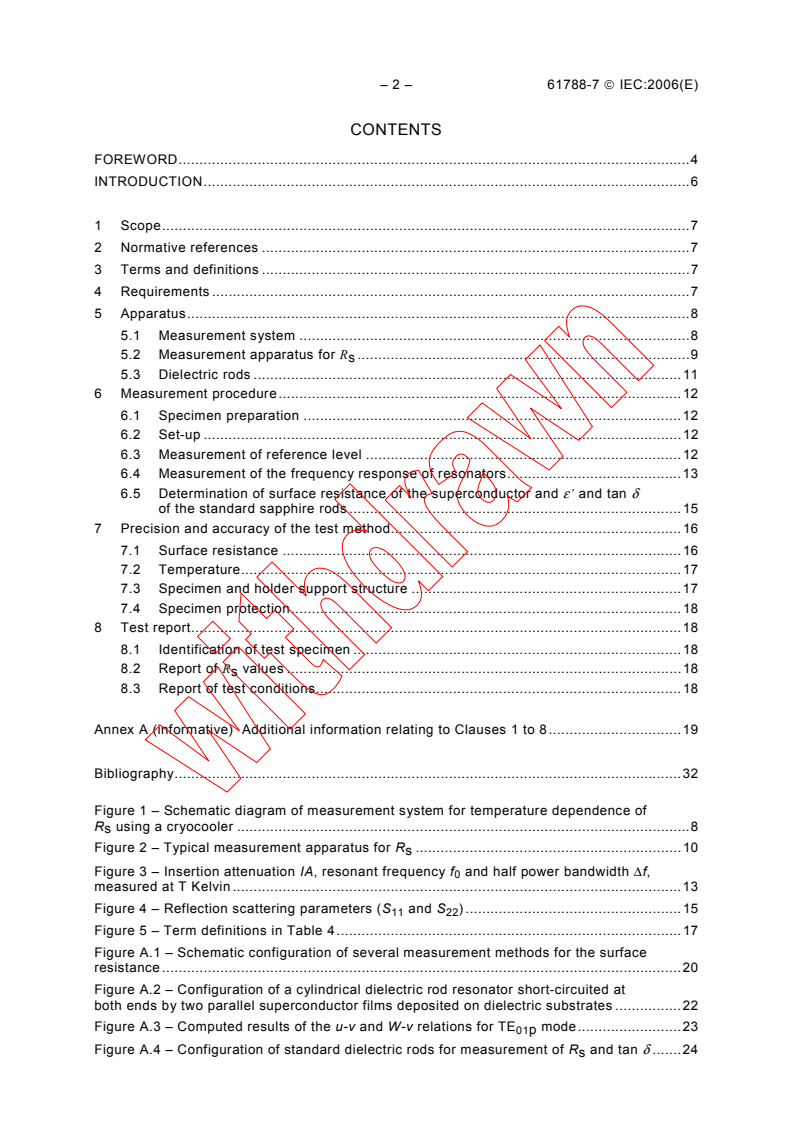
IEC 61788-7:2006 - Superconductivity - Part 7: Electronic characteristic measurements - Surface resistance of superconductors at microwave frequencies Released:10/25/2006
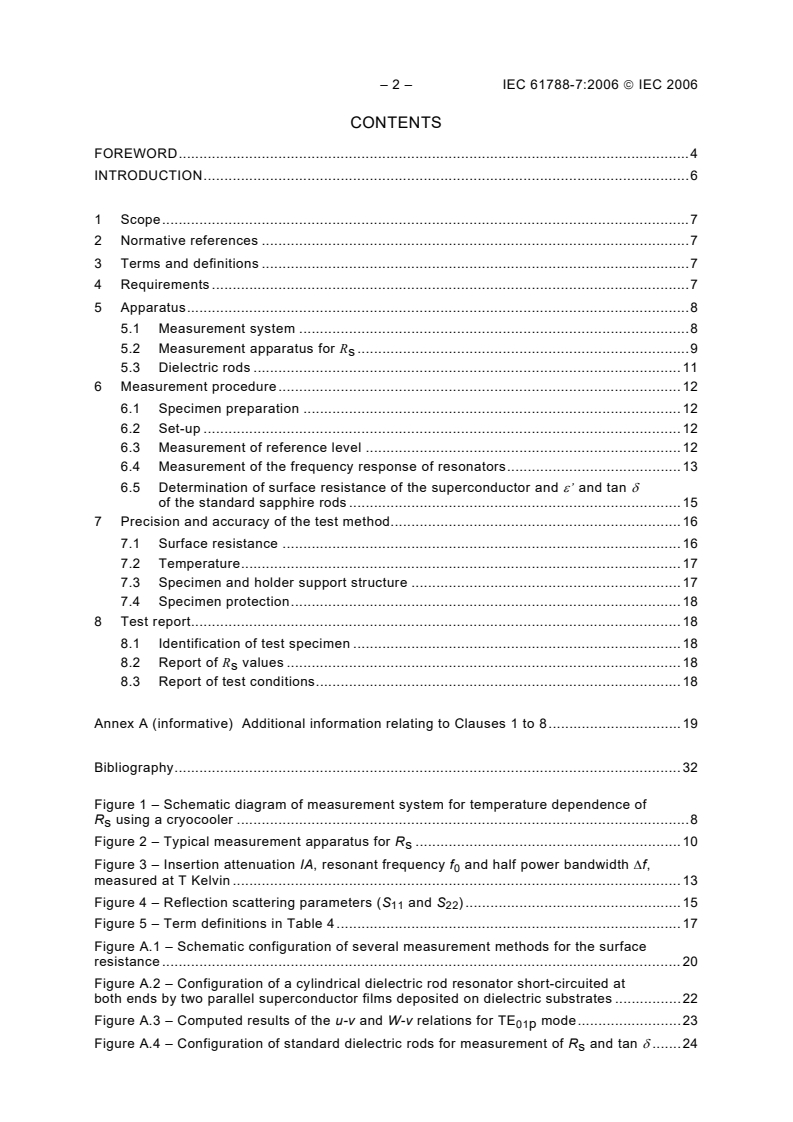
IEC 61788-7:2006 - Superconductivity - Part 7: Electronic characteristic measurements - Surface resistance of superconductors at microwave frequencies Released:7/23/2020
Overview
IEC 61788-7:2006 - Superconductivity Part 7 - defines a standardized laboratory method to measure the surface resistance (Rs) of superconducting materials at microwave frequencies. The standard specifies the two‑resonator (dielectric resonator) technique to determine the temperature dependence of Rs at a resonant frequency, with practical measurement coverage in the microwave band and high sensitivity (example resolution: 0.01 milliohm at 10 GHz). The publication also updates recommendations for resonator designs (including closed‑type resonators) and includes guidance on sapphire dielectric rods commonly used for high‑precision measurements.
Key topics and technical requirements
- Measurement method: Standard two‑resonator dielectric resonator approach to extract Rs from resonator Q‑values and insertion loss.
- Temperature dependence: Procedures for measuring Rs(T) over cryogenic to elevated temperatures (cryocooler setups are illustrated).
- Apparatus and components:
- Dielectric resonators (sapphire rods recommended), resonator geometries (closed‑type favored for stability).
- Vector Network Analyzer (VNA) specifications and calibration/measurement procedures.
- Sample holders, specimen preparation and mounting to avoid measurement artifacts.
- Measurement procedure: Setup, reference‑level measurement, frequency response capture, and calculation steps to determine Rs and dielectric parameters (ε′ and tan δ of standard rods).
- Precision, accuracy and reporting: Uncertainty sources (temperature control, sample support, instrument specs), resolution limits, and required information for a compliant test report.
- Recommended measurement frequencies: Examples and design tables in the standard include microwave bands (the standard adds recommended frequencies such as 12 GHz, 18 GHz and 22 GHz in addition to specified microwave ranges).
Applications and who uses it
IEC 61788-7 is intended for:
- Materials scientists and thin‑film researchers characterizing high‑Tc and low‑Tc superconducting films.
- Microwave and RF engineers designing low‑loss filters, resonators, antennas and delay lines that use superconducting films.
- Test laboratories and QA/qualification teams requiring repeatable, traceable Rs measurements for production control.
- Component manufacturers and R&D organizations developing HTS-based telecom or sensing products.
Practical uses include material selection, process optimization for epitaxial films, component loss budgeting, and acceptance testing of superconducting microwave components.
Related standards
- Other parts of the IEC 61788 series covering critical current, residual resistance ratio, AC loss and mechanical tests (e.g., Parts 1–6, 8–13) - useful when a complete superconducting material characterization program is required.
Keywords: IEC 61788-7, surface resistance, superconductors, microwave measurements, dielectric resonator, sapphire resonator, two-resonator method, Rs(T), vector network analyzer, cryocooler.
Relations
- Effective Date
- 05-Sep-2023
- Effective Date
- 05-Sep-2023
Buy Documents
IEC 61788-7:2006 - Superconductivity - Part 7: Electronic characteristic measurements - Surface resistance of superconductors at microwave frequencies Released:10/25/2006
IEC 61788-7:2006 - Superconductivity - Part 7: Electronic characteristic measurements - Surface resistance of superconductors at microwave frequencies Released:7/23/2020
Get Certified
Connect with accredited certification bodies for this standard

IMQ S.p.A. (Certification)
Italian electrical product certification.

SLG Prüf- und Zertifizierungs GmbH
German testing and certification body.

UL Solutions
Global safety science company with testing, inspection and certification.
Sponsored listings
Frequently Asked Questions
IEC 61788-7:2006 is a standard published by the International Electrotechnical Commission (IEC). Its full title is "Superconductivity - Part 7: Electronic characteristic measurements - Surface resistance of superconductors at microwave frequencies". This standard covers: IEC 61788-7:2006 describes measurement of the surface resistance of superconductors at microwave frequencies by the standard two-resonator method. The object of measurement is the temperature dependence of Rs at the resonant frequency. The applicable measurement range of surface resistances for this method is as follows: - Frequency: 8 GHz - Measurement resolution: 0,01 milliohm at 10 GHz.
IEC 61788-7:2006 describes measurement of the surface resistance of superconductors at microwave frequencies by the standard two-resonator method. The object of measurement is the temperature dependence of Rs at the resonant frequency. The applicable measurement range of surface resistances for this method is as follows: - Frequency: 8 GHz - Measurement resolution: 0,01 milliohm at 10 GHz.
IEC 61788-7:2006 is classified under the following ICS (International Classification for Standards) categories: 17.220.20 - Measurement of electrical and magnetic quantities; 29.050 - Superconductivity and conducting materials. The ICS classification helps identify the subject area and facilitates finding related standards.
IEC 61788-7:2006 has the following relationships with other standards: It is inter standard links to IEC 61788-7:2020, IEC 61788-7:2002. Understanding these relationships helps ensure you are using the most current and applicable version of the standard.
IEC 61788-7:2006 is available in PDF format for immediate download after purchase. The document can be added to your cart and obtained through the secure checkout process. Digital delivery ensures instant access to the complete standard document.
Standards Content (Sample)
INTERNATIONAL IEC
STANDARD 61788-7
Second edition
2006-10
Superconductivity –
Part 7:
Electronic characteristic measurements –
Surface resistance of superconductors at
microwave frequencies
Reference number
Publication numbering
As from 1 January 1997 all IEC publications are issued with a designation in the
60000 series. For example, IEC 34-1 is now referred to as IEC 60034-1.
Consolidated editions
The IEC is now publishing consolidated versions of its publications. For example,
edition numbers 1.0, 1.1 and 1.2 refer, respectively, to the base publication, the
base publication incorporating amendment 1 and the base publication incorporating
amendments 1 and 2.
Further information on IEC publications
The technical content of IEC publications is kept under constant review by the IEC,
thus ensuring that the content reflects current technology. Information relating to
this publication, including its validity, is available in the IEC Catalogue of
publications (see below) in addition to new editions, amendments and corrigenda.
Information on the subjects under consideration and work in progress undertaken
by the technical committee which has prepared this publication, as well as the list
of publications issued, is also available from the following:
• IEC Web Site (www.iec.ch)
• Catalogue of IEC publications
The on-line catalogue on the IEC web site (www.iec.ch/searchpub) enables you to
search by a variety of criteria including text searches, technical committees
and date of publication. On-line information is also available on recently issued
publications, withdrawn and replaced publications, as well as corrigenda.
• IEC Just Published
This summary of recently issued publications (www.iec.ch/online_news/ justpub)
is also available by email. Please contact the Customer Service Centre (see
below) for further information.
• Customer Service Centre
If you have any questions regarding this publication or need further assistance,
please contact the Customer Service Centre:
Email: custserv@iec.ch
Tel: +41 22 919 02 11
Fax: +41 22 919 03 00
INTERNATIONAL IEC
STANDARD 61788-7
Second edition
2006-10
Superconductivity –
Part 7:
Electronic characteristic measurements –
Surface resistance of superconductors at
microwave frequencies
© IEC 2006 ⎯ Copyright - all rights reserved
No part of this publication may be reproduced or utilized in any form or by any means, electronic or
mechanical, including photocopying and microfilm, without permission in writing from the publisher.
International Electrotechnical Commission, 3, rue de Varembé, PO Box 131, CH-1211 Geneva 20, Switzerland
Telephone: +41 22 919 02 11 Telefax: +41 22 919 03 00 E-mail: inmail@iec.ch Web: www.iec.ch
PRICE CODE
Commission Electrotechnique Internationale V
International Electrotechnical Commission
МеждународнаяЭлектротехническаяКомиссия
For price, see current catalogue
– 2 – 61788-7 © IEC:2006(E)
CONTENTS
FOREWORD.4
INTRODUCTION.6
1 Scope.7
2 Normative references .7
3 Terms and definitions .7
4 Requirements .7
5 Apparatus.8
5.1 Measurement system .8
5.2 Measurement apparatus for R .9
s
5.3 Dielectric rods .11
6 Measurement procedure.12
6.1 Specimen preparation .12
6.2 Set-up .12
6.3 Measurement of reference level .12
6.4 Measurement of the frequency response of resonators.13
6.5 Determination of surface resistance of the superconductor and ε’ and tan δ
of the standard sapphire rods .15
7 Precision and accuracy of the test method.16
7.1 Surface resistance .16
7.2 Temperature.17
7.3 Specimen and holder support structure .17
7.4 Specimen protection.18
8 Test report.18
8.1 Identification of test specimen .18
8.2 Report of R values .18
s
8.3 Report of test conditions.18
Annex A (informative) Additional information relating to Clauses 1 to 8.19
Bibliography.32
Figure 1 – Schematic diagram of measurement system for temperature dependence of
R using a cryocooler .8
s
Figure 2 – Typical measurement apparatus for R .10
s
Figure 3 – Insertion attenuation IA, resonant frequency f and half power bandwidth Δf,
measured at T Kelvin .13
Figure 4 – Reflection scattering parameters (S and S ) .15
11 22
Figure 5 – Term definitions in Table 4.17
Figure A.1 – Schematic configuration of several measurement methods for the surface
resistance .20
Figure A.2 – Configuration of a cylindrical dielectric rod resonator short-circuited at
both ends by two parallel superconductor films deposited on dielectric substrates .22
Figure A.3 – Computed results of the u-v and W-v relations for TE mode.23
01p
Figure A.4 – Configuration of standard dielectric rods for measurement of R and tan δ .24
s
61788-7 © IEC:2006(E) – 3 –
Figure A.5 – Three types of dielectric resonators .24
Figure A.6 – Mode chart to design TE resonator short-circuited at both ends by
parallel superconductor films [11] .27
Figure A.7 – Mode chart to design TE resonator short-circuited at both ends by
parallel superconductor films [11] .28
Figure A.8 – Mode chart for TE closed-type resonator.29
Figure A.9 – Mode chart for TE closed-type resonator.30
Table 1 – Typical dimensions of pairs of standard sapphire rods for 12 GHz, 18 GHz
and 22 GHz .11
Table 2 – Dimensions of superconductor film for 12 GHz, 18 GHz, and 22 GHz .12
Table 3 – Specifications on vector network analyzer .16
Table 4 – Specifications on sapphire rods.16
– 4 – 61788-7 © IEC:2006(E)
INTERNATIONAL ELECTROTECHNICAL COMMISSION
____________
SUPERCONDUCTIVITY –
Part 7: Electronic characteristic measurements –
Surface resistance of superconductors
at microwave frequencies
FOREWORD
1) The International Electrotechnical Commission (IEC) is a worldwide organization for standardization comprising
all national electrotechnical committees (IEC National Committees). The object of IEC is to promote
international co-operation on all questions concerning standardization in the electrical and electronic fields. To
this end and in addition to other activities, IEC publishes International Standards, Technical Specifications,
Technical Reports, Publicly Available Specifications (PAS) and Guides (hereafter referred to as “IEC
Publication(s)”). Their preparation is entrusted to technical committees; any IEC National Committee interested
in the subject dealt with may participate in this preparatory work. International, governmental and non-
governmental organizations liaising with the IEC also participate in this preparation. IEC collaborates closely
with the International Organization for Standardization (ISO) in accordance with conditions determined by
agreement between the two organizations.
2) The formal decisions or agreements of IEC on technical matters express, as nearly as possible, an international
consensus of opinion on the relevant subjects since each technical committee has representation from all
interested IEC National Committees.
3) IEC Publications have the form of recommendations for international use and are accepted by IEC National
Committees in that sense. While all reasonable efforts are made to ensure that the technical content of IEC
Publications is accurate, IEC cannot be held responsible for the way in which they are used or for any
misinterpretation by any end user.
4) In order to promote international uniformity, IEC National Committees undertake to apply IEC Publications
transparently to the maximum extent possible in their national and regional publications. Any divergence
between any IEC Publication and the corresponding national or regional publication shall be clearly indicated in
the latter.
5) IEC provides no marking procedure to indicate its approval and cannot be rendered responsible for any
equipment declared to be in conformity with an IEC Publication.
6) All users should ensure that they have the latest edition of this publication.
7) No liability shall attach to IEC or its directors, employees, servants or agents including individual experts and
members of its technical committees and IEC National Committees for any personal injury, property damage or
other damage of any nature whatsoever, whether direct or indirect, or for costs (including legal fees) and
expenses arising out of the publication, use of, or reliance upon, this IEC Publication or any other IEC
Publications.
8) Attention is drawn to the Normative references cited in this publication. Use of the referenced publications is
indispensable for the correct application of this publication.
9) Attention is drawn to the possibility that some of the elements of this IEC Publication may be the subject of
patent rights. IEC shall not be held responsible for identifying any or all such patent rights.
International Standard IEC 61788-7 has been prepared by IEC technical committee 90:
Superconductivity.
This second edition cancels and replaces the first edition, published in 2002, of which it
constitutes a technical revision. Examples of technical changes made are: 1) closed type
resonators are recommended from the viewpoint of the stable measurements, 2) uniaxial-
anisotropic characteristics of sapphire rods are taken into consideration for designing the size
of the sapphire rods, and 3) recommended measurement frequency of 18 GHz and 22 GHz
are added to 12 GHz described in the first edition.
The text of this standard is based on the following documents:
FDIS Report on voting
90/193/FDIS 90/198/RVD
61788-7 © IEC:2006(E) – 5 –
Full information on the voting for the approval of this standard can be found in the report on
voting indicated in the above table.
This publication has been drafted in accordance with the ISO/IEC Directives, Part 2.
IEC 61788 consists of the following parts, under the general title Superconductivity:
Part 1: Critical current measurement – DC critical current of Cu/Nb-Ti composite super-
conductors
Part 2: Critical current measurement – DC critical current of Nb Sn composite super-
conductors
Part 3: Critical current measurement – DC critical current of Ag- and/or Ag alloy-sheathed
Bi-2212 and Bi-2223 oxide superconductors
Part 4: Residual resistance ratio measurement – Residual resistance ratio of Nb-Ti
composite superconductors
Part 5: Matrix to superconductor volume ratio measurement – Copper to superconductor
volume ratio of Cu/Nb-Ti composite superconductors
Part 6: Mechanical properties measurement – Room temperature tensile test of Cu/Nb-Ti
composite superconductors
Part 7: Electronic characteristic measurements – Surface resistance of superconductors at
microwave frequencies
Part 8: AC loss measurements – Total AC loss measurement of Cu/Nb-Ti composite
superconducting wires exposed to a transverse alternating magnetic field by a
pickup coil method
Part 9: Measurements for bulk high temperature superconductors – Trapped flux density of
large grain oxide superconductors
Part 10: Critical temperature measurement – Critical temperature of Nb-Ti, Nb Sn, and
Bi-system oxide composite superconductors by a resistance method
Part 11: Residual resistance ratio measurement – Residual resistance ratio of Nb Sn
composite superconductors
Part 12: Matrix to superconductor volume ratio measurement – Copper to non-copper
volume ratio of Nb Sn composite superconducting wires
Part 13: AC loss measurements – Magnetometer methods for hysteresis loss in Cu/Nb-Ti
multifilamentary composites
The committee has decided that the contents of this publication will remain unchanged until
the maintenance result date indicated on the IEC web site under "http://webstore.iec.ch" in
the data related to the specific publication. At this date, the publication will be
• reconfirmed;
• withdrawn;
• replaced by a revised edition, or
• amended.
A bilingual version of this publication may be issued at a later date.
– 6 – 61788-7 © IEC:2006(E)
INTRODUCTION
Since the discovery of some Perovskite-type Cu-containing oxides, extensive research and
development (R & D) work on high-temperature oxide superconductors has been, and is being,
made worldwide, and its application to high-field magnet machines, low-loss power
transmission, electronics and many other technologies is in progress.
In various fields of electronics, especially in telecommunication fields, microwave passive
devices such as filters using oxide superconductors are being developed and are undergoing
1)
on-site testing [1,2] .
Superconductor materials for microwave resonators, filters, antenna and delay lines have the
advantage of very low loss characteristics. Knowledge of this parameter is of primary
importance for the development of new materials on the supplier side and for the design of
superconductor microwave components on the customer side. The parameters of
superconductor materials needed for the design of microwave low loss components are the
surface resistance R and the temperature dependence of the surface resistance.
s
Recent advances in high Tc superconductor (HTS) thin films with R several orders of
s
magnitude lower than that of normal metals have increased the need for a reliable
characterization technique to measure this property [3,4]. Traditionally, the R of Nb or any
s
other low temperature superconducting material was measured by first fabricating an entire
three dimensional resonant cavity and then measuring its Q-value. The R could be calculated
s
by solving the EM field distribution inside the cavity. Another technique involves placing a
small sample inside a larger cavity. This technique has many forms but usually involves the
uncertainty introduced by extracting the loss contribution due to the HTS films from the
experimentally measured total loss of the cavity.
The best HTS samples are epitaxial films grown on flat crystalline substrates and no high
quality films have been grown on any curved surface so far. What is needed is a technique
that: can use these small flat samples; requires no sample preparation; does not damage or
th
change the film; is highly repeatable; has great sensitivity (down to 1/1 000 the R of copper);
s
has great dynamic range (up to the R of copper); can reach high internal powers with only
s
modest input powers; and has broad temperature coverage (4,2 K to 150 K).
The dielectric resonator method is selected among several methods [5,6,7] to determine the
surface resistance at microwave frequencies because it is considered to be the most popular
and practical at present. Especially, the sapphire resonator is an excellent tool for measuring
the R of HTS materials [8,9].
s
The test method given in this standard can be also applied to other superconductor bulk
plates including low Tc material.
This standard is intended to provide an appropriate and agreeable technical base for the time
being to engineers working in the fields of electronics and superconductivity technology.
The test method covered in this standard is based on the VAMAS (Versailles Project on
Advanced Materials and Standards) pre-standardization work on the thin film properties of
superconductors.
___________
1)
Figures in square brackets refer to the Bibliography.
61788-7 © IEC:2006(E) – 7 –
SUPERCONDUCTIVITY –
Part 7: Electronic characteristic measurements –
Surface resistance of superconductors
at microwave frequencies
1 Scope
This part of IEC 61788 describes measurement of the surface resistance of superconductors
at microwave frequencies by the standard two-resonator method. The object of measurement
is the temperature dependence of R at the resonant frequency.
s
The applicable measurement range of surface resistances for this method is as follows:
– Frequency: 8 GHz < f < 30 GHz
– Measurement resolution: 0,01 mΩ at 10 GHz
The surface resistance data at the measured frequency, and that scaled to 10 GHz, assuming
the f rule for comparison, are reported.
2 Normative references
The following referenced documents are indispensable for the application of this document.
For dated references, only the edition cited applies. For undated references, the latest edition
of the referenced document (including any amendments) applies.
IEC 60050-815, International Electrotechnical Vocabulary (IEV) – Part 815: Superconductivity
3 Terms and definitions
For the purposes of this document, the terms and definitions given in IEC 60050-815 apply.
In general, surface impedance Z for conductors, including superconductors, is defined as the
s
ratio of the electric field E to the magnetic field H , tangential to a conductor surface:
t t
Z = E /H = R + jX
s t t s s
where R is the surface resistance and X is the surface reactance.
s s
4 Requirements
The surface resistance R of a superconductor film shall be measured by applying a
s
microwave signal to a dielectric resonator with the superconductor film specimen and then
measuring the attenuation of the resonator at each frequency. The frequency shall be swept
around the resonant frequency as the centre, and the attenuation–frequency characteristics
shall be recorded to obtain Q-value, which corresponds to the loss.
The target precision of this method is a coefficient of variation (standard deviation divided by
the average of the surface resistance determinations) that is less than 20 % for the
measurement temperature range from 30 K to 80 K.
– 8 – 61788-7 © IEC:2006(E)
It is the responsibility of the user of this standard to consult and establish appropriate safety
and health practices and to determine the applicability of regulatory limitations prior to use.
Hazards exist in this type of measurement. The use of a cryogenic system is essential to cool
the superconductors to allow transition into the superconducting state. Direct contact of skin
with cold apparatus components can cause immediate freezing, as can direct contact with a
spilled cryogen. The use of an r.f.-generator is also essential to measure high-frequency
properties of materials. If its power is too high, direct contact to human bodies can cause an
immediate burn.
5 Apparatus
5.1 Measurement system
Figure 1 shows a schematic diagram of the system required for the microwave measurement.
The system consists of a network analyzer system for transmission measurement, a
measurement apparatus, and a thermometer for monitoring the measuring temperature.
An incident power generated from a suitable microwave source such as a synthesized
sweeper is applied to the dielectric resonator fixed in the measurement apparatus. The
transmission characteristics are shown on the display of the network analyzer.
Vector network
analyser
Synthesized
sweeper
Thermometer
S-parameter
test set
Thermal sensor
Measurement apparatus
Cryocooler
IEC 004/02
Figure 1 – Schematic diagram of measurement system
for temperature dependence of R using a cryocooler
s
The measurement apparatus is fixed in a temperature-controlled cryocooler.
For the measurement of R for superconductor films, a vector network analyzer is recom-
s
mended. A vector network analyzer has better measurement accuracy than a scalar network
analyzer due to its wide dynamic range.
System interface
61788-7 © IEC:2006(E) – 9 –
5.2 Measurement apparatus for R
s
Figure 2 shows a schematic of a typical measurement apparatus (closed type resonator) for
the R of superconductor films deposited on a substrate with a flat surface. The upper
s
superconductor film is pressed down by a spring, which is made of phosphor bronze. The
plate type spring is recommended to be used for the improvement of measurement accuracy.
This type of spring reduces the friction between the spring and the other part of the apparatus,
and allows the smooth movement of superconductor films due to the thermal expansion of the
dielectric rod. In order to minimize the measurement error, the sapphire rod and the copper
ring shall be set in coaxial.
Two semi-rigid cables for measuring transmission characteristics of the resonator shall be
attached on both sides of the resonator in an axial symmetrical position (φ = 0 and π, where φ
is the rotational angle around the central axis of the sapphire rod). Each of the two semi-rigid
cables shall have a small loop at the ends. The plane of the loop shall be set parallel to that
of the superconductor films in order to suppress the unwanted TM modes. The coupling
mn0
loops shall be carefully checked for cracks in the spot weld joint that may have developed
upon repeated thermal cycling. These cables can move right and left to adjust the insertion
attenuation (IA). In this adjustment, coupling of unwanted cavity modes to the interested
dielectric resonance mode shall be suppressed. Unwanted, parasitic coupling to the other
modes reduces the high Q value of the TE mode resonator. For suppressing the parasitic
coupling, special attention shall be paid to designing high Q resonators. Two other types of
resonators along with the closed type shown in Figure 2 can be used. They are explained in
Clause A.4.
– 10 – 61788-7 © IEC:2006(E)
Screw Screws
Hexagonal
head bolt
Phosphor bronze
plate spring
Copper supports
Copper plate
Spot welding
Superconductor film
Copper ring
Small loop
Connector
Semi-rigid
Superconductor film
coaxial cable
Sapphire rod
Copper block
Screws to fix on
a cold stage
IEC 1733/06
Figure 2 – Typical measurement apparatus for R
s
61788-7 © IEC:2006(E) – 11 –
A reference line made of a semi-rigid cable shall be used to measure the full transmission
power level, i.e., the reference level. This cable has a length equal to the sum of the two
cables of the measurement apparatus. The semi-rigid cable with the outer diameter of
1,20 mm is recommended.
In order to minimize the measurement error, two superconductor films shall be set to be
parallel to each other. To ensure that the two superconductor films remain in tight contact with
the ends of the sapphire rod, without any air gap, both of the surfaces of the films and the
ends of the rod shall be cleaned carefully.
5.3 Dielectric rods
Two dielectric rods with the same relative permittivity, ε’, and loss factor, tan δ, preferably cut
from one cylindrical dielectric rod, are required. These two rods, standard dielectric rods, shall
have the same diameter but different heights: one has a height three times longer than the
other.
It is preferable to use standard dielectric rods with low tan δ to achieve the requisite
measurement accuracy on R . Recommended dielectric rods are sapphire rods with tan δ less
s
–6
than 10 at 77 K. Specifications on the sapphire rods are described in 7.1. In order to
minimize the measurement error in R of the superconductor films, both ends of the sapphire
s
rods shall be polished parallel to each other and perpendicular to the axis. Specifications for
the sapphire rods are described in Clause 7.
The diameter and the heights of the standard sapphire rods shall be carefully designed so
that the TE and TE modes do not couple to other TM, HE and EH modes, since the
011 013
coupling between TE mode and other modes causes the degradation of unloaded Q. A design
guideline for the standard sapphire rods is described in Clause A.5. Table 1 shows typical
examples of dimensions of the standard sapphire rods for 12 GHz, 18 GHz, and 22 GHz
resonance. At higher frequencies the unloaded Q value will be lower, which makes the
measurement easier, and the error will be lower.
Table 1 – Typical dimensions of pairs of standard sapphire rods for
12 GHz, 18 GHz and 22 GHz
Diameter Height
Frequency
d h
GHz
mm mm
Short rod (TEresonator) 11,4 5,7
Long rod (TE resonator) 11,4 17,1
Short rod (TEresonator) 7,6 3,8
Long rod (TE resonator) 7,6 11,4
Short rod (TEresonator) 6,2 3,1
Long rod (TE resonator) 6,2 9,3
– 12 – 61788-7 © IEC:2006(E)
6 Measurement procedure
6.1 Specimen preparation
From error estimation, the film diameter shall be about three times larger than that of the
sapphire rods. In this configuration, the reduction in precision of R due to the different
s
radiation losses between TE and TE mode can be considered negligible, given the
011 013
target precision of 20 %. The film thickness shall be about three times larger than the London
penetration depth value at each temperature. If the film thickness is much less than three
times the London penetration depth, the measured R should mean the effective surface
s
resistance.
Table 2 shows dimensions of the superconductor films recommended for the standard
sapphire rods of 12 GHz, 18 GHz, and 22 GHz.
Table 2 – Dimensions of superconductor film for 12 GHz, 18 GHz, and 22 GHz
Standard dielectric rod Superconductor film
Frequency Diameter Diameter Thickness
d
d′
GHz
μm
mm
mm
12 11,4 >35 ≅0,5
18 7,6 >25
≅0,5
22 6,2 >20 ≅0,5
In case of using closed type resonators, the dimensions of the superconductor films shall also
be designed taking into account the dimension of the copper cylinder between the
superconductor films. A design guideline for the dimension of the copper cylinder of the
closed type resonator is described in Clause A.6.
6.2 Set-up
Set up the measurement equipment as shown in Figure 1. All of the measurement apparatus,
standard sapphire rods, and superconductor films shall be kept in a clean and dry state as
high humidity may degrade the unloaded Q-value. The specimen and the measurement
apparatus shall be fixed in a temperature-controlled cryocooler. The specimen chamber shall
be generally evacuated. The temperatures of the superconductor films and standard sapphire
rods shall be measured by a diode thermometer, or a thermocouple. The temperatures of the
upper and lower superconductor films, and standard sapphire rods must be kept as close as
possible. This can be achieved by covering the measurement apparatus with aluminum foil, or
filling the specimen chamber with helium gas.
6.3 Measurement of reference level
The level of full transmission power (reference level) shall be measured first. Fix the output
power of the synthesized sweeper below 10 mW because the measurement accuracy
depends on the measuring signal level. Connect the reference line of semi-rigid cable
between the input and output connectors. Then, measure the transmission power level over
the entire measurement frequency and temperature range. The reference level can change
several decibels when temperature of the apparatus is changed from room temperature to the
lowest measurement temperature. Therefore, the temperature dependence of the reference
level must be taken into account.
61788-7 © IEC:2006(E) – 13 –
Reference level at T K
IA
f
3,01 dB
Δf
Frequency GHz
IEC 007/02
Figure 3 – Insertion attenuation IA, resonant frequency f
and half power bandwidth Δf, measured at T Kelvin
6.4 Measurement of the frequency response of resonators
The temperature dependence of the surface resistance R can be obtained through the
s
measurements of resonant frequency f and unloaded quality factor Q for TE and TE
0 u 011 013
resonators, which shall be measured as follows.
a) Connect the measurement apparatus between the input and output connectors (Figure 1).
Insert the standard short sapphire rod near the centre of the lower superconductor film
and fix the distance between the rod and each of the loops of the semi-rigid cables to be
equal to each other, so that this transmission-type resonator can be under-coupled
equally to both loops. Put down the upper superconductor film gently to touch the top face
of the rod. Be careful not to damage the surface of the superconductor films by excessive
pressure. Evacuate and cool down the specimen chamber below the critical temperature.
b) Find the TE mode resonance peak of this resonator at a frequency nearly equal to the
designed value of f .
c) Narrow the frequency span on the display so that only the resonance peak of TE mode
can be shown (Figure 3). Confirm that the insertion attenuation IA of this mode is larger
than 20 dB from the reference level, which depends strongly on the temperature.
d) Measure the temperature dependence of f and the half power band width Δf. The loaded
Q, Q , of the TE resonator is given by
L
f
Q = (1)
L
Δf
e) The unloaded Q-value, Q , shall be extracted from the Q by at least one of the two
u
L
techniques described below.
One technique for extracting the unloaded Q-value involves measuring the insertion
attenuation IA. The Q is given by
u
Q
− IA[]dB / 20
L
Q = , A = 10 (2)
u t
1 - A
t
Attenuation dB
– 14 – 61788-7 © IEC:2006(E)
This technique of using insertion attenuation assumes that the coupling on both sides of
the resonator is identical. The coupling loops are difficult to fabricate, the orientation of
the loop is difficult to control, and any movement of the sapphire rod during measurement
is not known. These assembly dependent effects are also temperature dependent. This
potential asymmetry in coupling can result in large errors in calculating the coupling factor
if the coupling is strong (IA <~ 10 dB). If the coupling is weak enough (IA > 20 dB),
asymmetry in the coupling becomes less important.
Another technique for extracting the unloaded Q-value involves measuring the reflection
scattering parameters at the resonant frequency of both sides of the resonator.
Q = Q (1+ β + β ) (3)
u L 1 2
1− | S |
β = (4)
| S | + | S |
11 22
1− | S |
β = (5)
| S | + | S |
11 22
In the above equations, S and S are the reflection scattering parameters as shown in
11 22
Figure 4, and are measured in linear units of power, not relative dB. β and β are the
1 2
coupling coefficients.
This technique of using the reflection scattering parameters has two advantages. It does
not require the additional step of calibration of the reference level and it gives a
measurement of the coupling values for both sides of the resonator. This also has two
disadvantages. It only works for a narrow band resonance (which is fortunately the case)
and is limited by the dynamic range of the network analyzer in measuring the reflection
coefficients.
A combination of the two techniques is an excellent “double” check and is therefore
recommended.
f) The f and Q measured for this short rod are denoted as f and Q . By slowly changing
0 u 01 u
the temperature of the cryocooler, the temperature dependence of f and Q shall be
01 u1
measured.
g) After the temperature dependence measurement of f and Q is finished, the
01 u1
measurement apparatus shall be heated up to room temperature.
h) Then, replace the TE resonator in the apparatus with the TE resonator at room
011 013
temperature, cool down the apparatus to a temperature lower than the critical temperature,
and measure the temperature dependence of f and Q of its TE resonance mode,
0 u 013
denoted as f and Q , in a similar way as the TE resonator case. When the length of
03 u 011
the sapphire rod of the TE resonator is precisely three times longer than that of the
TE resonator, the f of the TE resonator must coincide with f of the TE
011 03 013 01 011
resonator. If carefully designed, the difference between f and f is usually very small
01 03
(<~0,25%). We can treat as f = f = f in the calculations of 6.5.
0 01 03
61788-7 © IEC:2006(E) – 15 –
S or S
11 22
f
Frequency
IEC 008/02
Figure 4 – Reflection scattering parameters (S and S )
11 22
6.5 Determination of surface resistance of the superconductor and ε’ and tan δ of the
standard sapphire rods
Calculate the temperature dependence of the surface resistance R of the superconductor
s
films, and ε’ and tan δ of the standard sapphire rods using the temperature dependence of
f , Q , f , and Q from Equations (6), (7) and (8).
01 u1 03 u3
⎛ ⎞
2h ⎛ ⎞
30π ×3 ε'+W 1 1
⎜ ⎟
⎜ ⎟
R = − (6)
s
⎜ ⎟
⎜ ⎟
()3 −1 1+W Q Q
⎝ u1 u3⎠
λ0
⎝ ⎠
⎛ ⎞
λ
2 2
ε' = ⎜ ⎟()+ + 1 (7)
u v
⎜ ⎟
πd
⎝ ⎠
W
1+
⎛ ⎞
3 1
ε '
⎜ ⎟
tan δ = - (8)
⎜ ⎟
(3 - 1) Q Q
⎝ u3 u1⎠
c
where λ = (9)
f
2 2
J (u) K (v)K (v) −
K (v)
1 0 2 1
W = (10)
2 2
K (v) J (u) − J (u)J (u)
1 1 0 2
2⎡ ⎤
⎛ ⎞
λ
2 0
⎛ πd⎞
⎜ ⎟
= ⎢ -1⎥ (11)
⎜ ⎟
v
λ ⎜ ⎟
⎝ ⎠
2h
⎢ ⎥
⎝ 0⎠
⎣ ⎦
(u) (v)
J K
0 0
u = -v (12)
(u) (v)
J K
1 1
Reflection coefficient
– 16 – 61788-7 © IEC:2006(E)
In the equations, λ is the free space resonant wavelength, c is the velocity of light in a
vacuum (c = 2,9979 × 10 m/s), h is the height of the short standard dielectric rod. The value
2 2
u is given by the transcendental Equation (12) using the value of v , where J (u) is the
n
Bessel function of the first kind, and K (v) is the modified Bessel function of the second kind.
n
The derivations of the equations are described in Clause A.3.
Generally the thermal expansion coefficient of the rods must be known to determine the
temperature dependence of their sizes. However, the thermal expansion effect of the sapphire
rods can be neglected for the target precision of the R (20 %).
s
It is noted that the measured R means the effective surface resistance if the film thickness is
s
not much larger than the temperature-dependent penetration depth.
7 Precision and accuracy of the test method
7.1 Surface resistance
The surface resistance shall be determined from the Q-value measured with a dielectric
resonator technique.
A vector network analyzer as specified in Table 3 shall be used to record the frequency
dependence of attenuation. The resulting record shall allow the determination of Q to a
–2
relative uncertainty of 10 .
Table 3 – Specifications for vector network analyzer
Dynamic range of S above 60 dB
Frequency resolution below 1 Hz
Attenuation uncertainty below 0,1 dB
Input power limitation below 10 dBm
The dielectric resonators shall be provided with two dielectric rods with low tan δ of less than
–6
10 at 77 K and a radius less than 1/3 of the superconducting specimen’s radius. The best
candidate for the rods is sapphire as specified in Table 4. Term definitions in Table 4 are
shown in Figure 5.
Table 4 – Specifications for sapphire rods
Diameter ±0,05 mm
Height ±0,05 mm
Flatness below 0,005 mm
Surface roughness top and bottom surface: below 10 nm r.m.s.
cylindrical surface: below 0,001 mm r.m.s.
Perpendicularity within 0,1 degree
Axis parallel to c-axis within 0,3°
61788-7 © IEC:2006(E) – 17 –
Surface roughness Flatness
c-axis of
Cylinder axis
Perpendicularity
crystal
IEC 009/02
Figure 5 – Term definitions in Table 4
The technique as described assumes that single and triple height sapphire rods can be
fabricated with the same tan δ. However, the variation of the tan δ between nominally identical
rods, cut from the same boule and polished by the same technique, may be as large as two
orders of magnitude. To date, the smallest variation in tan δ between nominally identical
sapphire rods has been a factor of four[9]. Therefore, the uncertainty in the measured tan δ is
large. The variation of tan δ of the present sapphire rod causes an additional uncertainty up to
at least 10 % in the surface resistance measurement. This limits the target precision of the
present technique at 20 %. If reproducibility of sapphire rods is improved, or a selection
method for standard sapphire rods is established, a target precision can be improved.
7.2 Temperature
The measurement apparatus is cooled down to the specified temperature by any means
during testing. An easy choice would be to immerse the apparatus into a liquid cryogen. This
technique is quick and simple and yields a known and stable temperature. Unfortunately, most
HTS materials are damaged by the condensation of moisture that occurs when removing the
sample from the cryogen. In addition, uncertainties generated by the presence of a gas/liquid
mixture within the cavity, and the inability to measure R as a function of temperature support
s
the use of other cooling methods. These limitations can be circumvented by the immersion of
a vacuum can into a liquid cryogen. If the vacuum can is backfilled with gas, then rapid
cooling and uniform temperatures occur. If heaters are attached to the apparatus, then the
temperature dependence of the HTS material can be measured. A third and equally good
choice is the use of a cryocooler. In this case, the resonator is under vacuum and cooled by
conduction through the metallic package. Care must be taken to avoid temperature gradients
with the apparatus.
A cryostat shall be provided with the necessary environment for measuring R and the
s
specimen shall be measured while in a stable and isothermal state. The specimen
temperature is assumed to be the same as the sample holder temperature. The holder tem-
perature shall be reported to an accuracy of ±0,5 K, measured by means of an appropriate
temperature sensor.
The difference between the specimen temperature and the holder temperature shall be
minimized by using shields with good thermal conductivity.
7.3 Specimen and holder support structure
The support structure shall provide adequate support for the specimen. It is imperative that
the two films be parallel and mechanically stable throughout the measurement, especially in a
cryocooler and over a wide range of temperature.
– 18 – 61788-7 © IEC:2006(E)
7.4 Specimen protection
Condensation of moisture and scratching of the film deteriorate superconducting properties.
Some protection measures should be provided for the specimens. Polytetrafluoroethylene
(PTFE) or polymethylmethacrylate (PMMA) coating does not affect the measurements, thus
they can be used for protection. A coating material thickness of less than several micrometres
is recommended.
8 Test report
8.1 Identification of test specimen
The test specimen shall be identified, if possible, by the following:
a) name of the manufacturer of the specimen;
b) classification and/or symbol;
c) lot number;
d) chemical composition of the thin film and the substrate;
e) thickness and roughness of the thin film;
f) manufacturing process technique.
8.2 Report of R values
s
The R values, together with their corresponding f , f , Q , Q , IA and/or (β , β ), ε’ and
s 01 03 u1 u3 1 2
tan δ values, and their temperature dependence shall be reported.
8.3 Report of test conditions
The following test conditions shall be reported:
a) test frequency and resolution of frequency;
b) test maximum r.f. power;
c) test temperature, accuracy of temperature and temperature difference in two plates;
d) sample history with temperature variation.
61788-7 © IEC:2006(E) – 19 –
Annex A
(informative)
Additional information relating to Clauses 1 to 8
A.1 Scope
The establishment of the standard measurement method is needed to evaluate film quality of
high Tc superconductor (HTS) films having low surface resistance R values such as 0,1 mΩ
s
at 10 GHz. Several resonance methods as shown in Figure A.1 have been proposed so far to
measure them in microwave and millimetre wave range. These resonator structures are
grouped into the following six types:
2)
A.1.1 Cylindrical cavity method [1]
Figure A.1(a) shows a cavity structure using the TE mode, which is constructed from a
copper cylinder and two HTS films. In the microwave range below 30 GHz, the R
s
measurement precision of this
...
IEC 61788-7 ®
Edition 2.0 2006-10
INTERNATIONAL
STANDARD
NORME
INTERNATIONALE
colour
inside
Superconductivity –
Part 7: Electronic characteristic measurements – Surface resistance of
superconductors at microwave frequencies
Supraconductivité –
Partie 7: Mesures des caractéristiques électroniques – Résistance de surface
des supraconducteurs à des hyperfréquences
All rights reserved. Unless otherwise specified, no part of this publication may be reproduced or utilized in any form
or by any means, electronic or mechanical, including photocopying and microfilm, without permission in writing from
either IEC or IEC's member National Committee in the country of the requester. If you have any questions about IEC
copyright or have an enquiry about obtaining additional rights to this publication, please contact the address below or
your local IEC member National Committee for further information.
Droits de reproduction réservés. Sauf indication contraire, aucune partie de cette publication ne peut être reproduite
ni utilisée sous quelque forme que ce soit et par aucun procédé, électronique ou mécanique, y compris la photocopie
et les microfilms, sans l'accord écrit de l'IEC ou du Comité national de l'IEC du pays du demandeur. Si vous avez des
questions sur le copyright de l'IEC ou si vous désirez obtenir des droits supplémentaires sur cette publication, utilisez
les coordonnées ci-après ou contactez le Comité national de l'IEC de votre pays de résidence.
IEC Central Office Tel.: +41 22 919 02 11
3, rue de Varembé info@iec.ch
CH-1211 Geneva 20 www.iec.ch
Switzerland
About the IEC
The International Electrotechnical Commission (IEC) is the leading global organization that prepares and publishes
International Standards for all electrical, electronic and related technologies.
About IEC publications
The technical content of IEC publications is kept under constant review by the IEC. Please make sure that you have the
latest edition, a corrigendum or an amendment might have been published.
IEC publications search - webstore.iec.ch/advsearchform Electropedia - www.electropedia.org
The advanced search enables to find IEC publications by a The world's leading online dictionary on electrotechnology,
variety of criteria (reference number, text, technical containing more than 22 000 terminological entries in English
committee,…). It also gives information on projects, replaced and French, with equivalent terms in 16 additional languages.
and withdrawn publications. Also known as the International Electrotechnical Vocabulary
(IEV) online.
IEC Just Published - webstore.iec.ch/justpublished
Stay up to date on all new IEC publications. Just Published IEC Glossary - std.iec.ch/glossary
details all new publications released. Available online and 67 000 electrotechnical terminology entries in English and
once a month by email. French extracted from the Terms and Definitions clause of
IEC publications issued since 2002. Some entries have been
IEC Customer Service Centre - webstore.iec.ch/csc collected from earlier publications of IEC TC 37, 77, 86 and
If you wish to give us your feedback on this publication or CISPR.
need further assistance, please contact the Customer Service
Centre: sales@iec.ch.
A propos de l'IEC
La Commission Electrotechnique Internationale (IEC) est la première organisation mondiale qui élabore et publie des
Normes internationales pour tout ce qui a trait à l'électricité, à l'électronique et aux technologies apparentées.
A propos des publications IEC
Le contenu technique des publications IEC est constamment revu. Veuillez vous assurer que vous possédez l’édition la
plus récente, un corrigendum ou amendement peut avoir été publié.
Recherche de publications IEC - Electropedia - www.electropedia.org
webstore.iec.ch/advsearchform Le premier dictionnaire d'électrotechnologie en ligne au
La recherche avancée permet de trouver des publications IEC monde, avec plus de 22 000 articles terminologiques en
en utilisant différents critères (numéro de référence, texte, anglais et en français, ainsi que les termes équivalents dans
comité d’études,…). Elle donne aussi des informations sur les 16 langues additionnelles. Egalement appelé Vocabulaire
projets et les publications remplacées ou retirées. Electrotechnique International (IEV) en ligne.
IEC Just Published - webstore.iec.ch/justpublished Glossaire IEC - std.iec.ch/glossary
Restez informé sur les nouvelles publications IEC. Just 67 000 entrées terminologiques électrotechniques, en anglais
Published détaille les nouvelles publications parues. et en français, extraites des articles Termes et Définitions des
Disponible en ligne et une fois par mois par email. publications IEC parues depuis 2002. Plus certaines entrées
antérieures extraites des publications des CE 37, 77, 86 et
Service Clients - webstore.iec.ch/csc CISPR de l'IEC.
Si vous désirez nous donner des commentaires sur cette
publication ou si vous avez des questions contactez-nous:
sales@iec.ch.
IEC 61788-7 ®
Edition 2.0 2006-10
INTERNATIONAL
STANDARD
NORME
INTERNATIONALE
colour
inside
Superconductivity –
Part 7: Electronic characteristic measurements – Surface resistance of
superconductors at microwave frequencies
Supraconductivité –
Partie 7: Mesures des caractéristiques électroniques – Résistance de surface
des supraconducteurs à des hyperfréquences
INTERNATIONAL
ELECTROTECHNICAL
COMMISSION
COMMISSION
ELECTROTECHNIQUE
INTERNATIONALE
ICS 17.220.20; 29.050 ISBN 978-2-8322-8658-6
– 2 – IEC 61788-7:2006 IEC 2006
CONTENTS
FOREWORD . 4
INTRODUCTION . 6
1 Scope . 7
2 Normative references . 7
3 Terms and definitions . 7
4 Requirements . 7
5 Apparatus . 8
5.1 Measurement system . 8
5.2 Measurement apparatus for R . 9
s
5.3 Dielectric rods . 11
6 Measurement procedure . 12
6.1 Specimen preparation . 12
6.2 Set-up . 12
6.3 Measurement of reference level . 12
6.4 Measurement of the frequency response of resonators . 13
6.5 Determination of surface resistance of the superconductor and ε’ and tan δ
of the standard sapphire rods . 15
7 Precision and accuracy of the test method. 16
7.1 Surface resistance . 16
7.2 Temperature . 17
7.3 Specimen and holder support structure . 17
7.4 Specimen protection . 18
8 Test report. 18
8.1 Identification of test specimen . 18
8.2 Report of R values . 18
s
8.3 Report of test conditions . 18
Annex A (informative) Additional information relating to Clauses 1 to 8 . 19
Bibliography . 32
Figure 1 – Schematic diagram of measurement system for temperature dependence of
R using a cryocooler . 8
s
Figure 2 – Typical measurement apparatus for R . 10
s
Figure 3 – Insertion attenuation IA, resonant frequency f and half power bandwidth ∆f,
measured at T Kelvin . 13
Figure 4 – Reflection scattering parameters (S and S ) . 15
11 22
Figure 5 – Term definitions in Table 4 . 17
Figure A.1 – Schematic configuration of several measurement methods for the surface
resistance . 20
Figure A.2 – Configuration of a cylindrical dielectric rod resonator short-circuited at
both ends by two parallel superconductor films deposited on dielectric substrates . 22
Figure A.3 – Computed results of the u-v and W-v relations for TE mode . 23
01p
Figure A.4 – Configuration of standard dielectric rods for measurement of R and tan δ . 24
s
Figure A.5 – Three types of dielectric resonators . 24
Figure A.6 – Mode chart to design TE resonator short-circuited at both ends by
parallel superconductor films [11] . 27
Figure A.7 – Mode chart to design TE resonator short-circuited at both ends by
parallel superconductor films [11] . 28
Figure A.8 – Mode chart for TE closed-type resonator . 29
Figure A.9 – Mode chart for TE closed-type resonator . 30
Table 1 – Typical dimensions of pairs of standard sapphire rods for 12 GHz, 18 GHz
and 22 GHz . 11
Table 2 – Dimensions of superconductor film for 12 GHz, 18 GHz, and 22 GHz . 12
Table 3 – Specifications on vector network analyzer . 16
Table 4 – Specifications on sapphire rods . 16
– 4 – IEC 61788-7:2006 IEC 2006
INTERNATIONAL ELECTROTECHNICAL COMMISSION
____________
SUPERCONDUCTIVITY –
Part 7: Electronic characteristic measurements –
Surface resistance of superconductors
at microwave frequencies
FOREWORD
1) The International Electrotechnical Commission (IEC) is a worldwide organization for standardization comprising
all national electrotechnical committees (IEC National Committees). The object of IEC is to promote
international co-operation on all questions concerning standardization in the electrical and electronic fields. To
this end and in addition to other activities, IEC publishes International Standards, Technical Specifications,
Technical Reports, Publicly Available Specifications (PAS) and Guides (hereafter referred to as “IEC
Publication(s)”). Their preparation is entrusted to technical committees; any IEC National Committee interested
in the subject dealt with may participate in this preparatory work. International, governmental and non-
governmental organizations liaising with the IEC also participate in this preparation. IEC collaborates closely
with the International Organization for Standardization (ISO) in accordance with conditions determined by
agreement between the two organizations.
2) The formal decisions or agreements of IEC on technical matters express, as nearly as possible, an international
consensus of opinion on the relevant subjects since each technical committee has representation from all
interested IEC National Committees.
3) IEC Publications have the form of recommendations for international use and are accepted by IEC National
Committees in that sense. While all reasonable efforts are made to ensure that the technical content of IEC
Publications is accurate, IEC cannot be held responsible for the way in which they are used or for any
misinterpretation by any end user.
4) In order to promote international uniformity, IEC National Committees undertake to apply IEC Publications
transparently to the maximum extent possible in their national and regional publications. Any divergence
between any IEC Publication and the corresponding national or regional publication shall be clearly indicated in
the latter.
5) IEC provides no marking procedure to indicate its approval and cannot be rendered responsible for any
equipment declared to be in conformity with an IEC Publication.
6) All users should ensure that they have the latest edition of this publication.
7) No liability shall attach to IEC or its directors, employees, servants or agents including individual experts and
members of its technical committees and IEC National Committees for any personal injury, property damage or
other damage of any nature whatsoever, whether direct or indirect, or for costs (including legal fees) and
expenses arising out of the publication, use of, or reliance upon, this IEC Publication or any other IEC
Publications.
8) Attention is drawn to the Normative references cited in this publication. Use of the referenced publications is
indispensable for the correct application of this publication.
9) Attention is drawn to the possibility that some of the elements of this IEC Publication may be the subject of
patent rights. IEC shall not be held responsible for identifying any or all such patent rights.
International Standard IEC 61788-7 has been prepared by IEC technical committee 90:
Superconductivity.
This bilingual version (2020-07) corresponds to the monolingual English version, published in
2006-10.
This second edition cancels and replaces the first edition, published in 2002, of which it
constitutes a technical revision. Examples of technical changes made are: 1) closed type
resonators are recommended from the viewpoint of the stable measurements, 2) uniaxial-
anisotropic characteristics of sapphire rods are taken into consideration for designing the size
of the sapphire rods, and 3) recommended measurement frequency of 18 GHz and 22 GHz
are added to 12 GHz described in the first edition.
The text of this standard is based on the following documents:
FDIS Report on voting
90/193/FDIS 90/198/RVD
Full information on the voting for the approval of this standard can be found in the report on
voting indicated in the above table.
The French version of this standard has not been voted upon.
This publication has been drafted in accordance with the ISO/IEC Directives, Part 2.
IEC 61788 consists of the following parts, under the general title Superconductivity:
Part 1: Critical current measurement – DC critical current of Cu/Nb-Ti composite super-
conductors
Part 2: Critical current measurement – DC critical current of Nb Sn composite super-
conductors
Part 3: Critical current measurement – DC critical current of Ag- and/or Ag alloy-sheathed
Bi-2212 and Bi-2223 oxide superconductors
Part 4: Residual resistance ratio measurement – Residual resistance ratio of Nb-Ti
composite superconductors
Part 5: Matrix to superconductor volume ratio measurement – Copper to superconductor
volume ratio of Cu/Nb-Ti composite superconductors
Part 6: Mechanical properties measurement – Room temperature tensile test of Cu/Nb-Ti
composite superconductors
Part 7: Electronic characteristic measurements – Surface resistance of superconductors at
microwave frequencies
Part 8: AC loss measurements – Total AC loss measurement of Cu/Nb-Ti composite
superconducting wires exposed to a transverse alternating magnetic field by a
pickup coil method
Part 9: Measurements for bulk high temperature superconductors – Trapped flux density of
large grain oxide superconductors
Part 10: Critical temperature measurement – Critical temperature of Nb-Ti, Nb Sn, and
Bi-system oxide composite superconductors by a resistance method
Part 11: Residual resistance ratio measurement – Residual resistance ratio of Nb Sn
composite superconductors
Part 12: Matrix to superconductor volume ratio measurement – Copper to non-copper
volume ratio of Nb Sn composite superconducting wires
Part 13: AC loss measurements – Magnetometer methods for hysteresis loss in Cu/Nb-Ti
multifilamentary composites
The committee has decided that the contents of this publication will remain unchanged until
the maintenance result date indicated on the IEC web site under "http://webstore.iec.ch" in
the data related to the specific publication. At this date, the publication will be
• reconfirmed;
• withdrawn;
• replaced by a revised edition, or
• amended.
IMPORTANT – The 'colour inside' logo on the cover page of this publication indicates
that it contains colours which are considered to be useful for the correct
understanding of its contents. Users should therefore print this document using a
colour printer.
– 6 – IEC 61788-7:2006 IEC 2006
INTRODUCTION
Since the discovery of some Perovskite-type Cu-containing oxides, extensive research and
development (R & D) work on high-temperature oxide superconductors has been, and is being,
made worldwide, and its application to high-field magnet machines, low-loss power
transmission, electronics and many other technologies is in progress.
In various fields of electronics, especially in telecommunication fields, microwave passive
devices such as filters using oxide superconductors are being developed and are undergoing
1)
on-site testing [1,2] .
Superconductor materials for microwave resonators, filters, antenna and delay lines have the
advantage of very low loss characteristics. Knowledge of this parameter is of primary
importance for the development of new materials on the supplier side and for the design of
superconductor microwave components on the customer side. The parameters of
superconductor materials needed for the design of microwave low loss components are the
surface resistance R and the temperature dependence of the surface resistance.
s
Recent advances in high Tc superconductor (HTS) thin films with R several orders of
s
magnitude lower than that of normal metals have increased the need for a reliable
characterization technique to measure this property [3,4]. Traditionally, the R of Nb or any
s
other low temperature superconducting material was measured by first fabricating an entire
could be calculated
three dimensional resonant cavity and then measuring its Q-value. The R
s
by solving the EM field distribution inside the cavity. Another technique involves placing a
small sample inside a larger cavity. This technique has many forms but usually involves the
uncertainty introduced by extracting the loss contribution due to the HTS films from the
experimentally measured total loss of the cavity.
The best HTS samples are epitaxial films grown on flat crystalline substrates and no high
quality films have been grown on any curved surface so far. What is needed is a technique
that: can use these small flat samples; requires no sample preparation; does not damage or
th
change the film; is highly repeatable; has great sensitivity (down to 1/1 000 the R of copper);
s
has great dynamic range (up to the R of copper); can reach high internal powers with only
s
modest input powers; and has broad temperature coverage (4,2 K to 150 K).
The dielectric resonator method is selected among several methods [5,6,7] to determine the
surface resistance at microwave frequencies because it is considered to be the most popular
and practical at present. Especially, the sapphire resonator is an excellent tool for measuring
the R of HTS materials [8,9].
s
The test method given in this standard can be also applied to other superconductor bulk
plates including low Tc material.
This standard is intended to provide an appropriate and agreeable technical base for the time
being to engineers working in the fields of electronics and superconductivity technology.
The test method covered in this standard is based on the VAMAS (Versailles Project on
Advanced Materials and Standards) pre-standardization work on the thin film properties of
superconductors.
___________
1)
Figures in square brackets refer to the Bibliography.
SUPERCONDUCTIVITY –
Part 7: Electronic characteristic measurements –
Surface resistance of superconductors
at microwave frequencies
1 Scope
This part of IEC 61788 describes measurement of the surface resistance of superconductors
at microwave frequencies by the standard two-resonator method. The object of measurement
is the temperature dependence of R at the resonant frequency.
s
The applicable measurement range of surface resistances for this method is as follows:
– Frequency: 8 GHz < f < 30 GHz
– Measurement resolution: 0,01 mΩ at 10 GHz
The surface resistance data at the measured frequency, and that scaled to 10 GHz, assuming
the f rule for comparison, are reported.
2 Normative references
The following referenced documents are indispensable for the application of this document.
For dated references, only the edition cited applies. For undated references, the latest edition
of the referenced document (including any amendments) applies.
IEC 60050-815, International Electrotechnical Vocabulary (IEV) – Part 815: Superconductivity
3 Terms and definitions
For the purposes of this document, the terms and definitions given in IEC 60050-815 apply.
In general, surface impedance Z for conductors, including superconductors, is defined as the
s
ratio of the electric field E to the magnetic field H , tangential to a conductor surface:
t t
Z = E /H = R + jX
s t t s s
where R is the surface resistance and X is the surface reactance.
s s
4 Requirements
The surface resistance R of a superconductor film shall be measured by applying a
s
microwave signal to a dielectric resonator with the superconductor film specimen and then
measuring the attenuation of the resonator at each frequency. The frequency shall be swept
around the resonant frequency as the centre, and the attenuation–frequency characteristics
shall be recorded to obtain Q-value, which corresponds to the loss.
The target precision of this method is a coefficient of variation (standard deviation divided by
the average of the surface resistance determinations) that is less than 20 % for the
measurement temperature range from 30 K to 80 K.
– 8 – IEC 61788-7:2006 IEC 2006
It is the responsibility of the user of this standard to consult and establish appropriate safety
and health practices and to determine the applicability of regulatory limitations prior to use.
Hazards exist in this type of measurement. The use of a cryogenic system is essential to cool
the superconductors to allow transition into the superconducting state. Direct contact of skin
with cold apparatus components can cause immediate freezing, as can direct contact with a
spilled cryogen. The use of an r.f.-generator is also essential to measure high-frequency
properties of materials. If its power is too high, direct contact to human bodies can cause an
immediate burn.
5 Apparatus
5.1 Measurement system
Figure 1 shows a schematic diagram of the system required for the microwave measurement.
The system consists of a network analyzer system for transmission measurement, a
measurement apparatus, and a thermometer for monitoring the measuring temperature.
An incident power generated from a suitable microwave source such as a synthesized
sweeper is applied to the dielectric resonator fixed in the measurement apparatus. The
transmission characteristics are shown on the display of the network analyzer.
Vector network
analyser
Synthesized
sweeper
Thermometer
S-parameter
test set
Thermal sensor
Measurement apparatus
Cryocooler
IEC 004/02
Figure 1 – Schematic diagram of measurement system
for temperature dependence of R using a cryocooler
s
The measurement apparatus is fixed in a temperature-controlled cryocooler.
For the measurement of R for superconductor films, a vector network analyzer is recom-
s
mended. A vector network analyzer has better measurement accuracy than a scalar network
analyzer due to its wide dynamic range.
System interface
5.2 Measurement apparatus for R
s
Figure 2 shows a schematic of a typical measurement apparatus (closed type resonator) for
the R of superconductor films deposited on a substrate with a flat surface. The upper
s
superconductor film is pressed down by a spring, which is made of phosphor bronze. The
plate type spring is recommended to be used for the improvement of measurement accuracy.
This type of spring reduces the friction between the spring and the other part of the apparatus,
and allows the smooth movement of superconductor films due to the thermal expansion of the
dielectric rod. In order to minimize the measurement error, the sapphire rod and the copper
ring shall be set in coaxial.
Two semi-rigid cables for measuring transmission characteristics of the resonator shall be
attached on both sides of the resonator in an axial symmetrical position (φ = 0 and π, where φ
is the rotational angle around the central axis of the sapphire rod). Each of the two semi-rigid
cables shall have a small loop at the ends. The plane of the loop shall be set parallel to that
of the superconductor films in order to suppress the unwanted TM modes. The coupling
mn0
loops shall be carefully checked for cracks in the spot weld joint that may have developed
upon repeated thermal cycling. These cables can move right and left to adjust the insertion
attenuation (IA). In this adjustment, coupling of unwanted cavity modes to the interested
dielectric resonance mode shall be suppressed. Unwanted, parasitic coupling to the other
modes reduces the high Q value of the TE mode resonator. For suppressing the parasitic
coupling, special attention shall be paid to designing high Q resonators. Two other types of
resonators along with the closed type shown in Figure 2 can be used. They are explained in
Clause A.4.
– 10 – IEC 61788-7:2006 IEC 2006
Screws
Screw
Hexagonal
head bolt
Phosphor bronze
plate spring
Copper supports
Copper plate
Spot welding
Superconductor film
Copper ring
Small loop
Connector
Semi-rigid
Superconductor film
coaxial cable
Sapphire rod
Copper block
Screws to fix on
a cold stage
IEC 1733/06
Figure 2 – Typical measurement apparatus for R
s
A reference line made of a semi-rigid cable shall be used to measure the full transmission
power level, i.e., the reference level. This cable has a length equal to the sum of the two
cables of the measurement apparatus. The semi-rigid cable with the outer diameter of
1,20 mm is recommended.
In order to minimize the measurement error, two superconductor films shall be set to be
parallel to each other. To ensure that the two superconductor films remain in tight contact with
the ends of the sapphire rod, without any air gap, both of the surfaces of the films and the
ends of the rod shall be cleaned carefully.
5.3 Dielectric rods
Two dielectric rods with the same relative permittivity, ε’, and loss factor, tan δ, preferably cut
from one cylindrical dielectric rod, are required. These two rods, standard dielectric rods, shall
have the same diameter but different heights: one has a height three times longer than the
other.
It is preferable to use standard dielectric rods with low tan δ to achieve the requisite
measurement accuracy on R . Recommended dielectric rods are sapphire rods with tan δ less
s
–6
than 10 at 77 K. Specifications on the sapphire rods are described in 7.1. In order to
minimize the measurement error in R of the superconductor films, both ends of the sapphire
s
rods shall be polished parallel to each other and perpendicular to the axis. Specifications for
the sapphire rods are described in Clause 7.
The diameter and the heights of the standard sapphire rods shall be carefully designed so
that the TE and TE modes do not couple to other TM, HE and EH modes, since the
011 013
coupling between TE mode and other modes causes the degradation of unloaded Q. A design
guideline for the standard sapphire rods is described in Clause A.5. Table 1 shows typical
examples of dimensions of the standard sapphire rods for 12 GHz, 18 GHz, and 22 GHz
resonance. At higher frequencies the unloaded Q value will be lower, which makes the
measurement easier, and the error will be lower.
Table 1 – Typical dimensions of pairs of standard sapphire rods for
12 GHz, 18 GHz and 22 GHz
Diameter Height
Frequency
d h
GHz
mm mm
Short rod (TE resonator) 11,4 5,7
Long rod (TE resonator) 11,4 17,1
Short rod (TE resonator) 7,6 3,8
Long rod (TE resonator) 7,6 11,4
Short rod (TE resonator) 6,2 3,1
Long rod (TE resonator) 6,2 9,3
– 12 – IEC 61788-7:2006 IEC 2006
6 Measurement procedure
6.1 Specimen preparation
From error estimation, the film diameter shall be about three times larger than that of the
sapphire rods. In this configuration, the reduction in precision of R due to the different
s
radiation losses between TE and TE mode can be considered negligible, given the
011 013
target precision of 20 %. The film thickness shall be about three times larger than the London
penetration depth value at each temperature. If the film thickness is much less than three
times the London penetration depth, the measured R should mean the effective surface
s
resistance.
Table 2 shows dimensions of the superconductor films recommended for the standard
sapphire rods of 12 GHz, 18 GHz, and 22 GHz.
Table 2 – Dimensions of superconductor film for 12 GHz, 18 GHz, and 22 GHz
Standard dielectric rod Superconductor film
Frequency Diameter Diameter Thickness
d
d′
GHz mm mm µm
12 11,4 >35
≅0,5
18 7,6 >25 ≅0,5
22 6,2 >20
≅0,5
In case of using closed type resonators, the dimensions of the superconductor films shall also
be designed taking into account the dimension of the copper cylinder between the
superconductor films. A design guideline for the dimension of the copper cylinder of the
closed type resonator is described in Clause A.6.
6.2 Set-up
Set up the measurement equipment as shown in Figure 1. All of the measurement apparatus,
standard sapphire rods, and superconductor films shall be kept in a clean and dry state as
high humidity may degrade the unloaded Q-value. The specimen and the measurement
apparatus shall be fixed in a temperature-controlled cryocooler. The specimen chamber shall
be generally evacuated. The temperatures of the superconductor films and standard sapphire
rods shall be measured by a diode thermometer, or a thermocouple. The temperatures of the
upper and lower superconductor films, and standard sapphire rods must be kept as close as
possible. This can be achieved by covering the measurement apparatus with aluminum foil, or
filling the specimen chamber with helium gas.
6.3 Measurement of reference level
The level of full transmission power (reference level) shall be measured first. Fix the output
power of the synthesized sweeper below 10 mW because the measurement accuracy
depends on the measuring signal level. Connect the reference line of semi-rigid cable
between the input and output connectors. Then, measure the transmission power level over
the entire measurement frequency and temperature range. The reference level can change
several decibels when temperature of the apparatus is changed from room temperature to the
lowest measurement temperature. Therefore, the temperature dependence of the reference
level must be taken into account.
Figure 3 – Insertion attenuation IA, resonant frequency f
and half power bandwidth ∆f, measured at T Kelvin
6.4 Measurement of the frequency response of resonators
The temperature dependence of the surface resistance R can be obtained through the
s
measurements of resonant frequency f and unloaded quality factor Q for TE and TE
0 u 011 013
resonators, which shall be measured as follows.
a) Connect the measurement apparatus between the input and output connectors (Figure 1).
Insert the standard short sapphire rod near the centre of the lower superconductor film
and fix the distance between the rod and each of the loops of the semi-rigid cables to be
equal to each other, so that this transmission-type resonator can be under-coupled
equally to both loops. Put down the upper superconductor film gently to touch the top face
of the rod. Be careful not to damage the surface of the superconductor films by excessive
pressure. Evacuate and cool down the specimen chamber below the critical temperature.
b) Find the TE mode resonance peak of this resonator at a frequency nearly equal to the
designed value of f .
c) Narrow the frequency span on the display so that only the resonance peak of TE mode
can be shown (Figure 3). Confirm that the insertion attenuation IA of this mode is larger
than 20 dB from the reference level, which depends strongly on the temperature.
d) Measure the temperature dependence of f and the half power band width ∆f. The loaded
Q, Q , of the TE resonator is given by
L
f
Q = (1)
L
∆f
e) The unloaded Q-value, Q , shall be extracted from the Q by at least one of the two
u
L
techniques described below.
One technique for extracting the unloaded Q-value involves measuring the insertion
attenuation IA. The Q is given by
u
Q
L − IA[dB]/ 20
Q = , A = 10 (2)
u t
1 - A
t
– 14 – IEC 61788-7:2006 IEC 2006
This technique of using insertion attenuation assumes that the coupling on both sides of
the resonator is identical. The coupling loops are difficult to fabricate, the orientation of
the loop is difficult to control, and any movement of the sapphire rod during measurement
is not known. These assembly dependent effects are also temperature dependent. This
potential asymmetry in coupling can result in large errors in calculating the coupling factor
if the coupling is strong (IA <~ 10 dB). If the coupling is weak enough (IA > 20 dB),
asymmetry in the coupling becomes less important.
Another technique for extracting the unloaded Q-value involves measuring the reflection
scattering parameters at the resonant frequency of both sides of the resonator.
Q = Q (1+ β + β ) (3)
u L 1 2
1− | S |
β = (4)
| S | + | S |
11 22
1− | S |
β = (5)
| S | + | S |
11 22
In the above equations, S and S are the reflection scattering parameters as shown in
11 22
Figure 4, and are measured in linear units of power, not relative dB. β and β are the
1 2
coupling coefficients.
This technique of using the reflection scattering parameters has two advantages. It does
not require the additional step of calibration of the reference level and it gives a
measurement of the coupling values for both sides of the resonator. This also has two
disadvantages. It only works for a narrow band resonance (which is fortunately the case)
and is limited by the dynamic range of the network analyzer in measuring the reflection
coefficients.
A combination of the two techniques is an excellent “double” check and is therefore
recommended.
f) The f and Q measured for this short rod are denoted as f and Q 1. By slowly changing
0 u 01 u
the temperature of the cryocooler, the temperature dependence of f and Q shall be
01 u1
measured.
g) After the temperature dependence measurement of f and Q is finished, the
01 u1
measurement apparatus shall be heated up to room temperature.
h) Then, replace the TE resonator in the apparatus with the TE resonator at room
011 013
temperature, cool down the apparatus to a temperature lower than the critical temperature,
and Q of its TE resonance mode,
and measure the temperature dependence of f
0 u 013
denoted as f and Q 3, in a similar way as the TE resonator case. When the length of
03 u 011
the sapphire rod of the TE resonator is precisely three times longer than that of the
TE resonator, the f of the TE resonator must coincide with f of the TE
011 03 013 01 011
resonator. If carefully designed, the difference between f and f is usually very small
01 03
(<~0,25%). We can treat as f = f = f in the calculations of 6.5.
0 01 03
S or S
11 22
f
Frequency
IEC 008/02
Figure 4 – Reflection scattering parameters (S and S )
11 22
6.5 Determination of surface resistance of the superconductor and ε’ and tan δ of the
standard sapphire rods
Calculate the temperature dependence of the surface resistance R of the superconductor
s
films, and ε’ and tan δ of the standard sapphire rods using the temperature dependence of
f , Q , f , and Q from Equations (6), (7) and (8).
01 u1 03 u3
2h
30π ×3 ε'+W 1 1
R = − (6)
s
(3 −1) 1+W Q Q
u1 u3
λ0
λ
2 2
( )
ε' = + + 1 (7)
u v
πd
W
1+
3 1
ε '
tan δ = - (8)
(3 - 1) Q Q
u3 u1
c
where λ = (9)
f
2 2
K (v)K (v) −
J (u) K (v)
1 0 2
W = (10)
2 2
K (v) J (u) − J (u)J (u)
1 1 0 2
λ
2 πd
= -1 (11)
v
λ
0
2h
0
(u)
(v)
J K
0 0
u = -v (12)
(u) (v)
J K
1 1
Reflection coefficient
– 16 – IEC 61788-7:2006 IEC 2006
In the equations, λ is the free space resonant wavelength, c is the velocity of light in a
vacuum (c = 2,9979 × 10 m/s), h is the height of the short standard dielectric rod. The value
2 2
u is given by the transcendental Equation (12) using the value of v , where J (u) is the
n
Bessel function of the first kind, and K (v) is the modified Bessel function of the second kind.
n
The derivations of the equations are described in Clause A.3.
Generally the thermal expansion coefficient of the rods must be known to determine the
temperature dependence of their sizes. However, the thermal expansion effect of the sapphire
rods can be neglected for the target precision of the R (20 %).
s
It is noted that the measured R means the effective surface resistance if the film thickness is
s
not much larger than the temperature-dependent penetration depth.
7 Precision and accuracy of the test method
7.1 Surface resistance
The surface resistance shall be determined from the Q-value measured with a dielectric
resonator technique.
A vector network analyzer as specified in Table 3 shall be used to record the frequency
dependence of attenuation. The resulting record shall allow the determination of Q to a
–2
relative uncertainty of 10 .
Table 3 – Specifications for vector network analyzer
Dynamic range of S above 60 dB
Frequency resolution below 1 Hz
Attenuation uncertainty below 0,1 dB
Input power limitation below 10 dBm
The dielectric resonators shall be provided with two dielectric rods with low tan δ of less than
–6
10 at 77 K and a radius less than 1/3 of the superconducting specimen’s radius. The best
candidate for the rods is sapphire as specified in Table 4. Term definitions in Table 4 are
shown in Figure 5.
Table 4 – Specifications for sapphire rods
Diameter ±0,05 mm
Height ±0,05 mm
Flatness below 0,005 mm
Surface roughness top and bottom surface: below 10 nm r.m.s.
cylindrical surface: below 0,001 mm r.m.s.
Perpendicularity within 0,1 degree
Axis parallel to c-axis within 0,3°
Surface roughness Flatness
c-axis of
Cylinder axis
Perpendicularity
crystal
IEC 009/02
Figure 5 – Term definitions in Table 4
The technique as described assumes that single and triple height sapphire rods can be
fabricated with the same tan δ. However, the variation of the tan δ between nominally identical
rods, cut from the same boule and polished by the same technique, may be as large as two
orders of magnitude. To date, the smallest variation in tan δ between nominally identical
sapphire rods has been a factor of four[9]. Therefore, the uncertainty in the measured tan δ is
large. The variation of tan δ of the present sapphire rod causes an additional uncertainty up to
at least 10 % in the surface resistance measurement. This limits the target precision of the
present technique at 20 %. If reproducibility of sapphire rods is improved, or a selection
method for standard sapphire rods is established, a target precision can be improved.
7.2 Temperature
The measurement apparatus is cooled down to the specified temperature by any means
during testing. An easy choice would be to immerse the apparatus into a liquid cryogen. This
technique is quick and simple and yields a known and stable temperature. Unfortunately, most
HTS materials are damaged by the condensation of moisture that occurs when removing the
sample from the cryogen. In addition, uncertainties generated by the presence of a gas/liquid
mixture within the cavity, and the inability to measure R as a function of temperature support
s
the use of other cooling methods. These limitations can be circumvented by the immersion of
a vacuum can into a liquid cryogen. If the vacuum can is backfilled with gas, then rapid
cooling and uniform temperatures occur. If heaters are attached to the apparatus, then the
temperature dependence of the HTS material can be measured. A third and equally good
choice is the use of a cryocooler. In this case, the resonator is
...