

IEC 62747:2014
(Main)Terminology for voltage-sourced converters (VSC) for high-voltage direct current (HVDC) systems
General Information
- Abstract
IEC 62747:2014 defines terms for the subject of self-commutated voltage-sourced converters used for transmission of power by high voltage direct current (HVDC). The standard is written mainly for the case of application of insulated gate bipolar transistors (IGBTs) in voltage sourced converters (VSC) but may also be used for guidance in the event that other types of semiconductor devices which can both be turned on and turned off by control action are used. Line-commutated and current-sourced converters for high-voltage direct current (HVDC) power transmission systems are specifically excluded from this standard. The contents of the corrigendum of February 2015 have been included in this copy.
- Status
- Published
- Publication Date
- 23-Jan-2019
- Drafting Committee
- MT 33 - TC 22/SC 22F/MT 33
- Current Stage
- PPUB - Publication issued
- Start Date
- 17-Jul-2014
- Completion Date
- 30-Sep-2014
Buy Documents
IEC 62747:2014 - Terminology for voltage-sourced converters (VSC) for high-voltage direct current (HVDC) systems Released:7/17/2014

IEC 62747:2014+AMD1:2019 CSV - Terminology for voltage-sourced converters (VSC) for high-voltage direct current (HVDC) systems Released:1/24/2019
Overview
IEC 62747:2014 is an international standard published by the International Electrotechnical Commission (IEC). It establishes consistent and precise terminology for voltage-sourced converters (VSC) used in high-voltage direct current (HVDC) power transmission systems. This standard mainly addresses the use of insulated gate bipolar transistors (IGBTs) within VSCs, but its terminology is also applicable to other self-commutated semiconductor devices capable of being turned on and off by control signals.
By providing a harmonized vocabulary, IEC 62747:2014 supports clear communication, system design, deployment, and operation of HVDC systems based on VSC technology, which has become increasingly important for modern energy transmission due to its grid integration flexibility and suitability for renewable energy sources.
Key Topics
The content of IEC 62747:2014 covers the foundational vocabulary for VSC-based HVDC systems, ensuring stakeholders use universally understood terms. Key topics include:
- General converter terminology: Definitions for concepts such as conversion, commutation, and converter types specific to HVDC applications.
- VSC-specific concepts: Clear explanation of terms related to VSC operation, such as self-commutation, modulation index, and operation modes (rectifier, inverter, STATCOM).
- Topologies and components: Standardized names for VSC topologies (e.g., modular multilevel converter - MMC, cascaded two-level converter - CTL) and components including IGBTs, free-wheeling diodes, submodules, arm inductors, and d.c. capacitors.
- Circuit and system elements: Distinctions between items like phase units, converters, substations, and interface transformers.
- Operation and control vocabulary: Terms for various operation states (idling, blocked, charging), controls strategies, and system management concepts.
This standard specifically excludes terminology for line-commutated and current-sourced converters used in HVDC systems.
Applications
IEC 62747:2014 is essential for organizations involved in the planning, design, implementation, testing, and maintenance of HVDC transmission projects based on VSC technology. Key applications include:
- System design and specification: Enables component suppliers, system integrators, and utilities to communicate requirements and system functionalities efficiently.
- Technical documentation and training: Facilitates the creation of clear instructions, operation manuals, and training materials for HVDC engineers and operators.
- Tendering and procurement: Supports clear and unambiguous documentation for bids and contracts, reducing misinterpretation risks.
- Research and development: Guides researchers and product developers in using consistent terminology when exploring innovations in VSC-HVDC, such as new topologies or optimized control methods.
- International projects: As projects cross borders, adherence to IEC 62747 terminology ensures effective collaboration between multinational teams, regulators, and equipment manufacturers.
Related Standards
Several other IEC standards complement IEC 62747:2014 and are relevant to the HVDC and VSC field. Notable related standards include:
- IEC 60633: Provides general terminology specific to high-voltage direct current (HVDC) transmission.
- IEC 60027: Establishes letter symbols to be used in electrical technology.
- IEC 60617: Details graphical symbols for diagrams used in electrical installations and systems.
- Other VSC-HVDC standards: These relate to system design, performance requirements, testing procedures, and operational guidelines for HVDC converter stations and equipment.
By aligning with these standards, users can ensure systematic and internationally recognized terminology and practices throughout VSC-HVDC system lifecycles, supporting interoperability, safety, and quality in energy infrastructure worldwide.
Keywords: IEC 62747, voltage-sourced converter, VSC, HVDC system, insulated gate bipolar transistor, IGBT, terminologies, high-voltage direct current, modular multilevel converter, power transmission standard, international standard, converter terminology, VSC-HVDC applications, energy transmission.
Relations
- Effective Date
- 10-Feb-2026
- Effective Date
- 10-Feb-2026
- Effective Date
- 05-Sep-2023
- Effective Date
- 05-Sep-2023
Buy Documents
IEC 62747:2014 - Terminology for voltage-sourced converters (VSC) for high-voltage direct current (HVDC) systems Released:7/17/2014
IEC 62747:2014+AMD1:2019 CSV - Terminology for voltage-sourced converters (VSC) for high-voltage direct current (HVDC) systems Released:1/24/2019
Get Certified
Connect with accredited certification bodies for this standard

IMQ S.p.A. (Certification)
Italian electrical product certification.

SLG Prüf- und Zertifizierungs GmbH
German testing and certification body.

UL Solutions
Global safety science company with testing, inspection and certification.
Sponsored listings
Frequently Asked Questions
IEC 62747:2014 is a standard published by the International Electrotechnical Commission (IEC). Its full title is "Terminology for voltage-sourced converters (VSC) for high-voltage direct current (HVDC) systems". This standard covers: IEC 62747:2014 defines terms for the subject of self-commutated voltage-sourced converters used for transmission of power by high voltage direct current (HVDC). The standard is written mainly for the case of application of insulated gate bipolar transistors (IGBTs) in voltage sourced converters (VSC) but may also be used for guidance in the event that other types of semiconductor devices which can both be turned on and turned off by control action are used. Line-commutated and current-sourced converters for high-voltage direct current (HVDC) power transmission systems are specifically excluded from this standard. The contents of the corrigendum of February 2015 have been included in this copy.
IEC 62747:2014 defines terms for the subject of self-commutated voltage-sourced converters used for transmission of power by high voltage direct current (HVDC). The standard is written mainly for the case of application of insulated gate bipolar transistors (IGBTs) in voltage sourced converters (VSC) but may also be used for guidance in the event that other types of semiconductor devices which can both be turned on and turned off by control action are used. Line-commutated and current-sourced converters for high-voltage direct current (HVDC) power transmission systems are specifically excluded from this standard. The contents of the corrigendum of February 2015 have been included in this copy.
IEC 62747:2014 is classified under the following ICS (International Classification for Standards) categories: 01 - GENERALITIES. TERMINOLOGY. STANDARDIZATION. DOCUMENTATION; 29.200 - Rectifiers. Convertors. Stabilized power supply; 29.240.99 - Other equipment related to power transmission and distribution networks. The ICS classification helps identify the subject area and facilitates finding related standards.
IEC 62747:2014 has the following relationships with other standards: It is inter standard links to CLC/TS 50654-2:2020, CLC/TS 50654-1:2020, IEC 62747:2014/AMD1:2019, IEC 62747:2014/COR1:2015. Understanding these relationships helps ensure you are using the most current and applicable version of the standard.
IEC 62747:2014 is available in PDF format for immediate download after purchase. The document can be added to your cart and obtained through the secure checkout process. Digital delivery ensures instant access to the complete standard document.
Standards Content (Sample)
IEC 62747 ®
Edition 1.0 2014-07
INTERNATIONAL
STANDARD
NORME
INTERNATIONALE
colour
inside
Terminology for voltage-sourced converters (VSC) for high-voltage direct
current (HVDC) systems
Terminologie relative aux convertisseurs de source de tension (VSC) des
systèmes en courant continu à haute tension (CCHT)
All rights reserved. Unless otherwise specified, no part of this publication may be reproduced or utilized in any form
or by any means, electronic or mechanical, including photocopying and microfilm, without permission in writing from
either IEC or IEC's member National Committee in the country of the requester. If you have any questions about IEC
copyright or have an enquiry about obtaining additional rights to this publication, please contact the address below or
your local IEC member National Committee for further information.
Droits de reproduction réservés. Sauf indication contraire, aucune partie de cette publication ne peut être reproduite
ni utilisée sous quelque forme que ce soit et par aucun procédé, électronique ou mécanique, y compris la photocopie
et les microfilms, sans l'accord écrit de l'IEC ou du Comité national de l'IEC du pays du demandeur. Si vous avez des
questions sur le copyright de l'IEC ou si vous désirez obtenir des droits supplémentaires sur cette publication, utilisez
les coordonnées ci-après ou contactez le Comité national de l'IEC de votre pays de résidence.
IEC Central Office Tel.: +41 22 919 02 11
3, rue de Varembé Fax: +41 22 919 03 00
CH-1211 Geneva 20 info@iec.ch
Switzerland www.iec.ch
About the IEC
The International Electrotechnical Commission (IEC) is the leading global organization that prepares and publishes
International Standards for all electrical, electronic and related technologies.
About IEC publications
The technical content of IEC publications is kept under constant review by the IEC. Please make sure that you have the
latest edition, a corrigenda or an amendment might have been published.
IEC Catalogue - webstore.iec.ch/catalogue Electropedia - www.electropedia.org
The stand-alone application for consulting the entire The world's leading online dictionary of electronic and
bibliographical information on IEC International Standards, electrical terms containing more than 30 000 terms and
Technical Specifications, Technical Reports and other definitions in English and French, with equivalent terms in 14
documents. Available for PC, Mac OS, Android Tablets and additional languages. Also known as the International
iPad. Electrotechnical Vocabulary (IEV) online.
IEC publications search - www.iec.ch/searchpub IEC Glossary - std.iec.ch/glossary
The advanced search enables to find IEC publications by a More than 55 000 electrotechnical terminology entries in
variety of criteria (reference number, text, technical English and French extracted from the Terms and Definitions
committee,…). It also gives information on projects, replaced clause of IEC publications issued since 2002. Some entries
and withdrawn publications. have been collected from earlier publications of IEC TC 37,
77, 86 and CISPR.
IEC Just Published - webstore.iec.ch/justpublished
Stay up to date on all new IEC publications. Just Published IEC Customer Service Centre - webstore.iec.ch/csc
details all new publications released. Available online and If you wish to give us your feedback on this publication or
also once a month by email. need further assistance, please contact the Customer Service
Centre: csc@iec.ch.
A propos de l'IEC
La Commission Electrotechnique Internationale (IEC) est la première organisation mondiale qui élabore et publie des
Normes internationales pour tout ce qui a trait à l'électricité, à l'électronique et aux technologies apparentées.
A propos des publications IEC
Le contenu technique des publications IEC est constamment revu. Veuillez vous assurer que vous possédez l’édition la
plus récente, un corrigendum ou amendement peut avoir été publié.
Catalogue IEC - webstore.iec.ch/catalogue Electropedia - www.electropedia.org
Application autonome pour consulter tous les renseignements
Le premier dictionnaire en ligne de termes électroniques et
bibliographiques sur les Normes internationales,
électriques. Il contient plus de 30 000 termes et définitions en
Spécifications techniques, Rapports techniques et autres
anglais et en français, ainsi que les termes équivalents dans
documents de l'IEC. Disponible pour PC, Mac OS, tablettes
14 langues additionnelles. Egalement appelé Vocabulaire
Android et iPad.
Electrotechnique International (IEV) en ligne.
Recherche de publications IEC - www.iec.ch/searchpub
Glossaire IEC - std.iec.ch/glossary
Plus de 55 000 entrées terminologiques électrotechniques, en
La recherche avancée permet de trouver des publications IEC
en utilisant différents critères (numéro de référence, texte, anglais et en français, extraites des articles Termes et
comité d’études,…). Elle donne aussi des informations sur les Définitions des publications IEC parues depuis 2002. Plus
projets et les publications remplacées ou retirées. certaines entrées antérieures extraites des publications des
CE 37, 77, 86 et CISPR de l'IEC.
IEC Just Published - webstore.iec.ch/justpublished
Service Clients - webstore.iec.ch/csc
Restez informé sur les nouvelles publications IEC. Just
Published détaille les nouvelles publications parues. Si vous désirez nous donner des commentaires sur cette
Disponible en ligne et aussi une fois par mois par email. publication ou si vous avez des questions contactez-nous:
csc@iec.ch.
IEC 62747 ®
Edition 1.0 2014-07
INTERNATIONAL
STANDARD
NORME
INTERNATIONALE
colour
inside
Terminology for voltage-sourced converters (VSC) for high-voltage direct
current (HVDC) systems
Terminologie relative aux convertisseurs de source de tension (VSC) des
systèmes en courant continu à haute tension (CCHT)
INTERNATIONAL
ELECTROTECHNICAL
COMMISSION
COMMISSION
ELECTROTECHNIQUE
PRICE CODE
INTERNATIONALE
CODE PRIX V
ICS 29.200; 29.240 ISBN 978-2-8322-1702-3
– 2 – IEC 62747:2014 IEC 2014
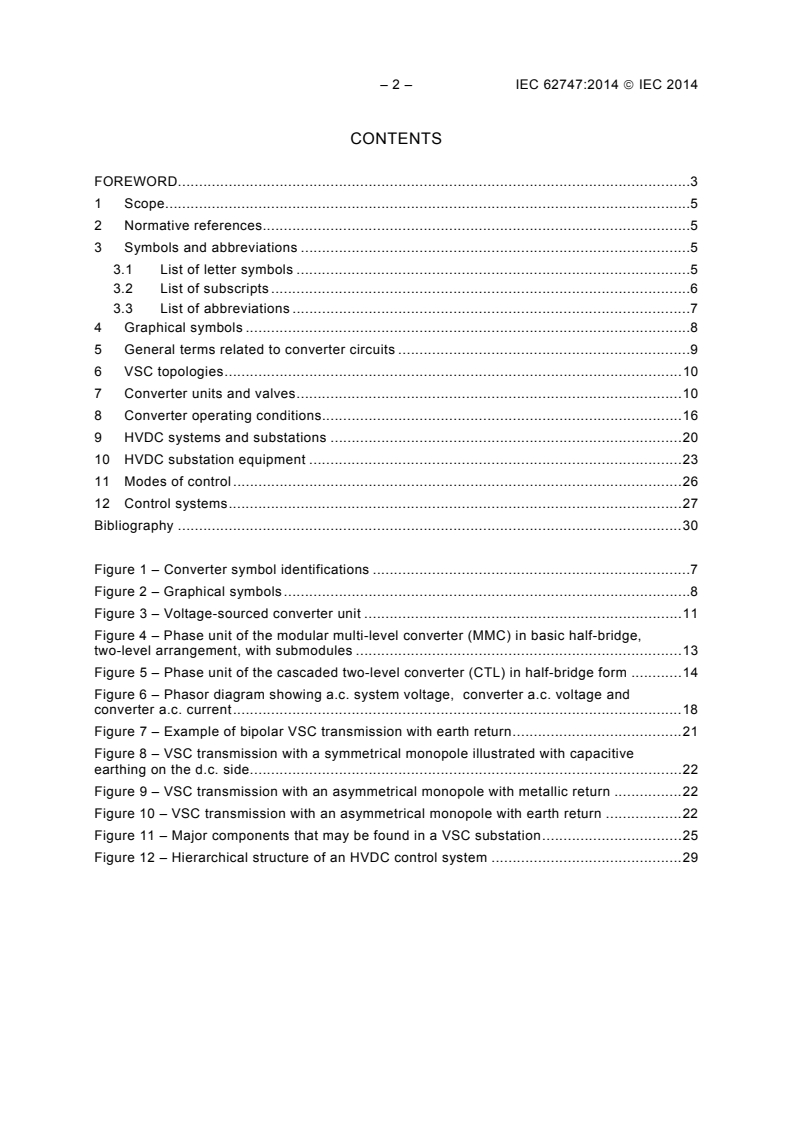
CONTENTS
FOREWORD . 3
1 Scope . 5
2 Normative references. 5
3 Symbols and abbreviations . 5
3.1 List of letter symbols . 5
3.2 List of subscripts . 6
3.3 List of abbreviations . 7
4 Graphical symbols . 8
5 General terms related to converter circuits . 9
6 VSC topologies . 10
7 Converter units and valves . 10
8 Converter operating conditions. 16
9 HVDC systems and substations . 20
10 HVDC substation equipment . 23
11 Modes of control . 26
12 Control systems . 27
Bibliography . . 30
Figure 1 – Converter symbol identifications . 7
Figure 2 – Graphical symbols . 8
Figure 3 – Voltage-sourced converter unit . 11
Figure 4 – Phase unit of the modular multi-level converter (MMC) in basic half-bridge,
two-level arrangement, with submodules . 13
Figure 5 – Phase unit of the cascaded two-level converter (CTL) in half-bridge form . 14
Figure 6 – Phasor diagram showing a.c. system voltage, converter a.c. voltage and
converter a.c. current . . 18
Figure 7 – Example of bipolar VSC transmission with earth return . 21
Figure 8 – VSC transmission with a symmetrical monopole illustrated with capacitive
earthing on the d.c. side . 22
Figure 9 – VSC transmission with an asymmetrical monopole with metallic return . 22
Figure 10 – VSC transmission with an asymmetrical monopole with earth return . 22
Figure 11 – Major components that may be found in a VSC substation . 25
Figure 12 – Hierarchical structure of an HVDC control system . 29
INTERNATIONAL ELECTROTECHNICAL COMMISSION
____________
TERMINOLOGY FOR VOLTAGE-SOURCED CONVERTERS (VSC)
FOR HIGH-VOLTAGE DIRECT CURRENT (HVDC) SYSTEMS
FOREWORD
1) The International Electrotechnical Commission (IEC) is a worldwide organization for standardization comprising
all national electrotechnical committees (IEC National Committees). The object of IEC is to promote
international co-operation on all questions concerning standardization in the electrical and electronic fields. To
this end and in addition to other activities, IEC publishes International Standards, Technical Specifications,
Technical Reports, Publicly Available Specifications (PAS) and Guides (hereafter referred to as “IEC
Publication(s)”). Their preparation is entrusted to technical committees; any IEC National Committee interested
in the subject dealt with may participate in this preparatory work. International, governmental and non-
governmental organizations liaising with the IEC also participate in this preparation. IEC collaborates closely
with the International Organization for Standardization (ISO) in accordance with conditions determined by
agreement between the two organizations.
2) The formal decisions or agreements of IEC on technical matters express, as nearly as possible, an international
consensus of opinion on the relevant subjects since each technical committee has representation from all
interested IEC National Committees.
3) IEC Publications have the form of recommendations for international use and are accepted by IEC National
Committees in that sense. While all reasonable efforts are made to ensure that the technical content of IEC
Publications is accurate, IEC cannot be held responsible for the way in which they are used or for any
misinterpretation by any end user.
4) In order to promote international uniformity, IEC National Committees undertake to apply IEC Publications
transparently to the maximum extent possible in their national and regional publications. Any divergence
between any IEC Publication and the corresponding national or regional publication shall be clearly indicated in
the latter.
5) IEC itself does not provide any attestation of conformity. Independent certification bodies provide conformity
assessment services and, in some areas, access to IEC marks of conformity. IEC is not responsible for any
services carried out by independent certification bodies.
6) All users should ensure that they have the latest edition of this publication.
7) No liability shall attach to IEC or its directors, employees, servants or agents including individual experts and
members of its technical committees and IEC National Committees for any personal injury, property damage or
other damage of any nature whatsoever, whether direct or indirect, or for costs (including legal fees) and
expenses arising out of the publication, use of, or reliance upon, this IEC Publication or any other IEC
Publications.
8) Attention is drawn to the Normative references cited in this publication. Use of the referenced publications is
indispensable for the correct application of this publication.
9) Attention is drawn to the possibility that some of the elements of this IEC Publication may be the subject of
patent rights. IEC shall not be held responsible for identifying any or all such patent rights.
International Standard IEC 62747 has been prepared by subcommittee 22F: Power
electronics for electrical transmission and distribution systems, of IEC technical committee 22:
Power electronic systems and equipment.
The text of this standard is based on the following documents:
CDV Report on voting
22F/301/CDV 22F/317A/RVC
Full information on the voting for the approval of this standard can be found in the report on
voting indicated in the above table.
This publication has been drafted in accordance with the ISO/IEC Directives, Part 2.
– 4 – IEC 62747:2014 IEC 2014
The committee has decided that the contents of this publication will remain unchanged until
the stability date indicated on the IEC web site under "http://webstore.iec.ch" in the data
related to the specific publication. At this date, the publication will be
• reconfirmed,
• withdrawn,
• replaced by a revised edition, or
• amended.
The contents of the corrigendum of February 2015 have been included in this copy.
IMPORTANT – The 'colour inside' logo on the cover page of this publication indicates
that it contains colours which are considered to be useful for the correct
understanding of its contents. Users should therefore print this document using a
colour printer.
TERMINOLOGY FOR VOLTAGE-SOURCED CONVERTERS (VSC)
FOR HIGH-VOLTAGE DIRECT CURRENT (HVDC) SYSTEMS
1 Scope
This International Standard defines terms for the subject of self-commutated voltage-sourced
converters used for transmission of power by high voltage direct current (HVDC).
The standard is written mainly for the case of application of insulated gate bipolar transistors
(IGBTs) in voltage sourced converters (VSC) but may also be used for guidance in the event
that other types of semiconductor devices which can both be turned on and turned off by
control action are used.
Line-commutated and current-sourced converters for high-voltage direct current (HVDC)
power transmission systems are specifically excluded from this standard.
2 Normative references
The following documents, in whole or in part, are normatively referenced in this document and
are indispensable for its application. For dated references, only the edition cited applies. For
undated references, the latest edition of the referenced document (including any
amendments) applies.
IEC 60027 (all parts), Letter symbols to be used in electrical technology
IEC 60617, Graphical symbols for diagrams
3 Symbols and abbreviations
3.1 List of letter symbols
Essential terms and definitions necessary for the understanding of this standard are given
here; other terminology is as per relevant parts of IEC 60747.
The list covers only the most frequently used symbols (see Figure 1). IEC 60027 shall be
used for a more complete list of the symbols which have been adopted for static converters.
See also other standards listed in the normative references and the bibliography.
U direct voltage
d
U converter d.c. voltage
dc
U pole-to-earth direct voltage
dpe
U pole-to-pole direct voltage
dpp
U rated pole-to-pole direct voltage
dppN
U rated pole-to-earth direct voltage
dpeN
U line-to-line voltage on line side of interface transformer, r.m.s. value including
L
harmonics
– 6 – IEC 62747:2014 IEC 2014
U line-to-earth voltage on line side of interface transformer, r.m.s. value including
Le
harmonics
U rated value of U
LN L
U line-to-line voltage on valve side of interface transformer, r.m.s. value including
v
harmonics
U line-to-earth voltage on valve side of interface transformer, r.m.s. value including
ve
harmonics
U line-to-line converter voltage, r.m.s. value including harmonics
c
NOTE U is equal to U minus the voltage drop across the phase and valve reactors. However, U has only a
c v c
clear meaning during balanced conditions (steady state).
U line-to-earth converter voltage , r.m.s. value including harmonics
ce
U voltage between terminals of a valve (any defined value)
valve
I direct current (any defined value)
d
I rated direct current
dN
I current on line side of interface transformer, r.m.s. value including harmonics
L
I rated value of I
LN L
I current on valve side of interface transformer, r.m.s. value including harmonics
ν
I current through a valve
νalve
3.2 List of subscripts
0 (zero) at no load
e earth
p pole
N rated value or at rated load
d direct current or voltage
L line side of interface transformer
c converter
v valve side of interface transformer
valve through or across one valve
max maximum
min minimum
n pertaining to harmonic component of order n
Positive d.c. terminal
I I
valve d
U
valve
U U U
Le ve dpe
U
c
U
ce
U
L
I
L I
v
U
dpp
U
v
transformer transformer
line side valve side
I
d
I
valve
Negative d.c. terminal
IEC
Figure 1 – Converter symbol identifications
3.3 List of abbreviations
The following abbreviations are always in capital letters and without dots.
CTL cascaded two-level converter
ERTB earth return transfer breaker
ESCR effective short-circuit ratio
FWD free-wheeling diode
HF high frequency
HVDC high-voltage direct current
IGBT insulated gate bipolar transistor
MMC modular multilevel converter
MRTB metallic return transfer breaker
MTDC multi-terminal HVDC transmission system
MVU multiple valve (unit)
NBS neutral bus switch
NGBS neutral bus grounding switch
PCC point of common coupling
PCC-DC point of common coupling – d.c. side
– 8 – IEC 62747:2014 IEC 2014
SCR short-circuit ratio
VBE valve base electronics
VCU valve control unit
VSC voltage-sourced converter
NOTE Even though the word “breaker” is used in the abbreviations, it does not necessarily imply the ability to
interrupt fault currents.
4 Graphical symbols
Figure 2 shows the specific graphical symbols which are defined only for the purposes of this
standard. IEC 60617 shall be used for a more complete list of the graphical symbols which
have been adopted for static converters.
IEC
Figure 2 – Graphical symbols
5 General terms related to converter circuits
5.1
conversion
in the context of HVDC, the transfer of energy from a.c. to d.c. or vice versa, or a combination
of these operations
5.2
converter
in the context of HVDC, the device employed to transfer of energy from a.c. to d.c. or vice
versa, it connects between three a.c. terminals and two d.c. terminals
5.3
voltage-sourced converter
VSC
electronic a.c./d.c. converter having an essentially smooth d.c. voltage provided by e.g. a
common d.c. link capacitor or distributed d.c. capacitors within the converter arms
5.4
arm
converter arm
part of a converter connecting the a.c. phase terminal with the d.c. pole terminal
5.5
commutation
transfer of current between any two paths with both paths carrying current simultaneously
during this process
5.6
line commutation
method of commutation whereby the commutating voltage is supplied by the a.c. system
5.7
self-commutation
commutation where the commutating voltage is supplied by components within the converter
or the electronic switch
5.8
commutating voltage
voltage which causes the current to commutate, provided either by the system or by a
switching action of valve/semiconductor devices
5.9
commutation inductance
total inductance included in the commutation circuit, in series with the commutating voltage
Note 1 to entry: The commutation inductance is typically referred as stray inductance or loop inductance.
5.10
coupling inductance
equivalent inductance referred to the converter side of the interface transformer between the
point of common coupling (PCC) and the d.c. terminal of the valve
– 10 – IEC 62747:2014 IEC 2014
6 VSC topologies
6.1
two-level converter
converter in which the voltage between the a.c. terminals of the VSC unit (see 7.6) and VSC
unit midpoint (see 7.28) is switched between two discrete d.c. voltage levels
6.2
three-level converter
converter in which the voltage between the a.c. terminals of the VSC unit (see 7.6) and VSC
unit midpoint (see 7.28) is switched between three discrete d.c. voltage levels
6.3
multi-level converter
converter in which the voltage between the a.c. terminals of the VSC unit (see 7.6) and VSC
unit midpoint (see 7.28) is switched between more than three discrete d.c. voltage levels
6.4
modular multi-level converter
MMC
multi-level converter in which each VSC valve (see 7.8, 7.9) consists of a number of MMC
building blocks (see 7.11) connected in series
Note 1 to entry: See also Figure 4.
6.5
cascaded two-level converter
CTL
modular multi-level converter in which each switch position consists of more than one IGBT-
diode pair connected in series
Note 1 to entry: See Figure 5.
7 Converter units and valves
7.1
turn-off semiconductor device
controllable semiconductor device which may be turned on and off by a control signal, for
example an IGBT
7.2
insulated gate bipolar transistor
IGBT
turn-off semiconductor device with three terminals: a gate terminal (G) and two load terminals
emitter (E) and collector (C)
7.3
free-wheeling diode
FWD
power semiconductor device with diode characteristic
Note 1 to entry: A FWD has two terminals: an anode (A) and a cathode (K).
Note 2 to entry: The current through FWDs is in the opposite direction to the IGBT current.
7.4
IGBT-diode pair
arrangement of IGBT and FWD connected in inverse parallel
Note 1 to entry: An IGBT-diode pair is usually in one common package, however, it can include individual IGBTs
and/or diodes packages connected in parallel.
7.5
converter unit
indivisible operative unit comprising all equipment between the point of common coupling on
the a.c. side (see 9.25) and the point of common coupling – d.c. side (see 9.26), essentially
one or more VSC units, together with one or more interface transformers, converter unit
control equipment, essential protective and switching devices and auxiliaries, if any, used for
conversion
Note 1 to entry: See Figure 3.
7.6
VSC unit
three VSC phase units, together with VSC unit control equipment, essential protective and
switching devices, d.c. storage capacitors, phase reactors and auxiliaries, if any, used for
conversion
Note 1 to entry: See Figure 3.
7.7
VSC phase unit
equipment used to connect the two d.c. terminals to one a.c. terminal
Note 1 to entry: In the simplest implementation, the VSC phase unit consists of two VSC valves, and in some
case, it may include also valve reactors. The VSC phase unit may also include control and protection equipment,
and other components.
7.8
VSC valve
arrangement of IGBT-diode pairs connected in series and arranged to be
switched simultaneously as a single function unit
VSC valveVSC valve VSC valveVSC valve VSC valveVSC valve
D.c.
capacitor
ValveValve ValveValve ValveValve
reactorsreactors reactorsreactors reactorsreactors
PhasePhase PhasePhase PhasePhase
reactorreactor reactorreactor reactorreactor
VSC valveVSC valve VSC valveVSC valve VSC valveVSC valve
Phase PhasePhase PhasePhase
unit unitunit unitunit
D.c. Protective Dynamic
Converter control
capacitor devices braking valve
IEC
Figure 3 – Voltage-sourced converter unit
Note 1 to entry: In some designs of VSC, the phase reactors may fulfill part of the function of the converter-side
high frequency filter. In addition, in some designs of VSC, part or all of the phase reactor may be built into the
three “phase units” of the VSC unit, as “valve reactors”.
Note 2 to entry: In some designs of VSC, the VSC d.c. capacitor may be partly or entirely distributed amongst the
three “phase units” of the VSC unit, where it is referred to as d.c. submodule capacitors.
Note 3 to entry: Valve and/or phase reactors shown above show optional configurations which may not be
included in all schemes.
– 12 – IEC 62747:2014 IEC 2014
Note 4 to entry: Just a typical example of how a VSC unit could look like is shown in Figure 3, differences may
exist at all levels.
7.9
VSC valve
complete controllable voltage source assembly, which is
generally connected between one a.c. terminal and one d.c. terminal
7.10
VSC valve level
the smallest indivisible functional unit of VSC valve
Note 1 to entry: For any VSC valve in which IGBTs are connected in series and operated simultaneously, one
VSC valve level is one IGBT-diode pair including its auxiliaries (see Figure 4). For MMC type without IGBT-diode
pairs connected in series, one valve level is one submodule together with its auxiliaries (see Figure 5).
7.11
MMC building block
self-contained, two-terminal controllable voltage source together with d.c. capacitor(s) and
immediate auxiliaries, forming part of a MMC
7.12
switch position
semiconductor function which behaves as a single, indivisible switch
Note 1 to entry: A switch position may consist of a single IGBT-diode pair or, in the case of the Cascaded Two
Level converter, a series connection of multiple IGBT-diode pairs.
7.13
submodule
MMC building block where each switch position consists of only one IGBT-diode pair
Note 1 to entry: See Figure 4.
P
Valve
MMC building block
= Submodule
= VSC valve level
Switch
position
AC
Valve
N
IEC
Figure 4 – Phase unit of the modular multi-level converter (MMC)
in basic half-bridge, two-level arrangement, with submodules
7.14
cell
MMC building block where each switch position consists of more than one IGBT-diode pair
connected in series
Note 1 to entry: See Figure 5.
– 14 – IEC 62747:2014 IEC 2014
P
Valve
VSC valve level
MMC building block
= Cell
Switch
position
AC
Valve
N
IEC
Figure 5 – Phase unit of the cascaded two-level converter (CTL) in half-bridge form
7.15
diode valve
semiconductor valve containing only diodes as the main semiconductor devices and
associated circuits and components if any, which might be used in some VSC topologies
7.16
diode valve level
part of a diode valve composed of a diode and associated circuits and components, if any
7.17
dynamic braking valve
complete controllable device assembly, which is used to control energy absorption in a
dynamic braking resistor
7.18
dynamic braking valve level
part of a dynamic braking valve comprising a turn-off semiconductor device and an associated
diode, or controllable switches and diodes connected in parallel, or turn-off semiconductor
devices and diodes connected to a half bridge arrangement, together with their immediate
auxiliaries, storage capacitor, if any
7.19
valve
VSC valve, dynamic braking valve or diode valve according to the context
7.20
redundant levels
the maximum number of series connected VSC valve levels or diode valve levels in a valve
that may be short-circuited externally or internally without affecting the safe operation of the
valve as demonstrated by type tests, and which if and when exceeded, would require
shutdown of the valve to replace the failed levels or acceptance of increased risk of failures
Note 1 to entry: In valve designs such as the cascaded two level converter, which contain two or more conduction
paths within each cell and have series-connected VSC valve levels in each path, redundant levels shall be counted
only in one conduction path in each cell.
7.21
d.c. capacitor
capacitor which is used as part of a voltage-sourced converter which experiences mainly d.c.
voltage between its terminals
Note 1 to entry: For valves of the controllable switch type, the d.c. capacitor is usually arranged as a single
device between the d.c. terminals. For valves of the controllable voltage-sourced type the d.c. capacitor is usually
distributed amongst the MMC building blocks.
7.22
valve reactor
reactor (if any) which is connected in series to a VSC valve of the controllable voltage-source
type
Note 1 to entry: One or more valve reactors can be associated to one VSC valve and might be connected at
different positions within the valve. According to the definition, valve reactors are not part of the VSC valve.
However, it is also possible to integrate the valve reactors in the structural design of the VSC valve, e.g. into each
valve level.
7.23
valve module
the largest factory-assembled and tested building block of the valve, consisting of one or
more VSC valve levels, submodules or cells connected electrically in series
7.24
valve structure
structural components of a valve, required in order to mechanically support the valve modules
7.25
valve support
that part of the valve which mechanically supports and electrically insulates the active part of
the valve from earth
Note 1 to entry: A part of a valve which is clearly identifiable in a discrete form to be a valve support may not
exist in all designs of valves.
– 16 – IEC 62747:2014 IEC 2014
7.26
multiple valve unit
MVU
mechanical arrangement of 2 or more valves or 1 or more VSC phase units sharing a common
valve support
Note 1 to entry: A MVU might not exist in all topologies and physical arrangement of converters.
7.27
valve section
electrical assembly defined for test purposes, comprising a number valve levels and other
components, which exhibits pro-rated electrical properties of a complete valve
Note 1 to entry: For valves of controllable voltage source type, the valve section includes d.c. capacitor in
addition to VSC valve levels.
7.28
VSC unit midpoint
point in a VSC unit whose electrical potential is equal to the average of the potentials of the
positive and negative d.c. terminals of the VSC unit
Note 1 to entry: In some applications, the VSC unit midpoint may exist only as a virtual point, not corresponding
to a physical node in the circuit.
8 Converter operating conditions
8.1
rectifier operation
rectification
mode of operation of a converter or an HVDC substation when energy is transferred from the
a.c. side to the d.c. side
Note 1 to entry: Phasor diagram showing a.c. system voltage, converter a.c. voltage and converter a.c. current for
rectifier operation is shown in Figure 6.
8.2
inverter operation
inversion
mode of operation of a converter or an HVDC substation when energy is transferred from the
d.c. side to the a.c. side
Note 1 to entry: Phasor diagram showing a.c. system voltage, converter a.c. voltage and converter a.c. current for
inverter operation is shown in Figure 6.
8.3
capacitive operation
operation in which the converter feeds reactive power into the a.c. system with or without
exchanging active power
8.4
inductive operation
operation in which the converter consums reactive power from the a.c. system with or without
exchanging active power
8.5
STATCOM operation
mode of operation of a converter when only reactive power (capacitive or inductive) is
exchanged with the a.c. system
8.6
operating state
condition in which the HVDC substation is energized and the converters are de-blocked
Note 1 to entry: Unlike line-commutated converter, VSC can operate with zero active/reactive power output.
8.7
no-load operating state
condition in which the HVDC substation is energized but the IGBTs are blocked and all
necessary substation service loads and auxiliary equipment are connected
8.8
idling operating state
condition in which the HVDC substation is energized and the IGBTs are de-blocked but with
no active or reactive power output at the point of common connection to the a.c. network
Note 1 to entry: The “idling operating” and “no-load” conditions are similar but from the no-load state, several
seconds may be needed before power can be transmitted, while from the idling operating state, power transmission
may be commenced almost immediately (less than 3 power frequency cycles).
Note 2 to entry: In the idling operating state, the converter is capable of actively controlling the d.c. voltage, in
contrast to the no-load state, where the behavior of the converter is essentially “passive”.
Note 3 to entry: Losses will generally be slightly lower in the no-load state than in the idling operating state,
therefore this operating mode is preferred where the arrangement of the VSC system permits it.
8.9
blocked state
condition in which all valves of the VSC unit are blocked
8.10
converter charging
transitional condition of the converter when the a.c. system voltage is applied to the converter
via a pre-insertion resistor
Note 1 to entry: Pre-insertion resistor may not be necessary in all applications.
8.11
modulation index
M
ratio of the peak line to ground a.c. converter voltage, to half of the converter d.c. terminal to
terminal voltage
2U
c1
M
U
dc
3
where
U is the r.m.s value of the fundamental frequency component of the line-to-line voltage U ;
c1 c
U is the output voltage of one VSC phase unit at its a.c. terminal;
c
U is the output voltage of one VSC phase unit at its d.c. terminals.
dc
Note 1 to entry: Some sources define modulation index in a different way such that a modulation index of 1 refers
to a square-wave output, which means that the modulation index can never exceed 1. The modulation index
according to that definition is given simply by M·(/4). However, that definition is relevant mainly to two-level
converters using pulse width modulation (PWM).
– 18 – IEC 62747:2014 IEC 2014
V =jX *I
LI L LI
U
CEI
U
LI
X
L
I
LI δ
R
δ
I
ϕ
R
I
LEI
ϕ
I
V
LI
U
U CEI
LEI
IEC
Figure 6 – Phasor diagram showing a.c. system voltage,
converter a.c. voltage and converter a.c. current
8.12
positive conducting state
condition of an IGBT-diode pair in which load current flows through the IGBT from collector to
emitter
8.13
negative conducting state
condition of an IGBT-diode pair in which load current flows through the free-wheeling diode
from anode to cathode
8.14
positive valve current
direction of current flow through the valve from positive d.c. terminal to negative d.c. terminal
or, in case of a diode valve, in the direction that forward biases the diode valve
8.15
negative valve current
direction of current flow through the valve from negative d.c. terminal to positive d.c. terminal
8.16
positive valve terminal
terminal of the valve that is closest to the positive d.c. terminal of the VSC unit
8.17
negative valve terminal
terminal of the valve that is closest to the negative d.c. terminal of the VSC unit
8.18
valve voltage
potential difference between the positive valve terminal and negative valve terminal
8.19
valve blocking state
condition of a valve when all IGBTs are turned off
8.20
IGBT gating
control action carried out to establish a current or interrupt a current in an IGBT
8.21
short-circuit failure mode
condition of an IGBT in which it is no longer capable of withstanding voltage but can safely
conduct current in either direction
8.22
MMC building block operating states
possible states under which MMC building blocks can be operated
8.22.1
bypassed
operating state where the IGBT(s) of one or more switch positions are turned on such that the
valve current does not flow through the cell/submodule d.c. capacitor
8.22.2
active
operating state where the IGBT(s) of one or more switch positions are turned on such that the
valve current flows through the cell/submodule d.c. capacitor
8.22.3
protectively bypassed
emergency operating state where the valve current flows through a protective device other
than the IGBT(s)/diode(s) in order to prevent damage to the MMC building block or its
components
Note 1 to entry: Protective bypassing may be used for either permanent or temporary conditions depending on the
type of fault.
8.22.4
converter blocking
operation to initiate a mode change from operating state to blocked state of a VSC unit
8.23
valve protective blocking
means of protecting the valve or converter from excessive electrical stress by the emergency
turn-off of all IGBTs in one or more valves
8.24
converter deblocking
operation to initiate a mode change from blocked state to operating state of a VSC unit
8.25
short-circuit ratio
SCR
ratio of the a.c network short-circuit level (in MVA) at 1 p.u. voltage at the point of connection
to the HVDC substation a.c. bus, to the rated d.c. power of the HVDC substation (in MW)
8.26
effective short-circuit ratio
ESCR
ratio of the a.c. network short-circuit level (in MVA) at 1 p.u. voltage at the point of connection
to the HVDC substation a.c. bus, reduced by the reactive power of the shunt capacitor banks
and a.c. filters, if any, connected to this point (in MVAr), to the rated d.c. power of the HVDC
substation (in MW)
– 20 – IEC 62747:2014 IEC 2014
9 HVDC systems and substations
9.1
HVDC system
electrical power system which transfers energy in the form of high-voltage direct current
between two or more a.c. buses
9.2
HVDC transmission system
HVDC system which transfers energy between two or more geographic locations
9.3
two-terminal HVDC transmission system
HVDC transmission system consisting of two HVDC transmission substations and the
connected HVDC transmission line(s)
9.4
multiterminal HVDC transmission system
MTDC
HVDC transmission system consisting of more than two separated HVDC substations and the
interconnecting HVDC transmission lines
9.5
symmetrical monopole
single VSC converter with symmetrical d.c. voltage output on the two terminals
Note 1 to entry: The term “symmetrical monopole” is used even though there are two polarities with d.c. voltages,
because with only one converter it is not possible to provide the redundancy which is normally associated with the
term “bipole”.
9.6
asymmetrical monopole
single VSC converter with asymmetrical d.c. voltage output on the two terminals, normally
with one terminal earthed
9.7
bipole
two or more VSC asymmetrical monopoles forming a bipolar d.c. circuit
9.8
parallel converter configuration
two or more converters located in the same substation and connected to the same a.c. and
d.c. transmission system connected in parallel
9.9
series converter configuration
two or more converters located in the same substation and connected to the same a.c. and
d.c. transmission systems, connected in parallel on the a.c. side and in series in the d.c. side
9.10
bi-directional HVDC system
HVDC system for the transfer of energy in either direction
9.11
uni-directional HVDC system
HVDC system for the transfer of energy in only one direction
Note 1 to entry: Most HVDC systems are inherently bi-directional. However, some systems may be optimized to
transmit power in only one preferred direction. Such systems may still be considered as “bi-directional”.
9.12
HVDC back-to-back system
HVDC system which transfers energy between a.c. buses at the same location
9.13
(HVDC) (system) pole
part of an HVDC system consisting of all the equipment in the HVDC substations and the
interconnecting transmission lines, if any, which during normal operation exhibit a common
direct voltage polarity with respect to earth
Note 1 to entry: See Figure 7.
9.14
(HVDC) (system) bipole
part of an HVDC system consisting of two HVDC system poles, which during normal
operation, exhibit opposite direct voltage polarities with respect to earth
9.15
bipolar (HVDC) system
HVDC system with two independently operable poles of opposite polarity with respect to earth
Pole
DC :Line or cable
~ ~
=
=
~ ~
DC :Line or cable
=
=
Pole
IEC
Figure 7 – Example of bipolar VSC transmission with earth return
9.16
earth return
operation mode in which the return current path between neutrals of the HVDC substations is
through the earth
9.17
metallic return
operation mode in which the return current path between neutrals of the HVDC substations is
through a dedicated conductor
Note 1 to entry: The metallic return conductor may be either a dedicated neutral conductor or another high
voltage conductor.
9.18
monopolar (HVDC system)
HVDC system with only one pole
– 22 – IEC 62747:2014 IEC 2014
9.19
symmetrical monopolar HVDC system
HVDC system consisting of a single converter unit or a parallel connection of two or more
converter units at each substation operated such that the two d.c. output terminals are at
symmetrical voltages with respect to earth
Note 1 to entry: See Figure 8.
IEC
Figure 8 – VSC transmission with a symmetrical monopole illustrated with capacitive
earthing on the d.c. side
9.20
asymmetrical monopolar HVDC system
HVDC system consisting of a single converter unit or a parallel connection of two or more
converter units at each substation operated such that one of the two d.c. output terminals of
at least one substation is earthed
Note 1 to entry: See Figures 9 and 10.
~ ~
=
=
IEC
Figure 9 – VSC transmission with an asymmetrical monopole with metallic return
~ ~
=
=
IEC
Figure 10 – VSC transmission with an asymmetrical monopole with earth return
9.21
HVDC substation
HVDC converter station
part of an HVDC system which consists of one or more converter units installed in a single
location together with buildings, reactors, filters, reactive power supply, co
...
IEC 62747 ®
Edition 1.1 2019-01
CONSOLIDATED VERSION
INTERNATIONAL
STANDARD
NORME
INTERNATIONALE
colour
inside
Terminology for voltage-sourced converters (VSC) for high-voltage direct
current (HVDC) systems
Terminologie relative aux convertisseurs de source de tension (VSC) des
systèmes en courant continu à haute tension (CCHT)
All rights reserved. Unless otherwise specified, no part of this publication may be reproduced or utilized in any form
or by any means, electronic or mechanical, including photocopying and microfilm, without permission in writing from
either IEC or IEC's member National Committee in the country of the requester. If you have any questions about IEC
copyright or have an enquiry about obtaining additional rights to this publication, please contact the address below or
your local IEC member National Committee for further information.
Droits de reproduction réservés. Sauf indication contraire, aucune partie de cette publication ne peut être reproduite
ni utilisée sous quelque forme que ce soit et par aucun procédé, électronique ou mécanique, y compris la photocopie
et les microfilms, sans l'accord écrit de l'IEC ou du Comité national de l'IEC du pays du demandeur. Si vous avez des
questions sur le copyright de l'IEC ou si vous désirez obtenir des droits supplémentaires sur cette publication, utilisez
les coordonnées ci-après ou contactez le Comité national de l'IEC de votre pays de résidence.
IEC Central Office Tel.: +41 22 919 02 11
3, rue de Varembé info@iec.ch
CH-1211 Geneva 20 www.iec.ch
Switzerland
About the IEC
The International Electrotechnical Commission (IEC) is the leading global organization that prepares and publishes
International Standards for all electrical, electronic and related technologies.
About IEC publications
The technical content of IEC publications is kept under constant review by the IEC. Please make sure that you have the
latest edition, a corrigendum or an amendment might have been published.
IEC publications search - webstore.iec.ch/advsearchform Electropedia - www.electropedia.org
The advanced search enables to find IEC publications by a The world's leading online dictionary on electrotechnology,
variety of criteria (reference number, text, technical containing more than 22 000 terminological entries in English
committee,…). It also gives information on projects, replaced and French, with equivalent terms in 16 additional languages.
and withdrawn publications. Also known as the International Electrotechnical Vocabulary
(IEV) online.
IEC Just Published - webstore.iec.ch/justpublished
Stay up to date on all new IEC publications. Just Published IEC Glossary - std.iec.ch/glossary
details all new publications released. Available online and 67 000 electrotechnical terminology entries in English and
once a month by email. French extracted from the Terms and Definitions clause of
IEC publications issued since 2002. Some entries have been
IEC Customer Service Centre - webstore.iec.ch/csc collected from earlier publications of IEC TC 37, 77, 86 and
If you wish to give us your feedback on this publication or CISPR.
need further assistance, please contact the Customer Service
Centre: sales@iec.ch.
A propos de l'IEC
La Commission Electrotechnique Internationale (IEC) est la première organisation mondiale qui élabore et publie des
Normes internationales pour tout ce qui a trait à l'électricité, à l'électronique et aux technologies apparentées.
A propos des publications IEC
Le contenu technique des publications IEC est constamment revu. Veuillez vous assurer que vous possédez l’édition la
plus récente, un corrigendum ou amendement peut avoir été publié.
Recherche de publications IEC - Electropedia - www.electropedia.org
webstore.iec.ch/advsearchform Le premier dictionnaire d'électrotechnologie en ligne au
La recherche avancée permet de trouver des publications IEC monde, avec plus de 22 000 articles terminologiques en
en utilisant différents critères (numéro de référence, texte, anglais et en français, ainsi que les termes équivalents dans
comité d’études,…). Elle donne aussi des informations sur les 16 langues additionnelles. Egalement appelé Vocabulaire
projets et les publications remplacées ou retirées. Electrotechnique International (IEV) en ligne.
IEC Just Published - webstore.iec.ch/justpublished Glossaire IEC - std.iec.ch/glossary
Restez informé sur les nouvelles publications IEC. Just 67 000 entrées terminologiques électrotechniques, en anglais
Published détaille les nouvelles publications parues. et en français, extraites des articles Termes et Définitions des
Disponible en ligne et une fois par mois par email. publications IEC parues depuis 2002. Plus certaines entrées
antérieures extraites des publications des CE 37, 77, 86 et
Service Clients - webstore.iec.ch/csc CISPR de l'IEC.
Si vous désirez nous donner des commentaires sur cette
publication ou si vous avez des questions contactez-nous:
sales@iec.ch.
IEC 62747 ®
Edition 1.1 2019-01
CONSOLIDATED VERSION
INTERNATIONAL
STANDARD
NORME
INTERNATIONALE
colour
inside
Terminology for voltage-sourced converters (VSC) for high-voltage direct
current (HVDC) systems
Terminologie relative aux convertisseurs de source de tension (VSC) des
systèmes en courant continu à haute tension (CCHT)
INTERNATIONAL
ELECTROTECHNICAL
COMMISSION
COMMISSION
ELECTROTECHNIQUE
INTERNATIONALE
ICS 29.200; 29.240.99 ISBN 978-2-8322-6484-3
IEC 62747 ®
Edition 1.1 2019-01
CONSOLIDATED VERSION
REDLINE VERSION
VERSION REDLINE
colour
inside
Terminology for voltage-sourced converters (VSC) for high-voltage direct
current (HVDC) systems
Terminologie relative aux convertisseurs de source de tension (VSC) des
systèmes en courant continu à haute tension (CCHT)
– 2 – IEC 62747:2014+AMD1:2019 CSV
IEC 2019
CONTENTS
FOREWORD . 3
1 Scope . 5
2 Normative references . 5
3 Symbols and abbreviations . 5
3.1 List of letter symbols . 5
3.2 List of subscripts . 6
3.3 List of abbreviations . 8
4 Graphical symbols . 9
5 General terms related to converter circuits . 10
6 VSC topologies . 11
7 Converter units and valves . 12
8 Converter operating conditions . 18
9 HVDC systems and substations . 22
10 HVDC substation equipment . 25
11 Modes of control . 28
12 Control systems . 29
Bibliography . 32
Figure 1 – Converter symbol identifications . 8
Figure 2 – Graphical symbols . 10
Figure 3 – Voltage-sourced converter unit . 13
Figure 4 – Phase unit of the modular multi-level converter (MMC) in basic half-bridge,
two-level arrangement, with submodules . 15
Figure 5 – Phase unit of the cascaded two-level converter (CTL) in half-bridge form . 16
Figure 6 – Phasor diagram showing a.c. system voltage, converter a.c. voltage and
converter a.c. current . 20
Figure 7 – Example of bipolar VSC transmission with earth return . 23
Figure 8 – VSC transmission with a symmetrical monopole illustrated with capacitive
earthing on the d.c. side . 24
Figure 9 – VSC transmission with an asymmetrical monopole with metallic return . 24
Figure 10 – VSC transmission with an asymmetrical monopole with earth return . 24
Figure 11 – Major components that may be found in a VSC substation . 27
Figure 12 – Hierarchical structure of an HVDC control system . 31
IEC 2019
INTERNATIONAL ELECTROTECHNICAL COMMISSION
____________
TERMINOLOGY FOR VOLTAGE-SOURCED CONVERTERS (VSC)
FOR HIGH-VOLTAGE DIRECT CURRENT (HVDC) SYSTEMS
FOREWORD
1) The International Electrotechnical Commission (IEC) is a worldwide organization for standardization comprising
all national electrotechnical committees (IEC National Committees). The object of IEC is to promote
international co-operation on all questions concerning standardization in the electrical and electronic fields. To
this end and in addition to other activities, IEC publishes International Standards, Technical Specifications,
Technical Reports, Publicly Available Specifications (PAS) and Guides (hereafter referred to as “IEC
Publication(s)”). Their preparation is entrusted to technical committees; any IEC National Committee interested
in the subject dealt with may participate in this preparatory work. International, governmental and non-
governmental organizations liaising with the IEC also participate in this preparation. IEC collaborates closely
with the International Organization for Standardization (ISO) in accordance with conditions determined by
agreement between the two organizations.
2) The formal decisions or agreements of IEC on technical matters express, as nearly as possible, an international
consensus of opinion on the relevant subjects since each technical committee has representation from all
interested IEC National Committees.
3) IEC Publications have the form of recommendations for international use and are accepted by IEC National
Committees in that sense. While all reasonable efforts are made to ensure that the technical content of IEC
Publications is accurate, IEC cannot be held responsible for the way in which they are used or for any
misinterpretation by any end user.
4) In order to promote international uniformity, IEC National Committees undertake to apply IEC Publications
transparently to the maximum extent possible in their national and regional publications. Any divergence
between any IEC Publication and the corresponding national or regional publication shall be clearly indicated in
the latter.
5) IEC itself does not provide any attestation of conformity. Independent certification bodies provide conformity
assessment services and, in some areas, access to IEC marks of conformity. IEC is not responsible for any
services carried out by independent certification bodies.
6) All users should ensure that they have the latest edition of this publication.
7) No liability shall attach to IEC or its directors, employees, servants or agents including individual experts and
members of its technical committees and IEC National Committees for any personal injury, property damage or
other damage of any nature whatsoever, whether direct or indirect, or for costs (including legal fees) and
expenses arising out of the publication, use of, or reliance upon, this IEC Publication or any other IEC
Publications.
8) Attention is drawn to the Normative references cited in this publication. Use of the referenced publications is
indispensable for the correct application of this publication.
9) Attention is drawn to the possibility that some of the elements of this IEC Publication may be the subject of
patent rights. IEC shall not be held responsible for identifying any or all such patent rights.
This consolidated version of the official IEC Standard and its amendment has been
prepared for user convenience.
IEC 62747 edition 1.1 contains the first edition (2014-07) [documents 22F/301/CDV and
22F/317A/RVC] and its corrigendum 1 (2015-02), and its amendment 1 (2019-01)
[documents 22F/481/CDV and 22F/489/RVC].
In this Redline version, a vertical line in the margin shows where the technical content
is modified by amendment 1. Additions are in green text, deletions are in strikethrough
red text. A separate Final version with all changes accepted is available in this
publication.
– 4 – IEC 62747:2014+AMD1:2019 CSV
IEC 2019
International Standard IEC 62747 has been prepared by subcommittee 22F: Power
electronics for electrical transmission and distribution systems, of IEC technical committee 22:
Power electronic systems and equipment.
This publication has been drafted in accordance with the ISO/IEC Directives, Part 2.
The committee has decided that the contents of the base publication and its amendment will
remain unchanged until the stability date indicated on the IEC web site under
"http://webstore.iec.ch" in the data related to the specific publication. At this date, the
publication will be
• reconfirmed,
• withdrawn,
• replaced by a revised edition, or
• amended.
IMPORTANT – The 'colour inside' logo on the cover page of this publication indicates
that it contains colours which are considered to be useful for the correct
understanding of its contents. Users should therefore print this document using a
colour printer.
IEC 2019
TERMINOLOGY FOR VOLTAGE-SOURCED CONVERTERS (VSC)
FOR HIGH-VOLTAGE DIRECT CURRENT (HVDC) SYSTEMS
1 Scope
This International Standard defines terms for the subject of self-commutated voltage-sourced
converters used for transmission of power by high voltage direct current (HVDC).
The standard is written mainly for the case of application of insulated gate bipolar transistors
(IGBTs) in voltage sourced converters (VSC) but may also be used for guidance in the event
that other types of semiconductor devices which can both be turned on and turned off by
control action are used.
Line-commutated and current-sourced converters for high-voltage direct current (HVDC)
power transmission systems are specifically excluded from this standard.
2 Normative references
The following documents, in whole or in part, are normatively referenced in this document and
are indispensable for its application. For dated references, only the edition cited applies. For
undated references, the latest edition of the referenced document (including any
amendments) applies.
IEC 60027 (all parts), Letter symbols to be used in electrical technology
IEC 60617, Graphical symbols for diagrams
IEC 60633, Terminology for high-voltage direct current (HVDC) transmission
3 Symbols and abbreviations
3.1 List of letter symbols
Essential terms and definitions necessary for the understanding of this standard are given
here; other terminology is as per relevant parts of IEC 60747, and as per IEC 60633 for
certain specialized types of equipment which are found mainly on line-commutated HVDC
schemes but may occasionally be included in VSC HVDC schemes.
The list covers only the most frequently used symbols (see Figure 1). IEC 60027 shall be
used for a more complete list of the symbols which have been adopted for static converters.
See also other standards listed in the normative references and the bibliography.
U direct voltage
d
U converter d.c. voltage
dc
U pole-to-earth direct voltage
dpe
U pole-to-pole direct voltage
dpp
U rated pole-to-pole direct voltage
dppN
U rated pole-to-earth direct voltage
dpeN
– 6 – IEC 62747:2014+AMD1:2019 CSV
IEC 2019
U line-to-line voltage on line side of interface transformer, r.m.s. value including
L
harmonics
U line-to-earth voltage on line side of interface transformer, r.m.s. value including
Le
harmonics
U rated value of U
LN L
U line-to-line voltage on valve side of interface transformer, r.m.s. value including
v
harmonics
U line-to-earth voltage on valve side of interface transformer, r.m.s. value including
ve
harmonics
U line-to-line converter voltage on converter side of interface transformer, r.m.s. value
c
including harmonics
NOTE U is equal to U minus the voltage drop across the phase and valve reactors. However, U has only a
c v c
clear meaning during balanced conditions (steady state).
U line-to-earth converter voltage on converter side of interface transformer, r.m.s.
ce
value including harmonics
U voltage between terminals of a valve (any defined value)
valve
U voltage between terminals of a valve (any defined value)
vtt
I current on converter side of interface transformer, r.m.s. value including harmonics
c
I direct current (any defined value)
d
I rated direct current
dN
I current on line side of interface transformer, r.m.s. value including harmonics
L
I rated value of I
LN L
I current on through a valve side of interface transformer, r.m.s. value including
ν
harmonics
I current through a valve
νalve
3.2 List of subscripts
0 (zero) at no load
e earth
p pole
N rated value or at rated load
d direct current or voltage
L line side of interface transformer
c converter side of interface transformer
v through or across one valve side of interface transformer
valve through or across one valve
max maximum
IEC 2019
min minimum
n pertaining to harmonic component of order n
tt terminal to terminal
– 8 – IEC 62747:2014+AMD1:2019 CSV
IEC 2019
Positive d.c. terminal
I I
valve d
U
valve
U U U
Le ve dpe
U
c
U
ce
U
L
I
L I
v
U
dpp
U
v
transformer transformer
line side valve side
I
d
I
valve
Negative d.c. terminal
IEC
Positive d.c. terminal
I I
v d
U
vtt
U U U
Le ce dpe
U
L
I
L I
c
U
dpp
U
c
Transformer Transformer
line side converter side
I
d
I
v
Negative d.c. terminal
IEC
Figure 1 – Converter symbol identifications
3.3 List of abbreviations
The following abbreviations are always in capital letters and without dots.
CTL cascaded two-level converter
IEC 2019
ERTB earth return transfer breaker
ESCR effective short-circuit ratio
FWD free-wheeling diode
HF high frequency
HVDC high-voltage direct current
IGBT insulated gate bipolar transistor
MMC modular multilevel converter
MRTB metallic return transfer breaker
MTDC multi-terminal HVDC transmission system
MVU multiple valve (unit)
NBS neutral bus switch
NGBS NBGS neutral bus grounding switch
PCC point of common coupling
PCC-DC point of common coupling – d.c. side
SCR short-circuit ratio
VBE valve base electronics
VCU valve control unit
VSC voltage-sourced converter
NOTE Even though the word “breaker” is used in the abbreviations, it does not necessarily imply the ability to
interrupt fault currents.
4 Graphical symbols
Figure 2 shows the specific graphical symbols which are defined only for the purposes of this
standard. IEC 60617 shall be used for a more complete list of the graphical symbols which
have been adopted for static converters.
– 10 – IEC 62747:2014+AMD1:2019 CSV
IEC 2019
IEC
Figure 2 – Graphical symbols
5 General terms related to converter circuits
5.1
conversion
in the context of HVDC, the transfer of energy from a.c. to d.c. or vice versa, or a combination
of these operations
5.2
converter
in the context of HVDC, the device employed to transfer of energy from a.c. to d.c. or vice
versa, it connects between three a.c. terminals and two d.c. terminals
5.3
voltage-sourced converter
VSC
electronic a.c./d.c. converter having an essentially smooth d.c. voltage provided by e.g. a
common d.c. link capacitor or distributed d.c. capacitors within the converter arms
IEC 2019
5.4
arm
converter arm
part of a converter connecting the one a.c. phase terminal with the one d.c. pole terminal
5.5
commutation
transfer of current between any two paths with both paths carrying current simultaneously
during this process
5.6
line commutation
method of commutation whereby the commutating voltage is supplied by the a.c. system
5.7
self-commutation
commutation where the commutating voltage is supplied by components within the converter
or the electronic switch
5.8
commutating voltage
voltage which causes the current to commutate, provided either by the system or by a
switching action of valve/semiconductor devices
5.9
commutation inductance
total inductance included in the commutation circuit, in series with the commutating voltage
Note 1 to entry: The commutation inductance is typically referred as stray inductance or loop inductance.
5.10
coupling inductance
equivalent inductance referred to the converter side of the interface transformer between the
point of common coupling (PCC) and the d.c. terminal of the valve
6 VSC topologies
6.1
two-level converter
converter in which the voltage between the a.c. terminals of the VSC unit (see 7.6) and VSC
unit midpoint (see 7.28) is switched between two discrete d.c. voltage levels
6.2
three-level converter
converter in which the voltage between the a.c. terminals of the VSC unit (see 7.6) and VSC
unit midpoint (see 7.28) is switched between three discrete d.c. voltage levels
6.3
multi-level converter
converter in which the voltage between the a.c. terminals of the VSC unit (see 7.6) and VSC
unit midpoint (see 7.28) is switched between more than three discrete d.c. voltage levels
6.4
modular multi-level converter
MMC
multi-level converter in which each VSC valve (see 7.8, 7.9) consists of a number of MMC
building blocks (see 7.11) connected in series
– 12 – IEC 62747:2014+AMD1:2019 CSV
IEC 2019
Note 1 to entry: See also Figure 4.
6.5
cascaded two-level converter
CTL
modular multi-level converter in which each switch position consists of more than one IGBT-
diode pair connected in series
Note 1 to entry: See Figure 5.
7 Converter units and valves
7.1
turn-off semiconductor device
controllable semiconductor device which may be turned on and off by a control signal, for
example an IGBT
7.2
insulated gate bipolar transistor
IGBT
turn-off semiconductor device with three terminals: a gate terminal (G) and two load terminals
emitter (E) and collector (C)
7.3
free-wheeling diode
FWD
power semiconductor device with diode characteristic
Note 1 to entry: A FWD has two terminals: an anode (A) and a cathode (K).
Note 2 to entry: The current through FWDs is in the opposite direction to the IGBT current.
7.4
IGBT-diode pair
arrangement of IGBT and FWD connected in inverse parallel
Note 1 to entry: An IGBT-diode pair is usually in one common package, however, it can include individual IGBTs
and/or diodes packages connected in parallel.
7.5
converter unit
indivisible operative unit comprising all equipment between the point of common coupling on
the a.c. side (see 9.25) and the point of common coupling – d.c. side (see 9.26), essentially
one or more VSC units, together with one or more interface transformers, converter unit
control equipment, essential protective and switching devices and auxiliaries, if any, used for
conversion
Note 1 to entry: See Figure 3.
7.6
VSC unit
three VSC phase units, together with VSC unit control equipment, essential protective and
switching devices, d.c. storage capacitors, phase reactors and auxiliaries, if any, used for
conversion
Note 1 to entry: See Figure 3.
7.7
VSC phase unit
equipment used to connect the two d.c. terminals to one a.c. terminal
IEC 2019
Note 1 to entry: In the simplest implementation, the VSC phase unit consists of two VSC valves, and in some
case, it may include also valve reactors. The VSC phase unit may also include control and protection equipment,
and other components.
7.8
VSC switch type valve
arrangement of IGBT-diode pairs connected in series and arranged to be
switched simultaneously as a single function unit
VSC valveVSC valve VSC valveVSC valve VSC valveVSC valve
D.c.
capacitor
ValveValve ValveValve ValveValve
reactorsreactors reactorsreactors reactorsreactors
PhasePhase PhasePhase PhasePhase
reactorreactor reactorreactor reactorreactor
VSC valveVSC valve VSC valveVSC valve VSC valveVSC valve
Phase PhasePhase PhasePhase
unit unitunit unitunit
D.c. Protective Dynamic
Converter control
capacitor devices braking valve
IEC
Figure 3 – Voltage-sourced converter unit
Note 1 to entry: In some designs of VSC, the phase reactors may fulfill part of the function of the converter-side
high frequency filter. In addition, in some designs of VSC, part or all of the phase reactor may be built into the
three “phase units” of the VSC unit, as “valve reactors”.
Note 2 to entry: In some designs of VSC, the VSC d.c. capacitor may be partly or entirely distributed amongst the
three “phase units” of the VSC unit, where it is referred to as d.c. submodule capacitors.
Note 3 to entry: Valve and/or phase reactors shown above show optional configurations which may not be
included in all schemes.
Note 4 to entry: Just a typical example of how a VSC unit could look like is shown in Figure 3, differences may
exist at all levels.
7.9
VSC controllable voltage source type valve
complete controllable voltage source assembly, which is
generally connected between one a.c. terminal and one d.c. terminal
7.10
VSC valve level
the smallest indivisible functional unit of VSC valve
Note 1 to entry: For any VSC valve in which IGBTs are connected in series and operated simultaneously, one
VSC valve level is one IGBT-diode pair including its auxiliaries (see Figure 4). For MMC type without IGBT-diode
pairs connected in series, one valve level is one submodule together with its auxiliaries (see Figure 5).
7.11
MMC building block
self-contained, two-terminal controllable voltage source together with d.c. capacitor(s) and
immediate auxiliaries, forming part of a MMC
– 14 – IEC 62747:2014+AMD1:2019 CSV
IEC 2019
7.12
switch position
semiconductor function which behaves as a single, indivisible switch
Note 1 to entry: A switch position may consist of a single IGBT-diode pair or, in the case of the Cascaded Two
Level converter, a series connection of multiple IGBT-diode pairs.
7.13
submodule
MMC building block where each switch position consists of only one IGBT-diode pair
Note 1 to entry: See Figure 4.
IEC 2019
P
Valve
MMC building block
= Submodule
= VSC valve level
Switch
position
AC
Valve
N
IEC
Figure 4 – Phase unit of the modular multi-level converter (MMC)
in basic half-bridge, two-level arrangement, with submodules
7.14
cell
MMC building block where each switch position consists of more than one IGBT-diode pair
connected in series
Note 1 to entry: See Figure 5.
– 16 – IEC 62747:2014+AMD1:2019 CSV
IEC 2019
P
Valve
VSC valve level
MMC building block
= Cell
Switch
position
AC
Valve
N
IEC
Figure 5 – Phase unit of the cascaded two-level converter (CTL) in half-bridge form
7.15
diode valve
semiconductor valve containing only diodes as the main semiconductor devices and
associated circuits and components if any, which might be used in some VSC topologies
7.16
diode valve level
part of a diode valve composed of a diode and associated circuits and components, if any
7.17
dynamic braking valve
complete controllable device assembly, which is used to control energy absorption in a
dynamic braking resistor
IEC 2019
7.18
dynamic braking valve level
part of a dynamic braking valve comprising a turn-off semiconductor device and an associated
diode, or controllable switches and diodes connected in parallel, or turn-off semiconductor
devices and diodes connected to a half bridge arrangement, together with their immediate
auxiliaries, storage capacitor, if any
7.19
valve
VSC valve, dynamic braking valve or diode valve according to the context
7.20
redundant levels
the maximum number of series connected VSC valve levels or diode valve levels in a valve
that may be short-circuited externally or internally without affecting the safe operation of the
valve as demonstrated by type tests, and which if and when exceeded, would require
shutdown of the valve to replace the failed levels or acceptance of increased risk of failures
Note 1 to entry: In valve designs such as the cascaded two level converter, which contain two or more conduction
paths within each cell and have series-connected VSC valve levels in each path, redundant levels shall be counted
only in one conduction path in each cell.
7.21
d.c. capacitor
capacitor which is used as part of a voltage-sourced converter which experiences mainly d.c.
voltage between its terminals
Note 1 to entry: For valves of the controllable switch type, the d.c. capacitor is usually arranged as a single
device between the d.c. terminals. For valves of the controllable voltage-sourced type the d.c. capacitor is usually
distributed amongst the MMC building blocks.
7.22
valve reactor
reactor (if any) which is connected in series to a VSC valve of the controllable voltage-source
type
Note 1 to entry: One or more valve reactors can be associated to one VSC valve and might be connected at
different positions within the valve. According to the definition, valve reactors are not part of the VSC valve.
However, it is also possible to integrate the valve reactors in the structural design of the VSC valve, e.g. into each
valve level.
7.23
valve module
the largest factory-assembled and tested building block of the valve, consisting of one or
more VSC valve levels, submodules or cells connected electrically in series
7.24
valve structure
structural components of a valve, required in order to mechanically support the valve modules
7.25
valve support
that part of the valve which mechanically supports and electrically insulates the active part of
the valve from earth
Note 1 to entry: A part of a valve which is clearly identifiable in a discrete form to be a valve support may not
exist in all designs of valves.
– 18 – IEC 62747:2014+AMD1:2019 CSV
IEC 2019
7.26
multiple valve unit
MVU
mechanical arrangement of 2 or more valves or 1 or more VSC phase units sharing a common
valve support
Note 1 to entry: A MVU might not exist in all topologies and physical arrangement of converters.
7.27
valve section
electrical assembly defined for test purposes, comprising a number valve levels and other
components, which exhibits pro-rated electrical properties of a complete valve
Note 1 to entry: For valves of controllable voltage source type, the valve section includes d.c. capacitor in
addition to VSC valve levels.
7.28
VSC unit midpoint
point in a VSC unit whose electrical potential is equal to the average of the potentials of the
positive and negative d.c. terminals of the VSC unit
Note 1 to entry: In some applications, the VSC unit midpoint may exist only as a virtual point, not corresponding
to a physical node in the circuit.
8 Converter operating conditions
8.1
rectifier operation
rectification
mode of operation of a converter or an HVDC substation when energy is transferred from the
a.c. side to the d.c. side
Note 1 to entry: Phasor diagram showing a.c. system voltage, converter a.c. voltage and converter a.c. current for
rectifier operation is shown in Figure 6.
8.2
inverter operation
inversion
mode of operation of a converter or an HVDC substation when energy is transferred from the
d.c. side to the a.c. side
Note 1 to entry: Phasor diagram showing a.c. system voltage, converter a.c. voltage and converter a.c. current for
inverter operation is shown in Figure 6.
8.3
capacitive operation
operation in which the converter feeds reactive power into the a.c. system with or without
exchanging active power
8.4
inductive operation
operation in which the converter consums reactive power from the a.c. system with or without
exchanging active power
8.5
STATCOM operation
mode of operation of a converter when only reactive power (capacitive or inductive) is
exchanged with the a.c. system
IEC 2019
8.6
operating state
condition in which the HVDC substation is energized and the converters are de-blocked
Note 1 to entry: Unlike line-commutated converter, VSC can operate with zero active/reactive power output.
8.7
no-load operating state
condition in which the HVDC substation is energized but the IGBTs are blocked and all
necessary substation service loads and auxiliary equipment are connected
8.8
idling operating state
condition in which the HVDC substation is energized and the IGBTs are de-blocked but with
no active or reactive power output at the point of common connection to the a.c. network
Note 1 to entry: The “idling operating” and “no-load” conditions are similar but from the no-load state, several
seconds may be needed before power can be transmitted, while from the idling operating state, power transmission
may be commenced almost immediately (less than 3 power frequency cycles).
Note 2 to entry: In the idling operating state, the converter is capable of actively controlling the d.c. voltage, in
contrast to the no-load state, where the behavior of the converter is essentially “passive”.
Note 3 to entry: Losses will generally be slightly lower in the no-load state than in the idling operating state,
therefore this operating mode is preferred where the arrangement of the VSC system permits it.
8.9
blocked state
condition in which all valves of the VSC unit are blocked turn-off signal is applied continuously
to all IGBTs of the VSC unit
8.10
converter charging
transitional condition of the converter when the a.c. system voltage is applied to the converter
via a pre-insertion resistor
Note 1 to entry: Pre-insertion resistor may not be necessary in all applications.
8.11
modulation index
M
ratio of the peak line to ground a.c. converter voltage, to half of the converter d.c. terminal to
terminal voltage
2⋅U
c1
M=
U
dc
3⋅
where
U is the r.m.s value of the fundamental frequency component of the line-to-line voltage U ;
c1 c
U is the output voltage of one VSC phase unit at its a.c. terminal;
c
U is the output voltage of one VSC phase unit at its d.c. terminals.
dc
Note 1 to entry: Some sources define modulation index in a different way such that a modulation index of 1 refers
to a square-wave output, which means that the modulation index can never exceed 1. The modulation index
according to that definition is given simply by M·(π/4). However, that definition is relevant mainly to two-level
converters using pulse width modulation (PWM).
– 20 – IEC 62747:2014+AMD1:2019 CSV
IEC 2019
V =jX *I
LI L LI
U
CEI
U
LI
X
L
I
LI δ
R
δ
I
ϕ
R
I
LEI
ϕ
I
V
LI
U
U CEI
LEI
IEC
Figure 6 – Phasor diagram showing a.c. system voltage,
converter a.c. voltage and converter a.c. current
8.12
positive conducting state
condition of an IGBT-diode pair in which load current flows through the IGBT from collector to
emitter
8.13
negative conducting state
condition of an IGBT-diode pair in which load current flows through the free-wheeling diode
from anode to cathode
8.14
positive valve current
direction of current flow through the valve from positive d.c. terminal to negative d.c. terminal
or, in case of a diode valve, in the direction that forward biases the diode valve
8.15
negative valve current
direction of current flow through the valve from negative d.c. terminal to positive d.c. terminal
8.16
positive valve terminal
terminal of the valve that is closest to the positive d.c. terminal of the VSC unit
8.17
negative valve terminal
terminal of the valve that is closest to the negative d.c. terminal of the VSC unit
8.18
valve voltage
potential difference between the positive valve terminal and negative valve terminal
8.19
valve blocking state
condition of a valve when all IGBTs are turned off
8.20
IGBT gating
control action carried out to establish a current or interrupt a current in an IGBT
IEC 2019
8.21
short-circuit failure mode
condition of an IGBT in which it is no longer capable of withstanding voltage but can safely
conduct current in either direction
8.22
MMC building block operating states
possible states under which MMC building blocks can be operated
8.22.1
bypassed
operating state where the IGBT(s) of one or more switch positions are turned on such that the
valve current does not flow through the cell/submodule d.c. capacitor
8.22.2
active
operating state where the IGBT(s) of one or more switch positions are turned on such that the
valve current flows through the cell/submodule d.c. capacitor
8.22.3
protectively bypassed
emergency operating state where the valve current flows through a protective device other
than the IGBT(s)/diode(s) in order to prevent damage to the MMC building block or its
components
Note 1 to entry: Protective bypassing may be used for either permanent or temporary conditions depending on the
type of fault.
8.22.4
converter blocking
operation to initiate a mode change from operating state to blocked state of a VSC unit
8.23
valve protective blocking
means of protecting the valve or converter from excessive electrical stress by the emergency
turn-off of all IGBTs in one or more valves
8.24
converter deblocking
operation to initiate a mode change from blocked state to operating state of a VSC unit
8.25
short-circuit ratio
SCR
ratio of the a.c network short-circuit level (in MVA) at 1 p.u. voltage at the point of connection
to the HVDC substation a.c. bus, to the rated d.c. power of the HVDC substation (in MW)
8.26
effective short-circuit ratio
ESCR
ratio of the a.c. network short-circuit level (in MVA) at 1 p.u. voltage at the point of connection
to the HVDC substation a.c. bus, reduced by the reactive power of the shunt capacitor banks
and a.c. filters, if any, connected to this point (in MVAr), to the rated d.c. power of the HVDC
substation (in MW)
– 22 – IEC 62747:2014+AMD1:2019 CSV
IEC 2019
9 HVDC systems and substations
9.1
HVDC system
electrical power system which transfers energy in the form of high-voltage direct current
between two or more a.c. buses
9.2
HVDC transmission system
HVDC system which transfers energy between two or more geographic locations
9.3
two-terminal HVDC transmission system
HVDC transmission system consisting of two HVDC transmission substations and the
connected HVDC transmission line(s)
9.4
multiterminal HVDC transmission system
MTDC
HVDC transmission system consisting of more than two separated HVDC substations and the
interconnecting HVDC transmission lines
9.5
symmetrical monopole
single VSC converter with symmetrical d.c. voltage output on the two terminals
Note 1 to entry: The term “symmetrical monopole” is used even though there are two polarities with d.c. voltages,
because with only one converter it is not possible to provide the redundancy which is normally associated with the
term “bipole”.
9.6
asymmetrical monopole
single VSC converter with asymmetrical d.c. voltage output on the two terminals, normally
with one terminal earthed
9.7
bipole
two or more VSC asymmetrical monopoles forming a bipolar d.c. circuit
9.8
parallel converter configuration
two or more converters located in the same substation and connected to the same a.c. and
d.c. transmission system connected in parallel
9.9
series converter configuration
two or more converters located in the same substation and connected to the same a.c. and
d.c. transmission systems, connected in parallel on the a.c. side and in series in the d.c. side
9.10
bi-directional HVDC system
HVDC system for the transfer of energy in either direction
9.11
uni-directional HVDC system
HVDC system for the transfer of energy in only one direction
Note 1 to entry: Most HVDC systems are inherently bi-directional. However, some systems may be optimized to
transmit power in only one preferred direction. Such systems may still be considered as “bi-directional”.
IEC 2019
9.12
HVDC back-to-back system
HVDC system which transfers energy between a.c. buses at the same location
9.13
(HVDC) (system) pole
part of an HVDC system consisting of all the equipment in the HVDC substations and the
interconnecting transmission lines, if any, which during normal operation exhibit a common
direct voltage polarity with respect to earth
Note 1 to entry: See Figure 7.
9.14
(HVDC) (system) bipole
part of an HVDC system consisting of two HVDC system poles, which during normal
operation, exhibit opposite direct voltage polarities with respect to earth
9.15
bipolar (HVDC) system
HVDC system with two independently operable poles of opposite polarity with respect to earth
Pole
DC :Line or cable
~ ~
=
=
~ ~
DC :Line or cable
=
=
Pole
IEC
Figure 7 – Example of bipolar VSC transmission with earth return
9.16
earth return
operation mode in which the return current path between neutrals of the HVDC substations is
through
...