


CLC/TS 50654-1:2020
(Main)HVDC Grid Systems and connected Converter Stations - Guideline and Parameter Lists for Functional Specifications - Part 1: Guidelines
General Information
- Abstract
1.1 General These Guidelines and Parameter Lists to Functional Specifications describe specific functional requirements for HVDC Grid Systems. The terminology "HVDC Grid Systems" is used here describing HVDC systems for power transmission having more than two converter stations connected to a common DC circuit. While this document focuses on requirements, that are specific for HVDC Grid Systems, some requirements are considered applicable to all HVDC systems in general, i.e. including point-to-point HVDC systems. Existing IEC, Cigré or other documents relevant have been used for reference as far as possible. Corresponding to electric power transmission applications, this document is applicable to high voltage systems, i.e. having typically nominal DC voltages higher than 50 kV with respect to earth are considered in this document. NOTE: While the physical principles of DC networks are basically voltage independent, the technical options for designing equipment get much wider with lower DC voltage levels, e.g. in case of converters or switchgear. Both parts have the same outline and headlines to aid the reader. 1.2 About the Present Release The present release of the Guidelines and Parameter Lists for Functional Specifications describes technical guidelines and specifications for HVDC Grid Systems which are characterized by having exactly one single connection between two converter stations, often referred to as radial systems. When developing the requirements for radial systems, care is taken not to build up potential showstoppers for meshed systems. Meshed HVDC Grid Systems can be included into this specification at a later point in time. The Guidelines and Parameter List to the Functional Specification of HVDC Grid Systems cover technical aspects of: - coordination of HVDC grid and AC systems - HVDC Grid System characteristics - HVDC Grid System control - HVDC Grid System protection - AC/DC converter stations - HVDC Grid System installations, including DC switching stations - models and validation - HVDC Grid System integration tests Beyond the present scope, the following content is proposed for future work: - transmission lines and transition stations - DC/DC converter stations - DC line power flow controllers
- Status
- Withdrawn
- Publication Date
- 18-Jun-2020
- Technical Committee
- CLC/TC 8X - System aspects of electrical energy supply
- Drafting Committee
- CLC/TC 8X/WG 06 - System aspects for HVDC grid
- Current Stage
- 9960 - Withdrawal effective - Withdrawal
- Start Date
- 12-Sep-2025
- Completion Date
- 25-Aug-2026

Relations
- Effective Date
- 07-Jun-2022
- Effective Date
- 29-Oct-2024
- Effective Date
- 10-Feb-2026
- Effective Date
- 10-Feb-2026
- Effective Date
- 10-Feb-2026
- Effective Date
- 10-Feb-2026
- Effective Date
- 09-Feb-2026
- Effective Date
- 03-Feb-2026
- Effective Date
- 03-Feb-2026
- Effective Date
- 03-Feb-2026
- Effective Date
- 03-Feb-2026
Get Certified
Connect with accredited certification bodies for this standard

IMQ S.p.A. (Certification)
Italian electrical product certification.

SLG Prüf- und Zertifizierungs GmbH
German testing and certification body.

UL Solutions
Global safety science company with testing, inspection and certification.
Sponsored listings
Frequently Asked Questions
CLC/TS 50654-1:2020 is a technical specification published by CLC. Its full title is "HVDC Grid Systems and connected Converter Stations - Guideline and Parameter Lists for Functional Specifications - Part 1: Guidelines". This standard covers: 1.1 General These Guidelines and Parameter Lists to Functional Specifications describe specific functional requirements for HVDC Grid Systems. The terminology "HVDC Grid Systems" is used here describing HVDC systems for power transmission having more than two converter stations connected to a common DC circuit. While this document focuses on requirements, that are specific for HVDC Grid Systems, some requirements are considered applicable to all HVDC systems in general, i.e. including point-to-point HVDC systems. Existing IEC, Cigré or other documents relevant have been used for reference as far as possible. Corresponding to electric power transmission applications, this document is applicable to high voltage systems, i.e. having typically nominal DC voltages higher than 50 kV with respect to earth are considered in this document. NOTE: While the physical principles of DC networks are basically voltage independent, the technical options for designing equipment get much wider with lower DC voltage levels, e.g. in case of converters or switchgear. Both parts have the same outline and headlines to aid the reader. 1.2 About the Present Release The present release of the Guidelines and Parameter Lists for Functional Specifications describes technical guidelines and specifications for HVDC Grid Systems which are characterized by having exactly one single connection between two converter stations, often referred to as radial systems. When developing the requirements for radial systems, care is taken not to build up potential showstoppers for meshed systems. Meshed HVDC Grid Systems can be included into this specification at a later point in time. The Guidelines and Parameter List to the Functional Specification of HVDC Grid Systems cover technical aspects of: - coordination of HVDC grid and AC systems - HVDC Grid System characteristics - HVDC Grid System control - HVDC Grid System protection - AC/DC converter stations - HVDC Grid System installations, including DC switching stations - models and validation - HVDC Grid System integration tests Beyond the present scope, the following content is proposed for future work: - transmission lines and transition stations - DC/DC converter stations - DC line power flow controllers
1.1 General These Guidelines and Parameter Lists to Functional Specifications describe specific functional requirements for HVDC Grid Systems. The terminology "HVDC Grid Systems" is used here describing HVDC systems for power transmission having more than two converter stations connected to a common DC circuit. While this document focuses on requirements, that are specific for HVDC Grid Systems, some requirements are considered applicable to all HVDC systems in general, i.e. including point-to-point HVDC systems. Existing IEC, Cigré or other documents relevant have been used for reference as far as possible. Corresponding to electric power transmission applications, this document is applicable to high voltage systems, i.e. having typically nominal DC voltages higher than 50 kV with respect to earth are considered in this document. NOTE: While the physical principles of DC networks are basically voltage independent, the technical options for designing equipment get much wider with lower DC voltage levels, e.g. in case of converters or switchgear. Both parts have the same outline and headlines to aid the reader. 1.2 About the Present Release The present release of the Guidelines and Parameter Lists for Functional Specifications describes technical guidelines and specifications for HVDC Grid Systems which are characterized by having exactly one single connection between two converter stations, often referred to as radial systems. When developing the requirements for radial systems, care is taken not to build up potential showstoppers for meshed systems. Meshed HVDC Grid Systems can be included into this specification at a later point in time. The Guidelines and Parameter List to the Functional Specification of HVDC Grid Systems cover technical aspects of: - coordination of HVDC grid and AC systems - HVDC Grid System characteristics - HVDC Grid System control - HVDC Grid System protection - AC/DC converter stations - HVDC Grid System installations, including DC switching stations - models and validation - HVDC Grid System integration tests Beyond the present scope, the following content is proposed for future work: - transmission lines and transition stations - DC/DC converter stations - DC line power flow controllers
CLC/TS 50654-1:2020 is classified under the following ICS (International Classification for Standards) categories: 29.240.01 - Power transmission and distribution networks in general. The ICS classification helps identify the subject area and facilitates finding related standards.
CLC/TS 50654-1:2020 has the following relationships with other standards: It is inter standard links to CLC/TS 50654-1:2018, CLC IEC/TS 63291-1:2025, IEC 62271-100:2021, IEC 62747:2014, IEC 62747:2014/AMD1:2019, IEC 62271-102:2018, EN 660-1:1999/A1:2003, EN 60909-3:2003, EN 61660-1:1997, EN 60909-3:2010, EN 60909-0:2016. Understanding these relationships helps ensure you are using the most current and applicable version of the standard.
CLC/TS 50654-1:2020 is available in PDF format for immediate download after purchase. The document can be added to your cart and obtained through the secure checkout process. Digital delivery ensures instant access to the complete standard document.
Standards Content (Sample)
SLOVENSKI STANDARD
01-september-2020
Nadomešča:
SIST-TS CLC/TS 50654-1:2018
Sistemi visokonapetostnega enosmernega omrežja in priključene pretvorniške
postaje - Smernice in seznam parametrov za funkcijsko specifikacijo - 1. del:
Smernice
HVDC Grid Systems and connected Converter Stations - Guideline and Parameter Lists
for Functional Specifications - Part 1: Guidelines
Hochspannungsgleichstrom-Netzsysteme - Leitfaden und Parameter-Listen für
funktionale Spezifikationen - Teil 1: Leitfaden
Réseaux CCHT et stations de conversion connectées - Lignes directrices et listes de
paramètres pour les spécifications fonctionnelles - Partie 1: Lignes directrices
Ta slovenski standard je istoveten z: CLC/TS 50654-1:2020
ICS:
29.240.01 Omrežja za prenos in Power transmission and
distribucijo električne energije distribution networks in
na splošno general
2003-01.Slovenski inštitut za standardizacijo. Razmnoževanje celote ali delov tega standarda ni dovoljeno.
TECHNICAL SPECIFICATION CLC/TS 50654-1
SPÉCIFICATION TECHNIQUE
TECHNISCHE SPEZIFIKATION
June 2020
ICS 29.240.01 Supersedes CLC/TS 50654-1:2018
English Version
HVDC Grid Systems and connected Converter Stations -
Guideline and Parameter Lists for Functional Specifications -
Part 1: Guidelines
Réseaux CCHT et stations de conversion connectées - Hochspannungsgleichstrom-Netzsysteme - Leitfaden und
Lignes directrices et listes de paramètres pour les Parameter-Listen für funktionale Spezifikationen - Teil 1:
spécifications fonctionnelles - Partie 1: Lignes directrices Leitfaden
This Technical Specification was approved by CENELEC on 2020-04-13.
CENELEC members are required to announce the existence of this TS in the same way as for an EN and to make the TS available promptly
at national level in an appropriate form. It is permissible to keep conflicting national standards in force.
CENELEC members are the national electrotechnical committees of Austria, Belgium, Bulgaria, Croatia, Cyprus, the Czech Republic,
Denmark, Estonia, Finland, France, Germany, Greece, Hungary, Iceland, Ireland, Italy, Latvia, Lithuania, Luxembourg, Malta, the
Netherlands, Norway, Poland, Portugal, Republic of North Macedonia, Romania, Serbia, Slovakia, Slovenia, Spain, Sweden, Switzerland,
Turkey and the United Kingdom.
European Committee for Electrotechnical Standardization
Comité Européen de Normalisation Electrotechnique
Europäisches Komitee für Elektrotechnische Normung
CEN-CENELEC Management Centre: Rue de la Science 23, B-1040 Brussels
© 2020 CENELEC All rights of exploitation in any form and by any means reserved worldwide for CENELEC Members.
Ref. No. CLC/TS 50654-1:2020 E
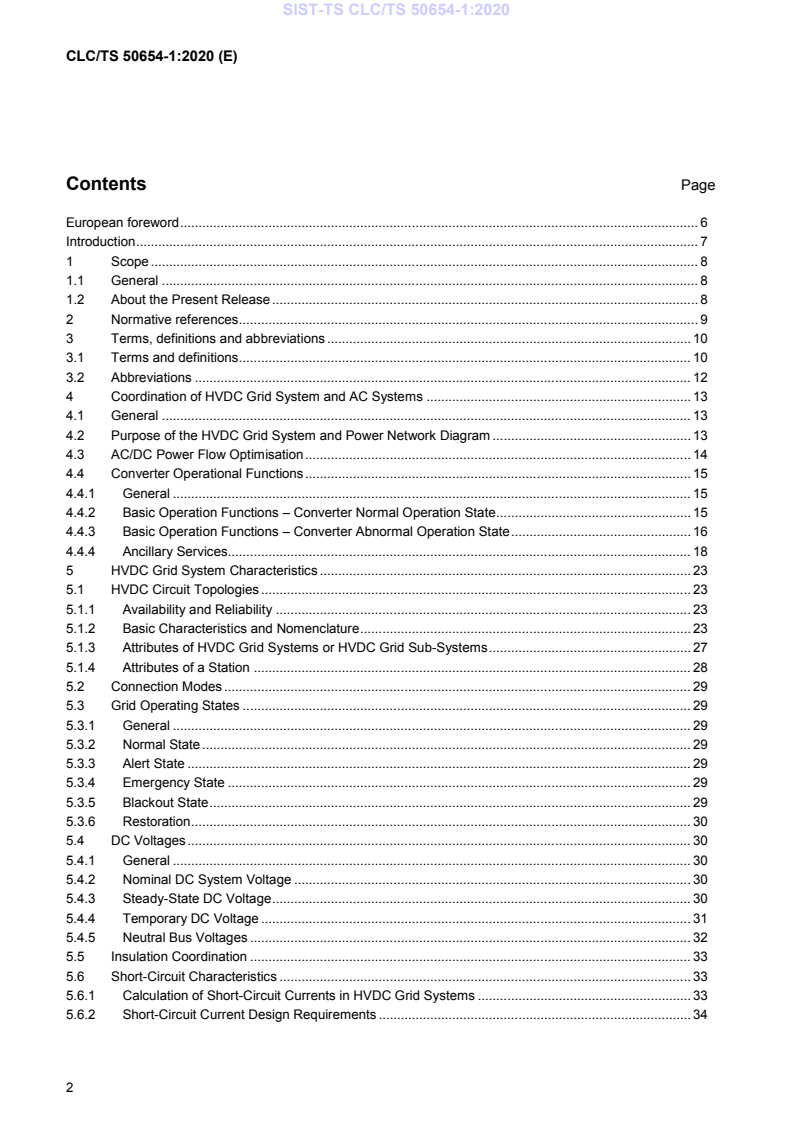
Contents Page
European foreword . 6
Introduction . 7
1 Scope . 8
1.1 General . 8
1.2 About the Present Release . 8
2 Normative references . 9
3 Terms, definitions and abbreviations . 10
3.1 Terms and definitions . 10
3.2 Abbreviations . 12
4 Coordination of HVDC Grid System and AC Systems . 13
4.1 General . 13
4.2 Purpose of the HVDC Grid System and Power Network Diagram . 13
4.3 AC/DC Power Flow Optimisation . 14
4.4 Converter Operational Functions . 15
4.4.1 General . 15
4.4.2 Basic Operation Functions – Converter Normal Operation State . 15
4.4.3 Basic Operation Functions – Converter Abnormal Operation State . 16
4.4.4 Ancillary Services. 18
5 HVDC Grid System Characteristics . 23
5.1 HVDC Circuit Topologies . 23
5.1.1 Availability and Reliability . 23
5.1.2 Basic Characteristics and Nomenclature . 23
5.1.3 Attributes of HVDC Grid Systems or HVDC Grid Sub-Systems . 27
5.1.4 Attributes of a Station . 28
5.2 Connection Modes . 29
5.3 Grid Operating States . 29
5.3.1 General . 29
5.3.2 Normal State . 29
5.3.3 Alert State . 29
5.3.4 Emergency State . 29
5.3.5 Blackout State . 29
5.3.6 Restoration . 30
5.4 DC Voltages . 30
5.4.1 General . 30
5.4.2 Nominal DC System Voltage . 30
5.4.3 Steady-State DC Voltage . 30
5.4.4 Temporary DC Voltage . 31
5.4.5 Neutral Bus Voltages . 32
5.5 Insulation Coordination . 33
5.6 Short-Circuit Characteristics . 33
5.6.1 Calculation of Short-Circuit Currents in HVDC Grid Systems . 33
5.6.2 Short-Circuit Current Design Requirements . 34
5.7 Steady-State Voltage and Current Distortions . 34
5.7.1 Voltage and Current Distortion Limits . 34
5.7.2 Frequency Dependent DC System Impedance . 36
5.8 DC System Restoration . 37
5.8.1 General . 37
5.8.2 Post DC Fault Recovery . 37
5.8.3 Restoration from Blackout . 37
6 HVDC Grid System Control . 37
6.1 Closed-Loop Control Functions . 37
6.1.1 General . 37
6.1.2 Core Control Functions . 38
6.1.3 Coordinating Control Functions . 38
6.2 Controller Hierarchy . 38
6.2.1 General . 38
6.2.2 Internal Converter Control . 39
6.2.3 DC Node Voltage Control . 40
6.2.4 Coordinated HVDC Grid System Control . 41
6.2.5 AC/DC Grid Control . 43
6.3 Propagation of Information . 44
6.4 Open-Loop Controls . 45
6.4.1 Coordination of Connection Modes between Stations and their PoC-DCs . 45
6.4.2 Operating Sequences for HVDC Grid System Installations . 45
6.4.3 Post DC Fault Recovery . 46
7 HVDC Grid System Protection . 47
7.1 General . 47
7.2 DC Fault Separation . 47
7.3 Protection System Related Installations and Equipment . 48
7.3.1 AC/DC Converter Station . 48
7.3.2 HVDC Grid System Topology and Equipment . 48
7.4 HVDC Grid System Protection Zones . 49
7.4.1 General . 49
7.4.2 Permanent Stop P . 51
7.4.3 Permanent Stop PQ . 53
7.4.4 Temporary Stop P . 54
7.4.5 Temporary Stop PQ . 56
7.4.6 Continued Operation . 56
7.4.7 Example of a Protection Zone Matrix . 58
7.5 DC Protection . 59
7.5.1 General . 59
7.5.2 DC Converter Protections . 60
7.5.3 HVDC Grid System Protections . 60
7.5.4 DC Grid Protection Communication . 61
8 AC/DC Converter Stations . 62
8.1 Introduction . 62
8.2 AC/DC Converter Station Types . 62
8.3 Overall Requirements . 63
8.3.1 Robustness of AC/DC Converter Stations . 63
8.3.2 Availability and Reliability . 63
8.3.3 Active Power Reversal . 64
8.4 Main Circuit Design . 64
8.4.1 General Characteristics . 64
8.4.2 DC Side . 65
8.4.3 AC Side . 74
8.5 Controls . 75
8.5.1 General . 75
8.5.2 Automated vs. Manual Operation . 75
8.5.3 Control Modes & Support of Coordination . 75
8.5.4 Limitation Strategies . 75
8.5.5 Operating Sequences for AC/DC Converter Station . 75
8.5.6 Dynamic Behaviour . 78
8.6 Protection . 79
8.6.1 General . 79
8.6.2 Configuration Requirements . 79
8.6.3 Function Requirements . 79
8.6.4 DC Grid Interface . 81
8.6.5 Fault Separation Strategy for Faults inside the AC/DC Converter Station . 81
8.6.6 Coordination of the DC Protection with the HVDC Grid System . 82
8.6.7 Example for Coordination of the DC Protection with the HVDC Grid System . 82
9 HVDC Grid System Installations . 84
9.1 General . 84
9.2 DC Switching Station . 87
9.2.1 Overall Requirements . 87
9.2.2 Main Circuit Design . 88
9.2.3 Controls . 98
9.2.4 Protection . 99
9.3 Transmission Lines and Transition Stations . 102
9.4 DC/DC Converter Stations . 102
9.5 DC Line Power Flow Controllers . 102
10 Models and Validation . 102
10.1 Introduction . 102
10.2 HVDC Grid System Studies . 102
10.2.1 Type of Studies . 102
10.2.2 Tools and Methods . 104
10.3 Model General Specifications . 104
10.3.1 Introductory note . 104
10.3.2 Model Capability . 104
10.3.3 Model Format and Data Type . 105
10.3.4 Model Aggregation . 105
10.4 Model Specific Recommendations . 105
10.4.1 Load Flow Models . 105
10.4.2 Short-Circuit Models . 106
10.4.3 Protection System Models . 106
10.4.4 Insulation Coordination Related Models . 106
10.4.5 Electromechanical Transient Models . 107
10.4.6 Electromagnetic Transient Models . 107
10.4.7 Power Quality Models . 108
10.5 Model Validation . 109
10.6 Compliance Simulation . 111
10.7 Outputs/Results . 111
10.7.1 Model Data . 111
10.7.2 Model Documentation . 111
10.7.3 Model Example . 112
10.7.4 Model Compliance Documentation . 112
10.7.5 Model Validation Documentation – Model Final Version . 112
10.7.6 Model Guarantee . 112
11 HVDC Grid System Integration Tests. 112
11.1 Off-Site Testing of the HVDC Control and Protection System . 113
11.2 Dynamic Performance Study/Tests (DPS) Performed with Offline Models . 114
11.2.1 DPS Simulations in a Multi-Vendor Environment . 114
11.2.2 DPS Simulations Scenarios . 115
11.3 Factory Tests . 115
11.3.1 General . 115
11.3.2 Factory Test Scenarios . 115
11.3.3 Factory Tests when Existing System C&P Replicas are Available . 116
11.3.4 Factory Tests when Existing System C&P Replicas are not Available . 119
11.4 On Site Testing . 121
Bibliography . 123
European foreword
This document (CLC/TS 50654-1:2020) has been prepared by CLC/TC 8X “System aspects of electrical energy
supply”.
This document supersedes CLC/TS 50654-1:2018.
1:2018:
— new content concerning AC/DC converter stations;
— new content concerning HVDC Grid System installations, including DC switching stations;
— new content concerning HVDC Grid System integration tests.
Attention is drawn to the possibility that some of the elements of this document may be the subject of patent
rights. CENELEC shall not be held responsible for identifying any or all such patent rights.
Introduction
HVDC Grid Systems are a new field of technology. There are very few systems with a small number of converter
stations in operation; some more are in execution or in detailed planning.
The Guidelines and Parameter Lists to Functional Specifications are presented featuring planning, specification
and execution of multi-vendor HVDC Grid Systems in Europe. Being elaborated by a team of experts from
leading vendors of HVDC technology, Transmission System Operators (TSO's), Academia and Institutions in
Europe, the present document provides a commonly agreed basis for an open market of compatible equipment
and solutions for HVDC Grid Systems. Executing such systems and gaining operational experience is seen an
important prerequisite for developing corresponding technical standards in the future.
By elaborating this document, special care has been taken to as far as possible describe the requirements in a
technologically independent way. In order to achieve that, a function of interest is described by a comprehensive
set of parameters. The parameters are selected based on a systematic analysis of physical phenomena relevant
to achieve the requested functionality. The physical phenomena are categorized in order to show the mutual
dependence of the individual parameters and ensure completeness of the physical aspects to be considered.
Based on a clearly defined common language describing the functionalities requested, existing technologies
can be applied, or new dedicated technical solutions can be developed.
Reflecting the early stage of technology, these Guidelines and Parameter Lists to Functional Specifications need
comprehensive explanations and background information for the technical parameters. This dual character of
the content will be represented by two corresponding parts:
• Part I “Guidelines” containing the explanations and the background information in context with the
Parameter Lists.
• Part II “Parameter Lists” containing the essential lists of parameters and values describing properties of
the AC respectively DC system (operating conditions) and parameters describing the performance of
the newly installed component (performance requirements).
1 Scope
1.1 General
These Guidelines and Parameter Lists to Functional Specifications describe specific functional requirements for
HVDC Grid Systems. The terminology “HVDC Grid Systems” is used here describing HVDC systems for power
transmission having more than two converter stations connected to a common DC circuit.
While this document focuses on requirements, that are specific for HVDC Grid Systems, some requirements are
considered applicable to all HVDC systems in general, i.e. including point-to-point HVDC systems. Existing IEC,
Cigré or other documents relevant have been used for reference as far as possible.
Corresponding to electric power transmission applications, this document is applicable to high voltage systems,
i.e. having typically nominal DC voltages higher than 50 kV with respect to earth are considered in this document.
NOTE While the physical principles of DC networks are basically voltage independent, the technical options for
designing equipment get much wider with lower DC voltage levels, e.g. in case of converters or switchgear.
Both parts have the same outline and headlines to aid the reader.
1.2 About the Present Release
The present release of the Guidelines and Parameter Lists for Functional Specifications describes technical
guidelines and specifications for HVDC Grid Systems which are characterized by having exactly one single
connection between two converter stations, often referred to as radial systems. When developing the
requirements for radial systems, care is taken not to build up potential showstoppers for meshed systems.
Meshed HVDC Grid Systems can be included into this specification at a later point in time.
The Guidelines and Parameter List to the Functional Specification of HVDC Grid Systems cover technical
aspects of:
• coordination of HVDC grid and AC systems
• HVDC Grid System characteristics
• HVDC Grid System control
• HVDC Grid System protection
• AC/DC converter stations
• HVDC Grid System installations, including DC switching stations
• models and validation
• HVDC Grid System integration tests
Beyond the present scope, the following content is proposed for future work:
• transmission lines and transition stations
• DC/DC converter stations
• DC line power flow controllers
2 Normative references
The following documents are referred to in the text in such a way that some or all of their content constitutes
requirements of this document. For dated references, only the edition cited applies. For undated references, the
latest edition of the referenced document (including any amendments) applies.
EN 60909 (series), Short-circuit currents in three-phase AC systems
EN 61660-1:1997, Short-circuit currents in DC auxiliary installations in power plants and substations — Part 1:
Calculation of short-circuit currents
IEC 60050, International Electrotechnical Vocabulary
IEC/TR 60919-1:2010 , Performance of high-voltage direct current (HVDC) systems with line-commutated
converters – Part 1: Steady-state conditions
IEC 62271-100, High-voltage switchgear and controlgear - Part 100: Alternating-current circuit-breakers
IEC 62271-102, High-voltage switchgear and controlgear - Part 102: Alternating current disconnectors and
earthing switches
IEC 62747:2014 , Terminology for voltage-sourced converters (VSC) for high-voltage direct current (HVDC)
systems
IEV 351-45-27, International electrotechnical vocabulary, control technology
As impacted by IEC/TR 60919-1:2010/A1:2013, IEC/TR 60919-1:2010/A2:2017.
As impacted by IEC 62747:2014/A1:2019.
3 Terms, definitions and abbreviations
3.1 Terms and definitions
For the purposes of this document, the following terms and definitions apply. ISO and IEC maintain
terminological databases for use in standardization at the following addresses:
• IEC Electropedia: available at http://www.electropedia.org/
• ISO Online browsing platform: available at https://www.iso.org/obp
3.1.1
AC/DC converter unit
indivisible operative unit comprising all equipment between the PoC-AC and the PoC-DC, essentially one or
more converters, together with converter transformers, control equipment, essential protective and switching
devices and auxiliaries, if any, used for conversion
[SOURCE: EN 62747:2014 , modified – The definition was neutralised with respect to technology (not only VSC
converters) and uses the terms PoC as defined in the present document]
3.1.2
AC/DC converter station
part of an HVDC system which consists of one or more AC/DC converter units including DC switchgear, if any,
DC fault current controlling devices, if any, installed in a single location together with buildings, reactors, filters,
reactive power supply, control, monitoring, protective, measuring and auxiliary equipment
[SOURCE: EN 62747:2014 , modified – The definition was made specific with respect to AC/DC converter units,
differentiating from DC/DC converter units. Furthermore, only the term AC/DC converter station is used in the
present document]
3.1.3
point of connection-DC
PoC-DC
electrical interface point at DC voltage as shown in Figure 1
3.1.4
point of connection-AC
PoC-AC
electrical interface point at AC voltage as shown in Figure 1
Figure 1 — Definition of the Point of Connection-AC and the Point of Connection-DC at an AC/DC
converter station
3.1.5
DC/DC converter unit
indivisible operative unit comprising all equipment between the points of connection to the HVDC Grid System,
essentially one or more converters, together with converter transformers, if any, control equipment, essential
protective and switching devices and auxiliaries, if any, used for conversion
3.1.6
DC/DC converter station
part of an HVDC Grid System which consists of one or more DC/DC converter units including DC switchgear, if
any, DC fault current controlling devices, if any, installed in a single location together with buildings, reactors,
filters, control, monitoring, protective, measuring and auxiliary equipment, if any
3.1.7
DC switching unit
indivisible operative unit comprising all equipment between the DC busbars and the terminals (HV poles and
neutral, if any) of one point of connection on the DC side, comprising, if any, one or more switches, control,
monitoring, protective, measuring equipment and auxiliaries
3.1.8
DC switching station
part of an HVDC Grid System which consists of one or more DC switches, but no AC/DC or DC/DC converter
units, installed in a single location together with buildings, reactors, filters, control, monitoring, protective,
measuring and auxiliary equipment, if any
3.1.9
HVDC Grid System
high voltage direct current transmission network connecting more than two AC/DC converter stations transferring
energy in the form of high-voltage direct current including related transmission lines, switching stations, DC/DC
converter stations, if any, as well as other equipment and sub-systems needed for operation
3.1.10
meshed HVDC Grid System
HVDC Grid System having more than one direct current connection between at least two converter stations
3.1.11
radial HVDC Grid System
HVDC Grid System having exactly one direct current connection between two arbitrary converter stations
3.1.12
DC protection zone
physical part of a HVDC Grid System with a distinct DC fault handling sequence
3.1.13
rigid bipolar (HVDC) system
bipolar (HVDC) system without dedicated return path or electrodes as illustrated in Figure 2
NOTE 1 to entry Monopolar operation is possible by means of bypass switches during a converter pole outage, but not
during an HVDC conductor outage. A short bipolar outage will follow a converter pole outage before bypass operation can
be established.
[SOURCE: IEC/TR 60919-1:2010]
Figure 2 — Rigid Bipolar HVDC system
3.2 Abbreviations
AC/DC alternating current / direct current (conversion)
BB bus bar
CB circuit breaker
CLES converter local earthing switch
CU converter unit
C&P control and protection
DC/DC direct current / direct current (conversion)
DPS dynamic performance studies
DPT dynamic performance tests
EMT electromagnetic transients
ENTSO-E European Network of Transmission System Operators for Electricity
ERTS earth return transfer switch
FAT factory acceptance tests
FCR frequency containment reserve
FRR frequency restoration reserve
FSD fault separation device
GOOSE generic object-oriented substation events
HSS high-speed switches
HV high voltage
HVDC high-voltage direct current
IEEE Institute of Electrical and Electronics Engineers
LAT laboratory acceptance test
MMC modular multilevel converter
MRTS metallic return transfer switch
NBGS neutral bus grounding switch
NBS neutral bus switch
NC Network Code
OHL overhead line
OP operating point
OPF optimum power flow
OVRT over-voltage ride through
PoC point of connection
POD power oscillation damping
STATCOM static synchronous compensator
SRAS System Recovery Ancillary Service
T terminal
THD total harmonic distortion
TSO transmission system operator
UVRT under-voltage ride through
VSC voltage-sourced converter
4 Coordination of HVDC Grid System and AC Systems
4.1 General
The HVDC Grid System connects several AC/DC converters via their respective PoC-DC to a common DC
circuit as shown in Figure 3. The HVDC Grid System can consist of one or more of the following installations:
• DC switching station
• transmission line (overhead line, cable or combinations thereof)
• DC/DC converter station
• DC line power flow controller.
Figure 3 — Principle structure of an HVDC Grid System
The topologies of the AC/DC converter stations as well as the various installations of the HVDC Grid System
shall be coordinated and specified as described in chapter 5.1 “HVDC Circuit Topologies”.
Within the boundaries of the given topologies, each AC/DC converter station or HVDC Grid System installation
can be operated in different DC connection modes as described for AC/DC converter stations in chapter 8.4.2.1
“DC Connection” and for DC switching stations in chapter 9.2.2.2.1 “DC Connection”. The individual connection
modes and their application needs to be coordinated throughout the HVDC Grid System any time when
operating.
4.2 Purpose of the HVDC Grid System and Power Network Diagram
To provide an overall understanding of the HVDC Grid System, the purposes and basic functions of the HVDC
Grid System including all AC/DC converter stations shall be explained.
To explain the AC and HVDC Grid System structure a network diagram shall be specified showing the grid
topology including the installations and their connections. This diagram shall contain information such as:
• AC networks showing the connection of each AC/DC converter station to the synchronous areas
• HVDC Grid System topology and converter station topology for each AC/DC converter station as well
as each DC/DC converter station according to the nomenclature given in Table 1
• DC earthing impedances at each AC/DC converter station and DC/DC converter station
• fault separation devices
• energy storages
• energy absorbers, e.g. dynamic braking devices typically used for absorbing energy from wind farms or
HV pole re-balancing after pole-to-earth DC faults
4.3 AC/DC Power Flow Optimisation
The behaviour of an HVDC Grid System and its AC/DC converter stations within their AC system environment
is typically described in corresponding network codes for the respective AC systems. This chapter describes
typical requirements from the AC system perspective with respect to their implications on the design of HVDC
Grid Systems.
An HVDC Grid System with more than two AC/DC converter stations in operation requires superordinate
coordination of the power flow between the individual converter stations. The requirements for such coordination
are described in chapter 6 “HVDC Grid System Control”.
The steady-state active and reactive power capabilities of an AC/DC converter station are described by the
maximum and minimum active vs. reactive power exchange capability charts depending on the AC voltage at
the PoC-AC (U ) of each station as shown in Figure 4.
AC
The power flow shall be specified such that the power exchange of a converter station operating in rectification
mode (rectifier) shall be counted positive, i.e. power flowing from the PoC-AC into the converter and further on
from the converter into the PoC-DC shall have positive sign.
This diagram can be specified for different AC voltage levels. For one AC voltage level the boundaries under
temporary conditions, e.g. overload operation can be represented by different graphs in Figure 4.
Figure 4 — Example of a PQ-diagram showing maximum and minimum active vs. reactive power
exchange capability of an AC/DC converter station for a given AC voltage level
Compared to AC infrastructures, AC/DC converter stations provide the capability to set and control active power
flow going through them. The active power set points as well as the control droop parameters have an impact
on the global grid power flows (AC and DC). Optimising the static power flow, can aim at different objectives,
e.g. minimizing the overall losses, while remaining below the limits of individual equipment (converters, ampacity
of lines, etc.) and minimizing the consequences of contingencies such as loss of a line.
4.4 Converter Operational Functions
4.4.1 General
In this document a general categorization of converter operational functions into basic operation functions during
normal operation states, basic operation functions during abnormal operation states and functions for ancillary
service provision is provided. Basic operation functions both during normal and abnormal operating state are
functions which need to
...