

IEC 62271-100:2021
(Main)High-voltage switchgear and controlgear - Part 100: Alternating-current circuit-breakers
General Information
- Abstract
IEC 62271-100:2021 is applicable to three-phase AC circuit-breakers designed for indoor or outdoor installation and for operation at frequencies of 50 Hz and/or 60 Hz on systems having voltages above 1 000 V. This document includes only direct testing methods for making-breaking tests. For synthetic testing methods refer to IEC 62271-101.
This third edition cancels and replaces the second edition published in 2008, Amendment 1:2012 and Amendment 2:2017. This edition constitutes a technical revision.
The main changes with respect to the previous edition are listed below:
– the document has been updated to IEC 62271-1:2017;
– Amendments 1 and 2 have been included;
– the definitions have been updated, terms not used have been removed;
– Subclauses 7.102 through 7.108 have been restructured.
The contents of the corrigendum of December 2021, July 2022 and January 2024 have been included in this copy.
- Status
- Published
- Publication Date
- 18-Aug-2024
- Technical Committee
- SC 17A - Switching devices
- Drafting Committee
- MT 36 - TC 17/SC 17A/MT 36
- Current Stage
- PPUB - Publication issued
- Start Date
- 07-Jul-2021
- Completion Date
- 18-Jun-2021
Buy Documents
IEC 62271-100:2021+AMD1:2024 CSV - High-voltage switchgear and controlgear - Part 100: Alternating-current circuit-breakers Released:8/19/2024
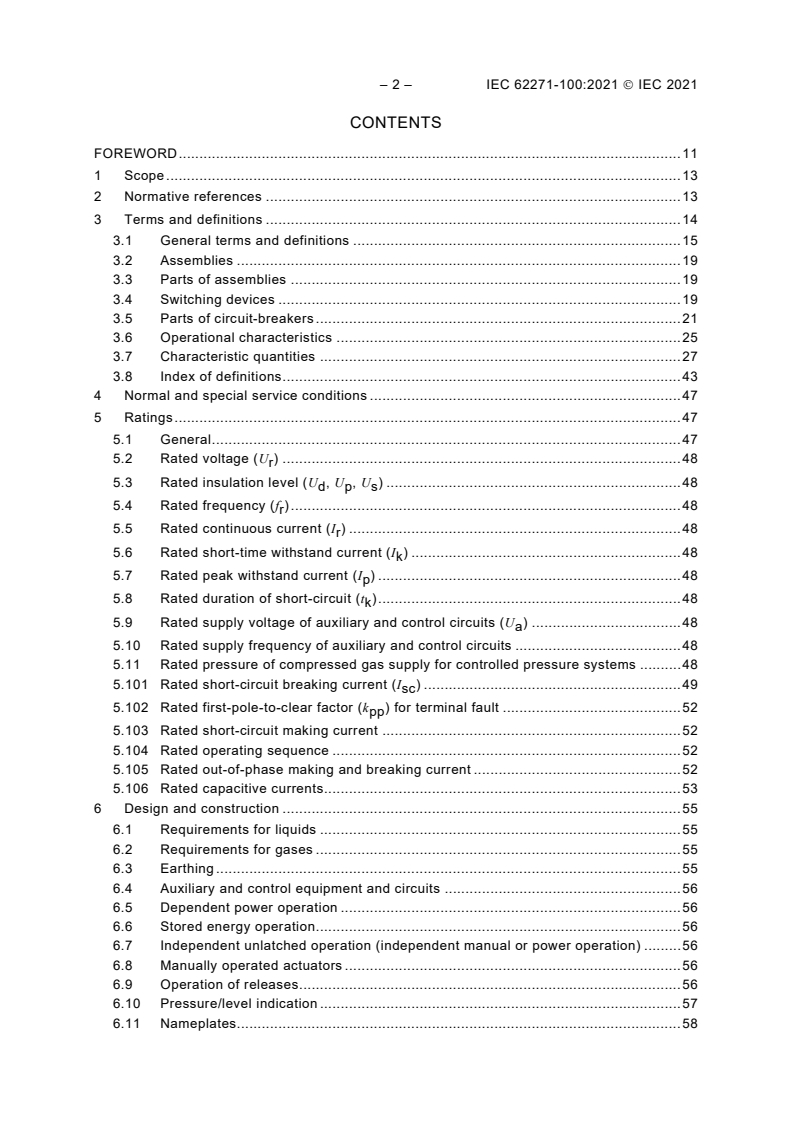
IEC 62271-100:2021 - High-voltage switchgear and controlgear - Part 100: Alternating-current circuit-breakers Released:7/7/2021
Overview
IEC 62271-100:2021 is the international standard that specifies requirements and direct test methods for high-voltage alternating-current (AC) circuit-breakers used in three-phase systems with voltages above 1 000 V and operating at 50 Hz and/or 60 Hz. Intended for indoor and outdoor installations, this third edition (with Amendment 1 consolidated) updates definitions, aligns with IEC 62271-1:2017, incorporates previous amendments and corrigenda, and restructures key making/breaking test subclauses. Note: this document includes only direct making‑breaking test methods; synthetic test methods are covered in IEC 62271-101.
Key topics and technical requirements
- Scope and applicability: three‑phase AC circuit‑breakers for systems >1 kV, indoor/outdoor, 50/60 Hz.
- Ratings: rated voltage, insulation levels, rated continuous and short‑time currents, peak withstand, rated breaking/making currents, operating sequences and related quantities.
- Design and construction: requirements for liquids, gases, earthing, auxiliary/control circuits, sealing (gas/vacuum/liquid tightness), mechanical loads and degrees of protection.
- Type tests and making‑breaking tests: dielectric tests, short‑time and peak withstand tests, making and breaking procedures, TRV (transient recovery voltage) considerations, terminal and short‑line fault tests.
- Routine tests: dielectric and resistance checks, tightness, mechanical operation and visual inspections.
- Performance verification: electromagnetic compatibility (EMC), radio interference voltage (RIV), X‑radiation tests for vacuum interrupters, and demonstration of arcing times.
- Guidance and annexes: selection guides, installation/operation/maintenance instructions, TRV calculation methods, tolerances, and test report requirements.
Practical applications and who uses this standard
- Manufacturers of high‑voltage circuit‑breakers use IEC 62271-100 to design, test and certify products to international performance and safety criteria.
- Test laboratories and certification bodies rely on the standard for validated type and routine test procedures (making/breaking and dielectric tests).
- Utilities, EPCs and specifiers reference the standard when selecting switchgear for substations and power networks, ensuring correct ratings and switching performance for fault and capacitive switching duties.
- Procurement and compliance teams use it in tenders and contracts to define acceptance tests, documentation and maintenance requirements.
- Design engineers consult annexes (TRV, short‑line faults) and selection guidance to match circuit‑breaker capability with network conditions.
Related standards
- IEC 62271-1 - General definitions and common requirements for high‑voltage switchgear and controlgear.
- IEC 62271-101 - Synthetic testing methods for making/breaking tests (complements IEC 62271-100).
Keywords: IEC 62271-100, high-voltage switchgear, AC circuit-breakers, making‑breaking tests, type tests, TRV, dielectric tests, short-circuit testing, switchgear standards.
Relations
- Effective Date
- 22-Apr-2026
- Effective Date
- 10-Feb-2026
- Effective Date
- 05-Sep-2023
- Effective Date
- 15-Dec-2023
- Effective Date
- 05-Sep-2023
- Effective Date
- 05-Sep-2023
- Effective Date
- 05-Sep-2023
- Effective Date
- 05-Sep-2023
- Effective Date
- 05-Sep-2023
- Effective Date
- 05-Sep-2023
- Effective Date
- 05-Sep-2023
Buy Documents
IEC 62271-100:2021+AMD1:2024 CSV - High-voltage switchgear and controlgear - Part 100: Alternating-current circuit-breakers Released:8/19/2024
IEC 62271-100:2021 - High-voltage switchgear and controlgear - Part 100: Alternating-current circuit-breakers Released:7/7/2021
Get Certified
Connect with accredited certification bodies for this standard

IMQ S.p.A. (Certification)
Italian electrical product certification.

SLG Prüf- und Zertifizierungs GmbH
German testing and certification body.

UL Solutions
Global safety science company with testing, inspection and certification.
Sponsored listings
Frequently Asked Questions
IEC 62271-100:2021 is a standard published by the International Electrotechnical Commission (IEC). Its full title is "High-voltage switchgear and controlgear - Part 100: Alternating-current circuit-breakers". This standard covers: IEC 62271-100:2021 is applicable to three-phase AC circuit-breakers designed for indoor or outdoor installation and for operation at frequencies of 50 Hz and/or 60 Hz on systems having voltages above 1 000 V. This document includes only direct testing methods for making-breaking tests. For synthetic testing methods refer to IEC 62271-101. This third edition cancels and replaces the second edition published in 2008, Amendment 1:2012 and Amendment 2:2017. This edition constitutes a technical revision. The main changes with respect to the previous edition are listed below: – the document has been updated to IEC 62271-1:2017; – Amendments 1 and 2 have been included; – the definitions have been updated, terms not used have been removed; – Subclauses 7.102 through 7.108 have been restructured. The contents of the corrigendum of December 2021, July 2022 and January 2024 have been included in this copy.
IEC 62271-100:2021 is applicable to three-phase AC circuit-breakers designed for indoor or outdoor installation and for operation at frequencies of 50 Hz and/or 60 Hz on systems having voltages above 1 000 V. This document includes only direct testing methods for making-breaking tests. For synthetic testing methods refer to IEC 62271-101. This third edition cancels and replaces the second edition published in 2008, Amendment 1:2012 and Amendment 2:2017. This edition constitutes a technical revision. The main changes with respect to the previous edition are listed below: – the document has been updated to IEC 62271-1:2017; – Amendments 1 and 2 have been included; – the definitions have been updated, terms not used have been removed; – Subclauses 7.102 through 7.108 have been restructured. The contents of the corrigendum of December 2021, July 2022 and January 2024 have been included in this copy.
IEC 62271-100:2021 is classified under the following ICS (International Classification for Standards) categories: 29.130.10 - High voltage switchgear and controlgear. The ICS classification helps identify the subject area and facilitates finding related standards.
IEC 62271-100:2021 has the following relationships with other standards: It is inter standard links to EN ISO 8528-13:2026, CLC/TS 50654-1:2020, IEC 62271-100:2021/AMD1:2024, IEC 62271-100:2021/COR3:2024, IEC 62271-100:2021/COR2:2022, IEC 62271-100:2021/COR1:2021, IEC 62271-100:2008/AMD1:2012/COR1:2012, IEC 62271-100:2008/AMD2:2017/COR1:2018, IEC 62271-100:2008/AMD2:2017, IEC 62271-100:2008/AMD1:2012, IEC 62271-100:2008. Understanding these relationships helps ensure you are using the most current and applicable version of the standard.
IEC 62271-100:2021 is available in PDF format for immediate download after purchase. The document can be added to your cart and obtained through the secure checkout process. Digital delivery ensures instant access to the complete standard document.
Standards Content (Sample)
IEC 62271-100 ®
Edition 3.1 2024-08
CONSOLIDATED VERSION
INTERNATIONAL
STANDARD
colour
inside
High-voltage switchgear and controlgear –
Part 100: Alternating-current circuit-breakers
All rights reserved. Unless otherwise specified, no part of this publication may be reproduced or utilized in any form
or by any means, electronic or mechanical, including photocopying and microfilm, without permission in writing from
either IEC or IEC's member National Committee in the country of the requester. If you have any questions about IEC
copyright or have an enquiry about obtaining additional rights to this publication, please contact the address below or
your local IEC member National Committee for further information.
IEC Secretariat Tel.: +41 22 919 02 11
3, rue de Varembé info@iec.ch
CH-1211 Geneva 20 www.iec.ch
Switzerland
About the IEC
The International Electrotechnical Commission (IEC) is the leading global organization that prepares and publishes
International Standards for all electrical, electronic and related technologies.
About IEC publications
The technical content of IEC publications is kept under constant review by the IEC. Please make sure that you have the
latest edition, a corrigendum or an amendment might have been published.
IEC publications search - webstore.iec.ch/advsearchform IEC Products & Services Portal - products.iec.ch
The advanced search enables to find IEC publications by a Discover our powerful search engine and read freely all the
variety of criteria (reference number, text, technical publications previews, graphical symbols and the glossary.
committee, …). It also gives information on projects, replaced With a subscription you will always have access to up to date
and withdrawn publications. content tailored to your needs.
IEC Just Published - webstore.iec.ch/justpublished
Electropedia - www.electropedia.org
Stay up to date on all new IEC publications. Just Published
The world's leading online dictionary on electrotechnology,
details all new publications released. Available online and once
containing more than 22 500 terminological entries in English
a month by email.
and French, with equivalent terms in 25 additional languages.
Also known as the International Electrotechnical Vocabulary
IEC Customer Service Centre - webstore.iec.ch/csc
(IEV) online.
If you wish to give us your feedback on this publication or need
further assistance, please contact the Customer Service
Centre: sales@iec.ch.
IEC 62271-100 ®
Edition 3.1 2024-08
CONSOLIDATED VERSION
INTERNATIONAL
STANDARD
colour
inside
High-voltage switchgear and controlgear –
Part 100: Alternating-current circuit-breakers
INTERNATIONAL
ELECTROTECHNICAL
COMMISSION
ICS 29.130.10 ISBN 978-2-8322-9579-3
REDLINE VERSION – 2 – IEC 62271-100:2021+AMD1:2024 CSV
IEC 2024
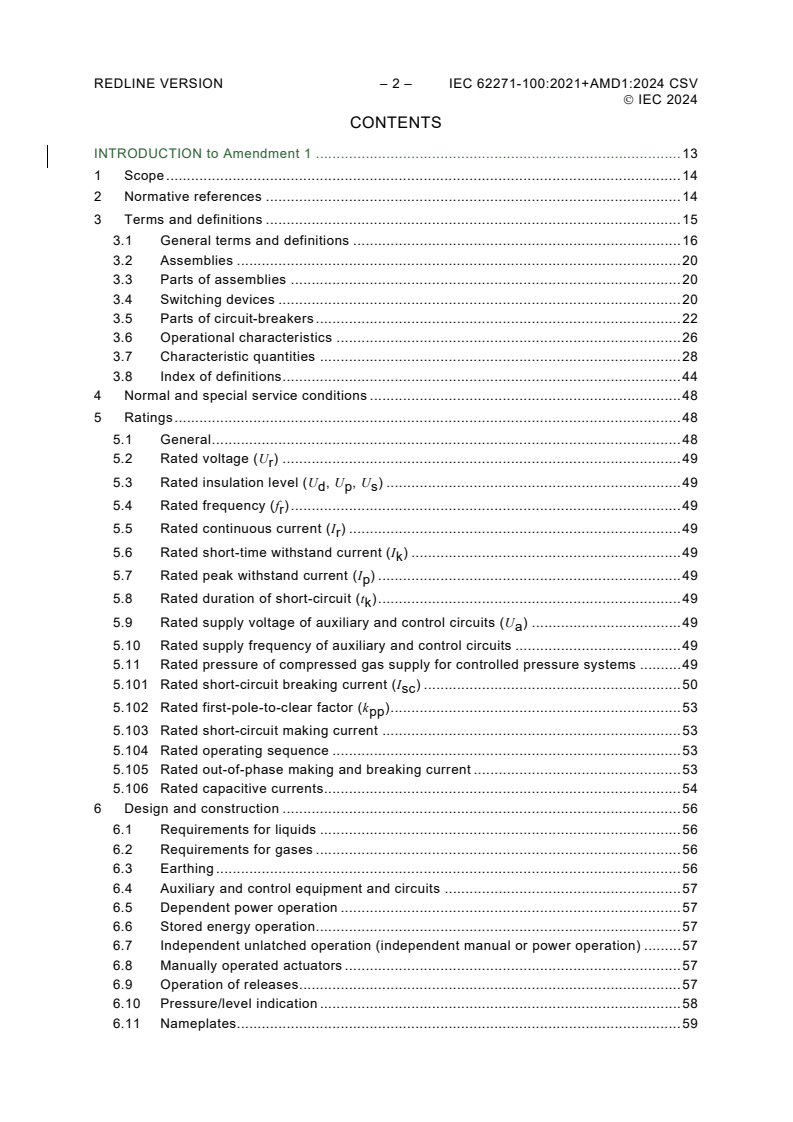
CONTENTS
INTRODUCTION to Amendment 1 . 13
1 Scope . 14
2 Normative references . 14
3 Terms and definitions . 15
3.1 General terms and definitions . 16
3.2 Assemblies . 20
3.3 Parts of assemblies . 20
3.4 Switching devices . 20
3.5 Parts of circuit-breakers . 22
3.6 Operational characteristics . 26
3.7 Characteristic quantities . 28
3.8 Index of definitions . 44
4 Normal and special service conditions . 48
5 Ratings . 48
5.1 General . 48
5.2 Rated voltage (U ) . 49
r
5.3 Rated insulation level (U , U , U ) . 49
d p s
5.4 Rated frequency (f ) . 49
r
5.5 Rated continuous current (I ) . 49
r
5.6 Rated short-time withstand current (I ) . 49
k
5.7 Rated peak withstand current (I ) . 49
p
5.8 Rated duration of short-circuit (t ) . 49
k
5.9 Rated supply voltage of auxiliary and control circuits (U ) . 49
a
5.10 Rated supply frequency of auxiliary and control circuits . 49
5.11 Rated pressure of compressed gas supply for controlled pressure systems . 49
5.101 Rated short-circuit breaking current (I ) . 50
sc
5.102 Rated first-pole-to-clear factor (k ) . 53
pp
5.103 Rated short-circuit making current . 53
5.104 Rated operating sequence . 53
5.105 Rated out-of-phase making and breaking current . 53
5.106 Rated capacitive currents. 54
6 Design and construction . 56
6.1 Requirements for liquids . 56
6.2 Requirements for gases . 56
6.3 Earthing . 56
6.4 Auxiliary and control equipment and circuits . 57
6.5 Dependent power operation . 57
6.6 Stored energy operation . 57
6.7 Independent unlatched operation (independent manual or power operation) . 57
6.8 Manually operated actuators . 57
6.9 Operation of releases . 57
6.10 Pressure/level indication . 58
6.11 Nameplates. 59
IEC 2024
6.12 Locking devices . 61
6.13 Position indication . 61
6.14 Degrees of protection provided by enclosures . 61
6.15 Creepage distances for outdoor insulators . 61
6.16 Gas and vacuum tightness . 61
6.17 Tightness for liquid systems . 61
6.18 Fire hazard (flammability) . 61
6.19 Electromagnetic compatibility (EMC) . 61
6.20 X-ray emission . 61
6.21 Corrosion . 61
6.22 Filling levels for insulation, switching and/or operation . 62
6.101 Requirements for simultaneity of poles during single closing and single
opening operations . 62
6.102 General requirement for operation . 62
6.103 Pressure limits of fluids for operation . 62
6.104 Vent outlets . 63
6.105 Time quantities . 63
6.106 Mechanical loads . 63
6.107 Circuit-breaker classification . 64
7 Type tests . 66
7.1 General . 66
7.2 Dielectric tests . 68
7.3 Radio interference voltage (RIV) test . 73
7.4 Resistance measurement . 73
7.5 Continuous current tests . 74
7.6 Short-time withstand current and peak withstand current tests . 75
7.7 Verification of the protection . 75
7.8 Tightness tests . 75
7.9 Electromagnetic compatibility tests (EMC) . 75
7.10 Additional tests on auxiliary and control circuits . 76
7.11 X-radiation test procedure for vacuum interrupters . 77
7.101 Mechanical and environmental tests . 77
7.102 Miscellaneous provisions for making and breaking tests . 89
7.103 General considerations for making and breaking tests . 107
7.104 Demonstration of arcing times . 114
7.105 Short-circuit test quantities . 133
7.106 Short-circuit test procedure . 157
7.107 Terminal fault tests . 159
7.108 Additional short-circuit tests . 163
7.109 Short-line fault tests . 166
7.110 Out-of-phase making and breaking tests . 179
7.111 Capacitive current tests . 181
7.112 Requirements for making and breaking tests on class E2 circuit-breakers
having a rated voltage above 1 kV up to and including 52 kV . 195
8 Routine tests . 196
8.1 General . 196
8.2 Dielectric test on the main circuit . 197
8.3 Tests on auxiliary and control circuits . 199
REDLINE VERSION – 4 – IEC 62271-100:2021+AMD1:2024 CSV
IEC 2024
8.4 Measurement of the resistance of the main circuit . 199
8.5 Tightness test . 199
8.6 Design and visual checks . 199
8.101 Mechanical operating tests . 199
9 Guide to the selection of switchgear and controlgear (informative) . 201
9.101 General . 201
9.102 Selection of rated values for service conditions . 203
9.103 Selection of rated values for fault conditions . 205
9.104 Selection for electrical endurance in networks of rated voltage above 1 kV
and up to and including 52 kV . 209
9.105 Selection for switching of capacitive loads . 209
10 Information to be given with enquiries, tenders and orders (informative) . 209
10.1 General . 209
10.2 Information with enquiries and orders . 209
10.3 Information to be given with tenders. 210
11 Transport, storage, installation, operation instructions and maintenance. 212
11.1 General . 212
11.2 Conditions during transport, storage and installation . 212
11.3 Installation . 212
11.4 Operating instructions . 218
11.5 Maintenance . 218
11.101 Resistors and capacitors . 219
12 Safety . 219
13 Influence of the product on the environment . 219
Annex A (normative) Calculation of TRVs for short-line faults from rated
characteristics . 220
A.1 Basic approach . 220
A.2 Transient voltage on line side . 223
A.3 Transient voltage on source side . 223
A.4 Examples of calculations . 227
Annex B (normative) Tolerances on test quantities during type tests . 230
Annex C (normative) Records and reports of type tests. 239
C.1 Information and results to be recorded . 239
C.2 Information to be included in type test reports . 239
Annex D (normative) Method of determination of the prospective TRV . 243
D.1 General . 243
D.2 Drawing the envelope . 243
D.3 Determination of parameters . 244
Annex E (normative) Methods of determining prospective TRV waves . 247
E.1 General . 247
E.2 General summary of the recommended methods . 249
E.3 Detailed consideration of the recommended methods . 250
E.4 Comparison of methods . 261
Annex F (informative) Requirements for breaking of transformer-limited faults by
circuit-breakers with rated voltage higher than 1 kV . 265
F.1 General . 265
F.2 Circuit-breakers with rated voltage less than 100 kV . 266
IEC 2024
F.3 Circuit-breakers with rated voltage from 100 kV to 800 kV . 268
F.4 Circuit-breakers with rated voltage higher than 800 kV . 268
Annex G (normative) Use of mechanical characteristics and related requirements . 270
Annex H (normative) Requirements for making and breaking test procedures for
metal-enclosed and dead tank circuit-breakers . 272
H.1 General . 272
H.2 Reduced number of making and breaking units for testing purposes . 272
H.3 Tests for single pole in one enclosure . 273
H.4 Tests for three poles in one enclosure . 276
Annex I (normative) Requirements for circuit-breakers with opening resistors . 278
I.1 General . 278
I.2 Switching performance to be verified . 278
I.3 Insertion time of the resistor. 291
I.4 Current carrying performance . 291
I.5 Dielectric performance . 291
I.6 Mechanical performance . 291
I.7 Requirements for the specification of opening resistors. 291
I.8 Examples of recovery voltage waveshapes . 291
Annex J (normative) Verification of capacitive current breaking in presence of single
or two-phase earth faults . 298
J.1 General . 298
J.2 Test voltage . 298
J.3 Test current . 298
J.4 Test-duty . 299
J.5 Criteria to pass the tests . 299
Bibliography . 300
Figure 1 – Typical oscillogram of a three-phase short-circuit make-break cycle. 30
Figure 2 – Circuit-breaker without switching resistors – Opening and closing operations . 31
Figure 3 – Circuit breaker without switching resistors – Close-open cycle . 32
Figure 4 – Circuit-breaker without switching resistors – Reclosing (auto-reclosing) . 33
Figure 5 – Circuit-breaker with switching resistors – Opening and closing operations . 34
Figure 6 – Circuit-breaker with switching resistors – Close-open cycle . 35
Figure 7 – Circuit-breaker with switching resistors – Reclosing (auto-reclosing) . 36
Figure 8 – Determination of short-circuit making and breaking currents, and of
percentage DC component . 51
Figure 9 – Percentage DC component in relation to the time interval from the initiation
of the short-circuit for the different time constants . 52
Figure 10 – Example of wind velocity measurement . 83
Figure 11 – Test sequence for low temperature test . 85
Figure 12 – Test sequence for high temperature test . 86
Figure 13 – Humidity test . 88
Figure 14 – Example of reference mechanical characteristics (idealised curve) . 92
Figure 15 – Reference mechanical characteristics of Figure 14 with the envelopes
centred over the reference curve (+5 %, –5 %) . 93
REDLINE VERSION – 6 – IEC 62271-100:2021+AMD1:2024 CSV
IEC 2024
Figure 16 – Reference mechanical characteristics of Figure 14 with the envelope fully
displaced upward from the reference curve (+10 %, –0 %) . 94
Figure 17 – Reference mechanical characteristics of Figure 14 with the envelope fully
displaced downward from the reference curve (+0 %, –10 %) . 94
Figure 18 – Equivalent testing set-up for unit testing of circuit-breakers with more than
one separate making and breaking units . 96
Figure 19 – Earthing of test circuits for single-phase short-circuit tests, k = 1,5 . 97
pp
Figure 20 – Earthing of test circuits for single-phase short-circuit tests, k = 1,3 . 98
pp
Figure 21 – Test circuit for single-phase out-of-phase tests . 98
Figure 22 – Test circuit for out-of-phase tests using two voltages separated by 120
electrical degrees . 99
Figure 23 – Test circuit for out-of-phase tests with one terminal of the circuit-breaker
earthed (subject to agreement of the manufacturer) . 99
Figure 24 – Example of prospective test TRV with four-parameter envelope which
satisfies the conditions to be met during type test – Case of specified TRV with four-
parameter reference line . 100
Figure 25 – Example of prospective test TRV with two-parameter envelope which
satisfies the conditions to be met during type test: case of specified TRV with two-
parameter reference line . 101
Figure 26 – Example of prospective test TRV-waves and their combined envelope in
two-part test. 102
Figure 27 – Earthing of test circuits for three-phase short-circuit tests, k = 1,5 . 109
pp
Figure 28 – Earthing of test circuits for three-phase short-circuit tests, k = 1,3 . 110
pp
Figure 29 – Determination of power frequency recovery voltage . 112
Figure 30 – Graphical representation of the time parameters for the demonstration of
arcing times in three-phase tests of test-duty T100a . 115
Figure 31 – Graphical representation of an example of the three valid symmetrical
breaking operations for k = 1,5 . 116
pp
Figure 32 – Graphical representation of the three valid symmetrical breaking
operations for k = 1,2 or 1,3 . 117
pp
Figure 33 – Graphical representation of an example of the three valid asymmetrical
breaking operations for k = 1,5 . 121
pp
Figure 34 – Graphical representation of an example of the three valid asymmetrical
breaking operations for k = 1,2 or 1,3 . 122
pp
Figure 35 – Example of a graphical representation of the three valid symmetrical
breaking operations for single-phase tests in substitution of three-phase conditions for
k = 1,5 . 126
pp
Figure 36 – Example of a graphical representation of an example of the three valid
symmetrical breaking operations for single-phase tests in substitution of three-phase
conditions for k = 1,2 or 1,3 . 127
pp
Figure 37 – Example of a graphical representation of an example of the three valid
asymmetrical breaking operations for single-phase tests in substitution of three-phase
conditions for k = 1,5 . 129
pp
Figure 38 – Example of a graphical representation of an example of the three valid
asymmetrical breaking operations for single-phase tests in substitution of three-phase
for k = 1,2 and 1,3 . 130
pp
IEC 2024
Figure 39 – Graphical representation of the arcing window and the pole factor k ,
p
determining the TRV of the individual pole, for systems with a k of 1,2 . 132
pp
Figure 40 – Graphical representation of the arcing window and the pole factor k ,
p
determining the TRV of the individual pole, for systems with a k of 1,3 . 132
pp
Figure 41 – Graphical representation of the arcing window and the pole factor k ,
p
determining the TRV of the individual pole, for systems with a k of 1,5 . 133
pp
Figure 42 – Representation of a specified TRV by a 4-parameter reference line and a
delay line . 136
Figure 43 – Representation of a specified TRV by a two-parameter reference line and
a delay line . 137
Figure 44 – Basic circuit for terminal fault with ITRV . 137
Figure 45 – Representation of ITRV in relationship to TRV . 138
Figure 46 – Example of line transient voltage with time delay with non-linear rate
of rise . 153
Figure 47 – Necessity of additional single-phase tests and requirements for testing. 164
Figure 48 – Basic circuit arrangement for short-line fault testing and prospective TRV-
circuit-type a) according to 7.109.3: Source side and line side with time delay . 169
Figure 49 – Basic circuit arrangement for short-line fault testing – circuit type b1)
according to 7.109.3: Source side with ITRV and line side with time delay . 170
Figure 50 – Basic circuit arrangement for short-line fault testing – circuit type b2)
according to 7.109.3: Source side with time delay and line side without time delay . 171
Figure 51 – Example of a line side transient voltage with time delay . 172
Figure 52 – Flow chart for the choice of short-line fault test circuits . 174
Figure 53 – Compensation of deficiency of the source side time delay by an increase
of the excursion of the line side voltage . 176
Figure 54 – Recovery voltage for capacitive current breaking tests . 192
Figure 55 – Reclassification procedure for line and cable-charging current tests . 194
Figure 56 – Reclassification procedure for capacitor bank current tests . 195
Figure A.1 – Typical graph of line and source side TRV parameters – Line side and
source side with time delay . 222
Figure A.2 – Actual course of the source side TRV for short-line fault L , L and L . 225
90 75 60
Figure A.3 – Typical graph of line and source side TRV parameters – Line side and
source side with time delay, source side with ITRV . 226
Figure D.1 – Representation by four parameters of a prospective TRV of a circuit –
Case D.2 c) 1) . 245
Figure D.2 – Representation by four parameters of a prospective TRV of a circuit –
Case D.2 c) 2) . 245
Figure D.3 – Representation by four parameters of a prospective TRV of a circuit –
Case D.2 c) 3) i) . 246
Figure D.4 – Representation by two parameters of a prospective TRV of a circuit –
Case D.2 c) 3) ii) . 246
Figure E.1 – Effect of depression on the peak value of the TRV . 248
Figure E.2 – Breaking with arc-voltage present . 250
Figure E.3 – TRV in case of ideal breaking . 251
Figure E.4 – Breaking with pronounced premature current-zero . 251
REDLINE VERSION – 8 – IEC 62271-100:2021+AMD1:2024 CSV
IEC 2024
Figure E.5 – Relationship between the values of current and TRV occurring in test and
those prospective to the system . 252
Figure E.6 – Breaking with post-arc current . 253
Figure E.7 – Schematic diagram of power-frequency current injection apparatus . 254
Figure E.8 – Sequence of operation of power-frequency current injection apparatus . 255
Figure E.9 – Schematic diagram of capacitance injection apparatus . 257
Figure E.10 – Sequence of operation of capacitor-injection apparatus . 258
Figure F.1 – First example of transformer-limited fault (also called transformer-fed
fault) . 265
Figure F.2 – Second example of transformer-limited fault (also called transformer-
secondary fault) . 266
Figure H.1 – Test configuration considered in Table H.1, Table H.2 and Table H.3 . 274
Figure I.1 – Typical system configuration for breaking by a circuit-breaker with opening
resistors . 278
Figure I.2 – Test circuit for test-duties T60 and T100 . 280
Figure I.3 – Test circuit for test-duties T10, T30 and OP2 . 281
Figure I.4 – Example of an underdamped TRV for T100s(b), U = 1 100 kV I = 50 kA,
r sc
f = 50 Hz . 283
r
Figure I.5 – Example of an overdamped TRV for T10, U = 1 100 kV I = 50 kA, f =
r sc r
50 Hz . 284
Figure I.6 – Example of a test circuit for short-line fault test-duty L . 285
Figure I.7 – Example of real line simulation for short-line fault test-duty L based on
U = 1 100 kV, I = 50 kA and f = 50 Hz . 286
r sc r
Figure I.8 – Typical recovery voltage waveshape of capacitive current breaking on a
circuit-breaker equipped with opening resistors. 288
Figure I.9 – Typical recovery voltage waveshape of T10 (based on U = 1 100 kV, I =
r sc
50 kA and f = 50 Hz) on the resistor switch of a circuit-breaker equipped with opening
r
resistors . 289
Figure I.10 – TRV waveshapes for high short-circuit current breaking operation . 292
Figure I.11 – Currents in case of high short-circuit current breaking operation . 293
Figure I.12 – TRV shapes for low short-circuit current breaking operation . 294
Figure I.13 – Currents in case of low short-circuit current breaking operation . 295
Figure I.14 – Voltage waveshapes for line-charging current breaking operation . 296
Figure I.15 – Current waveshapes for line-charging current breaking operation . 297
Table 1 – Preferred values of rated capacitive currents . 55
Table 2 – Nameplate information . 60
Table 3 – Examples of static horizontal and vertical forces for static terminal load . 64
Table 4 – Number of mechanical operations . 65
Table 5 – Type tests . 67
Table 6 – Invalid tests . 68
Table 7 – Test requirements for voltage tests as condition check for metal-enclosed
circuit-breakers . 72
Table 8 – Number of operating sequences . 80
IEC 2024
Table 9 – Standard values of ITRV – Rated voltages 100 kV and above . 113
Table 10 – Last current loop parameters in three-phase tests and in single-phase tests
in substitution for three-phase conditions in relation with short-circuit test-duty T100a –
Tests for 50 Hz operation . 118
Table 11 – Last current loop parameters in three-phase tests and in single-phase tests
in substitution for three-phase conditions in relation with short-circuit test-duty T100a –
Tests for 60 Hz operation . 119
Table 12 – Prospective TRV parameters for single-phase tests in substitution for three-
phase tests to demonstrate the breaking of the second-pole-to-clear for k = 1,3 . 123
pp
Table 13 – Prospective TRV parameters for single-phase tests in substitution for three-
phase tests to demonstrate the breaking of the third-pole-to-clear for k = 1,3 . 124
pp
Table 14 – Standard multipliers for TRV values for second and third clearing poles . 131
Table 15 – Arcing window for tests with symmetrical current . 131
Table 16 – Values of prospective TRV for class S1 circuit-breakers rated for k = 1,5 . 139
pp
Table 17 – Values of prospective TRV for class S1 circuit-breakers rated for k = 1,3 . 141
pp
Table 18 – Values of prospective TRV for class S2 circuit-breakers rated for k = 1,5 . 143
pp
Table 19 – Values of prospective TRV for class S2 circuit-breakers rated for k = 1,3 . 145
pp
Table 20 – Values of prospective TRV for circuit-breakers rated for k = 1,2 or 1,3 –
pp
Rated voltages of 100 kV and above . 148
Table 21 – Values of prospective TRV for circuit-breakers rated for k = 1,5 – Rated
pp
voltages of 100 kV to 170 kV . 151
Table 22 – Values of prospective TRV for out-of-phase tests on class S1 circuit-
breakers for k = 2,5 . 154
pp
Table 23 – Values of prospective TRV for out-of-phase tests on class S1 circuit-
breakers for k = 2,0 . 155
pp
Table 24 – Values of prospective TRV for out-of-phase tests on class S2 circuit-
breakers for k = 2,5 . 155
pp
Table 25 – Values of prospective TRV for out-of-phase tests on class S2 circuit-
breakers for k = 2,0 . 156
pp
Table 26 – Values of prospective TRV for out-of-phase tests on circuit-breakers rated
for k = 2,5 – Rated voltages of 100 kV to 170 kV . 156
pp
Table 27 – Values of prospective TRV for out-of-phase tests on circuit-breakers rated
for k = 2,0 – Rated voltages of 100 kV and above . 157
pp
Table 28 – Prospective TRV parameters for single-phase and double-earth fault tests . 165
Table 29 – Values of line characteristics for short-line faults . 167
Table 30 – Values of prospective TRV for the supply circuit of short-line fault tests . 178
Table 31 – Test-duties to demonstrate the out-of-phase rating . 180
Table 32 – Specified values of u , t , u and t . 183
1 1 c 2
Table 33 – Common requirements for test-duties . 185
Table 34 – Operating sequence for electrical endurance test on class E2 circuit-
breakers for auto-reclosing duty . 196
Table 35 – Application of voltage for dielectric test on the main circuit . 197
Table 36 – Test voltage for partial discharge test . 198
Table A.1 – Ratios of voltage-drop and source-side TRV . 222
REDLINE VERSION – 10 – IEC 62271-100:2021+AMD1:2024 CSV
IEC 2024
Table B.1 – Tolerances on test quantities for type tests . 231
Table E.1 – Methods for determination of prospective TRV . 262
Table F.1 – Required values of prospective TRV for T30, for circuit-breakers intended
to be connected to a transformer with a connection of small capacitance – Rated
voltage hi
...
IEC 62271-100 ®
Edition 3.0 2021-07
INTERNATIONAL
STANDARD
NORME
INTERNATIONALE
colour
inside
High-voltage switchgear and controlgear –
Part 100: Alternating-current circuit-breakers
Appareillage à haute tension –
Partie 100: Disjoncteurs à courant alternatif
All rights reserved. Unless otherwise specified, no part of this publication may be reproduced or utilized in any form
or by any means, electronic or mechanical, including photocopying and microfilm, without permission in writing from
either IEC or IEC's member National Committee in the country of the requester. If you have any questions about IEC
copyright or have an enquiry about obtaining additional rights to this publication, please contact the address below or
your local IEC member National Committee for further information.
Droits de reproduction réservés. Sauf indication contraire, aucune partie de cette publication ne peut être reproduite
ni utilisée sous quelque forme que ce soit et par aucun procédé, électronique ou mécanique, y compris la photocopie
et les microfilms, sans l'accord écrit de l'IEC ou du Comité national de l'IEC du pays du demandeur. Si vous avez des
questions sur le copyright de l'IEC ou si vous désirez obtenir des droits supplémentaires sur cette publication, utilisez
les coordonnées ci-après ou contactez le Comité national de l'IEC de votre pays de résidence.
IEC Central Office Tel.: +41 22 919 02 11
3, rue de Varembé info@iec.ch
CH-1211 Geneva 20 www.iec.ch
Switzerland
About the IEC
The International Electrotechnical Commission (IEC) is the leading global organization that prepares and publishes
International Standards for all electrical, electronic and related technologies.
About IEC publications
The technical content of IEC publications is kept under constant review by the IEC. Please make sure that you have the
latest edition, a corrigendum or an amendment might have been published.
IEC publications search - webstore.iec.ch/advsearchform IEC online collection - oc.iec.ch
The advanced search enables to find IEC publications by a Discover our powerful search engine and read freely all the
variety of criteria (reference number, text, technical publications previews. With a subscription you will always
committee, …). It also gives information on projects, replaced have access to up to date content tailored to your needs.
and withdrawn publications.
Electropedia - www.electropedia.org
IEC Just Published - webstore.iec.ch/justpublished
The world's leading online dictionary on electrotechnology,
Stay up to date on all new IEC publications. Just Published
containing more than 22 000 terminological entries in English
details all new publications released. Available online and
and French, with equivalent terms in 18 additional languages.
once a month by email.
Also known as the International Electrotechnical Vocabulary
(IEV) online.
IEC Customer Service Centre - webstore.iec.ch/csc
If you wish to give us your feedback on this publication or
need further assistance, please contact the Customer Service
Centre: sales@iec.ch.
A propos de l'IEC
La Commission Electrotechnique Internationale (IEC) est la première organisation mondiale qui élabore et publie des
Normes internationales pour tout ce qui a trait à l'électricité, à l'électronique et aux technologies apparentées.
A propos des publications IEC
Le contenu technique des publications IEC est constamment revu. Veuillez vous assurer que vous possédez l’édition la
plus récente, un corrigendum ou amendement peut avoir été publié.
Recherche de publications IEC - IEC online collection - oc.iec.ch
webstore.iec.ch/advsearchform Découvrez notre puissant moteur de recherche et consultez
La recherche avancée permet de trouver des publications IEC gratuitement tous les aperçus des publications. Avec un
en utilisant différents critères (numéro de référence, texte, abonnement, vous aurez toujours accès à un contenu à jour
comité d’études, …). Elle donne aussi des informations sur adapté à vos besoins.
les projets et les publications remplacées ou retirées.
Electropedia - www.electropedia.org
IEC Just Published - webstore.iec.ch/justpublished
Le premier dictionnaire d'électrotechnologie en ligne au
Restez informé sur les nouvelles publications IEC. Just
monde, avec plus de 22 000 articles terminologiques en
Published détaille les nouvelles publications parues.
anglais et en français, ainsi que les termes équivalents dans
Disponible en ligne et une fois par mois par email.
16 langues additionnelles. Egalement appelé Vocabulaire
Electrotechnique International (IEV) en ligne.
Service Clients - webstore.iec.ch/csc
Si vous désirez nous donner des commentaires sur cette
publication ou si vous avez des questions contactez-nous:
sales@iec.ch.
IEC 62271-100 ®
Edition 3.0 2021-07
INTERNATIONAL
STANDARD
NORME
INTERNATIONALE
colour
inside
High-voltage switchgear and controlgear –
Part 100: Alternating-current circuit-breakers
Appareillage à haute tension –
Partie 100: Disjoncteurs à courant alternatif
INTERNATIONAL
ELECTROTECHNICAL
COMMISSION
COMMISSION
ELECTROTECHNIQUE
INTERNATIONALE
ICS 29.130.10 ISBN 978-2-8322-9885-5
– 2 – IEC 62271-100:2021 IEC 2021
CONTENTS
FOREWORD . 11
1 Scope . 13
2 Normative references . 13
3 Terms and definitions . 14
3.1 General terms and definitions . 15
3.2 Assemblies . 19
3.3 Parts of assemblies . 19
3.4 Switching devices . 19
3.5 Parts of circuit-breakers . 21
3.6 Operational characteristics . 25
3.7 Characteristic quantities . 27
3.8 Index of definitions . 43
4 Normal and special service conditions . 47
5 Ratings . 47
5.1 General . 47
5.2 Rated voltage (U ) . 48
r
5.3 Rated insulation level (U , U , U ) . 48
d p s
5.4 Rated frequency (f ) . 48
r
5.5 Rated continuous current (I ) . 48
r
5.6 Rated short-time withstand current (I ) . 48
k
5.7 Rated peak withstand current (I ) . 48
p
5.8 Rated duration of short-circuit (t ) . 48
k
5.9 Rated supply voltage of auxiliary and control circuits (U ) . 48
a
5.10 Rated supply frequency of auxiliary and control circuits . 48
5.11 Rated pressure of compressed gas supply for controlled pressure systems . 48
5.101 Rated short-circuit breaking current (I ) . 49
sc
5.102 Rated first-pole-to-clear factor (k ) for terminal fault . 52
pp
5.103 Rated short-circuit making current . 52
5.104 Rated operating sequence . 52
5.105 Rated out-of-phase making and breaking current . 52
5.106 Rated capacitive currents. 53
6 Design and construction . 55
6.1 Requirements for liquids . 55
6.2 Requirements for gases . 55
6.3 Earthing . 55
6.4 Auxiliary and control equipment and circuits . 56
6.5 Dependent power operation . 56
6.6 Stored energy operation . 56
6.7 Independent unlatched operation (independent manual or power operation) . 56
6.8 Manually operated actuators . 56
6.9 Operation of releases . 56
6.10 Pressure/level indication . 57
6.11 Nameplates. 58
6.12 Locking devices . 60
6.13 Position indication . 60
6.14 Degrees of protection provided by enclosures . 60
6.15 Creepage distances for outdoor insulators . 60
6.16 Gas and vacuum tightness . 60
6.17 Tightness for liquid systems . 60
6.18 Fire hazard (flammability) . 60
6.19 Electromagnetic compatibility (EMC) . 60
6.20 X-ray emission . 60
6.21 Corrosion . 60
6.22 Filling levels for insulation, switching and/or operation . 61
6.101 Requirements for simultaneity of poles during single closing and single
opening operations . 61
6.102 General requirement for operation . 61
6.103 Pressure limits of fluids for operation . 61
6.104 Vent outlets . 62
6.105 Time quantities . 62
6.106 Mechanical loads . 62
6.107 Circuit-breaker classification . 63
7 Type tests . 65
7.1 General . 65
7.2 Dielectric tests . 67
7.3 Radio interference voltage (RIV) test . 72
7.4 Resistance measurement . 72
7.5 Continuous current tests . 73
7.6 Short-time withstand current and peak withstand current tests . 74
7.7 Verification of the protection . 74
7.8 Tightness tests . 74
7.9 Electromagnetic compatibility tests (EMC) . 74
7.10 Additional tests on auxiliary and control circuits . 75
7.11 X-radiation test procedure for vacuum interrupters . 75
7.101 Mechanical and environmental tests . 75
7.102 Miscellaneous provisions for making and breaking tests . 88
7.103 General considerations for making and breaking tests . 106
7.104 Demonstration of arcing times . 113
7.105 Short-circuit test quantities . 132
7.106 Short-circuit test procedure . 155
7.107 Terminal fault tests . 157
7.108 Additional short-circuit tests . 161
7.109 Short-line fault tests . 164
7.110 Out-of-phase making and breaking tests . 175
7.111 Capacitive current tests . 177
7.112 Requirements for making and breaking tests on class E2 circuit-breakers
having a rated voltage above 1 kV up to and including 52 kV . 191
8 Routine tests . 192
8.1 General . 192
8.2 Dielectric test on the main circuit . 193
8.3 Tests on auxiliary and control circuits . 195
– 4 – IEC 62271-100:2021 IEC 2021
8.4 Measurement of the resistance of the main circuit . 195
8.5 Tightness test . 195
8.6 Design and visual checks . 195
8.101 Mechanical operating tests . 195
9 Guide to the selection of switchgear and controlgear (informative) . 197
9.101 General . 197
9.102 Selection of rated values for service conditions . 199
9.103 Selection of rated values for fault conditions . 201
9.104 Selection for electrical endurance in networks of rated voltage above 1 kV
and up to and including 52 kV . 205
9.105 Selection for switching of capacitive loads . 205
10 Information to be given with enquiries, tenders and orders (informative) . 205
10.1 General . 205
10.2 Information with enquiries and orders . 205
10.3 Information to be given with tenders. 206
11 Transport, storage, installation, operation instructions and maintenance. 208
11.1 General . 208
11.2 Conditions during transport, storage and installation . 208
11.3 Installation . 208
11.4 Operating instructions . 214
11.5 Maintenance . 214
11.101 Resistors and capacitors . 215
12 Safety . 215
13 Influence of the product on the environment . 215
Annex A (normative) Calculation of TRVs for short-line faults from rated
characteristics . 216
A.1 Basic approach . 216
A.2 Transient voltage on line side . 219
A.3 Transient voltage on source side . 219
A.4 Examples of calculations . 223
Annex B (normative) Tolerances on test quantities during type tests . 226
Annex C (normative) Records and reports of type tests. 235
C.1 Information and results to be recorded . 235
C.2 Information to be included in type test reports . 235
Annex D (normative) Method of determination of the prospective TRV . 239
D.1 General . 239
D.2 Drawing the envelope . 239
D.3 Determination of parameters . 240
Annex E (normative) Methods of determining prospective TRV waves . 243
E.1 General . 243
E.2 General summary of the recommended methods . 245
E.3 Detailed consideration of the recommended methods . 246
E.4 Comparison of methods . 257
Annex F (informative) Requirements for breaking of transformer-limited faults by
circuit-breakers with rated voltage higher than 1 kV . 261
F.1 General . 261
F.2 Circuit-breakers with rated voltage less than 100 kV . 262
F.3 Circuit-breakers with rated voltage from 100 kV to 800 kV . 264
F.4 Circuit-breakers with rated voltage higher than 800 kV . 264
Annex G (normative) Use of mechanical characteristics and related requirements . 265
Annex H (normative) Requirements for making and breaking test procedures for
metal-enclosed and dead tank circuit-breakers . 266
H.1 General . 266
H.2 Reduced number of making and breaking units for testing purposes . 266
H.3 Tests for single pole in one enclosure . 267
H.4 Tests for three poles in one enclosure . 270
Annex I (normative) Requirements for circuit-breakers with opening resistors . 272
I.1 General . 272
I.2 Switching performance to be verified . 272
I.3 Insertion time of the resistor. 285
I.4 Current carrying performance . 285
I.5 Dielectric performance . 285
I.6 Mechanical performance . 285
I.7 Requirements for the specification of opening resistors. 285
I.8 Examples of recovery voltage waveshapes . 285
Annex J (normative) Verification of capacitive current breaking in presence of single
or two-phase earth faults . 292
J.1 General . 292
J.2 Test voltage . 292
J.3 Test current . 292
J.4 Test-duty . 293
J.5 Criteria to pass the tests . 293
Bibliography . 294
Figure 1 – Typical oscillogram of a three-phase short-circuit make-break cycle. 29
Figure 2 – Circuit-breaker without switching resistors – Opening and closing operations . 30
Figure 3 – Circuit breaker without switching resistors – Close-open cycle . 31
Figure 4 – Circuit-breaker without switching resistors – Reclosing (auto-reclosing) . 32
Figure 5 – Circuit-breaker with switching resistors – Opening and closing operations . 33
Figure 6 – Circuit-breaker with switching resistors – Close-open cycle . 34
Figure 7 – Circuit-breaker with switching resistors – Reclosing (auto-reclosing) . 35
Figure 8 – Determination of short-circuit making and breaking currents, and of
percentage DC component . 50
Figure 9 – Percentage DC component in relation to the time interval from the initiation
of the short-circuit for the different time constants . 51
Figure 10 – Example of wind velocity measurement . 82
Figure 11 – Test sequence for low temperature test . 84
Figure 12 – Test sequence for high temperature test . 85
Figure 13 – Humidity test . 87
Figure 14 – Example of reference mechanical characteristics (idealised curve) . 91
Figure 15 – Reference mechanical characteristics of Figure 14 with the envelopes
centred over the reference curve (+5 %, –5 %) . 92
– 6 – IEC 62271-100:2021 IEC 2021
Figure 16 – Reference mechanical characteristics of Figure 14 with the envelope fully
displaced upward from the reference curve (+10 %, –0 %) . 93
Figure 17 – Reference mechanical characteristics of Figure 14 with the envelope fully
displaced downward from the reference curve (+0 %, –10 %) . 93
Figure 18 – Equivalent testing set-up for unit testing of circuit-breakers with more than
one separate making and breaking units . 95
Figure 19 – Earthing of test circuits for single-phase short-circuit tests, k = 1,5 . 96
pp
Figure 20 – Earthing of test circuits for single-phase short-circuit tests, k = 1,3 . 97
pp
Figure 21 – Test circuit for single-phase out-of-phase tests . 97
Figure 22 – Test circuit for out-of-phase tests using two voltages separated by 120
electrical degrees . 98
Figure 23 – Test circuit for out-of-phase tests with one terminal of the circuit-breaker
earthed (subject to agreement of the manufacturer) . 98
Figure 24 – Example of prospective test TRV with four-parameter envelope which
satisfies the conditions to be met during type test – Case of specified TRV with four-
parameter reference line . 99
Figure 25 – Example of prospective test TRV with two-parameter envelope which
satisfies the conditions to be met during type test: case of specified TRV with two-
parameter reference line . 100
Figure 26 – Example of prospective test TRV-waves and their combined envelope in
two-part test. 101
Figure 27 – Earthing of test circuits for three-phase short-circuit tests, k = 1,5 . 108
pp
Figure 28 – Earthing of test circuits for three-phase short-circuit tests, k = 1,3 . 109
pp
Figure 29 – Determination of power frequency recovery voltage . 111
Figure 30 – Graphical representation of the time parameters for the demonstration of
arcing times in three-phase tests of test-duty T100a . 114
Figure 31 – Graphical representation of an example of the three valid symmetrical
breaking operations for k = 1,5 . 115
pp
Figure 32 – Graphical representation of the three valid symmetrical breaking
operations for k = 1,2 or 1,3 . 116
pp
Figure 33 – Graphical representation of an example of the three valid asymmetrical
breaking operations for k = 1,5 . 120
pp
Figure 34 – Graphical representation of an example of the three valid asymmetrical
breaking operations for k = 1,2 or 1,3 . 121
pp
Figure 35 – Example of a graphical representation of the three valid symmetrical
breaking operations for single-phase tests in substitution of three-phase conditions for
k = 1,5 . 125
pp
Figure 36 – Example of a graphical representation of an example of the three valid
symmetrical breaking operations for single-phase tests in substitution of three-phase
conditions for k = 1,2 or 1,3 . 126
pp
Figure 37 – Example of a graphical representation of an example of the three valid
asymmetrical breaking operations for single-phase tests in substitution of three-phase
conditions for k = 1,5 . 128
pp
Figure 38 – Example of a graphical representation of an example of the three valid
asymmetrical breaking operations for single-phase tests in substitution of three-phase
for k = 1,2 and 1,3 . 129
pp
Figure 39 – Graphical representation of the arcing window and the pole factor k ,
p
determining the TRV of the individual pole, for systems with a k of 1,2 . 131
pp
Figure 40 – Graphical representation of the arcing window and the pole factor k ,
p
determining the TRV of the individual pole, for systems with a k of 1,3 . 131
pp
Figure 41 – Graphical representation of the arcing window and the pole factor k ,
p
determining the TRV of the individual pole, for systems with a k of 1,5 . 132
pp
Figure 42 – Representation of a specified TRV by a 4-parameter reference line and a
delay line . 135
Figure 43 – Representation of a specified TRV by a two-parameter reference line and
a delay line . 136
Figure 44 – Basic circuit for terminal fault with ITRV . 136
Figure 45 – Representation of ITRV in relationship to TRV . 137
Figure 46 – Example of line transient voltage with time delay with non-linear rate of rise . 151
Figure 47 – Necessity of additional single-phase tests and requirements for testing. 162
Figure 48 – Basic circuit arrangement for short-line fault testing and prospective TRV-
circuit-type a) according to 7.109.3: Source side and line side with time delay . 166
Figure 49 – Basic circuit arrangement for short-line fault testing – circuit type b1)
according to 7.109.3: Source side with ITRV and line side with time delay . 167
Figure 50 – Basic circuit arrangement for short-line fault testing – circuit type b2)
according to 7.109.3: Source side with time delay and line side without time delay . 168
Figure 51 – Example of a line side transient voltage with time delay . 169
Figure 52 – Flow chart for the choice of short-line fault test circuits . 170
Figure 53 – Compensation of deficiency of the source side time delay by an increase
of the excursion of the line side voltage . 172
Figure 54 – Recovery voltage for capacitive current breaking tests . 188
Figure 55 – Reclassification procedure for line and cable-charging current tests . 190
Figure 56 – Reclassification procedure for capacitor bank current tests . 191
Figure A.1 – Typical graph of line and source side TRV parameters – Line side and
source side with time delay . 218
Figure A.2 – Actual course of the source side TRV for short-line fault L , L and L . 221
90 75 60
Figure A.3 – Typical graph of line and source side TRV parameters – Line side and
source side with time delay, source side with ITRV . 222
Figure D.1 – Representation by four parameters of a prospective TRV of a circuit –
Case D.2 c) 1) . 241
Figure D.2 – Representation by four parameters of a prospective TRV of a circuit –
Case D.2 c) 2) . 241
Figure D.3 – Representation by four parameters of a prospective TRV of a circuit –
Case D.2 c) 3) i) . 242
Figure D.4 – Representation by two parameters of a prospective TRV of a circuit –
Case D.2 c) 3) ii) . 242
Figure E.1 – Effect of depression on the peak value of the TRV . 244
Figure E.2 – Breaking with arc-voltage present . 246
Figure E.3 – TRV in case of ideal breaking . 247
Figure E.4 – Breaking with pronounced premature current-zero . 247
Figure E.5 – Relationship between the values of current and TRV occurring in test and
those prospective to the system . 248
– 8 – IEC 62271-100:2021 IEC 2021
Figure E.6 – Breaking with post-arc current . 249
Figure E.7 – Schematic diagram of power-frequency current injection apparatus . 250
Figure E.8 – Sequence of operation of power-frequency current injection apparatus . 251
Figure E.9 – Schematic diagram of capacitance injection apparatus . 253
Figure E.10 – Sequence of operation of capacitor-injection apparatus . 254
Figure F.1 – First example of transformer-limited fault (also called transformer-fed fault) . 261
Figure F.2 – Second example of transformer-limited fault (also called transformer-
secondary fault) . 262
Figure H.1 – Test configuration considered in Table H.1, Table H.2 and Table H.3 . 268
Figure I.1 – Typical system configuration for breaking by a circuit-breaker with opening
resistors . 272
Figure I.2 – Test circuit for test-duties T60 and T100 . 274
Figure I.3 – Test circuit for test-duties T10, T30 and OP2 . 275
Figure I.4 – Example of an underdamped TRV for T100s(b), U = 1 100 kV I = 50 kA,
r sc
f = 50 Hz . 277
r
Figure I.5 – Example of an overdamped TRV for T10, U = 1 100 kV I = 50 kA, f =
r sc r
50 Hz . 278
Figure I.6 – Example of a test circuit for short-line fault test-duty L . 279
Figure I.7 – Example of real line simulation for short-line fault test-duty L based on
U = 1 100 kV, I = 50 kA and f = 50 Hz . 280
r sc r
Figure I.8 – Typical recovery voltage waveshape of capacitive current breaking on a
circuit-breaker equipped with opening resistors. 282
Figure I.9 – Typical recovery voltage waveshape of T10 (based on U = 1 100 kV, I =
r sc
50 kA and f = 50 Hz) on the resistor switch of a circuit-breaker equipped with opening
r
resistors . 283
Figure I.10 – TRV waveshapes for high short-circuit current breaking operation . 286
Figure I.11 – Currents in case of high short-circuit current breaking operation . 287
Figure I.12 – TRV shapes for low short-circuit current breaking operation . 288
Figure I.13 – Currents in case of low short-circuit current breaking operation . 289
Figure I.14 – Voltage waveshapes for line-charging current breaking operation . 290
Figure I.15 – Current waveshapes for line-charging current breaking operation . 291
Table 1 – Preferred values of rated capacitive currents . 54
Table 2 – Nameplate information . 59
Table 3 – Examples of static horizontal and vertical forces for static terminal load . 63
Table 4 – Number of mechanical operations . 64
Table 5 – Type tests . 66
Table 6 – Invalid tests . 67
Table 7 – Test requirements for voltage tests as condition check for metal-enclosed
circuit-breakers . 70
Table 8 – Number of operating sequences . 79
Table 9 – Standard values of ITRV – Rated voltages 100 kV and above . 112
Table 10 – Last current loop parameters in three-phase tests and in single-phase tests
in substitution for three-phase conditions in relation with short-circuit test-duty T100a –
Tests for 50 Hz operation . 117
Table 11 – Last current loop parameters in three-phase tests and in single-phase tests
in substitution for three-phase conditions in relation with short-circuit test-duty T100a –
Tests for 60 Hz operation . 118
Table 12 – Prospective TRV parameters for single-phase tests in substitution for three-
phase tests to demonstrate the breaking of the second-pole-to-clear for k = 1,3 . 122
pp
Table 13 – Prospective TRV parameters for single-phase tests in substitution for three-
phase tests to demonstrate the breaking of the third-pole-to-clear for k = 1,3 . 123
pp
Table 14 – Standard multipliers for TRV values for second and third clearing poles . 130
Table 15 – Arcing window for tests with symmetrical current . 130
Table 16 – Values of prospective TRV for class S1 circuit-breakers rated for k = 1,5 . 138
pp
Table 17 – Values of prospective TRV for class S1 circuit-breakers rated for k = 1,3 . 140
pp
Table 18 – Values of prospective TRV for class S2 circuit-breakers rated for k = 1,5 . 142
pp
Table 19 – Values of prospective TRV for class S2 circuit-breakers for rated for k = 1,3 . 144
pp
Table 20 – Values of prospective TRV for circuit-breakers rated for k = 1,2 or 1,3 –
pp
Rated voltages of 100 kV and above . 147
Table 21 – Values of prospective TRV for circuit-breakers rated for k = 1,5 – Rated
pp
voltages of 100 kV to 170 kV . 149
Table 22 – Values of prospective TRV for out-of-phase tests on class S1 circuit-
breakers for k = 2,5 . 152
pp
Table 23 – Values of prospective TRV for out-of-phase tests on class S1 circuit-
breakers for k = 2,0 . 153
pp
Table 24 – Values of prospective TRV for out-of-phase tests on class S2 circuit-
breakers for k = 2,5 . 153
pp
Table 25 – Values of prospective TRV for out-of-phase tests on class S2 circuit-
breakers for k = 2,0 .
...