

IEC 62271-100:2008
(Main)High-voltage switchgear and controlgear - Part 100: Alternating current circuit-breakers
General Information
- Abstract
IEC 62271-100:2008 is applicable to a.c. circuit-breakers designed for indoor or outdoor installation and for operation at frequencies of 50 Hz and 60 Hz on systems having voltages above 1 000 V. It is only applicable to three-pole circuit-breakers for use in three-phase systems and single-pole circuit-breakers for use in single-phase systems. This second edition cancels and replaces the first edition published in 2001 and its amendments 1 (2002) and 2 (2006). It also cancels and replaces IEC 61633 and IEC 62271-308. The main changes with respect to the previous edition are listed below:
- the introduction of harmonised (IEC and IEEE) TRV waveshapes for rated voltages of 100 kV and above (amendment 1 to the first edition);
- the introduction of cable and line systems with their associated TRVs for rated voltages below 100 kV (amendment 2 to the first edition);
- the inclusion of IEC 61633 and IEC 62271-308.
This standard shall be read in conjunction with IEC 62271-1, first edition, published in 2007.
- Status
- Published
- Publication Date
- 14-Jun-2017
- Technical Committee
- SC 17A - Switching devices
- Drafting Committee
- MT 36 - TC 17/SC 17A/MT 36
- Current Stage
- DELPUB - Deleted Publication
- Start Date
- 07-Jul-2021
- Completion Date
- 22-Mar-2018
Buy Documents
IEC 62271-100:2008 - High-voltage switchgear and controlgear - Part 100: Alternating current circuit-breakers Released:4/21/2008

IEC 62271-100:2008+AMD1:2012+AMD2:2017 CSV - High-voltage switchgear and controlgear - Part 100: Alternating-current circuit-breakers Released:6/15/2017
IEC 62271-100:2008+AMD1:2012 CSV - High-voltage switchgear and controlgear - Part 100: Alternatingcurrent circuit-breakers Released:9/27/2012
Overview
IEC 62271-100:2008 is an international standard established by the International Electrotechnical Commission (IEC) that governs the design, testing, and performance of alternating current (a.c.) high-voltage circuit-breakers. Applicable to circuit-breakers intended for both indoor and outdoor installation, this standard targets equipment operating at system voltages above 1,000 V and frequencies of 50 Hz or 60 Hz. It specifically covers three-pole circuit-breakers for three-phase systems and single-pole circuit-breakers for single-phase systems.
This edition (second edition, consolidated version 2.2, 2017) supersedes the first edition from 2001 as well as its amendments 1 (2012) and 2 (2017), consolidating a number of changes including:
- Harmonized transient recovery voltage (TRV) waveforms aligned with IEC and IEEE standards for voltages at or above 100 kV.
- Inclusion of cable and line system TRVs for voltages below 100 kV.
- Incorporation of standards IEC 61633 and IEC 62271-308.
IEC 62271-100 should be read in conjunction with IEC 62271-1, which covers general requirements for high-voltage switchgear and controlgear.
Key Topics
- Scope and Application: The standard applies to a.c. circuit-breakers used in high-voltage applications, covering design, construction, operational criteria, and testing protocols relevant to systems exceeding 1 kV.
- Ratings and Performance: Defines essential ratings such as rated voltage, normal and short-circuit current, short-time withstand current, peak withstand current, and operational sequences. It also details the transient recovery voltage characteristics essential for circuit-breaker performance under fault conditions.
- Design Requirements: Covers materials used (liquids, gases), mechanical constructions, earthing methods, auxiliary devices, interlocking mechanisms, and environmental protections such as fire hazard and corrosion resistance.
- Testing Procedures: Specifies extensive type and routine tests including dielectric and temperature rise tests, short-circuit making and breaking tests, radio interference voltage tests, tightness, electromagnetic compatibility (EMC), and mechanical endurance assessments.
- Service Conditions and Selection Guidance: Provides guidance for selecting appropriate circuit-breakers based on operational environments, electrical endurance classifications, and fault current ratings to ensure reliable protection in power systems.
Applications
IEC 62271-100 is essential for manufacturers, designers, and engineers involved in:
- Power Transmission and Distribution: Ensuring high-voltage circuit-breakers meet safety and reliability requirements for interrupting fault currents in transmission lines, substations, and distribution networks.
- Industrial Electrical Systems: Use in high-voltage switchgear assemblies for industries requiring robust electrical protection.
- Infrastructure Projects: Implementation in public utilities and infrastructure developments that involve medium to ultra-high voltage equipment.
- Electrical Safety and Compliance: Helping utilities and equipment manufacturers comply with international safety standards and harmonized operational parameters.
Related Standards
For comprehensive application and compliance, IEC 62271-100 is to be used alongside:
- IEC 62271-1: General rules for high-voltage switchgear and controlgear.
- IEC 61633: Testing of high-voltage circuit-breakers (now incorporated into IEC 62271-100).
- IEC 62271-308: Specific requirements for high-voltage circuit-breakers with certain technologies (now incorporated).
- IEEE and other IEC TRVs standards: Harmonized waveforms for transient recovery voltages that impact circuit-breaker design and testing regimes.
By adhering to IEC 62271-100, stakeholders can ensure the design and deployment of safe, reliable, and standardized alternating current circuit-breakers that meet modern power system demands. This standard is crucial for enhancing the durability and performance of high-voltage switchgear equipment worldwide.
Relations
- Effective Date
- 05-Sep-2023
- Effective Date
- 05-Sep-2023
- Effective Date
- 05-Sep-2023
- Effective Date
- 05-Sep-2023
- Effective Date
- 05-Sep-2023
- Effective Date
- 05-Sep-2023
- Effective Date
- 05-Sep-2023
- Effective Date
- 05-Sep-2023
- Effective Date
- 05-Sep-2023
Buy Documents
IEC 62271-100:2008 - High-voltage switchgear and controlgear - Part 100: Alternating current circuit-breakers Released:4/21/2008
IEC 62271-100:2008+AMD1:2012+AMD2:2017 CSV - High-voltage switchgear and controlgear - Part 100: Alternating-current circuit-breakers Released:6/15/2017
IEC 62271-100:2008+AMD1:2012 CSV - High-voltage switchgear and controlgear - Part 100: Alternatingcurrent circuit-breakers Released:9/27/2012
Get Certified
Connect with accredited certification bodies for this standard

IMQ S.p.A. (Certification)
Italian electrical product certification.

SLG Prüf- und Zertifizierungs GmbH
German testing and certification body.

UL Solutions
Global safety science company with testing, inspection and certification.
Sponsored listings
Frequently Asked Questions
IEC 62271-100:2008 is a standard published by the International Electrotechnical Commission (IEC). Its full title is "High-voltage switchgear and controlgear - Part 100: Alternating current circuit-breakers". This standard covers: IEC 62271-100:2008 is applicable to a.c. circuit-breakers designed for indoor or outdoor installation and for operation at frequencies of 50 Hz and 60 Hz on systems having voltages above 1 000 V. It is only applicable to three-pole circuit-breakers for use in three-phase systems and single-pole circuit-breakers for use in single-phase systems. This second edition cancels and replaces the first edition published in 2001 and its amendments 1 (2002) and 2 (2006). It also cancels and replaces IEC 61633 and IEC 62271-308. The main changes with respect to the previous edition are listed below: - the introduction of harmonised (IEC and IEEE) TRV waveshapes for rated voltages of 100 kV and above (amendment 1 to the first edition); - the introduction of cable and line systems with their associated TRVs for rated voltages below 100 kV (amendment 2 to the first edition); - the inclusion of IEC 61633 and IEC 62271-308. This standard shall be read in conjunction with IEC 62271-1, first edition, published in 2007.
IEC 62271-100:2008 is applicable to a.c. circuit-breakers designed for indoor or outdoor installation and for operation at frequencies of 50 Hz and 60 Hz on systems having voltages above 1 000 V. It is only applicable to three-pole circuit-breakers for use in three-phase systems and single-pole circuit-breakers for use in single-phase systems. This second edition cancels and replaces the first edition published in 2001 and its amendments 1 (2002) and 2 (2006). It also cancels and replaces IEC 61633 and IEC 62271-308. The main changes with respect to the previous edition are listed below: - the introduction of harmonised (IEC and IEEE) TRV waveshapes for rated voltages of 100 kV and above (amendment 1 to the first edition); - the introduction of cable and line systems with their associated TRVs for rated voltages below 100 kV (amendment 2 to the first edition); - the inclusion of IEC 61633 and IEC 62271-308. This standard shall be read in conjunction with IEC 62271-1, first edition, published in 2007.
IEC 62271-100:2008 is classified under the following ICS (International Classification for Standards) categories: 29.130.10 - High voltage switchgear and controlgear. The ICS classification helps identify the subject area and facilitates finding related standards.
IEC 62271-100:2008 has the following relationships with other standards: It is inter standard links to IEC TR 62271-308:2002, IEC 62271-100:2008/AMD2:2017, IEC 62271-100:2008/AMD1:2012, IEC 62271-100:2021, IEC 62271-100:2001, IEC 62271-100:2001/AMD2:2006, IEC 62271-100:2001/AMD1:2002/COR2:2003, IEC 62271-100:2001/AMD1:2002, IEC 62271-100:2001/AMD1:2002/COR1:2002. Understanding these relationships helps ensure you are using the most current and applicable version of the standard.
IEC 62271-100:2008 is available in PDF format for immediate download after purchase. The document can be added to your cart and obtained through the secure checkout process. Digital delivery ensures instant access to the complete standard document.
Standards Content (Sample)
IEC 62271-100
Edition 2.0 2008-04
INTERNATIONAL
STANDARD
NORME
INTERNATIONALE
High-voltage switchgear and controlgear –
Part 100: Alternating-current circuit-breakers
Appareillage à haute tension –
Partie 100: Disjoncteurs à courant alternatif
All rights reserved. Unless otherwise specified, no part of this publication may be reproduced or utilized in any form or by
any means, electronic or mechanical, including photocopying and microfilm, without permission in writing from either IEC or
IEC's member National Committee in the country of the requester.
If you have any questions about IEC copyright or have an enquiry about obtaining additional rights to this publication,
please contact the address below or your local IEC member National Committee for further information.
Droits de reproduction réservés. Sauf indication contraire, aucune partie de cette publication ne peut être reproduite
ni utilisée sous quelque forme que ce soit et par aucun procédé, électronique ou mécanique, y compris la photocopie
et les microfilms, sans l'accord écrit de la CEI ou du Comité national de la CEI du pays du demandeur.
Si vous avez des questions sur le copyright de la CEI ou si vous désirez obtenir des droits supplémentaires sur cette
publication, utilisez les coordonnées ci-après ou contactez le Comité national de la CEI de votre pays de résidence.
IEC Central Office
3, rue de Varembé
CH-1211 Geneva 20
Switzerland
Email: inmail@iec.ch
Web: www.iec.ch
About the IEC
The International Electrotechnical Commission (IEC) is the leading global organization that prepares and publishes
International Standards for all electrical, electronic and related technologies.
About IEC publications
The technical content of IEC publications is kept under constant review by the IEC. Please make sure that you have the
latest edition, a corrigenda or an amendment might have been published.
ƒ Catalogue of IEC publications: www.iec.ch/searchpub
The IEC on-line Catalogue enables you to search by a variety of criteria (reference number, text, technical committee,…).
It also gives information on projects, withdrawn and replaced publications.
ƒ IEC Just Published: www.iec.ch/online_news/justpub
Stay up to date on all new IEC publications. Just Published details twice a month all new publications released. Available
on-line and also by email.
ƒ Electropedia: www.electropedia.org
The world's leading online dictionary of electronic and electrical terms containing more than 20 000 terms and definitions
in English and French, with equivalent terms in additional languages. Also known as the International Electrotechnical
Vocabulary online.
ƒ Customer Service Centre: www.iec.ch/webstore/custserv
If you wish to give us your feedback on this publication or need further assistance, please visit the Customer Service
Centre FAQ or contact us:
Email: csc@iec.ch
Tel.: +41 22 919 02 11
Fax: +41 22 919 03 00
A propos de la CEI
La Commission Electrotechnique Internationale (CEI) est la première organisation mondiale qui élabore et publie des
normes internationales pour tout ce qui a trait à l'électricité, à l'électronique et aux technologies apparentées.
A propos des publications CEI
Le contenu technique des publications de la CEI est constamment revu. Veuillez vous assurer que vous possédez
l’édition la plus récente, un corrigendum ou amendement peut avoir été publié.
ƒ Catalogue des publications de la CEI: www.iec.ch/searchpub/cur_fut-f.htm
Le Catalogue en-ligne de la CEI vous permet d’effectuer des recherches en utilisant différents critères (numéro de référence,
texte, comité d’études,…). Il donne aussi des informations sur les projets et les publications retirées ou remplacées.
ƒ Just Published CEI: www.iec.ch/online_news/justpub
Restez informé sur les nouvelles publications de la CEI. Just Published détaille deux fois par mois les nouvelles
publications parues. Disponible en-ligne et aussi par email.
ƒ Electropedia: www.electropedia.org
Le premier dictionnaire en ligne au monde de termes électroniques et électriques. Il contient plus de 20 000 termes et
définitions en anglais et en français, ainsi que les termes équivalents dans les langues additionnelles. Egalement appelé
Vocabulaire Electrotechnique International en ligne.
ƒ Service Clients: www.iec.ch/webstore/custserv/custserv_entry-f.htm
Si vous désirez nous donner des commentaires sur cette publication ou si vous avez des questions, visitez le FAQ du
Service clients ou contactez-nous:
Email: csc@iec.ch
Tél.: +41 22 919 02 11
Fax: +41 22 919 03 00
IEC 62271-100
Edition 2.0 2008-04
INTERNATIONAL
STANDARD
NORME
INTERNATIONALE
High-voltage switchgear and controlgear –
Part 100: Alternating-current circuit-breakers
Appareillage à haute tension –
Partie 100: Disjoncteurs à courant alternatif
INTERNATIONAL
ELECTROTECHNICAL
COMMISSION
COMMISSION
ELECTROTECHNIQUE
PRICE CODE
INTERNATIONALE
CODE PRIX XH
ICS 29.130.10 ISBN 2-8318-9714-9
– 2 – 62271-100 © IEC:2008
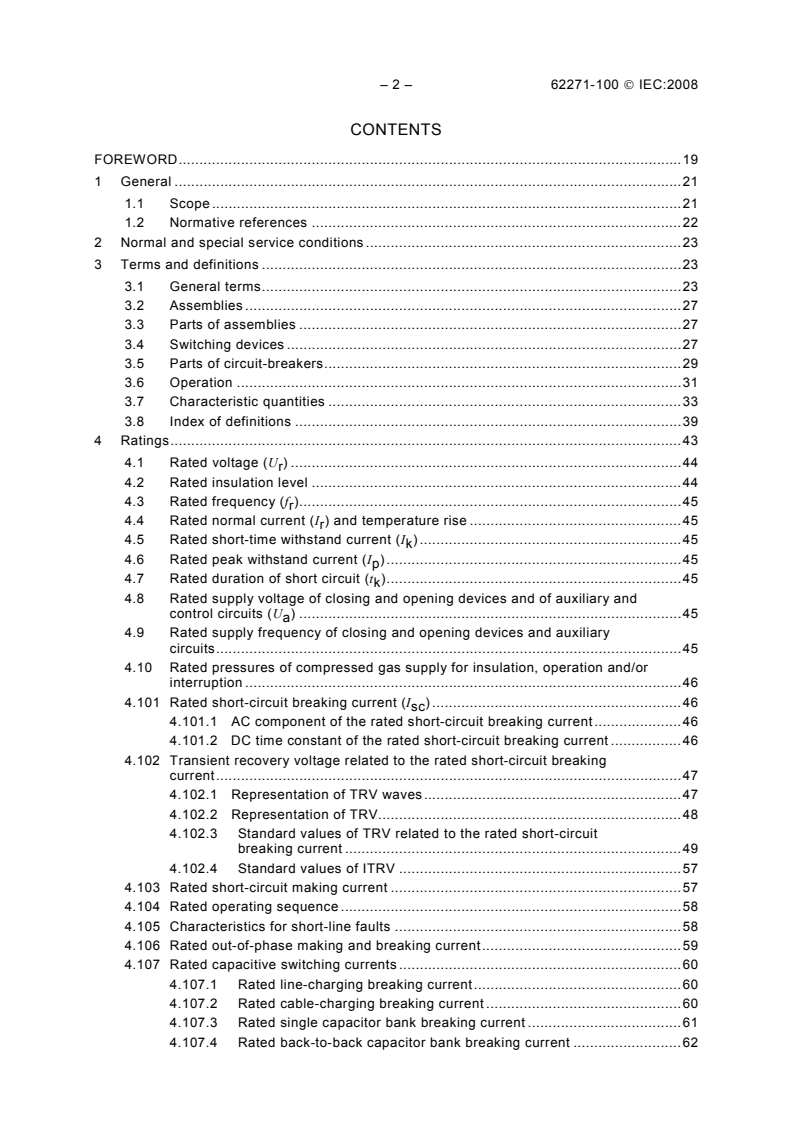
CONTENTS
FOREWORD.19
1 General .21
1.1 Scope .21
1.2 Normative references .22
2 Normal and special service conditions .23
3 Terms and definitions .23
3.1 General terms.23
3.2 Assemblies .27
3.3 Parts of assemblies .27
3.4 Switching devices .27
3.5 Parts of circuit-breakers.29
3.6 Operation .31
3.7 Characteristic quantities .33
3.8 Index of definitions .39
4 Ratings.43
4.1 Rated voltage (U ) .44
r
4.2 Rated insulation level .44
4.3 Rated frequency (f ).45
r
4.4 Rated normal current (I ) and temperature rise .45
r
4.5 Rated short-time withstand current (I ) .45
k
4.6 Rated peak withstand current (I ) .45
p
4.7 Rated duration of short circuit (t ).45
k
4.8 Rated supply voltage of closing and opening devices and of auxiliary and
control circuits (U ) .45
a
4.9 Rated supply frequency of closing and opening devices and auxiliary
circuits.45
4.10 Rated pressures of compressed gas supply for insulation, operation and/or
interruption .46
4.101 Rated short-circuit breaking current (I ) .46
sc
4.101.1 AC component of the rated short-circuit breaking current.46
4.101.2 DC time constant of the rated short-circuit breaking current .46
4.102 Transient recovery voltage related to the rated short-circuit breaking
current.47
4.102.1 Representation of TRV waves.47
4.102.2 Representation of TRV.48
4.102.3 Standard values of TRV related to the rated short-circuit
breaking current .49
4.102.4 Standard values of ITRV .57
4.103 Rated short-circuit making current .57
4.104 Rated operating sequence .58
4.105 Characteristics for short-line faults .58
4.106 Rated out-of-phase making and breaking current.59
4.107 Rated capacitive switching currents .60
4.107.1 Rated line-charging breaking current.60
4.107.2 Rated cable-charging breaking current .60
4.107.3 Rated single capacitor bank breaking current .61
4.107.4 Rated back-to-back capacitor bank breaking current .62
62271-100 © IEC:2008 – 3 –
4.107.5 Rated single capacitor bank inrush making current.62
4.108 Inductive load switching.62
4.109 Rated time quantities.62
4.109.1 Rated break-time.63
4.110 Number of mechanical operations.63
4.111 Classification of circuit-breakers as a function of electrical endurance .63
5 Design and construction .64
5.1 Requirements for liquids in circuit-breakers .64
5.2 Requirements for gases in circuit-breakers .64
5.3 Earthing of circuit-breakers.64
5.4 Auxiliary equipment .64
5.5 Dependent power closing.65
5.6 Stored energy closing .65
5.7 Independent manual operation.65
5.8 Operation of releases .65
5.8.101 Over-current release.65
5.8.101.1 Operating current.65
5.8.101.2 Operating time.65
5.8.101.3 Resetting current .66
5.8.102 Multiple releases.66
5.8.103 Operation limits of releases.66
5.8.104 Power consumption of releases.66
5.8.105 Integrated relays for self-tripping circuit-breakers.66
5.9 Low- and high-pressure interlocking devices.66
5.10 Nameplates .66
5.11 Interlocking devices .68
5.12 Position indication .68
5.13 Degrees of protection by enclosures.68
5.14 Creepage distances.68
5.15 Gas and vacuum tightness.68
5.16 Liquid tightness .68
5.17 Fire hazard (flammability) .68
5.18 Electromagnetic compatibility .68
5.19 X-ray emission.69
5.20 Corrosion.69
5.101 Requirements for simultaneity of poles during single closing and single
opening operations .69
5.102 General requirement for operation .69
5.103 Pressure limits of fluids for operation.69
5.104 Vent outlets.70
6 Type tests .70
6.1 General .72
6.1.1 Grouping of tests .72
6.1.2 Information for identification of specimens .72
6.1.3 Information to be included in type test reports.72
6.1.101 Invalid tests .72
6.2 Dielectric tests.73
6.2.1 Ambient air conditions during tests .73
6.2.2 Wet test procedure .73
– 4 – 62271-100 © IEC:2008
6.2.3 Condition of circuit-breaker during dielectric tests.73
6.2.4 Criteria to pass the test.73
6.2.5 Application of test voltage and test conditions.73
6.2.6 Tests of circuit-breakers of U ≤ 245 kV .74
r
6.2.7 Tests of circuit-breakers of U > 245 kV .74
r
6.2.8 Artificial pollution tests.75
6.2.9 Partial discharge tests .75
6.2.10 Tests on auxiliary and control circuits .75
6.2.11 Voltage test as a condition check.75
6.3 Radio interference voltage (r.i.v.) tests .76
6.4 Measurement of the resistance of the main circuit .76
6.5 Temperature-rise tests.76
6.5.1 Conditions of the circuit-breaker to be tested .76
6.5.2 Arrangement of the equipment.76
6.5.3 Measurement of the temperature and the temperature rise .77
6.5.4 Ambient air temperature .77
6.5.5 Temperature-rise tests of the auxiliary and control equipment.77
6.5.6 Interpretation of the temperature-rise tests .77
6.6 Short-time withstand current and peak withstand current tests.77
6.6.1 Arrangement of the circuit-breaker and of the test circuit .77
6.6.2 Test current and duration.77
6.6.3 Behaviour of the circuit-breaker during test.77
6.6.4 Conditions of the circuit-breaker after test .78
6.7 Verification of the degree of protection .78
6.7.1 Verification of the IP coding .78
6.7.2 Mechanical impact test .78
6.8 Tightness tests .78
6.9 Electromagnetic compatibility (EMC) tests .78
6.9.3.1 Ripple on d.c. input power port immunity test.78
6.9.3.2 Voltage dips, short interruptions and voltage variations on d.c.
input power port immunity tests .78
6.10 Additional tests on auxiliary and control circuits.78
6.10.1 General .78
6.10.2 Functional tests .79
6.10.3 Electrical continuity of earthed metallic parts test .79
6.10.4 Verification of the operational characteristics of auxiliary
contacts .79
6.10.5 Environmental tests .79
6.101 Mechanical and environmental tests .79
6.101.1 Miscellaneous provisions for mechanical and environmental tests .79
6.101.1.1 Mechanical characteristics.79
6.101.1.2 Component tests.80
6.101.1.3 Characteristics and settings of the circuit-breaker to be recorded
before and after the tests .80
6.101.1.4 Condition of the circuit-breaker during and after the tests .81
6.101.1.5 Condition of the auxiliary and control equipment during and after
the tests .81
6.101.2 Mechanical operation test at ambient air temperature .81
6.101.2.1 General .81
6.101.2.2 Condition of the circuit-breaker before the test.82
62271-100 © IEC:2008 – 5 –
6.101.2.3 Description of the test on class M1 circuit-breakers .82
6.101.2.4 Extended mechanical endurance tests on class M2 circuit-
breakers for special service requirements .83
6.101.2.5 Acceptance criteria for the mechanical operation tests.83
6.101.3 Low and high temperature tests .84
6.101.3.1 General .84
6.101.3.2 Measurement of ambient air temperature.85
6.101.3.3 Low temperature test.85
6.101.3.4 High-temperature test.86
6.101.4 Humidity test.87
6.101.4.1 General .87
6.101.4.2 Test procedure .88
6.101.5 Test to prove the operation under severe ice conditions .89
6.101.6 Static terminal load test .89
6.101.6.1 General .89
6.101.6.2 Tests .89
6.102 Miscellaneous provisions for making and breaking tests .90
6.102.1 General.91
6.102.2 Number of test specimens .91
6.102.3 Arrangement of circuit-breaker for tests .92
6.102.3.1 General .92
6.102.3.2 Common enclosure type .93
6.102.3.3 Multi-enclosure type .93
6.102.3.4 Self-tripping circuit-breakers.94
6.102.4 General considerations concerning testing methods .94
6.102.4.1 Single-phase testing of a single pole of a three-pole circuit-
breaker .94
6.102.4.2 Unit testing .95
6.102.4.2.1 Identical nature of the units .96
6.102.4.2.2 Voltage distribution.96
6.102.4.2.3 Requirements for unit testing.97
6.102.4.3 Multi-part testing.97
6.102.5 Synthetic tests.98
6.102.6 No-load operations before tests .98
6.102.7 Alternative operating mechanisms.98
6.102.8 Behaviour of circuit-breaker during tests.99
6.102.9 Condition of circuit-breaker after tests .99
6.102.9.1 General .99
6.102.9.2 Condition after a short-circuit test-duty . 100
6.102.9.3 Condition after a short-circuit test series. 100
6.102.9.4 Condition after a capacitive current switching test series . 101
6.102.9.5 Reconditioning after a short-circuit test-duty and other test
series .102
6.102.10 Demonstration of arcing times . 102
6.102.10.1 Three-phase tests . 102
6.102.10.1.1 Test-duty T10, T30, T60, T100s, T100s(b), OP1 and OP2 . 102
6.102.10.1.2 Test-duty T100a.102
6.102.10.2 Single-phase tests in substitution for three-phase conditions. 104
6.102.10.2.1 Non-effectively earthed neutral systems . 104
6.102.10.2.1.1 Test-duties T10, T30, T60, T100s and T100s(b), OP1 and OP2 .104
– 6 – 62271-100 © IEC:2008
6.102.10.2.1.2 Test-duty T100a .105
6.102.10.2.2 Effectively earthed neutral systems including short-line fault
tests.115
6.102.10.2.2.1 Test-duties T10, T30, T60, T100s and T100s(b), OP1 and
OP2, L , L and L .115
90 75 60
6.102.10.2.2.2 Test-duty T100a .115
6.102.10.2.3 Modified procedure in cases where the circuit-breaker failed
to interrupt during a test with a medium arcing time. 115
6.102.10.2.3.1 Breaking test with symmetrical current. 115
6.102.10.2.3.2 Breaking test with asymmetrical current. 116
6.102.10.2.4 Tests combining the conditions for effectively and non-
effectively earthed neutral systems .116
6.102.10.2.5 Splitting of test-duties in test series taking into account the
associated TRV for each pole-to-clear. 116
6.103 Test circuits for short-circuit making and breaking tests.117
6.103.1 Power factor.117
6.103.2 Frequency.117
6.103.3 Earthing of test circuit.117
6.103.4 Connection of test circuit to circuit-breaker . 119
6.104 Short-circuit test quantities.119
6.104.1 Applied voltage before short-circuit making tests . 119
6.104.2 Short-circuit making current .119
6.104.2.1 General .119
6.104.2.2 Test procedure .120
6.104.2.2.1 Three-phase tests .120
6.104.2.2.2 Single-phase tests.120
6.104.3 Short-circuit breaking current. 121
6.104.4 DC component of short-circuit breaking current . 121
6.104.5 Transient recovery voltage (TRV) for short-circuit breaking tests . 122
6.104.5.1 General .122
6.104.5.2 Test-duties T100s and T100a .124
6.104.5.3 Test duty T60 .124
6.104.5.4 Test duty T30 .124
6.104.5.5 Test duty T10 .125
6.104.5.6 Test-duties OP1 and OP2.125
6.104.6 Measurement of transient recovery voltage during test . 125
6.104.7 Power frequency recovery voltage .132
6.105 Short-circuit test procedure.132
6.105.1 Time interval between tests .132
6.105.2 Application of auxiliary power to the opening release – Breaking
tests.133
6.105.3 Application of auxiliary power to the opening release – Make-
break tests .133
6.105.4 Latching on short-circuit.133
6.106 Basic short-circuit test-duties.133
6.106.1 Test-duty T10 .134
6.106.2 Test-duty T30 .134
6.106.3 Test-duty T60 .134
6.106.4 Test-duty T100s.134
6.106.4.1 Time constant of the d.c. component of the test circuit equal to
the specified value .135
62271-100 © IEC:2008 – 7 –
6.106.4.2 Time constant of the d.c. component of the test circuit less than
the specified value .135
6.106.4.3 Time constant of the d.c. component of the test circuit greater
than the specified value .136
6.106.4.4 Significant decay of the a.c. component of the test circuit . 136
6.106.5 Test-duty T100a.137
6.106.6 Asymmetry criteria.138
6.106.6.1 Three-phase tests.139
6.106.6.1.1 Test current amplitude and last current loop duration.139
6.106.6.1.2 Percentage of d.c. component at current zero .139
6.106.6.2 Single-phase tests .139
6.106.6.2.1 Test current amplitude and last current loop duration.139
6.106.6.2.2 Percentage of the d.c. component at current zero . 140
6.106.6.3 Adjustment measures .140
6.107 Critical current tests .140
6.107.1 Applicability.140
6.107.2 Test current.141
6.107.3 Critical current test-duty.141
6.108 Single-phase and double-earth fault tests . 141
6.108.1 Applicability.141
6.108.2 Test current and recovery voltage.142
6.108.3 Test-duty.142
6.109 Short-line fault tests .143
6.109.1 Applicability.143
6.109.2 Test current.143
6.109.3 Test circuit.144
6.109.4 Test-duties.146
6.109.5 Short-line fault tests with a test supply of limited power .146
6.110 Out-of-phase making and breaking tests.147
6.110.1 Test circuit.147
6.110.2 Test voltage.147
6.110.3 Test-duties.147
6.111 Capacitive current switching tests.148
6.111.1 Applicability.148
6.111.2 General.148
6.111.3 Characteristics of supply circuits. 149
6.111.4 Earthing of the supply circuit.149
6.111.5 Characteristics of the capacitive circuit to be switched. 150
6.111.5.1 Line-charging and cable-charging current switching tests . 150
6.111.5.2 Capacitor bank current switching tests.151
6.111.6 Waveform of the current .151
6.111.7 Test voltage.151
6.111.8 Test current.152
6.111.9 Test-duties.152
6.111.9.1 Test conditions for class C2 circuit-breakers.153
6.111.9.1.1 Class C2 test-duties.153
6.111.9.1.2 Three-phase line-charging and cable-charging current
switching tests .156
6.111.9.1.3 Single-phase line-charging and cable-charging current
switching tests .156
– 8 – 62271-100 © IEC:2008
6.111.9.1.4 Three-phase capacitor bank (single or back-to-back) current
switching tests .156
6.111.9.1.5 Single-phase capacitor bank (single or back-to-back) current
switching tests .157
6.111.9.2 Test conditions for class C1 circuit-breakers.158
6.111.9.2.1 Class C1 test-duties.158
6.111.9.2.2 Single-phase and three-phase capacitive current switching
tests.160
6.111.9.3 Test conditions corresponding to breaking in the presence of
earth faults .160
6.111.10 Tests with specified TRV .161
6.111.11 Criteria to pass the test.161
6.111.11.1 General.161
6.111.11.2 Class C2 circuit-breaker.162
6.111.11.3 Class C1 circuit-breaker.162
6.111.11.4 Criteria for reclassification of a circuit-breaker tested to the
class C2 requirements as a class C1 circuit-breaker.162
6.112 Special requirements for making and breaking tests on class E2 circuit-
breakers .163
6.112.1 Class E2 circuit-breakers intended for use without auto-reclosing
duty.163
6.112.2 Class E2 circuit-breakers intended for auto-reclosing duty. 163
7 Routine tests .164
7.1 Dielectric test on the main circuit .164
7.2 Tests on auxiliary and control circuits .165
7.3 Measurement of the resistance of the main circuit . 165
7.4 Tightness test .165
7.5 Design and visual checks .165
7.101 Mechanical operating tests .165
8 Guidance to the selection of circuit-breakers for service . 167
8.101 General.167
8.102 Selection of rated values for service conditions . 168
8.102.1 Selection of rated voltage . 168
8.102.2 Insulation coordination.169
8.102.3 Rated frequency .169
8.102.4 Selection of rated normal current .169
8.102.5 Local atmospheric and climatic conditions . 169
8.102.6 Use at high altitudes .170
8.103 Selection of rated values for fault conditions.170
8.103.1 Selection of rated short-circuit breaking current . 170
8.103.2 Selection of transient recovery voltage (TRV) for terminal faults,
first-pole-to-clear factor and characteristics for short-line faults. 172
8.103.3 Selection of out-of-phase characteristics . 173
8.103.4 Selection of rated short-circuit making current . 173
8.103.5 Operating sequence in service.174
8.103.6 Selection of rated duration of short-circuit. 174
8.103.7 Faults in the presence of current limiting reactors . 174
8.104 Selection for electrical endurance in networks of rated voltage above
1 kVand up to and including 52 kV.175
8.105 Selection for capacitive current switching .175
9 Information to be given with enquiries, tenders and orders .175
62271-100 © IEC:2008 – 9 –
9.101 Information to be given with enquiries and orders . 175
9.102 Information to be given with tenders .177
10 Rules for transport, storage, installation, operation and maintenance . 178
10.1 Conditions during transport, storage and installation. 178
10.2 Installation.179
10.2.101 Commissioning tests.179
10.2.102 Commissioning checks and test programme .179
10.2.102.1 Checks after installation .179
10.2.102.1.1 General checks . 179
10.2.102.1.2 Checks of electrical circuits . 180
10.2.102.1.3 Checks of the insulation and/or extinguishing fluid(s) .180
10.2.102.1.4 Checks on operating fluid(s), where filled or added to on site . 180
10.2.102.1.5 Site operations.180
10.2.102.2 Mechanical tests and measurements .180
10.2.102.2.1 Measurements of the characteristic insulating and/or
interrupting fluid pressures (where applicable) . 180
10.2.102.2.1.1 General.180
10.2.102.2.1.2 Measurements to be taken. 180
10.2.102.2.2 Measurements of characteristic operating fluid pressures (if
applicable) .181
10.2.102.2.2.1 General.181
10.2.102.2.2.2 Measurements to be taken. 181
10.2.102.2.3 Measurement of consumption during operations (if applicable).181
10.2.102.2.4 Verification of the rated operating sequence. 182
10.2.102.2.5 Measurement of time quantities . 182
10.2.102.2.5.1 Characteristic time quantities of the circuit-breaker. 182
10.2.102.2.6 Record of mechanical travel characteristics . 183
10.2.102.2.7Checks of certain specific operations .183
10.2.102.2.7.1 Auto-reclosing at the minimum functional pressure for
operation (if applicable).
...
IEC 62271-100 ®
Edition 2.2 2017-06
CONSOLIDATED VERSION
INTERNATIONAL
STANDARD
NORME
INTERNATIONALE
colour
inside
High-voltage switchgear and controlgear –
Part 100: Alternating-current circuit-breakers
Appareillage à haute tension –
Partie 100: Disjoncteurs à courant alternatif
All rights reserved. Unless otherwise specified, no part of this publication may be reproduced or utilized in any form
or by any means, electronic or mechanical, including photocopying and microfilm, without permission in writing from
either IEC or IEC's member National Committee in the country of the requester. If you have any questions about IEC
copyright or have an enquiry about obtaining additional rights to this publication, please contact the address below or
your local IEC member National Committee for further information.
Droits de reproduction réservés. Sauf indication contraire, aucune partie de cette publication ne peut être reproduite
ni utilisée sous quelque forme que ce soit et par aucun procédé, électronique ou mécanique, y compris la photocopie
et les microfilms, sans l'accord écrit de l'IEC ou du Comité national de l'IEC du pays du demandeur. Si vous avez des
questions sur le copyright de l'IEC ou si vous désirez obtenir des droits supplémentaires sur cette publication, utilisez
les coordonnées ci-après ou contactez le Comité national de l'IEC de votre pays de résidence.
IEC Central Office Tel.: +41 22 919 02 11
3, rue de Varembé Fax: +41 22 919 03 00
CH-1211 Geneva 20 info@iec.ch
Switzerland www.iec.ch
About the IEC
The International Electrotechnical Commission (IEC) is the leading global organization that prepares and publishes
International Standards for all electrical, electronic and related technologies.
About IEC publications
The technical content of IEC publications is kept under constant review by the IEC. Please make sure that you have the
latest edition, a corrigenda or an amendment might have been published.
IEC Catalogue - webstore.iec.ch/catalogue Electropedia - www.electropedia.org
The stand-alone application for consulting the entire The world's leading online dictionary of electronic and
bibliographical information on IEC International Standards, electrical terms containing 20 000 terms and definitions in
Technical Specifications, Technical Reports and other English and French, with equivalent terms in 16 additional
documents. Available for PC, Mac OS, Android Tablets and languages. Also known as the International Electrotechnical
iPad. Vocabulary (IEV) online.
IEC publications search - www.iec.ch/searchpub IEC Glossary - std.iec.ch/glossary
The advanced search enables to find IEC publications by a 65 000 electrotechnical terminology entries in English and
variety of criteria (reference number, text, technical French extracted from the Terms and Definitions clause of
committee,…). It also gives information on projects, replaced IEC publications issued since 2002. Some entries have been
and withdrawn publications. collected from earlier publications of IEC TC 37, 77, 86 and
CISPR.
IEC Just Published - webstore.iec.ch/justpublished
Stay up to date on all new IEC publications. Just Published IEC Customer Service Centre - webstore.iec.ch/csc
details all new publications released. Available online and If you wish to give us your feedback on this publication or
also once a month by email. need further assistance, please contact the Customer Service
Centre: csc@iec.ch.
A propos de l'IEC
La Commission Electrotechnique Internationale (IEC) est la première organisation mondiale qui élabore et publie des
Normes internationales pour tout ce qui a trait à l'électricité, à l'électronique et aux technologies apparentées.
A propos des publications IEC
Le contenu technique des publications IEC est constamment revu. Veuillez vous assurer que vous possédez l’édition la
plus récente, un corrigendum ou amendement peut avoir été publié.
Catalogue IEC - webstore.iec.ch/catalogue Electropedia - www.electropedia.org
Application autonome pour consulter tous les renseignements
Le premier dictionnaire en ligne de termes électroniques et
bibliographiques sur les Normes internationales,
électriques. Il contient 20 000 termes et définitions en anglais
Spécifications techniques, Rapports techniques et autres
et en français, ainsi que les termes équivalents dans 16
documents de l'IEC. Disponible pour PC, Mac OS, tablettes
langues additionnelles. Egalement appelé Vocabulaire
Android et iPad.
Electrotechnique International (IEV) en ligne.
Recherche de publications IEC - www.iec.ch/searchpub
Glossaire IEC - std.iec.ch/glossary
La recherche avancée permet de trouver des publications IEC
65 000 entrées terminologiques électrotechniques, en anglais
en utilisant différents critères (numéro de référence, texte,
et en français, extraites des articles Termes et Définitions des
comité d’études,…). Elle donne aussi des informations sur les
publications IEC parues depuis 2002. Plus certaines entrées
projets et les publications remplacées ou retirées.
antérieures extraites des publications des CE 37, 77, 86 et
CISPR de l'IEC.
IEC Just Published - webstore.iec.ch/justpublished
Restez informé sur les nouvelles publications IEC. Just Service Clients - webstore.iec.ch/csc
Published détaille les nouvelles publications parues. Si vous désirez nous donner des commentaires sur cette
Disponible en ligne et aussi une fois par mois par email. publication ou si vous avez des questions contactez-nous:
csc@iec.ch.
IEC 62271-100 ®
Edition 2.2 2017-06
CONSOLIDATED VERSION
INTERNATIONAL
STANDARD
NORME
INTERNATIONALE
colour
inside
High-voltage switchgear and controlgear –
Part 100: Alternating-current circuit-breakers
Appareillage à haute tension –
Partie 100: Disjoncteurs à courant alternatif
INTERNATIONAL
ELECTROTECHNICAL
COMMISSION
COMMISSION
ELECTROTECHNIQUE
INTERNATIONALE
ICS 29.130.10 ISBN 978-2-8322-4470-8
IEC 62271-100 ®
Edition 2.2 2017-06
CONSOLIDATED VERSION
REDLINE VERSION
VERSION REDLINE
colour
inside
High-voltage switchgear and controlgear –
Part 100: Alternating-current circuit-breakers
Appareillage à haute tension –
Partie 100: Disjoncteurs à courant alternatif
– 2 – IEC 62271-100:2008+AMD1:2012
+AMD2:2017 CSV IEC 2017
CONTENTS
FOREWORD . 13
INTRODUCTION to the Amendment . 15
1 General . 16
1.1 Scope . 16
1.2 Normative references . 17
2 Normal and special service conditions . 18
3 Terms and definitions . 18
3.1 General terms . 18
3.2 Assemblies . 22
3.3 Parts of assemblies . 22
3.4 Switching devices . 22
3.5 Parts of circuit-breakers . 24
3.6 Operation . 26
3.7 Characteristic quantities . 29
3.8 Index of definitions . 36
4 Ratings . 40
4.1 Rated voltage (U ) . 41
r
4.2 Rated insulation level . 41
4.3 Rated frequency (f ) . 42
r
4.4 Rated normal current (I ) and temperature rise . 43
r
4.5 Rated short-time withstand current (I ) . 43
k
4.6 Rated peak withstand current (I ) . 43
p
4.7 Rated duration of short circuit (t ) . 43
k
4.8 Rated supply voltage of closing and opening devices and of auxiliary and
control circuits (U ) . 43
a
4.9 Rated supply frequency of closing and opening devices and auxiliary
circuits . 43
4.10 Rated pressures of compressed gas supply for insulation, operation and/or
interruption controlled pressure systems . 43
4.11 Rated filling levels for insulation and/or operation . 43
4.101 Rated short-circuit breaking current (Isc) . 44
4.102 Transient recovery voltage related to the rated short-circuit breaking
current .
4.102 Rated first-pole-to-clear factor . 55
4.103 Rated short-circuit making current . 56
4.104 Rated operating sequence . 56
4.105 Characteristics for Short-line faults breaking capability . 57
4.106 Rated out-of-phase making and breaking current . 58
4.107 Rated capacitive switching currents . 59
4.108 Inductive load switching . 62
4.109 Rated time quantities Void . 62
4.110 Number of mechanical operations . 63
4.111 Classification of circuit-breakers as a function of electrical endurance . 63
5 Design and construction . 64
5.1 Requirements for liquids in circuit-breakers . 64
5.2 Requirements for gases in circuit-breakers . 64
+AMD2:2017 CSV IEC 2017
5.3 Earthing of circuit-breakers . 64
5.4 Auxiliary equipment . 64
5.5 Dependent power closing operation . 65
5.6 Stored energy closing operation . 65
5.7 Independent manual or power operation . 65
5.8 Operation of releases . 65
5.9 Low- and high-pressure interlocking devices . 66
5.10 Nameplates . 66
5.11 Interlocking devices . 68
5.12 Position indication . 68
5.13 Degrees of protection by enclosures . 68
5.14 Creepage distances . 68
5.15 Gas and vacuum tightness . 68
5.16 Liquid tightness . 68
5.17 Fire hazard (flammability) . 68
5.18 Electromagnetic compatibility . 68
5.19 X-ray emission . 69
5.20 Corrosion . 69
5.101 Requirements for simultaneity of poles during single closing and single
opening operations . 69
5.102 General requirement for operation . 69
5.103 Pressure limits of fluids for operation . 70
5.104 Vent outlets . 70
5.105 Time quantities . 70
5.106 Static mechanical loads . 71
6 Type tests . 72
6.1 General . 72
6.2 Dielectric tests . 75
6.3 Radio interference voltage (r.i.v.) tests . 80
6.4 Measurement of the resistance of the main circuit . 80
6.5 Temperature-rise tests . 80
6.6 Short-time withstand current and peak withstand current tests . 81
6.7 Verification of the degree of protection . 82
6.8 Tightness tests . 82
6.9 Electromagnetic compatibility (EMC) tests . 82
6.10 Additional tests on auxiliary and control circuits . 82
6.11 X-radiation test procedure for vacuum interrupters . 83
6.101 Mechanical and environmental tests . 83
6.102 Miscellaneous provisions for making and breaking tests . 95
6.103 Test circuits for short-circuit making and breaking tests . 133
6.104 Short-circuit test quantities . 135
6.105 Short-circuit test procedure . 160
6.106 Basic short-circuit test-duties . 162
6.107 Critical current tests . 169
6.108 Single-phase and double-earth fault tests . 169
6.109 Short-line fault tests . 171
6.110 Out-of-phase making and breaking tests . 177
6.111 Capacitive current switching tests . 179
– 4 – IEC 62271-100:2008+AMD1:2012
+AMD2:2017 CSV IEC 2017
6.112 Special requirements for making and breaking tests on class E2 circuit-
breakers . 206
7 Routine tests . 207
7.1 Dielectric test on the main circuit . 207
7.2 Tests on auxiliary and control circuits . 209
7.3 Measurement of the resistance of the main circuit . 209
7.4 Tightness test . 209
7.5 Design and visual checks . 209
7.101 Mechanical operating tests . 209
8 Guidance to the selection of circuit-breakers for service . 211
8.101 General . 211
8.102 Selection of rated values for service conditions . 213
8.103 Selection of rated values for fault conditions . 215
8.104 Selection for electrical endurance in networks of rated voltage above
1 kVand up to and including 52 kV . 220
8.105 election for capacitive current switching . 220
9 Information to be given with enquiries, tenders and orders . 220
9.101 Information to be given with enquiries and orders . 220
9.102 Information to be given with tenders . 222
10 Rules for transport, storage, installation, operation and maintenance . 224
10.1 Conditions during transport, storage and installation . 224
10.2 Installation . 224
10.3 Operation . 230
10.4 Maintenance . 230
11 Safety . 230
12 Influence of the product on the environment . 230
Annex A (normative) Calculation of transient recovery voltages for short-line faults
from rated characteristics . 306
A.1 Basic approach . 306
A.2 Transient voltage on line side . 308
A.3 Transient voltage on source side . 309
A.4 Examples of calculations . 311
Annex B (normative) Tolerances on test quantities during type tests . 317
Annex C (normative) Records and reports of type tests . 326
C.1 Information and results to be recorded . 326
C.2 Information to be included in type test reports . 326
Annex D (normative) Determination of short-circuit power factor . 330
D.1 Method I – Calculation from d.c. component . 330
D.2 Method II – Determination with pilot generator . 330
Annex E (normative) Method of drawing the envelope determination of the prospective
TRV of a circuit and determining the representative parameters . 332
E.1 Introduction General . 332
E.2 Drawing the envelope . 333
E.3 Determination of parameters . 333
Annex F (normative) Methods of determining prospective transient recovery voltage
waves . 337
F.1 Introduction General . 337
F.2 General summary of the recommended methods . 338
+AMD2:2017 CSV IEC 2017
F.3 Detailed consideration of the recommended methods . 339
F.4 Comparison of methods . 343
Annex G (normative) Rationale behind introduction of circuit-breakers class E2 . 353
Annex H (informative) Inrush currents of single and back-to-back capacitor banks .
H.1 General .
H.2 Example 1 – One capacitor to be switched in parallel (see Figure H.1) .
H.3 Example 2 – Two capacitors to be switched in parallel (see Figure H.2) .
Annex I (informative) Explanatory notes .
I.1 General .
I.2 Explanatory note regarding the d.c. time constant of the rated short-circuit
breaking current (4.101.2) – Advice for the choice of the appropriate time
constant .
I.3 Explanatory note regarding capacitive current switching tests (6.111).
Annex J (informative) Test current and line length tolerances for short-line fault testing .
Annex K (informative) List of symbols and abbreviations used in this standard .
Annex L (informative) Explanatory notes on the revision of TRVs for circuit-breakers
of rated voltages higher than 1 kV and less than 100 kV .
L.1 General .
L.2 Terminal fault .
L.3 Short-line fault .
L.4 Out-of-phase .
L.5 Series reactor fault .
L.6 TRV for last clearing poles / Tests circuit topology .
Annex M (normative informative) Requirements for breaking of transformer-limited
faults by circuit-breakers with rated voltage higher than 1 kV and less than 100 kV . 376
M.1 General . 376
M.2 Circuit-breakers with rated voltage less than 100 kV . 377
M.3 Circuit-breakers with rated voltage from 100 kV to 800 kV . 380
M.4 Circuit-breakers with rated voltage higher than 800 kV . 380
Annex N (normative) Use of mechanical characteristics and related requirements . 382
Annex O (informative normative) Guidance Requirements for short-circuit and
switching test procedures for metal-enclosed and dead tank circuit-breakers . 385
O.1 General . 396
O.2 Reduced number of units for testing purposes . 397
O.3 Tests for single pole in one enclosure . 397
O.4 Tests for three poles in one enclosure . 400
Annex P (normative) Calculation of the TRV parameters during asymmetrical fault
condition (T100a) .
Annex Q (informative) Examples for the application of the asymmetry criteria during
asymmetrical test-duty T100a .
Q.1 Three-phase testing of a circuit-breaker with a rated d.c. time constant of
the rated short-circuit breaking current constant longer than the test circuit
time constant .
Q.2 Single phase testing of a circuit-breaker with a rated d.c. time constant of
the rated short-circuit breaking current shorter than the test circuit time
constant .
Q.3 Single-phase testing of a circuit-breaker with a rated d.c. time constant of
the rated short-circuit breaking current longer than the test circuit time
constant .
Annex R (normative) Requirements for circuit-breakers with opening resistors . 415
– 6 – IEC 62271-100:2008+AMD1:2012
+AMD2:2017 CSV IEC 2017
R.1 General . 415
R.2 Switching performance to be verified . 415
R.3 Insertion time of the resistor . 428
R.4 Current carrying performance . 428
R.5 Dielectric performance . 428
R.6 Mechanical performance . 428
R.7 Requirements for the specification of opening resistors . 428
R.8 Examples of recovery voltage waveshapes . 428
Annex S (normative) Verification of capacitive current switching in presence of single
or two-phase earth faults . 432
S.1 General . 432
S.2 Test voltage . 432
S.3 Test current . 432
S.4 Test-duty . 433
S.5 Criteria to pass the tests . 433
Bibliography . 434
Figure 1 – Typical oscillogram of a three-phase short-circuit make-break cycle . 232
Figure 2 – Circuit-breaker without switching resistors – Opening and closing operations. 235
Figure 3 – Circuit breaker without switching resistors – Close-open cycle . 237
Figure 4 – Circuit-breaker without switching resistors – Reclosing (auto-reclosing) . 239
Figure 5 – Circuit-breaker with switching resistors – Opening and closing operations . 241
Figure 6 – Circuit-breaker with switching resistors – Close-open cycle . 243
Figure 7 – Circuit-breaker with switching resistors – Reclosing (auto-reclosing) . 245
Figure 8 – Determination of short-circuit making and breaking currents, and of
percentage d.c. component . 246
Figure 9 – Percentage d.c. component in relation to the time interval from the initiation
of the short-circuit for the standard different time constants τ and for the special case
time constants τ , τ and τ . 247
2 3 4
Figure 10 – Representation of a specified four-parameter TRV and a delay line for
T100, T60, short-line fault and out-of-phase condition. 248
Figure 11 – Representation of a specified TRV by a two-parameter reference line and
a delay line . 248
Figure 12 - ITRV circuit and representation of ITRV in relationship to TRV . 249
Figure 13 – Three-phase short-circuit representation . 251
Figure 14 – Alternative representation of Figure 13 . 252
Figure 15 – Basic short-line fault circuit . 253
Figure 16 – Example of a line-side transient voltage with time delay and rounded crest
showing construction to derive the values u *, t and t .
L dL
L
Figure 16 – Examples of line side transient voltages . 254
Figure 17 – Test sequences for low and high temperature tests . 255
Figure 18 – Humidity test . 256
Figure 19 – Static terminal load forces .
Figure 20 – Directions for static terminal load tests .
Figure 21 – Permitted number of samples for making, breaking and switching tests,
illustrations of the statements in 6.102.2 .
Figure 22 – Definition of a single test specimen in accordance with 3.2.2 of IEC 62271-1 .
+AMD2:2017 CSV IEC 2017
Figure 23a – Reference mechanical characteristics (idealised curve) . 262
Figure 23b – Reference mechanical characteristics (idealised curve) with the
prescribed envelopes centered over the reference curve (+5 %, –5 %), contact
separation in this example at time t = 20 ms . 262
Figure 23c – Reference mechanical characteristics (idealised curve) with the
prescribed envelopes fully displaced upward from the reference curve (+10 %, –0 %),
contact separation in this example at time t = 20 ms . 263
Figure 23d – Reference mechanical characteristics (idealised curve) with the
prescribed envelopes fully displaced downward from the reference curve (+0 %, –
10 %), contact separation in this example at time t = 20 ms . 263
Figure 24 – Equivalent testing set-up for unit testing of circuit-breakers with more than
one separate interrupter units . 264
Figure 25 – Earthing of test circuits for three-phase short-circuit tests, first-pole-to-
clear factor 1,5. 265
Figure 26 – Earthing of test circuits for three-phase short-circuit tests, first-pole-to-
clear factor 1,3. 266
Figure 27 – Earthing of test circuits for single-phase short-circuit tests, first-pole-to-
clear factor 1,5. 267
Figure 28 – Earthing of test circuits for single-phase short-circuit tests, first-pole-to-
clear factor 1,3. 267
Figure 29 – Graphical representation of the three valid symmetrical breaking
operations for three-phase tests in a non-effectively earthed neutral system (first-pole-
to-clear factor 1,5) an example of the three valid symmetrical breaking operations for
kpp = 1,5 . 270
Figure 30 – Graphical representation of the three valid symmetrical breaking
operations for three-phase tests in an effectively earthed neutral system
(first-pole-to-clear factor 1,3) k = 1,2 or 1,3 . 272
pp
Figure 31 – Graphical representation of an example of the three valid asymmetrical
breaking operations for three-phase tests in a non-effectively earthed neutral system
(first-pole-to-clear factor 1,5) for k = 1,5 . 274
pp
Figure 32 – Graphical representation of the three valid symmetrical breaking
operations for single-phase tests in substitution of three-phase conditions in a non-
effectively earthed neutral system (first-pole-to-clear factor 1,5) for k = 1,5 . 276
pp
Figure 33 – Graphical representation of the three valid symmetrical breaking
operations for single-phase tests in substitution of three-phase conditions in a non-
effectively earthed neutral system (first-pole-to-clear factor 1,5) for k = 1,5 . 278
pp
Figure 34 – Graphical representation of an example of the three valid asymmetrical
breaking operations for single-phase tests in substitution of three-phase conditions in a
non-effectively earthed neutral system (first-pole-to-clear factor 1,5)
for k = 1,2 or 1,3 . 280
pp
Figure 35 – Graphical representation of an example of the three valid asymmetrical
breaking operations for single-phase tests in substitution of three-phase conditions in
an effectively earthed neutral system (first-pole-to-clear factor 1,3) for k = 1,5 . 282
pp
Figure 36 – Graphical representation of an example of the three valid asymmetrical
breaking operations for single-phase tests in substitution of three-phase conditions in
an effectively earthed neutral system (first-pole-to-clear factor 1,3) for k = 1,2
pp
and 1,3 . 284
Figure 37 – Graphical representation of the interrupting window and the voltage factor
k , determining the TRV of the individual pole, for systems with a first-pole-to-clear
p
factor of 1,3 . 286
Figure 38 – Graphical representation of the interrupting window and the voltage factor
k , determining the TRV of the individual pole, for systems with a first-pole-to-clear
p
factor of 1,5 . 287
– 8 – IEC 62271-100:2008+AMD1:2012
+AMD2:2017 CSV IEC 2017
Figure 39 – Example of prospective test TRV with four-parameter envelope which
satisfies the conditions to be met during type test – Case of specified TRV with four-
parameter reference line . 288
Figure 40 – Example of prospective test TRV with two-parameter envelope which
satisfies the conditions to be met during type test: case of specified TRV with two-
parameter reference line . 289
Figure 41 – Example of prospective test TRV with four-parameter envelope which
satisfies the conditions to be met during type-test – Case of specified TRV with two-
parameter reference line .
Figure 42 – Example of prospective test TRV with two-parameter envelope which
satisfies the conditions to be met during type-test – Case of specified TRV with four-
parameter reference line .
Figure 43 – Example of prospective test TRV-waves and their combined envelope in
two-part test . 291
Figure 44 – Determination of power frequency recovery voltage . 292
Figure 45 – Necessity of additional single-phase tests and requirements for testing . 293
Figure 46 – Basic circuit arrangement for short-line fault testing and prospective TRV-
circuit-type a) according to 6.109.3: source side and line side with time delay . 295
Figure 47 – Basic circuit arrangement for short-line fault testing – circuit type b1)
according to 6.109.3: source side with ITRV and line side with time delay . 297
Figure 48 – Basic circuit arrangement for short-line fault testing – circuit type b2)
according to 6.109.3: source side with time delay and line side without time delay . 299
Figure 49 – Flow-chart for the choice of short-line fault test circuits for class S2 circuit-
breakers and for circuit-breakers having a rated voltage of 100 kV and above . 300
Figure 50 – Compensation of deficiency of the source side time delay by an increase
of the excursion of the line side voltage . 301
Figure 51 – Test circuit for single-phase out-of-phase tests . 302
Figure 52 – Test circuit for out-of-phase tests using two voltages separated by 120
electrical degrees . 302
Figure 53 – Test circuit for out-of-phase tests with one terminal of the circuit-breaker
earthed (subject to agreement of the manufacturer) . 303
Figure 54 – Recovery voltage for capacitive current breaking tests . 303
Figure 55 – Reclassification procedure for line and cable-charging current switching
tests . 304
Figure 56 – Reclassification procedure for capacitor bank current switching tests . 305
Figure 58 – Graphical representation of the interrupting window and the voltage factor
k , determining the TRV of the individual pole, for systems with a first-pole-to-clear
p
factor of 1,2 . 285
Figure 59 – Example of wind velocity measurement . 257
Figure 60 – Graphical representation of the time parameters for the demonstration of
arcing times in three-phase tests of test-duty T100a . 268
Figure A.1 – Typical graph of line and source side TRV parameters – Line side and
source side with time delay . 314
Figure A.2 – Typical graph of line and source side TRV parameters – Line side and
source side with time delay, source side with ITRV . 315
Figure A.3 – Actual course of the source side transient recovery voltage for short-line
fault L , L and L .
...
IEC 62271-100 ®
Edition 2.1 2012-09
INTERNATIONAL
STANDARD
NORME
INTERNATIONALE
colour
inside
High-voltage switchgear and controlgear –
Part 100: Alternating-current circuit-breakers
Appareillage à haute tension –
Partie 100: Disjoncteurs à courant alternatif
All rights reserved. Unless otherwise specified, no part of this publication may be reproduced or utilized in any form
or by any means, electronic or mechanical, including photocopying and microfilm, without permission in writing from
either IEC or IEC's member National Committee in the country of the requester.
If you have any questions about IEC copyright or have an enquiry about obtaining additional rights to this publication,
please contact the address below or your local IEC member National Committee for further information.
Droits de reproduction réservés. Sauf indication contraire, aucune partie de cette publication ne peut être reproduite ni
utilisée sous quelque forme que ce soit et par aucun procédé, électronique ou mécanique, y compris la photocopie et les
microfilms, sans l'accord écrit de la CEI ou du Comité national de la CEI du pays du demandeur.
Si vous avez des questions sur le copyright de la CEI ou si vous désirez obtenir des droits supplémentaires sur cette
publication, utilisez les coordonnées ci-après ou contactez le Comité national de la CEI de votre pays de résidence.
IEC Central Office Tel.: +41 22 919 02 11
3, rue de Varembé Fax: +41 22 919 03 00
CH-1211 Geneva 20 info@iec.ch
Switzerland www.iec.ch
About the IEC
The International Electrotechnical Commission (IEC) is the leading global organization that prepares and publishes
International Standards for all electrical, electronic and related technologies.
About IEC publications
The technical content of IEC publications is kept under constant review by the IEC. Please make sure that you have the
latest edition, a corrigenda or an amendment might have been published.
Useful links:
IEC publications search - www.iec.ch/searchpub Electropedia - www.electropedia.org
The advanced search enables you to find IEC publications The world's leading online dictionary of electronic and
by a variety of criteria (reference number, text, technical electrical terms containing more than 30 000 terms and
committee,…). definitions in English and French, with equivalent terms in
It also gives information on projects, replaced and additional languages. Also known as the International
withdrawn publications. Electrotechnical Vocabulary (IEV) on-line.
IEC Just Published - webstore.iec.ch/justpublished Customer Service Centre - webstore.iec.ch/csc
Stay up to date on all new IEC publications. Just Published If you wish to give us your feedback on this publication
details all new publications released. Available on-line and or need further assistance, please contact the
also once a month by email. Customer Service Centre: csc@iec.ch.
A propos de la CEI
La Commission Electrotechnique Internationale (CEI) est la première organisation mondiale qui élabore et publie des
Normes internationales pour tout ce qui a trait à l'électricité, à l'électronique et aux technologies apparentées.
A propos des publications CEI
Le contenu technique des publications de la CEI est constamment revu. Veuillez vous assurer que vous possédez
l’édition la plus récente, un corrigendum ou amendement peut avoir été publié.
Liens utiles:
Recherche de publications CEI - www.iec.ch/searchpub Electropedia - www.electropedia.org
La recherche avancée vous permet de trouver des Le premier dictionnaire en ligne au monde de termes
publications CEI en utilisant différents critères (numéro de électroniques et électriques. Il contient plus de 30 000
référence, texte, comité d’études,…). termes et définitions en anglais et en français, ainsi que
Elle donne aussi des informations sur les projets et les les termes équivalents dans les langues additionnelles.
publications remplacées ou retirées. Egalement appelé Vocabulaire Electrotechnique
International (VEI) en ligne.
Just Published CEI - webstore.iec.ch/justpublished
Service Clients - webstore.iec.ch/csc
Restez informé sur les nouvelles publications de la CEI.
Just Published détaille les nouvelles publications parues. Si vous désirez nous donner des commentaires sur
Disponible en ligne et aussi une fois par mois par email. cette publication ou si vous avez des questions
contactez-nous: csc@iec.ch.
IEC 62271-100 ®
Edition 2.1 2012-09
INTERNATIONAL
STANDARD
NORME
INTERNATIONALE
colour
inside
High-voltage switchgear and controlgear –
Part 100: Alternating-current circuit-breakers
Appareillage à haute tension –
Partie 100: Disjoncteurs à courant alternatif
INTERNATIONAL
ELECTROTECHNICAL
COMMISSION
COMMISSION
ELECTROTECHNIQUE
PRICE CODE
INTERNATIONALE
CODE PRIX CV
ICS 29.130.10 ISBN 978-2-8322-0403-0
– 2 – 62271-100 IEC:2008+A1:2012
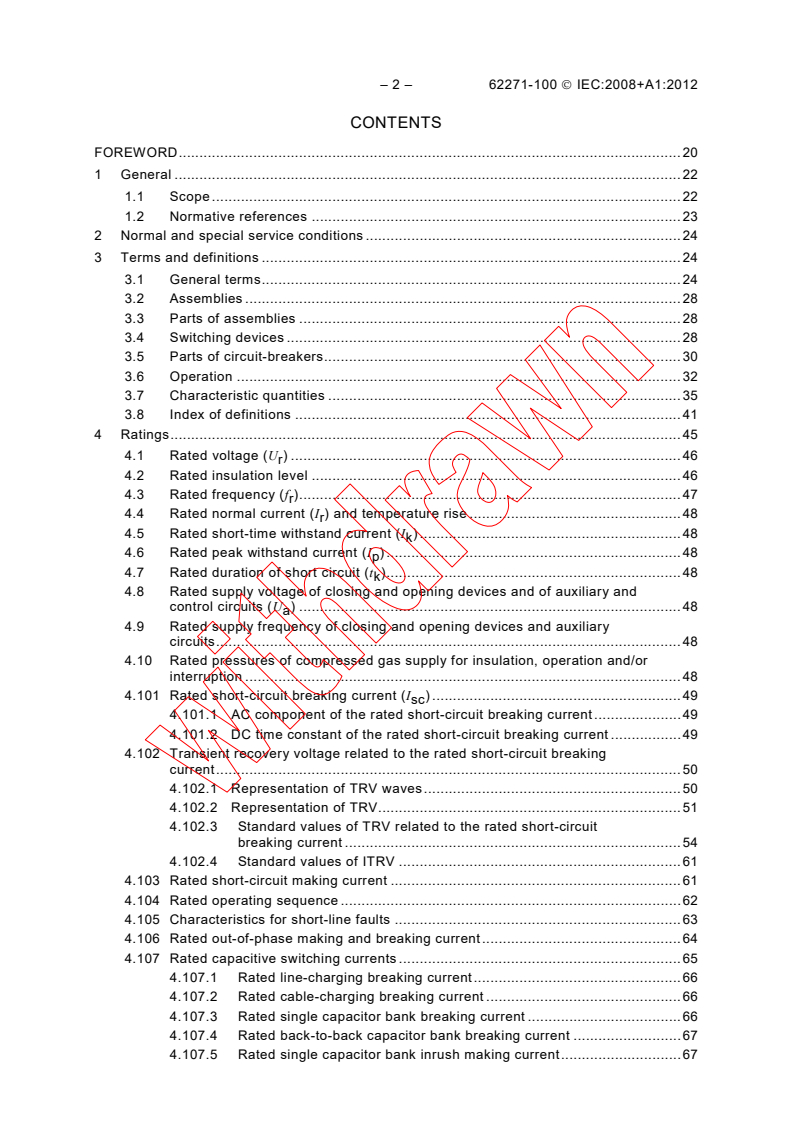
CONTENTS
FOREWORD . 20
1 General . 22
1.1 Scope . 22
1.2 Normative references . 23
2 Normal and special service conditions . 24
3 Terms and definitions . 24
3.1 General terms . 24
3.2 Assemblies . 28
3.3 Parts of assemblies . 28
3.4 Switching devices . 28
3.5 Parts of circuit-breakers . 30
3.6 Operation . 32
3.7 Characteristic quantities . 35
3.8 Index of definitions . 41
4 Ratings . 45
4.1 Rated voltage (U ) . 46
r
4.2 Rated insulation level . 46
4.3 Rated frequency (f ) . 47
r
4.4 Rated normal current (I ) and temperature rise . 48
r
4.5 Rated short-time withstand current (I ) . 48
k
4.6 Rated peak withstand current (I ) . 48
p
4.7 Rated duration of short circuit (t ) . 48
k
4.8 Rated supply voltage of closing and opening devices and of auxiliary and
control circuits (U ) . 48
a
4.9 Rated supply frequency of closing and opening devices and auxiliary
circuits . 48
4.10 Rated pressures of compressed gas supply for insulation, operation and/or
interruption . 48
4.101 Rated short-circuit breaking current (I ) . 49
sc
4.101.1 AC component of the rated short-circuit breaking current . 49
4.101.2 DC time constant of the rated short-circuit breaking current . 49
4.102 Transient recovery voltage related to the rated short-circuit breaking
current . 50
4.102.1 Representation of TRV waves . 50
4.102.2 Representation of TRV . 51
4.102.3 Standard values of TRV related to the rated short-circuit
breaking current . 54
4.102.4 Standard values of ITRV . 61
4.103 Rated short-circuit making current . 61
4.104 Rated operating sequence . 62
4.105 Characteristics for short-line faults . 63
4.106 Rated out-of-phase making and breaking current . 64
4.107 Rated capacitive switching currents . 65
4.107.1 Rated line-charging breaking current . 66
4.107.2 Rated cable-charging breaking current . 66
4.107.3 Rated single capacitor bank breaking current . 66
4.107.4 Rated back-to-back capacitor bank breaking current . 67
4.107.5 Rated single capacitor bank inrush making current . 67
62271-100 IEC:2008+A1:2012 – 3 –
4.108 Inductive load switching . 67
4.109 Rated time quantities . 67
4.109.1 Rated break-time . 68
4.110 Number of mechanical operations . 70
4.111 Classification of circuit-breakers as a function of electrical endurance . 70
5 Design and construction . 70
5.1 Requirements for liquids in circuit-breakers . 70
5.2 Requirements for gases in circuit-breakers . 70
5.3 Earthing of circuit-breakers . 70
5.4 Auxiliary equipment . 70
5.5 Dependent power closing. 71
5.6 Stored energy closing . 71
5.7 Independent manual operation . 71
5.8 Operation of releases . 72
5.8.101 Over-current release . 72
5.8.101.1 Operating current . 72
5.8.101.2 Operating time . 72
5.8.101.3 Resetting current . 72
5.8.102 Multiple releases . 72
5.8.103 Operation limits of releases . 72
5.8.104 Power consumption of releases . 72
5.8.105 Integrated relays for self-tripping circuit-breakers . 73
5.9 Low- and high-pressure interlocking devices . 73
5.10 Nameplates . 73
5.11 Interlocking devices . 75
5.12 Position indication . 75
5.13 Degrees of protection by enclosures . 75
5.14 Creepage distances . 75
5.15 Gas and vacuum tightness . 75
5.16 Liquid tightness . 75
5.17 Fire hazard (flammability) . 75
5.18 Electromagnetic compatibility . 75
5.19 X-ray emission . 76
5.20 Corrosion . 76
5.101 Requirements for simultaneity of poles during single closing and single
opening operations . 76
5.102 General requirement for operation . 76
5.103 Pressure limits of fluids for operation . 76
5.104 Vent outlets . 77
6 Type tests . 77
6.1 General . 79
6.1.1 Grouping of tests . 79
6.1.2 Information for identification of specimens . 79
6.1.3 Information to be included in type test reports . 79
6.1.101 Invalid tests . 79
6.2 Dielectric tests . 80
6.2.1 Ambient air conditions during tests . 80
6.2.2 Wet test procedure . 80
6.2.3 Condition of circuit-breaker during dielectric tests . 80
– 4 – 62271-100 IEC:2008+A1:2012
6.2.4 Criteria to pass the test . 80
6.2.5 Application of test voltage and test conditions . 80
6.2.6 Tests of circuit-breakers of U ≤ 245 kV . 81
r
6.2.7 Tests of circuit-breakers of U > 245 kV . 81
r
6.2.8 Artificial pollution tests . 82
6.2.9 Partial discharge tests . 82
6.2.10 Tests on auxiliary and control circuits . 82
6.2.11 Voltage test as a condition check . 82
6.3 Radio interference voltage (r.i.v.) tests . 85
6.4 Measurement of the resistance of the main circuit . 85
6.5 Temperature-rise tests . 85
6.5.1 Conditions of the circuit-breaker to be tested . 85
6.5.2 Arrangement of the equipment . 85
6.5.3 Measurement of the temperature and the temperature rise . 85
6.5.4 Ambient air temperature . 85
6.5.5 Temperature-rise tests of the auxiliary and control equipment. 85
6.5.6 Interpretation of the temperature-rise tests . 85
6.6 Short-time withstand current and peak withstand current tests . 85
6.6.1 Arrangement of the circuit-breaker and of the test circuit . 86
6.6.2 Test current and duration . 86
6.6.3 Behaviour of the circuit-breaker during test . 86
6.6.4 Conditions of the circuit-breaker after test . 86
6.7 Verification of the degree of protection . 86
6.7.1 Verification of the IP coding . 86
6.7.2 Mechanical impact test . 86
6.8 Tightness tests . 86
6.9 Electromagnetic compatibility (EMC) tests . 87
6.9.3.1 Ripple on d.c. input power port immunity test . 87
6.9.3.2 Voltage dips, short interruptions and voltage variations on d.c.
input power port immunity tests . 87
6.10 Additional tests on auxiliary and control circuits . 87
6.10.1 General . 87
6.10.2 Functional tests . 87
6.10.3 Electrical continuity of earthed metallic parts test . 87
6.10.4 Verification of the operational characteristics of auxiliary
contacts . 87
6.10.5 Environmental tests . 87
6.101 Mechanical and environmental tests . 88
6.101.1 Miscellaneous provisions for mechanical and environmental tests . 88
6.101.1.1 Mechanical characteristics . 88
6.101.1.2 Component tests . 88
6.101.1.3 Characteristics and settings of the circuit-breaker to be recorded
before and after the tests . 89
6.101.1.4 Condition of the circuit-breaker during and after the tests . 89
6.101.1.5 Condition of the auxiliary and control equipment during and after
the tests . 90
6.101.2 Mechanical operation test at ambient air temperature . 90
6.101.2.1 General . 90
6.101.2.2 Condition of the circuit-breaker before the test . 90
6.101.2.3 Description of the test on class M1 circuit-breakers . 91
62271-100 IEC:2008+A1:2012 – 5 –
6.101.2.4 Extended mechanical endurance tests on class M2 circuit-
breakers for special service requirements . 91
6.101.2.5 Acceptance criteria for the mechanical operation tests . 92
6.101.3 Low and high temperature tests . 92
6.101.3.1 General . 92
6.101.3.2 Measurement of ambient air temperature . 93
6.101.3.3 Low temperature test . 93
6.101.3.4 High-temperature test . 95
6.101.4 Humidity test. 96
6.101.4.1 General . 96
6.101.4.2 Test procedure . 96
6.101.5 Test to prove the operation under severe ice conditions . 97
6.101.6 Static terminal load test . 97
6.101.6.1 General . 97
6.101.6.2 Tests . 98
6.102 Miscellaneous provisions for making and breaking tests . 99
6.102.1 General . 99
6.102.2 Number of test specimens . 100
6.102.3 Arrangement of circuit-breaker for tests . 101
6.102.3.1 General . 101
6.102.3.2 Common enclosure type . 102
6.102.3.3 Multi-enclosure type . 102
6.102.3.4 Self-tripping circuit-breakers . 102
6.102.4 General considerations concerning testing methods . 102
6.102.4.1 Single-phase testing of a single pole of a three-pole circuit-
breaker . 102
6.102.4.2 Unit testing . 103
6.102.4.2.1 Identical nature of the units . 105
6.102.4.2.2 Voltage distribution . 105
6.102.4.2.3 Requirements for unit testing . 106
6.102.4.3 Multi-part testing . 106
6.102.5 Synthetic tests . 106
6.102.6 No-load operations before tests . 107
6.102.7 Alternative operating mechanisms . 107
6.102.8 Behaviour of circuit-breaker during tests . 108
6.102.9 Condition of circuit-breaker after tests . 108
6.102.9.1 General . 108
6.102.9.2 Condition after a short-circuit test-duty . 109
6.102.9.3 Condition after a short-circuit test series . 109
6.102.9.4 Condition after a capacitive current switching test series . 110
6.102.9.5 Reconditioning after a short-circuit test-duty and other test
series . 111
6.102.10 Demonstration of arcing times . 111
6.102.10.1 Three-phase tests . 111
6.102.10.1.1 Test-duty T10, T30, T60, T100s, T100s(b), OP1 and OP2 . 111
6.102.10.1.2 Test-duty T100a . 112
6.102.10.2 Single-phase tests in substitution for three-phase conditions . 113
6.102.10.2.1 Non-effectively earthed neutral systems . 113
6.102.10.2.1.1 Test-duties T10, T30, T60, T100s and T100s(b), OP1 and OP2 . 113
6.102.10.2.1.2 Test-duty T100a . 114
– 6 – 62271-100 IEC:2008+A1:2012
6.102.10.2.2 Effectively earthed neutral systems including short-line fault
tests . 125
6.102.10.2.2.1 Test-duties T10, T30, T60, T100s and T100s(b), OP1 and
OP2, L , L and L . 125
90 75 60
6.102.10.2.2.2 Test-duty T100a . 125
6.102.10.2.3 Modified procedure in cases where the circuit-breaker failed
to interrupt during a test with a medium arcing time . 125
6.102.10.2.3.1 Breaking test with symmetrical current. 125
6.102.10.2.3.2 Breaking test with asymmetrical current . 126
6.102.10.2.4 Tests combining the conditions for effectively and non-
effectively earthed neutral systems . 126
6.102.10.2.5 Splitting of test-duties in test series taking into account the
associated TRV for each pole-to-clear . 126
6.103 Test circuits for short-circuit making and breaking tests . 127
6.103.1 Power factor . 127
6.103.2 Frequency . 127
6.103.3 Earthing of test circuit . 127
6.103.4 Connection of test circuit to circuit-breaker . 129
6.104 Short-circuit test quantities . 129
6.104.1 Applied voltage before short-circuit making tests . 129
6.104.2 Short-circuit making current . 129
6.104.2.1 General . 129
6.104.2.2 Test procedure . 130
6.104.2.2.1 Three-phase tests . 130
6.104.2.2.2 Single-phase tests . 130
6.104.3 Short-circuit breaking current . 131
6.104.4 DC component of short-circuit breaking current . 131
6.104.5 Transient recovery voltage (TRV) for short-circuit breaking tests . 132
6.104.5.1 General . 132
6.104.5.2 Test-duties T100s and T100a . 137
6.104.5.3 Test duty T60 . 138
6.104.5.4 Test duty T30 . 138
6.104.5.5 Test duty T10 . 138
6.104.5.6 Test-duties OP1 and OP2 . 139
6.104.6 Measurement of transient recovery voltage during test . 139
6.104.7 Power frequency recovery voltage . 147
6.105 Short-circuit test procedure . 147
6.105.1 Time interval between tests . 147
6.105.2 Application of auxiliary power to the opening release – Breaking
tests . 148
6.105.3 Application of auxiliary power to the opening release – Make-
break tests . 148
6.105.4 Latching on short-circuit . 148
6.106 Basic short-circuit test-duties . 149
6.106.1 Test-duty T10 . 149
6.106.2 Test-duty T30 . 149
6.106.3 Test-duty T60 . 149
6.106.4 Test-duty T100s . 149
6.106.4.1 Time constant of the d.c. component of the test circuit equal to
the specified value . 150
62271-100 IEC:2008+A1:2012 – 7 –
6.106.4.2 Time constant of the d.c. component of the test circuit less than
the specified value . 150
6.106.4.3 Time constant of the d.c. component of the test circuit greater
than the specified value . 151
6.106.4.4 Significant decay of the a.c. component of the test circuit . 151
6.106.5 Test-duty T100a . 153
6.106.6 Asymmetry criteria . 153
6.106.6.1 Three-phase tests . 154
6.106.6.1.1 Test current amplitude and last current loop duration . 154
6.106.6.1.2 Percentage of d.c. component at current zero . 154
6.106.6.2 Single-phase tests . 155
6.106.6.2.1 Test current amplitude and last current loop duration . 155
6.106.6.2.2 Percentage of the d.c. component at current zero . 155
6.106.6.3 Adjustment measures . 155
6.107 Critical current tests . 156
6.107.1 Applicability . 156
6.107.2 Test current . 156
6.107.3 Critical current test-duty. 156
6.108 Single-phase and double-earth fault tests . 156
6.108.1 Applicability . 156
6.108.2 Test current and recovery voltage . 157
6.108.3 Test-duty . 157
6.109 Short-line fault tests . 158
6.109.1 Applicability . 158
6.109.2 Test current . 158
6.109.3 Test circuit . 159
6.109.4 Test-duties . 161
6.109.5 Short-line fault tests with a test supply of limited power . 162
6.110 Out-of-phase making and breaking tests . 162
6.110.1 Test circuit . 162
6.110.2 Test voltage . 163
6.110.3 Test-duties . 163
6.111 Capacitive current switching tests . 164
6.111.1 Applicability . 164
6.111.2 General . 164
6.111.3 Characteristics of supply circuits . 165
6.111.4 Earthing of the supply circuit . 165
6.111.5 Characteristics of the capacitive circuit to be switched . 166
6.111.5.1 Line-charging and cable-charging current switching tests . 166
6.111.5.2 Capacitor bank current switching tests . 167
6.111.6 Waveform of the current . 167
6.111.7 Test voltage . 167
6.111.8 Test current . 168
6.111.9 Test-duties . 168
6.111.9.1 Test conditions for class C2 circuit-breakers . 169
6.111.9.1.1 Class C2 test-duties . 169
6.111.9.1.2 Three-phase line-charging and cable-charging current
switching tests . 171
6.111.9.1.3 Single-phase line-charging and cable-charging current
switching tests . 172
– 8 – 62271-100 IEC:2008+A1:2012
6.111.9.1.4 Three-phase capacitor bank (single or back-to-back) current
switching tests . 172
6.111.9.1.5 Single-phase capacitor bank (single or back-to-back) current
switching tests . 173
6.111.9.2 Test conditions for class C1 circuit-breakers . 173
6.111.9.2.1 Class C1 test-duties . 173
6.111.9.2.2 Single-phase and three-phase capacitive current switching
tests . 175
6.111.9.3 Test conditions corresponding to breaking in the presence of
earth faults . 176
6.111.10 Tests with specified TRV . 176
6.111.11 Criteria to pass the test . 177
6.111.11.1 General . 177
6.111.11.2 Class C2 circuit-breaker . 177
6.111.11.3 Class C1 circuit-breaker . 178
6.111.11.4 Criteria for reclassification of a circuit-breaker tested to the
class C2 requirements as a class C1 circuit-breaker. 178
6.112 Special requirements for making and breaking tests on class E2 circuit-
breakers . 178
6.112.1 Class E2 circuit-breakers intended for use without auto-reclosing
duty . 178
6.112.2 Class E2 circuit-breakers intended for auto-reclosing duty . 179
7 Routine tests . 180
7.1 Dielectric test on the main circuit . 180
7.2 Tests on auxiliary and control circuits . 180
7.3 Measurement of the resistance of the main circuit . 180
7.4 Tightness test . 180
7.5 Design and visual checks . 180
7.101 Mechanical operating tests . 181
8 Guidance to the selection of circuit-breakers for service . 182
8.101 General . 182
8.102 Selection of rated values for service conditions . 184
8.102.1 Selection of rated voltage . 184
8.102.2 Insulation coordination . 184
8.102.3 Rated frequency . 185
8.102.4 Selection of rated normal current . 185
8.102.5 Local atmospheric and climatic conditions . 185
8.102.6 Use at high altitudes . 186
8.103 Selection of rated values for fault conditions . 186
8.103.1 Selection of rated short-circuit breaking current . 186
8.103.2 Selection of transient recovery voltage (TRV) for terminal faults,
first-pole-to-clear factor and characteristics for short-line faults . 188
8.103.3 Selection of out-of-phase characteristics . 189
8.103.4 Selection of rated short-circuit making current . 190
8.103.5 Operating sequence in service . 190
8.103.6 Selection of rated duration of short-circuit . 191
8.103.7 Faults in the presence of current limiting reactors . 191
8.104 Selection for electrical endurance in networks of rated voltage above
1 kVand up to and including 52 kV . 192
8.105 Selection for capacitive current switching . 192
9 Information to be given with enquiries, tenders and orders . 192
62271-100 IEC:2008+A1:2012 – 9 –
9.101 Information to be given with enquiries and orders . 192
9.102 Information to be given with tenders . 193
10 Rules for transport, storage, installation, operation and maintenance . 195
10.1 Conditions during transport, storage and installation . 195
10.2 Installation . 195
10.2.101 Commissioning tests . 195
10.2.102 Commissioning checks and test programme . 196
10.2.102.1 Checks after installation . 196
10.2.102.1.1 General checks . 196
10.2.102.1.2 Checks of electrical circuits . 196
10.2.102.1.3 Checks of the insulation and/or extinguishing fluid(s) . 196
10.2.102.1.4 Checks on operating fluid(s), where filled or added to on site . 197
10.2.102.1.5 Site operations . 197
10.2.102.2 Mechanical tests and measurements . 197
10.2.102.2.1 Measurements of the characteristic insulating and/or
interrupting fluid pressures (where applicable) . 197
10.2.102.2.1.1 General . 197
10.2.102.2.1.2 Measurements to be taken. 197
...