


EN 60825-1:2007
(Main)Safety of laser products - Part 1: Equipment classification and requirements
General Information
- Abstract
IEC 60825-1 is applicable to safety of laser products emitting laser radiation in the wavelength range 180 nm to 1 mm. A laser product may consist of a single laser with or without a separate power supply or may incorporate one or more lasers in a complex optical, electrical, or mechanical system. Typically, laser products are used for demonstration of physical and optical phenomena, materials processing, data reading and storage, transmission and display of information, etc. Such systems have found use in industry, business, entertainment, research, education, medicine and consumer products. Laser products that are sold to other manufacturers for use as components of any system for subsequent sale are not subject to IEC 60825-1, since the final product will itself be subject to this standard. However, if the laser system within the laser product is operable when removed from the equipment, the requirements of this Part 1 apply to the removable unit. Any laser product is exempt from all further requirements of this Part 1 if classification by the manufacturer of that product according to Clauses 3, 8 and 9 shows that the emission level does not exceed the AEL (accessible emission limit) of Class 1 under all conditions of operation, maintenance, service and failure. In addition to the hazards resulting from laser radiation, laser equipment may also give rise to other hazards such as fire and electric shock. This Part 1 describes the minimum requirements. Compliance with this Part 1 may not be sufficient to achieve the required level of product safety. Laser products must conform to the applicable performance and testing requirements of the applicable product safety standards. Where a laser system forms a part of equipment which is subject to another IEC product safety standard (e.g. for medical equipment (IEC 60601-2-22), IT equipment (IEC 60950), audio and video equipment (IEC 60065), equipment for use in hazardous atmospheres (IEC 60079), or electric toys (IEC 62115)), this Part 1 will apply in accordance with the provisions of IEC Guide 1042) for hazards resulting from laser radiation. If no product safety standard is applicable, then IEC 61010-1 applies. In previous editions, LEDs were included in the scope of IEC 60825-1, and they may be still included in other parts of the IEC 60825 series. However, with the development of lamp safety standards, optical radiation safety of LEDs in general can be more appropriately addressed by lamp safety standards. The removal of LEDs from the scope of this Part 1 does not preclude other standards from including LEDs whenever they refer to lasers. CIE S009 may be applied to determine the risk group class of an LED or product incorporating one or more LEDs. The MPE (maximum permissible exposure) values of this Part 1 were developed for laser radiation and do not apply to collateral radiation. However, if a concern exists that accessible collateral radiation might be hazardous, the laser MPE values may be applied to conservatively evaluate this potential hazard. The MPE values are not applicable to intentional human exposure to laser radiation for the purpose of medical or cosmetic/aesthetic treatment. The objectives of this part of IEC 60825 are the following: to introduce a system of classification of lasers and laser products according to their degree of optical radiation hazard in order to aid hazard evaluation and to aid the determination of user control measures; to establish requirements for the manufacturer to supply information so that proper precautions can be adopted; to ensure, through labels and instructions, adequate warning to individuals of hazards associated with accessible radiation from laser products; to reduce the possibility of injury by minimizing unnecessary accessible radiation and to give improved control of the laser radiation hazards through protective features.
- Status
- Withdrawn
- Publication Date
- 16-Oct-2007
- Withdrawal Date
- 31-Aug-2010
- Technical Committee
- CLC/TC 76 - Optical radiation safety and laser equipment
- Drafting Committee
- IEC/TC 76 - IEC_TC_76
- Parallel Committee
- IEC/TC 76 - IEC_TC_76
- Current Stage
- 9960 - Withdrawal effective - Withdrawal
- Start Date
- 19-Jun-2019
- Completion Date
- 25-Aug-2026
- Directive
- Not Harmonized1999/5/EC - Directive 1999/5/EC of the European Parliament and of the Council of 9 March 1999 on radio equipment and telecommunications terminal equipment and the mutual recognition of their conformityOJ Ref: C 303/35, C 297/01 OJ Date: 12-Oct-2013
Not Harmonized2006/95/EC - Directive 2006/95/EC of the European Parliament and of the Council of 12 December 2006 on the harmonisation of the laws of Member States relating to electrical equipment designed for use within certain voltage limits (codified version)OJ Ref: C 71/, C 71/17, C 348/03 OJ Date: 28-Nov-2013
Harmonized Standard2014/35/EU - Directive 2014/35/EU of the European Parliament and of the Council of 26 February 2014 on the harmonisation of the laws of the Member States relating to the making available on the market of electrical equipment designed for use within certain voltage limitsOJ Ref: C 249/03 OJ Date: 08-Jul-2016

Relations
- Effective Date
- 29-Jan-2023
- Effective Date
- 29-Jan-2023
- Effective Date
- 29-Jan-2023
- Replaced By
EN 60825-1:2014 - Safety of laser products - Part 1: Equipment classification and requirements - Effective Date
- 28-Jan-2023
- Effective Date
- 09-Feb-2026
- Effective Date
- 03-Feb-2026
- Effective Date
- 03-Feb-2026
- Effective Date
- 10-Feb-2026
- Effective Date
- 09-Feb-2026
- Effective Date
- 09-Feb-2026
- Effective Date
- 09-Feb-2026
- Effective Date
- 09-Feb-2026
- Effective Date
- 09-Feb-2026
- Effective Date
- 09-Feb-2026
- Effective Date
- 09-Feb-2026
Get Certified
Connect with accredited certification bodies for this standard

CIS Institut d.o.o.
Personal Protective Equipment (PPE) certification body. Notified Body NB-2890 for EU Regulation 2016/425 PPE.

Kiwa BDA Testing
Building and construction product certification.
Kmetijski inštitut Slovenije
Agricultural Institute of Slovenia. Soil testing, plant health, agricultural product analysis.
Sponsored listings
Frequently Asked Questions
EN 60825-1:2007 is a standard published by CLC. Its full title is "Safety of laser products - Part 1: Equipment classification and requirements". This standard covers: IEC 60825-1 is applicable to safety of laser products emitting laser radiation in the wavelength range 180 nm to 1 mm. A laser product may consist of a single laser with or without a separate power supply or may incorporate one or more lasers in a complex optical, electrical, or mechanical system. Typically, laser products are used for demonstration of physical and optical phenomena, materials processing, data reading and storage, transmission and display of information, etc. Such systems have found use in industry, business, entertainment, research, education, medicine and consumer products. Laser products that are sold to other manufacturers for use as components of any system for subsequent sale are not subject to IEC 60825-1, since the final product will itself be subject to this standard. However, if the laser system within the laser product is operable when removed from the equipment, the requirements of this Part 1 apply to the removable unit. Any laser product is exempt from all further requirements of this Part 1 if classification by the manufacturer of that product according to Clauses 3, 8 and 9 shows that the emission level does not exceed the AEL (accessible emission limit) of Class 1 under all conditions of operation, maintenance, service and failure. In addition to the hazards resulting from laser radiation, laser equipment may also give rise to other hazards such as fire and electric shock. This Part 1 describes the minimum requirements. Compliance with this Part 1 may not be sufficient to achieve the required level of product safety. Laser products must conform to the applicable performance and testing requirements of the applicable product safety standards. Where a laser system forms a part of equipment which is subject to another IEC product safety standard (e.g. for medical equipment (IEC 60601-2-22), IT equipment (IEC 60950), audio and video equipment (IEC 60065), equipment for use in hazardous atmospheres (IEC 60079), or electric toys (IEC 62115)), this Part 1 will apply in accordance with the provisions of IEC Guide 1042) for hazards resulting from laser radiation. If no product safety standard is applicable, then IEC 61010-1 applies. In previous editions, LEDs were included in the scope of IEC 60825-1, and they may be still included in other parts of the IEC 60825 series. However, with the development of lamp safety standards, optical radiation safety of LEDs in general can be more appropriately addressed by lamp safety standards. The removal of LEDs from the scope of this Part 1 does not preclude other standards from including LEDs whenever they refer to lasers. CIE S009 may be applied to determine the risk group class of an LED or product incorporating one or more LEDs. The MPE (maximum permissible exposure) values of this Part 1 were developed for laser radiation and do not apply to collateral radiation. However, if a concern exists that accessible collateral radiation might be hazardous, the laser MPE values may be applied to conservatively evaluate this potential hazard. The MPE values are not applicable to intentional human exposure to laser radiation for the purpose of medical or cosmetic/aesthetic treatment. The objectives of this part of IEC 60825 are the following: to introduce a system of classification of lasers and laser products according to their degree of optical radiation hazard in order to aid hazard evaluation and to aid the determination of user control measures; to establish requirements for the manufacturer to supply information so that proper precautions can be adopted; to ensure, through labels and instructions, adequate warning to individuals of hazards associated with accessible radiation from laser products; to reduce the possibility of injury by minimizing unnecessary accessible radiation and to give improved control of the laser radiation hazards through protective features.
IEC 60825-1 is applicable to safety of laser products emitting laser radiation in the wavelength range 180 nm to 1 mm. A laser product may consist of a single laser with or without a separate power supply or may incorporate one or more lasers in a complex optical, electrical, or mechanical system. Typically, laser products are used for demonstration of physical and optical phenomena, materials processing, data reading and storage, transmission and display of information, etc. Such systems have found use in industry, business, entertainment, research, education, medicine and consumer products. Laser products that are sold to other manufacturers for use as components of any system for subsequent sale are not subject to IEC 60825-1, since the final product will itself be subject to this standard. However, if the laser system within the laser product is operable when removed from the equipment, the requirements of this Part 1 apply to the removable unit. Any laser product is exempt from all further requirements of this Part 1 if classification by the manufacturer of that product according to Clauses 3, 8 and 9 shows that the emission level does not exceed the AEL (accessible emission limit) of Class 1 under all conditions of operation, maintenance, service and failure. In addition to the hazards resulting from laser radiation, laser equipment may also give rise to other hazards such as fire and electric shock. This Part 1 describes the minimum requirements. Compliance with this Part 1 may not be sufficient to achieve the required level of product safety. Laser products must conform to the applicable performance and testing requirements of the applicable product safety standards. Where a laser system forms a part of equipment which is subject to another IEC product safety standard (e.g. for medical equipment (IEC 60601-2-22), IT equipment (IEC 60950), audio and video equipment (IEC 60065), equipment for use in hazardous atmospheres (IEC 60079), or electric toys (IEC 62115)), this Part 1 will apply in accordance with the provisions of IEC Guide 1042) for hazards resulting from laser radiation. If no product safety standard is applicable, then IEC 61010-1 applies. In previous editions, LEDs were included in the scope of IEC 60825-1, and they may be still included in other parts of the IEC 60825 series. However, with the development of lamp safety standards, optical radiation safety of LEDs in general can be more appropriately addressed by lamp safety standards. The removal of LEDs from the scope of this Part 1 does not preclude other standards from including LEDs whenever they refer to lasers. CIE S009 may be applied to determine the risk group class of an LED or product incorporating one or more LEDs. The MPE (maximum permissible exposure) values of this Part 1 were developed for laser radiation and do not apply to collateral radiation. However, if a concern exists that accessible collateral radiation might be hazardous, the laser MPE values may be applied to conservatively evaluate this potential hazard. The MPE values are not applicable to intentional human exposure to laser radiation for the purpose of medical or cosmetic/aesthetic treatment. The objectives of this part of IEC 60825 are the following: to introduce a system of classification of lasers and laser products according to their degree of optical radiation hazard in order to aid hazard evaluation and to aid the determination of user control measures; to establish requirements for the manufacturer to supply information so that proper precautions can be adopted; to ensure, through labels and instructions, adequate warning to individuals of hazards associated with accessible radiation from laser products; to reduce the possibility of injury by minimizing unnecessary accessible radiation and to give improved control of the laser radiation hazards through protective features.
EN 60825-1:2007 is classified under the following ICS (International Classification for Standards) categories: 13.110 - Safety of machinery; 31.260 - Optoelectronics. Laser equipment. The ICS classification helps identify the subject area and facilitates finding related standards.
EN 60825-1:2007 has the following relationships with other standards: It is inter standard links to EN 60825-1:1994, EN 60825-1:1994/A1:2002, EN 60825-1:1994/A2:2001, EN 60825-1:2014, EN ISO 10692-1:2001, EN 60601-2-22:1996, EN 61010-1:2001, EN 207:2017, EN 1870-11:2003+A1:2009, EN 13675:2004+A1:2010, EN 1870-17:2012+A1:2015, EN 1870-18:2013, EN 1870-11:2013, EN 1640:2009, EN 1870-10:2003+A1:2009. Understanding these relationships helps ensure you are using the most current and applicable version of the standard.
EN 60825-1:2007 is associated with the following European legislation: EU Directives/Regulations: 1999/5/EC, 2006/95/EC, 2014/35/EU, 2014/53/EU. When a standard is cited in the Official Journal of the European Union, products manufactured in conformity with it benefit from a presumption of conformity with the essential requirements of the corresponding EU directive or regulation.
EN 60825-1:2007 is available in PDF format for immediate download after purchase. The document can be added to your cart and obtained through the secure checkout process. Digital delivery ensures instant access to the complete standard document.
Standards Content (Sample)
2003-01.Slovenski inštitut za standardizacijo. Razmnoževanje celote ali delov tega standarda ni dovoljeno.Varnost laserskih izdelkov - 1. del: Klasifikacija opreme in zahteve (IEC 60825-1:2007)Sicherheit von Lasereinrichtungen - Teil 1: Klassifizierung von Anlagen und Anforderungen (IEC 60825-1:2007)Sécurité des appareils à laser - Partie 1: Classification des matériels et exigences (CEI 60825-1:2007)Safety of laser products - Part 1: Equipment classification and requirements (IEC 60825-1:2007)31.260Optoelektronika, laserska opremaOptoelectronics. Laser equipment13.280Varstvo pred sevanjemRadiation protectionICS:Ta slovenski standard je istoveten z:EN 60825-1:2007SIST EN 60825-1:2009en,fr01-januar-2009SIST EN 60825-1:2009SLOVENSKI
STANDARDSIST EN 60825-1:1999/A2:2002SIST EN 60825-1:1999/A1:2004SIST EN 60825-1:19991DGRPHãþD
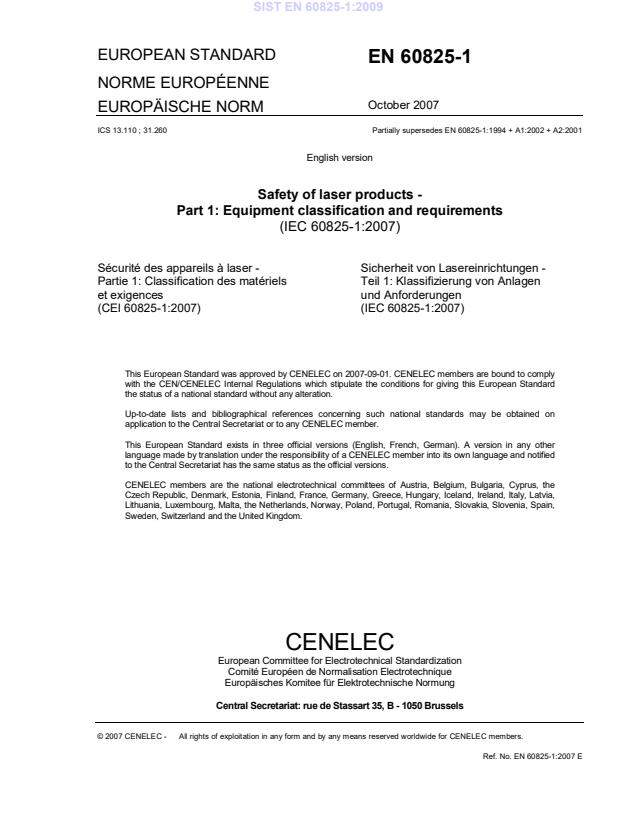
EUROPEAN STANDARD EN 60825-1 NORME EUROPÉENNE
EUROPÄISCHE NORM October 2007
CENELEC European Committee for Electrotechnical Standardization Comité Européen de Normalisation Electrotechnique Europäisches Komitee für Elektrotechnische Normung
Central Secretariat: rue de Stassart 35, B - 1050 Brussels
© 2007 CENELEC -
All rights of exploitation in any form and by any means reserved worldwide for CENELEC members.
Ref. No. EN 60825-1:2007 E
ICS 13.110 ; 31.260 Partially supersedes EN 60825-1:1994 + A1:2002 + A2:2001
English version
Safety of laser products -
Part 1: Equipment classification and requirements (IEC 60825-1:2007)
Sécurité des appareils à laser -
Partie 1: Classification des matériels
et exigences (CEI 60825-1:2007)
Sicherheit von Lasereinrichtungen -
Teil 1: Klassifizierung von Anlagen
und Anforderungen (IEC 60825-1:2007)
This European Standard was approved by CENELEC on 2007-09-01. CENELEC members are bound to comply with the CEN/CENELEC Internal Regulations which stipulate the conditions for giving this European Standard the status of a national standard without any alteration.
Up-to-date lists and bibliographical references concerning such national standards may be obtained on application to the Central Secretariat or to any CENELEC member.
This European Standard exists in three official versions (English, French, German). A version in any other language made by translation under the responsibility of a CENELEC member into its own language and notified to the Central Secretariat has the same status as the official versions.
CENELEC members are the national electrotechnical committees of Austria, Belgium, Bulgaria, Cyprus, the Czech Republic, Denmark, Estonia, Finland, France, Germany, Greece, Hungary, Iceland, Ireland, Italy, Latvia, Lithuania, Luxembourg, Malta, the Netherlands, Norway, Poland, Portugal, Romania, Slovakia, Slovenia, Spain, Sweden, Switzerland and the United Kingdom.
– 2 – Foreword The text of document 76/338/CDV, future edition 2 of IEC 60825-1, prepared by IEC TC 76, Optical radiation safety and laser equipment, was submitted to the IEC-CENELEC parallel Unique Acceptance Procedure and was approved by CENELEC as EN 60825-1 on 2007-09-01. This European Standard partially supersedes EN 60825-1:1994 (+ corrigendum February 1995) + A1:2002 + A2:2001 (+ corrigendum April 2004). The user’s guide has been removed from this part of the EN 60825 series and is now a separate document (Part 14). Light emitting diodes (LEDs) have been removed from the scope of this part of EN 60825, but may still be included in other parts. The following dates were fixed: – latest date by which the EN has to be implemented
at national level by publication of an identical
national standard or by endorsement
(dop)
2008-06-01 – latest date by which the national standards conflicting
with the EN have to be withdrawn
(dow)
2010-09-01 Annex ZA has been added by CENELEC. __________ Endorsement notice The text of the International Standard IEC 60825-1:2007 was approved by CENELEC as a European Standard without any modification. In the official version, for Bibliography, the following notes have to be added for the standards indicated: IEC 60027-1 NOTE Harmonized as EN 60027-1:2006 (not modified). IEC 60065 NOTE Harmonized as EN 60065:2002 (modified). IEC 60079 NOTE Harmonized in EN 60079 series (partially modified). IEC 60079-0 NOTE Harmonized as EN 60079-0:2004 (not modified). IEC 60204-1 NOTE Harmonized as EN 60204-1:2006 (modified). IEC 60825-2 NOTE Harmonized as EN 60825-2:2004 (not modified). IEC 60825-4 NOTE Harmonized as EN 60825-4:2006 (not modified). IEC 60825-12 NOTE Harmonized as EN 60825-12:2004 (not modified). IEC 60950 NOTE Harmonized in EN 60950 series (modified). IEC 61040 NOTE Harmonized as EN 61040:1992 (not modified). IEC 61508 NOTE Harmonized in EN 61508 series (not modified). IEC 62115 NOTE Harmonized as EN 62115:2005 (modified). ISO 11146-1 NOTE Harmonized as EN ISO 11146-1:2005 (not modified). ISO 11553-1 NOTE Harmonized as EN ISO 11553-1:2005 (not modified). ISO 12100-1 NOTE Harmonized as EN ISO 12100-1:2003 (not modified). ISO 12100-2 NOTE Harmonized as EN ISO 12100-2:2003 (not modified). ISO 13694 NOTE Harmonized as EN ISO 13694:2000 (not modified). __________ SIST EN 60825-1:2009
– 3 – EN 60825-1:2007
Annex ZA
(normative)
Normative references to international publications with their corresponding European publications
The following referenced documents are indispensable for the application of this document. For dated references, only the edition cited applies. For undated references, the latest edition of the referenced document (including any amendments) applies.
NOTE
When an international publication has been modified by common modifications, indicated by (mod), the relevant EN/HD applies.
Publication Year Title EN/HD Year IEC 60050-845 1987 International Electrotechnical Vocabulary (IEV) -
Chapter 845: Lighting – –
IEC 60601-2-22 – 1) Medical electrical equipment -
Part 2: Particular requirements for the safety of diagnostic and therapeutic laser equipment EN 60601-2-22 1996 2)
IEC 61010-1
– 1) Safety requirements for electrical
equipment for measurement, control, and laboratory use -
Part 1: General requirements EN 61010-1 + corr. June
2001 3) 2002
1) Undated reference.
2) Valid edition at date of issue. EN 60601-2-22:1996 will be superseded by EN 60601-2-22:200X, which is based on IEC 60601-2--22:2007. 3) Valid edition at date of issue. SIST EN 60825-1:2009
IEC 60825-1Edition 2.0 2007-03INTERNATIONAL STANDARD NORME INTERNATIONALESafety of laser products –
Part 1: Equipment classification and requirements
Sécurité des appareils à laser –
Partie 1: Classification des matériels et exigences
INTERNATIONAL ELECTROTECHNICAL COMMISSION COMMISSION ELECTROTECHNIQUE INTERNATIONALE XDICS 13.110; 31.260 PRICE CODECODE PRIXISBN 2-8318-9085-3GROUP SAFETY PUBLICATION PUBLICATION GROUPÉE DE SÉCURITÉSIST EN 60825-1:2009
– 2 – 60825-1 ⎝ IEC:2007
CONTENTS FOREWORD.5
1 Scope and object.7 2 Normative references.9 3 Terms and definitions.9 4 Engineering specifications.22 4.1 General remarks.22 4.2 Protective housing.22 4.3 Access panels and safety interlocks.22 4.4 Remote interlock connector.23 4.5 Manual reset.23 4.6 Key control.24 4.7 Laser radiation emission warning.24 4.8 Beam stop or attenuator.24 4.9 Controls.24 4.10 Viewing optics.24 4.11 Scanning safeguard.25 4.12 "Walk-in" access.25 4.13 Environmental conditions.25 4.14 Protection against other hazards.25 5 Labelling.26 5.1 General.26 5.2 Class 1 and Class 1M.28 5.3 Class 2 and Class 2M.29 5.4 Class 3R.30 5.5 Class 3B.30 5.6 Class 4.30 5.7 Aperture label.30 5.8 Radiation output and standards information.30 5.9 Labels for access panels.31 5.10 Warning for invisible laser radiation.32 5.11 Warning for visible laser radiation.32 6 Other informational requirements.32 6.1 Information for the user.32 6.2 Purchasing and servicing information.34 7 Additional requirements for specific laser products.34 7.1 Other parts of the standard series IEC 60825.34 7.2 Medical laser products.35 7.3 Laser processing machines.35 7.4 Electric toys.35 7.5 Consumer electronic products.35 8 Classification.35 8.1 Introduction.35 8.2 Classification responsibilities.36 8.3 Classification rules.36 SIST EN 60825-1:2009
60825-1 ⎝ IEC:2007 – 3 –
9 Determination of the accessible emission level.40 9.1 Tests.40 9.2 Measurement of laser radiation.41 9.3 Measurement geometry.51
Annex A (informative)
Maximum permissible exposure values.57 Annex B (informative)
Examples of calculations.64 Annex C (informative)
Description of the classes and potentially associated hazards.74 Annex D (informative)
Biophysical considerations.80 Annex E
(informative)
MPEs and AELs expressed as radiance.90 Annex F (informative)
Summary tables.94 Annex G (informative)
Overview of associated parts of IEC 60825.97
Bibliography.99
Figure 1 – Warning label – Hazard symbol.27 Figure 2 – Explanatory label.28 Figure 3 – Measurement set-up to limit angle of acceptance
by imaging the apparent source onto the plane of the field stop.53 Figure 4 – Measurement set-up to limit angle of acceptance by placing a circular aperture or a mask (serving as field stop) close to the apparent source.54 Figure 5 – Experimental set-up for the determination of the accessible emission (above) and the angular subtense of the apparent source (below) for condition 2 when an extended source is to be considered (i.e. not using the default, simplified evaluation).55 Figure B.1 – Flowchart guide for the classification of laser products from supplied output parameters.66 Figure B.2 – Flowchart guide for the classification of Class 1M and Class 2M laser products.68 Figure B.3 – AEL for Class 1 ultra-violet laser products for selected emission durations from 10–9 s to 103 s.69 Figure B.4 – AEL for Class 1 ultra-violet laser products for emission durations
from 10–9 s to 103 s at selected wavelengths.69 Figure B.5 – AEL for Class 1 visible and selected infra-red laser products (case C6 = 1).70 Figure D.1 – Anatomy of the eye.80 Figure D.2 – Diagram of laser-induced damage in biological systems.82 Figure E.1 – Radiance as a function of wavelength.90
– 4 – 60825-1 ⎝ IEC:2007
Table 1 – Requirements for safety interlocking.23 Table 2 – Additivity of effects on eye and skin of radiation of different spectral regions.37 Table 3 – Times below which pulse groups are summed.40 Table 4 – Accessible emission limits for Class 1 and Class 1M laser products
and C6 = 1.44 Table 5 – Accessible emission limits for Class 1 laser products in the wavelength range from 400 nm to 1 400 nm
(retinal hazard region): extended sources.45 Table 6 – Accessible emission limits for Class 2 and Class 2M laser products.46 Table 7 – Accessible emission limits for Class 3R laser products and C6 = 1.47 Table 8 – Accessible emission limits for Class 3R laser products in the wavelength range from 400 nm to 1 400 nm
(retinal hazard region): extended sources.48 Table 9 – Accessible emission limits for Class 3B laser products.49 Table 10 – Correction factors and breakpoints for use in AEL and MPE evaluations.50 Table 11 – Measurement aperture diameters and measurement distances
for the default (simplified) evaluation.52 Table 12 – Reference points.52 Table 13 – Limiting angle of acceptance γph.55 Table A.1 – Maximum permissible exposure (MPE) for C6 = 1 at the cornea for exposure to laser radiation.58 Table A.2 – Maximum permissible exposure (MPE) at the cornea for exposure to laser radiation from extended sources
in the wavelength range from 400 nm to 1 400 nm (retinal hazard region).59 Table A.3 – Maximum permissible exposure (MPE) of the skin to laser radiation.60 Table A.4 – Aperture diameters for measuring laser irradiance and radiant exposure.60 Table D.1 – Summary of pathological effects associated
with excessive exposure to light.84 Table D.2 – Explanation of measurement apertures applied to the MPEs.88 Table E.1 – Maximum radiance of a diffused source for Class 1.91 Table F.1 – Summary of the physical quantities used in this Part 1.94 Table F.2 – Summary of manufacturer's requirements.95 Table G.1 – Overview of additional data in associated parts of IEC 60825.98
60825-1 ⎝ IEC:2007 – 5 –
INTERNATIONAL ELECTROTECHNICAL COMMISSION ____________
SAFETY OF LASER PRODUCTS –
Part 1: Equipment classification and requirements
FOREWORD 1) The International Electrotechnical Commission (IEC) is a worldwide organization for standardization comprising all national electrotechnical committees (IEC National Committees). The object of IEC is to promote international co-operation on all questions concerning standardization in the electrical and electronic fields. To this end and in addition to other activities, IEC publishes International Standards, Technical Specifications, Technical Reports, Publicly Available Specifications (PAS) and Guides (hereafter referred to as “IEC Publication(s)”). Their preparation is entrusted to technical committees; any IEC National Committee interested in the subject dealt with may participate in this preparatory work. International, governmental and non-governmental organizations liaising with the IEC also participate in this preparation. IEC collaborates closely with the International Organization for Standardization (ISO) in accordance with conditions determined by agreement between the two organizations. 2) The formal decisions or agreements of IEC on technical matters express, as nearly as possible, an international consensus of opinion on the relevant subjects since each technical committee has representation from all interested IEC National Committees.
3) IEC Publications have the form of recommendations for international use and are accepted by IEC National Committees in that sense. While all reasonable efforts are made to ensure that the technical content of IEC Publications is accurate, IEC cannot be held responsible for the way in which they are used or for any misinterpretation by any end user. 4) In order to promote international uniformity, IEC National Committees undertake to apply IEC Publications transparently to the maximum extent possible in their national and regional publications. Any divergence between any IEC Publication and the corresponding national or regional publication shall be clearly indicated in the latter. 5) IEC provides no marking procedure to indicate its approval and cannot be rendered responsible for any equipment declared to be in conformity with an IEC Publication. 6) All users should ensure that they have the latest edition of this publication. 7) No liability shall attach to IEC or its directors, employees, servants or agents including individual experts and members of its technical committees and IEC National Committees for any personal injury, property damage or other damage of any nature whatsoever, whether direct or indirect, or for costs (including legal fees) and expenses arising out of the publication, use of, or reliance upon, this IEC Publication or any other IEC Publications.
8) Attention is drawn to the Normative references cited in this publication. Use of the referenced publications is indispensable for the correct application of this publication. 9) Attention is drawn to the possibility that some of the elements of this IEC Publication may be the subject of patent rights. IEC shall not be held responsible for identifying any or all such patent rights. International Standard IEC 60825-1 has been prepared by IEC technical committee 76: Optical radiation safety and laser equipment. This second edition of IEC 60825-1 cancels and replaces the first edition published in 1993, its Amendment 1 (1997) and its Amendment 2 (2001). It constitutes a technical revision. The user’s guide has been removed from this part of the IEC 60825 series and is now a separate document (Part 14). Light emitting diodes (LEDs) have been removed from the scope of this part of IEC 60825, but may still be included in other parts.
– 6 – 60825-1 ⎝ IEC:2007
This part of IEC 60825 has the status of a Group Safety Publication, in accordance with IEC Guide 1041), for aspects of laser radiation pertaining to human safety. The text of this standard is based on the following documents: CDV Report on voting 76/338/CDV 76/357/RVC
Full information on the voting for the approval of this standard can be found in the report on voting indicated in the above table. This publication has been drafted in accordance with the ISO/IEC Directives, Part 2. The list of all parts of the IEC 60825 series, published under the title Safety of laser products, can be found on the IEC website. This part of IEC 60825 is also referred to as "Part 1" in this publication. The committee has decided that the contents of this publication will remain unchanged until the maintenance result date indicated on the IEC web site under "http://webstore.iec.ch" in the data related to the specific publication. At this date, the publication will be
• reconfirmed; • withdrawn; • replaced by a revised edition, or • amended.
___________ 1)
IEC Guide 104:1997, The preparation of safety publications and the use of basic safety publications and group safety publications
It gives guidance to IEC technical committees and to writers of specifications concerning the manner in which safety publications should be drafted.
This guide does not constitute a normative reference and reference to it is given for information only. SIST EN 60825-1:2009
60825-1 ⎝ IEC:2007 – 7 –
SAFETY OF LASER PRODUCTS –
Part 1: Equipment classification and requirements
1 Scope and object IEC 60825-1 is applicable to safety of laser products emitting laser radiation in the wavelength range 180 nm to 1 mm.
A laser product may consist of a single laser with or without a separate power supply or may incorporate one or more lasers in a complex optical, electrical, or mechanical system. Typically, laser products are used for demonstration of physical and optical phenomena, materials processing, data reading and storage, transmission and display of information, etc. Such systems have found use in industry, business, entertainment, research, education, medicine and consumer products.
Laser products that are sold to other manufacturers for use as components of any system for subsequent sale are not subject to IEC 60825-1, since the final product will itself be subject to this standard. However, if the laser system within the laser product is operable when removed from the equipment, the requirements of this Part 1 apply to the removable unit. NOTE 1 Operable equipment does not require a tool to prepare for operation.
Any laser product is exempt from all further requirements of this Part 1 if classification by the manufacturer of that product according to Clauses 3, 8 and 9 shows that the emission level does not exceed the AEL (accessible emission limit) of Class 1 under all conditions of operation, maintenance, service and failure.
NOTE 2 The above exemption is to ensure that inherently safe laser products are not unnecessarily subject to the standard. In addition to the hazards resulting from laser radiation, laser equipment may also give rise to other hazards such as fire and electric shock.
NOTE 3 However, the classification and other requirements of this standard are intended to address only the laser radiation hazards to the eyes and skin. Other hazards are not included within its scope. This Part 1 describes the minimum requirements. Compliance with this Part 1 may not be sufficient to achieve the required level of product safety. Laser products must conform to the applicable performance and testing requirements of the applicable product safety standards. NOTE 4 Other standards may contain additional requirements. Consideration should also be given to the intended application and user group. For example, a class 3B or class 4 laser product may not be suitable for use as a consumer product.
– 8 – 60825-1 ⎝ IEC:2007
Where a laser system forms a part of equipment which is subject to another IEC product safety standard (e.g. for medical equipment (IEC 60601-2-22), IT equipment (IEC 60950), audio and video equipment (IEC 60065), equipment for use in hazardous atmospheres (IEC 60079), or electric toys (IEC 62115)), this Part 1 will apply in accordance with the provisions of IEC Guide 1042) for hazards resulting from laser radiation. If no product safety standard is applicable, then IEC 61010-1 applies. In previous editions, LEDs were included in the scope of IEC 60825-1, and they may be still included in other parts of the IEC 60825 series. However, with the development of lamp safety standards, optical radiation safety of LEDs in general can be more appropriately addressed by lamp safety standards. The removal of LEDs from the scope of this Part 1 does not preclude other standards from including LEDs whenever they refer to lasers. CIE S009 may be applied to determine the risk group class of an LED or product incorporating one or more LEDs. The MPE (maximum permissible exposure) values of this Part 1 were developed for laser radiation and do not apply to collateral radiation. However, if a concern exists that accessible collateral radiation might be hazardous, the laser MPE values may be applied to conservatively evaluate this potential hazard. The MPE values are not applicable to intentional human exposure to laser radiation for the purpose of medical or cosmetic/aesthetic treatment. NOTE 5 Annexes A to H have been included for purposes of general guidance and to illustrate many typical cases. However, the annexes are not regarded as definitive or exhaustive and reference should always be made to the appropriate clause(s) in the normative part of this document.
The objectives of this part of IEC 60825 are the following: • to introduce a system of classification of lasers and laser products according to their degree of optical radiation hazard in order to aid hazard evaluation and to aid the determination of user control measures; • to establish requirements for the manufacturer to supply information so that proper precautions can be adopted;
• to ensure, through labels and instructions, adequate warning to individuals of hazards associated with accessible radiation from laser products; • to reduce the possibility of injury by minimizing unnecessary accessible radiation and to give improved control of the laser radiation hazards through protective features. ___________ 2)
IEC Guide 104:1997, The preparation of safety publications and the use of basic safety publications and group safety publications SIST EN 60825-1:2009
60825-1 ⎝ IEC:2007 – 9 –
2 Normative references The following referenced documents are indispensable for the application of this document. For dated references, only the edition cited applies. For undated references, the latest edition of the referenced document (including any amendments) applies.
IEC 60050-845:1987, International Electrotechnical Vocabulary (IEV) – Chapter 845: Lighting IEC 60601-2-22, Medical electrical equipment – Part 2: Particular requirements for the safety of diagnostic and therapeutic laser equipment IEC 61010-1, Safety requirements for electrical equipment for measurement, control, and laboratory use – Part 1: General requirements 3 Terms and definitions
For the purposes of this document, the definitions of IEC 60050-845 as well as the following apply. NOTE For convenience here, the definitions have been arranged in English alphabetical order. Departures from IEC 60050-845 are intentional and are indicated. In such cases, reference is made, between brackets, to the definition of Part 845 of IEC 60050, with the mention “modified”. 3.1
access panel part of the protective housing or enclosure which provides access to laser radiation when removed or displaced
3.2
accessible emission level of radiation determined at a position and with aperture stops (when the AEL is given in units of Watts or Joules) or limiting apertures (when the AEL is given in units of W⋅m-2 or J⋅m-2) as described in Clause 9
The accessible emission is determined where human access is considered, as specified in Definition 3.37. The accessible emission is compared with the accessible emission limit (Definition 3.3) in order to determine the class of the laser product. In the body of the standard, whenever the term “emission level” is used, it is to be understood as accessible emission.
NOTE When the beam diameter is larger than the aperture stop, the accessible emission when given in units of Watts or Joules is less than the total emitted power or energy of the laser product. When the beam diameter is smaller than the diameter of the limiting aperture, the accessible emission when given in units of W⋅m-2 or J⋅m-2, i.e. as irradiance or radiant exposure averaged over the limiting aperture, is smaller than the actual irradiance or radiant exposure of the beam. See also aperture stop (3.9) and limiting aperture (3.52). 3.3
accessible emission limit
AEL the maximum accessible emission permitted within a particular class NOTE Wherever the text refers to “emission level not exceeding the AEL” or similar wording, it is implicit that the accessible emission is determined following the measurement criteria specified in Clause 9. SIST EN 60825-1:2009
– 10 – 60825-1 ⎝ IEC:2007
3.4
administrative control safety measures of a non-engineering type such as: key supervision, safety training of personnel, warning notices, count-down procedures, and range safety controls 3.5
alpha min
α min see angular subtense and minimum angular subtense (see 3.7 and 3.58) 3.6
angle of acceptance plane angle within which a detector will respond to optical radiation, usually measured in radians
This angle of acceptance may be controlled by apertures or optical elements in front of the detector (see Figure 3 and 4). The angle of acceptance is also sometimes referred to as the field of view.
Symbol: γ 3.7
angular subtense of the apparent source
α angle subtended by an apparent source as viewed from a point in space, as shown in Figure 3 NOTE 1 The location and angular subtense of the apparent source depends on the viewing position in the beam (see 3.11).
NOTE 2 The angular subtense of an apparent source is applicable in this Part 1 only in the wavelength range from 400 nm to 1 400 nm, the retinal hazard region.
NOTE 3 The angular subtense of the source should not be confused with the divergence of the beam. The angular subtense of the source can not be larger than the divergence of the beam but it is usually smaller than the divergence of the beam. 3.8
aperture
any opening in the protective housing or other enclosure of a laser product through which laser radiation is emitted, thereby allowing human access to such radiation
See also limiting aperture (3.52). 3.9
aperture stop
opening serving to define the area over which radiation is measured
3.10
apparent source for a given evaluation location of the retinal hazard, the real or virtual object that forms the smallest possible retinal image (considering the accommodation range of the human eye)
NOTE 1 The accommodation range of the eye is assumed to be variable from 100 mm to infinity. The location of the apparent source for a given viewing position in the beam is that location to which the eye accommodates to produce the most hazardous retinal irradiance condition. NOTE 2 This definition is used to determine, for a given evaluation position, the location of the apparent origin of laser radiation in the wavelength range of 400 nm to 1 400 nm. In the limit of vanishing divergence, i.e. in the case of a well collimated beam, the location of the apparent source goes to infinity. SIST EN 60825-1:2009
60825-1 ⎝ IEC:2007 – 11 –
3.11
beam laser radiation that may be characterized by direction, divergence, diameter or scan speci-fications
Scattered radiation from a non-specular reflection is not considered to be a beam. 3.12
beam attenuator device which reduces the laser radiation to or below a specified level 3.13
beam diameter
beam width the beam diameter du at a position in space is the diameter of the smallest circle which contains u % of the total laser power (or energy)
For the purpose of this standard d63 is used. NOTE 1 In the case of a Gaussian beam, d63 corresponds to the point where the irradiance (radiant exposure) falls to 1/e of its central peak value. NOTE 2 The second moment diameter definition (as defined in ISO 11146-1) is not used for beam profiles with central high irradiance peaks and a low level background, such as produced by unstable resonators in the far field: the power that passes through an aperture can be significantly underestimated when using the 2nd moment and calculating the power with the assumption of a Gaussian beam profile.
3.14
beam divergence far field plane angle of the cone defined by the beam diameter
If the beam diameters (see 3.13) at two points separated by a distance r are d63 and d′63 the divergence is given by:
ϕ = ⎟⎟⎠⎞⎜⎜⎝⎛−rdd2' arctan26363 SI unit: radian NOTE The second moment divergence definition (ISO 11146-1) is not used for beam profiles with central high irradiance peaks and a low level background, such as produced by unstable resonators in the far field or beam profiles that show diffraction patterns caused by apertures. 3.15
beam expander combination of optical elements which will increase the diameter of a laser beam 3.16
beam path component optical component which lies on a defined beam path (e.g. a beam steering mirror or a focusing lens) 3.17
beam stop device which terminates a laser beam path 3.18
Class 1 laser product any laser product which during operation does not permit human access to accessible laser radiation in excess of the accessible emission limits of Class 1 for applicable wavelengths and emission durations (see 8.2 and 8.3 e)) SIST EN 60825-1:2009
– 12 – 60825-1 ⎝ IEC:2007
NOTE 1 See also the limitations of the classification scheme in Annex C.
NOTE 2 As tests for the determination of the classification of the product are limited to tests during operation, it may be the case for embedded laser products that, depending on the product, radiation above the AEL of Class 1 can become accessible during maintenance when interlocks of access panels are overridden.
3.19
Class 1M laser product any laser product in the wavelength range from 302,5 nm to 4 000 nm which during operation does not permit human access to accessible laser radiation in excess of the accessible emission limits of Class 1 for applicable wavelengths and emission durations (see 8.3e)), where the level of radiation is measured according to 9.2 g)
NOTE 1 See also the limitations of the Classification scheme in Annex C.
NOTE 2 Since the evaluation is with a smaller measurement aperture or at a greater distance from the apparent source than those used for Class 1 laser products, the output of a Class 1M laser product is therefore potentially hazardous when viewed using an optical instrument (see 8.2). NOTE 3
As tests for the determination of the classification of the product are limited to tests during operation, it may be the case for embedded laser products that, depending on the product, radiation above the AEL of Class 1M can become accessible during maintenance when interlocks of access panels are overridden.
3.20
Class 2 laser product any laser product in the wavelength range from 400 nm to 700 nm which during operation does not permit human access to accessible laser radiation in excess of the accessible emission limits of Class 2 for applicable wavelengths and emission durations (see 8.2 and 8.3e)) NOTE 1
See also the limitations of the Classification scheme in Annex C.
NOTE 2 As tests for the determination of the classification of the product are limited to tests during operation, it may be the case for embedded laser products that, depending on the product, radiation above the AEL of Class 2 can become accessible during maintenance when interlocks of access panels are overridden.
3.21
Class 2M laser product any laser product in the wavelength range from 400 nm to 700 nm which during operation does not permit human access to accessible laser radiation in excess of the accessible emission limits of Class 2 for applicable wavelengths and emission durations (see 8.3 e)), where the level of radiation is measured according to 9.2 h)
NOTE 1 See also the limitations of the Classification scheme in Annex C. NOTE 2 Since the evaluation is with a smaller measurement aperture or at a greater distance from the apparent source than those used for Class 2 laser products, the output of a Class 2M product is therefore potentially hazardous when viewed using an optical instrument (see 8.2). NOTE 3 As tests for the determination of the classification of the product are limited to tests during operation, it may be the case for embedded laser products that, depending on the product, radiation above the AEL of Class 2M can become accessible during maintenance when interlocks of access panels are overridden. 3.22
Class 3R and Class 3B laser products any laser product which during operation permits human access to laser radiation in excess of the accessible emission limits of Class 1 and Class 2, as applicable, but which does not permit human access to laser radiation in excess of the accessible emission limits of Classes 3R and 3B (respectively) for any emission duration and wavelength (see 8.2) NOTE 1 See also the limitations of the Classification scheme in Annex C.
NOTE 2 Class 1M and Class 2M products may have outputs above or below the AEL of Class 3R, depending on their optical characteristics. SIST EN 60825-1:2009
60825-1 ⎝ IEC:2007 – 13 –
3.23
Class 4 laser product any laser product which permits human access to laser radiation in excess of the accessible emission limits of Class 3B (see 8.2) 3.24
collateral radiation any electromagnetic radiation, within the wavelength range between 180 nm and 1 mm, except laser radiation, emitted by a laser product as a result of, or physically necessary for, the operation of a laser 3.25
collimated beam beam of radiation with very small angular divergence or convergence 3.26
continuous wave
CW in this Part 1, a laser operating with a continuous output for a duration equal to or greater than 0,25 s is regarded as a CW laser 3.27
defined beam path intended path of a laser beam within the laser product 3.28
demonstration laser product any laser product designed, manufactured, intended or promoted for purposes of demon-stration, entertainment, advertising, display or artistic composition The term "demonstration laser product" does not apply to laser products which are designed and intended for other applications, although they may be used for demonstrating those applications. 3.29
diffuse reflection change of the spatial distribution of a beam of radiation by scattering in many directions by a surface or medium
A perfect diffuser destroys all correlation between the directions of the incident and emergent radiation. [IEV 845-04-47, modified] 3.30
embedded laser product in this Part 1, a laser product which, because of engineering features limiting the accessible emission, has been assigned a class number lower than the inherent capability of the laser incorporated NOTE The laser which is incorporated in the embedded laser product is called the embedded laser. 3.31
emission duration temporal duration of a pulse, of a train or series of pulses, or of continuous operation, during which human access to laser radiation could occur as a result of operation, maintenance or servicing of a laser product
– 14 – 60825-1 ⎝ IEC:2007
For a single pulse, this is the duration between the half-peak power point of the leading edge and the corresponding point on the trailing edge. For a train of pulses (or subsections of a train of pulses), this is the duration between the first half-peak power point of the leading pulse and the last half-peak power point of the trailing pulse.
3.32
errant laser radiation laser radiation which deviates from a defined beam path
Such radiation includes unwanted reflections from beam path components and deviant radiation from misaligned or damaged components. 3.33
exposure duration duration of a pulse, or series, or train of pulses or of continuous emission of laser radiation incident upon the human body
For a train of pulses, this is the duration between the first half-peak power point of the leading pulse and the last half-peak power point of the trailing pulse. 3.34
extended source viewing viewing conditions whereby the apparent source at a distance of 100 mm or more subtends an angle at the eye greater than the minimum angular subtense (αmin) Two extended source conditions are considered in this standard when considering retinal thermal injury hazards: intermediate source and large source. They are used to distinguish sources with angular subtenses of the apparent source, α, between αmin and αmax (intermediate sources), and greater than αmax (large sources). (See also 3.80) Examples are viewing of some diffused laser sources, diffuse reflections and of some laser diode arrays. 3.35
fail safe design consideration in which failure of a component does not increase the hazard
In the failure mode the system is rendered inoperative or non-hazardous. 3.36
fail safe safety interlock interlock which in the failure mode does not defeat the purpose of the interlock; for example, an interlock which is positively driven into the OFF position as soon as a hinged cover begins to open, or before a detachable cover is removed, and which is positively held in the OFF position until the hinged cover is closed or the detachable cover is locked in the closed position 3.37
human access
a) ability of the human body to meet laser radiation emitted by the laser product, i.e. radiation that
...