

EN 1870-10:2003+A1:2009
(Main + Amendment)Safety of woodworking machines - Circular sawing machines - Part 10: Single blade automatic and semi-automatic up-cutting cross-cut sawing machines
- Abstract
This document deals with all significant hazards, hazardous situations and events as listed in Clause 4 which are relevant to single blade automatic and semi-automatic up-cutting cross cut sawing machines with one sawing unit herein after referred to as ‘machines’ designed to cut solid wood, chipboard, fibreboard, plywood and also these materials when they are covered with plastic edging and/or plastic/light alloy laminates.
Any workpiece positioning equipment fitted to the machine is included in this European Standard.
This European Standard does not apply to machines designed for cross cutting logs.
For Computer Numerically Controlled (CNC) machines this European Standard does not cover hazards related to Electro-Magnetic Compatibility (EMC).
NOTE The requirements of this European Standard apply to all machines whatever their method of control e.g. electromechanical and/or electronic.
This European Standard is primarily directed to machines which are manufactured after the date of publication by CEN.
- Status
- Withdrawn
- Publication Date
- 08-Sep-2009
- Withdrawal Date
- 30-Apr-2013
- Technical Committee
- CEN/TC 142 - Woodworking machines - Safety
- Drafting Committee
- CEN/TC 142/WG 4 - Circular sawing machines
- Current Stage
- 9960 - Withdrawal effective - Withdrawal
- Start Date
- 01-May-2013
- Completion Date
- 01-May-2013
- Directive
- 2006/42/EC - Directive 2006/42/EC of the European Parliament and of the Council of 17 May 2006 on machinery, and amending Directive 95/16/EC (recast)OJ Ref: C, C 309 OJ Date: 18-Dec-2009

Relations
- Effective Date
- 18-Jan-2023
- Effective Date
- 18-Jan-2023
- Effective Date
- 11-Jul-2009
- Effective Date
- 08-May-2013
- Effective Date
- 25-Aug-2026
- Effective Date
- 25-Aug-2026
- Effective Date
- 25-Aug-2026
- Effective Date
- 09-Feb-2026
- Effective Date
- 09-Feb-2026
- Effective Date
- 09-Feb-2026
- Effective Date
- 09-Feb-2026
- Effective Date
- 09-Feb-2026
- Effective Date
- 09-Feb-2026
- Effective Date
- 09-Feb-2026
- Effective Date
- 09-Feb-2026
Get Certified
Connect with accredited certification bodies for this standard

Gozdarski inštitut Slovenije
Slovenian Forestry Institute. Forest management certification support, timber testing.
Sponsored listings
Frequently Asked Questions
EN 1870-10:2003+A1:2009 is a standard published by the European Committee for Standardization (CEN). Its full title is "Safety of woodworking machines - Circular sawing machines - Part 10: Single blade automatic and semi-automatic up-cutting cross-cut sawing machines". This standard covers: This document deals with all significant hazards, hazardous situations and events as listed in Clause 4 which are relevant to single blade automatic and semi-automatic up-cutting cross cut sawing machines with one sawing unit herein after referred to as ‘machines’ designed to cut solid wood, chipboard, fibreboard, plywood and also these materials when they are covered with plastic edging and/or plastic/light alloy laminates. Any workpiece positioning equipment fitted to the machine is included in this European Standard. This European Standard does not apply to machines designed for cross cutting logs. For Computer Numerically Controlled (CNC) machines this European Standard does not cover hazards related to Electro-Magnetic Compatibility (EMC). NOTE The requirements of this European Standard apply to all machines whatever their method of control e.g. electromechanical and/or electronic. This European Standard is primarily directed to machines which are manufactured after the date of publication by CEN.
This document deals with all significant hazards, hazardous situations and events as listed in Clause 4 which are relevant to single blade automatic and semi-automatic up-cutting cross cut sawing machines with one sawing unit herein after referred to as ‘machines’ designed to cut solid wood, chipboard, fibreboard, plywood and also these materials when they are covered with plastic edging and/or plastic/light alloy laminates. Any workpiece positioning equipment fitted to the machine is included in this European Standard. This European Standard does not apply to machines designed for cross cutting logs. For Computer Numerically Controlled (CNC) machines this European Standard does not cover hazards related to Electro-Magnetic Compatibility (EMC). NOTE The requirements of this European Standard apply to all machines whatever their method of control e.g. electromechanical and/or electronic. This European Standard is primarily directed to machines which are manufactured after the date of publication by CEN.
EN 1870-10:2003+A1:2009 is classified under the following ICS (International Classification for Standards) categories: 79.120.10 - Woodworking machines. The ICS classification helps identify the subject area and facilitates finding related standards.
EN 1870-10:2003+A1:2009 has the following relationships with other standards: It is inter standard links to EN 1870-10:2003/AC:2006, EN 1870-10:2003, EN 1870-10:2003/prA1, EN 1870-10:2013, ISO 8598:1996, ISO 7490:1990, ISO 7960:1995, HD 22.4 S4:2004, CLC/TS 61496-2:2006, HD 21.1 S4:2002, EN 60529:1991, EN 50370-1:2005, HD 22.1 S4:2002, EN 60947-5-1:2004, EN 60947-4-1:2001. Understanding these relationships helps ensure you are using the most current and applicable version of the standard.
EN 1870-10:2003+A1:2009 is associated with the following European legislation: EU Directives/Regulations: 2006/42/EC, 98/37/EC; Standardization Mandates: M/079, M/396. When a standard is cited in the Official Journal of the European Union, products manufactured in conformity with it benefit from a presumption of conformity with the essential requirements of the corresponding EU directive or regulation.
EN 1870-10:2003+A1:2009 is available in PDF format for immediate download after purchase. The document can be added to your cart and obtained through the secure checkout process. Digital delivery ensures instant access to the complete standard document.
Standards Content (Sample)
2003-01.Slovenski inštitut za standardizacijo. Razmnoževanje celote ali delov tega standarda ni dovoljeno.Sicherheit von Holzbearbeitungsmaschinen - Kreissägemaschinen - Teil 10: Von unten schneidende automatische und halbauttomatische Kappsägemaschinen mit einem Sägeblatt (Untertischkappkreissägemaschinen)Sécurité des machines pour le travail du bois - Machines à scier circulaires - Partie 10: Tronçonneuses monolames automatiques et semi-automatiques à coupe ascendanteSafety of woodworking machines - Circular sawing machines - Part 10: Single blade automatic and semi-automatic up-cutting cross-cut sawing machines79.120.10Lesnoobdelovalni strojiWoodworking machines25.080.60Strojne žageSawing machinesICS:Ta slovenski standard je istoveten z:EN 1870-10:2003+A1:2009SIST EN 1870-10:2004+A1:2009en01-november-2009SIST EN 1870-10:2004+A1:2009SLOVENSKI
STANDARD
EUROPEAN STANDARD NORME EUROPÉENNE EUROPÄISCHE NORM
EN 1870-10:2003+A1
September 2009 ICS 79.120.10 Supersedes EN 1870-10:2003English Version
Safety of woodworking machines - Circular sawing machines - Part 10: Single blade automatic and semi-automatic up-cutting cross-cut sawing machines
Sécurité des machines pour le travail du bois - Machines à scier circulaires - Partie 10: Tronçonneuses monolames automatiques et semi-automatiques à coupe ascendante
Sicherheit von Holzbearbeitungsmaschinen - Kreissägemaschinen - Teil 10: Von unten schneidende automatische und halbauttomatische Kappsägemaschinen mit einem Sägeblatt (Untertischkappkreissägemaschinen)This European Standard was approved by CEN on 1st September 2003 and includes Corrigendum 1 issued by CEN on 20 December 2006 and Amendment 1 approved by CEN on 6 August 2009.
CEN members are bound to comply with the CEN/CENELEC Internal Regulations which stipulate the conditions for giving this European Standard the status of a national standard without any alteration. Up-to-date lists and bibliographical references concerning such national standards may be obtained on application to the CEN Management Centre or to any CEN member.
This European Standard exists in three official versions (English, French, German). A version in any other language made by translation under the responsibility of a CEN member into its own language and notified to the CEN Management Centre has the same status as the official versions.
CEN members are the national standards bodies of Austria, Belgium, Bulgaria, Cyprus, Czech Republic, Denmark, Estonia, Finland, France, Germany, Greece, Hungary, Iceland, Ireland, Italy, Latvia, Lithuania, Luxembourg, Malta, Netherlands, Norway, Poland, Portugal, Romania, Slovakia, Slovenia, Spain, Sweden, Switzerland and United Kingdom.
EUROPEAN COMMITTEE FOR STANDARDIZATION
COMITÉ EUROPÉEN DE NORMALISATION EUROPÄISCHES KOMITEE FÜR NORMUNG
Management Centre:
Avenue Marnix 17,
B-1000 Brussels © 2009 CEN All rights of exploitation in any form and by any means reserved worldwide for CEN national Members. Ref. No. EN 1870-10:2003+A1:2009: ESIST EN 1870-10:2004+A1:2009
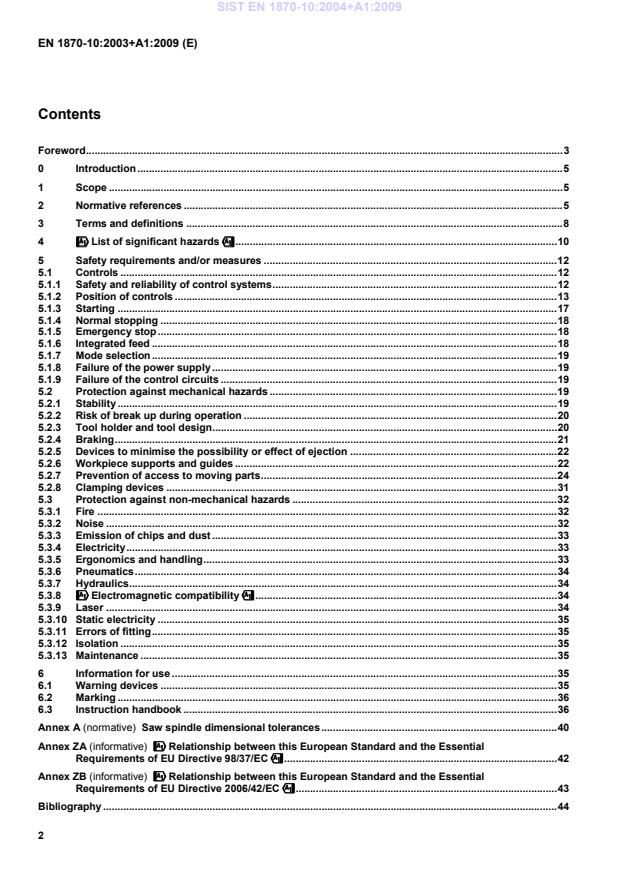
Saw spindle dimensional tolerances . 40Annex ZA (informative)
!!!!Relationship between this European Standard and the Essential Requirements of EU Directive 98/37/EC"""" . 42Annex ZB (informative)
!!!!Relationship between this European Standard and the Essential Requirements of EU Directive 2006/42/EC"""" . 43Bibliography . 44SIST EN 1870-10:2004+A1:2009
1 Applicable to the French version only. SIST EN 1870-10:2004+A1:2009
This European Standard also includes information which can be provided by the manufacturer to the user. Common requirements for tooling are given in !EN 847-1:2005". 1 Scope !This document deals with all significant hazards, hazardous situations and events as listed in Clause 4 which are relevant to single blade automatic and semi-automatic up-cutting cross cut sawing machines with one sawing unit herein after referred to as ‘machines’ designed to cut solid wood, chipboard, fibreboard, plywood and also these materials when they are covered with plastic edging and/or plastic/light alloy laminates." Any workpiece positioning equipment fitted to the machine is included in this European Standard.
!deleted text" This European Standard does not apply to machines designed for cross cutting logs. For Computer Numerically Controlled (CNC) machines this European Standard does not cover hazards related to Electro-Magnetic Compatibility (EMC). NOTE
The requirements of this European Standard apply to all machines whatever their method of control e.g. electromechanical and/or electronic. This European Standard is primarily directed to machines which are manufactured after the date of publication by CEN. 2 Normative references !The following referenced documents are indispensable for the application of this document. For dated references, only the edition cited applies. For undated references, the latest edition of the referenced document (including any amendments) applies." !deleted text" EN 574:1996, Safety of machinery — Two-hand control devices —Functional aspects — Principles for design SIST EN 1870-10:2004+A1:2009
Part 1: Emission EN 50370-2:2003, Electromagnetic compatibility (EMC) — Product family standard for machine-tools —
Part 2: Immunity" !EN 60204-1:2006, Safety of machinery — Electrical equipment of machines — Part 1: General requirements (IEC 60204-1:2005, modified)" !EN 60439-1:1999, Low-voltage switchgear and controlgear assemblies — Part 1: Type-tested and partially type-tested assemblies (IEC 60439-1:1999) "
EN 60529:1991, Degrees of protection provided by enclosures (IP code) (IEC 60529:1989) !EN 60825-1:2007, Safety of laser products — Part 1: Equipment classification and requirements (IEC 60825-1:2007) " SIST EN 1870-10:2004+A1:2009
tactile signals (IEC 61310-1:2007) " !CLC/TS 61496-2:2006", Safety of machinery — Electrosensitive protective equipment — !Part 2: Particular requirements for equipment using active opto-electronic protective devices (AOPDs) (IEC 61496-2:2006)" EN ISO 3743-1:1995, Acoustics — Determination of sound power levels of noise sources — Engineering methods for small, moveable sources in reverberant fields — Part 1: Comparison method for hard walled test rooms (ISO 3743-1:1994) EN ISO 3743-2:1996, Acoustics — Determination of sound power levels of noise sources using sound pressure — Engineering methods for small, moveable sources in reverberant fields — Part 2: Methods for special reverberation test rooms (ISO 3743-2:1994) EN ISO 3744:1995, Acoustics — Determination of sound power levels of noise sources using sound pressure — Engineering method in an essentially free field over a reflecting plane (ISO 3744:1994) !EN ISO 3745:2003, Acoustics — Determination of sound power levels of noise sources using sound pressure — Precision methods for anechoic and hemi-anechoic rooms (ISO 3745:2003) " EN ISO 3746:1995, Acoustics — Determination of sound power levels of noise sources using sound pressure — Survey method using an enveloping measurement surface over a reflecting plane (ISO 3746:1995) EN ISO 4871:1996, Acoustics — Declaration and verification of noise emission values of machinery and equipment (ISO 4871:1996) EN ISO 9614-1:1995, Acoustics — Determination of sound power levels of noise sources using sound intensity — Part 1: Measurement at discrete points (ISO 9614-1:1993) EN ISO 11202:1995, Acoustics — Noise emitted by machinery and equipment — Measurement of emission sound pressure levels at a work station and at other specified positions — Survey method in situ (ISO 11202:1995) EN ISO 11204:1995, Acoustics — Noise emitted by machinery and equipment — Measurement of emission sound pressure levels at a work station and at other specified positions — Method requiring environmental corrections (ISO 11204:1995) EN ISO 11688-1:1998, Acoustics — Recommended practice for the design of low-noise machinery and equipment — Part 1: Planning (ISO/TR 11688-1:1995) !EN ISO 12100-1:2003, Safety of machinery — Basic concepts, general principles for design — Part 1: Basic terminology and methodology (ISO 12100-1:2003) EN ISO 12100-2:2003, Safety of machinery — Basic concepts, general principles for design — Part 2: Technical principles (ISO 12100-2:2003) " !EN ISO 13849-1:2008, Safety of machinery — Safety-related parts of control systems — Part 1: General principles for design (ISO 13849-1:2006) " !EN ISO 13850:2008, Safety of machinery — Emergency stop — Principles for design (ISO 13850:2006)" !EN ISO 13857:2008, Safety of machinery — Safety distances to prevent hazard zones being reached by upper and lower limbs (ISO 13857:2008) " !deleted text" SIST EN 1870-10:2004+A1:2009
Key 1 Front of the machine Figure 1 — Example of up-cutting cross cut saw (Diagrammatic)
No Hazards, hazardous situations and hazardous events EN ISO 12100 Relevant sub-clause of this document
Part 1: 2003 Part 2: 2003
1 Mechanical hazards related to: - machine parts or workpieces:
a) shape; 4.2 4.2.1, 4.2.2, 5 5.1.2, 5.1.3, 5.2.3, 5.2.6, 5.2.7, 5.2.8
b) relative location; 5.1.2, 5.2.6.2, 5.2.7.1, 5.2.7.2, 5.3.5
c) mass and stability (potential energy of elements which may move under the effect of gravity) 5.2.6
d) mass and velocity (kinetic energy of elements in controlled or uncontrolled motion); 5.2.7.2
e) mechanical strength 5.2.2, 5.2.3.1
- accumulation of energy inside the machinery:
g) liquids and gases under pressure; 4.2 4.10, 5.5.4 5.3.6, 5.3.7 1.1 Crushing hazard 4.2.1
5.2.7, 5.2.8 1.2 Shearing hazard 5.2.7, 5.2.8 1.3 Cutting or severing hazard 5.2.2, 5.2.3, 5.2.4, 5.2.7 1.4 Entanglement hazard 5.2.7 1.5 Drawing-in or trapping hazard 5.2.7 1.6 Impact hazard 5.2.7.2 1.8 Friction or abrasion hazard 5.2.4 1.9 High pressure fluid injection or ejection hazard 5.2.4, 5.3.6, 5.3.7 2 Electrical hazards due to: 2.1 Contact of persons with live parts (direct contact) 4.3 4.9, 5.5.4 5.3.4, 5.3.12, 5.3.13 SIST EN 1870-10:2004+A1:2009
5.3.2 6 Hazards generated by radiation 6.5 Lasers 4.7
5.3.9 7 Hazards generated by materials and substances (and their constituent elements) processed or used by the machinery 7.1 Hazards from contact with or inhalation of harmful fluids and dusts 4.8 4.3b, 4.4
5.3.3, 6.3 7.2 Fire hazard 4.8 4.4
5.3.1, 5.3.3 8 Hazards generated by neglecting ergonomic principles in machinery design related to: 8.1 Unhealthy postures or excessive effort 4.9 4.7, 4.8.2, 4.11.12, 5.5.5, 5.5.6 5.1.2, 5.3.5, 6.3 8.2 Hand-arm or foot-leg anatomy 4.9 4.8.3
5.1.2, 5.3.5, 6.3 8.4 Local lighting
4.8.6 6.3 8.6 Human error, human behaviour
4.8, 4.11.8, 4.11.10, 5.5.2, 6 6.3 8.7 Design, location or identification of manual controls
4.8.7, 4.11.8 5.1.2 8.8 Design or location of visual display units
4.8.8, 6.2 5.1.2 9 Combination of hazards 4.11
5.1.6, 5.1.7, 5.1.8, 5.2.7.2, 5.3.3, 5.3.4 10 Unexpected start up, unexpected overrun/overspeed (or any similar malfunction) from: 10.1 Failure/disorder of the control system
4.11, 5.5.4
5.1.8, 5.1.9, 5.2.3.1
10.2 Restoration of energy supply after an interruption
4.11.4
5.1.8, 5.1.9, 5.2.4, 5.3.7, 5.3.8 10.3 External influences on electrical equipment
4.11.11 5.3.4, 5.3.8 10.6 Errors made by the operator (due to mismatch of machinery with human characteristics and abilities, see 8.6) 4.9 4.8, 4.11.8, 4.11.10, 5.5.2, 6
5.1.1, 5.3.5, 6.3 11 Impossibility of stopping the machine in the best possible conditions
4.11.1, 4.11.3, 5.5.2
5.1.2, 5.1.4, 5.1.5 13 Failure of the power supply
4.11.1, 4.11.4 5.1.8, 5.1.9, 5.2.4, 5.3.7, 5.3.8 14 Failure of the control circuit
4.11, 5.5.4
5.2.1 15 Errors of fitting 4.9
4.7, 6.5
5.2.3, 5.3.11, 6.1, 6.3 16 Break-up during operation 4.2.2 4.3 5.2.2 SIST EN 1870-10:2004+A1:2009
5.1.6, 5.1.9, 5.2.2, 5.2.3, 5.2.5, 5.2.6, 5.2.8, 5.3.7, 5.3.8, 5.3.12 18 Loss of stability / overturning of machinery 4.2.2 5.2.6
5.2.1 "
5 Safety requirements and/or measures The machine shall comply with the safety requirements and/or protective measures of this clause. In addition, the machine shall be designed according to the principles of clauses 5 and 6 of !EN ISO 12100-1:2003" for hazards relevant but not significant, which are not dealt with by this document (e.g. sharp edges). For guidance in connection with risk reduction by design, see !4.1 of EN ISO 12100-2:2003", and for safeguarding measures, see !Clause 5 of EN ISO 12100-2:2003". 5.1 Controls 5.1.1 Safety and reliability of control systems For the purposes of this European Standard a safety related control system is one from and including the initial manual control or position detector to the point of input to the final actuator or element e.g. motor. The safety related control systems of this machine are those for: starting (see 5.1.3); normal stopping (see 5.1.4); emergency stop (see 5.1.5); moveable interlocked guards (see 5.1.3, 5.2.7.3); moveable interlocked guards with guard locking (see 5.2.7.1, 5.2.7.2, 5.2.7.3); interlocking of the cutting stroke with saw blade rotation and workpiece clamping (where fitted) (see 5.1.3 and 5.2.7.1.2); interlocking of the powered workpiece positioning with the cutting stroke (see 5.1.6); hold-to-run control device (see 5.2.7.1.2); mode selection (see 5.1.7); initiation of the braking system (see 5.1.4, 5.1.5, 5.2.4); two hand control devices (see 5.2.7.1); pressure sensitive mats (see 5.2.7.1, 5.2.7.2); active optoelectronic protective devices (light barriers) (see 5.2.7.1, 5.2.7.2); mechanically actuated trip devices (trip bars) (see 5.2.7.2 ); workpiece clamping (see 5.2.8). Unless otherwise stated in this European Standard these control systems shall, as a minimum, be designed and constructed in accordance with category 1 as defined in !EN ISO 13849-1:2008". For the purposes of this European Standard "well tried components and principles" means: a) electrical components if they comply with relevant standards including the following as: i) !EN 60947-5-1:2004" (section 3) for control switches with positive opening operation used as mechanical actuated position detectors for interlocking guards and for relays used in auxiliary circuits; ii) !EN 60947-4-1:2001" for electromechanical contactors and motor-starters used in main circuits; iii) !HD 22.1 S4:2002" for rubber-insulated cables; SIST EN 1870-10:2004+A1:2009
EN 574:1996; h) pressure sensitive mats if they are as minimum in accordance of type 2 of EN 1760-1:1997 and if they are tested together with their associated control circuits at least at each starting of the machine; i) active optoelectronic protective devices (light beam) if they comply as minimum of type 2 of
!CLC/TS
61496-2:2006" and if they are tested together with the associated control circuits at least at each starting of the machine; j) trip bars if they are as minimum in accordance with type 2 of EN 1760-2:2001 and if they are tested together with their associated control circuits at least at each starting of the machine. Time delay devices used in hardwired safety related control circuits may be of category B in accordance with the requirements of !EN ISO 13849-1:2008" if the time delay device is designed for at least one million actuations. Verification: By checking the relevant drawings and/or circuit diagrams and inspection of the machine. !deleted text" !NOTE For components characteristics the information from the component supplier can be useful." 5.1.2 Position of controls The main electrical controls for starting the saw blade spindle drive motor, normal stopping and integrated feed of the workpiece (where fitted) shall be located together on the machine or on a mobile control desk from which the loading position can be seen (see also !11.2.1 of EN 60204-1:2006").
Where controls are located on a mobile control desk the following requirements shall be met: a) it shall be connected by cable to the machine; b) its position shall be indicated in the instruction handbook. Where the machine is fitted with a two-hand control device it shall be: SIST EN 1870-10:2004+A1:2009
c) at the main control panel; d) within 500 mm of the two-hand control device (where provided); e) within 3,0 m of the saw unit. NOTE A single emergency stop can be positioned to fulfil more than one of these requirements. Verification: By checking the relevant drawings, measurement and inspection of the machine.
Key 1 Cutting line 2 Manual control actuators of the two-hand control device 3 Upper saw blade guard also operating as clamping device 4 Deterring/impeding device at the front side Figure 2 — Position of controls and guarding of the saw blade cutting area by two-hand control device and deterring/impeding device on machines with upper guard operating as clamping device
Key 1 Cutting line 2 Two-hand control device 3 Upper fixed saw blade guard Figure 3 — Position of controls and guarding of the saw blade cutting area
by two-hand control device and fixed guard
Dimensions in millimetres
Key 1 Cutting line 2 Manual control actuators of the two-hand control device 3 Upper movable saw blade guard 4 Deterring/impeding device at the front side Figure 4 — Position of controls and guarding of the saw blade cutting area by two hand control device, movable saw blade guard and deterring/impeding device 5.1.3 Starting Before starting or restarting the machine all the safeguards shall be in place and functional. This is achieved by the interlocking arrangements described in 5.2.7. Start or restart shall only be possible by actuation of the start control device provided for that purpose. For semi-automatic machines the cutting stroke shall only be capable of being started with a manually operated control device after saw blade rotation and clamping have been initiated. For all machines the cutting stroke shall only be capable of being started when: a) saw blade rotation and workpiece clamping (where fitted) have been initiated; b) all interlocked guards are in the closed position; c) no person is standing on pressure sensitive mats (where provided); d) no person is within the beams of an active optoelectronic device (where provided). All reset controls shall be located outside protected areas and not reachable when standing inside a protected area. For electrically started machines see 9.2.5.2 of !EN 60204-1:2006". The exceptions described with regard to 9.2.4 of !EN 60204-1:2006" are not relevant. Verification: By checking the relevant drawings and/or circuit diagrams, inspection and relevant functional testing of the machine. SIST EN 1870-10:2004+A1:2009
!EN 60204-1:2006". However !10.7.4 of EN 60204-1:2006" does not apply. When actuated the emergency stop shall disconnect power from all machine actuators and actuate the brake (if provided). When initiated the stopping sequence shall: a) initiate the return stroke of the saw unit; b) remove power to workpiece clamping (where fitted); c) cut power to saw spindle motor and initiate the brake (where fitted); d) cut power to brake when braking sequence is complete (if electrical brake is fitted). The stopping sequence shall be satisfied at the level of the control circuits. If a time delay device is used, time delay shall be at least the maximum run-down time and either the time delay shall be fixed, or, the time delay adjustment device shall be sealed. For positioning of the emergency stop control(s) see 5.1.2. Verification: By checking relevant drawings and/or circuit diagrams, inspection and relevant functional testing of the machine. 5.1.6 Integrated feed The integrated feed of the workpiece positioning mechanism shall only operate when the saw unit is in its rest position. For the integrated feed of the saw unit see 5.1.3. SIST EN 1870-10:2004+A1:2009
c) changing the mode shall not initiate any movement of the machine. Verification: By checking relevant drawings and/or circuit diagrams, inspection and relevant functional testing of the machine. 5.1.8 Failure of the power supply On electrically driven machines an automatic restart in the case of a supply interruption after the restoration of the supply voltage shall be prevented in accordance with 7.5 paragraphs 1 and 3 of !EN 60204-1:2006". Where pneumatic or hydraulic workpiece clamping is provided, in the event of loss of pneumatic or hydraulic pressure, clamping of the workpiece shall be maintained until the return stroke of the saw blade is initiated. Where non-return valves are used to meet this requirement, they shall be fitted to the actuating cylinders.
The automatic restart of the machine shall be prevented after restoration of the pneumatic or hydraulic energy. Verification: By checking relevant drawings and/or circuit
...