


prEN IEC 63479-3:2025
(Main)Infotainment services for public vehicles (PVIS) - Part 3: Framework
Infotainment services for public vehicles (PVIS) - Part 3: Framework
IEC 63479-3:2026 describes the infotainment services for public vehicles (PVIS) framework, including the functional reference models and the information flows for functional operations.
Infotainment Dienstleistungen für öffentliche Verkehrsmittel (PVIS) - Teil 3: Rahmen
Services d'infodivertissements pour véhicules publics (PVIS) - Partie 3: Cadre
L'IEC 63479-3:2026 décrit le cadre des services d'infodivertissements pour véhicules publics (PVIS), y compris les modèles de référence fonctionnels et les flux d'informations pour les opérations fonctionnelles.
Informacijska storitev za javna vozila (PVIS) - 3. del: Okvir
General Information
- Status
- Not Published
- Publication Date
- 26-Feb-2026
- Current Stage
- 4060 - Enquiry results established and sent to TC, SR, BTTF - Enquiry
- Start Date
- 25-Apr-2025
- Completion Date
- 25-Apr-2025
prEN IEC 63479-3:2025 - Infotainment services for public vehicles (PVIS) - Part 3: Framework
Overview
prEN IEC 63479-3:2025 defines the PVIS framework for infotainment services in terrestrial public vehicles (bus, train, subway). Part 3 of the IEC 63479 series specifies the functional reference models and the information flows required to provision, operate and maintain infotainment systems that serve many transient passengers. This document complements Part 1 (general) and Part 2 (requirements) and is intended to guide system architecture, operations and interoperability for public-vehicle infotainment.
Key facts:
- Applies to terrestrial public vehicles (excludes airplanes and ships).
- Defines PVIS entities: PVIS master, PVIS agent, PVIS devices, plus passenger devices, content providers and external applications.
- Describes a reference architecture with six core functions and three interworking functions.
- Document is at CDV stage (2025) and subject to change.
Key Topics and Requirements
The standard provides a functional framework rather than vendor-specific protocols. Main technical topics include:
Core functions (reference model):
- Authentication management
- Connectivity management
- History management
- Profile management
- Device management
- Content management
Interworking functions:
- Transport function
- Message function
- Interface function
Defined information flows for operational use cases:
- Device provisioning
- Device monitoring
- Device control
- Content deployment and maintenance
- Content delivery
Architectural notes:
- PVIS master may perform agent functions; agents include device-level functions.
- Designed for scalable management of many short-term passenger sessions and a diverse set of onboard devices.
Applications and Who Should Use It
This framework is practical for stakeholders designing, deploying or certifying public-vehicle infotainment solutions:
- Vehicle OEMs and subsystem suppliers (infotainment integrators)
- Public transport operators and transit IT teams
- System architects and software developers building PVIS platforms
- Content providers and digital service aggregators targeting transit audiences
- Test laboratories and certification bodies validating interoperability and conformance
- Regulators and procurement teams specifying requirements for passenger services
Use cases include multi-seat media delivery, centralized device provisioning and monitoring on buses/trains, and managed content updates for onboard displays and passenger devices.
Related Standards
- IEC 63479-1 - Infotainment services for public vehicles: General (Technical Report)
- IEC 63479-2 - Infotainment services for public vehicles: Requirements (International Standard)
- IEC TC100 work on Configurable Car Infotainment Services (IEC 63246 series) - provides context for personal-vehicle infotainment standards
Keywords: PVIS framework, infotainment services for public vehicles, IEC 63479-3, public transport infotainment, device provisioning, content delivery, vehicle infotainment standard.

Get Certified
Connect with accredited certification bodies for this standard

TÜV Rheinland
TÜV Rheinland is a leading international provider of technical services.

TÜV SÜD
TÜV SÜD is a trusted partner of choice for safety, security and sustainability solutions.

AIAG (Automotive Industry Action Group)
American automotive industry standards and training.
Sponsored listings
Frequently Asked Questions
prEN IEC 63479-3:2025 is a draft published by CLC. Its full title is "Infotainment services for public vehicles (PVIS) - Part 3: Framework". This standard covers: IEC 63479-3:2026 describes the infotainment services for public vehicles (PVIS) framework, including the functional reference models and the information flows for functional operations.
IEC 63479-3:2026 describes the infotainment services for public vehicles (PVIS) framework, including the functional reference models and the information flows for functional operations.
prEN IEC 63479-3:2025 is classified under the following ICS (International Classification for Standards) categories: 43.040.15 - Car informatics. On board computer systems. The ICS classification helps identify the subject area and facilitates finding related standards.
prEN IEC 63479-3:2025 is available in PDF format for immediate download after purchase. The document can be added to your cart and obtained through the secure checkout process. Digital delivery ensures instant access to the complete standard document.
Standards Content (Sample)
SLOVENSKI STANDARD
01-marec-2025
Informacijska storitev za javna vozila (PVIS) - 3. del: Okvir
Infotainment services for public vehicles (PVIS) - Part 3: Framework
Ta slovenski standard je istoveten z: prEN IEC 63479-3:2025
ICS:
43.040.15 Avtomobilska informatika. Car informatics. On board
Vgrajeni računalniški sistemi computer systems
2003-01.Slovenski inštitut za standardizacijo. Razmnoževanje celote ali delov tega standarda ni dovoljeno.
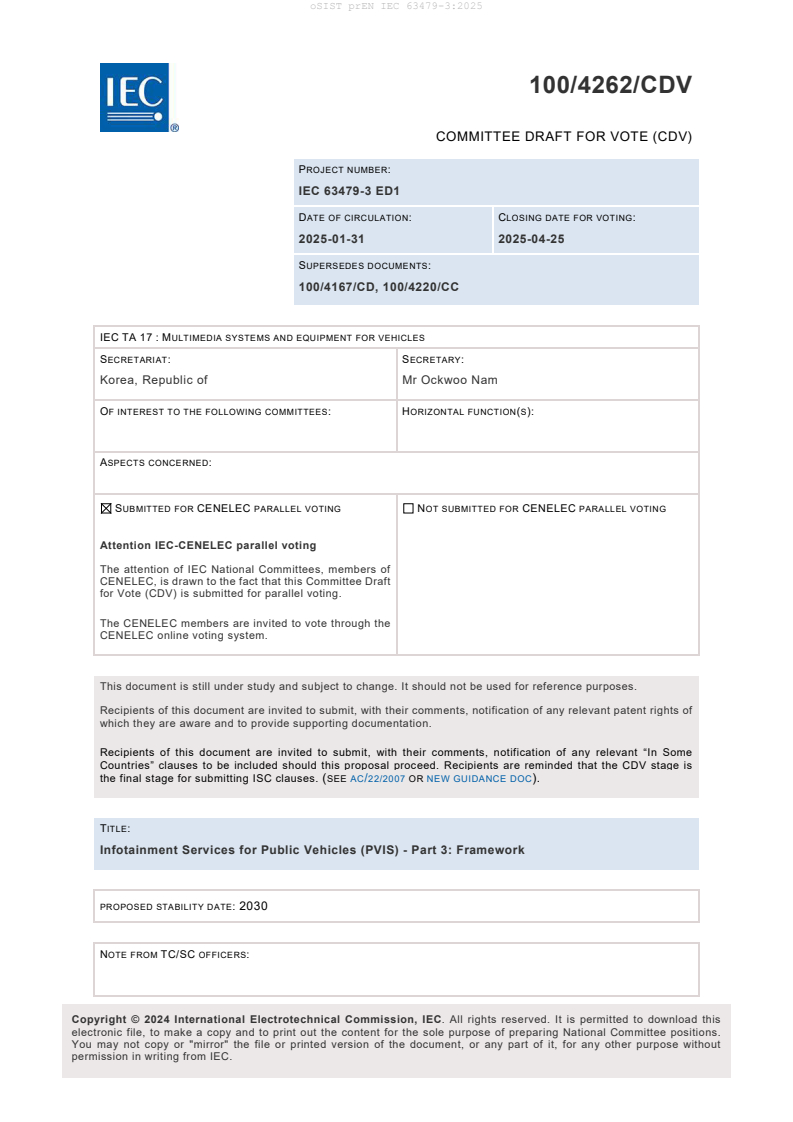
100/4262/CDV
COMMITTEE DRAFT FOR VOTE (CDV)
PROJECT NUMBER:
IEC 63479-3 ED1
DATE OF CIRCULATION: CLOSING DATE FOR VOTING:
2025-01-31 2025-04-25
SUPERSEDES DOCUMENTS:
100/4167/CD, 100/4220/CC
IEC TA 17 : MULTIMEDIA SYSTEMS AND EQUIPMENT FOR VEHICLES
SECRETARIAT: SECRETARY:
Korea, Republic of Mr Ockwoo Nam
OF INTEREST TO THE FOLLOWING COMMITTEES: HORIZONTAL FUNCTION(S):
ASPECTS CONCERNED:
SUBMITTED FOR CENELEC PARALLEL VOTING NOT SUBMITTED FOR CENELEC PARALLEL VOTING
Attention IEC-CENELEC parallel voting
The attention of IEC National Committees, members of
CENELEC, is drawn to the fact that this Committee Draft
for Vote (CDV) is submitted for parallel voting.
The CENELEC members are invited to vote through the
CENELEC online voting system.
This document is still under study and subject to change. It should not be used for reference purposes.
Recipients of this document are invited to submit, with their comments, notification of any relevant patent rights of
which they are aware and to provide supporting documentation.
Recipients of this document are invited to submit, with their comments, notification of any relevant “In Some
Countries” clauses to be included should this proposal proceed. Recipients are reminded that the CDV stage is
the final stage for submitting ISC clauses. (SEE AC/22/2007 OR NEW GUIDANCE DOC).
TITLE:
Infotainment Services for Public Vehicles (PVIS) - Part 3: Framework
PROPOSED STABILITY DATE: 2030
NOTE FROM TC/SC OFFICERS:
electronic file, to make a copy and to print out the content for the sole purpose of preparing National Committee positions.
You may not copy or "mirror" the file or printed version of the document, or any part of it, for any other purpose without
permission in writing from IEC.
100/4262/CDV – 2 – IEC CDV 63479-3 © IEC 2024
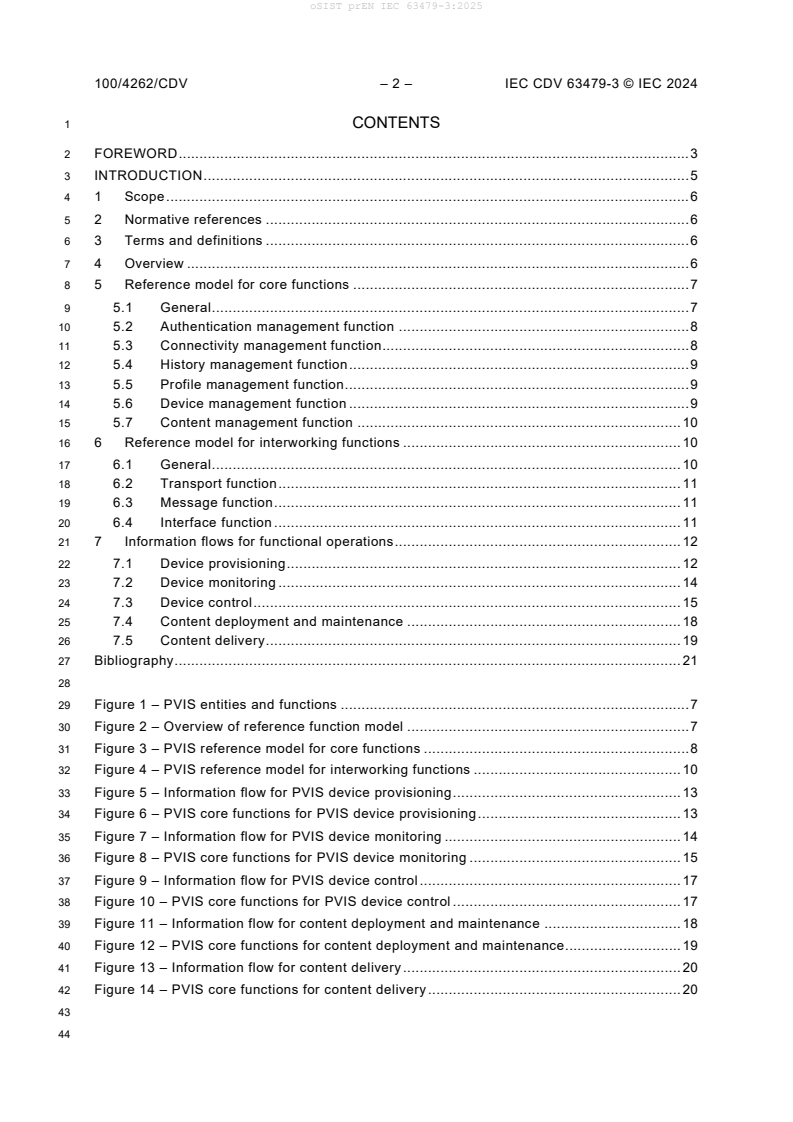
1 CONTENTS
2 FOREWORD . 3
3 INTRODUCTION . 5
4 1 Scope . 6
5 2 Normative references . 6
6 3 Terms and definitions . 6
7 4 Overview . 6
8 5 Reference model for core functions . 7
9 5.1 General . 7
10 5.2 Authentication management function . 8
11 5.3 Connectivity management function . 8
12 5.4 History management function . 9
13 5.5 Profile management function . 9
14 5.6 Device management function . 9
15 5.7 Content management function . 10
16 6 Reference model for interworking functions . 10
17 6.1 General . 10
18 6.2 Transport function . 11
19 6.3 Message function . 11
20 6.4 Interface function . 11
21 7 Information flows for functional operations . 12
22 7.1 Device provisioning . 12
23 7.2 Device monitoring . 14
24 7.3 Device control . 15
25 7.4 Content deployment and maintenance . 18
26 7.5 Content delivery . 19
27 Bibliography . 21
29 Figure 1 – PVIS entities and functions . 7
30 Figure 2 – Overview of reference function model . 7
31 Figure 3 – PVIS reference model for core functions . 8
32 Figure 4 – PVIS reference model for interworking functions . 10
33 Figure 5 – Information flow for PVIS device provisioning . 13
34 Figure 6 – PVIS core functions for PVIS device provisioning . 13
35 Figure 7 – Information flow for PVIS device monitoring . 14
36 Figure 8 – PVIS core functions for PVIS device monitoring . 15
37 Figure 9 – Information flow for PVIS device control . 17
38 Figure 10 – PVIS core functions for PVIS device control . 17
39 Figure 11 – Information flow for content deployment and maintenance . 18
40 Figure 12 – PVIS core functions for content deployment and maintenance . 19
41 Figure 13 – Information flow for content delivery . 20
42 Figure 14 – PVIS core functions for content delivery . 20
IEC CD 63479-3 © IEC 2024 – 3 – 100/4262/CDV
45 INTERNATIONAL ELECTROTECHNICAL COMMISSION
46 ____________
48 INFOTAINMENT SERVICES FOR PUBLIC VEHICLES (PVIS)
50 Part 3: Framework
52 FOREWORD
53 1) The International Electrotechnical Commission (IEC) is a worldwide organization for standardization comprising
54 all national electrotechnical committees (IEC National Committees). The object of IEC is to promote international
55 co-operation on all questions concerning standardization in the electrical and electronic fields. To this end and
56 in addition to other activities, IEC publishes International Standards, Technical Specifications, Technical Reports,
57 Publicly Available Specifications (PAS) and Guides (hereafter referred to as “IEC Publication(s)”). Their
58 preparation is entrusted to technical committees; any IEC National Committee interested in the subject dealt with
59 may participate in this preparatory work. International, governmental and non-governmental organizations liaising
60 with the IEC also participate in this preparation. IEC collaborates closely with the International Organization for
61 Standardization (ISO) in accordance with conditions determined by agreement between the two organizations.
62 2) The formal decisions or agreements of IEC on technical matters express, as nearly as possible, an international
63 consensus of opinion on the relevant subjects since each technical committee has representation from all
64 interested IEC National Committees.
65 3) IEC Publications have the form of recommendations for international use and are accepted by IEC National
66 Committees in that sense. While all reasonable efforts are made to ensure that the technical content of IEC
67 Publications is accurate, IEC cannot be held responsible for the way in which they are used or for any
68 misinterpretation by any end user.
69 4) In order to promote international uniformity, IEC National Committees undertake to apply IEC Publications
70 transparently to the maximum extent possible in their national and regional publications. Any divergence between
71 any IEC Publication and the corresponding national or regional publication shall be clearly indicated in the latter.
72 5) IEC itself does not provide any attestation of conformity. Independent certification bodies provide conformity
73 assessment services and, in some areas, access to IEC marks of conformity. IEC is not responsible for any
74 services carried out by independent certification bodies.
75 6) All users should ensure that they have the latest edition of this publication.
76 7) No liability shall attach to IEC or its directors, employees, servants or agents including individual experts and
77 members of its technical committees and IEC National Committees for any personal injury, property damage or
78 other damage of any nature whatsoever, whether direct or indirect, or for costs (including legal fees) and
79 expenses arising out of the publication, use of, or reliance upon, this IEC Publication or any other IEC
80 Publications.
81 8) Attention is drawn to the Normative references cited in this publication. Use of the referenced publications is
82 indispensable for the correct application of this publication.
83 9) IEC draws attention to the possibility that the implementation of this document may involve the use of (a)
84 patent(s). IEC takes no position concerning the evidence, validity or applicability of any claimed patent rights in
85 respect thereof. As of the date of publication of this document, IEC had not received notice of (a) patent(s), which
86 may be required to implement this document. However, implementers are cautioned that this may not represent
87 the latest information, which may be obtained from the patent database available at https://patents.iec.ch and
88 www.iso.org/patents. IEC shall not be held responsible for identifying any or all such patent rights.
89 IEC 63479-3 has been prepared by the technical area 17: multimedia systems and equipment
90 for vehicles, of IEC technical committee 100: audio, video and multimedia systems and
91 equipment. It is an International Standard.
92 The text of this International Standard is based on the following documents:
Draft Report on voting
XX/XX/FDIS XX/XX/RVD
94 Full information on the voting for its approval can be found in the report on voting indicated in
95 the above table.
96 The language used for the development of this International Standard is English.
100/4262/CDV – 4 – IEC CDV 63479-3 © IEC 2024
97 This document was drafted in accordance with ISO/IEC Directives, Part 2, and developed in
98 accordance with ISO/IEC Directives, Part 1 and ISO/IEC Directives, IEC Supplement available
99 at www.iec.ch/members_experts/refdocs. The main document types developed by IEC are
100 described in greater detail at www.iec.ch/publications.
101 The committee has decided that the contents of this document will remain unchanged until the
102 stability date indicated on the IEC website under webstore.iec.ch in the data related to the
103 specific document. At this date, the document will be
104 • reconfirmed,
105 • withdrawn,
106 • replaced by a revised edition, or
107 • amended.
IEC CD 63479-3 © IEC 2024 – 5 – 100/4262/CDV
109 INTRODUCTION
110 It is noted that the markets and industries on infotainment services for vehicles (as known as
111 in-vehicle infotainment services) have been growing rapidly. It is envisioned that a variety of
112 infotainment (or multimedia) devices and services will be newly developed for personal and
113 public vehicles in the future. Such devices include navigations, cameras, speakers, headrest
114 displays, air-conditioners, thermometers and heated seats, and lights.
115 The IEC TC100 have so far developed a set of standards on Configurable Car infotainment
116 Services (CCIS) with the IEC 63246 series. However, the CCIS standards have been basically
117 designed for personal users, such as car owner. In the meantime, there is also a crucial need
118 to provide a variety of infotainment services for public vehicles (PVIS) such as bus or train.
119 PVIS services have different requirements and features from CCIS services. For user type,
120 CCIS is targeted for one or two users (such as car owner), whereas PVIS is for a large number
121 of guests or passengers within the public vehicle. For device type, CCIS deals with the personal
122 devices (property or belonging) in the car, whereas PVIS will be targeted for a variety of public
123 devices that are contained in a public vehicle. Some PVIS services may be provisioned by
124 interworking with the external networks, as shown in the bus information service. For service
125 duration, CCIS usually provide long-term services, whereas PVIS may provide short-term
126 service during which a guest stays within a public vehicle.
127 From these observations, it is noted that there are many different features and requirements
128 between CCIS and PVIS. Accordingly, there is a need of standardization on PVIS. In particular,
129 PVIS needs to employ a set of agents to effectively manage a large number of users or devices.
130 The PVIS series (IEC 63479) describe infotainment (multimedia) services for terrestrial public
131 vehicles, such as bus, train, or subway. It is not applicable to public vehicles, such as airplane
132 or ship. For this purpose, the following issues are addressed: 1) identify a variety of functional
133 requirements for provisioning of PVIS, 2) design the PVIS framework, based on the identified
134 requirements. The PVIS standard are expected to provide guidelines on PVIS services for a
135 large number of users/devices, and to encourage development of new (enhanced) PVIS
136 services (possibly by interworking with the external systems).
137 The IEC 63479 consists of the following parts:
138 – Part 1: general,
139 – Part 2: requirements, and
140 – Part 3: framework.
142 Part 1 of IEC 63479 (Technical Report) describes general considerations and system model for
143 PVIS, with some examples of PVIS services.
144 Part 2 of IEC 63479 (International Standard) describes the functional requirements for PVIS.
145 Part 3 of IEC 63479 (International Standard) describes the framework, including the functional
146 information flows between functional entities.
100/4262/CDV – 6 – IEC CDV 63479-3 © IEC 2024
149 INFOTAINMENT SERVICES FOR PUBLIC VEHICLES (PVIS)
151 Part 3: Framework
155 1 Scope
156 This part of IEC 63479 describes the PVIS framework, including the functional reference models
157 and the information flows for functional operations.
158 2 Normative references
159 The following document is referred to in the text in such a way that some or all of their content
160 constitutes requirements of this document. For dated references, only the edition cited applies.
161 For undated references, the latest edition of the referenced document (including any
162 amendments) applies.
163 • IEC 63479-2, Infotainment Services for Public Vehicles (PVIS) – Part 2: Requirements
164 (202X)
166 3 Terms and definitions
167 No terms and definitions are listed in this document.
168 4 Overview
169 PVIS consists of a diverse ecosystem of entities, each contributing to the system's operation
170 and functionality. These entities can be categorized into two main groups:
171 • PVIS support entities: these entities are responsible for supporting the core functions
172 required by the PVIS. They include the PVIS master, PVIS agent, and PVIS devices. The
173 PVIS master serves as the central command, controlling and coordinating activities within
174 the system. The PVIS agent facilitates the connection between the master and the devices,
175 while the PVIS devices deliver the actual infotainment content to the passengers.
176 • PVIS user entities: these entities engage with the PVIS system on a more transient basis.
177 They include passenger devices, content providers, and external applications. Passenger
178 devices enable users to interact with the system, content providers supply the infotainment
179 materials, and external applications offer additional functionalities to enhance the overall
180 user experience.
181 The PVIS framework defines the functions that the PVIS master, agent, and devices need to
182 support in order to manage infotainment services effectively and deliver them to passengers
183 seamlessly.
184 Figure 1 illustrates how each entity has a specific set of PVIS functions to ensure the smooth
185 operation of PVIS. It is noted in the figure that the PVIS master should be able to perform the
186 functions of the PVIS agent, and the PVIS agent includes the functions of the PVIS device.
IEC CD 63479-3 © IEC 2024 – 7 – 100/4262/CDV
189 Figure 1 – PVIS entities and functions
190 Figure 2 presents a reference architecture of PVIS system, which includes the six core functions
191 and the three interworking functions. The core functions are specifically designed to meet the
192 functional requirements of each entity, while the interworking functions enable smooth
193 interaction between these entities. The details of these functions are described in the
194 subsequent clauses.
196 Figure 2 – Overview of reference function model
198 5 Reference model for core functions
199 5.1 General
200 The PVIS reference model for core functions comprises several functional modules that
201 facilitate efficient management and utilization of infotainment services. As illustrated in Figure
202 3, PVIS encompasses the following modules: authentication management, profile management,
203 device management, content management, connectivity management, and history management.
100/4262/CDV – 8 – IEC CDV 63479-3 © IEC 2024
205 Figure 3 – PVIS reference model for core functions
206 5.2 Authentication management function
207 The authentication management function within PVIS is responsible for delivering customized
208 services to authenticated users by leveraging their registered information. This function consists
209 of two crucial subfunctions: certification and permission.
210 The certification subfunction ensures the identification of each entity within the system and
211 generates access tokens that grant specific privileges for a limited duration. These access
212 tokens must be included in all exchanged messages by the entity, enabling secure and
213 authorized communication.
214 The permission subfunction is responsible for validating exchanged messages and governing
215 the permissions associated with devices and content. Different entities within the PVIS service
216 may have varying levels of permission to operate devices and access content. The validation
217 process relies on the access tokens issued by the certification module, ensuring that only
218 authorized entities can perform permitted actions.
219 5.3 Connectivity management function
220 In PVIS, the connectivity information associated with the various PVIS entities plays a crucial
221 role in delivering efficient and secure services. This connectivity information is represented by
222 connection and session data.
223 Within a PVIS system, all functional entities, except for PVIS master, are required to register
224 either with the PVIS master or the PVIS agent. During this registration process, a session token
225 is assigned to each entity. This session token is then included in all subsequent communications,
226 enabling the PVIS to maintain session context and track entity activities. For instance, a session
227 for a PVIS device includes details about the device's current state and occupant. Similarly, a
228 session related to a passenger's device encapsulates information such as the specific PVIS
229 device being used and the content currently being accessed. This session information forms
230 the foundation for maintaining effective and personalized interactions within the PVIS.
231 Furthermore, it facilitates the verification of entity permissions, ensuring secure and authorized
232 interactions within the system.
IEC CD 63479-3 © IEC 2024 – 9 – 100/4262/CDV
233 A connection is established between two entities to facilitate the exchange of messages.
234 5.4 History management function
235 The history management function is an essential component of the PVIS framework,
236 responsible for recording, maintaining, and utilizing historical data related to the usage of
237 infotainment services. It plays a critical role in improving service quality, enabling personalized
238 experiences, and supporting decision-making processes.
239 The module for service usage analytics focuses on acquiring and managing key usage
240 information, such as the most frequently accessed types of services by users. This data serves
241 as a foundation for enhancing user convenience and enables functions like content
242 recommendation and service personalization. Additionally, this information can be shared with
243 content providers to improve their services.
244 Furthermore, the history management function oversees the management of system historical
245 log information. Log information is vital in diagnosing and resolving system errors within the
246 PVIS. By providing a comprehensive record of system activities and events, it facilitates timely
247 identification, analysis, and resolution of any issues, contributing to the stability and reliability
248 of the system.
249 5.5 Profile management function
250 Profile management function serves as a repository for storing and organizing pertinent details
251 associated with devices, agents, and content. These profiles encompass a range of information,
252 including device specifications, connectivity attributes, access permissions, preferences, and
253 historical usage data. By collecting and managing such information, PVIS can effectively adapt
254 its services to meet the specific needs and preferences of individual entities.
255 5.6 Device management function
256 In PVIS, device management involves registering devices with a PVIS master or PVIS agent.
257 The device management function comprises three subfunctions: provisioning, monitoring, and
258 control.
259 • Provisioning: the provisioning subfunction handles the configuration process when
260 registering a PVIS device. This includes assigning a unique identifier to the device, setting
261 up its network connections, and installing any necessary software. It also covers updating
262 or decommissioning devices as required.
263 • Monitoring: PVIS entities registered in the system should always have their latest status
264 accessible. This is achieved through the following operating procedures:
265 – Periodic status reporting: PVIS devices periodically send their status to the relevant
266 PVIS agent or PVIS master. This ensures continuous and controllable connection
267 between the entities through message exchange. By consistently reporting status, the
268 PVIS system maintains an up-to-date understanding of the device's status and its
269 surrounding environment, allowing for identification and pre-emption of potential issues.
270 – Status reporting on status change: when a status change is detected, the PVIS system
271 quickly prepares for unexpected situations.
272 – Querying status: The PVIS master or PVIS agent managing a PVIS device can request
273 the device's status at any time by sending a status report request. This is useful when a
274 passenger device requests the list of available devices or when an expected status
275 report is not received within a specific time threshold.
276 • Control: the device management function provides a list of available PVIS devices and
277 supports control operations for those devices. Passengers need to obtain an access token
278 through the certification procedure to access this list. The request message should include
279 the access token and session information of the passenger device.
100/4262/CDV – 10 – IEC CDV 63479-3 © IEC 2024
280 The PVIS master or PVIS agent verifies the validity of each request message before processing
281 it. If the message is valid, the passenger is allowed to control the PVIS device. When the
282 passenger stops using the service, the PVIS master or PVIS agent initializes the device and
283 makes it available for other passengers.
284 5.7 Content management function
285 The content management function enables passengers to seamlessly access and engage with
286 a range of content provided by different content providers, enhancing their travel experience.
287 This function comprises three critical subfunctions: deployment, maintenance, and delivery.
288 • Deployment: the deployment subfunction handles the process of dispatching associated
289 metadata and managing it through the profile management function when new content
290 becomes available from pre-registered content providers. Additionally, this subfunction
291 manages content images to ensure optimal services to passengers, considering available
292 resources and distinct characteristics such as image type and size.
293 • Maintenance: deployed content may become unsupported or have varying versions over
294 time. To maintain high-quality services, the content metadata
...
Questions, Comments and Discussion
Ask us and Technical Secretary will try to provide an answer. You can facilitate discussion about the standard in here.
Loading comments...