

EN 12952-13:2003
(Main)Water-tube boilers and auxiliary installations - Part 13: Requirements for flue gas cleaning systems
General Information
- Abstract
This European Standard applies to the design of equipment for boiler plants to reduce air pollutants in the flue gases.
NOTE The effects of explosion are not considered in this Part of the is European Standard.
- Status
- Published
- Publication Date
- 18-Mar-2003
- Withdrawal Date
- 29-Sep-2003
- Technical Committee
- CEN/TC 269 - Shell and water tube boilers
- Drafting Committee
- CEN/TC 269/WG 3 - Equipment
- Current Stage
- 9092 - Decision on results of review/2YR ENQ - revise - Review Enquiry
- Start Date
- 03-Jun-2021
- Completion Date
- 30-Sep-2026
- Directive
- 97/23/EC - Pressure equipment


Overview
EN 12952-13:2003 is a European Standard developed by CEN that specifies the requirements for flue gas cleaning systems used in water-tube boilers and their auxiliary installations. The standard focuses on the design of equipment in boiler plants aimed at reducing air pollutants emitted with flue gases, ensuring compliance with environmental regulations and promoting sustainable industrial practices.
This part of the EN 12952 series addresses the safety, construction, equipment, inspection, and operational aspects of flue gas cleaning systems but explicitly excludes the effects of explosions in its scope.
Key Topics
Design and Construction Requirements
Equipment such as absorbers, reactors, scrubbers, heat exchangers, and ductwork must be designed to withstand mechanical loads, pressure, vacuum, and thermal conditions expected during operation. Materials must prevent corrosion and chemical attack, and proper measures are required to avoid temperatures falling below the dew point. Unfired pressure vessels included in the system are to comply with EN 13445 standards.Equipment and Erection
Proper control systems must be provided to prevent pressure or temperature excursions, including fail-safe mechanisms for fans, dampers, firing systems, and other auxiliary equipment. Access openings are required to facilitate inspection and maintenance with defined minimum dimensions and safety provisions such as interlocking devices and monitoring of seal air pressure.Inspection and Testing
Rigorous inspection of workmanship and leak testing are mandatory to ensure system integrity. Testing methods include hydrostatic and pneumatic tests, conducted under the manufacturer's responsibility. Final inspections before commissioning validate functional safety measures.Operating Manuals and Instructions
The manufacturer is required to supply comprehensive manuals detailing plant layout, operating, shutdown, and safety procedures, including action protocols for potential hazards and identification of escape routes. Proper training of personnel on safe operation and maintenance is emphasized.Safety and Maintenance
Specific measures must be implemented for fire protection, prevention of explosive gas mixtures, safe inspection access, emergency wash stations near chemical handling points, and environmental protection from potential water pollution. The standard also covers the safe handling and monitoring of seal-air systems to prevent harmful release of flue gases to work zones.
Applications
EN 12952-13:2003 applies primarily to industries utilizing water-tube boilers where flue gas treatment is essential for compliance with environmental emission standards. Key application areas include:
- Power generation plants
- Industrial boiler installations in manufacturing
- Chemical processing facilities
- Waste-to-energy plants
By conforming to this standard, boiler plant operators can ensure effective reduction of airborne pollutants such as sulfur oxides (SOx), nitrogen oxides (NOx), and particulate matter, supporting air quality management and regulatory adherence.
Related Standards
The standard is part of the EN 12952 series, which comprehensively covers water-tube boilers and auxiliary installations. Related parts include:
- EN 12952-1 to EN 12952-12 – Covering general design, materials, firing systems, safety devices, and water quality requirements
- EN 12952-14 – Specific requirements for flue gas DENOX systems, complementing the cleaning system requirements
- EN 13445 – Standards for unfired pressure vessels, relevant for vessel components in gas cleaning plants
- prEN 50156-1 – Requirements for electrical equipment applied in furnaces, relevant to electrical drives and safety units in flue gas systems
- prEN 12285 and prEN 13160 – Cover standards for water-pollution control related to plant equipment
Integration of these standards ensures a holistic approach to boiler plant design, operation, and environmental safety.
Keywords: EN 12952-13, flue gas cleaning, water-tube boilers, boiler plant emissions, air pollutant reduction, boiler safety standards, CEN standards, flue gas treatment design, boiler maintenance, industrial air quality control
Relations
- Effective Date
- 08-Jul-2026
- Effective Date
- 08-Jul-2026
- Effective Date
- 08-Jul-2026
- Effective Date
- 08-Jul-2026
- Effective Date
- 08-Jul-2026
- Effective Date
- 08-Jul-2026
- Effective Date
- 08-Jul-2026
- Effective Date
- 08-Jul-2026
- Effective Date
- 08-Jul-2026
- Effective Date
- 18-Feb-2026
- Effective Date
- 09-Feb-2026
- Effective Date
- 28-Jan-2026
- Effective Date
- 28-Jan-2026
- Effective Date
- 28-Jan-2026
- Effective Date
- 28-Jan-2026
Get Certified
Connect with accredited certification bodies for this standard

DNV
DNV is an independent assurance and risk management provider.

Lloyd's Register
Lloyd's Register is a global professional services organisation specialising in engineering and technology.
DNV Energy Systems
Energy and renewable energy certification.
Sponsored listings
Frequently Asked Questions
EN 12952-13:2003 is a standard published by the European Committee for Standardization (CEN). Its full title is "Water-tube boilers and auxiliary installations - Part 13: Requirements for flue gas cleaning systems". This standard covers: This European Standard applies to the design of equipment for boiler plants to reduce air pollutants in the flue gases. NOTE The effects of explosion are not considered in this Part of the is European Standard.
This European Standard applies to the design of equipment for boiler plants to reduce air pollutants in the flue gases. NOTE The effects of explosion are not considered in this Part of the is European Standard.
EN 12952-13:2003 is classified under the following ICS (International Classification for Standards) categories: 27.040 - Gas and steam turbines. Steam engines; 27.060.30 - Boilers and heat exchangers. The ICS classification helps identify the subject area and facilitates finding related standards.
EN 12952-13:2003 has the following relationships with other standards: It is inter standard links to EN 13445-6:2026, EN 13445-8:2026, EN 13445-3:2026, EN 13445-4:2026, EN 13445-10:2026, EN 13445-2:2026, EN 13445-1:2026, EN 13445-5:2026, EN 13445-11:2026, EN 13445-3:2021+A1:2026, EN 50156-1:2004, EN 13445-1:2021, EN 13445-2:2021+A1:2023, EN 13445-11:2024, EN 13445-6:2021. Understanding these relationships helps ensure you are using the most current and applicable version of the standard.
EN 12952-13:2003 is associated with the following European legislation: EU Directives/Regulations: 97/23/EC; Standardization Mandates: M/071. When a standard is cited in the Official Journal of the European Union, products manufactured in conformity with it benefit from a presumption of conformity with the essential requirements of the corresponding EU directive or regulation.
EN 12952-13:2003 is available in PDF format for immediate download after purchase. The document can be added to your cart and obtained through the secure checkout process. Digital delivery ensures instant access to the complete standard document.
Standards Content (Sample)
2003-01.Slovenski inštitut za standardizacijo. Razmnoževanje celote ali delov tega standarda ni dovoljeno.SOLQRYWasserrohrkessel und Anlagenkomponenten - Teil 13: Anforderungen an RauchgasreinigungsanlagenChaudieres a tubes d'eau et installations auxiliaires - Partie 13: Exigences pour les systemes de traitement des fuméesWater-tube boilers and auxiliary installations - Part 13: Requirements for flue gas cleaning systems27.060.30Grelniki vode in prenosniki toploteBoilers and heat exchangersICS:Ta slovenski standard je istoveten z:EN 12952-13:2003SIST EN 12952-13:2003en01-december-2003SIST EN 12952-13:2003SLOVENSKI
STANDARD
EUROPEAN STANDARDNORME EUROPÉENNEEUROPÄISCHE NORMEN 12952-13March 2003ICS 27.040; 27.060.30English versionWater-tube boilers and auxiliary installations - Part 13:Requirements for flue gas cleaning systemsChaudières à tubes d'eau et installations auxiliaires - Partie13: Exigences pour les systèmes de traitement des fuméesWasserrohrkessel und Anlagenkomponenten - Teil 13:Anforderungen an RauchgasreinigungsanlagenThis European Standard was approved by CEN on 27 December 2002.CEN members are bound to comply with the CEN/CENELEC Internal Regulations which stipulate the conditions for giving this EuropeanStandard the status of a national standard without any alteration. Up-to-date lists and bibliographical references concerning such nationalstandards may be obtained on application to the Management Centre or to any CEN member.This European Standard exists in three official versions (English, French, German). A version in any other language made by translationunder the responsibility of a CEN member into its own language and notified to the Management Centre has the same status as the officialversions.CEN members are the national standards bodies of Austria, Belgium, Czech Republic, Denmark, Finland, France, Germany, Greece,Hungary, Iceland, Ireland, Italy, Luxembourg, Malta, Netherlands, Norway, Portugal, Slovakia, Spain, Sweden, Switzerland and UnitedKingdom.EUROPEAN COMMITTEE FOR STANDARDIZATIONCOMITÉ EUROPÉEN DE NORMALISATIONEUROPÄISCHES KOMITEE FÜR NORMUNGManagement Centre: rue de Stassart, 36
B-1050 Brussels© 2003 CENAll rights of exploitation in any form and by any means reservedworldwide for CEN national Members.Ref. No. EN 12952-13:2003 ESIST EN 12952-13:2003
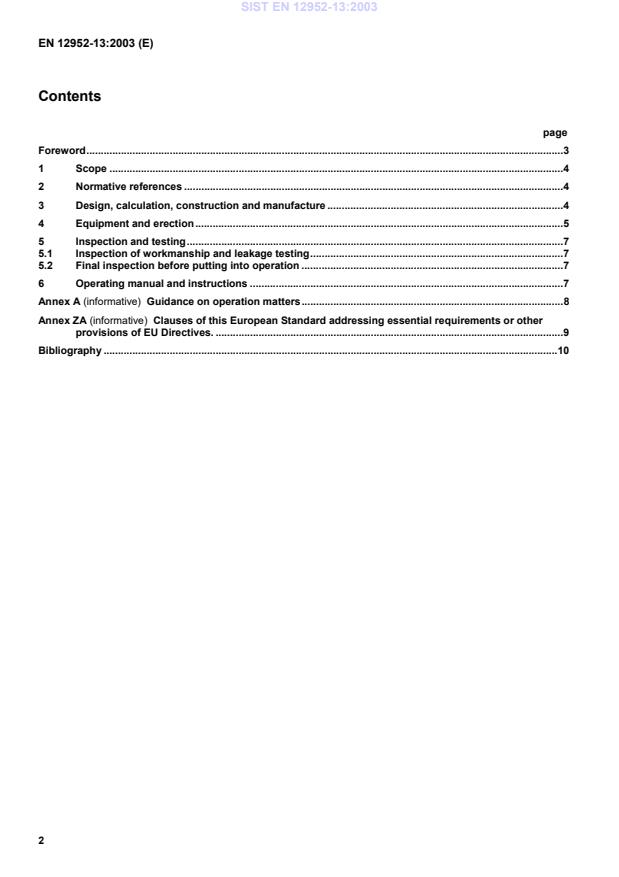
Guidance on operation matters.8Annex ZA (informative)
Clauses of this European Standard addressing essential requirements or otherprovisions of EU Directives.9Bibliography.10SIST EN 12952-13:2003
...