

EN ISO 15614-1:2004
(Main)Specification and qualification of welding procedures for metallic materials - Welding procedure test - Part 1: Arc and gas welding of steels and arc welding of nickel and nickel alloys (ISO 15614-1:2004)
- Abstract
ISO 15614-1:2004 specifies how a preliminary welding procedure specification is qualified by welding procedure tests.
It defines the conditions for the execution of welding procedure tests and the range of qualification for welding procedures for all practical welding operations within a range of variables. Additional tests may be required by application standards.
ISO 15614-1:2004 applies to the arc and gas welding of steels in all product forms and the arc welding of nickel and nickel alloys in all product forms.
Arc and gas welding are covered by the following processes:
manual metal arc welding (metal-arc welding with covered electrode);
self-shielded tubular-cored arc welding;
submerged arc welding;
metal inert gas welding, MIG welding;
metal active gas welding, MAG welding;
tubular-cored metal arc welding with active gas shield;
tubular-cored metal arc welding with inert gas shield;
tungsten inert gas arc welding; TIG welding;
plasma arc welding;
oxy-acetylene welding.
The principles of ISO 15614-1:2004 may be applied to other fusion welding processes.
- Status
- Withdrawn
- Publication Date
- 14-Jun-2004
- Withdrawal Date
- 06-Oct-2026
- Technical Committee
- CEN/TC 121 - Welding
- Drafting Committee
- CEN/TC 121/SC 4 - Quality management in the field of welding
- Current Stage
- 9960 - Withdrawal effective - Withdrawal
- Start Date
- 21-Jun-2017
- Completion Date
- 07-Oct-2026
- Directive
- 2009/105/EC - Simple pressure vesselsOJ Ref: C, C 229 OJ Date: 25-Aug-2010
2014/29/EU - Directive 2014/29/EU of The European Parliament and of the Council of 26 February 2016 on the harmonisation of the laws of the Member States relating to the making available on the market of simple pressure vesselsOJ Ref: C, C 138 OJ Date: 20-Apr-2016
2014/68/EU - Directive 2014/68/EU of the European Parliament and of the Council of 15 May 2014 on the harmonisation of the laws of the Member States relating to the making available on the market of pressure equipmentOJ Ref: C 293/01 OJ Date: 12-Aug-2016
97/23/EC - Pressure equipmentOJ Ref: C, C 118 OJ Date: 15-Apr-2011

Relations
- Effective Date
- 22-Dec-2008
- Effective Date
- 22-Dec-2008
- Effective Date
- 28-Jun-2017
- Effective Date
- 03-Jun-2026
- Effective Date
- 03-Jun-2026
- Effective Date
- 03-Jun-2026
- Refers
ISO 9606-4:1999 - Approval testing of welders — Fusion welding — Part 4: Nickel and nickel alloys - Effective Date
- 03-Jun-2026
- Effective Date
- 03-Jun-2026
- Effective Date
- 03-Jun-2026
- Effective Date
- 03-Jun-2026
- Effective Date
- 03-Jun-2026
- Refers
ISO 4063:1998 - Welding and allied processes — Nomenclature of processes and reference numbers - Effective Date
- 03-Jun-2026
- Effective Date
- 28-Jan-2026
- Effective Date
- 28-Jan-2026
- Effective Date
- 28-Jan-2026
Get Certified
Connect with accredited certification bodies for this standard

DVS-ZERT GmbH
German welding certification society.
CARES (UK Certification Authority for Reinforcing Steels)
UK certification for reinforcing steels and construction.
EWF/IIW (European/International Welding Federation)
International welding personnel certification.
Sponsored listings
Frequently Asked Questions
EN ISO 15614-1:2004 is a standard published by the European Committee for Standardization (CEN). Its full title is "Specification and qualification of welding procedures for metallic materials - Welding procedure test - Part 1: Arc and gas welding of steels and arc welding of nickel and nickel alloys (ISO 15614-1:2004)". This standard covers: ISO 15614-1:2004 specifies how a preliminary welding procedure specification is qualified by welding procedure tests. It defines the conditions for the execution of welding procedure tests and the range of qualification for welding procedures for all practical welding operations within a range of variables. Additional tests may be required by application standards. ISO 15614-1:2004 applies to the arc and gas welding of steels in all product forms and the arc welding of nickel and nickel alloys in all product forms. Arc and gas welding are covered by the following processes: manual metal arc welding (metal-arc welding with covered electrode); self-shielded tubular-cored arc welding; submerged arc welding; metal inert gas welding, MIG welding; metal active gas welding, MAG welding; tubular-cored metal arc welding with active gas shield; tubular-cored metal arc welding with inert gas shield; tungsten inert gas arc welding; TIG welding; plasma arc welding; oxy-acetylene welding. The principles of ISO 15614-1:2004 may be applied to other fusion welding processes.
ISO 15614-1:2004 specifies how a preliminary welding procedure specification is qualified by welding procedure tests. It defines the conditions for the execution of welding procedure tests and the range of qualification for welding procedures for all practical welding operations within a range of variables. Additional tests may be required by application standards. ISO 15614-1:2004 applies to the arc and gas welding of steels in all product forms and the arc welding of nickel and nickel alloys in all product forms. Arc and gas welding are covered by the following processes: manual metal arc welding (metal-arc welding with covered electrode); self-shielded tubular-cored arc welding; submerged arc welding; metal inert gas welding, MIG welding; metal active gas welding, MAG welding; tubular-cored metal arc welding with active gas shield; tubular-cored metal arc welding with inert gas shield; tungsten inert gas arc welding; TIG welding; plasma arc welding; oxy-acetylene welding. The principles of ISO 15614-1:2004 may be applied to other fusion welding processes.
EN ISO 15614-1:2004 is classified under the following ICS (International Classification for Standards) categories: 25.160.10 - Welding processes. The ICS classification helps identify the subject area and facilitates finding related standards.
EN ISO 15614-1:2004 has the following relationships with other standards: It is inter standard links to EN 288-3:1992/A1:1997, EN 288-3:1992, EN ISO 15614-1:2017, ISO 15607:2003, ISO/TR 15608:2005, ISO 5817:2003, ISO 9606-4:1999, ISO 9606-1:1994, ISO 15609-1:2004, ISO 14175:1997, ISO 6947:1990, ISO 4063:1998, EN ISO 9016:2022, EN ISO 15609-2:2001, EN ISO 14732:2025. Understanding these relationships helps ensure you are using the most current and applicable version of the standard.
EN ISO 15614-1:2004 is associated with the following European legislation: EU Directives/Regulations: 2009/105/EC, 2009/105//EC, 2014/29/EU, 2014/68/EU, 87/404/EEC, 97/23/EC; Standardization Mandates: M/071, M/BC/CEN/89/2. When a standard is cited in the Official Journal of the European Union, products manufactured in conformity with it benefit from a presumption of conformity with the essential requirements of the corresponding EU directive or regulation.
EN ISO 15614-1:2004 is available in PDF format for immediate download after purchase. The document can be added to your cart and obtained through the secure checkout process. Digital delivery ensures instant access to the complete standard document.
Standards Content (Sample)
2003-01.Slovenski inštitut za standardizacijo. Razmnoževanje celote ali delov tega standarda ni dovoljeno.Anforderung und Qualifizierung von Schweißverfahren für metallische Werkstoffe - Schweißverfahrensprüfung - Teil 1: Lichtbogen- und Gasschweißen von Stählen und Lichtbogenschweißen von Nickel und Nickellegierungen (ISO 15614-1:2004)Descriptif et qualification d'un mode opératoire de soudage pour les matériaux métalliques - Epreuve de qualification d'un mode opératoire de soudage - Partie 1: Soudage a l'arc et aux gaz des aciers et soudage a l'arc des nickels et alliages de nickel (ISO 15614-1:2004)Specification and qualification of welding procedures for metallic materials - Welding procedure test - Part 1: Arc and gas welding of steels and arc welding of nickel and nickel alloys (ISO 15614-1:2004)77.120.40Nikelj, krom in njune zlitineNickel, chromium and their alloys77.080.20JeklaSteels25.160.10Varilni postopki in varjenjeWelding processesICS:Ta slovenski standard je istoveten z:EN ISO 15614-1:2004SIST EN ISO 15614-1:2004en01-september-2004SIST EN ISO 15614-1:2004SLOVENSKI
STANDARDSIST EN 288-3:1996/A1:1999SIST EN 288-3:19961DGRPHãþD
EUROPEAN STANDARDNORME EUROPÉENNEEUROPÄISCHE NORMEN ISO 15614-1June 2004ICS 25.160.10English versionSpecification and qualification of welding procedures for metallicmaterials - Welding procedure test - Part 1: Arc and gas weldingof steels and arc welding of nickel and nickel alloys (ISO 15614-1:2004)Descriptif et qualification d'un mode opératoire de soudagepour les matériaux métalliques - Epreuve de qualificationd'un mode opératoire de soudage - Partie 1: Soudage àl'arc et aux gaz des aciers et soudage à l'arc des nickels etalliages de nickel (ISO 15614-1:2004)Anforderung und Qualifizierung von Schweißverfahren fürmetallische Werkstoffe - Schweißverfahrensprüfung - Teil1: Lichtbogen- und Gasschweißen von Stählen undLichtbogenschweißen von Nickel und Nickellegierungen(ISO 15614-1:2004)This European Standard was approved by CEN on 7 May 2003.CEN members are bound to comply with the CEN/CENELEC Internal Regulations which stipulate the conditions for giving this EuropeanStandard the status of a national standard without any alteration. Up-to-date lists and bibliographical references concerning such nationalstandards may be obtained on application to the Central Secretariat or to any CEN member.This European Standard exists in three official versions (English, French, German). A version in any other language made by translationunder the responsibility of a CEN member into its own language and notified to the Central Secretariat has the same status as the officialversions.CEN members are the national standards bodies of Austria, Belgium, Cyprus, Czech Republic, Denmark, Estonia, Finland, France,Germany, Greece, Hungary, Iceland, Ireland, Italy, Latvia, Lithuania, Luxembourg, Malta, Netherlands, Norway, Poland, Portugal, Slovakia,Slovenia, Spain, Sweden, Switzerland and United Kingdom.EUROPEAN COMMITTEE FOR STANDARDIZATIONCOMITÉ EUROPÉEN DE NORMALISATIONEUROPÄISCHES KOMITEE FÜR NORMUNGManagement Centre: rue de Stassart, 36
B-1050 Brussels© 2004 CENAll rights of exploitation in any form and by any means reservedworldwide for CEN national Members.Ref. No. EN ISO 15614-1:2004: ESIST EN ISO 15614-1:2004
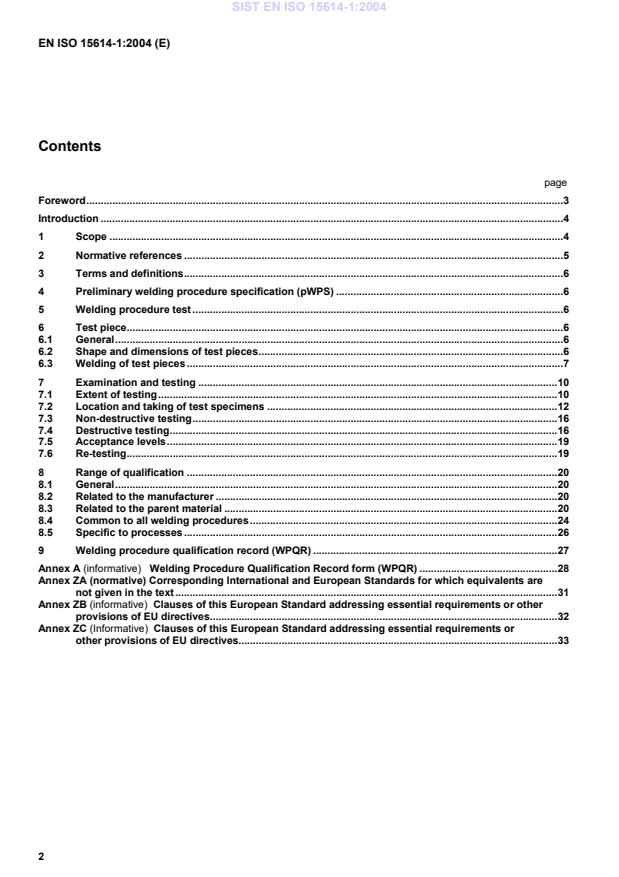
Welding Procedure Qualification Record form (WPQR).28Annex ZA (normative) Corresponding International and European Standards for which equivalents arenot given in the text.31Annex ZB (informative)
Clauses of this European Standard addressing essential requirements or otherprovisions of EU directives.32Annex ZC (Informative)
Clauses of this European Standard addressing essential requirements orother provisions of EU directives.33SIST EN ISO 15614-1:2004
Minimum value 150 mmb
Minimum value 350 mmt
Material thicknessFigure 1 — Test piece for a butt joint in plate with full penetrationSIST EN ISO 15614-1:2004
Minimum value 150 mmD
Outside pipe diametert
Material thicknessFigure 2 — Test piece for a butt joint in pipe with full penetrationKey1Joint preparation and fit-up as detailed in the preliminary Welding Procedure Specification (pWPS)aMinimum value 150 mmbMinimum value 350 mmtMaterial thicknessFigure 3 — Test piece for a T- jointSIST EN ISO 15614-1:2004
thick and having specified impact properties.Application standards may require impact testing below 12 mm thick. The testing temperature shall be chosen by themanufacturer with regard to the application or application standard but need not be lower than the parent metalspecification. For additional tests see 7.4.5.eNot required for parent metals: -sub-group 1.1, and groups 8, 41 to 48.fTests as detailed do not provide information on the mechanical properties of the joint. Where these properties arerelevant to the application an additional qualification shall also be held e.g. a butt weld qualification.gFor outside diameter £ 50 mm no ultrasonic test is required.For outside diameter > 50 mm and where it is not technically possible to carry out ultrasonic examination, aradiographic examination shall be carried out provided that the joint configuration will allow meaningful results.7.2 Location and taking of test specimensTest specimens shall be taken in accordance with Figures, 5, 6, 7 and 8.Test specimens shall be taken after all non-destructive testing (NDT) has been carried out and which has passedthe relevant inspection criteria for the NDT method(s) used.It is acceptable to take the test specimens from locations avoiding areas which have imperfections within theacceptance limits for the NDT method(s) used.SIST EN ISO 15614-1:2004
...