


EN 288-3:1992
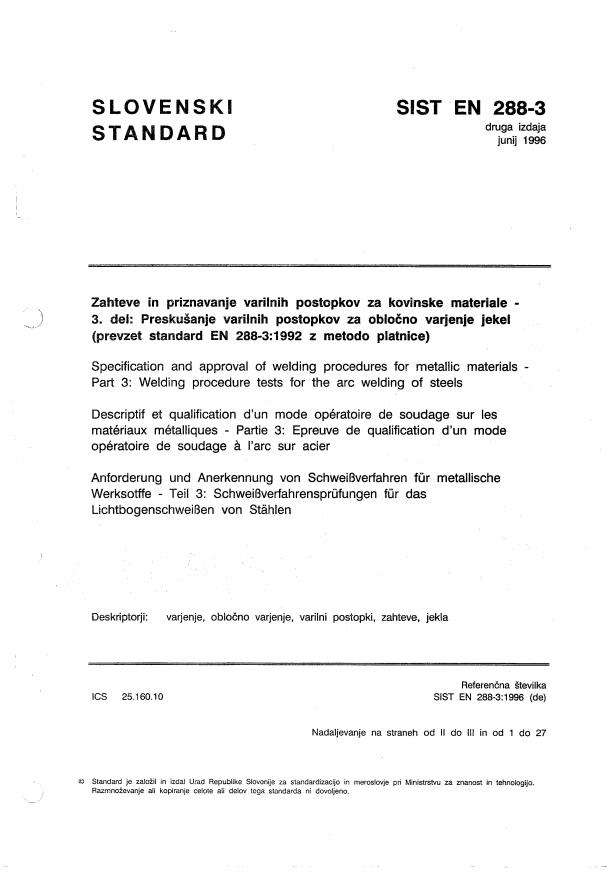
(Main)Specification and approval of welding procedures for metallic materials - Part 3: Welding procedure tests for the arc welding of steels
Specification and approval of welding procedures for metallic materials - Part 3: Welding procedure tests for the arc welding of steels
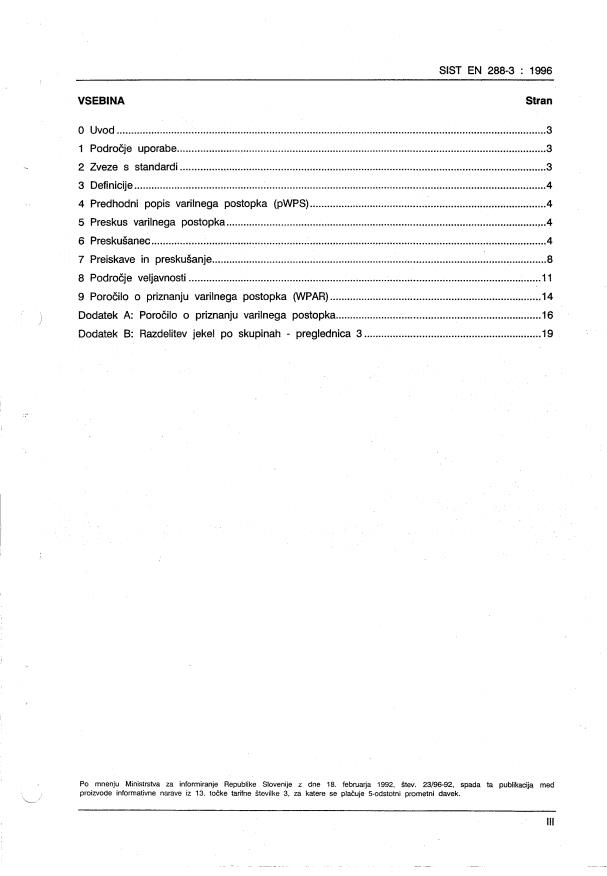
This standard specifies how a welding procedure specification is approved by welding procedure tests. It defines the conditions for the execution of welding procedure approval tests and the limits of validity of an approved welding procedure for all practical welding operations within the range of variables listed in clause 8. Tests shall be carried out in accordance with this standard unless more severe tests are specified by the relevant application standard or contract when these shall apply. This standard applies to the arc welding of steels. The principles of this standard may be applied to other fusion welding processes subject to agreement between the contracting parties. Note: Specific service, material or manufacturing conditions may require more comprehensive testing than is specified by this standard in order to gain more information and to avoid repeating the welding procedure test at a later date just to obtain additional test data. Such tests may include: - longitudinal weld tensile test; - all weld metal bend test; - Charpy V-notch impact test; - yield strength or 0,2 % proof stress; - elongation; - chemical analysis; - micro examination; - delta ferrite determination in austenitic stainless steels. Arc welding is covered by the following processes in accordance with EN 24063: 111 - metal-arc welding with covered electrode; 114 - flux-cored wire metal-arc welding without gas shield; 121 - submerged arc welding with wire electrode;1) 122 - submerged arc welding with strip electrode;1) 131 - metal-arc inert gas welding (MIG welding); 135 - metal-arc active gas welding (MAG welding); 136 - flux-cored wire metal-arc welding with active gas shield; 141 - tungsten inert gas arc welding (TIG welding); 15 - plasma arc welding; other fusion welding processes by agreement e.g. metal cored wire arc welding. 1. As modified by Amendment A1 :1997
Anforderung und Anerkennung von Schweißverfahren für metallische Werkstoffe - Teil 3: Schweißverfahrensprüfungen für das Lichtbogenschweißen von Stählen
Diese Norm legt fest, wie eine Schweissanweisung durch eine Schweissverfahrensprüfung anerkannt wird. Sie erklärt die Bedingungen für die Durchführung der Schweissverfahrensprüfung und die Grenzen der Gültigkeit eines anerkannten Schweissverfahrens für alle praktischen schweisstechnischen Tätigkeiten innerhalb des Bereiches der Einflussgrössen nach Abschnitt 8. Die Prüfungen sind nach dieser Norm durchzuführen, es sei denn, dass durch die entsprechende Anwendungsnorm oder durch den Vertrag schärfere Prüfungen festgelegt werden und diese anzuwenden sind.
Descriptif et qualification d'un mode opératoire de soudage pour les matériaux métalliques - Partie 3: Epreuve de qualification d'un mode opératoire de soudage à l'arc sur acier
La présente norme spécifie comment un descriptif de mode de soudage est qualifié par epreuve. Elle définit les conditions d'exécution des épreuves de qualification et les limites de validité d'un mode opératoire qualifié, pour toutes les opérations pratiques de soudage englobant la liste des variables mentionnées au paragraphe 8. Les épreuves de qualification sont réalisés conformément à la présente norme, sauf si une norme d'application ou un contrat prescrit des essais plus sévères au regard de leur domaine d'application.
Popis in odobritev varilnih postopkov za kovinske materiale - 3. del: Preskusi varilnih postopkov za obločno varjenje jekel
General Information
- Status
- Withdrawn
- Publication Date
- 25-Feb-1992
- Withdrawal Date
- 14-Jun-2004
- Technical Committee
- CEN/TC 121 - Welding
- Current Stage
- 9960 - Withdrawal effective - Withdrawal
- Start Date
- 15-Jun-2004
- Completion Date
- 15-Jun-2004
- Directive
- 87/404/EEC - Simple pressure vessels
- Directive
- 97/23/EC - Pressure equipment
Relations
- Effective Date
- 22-Dec-2008
- Effective Date
- 28-Jan-2026
- Effective Date
- 28-Jan-2026
- Effective Date
- 28-Jan-2026
- Effective Date
- 28-Jan-2026
- Effective Date
- 28-Jan-2026
- Effective Date
- 28-Jan-2026
- Effective Date
- 28-Jan-2026
- Effective Date
- 28-Jan-2026
- Effective Date
- 28-Jan-2026
- Referred By
EN ISO 21049:2004 - Pumps - Shaft sealing systems for centrifugal and rotary pumps (ISO 21049:2004) - Effective Date
- 28-Jan-2026
- Effective Date
- 22-Dec-2008

EN 288-3:1996
Get Certified
Connect with accredited certification bodies for this standard

National Aerospace and Defense Contractors Accreditation Program (NADCAP)
Global cooperative program for special process quality in aerospace.
CARES (UK Certification Authority for Reinforcing Steels)
UK certification for reinforcing steels and construction.
DVS-ZERT GmbH
German welding certification society.
Sponsored listings
Frequently Asked Questions
EN 288-3:1992 is a standard + national annex and/or foreword published by the European Committee for Standardization (CEN). Its full title is "Specification and approval of welding procedures for metallic materials - Part 3: Welding procedure tests for the arc welding of steels". This standard covers: This standard specifies how a welding procedure specification is approved by welding procedure tests. It defines the conditions for the execution of welding procedure approval tests and the limits of validity of an approved welding procedure for all practical welding operations within the range of variables listed in clause 8. Tests shall be carried out in accordance with this standard unless more severe tests are specified by the relevant application standard or contract when these shall apply. This standard applies to the arc welding of steels. The principles of this standard may be applied to other fusion welding processes subject to agreement between the contracting parties. Note: Specific service, material or manufacturing conditions may require more comprehensive testing than is specified by this standard in order to gain more information and to avoid repeating the welding procedure test at a later date just to obtain additional test data. Such tests may include: - longitudinal weld tensile test; - all weld metal bend test; - Charpy V-notch impact test; - yield strength or 0,2 % proof stress; - elongation; - chemical analysis; - micro examination; - delta ferrite determination in austenitic stainless steels. Arc welding is covered by the following processes in accordance with EN 24063: 111 - metal-arc welding with covered electrode; 114 - flux-cored wire metal-arc welding without gas shield; 121 - submerged arc welding with wire electrode;1) 122 - submerged arc welding with strip electrode;1) 131 - metal-arc inert gas welding (MIG welding); 135 - metal-arc active gas welding (MAG welding); 136 - flux-cored wire metal-arc welding with active gas shield; 141 - tungsten inert gas arc welding (TIG welding); 15 - plasma arc welding; other fusion welding processes by agreement e.g. metal cored wire arc welding. 1. As modified by Amendment A1 :1997
This standard specifies how a welding procedure specification is approved by welding procedure tests. It defines the conditions for the execution of welding procedure approval tests and the limits of validity of an approved welding procedure for all practical welding operations within the range of variables listed in clause 8. Tests shall be carried out in accordance with this standard unless more severe tests are specified by the relevant application standard or contract when these shall apply. This standard applies to the arc welding of steels. The principles of this standard may be applied to other fusion welding processes subject to agreement between the contracting parties. Note: Specific service, material or manufacturing conditions may require more comprehensive testing than is specified by this standard in order to gain more information and to avoid repeating the welding procedure test at a later date just to obtain additional test data. Such tests may include: - longitudinal weld tensile test; - all weld metal bend test; - Charpy V-notch impact test; - yield strength or 0,2 % proof stress; - elongation; - chemical analysis; - micro examination; - delta ferrite determination in austenitic stainless steels. Arc welding is covered by the following processes in accordance with EN 24063: 111 - metal-arc welding with covered electrode; 114 - flux-cored wire metal-arc welding without gas shield; 121 - submerged arc welding with wire electrode;1) 122 - submerged arc welding with strip electrode;1) 131 - metal-arc inert gas welding (MIG welding); 135 - metal-arc active gas welding (MAG welding); 136 - flux-cored wire metal-arc welding with active gas shield; 141 - tungsten inert gas arc welding (TIG welding); 15 - plasma arc welding; other fusion welding processes by agreement e.g. metal cored wire arc welding. 1. As modified by Amendment A1 :1997
EN 288-3:1992 is classified under the following ICS (International Classification for Standards) categories: 25.160.10 - Welding processes. The ICS classification helps identify the subject area and facilitates finding related standards.
EN 288-3:1992 has the following relationships with other standards: It is inter standard links to EN ISO 15614-1:2004, EN ISO 13710:2004, EN 13530-2:2002, EN 13458-2:2002, EN 1252-2:2001, EN 13814:2004, EN 12953-5:2002, EN 14197-2:2003, EN 1993-1-8:2005, EN 12063:1999, EN ISO 21049:2004, EN 288-3:1992/A1:1997. Understanding these relationships helps ensure you are using the most current and applicable version of the standard.
EN 288-3:1992 is associated with the following European legislation: EU Directives/Regulations: 87/404/EEC, 97/23/EC; Standardization Mandates: M/071, M/BC/CEN/89/2. When a standard is cited in the Official Journal of the European Union, products manufactured in conformity with it benefit from a presumption of conformity with the essential requirements of the corresponding EU directive or regulation.
EN 288-3:1992 is available in PDF format for immediate download after purchase. The document can be added to your cart and obtained through the secure checkout process. Digital delivery ensures instant access to the complete standard document.
Questions, Comments and Discussion
Ask us and Technical Secretary will try to provide an answer. You can facilitate discussion about the standard in here.
Loading comments...