

EN 12182:2012
(Main)Assistive products for persons with disability - General requirements and test methods
- Abstract
This European Standard specifies general requirements and test methods for assistive products for persons with a disability, which are medical devices according to the definition laid down in the EU Directive 93/42/EEC.
This European Standard does not apply to assistive products which achieve their intended purpose by administering pharmaceutical substances to the user.
Where other European Standards exist for particular types of assistive products then those standards apply. However, some of the requirements of this standard may still apply and may be considered in addition to those in other European standards.
NOTE Not all the items listed in EN ISO 9999 are medical devices. Contracting parties may wish to consider if this standard or parts of this standard can be used for assistive products which are not medical devices as defined in the EU Directive 93/42/EEC.
- Status
- Withdrawn
- Publication Date
- 08-May-2012
- Withdrawal Date
- 06-Oct-2026
- Technical Committee
- CEN/TC 293 - Technical aids for disabled persons
- Drafting Committee
- CEN/TC 293/WG 10 - Revision of EN 12182
- Current Stage
- 9960 - Withdrawal effective - Withdrawal
- Start Date
- 20-Jul-2022
- Completion Date
- 07-Oct-2026

Relations
- Effective Date
- 16-May-2012
- Replaced By
EN ISO 21856:2022 - Assistive products - General requirements and test methods (ISO 21856:2022) - Effective Date
- 30-May-2018
- Effective Date
- 01-Jul-2026
- Effective Date
- 29-Apr-2026
- Effective Date
- 09-Feb-2026
- Effective Date
- 09-Feb-2026
- Effective Date
- 09-Feb-2026
- Effective Date
- 09-Feb-2026
- Effective Date
- 09-Feb-2026
- Effective Date
- 09-Feb-2026
- Effective Date
- 09-Feb-2026
- Effective Date
- 09-Feb-2026
- Effective Date
- 09-Feb-2026
- Effective Date
- 09-Feb-2026
- Effective Date
- 09-Feb-2026
Get Certified
Connect with accredited certification bodies for this standard

BSI Group
BSI (British Standards Institution) is the business standards company that helps organizations make excellence a habit.

TÜV Rheinland
TÜV Rheinland is a leading international provider of technical services.

TÜV SÜD
TÜV SÜD is a trusted partner of choice for safety, security and sustainability solutions.
Sponsored listings
Frequently Asked Questions
EN 12182:2012 is a standard published by the European Committee for Standardization (CEN). Its full title is "Assistive products for persons with disability - General requirements and test methods". This standard covers: This European Standard specifies general requirements and test methods for assistive products for persons with a disability, which are medical devices according to the definition laid down in the EU Directive 93/42/EEC. This European Standard does not apply to assistive products which achieve their intended purpose by administering pharmaceutical substances to the user. Where other European Standards exist for particular types of assistive products then those standards apply. However, some of the requirements of this standard may still apply and may be considered in addition to those in other European standards. NOTE Not all the items listed in EN ISO 9999 are medical devices. Contracting parties may wish to consider if this standard or parts of this standard can be used for assistive products which are not medical devices as defined in the EU Directive 93/42/EEC.
This European Standard specifies general requirements and test methods for assistive products for persons with a disability, which are medical devices according to the definition laid down in the EU Directive 93/42/EEC. This European Standard does not apply to assistive products which achieve their intended purpose by administering pharmaceutical substances to the user. Where other European Standards exist for particular types of assistive products then those standards apply. However, some of the requirements of this standard may still apply and may be considered in addition to those in other European standards. NOTE Not all the items listed in EN ISO 9999 are medical devices. Contracting parties may wish to consider if this standard or parts of this standard can be used for assistive products which are not medical devices as defined in the EU Directive 93/42/EEC.
EN 12182:2012 is classified under the following ICS (International Classification for Standards) categories: 11.180.01 - Aids for disabled and handicapped persons in general. The ICS classification helps identify the subject area and facilitates finding related standards.
EN 12182:2012 has the following relationships with other standards: It is inter standard links to EN 12182:1999, EN ISO 21856:2022, EN ISO 11137-1:2026, EN ISO 14155:2026, EN IEC 62368-1:2024, ISO 8986-1:1993, ISO 24415-2:2011, EN 60601-1-2:2007, EN 60529:1991, EN 61000-4-8:2010, EN 62304:2006, EN IEC 61000-3-2:2019, CISPR 11:2009, EN IEC 60601-2-35:2021, EN 60601-1:2006. Understanding these relationships helps ensure you are using the most current and applicable version of the standard.
EN 12182:2012 is associated with the following European legislation: EU Directives/Regulations: 2007/47/EC, 93/42/EEC; Standardization Mandates: M/295. When a standard is cited in the Official Journal of the European Union, products manufactured in conformity with it benefit from a presumption of conformity with the essential requirements of the corresponding EU directive or regulation.
EN 12182:2012 is available in PDF format for immediate download after purchase. The document can be added to your cart and obtained through the secure checkout process. Digital delivery ensures instant access to the complete standard document.
Standards Content (Sample)
2003-01.Slovenski inštitut za standardizacijo. Razmnoževanje celote ali delov tega standarda ni dovoljeno.Technische Hilfen für behinderte Menschen - Allgemeine Anforderungen und PrüfverfahrenProduits d'assistance pour personnes en situation de handicap - Exigences générales et méthodes d'essaiAssistive products for persons with disability - General requirements and test methods11.180.01VSORãQRAids for disabled and handicapped persons in generalICS:Ta slovenski standard je istoveten z:EN 12182:2012SIST EN 12182:2012en,fr,de01-september-2012SIST EN 12182:2012SLOVENSKI
STANDARDSIST EN 12182:20001DGRPHãþD
EUROPEAN STANDARD NORME EUROPÉENNE EUROPÄISCHE NORM
EN 12182
May 2012 ICS 11.180.01 Supersedes EN 12182:1999English Version
Assistive products for persons with disability - General requirements and test methods
Produits d'assistance pour personnes en situation de handicap - Exigences générales et méthodes d'essai
Technische Hilfen für behinderte Menschen - Allgemeine Anforderungen und Prüfverfahren This European Standard was approved by CEN on 9 March 2012.
CEN members are bound to comply with the CEN/CENELEC Internal Regulations which stipulate the conditions for giving this European Standard the status of a national standard without any alteration. Up-to-date lists and bibliographical references concerning such national standards may be obtained on application to the CEN-CENELEC Management Centre or to any CEN member.
This European Standard exists in three official versions (English, French, German). A version in any other language made by translation under the responsibility of a CEN member into its own language and notified to the CEN-CENELEC Management Centre has the same status as the official versions.
CEN members are the national standards bodies of Austria, Belgium, Bulgaria, Croatia, Cyprus, Czech Republic, Denmark, Estonia, Finland, France, Germany, Greece, Hungary, Iceland, Ireland, Italy, Latvia, Lithuania, Luxembourg, Malta, Netherlands, Norway, Poland, Portugal, Romania, Slovakia, Slovenia, Spain, Sweden, Switzerland, Turkey and United Kingdom.
EUROPEAN COMMITTEE FOR STANDARDIZATION
COMITÉ EUROPÉEN DE NORMALISATION EUROPÄISCHES KOMITEE FÜR NORMUNG
Management Centre:
Avenue Marnix 17,
B-1000 Brussels © 2012 CEN All rights of exploitation in any form and by any means reserved worldwide for CEN national Members. Ref. No. EN 12182:2012: ESIST EN 12182:2012
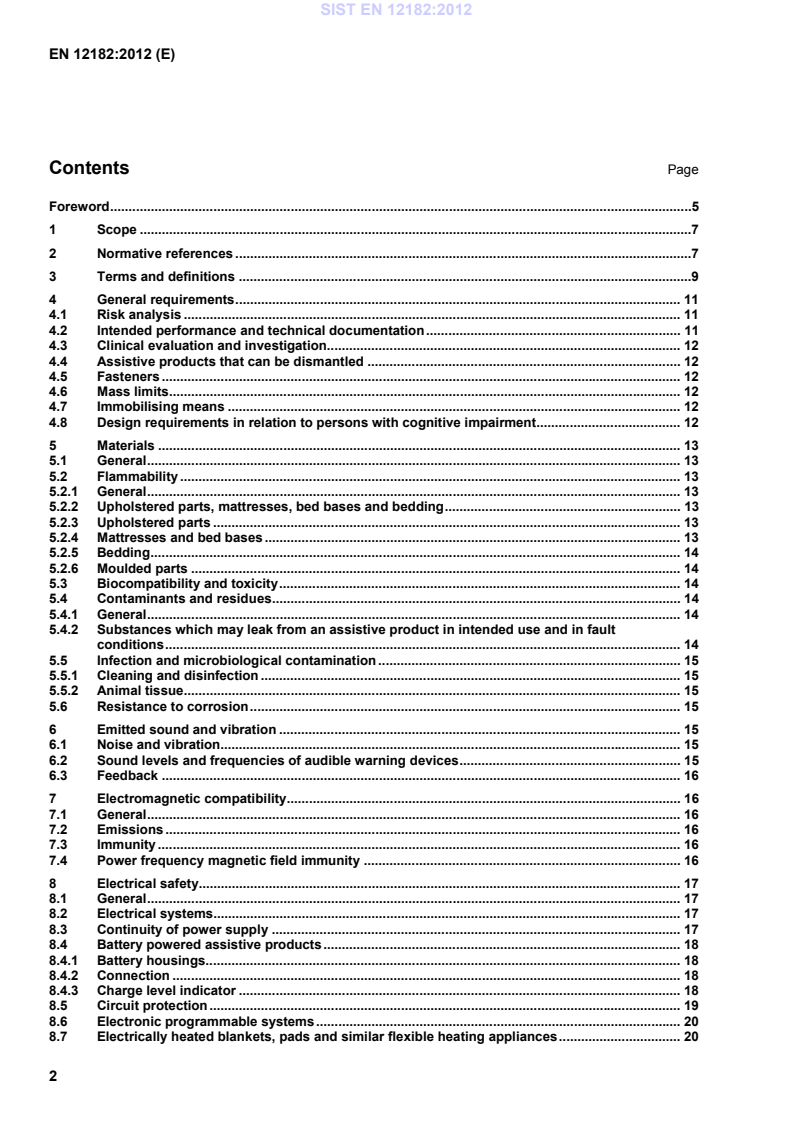
European standards for assistive products for persons with a disability produced or currently being developed by CEN/TC 293 . 34Annex B (informative)
General recommendations . 36Annex C (informative)
Cognitive impairment . 43Annex D (informative)
Environmental and consumer related requirements. 50Annex ZA (informative)
Relationship between this European Standard and the Essential Requirements of EU Directive 93/42/EEC on Medical Devices . 56Bibliography . 61 SIST EN 12182:2012
There are three levels of European Standards dealing with assistive products for persons with a disability. These are as follows, with Level 1 being the highest:
Level 1: General requirements for assistive products; Level 2: Particular requirements for families of assistive products; Level 3: Specific requirements for types of assistive products. Levels 2 and 3 may be combined into one single document.
All European Standards produced or currently being developed by CEN/TC 293 are listed in Annex A.
This standard is a Level 1 standard and contains requirements and recommendations which are generally applicable to assistive products for persons with a disability. For certain types of assistive products, these requirements are to be supplemented, modified or replaced by the special requirements of a standard for a particular assistive product (Level 2 or 3).
The Level 2 standards apply to a more restricted set or family of assistive products such as assistive products for walking. The Level 3 standards apply to specific types of assistive products, e.g. elbow crutches and urine collection bags.
Where standards for particular assistive products or groups of assistive products exist (Level 2 or 3), this general standard should not be used alone. The requirements of lower level standards take precedence over higher level standards. Therefore, to address all requirements for a particular assistive product, it is necessary to start with standards of the lowest available level.
European and International Standards for other assistive products for persons with a disability are being or may be developed by other technical committees within CEN/CENELEC, ISO/IEC (e.g. assistive products for hearing) and other organisations. For such assistive products, this Level 1 standard is only applicable if explicitly cited as a normative reference in the particular standard, although it may be used for general guidance within the field of assistive products for persons with a disability.
According to the CEN/CENELEC Internal Regulations, the national standards organizations of the following countries are bound to implement this European Standard: Austria, Belgium, Bulgaria, Croatia, Cyprus, Czech Republic, Denmark, Estonia, Finland, France, Germany, Greece, Hungary, Iceland, Ireland, Italy, Latvia, Lithuania, Luxembourg, Malta, Netherlands, Norway, Poland, Portugal, Romania, Slovakia, Slovenia, Spain, Sweden, Switzerland, Turkey and the United Kingdom. SIST EN 12182:2012
This European Standard specifies general requirements and test methods for assistive products for persons with a disability, which are medical devices according to the definition laid down in the EU Directive 93/42/EEC. This European Standard does not apply to assistive products which achieve their intended purpose by administering pharmaceutical substances to the user. Where other European Standards exist for particular types of assistive products then those standards apply. However, some of the requirements of this standard may still apply and may be considered in addition to those in other European standards.
NOTE Not all the items listed in EN ISO 9999 are medical devices. Contracting parties may wish to consider if this standard or parts of this standard can be used for assistive products which are not medical devices as defined in the EU Directive 93/42/EEC. 2 Normative references The following documents, in whole or in part, are normatively referenced in this document and are indispensable for its application. For dated references, only the edition cited applies. For undated references, the latest edition of the referenced document (including any amendments) applies. EN 556-1, Sterilization of medical devices Requirements for medical devices to be designated "STERILE" Part 1: Requirements for terminally sterilized medical devices EN 597-1, Furniture Assessment of the ignitability of mattresses and upholstered bed bases Part 1: Ignition source: Smouldering cigarette EN 597-2, Furniture Assessment of the ignitability of mattresses and upholstered bed bases Part 2: Ignition source: Match flame equivalent EN 614-1, Safety of machinery Ergonomic design principles Part 1: Terminology and general principles EN 980, Symbols for use in the labelling of medical devices EN 1021-1, Furniture Assessment of the ignitability of upholstered furniture Part 1: Ignition source smouldering cigarette EN 1021-2, Furniture Assessment of the ignitability of upholstered furniture Part 2: Ignition source match flame equivalent EN 1041, Information supplied by the manufacturer of medical devices EN ISO 25424, Sterilization of medical devices - Low temperature steam and formaldehyde - Requirements for development, validation and routine control of a sterilization process for medical devices (ISO 25424) EN 60065, Audio, video and similar electronic apparatus Safety requirements (IEC 60065) EN 60335-1, Household and similar electrical appliances Safety Part 1: General requirements (IEC 60335-1) EN 60529, Degrees of protection provided by enclosures (IP Code) (IEC 60529) EN 60601-1:2006, Medical electrical equipment Part 1: General requirements for basic safety and essential performance (IEC 60601-1:2005) SIST EN 12182:2012
umbrella term for impairments, activity limitations and participation restrictions denoting the negative aspects of the interaction between an individual (with a health condition) and that individual's contextual factors (environmental and personal factors) [SOURCE: ICF 2001, WHO] 3.9 hand held assistive products equipment intended to be supported by the hand during normal use 3.10 impairments problems in body function or structure, such as a significant deviation or loss [SOURCE: ICF 2001, WHO] 3.11 intended use use of a product, process or service in accordance with the specifications, instructions and information provided by the manufacturer Note 1 to entry: This information includes pre-sale information. 3.12 maximum rated load greatest permissible load as specified by the manufacturer Note 1 to entry: Includes user mass and the mass and loading of the accessories (mattresses, baskets, etc.). 3.13 medical electrical system combination, as specified by its manufacturer, of items of equipment, at least one of which is a medical equipment to be inter-connected by functional connection or by use of a multiple socket-outlet 3.14 mobile assistive products equipment intended to be moved from one location to another while supported by its own wheels or equivalent means 3.15 normal use operation. including routine inspection and adjustments by any operator, and stand-by, according to the instructions for use
Note 1 to entry: The operator can either be the user or the assistant. 3.17 person with a disability person with one or more impairments, one or more activity limitations, one or more participation restrictions or a combination thereof [SOURCE: ICF 2001, WHO] 3.18 portable assistive products equipment intended to be moved from one location to another while being carried by one or more persons 3.19 single fault condition
condition in which a single means for reducing a risk is defective or a single abnormal condition is present 3.20 technical documentation manufacturer’s data that shows that an assistive product conforms to the requirements of this standard and which may be used as part of the technical documentation required by EU Directive 93/42/EEC for conformity assessment procedures 3.21 user person with a disability for whom the assistive product is intended 4 General requirements 4.1 Risk analysis The safety of an assistive product shall be assessed by identifying hazards and estimating the risks associated with them using the procedures specified in EN ISO 14971. When using an assistive product in combination with a device that is not a medical device the device shall behave in a safe way regarding the MDD as a system. NOTE 1 In the case of certain disabilities there may be a need for higher levels of safety for equipment used to offset the effects of that disability. NOTE 2 Conformity with the requirements of this standard may be used to claim compliance with the requirements of EN ISO 14971 for those hazards and risks identified in this standard. 4.2 Intended performance and technical documentation a) An assistive product shall have sufficient strength and durability to sustain all loads expected during its intended use. This shall be confirmed by using, as appropriate, references to relevant clinical and scientific literature in addition to requirements in this standard, strength and/or durability calculations, appropriate test standards and their test results.
4.5 Fasteners If it is intended that an assistive product can be dismantled for storage or transportation, the fasteners which are loosened or removed to allow this dismantling shall not be single use fasteners. EXAMPLE Single use fasteners include wood screws and self-tapping screws. 4.6 Mass limits The user mass limit and maximum rated load shall be declared by the manufacturer.
4.7 Immobilising means If the movement of an assistive product or of any of its parts constitutes a risk for the user or a nearby person, there shall be immobilising means that provide control of the speed and/or prevent any undesired movement. 4.8 Design requirements in relation to persons with cognitive impairment a) Persons with cognitive impairment shall be considered potential users of all assistive products. b) Cognitive impairment aspects shall, as far as possible, be considered in the design, performance and use of all assistive products. c) The result of such considerations shall be described in the producer´s technical documentation. d) An assistive product may be used not only by whom it is primarily intended, but also by an assistant. Risk management shall include all involved persons.
NOTE Cognition is the understanding, integrating and processing of information. Cognition involves fundamental mental characteristics such as the capacity to learn, remember, understand, solve problems, plan, keep focused, etc. Cognitive impairment may reduce, more or less, the possibilites to learn how to operate a product, to understand warnings, etc. This increases the risk that persons with cognitive impairment will find themselves in hazardous situations. Cognitive impairment also involves a large and growing number of the population of Europe and other parts of the industrialized world. For further guidance, see Annex C.
For guidance, see EN 60601-1-9. 5.2 Flammability 5.2.1 General Manufacturers shall consider the environments and methods of use to which an assistive product or any materials that are usually used in combination with this assistive product, will be exposed and take appropriate steps to minimize any fire hazard. The manufacturer shall include a warning in the instructions for use about safe combinations of flame resistant and non flame resistant materials. NOTE 1 If flammable materials are used it needs to be indicated in the documentation. Every effort should be made to use products which meet the flammability requirements as it is of particular importance to persons with a disability who may not be able to escape from a fire. The use of non-flame retardant materials should be reviewed regularly, as there is continuous development in this field. Special attention shall be paid to assistive products where the main purpose is protection from fire.
NOTE 2 For guidance, see B.5.2. 5.2.2 Upholstered parts, mattresses, bed bases and bedding Upholstered parts, mattresses and bed bases and bedding shall comply with the requirements of 5.2.2 a) or 5.2.2 b). a) If the manufacturer claims that an assistive product is resistant to ignition by a cigarette or a small flame it shall comply with the appropriate requirements in 5.2.3, 5.2.4 or 5.2.5; b) if the clinical requirements prevent the use of materials which comply with 5.2.2 a), the reasons shall be included in the technical documentation and the assistive product shall be supplied with the following: 1) warning that it is not flame retardant, placed on the product if possible, and included in the instructions for use; and 2) a description of the precautions required to offset the increased risk. 5.2.3 Upholstered parts If the manufacturer claims that the upholstered parts are resistant to ignition by a cigarette or a small flame, progressive smouldering ignition and flaming ignition shall not occur when the materials used for the upholstered parts of an assistive product are tested in accordance with EN 1021-1 and EN 1021-2. 5.2.4 Mattresses and bed bases If the manufacturer claims that mattresses and/or bed bases are resistant to ignition by a cigarette or a small flame, progressive smouldering ignition and flaming ignition shall not occur when tested in accordance with EN 597-1 and EN 597-2.
If the manufacturer claims that a plastic moulded part is resistant to ignition by cigarettes, progressive smouldering ignition and flaming ignition shall not occur when tested in accordance with
FV-1 of EN 60695-11-10 or better. If the product is of a type that the user normally (by himself) cannot escape from or detect as a dangerous situation it shall be FV-0. If the manufacturer claims that plastic moulded parts are resistant to ignition by small flames, such as those from a match, progressive smouldering ignition and flaming ignition shall not occur when tested in accordance with EN 60695-11-10. 5.3 Biocompatibility and toxicity
Materials which come into contact with the human body shall be assessed for biocompatibility using the guidance in EN ISO 10993-1 and shall fulfil the following requirements.
The assessment shall take into account the intended use and contact by those involved in user care or transportation and storage of the product. The assistive products shall be designed and manufactured in such a way as to reduce to a minimum the risks posed by substances leaking from the assistive product. Special attention shall be given to substances which are carcinogenic, mutagenic or toxic to reproduction and other subst
...