


EN 60601-1-2:2007
(Main)Medical electrical equipment - Part 1-2: General requirements for basic safety and essential performance - Collateral standard: Electromagnetic compatibility - Requirements and tests
General Information
- Abstract
This collateral standard applies to electromagnetic compatibility of medical electrical equipment and medical electrical systems. The object of this collateral standard is to specify general requirements and tests for electromagnetic compatibility of medical electrical equipment and medical electrical systems. They are in addition to the requirements of the general standard and serve as the basis for particular standards. This edition of IEC 60601-1-2 was revised to structurally align it with the 2005 edition of IEC 60601-1 and to implement the decision of IEC subcommittee 62A that the clause numbering structure of collateral standards written to IEC 60601-1:2005 would adhere to the form specified in ISO/IEC Directives, Part 2:2004. The principle technical changes are in Clause 4, which now recognizes that there is a general requirement for a risk management process in IEC 60601-1:2005.
- Status
- Withdrawn
- Publication Date
- 30-Jul-2007
- Withdrawal Date
- 31-May-2012
- Technical Committee
- CLC/TC 62 - Electrical equipment in medical practice
- Drafting Committee
- IEC/SC 62A - IEC_SC_62A
- Parallel Committee
- IEC/SC 62A - IEC_SC_62A
- Current Stage
- 9960 - Withdrawal effective - Withdrawal
- Start Date
- 31-Dec-2018
- Completion Date
- 31-Dec-2018
Not Harmonized89/336/EEC - Electromagnetic compatibility (EMC)
Not Harmonized93/42/EEC - Medical devicesOJ Ref: C 293/39, C 22/02 OJ Date: 24-Jan-2013


Relations
- Effective Date
- 29-Jan-2023
- Effective Date
- 29-Jan-2023
- Effective Date
- 29-Jan-2023
- Effective Date
- 10-Feb-2026
- Effective Date
- 10-Feb-2026
- Effective Date
- 09-Feb-2026
- Effective Date
- 09-Feb-2026
- Effective Date
- 03-Feb-2026
- Effective Date
- 03-Feb-2026
- Effective Date
- 03-Feb-2026
- Effective Date
- 03-Feb-2026
- Effective Date
- 03-Feb-2026
- Effective Date
- 03-Feb-2026
- Effective Date
- 03-Feb-2026
- Effective Date
- 03-Feb-2026
Get Certified
Connect with accredited certification bodies for this standard

BSI Group
BSI (British Standards Institution) is the business standards company that helps organizations make excellence a habit.

TÜV Rheinland
TÜV Rheinland is a leading international provider of technical services.

TÜV SÜD
TÜV SÜD is a trusted partner of choice for safety, security and sustainability solutions.
Sponsored listings
Frequently Asked Questions
EN 60601-1-2:2007 is a standard published by CLC. Its full title is "Medical electrical equipment - Part 1-2: General requirements for basic safety and essential performance - Collateral standard: Electromagnetic compatibility - Requirements and tests". This standard covers: This collateral standard applies to electromagnetic compatibility of medical electrical equipment and medical electrical systems. The object of this collateral standard is to specify general requirements and tests for electromagnetic compatibility of medical electrical equipment and medical electrical systems. They are in addition to the requirements of the general standard and serve as the basis for particular standards. This edition of IEC 60601-1-2 was revised to structurally align it with the 2005 edition of IEC 60601-1 and to implement the decision of IEC subcommittee 62A that the clause numbering structure of collateral standards written to IEC 60601-1:2005 would adhere to the form specified in ISO/IEC Directives, Part 2:2004. The principle technical changes are in Clause 4, which now recognizes that there is a general requirement for a risk management process in IEC 60601-1:2005.
This collateral standard applies to electromagnetic compatibility of medical electrical equipment and medical electrical systems. The object of this collateral standard is to specify general requirements and tests for electromagnetic compatibility of medical electrical equipment and medical electrical systems. They are in addition to the requirements of the general standard and serve as the basis for particular standards. This edition of IEC 60601-1-2 was revised to structurally align it with the 2005 edition of IEC 60601-1 and to implement the decision of IEC subcommittee 62A that the clause numbering structure of collateral standards written to IEC 60601-1:2005 would adhere to the form specified in ISO/IEC Directives, Part 2:2004. The principle technical changes are in Clause 4, which now recognizes that there is a general requirement for a risk management process in IEC 60601-1:2005.
EN 60601-1-2:2007 is classified under the following ICS (International Classification for Standards) categories: 11.040.01 - Medical equipment in general; 33.100.10 - Emission; 33.100.20 - Immunity. The ICS classification helps identify the subject area and facilitates finding related standards.
EN 60601-1-2:2007 has the following relationships with other standards: It is inter standard links to EN 60601-1-2:2001/A1:2006, EN 60601-1-2:2001, EN 60601-1-2:2015, IEC 61000-4-6:2003/AMD1:2004, IEC 61000-4-6:2003/AMD2:2006, ENV 1995-1-1:1993/AC:1994, EN ISO 14673-3:2001, EN 61000-4-5:2006, EN 61000-3-3:1995, EN 55015:2006, EN 61000-4-3:2006, EN 60601-1:2006, EN 55014-1:2006, EN 61000-4-8:1993, EN 61000-4-6:2007. Understanding these relationships helps ensure you are using the most current and applicable version of the standard.
EN 60601-1-2:2007 is associated with the following European legislation: EU Directives/Regulations: 2004/108/EC, 2004/108/EU, 2014/30/EU, 89/336/EEC, 93/42/EEC; Standardization Mandates: M/432. When a standard is cited in the Official Journal of the European Union, products manufactured in conformity with it benefit from a presumption of conformity with the essential requirements of the corresponding EU directive or regulation.
EN 60601-1-2:2007 is available in PDF format for immediate download after purchase. The document can be added to your cart and obtained through the secure checkout process. Digital delivery ensures instant access to the complete standard document.
Standards Content (Sample)
2003-01.Slovenski inštitut za standardizacijo. Razmnoževanje celote ali delov tega standarda ni dovoljeno.&Medizinische elektrische Geräte -- Teil 1-2: Allgemeine Festlegungen für die Sicherheit einschließlich der wesentlichen Leistungsmerkmale - Ergänzungsnorm: Elektromagnetische Verträglichkeit - Anforderungen und PrüfungenAppareils électromédicaux -- Partie 1-2: Exigences générales pour la sécurité de base et les performances essentielles - Norme collatérale: Compatibilité électromagnétique - Exigences et essaisMedical electrical equipment - Part 1-2: General requirements for basic safety and essential performance - Collateral standard: Electromagnetic compatibility - Requirements and tests33.100.01Elektromagnetna združljivost na splošnoElectromagnetic compatibility in general11.040.01Medicinska oprema na splošnoMedical equipment in generalICS:Ta slovenski standard je istoveten z:EN 60601-1-2:2007SIST EN 60601-1-2:2008en,fr,de01-januar-2008SIST EN 60601-1-2:2008SLOVENSKI
STANDARDSIST EN 60601-1-2:2002/A1:2006SIST EN 60601-1-2:20021DGRPHãþD
EUROPEAN STANDARD EN 60601-1-2 NORME EUROPÉENNE
EUROPÄISCHE NORM July 2007
CENELEC European Committee for Electrotechnical Standardization Comité Européen de Normalisation Electrotechnique Europäisches Komitee für Elektrotechnische Normung
Central Secretariat: rue de Stassart 35, B - 1050 Brussels
© 2007 CENELEC -
All rights of exploitation in any form and by any means reserved worldwide for CENELEC members.
Ref. No. EN 60601-1-2:2007 E
ICS 11.040.01; 33.100.10; 33.100.20 Supersedes EN 60601-1-2:2001 + A1:2006Incorporates corrigendum March 2010
English version
Medical electrical equipment -
Part 1-2: General requirements for basic safety
and essential performance -
Collateral standard: Electromagnetic compatibility -
Requirements and tests (IEC 60601-1-2:2007, modified)
Appareils électromédicaux -
Partie 1-2: Exigences générales
pour la sécurité de base
et les performances essentielles -
Norme collatérale:
Compatibilité électromagnétique -
Exigences et essais (CEI 60601-1-2:2007, modifiée)
Medizinische elektrische Geräte -
Teil 1-2: Allgemeine Festlegungen
für die Sicherheit einschließlich
der wesentlichen Leistungsmerkmale -
Ergänzungsnorm:
Elektromagnetische Verträglichkeit -
Anforderungen und Prüfungen (IEC 60601-1-2:2007, modifiziert)
This European Standard was approved by CENELEC on 2007-04-11. CENELEC members are bound to comply with the CEN/CENELEC Internal Regulations which stipulate the conditions for giving this European Standard the status of a national standard without any alteration.
Up-to-date lists and bibliographical references concerning such national standards may be obtained on application to the Central Secretariat or to any CENELEC member.
This European Standard exists in three official versions (English, French, German). A version in any other language made by translation under the responsibility of a CENELEC member into its own language and notified to the Central Secretariat has the same status as the official versions.
CENELEC members are the national electrotechnical committees of Austria, Belgium, Bulgaria, Cyprus, the Czech Republic, Denmark, Estonia, Finland, France, Germany, Greece, Hungary, Iceland, Ireland, Italy, Latvia, Lithuania, Luxembourg, Malta, the Netherlands, Norway, Poland, Portugal, Romania, Slovakia, Slovenia, Spain, Sweden, Switzerland and the United Kingdom.
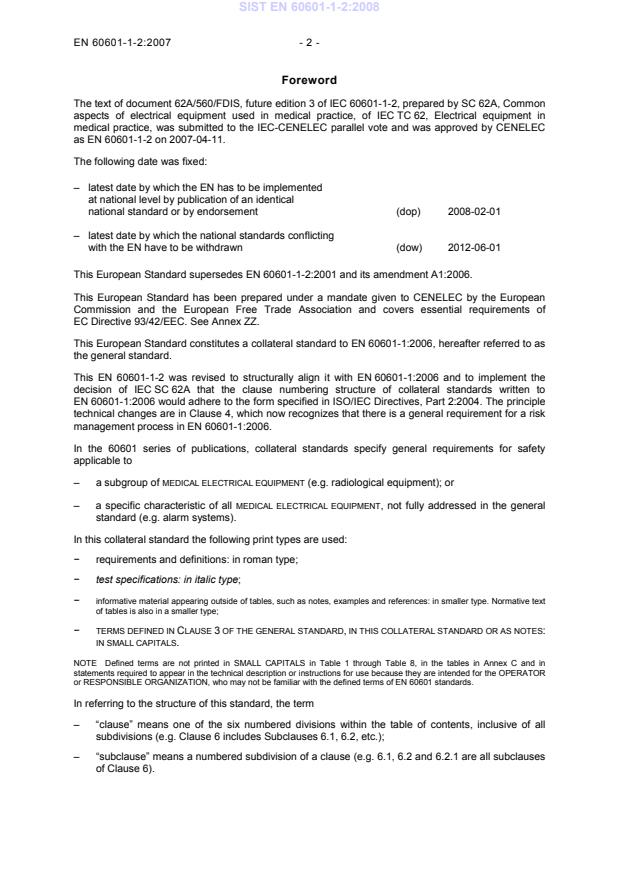
- 2 - Foreword The text of document 62A/560/FDIS, future edition 3 of IEC 60601-1-2, prepared by SC 62A, Common aspects of electrical equipment used in medical practice, of IEC TC 62, Electrical equipment in medical practice, was submitted to the IEC-CENELEC parallel vote and was approved by CENELEC as EN 60601-1-2 on 2007-04-11. The following date was fixed: – latest date by which the EN has to be implemented
at national level by publication of an identical
national standard or by endorsement
– latest date by which the national standards conflicting
with the EN have to be withdrawn
(dop)
(dow)
2008-02-01
2012-06-01 This European Standard supersedes EN 60601-1-2:2001 and its amendment A1:2006.
This European Standard has been prepared under a mandate given to CENELEC by the European Commission and the European Free Trade Association and covers essential requirements of EC Directive 93/42/EEC. See Annex ZZ. This European Standard constitutes a collateral standard to EN 60601-1:2006, hereafter referred to as the general standard. This EN 60601-1-2 was revised to structurally align it with EN 60601-1:2006 and to implement the decision of IEC SC 62A that the clause numbering structure of collateral standards written to EN 60601-1:2006 would adhere to the form specified in ISO/IEC Directives, Part 2:2004. The principle technical changes are in Clause 4, which now recognizes that there is a general requirement for a risk management process in EN 60601-1:2006. In the 60601 series of publications, collateral standards specify general requirements for safety applicable to – a subgroup of MEDICAL ELECTRICAL EQUIPMENT (e.g. radiological equipment); or – a specific characteristic of all MEDICAL ELECTRICAL EQUIPMENT, not fully addressed in the general standard (e.g. alarm systems). In this collateral standard the following print types are used: − requirements and definitions: in roman type; − test specifications: in italic type; − informative material appearing outside of tables, such as notes, examples and references: in smaller type. Normative text of tables is also in a smaller type; − TERMS DEFINED IN CLAUSE 3 OF THE GENERAL STANDARD, IN THIS COLLATERAL STANDARD OR AS NOTES: IN SMALL CAPITALS. NOTE Defined terms are not printed in SMALL CAPITALS in Table 1 through Table 8, in the tables in Annex C and in statements required to appear in the technical description or instructions for use because they are intended for the OPERATOR or RESPONSIBLE ORGANIZATION, who may not be familiar with the defined terms of EN 60601 standards. In referring to the structure of this standard, the term – “clause” means one of the six numbered divisions within the table of contents, inclusive of all subdivisions (e.g. Clause 6 includes Subclauses 6.1, 6.2, etc.); –
“subclause” means a numbered subdivision of a clause (e.g. 6.1, 6.2 and 6.2.1 are all subclauses of Clause 6). SIST EN 60601-1-2:2008
- 3 - EN 60601-1-2:2007 References to clauses within this standard are preceded by the term “Clause” followed by the clause number. References to subclauses within this standard are by number only.
In this standard, the conjunctive “or” is used as an “inclusive or” so a statement is true if any combination of the conditions is true. The verbal forms used in this standard conform to usage described in Annex H of the ISO/IEC Directives, Part 2. For the purposes of this standard, the auxiliary verb: − “shall” means that compliance with a requirement or a test is mandatory for compliance with this standard; − “should” means that compliance with a requirement or a test is recommended but is not mandatory for compliance with this standard; − “may” is used to describe a permissible way to achieve compliance with a requirement or test. Clauses, subclauses, items and definitions for which a rationale is provided in informative Annex A are marked with an asterisk (*). Annexes ZA and ZZ have been added by CENELEC. __________ The contents of the corrigendum of March 2010 have been included in this copy. SIST EN 60601-1-2:2008
- 4 - Endorsement notice The text of the International Standard IEC 60601-1-2:2007 was approved by CENELEC as a European Standard with agreed common modifications as given below. COMMON MODIFICATIONS Annex A, Subclause 4.2: Replace the last sentence by: These HAZARDS shall be considered in the RISK MANAGEMENT PROCESS. Bibliography Add the following notes for the standards indicated: CISPR 11 + A1 + A2 NOTE Harmonized as EN 55011:2007 (modified) and A2:2007 (not modified). CISPR 24 NOTE Harmonized as EN 55024:1998 (modified). IEC 61000-4-2 + A1 + A2 NOTE Harmonized as EN 61000-4-2:1995 + A1:1998 + A2:2001 (not modified). IEC 61000-4-3 NOTE Harmonized as EN 61000-4-3:2006 (not modified). IEC 61000-4-4 NOTE Harmonized as EN 61000-4-4:2004 (not modified). IEC 61000-4-6 + A1 + A2 NOTE Harmonized as EN 61000-4-6:2007 (not modified). IEC 61326-1 NOTE Harmonized as EN 61326-1:2006 (not modified). ISO 14971 NOTE Harmonized as EN ISO 14971:2000 (not modified). __________ SIST EN 60601-1-2:2008
- 5 - EN 60601-1-2:2007
Annex ZA (normative)
Normative references to international publications with their corresponding European publications
The following referenced documents are indispensable for the application of this document. For dated references, only the edition cited applies. For undated references, the latest edition of the referenced document (including any amendments) applies.
NOTE
When an international publication has been modified by common modifications, indicated by (mod), the relevant EN/HD applies.
Publication Year Title EN/HD Year IEC 60417 Data base Graphical symbols for use on equipment - -
IEC 60601-1 2005 Medical electrical equipment -
Part 1: General requirements for basic safety and essential performance EN 60601-1 2006
IEC 60601-1-8 2006 Medical electrical equipment -
Part 1-8: General requirements for basic safety and essential performance - Collateral Standard: General requirements, tests and guidance for alarm systems in medical electrical equipment and medical electrical systems EN 60601-1-8 2007
IEC 61000-3-2 - 1) Electromagnetic compatibility (EMC) -
Part 3-2: Limits - Limits for harmonic current emissions (equipment input current ≤ 16 A per phase) EN 61000-3-2 2006 2)
IEC 61000-3-3 - 1) Electromagnetic compatibility (EMC) -
Part 3-3: Limits - Limitation of voltage changes, voltage fluctuations and flicker in public low-voltage supply systems, for equipment with rated current ≤ 16 A per phase and not subject to conditional connection EN 61000-3-3 + corr. July
1995 2)1997
IEC 61000-4-2 - 1) Electromagnetic compatibility (EMC) -
Part 4-2: Testing and measurement techniques - Electrostatic discharge immunity test EN 61000-4-2 1995 2)
IEC 61000-4-3 - 1) Electromagnetic compatibility (EMC) -
Part 4-3: Testing and measurement techniques - Radiated, radio-frequency, electromagnetic field immunity test EN 61000-4-3 2006 2)
IEC 61000-4-4
- 1) Electromagnetic compatibility (EMC) -
Part 4-4: Testing and measurement techniques - Electrical fast transient/burst immunity test EN 61000-4-4 2004 2)
1) Undated reference.
2) Valid edition at date of issue.
- 6 - Publication Year Title EN/HD Year IEC 61000-4-5 - 1) Electromagnetic compatibility (EMC) -
Part 4-5: Testing and measurement techniques - Surge immunity test EN 61000-4-5 2006 2)
IEC 61000-4-6 + A1 + A2 2003 2004 2006 Electromagnetic compatibility (EMC) -
Part 4-6: Testing and measurement techniques - Immunity to conducted disturbances, induced by radio-frequency fields
EN 61000-4-6
IEC 61000-4-8 - 1) Electromagnetic compatibility (EMC) -
Part 4-8: Testing and measurement techniques - Power frequency magnetic field immunity test EN 61000-4-8 1993 2)
IEC 61000-4-11 - 1) Electromagnetic compatibility (EMC) -
Part 4-11: Testing and measurement techniques - Voltage dips, short interruptions and voltage variations immunity tests EN 61000-4-11 2004 2)
CISPR 11 (mod) - 1) Industrial scientific and medical (ISM)
radio-frequency equipment - Electromagnetic disturbance
characteristics - Limits and methods of measurement EN 55011 2007 2)
CISPR 14-1 - 1) Electromagnetic compatibility - Requirements for household appliances, electric tools and similar apparatus -
Part 1: Emission EN 55014-1 2006 2)
CISPR 15 - 1) Limits and methods of measurement of radio disturbance characteristics of electrical lighting and similar equipment EN 55015 2006 2)
CISPR 16-1-2 - 1) Specification for radio disturbance and immunity measuring apparatus and
methods -
Part 1-2: Radio disturbance and immunity measuring apparatus - Ancillary equipment - Conducted disturbances EN 55016-1-2 2004 2)
CISPR 22 (mod) - 1) Information technology equipment - Radio disturbance characteristics - Limits and methods of measurement EN 55022 2006 2)
- 7 - EN 60601-1-2:2007 Annex ZZ (informative)
Coverage of Essential Requirements of EC Directives This European Standard has been prepared under a mandate given to CENELEC by the European Commission and the European Free Trade Association and within its scope the standard covers all relevant essential requirements as given in Annex I of the EC Directive 93/42/EEC. Compliance with this standard provides one means of conformity with the specified essential requirements of the Directive concerned. WARNING: Other requirements and other EC Directives may be applicable to the products falling within the scope of this standard. ___________
IEC 60601-1-2Edition 3.0 2007-03INTERNATIONAL STANDARD NORME INTERNATIONALEMedical electrical equipment –
Part 1-2: General requirements for basic safety and essential performance – Collateral standard: Electromagnetic compatibility – Requirements and tests
Appareils électromédicaux – Partie 1-2: Exigences générales pour la sécurité de base et les performances essentielles – Norme collatérale: Compatibilité électromagnétique –
Exigences et essais
INTERNATIONAL ELECTROTECHNICAL COMMISSION COMMISSION ELECTROTECHNIQUE INTERNATIONALE XFICS 11.040.01;
33.100.10;
33.100.20 PRICE CODECODE PRIXISBN 2-8318-9050-0SIST EN 60601-1-2:2008
– 2 – 60601-1-2 © IEC:2007 CONTENTS FOREWORD.5 INTRODUCTION.8
1 Scope, object and related standards.10 1.1 * Scope.10 1.2 Object.10 1.3 Related standards.10 2 Normative references.10 3 Terms and definitions.12 4 General requirements.15 4.1 General requirements for ELECTROMAGNETIC COMPATIBILITY of ME EQUIPMENT
and ME SYSTEMS.15 4.2 * SINGLE FAULT CONDITION for ME EQUIPMENT.16 5 Identification, marking and documents.16 5.1 Marking on the outside of ME EQUIPMENT or ME EQUIPMENT parts.16 5.2 ACCOMPANYING DOCUMENTS.17 6 ELECTROMAGNETIC COMPATIBILITY.39 6.1 EMISSIONS.39 6.2 IMMUNITY.42
Annex A (informative)
General guidance and rationale.58 Annex B (informative)
Guide to marking and labelling requirements
for ME EQUIPMENT and ME SYSTEMS.88 Annex C (informative)
Example completion of Table 1 through Table 8.91 Annex D (informative)
Guidance in classification according to CISPR 11.103 Annex E (informative)
Guidance in the application of IEC 60601-1-2 to particular standards.106 Annex F (informative)
ELECTROMAGNETIC ENVIRONMENTS.109 Annex G (informative)
Guidance for determining if electrical equipment that is not ME EQUIPMENT and that is used in an ME SYSTEM is exempt from the EMC testing requirements of this collateral standard.110 Annex H (informative)
Mapping between the elements of the second edition of IEC 60601-1-2 as amended and IEC 60601-1-2:2007.112
Bibliography.120
Index of defined terms used in this collateral standard.121
Figure 1 – Instructions for completing Table 1 for CISPR 11 ME EQUIPMENT and ME SYSTEMS.21 Figure 2 – Instructions for completing Table 1 for CISPR 14 and CISPR 15 ME EQUIPMENT.22 Figure 3 – Instructions for completing Table 2.25 Figure 4 – Instructions for completing Table 3 and Table 5 for LIFE-SUPPORTING ME EQUIPMENT and ME SYSTEMS.31 SIST EN 60601-1-2:2008
60601-1-2 © IEC:2007 – 3 –
Figure 5 – Instructions for completing Table 4 and Table 6 for ME EQUIPMENT and ME SYSTEMS that are not LIFE-SUPPORTING.32 Figure A.1 – Example of cable arrangement for radiated IMMUNITY test.86 Figure A.2 – Examples showing maximum dimension for ME EQUIPMENT with one and with two cables.87 Figure G.1 – Procedure for determining if electrical equipment that is not ME EQUIPMENT and that is used in an ME SYSTEM is exempt from the EMC testing requirements of this collateral standard.111
Table 1 – Guidance and MANUFACTURER’S declaration – ELECTROMAGNETIC EMISSIONS – for all ME EQUIPMENT and ME SYSTEMS.20 Table 2 – Guidance and MANUFACTURER’S declaration []– electromagnetic IMMUNITY – for all ME EQUIPMENT and ME SYSTEMS.24 Table 3 – Guidance and MANUFACTURER’S declaration – electromagnetic IMMUNITY – for LIFE-SUPPORTING ME EQUIPMENT and ME SYSTEMS.27 Table 4 – Guidance and MANUFACTURER’S declaration – electromagnetic IMMUNITY – for ME EQUIPMENT and ME SYSTEMS that are not LIFE-SUPPORTING.28 Table 5 – Recommended separation distances between portable and mobile RF communications equipment and the ME EQUIPMENT or ME SYSTEM – for LIFE-SUPPORTING ME EQUIPMENT and ME SYSTEMS.29 Table 6 – Recommended separation distances between portable and mobile RF communications equipment and the ME EQUIPMENT or ME SYSTEM – for ME EQUIPMENT and ME SYSTEMS that are not LIFE-SUPPORTING.30 Table 7 – Guidance and MANUFACTURER’S declaration – electromagnetic IMMUNITY – for LIFE-SUPPORTING ME EQUIPMENT and ME SYSTEMS that are specified
for use only in a shielded location.36 Table 8 – Guidance and MANUFACTURER’S declaration – electromagnetic IMMUNITY – for ME EQUIPMENT and ME SYSTEMS that are not LIFE-SUPPORTING and are specified
for use only in a shielded location.37 Table 9 – Modulation frequency, PHYSIOLOGICAL SIMULATION FREQUENCY,
and OPERATING FREQUENCY.46 Table 10 – IMMUNITY TEST LEVELS for voltage dips.55 Table 11 – IMMUNITY TEST LEVEL for voltage interruption.55 Table B.1 – Marking on the outside of ME EQUIPMENT, ME SYSTEMS or their parts.88 Table B.2 – ACCOMPANYING DOCUMENTS, instructions for use.89 Table B.3 – ACCOMPANYING DOCUMENTS, technical description.90 Table C.1 – Example (1) of completed Table 1.91 Table C.2 – Example (2) of completed Table 1.92 Table C.3 – Example (3) of completed Table 1.93 Table C.4 – Example of completed Table 2.94 Table C.5 – Example (1) test, IMMUNITY and COMPLIANCE LEVELS.95 Table C.6 – Example of completed Table 3.96 Table C.7 – Example of completed Table 5.97 Table C.8 – Example of completed Table 4.98 Table C.9 – Example of completed Table 6.99 Table C.10 – Example (2) test, IMMUNITY and COMPLIANCE LEVELS.99 SIST EN 60601-1-2:2008
– 4 – 60601-1-2 © IEC:2007 Table C.11 – Example of completed Table 7.100 Table C.12 – Example (3) test, IMMUNITY and COMPLIANCE LEVELS.101 Table C.13 – Example of completed Table 8.102 Table F.1 – ELECTROMAGNETIC ENVIRONMENTS.109 Table H.1 – Mapping between the elements of the eecond edition of IEC 60601-1-2 as amended and IEC 60601-1-2:2007.112
60601-1-2 © IEC:2007 – 5 –
INTERNATIONAL ELECTROTECHNICAL COMMISSION ____________
MEDICAL ELECTRICAL EQUIPMENT –
Part 1-2: General requirements for basic safety
and essential performance – Collateral standard: Electromagnetic compatibility – Requirements and tests
FOREWORD 1) The International Electrotechnical Commission (IEC) is a worldwide organization for standardization comprising all national electrotechnical committees (IEC National Committees). The object of IEC is to promote international co-operation on all questions concerning standardization in the electrical and electronic fields. To this end and in addition to other activities, IEC publishes International Standards, Technical Specifications, Technical Reports, Publicly Available Specifications (PAS) and Guides (hereafter referred to as “IEC Publication(s)”). Their preparation is entrusted to technical committees; any IEC National Committee interested in the subject dealt with may participate in this preparatory work. International, governmental and non-governmental organizations liaising with the IEC also participate in this preparation. IEC collaborates closely with the International Organization for Standardization (ISO) in accordance with conditions determined by agreement between the two organizations. 2) The formal decisions or agreements of IEC on technical matters express, as nearly as possible, an international consensus of opinion on the relevant subjects since each technical committee has representation from all interested IEC National Committees.
3) IEC Publications have the form of recommendations for international use and are accepted by IEC National Committees in that sense. While all reasonable efforts are made to ensure that the technical content of IEC Publications is accurate, IEC cannot be held responsible for the way in which they are used or for any misinterpretation by any end user. 4) In order to promote international uniformity, IEC National Committees undertake to apply IEC Publications transparently to the maximum extent possible in their national and regional publications. Any divergence between any IEC Publication and the corresponding national or regional publication shall be clearly indicated in the latter. 5) IEC provides no marking procedure to indicate its approval and cannot be rendered responsible for any equipment declared to be in conformity with an IEC Publication. 6) All users should ensure that they have the latest edition of this publication. 7) No liability shall attach to IEC or its directors, employees, servants or agents including individual experts and members of its technical committees and IEC National Committees for any personal injury, property damage or other damage of any nature whatsoever, whether direct or indirect, or for costs (including legal fees) and expenses arising out of the publication, use of, or reliance upon, this IEC Publication or any other IEC Publications.
8) Attention is drawn to the Normative references cited in this publication. Use of the referenced publications is indispensable for the correct application of this publication. 9) Attention is drawn to the possibility that some of the elements of this IEC Publication may be the subject of patent rights. IEC shall not be held responsible for identifying any or all such patent rights. International standard IEC 60601-1-2 has been prepared by IEC subcommittee 62A: Common aspects of electrical equipment used in medical practice, of IEC technical committee 62: Electrical equipment in medical practice. This third edition constitutes a collateral standard to IEC 60601-1: Medical electrical equipment – Part 1: General requirements for safety and essential performance hereafter referred to as the general standard. This document cancels and replaces the second edition of IEC 60601-1-2, and constitutes a technical revision. SIST EN 60601-1-2:2008
– 6 – 60601-1-2 © IEC:2007 This edition of IEC 60601-1-2 was revised to structurally align it with the 2005 edition of IEC 60601-1 and to implement the decision of IEC subcommittee 62A that the clause numbering structure of collateral standards written to IEC 60601-1:2005 would adhere to the form specified in ISO/IEC Directives, Part 2:2004. The principle technical changes are in Clause 4, which now recognizes that there is a general requirement for a risk management process in IEC 60601-1:2005. The text of this standard is based on the following documents: FDIS Report on voting 62A/560/FDIS 62A/567/RVD
Full information on the voting for the approval of this standard can be found in the report on voting indicated in the above table. This publication has been drafted in accordance with the ISO/IEC Directives, Part 2. In the 60601 series of publications, collateral standards specify general requirements for safety applicable to: – a subgroup of MEDICAL ELECTRICAL EQUIPMENT (e.g. radiological equipment); or – a specific characteristic of all MEDICAL ELECTRICAL EQUIPMENT, not fully addressed in the general standard (e.g. alarm systems). In this collateral standard, the following print types are used: – requirements and definitions: roman type. – test specifications: italic type. – informative material appearing outside of tables, such as notes, examples and references: in smaller type. Normative text of tables is also in a smaller type. – TERMS DEFINED IN CLAUSE 3 OF THE GENERAL STANDARD, IN THIS COLLATERAL STANDARD OR AS NOTED: SMALL CAPITALS. NOTE Defined terms are not printed in SMALL CAPITALS in Table 1 through Table 8, in the tables in Annex C and in statements required to appear in the technical description or instructions for use because they are intended for the OPERATOR or RESPONSIBLE ORGANIZATION, who may not be familiar with the defined terms of IEC 60601 standards. In referring to the structure of this standard, the term – “clause” means one of the six numbered divisions within the table of contents, inclusive of all subdivisions (e.g. Clause 6 includes 6.1, 6.2, etc.); – “subclause” means a numbered subdivision of a clause (e.g. 6.1, 6.2 and 6.2.1 are all subclauses of Clause 6). References to clauses within this standard are preceded by the term “Clause” followed by the clause number. References to subclauses within this standard are by number only. In this standard, the conjunctive “or” is used as an “inclusive or” so a statement is true if any combination of the conditions is true. The verbal forms used in this standard conform to usage described in Annex H of the ISO/IEC Directives, Part 2. For the purposes of this standard, the auxiliary verb: − “shall” means that compliance with a requirement or a test is mandatory for compliance with this standard; SIST EN 60601-1-2:2008
60601-1-2 © IEC:2007 – 7 –
− “should” means that compliance with a requirement or a test is recommended but is not mandatory for compliance with this standard; − “may” is used to describe a permissible way to achieve compliance with a requirement or test. Clauses, subclauses, items and definitions for which a rationale is provided in informative Annex A are marked with an asterisk (*). A list of all parts of the IEC 60601 series, under the general title: Medical electrical equipment, can be found on the IEC website. The committee has decided that the contents of this publication will remain unchanged until the maintenance result date indicated on the IEC web site under "http://webstore.iec.ch" in the data related to the specific publication. At this date, the publication will be
• reconfirmed; • withdrawn; • replaced by a revised edition, or • amended.
– 8 – 60601-1-2 © IEC:2007 INTRODUCTION The need for establishing specific ELECTROMAGNETIC COMPATIBILITY standards for MEDICAL ELECTRICAL EQUIPMENT and MEDICAL ELECTRICAL SYSTEMS is well recognized. In particular, the existence of ELECTROMAGNETIC EMISSION standards is essential for the protection of: − safety services; − other MEDICAL ELECTRICAL EQUIPMENT and MEDICAL ELECTRICAL SYSTEMS; − electrical equipment that is not ME EQUIPMENT (e.g. computers); − telecommunications (e.g. radio/TV, telephone, radio-navigation). Of even more importance, the existence of ELECTROMAGNETIC IMMUNITY standards is essential to assure safety of MEDICAL ELECTRICAL EQUIPMENT and MEDICAL ELECTRICAL SYSTEMS. ELECTROMAGNETIC COMPATIBILITY (see Definition 3.4) differs from other aspects of safety covered by IEC 60601-1 because the electromagnetic phenomena exist, with varying degrees of severity, in the normal use environment of all MEDICAL ELECTRICAL EQUIPMENT and MEDICAL ELECTRICAL SYSTEMS and by definition the equipment must “perform satisfactorily” within its intended environment in order to establish ELECTROMAGNETIC COMPATIBILITY. This means that the conventional single fault approach to safety is not appropriate for application to ELECTROMAGNETIC COMPATIBILITY standards. The ELECTROMAGNETIC DISTURBANCE environment can be compared to ambient temperature, humidity and atmospheric pressure. MEDICAL ELECTRICAL EQUIPMENT and MEDICAL ELECTRICAL SYSTEMS may experience environmental conditions within the expected range at any time, and for extended periods of time. As with atmospheric pressure and humidity, the OPERATOR of the MEDICAL ELECTRICAL EQUIPMENT or MEDICAL ELECTRICAL SYSTEM may not be aware of ambient levels on a continuous basis. The IMMUNITY TEST LEVELS specified in this collateral standard (IEC 60601 TEST LEVELS) represent the range found in the general medical use environment. Therefore, under these conditions, the performance of the MEDICAL ELECTRICAL EQUIPMENT or MEDICAL ELECTRICAL SYSTEM would also be expected to be normal. MEDICAL ELECTRICAL EQUIPMENT and MEDICAL ELECTRICAL SYSTEMS are used in the practice of medicine because they provide needed FUNCTIONS. If MEDICAL ELECTRICAL EQUIPMENT or a MEDICAL ELECTRICAL SYSTEM does not provide its needed FUNCTION, because of a lack of IMMUNITY to events expected in the normal use environment, this interferes with the practice of medicine and cannot be considered an acceptable situation. This edition recognizes that there is a shared responsibility between MANUFACTURERS, RESPONSIBLE ORGANIZATIONS and OPERATORS to ensure that MEDICAL ELECTRICAL EQUIPMENT and MEDICAL ELECTRICAL SYSTEMS are designed and operated as intended. The MEDICAL ELECTRICAL EQUIPMENT or MEDICAL ELECTRICAL SYSTEM MANUFACTURER’S responsibility is to design and manufacture to meet the requirements of this collateral standard and to disclose information to the RESPONSIBLE ORGANIZATION or OPERATOR so that a compatible ELECTROMAGNETIC ENVIRONMENT can be maintained in order that the MEDICAL ELECTRICAL EQUIPMENT or MEDICAL ELECTRICAL SYSTEM will perform as intended. SIST EN 60601-1-2:2008
60601-1-2 © IEC:2007 – 9 –
Because the practice of medicine involves many specialities, there will by necessity be MEDICAL ELECTRICAL EQUIPMENT and MEDICAL ELECTRICAL SYSTEMS that are designed to perform a variety of FUNCTIONS. Some FUNCTIONS involve, for example, measurement of signals from a PATIENT that are of very low levels when compared to ELECTROMAGNETIC NOISE levels that can be coupled into MEDICAL ELECTRICAL EQUIPMENT and MEDICAL ELECTRICAL SYSTEMS during the ELECTROMAGNETIC IMMUNITY testing specified in this collateral standard. Because of the proven benefits of many such MEDICAL ELECTRICAL EQUIPMENT and MEDICAL ELECTRICAL SYSTEMS, this collateral standard allows the IMMUNITY TEST LEVELS to be lowered, provided there is sufficient justification based on physical, technological or physiological limitations. In this case, the MANUFACTURER is required to disclose the levels at which the MEDICAL ELECTRICAL EQUIPMENT or MEDICAL ELECTRICAL SYSTEM meets the performance requirements of this collateral standard and to specify the characteristics of the ELECTROMAGNETIC use environment and how this environment is established, in which the MEDICAL ELECTRICAL EQUIPMENT or MEDICAL ELECTRICAL SYSTEM will perform as intended. This collateral standard also recognizes that for certain environments, higher IMMUNITY LEVELS may be required. Research necessary to determine how to identify the environments that may require higher IMMUNITY LEVELS, as well as what the levels should be, is in progress.
Finally, this collateral standard recognizes that for LIFE-SUPPORTING MEDICAL ELECTRICAL EQUIPMENT and MEDICAL ELECTRICAL SYSTEMS, higher levels of IMMUNITY are necessary in order to establish a broader safety margin, even for use in the general medical use environment. Therefore, this collateral standard specifies additional requirements for LIFE-SUPPORTING MEDICAL ELECTRICAL EQUIPMENT and MEDICAL ELECTRICAL SYSTEMS. This collateral standard is based on existing IEC standards prepared by subcommittee 62A, technical committee 77 (electromagnetic compatibility between electrical equipment including networks) and CISPR (International special committee on radio interference). The ELECTROMAGNETIC COMPATIBILITY requirements specified by this collateral standard are generally applicable to MEDICAL ELECTRICAL EQUIPMENT and MEDICAL ELECTRICAL SYSTEMS as defined in 3.63 and 3.64 in the general standard. For certain types of MEDICAL ELECTRICAL EQUIPMENT and MEDICAL ELECTRICAL SYSTEMS, these requirements may need to be modified by the special requirements of a particular standard. Writers of particular standards are encouraged to refer to Annex E for guidance in the application of this collateral standard. SIST EN 60601-1-2:2008
– 10 – 60601-1-2 © IEC:2007 MEDICAL ELECTRICAL EQUIPMENT –
Part 1-2: General requirements for basic safety
and essential performance – Collateral standard: Electromagnetic compatibility – Requirements and tests
1 Scope, object and related standards 1.1 * Scope This International Standard applies to the BASIC SAFETY and ESSENTIAL PERFORMANCE of MEDICAL ELECTRICAL EQUIPMENT and MEDICAL ELECTRICAL SYSTEMS, hereafter referred to as ME EQUIPMENT and ME SYSTEMS. This collateral standard applies to ELECTROMAGNETIC COMPATIBILITY of ME EQUIPMENT and ME SYSTEMS. 1.2 Object The object of this collateral standard is to specify general requirements and tests for ELECTROMAGNETIC COMPATIBILITY of ME EQUIPMENT and ME SYSTEMS. They are in addition to the requirements of the general standard and serve as the basis for particular standards. 1.3 Related standards 1.3.1 IEC 60601-1 For ME EQUIPMENT and ME SYSTEMS, this collateral standard complements IEC 60601-1. When referring to IEC 60601-1 or to this collateral standard, either individually or in combination, the following conventions are used: – "the general standard" designates IEC 60601-1 alone; – "this collateral standard" designates IEC 60601-1-2 alone; – "this standard" designates the combination of the general standard and this collateral standard. 1.3.2 Particular standards A requirement in a particular standard takes priority over the corresponding requirement in this collateral standard. 2 Normative references The following referenced documents are indispensable for the application of this document. For dated references, only the edition cited applies. For undated references, the latest edition of the referenced document (including any amendments) applies. IEC 60417, Graphical symbols for use on equipment SIST EN 60601-1-2:2008
60601-1-2 © IEC:2007 – 11 –
IEC 60601-1:2005, Medical electrical equipment – Part 1: General requirements for basic safety and essential performance
IEC 60601-1-8:2006, Medical electrical equipment – Part 1-8: General requirements for basic safety and essential performance – Collateral standard: General requirements, tests and guidance for alarm systems in medical electrical equipment and medical electrical systems IEC 61000-3-2, Electromagnetic compatibility (EMC) – Part 3-2: Limits – Limits for harmonic current emissions (equipment input current ≤ 16 A per phase) IEC 61000-3-3, Electromagnetic compatibility (EMC) – Part 3-3: Limits – Limitation of voltage fluctuations and flicker in low-voltage supply systems for equipment with rated current ≤ 16 A IEC 61000-4-2, Electromagnetic compatibility (EMC) – Part 4-2: Testing and measurement techniques – Electrostatic discharge immunity test IEC 61000-4-3, Electromagnetic compatibility (EMC) – Part 4-3: Testing and measurement techniques – Radiated, radio-frequency, electromagnetic field immunity test IEC 61000-4-4, Electromagnetic compatibility (EMC) – Part 4-4: Testing and measurement techniques – Electrical fast transient/burst immunity test
IEC 61000-4-5, Electromagnetic compatibility (EMC) – Part 4-5: Testing and measurement techniques – Surge immunity test IEC 61000-4-6:2003, Electromagnetic compatibility (EMC) – Part 4-6: Testing and measurement techniques – Immunity to conducted disturbances, induced by radio-frequency fields 1)
Amendment 1 (2004) Amendment 2 (2006) IEC 61000-4-8, Electromagnetic compatibility (EMC) – Part 4-8: Testing and measurement techniques – Power frequency magnetic field immunity test
IEC 61000-4-11, Electromagnetic compatibility (EMC) – Part 4-11: Testing and measuring techniques –Voltage dips, short interruptions and voltage variations immunity tests CISPR 11, Industrial, scientific and medical (ISM) radio-frequency equipment – Electromagnetic disturbance characteristics – Limits and methods of measurement CISPR 14-1, Electromagnetic compatibility – Requirements for household appliances, electric tools and similar apparatus – Part 1: Emission CISPR 15, Limits and methods of measurement of radio disturbance characteristics of electrical lighting and similar equipment CISPR 16-1-2, Specification for radio disturbance and immunity measuring apparatus and methods – Part 1-2: Radio disturbance and immunity measuring apparatus – Ancillary equipment – Conducted disturbances CISPR 22, Information technology equipment – Radio disturbance characteristics – Limits and methods of measurement ___________ 1)
There exists a consolidated edition 2.2 (2006) that includes IEC 61000-4-6 (2003) and its Amendment 1 (2004) and Amendment 2 (2006). SIST EN 60601-1-2:2008
– 12 – 60601-1-2 © IEC:2007 3 Terms and definitions For the purposes of this document, the terms and definitions given in IEC 60601-1:2005, IEC 60601-1-8:2006 and the following definitions apply. NOTE 1 Where the terms “voltage” and “current” are used in this document, they mean the r.m.s. values of an alternating, direct or composite voltage or current unless stated otherwise. NOTE 2 The term “electrical equipment” is used to mean ME EQUIPMENT or other electrical equipment. This standard also uses the term “equipment” to mean ME EQUIPMENT or other electrical or non-electrical equipment in the context of an ME SYSTEM. NOTE 3 An index of defined terms is found beginning on page 121. 3.1
(IMMUNITY) COMPLIANCE LEVEL level less than or equal to the IMMUNITY LEVEL for which the ME EQUIPMENT or ME SYSTEM meets the requirements of the applicable subclause of 6.2 NOTE Additional requirements for COMPLIANCE LEVELS are specified in 5.2.2. 3.2
* DEGRADATION (of performance) undesired departure in the operational performance of ME EQUIPMENT or an ME SYSTEM from its intended performance NOTE The term "DEGRADATION" can apply to temporary or permanent failure. [IEV 161-01-19, modified] 3.3
* EFFECTIVE RADIATED POWER ERP power required at the input of a lossless reference antenna to produce, in a given direction at any specified distance, the same power flux density as that radiated by a given device NOTE As used by the ITU and as used in Chapter 712 of the IEV, the term “effective radiated power” appears without qualification only when the reference antenna is a half-wave dipole. [IEV 161-04-16, modified] 3.4
ELECTROMAGNETIC COMPATIBILITY EMC ability of ME EQUIPMENT or an ME SYSTEM to function satisfactorily in its ELECTROMAGNETIC ENVIRONMENT without introducing intolerable ELECTROMAGNETIC DISTURBANCES to anything in that environment [IEV 161-01-07, modified] 3.5
* ELECTROMAGNETIC DISTURBANCE any electromagnetic phenomenon that may degrade the performance of a device, equipment or system
NOTE An ELECTROMAGNETIC DISTURBANCE may be ELECTROMAGNETIC NOISE, an unwanted signal or a change in the propagation medium itself. [IEV 161-01-05, modified] SIST EN 60601-1-2:2008
60601-1-2 © IEC:2007 – 13 –
3.6
(ELECTROMAGNETIC) EMISSION phenomenon by which electromagnetic energy emanates from a source [IEV 161-01-08] 3.7
ELECTROMAGNETIC ENVIRONMENT totality of electromagnetic phenomena existing at a given location NOTE In general, the ELECTROMAGNETIC ENVIRONMENT is time dependent and its description may need a statistical approach. [IEV 161-01-01] 3.8
ELECTROMAGNETIC NOISE time-varying electromagnetic phenomenon apparently not conveying information and which may be superimposed on or combined with a wanted signal
[IEV 161-01-02] 3.9
ELECTROSTATIC DISCHARGE ESD transfer of electric charge between bodies of different electrostatic potential in proximity or through direct contact [IEV 161-01-22] 3.10
* EXCLUSION BAND frequency band for intentional receivers of RF electromagnetic energy that extends from −5 % to +5 % of the frequency, or frequency band, of reception for frequencies of reception greater than or equal to 80 MHz and from −10 % to +10 % of the frequency, or frequency band, of reception for frequencies of reception less than 80 MHz NOTE Other
...