


FprEN 13807
(Main)Transportable gas cylinders - Battery vehicles and multiple-element gas containers (MEGCs) - Design, manufacture, identification and testing
Transportable gas cylinders - Battery vehicles and multiple-element gas containers (MEGCs) - Design, manufacture, identification and testing
This document specifies the requirements for the design, manufacture, identification and testing of battery vehicles and multiple-element gas containers (MEGCs) containing cylinders, tubes, or bundles of cylinders. This document applies also to battery vehicles and MEGCs containing bundles of cylinders connected by a manifold which are dis-assembled from the battery vehicle and filled individually.
It is applicable to battery vehicles and MEGCs containing compressed gas, liquefied gas, and mixtures thereof. It is also applicable to battery vehicles for dissolved acetylene.
This document is not applicable to battery vehicles and MEGC for toxic gases with an LC50 value less than or equal to 200 ml/m3.
This document does not apply to battery vehicles and MEGCs containing pressure drums or tanks.
This document does not specify requirements for the vehicle chassis or motive unit.
This document is primarily intended for industrial gases other than liquefied petroleum gases (LPG).
Ortsbewegliche Gasflaschen - Batteriefahrzeuge und Gascontainer mit mehreren Elementen (MEGCs) - Auslegung, Herstellung, Kennzeichnung und Prüfung
Dieses Dokument legt die Anforderungen an die Auslegung, Herstellung, Kennzeichnung und Prüfung von Batteriefahrzeugen und Gascontainern mit mehreren Elementen (MEGCs) fest, welche Flaschen, Großflaschen oder Flaschenbündel enthalten. Dieses Dokument gilt auch für Batteriefahrzeuge und MEGCs, die Flaschenbündel enthalten, welche durch eine Sammelleitung miteinander verbunden sind und die vom Batteriefahrzeug demontiert und einzeln befüllt werden.
Es ist anwendbar für Batteriefahrzeuge und MEGCs, die verdichtete oder verflüssigte Gase sowie deren Gemische enthalten. Es ist auch anwendbar für Acetylen-Batteriefahrzeuge.
Dieses Dokument ist nicht anwendbar für Batteriefahrzeuge und MEGCs für giftige Gase mit einem LC50 Wert kleiner oder gleich 200 ml/m3.
Dieses Dokument ist nicht anwendbar für Batteriefahrzeuge und MEGCs, die Druckfässer oder Tanks enthalten.
Dieses Dokument ist nicht anwendbar für das Fahrgestell oder die Antriebseinheit.
Dieses Dokument ist in erster Linie für andere Industriegase als Flüssiggas (LPG, en: liquefied petroleum gases) vorgesehen.
Bouteilles à gaz transportables - Véhicules-batteries et conteneurs à gaz à éléments multiples (CGEM) - Conception, fabrication, identification et essai
Le présent document spécifie les exigences relatives à la conception, à la fabrication, à l’identification et aux essais des véhicules-batteries et des conteneurs à gaz à éléments multiples (CGEM) contenant des bouteilles, des tubes ou des cadres de bouteilles. Le présent document s’applique également aux véhicules-batteries et aux CGEM contenant des cadres de bouteilles reliés par un tuyau collecteur qui sont démontés du véhicule-batterie et remplis individuellement.
Il s’applique aux véhicules-batteries et aux CGEM contenant du gaz comprimé, du gaz liquéfié et des mélanges de ces gaz. Il s’applique également aux véhicules-batteries pour acétylène dissous. Le présent document ne s’applique pas aux véhicules-batteries et aux CGEM pour gaz toxiques ayant une valeur CL50 inférieure ou égale à 200 ml/m3.
Le présent document ne s’applique pas aux véhicules-batteries et aux CGEM contenant des fûts à pression ni aux citernes.
Le présent document ne spécifie pas d’exigence relative au châssis du véhicule ou à l’unité motrice.
Le présent document est destiné principalement aux gaz industriels autres que les gaz de pétrole liquéfiés (GPL).
Premične plinske jeklenke - Baterijska vozila in večprekatni zabojniki za pline (MEGC) - Konstruiranje, izdelava, označevanje in preskušanje
General Information
- Status
- Not Published
- Publication Date
- 17-Feb-2026
- Technical Committee
- CEN/TC 23 - Transportable gas cylinders
- Drafting Committee
- CEN/TC 23/SC 3/WG 5 - Manifold receptacles
- Current Stage
- 5060 - Closure of Vote - Formal Approval
- Start Date
- 04-Dec-2025
- Due Date
- 12-Jan-2026
- Completion Date
- 04-Dec-2025
Relations
- Effective Date
- 29-Nov-2023
Overview
The European standard FprEN 13807 establishes comprehensive requirements for the design, manufacture, identification, and testing of battery vehicles and multiple-element gas containers (MEGCs) that transport compressed gases. Developed by CEN Technical Committee CEN/TC 23, this standard applies to transportable gas cylinders organized in battery vehicles or MEGC units, which contain cylinders, tubes, or bundles connected by manifolds. It addresses industrial gases including compressed, liquefied gases, and dissolved acetylene, with strict exclusions for toxic gases below specified toxicity levels and excludes pressure drums, tanks, and motive units like chassis.
This standard is critical for ensuring safety, reliability, and conformity in the transport of industrial gases, supporting manufacturers, testers, and regulatory bodies in upholding consistent technical and safety practices across Europe and internationally.
Key Topics
Scope and Application
- Covers battery vehicles and MEGCs carrying industrial gases except liquefied petroleum gases (LPG).
- Applies to assemblies with manifolds connecting cylinders that may be disassembled for individual filling.
- Excludes toxic gases with LC50 ≤ 200 ml/m3 and pressure tanks or drums.
- Does not regulate vehicle chassis or motive mechanisms.
Design Requirements
- Stability, mounting, and impact protection principles for battery vehicles.
- Shell characteristics of pressure receptacles (cylinders or tubes).
- Manifold design tailored to gas type, including special provisions for hydrogen service.
- Valve and fitting specifications emphasizing welded and brazed joints, leak-proof connections, and flame resistance.
Manufacturing and Quality Controls
- Welding and brazing qualifications according to referenced EN ISO standards.
- Traceability and product identification ensuring clear marking for filling, hazardous substance, and ownership information.
- Documentation requirements covering design records, inspection reports, and type approval.
Testing and Approval
- Type approval, initial inspection, and performance testing protocols for the entire assembly including pressure, tightness, and functionality of manifolds and valves.
- Flame resistance and conductivity test guidelines particularly related to protective tarpaulins used on battery vehicles.
- Leak tests enforced post-assembly and pre-filling to ensure safety during transport.
Applications
FprEN 13807 is primarily utilized by:
- Manufacturers of industrial gas storage and transport containers to ensure their battery vehicles and MEGCs comply with safety and performance standards suitable for market introduction across the European Union and beyond.
- Transport and logistics companies specializing in the handling and delivery of compressed or liquefied industrial gases, as these standards guarantee the mechanical integrity and safe connection of gas receptacles during transit.
- Regulatory and certification bodies tasked with type approval and periodic inspection of transport units to maintain compliance with ADR regulations and European directives.
- Safety engineers and quality control teams engaged in designing and verifying manifold systems and pressurized container assemblies to meet international industrial gas handling standards.
The standard improves the efficiency and safety of gas transportation, minimizes risk of leakage or accidents during handling, and establishes uniform practices for marking and documentation, enhancing traceability and regulatory adherence.
Related Standards
- EN ISO 10286:2021 – Vocabulary and terms for gas cylinders and related equipment, supporting consistency in definitions.
- EN ISO 10961 – Design and manufacture specifications for gas cylinder bundles, closely related to MEGC assemblies.
- EN ISO 15615:2022 – Safety requirements for acetylene manifold systems, complementing specific provisions in FprEN 13807.
- ISO 1496-3 – Freight containers including tank containers for gases, relevant for transport container integration.
- EN ISO 9606-1 – Welders' qualification, critical to manufacturing quality and structural integrity.
- EN 13134 – Procedure approval for brazing, directly referenced for manifold and fitting manufacturing compliance.
By integrating these standards, FprEN 13807 ensures holistic coverage of battery vehicle and MEGC design, manufacture, and safety evaluation aligned with European and international transport legislation.
Keywords: transportable gas cylinders, battery vehicles, multiple-element gas containers, MEGC, industrial gases, compressed gas transport, liquefied gases, acetylene battery vehicles, gas manifold, gas cylinder testing, type approval, gas container identification, CEN standards, EN 13807, safety standards for gas transport.

Frequently Asked Questions
FprEN 13807 is a draft published by the European Committee for Standardization (CEN). Its full title is "Transportable gas cylinders - Battery vehicles and multiple-element gas containers (MEGCs) - Design, manufacture, identification and testing". This standard covers: This document specifies the requirements for the design, manufacture, identification and testing of battery vehicles and multiple-element gas containers (MEGCs) containing cylinders, tubes, or bundles of cylinders. This document applies also to battery vehicles and MEGCs containing bundles of cylinders connected by a manifold which are dis-assembled from the battery vehicle and filled individually. It is applicable to battery vehicles and MEGCs containing compressed gas, liquefied gas, and mixtures thereof. It is also applicable to battery vehicles for dissolved acetylene. This document is not applicable to battery vehicles and MEGC for toxic gases with an LC50 value less than or equal to 200 ml/m3. This document does not apply to battery vehicles and MEGCs containing pressure drums or tanks. This document does not specify requirements for the vehicle chassis or motive unit. This document is primarily intended for industrial gases other than liquefied petroleum gases (LPG).
This document specifies the requirements for the design, manufacture, identification and testing of battery vehicles and multiple-element gas containers (MEGCs) containing cylinders, tubes, or bundles of cylinders. This document applies also to battery vehicles and MEGCs containing bundles of cylinders connected by a manifold which are dis-assembled from the battery vehicle and filled individually. It is applicable to battery vehicles and MEGCs containing compressed gas, liquefied gas, and mixtures thereof. It is also applicable to battery vehicles for dissolved acetylene. This document is not applicable to battery vehicles and MEGC for toxic gases with an LC50 value less than or equal to 200 ml/m3. This document does not apply to battery vehicles and MEGCs containing pressure drums or tanks. This document does not specify requirements for the vehicle chassis or motive unit. This document is primarily intended for industrial gases other than liquefied petroleum gases (LPG).
FprEN 13807 is classified under the following ICS (International Classification for Standards) categories: 23.020.35 - Gas cylinders; 43.160 - Special purpose vehicles. The ICS classification helps identify the subject area and facilitates finding related standards.
FprEN 13807 has the following relationships with other standards: It is inter standard links to EN 13807:2017. Understanding these relationships helps ensure you are using the most current and applicable version of the standard.
FprEN 13807 is associated with the following European legislation: EU Directives/Regulations: 2008/68/EC; Standardization Mandates: M/TDG. When a standard is cited in the Official Journal of the European Union, products manufactured in conformity with it benefit from a presumption of conformity with the essential requirements of the corresponding EU directive or regulation.
You can purchase FprEN 13807 directly from iTeh Standards. The document is available in PDF format and is delivered instantly after payment. Add the standard to your cart and complete the secure checkout process. iTeh Standards is an authorized distributor of CEN standards.
Standards Content (Sample)
SLOVENSKI STANDARD
oSIST prEN 13807:2025
01-januar-2025
Premične plinske jeklenke - Baterijska vozila in MEGC - Načrtovanje, izdelava,
označevanje in preskušanje
Transportable gas cylinders - Battery vehicles and multiple-element gas containers
(MEGCs) - Design, manufacture, identification and testing
Ortsbewegliche Gasflaschen - Batterie-Fahrzeuge und Gascontainer mit mehreren
Elementen (MEGCs) - Auslegung, Herstellung, Kennzeichnung und Prüfung
Bouteilles à gaz transportables - Véhicules-batteries et conteneurs à gaz à éléments
multiples (CGEM) - Conception, fabrication, identification et essai
Ta slovenski standard je istoveten z: prEN 13807
ICS:
23.020.35 Plinske jeklenke Gas cylinders
43.160 Vozila za posebne namene Special purpose vehicles
oSIST prEN 13807:2025 en,fr,de
2003-01.Slovenski inštitut za standardizacijo. Razmnoževanje celote ali delov tega standarda ni dovoljeno.
oSIST prEN 13807:2025
oSIST prEN 13807:2025
DRAFT
EUROPEAN STANDARD
prEN 13807
NORME EUROPÉENNE
EUROPÄISCHE NORM
December 2024
ICS 43.160; 23.020.35 Will supersede EN 13807:2017
English Version
Transportable gas cylinders - Battery vehicles and
multiple-element gas containers (MEGCs) - Design,
manufacture, identification and testing
Bouteilles à gaz transportables - Véhicules-batteries et Ortsbewegliche Gasflaschen - Batterie-Fahrzeuge und
conteneurs à gaz à éléments multiples (CGEM) - Gascontainer mit mehreren Elementen (MEGCs) -
Conception, fabrication, identification et essai Auslegung, Herstellung, Kennzeichnung und Prüfung
This draft European Standard is submitted to CEN members for enquiry. It has been drawn up by the Technical Committee
CEN/TC 23.
If this draft becomes a European Standard, CEN members are bound to comply with the CEN/CENELEC Internal Regulations
which stipulate the conditions for giving this European Standard the status of a national standard without any alteration.
This draft European Standard was established by CEN in three official versions (English, French, German). A version in any other
language made by translation under the responsibility of a CEN member into its own language and notified to the CEN-CENELEC
Management Centre has the same status as the official versions.
CEN members are the national standards bodies of Austria, Belgium, Bulgaria, Croatia, Cyprus, Czech Republic, Denmark, Estonia,
Finland, France, Germany, Greece, Hungary, Iceland, Ireland, Italy, Latvia, Lithuania, Luxembourg, Malta, Netherlands, Norway,
Poland, Portugal, Republic of North Macedonia, Romania, Serbia, Slovakia, Slovenia, Spain, Sweden, Switzerland, Türkiye and
United Kingdom.
Recipients of this draft are invited to submit, with their comments, notification of any relevant patent rights of which they are
aware and to provide supporting documentation.
Warning : This document is not a European Standard. It is distributed for review and comments. It is subject to change without
notice and shall not be referred to as a European Standard.
EUROPEAN COMMITTEE FOR STANDARDIZATION
COMITÉ EUROPÉEN DE NORMALISATION
EUROPÄISCHES KOMITEE FÜR NORMUNG
CEN-CENELEC Management Centre: Rue de la Science 23, B-1040 Brussels
© 2024 CEN All rights of exploitation in any form and by any means reserved Ref. No. prEN 13807:2024 E
worldwide for CEN national Members.
oSIST prEN 13807:2025
prEN 13807:2024 (E)
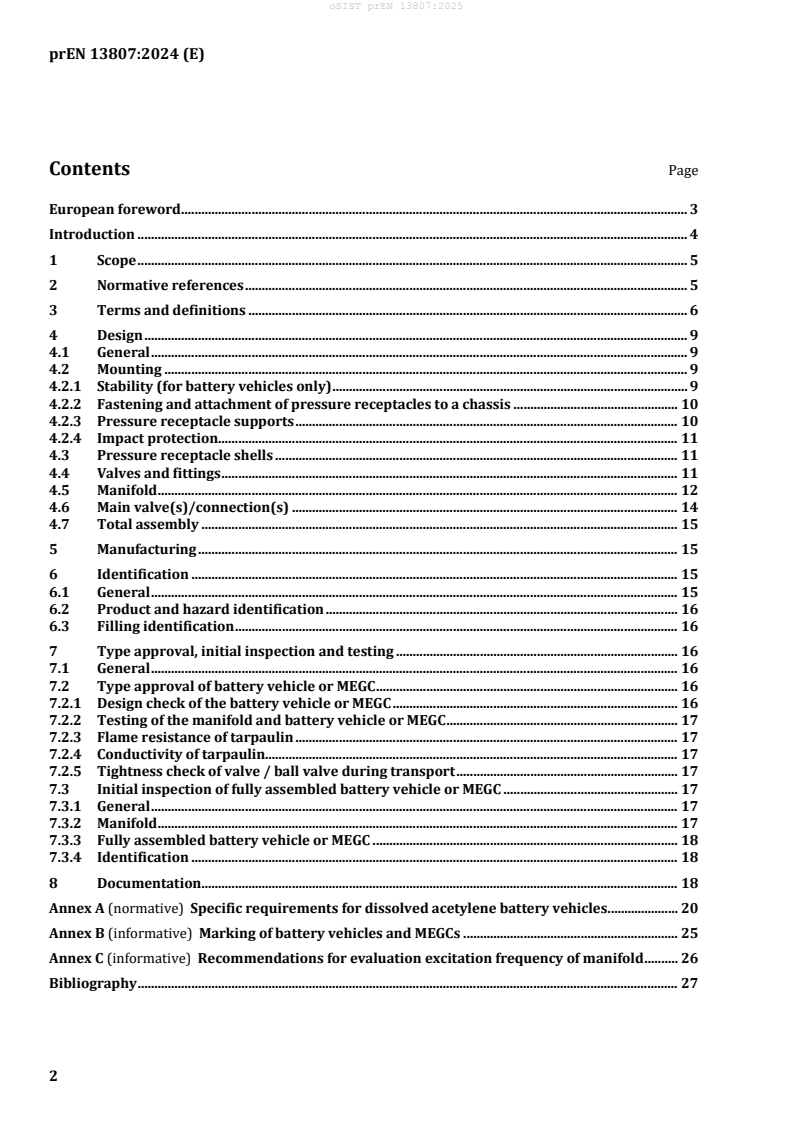
Contents Page
European foreword . 3
Introduction . 4
1 Scope . 5
2 Normative references . 5
3 Terms and definitions . 6
4 Design . 9
4.1 General . 9
4.2 Mounting . 9
4.2.1 Stability (for battery vehicles only) . 9
4.2.2 Fastening and attachment of pressure receptacles to a chassis . 10
4.2.3 Pressure receptacle supports . 10
4.2.4 Impact protection. 11
4.3 Pressure receptacle shells . 11
4.4 Valves and fittings . 11
4.5 Manifold . 12
4.6 Main valve(s)/connection(s) . 14
4.7 Total assembly . 15
5 Manufacturing . 15
6 Identification . 15
6.1 General . 15
6.2 Product and hazard identification . 16
6.3 Filling identification . 16
7 Type approval, initial inspection and testing . 16
7.1 General . 16
7.2 Type approval of battery vehicle or MEGC . 16
7.2.1 Design check of the battery vehicle or MEGC . 16
7.2.2 Testing of the manifold and battery vehicle or MEGC . 17
7.2.3 Flame resistance of tarpaulin . 17
7.2.4 Conductivity of tarpaulin. 17
7.2.5 Tightness check of valve / ball valve during transport . 17
7.3 Initial inspection of fully assembled battery vehicle or MEGC . 17
7.3.1 General . 17
7.3.2 Manifold . 17
7.3.3 Fully assembled battery vehicle or MEGC . 18
7.3.4 Identification . 18
8 Documentation . 18
Annex A (normative) Specific requirements for dissolved acetylene battery vehicles . 20
Annex B (informative) Marking of battery vehicles and MEGCs . 25
Annex C (informative) Recommendations for evaluation excitation frequency of manifold . 26
Bibliography . 27
oSIST prEN 13807:2025
prEN 13807:2024 (E)
European foreword
This document (prEN 13807:2024) has been prepared by Technical Committee CEN/TC 23
“Transportable gas cylinders”, the secretariat of which is held by BSI.
This document will supersede EN 13807:2017
This document has been prepared under a mandate given to CEN by the European Commission and the
European Free Trade Association.
This document will be submitted for reference into the technical annexes of the ADR [15].
The main technical changes are:
a) clarification of scope;
b) revision of definitions;
c) clarification of operation temperature for the pressurized and non-pressurized components
d) more details in chapter mounting to clarify the request;
e) special requirement of forming the manifold in hydrogen service;
f) clarification of leakage check after assembling and initial filling with gas in use.
g) add an annex for vibration test
oSIST prEN 13807:2025
prEN 13807:2024 (E)
Introduction
For certain applications, transport units known as battery vehicles and MEGCs of non-UN pressure
receptacles are used to supply greater volumes of gas in a single unit.
A battery vehicle is a vehicle containing pressure receptacles which are linked to each other by a manifold
and permanently fixed to a transport unit.
General requirements for the design, construction, equipment, type approval, inspections and tests and
marking of battery vehicles are given in Chapter 6.8 and 9 of the ADR. Some specific or additional
requirements are given in this document.
In standards, weight is equivalent to a force, expressed in Newton. However, in common parlance (as
used in terms defined in this document), the word “weight” continues to be used to mean “mass”, but this
practice is deprecated (ISO 80000-4).
In this document, the unit bar is used, due to its universal use in the field of technical gases. It should,
however, be noted that bar is not an SI unit, and that the according SI unit for pressure is Pa
5 5 2
(1 bar = 10 Pa = 10 N/m ).
Pressure values given in this document are given as gauge pressure (pressure exceeding atmospheric
pressure) unless noted otherwise.
Where there is any conflict between this document and any applicable regulation, the regulation always
takes precedence.
oSIST prEN 13807:2025
prEN 13807:2024 (E)
1 Scope
This document specifies the requirements for the design, manufacture, identification and testing of
battery vehicles and multiple-element gas containers (MEGCs) containing cylinders, tubes, or bundles of
cylinders. This document applies also to battery vehicles and MEGCs containing bundles of cylinders
connected by a manifold which are dis-assembled from the battery vehicle and filled individually.
It is applicable to battery vehicles and MEGCs containing compressed gas, liquefied gas, and mixtures
thereof. It is also applicable to battery vehicles for dissolved acetylene. This document is not applicable
to battery vehicles and MEGC for toxic gases with an LC value less than or equal to 200 ml/m .
This document does not apply to battery vehicles and MEGCs containing pressure drums or tanks.
This document does not specify requirements for the vehicle chassis or motive unit.
This document is primarily intended for industrial gases other than Liquefied Petroleum Gases (LPG).
2 Normative references
The following documents, in whole or in part, are normatively referenced in this document and are
indispensable for its application. For dated references, only the edition cited applies. For undated
references, the latest edition of the referenced document (including any amendments) applies.
EN 13134, Brazing - Procedure approval
EN ISO 9606-1, Qualification testing of welders - Fusion welding - Part 1: Steels
EN ISO 10286:2021, Gas cylinders - Vocabulary (ISO 10286:2021)
EN ISO 10297, Gas cylinders - Cylinder valves - Specification and type testing
EN ISO 23826, Gas cylinders - Ball valves - Specification and testing
EN ISO 10961, Gas cylinders - Cylinder bundles - Design, manufacture, testing and inspection
EN ISO 13585, Brazing - Qualification testing of brazers and brazing operators
EN ISO 14113, Gas welding equipment - Rubber and plastics hose and hose assemblies for use with industrial
gases up to 450 bar (45 MPa)
EN ISO 15607, Specification and qualification of welding procedures for metallic materials - General rules)
EN ISO 15615:2022, Gas welding equipment - Acetylene manifold systems for welding, cutting and allied
processes - Safety requirements in high-pressure devices (ISO 15615:2022)
ISO 1496-3, Series 1 freight containers — Specification and testing — Part 3: Tank containers for liquids,
gases and pressurized dry bulk
ISO 3834-2, Quality requirements for fusion welding of metallic materials — Part 2: Comprehensive quality
requirements
oSIST prEN 13807:2025
prEN 13807:2024 (E)
3 Terms and definitions
For the purposes of this document, the terms and definitions given in EN ISO 10286:2021 and the
following apply.
3.1
pressure receptacle
transportable receptacle intended for holding substances under pressure including its closure(s) and
other service equipment
Note 1 to entry: It is a collective term that includes cylinders, tubes, pressure drums, closed cryogenic
receptacles, metal-hydride storage system, bundle of cylinders and salvage pressure receptacles
[SOURCE: EN ISO 10286:2021, 3.1.1.1, modified — Example removed.]
3.2
battery vehicle
vehicle containing pressure receptacles which are linked to each other by a manifold and permanently
fixed to a vehicle such that the assembly is filled, transported and emptied as a single unit
[SOURCE: EN ISO 10286:2021, 3.1.1.12, modified — “elements” replaced by “pressure receptacles” and
replaced “transport unit” with “vehicle such that the assembly is filled, transported and emptied as a
single unit”.]
3.3
multiple-element gas container
MEGC
unit containing cylinders, tubes or bundles of cylinders which are linked to each other by a manifold and
mounted on a frame
Note 1 to entry: This definition is different but not in contradiction with the one given in RID/ADR/ADN:2023[5]
because it aims to reflect the scope of this document which excludes pressure drums and tanks.
3.4
manifold
piping system for connecting pressure receptacle(s) valves or fittings to the main valve(s) or the main
connection(s)
[SOURCE: EN ISO 10286:2021, 3.1.5.2, modified — Example removed.]
3.5
pressure receptacle valve
valve that is fitted into a pressure receptacle and to which a manifold is connected
3.6
pressure receptacle fitting
component with no gas shut-off capability that serves as a method for connecting a manifold to individual
pressure receptacle, when valves are not fitted to the pressure receptacles
[SOURCE: EN ISO 10286:2021, 3.1.5.5, modified — Term “cylinder fitting” replaced with “pressure
receptacle fitting”, domain in angle brackets removed, “cylinders or tubes” replaced by “pressure
receptacles” and Note to entry deleted.]
oSIST prEN 13807:2025
prEN 13807:2024 (E)
3.7
main connection
means of making a gas connection to a battery vehicle/MEGC
[SOURCE: EN ISO 10286:2021, 3.1.5.3, modified — “Bundle” deleted from list.]
3.8
main valve
valve which is fitted to the manifold of a battery vehicle or MEGC isolating it from the main connection(s)
[SOURCE: EN ISO 10286:2021, 3.1.5.4., modified — Bundle of cylinders and battery wagon deleted from
list, alternative and deprecated terms deleted.]
3.9
tare
/ weight of the battery vehicle or MEGC when empty, including accessories
fitted as presented for filling
[SOURCE: EN ISO 10286:2021, 3.5.43, modified — removed deprecated term, replaced “” with
“/” and “pressure receptacle” with “battery vehicle or MEGC”.]
3.10
maximum gross weight
/ sum of the tare of battery vehicle or MEGC and the maximum weight of the
gas product
[SOURCE: EN ISO 10286:2021, 3.5.41, modified — replaced “” with “
vehicle>/”, “bundle” with “battery vehicle or MEGC”, and replaced “maximum permissible filling
weight” with “maximum weight of the gas product”.]
3.11
maximum filling weight
for liquefied gases (e. g. SF ) sum of the minimum guaranteed water capacity of all pressure receptacles
of the battery vehicle or MEGC multiplied with the filling ratio of the gas contained
[SOURCE: EN ISO 10286:2021, 3.5.38, modified — included Note 1 to entry to definition by replacing
“product” by “for liquefied gases (e. g. SF ) sum” and replaced “the pressure receptacle” with “all pressure
receptacle of the battery vehicle or MEGC” and replaced “multiplied with” with “and the”.]
3.12
working pressure
settled pressure of a compressed gas at a uniform reference temperature of 15 °C in a
full battery vehicle or MEGC
[SOURCE: EN ISO 10286:2021, 3.5.30, modified — “gas cylinder” replaced by “battery vehicle or MEGC”]
3.13
maximum developed pressure
pressure developed by the gas contents in a battery vehicle or MEGC at a uniform temperature of T
max
Note 1 to entry: T is the expected maximum uniform temperature in normal service as specified in
max
international or national cylinder filling regulations.
[SOURCE: EN ISO 10286:2021, 3.5.27, modified — “cylinder” replaced by “battery vehicle or MEGC”,
added “of T ” to definition.]
max
oSIST prEN 13807:2025
prEN 13807:2024 (E)
3.14
leak test gas
gas or gas mixture used for leak testing
3.15
acetylene battery vehicle
assembly of acetylene cylinders or acetylene bundles of cylinders connected to a manifold and securely
mounted onto a vehicle chassis such that the assembly is transported and emptied as a single unit
3.16
acetylene battery vehicle type A
acetylene cylinders or acetylene bundles of cylinders that are removed each time from the vehicle and
filled individually
3.17
acetylene battery vehicle type B
acetylene cylinders or acetylene bundles of cylinders that are filled and emptied for a prescribed number
of re-fillings without removal from the vehicle
3.18
home station of the acetylene battery vehicle
location (name of the company, address and telephone number) where the documentation is kept
3.19
tare
sum of the tare weights of the individual cylinders (see EN ISO 3807) or
bundles of cylinders (see EN ISO 13088) plus the weight of the associated manifold, fittings, supports and
the chassis
3.20
maximum gross weight
acetylene battery vehicle sum of the total weight of the individual filled cylinders or the maximum gross
weight of the individual acetylene bundles of cylinders plus the weight of the associated manifold, fittings,
supports and the vehicle chassis
Note 1 to entry: In RID/ ADR the term “Total Mass” is used
3.21
maximum acetylene content
sum of the specified maximum weight of acetylene including saturation
acetylene in the pressure receptacles
3.22
dimensioning pressure
pressure taking into account the pressure increase caused by the
decomposition of acetylene
Note 1 to entry: It is used for the dimensioning of the manifold, hoses, valves and fittings.
3.23
working pressure
pressure equal to the working pressure stamped on the individual pressure
receptacles of the battery vehicle
oSIST prEN 13807:2025
prEN 13807:2024 (E)
3.24
maximum filling pressure
highest pressure which is allowed in an acetylene battery vehicle manifold
during filling
Note 1 to entry: It is 25 bar gauge, see A.2.5.3.
3.25
acetylene decomposition blocker
safety device that stops acetylene decomposition at a pressure of ≤ 25 bar
Note 1 to entry: The decomposition blocker for high-pressure acetylene can optionally comprise other safety
elements such as non-return valve or automatic quick-acting shut-off device (see ISO 15615).
[SOURCE: EN ISO 10286:2021, 3.1.4.13]
4 Design
4.1 General
All pressurized components shall be designed to operate in the temperature range of at least –20 °C to
+65 °C. All other parts such as frame, fastenings, etc. shall be designed to operate in the temperature
range of at least −20°C to +50°C.
The design requirements given in Clause B.2 are minimum requirements. The agreement of stricter
requirements is permitted.
NOTE 1 Local temperature conditions can necessitate higher or lower service temperatures.
NOTE 2 Additional requirements can be required for adapted equipment and/or tests.
NOTE 3 Pressure components and the frame, fastenings etc. can have different operating temperatures (see
marking Clause B.2)
Materials for parts which are in contact with the gas shall be selected in accordance with EN ISO 11114-1
and EN ISO 11114-2.
For battery vehicles and MEGCs which are filled by weight, the tare used as a reference for filling shall be
clearly identified taking into account removable components, where applicable.
For all gases consideration shall be given regarding the risk of accumulation of gases (e.g. explosive
atmosphere, anoxia) by permeation (as applicable) and leak rates by taking into account all possible
confined volumes (if any).
For acetylene battery vehicles, additional requirements apply on certain subjects. These are specified in
Annex A.
4.2 Mounting
4.2.1 Stability (for battery vehicles only)
The overall width of the ground-level bearing surface (distance between the outer points of contact with
the ground of the right-hand tyre and the left-hand tyre of the same axle) of the axle with greatest width
shall be at least equal to 90 % of the height of the centre of gravity of the laden battery vehicle. In an
articulated vehicle the mass on the axles of the load-carrying unit of the laden semi-trailer shall not
exceed 60 % of the nominal total laden mass of the complete articulated vehicle.
NOTE There could be more prescriptive vehicle regulations.
oSIST prEN 13807:2025
prEN 13807:2024 (E)
4.2.2 Fastening and attachment of pressure receptacles to a chassis
Fastenings and Attachments of pressure receptacles to a chassis of Battery Vehicles or MEGC shall, at the
maximum total mass, be capable of absorbing the forces equal to those exerted by:
— in the direction of travel — twice the gross weight;
— horizontally at right angles to the direction of travel — the Total mass, where the direction of
travel is not clearly determined twice the total mass in each direction;
— vertically upward — the gross weight;
— vertically downward — twice gross weight.
Values for gross weight shall be calculated independently of each other.
For the Fastenings and Attachments of pressure receptacles in under each force for
• Battery vehicles, the stress at the most severely stressed point of fastenings and attachments shall
be lower than the values 75 % of the yield strength (Re = guaranteed yield strength) or if more
stringent 50 % of the tensile strength (Rm; minimum guaranteed tensile strength)
• MEGC, the stress at the most severely stressed point of fastenings and attachments shall be lower
than the values 67 % of the yield strength (Re = guaranteed yield strength or for metals with no
clearly-defined yield point R0,2 and for austenitic steel R1,0) of the metal material used.
For non-metallic Material equivalent safety margin under consideration of the failure mechanism and
Time dependent properties changes can be applied.
4.2.3 Pressure receptacle supports
Pressure receptacles shall be secured in a manner that they are able to resists the force according to 4.2.2
under consideration of the working pressure.
For metal pressure receptacle supports, at the most severely stressed point, the max allowed stress shall
not exceed the value of 77 % Re (of the guaranteed yield strength) or if more stringent 2/3 Rm (Rm;
minimum guaranteed tensile strength)
For composite pressure receptacles the maximum allowed acceleration, for the x-, y- and z-direction shall
be provided from the pressure receptacle manufacturer for that load condition according to 4.2.2 in
addition with the working pressure.
For composite cylinders or tubes the supports shall leave sufficient space between the pressure
receptacles to take into account expansion. If a dome cap is used it may be in contact with one or more
dome caps and / or the frame.
oSIST prEN 13807:2025
prEN 13807:2024 (E)
4.2.4 Impact protection
4.2.4.1 For battery vehicles
There are two types of impact protection:
a) Rear end protection
An arrangement shall be fitted at the rear of the battery vehicle to provide adequate protection to the
rear manifold and fittings to prevent accidental leakage of product in the event of a rear impact. The
width of this arrangement shall be not less than that of the rear under-run protective device and not
less than that of the manifold and fittings. There shall be a clearance of at least 100 mm between the
arrangement and the rearmost point of the piping, fittings, and valves under gas pressure during
transport.
NOTE European directive 70/22/EEC contains additional requirements regarding the resistance to impact for
a rear under-run protective device.
b) Rollover protection
Manifolds shall be designed such that they are protected from impact in the event of a battery vehicle
rolling onto its side or upside down.
4.2.4.2 For MEGCs
An arrangement shall be fitted on the MEGC to provide adequate protection for manifold and fittings to
prevent accidental leakage of product in the event of a rear end impact.
The arrangement shall meet at least the impact requirements of an ISO frame in accordance with the
relevant provisions of ISO 1496-3. The manifolds shall be designed and/or placed such that they are
protected from impact in the event of a MEGC in case of rollover onto its side or upside down.
NOTE The tests of ISO 1496-3 also fulfil the requirements of CSC 1972.
4.3 Pressure receptacle shells
Pressure receptacle shells shall be suitable for their intended gas service. They shall have the same test
pressure and follow a relevant European Standard (e.g. EN ISO 11120, EN 12245, EN 17339) for the
individual type of pressure receptacle shell.
Composite pressure receptacle shells shall be protected from ultraviolet radiation according to the
manufacturer’s instructions. This may be achieved by individual or overall protection. Such protection
shall be taken into consideration for design of the ventilation.
4.4 Valves and fittings
4.4.1 Either a pressure receptacle valve or fitting shall be fitted into each pressure receptacle’s inlet
connection.
If a valve is used, it shall conform to either EN ISO 10297, or EN ISO 23826
For acetylene battery vehicles, A.2.4 and A.2.6 apply.
Valves and fittings shall be suitable for the gas service and pressure for which the battery vehicle or MEGC
is intended.
Valves and fittings inlet threads shall be compatible with the neck thread of the pressure receptacle shell.
oSIST prEN 13807:2025
prEN 13807:2024 (E)
Valves, pressure receptacles or manifolds as part of battery vehicles or MEGCs can also include pressure
relief devices.
NOTE The relevant transport regulation can require or forbid pressure relief devices for some gases, gas
mixtures or gas groups. Additional requirements for pressure relief devices can exist in international/regional
regulations/standards.
WARNING — Fast opening valve can lead to a pressure surge and related hazard e.g. adiabatic
compression shall take into consideration when designing the manifold.
4.4.2 Pressure receptacles of a battery-vehicle and MEGCs intended for the carriage of flammable gases
shall be combined in groups of not more than 5 000 l which are capable of being isolated by a shut-off
valve, which shall fulfil the requirements of 4.4.1 except for the threads.
For acetylene battery vehicles, A.2.6 applies.
Each pressure receptacle, including each individual cylinder of a bundle, intended for the carriage of toxic
gases with LC50 less than or equal to 200 ml/m , shall be capable of being isolated by a shut-off valve.
4.4.3 Access shall be provided to all valves.
4.5 Manifold
The manifold shall be designed and manufactured so as to avoid the risk of damage due to thermal
expansion and contraction, mechanical shock and vibration and be compatible with the gas.
4.5.1 To demonstrate the frequency sensitivity of the Manifold, the pipes and accessories should be
designed to avoid excitation frequency from the different modes of transport (see Annex C).
This can be achieved by adequately securing the Manifold system.
For acetylene battery vehicles' manifolds A.2.5 applies in addition.
4.5.2 For manifolds in use with embrittling gases, such as hydrogen, the following items need to be
covered:
• Many metallic materials can suffer embrittlement in hydrogen gas environments. These include
steels (especially high strength steels), stainless steel, and nickel alloys. The manifold shall be of
suitable metallic material (see EN ISO 11114-1).
• In principle the material limits for Steel in hydrogen service as defined in ISO 11114-1 shall be
) is limit to 950 MPa.
followed. The pipe material tensile strength (Rm
• General: Austenitic stainless steel shall be either:
1 Low carbon SS grades or
2 Stabilized SS grades or
3 SS grades with satisfactorily passed intergranular corrosion test according to e.g.
ASTM A262 / Practice E or EN ISO 3651-2 / Method A
oSIST prEN 13807:2025
prEN 13807:2024 (E)
• Cold forming:
The process of cold forming can influence mechanical and environmental properties such as
ductility, impact energy and corrosion resistance. Therefore, mechanical properties after cold
forming shall be given in the documentation. In case of hydrogen service processes and
materials should be adapted to take hydrogen embrittle issues under consideration.
• Welding:
For the Welds and heat affected zones, hardness and therefor capability to prevent
embrittlement related Hydrogen Environmental Embrittlement (H
...
Questions, Comments and Discussion
Ask us and Technical Secretary will try to provide an answer. You can facilitate discussion about the standard in here.
Loading comments...