

EN ISO 10993-17:2023/A1:2025
(Amendment)Biological evaluation of medical devices - Part 17: Toxicological risk assessment of medical device constituents - Amendment 1 (ISO 10993-17:2023/Amd 1:2025)
General Information
- Abstract
- Status
- Published
- Publication Date
- 23-Dec-2025
- Technical Committee
- CEN/TC 206 - Biocompatibility of medical and dental materials and devices
- Current Stage
- 6060 - Definitive text made available (DAV) - Publishing
- Start Date
- 24-Dec-2025
- Completion Date
- 24-Dec-2025

Overview
EN ISO 10993-17:2023/A1:2025 (Amendment 1 to ISO 10993-17:2023) updates guidance for the toxicological risk assessment of medical device constituents. This amendment clarifies exposure calculations, terminology and tables used to derive toxicological screening limits (TSLs) and worst‑case estimated exposure doses. It also aligns cross‑references to ISO 10993‑18 (chemical characterization) and clarifies the document’s relationship to Regulation (EU) 2017/745 (EU MDR).
Key topics and technical changes
- Cumulative exposure dose (TQ_max): The amendment emphasizes the use of the maximum total quantity (TQ_max, µg) - the cumulative exposure dose - when calculating risk metrics.
- Units and formulas: Corrections include unit changes (e.g., g/d → µg/d) and clarified formula variables: the meaning of D (minimum assumed duration in days) and SF (scaling factor relating maximum device contact to the extraction study).
- Toxicological screening limits (TSLs): Updates to Annex B refine how TSLs are calculated (Formula B.1) and specify when toxicological screening limits shall not apply (for prolonged/long‑term use in infants/neonates, and certain constituent types).
- Extraction and release data interpretation: New text in Annex E clarifies when extraction/quantification results can be treated as conservative and used as worst‑case cumulative exposures for hazard calculations (EED, HQ).
- Tables and examples: Revisions to Table B.1, Table F.3 and multiple examples improve consistency in exposure-period assumptions and scaling scenarios.
- Regulatory alignment: Annex ZA maps the standard’s provisions to General Safety and Performance Requirements of EU MDR (Regulation (EU) 2017/745).
Practical applications and users
Who uses this amendment:
- Medical device manufacturers preparing biological evaluation files and toxicological risk assessments.
- Regulatory affairs and quality teams demonstrating conformity with ISO 10993 series and EU MDR.
- Toxicologists and safety assessors calculating TSLs, HQ, and EED using extraction or release‑kinetics data.
- Testing laboratories interpreting extraction studies and reporting conservative constituent quantities.
How it is used:
- To establish safe exposure limits for constituents released from devices.
- To scale extraction results to worst‑case patient exposure using SF and D parameters.
- To document and justify biocompatibility risk decisions in clinical evaluation and technical files.
Related standards
- ISO 10993‑17:2023 (base document)
- ISO 10993‑18:2020 and its amendment on uncertainty factors - referenced normatively for chemical characterization and uncertainty considerations.
- Other parts of the ISO 10993 series for biological evaluation and testing.
Keywords: ISO 10993-17, toxicological risk assessment, medical devices, TQ_max, toxicological screening limit, extraction study, EU MDR, ISO 10993-18.
Relations
- Effective Date
- 04-Mar-2026
- Effective Date
- 28-Jan-2026
- Effective Date
- 09-Feb-2026
- Effective Date
- 28-Jan-2026
- Effective Date
- 28-Jan-2026
- Effective Date
- 12-Feb-2026
- Effective Date
- 15-Nov-2023
Get Certified
Connect with accredited certification bodies for this standard

BSI Group
BSI (British Standards Institution) is the business standards company that helps organizations make excellence a habit.

TÜV Rheinland
TÜV Rheinland is a leading international provider of technical services.

TÜV SÜD
TÜV SÜD is a trusted partner of choice for safety, security and sustainability solutions.
Sponsored listings
Frequently Asked Questions
EN ISO 10993-17:2023/A1:2025 is a amendment published by the European Committee for Standardization (CEN). Its full title is "Biological evaluation of medical devices - Part 17: Toxicological risk assessment of medical device constituents - Amendment 1 (ISO 10993-17:2023/Amd 1:2025)". This standard covers: Biological evaluation of medical devices - Part 17: Toxicological risk assessment of medical device constituents - Amendment 1 (ISO 10993-17:2023/Amd 1:2025)
Biological evaluation of medical devices - Part 17: Toxicological risk assessment of medical device constituents - Amendment 1 (ISO 10993-17:2023/Amd 1:2025)
EN ISO 10993-17:2023/A1:2025 is classified under the following ICS (International Classification for Standards) categories: 11.100.20 - Biological evaluation of medical devices. The ICS classification helps identify the subject area and facilitates finding related standards.
EN ISO 10993-17:2023/A1:2025 has the following relationships with other standards: It is inter standard links to ISO 14971:2007, EN 12201-3:2011/FprA1, EN 60601-1:2006/A2:2021, CEN/TS 15277:2006, EN 455-3:2006, ISO 10993-17:2023/Amd 1:2025, EN ISO 10993-17:2023. Understanding these relationships helps ensure you are using the most current and applicable version of the standard.
EN ISO 10993-17:2023/A1:2025 is associated with the following European legislation: EU Directives/Regulations: 2017/745; Standardization Mandates: M/575, M/575 Amd 2. When a standard is cited in the Official Journal of the European Union, products manufactured in conformity with it benefit from a presumption of conformity with the essential requirements of the corresponding EU directive or regulation.
EN ISO 10993-17:2023/A1:2025 is available in PDF format for immediate download after purchase. The document can be added to your cart and obtained through the secure checkout process. Digital delivery ensures instant access to the complete standard document.
Standards Content (Sample)
SLOVENSKI STANDARD
01-februar-2026
Biološko ovrednotenje medicinskih pripomočkov - 17. del: Toksikološka ocena
tveganja sestavin medicinskih pripomočkov - Dopolnilo A1 (ISO 10993-
17:2023/Amd 1:2025)
Biological evaluation of medical devices - Part 17: Toxicological risk assessment of
medical device constituents - Amendment 1 (ISO 10993-17:2023/Amd 1:2025)
Biologische Beurteilung von Medizinprodukten - Teil 17: Toxikologische Risikobewertung
von Medizinproduktbestandteilen - Änderung 1 (ISO 10993-17:2023/Amd 1:2025)
Évaluation biologique des dispositifs médicaux - Partie 17: Appréciation du risque
toxicologique des constituants des dispositifs médicaux - Amendement 1 (ISO 10993-
17:2023/Amd 1:2025)
Ta slovenski standard je istoveten z: EN ISO 10993-17:2023/A1:2025
ICS:
11.100.20 Biološko ovrednotenje Biological evaluation of
medicinskih pripomočkov medical devices
2003-01.Slovenski inštitut za standardizacijo. Razmnoževanje celote ali delov tega standarda ni dovoljeno.
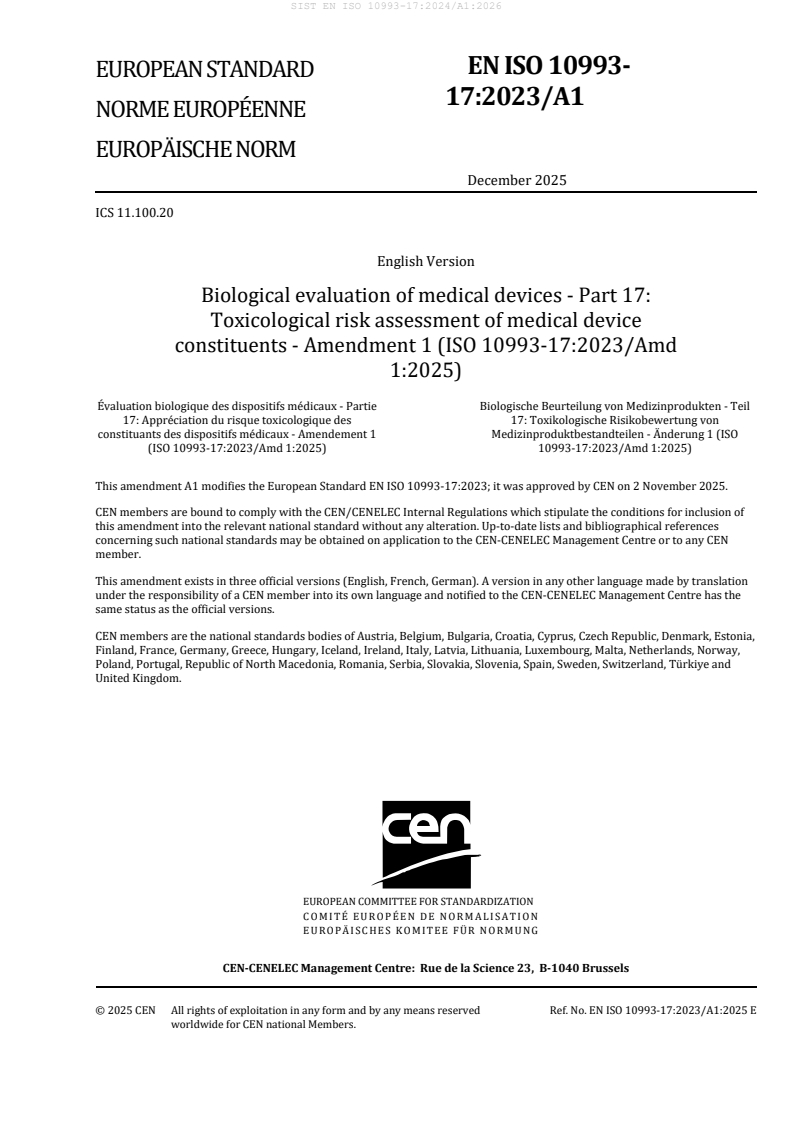
EN ISO 10993-
EUROPEAN STANDARD
17:2023/A1
NORME EUROPÉENNE
EUROPÄISCHE NORM
December 2025
ICS 11.100.20
English Version
Biological evaluation of medical devices - Part 17:
Toxicological risk assessment of medical device
constituents - Amendment 1 (ISO 10993-17:2023/Amd
1:2025)
Évaluation biologique des dispositifs médicaux - Partie Biologische Beurteilung von Medizinprodukten - Teil
17: Appréciation du risque toxicologique des 17: Toxikologische Risikobewertung von
constituants des dispositifs médicaux - Amendement 1 Medizinproduktbestandteilen - Änderung 1 (ISO
(ISO 10993-17:2023/Amd 1:2025) 10993-17:2023/Amd 1:2025)
This amendment A1 modifies the European Standard EN ISO 10993-17:2023; it was approved by CEN on 2 November 2025.
CEN members are bound to comply with the CEN/CENELEC Internal Regulations which stipulate the conditions for inclusion of
this amendment into the relevant national standard without any alteration. Up-to-date lists and bibliographical references
concerning such national standards may be obtained on application to the CEN-CENELEC Management Centre or to any CEN
member.
This amendment exists in three official versions (English, French, German). A version in any other language made by translation
under the responsibility of a CEN member into its own language and notified to the CEN-CENELEC Management Centre has the
same status as the official versions.
CEN members are the national standards bodies of Austria, Belgium, Bulgaria, Croatia, Cyprus, Czech Republic, Denmark, Estonia,
Finland, France, Germany, Greece, Hungary, Iceland, Ireland, Italy, Latvia, Lithuania, Luxembourg, Malta, Netherlands, Norway,
Poland, Portugal, Republic of North Macedonia, Romania, Serbia, Slovakia, Slovenia, Spain, Sweden, Switzerland, Türkiye and
United Kingdom.
EUROPEAN COMMITTEE FOR STANDARDIZATION
COMITÉ EUROPÉEN DE NORMALISATION
EUROPÄISCHES KOMITEE FÜR NORMUNG
CEN-CENELEC Management Centre: Rue de la Science 23, B-1040 Brussels
© 2025 CEN All rights of exploitation in any form and by any means reserved Ref. No. EN ISO 10993-17:2023/A1:2025 E
worldwide for CEN national Members.
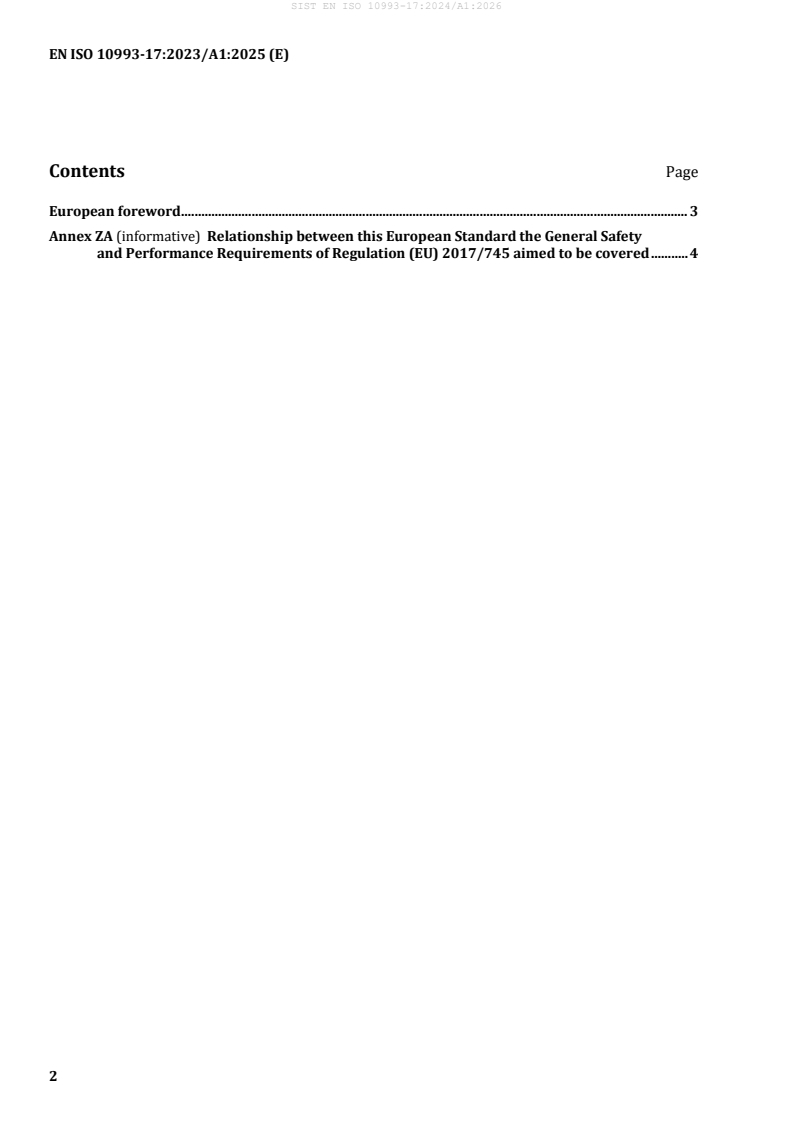
Contents Page
European foreword . 3
Annex ZA (informative) Relationship between this European Standard the General Safety
and Performance Requirements of Regulation (EU) 2017/745 aimed to be covered . 4
European foreword
This document (EN ISO 10993-17:2023/A1:2025) has been prepared by Technical Committee ISO/TC
194 "Biological and clinical evaluation of medical devices" in collaboration with Technical Committee
CEN/TC 206 “Biological and clinical evaluation of medical devices” the secretariat of which is held by
DIN.
This Amendment to the European Standard EN ISO 10993-17:2023 shall be given the status of a
national standard, either by publication of an identical text or by endorsement, at the latest by June
2026, and conflicting national standards shall be withdrawn at the latest by June 2026.
Attention is drawn to the possibility that some of the elements of this document may be the subject of
patent rights. CEN shall not be held responsible for identifying any or all such patent rights.
This document has been prepared under a standardization request addressed to CEN by the European
Commission. The Standing Committee of the EFTA States subsequently approves these requests for its
Member States.
For the relationship with EU Legislation, see informative Annex ZA, which is an integral part of this
document.
Any feedback and questions on this document should be directed to the users’ national standards
body/national committee. A complete listing of these bodies can be found on the CEN website.
According to the CEN-CENELEC Internal Regulations, the national standards organizations of the
following countries are bound to implement this European Standard: Austria, Belgium, Bulgaria,
Croatia, Cyprus, Czech Republic, Denmark, Estonia, Finland, France, Germany, Greece, Hungary, Iceland,
Ireland, Italy, Latvia, Lithuania, Luxembourg, Malta, Netherlands, Norway, Poland, Portugal, Republic of
North Macedonia, Romania, Serbia, Slovakia, Slovenia, Spain, Sweden, Switzerland, Türkiye and the
United Kingdom.
Endorsement notice
The text of ISO 10993-17:2023/Amd 1:2025 has been approved by CEN as EN ISO 10993-
17:2023/A1:2025 without any modification.
Annex ZA
(informative)
Relationship between this European Standard the General Safety and
Performance Requirements of Regulation (EU) 2017/745 aimed to be
covered
This European standard has been prepared under M/575 to provide one voluntary means of
conforming to the General Safety and Performance Requirements of Regulation (EU) 2017/745 of 5
April 2017 concerning medical devices [OJ L 117] and to system or process requirements including
those relating to quality management systems, risk management, post-market surveillance systems,
clinical investigations, clinical evaluation or post-market clinical follow-up.
Once this standard is cited in the Official Journal of the European Union under that Regulation,
compliance with the normative clauses of this standard given in Table ZA.1 and application of the
edition of the normatively referenced standards as given in Table ZA.2 confers, within the limits of the
scope of this standard, a presumption of conformity with the corresponding General Safety and
Performance Requirements of that Regulation, and associated EFTA Regulations.
Where a definition in this harmonised standard differs from a definition of the same term set out in
Regulation (EU) 2017/745, the differences shall be indicated in the Annex Z. For the purpose of using
this standard in support of the requirements set out in Regulation (EU) 2017/745, the definitions set
out in this Regulation prevail.
Where the European standard is an adoption of an International Standard, the scope of this document
can differ from the scope of the European Regulation that it supports. As the scope of the applicable
regulatory requirements differ from nation to nation and region to region the standard can only
support European regulatory requirements to the extent of the scope of the European Regulation for
medical devices ((EU) 2017/745).
NOTE 1 Where a reference from a clause of this standard to the risk management process is made, the risk
management process needs to be in compliance with Regulation (EU) 2017/745. This means that risks have to be
‘reduced as far as possible’, ‘reduced to the lowest possible level’, ‘reduced as far as possible and appropriate’,
‘removed or reduced as far as possible’, ‘eliminated or reduced as far as possible’, ’removed or minimized as far as
possible’, or ‘minimized’, according to the wording of the corresponding General Safety and Performance
Requirement.
NOTE 2 The manufacturer’s policy for determining acceptable risk must be in compliance with General Safety
and Performance Requirements 1, 2, 3, 4, 5, 8, 9, 10, 11, 14, 16, 17, 18, 19, 20, 21 and 22 of the Regulation.
NOTE 3 When a General Safety and Performance Requirement does not appear in Table ZA.1, it means that it is
not addressed by this European Standard.
Table ZA.1 — Correspondence between this European Standard and Annex I
of Regulation (EU) 2017/745 [OJ L 117] and to system or process requirements including those
relating to quality management systems, risk management, post-market surveillance systems,
clinical investigations, clinical evaluation or post-market clinical follow-up.
General Safety and Clause(s)/subclause(s) of Remarks/Notes
Performance Requirements this EN
of Regulation
(EU) 2017/745
10.1 a), b), d), e), and h) 5, 6, 7, 8, 9, 10 and Annex A, This document addresses the
Annex B, Annex C and Annex E choice of materials as regards
toxicity, but 10.1 is only partly
covered. Flammability and
mechanical or physical (e.g.,
surface) properties are not
covered. This document provides
requirements for a toxicological
risk assessment process for
constituents present in or on, or
released from, a medical device.
This risk assessment process
involves the identification of
substances that have the capacity
to interact with biological tissues,
cells or body fluids and the
assessment of the nature and
likelihood of any associated harm
to health arising as a result of the
intended use of the medical device.
While such an assessment can
confirm the absence of appreciable
toxicological risk, it does not
necessarily demonstrate the ability
of a medical device or material to
perform with an appropriate host
response in a specific application.
The toxicological risk assessment
is based on the composition of the
finished medical device, which is
dependent, in part, on the
processing materials used and the
impact of processes on the
materials of manufacture.
Where appropriate and necessary
for the risk assessment,
quantitative structure-activity
relationships or mathematical
models can be used as part of the
process specified.
The document provides
requirements for a process for
specifying a level of exposure to a
General Safety and Clause(s)/subclause(s) of Remarks/Notes
Performance Requirements this EN
of Regulation
(EU) 2017/745
constituent of a medical device that
is without appreciable harm to
health and for confirming that a
medical device meets the
specification so defined.
10.2 5, 6, 7, 8, 9, 10 and Annex A, The document addresses risks
Annex B, Annex C and Annex E posed by contaminants and
residues. However, 10.2 is only
partly covered by this document,
since the document does not
provide requirements for design,
manufacture and packaging.
Although the document does not
oblige manufacturers to minimize
the risk posed by contaminants
and residues in medical devices, it
provides a means to estimate those
risks and demonstrate that they
have been minimized.
The primary focus of this
document is the risk to patients,
but risks to users coming into
contact with a medical device are
also addressed. However the
document is not applicable to
medical device constituents that do
not contact the body, so risks to
persons involved in the transport
or storage of medical devices
would not normally be addressed.
10.4.1, 1st paragraph 5, 6, 7, 8, 9, 10 and Annex A, The document addresses risks
Annex B, Annex C and Annex E posed by substances, including
degradation products and
processing residues. However,
10.4.1 is only partly covered by
this document, since the document
does not provide requirements for
design and manufacture, nor does
it address risks associated with
particles, including wear debris,
from medical devices. Although
this document does not oblige
manufacturers to reduce as far as
possible the toxicological risk
posed by substa
...