

EN 81-73:2020
(Main)Safety rules for the construction and installation of lifts - Particular applications for passenger and goods passenger lifts - Part 73: Behaviour of lifts in the event of fire
- Abstract
This document specifies the special provisions and safety rules describing the behaviour of lifts in the event of fire in a building, on the basis of a recall signal(s) to the lift(s) control system.
This document applies to new passenger lifts and goods passenger lifts with all types of drives. However, it may be used as a basis to improve the safety of existing passenger and goods passenger lifts.
This document does not apply to:
- lifts that remain in use in the event of fire, e.g. firefighters lifts as defined in EN 81-72:2020,
- lifts used for the evacuation of a building.
- Status
- Published
- Publication Date
- 21-Jul-2020
- Withdrawal Date
- 30-Jul-2022
- Technical Committee
- CEN/TC 10 - Passenger, goods and service lifts
- Drafting Committee
- CEN/TC 10/WG 6 - Fire figting lifts
- Current Stage
- 9092 - Decision on results of review/2YR ENQ - revise - Review Enquiry
- Start Date
- 19-Jun-2025
- Completion Date
- 14-Oct-2026


Overview
EN 81-73:2020 (CEN) defines safety rules for the behaviour of passenger and goods passenger lifts in the event of fire based on a fire recall signal to the lift control system. It applies to new lifts with all drive types and can be used to improve existing installations. The standard sets requirements for recall means (manual or automatic), control-system interfaces, designated landings, signage and audible warnings. It does not apply to firefighters’ lifts (EN 81-72:2020) or lifts specifically used for building evacuation.
Key topics and requirements
- Scope & intent: Automatic return of car(s) to one or more designated landings and removal from normal service to reduce risk of trapped passengers and exposure to fire/smoke.
- Recall means: Can be manual (key switch, break-glass) or automatic (BMS, fire detection). Manual devices must be bi-stable, clearly indicated, protected from misuse and marked per EN ISO 7010 P020 (“Do not use lift in the event of fire”).
- Interface behaviour: Interruption or activation of the interface to the lift control system shall initiate recall. Only the first received signal is acted on until reset.
- Lift response on recall:
- All landing and car registration calls cancelled; landing controls rendered inoperative (door open and emergency alarm remain operative).
- Car returns nonstop to the designated landing; doors may be closed or opened per agreed strategy.
- Audible warning in car and relevant machine spaces, adjustable between 35–65 dB(A), initially set to 55 dB(A).
- Recall does not override safety or maintenance operations, inspection or emergency electrical operation, seismic mode or remote alarm systems.
- Signage & information: Prohibition signs (EN ISO 7010) must be displayed visibly on all landings; building designers and lift installers must agree on designated landings, interface type and maintenance/verification plans.
- Verification & maintenance: Provisions include verification of safety requirements and recommended maintenance/inspection regimes (see Annexes).
Applications - who uses EN 81-73:2020
- Lift manufacturers and control-system designers - to implement compliant fire-recall functions and interfaces.
- Building designers, architects and fire engineers - to specify designated landings and integration with fire detection/BMS.
- Lift installers, maintenance teams and facility managers - for commissioning, testing, maintenance and retrofits to improve fire safety.
- Regulators and safety assessors - for conformity assessment and risk reduction in buildings.
Related standards
- EN 81-20:2020 (passenger & goods passenger lifts)
- EN 81-50:2020 (tests & examinations)
- EN 81-72:2020 (firefighters’ lifts) - excluded by EN 81-73
- EN 81-77:2018 (seismic conditions)
- EN ISO 7010:2020 (safety signs)
- EN ISO 12100:2010 (risk assessment)
EN 81-73:2020 supersedes EN 81-73:2016; Annex ZA links the standard to EU Directive 2014/33/EU. Keywords: EN 81-73:2020, fire recall, lifts, designated landing, lift safety, lift control interface, building fire safety.
Relations
- Effective Date
- 08-Jun-2022
- Effective Date
- 28-Jan-2026
- Effective Date
- 28-Jan-2026
- Effective Date
- 28-Jan-2026
- Effective Date
- 28-Jan-2026
- Effective Date
- 28-Jan-2026
- Effective Date
- 09-Feb-2026
- Effective Date
- 28-Jan-2026
- Effective Date
- 28-Jan-2026
- Effective Date
- 28-Jan-2026
- Effective Date
- 28-Jan-2026
- Effective Date
- 28-Jan-2026
- Effective Date
- 28-Jan-2026
- Effective Date
- 28-Jan-2026
Get Certified
Connect with accredited certification bodies for this standard

DIBt (Deutsches Institut für Bautechnik)
German Institute for Building Technology.
DIN CERTCO
DIN Group product certification.

Kiwa BDA Testing
Building and construction product certification.
Sponsored listings
Frequently Asked Questions
EN 81-73:2020 is a standard published by the European Committee for Standardization (CEN). Its full title is "Safety rules for the construction and installation of lifts - Particular applications for passenger and goods passenger lifts - Part 73: Behaviour of lifts in the event of fire". This standard covers: This document specifies the special provisions and safety rules describing the behaviour of lifts in the event of fire in a building, on the basis of a recall signal(s) to the lift(s) control system. This document applies to new passenger lifts and goods passenger lifts with all types of drives. However, it may be used as a basis to improve the safety of existing passenger and goods passenger lifts. This document does not apply to: - lifts that remain in use in the event of fire, e.g. firefighters lifts as defined in EN 81-72:2020, - lifts used for the evacuation of a building.
This document specifies the special provisions and safety rules describing the behaviour of lifts in the event of fire in a building, on the basis of a recall signal(s) to the lift(s) control system. This document applies to new passenger lifts and goods passenger lifts with all types of drives. However, it may be used as a basis to improve the safety of existing passenger and goods passenger lifts. This document does not apply to: - lifts that remain in use in the event of fire, e.g. firefighters lifts as defined in EN 81-72:2020, - lifts used for the evacuation of a building.
EN 81-73:2020 is classified under the following ICS (International Classification for Standards) categories: 13.220.50 - Fire-resistance of building materials and elements; 91.140.90 - Lifts. Escalators. The ICS classification helps identify the subject area and facilitates finding related standards.
EN 81-73:2020 has the following relationships with other standards: It is inter standard links to EN 81-73:2016, EN 81-50:2020, EN ISO 12100:2010, EN 81-20:2020, EN 81-77:2018, EN ISO 7010:2020, EN 50600-2-1:2021, EN 81-80:2019, EN 81-71:2022, EN 12015:2004, EN 81-80:2003, EN 81-71:2018+AC:2019, EN 81-71:2018, EN 81-72:2020. Understanding these relationships helps ensure you are using the most current and applicable version of the standard.
EN 81-73:2020 is associated with the following European legislation: EU Directives/Regulations: 2014/33/EU; Standardization Mandates: M/549. When a standard is cited in the Official Journal of the European Union, products manufactured in conformity with it benefit from a presumption of conformity with the essential requirements of the corresponding EU directive or regulation.
EN 81-73:2020 is available in PDF format for immediate download after purchase. The document can be added to your cart and obtained through the secure checkout process. Digital delivery ensures instant access to the complete standard document.
Standards Content (Sample)
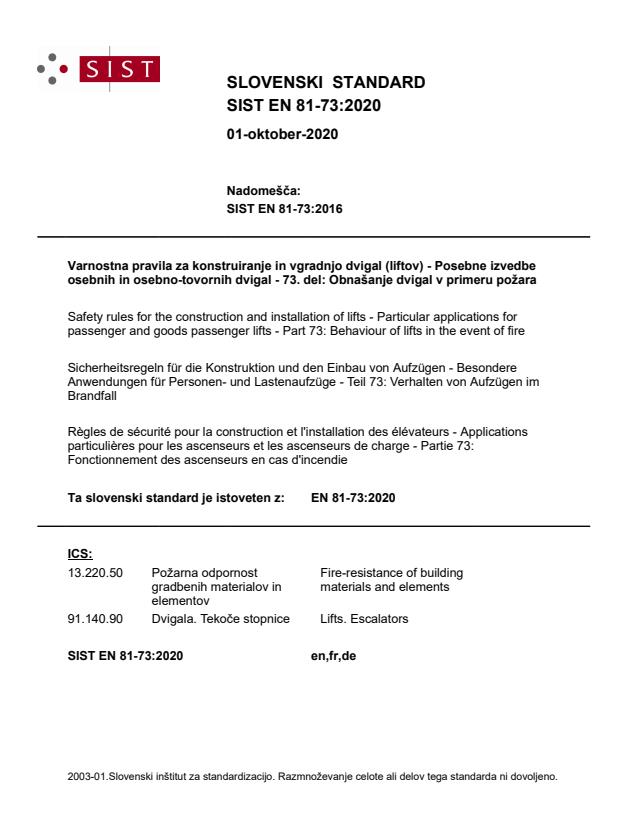
SLOVENSKI STANDARD
01-oktober-2020
Nadomešča:
SIST EN 81-73:2016
Varnostna pravila za konstruiranje in vgradnjo dvigal (liftov) - Posebne izvedbe
osebnih in osebno-tovornih dvigal - 73. del: Obnašanje dvigal v primeru požara
Safety rules for the construction and installation of lifts - Particular applications for
passenger and goods passenger lifts - Part 73: Behaviour of lifts in the event of fire
Sicherheitsregeln für die Konstruktion und den Einbau von Aufzügen - Besondere
Anwendungen für Personen- und Lastenaufzüge - Teil 73: Verhalten von Aufzügen im
Brandfall
Règles de sécurité pour la construction et l'installation des élévateurs - Applications
particulières pour les ascenseurs et les ascenseurs de charge - Partie 73:
Fonctionnement des ascenseurs en cas d'incendie
Ta slovenski standard je istoveten z: EN 81-73:2020
ICS:
13.220.50 Požarna odpornost Fire-resistance of building
gradbenih materialov in materials and elements
elementov
91.140.90 Dvigala. Tekoče stopnice Lifts. Escalators
2003-01.Slovenski inštitut za standardizacijo. Razmnoževanje celote ali delov tega standarda ni dovoljeno.
EN 81-73
EUROPEAN STANDARD
NORME EUROPÉENNE
July 2020
EUROPÄISCHE NORM
ICS 13.220.50; 91.140.90 Supersedes EN 81-73:2016
English Version
Safety rules for the construction and installation of lifts -
Particular applications for passenger and goods passenger
lifts - Part 73: Behaviour of lifts in the event of fire
Règles de sécurité pour la construction et l'installation Sicherheitsregeln für die Konstruktion und den Einbau
des élévateurs - Applications particulières pour les von Aufzügen - Besondere Anwendungen für
ascenseurs et ascenseurs de charge - Partie 73 : Personen- und Lastenaufzüge - Teil 73: Verhalten von
Fonctionnement des ascenseurs en cas d'incendie Aufzügen im Brandfall
This European Standard was approved by CEN on 8 June 2020.
CEN members are bound to comply with the CEN/CENELEC Internal Regulations which stipulate the conditions for giving this
European Standard the status of a national standard without any alteration. Up-to-date lists and bibliographical references
concerning such national standards may be obtained on application to the CEN-CENELEC Management Centre or to any CEN
member.
This European Standard exists in three official versions (English, French, German). A version in any other language made by
translation under the responsibility of a CEN member into its own language and notified to the CEN-CENELEC Management
Centre has the same status as the official versions.
CEN members are the national standards bodies of Austria, Belgium, Bulgaria, Croatia, Cyprus, Czech Republic, Denmark, Estonia,
Finland, France, Germany, Greece, Hungary, Iceland, Ireland, Italy, Latvia, Lithuania, Luxembourg, Malta, Netherlands, Norway,
Poland, Portugal, Republic of North Macedonia, Romania, Serbia, Slovakia, Slovenia, Spain, Sweden, Switzerland, Turkey and
United Kingdom.
EUROPEAN COMMITTEE FOR STANDARDIZATION
COMITÉ EUROPÉEN DE NORMALISATION
EUROPÄISCHES KOMITEE FÜR NORMUNG
CEN-CENELEC Management Centre: Rue de la Science 23, B-1040 Brussels
© 2020 CEN All rights of exploitation in any form and by any means reserved Ref. No. EN 81-73:2020 E
worldwide for CEN national Members.
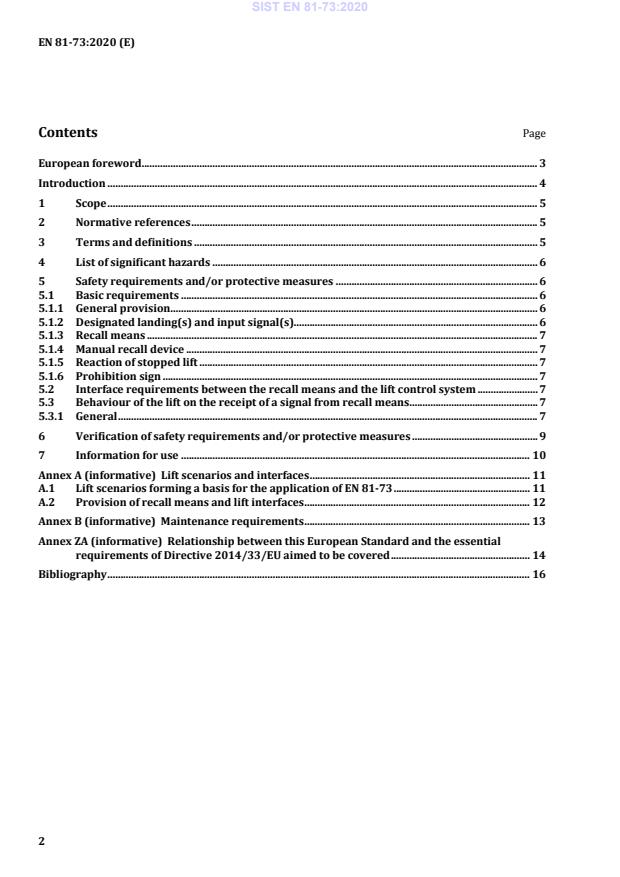
Contents Page
European foreword . 3
Introduction . 4
1 Scope . 5
2 Normative references . 5
3 Terms and definitions . 5
4 List of significant hazards . 6
5 Safety requirements and/or protective measures . 6
5.1 Basic requirements . 6
5.1.1 General provision . 6
5.1.2 Designated landing(s) and input signal(s). 6
5.1.3 Recall means . 7
5.1.4 Manual recall device . 7
5.1.5 Reaction of stopped lift . 7
5.1.6 Prohibition sign . 7
5.2 Interface requirements between the recall means and the lift control system . 7
5.3 Behaviour of the lift on the receipt of a signal from recall means. 7
5.3.1 General . 7
6 Verification of safety requirements and/or protective measures . 9
7 Information for use . 10
Annex A (informative) Lift scenarios and interfaces . 11
A.1 Lift scenarios forming a basis for the application of EN 81-73 . 11
A.2 Provision of recall means and lift interfaces . 12
Annex B (informative) Maintenance requirements . 13
Annex ZA (informative) Relationship between this European Standard and the essential
requirements of Directive 2014/33/EU aimed to be covered . 14
Bibliography . 16
European foreword
This document (EN 81-73:2020) has been prepared by Technical Committee CEN/TC 10 “Lifts,
escalators and moving walks”, the secretariat of which is held by AFNOR.
This European Standard shall be given the status of a national standard, either by publication of an
identical text or by endorsement, at the latest by January 2021, and conflicting national standards shall
be withdrawn at the latest by July 2022.
Attention is drawn to the possibility that some of the elements of this document may be the subject of
patent rights. CEN shall not be held responsible for identifying any or all such patent rights.
This document supersedes EN 81-73:2016.
This document is a revision of EN 81-73:2016 in order to align its Annex ZA to the new format and
requirements as laid out in the EU Commission Standardization Request “M/549 C (2016) 5884 final”.
During this revision no technical changes are made and the technical requirements of this document
remain identical to EN 81-73:2016.
This document has been prepared under a mandate given to CEN by the European Commission and the
European Free Trade Association, and supports essential requirements of EU Directive(s).
For relationship with EU Directive 2014/33/EC amended by 2006/42/EC, see informative Annex ZA,
which is an integral part of this document.
According to the CEN-CENELEC Internal Regulations, the national standards organisations of the
following countries are bound to implement this European Standard: Austria, Belgium, Bulgaria,
Croatia, Cyprus, Czech Republic, Denmark, Estonia, Finland, France, Germany, Greece, Hungary, Iceland,
Ireland, Italy, Latvia, Lithuania, Luxembourg, Malta, Netherlands, Norway, Poland, Portugal, Republic of
North Macedonia, Romania, Serbia, Slovakia, Slovenia, Spain, Sweden, Switzerland, Turkey and the
United Kingdom.
Introduction
This document is a type C standard as stated in EN ISO 12100:2010.
The lifts concerned and the extent to which hazards, hazardous situations and events are covered are
indicated in the scope of this document.
When provisions of this type C standard are different from those which are stated in type A or B
standards, the provisions of this type C standard take precedence over the provisions of the other
standards, for lifts that have been designed and built according to the provisions of this type C standard.
The function described in this document relates to the automatic return of the car(s) to a designated
landing and the removal of the lift(s) from service.
This document deals with
a) reducing the risk of passengers being trapped in a car in the event of a fire in a building,
b) helping the firefighters/rescue teams to check that the lift contains no trapped passengers since it
will be finally parked at a designated landing,
c) reducing the risk of passengers in the car being exposed to fire and smoke.
The contents of this document are based on the following assumptions:
— recall means initiates the signal to the lift causing a specific reaction of the lift;
— building designers, architects or planners give careful consideration to specifying fire recall to lifts
as this document;
— there is a clear separation between the functioning of the recall means and the lift control system;
and
— recall means is operating as intended.
This document assumes that negotiation has taken place between the building designer and the lift
installer on the following:
— type of recall means and its interface (see EN 81-20:2020, 0.4.2);
— type and protection of switch in case of manual recall device;
— number and location of designated landing(s);
— suitable maintenance and verification plan is implemented; and
— whether the lift parks with doors open or closed at the designated landing.
1 Scope
This document specifies the special provisions and safety rules describing the behaviour of lifts in the
event of fire in a building, on the basis of a recall signal(s) to the lift(s) control system.
This document applies to new passenger lifts and goods passenger lifts with all types of drives.
However, it may be used as a basis to improve the safety of existing passenger and goods passenger
lifts.
This document does not apply to:
— lifts that remain in use in the event of fire, e.g. firefighters lifts as defined in EN 81-72:2020,
— lifts used for the evacuation of a building.
2 Normative references
The following documents are referred to in the text in such a way that some or all of their content
constitutes requirements of this document. For dated references, only the edition cited applies. For
undated references, the latest edition of the referenced document (including any amendments) applies.
EN 81-20:2020, Safety rules for the construction and installation of lifts - Lifts for the transport of persons
and goods - Part 20: Passenger and goods passenger lifts
EN 81-50:2020, Safety rules for the construction and installation of lifts - Examinations and tests -
Part 50: Design rules, calculations, examinations and tests of lift components
EN 81-72:2020, Safety rules for the construction and installation of lifts - Particular applications for
passenger and goods passenger lifts - Part 72: Firefighters lifts
EN 81-77:2018, Safety rules for the construction and installations of lifts - Particular applications for
passenger and goods passenger lifts - Part 77: Lifts subject to seismic conditions
EN ISO 7010:2020, Graphical symbols - Safety colours and safety signs - Registered safety signs
(ISO 7010:2019)
EN ISO 12100:2010, Safety of machinery - General principles for design - Risk assessment and risk
reduction (ISO 12100:2010)
3 Terms and definitions
For the purposes of this document, the terms and definitions given in EN ISO 12100:2010,
EN 81-20:2020 and EN 81-50:2020 and the following apply.
ISO and IEC maintain terminological databases for use in standardization at the following addresses:
— IEC Electropedia: available at http://www.electropedia.org/
— ISO Online browsing platform: available at https://www.iso.org/obp/ui
3.1
building responsible person
person legally responsible for the building
3.2
building management system
BMS
system capable of making decisions based on information sent to it
3.3
designated landing
floor determined by the building evacuation strategy that allows persons leaving the lift to safely exit
the building or area of the building during a fire
3.4
manual recall device
manually operated device, e.g. break glass toggle switch, button or key switch, which, upon operation,
activates a signal, causing the lift under control to operate in the desired manner
4 List of significant hazards
This clause contains all the significant hazards, hazardous situations and events, as far as they are dealt
with in this document, identified by risk assessment as significant for lifts and which require action to
eliminate or reduce the risk. See Table 1.
Table 1 — Significant hazards dealt with in this document
No Hazards as listed in EN ISO 12100:2010, Requirements and clauses in this
Annex B document
1 Mechanical hazards 5.1.4, 5.1.5, 5.3.4, 5.3.5, 5.3.6, 5.3.7
1 Trapping hazard 5.1, 5.2, 5.3
1 Impact hazard 5.3.2
3 Thermal hazard (Contamination by heat or smoke) 5.1, 5.2, 5.3
8 Inadequate design or location of displaying uni
...