

EN 50600-2-1:2021
(Main)Information technology - Data centre facilities and infrastructures - Part 2-1: Building construction
General Information
- Abstract
This document gives guidelines for the construction of buildings and other structures which provide accommodation for data centres based upon the criteria and classification for “physical security” within EN 50600 1 in support of availability. This document specifies requirements and recommendations for the following: a) location and site selection (taking in to account natural environment and adjacencies); b) protection from environmental risks; c) site configuration; d) building construction; e) building configuration; f) provision of access; g) intrusion protection; h) physical fire protection; i) protection against damage from water; j) quality construction measures. Safety and electromagnetic compatibility (EMC) requirements are outside the scope of this document and are covered by other standards and regulations. However, information given in this document can be of assistance in meeting these standards and regulations. Conformance of data centres to the present document is covered in Clause 4.
- Status
- Published
- Publication Date
- 15-Apr-2021
- Technical Committee
- CLC/TC 215 - Electrotechnical aspects of telecommunication equipment
- Drafting Committee
- CLC/TC 215 - Electrotechnical aspects of telecommunication equipment
- Current Stage
- 9093 - Decision to confirm - Review Enquiry
- Start Date
- 11-Mar-2026
- Completion Date
- 25-Aug-2026



Overview
EN 50600-2-1:2021 (CLC) is the European building-construction component of the EN 50600 data centre standards series. It provides guidelines, requirements and recommendations for the construction and configuration of buildings and structures that house data centres, focusing on physical security and supporting availability. Published in 2021, it supersedes the 2014 edition and is intended to be used alongside other EN 50600 parts (design, operations, KPIs, maturity model).
Key topics and technical requirements
The standard addresses building-level measures that reduce environmental and operational risks for data centre facilities. Major topics include:
- Location and site selection: geographical assessment, environmental-risk analysis and utility provision to inform site choice (see Clause 5 and Annex B summary).
- Protection from environmental risks: guidance on flood, water ingress, and natural-hazard mitigation strategies (Clause 5 & Clause 10).
- Site configuration and outside spaces: access routes, parking, temporary facilities, fuel storage, underground installations and perimeter design (Clauses 6–7).
- Building construction and configuration: load-bearing structures, foundations, exterior/interior walls, roofs, floors, raised access floors and ceilings with construction quality measures (Clause 8).
- Access and intrusion protection: design for controlled entry, perimeter barriers and Protection Class boundaries to meet physical security levels (Clauses 7–8).
- Fire protection and compartmentation: fire compartments, barriers and related Protection Class boundary definitions for limiting spread of fire (Clause 11).
- Protection against water: water drainage, waterproofing and measures to prevent damage from internal or external water sources (Clauses 8 & 10).
- Support spaces and layout: allocation and construction guidance for computer rooms, control rooms, electrical/mechanical/telecom spaces, storage, docking bays and testing areas (Clauses 9–10).
- Conformance: procedures and criteria for demonstrating compliance to the standard are described in Clause 4.
Note: Safety and electromagnetic compatibility (EMC) requirements are outside the scope but the document can assist compliance with other applicable standards and regulations.
Practical applications and users
EN 50600-2-1 is practical for professionals involved in planning, designing, building and operating data centres:
- Owners, operators and facility managers assessing or procuring new data centre buildings
- Architects, structural and MEP engineers designing buildings to meet physical security and availability goals
- Contractors and builders implementing construction, waterproofing and fire compartmentation
- Consultants, auditors and commissioning agents verifying conformity and risk mitigation
- Colocation providers and network operators planning site selection, perimeter protection and utility redundancy
Use cases include new-build design, retrofit assessment of existing premises, site risk assessments, and specification of construction materials and access/perimeter controls.
Related standards
- EN 50600-1 (physical security classification and criteria)
- Other EN 50600 parts for design (2-x), operations (3-x) and KPIs (4-x)
- Relevant national building codes, fire safety and EMC standards
Keywords: EN 50600-2-1, data centre building construction, data centre standards, physical security, site selection, fire protection, flood protection, perimeter design, conformance.
Relations
- Effective Date
- 26-Jan-2023
- Effective Date
- 24-Jun-2026
- Effective Date
- 24-Jun-2026
- Effective Date
- 10-Feb-2026
- Effective Date
- 09-Feb-2026
- Effective Date
- 09-Feb-2026
- Effective Date
- 09-Feb-2026
- Effective Date
- 09-Feb-2026
- Effective Date
- 09-Feb-2026
- Effective Date
- 09-Feb-2026
- Effective Date
- 09-Feb-2026
- Effective Date
- 09-Feb-2026
- Effective Date
- 09-Feb-2026
- Effective Date
- 09-Feb-2026
- Effective Date
- 09-Feb-2026
Get Certified
Connect with accredited certification bodies for this standard

BSI Group
BSI (British Standards Institution) is the business standards company that helps organizations make excellence a habit.

DIBt (Deutsches Institut für Bautechnik)
German Institute for Building Technology.
DIN CERTCO
DIN Group product certification.
Sponsored listings
Frequently Asked Questions
EN 50600-2-1:2021 is a standard published by CLC. Its full title is "Information technology - Data centre facilities and infrastructures - Part 2-1: Building construction". This standard covers: This document gives guidelines for the construction of buildings and other structures which provide accommodation for data centres based upon the criteria and classification for “physical security” within EN 50600 1 in support of availability. This document specifies requirements and recommendations for the following: a) location and site selection (taking in to account natural environment and adjacencies); b) protection from environmental risks; c) site configuration; d) building construction; e) building configuration; f) provision of access; g) intrusion protection; h) physical fire protection; i) protection against damage from water; j) quality construction measures. Safety and electromagnetic compatibility (EMC) requirements are outside the scope of this document and are covered by other standards and regulations. However, information given in this document can be of assistance in meeting these standards and regulations. Conformance of data centres to the present document is covered in Clause 4.
This document gives guidelines for the construction of buildings and other structures which provide accommodation for data centres based upon the criteria and classification for “physical security” within EN 50600 1 in support of availability. This document specifies requirements and recommendations for the following: a) location and site selection (taking in to account natural environment and adjacencies); b) protection from environmental risks; c) site configuration; d) building construction; e) building configuration; f) provision of access; g) intrusion protection; h) physical fire protection; i) protection against damage from water; j) quality construction measures. Safety and electromagnetic compatibility (EMC) requirements are outside the scope of this document and are covered by other standards and regulations. However, information given in this document can be of assistance in meeting these standards and regulations. Conformance of data centres to the present document is covered in Clause 4.
EN 50600-2-1:2021 is classified under the following ICS (International Classification for Standards) categories: 35.020 - Information technology (IT) in general; 35.110 - Networking; 91.140.50 - Electricity supply systems. The ICS classification helps identify the subject area and facilitates finding related standards.
EN 50600-2-1:2021 has the following relationships with other standards: It is inter standard links to EN 50600-2-1:2014, EN ISO 8100-1:2026, EN ISO 8100-2:2026, EN 81-72:2015, EN 81-71:2005+A1:2006, EN 81-58:2003, EN 1634-2:2008, EN 81-72:2003, EN 81-77:2013, EN 81-77:2018, EN 81-30:2025, EN 81-73:2005, EN 81-40:2020, EN 81-3:2000, EN 81-76:2025. Understanding these relationships helps ensure you are using the most current and applicable version of the standard.
EN 50600-2-1:2021 is associated with the following European legislation: Standardization Mandates: M/462, M/526. When a standard is cited in the Official Journal of the European Union, products manufactured in conformity with it benefit from a presumption of conformity with the essential requirements of the corresponding EU directive or regulation.
EN 50600-2-1:2021 is available in PDF format for immediate download after purchase. The document can be added to your cart and obtained through the secure checkout process. Digital delivery ensures instant access to the complete standard document.
Standards Content (Sample)
SLOVENSKI STANDARD
01-junij-2021
Nadomešča:
SIST EN 50600-2-1:2014
Informacijska tehnologija - Naprave in infrastruktura podatkovnih centrov - 2-1.
del: Konstrukcija stavbe
Information technology - Data centre facilities and infrastructures - Part 2-1: Building
construction
Informationstechnik - Einrichtungen und Infrastrukturen von Rechenzentren - Teil 2-1:
Gebäudekonstruktion
Technologie de l'information - Installations et infrastructures de centres de traitement de
données - Partie 2-1: Construction des bâtiments
Ta slovenski standard je istoveten z: EN 50600-2-1:2021
ICS:
35.020 Informacijska tehnika in Information technology (IT) in
tehnologija na splošno general
35.110 Omreževanje Networking
91.140.50 Sistemi za oskrbo z elektriko Electricity supply systems
2003-01.Slovenski inštitut za standardizacijo. Razmnoževanje celote ali delov tega standarda ni dovoljeno.
EUROPEAN STANDARD EN 50600-2-1
NORME EUROPÉENNE
EUROPÄISCHE NORM
April 2021
ICS 35.020; 35.110; 91.140.50 Supersedes EN 50600-2-1:2014 and all of its
amendments and corrigenda (if any)
English Version
Information technology - Data centre facilities and infrastructures
- Part 2-1: Building construction
Technologie de l'information - Installation et infrastructures Informationstechnik - Einrichtungen und Infrastrukturen von
de centres de traitement de données - Partie 2-1: Rechenzentren - Teil 2-1: Gebäudekonstruktion
Construction des bâtiments
This European Standard was approved by CENELEC on 2021-03-22. CENELEC members are bound to comply with the CEN/CENELEC
Internal Regulations which stipulate the conditions for giving this European Standard the status of a national standard without any alteration.
Up-to-date lists and bibliographical references concerning such national standards may be obtained on application to the CEN-CENELEC
Management Centre or to any CENELEC member.
This European Standard exists in three official versions (English, French, German). A version in any other language made by translation
under the responsibility of a CENELEC member into its own language and notified to the CEN-CENELEC Management Centre has the
same status as the official versions.
CENELEC members are the national electrotechnical committees of Austria, Belgium, Bulgaria, Croatia, Cyprus, the Czech Republic,
Denmark, Estonia, Finland, France, Germany, Greece, Hungary, Iceland, Ireland, Italy, Latvia, Lithuania, Luxembourg, Malta, the
Netherlands, Norway, Poland, Portugal, Republic of North Macedonia, Romania, Serbia, Slovakia, Slovenia, Spain, Sweden, Switzerland,
Turkey and the United Kingdom.
European Committee for Electrotechnical Standardization
Comité Européen de Normalisation Electrotechnique
Europäisches Komitee für Elektrotechnische Normung
CEN-CENELEC Management Centre: Rue de la Science 23, B-1040 Brussels
© 2021 CENELEC All rights of exploitation in any form and by any means reserved worldwide for CENELEC Members.
Ref. No. EN 50600-2-1:2021 E
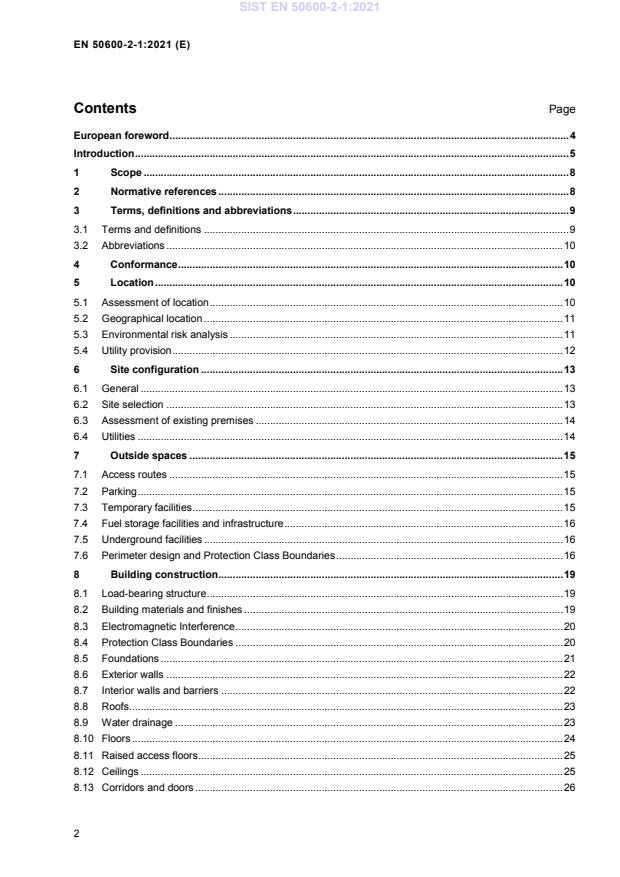
Contents Page
European foreword . 4
Introduction . 5
1 Scope . 8
2 Normative references . 8
3 Terms, definitions and abbreviations . 9
3.1 Terms and definitions . 9
3.2 Abbreviations . 10
4 Conformance . 10
5 Location . 10
5.1 Assessment of location . 10
5.2 Geographical location . 11
5.3 Environmental risk analysis . 11
5.4 Utility provision . 12
6 Site configuration . 13
6.1 General . 13
6.2 Site selection . 13
6.3 Assessment of existing premises . 14
6.4 Utilities . 14
7 Outside spaces . 15
7.1 Access routes . 15
7.2 Parking . 15
7.3 Temporary facilities . 15
7.4 Fuel storage facilities and infrastructure . 16
7.5 Underground facilities . 16
7.6 Perimeter design and Protection Class Boundaries . 16
8 Building construction . 19
8.1 Load-bearing structure . 19
8.2 Building materials and finishes . 19
8.3 Electromagnetic Interference . 20
8.4 Protection Class Boundaries . 20
8.5 Foundations . 21
8.6 Exterior walls . 22
8.7 Interior walls and barriers . 22
8.8 Roofs . 23
8.9 Water drainage . 23
8.10 Floors . 24
8.11 Raised access floors . 25
8.12 Ceilings . 25
8.13 Corridors and doors . 26
8.14 Transportation lifts . 26
9 Design of data centre spaces . 26
9.1 Accommodation . 26
9.2 Control room space . 27
9.3 Computer room space . 27
9.4 Electrical space . 28
9.5 Mechanical space . 28
9.6 Telecommunications space . 28
9.7 Spaces for firefighting systems . 28
9.8 Storage space . 28
9.9 Testing and holding spaces . 29
9.10 Docking bay . 29
9.11 General office space . 29
10 Construction of data centre spaces . 29
10.1 Protection against flooding . 29
10.2 Access to data centre spaces . 30
10.3 Vapour density . 30
11 Fire compartments and fire barriers . 30
11.1 Fire compartments . 30
11.2 Fire barriers. 31
11.3 Protection Class boundaries . 32
Annex A (informative) Building materials . 33
Annex B (informative) Summary of data centre location requirements and recommendations of
Clause 5 . 35
Bibliography . 38
Figures
Figure 1 — Schematic relationship between the EN 50600 series standards. 6
Figure 2 — Examples of free-standing barriers and minimum effective height . 18
Tables
Table 1 — Heights and topping requirements for free-standing barriers . 17
Table 2 — Load capacity guidance for building structures . 24
Table B.1 — Summary of EN 50600-2-1:2021, Clause 5 location requirements and recommendations35
European foreword
This document (EN 50600-2-1:2021) has been prepared by CLC/TC 215 “Electrotechnical aspects of
telecommunication equipment”.
The following dates are fixed:
• latest date by which this document has to be (dop) 2022-03-22
implemented at national level by publication of an
identical national standard or by endorsement
• latest date by which the national standards (dow) 2024-03-22
conflicting with this document have to be withdrawn
This document supersedes EN 50600-2-1:2014 and all of its amendments and corrigenda (if any).
This document includes the following significant technical changes with respect to EN 50600-2-1:2014:
a) the document has been completely revised and restructured;
b) the interrelationship between this document and EN 50600-2-5 concerning constructional prerequisites for
the implementation of security concepts and desired security systems has been more clearly presented;
c) Clause 6 “Site configuration” has been split and relevant subclauses have been moved into a new Clause 7
“Outside spaces”;
d) Clause 7 “Building construction” has been completely reworked to present all requirements and
recommendations in a single Clause 8;
e) Clause 8 “Data centre spaces and access routes” has been revised to focus on the design of data centre
spaces (now Clause 9);
f) a new Clause 10 “Construction of data centre spaces” has been added;
g) Clause 9 “Fire compartments, fire barriers and fire suppression systems” has been revised (now
Clause 11);
h) Annex A on additional requirements and recommendations has been removed;
i) Annex B on physical protection against external hazards has been revised as Annex A “Building materials”;
j) a new Annex B summarizing the requirements and recommendations of Clause 5 has been added;
k) Clauses 1 to 4 have been amended accordingly.
Attention is drawn to the possibility that some of the elements of this document may be the subject of patent
rights. CENELEC shall not be held responsible for identifying any or all such patent rights.
This document has been prepared under a mandate given to CENELEC by the European Commission and the
European Free Trade Association.
Introduction
The unrestricted access to internet-based information demanded by the information society has led to an
exponential growth of both internet traffic and the volume of stored/retrieved data. Data centres are housing
and supporting the information technology and network telecommunications equipment for data processing,
data storage and data transport. They are required both by network operators (delivering those services to
customer premises) and by enterprises within those customer premises.
Data centres usually provide modular, scalable and flexible facilities and infrastructures to easily accommodate
the rapidly changing requirements of the market. In addition, energy consumption of data centres has become
critical both from an environmental point of view (reduction of environmental footprint) and with respect to
economical considerations (cost of energy) for the data centre operator.
The implementation of data centres varies in terms of:
a) purpose (enterprise, co-location, co-hosting or network operator facilities);
b) security level;
c) physical size;
d) accommodation (mobile, temporary and permanent constructions).
The needs of data centres also vary in terms of availability of service, the provision of security and the objectives
for energy efficiency. These needs and objectives influence the design of data centres in terms of building
construction, power distribution, environmental control, telecommunications cabling and physical security as
well as the operation of the data centre. Effective management and operational information is important in order
to monitor achievement of the defined needs and objectives.
Recognizing the substantial resource consumption, particularly of energy, of larger data centres, it is also
important to provide tools for the assessment of that consumption both in terms of overall value and of source
mix and to provide Key Performance Indicators (KPIs) to evaluate trends and drive performance improvements.
At the time of publication of this document, the EN 50600 series is designed as a framework of standards,
technical specifications and technical reports covering the design, the operation and management, the key
performance indicators for energy efficient operation of the data centre as well as a data centre maturity model.
The EN 50600-2 series defines the requirements for the data centre design.
The EN 50600-3 series defines the requirements for the operation and the management of the data centre.
The EN 50600-4 series defines the key performance indicators for the data centre.
The CLC/TS 50600-5 series defines the data centre maturity model requirements and recommendations.
The CLC/TR 50600-99-X Technical Reports cover recommended practices and guidance for specific topics
around data centre operation and design.
This series of documents specifies requirements and recommendations to support the various parties involved
in the design, planning, procurement, integration, installation, operation and maintenance of facilities and
infrastructures within data centres. These parties include:
1) owners, operators, facility managers, ICT managers, project managers, main contractors;
2) consulting engineers, architects, building designers and builders, system and installation designers,
auditors, test and commissioning agents;
3) facility and infrastructure integrators, suppliers of equipment;
4) installers, maintainers.
At the time of publication of this document, the EN 50600-2 series comprises the following documents:
EN 50600-2-1, Information technology — Data centre facilities and infrastructures — Part 2-1: Building
construction;
EN 50600-2-2, Information technology — Data centre facilities and infrastructures — Part 2-2: Power supply
and distribution;
EN 50600-2-3, Information technology — Data centre facilities and infrastructures — Part 2-3: Environmental
control;
EN 50600-2-4, Information technology — Data centre facilities and infrastructures — Part 2-4:
Telecommunications cabling infrastructure;
EN 50600-2-5, Information technology — Data centre facilities and infrastructures — Part 2-5: Security
systems.
CLC/TS 50600-2-10, Information technology — Data centre facilities and infrastructures — Part 2-10:
Earthquake risk and impact analysis
The inter-relationship of the documents within the EN 50600 series is shown in Figure 1.
Figure 1 — Schematic relationship between the EN 50600 series standards
EN 50600-2-X documents specify requirements and recommendations for particular facilities and
infrastructures to support the relevant classification for “availability”, “physical security” and “energy efficiency
enablement” selected from EN 50600-1.
EN 50600-3-X documents specify requirements and recommendations for data centre operations,
processes and management.
EN 50600-4-X documents specify requirements and recommendations for key performance indicators (KPIs)
used to assess and improve the resource usage efficiency and effectiveness, respectively, of a data centre.
This document addresses the site selection and the building design of data centres; it addresses security issues
from a constructional point of view, whereas EN 50600-2-5 specifies the security system requirements of those
facilities and infrastructures (in accordance with the requirements of EN 50600-1).
This document is intended for use by and collaboration between architects, building designers and builders,
system and installation designers.
This series of documents does not address the selection of information technology and network
telecommunications equipment, software and associated configuration issues.
1 Scope
This document gives guidelines for the construction of buildings and other structures which provide
accommodation for data centres based upon the criteria and classification for “physical security” within
EN 50600-1 in support of availability.
This document specifies requirements and recommendations for the following:
a) location and site selection (taking in to account natural environment and adjacencies);
b) protection from environmental risks;
c) site configuration;
d) building construction;
e) building configuration;
f) provision of access;
g) intrusion protection;
h) physical fire protection;
i) protection against damage from water;
j) quality construction measures.
Safety and electromagnetic compatibility (EMC) requirements are outside the scope of this document and are
covered by other standards and regulations. However, information given in this document can be of assistance
in meeting these standards and regulations.
Conformance of data centres to the present document is covered in Clause 4.
2 Normative references
The following documents are referred to in the text in such a way that some or all of their content constitutes
requirements of this document. For dated references, only the edition cited applies. For undated references,
the latest edition of the referenced document (including any amendments) applies.
EN 81 (all parts), Safety rules for the construction and installation of lifts - Special lifts for the transport of
persons and goods
EN 1366-3, Fire resistance tests for service installations - Part 3: Penetration seals
EN 1627:2011, Pedestrian doorsets, windows, curtain walling, grilles and shutters - Burglar resistance -
Requirements and classification
EN 1634 (all parts), Fire resistance and smoke control tests for door and shutter assemblies, openable windows
and elements of building hardware
EN 1991-1-1, Eurocode 1: Actions on structures - Part 1-1: General actions - Densities, self-weight, imposed
loads for buildings
EN 12825:2001, Raised access floors
EN 50310, Telecommunications bonding networks for buildings and other structures
EN 50600-1:2019, Information technology - Data centre facilities and infrastructures - Part 1: General concepts
EN 50600-2-2, Information technology - Data centre facilities and infrastructures - Part 2-2: Power supply and
distribution
EN 50600-2-3, Information technology - Data centre facilities and infrastructures - Part 2-3: Environmental
control
EN 50600-2-4, Information technology - Data centre facilities and infrastructures - Part 2-4:
Telecommunications cabling infrastructure
EN 50600-2-5, Information technology - Data centre facilities and infrastructures - Part 2-5: Security systems
CLC/TS 50600-2-10, Information technology - Data centre facilities and infrastructures - Part 2-10: Earthquake
risk and impact analysis
EN 50600-3-1, Information technology - Data centre facilities and infrastructures - Part 3-1: Management and
operational information
3 Terms, definitions and abbreviations
3.1 Terms and definitions
For the purposes of this document, the terms and definitions given in EN 50600-1 and the following apply.
ISO and IEC maintain terminological databases for use in standardization at the following addresses:
— ISO Online browsing platform: available at https://www.iso.org/obp
— IEC Electropedia: available at http://www.electropedia.org/
3.1.1
effective height of free-standing barrier
h
e
shortest distance between any point on the top of the permanent part of the free-standing barrier (excluding
any toppings) and the surface of the supporting ground when measured in the plane of the barrier
3.1.2
free-standing barrier
wall, fence, gate, turnstile or other similar self-supporting barrier, and their associated foundations, designed to
prevent entry to a space of a given Protection Class
3.1.3
topping
construction, added to the top of a free-standing barrier, and designed to be an effective intruder deterrent or
for a decorative display of security
3.1.4
modular construction
construction method which uses a system of prefabricated elements and assemblies
3.1.5
pathway
defined route of different media between identified points
Note 1 to entry: Examples of media are bus bars, cables, conduits, ducts, pipes.
3.1.6
raised access floor
system consisting of completely removable and interchangeable floor panels that are supported on an
adjustable substructure to allow the area beneath the raised access floor panels to be used by building services
3.2 Abbreviations
For the purposes of this document, the following abbreviations apply:
AHU Air handling unit
HVAC Heating, Ventilation, Air Conditioning
IT Information Technology
M&E Mechanical and electrical
PDU Power distribution unit
UPS Uninterruptible Power System
4 Conformance
For a data centre to conform to this document:
a) its location shall have been selected following a site assessment as required in Clause 5 (see also
Annex B);
b) it shall comply with the site requirements of Clause 6;
c) it shall meet the requirements of Clause 7 where the data centre spaces are outside buildings;
d) it shall meet the building construction requirements of Clause 8 where the data centre spaces are within
buildings;
e) it shall meet the building configuration and construction requirements detailed in Clauses 9 and 10;
f) it shall meet the requirements of physical fire protection of Clause 11.
5 Location
5.1 Assessment of location
5.1.1 Requirements
The location of a site for a data centre can be assessed either for a “green field” construction of a new data
centre or the evaluation of a “brown field” existing site. The location shall be assessed against the following
criteria:
a) geographical location (see 5.2);
b) natural environment and adjacencies (see 5.3);
c) utility provision (see 5.4);
d) budgetary factors such as site costs and cost to bring utilities to the site.
5.1.2 Recommendations
Availability of personnel (operational personnel, security personnel) and public transport opportunities should
be considered.
5.2 Geographical location
5.2.1 Requirements
The impact of the elevation above sea level which can have a direct influence on the performance of equipment
shall be considered.
5.2.2 Recommendations
The choice of a location of a new data centre should consider:
a) assessment of its impact on the environment;
b) acceptance by the local community;
c) any opportunities to take advantage of renewable sources of energy (e.g. wind, solar, aerothermal,
geothermal, hydrothermal and ocean energy, hydropower, biomass, landfill gas, sewage treatment plant
gas and biogas);
d) any opportunities to take advantage of the reuse of energy (e.g. thermal) produced by the data centre.
5.3 Environmental risk analysis
5.3.1 General
An environmental risk analysis shall be undertaken addressing the natural environment (see 5.3.2) and
adjacencies (see 5.3.3).
The results of the environmental risk analysis shall be considered during design of the data centre. Where the
placement of a data centre in a location with negative environmental influences is unavoidable, these influences
shall be mitigated by protective constructional, technical, and/or organizational measures.
5.3.2 Natural environment
5.3.2.1 Requirements
The environmental risk analysis shall be conducted which, as a minimum, considers the following natural
environment items:
a) flooding;
b) seismic activity and earthquakes. Requirements and recommendations of CLC/TS 50600-2-10 shall be
taken into account;
c) high wind velocities, lightning and precipitation;
d) air contamination by natural causes (volcanic activities, etc.);
e) proximity to coast lines;
f) lower than sea level;
g) special purpose flood plains;
h) wildfires.
5.3.2.2 Recommendations
The environmental risk analysis should take into account the effects of climate change.
5.3.3 Adjacencies (e.g. man-made environment)
5.3.3.1 Requirements
The environmental risk analysis shall be conducted which, as a minimum, considers the following adjacencies
items:
a) facilities storing, processing or in other ways dealing with nuclear, explosive, flammable or toxic substances
or other hazardous materials;
b) air contamination by adjacency to open-air strip mining, agricultural use, construction sites, traffic etc.;
c) transportation arteries such as waterways, highways, railway tracks, flight paths;
d) sources of vibration, e.g. hammer mills, railroad tracks;
e) electromagnetic interference, created by e.g. high-voltage lines, transmitter stations;
f) places of public interest, gatherings or political/potential terrorist targets;
g) tall structures, e.g. telecommunication towers and installations that could damage the data centre if they
collapse;
h) other not related or non-essential operations (e.g. uncontrolled operations in multi-tenant premises);
i) criminal or destructive intentions (e.g. intrusion or sabotage) which could require higher resistance classes
for walls, doors, windows etc.
5.3.3.2 Recommendations
Sufficient space should be provided around the area or the building to enable the creation of buffer zones and
a secure perimeter.
Data centres should be located adjacent to potentially advantageous infrastructure or installations including,
but not limited to, the following:
a) emergency response services;
b) vendor support and service personnel;
c) monitoring stations of external security providers.
Future development plans and land designation should be checked to avoid future unexpected adjacent
hazards.
5.4 Utility provision
5.4.1 Requirements
Consideration shall be given to access to all the utility supplies (e.g. electricity, telecommunications
infrastructure, water, sewage and gas) that will be required over the intended lifetime of the data centre in terms
of:
a) accessibility (existence of utility services);
b) redundancy (services originating from different sources);
c) availability (reliability based on historical trends, if available);
d) capacity (e.g. electricity: short circuit current; water: pressure and flow; sewage: sizing).
5.4.2 Recommendations
In order to be able to reuse the heat generated by the data centre, consideration should be given to access to
district heating networks.
6 Site configuration
6.1 General
The typical data centre spaces are described and shown schematically in EN 50600-1:2019, Figure 3.
For information on the designation of spaces within the data centre building regarding their Protection Classes,
see EN 50600-2-5.
6.2 Site selection
6.2.1 Requirements
The size and shape of a new site shall be suitable to accommodate the intended functions.
A site survey shall be commissioned to include both surface and geotechnical aspects. The results of the survey
shall be relevant (i.e. based on current information).
The geotechnical survey shall include the following which would influence the construction and operation of the
data centre:
a) safe load bearing capacity;
b) buried cavities (natural or man-made) and buried utility infrastructures;
c) measurements, and expected variations of, soil resistivity and ground water conditions;
d) presence of contamination;
e) unexploded munitions;
f) risk associated with seismic activity according to CLC/TS 50600-2-10.
The site survey report shall be used to assist in the design of:
1) foundation configurations (taking account of any load increases due to possible building growth);
2) drainage infrastructure;
3) an aquifer thermal energy storage system when part of the design intent.
The design of the earthing system shall consider the soil resistivity information determined by the geotechnical
survey.
The site survey shall consider any need to provide spaces for support equipment such as underground fuel
tanks (diesel or natural gas) to supply the generator(s), HVAC heat rejection systems, etc.
The selection of a site shall take into account any restrictions that could exist concerning land use and
environmental impact aspects of any gaseous emissions and sound generation that could restrict fuel storage
and generator operation.
6.2.2 Recommendations
The design of adequate drainage and foundation systems that will be required over the intended lifetime of the
building should be based on the information provided by the geotechnical survey and should take into account
possible future expansion.
6.3 Assessment of existing premises
6.3.1 Requirements
The suitability of the existing premises shall be determined by a risk analysis which reflects the specific needs
of the proposed data centre which includes the assessment of criteria of Clause 5.
The results of an existing survey shall only be used if:
a) a review has been undertaken to identify any changes;
b) it was conducted with a similar objective to that of Clause 5.
6.3.2 Recommendations
The assessment of existing drainage and foundation systems should be based on information provided by a
geotechnical survey.
6.4 Utilities
6.4.1 General
The requirements and recommendations for implementation and physical separation of redundant pathways
for a given utility serving the:
a) power supplies to the data centre are specified in EN 50600-2-2;
b) environmental control system of the data centre are specified in EN 50600-2-3;
c) telecommunications infrastructure of the data centre are specified in EN 50600-2-4.
6.4.2 Requirements
The provision of external utilities to the premises including, but not restricted to, electricity, gas, water and
telecommunications shall be adequate for the intended Availability Class of the data centre as defined in
EN 50600-1.
The minimum distance of separation between pathways of different utilities are expected to be in accordance
with national or local regulations.
Documentation shall be collated, which allows the risk to data centre operation arising from utility infrastructures
to be assessed.
A composite utilities plan showing all underground and above ground utilities shall be provided (see
EN 50600-3-1).
6.4.3 Recommendations
Recommendations for the selection of pathways for electricity supply are provided in EN 50600-2-2.
In general, where under control of the premises owner, the pathways within the premises should be located
underground unless the risk from accidental excavation is considered higher than the threat from atmospheric
disturbance or deliberate or accidental physical damage.
Redundant pathways for the same utility serving the data centre, other than those of 6.4.1, should be physically
separated between the boundary of the premises and the point of entry into buildings to ensure that a single
incident will not cause damage to both paths and entrance facilities. Any additional distance of separation
between pathways of different utilities should be based upon risk analysis.
7 Outside spaces
7.1 Access routes
7.1.1 Requirements
The number of access routes to the site shall take into account the risk of blockage which can affect the delivery
of labour and materials and the accessibility for emergency services to the data centre. The design and
construction of access routes shall consider expected loads and dimensions of vehicles. Above ground exterior
installations adjacent to access routes shall be protected.
The boundaries between access routes and the data centre spaces and surrounding areas shall meet the
requirements for Protection Classes of EN 50600-2-5. The protective measures shall provide protection against
vehicle related hazards (e.g. vehicles overheating and catching fire or losing control (e.g. break failure),
vibration created by heavy vehicles, etc.).
7.1.2 Recommendations
Blockages resulting from extreme weather conditions should be considered (heavy snowfall, hail, flash ice,
etc.).
7.2 Parking
7.2.1 Requirements
The security requirements for the location and access restrictions to parking areas are specified in
EN 50600-2-5.
The layout and construction of parking areas shall consider expected loads, number and dimensions of
vehicles, and environmental exposure. The parking area shall be designed to allow for positive drainage.
7.2.2 Recommendations
Recommendations for the location and access restrictions to parking areas are specified in EN 50600-2-5.
Consideration should be given to any additional parking facilities which would be necessary during emergency
situations including those involving disaster recovery scenarios.
7.3 Temporary facilities
7.3.1 Requirements
The operation and growth of data centres can rely on the use of equipment which are only present on an
intermittent or temporary basis (e.g. generators, UPS, chillers) and also the temporary storage of materials.
Spaces allocated to items of equipment which are only present on an intermittent or temporary basis shall be:
a) designated as reserved space which shall not be used for other purposes;
b) designed with, or to enable the temporary construction of, an adequate load bearing surface;
c) enable unobstructed connection of the equipment to the relevant data centre infrastructure;
d) located so that when the equipment is in operation it does not impact the operation of other facilities of the
data centre and maintains the Protection Class.
Spaces allocated to temporary storage of materials shall be:
1) designated as reserved space which shall not be used for other purposes;
2) designed with, or to enable the temporary construction of, an adequate load bearing surface;
3) located so that delivery or removal of the stored materials does not impact the operation of other facilities
of the data centre;
4) no hazard to adjacent facilities, infrastructures and premises.
7.3.2 Recommendations
Temporary facilities should not be located in spaces, which are designated expansion areas of the data centre.
7.4 Fuel storage facilities and infrastructure
7.4.1 Requirements
The construction of fuel storage facilities, pumps and refill stations shall meet the requirements of the applicable
Protection Class for the power supply and power distributions systems (see EN 50600-2-2 and EN 50600-2-5).
The design of bulk fuel storage facilities (both above and underground) shall consider:
a) the use of double-walled tanks to minimize leakage to the surrounding environment;
b) the hazard to adjacent facilities, infrastructures and premises;
c) leakage detection system for the storage tank and fuel pipes to the generators;
d) the hazard of frost to fuel pipes (i.e. depth of running underground pipes, insulation, heating of pipes).
7.4.2 Recommendations
If above ground fuel tanks are exposed to the sun or other heat sources, shielding from heat sources or shading
should be considered.
7.5 Underground facilities
7.5.1 Requirements
Vehicular traffic shall not be routed over underground facilities unless they are protected by appropriate
constructional measures.
7.5.2 Recommendations
Underground fuel storage tanks should be installed in proximity to the generator(s) but outside of potential
future building expansion areas.
7.6 Perimeter design and Protection Class Boundaries
7.6.1 General
EN 50600-2-5 specifies Protection Classes for the areas surrounding the data centre spaces. Requirements
and recommendations for each Protection Class (and the boundaries between them) are specified in
EN 50600-2-5. The following subclauses specify the relevant constructional requirements and
recommendations of boundaries of these areas in outside spaces with reference to the Protection Class of
EN 50600-2-5. Requirements and recommendations regarding co-location of boundaries are given in
EN 50600-2-5.
Subclause 8.4 contains requirements for all materials used to construct the boundaries of spaces of a given
Protection Class. These are based on a minimum time of intrusion resistance using a specified set of tools as
defined in the Resistance Classes of EN 1627.
The following minimum times of intrusion resistance are applicable:
a) Resistance Class 2: 3 min.;
b) Resistance Class 3: 5 min.;
c) Resistance Class 4: 10 min.
The times shall be taken into account in the design of the response system following identification of a potential
intruder (see 8.4 for interior protection class boundaries).
This document applies those requirements to materials other than those included within the scope of EN 1627.
NOTE There are a number of internationally recognized assessment and audit schemes which extend the principles
of EN 1627 to other constructional elements including walls, roofs, gates and free-standing barriers.
The need for visual or acoustic screening of the data centre perimeters, exterior installations or individual
exterior data centre areas should be assessed.
The number of penetrations of the external physical barriers of Protection Classes should be minimized.
External areas should be maintained and buffer zones created to minimize disturbance to or by neighbours.
7.6.2 Free-standing barriers
The minimum effective height (h ) of free-standing barriers is specified in Table 1. Table 1 also contains
e
requirements for the height to which optimum penetration resistance is provided.
Table 1 — Heights and topping requirements for free-standing barriers
Resistance Minimum effective height Minimum height above finished Topping
Class h above finished ground ground or floor surface up to
e
or floor surface as which the barrier shall provide
defined in Figure 2 opt
...