

EN 81-22:2014
(Main)Safety rules for the construction and installation of lifts - Lifts for the transport of persons and goods - Part 22: Electric lifts with inclined path
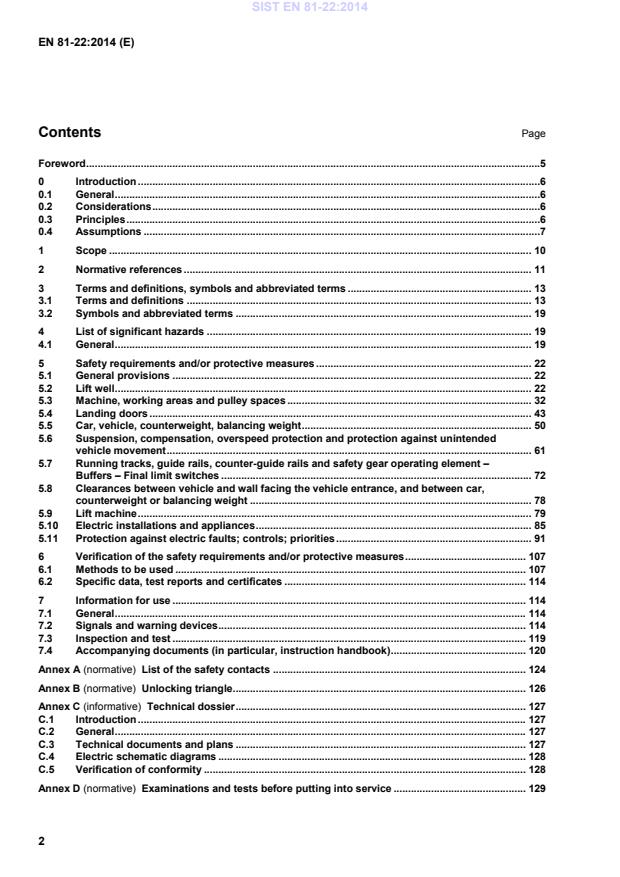
- Abstract
1.1 This European Standard specifies the safety rules for the construction and installation of permanently installed new electric lifts, with traction or positive drive, serving defined landings levels, having a vehicle designed to convey passengers or passengers and loads, suspended by ropes or chains and travelling in a vertical plan along guide rails that are inclined at an angle of between 15° and 75° in relation to the horizontal.
1.2 In addition to the requirements of this standard, supplementary requirements should be considered in special cases (potentially explosive atmosphere, extreme climate conditions, seismic conditions, transporting dangerous goods, etc.).
1.3 This European Standard does not cover:
a) lifts with drives other than those stated in 1.1;
b) installation of electric lifts in existing buildings to the extent that space does not permit;
c) important modifications (see Annex E) to a lift installed before this standard is brought into application;
d) lifting appliances, such as paternosters, mine lifts, theatrical lifts, appliances with automatic caging, skips, lifts and hoists for building and public works sites, ships' hoists, platforms for exploration or drilling at sea, construction and maintenance appliances;
e) safety during transport, installation, repairs, and dismantling of lifts;
f) lifts with rated speed ≤ 0,15 m/s.
However, this standard may usefully be taken as a basis.
Noise is not dealt with in this standard because it is not relevant to the safe use of the lift.
Vibrations are dealt with for electric parts only. Direct effects on human bodies are not considered as harmful.
1.4 This European Standard does not specify the additional requirements necessary for the use of lifts in case of fire.
1.5 Taking into account the state of art, the scope of the present standard is limited as follows:
- inclination: a variation in inclination is permitted for the travel path;
- travel path: confined within the vertical plane;
- maximum capacity of the car: 7 500 kg (100 passengers);
- maximum rated speed (v): 4 m/s.
Both characteristics (capacity and speed) are linked by the relation given in the following Figure 1.
(...)
The standard applies to all the constituent components of the lift including: running tracks, guides, safety gear operating device, counter-rails, but excludes the supporting structures, civil engineering structures and anchorages that are dealt with by other regulations.
1.6 This standard is not applicable for inclined lifts which are manufactured before the date of its publication as EN.
- Status
- Withdrawn
- Publication Date
- 20-May-2014
- Withdrawal Date
- 06-Oct-2026
- Technical Committee
- CEN/TC 10 - Passenger, goods and service lifts
- Drafting Committee
- CEN/TC 10/WG 9 - Inclined lifts
- Current Stage
- 9960 - Withdrawal effective - Withdrawal
- Start Date
- 01-Sep-2021
- Completion Date
- 07-Oct-2026
2014/33/EU - Directive 2014/33/EU of the European Parliament and of the Council of 26 February 2014 on the harmonisation of the laws of the Member States relating to lifts and safety components for lifts (recast)OJ Ref: C, C 138 OJ Date: 20-Apr-2016
95/16/EC - LiftsOJ Ref: C, C 412 OJ Date: 11-Dec-2015



Relations
- Effective Date
- 08-Sep-2021
- Effective Date
- 25-Aug-2026
- Effective Date
- 09-Feb-2026
- Effective Date
- 09-Feb-2026
- Effective Date
- 09-Feb-2026
- Effective Date
- 09-Feb-2026
- Effective Date
- 09-Feb-2026
- Effective Date
- 09-Feb-2026
- Effective Date
- 09-Feb-2026
- Effective Date
- 09-Feb-2026
- Effective Date
- 09-Feb-2026
- Effective Date
- 09-Feb-2026
- Effective Date
- 09-Feb-2026
- Effective Date
- 09-Feb-2026
- Effective Date
- 09-Feb-2026
Get Certified
Connect with accredited certification bodies for this standard

DIBt (Deutsches Institut für Bautechnik)
German Institute for Building Technology.
DIN CERTCO
DIN Group product certification.

Aboma Certification B.V.
Specialized in construction, metal, and transport sectors.
Sponsored listings
Frequently Asked Questions
EN 81-22:2014 is a standard published by the European Committee for Standardization (CEN). Its full title is "Safety rules for the construction and installation of lifts - Lifts for the transport of persons and goods - Part 22: Electric lifts with inclined path". This standard covers: 1.1 This European Standard specifies the safety rules for the construction and installation of permanently installed new electric lifts, with traction or positive drive, serving defined landings levels, having a vehicle designed to convey passengers or passengers and loads, suspended by ropes or chains and travelling in a vertical plan along guide rails that are inclined at an angle of between 15° and 75° in relation to the horizontal. 1.2 In addition to the requirements of this standard, supplementary requirements should be considered in special cases (potentially explosive atmosphere, extreme climate conditions, seismic conditions, transporting dangerous goods, etc.). 1.3 This European Standard does not cover: a) lifts with drives other than those stated in 1.1; b) installation of electric lifts in existing buildings to the extent that space does not permit; c) important modifications (see Annex E) to a lift installed before this standard is brought into application; d) lifting appliances, such as paternosters, mine lifts, theatrical lifts, appliances with automatic caging, skips, lifts and hoists for building and public works sites, ships' hoists, platforms for exploration or drilling at sea, construction and maintenance appliances; e) safety during transport, installation, repairs, and dismantling of lifts; f) lifts with rated speed ≤ 0,15 m/s. However, this standard may usefully be taken as a basis. Noise is not dealt with in this standard because it is not relevant to the safe use of the lift. Vibrations are dealt with for electric parts only. Direct effects on human bodies are not considered as harmful. 1.4 This European Standard does not specify the additional requirements necessary for the use of lifts in case of fire. 1.5 Taking into account the state of art, the scope of the present standard is limited as follows: - inclination: a variation in inclination is permitted for the travel path; - travel path: confined within the vertical plane; - maximum capacity of the car: 7 500 kg (100 passengers); - maximum rated speed (v): 4 m/s. Both characteristics (capacity and speed) are linked by the relation given in the following Figure 1. (...) The standard applies to all the constituent components of the lift including: running tracks, guides, safety gear operating device, counter-rails, but excludes the supporting structures, civil engineering structures and anchorages that are dealt with by other regulations. 1.6 This standard is not applicable for inclined lifts which are manufactured before the date of its publication as EN.
1.1 This European Standard specifies the safety rules for the construction and installation of permanently installed new electric lifts, with traction or positive drive, serving defined landings levels, having a vehicle designed to convey passengers or passengers and loads, suspended by ropes or chains and travelling in a vertical plan along guide rails that are inclined at an angle of between 15° and 75° in relation to the horizontal. 1.2 In addition to the requirements of this standard, supplementary requirements should be considered in special cases (potentially explosive atmosphere, extreme climate conditions, seismic conditions, transporting dangerous goods, etc.). 1.3 This European Standard does not cover: a) lifts with drives other than those stated in 1.1; b) installation of electric lifts in existing buildings to the extent that space does not permit; c) important modifications (see Annex E) to a lift installed before this standard is brought into application; d) lifting appliances, such as paternosters, mine lifts, theatrical lifts, appliances with automatic caging, skips, lifts and hoists for building and public works sites, ships' hoists, platforms for exploration or drilling at sea, construction and maintenance appliances; e) safety during transport, installation, repairs, and dismantling of lifts; f) lifts with rated speed ≤ 0,15 m/s. However, this standard may usefully be taken as a basis. Noise is not dealt with in this standard because it is not relevant to the safe use of the lift. Vibrations are dealt with for electric parts only. Direct effects on human bodies are not considered as harmful. 1.4 This European Standard does not specify the additional requirements necessary for the use of lifts in case of fire. 1.5 Taking into account the state of art, the scope of the present standard is limited as follows: - inclination: a variation in inclination is permitted for the travel path; - travel path: confined within the vertical plane; - maximum capacity of the car: 7 500 kg (100 passengers); - maximum rated speed (v): 4 m/s. Both characteristics (capacity and speed) are linked by the relation given in the following Figure 1. (...) The standard applies to all the constituent components of the lift including: running tracks, guides, safety gear operating device, counter-rails, but excludes the supporting structures, civil engineering structures and anchorages that are dealt with by other regulations. 1.6 This standard is not applicable for inclined lifts which are manufactured before the date of its publication as EN.
EN 81-22:2014 is classified under the following ICS (International Classification for Standards) categories: 91.140.90 - Lifts. Escalators. The ICS classification helps identify the subject area and facilitates finding related standards.
EN 81-22:2014 has the following relationships with other standards: It is inter standard links to EN 81-22:2021, ISO 8598:1996, EN 61249-2-23:2005, EN 60947-5-1:2004, EN 61249-2-38:2009, EN 61249-2-35:2009, EN 61249-2-43:2016, EN 61249-2-39:2013, EN 61249-2-13:1999, EN 61249-2-1:2005, EN 61249-2-5:2003, EN 61249-2-6:2003, EN 61249-2-30:2013, EN 60068-2-27:2009, EN 61249-2-8:2003. Understanding these relationships helps ensure you are using the most current and applicable version of the standard.
EN 81-22:2014 is associated with the following European legislation: EU Directives/Regulations: 2006/95/EC, 2014/33/EU, 95/16/EC; Standardization Mandates: M/BC/CEN/92/3. When a standard is cited in the Official Journal of the European Union, products manufactured in conformity with it benefit from a presumption of conformity with the essential requirements of the corresponding EU directive or regulation.
EN 81-22:2014 is available in PDF format for immediate download after purchase. The document can be added to your cart and obtained through the secure checkout process. Digital delivery ensures instant access to the complete standard document.
Standards Content (Sample)
2003-01.Slovenski inštitut za standardizacijo. Razmnoževanje celote ali delov tega standarda ni dovoljeno.Sicherheitsregeln für die Konstruktion und den Einbau von Aufzügen - Aufzüge für den Personen- und Gütertransport - Teil 22: Elektrisch betriebene Aufzüge mit geneigter FahrbahnRègles de sécurité pour la construction et l'installation des ascenseurs - Ascenseurs pour le transport de personnes et d'objets - Partie 22: Ascenseurs électriques à voie inclinéeSafety rules for the construction and installation of lifts - Lifts for the transport of persons and goods - Part 22: Electric lifts with inclined path91.140.90Lifts. EscalatorsICS:Ta slovenski standard je istoveten z:EN 81-22:2014SIST EN 81-22:2014en,fr01-julij-2014SIST EN 81-22:2014SLOVENSKI
STANDARD
EUROPEAN STANDARD NORME EUROPÉENNE EUROPÄISCHE NORM
EN 81-22
May 2014 ICS 91.140.90 English Version
Safety rules for the construction and installation of lifts - Lifts for the transport of persons and goods - Part 22: Electric lifts with inclined path
Règles de sécurité pour la construction et l'installation des ascenseurs - Ascenseurs pour le transport de personnes et d'objets - Partie 22 : Ascenseurs électriques à voie inclinée Sicherheitsregeln für die Konstruktion und den Einbau von Aufzügen - Aufzüge für den Personen- und Gütertransport -Teil 22: Elektrisch betriebene Aufzüge mit geneigter Fahrbahn This European Standard was approved by CEN on 4 February 2014.
CEN members are bound to comply with the CEN/CENELEC Internal Regulations which stipulate the conditions for giving this European Standard the status of a national standard without any alteration. Up-to-date lists and bibliographical references concerning such national standards may be obtained on application to the CEN-CENELEC Management Centre or to any CEN member.
This European Standard exists in three official versions (English, French, German). A version in any other language made by translation under the responsibility of a CEN member into its own language and notified to the CEN-CENELEC Management Centre has the same status as the official versions.
CEN members are the national standards bodies of Austria, Belgium, Bulgaria, Croatia, Cyprus, Czech Republic, Denmark, Estonia, Finland, Former Yugoslav Republic of Macedonia, France, Germany, Greece, Hungary, Iceland, Ireland, Italy, Latvia, Lithuania, Luxembourg, Malta, Netherlands, Norway, Poland, Portugal, Romania, Slovakia, Slovenia, Spain, Sweden, Switzerland, Turkey and United Kingdom.
EUROPEAN COMMITTEE FOR STANDARDIZATION
COMITÉ EUROPÉEN DE NORMALISATION EUROPÄISCHES KOMITEE FÜR NORMUNG
CEN-CENELEC Management Centre:
Avenue Marnix 17,
B-1000 Brussels © 2014 CEN All rights of exploitation in any form and by any means reserved worldwide for CEN national Members. Ref. No. EN 81-22:2014 ESIST EN 81-22:2014
List of the safety contacts . 124 Annex B (normative)
Unlocking triangle. 126 Annex C (informative)
Technical dossier . 127 C.1 Introduction . 127 C.2 General . 127 C.3 Technical documents and plans . 127 C.4 Electric schematic diagrams . 128 C.5 Verification of conformity . 128 Annex D (normative)
Examinations and tests before putting into service . 129 SIST EN 81-22:2014
Periodical examinations and tests, examinations and tests after an important modification or after an accident . 133 E.1 Periodical examinations and tests . 133 E.2 Examinations and tests after an important modification or after an accident . 133 Annex F (normative)
Safety components - Test procedures for verification of conformity . 135 F.0 Introduction . 135 F.1 Landing door locking devices . 136 F.2 Safety gear . 140 F.3 Overspeed governors . 144 F.4 Buffers . 147 F.5 Safety circuits containing electronic components and/or programmable electronic systems (PESSRAL) . 153 F.6 Ascending vehicle overspeed protection means . 156 F.7 Unintended vehicle movement protection means . 159 Annex G (informative)
Calculation of the supporting structure, the running tracks, the guide rails, the vehicle and the safety gear gripping element . 164 G.1 General . 164 G.2 Actions to take into account for calculation . 164 G.3 Proof of guide rails . 167 Annex H (normative)
Electronic components- Failure exclusion . 168 H.1 Scope . 168 H.2 Failure exclusions - conditions . 168 Annex I (informative)
Safety circuits . 172 I.1 Design guide-line for safety circuits . 172 I.2 Description of possible measures . 172 Annex J (normative)
Pendulum shock tests . 179 J.1 General . 179 J.2 Test rig . 179 J.3 Panels . 179 J.4 Test procedure . 179 J.5 Interpretation of the results . 180 J.6 Test report . 180 J.7 Exceptions from the tests. 180 Annex K (informative)
Traction evaluation . 185 K.1 General provisions . 185 K.2 Traction calculation . 185 K.3 Practical example . 190 Annex L (normative)
Evaluation of safety factor for suspension ropes . 193 L.1 General . 193 L.2 Equivalent number Nequiv of pulleys . 193 L.3 Static safety factor . 194 L.4 Examples . 195 Annex M (informative)
Machinery spaces – Access (5.3.3) . 197 Annex N (informative)
Building interfaces . 198 N.1 General provisions . 198 N.2 Support of guide rails . 198 N.3 Ventilation of car, lift well and machinery spaces . 198 Annex O (informative)
Environment: aspects to be considered for a risk analysis . 201 SIST EN 81-22:2014
Determination of anti-slip properties for floor surfaces . 203 P.1 General . 203 P.2 Testing and assessing anti-slip properties . 203 Annex ZA (informative)
Relationship between this European Standard and the Essential Requirements of EU Directive 95/16/EC . 205 Bibliography . 206
This is the first edition of this European Standard. According to the CEN-CENELEC Internal Regulations, the national standards organizations of the following countries are bound to implement this European Standard: Austria, Belgium, Bulgaria, Croatia, Cyprus, Czech Republic, Denmark, Estonia, Finland, Former Yugoslav Republic of Macedonia, France, Germany, Greece, Hungary, Iceland, Ireland, Italy, Latvia, Lithuania, Luxembourg, Malta, Netherlands, Norway, Poland, Portugal, Romania, Slovakia, Slovenia, Spain, Sweden, Switzerland, Turkey and the United Kingdom. SIST EN 81-22:2014
Key Q maximum capacity V rated speed Figure 1 — Speed and capacity The standard applies to all the constituent components of the lift including: running tracks, guides, safety gear operating device, counter-rails, but excludes the supporting structures, civil engineering structures and anchorages that are dealt with by other regulations. 1.6 This standard is not applicable for inclined lifts which are manufactured before the date of its publication as EN. 2 Normative references The following documents, in whole or in part, are normatively referenced in this document and are indispensable for its application. For dated references, only the edition cited applies. For undated references, the latest edition of the referenced document (including any amendments) applies. EN 81-1:1998+A3:2009, Safety rules for the construction and installation of lifts — Part 1: Electric lifts EN 81-28:2003, Safety rules for the construction and installation of lifts — Lifts for the transport of persons and goods — Part 28: Remote alarm on passenger and goods passenger lifts EN 81-58:2003, Safety rules for the construction and installation of lifts — Examination and tests — Part 58: Landing doors fire resistance test EN 131-2:2010+A1:2012, Ladders — Part 2: Requirements, testing, marking EN 10025-2:2004, Hot rolled products of structural steels — Part 2: Technical delivery conditions for non-alloy structural steels EN 12015:2014, Electromagnetic compatibility — Product family standard for lifts, escalators and moving walks — Emission EN 12016:2013, Electromagnetic compatibility — Product family standard for lifts, escalators and moving walks — Immunity EN 13015:2001+A1:2008, Maintenance for lifts and escalators — Rules for maintenance instructions SIST EN 81-22:2014
2-14: Tests — Test N: Change of temperature (IEC 60068-2-14:2009) EN 60068-2-27:2009, Environmental testing — Part 2-27: Tests — Test Ea and guidance: Shock (IEC 60068-2-27:2008) EN 60204-1:2006, Safety of machinery — Electrical equipment of machines — Part 1: General requirements (IEC 60204-1:2005, modified) EN 60269-1:2007, Low-voltage fuses — Part 1: General requirements (IEC 60269-1:2006) EN 60529:1991, Degrees of protection provided by enclosures (IP Code) (IEC 60529:1989)1) EN 60747-5-5:2011, Semiconductor devices — Discrete devices — Part 5-5: Optoelectronic devices — Photocouplers (IEC 60747-5-5:2007) EN 60664-1:2007, Insulation coordination for equipment within low-voltage systems — Part 1: Principles, requirements and tests (IEC 60664-1:2007) EN 60947-4-1:2010, Low-voltage switchgear and controlgear — Part 4-1: Contactors and motor-starters — Electromechanical contactors and motor-starters (IEC 60947-4-1:2009) EN 60947-5-1:2004, Low-voltage switchgear and controlgear — Part 5-1: Control circuit devices and switching elements — Electromechanical control circuit devices (IEC 60947-5-1:2003)2) EN 61249-2 (all parts), Materials for printed boards and other interconnecting structures — Part 2: Reinforced base materials, clad and unclad (IEC 61249-2, all parts) EN 61439-1:2011, Low-voltage switchgear and controlgear assemblies — Part 1: General rules (IEC 61439-1:2011) EN 61508-1:2010, Functional safety of electrical/electronic/programmable electronic safety-related systems —Part 1: General requirements (IEC 61508-1:2010) EN 61508-2:2010, Functional safety of electrical/electronic/programmable electronic safety-related systems — Part 2: Requirements for electrical/electronic/programmable electronic safety-related systems (IEC 61508-2:2010) EN 61508-3:2010, Functional safety of electrical/electronic/programmable electronic safety-related systems — Part 3: Software requirements (IEC 61508-3:2010) EN 61508-7:2010, Functional safety of electrical/electronic/programmable electronic safety related systems — Part 7: Overview of techniques and measures (IEC 61508-7:2010)
1)
This document is currently impacted by EN 60529:1991/A1:2000 and EN 60529:1991/A2:2013. 2)
This document is currently impacted by EN 60947-5-1:2004/A1:2009. SIST EN 81-22:2014
. (angle d’inclinaison) (Neigungswinkel) angle between the travel path as measured against the horizontal SIST EN 81-22:2014
(masse d’équilibrage) (Ausgleichgewicht) mass which saves energy by balancing all or part of the mass of the vehicle 3.1.5 buffer
(amortisseur) (Puffer) resilient stop at the end of travel, and comprising a means of braking using fluids or springs (or other similar means) 3.1.6 car
(cabine) (Fahrkorb) load carrier being part of the vehicle which carries the passengers and/or other loads and which can be supported by a sling or mounted on a carriage Note 1 to entry: A car can consist of several sections separated by a wall or a handrail. 3.1.7 carriage
(chariot) (Fahrwerk) structure hitched to traction devices on which the car and other elements are mounted Note 1 to entry: Running/sliding elements, safety gear, shock absorbers can belong to the latter elements. 3.1.8 compensating rope
(cable de compensation) (Ausgleichsseil) rope to be used for compensating one or all parts of the variations of weight of the traction ropes 3.1.9 counterweight
(contrepoids) (Gegengewicht) mass which ensures traction 3.1.10 counter-guide rail
(contre-rail) (Schutzschiene) rigid element that maintains the vehicle within the dynamic envelope 3.1.11 dynamic envelope
(gabarit dynamique) (Lichtraumprofil) envelope surface of the final limits Note 1 to entry: The dynamic envelope could be taken by all of the moving parts (e.g. car, carriage, sprocket, ropes, pulleys) taking into account wear and clearances, anticipated deformation and lateral motion caused by transverse forces to the trajectory. Breakages are not considered except for the running/sliding elements. SIST EN 81-22:2014
(chaîne électrique des sécurités) (elektrische Sicherheitskette) total of the electric safety devices connected in series 3.1.13 front-mounted door
(porte frontale) (Fronttür) door whose vertical plane is at 90 degrees to the travel path of the vehicle 3.1.14 goods passenger lift
(ascenseur de charge)3) (Lastenaufzug) lift mainly intended for the transport of goods, which are generally accompanied by persons 3.1.15 guide rails (guides) (Führungsschienen) rigid components which provide guiding for the vehicle, the counterweight or the balancing weight 3.1.16 headroom (partie supérieure de la gaine) (Schachtkopf) part of the well at its top end 3.1.17 instantaneous safety gear (parachute à prise instantanée) (Sperrfangvorrichtung) safety gear in which the full gripping action on the guide rails is almost immediate 3.1.18 instantaneous safety gear with buffered effect (parachute à prise instantanée avec effet amorti) (Sperrfangvorrichtung mit Dämpfung) safety gear in which the full gripping action on the guide rails is almost immediate Note 1 to entry: The reaction on the vehicle, counterweight or balancing weight is limited by presence of an intermediate buffering system. 3.1.19 laminated glass (verre feuilleté) (Verbundsicherheitsglas VSG) assembly of two or more glass layers, each of which is bonded together using a plastic film 3.1.20 levelling (nivelage) (Einfahren) operation which improves the accuracy of stopping at landings 3.1.21 levelling accuracy (precision du maintien au niveau) (Nachregulierungsgenauigkeit) vertical distance between car sill and landing sill during loading or unloading of the car
3) The French expression “ascenseur de charge” has been introduced into the French language document with the aim of harmonizing the texts in the three languages of CEN and of simplifying the wording. It does not in any way define a particular or supplementary category of lift. SIST EN 81-22:2014
PESSRAL (système électronique programmable dans les applications liées à la sécurité des ascenseurs (PESSRAL)) (programmierbares elektronisches System in sicherheitstechnisch relevanten Anwendungen für Aufzüge (Pessral)) system for control, protection or monitoring based on one or more programmable electronic devices, including all elements of the system such as power supplies, sensors and other input devices, data highways and other communication paths, and actuators and other output devices, used in safety related applications as listed in Tables A.1 and A.2 3.1.33 progressive safety gear (parachute à prise amortie) (Bremsfangvorrichtung) safety gear in which retardation is effected by a braking action on the guide rails and for which special provisions are made so as to limit the forces on the vehicle, counterweight or balancing weight to a permissible value 3.1.34 pulley room (local de poulies) (Rollenraum) room not containing the machine, in which pulleys are located, and in which the overspeed governor and the electrical equipment can also be housed 3.1.35 pulley space (emplacement de poulies) (Aufstellungsort von Seilrollen) space(s) inside or outside of the well where pulleys are placed 3.1.36 rated load (charge nominale) (Nennlast) load for which the equipment has been built 3.1.37 rated speed (vitesse nominale) (Nenngeschwindigkeit) speed v in metres per second of the vehicle for which the equipment has been built 3.1.38 re-levelling (isonivelage) (Nachstellen) operation, after the lift has stopped, to permit the stopping position to be corrected during loading or unloading, if necessary by successive movements (automatic or inching) 3.1.39 running/sliding element (élément de roulement/glissement) (Lauf-/Gleitkörper) element that ensures contact between the vehicle and the running tracks and between the vehicle and the guide rails 3.1.40 running track (piste de roulement) (Laufbahn) rigid element that the vehicle or counterweight runs along SIST EN 81-22:2014
...