

EN 81-80:2019
(Main)Safety rules for the construction and installation of lifts - Existing lifts - Part 80: Rules for the improvement of safety of existing passenger and goods passenger lifts
- Abstract
This document gives a methodology for improving the safety of existing lifts with the aim of reaching an equivalent level of safety to that of a newly installed lift by the application of today’s state-of-the-art for safety.
NOTE Due to situations such as the building design, etc. it may not be possible in all cases to reach today’s state-of-the-art for safety.
This document applies to permanently installed passenger or goods passenger lifts, with traction, positive or hydraulic drive serving defined landing levels, having a car designed for the transportation of persons or persons and goods and moving along guide rails inclined not more than 15° to the vertical.
This document includes the improvement of safety of existing lifts for:
a) passengers;
b) maintenance and inspection personnel;
c) persons outside the well, machinery space(s) and the pulley room(s) (but in their immediate vicinity);
d) any other authorized persons.
This document is not applicable to:
e) lifts with drive systems others than those mentioned above;
f) lifting appliances such as paternosters, mine lifts, theatre lifts, appliances with automatic caging, skips, lifts and hoists for building and public works sites, ships’ hoists, platforms for exploration or drilling at sea, construction and maintenance appliances;
g) installations where the inclination of the guide rails to the vertical exceeds 15°;
h) lifting appliances with a rated speed lower than or equal to 0,15 m/s;
i) safety during transport, installation, repairs and dismantling of lifts.
However, this document can usefully be taken as a reference basis.
- Status
- Published
- Publication Date
- 20-Aug-2019
- Withdrawal Date
- 30-Aug-2021
- Technical Committee
- CEN/TC 10 - Passenger, goods and service lifts
- Drafting Committee
- CEN/TC 10/WG 10 - Improvement of safety of existing lifts
- Current Stage
- 9093 - Decision to confirm - Review Enquiry
- Start Date
- 05-Mar-2025
- Completion Date
- 07-Oct-2026


Overview
EN 81-80:2019 - published by CEN - is the European standard that provides a structured methodology for improving the safety of existing passenger and goods passenger lifts. Its objective is to bring older, permanently installed lifts up to an equivalent level of safety to newly installed lifts by applying today’s state-of-the-art safety measures where practicable. EN 81-80:2019 supersedes EN 81-80:2003 and focuses on traction, positive and hydraulic drive lifts running on guide rails inclined no more than 15° to the vertical.
Key topics and requirements
- Scope and applicability: Applies to permanently installed passenger and goods passenger lifts (traction, positive, hydraulic). Not applicable to paternosters, mine lifts, construction hoists, ships’ hoists, very slow appliances (≤ 0.15 m/s) or during transport/installation/dismantling.
- Methodology for retrofit (Clause 5): Stepwise process including
- Identification of hazardous situations
- Evaluation of risks
- Classification of priority levels (high/medium/low)
- Filtering to determine practicable upgrades
- List of significant hazards: Comprehensive, updated hazard list aligned with EN 81-20 and risk assessment outcomes. New hazards since 2003 were added and numbering adjusted for clarity.
- Verification and documentation: Procedures for verifying safety measures and protective devices and for providing information for use (inspection, maintenance, rescue).
- Normative Annex A (checklist): Combines technical requirements and a practical audit checklist to assess existing installations and map corrective actions to today’s state-of-the-art.
- Stakeholder safety focus: Measures cover safety for passengers, maintenance and inspection personnel, and persons near well or machine spaces.
Practical applications
- Audit and retrofit planning: Use EN 81-80:2019 to audit existing lifts, prioritize upgrades, and create phased retrofit programs that balance risk reduction with building constraints and cost.
- Risk reduction: Identify high-, medium-, and low-priority safety improvements (e.g., door controls, rescue provisions, guarding) based on documented risk levels.
- Compliance guidance: National authorities can adopt the methodology to set implementation programs; owners and maintenance firms can use it to demonstrate responsible risk management.
- Design reference: Useful as a reference when full compliance with modern lift standards is impractical due to building constraints.
Who should use this standard
- Lift owners and facility managers
- Maintenance and inspection companies
- Lift manufacturers and retrofit contractors
- National authorities and safety regulators
- Building managers and accessibility planners
Related standards
Relevant documents referenced in EN 81-80:2019 include EN 81-20, EN 81-21, EN 81-28, EN 81-58, EN 81-72, EN 81-73, EN 81-77, EN 81-82, CEN/TS 81-83 and EN ISO 13857 - useful cross-references for new installations, fire behaviour, remote alarms, accessibility, vandal resistance and related safety tests.
Keywords: EN 81-80:2019, lift safety, existing lifts, retrofit methodology, passenger lifts, goods passenger lifts, CEN, risk assessment, safety checklist.
Relations
- Effective Date
- 20-Jul-2016
- Effective Date
- 24-Jun-2026
- Effective Date
- 28-Jan-2026
- Effective Date
- 28-Jan-2026
- Effective Date
- 28-Jan-2026
- Effective Date
- 28-Jan-2026
- Effective Date
- 28-Jan-2026
- Effective Date
- 28-Jan-2026
- Effective Date
- 28-Jan-2026
- Effective Date
- 28-Jan-2026
- Effective Date
- 28-Jan-2026
- Effective Date
- 28-Jan-2026
- Effective Date
- 28-Jan-2026
- Effective Date
- 28-Jan-2026
- Effective Date
- 09-Feb-2026
Get Certified
Connect with accredited certification bodies for this standard

DIBt (Deutsches Institut für Bautechnik)
German Institute for Building Technology.
DIN CERTCO
DIN Group product certification.

Aboma Certification B.V.
Specialized in construction, metal, and transport sectors.
Sponsored listings
Frequently Asked Questions
EN 81-80:2019 is a standard published by the European Committee for Standardization (CEN). Its full title is "Safety rules for the construction and installation of lifts - Existing lifts - Part 80: Rules for the improvement of safety of existing passenger and goods passenger lifts". This standard covers: This document gives a methodology for improving the safety of existing lifts with the aim of reaching an equivalent level of safety to that of a newly installed lift by the application of today’s state-of-the-art for safety. NOTE Due to situations such as the building design, etc. it may not be possible in all cases to reach today’s state-of-the-art for safety. This document applies to permanently installed passenger or goods passenger lifts, with traction, positive or hydraulic drive serving defined landing levels, having a car designed for the transportation of persons or persons and goods and moving along guide rails inclined not more than 15° to the vertical. This document includes the improvement of safety of existing lifts for: a) passengers; b) maintenance and inspection personnel; c) persons outside the well, machinery space(s) and the pulley room(s) (but in their immediate vicinity); d) any other authorized persons. This document is not applicable to: e) lifts with drive systems others than those mentioned above; f) lifting appliances such as paternosters, mine lifts, theatre lifts, appliances with automatic caging, skips, lifts and hoists for building and public works sites, ships’ hoists, platforms for exploration or drilling at sea, construction and maintenance appliances; g) installations where the inclination of the guide rails to the vertical exceeds 15°; h) lifting appliances with a rated speed lower than or equal to 0,15 m/s; i) safety during transport, installation, repairs and dismantling of lifts. However, this document can usefully be taken as a reference basis.
This document gives a methodology for improving the safety of existing lifts with the aim of reaching an equivalent level of safety to that of a newly installed lift by the application of today’s state-of-the-art for safety. NOTE Due to situations such as the building design, etc. it may not be possible in all cases to reach today’s state-of-the-art for safety. This document applies to permanently installed passenger or goods passenger lifts, with traction, positive or hydraulic drive serving defined landing levels, having a car designed for the transportation of persons or persons and goods and moving along guide rails inclined not more than 15° to the vertical. This document includes the improvement of safety of existing lifts for: a) passengers; b) maintenance and inspection personnel; c) persons outside the well, machinery space(s) and the pulley room(s) (but in their immediate vicinity); d) any other authorized persons. This document is not applicable to: e) lifts with drive systems others than those mentioned above; f) lifting appliances such as paternosters, mine lifts, theatre lifts, appliances with automatic caging, skips, lifts and hoists for building and public works sites, ships’ hoists, platforms for exploration or drilling at sea, construction and maintenance appliances; g) installations where the inclination of the guide rails to the vertical exceeds 15°; h) lifting appliances with a rated speed lower than or equal to 0,15 m/s; i) safety during transport, installation, repairs and dismantling of lifts. However, this document can usefully be taken as a reference basis.
EN 81-80:2019 is classified under the following ICS (International Classification for Standards) categories: 91.140.90 - Lifts. Escalators. The ICS classification helps identify the subject area and facilitates finding related standards.
EN 81-80:2019 has the following relationships with other standards: It is inter standard links to EN 81-80:2003, EN ISO 8100-1:2026, EN 81-83:2025, EN 81-28:2022, EN 81-58:2022, EN 81-20:2020, EN 81-72:2020, EN 81-73:2005, EN 81-82:2025, EN 81-21:2018, EN 81-28:2018, EN 81-77:2022, EN ISO 13857:2008, EN 81-73:2020, EN 50600-2-1:2021. Understanding these relationships helps ensure you are using the most current and applicable version of the standard.
EN 81-80:2019 is associated with the following European legislation: EU Directives/Regulations: 2014/33/EU; Standardization Mandates: M/549. When a standard is cited in the Official Journal of the European Union, products manufactured in conformity with it benefit from a presumption of conformity with the essential requirements of the corresponding EU directive or regulation.
EN 81-80:2019 is available in PDF format for immediate download after purchase. The document can be added to your cart and obtained through the secure checkout process. Digital delivery ensures instant access to the complete standard document.
Standards Content (Sample)
SLOVENSKI STANDARD
01-november-2019
Nadomešča:
SIST EN 81-80:2004
Varnostna pravila za konstruiranje in vgradnjo dvigal (liftov) - Obstoječa dvigala -
80. del: Pravila za izboljšanje varnosti obstoječih osebnih in osebno-tovornih
dvigal
Safety rules for the construction and installation of lifts - Existing lifts - Part 80: Rules for
the improvement of safety of existing passenger and goods passenger lifts
Sicherheitsregeln für die Konstruktion und den Einbau von Aufzügen - Bestehende
Aufzüge - Teil 80: Regeln für die Erhöhung der Sicherheit bestehender Personen- und
Lastenaufzüge
Règles de sécurité pour la construction et l’installation des élévateurs - Ascenseurs
existants - Partie 80 : Règles pour l’amélioration de la sécurité des ascenseurs et des
ascenseurs de charge existants
Ta slovenski standard je istoveten z: EN 81-80:2019
ICS:
91.140.90 Dvigala. Tekoče stopnice Lifts. Escalators
2003-01.Slovenski inštitut za standardizacijo. Razmnoževanje celote ali delov tega standarda ni dovoljeno.
EN 81-80
EUROPEAN STANDARD
NORME EUROPÉENNE
August 2019
EUROPÄISCHE NORM
ICS 91.140.90 Supersedes EN 81-80:2003
English Version
Safety rules for the construction and installation of lifts -
Existing lifts - Part 80: Rules for the improvement of safety
of existing passenger and goods passenger lifts
Règles de sécurité pour la construction et l'installation Sicherheitsregeln für die Konstruktion und den Einbau
des élévateurs - Ascenseurs existants - Partie 80 : von Aufzügen - Bestehende Aufzüge - Teil 80: Regeln
Règles pour l'amélioration de la sécurité des für die Erhöhung der Sicherheit bestehender
ascenseurs et des ascenseurs de charge existants Personen- und Lastenaufzüge
This European Standard was approved by CEN on 1 March 2019.
CEN members are bound to comply with the CEN/CENELEC Internal Regulations which stipulate the conditions for giving this
European Standard the status of a national standard without any alteration. Up-to-date lists and bibliographical references
concerning such national standards may be obtained on application to the CEN-CENELEC Management Centre or to any CEN
member.
This European Standard exists in three official versions (English, French, German). A version in any other language made by
translation under the responsibility of a CEN member into its own language and notified to the CEN-CENELEC Management
Centre has the same status as the official versions.
CEN members are the national standards bodies of Austria, Belgium, Bulgaria, Croatia, Cyprus, Czech Republic, Denmark, Estonia,
Finland, France, Germany, Greece, Hungary, Iceland, Ireland, Italy, Latvia, Lithuania, Luxembourg, Malta, Netherlands, Norway,
Poland, Portugal, Republic of North Macedonia, Romania, Serbia, Slovakia, Slovenia, Spain, Sweden, Switzerland, Turkey and
United Kingdom.
EUROPEAN COMMITTEE FOR STANDARDIZATION
COMITÉ EUROPÉEN DE NORMALISATION
EUROPÄISCHES KOMITEE FÜR NORMUNG
CEN-CENELEC Management Centre: Rue de la Science 23, B-1040 Brussels
© 2019 CEN All rights of exploitation in any form and by any means reserved Ref. No. EN 81-80:2019 E
worldwide for CEN national Members.
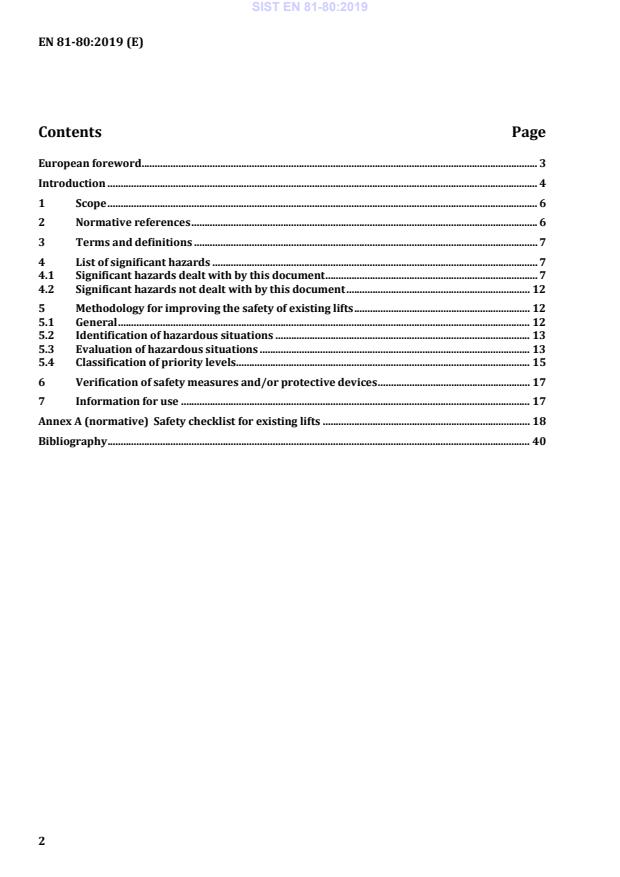
Contents Page
European foreword . 3
Introduction . 4
1 Scope . 6
2 Normative references . 6
3 Terms and definitions . 7
4 List of significant hazards . 7
4.1 Significant hazards dealt with by this document . 7
4.2 Significant hazards not dealt with by this document . 12
5 Methodology for improving the safety of existing lifts . 12
5.1 General . 12
5.2 Identification of hazardous situations . 13
5.3 Evaluation of hazardous situations . 13
5.4 Classification of priority levels . 15
6 Verification of safety measures and/or protective devices . 17
7 Information for use . 17
Annex A (normative) Safety checklist for existing lifts . 18
Bibliography . 40
European foreword
This document (EN 81-80:2019) has been prepared by Technical Committee CEN/TC 10 “Lifts, escalators
and moving walks”, the secretariat of which is held by AFNOR.
This European Standard shall be given the status of a national standard, either by publication of an
identical text or by endorsement, at the latest by February 2020, and conflicting national standards shall
be withdrawn at the latest by August 2021.
Attention is drawn to the possibility that some of the elements of this document may be the subject of
patent rights. CEN shall not be held responsible for identifying any or all such patent rights.
This document supersedes EN 81-80:2003.
EN 81-80:2003 and experience gained from its application. The main changes can be identified as:
— eleven new hazards have been added which are now covered in EN 81-20 or which have been
identified by risk assessment;
— due to these new hazards the numbering has been changed in order to keep a logical order of hazards
following the sequence in EN 81-20:—; however for tracking purposes the hazard numbers of
EN 81-80:2003 are listed in a separate column;
— the methodology for the identification of hazards, the evaluation of the hazardous situations and the
risk levels as well as the classification of priority levels including the filtering process have been
moved to Clause 5;
— all technical requirements for protective measures have been incorporated in the checklist in the
normative Annex A which combines now the previous chapter 5 and the previous checklist in
Annex A; this combination prevents duplication of technical requirements in the standard and allows
simplification of its use;
— the checklist also contains a column in which the risk levels and subsequent priority levels for items
in compliance with EN 81-1:1998 and EN 81-2:1998 or items upgraded according to EN 81-80:2003
are listed in relation to today’s state-of-the-art according to EN 81-20:—.
According to the CEN-CENELEC Internal Regulations, the national standards organisations of the
following countries are bound to implement this European Standard: Austria, Belgium, Bulgaria, Croatia,
Cyprus, Czech Republic, Denmark, Estonia, Finland, France, Germany, Greece, Hungary, Iceland, Ireland,
Italy, Latvia, Lithuania, Luxembourg, Malta, Netherlands, Norway, Poland, Portugal, Republic of
Macedonia, Romania, Serbia, Slovakia, Slovenia, Spain, Sweden, Switzerland, Turkey and the United
Kingdom.
Introduction
This document was developed to establish a methodology to specify at national level procedures for
improving the safety of existing lifts. A word of explanation:
a) Background of this document:
More than 6 million lifts are in use today (2019) in Europe and approximately 50 % were installed more
than 20 years ago.
Lifts were installed to the safety level appropriate at time of installation. This level is often lower than
today’s state-of-the-art for safety.
New technologies, experiences and social expectations have led to today's state-of-the-art for safety. This
has led to the situation today with different levels of safety, causing accidents. However, users and
authorized persons expect a common minimum level of safety wherever they go.
In addition, there is a growing trend for people to live longer and for disabled people to expect access and
design for all. Therefore it is especially important to provide a safe means of vertical transport for elderly
and disabled persons.
Lift attendants and in many cases building caretakers are not so common anymore, so it is important that
relevant safety features for the rescue of trapped persons should be provided.
Furthermore the life cycle of a lift is longer than most other transportation systems and building
equipment, which therefore means that lift design, performance and safety can fall behind modern
technologies. If existing lifts are upgraded to today's state-of-the-art for safety, the number of injuries is
very likely to decrease (especially in buildings which can be accessed by the general public).
b) The approach behind the creation of this document:
This document:
1) categorizes various hazards and hazardous situations, each of which has been analysed by a risk
assessment;
2) is intended to provide corrective actions to progressively and selectively improve, step by step,
the safety of all existing passenger and goods passenger lifts towards today’s state-of-the-art for
safety;
3) enables each lift to be audited and safety measures to be identified and implemented in a step by
step and selective fashion according to the frequency and severity of any single risk;
4) lists the high, medium and low risks and corrective actions which can be applied in separate
steps in order to mitigate the risks.
Other designs to previous national regulations or standards, providing they have an equivalent safety
level, may be acceptable.
c) Use of this document:
This document can be used as a guideline for:
1) national authorities to determine their own programme of implementation in a step by step
1)
process via a filtering process (see Clause 5) in a reasonable and practicable way based on the
level of risk (e.g. high, medium, low) and social and economic considerations;
2) owners to follow their responsibilities according to existing regulations;
3) maintenance companies and/or inspection bodies to inform the owners on the safety level of
their installations and to propose risk reduction measures;
4) owners to upgrade their existing lifts on a voluntary basis in accordance with 3) if no regulations
exist.
NOTE 1 Owner of the installation: natural or legal person who has the power of disposal of the installation and
takes the responsibility for its operation and use.
In making an audit of an existing lift installation Annex A can be used to identify the hazards and
corrective actions in this document. However, where a hazardous situation is identified which is not
covered in this document a separate risk assessment should be made. This risk assessment should be
based on EN ISO 14798.
NOTE 2 The risk profile according to EN ISO 14798 has been slightly modified in order to define different
priorities for the upgrading of items on existing lifts depending on the risk levels of the existing means (see 5.3 and
5.4). The probability level D is covering a large range of probabilities between level C and level E. Due to this reason
the largest number of risks in existing lifts would fall into level D. Therefore level D has been split into 3 smaller
sub-levels C-D, D and D-E. Higher probalilities C-D which may lead to a high number of incidents are close to C and
therefore are considered with high priority for severities 1 and 2 and with medium priority for severity 3. Lower
probabilities D-E where only very few incidents may be expected being close to E are considered with medium
priority for severity 1 in between high for 1 D and low for 1 E and with low priority for severity 2 as for 2 E.
1) "Reasonable and practicable” is defined as follows: “In deciding what is reasonable and practicable the
seriousness of a risk to injury should be weighed against the difficulty and cost of removing or reducing that risk.
Where the difficulty and cost are high, and a careful assessment shows that the risk is rather low, short or medium
term action may not need to be taken. On the other hand where the risk is high, action should be taken at whatever
cost.”
1 Scope
This document gives a methodology for improving the safety of existing lifts with the aim of reaching an
equivalent level of safety to that of a newly installed lift by the application of today’s state-of-the-art for
safety.
NOTE Due to situations such as the building design, etc. it may not be possible in all cases to reach today’s state-
of-the-art for safety.
This document applies to permanently installed passenger or goods passenger lifts, with traction,
positive or hydraulic drive serving defined landing levels, having a car designed for the transportation of
persons or persons and goods and moving along guide rails inclined not more than 15° to the vertical.
This document includes the improvement of safety of existing lifts for:
a) passengers;
b) maintenance and inspection personnel;
c) persons outside the well, machinery space(s) and the pulley room(s) (but in their immediate
vicinity);
d) any other authorized persons.
This document is not applicable to:
e) lifts with drive systems others than those mentioned above;
f) lifting appliances such as paternosters, mine lifts, theatre lifts, appliances with automatic caging,
skips, lifts and hoists for building and public works sites, ships’ hoists, platforms for exploration or
drilling at sea, construction and maintenance appliances;
g) installations where the inclination of the guide rails to the vertical exceeds 15°;
h) lifting appliances with a rated speed lower than or equal to 0,15 m/s;
i) safety during transport, installation, repairs and dismantling of lifts.
However, this document can usefully be taken as a reference basis.
2 Normative references
The following documents are referred to in the text in such a way that some or all of their content
constitutes requirements of this document. For dated references, only the edition cited applies. For
undated references, the latest edition of the referenced document (including any amendments) applies.
EN 81-20:—, Safety rules for the construction and installation of lifts — Lifts for the transport of persons
and goods — Part 20: Passenger and goods passenger lifts
EN 81-21:2018, Safety rules for the construction and installation of lifts — Lifts for the transport of persons
and goods — Part 21: New passenger and goods passenger lifts in existing building
Under preparation. Stage at time of publication: prEN 81-20:2018.
EN 81-28, Safety rules for the construction and installation of lifts — Lifts for the transport of persons and
goods — Part 28: Remote alarm on passenger and goods passenger lifts
EN 81-58, Safety rules for the construction and installation of lifts — Examination and tests - Part 58:
Landing doors fire resistance test
EN 81-72, Safety rules for the construction and installation of lifts — Particular applications for passenger
and goods passenger lifts — Part 72: Firefighters lifts
EN 81-73, Safety rules for the construction and installation of lifts — Particular applications for passenger
and goods passenger lifts — Part 73: Behaviour of lifts in the event of fire
EN 81-77, Safety rules for the construction and installations of lifts — Particular applications for passenger
and goods passenger lifts — Part 77: Lifts subject to seismic conditions
EN 81-82, Safety rules for the construction and installation of lifts — Existing lifts — Part 82: Rules for the
improvement of the accessibility of existing lifts for persons including persons with disability
CEN/TS 81-83, Safety rules for the construction and installation of lifts — Existing lifts — Part 83: Rules for
the improvement of the resistance against vandalism
EN ISO 13857:2008, Safety of machinery — Safety distances to prevent hazard zones being reached by
upper and lower limbs (ISO 13857:2008)
3 Terms and definitions
For the purposes of this document, the following term and definition apply.
ISO and IEC maintain terminological databases for use in standardization at the following addresses:
— IEC Electropedia: available at http://www.electropedia.org/
— ISO Online browsing platform: available at http://www.iso.org/obp
3.1
existing lift
lift which is in service
4 List of significant hazards
4.1 Significant hazards dealt with by this document
This clause contains all the significant hazards, hazardous situations and events, as far as they are dealt
with in this document, identified by risk assessments as significant for existing lifts and which require
action to eliminate or reduce the risk.
Table 1 — List of significant hazards
No. Hazard/Hazardous situation No. in
EN 81-80:2003
1 General
1.1 No or limited accessibility for disabled persons 2
1.2 No or inadequate vandal resistance 4
1.3 Inadequate firefighters lift Not covered
1.4 No or inadequate behaviour of the lift in the event of fire 5
1.5 No or inadequate earthquake resistance Not covered
1.6 Presence of harmful materials 1
2 Well
2.1 Inadequate locking devices on access, emergency and 8
inspection doors to well and pit
2.2 No stopping of car when access, emergency and inspection 8
doors to well or pit are opened
2.3 Well enclosures with perforate walls 6
2.4 Well enclosures with perforate walls near door locks 33
2.5 Partially enclosed well with too low enclosure 7
2.6 Inadequate vertical surface below landing door sills 9
2.7 Counterweight/balancing weight without safety gear in case 10
of accessible spaces below well
2.8 No or inadequate screen of counterweight/balancing weight 11
in the pit
2.9 No or inadequate partition in the pit for lifts in a common 12
well
2.10 No or inadequate partition between moving parts of lifts in a 13
common well
2.11 Insufficient refuge spaces and clearances in headroom 14
2.12 Insufficient refuge spaces and clearances in pit 14
2.13 No or inadequate means to enter the pit 15
2.14 No or inadequate lighting of the well 17
2.15 No or inadequate stopping device in the pit 16
2.16 No alarm initiation devices in pit and on car roof 18
2.17 Excessive horizontal distance between the inner surface of 58
the well and the sill, door frame of the car or closing edge of
car sliding doors
2.18 Excessive horizontal distance between car door and landing 59
door
No. Hazard/Hazardous situation No. in
EN 81-80:2003
2.19 Too large distance between leading edges of car and landing Not covered
doors
3 Machinery spaces and pulley rooms
3.1 No or unsafe means of access to machinery spaces and pulley 19
rooms
3.2 Inadequate lighting in machinery spaces and pulley rooms 23
3.3 No or inadequate stopping device(s) in the pulley room 16
3.4 Inadequate suspension points for handling of equipment in 24
machinery spaces and top of the well
3.5 Slippery floor in machinery spaces or pulley rooms 20
3.6 Insufficient horizontal or vertical clearances in machinery 21
spaces
3.7 No or inadequate protection on different levels and recesses 22
in the machine room
3.8 No or inadequate intercom system between car and the 72
location of the emergency operation
4 Landing doors and car doors
4.1 Perforate landing doors 25
4.2 Perforate car doors 25
4.3 Inadequate strength of landing doors 26
4.4 Inadequate strength of car doors Not covered
4.5 Inadequate glass in landing doors other than vision panels 27
4.6 Inadequate glass in car doors other than vision panels 27
4.7 Inadequate glass vision panels in landing doors 27
4.8 Inadequate glass vision panels in car doors 27
4.9 No or inadequate protective device (e.g. light curtain) for re- 30
opening of power operated car and landing sliding doors
4.10 No or inadequate protective device (150 N) for re-opening of 30
power operated sliding doors
4.11 No or inadequate protective device (150 N) for re-opening of Not covered
power operated doors other than sliding doors
4.12 No or inadequate means against dragging of children hands 28
in horizontally sliding car doors or landing doors with glass
4.13 No or inadequate lighting on landings 29
4.14 No safe locking device on landing door 31
No. Hazard/Hazardous situation No. in
EN 81-80:2003
4.15 No special device (e.g. triangular key) for emergency 32
unlocking of landing door
4.16 No or inadequate self-closing and locking of the landing door 34
after opening for whatever reason when the car is outside the
unlocking zone
4.17 Inadequate link between multiple panels of landing doors 35
(missing interlink or missing locking)
4.18 Inadequate fire resistance of landing doors 36
4.19 Car door moving with open (hinged) landing door 37
4.20 Car without door(s) 40
4.21 No car door restrictor where the landing door locking device Not covered
is accessible when the car door is opened outside of the door
zone
5 Car, counterweight and balancing weight
5.1 Large car area in relation to rated load 38
5.2 No car apron or inadequate length of car apron 39
5.3 Unsafe locking of emergency trap door on the car 41
5.4 Insufficient strength of car roof and emergency trap door 42
5.5 No or inadequate protection against falling from car roof 43
5.6 Insufficient ventilation in car 44
5.7 Inadequate lighting in car 45
5.8 No or inadequate emergency lighting in car 46
5.9 No emergency lighting on the car roof Not covered
5.10 No or inadequate load control 73
5.11 No or inadequate remote alarm system 71
6 Suspension means, compensation means, precautions against free fall,
excessive overspeed, unintended car movement and creeping of the car
6.1 No or inadequate protection against injury from traction 47
sheaves, pulleys or sprockets
6.2 No or inadequate protection against rope/chains leaving the 48
sheaves, pulleys or sprockets
6.3 No or inadequate protection against the introduction of 49
objects between ropes/chains and sheaves, pulleys or
sprockets
6.4 No or inadequate protection against free fall or descent with 50
excessive speed
No. Hazard/Hazardous situation No. in
EN 81-80:2003
6.5 No or inadequate protection means against ascending car 52
overspeed on traction drive lifts with counterweight
6.6 No or inadequate protection means against unintended car 53
movement with open doors
6.7 No or inadequate protection against creeping on hydraulic 54
lifts
6.8 No or inadequate slack rope switch for governor rope 51
6.9 No or inadequate slack rope/chain detection device 63
7 Guide rails, buffers and final limit switches
7.1 Inadequate guidance system for counterweight or balancing 55
weight
7.2 No or inadequate buffers 56
7.3 No or inadequate final limit switches 57
8 Lift machine
8.1 Inadequate machine brake (only one brake set) Not covered
8.2 No or inadequate emergency operation system 60
8.3 No or inadequate means for stopping the machine and 62
checking its stopped position
8.4 No motor run-time limiter 64
8.5 No shut-off valve (hydraulic lifts) 61
8.6 No or inadequate low cylinder pressure device on hydraulic 65
lifts
9 Electric installations and appliances
9.1 Insufficient protection against electric shock (direct contact) 66
9.2 Insufficient marking of connection terminals which remain 66
live after switching off the main switch
9.3 No or inadequate protection against overheating of lift 67
machine motor
9.4 No lockable main switch 68
9.5 No or inadequate stopping device at the machine in the Not covered
machinery space
10 Protection against electric faults, controls, priorities
10.1 No earth fault protection in circuits with electric safety Not covered
devices or in circuits controlling the brake or the down valve
10.2 No protection against phase reversal 69
10.3 Inadequate levelling and/or stopping accuracy 3
No. Hazard/Hazardous situation No. in
EN 81-80:2003
10.4 No or inadequate inspection control station and stopping 70
device on the car roof
10.5 No or inadequate inspection control station in the pit Not covered
11 Notices, markings and operating instructions
11.1 Missing notices, markings and operating instructions 74
4.2 Significant hazards not dealt with by this document
— Fire in well, machinery spaces and pulley rooms;
— environmental conditions including e.g. flooding;
— electromagnetic compatibility;
— cutting due to sharp edges.
5 Methodology for improving the safety of existing lifts
5.1 General
All technical solutions for upgrading existing lifts shall be aligned as much as possible to the state-of-the-
art solutions applicable for new lifts. The requirements and/or protective measures documented in
today's state-of-the-art standards for new lifts shall not be considered as the only possible solution.
Alternatives are permitted, provided they lead to an equivalent safety level. Although immediate
upgrading of all existing lifts to the state-of-the-art would be preferable from the safety point of view, this
may not be possible in a short period of time mainly due to economic reasons.
This document does not provide legally binding requirements for measures to be carried out or for the
period of time for such measures. Such obligations for existing lifts are subject to national legislation. The
procedures described in this clause are intended to assist in setting up national regulations and/or
providing a systematic approach to the lift owners for increasing the safety of existing lifts by showing:
— how to identify hazards;
— how to evaluate the existing hazardous situations; and
— how to classify priority levels which apply to the relevant hazards and risk reduction measures.
Where the requirements of this document cannot be met and a residual risk remains, or cannot be
avoided, then appropriate measures such as signs, instructions and training shall be given.
For specific safety requirements such as accessibility (see EN 81-82), requirements against vandalism
(see CEN/TS 81-83), firefighters lifts, behaviour of lifts in the event of fire, seismic requirements and the
treatment of harmful materials, this standard does not provide detailed rules for these applications. In
these cases the conditions in the building shall be checked to see what is relevant and practical to be
applied for lifts.
Before upgrading a lift by one or several of the appropriate measures, the consequences to other parts of
the lift shall be considered. This may lead to further modifications to align the interfaces and to prevent
lowering the safety in other areas of the lift.
After the upgrading of a lift by one or several of the appropriate measures the remaining hazardous
situations should be documented and recorded for future upgrades and general awareness to manage
any residual risks.
In a periodic scheme or whenever the use of the lift has changed, a new audit should be carried out in
order to check whether the previous assessment needs to be updated.
5.2 Identification of hazardous situations
Annex A contains a checklist which shall be used for identification of the hazardous situations relevant
for an individual lift. This list contains all hazardous situations indicated in 4.1. The hazardous situations
have been listed on the basis of experience gathered from registered accidents as well as specific risk
assessments. The state-of-the-art for safety of the European lift standards (EN 81 series of standards,
particularly EN 81-20:—) served as a basis for risk reduction measures.
There may be additional hazardous situations for very old lifts or lifts with special technology which are
not covered by this document. In this case additional risk assessments shall be performed to identify
hazards and risk reduction measures.
The identification of the hazardous situation can be carried out in the course of any periodical survey or
special examination on a given installation, but only technically competent and sufficiently trained
persons should be allowed to carry out these examinations. This can be subject to national regulations.
When extreme risks are identified during an audit immediate action to mitigate or lower the risk shall be
taken if the lift is kept in service. Corrective actions shall be carried out as soon as possible to eliminate
the risk.
5.3 Evaluation of hazardous situations
The hazardous situations as listed in 4.1 were subjected to risk assessment in preparation for this
standard.
The risk assessment was based on the assumption that an existing lift either has no or insufficient
equipment for preventing the hazardous situations.
Table 2 shows the original risk profile which can be present in existing lift installations which have not
been brought up to safety levels in accordance with state-of-the-art standards.
In the risk profile in Table 2 some risks appear twice. The background for this double assessment is that
some hazardous situations can lead to different effects, e.g. to high severity with a lower probability and
to medium severity with a higher probability. Accident statistics may show different experiences from
country to country. In these cases the double assessments should demonstrate that, even if high severity
accidents may not be experienced in a country, there is still a certain probability for medium severity
accidents.
Table 2 — Original risk profile
Level of severity
Level of
1 2 3 4
probability
Number of hazardous situation
A
B 4.9/4.10/4.11
2.3/4.1/4.2/4.9
C 4.19/5.8/7.3
4.10/4.11/8.2
2.6/2.13/2.14/3.1
3.2/3.7/4.5/4.6/4.7
C-D 10.4 4.13/5.7
4.8/4.20/5.11
6.4/7.2/10.3
1.6/2.1/2.2/2.4/2.5/2.9
2.10/2.11/2.12/2.14
2.15/2.17/2.18/2.19
2.16/3.4/3.6/4.4
3.3/4.3/4.5/4.6/4.7
D 4.12/5.3/5.6/6.1 5.4/6.3/8.4/8.5
4.8/4.14/4.15/4.16
6.2/6.5/6.9/8.6
4.20/5.2/5.5/5.11/6.4
6.6/6.7/8.1/8.2/8.3
9.1/9.2/9.4/10.3
3.8/4.17/4.18/4.21 3.5/5.1/5.10/7.1
D-E
6.5/6.8/10.1/11.1 9.3/9.5/10.2/10.5
E 2.7/2.8/3.4/5.10/7.1 5.9
F
Level of probability: Level of severity:
A Highly probable, B Probable, C Occasional, 1 High, 2 Medium, 3 Low, 4 Negligible
D Remote, E Improbable, F Highly improbable
NOTE 1 Numbers in cells correspond to the number of hazardous situation as listed in Table 1.
NOTE 2 For the significance of shading patterns see Table 3.
NOTE 3 For reasons of practical application, the frequency category D was subdivided into C-D, D and D-E.
However Table 2 does not strictly apply to every existing lift. Earlier local requirements valid in
individual countries may already include requirements which cover many of the hazardous situations in
4.1. Some of these requirements can be regarded as almost equivalent to the state-of-the-art standards.
Some of these requirements may have just partially covered the hazardous situations, which means that
the remaining residual risk may be still too high compared with the safety level which is achieved for a
lift in accordance with the state-of-the-art standards.
This is why re-evaluating the risks and comparing with previous national standards will lead to filtering
the risk profile. On the one hand hazardous situations covered by almost equivalent requirements can be
eliminated from the risk profile. On the other hand the residual risk can be re-evaluated and re-ranked in
the risk profile. This filtering process may be done at national level.
The risk caused by no or inadequate lighting of the well (risk number 2.14) should serve as an example
here:
Considering the worst case the risk assessment implies that no well lighting exists. The respective risk is
evaluated at severity level 1 and probability level D and also at 2 C-D. Consequently the risk levels in the
original risk profile (see Table 2) are high, which means that risk-reducing measures are necessary in any
case.
Former valid standards already required permanently installed well lighting. Such well lighting had to be
mounted at determined positions in the well, but, in contrast to more recent standards, a defined intensity
of illumination was not required.
Therefore the well lighting used earlier cannot be considered to be equivalent to the well lighting used
today. However, lifts equipped with well lighting in accordance with former standards have certainly a
lower residual risk than lifts without well lighting. Consequently the remaining residual risk can be
shifted to lower risk levels than the original risk profile, i.e. to 1 D-E or 2 D, for example.
5.4 Classification of priority levels
As mentioned before, upgrading all existing lifts to the state-of-the-art for safety at the same time may
not be possible for various reasons. This is why a procedure is recommended here which allows
subdivision of the hazardous situations in priority levels which then can be mitigated in several timed
steps by the respective measures proposed in this document.
The priority levels in Table 3 and Table 4 have been specified for the purpose of this document slightly
deviating from the safety levels of the risk profile according to EN ISO 14798. The risk profile is
subdivided in 4 priority levels (see Table 3 and Table 4) where only three of them are of practical
relevance.
These priority levels are defined in accordance with safety considerations only. However,
implementation of measures to mitigate the risk is also a question of economic consideration.
The priority levels can be assigned to a schedule for the implementation of the measures. Table 4 also
contains a possible schedule.
Table 3 — Modified risk profile with priority levels
Level of severity
Level of
1 2 3 4
probability
Priority level
A Extreme Extreme High Low
B Extreme High High Low
C Extreme High Medium
C-D High High Medium
D High Medium Low
D-E Medium Low
E Low Low
F
Level of probability: Level of severity:
A Highly probable, B Probable, C Occasional, D 1 High, 2 Medium,
Remote, E Improbable, F Highly improbable
3 Low, 4 Negligible
Table 4 — Priorities and schedule
Fields in risk profile
Priority Schedule
S P
1 A, B, C
Extreme Immediate
2 A
1 C-D, D
2 B, C, C-D High Short-term
3 A, B
1 D-E
Medium term or together
2 D Medium with a major
modernization
3 C, C-D
1 E
Long term or together with
2 D-E, E
Low a modernization of the
3 D
related component
4 A, B
1 F
2 F
- -
3 D-E, E, F
4 C, C-D, D, D-E, E, F
Level of probability: Level of severity:
A Highly probable, B Probable, 1 High, 2 Medium,
C Occasional, D Remote, E Improbable, 3 Low, 4 Negligible
F Highly improbable
NOTE The length of the terms is subject to national filtering, e.g. short-
term within 5 years, medium term within 10 years
6 Verification of safety measures and/or protective devices
Before putting a lift back into service after modifications it shall be subject to examinations and tests in
accordance with applicable state-of-the-art standards or national regulations.
Modifications made on a specific component may have implications on the safety or function of other
associated components and systems. Therefore, the examinations and tests after modification shall not
be limited only to those items modified but shall include these additional affected components and
systems.
7 Information for use
Relevant documentation shall be provided for those components which are modified, replaced or added.
Important modifications shall be recorded in the technical part of the register or file according to
EN 81-20:—, 7.3.2.
Annex A
(normative)
Safety checklist for existing lifts
The safety checklist in this annex (see Table A.1) shall be used as a tool to identify the significant hazards
on an existing lift and to determine which type of protective measure(s) according to today’s state-of-the-
art standards are applicable. It may be amended taking into account national filtering (see Clause 5) and
local requirements.
Alternative protective measures may be chosen, provided they lead to an equivalent safety level.
A risk assessment shall be made on a case by case basis for safety items not covered in this document.
If a risk is re-evaluated, this re-evaluation should be done following the risk analysis methodology
(EN ISO 14798) used to establish this document.
For many items the safety level of EN 81-20 compared to EN 81-1/-2 is equal. However, there are some
items where the safety level has been slightly increased like inspection control in the pit (EN 81-20:—,
5.2.1.5.1 b)), refuge spaces (EN 81-20:—, 5.2.5.7 and 5.2.5.8), door strength (EN 81-20:—, 5.3.5),
unintended car movement (EN 81-20:—, 5.6.7), etc.
The difference in safety level of such items is identified in the last column of Table A.1. In case of a “0” in
the last column the protective measures in EN 81-20 compared with EN 81-1/2 or measures according
to EN 81-80:2003 are either equal or the difference in safety level is marginal and can therefore be
ignored. In cases of significant differences in safety level between lifts in compliance with EN 81-20 and
lifts in compliance with EN 81-1/2 or upgraded according to EN 81-80:2003 the priority level of such
items is indicated and conditions for different priority levels are specified if applicable.
Table A.1 — Safety checklist for existing lifts
No. No. in Items to be Requirement Priority Protective measures Possible Priority level
EN 81-80: checked for fulfilled level measures to compared with lifts in
(risk reduction measures)
2003 compliance be adopted compliance with
with EN 81-1/2:1998 or
EN 81-20:— upgraded according to
EN 81-80:2003
1 General
1.1 2 Accessibility for Measures according to EN 81-82 Not applicable
☐ Yes ☐ No
☐ Yes ☐ No
disabled
☐ Not applicable
persons
1.2 4 Vandal Measures according to CEN/TS 81-83 Not applicable
☐ Yes ☐ No ☐ Yes ☐ No
resistance
☐ Not applicable
1.3 Not Firefighters lift Measures according to EN 81-72 Not applicable
☐ Yes ☐ No ☐ Yes ☐ No
covered
☐ Not applicable
1.4 5 Behaviour of Measures according to EN 81-73 Not applicable
☐ Yes ☐ No ☐ Yes ☐ No
the lift in the
☐ Not applicable
event of fire
1.5 Not Earthquake Measures according to EN 81-77 Not applicable
☐ Yes ☐ No ☐ Yes ☐ No
covered resistance if at
☐ Not applicable
least the
building is
earthquake
resistant
No. No. in Items to be Requirement Priority Protective measures Possible Priority level
EN 81-80: checked for fulfilled level measures to compared with lifts in
(risk reduction measures)
2003 compliance be adopted compliance with
with EN 81-1/2:1998 or
EN 81-20:— upgraded according to
EN 81-80:2003
1.6 1 Installation High Components are free from harmful materials, 0
☐ Yes ☐ No ☐ Yes ☐ No
without e.g. asbestos see EN 81-20:—, 0.4.3 e)
☐ Yes ☐ No
harmful
a) Remove asbestos which is subject to
material, e.g.
disintegration (e.g. replace brake lining
asbestos in
material)
brake linings,
b) Do not carry out work on asbestos = > put
contactor
warning label
shields,
cladding of the
well, landing
doors, cladding
of the machine
room, car
floors, etc.
2 Well
2.1 8 Locking devices High Provide locking device(s) according to 0
☐ Yes ☐ No ☐ Yes ☐ No
on access, EN 81-20:—, 5.2.3.3 b) and c)
☐ Not applicable
emergency and
inspection
doors to well
and pit
2.2 8 Car stops when High Provide electric safety device according to 0
☐ Yes ☐ No ☐ Yes ☐ No
access, EN 81-20:—, 5.2.3.3 d)
☐ Not applicable
emergency and
inspection
doors to well or
pit are open
No. No. in Items to be Requirement Priority Protective measures Possible Priority level
EN 81-80: checked for fulfilled level measures to compared with lifts in
(risk reduction measures)
2003 compliance be adopted compliance with
with EN 81-1/2:1998 or
EN 81-20:— upgraded according to
EN 81-80:2003
2.3 6 Imperforate High a) Provide imperforate well enclosure in 0
☐ Yes ☐ No ☐ Yes ☐ No
well enclosure accordance with EN 81-20:—, 5.2.5.2.2.1, or
☐ Not applicable ☐ Yes ☐ No
b) if it can be justified, provide perforate well
enclosure according to EN 81-21:2018, 5.2
2.4 33 Non- High a) Provide imperforate well enclosure, or 0
☐ Yes ☐ No ☐ Yes ☐ No
accessibility of
b) provide protection around landing door
☐ Not applicable ☐ Yes ☐ No
landing door
locking device according to EN 81-21:2018,
locking devices
5.2 b)
in case of well
enclosures with
perforate walls
by
unauthorized
persons to
prevent
deliberate
misuse (e.g.
reaching
through a mesh
well)
2.5 7 Partial well High a) Provide full well enclosure in accordance 0
☐ Yes ☐ No ☐ Yes ☐ No
enclosure with EN 81-20:—, 5.2.5.2.2.1, or
☐ Not applicable ☐ Yes ☐ No
b) provide partial well enclosure in accordance
with EN 81-20:—, 5.2.5.2.3
2.6 9 Height of High Provide appropriate means according to 0
☐ Yes ☐ No ☐ Yes ☐ No
vertical surface EN 81-20:—, 5.2.5.3.2 below each landing door
below landing sill
door sills
No. No. in Items to be Requirement Priority Protective measures Possible Priority level
EN 81-80: checked for fulfilled level measures to compared with lifts in
(risk reduction measures)
2003 compliance be adopted compliance with
with EN 81-1/2:1998 or
EN 81-20:— upgraded according
...