

EN 308:2022
(Main)Heat exchangers - Test procedures for establishing performance of air to air heat recovery components
- Abstract
This document specifies methods to be used for testing of air-to-air heat recovery components (HRC). The main purpose of the HRC is to exchange heat between exhaust air and supply air in order to save energy, which results in
— preheat or heat, and/or
— precool or cool
supply air in ventilation systems or air conditioning systems. Optionally HRC can exchange air humidity between exhaust and supply air. The HRC contains the heat exchangers and all necessary features and auxiliary devices for the exchange of sensible heat and (if available) air humidity between exhaust air and supply air. The HRC will be installed in casings or ducts. If fans are part of the test unit, the effect of the fan power on the measured values will be corrected.
This document specifies procedures and input criteria required for tests to determine the performance of a HRC at one or several test conditions, each of them with continuous and stationary air flows, air temperatures and humidities at both inlet sides. Three different test types are covered:
— Test type A, Laboratory testing of HRC installed in test casings (A1) or a HRC sections (A2);
— Test type B, Laboratory testing of HRC installed in non-residential ventilation units in design configuration;
— Test type C, on-site (field) testing of HRC in non-residential ventilation units (C1) or a HRC sections (C2) in operation configuration.
This document is applicable to recuperators, regenerators, and HRC with intermediary heat transfer medium.
This document prescribes test methods for determining:
1) the temperature and humidity efficiency,
2) the pressure drop of exhaust air and supply air sides,
3) possible internal leakages; exhaust air transfer ratio (EATR) and outdoor air correction factor (OACF),
4) external leakages and
5) auxiliary energy used for the operation of the HRC.
HRC using heat pumps are not covered by this document.
- Status
- Published
- Publication Date
- 29-Mar-2022
- Withdrawal Date
- 29-Sep-2022
- Technical Committee
- CEN/TC 156 - Ventilation for buildings
- Drafting Committee
- WG 27 - Performance of air to air heat recovery components
- Current Stage
- 6060 - Definitive text made available (DAV) - Publishing
- Start Date
- 30-Mar-2022
- Due Date
- 01-Nov-2021
- Completion Date
- 30-Mar-2022


Overview
EN 308:2022 (CEN) is the European standard that specifies test procedures for establishing the performance of air-to-air heat recovery components (HRC) used in ventilation and air-conditioning systems. It defines laboratory and on‑site methods to measure how HRCs-such as recuperators, regenerators, and units with an intermediary heat transfer medium-exchange sensible heat and, optionally, humidity between exhaust and supply air. The standard replaces EN 308:1997 and clarifies test types, precision classes and leakage assessment. HRCs using heat pumps are excluded.
Key topics and requirements
- Test scopes and types
- Test type A - Laboratory testing of HRC installed in test casings (A1) or HRC sections (A2).
- Test type B - Laboratory testing of HRC installed in non‑residential ventilation units (AHUs) in design configuration.
- Test type C - On‑site (field) testing of HRC installed in AHUs or ductwork (C1/C2) under operation conditions.
- Performance parameters specified
- Temperature and humidity efficiency (sensible and latent heat transfer).
- Pressure drop for exhaust and supply air sides.
- Internal leakages: determination of Exhaust Air Transfer Ratio (EATR) and Outdoor Air Correction Factor (OACF).
- External leakages and auxiliary energy consumption for HRC operation.
- Measurement and precision
- Continuous, stationary air flows, temperatures and humidities required at inlets.
- Different precision classes (P1, P2, P3, not classified) to match purposes from high‑precision certification to on‑site acceptance testing.
- Correction for fan power when fans are part of the test unit.
- Test procedures and reporting
- Defines input criteria, measurement equipment, uncertainty assessment and required test reports.
- Includes normative and informative annexes for uncertainty, leakage estimation and simplified setups.
Applications and users
EN 308:2022 is essential for:
- HVAC manufacturers and component suppliers certifying HRC products.
- Testing laboratories conducting laboratory and field performance tests.
- Air handling unit (AHU) designers and system integrators validating heat recovery performance.
- Commissioning agents, installers, building owners and market surveillance bodies performing acceptance tests or quality control. Practical uses include product certification, declaration of functionality, acceptance testing of installed systems and performance comparisons for energy efficiency planning.
Related standards
- EN 13053 - refers to EN 308 for heat recovery test setup in non‑residential ventilation units (AHUs).
- EN 1886 - ventilation for buildings: AHU mechanical performance (normative reference).
- EN 13141‑7 / EN 13141‑8 - residential ventilation unit testing (related domain).
- JCGM 100 - guide for expression of measurement uncertainty (referenced).
Keywords: EN 308:2022, heat exchangers, air-to-air heat recovery, HRC testing, EATR, OACF, pressure drop, efficiency, AHU, CEN.
Relations
- Effective Date
- 06-Apr-2022
- Effective Date
- 28-Jan-2026
- Effective Date
- 28-Jan-2026
- Effective Date
- 28-Jan-2026
- Effective Date
- 28-Jan-2026
- Effective Date
- 28-Jan-2026
- Effective Date
- 28-Jan-2026
- Effective Date
- 28-Jan-2026
- Effective Date
- 28-Jan-2026
- Effective Date
- 28-Jan-2026
- Effective Date
- 28-Jan-2026
Get Certified
Connect with accredited certification bodies for this standard

DNV
DNV is an independent assurance and risk management provider.

Lloyd's Register
Lloyd's Register is a global professional services organisation specialising in engineering and technology.
DNV Energy Systems
Energy and renewable energy certification.
Sponsored listings
Frequently Asked Questions
EN 308:2022 is a standard published by the European Committee for Standardization (CEN). Its full title is "Heat exchangers - Test procedures for establishing performance of air to air heat recovery components". This standard covers: This document specifies methods to be used for testing of air-to-air heat recovery components (HRC). The main purpose of the HRC is to exchange heat between exhaust air and supply air in order to save energy, which results in — preheat or heat, and/or — precool or cool supply air in ventilation systems or air conditioning systems. Optionally HRC can exchange air humidity between exhaust and supply air. The HRC contains the heat exchangers and all necessary features and auxiliary devices for the exchange of sensible heat and (if available) air humidity between exhaust air and supply air. The HRC will be installed in casings or ducts. If fans are part of the test unit, the effect of the fan power on the measured values will be corrected. This document specifies procedures and input criteria required for tests to determine the performance of a HRC at one or several test conditions, each of them with continuous and stationary air flows, air temperatures and humidities at both inlet sides. Three different test types are covered: — Test type A, Laboratory testing of HRC installed in test casings (A1) or a HRC sections (A2); — Test type B, Laboratory testing of HRC installed in non-residential ventilation units in design configuration; — Test type C, on-site (field) testing of HRC in non-residential ventilation units (C1) or a HRC sections (C2) in operation configuration. This document is applicable to recuperators, regenerators, and HRC with intermediary heat transfer medium. This document prescribes test methods for determining: 1) the temperature and humidity efficiency, 2) the pressure drop of exhaust air and supply air sides, 3) possible internal leakages; exhaust air transfer ratio (EATR) and outdoor air correction factor (OACF), 4) external leakages and 5) auxiliary energy used for the operation of the HRC. HRC using heat pumps are not covered by this document.
This document specifies methods to be used for testing of air-to-air heat recovery components (HRC). The main purpose of the HRC is to exchange heat between exhaust air and supply air in order to save energy, which results in — preheat or heat, and/or — precool or cool supply air in ventilation systems or air conditioning systems. Optionally HRC can exchange air humidity between exhaust and supply air. The HRC contains the heat exchangers and all necessary features and auxiliary devices for the exchange of sensible heat and (if available) air humidity between exhaust air and supply air. The HRC will be installed in casings or ducts. If fans are part of the test unit, the effect of the fan power on the measured values will be corrected. This document specifies procedures and input criteria required for tests to determine the performance of a HRC at one or several test conditions, each of them with continuous and stationary air flows, air temperatures and humidities at both inlet sides. Three different test types are covered: — Test type A, Laboratory testing of HRC installed in test casings (A1) or a HRC sections (A2); — Test type B, Laboratory testing of HRC installed in non-residential ventilation units in design configuration; — Test type C, on-site (field) testing of HRC in non-residential ventilation units (C1) or a HRC sections (C2) in operation configuration. This document is applicable to recuperators, regenerators, and HRC with intermediary heat transfer medium. This document prescribes test methods for determining: 1) the temperature and humidity efficiency, 2) the pressure drop of exhaust air and supply air sides, 3) possible internal leakages; exhaust air transfer ratio (EATR) and outdoor air correction factor (OACF), 4) external leakages and 5) auxiliary energy used for the operation of the HRC. HRC using heat pumps are not covered by this document.
EN 308:2022 is classified under the following ICS (International Classification for Standards) categories: 27.060.30 - Boilers and heat exchangers. The ICS classification helps identify the subject area and facilitates finding related standards.
EN 308:2022 has the following relationships with other standards: It is inter standard links to EN 308:1997, EN 1886:2025, EN 13053:2019, EN 13053:2006+A1:2011, EN 12599:2012, EN 13141-8:2006, EN 16798-3:2017, CEN/TR 16798-4:2017, EN 13779:2007, EN 16798-3:2025, EN 15316-4-2:2008. Understanding these relationships helps ensure you are using the most current and applicable version of the standard.
EN 308:2022 is associated with the following European legislation: Standardization Mandates: M/BC/CEN/87/5. When a standard is cited in the Official Journal of the European Union, products manufactured in conformity with it benefit from a presumption of conformity with the essential requirements of the corresponding EU directive or regulation.
EN 308:2022 is available in PDF format for immediate download after purchase. The document can be added to your cart and obtained through the secure checkout process. Digital delivery ensures instant access to the complete standard document.
Standards Content (Sample)
SLOVENSKI STANDARD
01-junij-2022
Nadomešča:
SIST EN 308:1997
Prenosniki toplote - Preskusni postopki za ugotavljanje lastnosti komponent za
rekuperacijo toplote zrak-zrak
Heat exchangers - Test procedures for establishing performance of air to air heat
recovery components
Wärmeaustauscher - Prüfverfahren zur Bestimmung der Leistungskriterien von Luft/Luft-
Wärmerückgewinnungsanlagen
Échangeurs thermiques - Procédures d'essai pour la détermination de la performance
des composants de récupération de chaleur air/air
Ta slovenski standard je istoveten z: EN 308:2022
ICS:
27.060.30 Grelniki vode in prenosniki Boilers and heat exchangers
toplote
2003-01.Slovenski inštitut za standardizacijo. Razmnoževanje celote ali delov tega standarda ni dovoljeno.
EN 308
EUROPEAN STANDARD
NORME EUROPÉENNE
March 2022
EUROPÄISCHE NORM
ICS 27.060.30 Supersedes EN 308:1997
English Version
Heat exchangers - Test procedures for establishing
performance of air to air heat recovery components
Échangeurs thermiques - Procédures d'essai pour la Wärmeaustauscher - Prüfverfahren zur Bestimmung
détermination de la performance des composants de der Leistungskriterien von Luft/Luft-
récupération de chaleur air/air Wärmerückgewinnungsanlagen
This European Standard was approved by CEN on 13 September 2021.
CEN members are bound to comply with the CEN/CENELEC Internal Regulations which stipulate the conditions for giving this
European Standard the status of a national standard without any alteration. Up-to-date lists and bibliographical references
concerning such national standards may be obtained on application to the CEN-CENELEC Management Centre or to any CEN
member.
This European Standard exists in three official versions (English, French, German). A version in any other language made by
translation under the responsibility of a CEN member into its own language and notified to the CEN-CENELEC Management
Centre has the same status as the official versions.
CEN members are the national standards bodies of Austria, Belgium, Bulgaria, Croatia, Cyprus, Czech Republic, Denmark, Estonia,
Finland, France, Germany, Greece, Hungary, Iceland, Ireland, Italy, Latvia, Lithuania, Luxembourg, Malta, Netherlands, Norway,
Poland, Portugal, Republic of North Macedonia, Romania, Serbia, Slovakia, Slovenia, Spain, Sweden, Switzerland, Turkey and
United Kingdom.
EUROPEAN COMMITTEE FOR STANDARDIZATION
COMITÉ EUROPÉEN DE NORMALISATION
EUROPÄISCHES KOMITEE FÜR NORMUNG
CEN-CENELEC Management Centre: Rue de la Science 23, B-1040 Brussels
© 2022 CEN All rights of exploitation in any form and by any means reserved Ref. No. EN 308:2022 E
worldwide for CEN national Members.
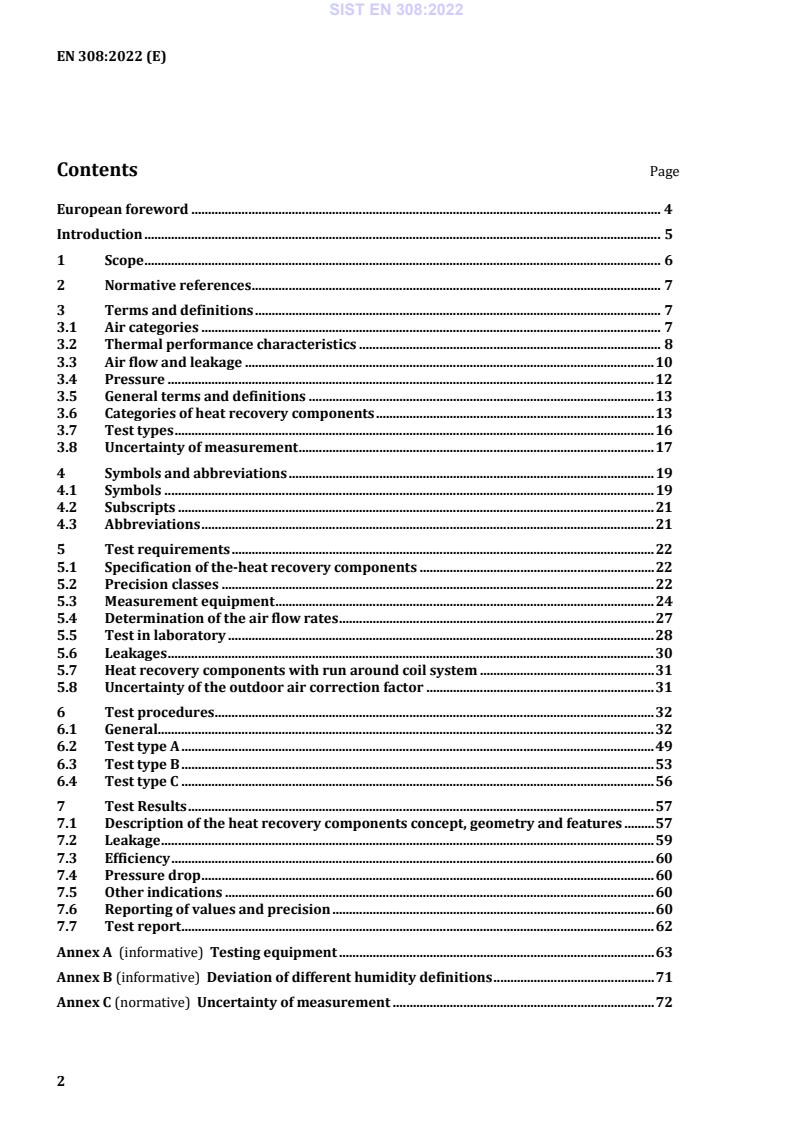
Contents Page
European foreword . 4
Introduction . 5
1 Scope . 6
2 Normative references . 7
3 Terms and definitions . 7
3.1 Air categories . 7
3.2 Thermal performance characteristics . 8
3.3 Air flow and leakage . 10
3.4 Pressure . 12
3.5 General terms and definitions . 13
3.6 Categories of heat recovery components . 13
3.7 Test types . 16
3.8 Uncertainty of measurement . 17
4 Symbols and abbreviations . 19
4.1 Symbols . 19
4.2 Subscripts . 21
4.3 Abbreviations . 21
5 Test requirements . 22
5.1 Specification of the-heat recovery components . 22
5.2 Precision classes . 22
5.3 Measurement equipment . 24
5.4 Determination of the air flow rates . 27
5.5 Test in laboratory . 28
5.6 Leakages . 30
5.7 Heat recovery components with run around coil system . 31
5.8 Uncertainty of the outdoor air correction factor . 31
6 Test procedures . 32
6.1 General. 32
6.2 Test type A . 49
6.3 Test type B . 53
6.4 Test type C . 56
7 Test Results . 57
7.1 Description of the heat recovery components concept, geometry and features . 57
7.2 Leakage . 59
7.3 Efficiency . 60
7.4 Pressure drop . 60
7.5 Other indications . 60
7.6 Reporting of values and precision . 60
7.7 Test report . 62
Annex A (informative) Testing equipment . 63
Annex B (informative) Deviation of different humidity definitions . 71
Annex C (normative) Uncertainty of measurement . 72
Annex D (informative) Estimation of Exhaust air transfer ratio . 78
Annex E (normative) Simplified test setup for static internal leakage . 81
Annex F (informative) Overviews of test procedures . 82
Bibliography . 86
European foreword
This document (EN 308:2022) has been prepared by Technical Committee CEN/TC 110 “Heat
exchangers”, the secretariat of which is held by DIN.
This European Standard shall be given the status of a national standard, either by publication of an
identical text or by endorsement, at the latest by September 2022, and conflicting national standards shall
be withdrawn at the latest by September 2022.
Attention is drawn to the possibility that some of the elements of this document may be the subject of
patent rights. CEN shall not be held responsible for identifying any or all such patent rights.
This document supersedes EN 308:1997.
This edition includes the following significant technical changes with respect to EN 308:1997:
— Scope: flue gas heat recovery devices are no more included.
— In addition to laboratory tests of heat recovery components (HRC), laboratory tests for HRC fitted
into air handling units and on-site tests of HRC are defined.
— Different precision classes for tests are defined.
— Leakage testing has been refined. Exhaust air transfer ratio (EATR) and outdoor air correction factor
(OACF) are implemented.
— Differences of the sensible and latent efficiency can occur due to leakages and bad heat balance.
— Several terms and definitions are changed, e.g. categories of heat recovery components.
— Type A test is only on the heat exchanger and does not necessarily give a representative value when
it is installed, corrections may be needed.
EN 13053 refers to EN 308 regarding the test setup and the test procedure. EN 13053 is a standard
harmonized with the Commission Regulation (EU) 1253/2014 [5].
Any feedback and questions on this document should be directed to the users’ national standards body.
A complete listing of these bodies can be found on the CEN website.
According to the CEN-CENELEC Internal Regulations, the national standards organisations of the
following countries are bound to implement this European Standard: Austria, Belgium, Bulgaria, Croatia,
Cyprus, Czech Republic, Denmark, Estonia, Finland, France, Germany, Greece, Hungary, Iceland, Ireland,
Italy, Latvia, Lithuania, Luxembourg, Malta, Netherlands, Norway, Poland, Portugal, Republic of North
Macedonia, Romania, Serbia, Slovakia, Slovenia, Spain, Sweden, Switzerland, Turkey and the United
Kingdom.
Introduction
This document specifies methods for the performance testing of air-to-air heat recovery components
(HRC) used in ventilation systems. This document does not contain any information on air handling units,
ductwork and components of air distribution, which are covered by other European Standards. The
document applies for laboratory and in on-site testing. Further it applies to different purposes of tests,
which can be e.g. certification of products, acceptance of installed products, market surveillance or quality
tests of manufacturers.
These different applications do not require the same precision of measurements results. Therefore,
different precision classes are defined. Table 1 gives informative examples for the application of the
different test types and precision classes. For low quality products, low quality installations and/or
simplified testing, a ‘not classified’ precision class can occur for all test types.
Table 1 — Examples for the application of the different test types and precision classes
Precision class P1 Precision class P2 Precision class P3 not classified
Test Type
(high precision) (medium precision) (low precision)
Test type A — certification or — test of — not intended use — not intended
declaration of functionality use
HRC installed in a test
products
casing or HRC-section
— performance test
Tested in laboratory
Test type B — test under ideal — certification or — test of — not intended
conditions declaration of functionality use
HRC installed in an
products
a
AHU
— performance test
Tested in laboratory
Test type C — not intended use, — test under ideal — typical test — test of
but possible conditions in real conditions in real functionality
HRC installed in an
under ideal systems systems
a
AHU or in duct work of
conditions and
— performance test
an installed ventilation
laboratory-like
system
test equipment
Tested on-site
a
The HRC is installed in an AHU (air handling unit) by the manufacturer of the AHU.
Customers and manufacturers are free to define the aspired precision class for testing of their products,
but it will be taken into account that the available precision class depends on the test conditions, the HRC
itself, the measurement equipment and the environment conditions.
This document is one of a series of European Standards dedicated to heat exchangers.
Note 1 Testing procedure of residential ventilation units, RVU’s, is covered by EN 13141-7 and EN 13141-8.
Note 2 EN 13053 deals with non-residential ventilation units, NRVU’s, specifically Air Handling Units (AHU’s).
For testing of the heat recovery, EN 13053 refers to EN 308.
1 Scope
This document specifies methods to be used for testing of air-to-air heat recovery components (HRC).
The main purpose of the HRC is to exchange heat between exhaust air and supply air in order to save
energy, which results in
— preheat or heat, and/or
— precool or cool
supply air in ventilation systems or air conditioning systems. Optionally HRC can exchange air humidity
between exhaust and supply air. The HRC contains the heat exchangers and all necessary features and
auxiliary devices for the exchange of sensible heat and (if available) air humidity between exhaust air and
supply air. The HRC will be installed in casings or ducts. If fans are part of the test unit, the effect of the
fan power on the measured values will be corrected.
This document specifies procedures and input criteria required for tests to determine the performance
of a HRC at one or several test conditions, each of them with continuous and stationary air flows, air
temperatures and humidities at both inlet sides. Three different test types are covered:
— Test type A, Laboratory testing of HRC installed in test casings (A1) or a HRC sections (A2);
— Test type B, Laboratory testing of HRC installed in non-residential ventilation units in design
configuration;
— Test type C, on-site (field) testing of HRC in non-residential ventilation units (C1) or a HRC sections
(C2) in operation configuration.
This document is applicable to recuperators, regenerators, and HRC with intermediary heat transfer
medium.
This document prescribes test methods for determining:
1) the temperature and humidity efficiency,
2) the pressure drop of exhaust air and supply air sides,
3) possible internal leakages; exhaust air transfer ratio (EATR) and outdoor air correction factor
(OACF),
4) external leakages and
5) auxiliary energy used for the operation of the HRC.
HRC using heat pumps are not covered by this document.
Definition according Commission Regulation (EU) No 1253/2014 [5].
2 Normative references
The following documents are referred to in the text in such a way that some or all of their content
constitutes requirements of this document. For dated references, only the edition cited applies. For
undated references, the latest edition of the referenced document (including any amendments) applies.
EN 1886, Ventilation for buildings — Air handling units — Mechanical performance
EN 13053, Ventilation for buildings — Air handling units — Rating and performance for units, components
and sections
JCGM 100, Evaluation of measurement data — Guide to the expression of uncertainty in measurement
3 Terms and definitions
For the purposes of this document, the following terms and definitions apply.
ISO and IEC maintain terminological databases for use in standardization at the following addresses:
— IEC Electropedia: available at https://www.electropedia.org/
— ISO Online browsing platform: available at https://www.iso.org/obp
3.1 Air categories
3.1.1
exhaust air inlet
air to be exhausted from the application, before entering the HRC
Note 1 to entry: In ventilation systems, this air is usually called extract air.
Note 2 to entry: Figure 1 shows the definition of the air flow categories in heat recovery components (HRC).
Key
11 Exhaust air inlet 22 Supply air outlet
12 Exhaust air outlet HRC Heat recovery component
21 Supply air inlet C Casing
Figure 1 — Air categories
3.1.2
exhaust air outlet
air in exhaust condition, intended to be blown back to the environment, after leaving the HRC
Note 1 to entry: In ventilation systems, this air is usually called exhaust air.
Note 2 to entry: See Figure 1.
3.1.3
supply air inlet
air intended for the application, before entering the HRC
Note 1 to entry: In ventilation systems, this air is usually called outdoor air. Sometimes this air does not come
directly from outdoor (preheated space, ground heat exchanger, etc.)
Note 2 to entry: See Figure 1.
3.1.4
supply air outlet
air intended for the application, after leaving the HRC
Note 1 to entry: See Figure 1.
3.2 Thermal performance characteristics
3.2.1
temperature efficiency
η
t,efy
transfer of sensible heat from exhaust to supply air, with correction of the temperature increase of the
supply air outlet caused by the EATR and a correction in case of a bad heat balance, to be used for the
description of the performance characteristic of a HRC
Note 1 to entry: The determination is according to 6.1.6.
Note 2 to entry: No definitions of temperature efficiency on the exhaust-air side are included. If data on the
exhaust-air side is required, conditions can be calculated by heat and mass balances, considering leakage and EATR.
Note 3 to entry: The temperature efficiency depends on the supply air mass flow and on the mass flow ratio
between the supply air flow and the exhaust air flow.
3.2.2
temperature gross efficiency
η
t,gro
temperature difference on the supply air side divided by the temperature difference between exhaust air
inlet and supply air inlet
Note 1 to entry: The determination is according to 6.1.6.
Note 2 to entry: The temperature gross efficiency does not regard internal or external leakages or heat flow
through the casing. The temperatures θ , θ and θ can differ from measured values, see 6.1.6.2.
11 21 22
Note 3 to entry: In Regulation (EU) 1253/2014 [5], the same equation is used. There, the definition is called
‘thermal efficiency of a non-residential HRS (η )’ and shall be measured under dry reference conditions, with
t_nrvu
balanced mass flows, an indoor-outdoor air temperature difference of 20 K, excluding thermal heat gain from fan
motors and from internal leakages.
3.2.3
temperature net efficiency
η
t,net
net transfer of sensible heat from exhaust to supply air, with correction of the temperature change of the
supply air outlet caused by the EATR
Note 1 to entry: The determination is according to 6.1.6.
Note 2 to entry: The temperature net efficiency does not regard external leakages or heat flow through the casing.
The temperatures θ , θ and θ can differ from measured values, see 6.1.6.2.
11 21 22
Note 3 to entry: Temperature net efficiency calculation is required if EATR is determined (see 5.5.2).
3.2.4
temperature effectiveness
ε
t
temperature gross efficiency, multiplied with the ratio of the mass flow rate of supply air outlet to the
minimum mass flow rate of supply outlet or exhaust air inlet
Note 1 to entry: The determination is according to 6.1.7.
Note 2 to entry: The temperature effectiveness describes the ratio of the effective sensible heat transfer from the
exhaust air side to the supply air side compared with the theoretical possible sensible heat transfer.
Note 3 to entry If the efficiency is very high, condensation occurs and the airflows are very unbalanced, the
effectiveness value can be higher than 1.
3.2.5
humidity efficiency
η
x,efy
transfer of latent heat from exhaust to supply air, with correction of the humidity change of the supply
air outlet caused by the EATR and a correction in case of a bad heat balance
Note 1 to entry: The humidity efficiency is determined according to 6.1.6.
Note 2 to entry: No definitions of humidity efficiency on the exhaust-air side are included. If data on the exhaust-
air side is required, conditions can be calculated by heat and mass balances, considering leakage and EATR.
Note 3 to entry: The humidity efficiency depends on the supply air flow and on the mass flow ratio between the
supply air flow and the exhaust air flow.
3.2.6
humidity gross efficiency
η
x,gro
absolute humidity difference on the supply air side divided by the absolute humidity difference between
exhaust air inlet and supply air inlet
Note 1 to entry: The determination is according to 6.1.6.
Note 2 to entry: No definitions of efficiency on the exhaust-air side are included. If data on the exhaust-air side is
required, conditions can be calculated by mass balances, considering leakages.
3.2.7
humidity net efficiency
η
x, net
net transfer of latent heat exhaust to supply air, with correction of the humidity change of the supply air
outlet caused by the EATR
Note 1 to entry: The determination is according to 6.1.6.
Note 2 to entry: Humidity net efficiency calculation is required if EATR is determined (see 5.5.2).
3.2.8
humidity effectiveness
ε
x
humidity efficiency, multiplied with the ratio of the dry mass flow rate of supply air outlet to the minimum
dry mass flow rate of supply outlet or exhaust air inlet
Note 1 to entry: The determination is according to 6.1.7.
3.3 Air flow and leakage
3.3.1
nominal leakage rate
ratio of the leakage (air volume flow) to the nominal air volume flow, at standard conditions
3.3.2
external leakage
q
ve
leakage from casing to or from the ambient air
Note 1 to entry: The external leakage is usually measured under static pressure difference. For calculations
considering the impact of the external leakage on measurement uncertainty, the external leakage in operational
mode has to be determined usually by calculation or estimation.
3.3.3
internal leakage
q
vi
umbrella term for the following definitions:
— test setup leakage;
— static internal leakage;
— dynamic internal leakage
3.3.4
test setup internal leakage
q
vi,setup
internal leakage of the test casing for Test Type A1, measured with static pressure difference
3.3.5
static internal leakage
q
vi,stat
internal leakage of the unit under test, measured with static pressure difference
Note 1 to entry: The static internal leakage is used as quality indicator for a HRC, where EATR and OACF are not
determined. This concerns constructions with no or only minor leakages, such as plate heat exchangers.
Note 2 to entry: The unit under test is defined by the test type.
3.3.6
dynamic internal leakage
internal leakage of the HRC, measured in operation conditions with air flow on both sides
Note 1 to entry: The dynamic internal leakage is characterized by EATR and OACF. EATR and OACF shall be
declared as a pair at identical conditions.
3.3.7
air flow
mass flow and volume flow of air
Note 1 to entry: If a clarification (mass or volume) is necessary the term is complemented with the applicable
symbol.
Note 2 to entry: Used as an umbrella term.
3.3.8
exhaust air transfer ratio
EATR
transfer of exhaust air into the supply air side in HRC and which provides information on the ratio of
exhaust air in the supply air
Note 1 to entry: The EATR can be measured with tracer gas. The determination is according to 6.1.2.
Note 2 to entry: The subscript shows how the EATR is determined or measured respectively:
— EATR : According to Test Type A1
A1
— EATR : According to Test Type A2
A2
— EATR : According to Test Type B
B
— EATR : According to Test Type C
C
Note 3 to entry: The EATR depends on pressure difference and airflows. Therefore, the test conditions at which
EATR is determined always have to be declared.
Note 4 to entry: Procedures for the estimation of the EATR for test type C are described in Annex D.
Note 5 to entry: EATR replaces the old term Carry-Over.
3.3.9
outdoor air correction factor
OACF
ratio of the entering supply mass airflow rate and the leaving supply mass airflow rate, which provides
information about the leakages between the air flows
Note 1 to entry: The determination is according to 6.1.2.
Note 2 to entry: The OACF depends on pressure difference and airflows. Therefore, the test conditions at which
OACF is determined always have to be declared.
3.3.10
mass flow rate exhaust air inlet
q
m11
air mass flow on the exhaust air inlet side
Note 1 to entry: This is the mass flow that leaves the application side.
3.3.11
mass flow rate exhaust air outlet
q
m12
air mass flow on the exhaust air outlet side
3.3.12
mass flow rate supply air inlet
q
m21
air mass flow on the supply air inlet side
3.3.13
mass flow rate supply air outlet
q
m22
air mass flow on the supply air outlet side
Note 1 to entry: This is the mass flow that enters the application side.
3.3.14
nominal air mass flow rate
q
m,n
declared air mass flow rate as base for testing and test results
3.4 Pressure
3.4.1
pressure difference 22−11
Δp
22−11
difference in static pressure between the supply air outlet and the exhaust air inlet, measured in the
casing or other connections with the same cross section area on both sides
Note to entry: The pressure difference is determined according 6.1.4.1.
3.4.2
pressure drop
Δp , Δp
11−12 21−22
loss in static pressure between the inlet and the outlet of a HRC, measured in the casing or other
connections with the same cross section area on both sides
Note to entry: The pressure drop is determined according 6.1.4.2.
3.4.3
external static pressure difference
Δp
s,ext
difference between the static pressure at the outlet of the air handling unit and the static pressure at the
inlet
[SOURCE: EN 13053]
3.4.4
static internal leakage mass flow rate
q
m,il,stat
leakage, caused by a static pressure difference between exhaust air side and supply air side
Note 1 to entry: Measured by blanking off and sealing all ducts of the HRC or HRC section.
3.5 General terms and definitions
3.5.1
standard air conditions
relating to air with a density of 1,20 kg/m , at a temperature of 20 °C, an atmospheric air pressure of
101 325 Pa and a relative humidity 40 %
3.5.2
face area
A
f22
orthographic projection of the supply air outlet side of the HRC, which is in contact with the supply air
Note 1 to entry: The face area of HRC depends on the HRC category and construction.
3.6 Categories of heat recovery components
3.6.1
heat recovery component
HRC
heat exchanger or combinations of heat exchangers which transfer heat and, in some cases humidity,
between exhaust and supply air flow depending on the difference of temperature and humidity levels and
which are generally installed in casings or air ducts
Note 1 to entry: In the following clauses the HRC are divided into three categories and additional sub-categories.
Table 2 gives an overview.
Note 2 to entry: Used as an umbrella term.
Table 2 — Category code for the principle of HRC
Detailed
Category Description
description in
HRC1 Recuperative HRC (general) 3.6.2
HRC1a Non-humidity permeable recuperative HRC 3.6.2.1
HRC1x Humidity permeable recuperative HRC 3.6.2.2
HRC2 HRC with intermediary heat transfer medium (general) 3.6.3
HRC2a HRC with a run around coil system, 3.6.3.1
intermediary heat transfer medium without phase-change
HRC2b HRC with intermediary heat transfer medium with phase-change (heat 3.6.3.2
pipe)
HRC3 Regenerative HRC (general) 3.6.4
HRC3a Non-hygroscopic rotary wheel 3.6.4.2
HRC3x Hygroscopic rotary wheel 3.6.4.3
HRC3b HRC with non-hygroscopic stationary accumulator 3.6.4.5
HRC3y HRC with hygroscopic stationary accumulator 3.6.4.6
The letters a and b are used for categories without intended humidity exchange. The letters x and y are
used for categories with intended humidity exchange.
3.6.2
recuperative heat recovery component
HRC1
heat exchangers designed to transfer energy from one air stream to another without moving parts
Note 1 to entry: Heat transfer surfaces are in form of plates or tubes. This heat exchanger can have parallel flow,
cross flow or counter flow construction or a combination of these.
Note 2 to entry: Used as an umbrella term.
3.6.2.1
non-humidity permeable recuperative heat recovery component
HRC1a
heat exchangers of category HRC1 designed for sensible heat transfer only
3.6.2.2
humidity permeable recuperative heat recovery component
HRC1x
heat exchangers of category HRC1 designed for transfer of sensible heat and humidity
3.6.3
Heat recovery component with intermediary heat transfer medium
HRC2
HRC with heat exchangers in both air streams connected with tubes or pipes, including all necessary parts
for the heat transport
Note 1 to entry: A transfer medium transports the sensible energy from one heat exchanger to the other.
Note 2 to entry: Used as an umbrella term.
3.6.3.1
Heat recovery component with a run around coil system
HRC2a
HRC of category HRC2 with an intermediary heat transfer medium without phase-change (liquid) used
as heat transfer medium and which includes the piping, pump and transfer medium
3.6.3.2
Heat recovery component with heat pipe
HRC2b
HRC of category HRC2 in which the transfer medium evaporates in the heat exchanger in the warm air
stream and condenses in the heat exchanger in the cold air stream
Note 1 to entry: Heat pumps are not covered by this definition.
3.6.4
Regenerative heat recovery component
HRC3
HRC designed for the regenerative heat transfer due to accumulation mass
Note 1 to entry: The mass is warmed up in the warm air stream and cooled down in the cold air stream. Both air
streams are in alternating contact with a common surface. Due to different possible mechanisms transfer of
humidity or other substances from one air stream to the other can occur.
Note 2 to entry: Used as an umbrella term.
3.6.4.1
rotary wheel
HRC of category HRC3 with an accumulation mass in form of a rotating cylinder which incorporates heat
transfer material, a drive mechanism, a casing or frame, and includes any seals which are provided to
prevent the bypassing and leakage of air from one air stream to the other
Note 1 to entry: In literature rotary wheels are sometimes also called “thermal wheels” or “heat wheels”.
3.6.4.2
non-hygroscopic rotary wheel
HRC3a
rotary wheel not intended for humidity exchange between the two air streams
Note 1 to entry: Humidity exchange can occur in case of condensation on the surface of the accumulator.
3.6.4.3
hygroscopic rotary wheel
HRC3x
rotary wheel determined for humidity exchange between the air streams without condensation
3.6.4.4
heat recovery component with stationary accumulator
HRC of category HRC3 with a stationary accumulation mass, where the change of the air flows is managed
by reciprocating opening and closing of dampers and which incorporates heat transfer material, dampers,
drive mechanism for dampers, a casing or frame, and includes any seals which are provided to retard the
bypassing and leakage of air from one air stream to the other
Note 1 to entry: According this definition also mixing and air flow direction changing devices are part of the HRC.
Note 2 to entry: According to the scope only the testing of HRC with steady air flows is covered by this standard.
3.6.4.5
heat recovery component with non-hygroscopic stationary accumulator
HRC3b
stationary accumulator not intended for humidity exchange between the two air streams
Note 1 to entry: Humidity exchange can occur in case of condensation on the surface of the accumulator.
3.6.4.6
heat recovery component with hygroscopic stationary accumulator
HRC3y
stationary accumulator determined for humidity exchange between the air streams without
condensation
3.7 Test types
3.7.1
test type A
laboratory testing of HRC and HRC sections
tests which are carried out in a laboratory
Note 1 to entry: Used as an umbrella term.
3.7.1.1
test type A1
laboratory testing of HRC
laboratory testing of a HRC integrated in a test casing or an air duct
Note 1 to entry: The HRC is tested under ideal conditions. This test type provides performance data for the HRC
itself, without influences of the application. The performance data are e.g. a reliable base for a general comparison
of products or a validation of software from HRC manufacturers.
Note 2 to entry: This fulfils in both cases the requirements given in 5.5.4.
3.7.1.2
test type A2
laboratory testing of a HRC section
laboratory testing of a unit delivered to the laboratory, consisting only of a HRC installed in a casing or in
an air duct
Note 1 to entry: According the definition no further component than the HRS is installed in the section.
Note 2 to entry: The definition deliberately leaves open whether the HRC is intended for commercial purposes or
manufactured for the sole purpose of testing.
Note 3 to entry: The test item is the HRC section. The HRC section is tested under ideal conditions. The laboratory
is not responsible for the casing.
3.7.2
test type B
laboratory testing of the HRC in an AHU
testing of a HRC is performed in a laboratory while the HRC is installed in an AHU, which is delivered to
the laboratory
Note 1 to entry: The air flow rates are determined at the ducts connections of the AHU. The conditions of the inlet
air (11 and 21) is also determined at the duct connection of the AHU.
Note 2 to entry: The HRC performance is tested under consideration of the installation conditions in the AHU, in
particular the flow conditions and the leakages. Nevertheless, the test takes place under standardized conditions, in
particular well-defined air and pressure conditions at the duct connections of the AHU.
3.7.3
test type C
on-site testing of the HRC
umbrella term for on-site testing of a HRC installed in an AHU, in a HRC section or in air ducts in a real
ventilation system, with air flow rates and air conditions as close as possible to the design conditions
Note 1 to entry: According this definition the HRC performance is tested under consideration of the installation
conditions. By definition, the pressure conditions are given by the design of the ventilation system.
Note 2 to entry: Used as an umbrella term.
3.7.3.1
test type C1
on-site testing of the HRC in the AHU
testing of the HRC, which is installed in the AHU, is performed on-site
Note 1 to entry: The air flow rates are determined at the duct connections of the AHU. The conditions of the inlet
air (11 and 21) is also determined at the duct connection of the AHU.
Note 2 to entry: If there is no access for measurement at the duct connections of the AHU, the HRC section can be
tested as Test Type C2.
3.7.3.2
test type C2
on-site testing of the HRC section
on-site testing of the HRC, which installed in air ducts or in a HRC section, which is not part of an AHU
Note 1 to entry: The air flow rates are determined at the duct connections of the HRC-section or the ducts belonging
to the HRC. The conditions of the inlet air (11 and 21) are also determined at the duct connection of the HRC-section
or the ducts belonging to the HRC.
3.8 Uncertainty of measurement
3.8.1 Expression of uncertainty
3.8.1.1
uncertainty of measurement
parameter, associated with the result of a measurement, that characterizes the dispersion of the values
that can reasonably be attributed to the measurand
[SOURCE: JCGM 100:2008]
3.8.1.2
standard uncertainty
uncertainty of the result of a measurement expressed as a standard deviation
[SOURCE: JCGM 100:2008]
3.8.1.3
combined standard uncertainty
standard uncertainty of the result of a measurement when that result is obtained from the values of a
number of other quantities, equal to the positive square root of a sum of terms, the terms being the
variances or covariances of these other quantities weighted according to how the measurement result
varies with changes in these quantities
[SOURCE: JCGM 100:2008]
3.8.1.4
expanded uncertainty
quantity defining an interval about the result of a measurement that can be expected to encompass a large
fraction of the distribution of values that can reasonably be attributed to the measurand
[SOURCE: JCGM 100:2008]
3.8.1.5
coverage factor
k
numerical factor used as a multiplier of the combined standard uncertainty in order to obtain an
expanded uncertainty, corresponding to a level of confidence of 95 %
Note 1 to entry: With the given level of confidence the rounded coverage factor is 2 for a Gaussian distribution.
[SOURCE: JCGM 100:2008, modified – addition of Note 1]
3.8.2
precision class
class of the absolute expanded measurement uncertainty of the temperature efficiency for winter
conditions or the humidity efficiency respectively
Note 1 to entry: With a class border according Table 3 under the conditions given in 5.2.
Table 3 — Precision classes
Expanded measurement uncertainty of the efficiency of precision class
Performance criteria
P1 P2 P3 not classified
Temperature efficiency 0,025 0,040 0,080 > 0,080
Humidity efficiency 0,060 0,090 0,160 > 0,160
4 Symbols and abbreviations
4.1 Symbols
For the purposes of this document, the symbols in Table 4 apply.
Table 4 — Symbols
Symbol Quantity Unit
A face area
m
f
C tracer gas concentration mol/l or ppm
P electric power input W, kW
E
c specific heat capacity at constant pressure J/(K · kg)
p
f conversion factor for electric power to heat –
E
h specific enthalpy J/kg
k coverage factor –
k correction of the efficiency due to bad heat balance –
hb
−1
n number of revolutions
s or rpm
p pressure Pa
p Pressure at exhaust air inlet Pa
p pressure at exhaust of air outlet Pa
p pressure at supply of air inlet Pa
p pressure at supply of air outlet Pa
q mass flow rate of exhaust air inlet kg/s
m11
q mass flow rate of supply air outlet kg/s
m22
q nominal mass flow rate kg/s
mn
q mass flow rate EATR kg/s
mEATR
3 3
q external leakage air volume flow rate
m /s or m /h
ve
3 3
q static internal leakage air volume flow rate
m /s or m /h
vi,stat
r specific enthalpy of vaporization of water (2 500 kJ/(kg ∙ K)) kJ/(kg ∙ K)
w
v
velocity m/s
declared velocity m/s
v
d
x absolute humidity kg water/kg dry air
x absolute humidity of exhaust air inlet kg water/kg dry air
x absolute humidity of supply air inlet kg water/kg dry air
Symbol Quantity Unit
x absolute humidity of supply air outlet kg water/kg dry air
Δp pressure drop on exhaust-air side Pa
11−12
Δp pressure drop on supply-air side Pa
21−22
Δp difference in static pressure between the supply air outlet Pa
22−11
and the exhaust air inlet
Δθ temperature difference K
∆ϕ
deviation of heat balance –
tolerance of heat balance (limits of the relative heat balance) –
∆ϕ
lim
temperature effectiveness -
ε
t
humidity effectiveness -
ε
x
Φ heat flow W, kW
η temperature efficiency –
t,efy
η temperature gross efficiency –
t,gro
η temperature net efficiency –
t,net
η humidity efficiency –
x,efy
η humidity gross efficiency –
x,gro
η humidity net efficiency –
x,net
θ temperature °C, K
θ temperature of exhaust air inlet °C, K
θ temperature of exhaust air outlet °C, K
θ temperature of supply air inlet °C, K
θ temperature of supply air outlet °C, K
ρ density
kg/m
3 3
ρ
standard air density (1,20 kg/m ) kg/m
st
4.2 Subscripts
0 reference
11 exhaust air inlet (see Figure 1)
12 exhaust air outlet (see Figure 1)
21 supply air inlet (see Figure 1)
22 supply air outlet (see Figure 1)
A1 determined or measured according to Test Type A1
A2 determined or measured according to Test Type A2
B determined or measured according to Test Type B
C1 determined or measured according to Test Type C1
C2 determined or measured according to Test Type C2
E related to electric energy
Te related to test conditions
a ambient
dry dry air
ext external
f face
gro gross
int internal
vi related to internal leakage volume flow rate
ve related to external leakage volume flow rate
min minimum
n nominal
net net
st related to standard condition
w water
4.3 Abbreviations
AHU Air Handling Unit
EATR Exhaust air transfer ratio
HRC Heat Recovery Component(s)
OACF Outdoor air correction factor
5 Test requirements
5.1 Specification of the-heat recovery components
The following information is required before proceeding to the test:
— Specification of the HRC category according to 3.3; this specification determines whether or not the
humidity efficiency is measured.
— Specification of the delivered HRC, that provides unambiguous identification by the testing
laboratory;
— For test type A: Nominal air flow rate, as defined in 3.3.14;
— For test type A: Maximum pressure difference 22-11 (positive and negative) between
...