

EN 12665:2011
(Main)Light and lighting - Basic terms and criteria for specifying lighting requirements
General Information
- Abstract
This European Standard defines basic terms and definitions for use in all lighting applications. This European Standard also sets out a framework for the specification of lighting requirements, giving details of aspects which have to be considered when setting those requirements.
- Status
- Withdrawn
- Publication Date
- 28-Jun-2011
- Withdrawal Date
- 29-Sep-2026
- Technical Committee
- CEN/TC 169 - Lighting applications
- Drafting Committee
- CEN/TC 169/WG 1 - Basic terms and criteria
- Current Stage
- 9960 - Withdrawal effective - Withdrawal
- Start Date
- 20-Jun-2018
- Completion Date
- 30-Sep-2026
- Directive
- 2008/57/EC - DIRECTIVE 2008/57/EC OF THE EUROPEAN PARLIAMENT AND OF THE COUNCIL of 17 June 2008 on the interoperability of the rail system within the Community (Recast)OJ Ref: C, C 345 OJ Date: 26-Nov-2013


Relations
- Replaces
EN 12665:2002 - Light and lighting - Basic terms and criteria for specifying lighting requirements - Effective Date
- 22-Dec-2008
- Replaced By
EN 12665:2018 - Light and lighting - Basic terms and criteria for specifying lighting requirements - Effective Date
- 08-Jun-2015
- Effective Date
- 28-Jan-2026
- Effective Date
- 28-Jan-2026
- Effective Date
- 28-Jan-2026
- Effective Date
- 28-Jan-2026
- Referred By
EN 12464-2:2014 - Light and lighting - Lighting of work places - Part 2: Outdoor work places - Effective Date
- 28-Jan-2026
- Effective Date
- 28-Jan-2026
Get Certified
Connect with accredited certification bodies for this standard

DIBt (Deutsches Institut für Bautechnik)
German Institute for Building Technology.
DIN CERTCO
DIN Group product certification.

Aboma Certification B.V.
Specialized in construction, metal, and transport sectors.
Sponsored listings
Frequently Asked Questions
EN 12665:2011 is a standard published by the European Committee for Standardization (CEN). Its full title is "Light and lighting - Basic terms and criteria for specifying lighting requirements". This standard covers: This European Standard defines basic terms and definitions for use in all lighting applications. This European Standard also sets out a framework for the specification of lighting requirements, giving details of aspects which have to be considered when setting those requirements.
This European Standard defines basic terms and definitions for use in all lighting applications. This European Standard also sets out a framework for the specification of lighting requirements, giving details of aspects which have to be considered when setting those requirements.
EN 12665:2011 is classified under the following ICS (International Classification for Standards) categories: 01.040.91 - Construction materials and building (Vocabularies); 91.160.01 - Lighting in general. The ICS classification helps identify the subject area and facilitates finding related standards.
EN 12665:2011 has the following relationships with other standards: It is inter standard links to EN 12665:2002, EN 12665:2018, EN 13201-3:2015, EN 1838:2013, EN 13201-5:2015, EN 16276:2013, EN 12464-2:2014, EN 12193:2018. Understanding these relationships helps ensure you are using the most current and applicable version of the standard.
EN 12665:2011 is associated with the following European legislation: EU Directives/Regulations: 2008/57/EC; Standardization Mandates: M/275, M/334. When a standard is cited in the Official Journal of the European Union, products manufactured in conformity with it benefit from a presumption of conformity with the essential requirements of the corresponding EU directive or regulation.
EN 12665:2011 is available in PDF format for immediate download after purchase. The document can be added to your cart and obtained through the secure checkout process. Digital delivery ensures instant access to the complete standard document.
Standards Content (Sample)
2003-01.Slovenski inštitut za standardizacijo. Razmnoževanje celote ali delov tega standarda ni dovoljeno.Svetloba in razsvetljava - Osnovni izrazi in merila za specifikacijo zahtev za razsvetljavoLicht und Beleuchtung - Grundlegende Begriffe und Kriterien für die Festlegung von Anforderungen an die BeleuchtungLumière et éclairage - Termes de base et critères pour la spécification des exigences en éclairageLight and lighting - Basic terms and criteria for specifying lighting requirements91.160.01Razsvetljava na splošnoLighting in general01.040.91Gradbeni materiali in gradnja (Slovarji)Construction materials and building (Vocabularies)ICS:Ta slovenski standard je istoveten z:EN 12665:2011SIST EN 12665:2011en,fr,de01-december-2011SIST EN 12665:2011SLOVENSKI
STANDARDSIST EN 12665:20041DGRPHãþD
EUROPEAN STANDARD NORME EUROPÉENNE EUROPÄISCHE NORM
EN 12665
June 2011 ICS 01.040.91; 91.160.01 Supersedes EN 12665:2002English Version
Light and lighting - Basic terms and criteria for specifying lighting requirements
Lumière et éclairage - Termes de base et critères pour la spécification des exigences en éclairage
Licht und Beleuchtung - Grundlegende Begriffe und Kriterien für die Festlegung von Anforderungen an die Beleuchtung This European Standard was approved by CEN on 11 May 2011.
CEN members are bound to comply with the CEN/CENELEC Internal Regulations which stipulate the conditions for giving this European Standard the status of a national standard without any alteration. Up-to-date lists and bibliographical references concerning such national standards may be obtained on application to the CEN-CENELEC Management Centre or to any CEN member.
This European Standard exists in three official versions (English, French, German). A version in any other language made by translation under the responsibility of a CEN member into its own language and notified to the CEN-CENELEC Management Centre has the same status as the official versions.
CEN members are the national standards bodies of Austria, Belgium, Bulgaria, Croatia, Cyprus, Czech Republic, Denmark, Estonia, Finland, France, Germany, Greece, Hungary, Iceland, Ireland, Italy, Latvia, Lithuania, Luxembourg, Malta, Netherlands, Norway, Poland, Portugal, Romania, Slovakia, Slovenia, Spain, Sweden, Switzerland and United Kingdom.
EUROPEAN COMMITTEE FOR STANDARDIZATION
COMITÉ EUROPÉEN DE NORMALISATION EUROPÄISCHES KOMITEE FÜR NORMUNG
Management Centre:
Avenue Marnix 17,
B-1000 Brussels © 2011 CEN All rights of exploitation in any form and by any means reserved worldwide for CEN national Members. Ref. No. EN 12665:2011: ESIST EN 12665:2011
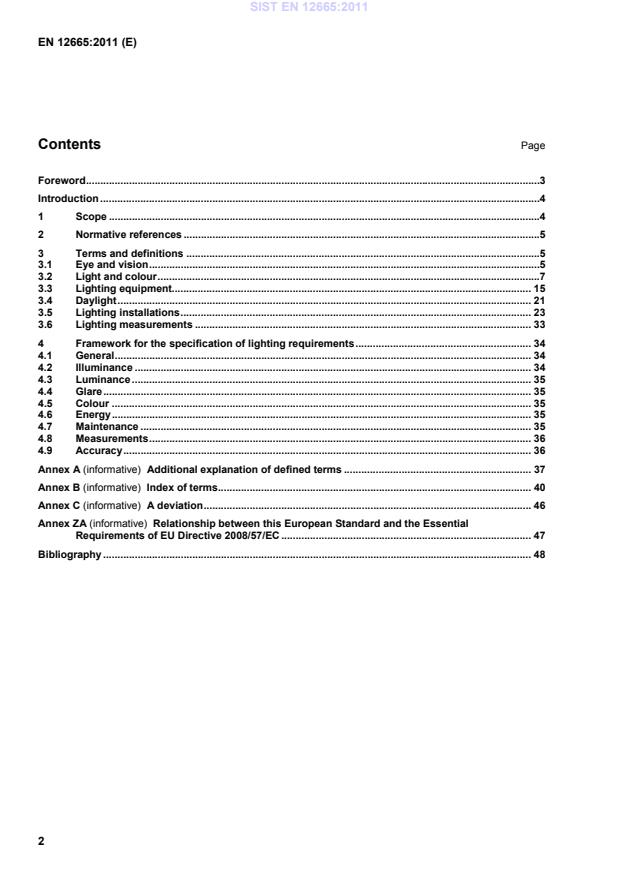
Additional explanation of defined terms . 37Annex B (informative)
Index of terms. 40Annex C (informative)
A deviation . 46Annex ZA (informative)
Relationship between this European Standard and the Essential Requirements of EU Directive 2008/57/EC . 47Bibliography . 48 SIST EN 12665:2011
EN 12464-2, EN 13032-1, EN 13032-2 and EN 15193. The significant change between EN 12665:2002 and EN 12665:2011 is within the scope of the document.
EN 12665:2002 defined basic terms for use in lighting applications, and specialist terms with limited applications were defined in individual standards. In practice this resulted in cases of similar terminology being used to define different concepts, and conversely different terms being used to describe similar concepts. Therefore EN 12665:2011 defines basic terms and definitions for use in all lighting applications. Furthermore some references have been updated. Attention is drawn to the possibility that some of the elements of this document may be the subject of patent rights. CEN [and/or CENELEC] shall not be held responsible for identifying any or all such patent rights. According to the CEN/CENELEC Internal Regulations, the national standards organizations of the following countries are bound to implement this European Standard: Austria, Belgium, Bulgaria, Croatia, Cyprus, Czech Republic, Denmark, Estonia, Finland, France, Germany, Greece, Hungary, Iceland, Ireland, Italy, Latvia, Lithuania, Luxembourg, Malta, Netherlands, Norway, Poland, Portugal, Romania, Slovakia, Slovenia, Spain, Sweden, Switzerland and United Kingdom.
The terms light adaptation and dark adaptation are also used, the former when the luminances of the stimuli are of at least several candelas per square metre, and the latter when the luminances are of less than some hundredths of a candela per square metre. NOTE 2
Adaptation to specific spatial frequencies, orientations, sizes, etc. are recognized as being included in this definition. [IEC 60050-845:1987/CIE 17.4:1987; 845-02-07]
3.1.2 accommodation adjustment of the dioptric power of the crystalline lens by which the image of an object, at a given distance, is focused on the retina
[IEC 60050-845:1987/CIE 17.4:1987; 845-02-44]
3.1.3 visual acuity 1.
qualitatively: capacity for seeing distinctly fine details that have very small angular separation 2.
quantitatively: any of a number of measures of spatial discrimination such as the reciprocal of the value of the angular separation in minutes of arc of two neighbouring objects (points or lines or other specified stimuli) which the observer can just perceive to be separate
[IEC 60050-845:1987/CIE 17.4:1987; 845-02-43]
3.1.4 brightness luminosity (obsolete) attribute of a visual sensation according to which an area appears to emit more or less light [IEC 60050-845:1987/CIE 17.4:1987; 845-02-28] SIST EN 12665:2011
3.1.5 contrast 1.
in the perceptual sense: assessment of the difference in appearance of two or more parts of a field seen simultaneously or successively (hence: brightness contrast, lightness contrast, colour contrast, simultaneous contrast, successive contrast, etc.) 2.
in the physical sense: quantity intended to correlate with the perceived brightness contrast, usually defined by one of a number of formulae which involve the luminances of the stimuli considered, for example: ûL/L near the luminance threshold, or L1/L2 for much higher luminances [IEC 60050-845:1987/CIE 17.4:1987; 845-02-47]
3.1.6 brightness contrast subjective assessment of the difference in brightness between two or more surfaces seen simultaneously or successively 3.1.7 colour contrast subjective assessment of the difference in colour between two or more surfaces seen simultaneously or successively 3.1.8 glare condition of vision in which there is discomfort or a reduction in the ability to see details or objects, caused by an unsuitable distribution or range of luminance, or to extreme contrasts [IEC 60050-845:1987/CIE 17.4:1987; 845-02-52]
3.1.9 flicker impression of unsteadiness of visual sensation induced by a light stimulus whose luminance or spectral distribution fluctuates with time [IEC 60050-845:1987/CIE 17.4:1987; 845-02-49]
3.1.10 visual field area or extent of physical space visible to an eye at a given position and direction of view NOTE
It should be stated whether the visual field is monocular or binocular. 3.1.11 visual performance performance of the visual system as measured for instance by the speed and accuracy with which a visual task is performed [IEC 60050-845:1987/CIE 17.4:1987; 845-09-04]
3.1.12 visual comfort subjective condition of visual well-being induced by the visual environment SIST EN 12665:2011
Φ
is the luminous flux;
()λλφdde is the spectral distribution of the radiant flux;
V()
is the spectral luminous efficiency function. NOTE 2 For the values of Km (photopic vision) and K′m (scotopic vision), see IEC 60050-845:1987/CIE 17.4:1987;
845-01-56. [IEC 60050-845:1987/CIE 17.4:1987; 845-01-25]
3.2.2 luminous intensity (of a source, in a given direction) I quotient of the luminous flux dΦ leaving the source and propagated in the element of solid angle d containing the given direction, by the element of solid angle (unit: cd = lm ⋅ sr -1) Ωφdd=I where I
is the luminous intensity of a source in a given direction; dΦ is the luminous flux leaving the source; dΩ is the solid angle. SIST EN 12665:2011
3.2.3 luminance (in a given direction, at a given point of a real or imaginary surface) L quantity defined by the equation (unit: cd ⋅ m-2 = lm ⋅ m -2 ⋅ sr -1) A-Ldcosddϑ= where L
is the luminance in a given direction or at a given point of a surface; φd is the luminous flux transmitted by an elementary beam passing through the given point and propagating in the solid angle Ωd containing the given direction; dA
is the area of a section of that beam containing the given point; dΩ
is the solid angle; ϑ
is the angle between the normal to that section and the direction of the beam. NOTE See notes 1 to 5 to IEC 60050-845:1987/CIE 17.4:1987; 845-01-34. [IEC 60050-845:1987/CIE 17.4:1987; 845-01-35]
3.2.4 average luminance L luminance averaged over the specified surface or solid angle (unit: cd ⋅ m-2) 3.2.5 minimum luminance Lmin lowest luminance of any relevant point on the specified surface (unit: cd ⋅ m-2) NOTE The relevant points at which the luminances are determined should be specified in the appropriate application standard. 3.2.6 maximum luminance Lmax highest luminance of any relevant point on the specified surface (unit: cd ⋅ m-2) NOTE The relevant points at which the luminances are determined should be specified in the appropriate application standard. 3.2.7 maintained luminance Lm minimum average luminance (unit: cd ⋅ m-2) NOTE 1 Value below which average luminance should not fall. NOTE 2 It is the average luminance at the time maintenance should be carried out. SIST EN 12665:2011
C1 = L2/L1 (usually for successive stimuli), or by the following equation C2 = (L2 - L1) / L1 (usually for surfaces viewed simultaneously), when the areas of different luminance are comparable in size and it is desired to take an average, the following equation can be used instead C3 = (L2 - L1) / 0,5(L2 + L1) where
L1
is the luminance of the background, or largest part of the visual field; and L2 is the luminance of the object; L2 is the luminance of the object.
3.2.10 illuminance (at a point of a surface) E quotient of the luminous flux d- incident on an element of the surface containing the point, by the area dù of that element (unit: lx = lm ⋅ m-2) NOTE Equivalent definition: Integral, taken over the hemisphere visible from the given point, of the expression
L ⋅ cos
⋅ d, where L is the luminance at the given point in the various directions of the incident elementary beams of solid angle d, and
is the angle between any of these beams and the normal to the surface at the given point. ∫Ω=Φ=srLAEπθ2dcosdd where E
is the illuminance at a point of a surface; L
is the luminance at the given point in the various directions of the incident elementary beams of solid angle dΩ; ,
is the angle between an incident beam and the normal to the surface at the given point; dΩ
is the solid angle. [IEC 60050-845:1987/CIE 17.4:1987; 845-01-38]
3.2.11 average illuminance E illuminance averaged over the specified surface (unit: lx) SIST EN 12665:2011
3.2.17 hemispherical illuminance (at a point) Ehs total luminous flux falling on the curved surface of a very small hemisphere located at the specified point divided by the curved surface area of the hemisphere (unit: lx) NOTE The base of the hemisphere is taken to be horizontal unless stated otherwise. 3.2.18 cylindrical illuminance (at a point, for a direction) Ez total luminous flux falling on the curved surface of a very small cylinder located at the specified point divided by the curved surface area of the cylinder (unit: lx) NOTE The axis of the cylinder is taken to be vertical unless stated otherwise. (see also IEC 60050-845:1987/CIE 17.4:1987; 845-01-41 cylindrical irradiance)
3.2.19 semi-cylindrical illuminance (at a point) Esz total luminous flux falling on the curved surface of a very small semi-cylinder located at the specified point, divided by the curved surface area of the semi-cylinder (unit: lx) SIST EN 12665:2011
3.2.22 disability glare glare that impairs the vision of objects without necessarily causing discomfort [IEC 60050-845:1987/CIE 17.4:1987; 845-02-57]
3.2.23 discomfort glare glare that causes discomfort without necessarily impairing the vision of objects [IEC 60050-845:1987/CIE 17.4:1987; 845-02-56]
3.2.24 veiling reflections specular reflections that appear on the object viewed and that partially or wholly obscure the details by reducing contrast [IEC 60050-845:1987/CIE 17.4:1987; 845-02-55]
3.2.25 luminous environment lighting considered in relation to its physiological and psychological effects [IEC 60050-845:1987/CIE 17.4:1987; 845-09-03]
3.2.26 colour rendering effect of an illuminant on the colour appearance of objects by conscious or subconscious comparison with their colour appearance under a reference illuminant NOTE In German, the term “Farbwiedergabe” is also applied to colour reproduction. [IEC 60050-845:1987/CIE 17.4:1987; 845-02-59]
3.2.27 CIE 1974 general colour rendering index Ra mean of the CIE 1974 special colour rendering indices for a specified set of eight test colour samples [IEC 60050-845:1987/CIE 17.4:1987; 845-02-63] SIST EN 12665:2011
3.2.28 colour stimulus visible radiation entering the eye and producing a sensation of colour, either chromatic or achromatic [IEC 60050-845:1987/CIE 17.4:1987; 845-03-02]
3.2.29 tristimulus values (of a colour stimulus) amounts of the three reference colour stimuli, in a given trichromatic system, required to match the colour of the stimulus considered NOTE In the CIE standard colorimetric systems, the tristimulus values are represented by the symbols X, Y, Z and X10, Y10, Z10. [IEC 60050-845:1987/CIE 17.4:1987; 845-03-22]
3.2.30 chromaticity coordinates ratio of each of a set of three tristimulus values to their sum NOTE 1 As the sum of the three chromaticity coordinates equals 1, two of them are sufficient to define a chromaticity. NOTE 2 In the CIE standard colorimetric systems, the chromaticity coordinates are presented by the symbols x, y, z and x10, y10, z10. [IEC 60050-845:1987/CIE 17.4:1987; 845-03-33]
3.2.31 chromaticity property of a colour stimulus defined by its chromaticity coordinates, or by its dominant or complementary wavelength and purity taken together [IEC 60050-845:1987/CIE 17.4:1987; 845-03-34]
3.2.32 colour temperature Tc temperature of a Planckian radiator whose radiation has the same chromaticity as that of a given stimulus (unit: K) NOTE The reciprocal colour temperature is also used, unit: K-1. [IEC 60050-845:1987/CIE 17.4:1987; 845-03-49]
3.2.33 correlated colour temperature Tcp temperature of the Planckian radiator whose perceived colour most closely resembles that of a given stimulus at the same brightness and under specified viewing conditions (unit: K) NOTE 1 The recommended method of calculating the correlated colour temperature of a stimulus is to determine on a chromaticity diagram the temperature corresponding to the point on the Planckian locus that is intersected by the agreed isotemperature line containing the point representing the stimulus (see CIE Publication No 15). NOTE 2 Reciprocal correlated colour temperature is used rather than reciprocal colour temperature whenever correlated colour temperature is appropriate. [IEC 60050-845:1987/CIE 17.4:1987; 845-03-50] SIST EN 12665:2011
3.2.34 fusion frequency critical flicker frequency (for a given set of conditions) frequency of alternation of stimuli above which flicker is not perceptible (unit: Hz) [IEC 60050-845:1987/CIE 17.4:1987; 845-02-50]
3.2.35 reflectance (for incident radiation of given spectral composition, polarization and geometrical distribution)
ratio of the reflected radiant or luminous flux to the incident flux in the given conditions (unit: 1) [IEC 60050-845:1987/CIE 17.4:1987; 845-04-58]
3.2.36 transmittance (for incident radiation of given spectral composition, polarization and geometrical distribution) τ ratio of the transmitted radiant or luminous flux to the incident flux in the given conditions (unit: 1) [IEC 60050-845:1987/CIE 17.4:1987; 845-04-59]
3.2.37 absorptance . ratio of the absorbed radiant or luminous flux to the incident flux under specified conditions (unit: 1) [IEC 60050-845:1987/CIE 17.4:1987; 845-04-75]
3.2.38 photometry measurement of quantities referring to radiation as evaluated according to a given spectral luminous efficiency function, e.g. V() or V’()
[IEC 60050-845:1987/CIE 17.4:1987; 845-05-09]
3.2.39 access zone luminance eye adaptation luminance in the access zone (unit: cd · m-2)
3.2.40 contrast revealing coefficient qc quotient between the luminance (L) of the road surface, and the vertical illuminance (υE) at that point (unit: cd · m-2 · lx-1) υELqc= where qc is the contrast revealing coefficient; L
is the luminance of the road surface at the point; Ev
is the vertical illuminance at the point SIST EN 12665:2011
3.2.43 glare rating limit RGL upper limit of glare by the CIE Glare Rating system 3.2.44 interior zone luminance (of a tunnel) Lin average road surface luminance of a transverse strip at a given location in the interior zone of the tunnel (as a function of the measurement grid) (unit: cd · m-2) 3.2.45 L20 access luminance (of a tunnel) average luminance contained in a conical field of view, subtending an angle of 20º with the apex at the position of the eye of an approaching driver and aimed at the centre of the tunnel mouth (unit: cd · m-2) NOTE L20 access luminance is assessed from a point at a distance equal to the stopping distance from the tunnel portal at the middle of the relevant carriageway or traffic lane. 3.2.46 longitudinal uniformity (of road surface luminance of a carriageway) Ul ratio of the minimum to the maximum road surface luminance found in a line in the centre along a driving lane NOTE The longitudinal uniformity is considered for each driving lane. 3.2.47 obtrusive light spill light which because of quantitative, directional or spectral attributes in a given context gives rise to annoyance, discomfort, distraction or reduction in the ability to see essential information NOTE 1 In the case of outdoor sports lighting installations, obtrusive light is considered around the installation and not for spectators, referees or players within the sports area. NOTE 2 In the case of large tertiary buildings with predominantly glazed facades, interior lighting may be considered as obtrusive light if it gives rise to annoyance, discomfort, distraction or a reduction in the ability to see essential information due to light spilling outside of the building structure. SIST EN 12665:2011
· m-2) 3.2.50 threshold zone luminance ratio at a point k ratio between the threshold zone luminance Lth and the L20 access zone luminance luminancezoneaccessL20thLk= where k is the threshold zone luminance ratio at a point; Lth
is the threshold zone luminance 3.2.51 transition zone luminance Ltr average road surface luminance of a transverse strip at a given location in the transition zone of the tunnel (as a function of the measurement grid) (unit: cd
· m-2) 3.2.52 unified glare rating limit RUGL upper limit of glare by the CIE Unified Glare Rating system 3.2.53 windscreen luminance Lwinds light veil as a result of the scatter in the vehicle windscreen expressed as a luminance (unit: cd
· m-2) 3.3 Lighting equipment 3.3.1 lamp source made in order to produce an optical radiation, usually visible NOTE This term is also sometimes used for certain types of luminaires. [IEC 60050-845:1987/CIE 17.4:1987; 845-07-03]
3.3.2 ballast device connected between the supply and one or more discharge lamps which serves mainly to limit the current of the lamp(s) to the required value SIST EN 12665:2011
3.3.3 luminaire apparatus which distributes, filters or transforms the light transmitted from one or more lamps and which includes, except the lamps themselves, all the parts necessary for fixing and protecting the lamps and, where necessary, circuit auxiliaries together with the means for connecting them to the electric supply [IEC 60050-845:1987/CIE 17.4:1987; 845-10-01]
3.3.4 reference ballast special type ballast designed for the purpose of providing comparison standards for use in testing ballasts, for the selection of reference lamps and for testing regular production lamps under standardized conditions [IEC 60050-845:1987/CIE 17.4:1987; 845-08-36]
3.3.5 reference lamp discharge lamp selected for the purpose of testing ballasts and which, when associated with a reference ballast under specified conditions, has electrical values which are close to the objective values given in a relevant specification [IEC 60050-845:1987/CIE 17.4:1987; 845-07-55]
3.3.6 rated luminous flux (of a type of lamp) value of the initial luminous flux of a given type of lamp declared by the manufacturer or the responsible vendor, the lamp being operated under specified conditions (unit: lm) NOTE 1 The initial luminous flux is the luminous flux of a lamp after a short ageing period as specified in the relevant lamp standard. NOTE 2 The rated luminous flux is sometimes marked on the lamp. NOTE 3 In French, formerly “flux lumineux nominal”. [IEC 60050-845:1987/CIE 17.4:1987; 845-07-59]
3.3.7 luminous efficacy of a source
quotient of the luminous flux emitted by the power absorbed by the source (unit: lm · W-1)
[IEC 60050-845:1987/CIE 17.4:1987; 845-01-55]
3.3.8 light output ratio (of a luminaire) RLO ratio of the total flux of the luminaire, measured under specified practical conditions with its own lamps and equipment, to the sum of the individual luminous fluxes of the same lamps when operated outside the luminaire with the same equipment, under specified conditions NOTE 1 For luminaires using incandescent lamps only, the optical light output ratio and the light output ratio are the same in practice. SIST EN 12665:2011
3.3.9 light output ratio working (of a luminaire) RLOW ratio of the total flux of the luminaire, measured under specified practical conditions with its own lamps and equipment, to the sum of the individual luminous fluxes of the same lamps when operating outside the luminaire with a reference ballast, under reference conditions 3.3.10 ballast lumen factor FBallast ratio of the luminous flux emitted by a reference lamp when operated with a particular production ballast to the luminous flux emitted by the same lamp when operated with its reference ballast NOTE Ballast lumen factor is sometimes signified by the abbreviation BLF. [IEC 60050-845:1987/CIE 17.4:1987; 845-09-63]
3.3.11 downward light output ratio (of a luminaire) RDLO ratio of the downward flux of the luminaire, measured under specified practical conditions with its own lamps and equipment, to the sum of the individual luminous fluxes of the same lamps when operated outside the luminaire with the same equipment, under specified conditions
NOTE 1 The luminaire attitude should be declared so that appropriate corrections to the DLOR can be made if in application the installed attitude is different. NOTE 2 Downward light output ratio is sometimes signified by the abbreviation DLOR [IEC 60050-845:1987/CIE 17.4:1987; 845-09-40] 3.3.12 upward light output ratio (of a luminaire) RULO ratio of the upward flux of the luminaire, measured under specified practical conditions with its own lamps and equipment, to the sum of the individual luminous fluxes of the same lamps when operated outside the luminaire with the same equipment, under specified conditions NOTE 1 The luminaire attitude should be declared so that appropriate corrections to the ULOR can be made if in application the installed attitude is different. NOTE 2 Upward light output ratio is sometimes signified by the abbreviation ULOR. 3.3.13 (spatial) distribution of luminous intensity (of a source) display, by means of curves or tables, of the value of the luminous intensity of the source as a function of direction in space [IEC 60050-845:1987/CIE 17.4:1987; 845-09-24]
3.3.15 utilance (of an installation, for a reference surface) U ratio of the luminous flux received by the reference surface to the sum of the individual total fluxes of the luminaires of the installation [IEC 60050-845:1987/CIE 17.4:1987; 845-09-53]
3.3.16 lamp lumen maintenance factor FLLM ratio of the luminous flux of a lamp at a given time in its life to the initial luminous flux NOTE 1 See also CIE 97. NOTE 2 Lamp lumen maintenance factor is sometimes signified by the abbreviation LLMF. 3.3.17 lamp survival factor FLS fraction of the total number of lamps which continue to operate at a given time under defined conditions and switching frequency NOTE 1 See also CIE 97. NOTE 2 Lamp survival factor is sometimes signified by the abbreviation LSF. 3.3.18 luminaire maintenance factor FLM ratio of the light output ratio of a luminaire at a given time to the initial light output ratio NOTE 1 See also CIE 97. NOTE 2 Luminaire maintenance factor is sometimes signified by the abbreviation LMF. 3.3.19 cut-off technique used for concealing lamps and surfaces of high luminance from direct view in order to reduce glare NOTE In public lighting distinction is made between full-cut-off luminaires, semi-cut-off luminaires and non-cut-off luminaires. [IEC 60050-845:1987/CIE 17.4:1987; 845-10-29]
3.3.20 cut-off angle (of a luminaire) angle, measured up from nadir, between the vertical axis and the first line of sight at which the lamps and the surfaces of high luminance are not visible (unit: degree) [IEC 60050-845:1987/CIE 17.4:1987; 845-10-30] SIST EN 12665:2011
3.3.21 circuit luminous efficacy of a source c quotient of the luminous flux emitted by the power absorbed by the source and associated circuits (unit:
lm
· W-1)
3.3.22 cold spot coldest point on lamp surface 3.3.23 control gear components required to control the electrical operation of the lamp(s) NOTE Control gear may also include means for transforming the supply voltage, correcting the power factor and, either alone or in combination with a starting device, provide the necessary conditions for starting the lamp(s). 3.3.24 correction factor factor to modify the luminaire data as presented on a particular photometric data sheet to those of similar luminaires NOTE Examples are ballast lumen factor, length, lumen corrections. 3.3.25 emergency ballast lumen factor FEBallast ratio of the luminous flux of the lamp, operated with ballast under test, at the lowest voltage which can occur during emergency mode, after failure of the normal supply (for the appropriate start time for the application requirement) and continuously to the end of rated duration of operation, to the luminous flux of the same lamp operated with the appropriate reference ballast supplied at its rated voltage and frequency minBallastEBallastFFF×= where FEBallast
is the emergency ballast lumen factor; FBallast
is the ballast lumen factor; Fmin
is the worst case of the emergency time dependent factors 3.3.26 emergency lighting charging power Pei input power to the charging circuit of emergency luminaires when the lamps are not operating (unit: W) 3.3.27 essential data lamp and luminaire data required for the verification of conformity to requirements 3.3.28 minimum value emergency factor Fmin worst case of the emergency time dependent factors SIST EN 12665:2011
3.3.33 luminaire parasitic energy consumption WP,t parasitic energy consumed in period t, by the luminaire emergency lighting charging circuit plus the standby control system controlling the luminaires when the lamps are not operating (unit: kWh) 3.3.34 luminaire parasitic power Ppi input power consumed by the charging circuit of emergency lighting luminaires and the standby power for automatic controls in the luminaire when lamps are not operating (unit: W) eicipiPPP+= where Ppi
is the luminaire parasitic power consumed by the luminaire with the lamps off, expressed in watts; Pci
is the parasitic power of the controls only during the time with the lamps off, expressed in watts; Pei is the emergency lighting charging power, expressed in watts 3.3.35 luminaire power Pi input power consumed by the lamp(s), control gear and control circuit in or associated with the luminaire, which includes any parasitic power when the luminaire is turned on (unit: W) NOTE The rated luminaire power (Pi) for a specific luminaire may be obtained from the luminaire manufacturer. 3.3.36 nominal lamp wattage Wlamp approximate wattage used to designate or identify the lamp (unit: W) 3.3.37 parasitic power of the controls (with the lamps off) Pci parasitic input power to the control system in the luminaires during the period with the lamps not operating (unit: W) SIST EN 12665:2011
is the practical emergency lamp flux, expressed in lumens; -LD
is the initial lighting design lumens at 100 h; FEBallast
is the emergency ballast lumen factor 3.3.39 shielding angle the angle between the horizontal plane and the first line of sight at which the luminous parts of the lamps in the luminaire are directly visible (unit: degrees) NOTE The complementary angle to the shielding angle is named cut-off angle. 3.3.40 source light source object that produces light or other radiant flux NOTE The term light source indicates the source is essentially intended for illuminating and signalling purposes. 3.3.41 useful data lamp and luminaire data beneficial to the designers and users in the planning and operation of lighting installations 3.4 Daylight 3.4.1 solar radiation electromagnetic radiation from the sun [IEC 60050-845:1987/CIE 17.4:1987; 845-09-76]
3.4.2 direct solar radiation that part of the extraterrestrial solar radiation which as a collimated beam reaches the Earth’s surface after selective attenuation by the atmosphere [IEC 60050-845:1987/CIE 17.4:1987; 845 09-79]
3.4.3 diffuse sky radiation that part of solar radiation which reaches the Earth as a result of being scattered by the air molecules, aerosol particles, cloud particles or other particles
[IEC 60050-845:1987/CIE 17.4:1987; 845-09-80] SIST EN 12665:2011
3.4.4 global solar radiation combined direct solar radiation and diffuse sky radiation [IEC 60050-845:1987/CIE 17.4:1987; 845-09-81]
3.4.5 sunlight visible part of direct solar radiation [IEC 60050-845:1987/CIE 17.4:1987; 845-09-82] NOTE When dealing with actinic effects of optical radiations, this term is commonly used for radiations extending beyond the visible region of the spectrum. 3.4.6 skylight visible part of diffuse sky radiation [IEC 60050-845:1987/CIE 17.4:1987; 845-09-83] NOTE When dealing with actinic effects of optical radiations, this term is commonly used for radiations extending beyond the visible region of the spectrum. 3.4.7 daylight visible part of global solar radiation [IEC 60050-845:1987/CIE 17.4:1987; 845-09-84] NOTE When dealing with actinic effects of optical radiation, this term is commonly used for radiations extending beyond the visible region of the spectrum. 3.4.8 daylight factor D ratio of the illuminance at a point on a given plane due to the light received directly or indirectly from a sky of assumed or known luminance distribution, to the illuminance on a horizontal plane due to an unobstructed hemisphere of this sky, excluding the contribution of direct sunlight to both illuminances NOTE 1 Glazing, dirt effects, etc. are included. NOTE 2 When calculating the lighting of interiors, the contribution of direct sunlight needs to be considered separately. [IEC 60050-845:1987/CIE 17.4:1987; 845-09-97]
3.4.9 atmospheric luminance Latm light veil as a result of the scatter in the atmosphere expressed as a luminance (unit: cd · m-2) 3.4.10 daylight screens daylight louvres devices that transmit (part of) the ambient daylight NOTE They may be applied for the lighting of the threshold zone and/or the entrance zone of a tunnel. SIST EN 12665:2011
...